Marcus looked at Sarah. “What did he find?” Her lips moved, but no sound came. Jessica knelt beside her. “Sarah, paramedics are coming. You don’t have to explain anything right now.”
Sarah’s eyes moved toward the black duffel bag. Then toward David. Fear returned to her face. Not fear of the police. Fear of what David might say before she could. “Chloe,” Sarah whispered. The little girl tried to move toward her mother.
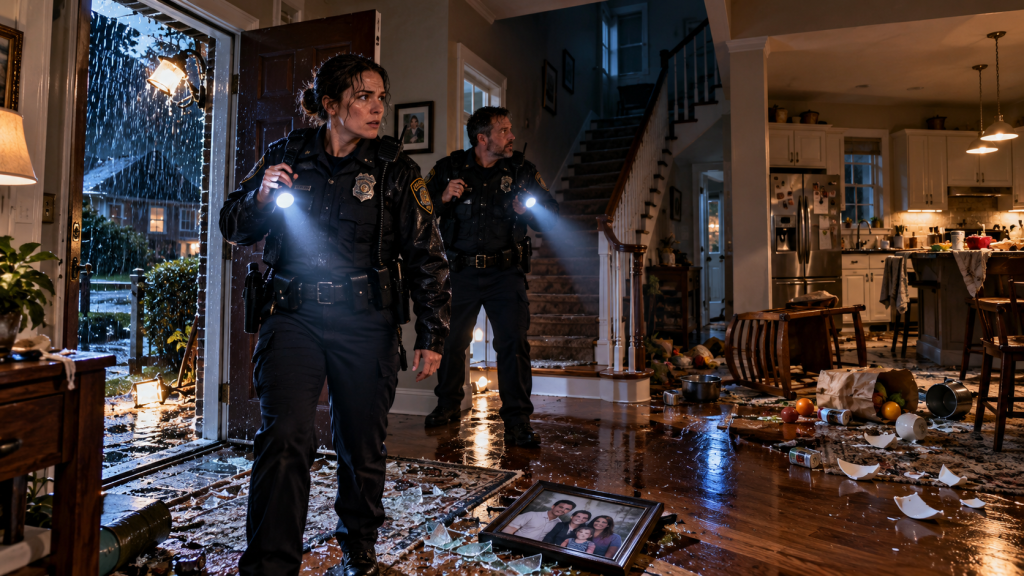
Jessica gently stopped her. “Let the medics help Mommy first.” “But she needs me.” “I know.” Chloe’s lower lip trembled. Jessica crouched until they were eye level. “Right now, the best way you can help her is by staying safe with me.”
Chloe looked at Sarah.
“Promise?”
“I promise that’s what she needs from you right now.”
Sirens grew louder outside.
David suddenly sank onto the edge of the bed.
“I didn’t mean for this to happen.”
Marcus turned.
“Don’t speak to her.”
“I’m her husband.”
“Right now, you’re being detained.”
David looked offended.
As though the handcuffs were the insult.
As though the shattered house, terrified children, and injured wife were somehow secondary.
“You don’t understand.”
Marcus secured his wrists.
“Then save it.”
Vince laughed again.
It was a thin, nervous sound.
“Man, this is crazy. We were drinking. Couples fight.”
Jessica looked at him.
“Children hide in closets during your normal evenings?”
Vince stopped smiling.
Paramedics rushed upstairs.
The hallway filled with movement.
Questions.
Equipment.
Commands.
One paramedic knelt beside Sarah.
Another checked her breathing.
Chloe tried to watch everything.
Jessica stepped slightly into her line of sight.
“Come with me.”
“No.”
“Chloe.”
“I’m not leaving Mommy.”
“You’re not leaving her. We’re going downstairs so they have room to help.”
“What if Dad gets out?”
“He won’t.”
“What if Vince gets out?”
“He won’t.”
“What if—”
Jessica held out her hand.
“You already did the hardest thing tonight.”
Chloe stared at it.
“What?”
“You called us.”
The girl’s face crumpled.
“I almost didn’t.”
“But you did.”
Chloe slowly took her hand.
Her little brother, Noah, clung to Chloe’s shirt.
Jessica led them downstairs.
When they reached the kitchen, Chloe stopped.
She stared at the dark stain on the floor.
Jessica immediately guided both children around it.
“Look at me.”
Chloe did.
“Did I do something bad?”
“No.”
“I called on Dad.”
“You called because somebody was in danger.”
“He’s going to hate me.”
Jessica felt something twist inside her chest.
“That is not something you need to carry tonight.”
“But he always says family doesn’t tell strangers our business.”
Jessica knelt again.
“When someone is hurting another person, asking for help is not betraying your family.”
Chloe’s eyes filled.
“Even if it’s your dad?”
“Even then.”
Upstairs, Marcus opened the sealed envelope.
He did it carefully.
David had reacted too strongly for it to be ignored.
Inside was a handwritten letter.
A bank deposit receipt.
A small brass key taped to an index card.
And a photograph.
Marcus studied the picture.
It showed Sarah standing beside a storage-unit door.
On the back, in Sarah’s handwriting:
IF ANYTHING HAPPENS TO ME, GIVE THIS TO CHLOE WHEN SHE IS OLD ENOUGH. THE KEY IS FOR UNIT 214. EVERYTHING IS THERE.
Marcus felt the hair rise on his arms.
He showed Jessica when she returned.
“What do you think ‘everything’ means?”
“I don’t know.”
Vince, seated against the hallway wall in handcuffs, answered before anyone asked him.
“Nothing.”
Marcus turned.
Vince immediately looked away.
Marcus crouched.
“Interesting.”
“What?”
“Nobody asked you.”
Vince’s face tightened.
“I heard you.”
“You know about unit 214?”
“No.”
“You sure?”
“Never heard of it.”
Marcus stood.
“Good.”
He looked at another officer.
“Make sure that denial gets documented.”
Vince swore under his breath.
David said nothing.
But he was staring at the photograph.
And for the first time since police arrived, he looked completely sober.
Sarah was transported to the hospital.
She was alive.
That was the only information Jessica gave Chloe at first.
Alive.
Doctors were helping her.
The children were taken somewhere safe while investigators worked through the house.
At 2:36 a.m., Marcus obtained enough information to begin the process of securing the storage unit while detectives and prosecutors handled the necessary legal steps.
By sunrise, the case had changed.
Unit 214 did not contain money.
Not primarily.
It contained records.
Years of them.
Photographs.
Copies of bank statements.
Medical paperwork.
A second phone.
A notebook in Sarah’s handwriting.
Audio files.
Messages.
And documents linking Vince to something no one expected.
David’s drinking had been destroying the family.
But Vince had been feeding the destruction for a reason.
Sarah had discovered it months earlier.
Vince had been using David.
Not merely drinking with him.
Using him.
David had once worked at a distribution warehouse.
Before being laid off, he had access to shipping schedules, inventory information, employee credentials, and loading procedures.
According to the records Sarah had gathered, Vince had repeatedly pressured David for information.
At first, David apparently believed it was harmless.
Then money appeared.
Small deposits.
Cash.
Bills suddenly paid.
After David lost his job, Vince’s visits increased.
So did the drinking.
So did the secrecy.
Sarah began documenting everything.
One notebook entry stopped Marcus cold.
DAVID ISN’T JUST DRINKING WITH VINCE. HE’S AFRAID OF HIM.
Another:
VINCE SAID IF DAVID TALKS, WE ALL GO DOWN WITH HIM.
Another:
DAVID KEEPS SAYING HE CAN FIX IT. HE CAN’T.
And then:
I FOUND THE SECOND PHONE.
The second phone contained messages that suggested stolen merchandise from warehouse shipments had been resold through a network of intermediaries.
Detectives would spend months determining who had done what.
Sarah had not known the entire operation.
But she had known enough to be terrified.
The sealed envelope was her emergency map.
The storage unit was her insurance.
And Chloe had unknowingly been living in the middle of a secret much larger than alcohol.
At 8:10 that morning, Sarah woke in the hospital.
Her first words were:
“My children?”
A nurse leaned close.
“They’re safe.”
“Chloe?”
“Safe.”
“Noah?”
“Safe.”
Sarah closed her eyes.
Tears escaped.
Then she whispered:
“David?”
“In custody.”
“Vince?”
“In custody.”
Her entire body relaxed.
Only slightly.
But enough.
When Detective Lena Ortiz entered later that morning, Sarah looked at her and said:
“You found the unit.”
It was not a question.
“Yes.”
Sarah stared at the ceiling.
“I thought he destroyed the envelope.”
“Who?”
“David.”
“Why did Chloe’s name appear on it?”
Sarah’s eyes filled.
“Because I didn’t trust myself anymore.”
Lena waited.
Sarah continued.
“Every morning he apologized.”
Her voice shook.
“Every morning I believed maybe that was the morning he meant it.”
She swallowed.
“Then by afternoon I’d be explaining another broken plate to the kids.”
Lena sat beside the bed.
“You created the storage unit as a backup?”
“Yes.”
“I kept telling myself I was collecting enough evidence to leave.”
A tear slid toward her ear.
“But really, I think I was collecting courage.”
Lena let that sentence sit.
Sarah turned toward her.
“Is Chloe angry with me?”
“No.”
“She should be.”
“She’s nine.”
“I let her see too much.”
“You survived something dangerous.”
“I should have left sooner.”
Lena’s expression remained gentle.
“Sarah, there will be time to work through what you wish had happened differently.”
Sarah began crying.
“But right now, your children are safe, you are alive, and you told the truth before someone else could erase it.”
Sarah covered her face.
“I heard Chloe calling 911.”
“You heard her?”
“I was on the floor in the hallway.”
Her breathing became uneven.
“David kept saying, ‘Give me the phone. Where’s the phone?’ He thought I had called.”
“But Chloe had.”
Sarah nodded.
“She saved us.”
Lena answered carefully.
“She asked for help.”
Sarah stared at her.
“That’s what I should have done.”
“You did.”
“When?”
“You built a record. You created the unit. You wrote the letter. You survived long enough for the truth to be found.”
Sarah looked away.
“It doesn’t feel brave.”
“It rarely does from inside the worst moment.”
Two floors away, Chloe sat at a small table eating cereal from a paper cup.
Noah slept against Jessica’s side.
Jessica had stayed longer than her shift required.
She told herself it was because investigators needed continuity.
That was only partly true.
Chloe had asked:
“Will you stay until Mommy wakes up?”
Jessica had said yes.
So she stayed.
When the doctor finally said Sarah could see Chloe briefly, Jessica walked her to the room.
At the door, Chloe froze.
Sarah looked small in the hospital bed.
Machines surrounded her.
Bandages covered injuries Chloe did not understand.
Her mother opened her eyes.
“Baby.”
Chloe ran.
A nurse caught her gently before she climbed onto the bed.
“Careful.”
Chloe stopped beside Sarah.
“I’m sorry.”
Sarah’s face broke.
“What?”
“I called the police.”
“Oh, Chloe.”
“Dad said we never call strangers.”
Sarah reached for her daughter’s hand.
“You listen to me.”
Chloe cried silently.
“You did the right thing.”
“But Dad got arrested.”
“That is not because of you.”
“Vince too.”
“Not because of you.”
“But I called.”
Sarah squeezed her fingers.
“You called because adults were doing dangerous things.”
Chloe stared at her.
“Are you mad?”
“No.”
“Dad will be.”
Sarah’s eyes changed.
For years, fear had lived behind them.
Something else appeared now.
Not strength exactly.
Strength was too simple.
Decision.
“Your father’s anger is not your responsibility.”
Chloe began sobbing.
Sarah cried with her.
“I’m so sorry you ever thought it was.”
Jessica stepped outside.
She had seen terrible things during her career.
But the sound of a child apologizing for calling for help stayed with her longer than most.
The first twist in the investigation came that afternoon.
David asked to speak with detectives.
Without Vince.
His attorney was present.
David looked nothing like the smiling man from the family portrait.
He looked hollow.
He stared at the table for almost a minute.
Then said:
“Vince was never supposed to be at the house last night.”
Detective Ortiz replied:
“Yet he was.”
“I told him I was done.”
“With what?”
David looked at his attorney.
Then back at Lena.
“Everything.”
“That’s not an answer.”
“He knew Sarah found the phone.”
“What phone?”
David closed his eyes.
“The one from the warehouse.”
“What was on it?”
“Messages.”
“Between you and Vince?”
“Yes.”
“About stolen goods?”
His attorney interrupted.
“My client is willing to discuss matters under the appropriate conditions.”
Lena leaned back.
“Then arrange the appropriate conditions.”
David’s jaw tightened.
“I need to know my kids are okay.”
Lena stared at him.
“They were hiding in a closet.”
His eyes filled.
“I know.”
“Your nine-year-old called 911 because she believed her mother might die.”
He looked down.
“I know.”
“You don’t get to use concern for them as currency.”
David flinched.
“I’m not.”
“Then tell the truth because it is the truth.”
His attorney touched his arm.
David ignored him.
“Vince started asking questions about the warehouse two years ago.”
Lena said nothing.
“At first, schedules.”
“What kind?”
“Trucks. High-value shipments. Electronics mostly.”
“And you gave him information?”
“Yes.”
“For money?”
“Sometimes.”
“How much?”
“Not much at first.”
“Then?”
“More.”
“What happened?”
“I got caught accessing information I didn’t need.”
“Is that why you were fired?”
David nodded.
Sarah had believed he was laid off.
So had everyone else.
David continued.
“They let me go quietly. They didn’t know everything.”
“Did Sarah?”
“Not then.”
“When did she learn?”
“About six months ago.”
“How?”
“She found the phone.”
“What did you do?”
David’s face collapsed.
“I lied.”
“Then?”
“She kept asking.”
“And?”
“I drank.”
Lena’s expression hardened.
“Alcohol did not answer the question.”
David swallowed.
“I got angry.”
“You hurt her.”
He looked down.
“Yes.”
“How many times?”
His voice became almost inaudible.
“I don’t know.”
Lena stared.
“You don’t know?”
“I stopped counting.”
The room went silent.
Even his attorney looked away.
David began crying.
Not dramatically.
His shoulders simply shook.
“I became somebody my kids were afraid of.”
Lena did not comfort him.
That was not her job.
He continued.
“Vince knew Sarah was collecting things.”
“How?”
“I told him.”
“Why?”
“Because I was drunk.”
“And last night?”
“He came over because he wanted the phone.”
“Did you know about the storage unit?”
“No.”
“The envelope?”
“I found it yesterday afternoon.”
Lena leaned forward.
“Where?”
“Sarah’s dresser.”
“What did you do?”
“I opened the drawer looking for the phone.”
“Did you open the envelope?”
“No. She walked in.”
“What happened?”
“We argued.”
“And Vince arrived?”
“Later.”
“Why?”
“I called him.”
His attorney sighed.
David covered his face.
“I called the man she was afraid of.”
“Why?”
“I thought if I gave him whatever Sarah had, it would finally end.”
Lena stared.
“You thought giving evidence to the person threatening your family would end the threat?”
“I wasn’t thinking.”
“No.”
Her voice was cold.
“You were choosing.”
David looked up.
The sentence hit him.
He nodded.
“Yes.”
Lena continued.
“What happened after Vince arrived?”
“He wanted Sarah to tell him where everything was.”
“And when she refused?”
David’s eyes filled.
“I yelled at her.”
“Did you hurt her?”
“Yes.”
“Did Vince?”
David looked at his attorney.
Then whispered:
“Yes.”
The interview continued for hours.
By evening, investigators understood the broad shape of the truth.
But another question remained.
Why had Sarah addressed the envelope to Chloe instead of a trusted adult?
Sarah answered the next morning.
“Because I didn’t know who to trust.”
Detective Ortiz sat beside her again.
“Not neighbors?”
“David knew them.”
“Family?”
“My sister lives in Arizona. David told her for years that I was unstable.”
Lena paused.
“Did he?”
Sarah nodded.
“Whenever I tried to tell anyone something was wrong, he got there first.”
That pattern was familiar.
“He’d say I was depressed.”
“Were you?”
“Yes.”
Sarah almost laughed.
“But he used it to make everything I said sound unreliable.”
“What about Chloe?”
Sarah stared toward the window.
“Chloe knew.”
“She saw?”
“Too much.”
Her voice broke.
“I hated that she knew.”
“So the envelope?”
“I thought if something happened to me, nobody could convince Chloe she imagined it.”
Lena swallowed.
“She knew where to find the envelope?”
“No.”
“Then why her name?”
“Because I wanted whoever found it to understand the truth belonged to her too.”
Sarah wiped tears away.
“Not the burden. The truth.”
That distinction would matter later.
At first, Chloe wanted every detail.
“What was in the bag?”
“Why did Dad lie?”
“What did Vince want?”
“Why did Mommy hide things?”
The child psychologist assigned to the family advised everyone to answer honestly but carefully.
No graphic details.
No adult burdens.
No making Chloe responsible for understanding crimes committed by adults.
So Sarah told her:
“Dad made dangerous choices.”
“Because he drank?”
“Drinking made things worse, but drinking did not make the choices for him.”
“Is he bad?”
Sarah struggled.
Children want categories.
Good.
Bad.
Safe.
Dangerous.
Adults want them too.
Finally she said:
“Your dad has done things that were wrong and frightening.”
“Does he love me?”
Sarah’s eyes filled.
“I believe he does.”
“Then why did he scare us?”
Sarah took a long breath.
“Because loving someone does not automatically make a person safe.”
Chloe stared at her.
That answer was painful.
But true.
“Can somebody love you and still hurt you?”
“Yes.”
“Then what does love do?”
Sarah looked at her daughter.
“Real love has to take responsibility.”
Chloe was quiet.
“Is Dad?”
“I don’t know yet.”
The legal process moved slowly.
Much more slowly than television.
There was no single dramatic courtroom day where everything became clear.
There were interviews.
Hearings.
Evidence reviews.
Attorneys.
Medical records.
Child-protection assessments.
Investigators tracing money and communications.
David faced serious consequences related to the violence in the home and his involvement in the theft scheme.
Vince faced his own charges.
The exact outcomes took time.
What happened quickly was simpler.
David was not allowed to return home.
Neither was Vince.
Sarah and the children stayed elsewhere while locks were changed and safety plans were created.
The first night in temporary housing, Chloe could not sleep.
Every sound made her sit up.
A car door.
Pipes.
Someone walking in the apartment above them.
At 2:13 a.m., Sarah found her sitting beside Noah’s bed.
“What are you doing?”
“Watching.”
“For what?”
“In case someone comes.”
Sarah sat beside her.
“No one is coming.”
“You don’t know.”
The words hurt.
Because Chloe was right.
For years, adults had promised safety they could not guarantee.
Sarah did not say, “I promise.”
Instead:
“The door is locked.”
Chloe looked at her.
“The police know where we are.”
Silence.
“My phone is charged.”
Chloe listened.
“And if you get scared, you wake me.”
“What if you’re sleeping?”
“Wake me.”
“What if you’re tired?”
“Wake me.”
“What if—”
“Chloe.”
Sarah took her hand.
“You are nine.”
Tears filled Chloe’s eyes.
“You don’t have to stay awake so I can sleep.”
That was the first night Chloe cried like a child instead of speaking like a frightened adult.
She crawled into Sarah’s arms.
“I thought you were dead.”
Sarah held her.
“I know.”
“I thought Dad killed you.”
“I know.”
“I couldn’t get Noah to stop crying.”
“I know.”
“I put a blanket over us.”
“You kept him close.”
“I told him we were playing hide-and-seek.”
Sarah closed her eyes.
“Oh, baby.”
“I lied.”
“No.”
Sarah kissed her hair.
“You protected him the only way you knew how.”
Chloe sobbed.
“I don’t want to protect anybody anymore.”
Sarah cried too.
“Then don’t.”
For the first time in months, Chloe slept until morning.
Sarah did not.
But that was okay.
Healing did not arrive evenly.
Three weeks later, Officer Jessica Hayes visited.
Not officially.
She brought a stuffed fox for Noah and a sketchbook for Chloe.
Chloe opened the door and stared.
“You came back.”
“I said I would.”
“Police say things sometimes.”
Jessica smiled sadly.
“So do adults.”
Chloe hugged her.
Jessica froze for half a second.
Then hugged back.
Sarah watched from the kitchen.
“Coffee?”
“Please.”
They sat.
The apartment was small.
Safe.
That made it beautiful.
Chloe drew while the adults talked.
At one point, she looked up.
“Officer Hayes?”
“Yes?”
“Were you scared that night?”
Jessica considered lying.
Police officers are supposed to be brave in children’s minds.
But Chloe had heard enough polished lies.
“Yes.”
Chloe stopped drawing.
“You were?”
“Yes.”
“But you had a gun.”
“Having equipment doesn’t mean you stop feeling fear.”
“Then how did you go upstairs?”
Jessica smiled.
“Being brave doesn’t mean you aren’t scared.”
Chloe rolled her eyes.
“My teacher says that.”
“Your teacher is stealing my material.”
Chloe giggled.
Jessica continued.
“It means you know something is important enough to do while you’re scared.”
Chloe looked at her drawing.
“Like calling 911?”
“Exactly.”
Chloe smiled.
Sarah looked away before anyone saw her cry.
Months passed.
The investigation into Vince widened.
The warehouse theft operation involved more people than David had initially admitted.
David eventually cooperated.
Not heroically.
Not enough to erase what he had done.
But fully enough that investigators recovered stolen property and identified others involved.
He also entered treatment for alcohol dependence.
Sarah heard this through attorneys.
She did not visit.
Chloe asked once.
“Is Dad getting better?”
Sarah answered:
“He is getting help.”
“Does that mean he comes home?”
“No.”
“Ever?”
“I don’t know.”
Chloe nodded.
She was learning that recovery did not automatically restore access.
That consequences and compassion could exist in the same room.
David wrote letters.
At first, Sarah kept them.
Then, with professional guidance, some were shared with Chloe when appropriate.
The first letter began:
Dear Chloe,
I have written this sentence seventeen times because every version sounded like I was trying to explain what cannot be explained.
You called 911 because I made our home unsafe.
You did the right thing.
I did not.
Chloe stopped reading.
She looked at Sarah.
“Did he write that?”
“Yes.”
“He says I did the right thing.”
“Yes.”
She returned to the letter.
I want to tell you I was sick, drunk, afraid, angry, and being pressured by Vince. All of those things are true.
None of them make what I did your fault.
None of them make what I did to your mother acceptable.
I am sorry.
Chloe folded the letter.
“Do I have to forgive him?”
“No.”
“Will you?”
Sarah thought.
“I don’t know.”
“What if he gets sad?”
“His feelings are not your job.”
Chloe nodded.
That sentence became a family rule.
His feelings are not your job.
Mom’s feelings are not your job.
Noah’s feelings are not your job.
You can care.
You can help.
But you are not responsible for carrying everybody.
Sarah needed that rule too.
For years, she had lived according to the opposite.
David’s job loss became her responsibility.
His drinking became her responsibility.
His shame.
His anger.
His promises.
His hangovers.
His fear of Vince.
His debt.
His secrets.
She had carried all of it until she could barely recognize herself beneath the weight.
Therapy forced her to ask an uncomfortable question.
Why had she stayed?
Not in the accusing way strangers ask.
Why didn’t you just leave?
But in the deeper way.
What kept you hoping?
The answers were complicated.
Love.
Fear.
Money.
Children.
Isolation.
Embarrassment.
Memories of who David had once been.
The belief that the man who hung Christmas lights could return if she endured the man who broke plates.
The fear that leaving would provoke something worse.
The fear that nobody would believe her.
And perhaps most painfully:
The belief that protecting her children meant keeping the family together.
One afternoon, her therapist asked:
“What do you think protecting them means now?”
Sarah looked through the office window.
“Teaching them home shouldn’t feel like a place you survive.”
That became her work.
Not creating a perfect childhood.
That was impossible.
Creating a truthful one.
When Chloe had nightmares, they talked.
When Noah began screaming whenever he heard a bottle fall, they did not call him dramatic.
When Sarah herself panicked at the smell of beer in a restaurant, she did not hide in the bathroom and pretend she had a headache.
She said:
“That smell scared me. I need a minute.”
Truth became ordinary.
That was how the family rebuilt.
Not through one grand revelation.
Through hundreds of small honest moments.
Six months after the 911 call, Sarah returned to the house.
Only briefly.
She had decided to sell it.
Chloe came with her.
Noah stayed with Sarah’s sister, who had flown from Arizona and become part of their support system.
The porch light had been replaced.
The broken glass was gone.
The walls were repaired.
The family portrait no longer hung in the hallway.
Sarah had packed it away.
Chloe stood where it used to be.
“Are we taking it?”
“The picture?”
“Yes.”
“Do you want it?”
Chloe shrugged.
“Dad looks nice in it.”
“He was happy that day.”
“Was it fake?”
Sarah stopped.
“No.”
Chloe looked surprised.
“Really?”
“People can have real happy moments and still have serious problems.”
“So he wasn’t pretending?”
“Not every time.”
Chloe studied the photograph.
“That makes it harder.”
Sarah felt tears rise.
“Yes.”
Because monsters are easy to leave in stories.
Real people are harder.
Real people make pancakes.
Fix bicycles.
Tell jokes.
Hang Christmas lights.
Then sometimes they do things that destroy trust.
The good memories do not cancel the harm.
The harm does not necessarily make every old smile fake.
Both truths can exist.
Chloe put the photograph into a box.
“Maybe I want it when I’m older.”
“Okay.”
They went upstairs.
At the end of the hallway, Chloe stopped outside the closet.
The closet.
Sarah’s heart tightened.
“You don’t have to go in.”
“I know.”
Chloe opened the door.
Empty.
Ordinary.
Just a closet.
She stepped inside.
Sarah remained outside.
Chloe touched the wall.
“I was right here.”
Sarah couldn’t speak.
“Noah was there.”
She pointed.
“I had the phone.”
Sarah covered her mouth.
Chloe turned.
“Mom?”
“Yes?”
“Why didn’t you call before?”
There it was.
The question Sarah had feared.
She could have defended herself.
She could have said she tried.
She could have explained fear and money and threats.
All true.
Instead she began with what Chloe deserved.
“I should have asked for help sooner.”
Chloe looked at her.
“I was scared.”
“Of Dad?”
“Yes.”
“Of Vince?”
“Yes.”
“Of being alone?”
Sarah’s eyes filled.
“Yes.”
Chloe nodded.
“I was scared too.”
“I know.”
“But I called.”
Sarah cried.
“Yes.”
Chloe stepped out of the closet.
Then took her mother’s hand.
“You can call next time.”
Sarah laughed through tears.
“There will never be a next time like that.”
“You don’t know.”
Again, the child refused false promises.
Sarah nodded.
“You’re right.”
She squeezed her hand.
“If I ever feel unsafe again, I will ask for help.”
“Before it gets really bad?”
“Yes.”
“Promise?”
This time Sarah could promise the action, even if she could not promise the world.
“I promise.”
Chloe closed the closet door.
They left the house together.
The trial-related proceedings stretched beyond a year.
Eventually, David accepted responsibility through the legal process rather than forcing Sarah and Chloe through every possible contested step.
Vince did not.
He fought.
Denied.
Minimized.
Blamed David.
Blamed alcohol.
Blamed Sarah for “collecting things out of context.”
But the storage unit existed.
The phone existed.
The messages existed.
The financial trail existed.
And David’s cooperation corroborated significant parts of the case.
The most important thing for Sarah was that she did not have to convince herself anymore.
For years, every morning began with uncertainty.
Was last night really that bad?
Did I provoke him?
Was Vince joking?
Am I exaggerating?
Maybe David is right.
Maybe I’m unstable.
Maybe the bruise looks worse than it is.
Maybe the children didn’t hear.
Maybe tomorrow will be different.
The evidence ended the maybes.
That was why she had collected it.
Not only for police.
For herself.
One afternoon, Detective Ortiz returned Sarah’s notebook after the case reached a stage where it could be released.
Sarah held it.
“I don’t want this.”
“You don’t have to keep it.”
“I spent months hiding it.”
“You can destroy your copy if your attorney confirms it’s no longer needed.”
Sarah stared at the pages.
“I thought this would save me.”
“Did it?”
Sarah looked toward Chloe, who was outside playing.
“No.”
She smiled faintly.
“My daughter did.”
Lena shook her head gently.
“Be careful with that.”
Sarah frowned.
“What?”
“Chloe called for help. That was brave.”
“Yes.”
“But she is not responsible for saving the family.”
Sarah went still.
Lena continued.
“Children who survive frightening homes sometimes build their identity around being the protector.”
Sarah looked through the window.
Chloe was helping Noah tie his shoe.
“She does that.”
“Let her be nine.”
Sarah’s eyes filled.
That evening, Sarah sat beside Chloe.
“I need to tell you something.”
“Am I in trouble?”
“No.”
“Then why do adults always say it like that?”
Sarah laughed.
“Fair.”
She tried again.
“I’ve been saying you saved us.”
Chloe looked pleased.
“You did something incredibly brave.”
“I called 911.”
“Yes.”
“But it was never supposed to be your job to save us.”
Chloe frowned.
“What do you mean?”
“I mean I am your mother.”
Sarah touched her chest.
“Adults are responsible for keeping children safe.”
“But you were hurt.”
“Yes.”
“So I helped.”
“You did.”
“Then what’s wrong?”
“Nothing.”
Sarah smiled.
“I just don’t want you thinking that if something bad happens someday, it’s because you failed to stop it.”
Chloe thought.
“So I’m not the family police?”
Sarah laughed.
“No.”
“Good.”
“Why good?”
“Because Noah is annoying.”
From the other room, Noah shouted:
“I HEARD THAT!”
For a second, Sarah stared.
Then all three began laughing.
It was the loudest laughter their new apartment had heard.
A year and a half after the call, Sarah moved with the children into a small blue house.
Nothing fancy.
Two bedrooms upstairs.
A tiny backyard.
A maple tree.
The first thing Chloe asked:
“Does Dad know where we live?”
Sarah answered honestly.
“Not right now.”
Chloe nodded.
“Good.”
Then:
“Can we have Christmas lights?”
Sarah’s heart tightened.
David had always done the lights.
She almost said no.
Instead:
“Absolutely.”
They were terrible at it.
Sarah climbed the ladder.
Chloe held it.
Noah tangled himself in a strand.
Half the lights did not work.
The line across the gutter sagged dramatically in the middle.
Their neighbor came outside.
“Need help?”
Sarah almost automatically said no.
Then stopped.
“Yes.”
The neighbor smiled.
“Be right over.”
That small answer felt enormous.
Yes.
Help.
Please.
Words Sarah had once treated like admissions of failure.
Now they were tools.
By sunset, the house glowed.
Unevenly.
Beautifully.
Chloe stood on the sidewalk.
“Dad’s were straighter.”
Sarah laughed.
“Rude.”
“They were.”
“They absolutely were.”
Noah shouted:
“Ours are better!”
“Why?”
“They’re BLUE!”
There was no logic.
Only joy.
Sarah took a photograph.
Not to prove anything.
Not for evidence.
Just because she wanted to remember.
Two years after the call, Chloe was eleven.
Officer Hayes attended her school’s community-safety day.
Chloe saw her across the gym and ran.
Jessica barely had time to brace herself.
“You got tall.”
“You got old.”
Jessica gasped.
“Arrest this child.”
Chloe laughed.
Then grew serious.
“Do you remember me?”
Jessica stared at her.
“Of course.”
“Do you remember that night?”
“Yes.”
“Do you remember what I said?”
Jessica paused.
“Some of it.”
“I don’t.”
“That can happen.”
“I remember the closet.”
Jessica nodded.
“I remember the rain.”
“Yes.”
“I remember your hand.”
Jessica swallowed.
Chloe looked embarrassed.
“Is that weird?”
“No.”
“I couldn’t remember your face for a while.”
“That’s okay.”
“But I remembered your hand.”
Jessica’s eyes filled.
“You held it all the way downstairs.”
Chloe nodded.
Then whispered:
“Thank you for coming fast.”
Jessica crouched despite her knees complaining.
“Thank you for telling us where you were.”
Chloe hugged her.
This time Jessica did not freeze.
She hugged back immediately.
At thirteen, Chloe read the envelope Sarah had written years earlier.
Not because she had to.
Because she asked.
Sarah sat beside her.
The original note was simple.
My Chloe,
If you are reading this because I cannot explain it myself, I am sorry.
None of what happened in this house was your fault.
There are things adults did that you were never supposed to carry.
The key leads to records I kept because I was afraid the truth would disappear if I did.
You do not owe anyone silence.
Not me.
Not your father.
Not family.
Truth does not destroy a safe family.
What destroys families is making children live inside lies.
I love you more than I have known how to prove.
Mom.
Chloe read it twice.
Then looked at Sarah.
“You wrote this before I called?”
“Yes.”
“Did you think you were going to die?”
Sarah’s throat tightened.
“Sometimes I was afraid I might.”
Chloe looked down.
“Why didn’t you put Noah’s name?”
“You were older.”
“That’s not fair.”
“No.”
Sarah smiled sadly.
“It wasn’t.”
Chloe handed the letter back.
“Can I keep it someday?”
“Yes.”
“But not now.”
“Okay.”
“I don’t want my room to feel like evidence.”
Sarah’s eyes filled.
“That might be the healthiest sentence anyone in this family has ever said.”
Chloe rolled her eyes.
“Mom.”
“Sorry.”
At fourteen, Chloe stopped asking whether David loved her.
She started asking whether she wanted contact with him.
Those were different questions.
By then, David had spent years in treatment and had complied with the legal restrictions around contact.
He sent appropriate letters through approved channels.
Never blaming Chloe.
Never asking her to keep secrets.
Never asking Sarah to take him back.
That mattered.
It did not erase anything.
Chloe eventually chose a supervised meeting.
Sarah did not attend.
A therapist did.
Before Chloe entered, she asked:
“What if I hate him?”
The therapist answered:
“Then you notice that feeling.”
“What if I love him?”
“Then you notice that too.”
“What if both?”
“That is allowed.”
David entered.
He had aged.
Chloe knew him immediately.
He stopped several feet away.
“Hi, Chloe.”
She stared.
“Hi.”
He looked like he wanted to hug her.
He didn’t ask.
Good.
They sat.
David’s hands trembled.
“You look like your mom.”
“Everyone says that.”
“You have my ears.”
Chloe almost smiled.
“Unfortunately.”
He laughed once.
Then cried.
Chloe watched him.
“I don’t know what I’m supposed to say.”
“You don’t owe me anything.”
She studied him.
“Mom says that.”
“She’s right.”
“Do you remember the night?”
David looked down.
“Yes.”
“All of it?”
“No.”
“Because you were drunk?”
“Yes.”
Chloe’s jaw tightened.
“I remember.”
David closed his eyes.
“I know.”
“No, you don’t.”
He looked at her.
“I remember Noah crying.”
Tears filled her eyes.
“I remember Mom making that sound upstairs.”
David began crying.
“I remember you walking in the hallway.”
He covered his mouth.
“I remember thinking if you found me, you’d be mad I called.”
David bent forward.
“I’m sorry.”
“Stop.”
He froze.
“Don’t say sorry every time I say something.”
He nodded.
“Okay.”
“I want you to hear it.”
“I will.”
So Chloe told him.
Not everything.
Only what she wanted.
The closet.
The blanket.
The operator’s voice.
The rain.
Officer Hayes’s hand.
The hospital.
The nightmares.
David listened.
No excuses.
When she finished, she asked:
“Why?”
He took a long time.
“Because I made selfish, dangerous choices.”
“That sounds like therapy.”
A tiny smile.
“It probably is.”
“I mean why didn’t you stop?”
David looked at his hands.
“Because every time I crossed a line, I told myself the next line would be the one I wouldn’t cross.”
Chloe listened.
“Then I crossed that one too.”
Silence.
“Eventually I became more afraid of facing what I had done than I was afraid of doing worse.”
Chloe’s expression changed.
That answer sounded real.
Not good.
Not comforting.
Real.
“And Vince?”
“I was afraid of him.”
“You were bigger than him.”
“Fear isn’t always about size.”
Chloe nodded.
She knew.
“Did he make you hurt Mom?”
David’s face twisted.
“No.”
Chloe stared.
“No?”
“No.”
His voice shook.
“He pressured me. Threatened me. Used me. But what I did to your mother was my responsibility.”
Chloe looked down.
That answer mattered too.
At the end of the hour, David asked:
“Can I see you again?”
Chloe thought.
“I don’t know.”
“Okay.”
“You won’t get mad?”
“No.”
“You used to.”
“I know.”
“I’ll decide later.”
“Okay.”
She stood.
David remained seated.
Chloe walked to the door.
Then turned.
“Dad?”
His face lifted.
“I don’t forgive you yet.”
He swallowed.
“You don’t have to.”
“But I don’t hate you every day anymore.”
David cried.
Chloe left before he could answer.
Outside, Sarah waited in the car.
Chloe got in.
“Well?”
Sarah asked.
Chloe stared through the windshield.
“He looks old.”
Sarah laughed unexpectedly.
Chloe laughed too.
Then cried.
Sarah held her.
“Do you want to talk?”
“Not yet.”
“Okay.”
“Can we get fries?”
“Yes.”
“Large.”
“Obviously.”
They drove away.
No dramatic reconciliation.
No restored family portrait.
Just fries.
Sometimes healing looks disappointingly ordinary.
That is often how you know it is real.
Years passed.
Noah remembered almost nothing from the night itself.
His body remembered more than his mind.
For years, shouting made him freeze.
Breaking glass made him cry.
But with support, those reactions softened.
At ten, he knew the broad truth.
Dad hurt Mom.
Dad made unsafe choices.
Police came.
Chloe called.
Nobody told him she had “saved” him.
They told him:
“She stayed with you because she loved you.”
That was enough.
Sarah rebuilt her career.
Before everything collapsed, she had worked part-time in medical billing.
Afterward, she returned full-time.
Then trained for a supervisory position.
The first time she received a promotion, she sat in her car and cried.
Not because of the money.
Because her new office had a door.
A door she could close because she chose privacy.
Not because she was hiding.
There is a difference between a locked door used for fear and one used for peace.
She bought herself flowers.
No occasion.
Yellow tulips.
Chloe asked:
“Who sent those?”
“I did.”
“To yourself?”
“Yes.”
“That’s weird.”
“Wait until adulthood.”
Chloe laughed.
Sarah placed them beside the window.
For years, she had waited for apologies to become flowers.
Now she bought her own.
David’s legal consequences lasted years.
His cooperation did not erase his responsibility.
His treatment did not erase it.
His remorse did not erase it.
But those things mattered in a different way.
They determined who he became after consequences began.
He stayed sober.
Then one year.
Then two.
Then five.
He worked when permitted.
Paid required obligations.
Followed contact restrictions.
He stopped asking Sarah for forgiveness.
That was one of the first signs she believed his remorse might be real.
People who are truly sorry eventually understand forgiveness is not an invoice they can send the person they hurt.
Sarah never reconciled romantically with him.
She eventually divorced him.
The day the divorce became final, she did not celebrate.
She went home.
Made spaghetti.
Helped Noah with homework.
Watched a movie with Chloe.
Then, after the children slept, she stood in the kitchen.
The refrigerator hummed.
Rain tapped the windows.
For a moment, she remembered another rainy night.
11:47 p.m.
A phone.
A closet.
Sirens.
She put both hands on the counter.
And whispered:
“We made it.”
Not I.
We.
But she corrected herself.
“No.”
She smiled through tears.
“We’re making it.”
Because survival was not a finish line either.
At seventeen, Chloe decided she wanted to volunteer with a youth crisis organization.
Sarah panicked.
“Why?”
“Because I want to.”
“Are you sure this isn’t because of what happened?”
“Of course it is.”
Sarah stared.
Chloe continued.
“Everything we do comes from somewhere.”
“I don’t want you spending your life trying to rescue people.”
“Neither do I.”
“Then why?”
“Because someone answered the phone.”
Sarah went quiet.
Chloe smiled.
“That dispatcher didn’t know me.”
“No.”
“She stayed.”
“Yes.”
“Officer Hayes didn’t know me.”
“No.”
“She came.”
“Yes.”
“I want to be one person who comes.”
Sarah cried.
“You’re going to make me ruin my mascara.”
“You’re not wearing mascara.”
“Emotionally, I am.”
Chloe laughed.
She volunteered.
Carefully.
With training.
Boundaries.
Supervision.
She did not become everybody’s rescuer.
She became someone who knew how to listen.
At eighteen, she graduated high school.
Officer Hayes attended.
So did Detective Ortiz.
Sarah sat in the front row with Noah.
David attended under circumstances Chloe had chosen.
He sat farther back.
When Chloe crossed the stage, everyone stood.
Sarah cried.
Noah shouted.
Jessica clapped.
David remained standing long after everyone sat.
Afterward, Chloe took photographs.
One with Mom.
One with Noah.
One with Jessica.
One with Detective Ortiz.
Then she approached David.
“Want one?”
He looked shocked.
“Are you sure?”
“Yes.”
They stood side by side.
Not touching.
The camera clicked.
Chloe looked at the photograph.
It did not look like the old family portrait.
Good.
She did not want a replacement.
She wanted truth.
Later, Sarah asked:
“Why did you take one with him?”
Chloe shrugged.
“Because he was there.”
Sarah nodded.
That was enough.
No symbolism required.
At twenty-one, Chloe finally took the original envelope from Sarah.
The paper had yellowed slightly.
The brass key no longer opened anything.
Unit 214 had been emptied years earlier.
The evidence had done its job.
Chloe sat at Sarah’s kitchen table.
“Do you still want this?”
Sarah asked.
Chloe looked at her name.
Her mother’s handwriting.
She thought about the little girl in the closet.
For years, adults had praised her courage.
She appreciated it.
But she also felt sad for that child.
Nine years old.
Bare feet.
Phone trembling in both hands.
Trying to whisper an address while her brother cried.
That child had been brave because she had no better option.
Adult Chloe wished she could reach backward and tell her:
You were never supposed to be this brave tonight.
She opened the envelope.
The old photograph remained.
The deposit slip.
Copies of the letter.
She removed the brass key.
Held it in her palm.
Then said:
“I don’t want to keep all of it.”
Sarah nodded.
“What do you want?”
“The letter.”
“Okay.”
“The photograph maybe.”
“Okay.”
“The key?”
Chloe looked at it.
“No.”
Sarah smiled.
“What should we do with it?”
Chloe thought.
“Throw it away.”
Sarah raised an eyebrow.
“Really?”
“Yes.”
“So dramatic.”
“Mom.”
Sarah laughed.
Chloe walked to the trash.
Then stopped.
For years, the key had symbolized everything.
Evidence.
Fear.
Secrets.
The hidden truth.
She expected throwing it away to feel profound.
It didn’t.
It made a tiny metallic sound against the bottom of the bin.
Clink.
That was all.
Chloe stared.
Then laughed.
Sarah joined her.
“What?”
“I thought it would feel bigger.”
“Most endings don’t.”
Chloe looked at her mother.
“Maybe that’s good.”
“Yes.”
It was.
That evening, they sat on the porch of the little blue house.
Noah was away at a friend’s.
Christmas lights glowed along the gutter.
Still crooked.
They had kept the tradition.
Sarah handed Chloe tea.
“Do you remember the old house?”
“Some parts.”
“The porch?”
“Yes.”
“The family picture?”
“Yes.”
“Do you remember your dad sweeping the driveway?”
Chloe smiled.
“Yeah.”
Sarah looked surprised.
“He used to let me draw with chalk while he did it.”
“I forgot that.”
“I didn’t.”
They sat quietly.
Then Chloe said:
“Mom?”
“Yes?”
“Do you regret him?”
Sarah looked at her daughter.
“What do you mean?”
“Dad.”
Sarah considered.
“I regret what he did.”
“That isn’t what I asked.”
“I know.”
She looked toward the lights.
“If I say I regret everything, then I have to regret every good day too.”
Chloe listened.
“And you and Noah came from that life.”
Sarah smiled.
“I could never regret you.”
“So?”
“So I don’t need one sentence that explains twenty years.”
Chloe nodded.
“I like that.”
“Life is annoyingly complicated.”
“Very.”
A car passed.
Rain began lightly.
Chloe noticed it.
For years, rain at night made her uneasy.
Now she listened.
Nothing more.
Just rain.
She smiled.
Sarah noticed.
“What?”
“Nothing.”
Chloe leaned back.
“It’s just rain.”
Sarah understood.
She reached over.
Took her daughter’s hand.
Years earlier, the storm had sounded like the end of the world.
Now it sounded like weather.
That was healing too.
Not forgetting the storm.
Learning that not every cloud meant the door was about to break open.
Jessica Hayes retired when Chloe was twenty-four.
At the retirement reception, Chloe arrived carrying a small wrapped box.
Jessica saw her.
“No.”
“What?”
“You are not allowed to make me emotional at my own retirement.”
“Too late.”
Jessica hugged her.
Inside the box was a framed drawing.
A child’s drawing.
Two stick figures.
One small.
One tall.
Holding hands under blue rain.
Jessica stared.
“Did you draw this?”
“When I was ten.”
Her eyes filled.
“I found it in Mom’s things.”
At the bottom, in childish handwriting:
THE POLICE LADY CAME.
Jessica covered her mouth.
Chloe smiled.
“I thought you should have it.”
Jessica hugged her again.
“I kept thinking about you.”
“I know.”
“How?”
“Mom told me you checked in.”
“I wondered whether staying that night mattered.”
Chloe pulled back.
“You held my hand.”
Jessica cried.
“So yes.”
Later, Jessica placed the drawing in her home office.
Not because it represented a perfect rescue.
There had been nothing perfect about that night.
Because it reminded her why arriving mattered.
Sometimes officers arrive after the worst thing has already begun.
Sometimes they cannot undo it.
But arrival can still divide a life into before and after.
At twenty-seven, Chloe worked in pediatric social services.
She had chosen a career adjacent to crisis work, but not because anyone expected it.
She was good at it.
She also painted.
Badly.
Traveled.
Laughed too loudly.
Had friends who knew almost nothing about the 911 call until she chose to tell them.
She was not “the brave little girl” every day.
She was Chloe.
That mattered most.
One evening, a frightened child sat across from her at work.
Different family.
Different story.
The girl whispered:
“Am I bad for telling?”
Chloe felt time fold.
Closet.
Rain.
Phone.
Dad will hate me.
She did not tell the child her own story.
The moment belonged to the girl.
Instead Chloe said:
“No.”
The child stared.
“You asked for help because something felt unsafe.”
“What if everybody gets mad?”
“Adults are responsible for their own choices.”
The girl cried.
Chloe handed her a tissue.
“You don’t have to carry what they chose.”
After work, Chloe sat in her car.
She cried for nine-year-old herself.
Not because she was still trapped there.
Because she wasn’t.
She called Sarah.
“Hey.”
“Everything okay?”
“Yes.”
“Long day?”
“Yes.”
“Come over.”
“I’m tired.”
“I have peach cobbler.”
“You don’t know how to make peach cobbler.”
“I bought peach cobbler.”
“More believable.”
Chloe drove over.
No emergency.
No storm.
No police.
Just dessert.
Sarah had gray in her hair.
Noah was in college.
David lived elsewhere and had a careful, limited relationship with both children according to what each chose.
Vince was no longer part of their lives except in old legal files and memories that surfaced less often with time.
The black duffel bag was gone.
Unit 214 was gone.
The old house belonged to another family.
The closet probably held winter coats now.
That thought comforted Chloe.
She hoped some child complained about cleaning it.
She hoped nobody ever hid there.
After dessert, Sarah brought out the old family portrait.
“Why do you still have that?”
“I told you. Complicated life.”
Chloe smiled.
They looked at it.
Sarah smiling.
Little Chloe hugging Noah.
David’s hand on everyone’s shoulder.
A photograph taken before everything was known.
Chloe touched the glass.
“We look happy.”
“We were happy that afternoon.”
“That’s still weird.”
“Yes.”
Chloe looked at David’s face.
For years, she had wanted to know which version was real.
The father in the photograph?
Or the man in handcuffs?
Eventually she understood the answer.
Both.
That was what made accountability necessary.
People do not become innocent because they once loved you.
They do not become incapable of change because they once failed you.
But change does not rewrite what happened.
Truth can hold more than one thing.
Chloe put the photograph down.
“I don’t need this.”
Sarah nodded.
“I think I finally don’t either.”
“What should we do?”
“Box?”
“Box.”
No dramatic burning.
No smashing glass.
They placed it in a box.
Then Sarah pulled out her phone.
“Come here.”
“Why?”
“Picture.”
“Mom.”
“Come on.”
Chloe sat beside her.
Sarah held the phone out.
They smiled.
Click.
No David.
No staged perfection.
No need to prove anything.
Just mother and daughter after dessert.
Sarah looked at the photograph.
“Oh, that’s terrible.”
“You blinked.”
“You made me laugh.”
“Delete it.”
“No.”
“Mom.”
“Absolutely not.”
Chloe laughed.
Sarah saved it.
A new family picture.
Imperfect.
True.
That night, Chloe drove home through rain.
At a red light, she remembered the dispatcher’s voice.
Honey, what’s your name?
Chloe.
Where are you right now?
In the closet.
For years, that recording existed somewhere in case files.
Chloe had been offered an opportunity to hear it as an adult.
She declined.
She did not need to hear herself terrified to believe it happened.
That was another kind of freedom.
She knew the truth without reopening every wound.
When she reached home, she stood under the awning.
Rain ran down the street.
She looked up.
At nine, rain had sounded like danger.
At twenty-seven, it smelled clean.
She went inside.
Locked the door.
Not from panic.
From habit.
Made tea.
Changed into pajamas.
Her phone buzzed.
Mom:
YOU LEFT YOUR UMBRELLA.
Chloe smiled.
She replied:
KEEP IT.
Mom:
YOU OWN THREE UMBRELLAS AND SOMEHOW HAVE ZERO WHEN IT RAINS.
Chloe:
TRAUMA MADE ME BAD AT WEATHER PREPARATION.
Mom:
THERAPIST WOULD HATE THAT EXCUSE.
Chloe laughed.
Then Sarah sent the terrible photograph from the couch.
Both of them mid-laugh.
Blurry.
Warm.
Alive.
Chloe stared at it.
She saved it.
Years earlier, the family portrait on the hallway wall had shown four people looking perfect while fear quietly grew behind closed doors.
This picture showed two women laughing badly after store-bought cobbler.
She preferred this one.
Because nobody had been instructed to smile.
She set the phone down.
Outside, thunder rolled.
Chloe paused.
Her body noticed.
Then released.
She whispered:
“Just weather.”
And continued making tea.
There had been a time when she believed courage was hiding her brother beneath a blanket while whispering to 911.
That was courage.
But it was not the only kind.
Courage was Sarah admitting she needed help.
Courage was telling the truth in a hospital bed.
Courage was selling the house.
Courage was David admitting Vince had not made his choices for him.
Courage was Chloe meeting her father years later and saying:
I don’t forgive you yet.
Courage was asking for boundaries.
Keeping them.
Changing them when she chose.
Courage was allowing ordinary life to become ordinary again.
And perhaps the greatest victory was that eventually Chloe stopped needing to be courageous every minute.
She could simply be tired.
Funny.
Annoyed.
Late.
Happy.
Wrong.
In love.
Confused.
Human.
The nine-year-old in the closet had believed her job was to keep everyone alive until help arrived.
The woman she became understood something different.
Children should not have jobs like that.
Adults must build homes where courage is used for climbing trees, trying out for teams, making friends, admitting mistakes, and dreaming too big.
Not surviving the people who are supposed to protect them.
Years later, Sarah asked Chloe whether she remembered what she said before hanging up with 911.
Chloe shook her head.
Sarah did.
The dispatcher had told her:
“Officers are almost there.”
Chloe had whispered:
“Please tell them not to leave without my mom.”
Sarah never forgot that.
Neither did Jessica when she later read the transcript.
Not:
Don’t leave without me.
My mom.
Even terrified, Chloe was thinking about someone else.
For years, Sarah carried guilt about that.
Eventually, she transformed it into a promise.
Her daughter would never again need to beg adults not to leave her mother behind.
Sarah chose safety.
Again.
And again.
And again.
Until safety stopped feeling like a decision and became the ordinary shape of their lives.
On Sarah’s sixtieth birthday, both children came home.
Noah brought his girlfriend.
Chloe brought cake.
Jessica came.
Detective Ortiz sent flowers.
The little blue house was crowded.
Someone burned garlic bread.
Noah blamed the oven.
Everyone knew it was Noah.
Sarah stood at the center of the kitchen.
Older.
Laughing.
Safe.
Chloe watched her.
For one second, the memory returned.
Her mother on the floor.
Her mother whispering:
He found it.
Then the image changed.
Sarah now.
Holding a cake knife.
Complaining about sixty candles.
Alive.
Chloe walked over and hugged her.
Sarah laughed.
“What is this?”
“Nothing.”
“You’re being weird.”
“Happy birthday.”
“Thank you.”
Sarah kissed her cheek.
“Love you.”
“Love you too.”
No fear attached.
No apology afterward.
No broken plate.
No silence waiting to become dangerous.
Just love.
After everyone left, Chloe helped clean.
Sarah picked up an empty wine bottle one guest had brought.
Chloe noticed.
Years earlier, the sight might have tightened her chest.
Now it was just glass.
Sarah placed it in recycling.
Clink.
Chloe smiled.
“What?”
Sarah asked.
“Nothing.”
She thought about the brass key hitting the trash.
Clink.
Objects lose power when the danger attached to them is gone.
Not always.
But sometimes.
And sometimes that is enough.
Before leaving, Chloe stepped onto the porch.
Rain had started.
Of course.
Sarah stood beside her.
“Drive carefully.”
“I will.”
“Text me.”
“I will.”
“Don’t forget—”
“Mom.”
“Fine.”
Chloe smiled.
Then looked out at the rain.
“Twenty years.”
Sarah knew exactly what she meant.
“Almost.”
“Feels longer.”
“And shorter.”
Chloe nodded.
“Do you ever think about what would have happened if I hadn’t called?”
Sarah’s face changed.
She took her daughter’s hand.
“Sometimes.”
“Me too.”
They stood quietly.
Then Sarah said:
“But you did.”
Chloe looked at her.
“Yes.”
“You called.”
“Yes.”
“They came.”
“Yes.”
“And we are here.”
Chloe smiled through tears.
“We are.”
Sarah squeezed her hand.
That was enough.
Not because everything had been fixed.
Some things cannot be restored.
But lives can grow around damage.
Children can become adults without remaining trapped in the rooms that frightened them.
Mothers can rebuild.
Fathers can face consequences without being rewritten as heroes for finally admitting harm.
Truth can survive.
And sometimes a nine-year-old’s whisper can become the first sound of a family’s silence finally breaking.
At 11:47 p.m. all those years ago, Chloe thought she was making the most frightening call of her life.
She did not know officers were already racing through the rain.
She did not know her mother had hidden evidence in unit 214.
She did not know David would eventually admit the truth.
She did not know Vince’s secrets would unravel.
She did not know she would one day sit across from frightened children and tell them they were not bad for asking for help.
She knew only three things.
Her mother was in danger.
Her brother was crying.
And somebody needed to come.
So she whispered into the phone.
And somebody did.
The rest took years.
But that was where it began.
Not with the black duffel bag.
Not with the envelope.
Not with the arrests.
With a child deciding that the rule about keeping family secrets mattered less than keeping her mother alive.
Twenty years later, Chloe no longer remembered every word she said that night.
She remembered something better.
What happened after.
The sirens arrived.
The door opened.
A hand reached toward her.
And for the first time in a very long time, an adult said:
“You’re safe with me.”
This time, it became true.
But there was one final thing Chloe did not learn until years later.
Jessica had kept a copy of the incident report from that night in a private folder of career memories after all official requirements were satisfied.
Not the photographs.
Not the evidence.
Just the first page.
At the bottom was a line Marcus had written shortly after sunrise:
CHILD CALLER REMAINED CALM ENOUGH TO PROVIDE ADDRESS AND LOCATION OF YOUNGER SIBLING DESPITE EXTREME FEAR.
When Jessica showed it to Chloe after retirement, Chloe stared at the sentence.
“Calm?”
Jessica smiled sadly.
“That’s what reports say when real life is too complicated for a box.”
“I wasn’t calm.”
“I know.”
“I was terrified.”
“I know.”
“My hands were shaking.”
“I know.”
Chloe touched the paper.
“Then why write calm?”
Jessica looked at her.
“Because you kept talking.”
That answer stayed with Chloe.
For years, she had imagined bravery as the absence of collapse.
Now she understood that sometimes bravery was collapsing and continuing to speak anyway.
Jessica pointed farther down the page.
There was another handwritten note.
CHILD REPEATEDLY ASKED WHETHER MOTHER WAS ALIVE.
Chloe swallowed.
“I don’t remember asking repeatedly.”
“Trauma can do strange things to memory.”
“Did you answer me?”
“Every time.”
“What did you say?”
Jessica’s eyes filled.
“I told you the paramedics were helping her.”
“Even before you knew?”
“I knew she was breathing.”
Chloe nodded.
Then she found another line.
CHILD REQUESTED OFFICERS NOT LEAVE MOTHER BEHIND.
Her vision blurred.
“There it is.”
“Yes.”
Chloe sat down.
Jessica sat beside her.
For a long time, neither spoke.
Finally Chloe said:
“I spent years thinking that little girl was me.”
Jessica frowned.
“She was.”
“No.”
Chloe shook her head.
“I mean, I thought I was still responsible for finishing what she started.”
Jessica understood.
Chloe continued.
“Like if I stopped being useful, stopped checking on Mom, stopped watching Noah, stopped understanding Dad, then somehow everything she did that night would be wasted.”
Jessica reached for her hand.
Chloe laughed through tears.
“Same hand.”
“What?”
“You’re holding my hand again.”
Jessica looked down.
“So I am.”
Chloe squeezed it.
“But I don’t need you to walk me downstairs this time.”
Jessica smiled.
“No.”
“I can walk myself.”
“Yes.”
Chloe stood.
She folded the copy carefully.
Then stopped.
“Do you want this?”
Jessica asked.
Chloe considered.
“No.”
“You sure?”
“Yes.”
“Why?”
“Because I don’t need a police report to tell me I was brave.”
Jessica’s face softened.
“Good.”
Chloe looked once more at the line.
Then left it on the table.
That night she called Sarah.
“Mom?”
“Yes?”
“I saw part of the old report.”
Silence.
“Are you okay?”
“Yes.”
“Do you want me to come over?”
Chloe smiled.
“No.”
“Want to talk?”
“Maybe for a minute.”
So she told her.
About the line.
About Jessica’s hand.
About finally understanding she did not have to spend adulthood proving the nine-year-old in the closet had been worth rescuing.
Sarah cried quietly.
Then said:
“You know what I wish I could tell her?”
“What?”
“That I’m sorry she had to call.”
Chloe closed her eyes.
“And I’d tell her thank you.”
Sarah’s voice broke.
“No.”
“What?”
“That’s what I learned.”
Sarah inhaled.
“She doesn’t need our gratitude.”
Chloe went silent.
“She needed adults to come.”
Sarah continued.
“She needed me to survive.”
“She needed you to be her mother.”
“She didn’t owe us heroism.”
Chloe wiped her face.
“Then what would you tell her?”
Sarah thought.
“I’d tell her she can put the phone down now.”
Chloe began crying.
Not from pain alone.
From recognition.
Put the phone down.
Stop listening for footsteps.
Stop measuring the distance to the closet.
Stop wondering whether Noah is quiet enough.
Stop waiting for the porch light to flicker.
Stop believing somebody’s life depends on staying awake.
The call had ended decades ago.
Some part of Chloe had never hung up.
Until then.
She walked to her kitchen window.
Rain shimmered beneath the streetlights.
Her home was quiet.
Noah was safe.
Sarah was safe.
Jessica was retired.
Marcus had moved to another department years earlier.
David lived with the consequences of what he had done.
Vince belonged to history.
And Chloe?
Chloe was standing in her own kitchen holding a phone she could end whenever she wanted.
“Mom?”
“Yes?”
“I love you.”
“I love you too.”
“I’m going to bed.”
Sarah laughed softly.
“Okay.”
“No checking on you.”
“You better not.”
“No checking on Noah.”
“He’d complain anyway.”
“No listening for anything.”
“Good.”
Chloe smiled.
“Goodnight.”
“Goodnight, baby.”
Chloe ended the call.
She placed the phone on the counter.
For a moment, she simply stared at it.
Then she turned it facedown.
Walked upstairs.
And slept.
No nightmare came.
Morning arrived quietly.
Sunlight crossed the bedroom wall.
A garbage truck groaned somewhere outside.
Someone’s dog barked.
Chloe opened her eyes and realized she had slept eight uninterrupted hours.
She smiled into the pillow.
Ordinary.
That word had once sounded boring.
Now it sounded magnificent.
Downstairs, she made coffee.
Not because she needed to stay awake.
Because she liked coffee.
She opened the curtains.
The storm had passed.
Water clung to the leaves.
Children walked toward school at the end of the street.
One little girl jumped deliberately into a puddle while her father pretended to be horrified.
Chloe laughed.
She thought about calling Sarah.
Then decided not to.
She would call later.
There was no emergency.
There was no need to confirm everyone was alive before breakfast.
That realization felt almost sacred.
She poured coffee into a yellow mug Sarah had given her.
Not evidence.
Not an heirloom.
Just a mug.
Her phone buzzed once.
A message from Noah.
Lunch Sunday?
Chloe replied:
Yes.
Then another.
Mom invited herself.
Chloe smiled.
Obviously.
Noah:
Should we tell her no?
Chloe:
I enjoy being alive.
He sent a laughing face.
Chloe set the phone down.
There it was.
Family.
Not perfect.
Not untouched.
Not restored to what existed before.
Something better than restoration.
Something chosen.
A mother who learned to ask for help.
A son who grew without being defined by what he barely remembered.
A daughter who learned she could be brave without remaining afraid.
And even a father, far outside the center of their lives, who eventually learned that remorse meant accepting whatever distance the people he hurt needed.
Nobody got the old family back.
They stopped trying.
That was part of healing too.
Chloe carried her coffee onto the porch.
The morning air smelled like wet pavement and maple leaves.
She sat.
Listened.
No shouting.
No glass.
No footsteps.
Just a neighborhood waking up.
She imagined nine-year-old Chloe beside her.
Small.
Barefoot.
Blanket around her shoulders.
Phone clutched in both hands.
Adult Chloe did not tell her everything would be okay.
That promise would have been too easy.
Instead, in her imagination, she moved closer.
Took the phone gently.
And said:
“You already called.”
The child looked up.
“Are they coming?”
“Yes.”
“Mom too?”
“Yes.”
“Noah?”
“Yes.”
“What do I do now?”
Adult Chloe smiled.
“Nothing.”
The child frowned.
“Nothing?”
“Nothing.”
“But somebody has to watch.”
“Not you.”
“Somebody has to listen.”
“Not you.”
“What if Dad—”
“Not you.”
The little girl began to cry.
Adult Chloe wrapped the blanket tighter around her.
“You can be nine now.”
And somewhere inside the woman she had become, the child finally believed her.
Chloe opened her eyes.
The porch was empty.
Of course it was.
But she felt lighter.
Across the street, a little boy rode past on a bicycle.
His mother called after him to slow down.
He complained.
She laughed.
Normal noise.
Beautiful noise.
Chloe lifted her coffee.
The rain had ended.
The storm had ended long ago.
And finally, so had the waiting.
THE END STORIES! THANK YOU FOR READING GOOD LUCK! ❤️
Related Posts



