Greg’s scream carried through the emergency department. “DON’T LET THEM GO TO MY HOUSE!” Leo flinched so hard that the IV line trembled against his arm. Sarah moved immediately between him and the door.
I had spent fifteen years working in emergency medicine. I had heard intoxicated patients threaten staff, terrified parents scream at bad news, and frightened people say irrational things because panic had swallowed their judgment.
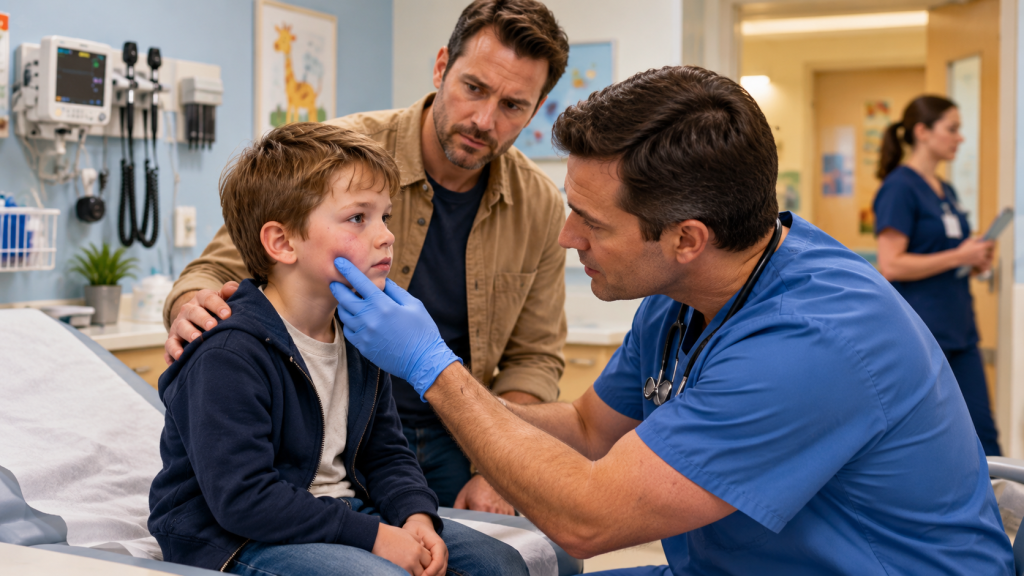
Greg’s voice was different. He wasn’t demanding anymore. He was begging. And somehow that frightened me more. Leo stared toward the hallway. “He knows.” I pulled my stool closer. “Knows what?” Leo’s lips trembled.
“That Mom left me the key.”
Sarah and I exchanged a look.
“What does the key open?”
“I don’t know.”
Greg shouted again.
“You need a warrant! You hear me? That’s my property!”
One of the security officers ordered him to calm down.
A second voice joined them.
Police.
Good.
Sarah closed the door completely.
I kept my voice low.
“Leo, nobody is taking you out of this room with Greg.”
His eyes lifted.
“Promise?”
There are promises doctors should never make.
We cannot promise a frightened child that everything will be fine.
We cannot promise test results.
We cannot promise tomorrow.
But this one I could make.
“I promise you’re staying with us while we make sure you’re safe.”
His shoulders dropped perhaps half an inch.
That was all.
For Leo, half an inch looked like surrendering a hundred pounds.
The radiologist called again.
“Thomas, surgery needs to see him now.”
“What exactly are we dealing with?”
“I don’t want to speculate from imaging alone.”
“That’s a sentence doctors use when they’re worried.”
“I’m worried.”
I turned slightly away from Leo.
“Foreign bodies?”
“Yes.”
“How many?”
“At least three distinct densities.”
“Metal?”
“One may be.”
“And the movement?”
A pause.
“I don’t know.”
That answer chilled me.
“Could this be parasitic?”
“Possible. Could also be reactive tissue around introduced material. Surgery needs direct visualization.”
“Any extension toward the orbit?”
“Not yet.”
Not yet.
Two words I hated.
“Bone?”
“Inflammatory changes nearby. Thomas, move.”
“I’m moving.”
I hung up.
Sarah was already preparing Leo.
“Where are we going?” he asked.
“To a surgical team upstairs.”
“Are they going to cut my face?”
The fear in his voice was enormous.
I crouched.
“They’re going to make you sleep first.”
“Like dead?”
“No.”
He stared at me.
“Like asleep. Medicine keeps you comfortable while the doctors clean the infection and figure out what’s inside.”
“Will I wake up?”
“That is what the team expects.”
“Can you come?”
I hesitated.
I was not the surgeon.
“I can come upstairs with you until they take over.”
His fingers tightened around the blanket.
“What about Sarah?”
Sarah answered before I could.
“I’m not disappearing either.”
Leo looked from one of us to the other.
Then whispered:
“Okay.”
As transport arrived, a police officer stepped into the room.
She introduced herself as Officer Elena Ruiz.
She kept her hands visible and stayed near the doorway.
“Leo, I’m not here to ask you a bunch of questions right now.”
He stared at her badge.
“I just need to make sure you know Greg is staying here with other officers.”
“Is he arrested?”
“He’s being detained while we figure out what happened.”
Leo looked worried.
Not relieved.
Worried.
That reaction told me something too.
Children can fear the person hurting them and still fear what happens when that person is taken away.
“What about Mom?” he asked.
Officer Ruiz’s expression softened.
“We’re working on finding your mom.”
“She’s at home.”
“Do you know that?”
Leo hesitated.
“No.”
“When did you last see her?”
“Thursday.”
It was now Sunday morning.
My chest tightened.
“What happened Thursday?” Ruiz asked gently.
Leo looked toward me.
I nodded once.
“You can tell her if you want.”
He stared at the blanket.
“Mom and Greg were fighting.”
“About what?”
“The shed.”
Ruiz did not interrupt.
“Mom told him he had to get rid of everything.”
“What everything?”
“The jars.”
“What was in them?”
“I don’t know.”
“Did you see them?”
Leo nodded.
“Some had bugs.”
My stomach turned.
“Bugs?” Sarah asked.
“Things from outside.”
“What kind of things?”
“Worms. Beetles. Spiders sometimes.”
Greg had called the wound a spider bite.
Ruiz asked:
“What did your mom say about the jars?”
“She said he wasn’t allowed to keep doing it.”
“Doing what?”
Leo looked confused.
“Experiments.”
The word hung there.
“What kind of experiments?”
“He said he was making better bait.”
“For fishing?”
Leo shrugged.
“He said fish would eat anything if you made it smell right.”
Sarah and I looked at each other.
The strangely sweet odor.
Damp earth.
The wound.
The moving sensation.
I felt sick.
Ruiz remained calm.
“What happened after your mom told him to get rid of everything?”
“Greg got mad.”
“Did he hurt her?”
Leo’s eyes filled.
“I heard something break.”
“Did you see what happened?”
“No.”
“Then what?”
“She came into my room.”
“What did she say?”
Leo touched the hoodie lying inside the evidence bag.
“She told me to wear that.”
“The hoodie?”
“Yes.”
“Why?”
“She said it was cold.”
“Was it?”
“No.”
The room became very quiet.
“She put something in the pocket?”
“I didn’t know.”
The key.
The note.
Sarah whispered:
“She hid it on him.”
Ruiz nodded slightly.
“What happened after she gave you the hoodie?”
“Greg came upstairs.”
“And?”
“Mom told me to go lock my door.”
“Did you?”
“Yes.”
“What did you hear?”
Leo began breathing faster.
I raised a hand.
“That’s enough for now.”
Ruiz agreed immediately.
“You’re right.”
Leo looked ashamed.
“I can tell.”
“Not right now,” I said.
“But Mom—”
“Your job right now is to let us take care of you.”
“But if I don’t tell you—”
“Leo.”
I waited until he looked at me.
“You are nine years old.”
His chin trembled.
“You are not responsible for solving this.”
He stared.
“Adults are working on finding your mother.”
“What if they don’t know where to look?”
“Then we’ll use what you already gave us.”
His eyes moved toward the brass key.
Ruiz said:
“And that may help more than you realize.”
We moved Leo upstairs.
Behind us, Greg’s voice disappeared.
For the first time since he entered the emergency department, Leo could no longer hear him.
And for the first time, I watched the boy take a full breath.
The surgical team met us outside the operating suite.
Dr. Priya Nandakumar, one of our pediatric surgeons, reviewed the scans while anesthesia spoke quietly with Leo.
Priya pulled me aside.
“You felt movement?”
“Twice.”
“Could be pressure displacement.”
“It pushed against my glove.”
She looked at the scan again.
“I see inflammatory pockets. Several foreign bodies. One elongated structure.”
“Living?”
“I’m not calling it living until I see it.”
“Smart.”
“You think intentional introduction?”
“I think his stepfather is currently screaming at police not to search the house.”
Priya looked at me.
“That answers more than the CT does.”
“Unfortunately.”
Leo called my name.
“Dr. Thomas?”
I returned.
The anesthesiologist was placing a mask near him.
Leo looked terrified.
“Will you be here when I wake up?”
“My shift technically ends soon.”
His face fell.
I smiled.
“But I’m terrible at leaving on time.”
Sarah groaned.
“True.”
Leo almost smiled.
It was the first hint of one.
“I’ll check on you.”
“Promise?”
“Promise.”
He closed his eyes.
The doors shut.
Then there was nothing for me to do.
Doctors hate that.
We are trained for action.
Order.
Interpret.
Stabilize.
Treat.
But sometimes the most important thing happening to your patient is happening in another room.
So I went downstairs.
Greg was gone from the hallway.
Officer Ruiz stood near the nurses’ station.
“Where is he?”
“Police interview room.”
“Anything?”
“Enough that nobody is releasing him.”
“What about the house?”
“We’re working through the legal process. Given the missing mother, the child’s statements, the note, and what happened here, detectives are moving quickly.”
“Please tell them not to open random containers in that shed without protective equipment.”
Ruiz stared.
“That bad?”
“I don’t know yet.”
“That sentence seems popular tonight.”
“Medicine.”
She glanced toward the elevator.
“How’s Leo?”
“In surgery.”
Ruiz nodded.
“Child protective services is responding.”
“Good.”
“Do you know anything about his mother?”
“Only that her name is Rebecca Hale. Greg is stepfather. Leo called her Mom. Greg referred to her as his wife.”
Ruiz checked her notes.
“Greg Hale?”
“Yes.”
“Leo’s surname?”
“Mercer.”
She nodded.
“Different biological father?”
“Presumably.”
“We’re checking.”
I looked toward the clock.
4:22 a.m.
Rain continued.
The emergency department had begun its strange predawn lull.
Not quiet.
Never quiet.
Just tired.
At 4:41, my phone rang.
Priya.
“We found the source of the movement.”
I stood.
“What is it?”
“A larval infestation in devitalized tissue.”
My stomach dropped.
“Accidental?”
“Thomas.”
Her voice changed.
“We also removed three small fragments.”
“What kind?”
“One is plastic. One appears to be part of a thin mesh capsule. The third is metallic.”
“Capsule?”
“Yes.”
“You think something was placed in the wound?”
“I’m saying this does not look like an ordinary environmental exposure.”
I closed my eyes.
“How’s Leo?”
“Stable.”
“Any deeper spread?”
“We got ahead of the worst of it. He’ll need infectious disease, wound care, antibiotics, probably additional procedures, but I’m cautiously optimistic.”
I exhaled.
“Thank you.”
“Don’t thank me yet.”
“What?”
“The metallic object.”
“Yes?”
“It has numbers engraved on it.”
I went upstairs.
Priya met me outside recovery.
She had changed gloves and gown.
“You need to see this.”
Inside a specimen container was a tiny rectangular piece of metal.
Not much larger than a grain of rice.
Numbers had been stamped into one side.
I stared.
“What is that?”
“I don’t know.”
“Medical device?”
“Not one I recognize.”
“Tracking tag?”
“Could be an identification marker.”
“For what?”
“That’s the question.”
A technician photographed it.
Priya folded her arms.
“The plastic fragment has similar markings.”
“Same number?”
“Partially.”
“Meaning?”
“Meaning these may have come from a labeled container or research sample.”
“Greg’s ‘bait experiments.’”
“Maybe.”
My phone buzzed.
Ruiz.
SEARCH TEAM ENTERING PROPERTY.
I looked at Priya.
“They’re going in.”
“Tell them to wear gloves.”
“I already did.”
Leo woke twenty-three minutes later.
Confused.
Groggy.
His first word was:
“Mom?”
I was standing beside Sarah.
I hated that we had no answer.
“Police are looking for her.”
He blinked slowly.
“My face?”
“The surgeons cleaned the infection.”
“Did they find the spider?”
Sarah looked at me.
I chose my words carefully.
“They found an infection caused by small organisms in the damaged skin.”
His eyes widened.
“Bugs?”
“Yes.”
He began crying.
Not loudly.
Tears simply rolled sideways toward his ears.
“Greg said it would only hurt for a minute.”
Everything inside me stopped.
Sarah turned pale.
“What did you say?” I asked.
Leo’s breathing quickened.
“He said it would only hurt for a minute.”
“When?”
“The shed.”
I pulled my chair closer.
“You do not have to tell us more right now.”
“But I remember.”
“Okay.”
“He put something on my face.”
Sarah’s hand closed around the bed rail.
“Greg did?”
Leo nodded.
“He said I ruined his best jar.”
“How?”
“I knocked it over.”
“When?”
“Thursday.”
The timeline aligned.
“What happened after?”
“He got really mad.”
“Leo, did Greg make the opening on your cheek?”
The boy closed his eyes.
Then nodded.
I felt a wave of anger so intense that for a moment I had to look away.
Doctors are human.
We are supposed to be calm.
Sometimes calm is something we build over fury.
“What did he put there?”
“I don’t know.”
“Did he say?”
“He said now I could see what happens when you waste somebody’s work.”
Sarah turned toward the window.
She was crying silently.
I continued carefully.
“Did your mom know?”
“She found me.”
“When?”
“Later.”
“What did she do?”
“She washed it.”
“Did she want to bring you to the hospital?”
“Yes.”
“What happened?”
“Greg took her phone.”
“Then?”
“They fought.”
“And he put you in the shed?”
Leo nodded.
“How long?”
“I don’t know.”
“You said two nights.”
“I slept twice.”
I swallowed.
“Did anyone bring you food?”
“Mom did once.”
“What happened?”
“Greg caught her.”
His voice became smaller.
“Then she didn’t come back.”
There are moments in medicine when you know the room has changed before anyone speaks.
That was one.
I pressed the call button.
“Sarah, get Ruiz.”
She was already moving.
Leo grabbed my sleeve.
“Did I get Mom in trouble?”
“No.”
“Greg said if I told, police would take her too.”
“No.”
“He said she let it happen.”
I leaned closer.
“Listen to me.”
His eyes met mine.
“What Greg told you was meant to scare you.”
“Mom tried to help.”
“I believe you.”
“She did.”
“I believe you.”
“She came to the shed.”
“I believe you.”
Leo cried.
“She said she was going to get me out.”
I stayed beside him until Ruiz arrived.
This time, she brought Detective Mara Chen.
Mara did not question Leo immediately.
Instead, she spoke with me.
I told her exactly what Leo had disclosed.
She wrote everything.
Then her phone rang.
She listened.
Her expression changed.
“What?”
Ruiz asked.
Mara looked at us.
“They found the shed.”
Leo heard.
His fingers tightened.
“And?”
I asked.
Mara turned slightly away from him.
“Multiple containers. Biological material. Workbench. Freezer.”
The note.
LEO—IF I DISAPPEAR, OPEN THE FREEZER.
“Rebecca?”
Mara shook her head.
“Not yet.”
Leo began to cry.
“Is Mom in the freezer?”
The entire room froze.
Mara immediately came closer.
“No, Leo.”
“How do you know?”
“The freezer is small.”
That was true, she later told me.
A chest freezer used for specimens.
Not large enough for what Leo feared.
He covered his face.
“I thought—”
“I know.”
Mara crouched.
“Your mom’s note was telling us to look inside because she wanted us to find something.”
“What?”
“We’re figuring that out.”
The search team did.
Inside the freezer were dozens of sealed specimen bags.
Insects.
Larvae.
Fish tissue.
Animal tissue.
Containers labeled with dates.
Some were legal commercial bait cultures.
Others were not.
And beneath a false bottom was a waterproof document case.
The brass key fit the lock.
Inside were photographs.
Receipts.
A flash drive.
Copies of correspondence.
And Rebecca’s handwritten journal.
But Rebecca was not there.
The journal began eight months earlier.
Greg had once worked for a small private aquaculture supplier that produced live bait and specialty feed cultures.
He had been fired.
According to Rebecca, he believed the company had stolen one of his ideas.
He began conducting his own experiments at home.
At first, they were ordinary enough.
Different feed mixtures.
Different breeding conditions.
Then he became obsessed with producing larvae that survived longer in poor conditions.
He purchased biological materials online.
Some legal.
Some questionable.
He began collecting wild specimens.
Rebecca hated it.
The smell invaded the house.
The shed became locked.
Greg told Leo never to enter.
Then Rebecca discovered something worse.
Greg was not merely developing fishing bait.
He was deliberately testing how different organisms reacted to damaged animal tissue.
She photographed his work.
She threatened to report him.
Greg promised to stop.
He didn’t.
Then she found a notebook.
One entry read:
HUMAN TEMPERATURE WOULD ACCELERATE THE CYCLE.
Another:
NEED REAL-WORLD EXPOSURE DATA.
That sentence turned my stomach when Detective Chen later told me.
Rebecca confronted him.
Greg claimed it was theoretical.
Then Leo knocked over one of his cultures.
And Greg decided to punish him.
But there was another twist.
The metal fragment removed from Leo’s face was not a tracker.
It was an identification tag.
A tiny label from one of Greg’s experimental sample capsules.
He had placed contaminated material into Leo’s wound.
Deliberately.
Not because he was conducting a sophisticated scientific study.
Because rage and obsession had merged into cruelty.
The medical explanation was terrible enough.
But the human explanation was worse.
Leo had broken a jar.
Greg wanted him to suffer for it.
Rebecca discovered what he had done.
And disappeared while trying to get Leo out.
At 7:18 a.m., police found her car.
Abandoned near an old boat launch twelve miles from the house.
The driver’s door was unlocked.
Her purse remained inside.
Her phone was gone.
There was no blood.
No sign of a struggle.
Only a receipt from a gas station.
And a folded road map.
Rebecca Hale had vanished.
Greg refused to say where she was.
By then, his attitude had changed again.
The panic was gone.
He sat across from detectives and smiled.
“My wife leaves all the time.”
Detective Chen stared.
“For how long?”
“Hours.”
“She’s been missing since Thursday.”
“She’s dramatic.”
“Her nine-year-old son says she tried to rescue him from a locked shed.”
Greg shrugged.
“Kid lies.”
“Surgeons removed material from his face linked to containers in your shed.”
His smile weakened.
“I told you. Spider bite.”
“The container tag says otherwise.”
Silence.
Mara placed a photograph on the table.
Greg looked at it.
His face changed.
The photograph showed the workbench.
The jars.
The freezer.
The opened false compartment.
“You searched that?”
“Yes.”
“You had no right.”
“Your attorney can litigate the search.”
Greg leaned back.
“You won’t find Rebecca.”
Mara stopped.
Not:
You haven’t found Rebecca.
You won’t.
“What did you say?”
Greg realized his mistake.
“My wife doesn’t want to be found.”
“How do you know?”
“Because I know her.”
“Where is she?”
“I don’t know.”
“You just said we won’t find her.”
“Figure of speech.”
Mara watched him.
“Did you hurt Rebecca?”
“No.”
“Did you lock Leo in the shed?”
“No.”
“Did you put contaminated material into his face?”
“No.”
“Did you take Rebecca’s phone?”
“No.”
“Did you threaten her?”
“No.”
“Then why did you scream at hospital staff not to go to your house?”
Greg smiled again.
“Because I value privacy.”
That smile would not last.
At 8:03 a.m., my shift had been over for more than an hour.
Sarah stood beside me.
“You going home?”
“No.”
“Thomas.”
“I promised him.”
“You promised you’d check on him when he woke up.”
“I checked.”
“Go home.”
I looked through the glass.
Leo was asleep.
A child welfare worker sat nearby.
Officer Ruiz remained outside.
“He doesn’t have anybody.”
Sarah sighed.
“Right now he has half the hospital.”
“That’s not the same.”
“No.”
She softened.
“But you’re no good to him if you collapse.”
I rubbed my eyes.
“Coffee first.”
“That is not sleep.”
“Coffee, then sleep.”
“You’re a terrible patient.”
“So I’ve been told.”
Before I could leave, Detective Chen found me.
“We may have something.”
“Rebecca?”
“A voicemail.”
My exhaustion vanished.
“From when?”
“Thursday night.”
“Who received it?”
“Her sister.”
“What does it say?”
“She didn’t answer because it came from an unknown number.”
Mara pulled out her phone.
“Rebecca’s own phone had apparently been taken, so she used another.”
“Can I hear it?”
Mara hesitated.
“Not the whole thing.”
She read from the transcript.
“Rebecca says: ‘If Greg tells anyone I left, don’t believe him. I’m trying to get Leo. I hid what I found. He knows. Vince said—’”
Mara stopped.
“Vince?”
“Yes.”
“Who is Vince?”
“We don’t know.”
I stared.
“You’re telling me there’s another person?”
“Possibly.”
“Greg’s coworker?”
“We’re checking.”
“Does the voicemail say more?”
“It cuts off.”
“Location?”
“We’re working on tracing the number.”
The name Vince opened a new door.
By noon, police identified him.
Vincent Dale.
Forty-six.
Owner of a small bait and tackle shop outside Tillamook.
Former coworker of Greg’s at the aquaculture supplier.
And according to financial records discovered in Rebecca’s hidden case, Greg had been sending Vince money.
Regularly.
Rebecca had written about him.
VINCE KNOWS WHAT GREG IS DOING.
Then:
VINCE GAVE HIM THE CULTURES.
And finally:
VINCE CAME TO THE HOUSE. HE SAID IF I REPORT THEM, THEY’LL SAY I WAS PART OF IT.
Police went to Vince’s shop.
Closed.
His truck was gone.
His phone was off.
Now they had two missing adults.
One possibly running.
One possibly in danger.
I finally went home.
I showered.
Lay down.
Closed my eyes.
And saw Leo’s face.
“He said it would only hurt for a minute.”
I got up again.
There are cases doctors carry home.
We try not to.
But some patients follow you into the quiet.
I made coffee I did not need.
Then my phone rang.
Sarah.
“Tell me Leo’s okay.”
“He’s stable.”
“Then why are you calling?”
“Because he woke up asking for his backpack.”
“What backpack?”
“Exactly.”
I returned to the hospital.
Yes, I know.
Terrible boundaries.
But when I entered Leo’s room, he looked relieved.
“You came back.”
“I said I would.”
“You went home.”
“For forty-seven glorious minutes.”
He almost smiled.
“Where’s your backpack?”
“Greg took it.”
“When?”
“Thursday.”
“Why do you need it?”
Leo looked toward the child welfare worker.
Then back at me.
“Mom put her phone in it.”
My heart started pounding.
“Her phone?”
“She had two.”
“Leo.”
I pulled the chair closer.
“Why didn’t you tell police?”
“I forgot.”
That was entirely plausible.
He had been sick.
Terrified.
In surgery.
“Where did Greg take the backpack?”
“The shed.”
Police returned immediately.
They searched again.
No backpack.
But Leo remembered something else.
“There’s a hole.”
Detective Chen leaned forward.
“What kind of hole?”
“Under the boards.”
“What boards?”
“Behind the shed.”
“Can you describe it?”
Leo closed his eyes.
“There’s a broken fence. Then blackberry bushes. There’s wood on the ground.”
“What’s under it?”
“Like a little room.”
Mara’s expression sharpened.
“A cellar?”
“I don’t know.”
“Have you been inside?”
“No.”
“Who has?”
“Greg.”
“And your mom?”
“I saw her come out once.”
Mara stood.
“We’re going back.”
This time, they found it.
Behind the shed, concealed beneath weathered boards and blackberry vines, was an old storm cellar that predated the house.
Greg had used it for storage.
The door was secured with a padlock.
Inside were more containers.
A folding table.
Camping supplies.
A cot.
Rebecca’s missing phone.
Leo’s backpack.
And a bloodstained piece of cloth.
Rebecca was not there.
But her phone changed everything.
She had recorded Greg.
Not once.
For months.
The first recordings were arguments.
“You promised the cultures were gone.”
“They’re harmless.”
“You are keeping insects in our backyard.”
“They’re bait.”
“You were fired for violating protocols.”
“I was fired because they stole my work.”
“You are not a scientist, Greg.”
“I know more than those idiots.”
Then another.
“Stay away from Leo.”
“I didn’t touch him.”
“He has a mark on his face.”
“He fell.”
“I saw your capsule.”
Silence.
Then Greg:
“You need to calm down.”
Rebecca:
“You put something in my son.”
Greg:
“Lower your voice.”
Rebecca:
“I’m calling the police.”
A crash.
Recording ends.
There were more.
One contained Vince.
His voice was distinctive.
“Rebecca, nobody wants this ugly.”
“You gave him those samples.”
“I sold him bait cultures.”
“You knew.”
“I knew he was experimenting.”
“On my child?”
“Don’t say stupid things.”
“You both belong in prison.”
Then Greg:
“Give me the phone.”
Rebecca:
“Stay away from me.”
Recording ends.
The final file was recorded at 10:41 p.m. Thursday.
Rebecca was whispering.
“If anyone finds this, Leo is in the shed. Greg locked him there. I’m going to get him out. I called my sister but couldn’t reach her. Greg has my regular phone. I’m hiding this one in Leo’s backpack.”
She breathed.
“I put the key and note in his hoodie.”
Then:
“If I can’t get him tonight, I’m going to the police.”
A sound in the background.
Rebecca whispered:
“Someone’s here.”
Then the recording stopped.
Someone.
Not Greg.
She had referred to Greg by name every other time.
Who arrived at 10:41?
Vince.
Police issued alerts.
His truck was located at 4:26 that afternoon.
Empty.
Near an abandoned cannery road.
Rebecca’s car had been found only seven miles away.
Search teams moved in.
Rain complicated everything.
Mud.
Dense brush.
Drainage channels.
Old industrial buildings.
Coastal fog.
Hours passed.
Leo asked about his mother repeatedly.
We did not tell him every development.
Children deserve truth.
They do not need every terrifying possibility while adults are still trying to understand it.
That evening, I sat beside him while he ate applesauce.
He made a face.
“What?”
“It tastes like baby food.”
“You’re nine. You’re practically elderly.”
He smiled.
Then stopped.
“Dr. Thomas?”
“Yes?”
“Do you think Mom ran away?”
“I don’t know.”
“Greg says people leave because of me.”
I felt anger rise again.
“What people?”
“My real dad.”
I paused.
“Where is your biological father?”
“I don’t know.”
“Greg says he left because I cried too much.”
I set down my coffee.
“Babies cry.”
“I know.”
“Adults do not leave because babies cry too much.”
Leo shrugged.
“Greg said Mom would leave too.”
I chose my words carefully.
“Your mom left evidence specifically to help people find the truth and protect you.”
He looked at me.
“That does not sound like a mother who wanted to abandon you.”
His eyes filled.
“She came to the shed.”
“Yes.”
“She brought me a sandwich.”
“What kind?”
“Peanut butter.”
“Good choice.”
“No jelly.”
“Criminal.”
Leo laughed.
A real laugh.
Then covered his mouth as if laughter itself were forbidden.
I smiled.
“You’re allowed.”
“What?”
“To laugh.”
His expression changed.
“Even when Mom’s missing?”
“Yes.”
“Isn’t that bad?”
“No.”
“You can be scared and still laugh.”
He considered this.
“Can you be sad and hungry?”
“Absolutely.”
“Can I have pizza?”
“That was a suspiciously strategic question.”
He smiled.
We ordered pizza after dietary clearance.
At 8:17 p.m., Detective Chen called the nurses’ station.
Sarah answered.
Then looked at me.
Her face had changed.
I stood.
“What?”
She covered the receiver.
“They found someone.”
Everything stopped.
“Rebecca?”
“She doesn’t know yet.”
Twenty minutes later, we learned the truth.
A search dog had located Rebecca inside a maintenance structure near the abandoned cannery.
Alive.
Injured.
Dehydrated.
Terrified.
But alive.
I sat down.
Sarah cried.
I did too.
No shame.
Leo was asleep.
We decided not to wake him until information was confirmed.
At 9:03, it was.
Rebecca Hale was alive.
She had been found with one wrist secured by a plastic restraint to a metal support.
Searchers freed her.
She was transported to another hospital because of proximity.
Her first question was about Leo.
Her second was whether Greg had been arrested.
Her third:
“Where’s Vince?”
Police did not know.
Not yet.
Rebecca told them what happened.
She had tried to get Leo out of the shed.
Greg stopped her.
They argued.
Vince arrived.
Greg was drunk.
Vince was not.
That distinction mattered.
According to Rebecca, Vince realized she had collected evidence.
He told Greg:
“She’s going to bury both of us.”
Rebecca ran.
She made it outside.
Got into her car.
Drove.
Vince followed.
Greg stayed behind with Leo.
At the boat launch, Vince forced her vehicle off the access road.
Rebecca tried to escape on foot.
He caught her.
He demanded the location of the hidden evidence.
She refused.
He drove her to the abandoned cannery.
For nearly three days, he kept returning to question her.
“Where’s the key?”
“Who did you send copies to?”
“What did Leo see?”
Rebecca lied.
She said the evidence was with an attorney.
It wasn’t.
She said police already had copies.
They didn’t.
She said her sister knew everything.
She didn’t.
Those lies may have saved her.
Vince became afraid to kill her because he could not determine who else knew.
Then police activity intensified.
He fled.
Rebecca was left behind.
Alive.
At 9:22 p.m., I woke Leo.
“Hey.”
His eyes opened.
“What?”
“I have news.”
He sat up immediately.
“Mom?”
I smiled.
“They found her.”
His entire face changed.
“Alive?”
“Yes.”
“Alive alive?”
I laughed through tears.
“Very alive.”
He began crying.
“Can I see her?”
“She’s at another hospital.”
“Is she okay?”
“She’s hurt and exhausted, but doctors are taking care of her.”
“Can I call?”
“We’re working on that.”
“Did she ask about me?”
“Yes.”
That was the question that mattered.
“She did?”
“Immediately.”
Leo covered his face.
His shoulders shook.
Sarah sat beside him.
“She asked where you were.”
“She didn’t leave?”
“No.”
“She didn’t leave me?”
“No.”
“She came back to the shed?”
“Yes.”
He cried harder.
I let him.
There are tears you treat.
And tears you protect.
An hour later, a nurse at Rebecca’s hospital arranged a video call.
Her face was bruised.
Her voice weak.
But when Leo appeared on the screen, she smiled.
“Baby.”
“Mom.”
Rebecca covered her mouth.
Leo pressed both hands against the tablet.
“Where are you?”
“In a hospital.”
“Me too.”
“I know.”
“Greg put bugs in my face.”
Rebecca’s eyes closed.
“I know.”
“Did you know?”
“I found out.”
“Why didn’t you get me out?”
The question landed like a blade.
Rebecca cried.
“I tried.”
Leo cried too.
“I waited.”
“I know.”
“You said you were coming back.”
“I tried, baby.”
“Greg said you left.”
“I didn’t.”
“Promise?”
“I promise.”
“You didn’t leave because I broke the jar?”
“No.”
“Because I cried?”
“No.”
“Because I’m bad?”
Rebecca shook her head desperately.
“You are not bad.”
“Then why does everyone leave?”
She pressed a hand to the screen.
“I didn’t leave you.”
Leo pressed his palm against hers through the glass.
For a moment, nobody in either hospital room spoke.
Then Rebecca whispered:
“I fought every second to come back.”
Leo nodded.
“Okay.”
That one word contained more forgiveness than any child should have needed to give.
But it was not complete forgiveness.
It was recognition.
Mom had come back.
The next morning, Vince was arrested.
He had attempted to hide at a remote cabin belonging to a relative.
Police found him after tracing a vehicle connected to an acquaintance.
He denied abducting Rebecca.
Then investigators recovered her blood from his truck.
He changed his story.
She had come willingly.
Then they found the restraint packaging.
He changed it again.
She attacked him first.
Then they recovered location data.
Another story.
Another collapse.
Evidence is patient.
It does not get tired of lies.
Greg’s case was equally damning.
The medical evidence.
The sample tag.
Rebecca’s recordings.
Leo’s statements.
The shed.
The storm cellar.
The journal.
The cultures.
Greg’s own inconsistent explanations.
No single clue solved everything.
Together, they formed a wall.
And Greg had built it himself.
Rebecca and Leo were reunited in person four days later.
By then, Leo could walk the hallway with assistance.
His face remained bandaged.
He would need more care.
But the infection was responding.
When Rebecca entered in a wheelchair, Leo stared.
Then climbed carefully from bed.
“Mom?”
She opened her arms.
He ran the last two steps.
Everyone in the room turned away.
Not because the moment was private.
Because some moments are too human to watch without feeling like an intruder.
Rebecca held him.
“I’m sorry.”
Leo buried his face against her shoulder.
“I broke the jar.”
“I don’t care about the jar.”
“Greg did.”
“I know.”
“He said it was expensive.”
“I don’t care.”
“He said—”
“Leo.”
Rebecca held his face gently.
“You could break every jar in the world.”
He stared.
“And I would still come for you.”
His mouth trembled.
“Every jar?”
“Every single one.”
“What about a million-dollar jar?”
Rebecca laughed and cried.
“Especially that one.”
Leo smiled.
Then he remembered something.
“My backpack.”
“I know.”
“You hid your phone.”
“Yes.”
“And the key.”
“Yes.”
“Why didn’t you tell me?”
“Because I was trying to keep you out of it.”
He frowned.
“That didn’t work.”
Rebecca closed her eyes.
“No.”
She touched his hair.
“It didn’t.”
He looked at her hospital gown.
“Did Vince hurt you?”
Rebecca glanced toward the social worker.
Then back.
“He kept me somewhere I didn’t want to be.”
“Why?”
“Because he was afraid I would tell the truth.”
“Did you?”
“Yes.”
“Good.”
Rebecca kissed his forehead.
“Good.”
The recovery was not simple.
Stories like this often end at rescue.
Real life does not.
Leo did not leave the hospital and become instantly carefree.
He had nightmares.
He hid food.
He startled when men raised their voices.
For months, he hated sheds.
He refused to go near fishing bait.
At one point, he became terrified of insects so completely that a harmless moth sent him running from a classroom.
He also became angry.
Very angry.
At Greg.
At Vince.
At Rebecca.
At doctors.
At himself.
Especially himself.
“If I hadn’t broken the jar, none of this happened.”
His therapist spent months helping him untangle that belief.
The jar was an accident.
Greg’s actions were choices.
Again.
The jar was an accident.
Greg’s actions were choices.
Again.
Until eventually Leo could say it himself.
“The jar was an accident.”
“And Greg’s actions?”
“Were his.”
Not mine.
That was the part that took longest.
Rebecca struggled too.
She blamed herself for not reporting Greg sooner.
For believing his promises.
For allowing the shed to remain.
For being intimidated by Vince.
For hiding evidence instead of immediately going to police.
For leaving Leo alone Thursday night while trying to escape.
For everything.
One afternoon, months later, she came to the hospital for one of Leo’s follow-up appointments.
I had moved on to another shift.
Another hundred patients.
But I saw her name on the schedule and stopped by.
Leo was drawing.
Rebecca stood near the window.
“How is he?”
“Better.”
“How are you?”
She laughed without humor.
“People keep asking that.”
“Annoying habit.”
“I don’t know.”
“Acceptable answer.”
She looked at me.
“I should have brought him here Thursday.”
“Yes.”
The bluntness surprised her.
I continued.
“You should have.”
Tears filled her eyes.
“I thought you were going to tell me it wasn’t my fault.”
“That phrase can become meaningless if we use it to erase choices.”
She stared.
“You were afraid.”
“Yes.”
“You were being controlled and threatened.”
“Yes.”
“You made decisions under those conditions.”
“Yes.”
“Some you wish you made differently.”
“Yes.”
“None of that makes Greg’s abuse your responsibility.”
She began crying.
I handed her tissues.
“I needed someone to say both.”
“Both things can be true.”
“I should have acted sooner.”
“Yes.”
“And Greg chose what he did.”
“Yes.”
She nodded.
“I can live with that.”
“That’s the goal.”
Leo looked up.
“Mom, why are you crying?”
Rebecca wiped her face.
“Dr. Thomas is mean.”
I nodded.
“Very.”
Leo grinned.
“Can we get pizza?”
Rebecca looked at me.
“He asks everyone that.”
“Effective strategy.”
Life began rebuilding around ordinary things.
School.
Appointments.
Rent.
Groceries.
Therapy.
Homework.
Birthday cake.
Leo turned ten.
Rebecca asked what kind of party he wanted.
“No bugs.”
“Agreed.”
“No fishing.”
“Absolutely.”
“No sheds.”
“Very reasonable.”
“Pizza.”
“Obviously.”
He invited six classmates.
Only four came.
Leo worried the other two hated him.
Rebecca reminded him one had the flu and the other was visiting grandparents.
Trauma can teach children that every absence is rejection.
Healing teaches them there may simply be traffic.
At the party, Leo laughed so hard during a game that he spilled soda.
He froze.
The cup hit the floor.
His face went pale.
Everyone else kept laughing.
Rebecca grabbed towels.
“No big deal.”
Leo stared.
“I spilled it.”
“Yes.”
“You’re not mad?”
“I’m mildly offended by the waste of perfectly good root beer.”
He waited.
Nothing happened.
No shouting.
No wrist grabbed.
No punishment.
No shed.
Rebecca wiped the floor.
“Grab another.”
Leo did.
Later, she found him crying in the bathroom.
“What happened?”
“Nothing.”
She sat outside the door.
“Okay.”
“He would’ve gotten mad.”
“Greg?”
“Yes.”
“I know.”
“I thought you were going to.”
“I didn’t.”
“I know.”
“Then why are you crying?”
“I don’t know.”
Rebecca understood.
His body had prepared for something that never arrived.
Sometimes safety hurts when you first encounter it.
Because it reveals how unsafe you were.
She waited.
Eventually Leo opened the door.
She hugged him.
No speech.
No lesson.
Just arms.
A year after the ER visit, the criminal cases moved toward resolution.
The exact legal process was complicated.
There were multiple charges involving Leo, Rebecca, unlawful biological materials, confinement, assault, and other conduct.
Attorneys argued.
Experts testified.
Evidence was challenged.
The system moved slowly.
But neither Greg nor Vince returned to the family’s life.
That mattered more to Leo than legal terminology.
“Are they coming home?”
“No.”
“Tomorrow?”
“No.”
“Next week?”
“No.”
“Christmas?”
“No.”
Eventually he stopped asking.
Rebecca obtained a permanent protective order.
They moved.
Not far.
Leo wanted to stay at his school.
Their new house had no shed.
That was deliberate.
It did have a small detached garage.
The first time Leo saw it, he refused to enter.
Rebecca said:
“Okay.”
Six months later, he stepped inside voluntarily.
There were bicycles.
Holiday decorations.
A lawn mower.
No jars.
No locks on the outside.
He looked around.
“This is boring.”
Rebecca smiled.
“That’s the dream.”
At eleven, Leo became obsessed with astronomy.
Maybe because the sky felt like the opposite of confinement.
He learned planets.
Constellations.
Meteor showers.
He saved allowance money for a telescope.
One night, Rebecca found him in the backyard at midnight.
“What are you doing?”
“Saturn.”
“You have school.”
“Saturn doesn’t care.”
“Unfortunately, your principal does.”
“Five minutes.”
“Two.”
“Four.”
“Three.”
“Deal.”
She sat beside him.
He adjusted the telescope.
“Look.”
Rebecca leaned down.
A tiny ringed planet floated in the eyepiece.
She gasped.
“That’s actually Saturn?”
“No, Mom. I taped a sticker inside the telescope.”
She nudged him.
He laughed.
Then they sat beneath the stars.
Three years earlier, darkness had meant a locked shed.
Now darkness meant planets.
That was healing.
Not deleting one meaning.
Adding another.
At twelve, Leo asked to read Rebecca’s journal.
She said no.
He was furious.
“It’s about me.”
“Some of it.”
“Then I should get to see it.”
“When you’re older.”
“You always say that.”
“Because you keep getting older.”
“That doesn’t even make sense.”
“It made enough sense.”
He slammed his bedroom door.
Rebecca flinched.
For a second, Greg’s anger flashed through memory.
Then she reminded herself:
Leo was allowed to be angry.
A slammed door was not automatically danger.
Ten minutes later, he returned.
“Sorry.”
“You can be mad.”
“I shouldn’t slam doors.”
“Probably not.”
“You’re still not letting me read it?”
“No.”
“Still mad.”
“Allowed.”
He stomped away less dramatically.
Rebecca smiled.
Healthy families are not families without conflict.
They are families where conflict does not threaten someone’s safety.
At fourteen, Leo asked again.
This time Rebecca let him read selected sections with his therapist.
He learned how afraid she had been.
He learned she had tried to get help before the final night.
He learned Greg had isolated her financially.
He learned Vince had threatened to implicate her.
He learned the brass key had originally been meant for Rebecca’s sister, not him.
“Then why put it in my hoodie?”
“Because Greg was searching my things.”
“You thought he wouldn’t search mine?”
“I hoped.”
Leo looked down.
“He did.”
“Yes.”
“But he missed the inside pocket.”
“Yes.”
Leo smiled faintly.
“Bad searcher.”
Rebecca laughed.
Then he became serious.
“Did you think you were going to die?”
She answered honestly.
“At the cannery?”
“Yes.”
“Yes.”
Leo looked away.
“I thought you were dead too.”
“I know.”
He swallowed.
“I was mad at you for a long time.”
“I know.”
“I’m still mad sometimes.”
“You’re allowed.”
“I love you.”
“I love you too.”
“Both?”
“Both.”
That became another lesson.
Love and anger can occupy the same room.
So can grief and relief.
So can memory and growth.
The world does not require us to choose only one emotion at a time.
At fifteen, Leo returned to our hospital.
Not as a patient.
His school offered a career-shadowing program.
He requested emergency medicine.
When I saw his name, I assumed coincidence.
Then a tall teenager walked into the department.
I stared.
“No.”
He smiled.
“Yes.”
“Leo?”
“Dr. Thomas.”
“You were approximately four feet tall.”
“People grow.”
“Unacceptable.”
He laughed.
The scar along his cheek had faded.
Not disappeared.
Faded.
He touched it when he noticed me looking.
“Still there.”
“I see.”
“I don’t hate it anymore.”
“Good.”
“Sometimes people ask.”
“What do you tell them?”
“Depends.”
“On?”
“Whether I like them.”
Fair.
He followed me through part of a shift.
Chest pain.
A sprained ankle.
A toddler with fever.
A teenager who needed stitches after an ill-advised skateboard trick.
Leo watched everything.
At lunch, he asked:
“Do you remember that night?”
“Yes.”
“All of it?”
“Too much.”
“Did you know Greg was lying right away?”
“No.”
He seemed surprised.
“Really?”
“Doctors aren’t detectives with magical powers.”
“You made him stand against the wall.”
I smiled.
“You remember that?”
“Yes.”
“That was me creating space.”
“You lied about a rule.”
“I creatively interpreted hospital policy.”
“You lied.”
“I prefer my version.”
He laughed.
Then asked:
“When you touched my face, were you scared?”
“Yes.”
“Because it moved?”
“Yes.”
“I remember your eyes.”
I looked at him.
“What about them?”
“You tried not to look scared.”
“I failed?”
“Completely.”
“Wonderful.”
He smiled.
Then:
“Why did you stay?”
“What?”
“Your shift ended.”
“How do you know?”
“Mom told me.”
I shrugged.
“I made a promise.”
“That’s it?”
“Mostly.”
Leo looked down at his sandwich.
“Greg made promises too.”
I understood.
“Then maybe the difference is not making them.”
He looked up.
“It’s keeping them.”
Leo nodded.
That afternoon, he watched Sarah start an IV on a frightened six-year-old.
Sarah had also aged.
She recognized him immediately.
“My pizza criminal.”
Leo grinned.
“You remember?”
“You manipulated dietary clearance through emotional blackmail.”
“I was nine.”
“Mastermind.”
The child receiving the IV began crying.
Leo stood quietly nearby.
Sarah said:
“Want to help?”
“What do I do?”
“Distract him.”
Leo crouched.
“You like space?”
The boy sniffed.
“No.”
“Dinosaurs?”
“Yes.”
“Excellent. Which dinosaur would win a fight against a shark?”
The child stopped crying long enough to argue.
By the time he realized the IV was in, Sarah was taping it.
Leo looked amazed.
“That worked.”
Sarah smiled.
“Medicine.”
He left the hospital that day with a new idea.
He wanted to become a nurse.
Not because Sarah told him to.
Not because of what happened.
At least not entirely.
He liked the closeness.
Doctors came and went.
Nurses stayed.
He remembered Sarah staying.
Years later, he would tell her that.
She would cry.
Then deny crying.
“Hospital air.”
“Sure.”
At sixteen, Leo attended one legal proceeding related to Greg.
By choice.
Rebecca did not pressure him.
Greg had aged too.
He looked smaller.
Leo hated that.
He wanted him to look like the monster from memory.
Instead Greg looked like a man.
Ordinary.
That disturbed him more.
Afterward, Leo asked his therapist:
“How can somebody ordinary do something like that?”
The therapist answered:
“Ordinary appearance does not guarantee ordinary choices.”
Leo thought about it.
He had spent years imagining danger as something visible.
A scar.
A dark room.
A strange man.
But Greg had worn a steel watch.
Gone to work.
Bought groceries.
Complained about bills.
Looked normal.
Safety could not be measured by appearance.
It had to be measured by behavior.
Respect.
Boundaries.
Responsibility.
What someone does when angry.
What someone does when told no.
What someone does when they have power over someone smaller.
Those became Leo’s standards.
Not charm.
Not promises.
Behavior.
At eighteen, he graduated high school.
Rebecca cried before the ceremony began.
“Stop.”
“I can’t.”
“I haven’t even graduated yet.”
“You’re wearing the hat.”
“That is not the achievement.”
“It’s very moving.”
“Mom.”
She took approximately two hundred photographs.
Afterward, I received one by text.
Leo in cap and gown.
Rebecca beside him.
Both smiling.
Under it:
Remember the kid who asked whether he’d wake up?
I stared at the message.
Then replied:
Tell him he still owes me for the pizza.
Rebecca responded:
He says send an invoice.
I laughed in the physician workroom.
A resident looked at me strangely.
“Good news?”
“Yes.”
The best kind.
Life.
Leo entered nursing school.
It was difficult.
He failed his first pharmacology exam.
He called Rebecca.
“I’m dropping out.”
“No.”
“I got sixty-eight.”
“So?”
“So I’m stupid.”
“No.”
“I’m going to kill somebody.”
“That seems unlikely after one exam.”
“You don’t understand.”
“I understand dramatic teenagers who became dramatic adults.”
“I’m serious.”
“So am I.”
She paused.
“Get tutoring.”
“I don’t need tutoring.”
“You got sixty-eight.”
“I hate you.”
“Love you too.”
He got tutoring.
Passed.
Then passed again.
Clinical rotations were harder emotionally.
The first time he entered a pediatric room where a child flinched when a parent moved too quickly, Leo had to excuse himself.
He went into a supply closet.
His breathing accelerated.
For one horrible second, the closet became the shed.
Dark.
Cold.
Locked.
He put both hands against the shelves.
“You’re twenty.”
He breathed.
“You’re at work.”
Another breath.
“The door opens.”
He opened it.
That mattered.
He called his therapist.
Not because he had failed.
Because he had learned what asking for help looked like.
He completed the rotation.
He did not tell the child his own story.
The child did not need it.
He simply made sure the child had space to answer questions.
Years earlier, I had moved Greg against a wall to give Leo that space.
Now Leo created it for someone else.
Patterns can repeat in more than one direction.
Harm repeats.
But so does care.
At twenty-two, Leo graduated.
Sarah attended.
I attended.
Rebecca sat between us.
When Leo walked across the stage, Sarah grabbed my arm.
“That’s our kid.”
Rebecca laughed through tears.
“Excuse me?”
Sarah corrected herself.
“Your kid.”
“Better.”
I whispered:
“Technically, I prescribed the pizza.”
Rebecca looked at me.
“You are both ridiculous.”
Leo received his pin.
Afterward, he hugged Rebecca first.
Then Sarah.
Then me.
“You stayed.”
I knew what he meant.
“Yeah.”
He smiled.
“Thanks.”
“No speeches.”
“I had a speech.”
“Absolutely not.”
“Too late.”
He pulled a folded piece of paper from his pocket.
Sarah groaned.
“Oh, no.”
Leo laughed.
“I’m kidding.”
He threw the blank paper away.
Rebecca smacked his arm.
For a moment, we were simply people laughing outside an auditorium.
No hospital monitors.
No police.
No specimen containers.
No Greg.
No Vince.
Just a young man beginning a career.
Leo eventually chose pediatric nursing.
Of course he did.
His first job was not at our hospital.
He wanted his own place.
His own colleagues.
His own identity.
I respected that.
Three years later, he returned.
Not because he needed rescue.
Because we had an opening.
Sarah was nearing retirement.
I was reducing overnight shifts.
Leo applied.
He got the job without our involvement.
On his first night, he walked into the emergency department wearing navy scrubs.
Sarah stared.
“Absolutely not.”
“What?”
“You were nine yesterday.”
“Apparently not.”
She hugged him.
Then stepped back.
“You know the rule.”
“What rule?”
“No manipulating physicians for pizza.”
“Still bitter.”
At 2:51 a.m., a frightened eight-year-old girl arrived with abdominal pain.
Her mother kept answering every question.
Leo noticed.
He pulled up a chair.
“Can I ask her directly?”
The mother frowned.
“She’s shy.”
“That’s okay.”
Leo smiled at the child.
“I’m shy too.”
She looked skeptical.
“You talk a lot.”
“Excellent observation.”
She smiled.
Eventually, with appropriate privacy and evaluation, the team discovered the child had been afraid to mention symptoms because she thought she would get in trouble.
Nothing sinister.
No hidden crime.
Just a scared child.
Sometimes a stomachache is a stomachache.
That mattered to Leo too.
Not every case had to become his story.
He learned not to see Greg everywhere.
Not every stern stepfather was abusive.
Not every shed hid something terrible.
Not every insect was dangerous.
Trauma had once taught him to generalize fear.
Clinical judgment taught him to look carefully.
Evidence.
Behavior.
Context.
Not assumptions.
One morning after shift, we drank coffee outside.
Rain tapped the awning.
“You know,” Leo said, “it always rains in my memories of this place.”
“Oregon.”
“Fair.”
He touched the scar.
“Do you remember what was inside?”
“Yes.”
“I used to think I had to understand why he did it.”
“Do you?”
“No.”
He sipped coffee.
“I understand what he did.”
“That’s different.”
“Yeah.”
He looked toward the ambulance bay.
“Why used to bother me more.”
“And now?”
“Now I think why can become a trap.”
I nodded.
“Sometimes.”
“He was angry.”
“Yes.”
“Obsessed.”
“Yes.”
“Controlling.”
“Yes.”
“Maybe he wanted to scare me.”
“Likely.”
“Maybe he wanted to test something.”
“Possible.”
“Maybe all of it.”
“Possible.”
Leo shrugged.
“But none of those answers changes what I needed.”
“What did you need?”
“For somebody to stop him.”
The rain continued.
“That happened.”
“Yes.”
He smiled faintly.
“Eventually.”
Sarah retired that winter.
At her party, Leo gave her a gift.
A pizza box.
She opened it.
Inside was a framed photograph.
Not of pizza.
A copy of an old nursing note from Leo’s hospitalization, with protected information appropriately handled.
One line was highlighted:
Patient asked whether staff would remain nearby until he fell asleep.
Below it, adult Leo had written:
You did.
Sarah cried immediately.
“Hospital air?”
Leo asked.
“Shut up.”
She hugged him.
“I was just doing my job.”
“I know.”
“That’s what nurses do.”
“I know.”
“You don’t owe me.”
“I know.”
“Then why are you making me cry?”
“Revenge.”
She laughed.
“Terrible child.”
Years passed.
Rebecca eventually moved inland.
She bought a small house with a garden.
She planted tomatoes.
Killed most of them.
Leo teased her relentlessly.
“Maybe gardening isn’t genetic.”
“You don’t garden.”
“Exactly. Survival instinct.”
She kept no locked sheds.
But eventually she did buy a greenhouse.
The first time Leo visited, he stood outside it.
Rebecca noticed.
“We don’t have to go in.”
He stared at the transparent panels.
Sunlight.
Plants.
Open door.
“No.”
He stepped inside.
Tomato vines climbed strings.
Basil filled the air.
A bee bumped lazily against the roof.
Leo flinched.
Then laughed.
“This is basically a shed full of bugs.”
Rebecca froze.
“Oh my God.”
He laughed harder.
“Mom.”
“I didn’t think.”
“It’s okay.”
“We can tear it down.”
“Absolutely not.”
“You sure?”
“Yes.”
He touched a tomato.
“This one’s actually alive.”
“Rude.”
They stood there.
A shed had once been a place where someone punished him.
Now a greenhouse was a place his mother grew terrible tomatoes.
Another meaning added.
That evening, Rebecca opened a drawer.
“I have something.”
“What?”
She handed him the brass key.
The key from his hoodie.
Police had eventually returned it after the case concluded.
Leo stared.
“You kept this?”
“I didn’t know what to do with it.”
“It opened the freezer compartment.”
“Yes.”
He turned it in his fingers.
Tiny.
Ordinary.
A piece of metal that had once carried the weight of survival.
“Do you want it?” Rebecca asked.
Leo thought.
“No.”
“Neither do I.”
“What should we do?”
Rebecca smiled.
“Bury it under a tomato plant?”
Leo laughed.
“That is absurdly symbolic.”
“I’m old. Let me have this.”
They went outside.
Rebecca dug a small hole.
Leo dropped the key inside.
She covered it with soil.
“That’s it?” he asked.
“That’s it.”
“I expected more.”
“Fireworks?”
“Maybe.”
Rebecca patted the dirt.
“Most endings are quiet.”
Leo looked at the greenhouse.
“Good.”
They went inside.
Neither checked the key again.
At thirty, Leo bought a house.
Small.
Two bedrooms.
One garage.
No shed.
Not because he was afraid.
Because he hated yard work.
He invited Rebecca over.
She walked through every room.
“You need curtains.”
“I have blinds.”
“Those are depressing.”
“They block sunlight.”
“You need a dining table.”
“I eat at the counter.”
“You’re thirty.”
“What does age have to do with furniture?”
“Everything.”
He rolled his eyes.
Then showed her the guest room.
Rebecca stopped.
“What?”
“For you.”
She stared.
“You made me a room?”
“Don’t get emotional.”
Too late.
She hugged him.
“You came back for me,” he whispered.
Rebecca cried against his shoulder.
“Always.”
That night, after she went home, Leo stood in his kitchen.
Rain tapped the windows.
His refrigerator hummed.
The house was quiet.
He thought about the first night we met.
Greg gripping his wrist.
The steel watch.
“He’s not worth missing a shift over.”
For years, those words had lived inside Leo.
Not worth.
Not worth missing work.
Not worth patience.
Not worth food.
Not worth a hospital visit.
Not worth protection.
Children believe adults.
Even terrible adults.
Sometimes especially terrible adults.
Leo had spent years unlearning one sentence.
He looked around his house.
Diploma on the wall.
Shoes by the door.
A ridiculous plant Sarah gave him.
A photograph of Rebecca beside her greenhouse.
A picture of his nursing-school class.
Evidence of another kind.
Not evidence of what had happened.
Evidence of what came after.
His phone rang.
Rebecca.
“Did you eat?”
“Yes.”
“What?”
“Food.”
“Leo.”
“Pizza.”
“Of course.”
“You raised me badly.”
“I tried.”
He smiled.
“Love you.”
“Love you too.”
He hung up.
No fear.
No checking whether she was alive.
No hidden message.
No key.
Just a mother calling her adult son because mothers apparently believe thirty-year-old nurses cannot feed themselves.
Leo went upstairs.
Before bed, he looked into the mirror.
The scar remained.
Thin.
Pale.
He ran one finger along it.
He no longer thought of what had moved beneath the skin.
He thought of what had moved afterward.
Police.
Surgeons.
Nurses.
Social workers.
Therapists.
Rebecca fighting to return.
A frightened boy slowly moving toward safety.
Movement did not always mean something terrible was coming.
Sometimes it meant you were getting out.
Years later, I retired.
Leo came to my final shift.
He brought pizza.
Naturally.
“Very funny.”
“You started it.”
“I did not.”
“You approved hospital pizza.”
“Under pressure.”
Sarah came too.
Rebecca drove in.
At midnight, someone produced a cake that said:
DR. THOMAS, PLEASE FINALLY GO HOME.
I laughed.
Then Leo handed me an envelope.
“What is this?”
“Open it later.”
“I hate emotional ambushes.”
“Good.”
I opened it immediately.
Inside was a photograph.
Leo at nine.
Not from the hospital.
Taken months later.
Standing beside Rebecca.
Bandage gone.
Small scar visible.
Both smiling.
On the back, adult Leo had written:
You told me I was staying until I was safe. I thought you meant the hospital room. It took me years to understand safety could become a whole life. Thank you for helping me reach the first morning.
I had to sit down.
Sarah looked over my shoulder.
Then started crying.
“Hospital air,” Leo said.
Sarah smacked him.
Rebecca laughed.
I looked at Leo.
“You know I didn’t save you.”
“I know.”
“Your mother left the evidence.”
“I know.”
“Police found her.”
“I know.”
“Priya did the surgery.”
“I know.”
“Sarah did most of the actual work.”
“Obviously.”
Sarah nodded smugly.
I continued.
“You survived.”
Leo smiled.
“I know.”
That was the answer I wanted.
Not gratitude.
Recognition.
He knew.
He had survived.
Not because one doctor had been clever.
Not because one detective solved a mystery.
Not because a brass key magically unlocked justice.
Survival was a chain.
Rebecca documenting.
Leo speaking.
Sarah noticing.
Security responding.
Police listening.
Surgeons acting.
Search teams refusing to stop.
Therapists staying.
Teachers adjusting.
A mother rebuilding.
A child growing.
Hundreds of hands.
Hundreds of choices.
Some people had used power to hurt.
Others used theirs to protect.
That difference shaped the rest of Leo’s life.
Near the end of my retirement party, I asked him one question.
“Do you remember what you told me first?”
“In the ER?”
“Yes.”
He thought.
“About the shed?”
“Yes.”
“He put me in the shed.”
“Exactly.”
Leo nodded.
“I remember.”
“You said it very quietly.”
“I thought Greg could hear through walls.”
“I know.”
He looked across the room at Rebecca.
“She believed me eventually.”
“So did we.”
He smiled.
“That’s what mattered.”
At 3:14 a.m., decades earlier, a frightened nine-year-old had entered my emergency department with rainwater dripping from his shoes.
His stepfather wanted antibiotics.
A quick prescription.
A convenient lie.
Something that would let him return to work without anyone asking questions.
Instead, one examination uncovered an infection.
The infection uncovered deliberate harm.
The harm uncovered the shed.
The shed uncovered the freezer.
The freezer uncovered the key.
The key uncovered Rebecca’s evidence.
The evidence exposed Greg.
The phone led investigators toward Vince.
And a terrified mother was found alive because people kept looking.
But that was not the ending.
The ending came slowly.
In birthdays.
Therapy appointments.
Astronomy books.
Nursing exams.
Burned tomatoes.
Bad pizza.
A greenhouse.
A first house.
A mother calling her adult son to ask whether he had eaten.
The ending was not Greg being punished.
The ending was Greg becoming less important.
That distinction mattered.
For years, Greg occupied the center of Leo’s memories because fear makes dangerous people enormous.
Eventually he became what he should always have been.
A person responsible for his own choices.
Outside Leo’s life.
Nothing more.
Vince too.
The men who once controlled every room eventually had no place in any room Leo cared about.
And the boy Greg had once described as “not worth missing a shift over” grew into a nurse who stayed after his own shifts when frightened children needed one more minute.
Not because he believed he had to save everyone.
He learned better than that.
He stayed when staying was appropriate.
Left when his work was done.
Asked colleagues for help.
Took vacations.
Went to therapy when old memories became loud.
Set boundaries.
Laughed.
Loved.
Lived.
That was the part Greg could never have predicted.
Cruel people often imagine the pain they create will define someone forever.
Sometimes it does leave scars.
But a scar is not a biography.
One summer evening, Leo visited Rebecca.
The greenhouse door stood open.
Rain had just passed.
The air smelled like soil.
Rebecca handed him a tomato.
“This one survived.”
He inspected it.
“Suspicious.”
“Eat it.”
He took a bite.
His face twisted.
“Terrible.”
“You liar.”
He laughed.
A beetle landed on the greenhouse frame.
Leo noticed it.
Years ago, he would have frozen.
Now he watched it crawl.
Rebecca noticed.
“You okay?”
“Yeah.”
He smiled.
“Just a bug.”
She smiled too.
“Just a bug.”
There was no specimen jar.
No locked door.
No punishment waiting.
The beetle opened its wings.
Flew away.
Leo watched until it disappeared into the evening.
Then he turned back toward his mother.
“Pizza?”
Rebecca sighed.
“You are thirty-two.”
“And hungry.”
“You’re a nurse.”
“Still hungry.”
She grabbed her keys.
“Fine.”
They walked toward the car.
The greenhouse remained open behind them.
And somewhere beneath one stubborn tomato plant rested a tiny brass key that no longer needed to open anything.
The truth had already gotten out.
So had Leo.
THE END STORIES! THANK YOU FOR READING GOOD LUCK! ❤️
Related Posts