Thomas stepped out with an envelope and said, “Brandon, perhaps you should explain the unauthorized withdrawals first.” For several seconds, no one moved. Snow had started falling in thin, nervous flakes, catching in Jessica’s hair and melting against Chloe’s dark coat.
Brandon’s face changed first. Not guilt. Calculation. He looked at Thomas. Then at the forensic accountant. Then at the security guard standing beside my gate. Finally, he looked directly into the camera above the intercom.
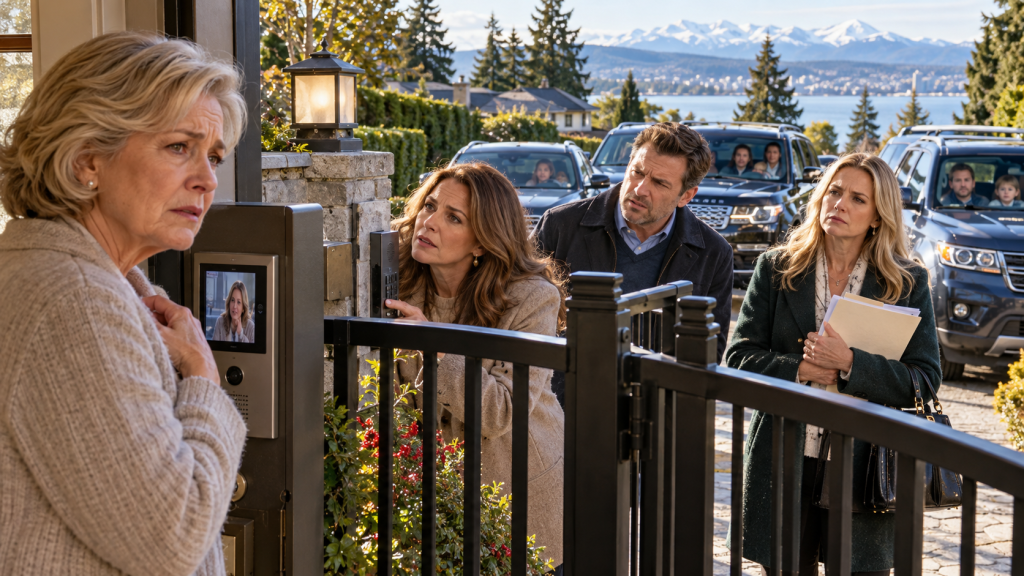
“Mom,” he said carefully, “you need to open the gate.” “No.” “You don’t understand what’s happening.” “That sentence has become very popular today.” Jessica turned toward Brandon. “What withdrawals?”
He ignored her.
Thomas didn’t.
“That is an excellent question.”
Jessica looked at him.
“Who are you?”
“Thomas Reed.”
Her expression tightened.
“I know who you are.”
“Then you know your mother retained me to revise her estate plan.”
Chloe stepped closer.
“What does that have to do with Brandon?”
Thomas held up the envelope.
“A great deal, potentially.”
Brandon snapped, “Don’t discuss private financial information in the driveway.”
Thomas glanced at the gate.
“Technically, I’m still outside the driveway.”
I almost laughed.
I didn’t.
Not yet.
The spouses had started getting out of their cars.
Jessica’s husband, Paul, walked toward the gate with his hands shoved into his coat pockets.
Chloe’s wife, Denise, remained near their SUV, one arm around their youngest child.
Brandon’s wife, Melissa, stood frozen beside their sedan.
She looked more confused than anyone.
That mattered.
Because Brandon had spent years pretending Melissa knew everything.
Apparently she didn’t.
My grandson Ethan walked toward his father.
“Dad, what’s going on?”
Brandon turned sharply.
“Get back in the car.”
Ethan stopped.
He was seventeen.
Old enough to know when adults were lying.
“Why?”
“I said get back in the car.”
I pressed the intercom.
“Ethan.”
He looked toward the camera.
“Hi, Grandma.”
The sadness in his voice nearly broke me.
“Sweetheart, none of this is your fault.”
Jessica’s eyes flashed.
“Mom, stop involving the kids.”
I stared at the monitor.
“You brought them.”
Silence.
That was the first truth of the afternoon nobody could argue with.
They had brought spouses.
Children.
Holiday bags.
A folder.
They had built the scene carefully.
Family reunion on one side.
One old woman behind a gate on the other.
They expected emotion to open what the code no longer could.
Thomas turned toward Brandon.
“I suggest we keep this simple.”
Brandon laughed bitterly.
“You’re threatening me on my mother’s property.”
“No.”
Thomas’s voice remained calm.
“I’m advising you that the audit identified transfers requiring explanation.”
Melissa looked at her husband.
“What transfers?”
Brandon exhaled.
“Nothing illegal.”
“That wasn’t the question.”
she said.
He looked at her.
“Melissa, please.”
“No.”
Her voice changed.
“What transfers?”
The forensic accountant stepped forward.
Her name was Nina Patel.
Small woman.
Gray wool coat.
Glasses.
She had spent the previous month studying years of statements David Vance’s firm had apparently assumed no one would ever examine closely.
Nina said:
“Mrs. Whitmore’s investment trust showed multiple distributions to entities not listed among her authorized beneficiaries or ordinary expenses.”
Jessica frowned.
“What entities?”
Brandon snapped, “This is ridiculous.”
Nina looked at Thomas.
He nodded.
She continued.
“One entity was North Peak Consulting.”
Melissa went pale.
I knew that name meant something to her.
“Brandon?”
He stared at Nina.
“What does that have to do with anything?”
Melissa whispered:
“North Peak was yours.”
Jessica turned.
“What?”
Brandon looked at his wife.
“You don’t know what you’re talking about.”
“Yes, I do.”
Melissa stepped away from him.
“You opened it when the startup failed.”
His face tightened.
“That was years ago.”
“How much?”
she asked Nina.
Nina opened her folder.
“Across twenty-six months, approximately one hundred and ninety-four thousand dollars.”
My throat tightened even though I already knew the number.
Hearing it aloud still hurt.
Not because of the money alone.
Because Robert had built that trust.
Carefully.
Quietly.
For me.
For my security.
The money had been his final way of continuing to care after he no longer could.
And someone had treated it like a family emergency fund with only one person’s name on the withdrawal slip.
Jessica stared at Brandon.
“One hundred and ninety-four thousand?”
“That is not what happened.”
Chloe looked sick.
“What happened then?”
Brandon turned toward the camera.
“Mom, open the gate.”
“No.”
“We can explain this inside.”
“You can explain it from exactly where you are.”
His jaw clenched.
The old Brandon would have charmed.
The teenage Brandon who once talked himself out of detention.
The college Brandon who could explain a maxed credit card as “temporary timing.”
The thirty-eight-year-old Brandon who convinced Robert and me to invest in his first startup because he was “one contract away from scale.”
I knew the rhythm.
Calm first.
Then wounded pride.
Then anger.
Then blame.
“Fine.”
he said.
“Dad knew.”
Everything inside me went still.
“What?”
Brandon lifted his chin.
“Dad knew I needed help.”
My heart pounded.
“Robert died six years ago.”
“Yes.”
“The transfers began four years ago.”
Silence.
Brandon realized it too late.
Jessica closed her eyes.
Chloe whispered:
“Oh my God.”
Melissa stared at her husband.
Thomas said nothing.
He didn’t need to.
Brandon tried again.
“I meant Dad knew I might need financial help in the future.”
I almost laughed.
“You are forty-three years old.”
“What does that have to do with anything?”
“Your father did not create a ghost permission slip for you to steal from me after he died.”
“I didn’t steal.”
“Then explain.”
Brandon looked toward Nina.
“Those were loans.”
“Where are the loan agreements?”
Thomas asked.
“David handled it.”
My chest tightened.
There.
David.
Again.
The financial advisor I had trusted because Robert trusted him.
The man who sent Christmas baskets.
The man who sat in my living room after Robert’s funeral and said:
“You don’t need to worry about money, Eleanor. I’ll make sure everything stays exactly as Robert intended.”
Exactly as Robert intended.
I had replayed that sentence for three months.
Now it sounded rotten.
Jessica looked at Thomas.
“What exactly are you saying David did?”
Thomas glanced toward the camera, silently asking whether I wanted this discussed.
I pressed the speaker button.
“Tell them.”
He nodded.
“The audit suggests Mr. Vance approved distributions that exceeded his delegated authority.”
“To Brandon?”
Chloe asked.
“Some.”
“To who else?”
Nina answered.
“Two companies linked to Brandon.”
“One limited partnership in which Mr. Vance appears to have held a financial interest.”
“And several payments described as advisory fees that exceeded the trust’s management agreement.”
Jessica stared.
“How much?”
Nina looked down.
“The full amount under review is approximately four hundred and eighty-seven thousand dollars.”
No one spoke.
The snow kept falling.
My youngest granddaughter, Grace, began asking from the car why nobody was going inside.
Denise opened the rear door and distracted her with something.
Christmas music drifted faintly from one of the vehicles.
It made everything worse.
Jessica whispered:
“Half a million dollars?”
“Potentially.”
Nina corrected.
“Some payments may prove legitimate.”
“Others may not.”
Brandon snapped:
“You’re making this sound criminal.”
Thomas said:
“We haven’t used that word.”
“You brought a forensic accountant to my mother’s house on Christmas.”
“December twenty-third.”
Thomas replied.
“And you brought property-transfer papers.”
That stopped everyone.
I stared at the folder in Brandon’s hand.
“So we’re going back to that.”
Jessica glanced at the folder.
“It’s assisted-living paperwork.”
Thomas looked at her.
“Is it?”
Jessica hesitated.
“Mostly.”
I felt something cold move through me.
“Mostly?”
Chloe looked at her sister.
“Jess.”
Jessica sighed.
“Mom, don’t start.”
“Open the folder.”
Brandon’s grip tightened.
“No.”
“Then leave.”
“We came all this way.”
“I did not invite you.”
Paul finally spoke.
“Jessica, what’s actually in the folder?”
She glared at him.
“You knew.”
“I knew about brochures.”
“Not legal documents.”
His eyes sharpened.
“Did you bring legal documents?”
Jessica looked away.
That was answer enough.
I pressed the gate speaker again.
“Thomas.”
“Yes?”
“Can they put the folder through the parcel slot?”
Brandon immediately said:
“No.”
Jessica turned on him.
“Why not?”
“Because this is insane.”
“It’s Mom’s property.”
“She doesn’t need to review private planning documents with her lawyer hovering.”
I stared at the screen.
“You brought documents for my signature and don’t want my lawyer reviewing them.”
Brandon realized how it sounded.
Too late.
Thomas said:
“That alone would make me advise Mrs. Whitmore not to sign anything.”
Chloe stepped toward Brandon.
“Give me the folder.”
“No.”
“Brandon.”
“Back off.”
She stared at him.
“What is in there?”
He said nothing.
Melissa spoke quietly.
“Give her the folder.”
Brandon looked at his wife.
She had tears in her eyes now.
“I said give her the folder.”
He laughed bitterly.
“Everyone has suddenly decided I’m the villain.”
Jessica said:
“Then prove you’re not.”
For a moment, I almost felt sorry for him.
Not because he was innocent.
Because the family coalition had finally turned inward.
The three children who once presented themselves as a united front against my “dramatic loneliness” now looked at one another with suspicion.
That was the thing about shared selfishness.
It feels like solidarity until everyone realizes the terms were never equal.
Brandon held the folder out.
Jessica snatched it.
He said:
“Fine.”
She opened it.
At first her expression remained irritated.
Then confused.
Then frightened.
“Brandon.”
“What?”
“What is this?”
He looked away.
Jessica pulled out the first document.
“Power of attorney.”
My entire body went cold.
Chloe stepped closer.
“What?”
Jessica flipped another page.
“Durable financial power of attorney.”
Another.
“Authorization to list property.”
Another.
“Consent to senior-community admission.”
Paul stared.
“You said these were brochures.”
Jessica snapped:
“I didn’t prepare them.”
“Who did?”
Her eyes moved toward Brandon.
His silence said everything.
I had expected a sales agreement.
Maybe assisted-living paperwork.
I had not expected a power of attorney.
Thomas’s expression changed.
“Jessica.”
She looked at him.
“Check the signature lines.”
She did.
My name was printed beneath them.
No signature yet.
Thank God.
“Who drafted these?”
Thomas asked.
Jessica looked at the footer.
“Henderson Legal Group.”
Thomas frowned.
“I don’t know them.”
Brandon said:
“It’s a document service.”
“A law firm?”
“No.”
“Your mother already has counsel.”
“She wasn’t listening.”
My anger arrived so cleanly it almost felt peaceful.
“She wasn’t listening.”
I repeated.
Brandon looked toward the camera.
“That’s not what I meant.”
“Yes, it is.”
“Mom.”
“You mean I said no.”
His face tightened.
“That doesn’t mean you understand the consequences.”
There.
The sentence I needed.
Not because it surprised me.
Because it clarified everything.
Three months without a call.
Then one refusal to sell.
And suddenly my competence was negotiable.
I said:
“What consequences?”
“You’re alone in that house.”
“By choice.”
“You were hospitalized.”
“Overnight.”
“You have heart issues.”
“I have a managed arrhythmia.”
“You could fall.”
“So could you.”
“This is exactly what I mean.”
His voice rose.
“You’re being combative.”
I almost laughed.
“No.”
“I’m being seventy-one and disobedient.”
Jessica closed her eyes.
“Mom, please.”
“No.”
I stared at the camera.
“You all told me to stop calling.”
“You said you had your own lives.”
“So I listened.”
“And now three months later, you’re standing at my gate with paperwork designed to give you authority over mine.”
Chloe whispered:
“We didn’t know about the power of attorney.”
I looked at her.
“Did you know about selling the house?”
She hesitated.
“Yes.”
“Did you know I said no?”
Silence.
That was enough.
Jessica said:
“We thought once you saw the community—”
“I already said no.”
“We were worried.”
“After three months?”
Jessica flinched.
I continued.
“You were not worried when I went home from the hospital alone.”
“That isn’t fair.”
“No.”
My voice shook.
“It is precise.”
They had no answer.
Thomas held out his hand.
“Jessica, please slide the documents through.”
She looked at Brandon.
Then me.
Then placed the folder in the locked parcel drawer built into the gate.
The security guard retrieved it from my side and handed it to Thomas through the pedestrian access.
Thomas examined the first page.
His face hardened.
“This is worse than I expected.”
My stomach tightened.
“What?”
He turned the paper.
“There’s a physician-certification attachment.”
I stared.
“What physician?”
He read.
“Dr. Leonard Ashford.”
I had never heard the name.
Jessica frowned.
“Who is that?”
Brandon’s face changed.
Tiny.
Enough.
Thomas saw it.
“So you know him.”
Brandon said:
“He consults for Evergreen Meadows.”
The assisted-living community.
Thomas continued reading.
“This form states that Mrs. Whitmore demonstrates signs of impaired judgment following recent hospitalization and may benefit from financial supervision.”
My heart began pounding.
“I have never met that doctor.”
Thomas nodded.
“The form is unsigned.”
“Then it means nothing.”
Brandon said quickly.
Nina looked at him.
“Why is it in the packet?”
He said nothing.
Thomas flipped farther.
“There’s also a draft petition for guardianship.”
The entire driveway froze.
Even I stopped breathing.
Jessica turned toward her brother.
“What?”
Chloe whispered:
“No.”
Brandon snapped:
“It was a backup.”
“A backup for what?”
Jessica demanded.
“If Mom refused everything.”
No one spoke.
Then Melissa slapped him.
Not hard.
Not theatrical.
A single stunned strike across the face.
Brandon looked at her.
She was crying.
“You told me we were coming for Christmas.”
He touched his cheek.
“Melissa.”
“You said your mother was becoming confused.”
“I was worried.”
“You told me she had forgotten things.”
“She has.”
I pressed the speaker.
“Name one.”
He looked toward the camera.
“What?”
“One thing I forgot.”
“Mom.”
“Name it.”
“You repeat stories.”
“So do you.”
“You misplaced your medication once.”
“I put it in my travel bag.”
“You called Jessica twice in one afternoon.”
“She didn’t answer the first time.”
Silence.
I stared at him.
“Anything else?”
He looked away.
I had never felt more mentally sharp in my life.
Chloe covered her mouth.
Jessica’s expression was horrified.
“Guardianship?”
she whispered.
“You were going to ask a court to declare Mom incompetent?”
“Only if she refused reasonable planning.”
“That is not incompetence.”
“I said backup.”
“You said I was helping Mom move.”
Jessica looked like she might vomit.
“You told me we were doing this together.”
Brandon’s face twisted.
“You wanted the house sold too.”
Jessica stepped back.
“I wanted her to downsize.”
“You wanted your share.”
Her face changed.
My stomach dropped.
“What share?”
No one answered.
I pressed the speaker.
“Jessica.”
She stared at the camera.
“What share?”
Her eyes filled.
“Mom.”
I waited.
She whispered:
“Brandon said you were planning to distribute some assets early.”
I almost laughed.
“Did I?”
“No.”
“How much did he say?”
“After the house sold…”
She swallowed.
“One hundred thousand each.”
There it was.
Christmas came early.
Not from me.
From Brandon’s imagination.
Chloe turned toward him.
“You told me fifty.”
Jessica looked at her sister.
“What?”
Chloe’s face flushed.
“He said Mom wanted to give us fifty thousand each to help with the grandchildren.”
My chest tightened.
Brandon had not even kept the lie consistent.
Jessica stared.
“You told me a hundred.”
He snapped:
“Because your mortgage is higher.”
Paul laughed in disbelief.
“That makes it better?”
Brandon threw up his hands.
“Mom has millions.”
I felt the words hit me harder than I expected.
Not because the number was secret.
They knew enough.
Because he said it like wealth dissolved ownership.
Like money sitting near me belonged to the family gravitational field.
“Mom has millions.”
I repeated quietly.
“So?”
Brandon stared at the camera.
“So what are you protecting it for?”
There it was.
The ugliest question.
Not:
Are you safe?
Not:
Are you happy?
Not:
What do you want your remaining years to look like?
What are you protecting it for?
As if my life after motherhood required economic justification.
I answered slowly.
“Myself.”
He scoffed.
“You can’t spend all that.”
“Watch me live.”
“That’s not what I mean.”
“I know exactly what you mean.”
Thomas looked toward me through the gate.
His face softened.
Brandon continued.
“Dad built that for the family.”
“No.”
I said.
“Your father built the trust for me.”
“He built everything for us.”
“He loved you.”
“Yes.”
“He helped you.”
“Yes.”
“He did not appoint you owner of my old age.”
Brandon looked furious now.
“You’re giving it to charities.”
The driveway went silent again.
Jessica turned toward him.
“What?”
Chloe looked at me.
“Mom?”
Brandon’s expression told me he realized he had said too much.
I pressed the speaker.
“How do you know that?”
He froze.
No answer.
“How do you know what my new estate plan says?”
Jessica looked at him.
“Brandon?”
He looked away.
My heart started pounding.
Thomas became very still.
Then he asked:
“Who told you?”
Brandon said nothing.
Nina whispered:
“David.”
I closed my eyes.
Of course.
David.
The formal notice to David’s firm had included enough to show he was being removed.
Not my new will.
Not the charities.
Unless someone had accessed drafts.
Thomas turned toward Nina.
“Could David have seen the revised estate documents?”
“No.”
she said.
“Not through the trust transfer.”
Thomas looked at me.
“Eleanor, did anyone else have access to your email during the revision process?”
I thought.
Old passwords.
Shared family recovery email.
Brandon once helped me set up my tablet after Robert died.
My stomach turned.
“I changed everything three months ago.”
“What about before?”
“I don’t know.”
Thomas’s face hardened.
“We need to check.”
Brandon snapped:
“This is paranoid.”
Thomas looked at him.
“You just revealed information your mother did not share with you.”
Brandon’s face reddened.
“I guessed.”
“You guessed specific charitable beneficiaries?”
“I didn’t name them.”
“You knew the residue no longer went to the children.”
Silence.
Jessica looked broken.
“What did you do?”
she asked him.
He said nothing.
Then Ethan spoke.
From behind his father.
“Dad.”
Everyone turned.
My grandson stood beside the sedan.
His face was pale.
“I saw your laptop.”
Brandon froze.
“Get in the car.”
“No.”
“Ethan.”
“You had Grandma’s email open.”
Melissa stared at him.
“When?”
Ethan looked frightened now.
“Last month.”
Brandon stepped toward him.
“Stop talking.”
The security guard shifted closer to the gate.
I pressed the intercom.
“Brandon.”
He stopped.
“Do not intimidate my grandson on my property.”
“I’m his father.”
“You are at my gate.”
He looked at the camera.
For the first time that afternoon, he seemed to understand he was not in control.
Ethan continued.
“I thought Grandma sent something.”
“What did you see?”
I asked.
He looked at me.
“An email from Mr. Reed.”
Thomas went still.
“What subject?”
Ethan tried to remember.
“Something about estate revision.”
My stomach turned.
Brandon snapped:
“He’s a kid.”
Ethan’s face hardened.
“I’m seventeen.”
“Yes.”
his father said.
“And you don’t understand any of this.”
I heard myself laugh.
“That sentence seems hereditary.”
Melissa said:
“Did you access Eleanor’s email?”
Brandon looked at his wife.
“No.”
Ethan whispered:
“You had her inbox open.”
“I was helping her.”
“I hadn’t spoken to you in three months.”
I said.
Brandon looked toward the camera.
“Old login.”
The admission came so quietly some people missed it.
Thomas didn’t.
“What?”
Brandon exhaled.
“You had an old tablet account.”
“I logged in months ago.”
“Why?”
“To make sure bills weren’t being missed.”
I almost could not believe the arrogance.
“You secretly read my email to make sure I paid bills?”
“You were getting older.”
“You were forty-three and apparently stealing from a trust.”
He flinched.
Thomas stepped toward the gate.
“When did you last access her account?”
“I don’t remember.”
“Did David Vance ask you for information from it?”
“No.”
“Did you send David anything?”
“No.”
Nina looked at him.
“Mr. Vance emailed North Peak Consulting from his private address sixteen times.”
Brandon’s face changed.
Jessica whispered:
“You and David were working together.”
Brandon snapped:
“We discussed investments.”
“With Mom’s money?”
“Family money.”
I felt something in me break.
Not shatter.
Settle.
The last excuse I had been preserving for him disappeared.
This was not desperation.
Not one mistake.
Not a son borrowing money and intending to repay.
He had created a philosophy.
Family money.
Meaning:
Available to him.
Thomas spoke calmly.
“Brandon, I strongly recommend you stop discussing this in public.”
Brandon laughed bitterly.
“Now you’re protecting me?”
“No.”
“I’m protecting Eleanor’s future case.”
That silenced him.
The family stood in the snow.
No one wanted Christmas anymore.
I looked at my grandchildren.
Ethan.
Grace.
Little Oliver.
Jessica’s two daughters.
Chloe’s youngest boy.
They had been brought to soften me.
Now they were witnessing adults unravel over money they did not own.
I hated that.
I pressed the speaker.
“Children and spouses can come inside.”
Everyone looked up.
Jessica stared.
“What?”
“Not you three.”
Her face crumpled.
“Mom.”
“You heard me.”
“The grandchildren can come inside.”
“Spouses too, if they want.”
“Jessica, Brandon, Chloe—you leave.”
Chloe whispered:
“Mom, I didn’t know about half of this.”
“You knew I said not to come.”
She looked down.
“That is enough for today.”
“What about Christmas?”
I swallowed.
“We will discuss Christmas when respect exists again.”
Jessica started crying.
“You’re punishing us.”
“No.”
I shook my head.
“I am enforcing the boundary you refused to hear before you drove here.”
Paul looked at his wife.
“I’m taking the girls in.”
Jessica stared.
“What?”
“They came to see their grandmother.”
She looked betrayed.
“I’m their mother.”
“And Eleanor is their grandmother.”
He walked toward the gate.
I buzzed the pedestrian entrance.
The guard checked him.
Then the girls ran through.
My oldest granddaughter, Ava, reached the porch first.
I opened the door.
She hugged me.
“Grandma.”
That nearly ended me.
“I thought you were sick.”
I pulled back.
“Who told you that?”
She looked toward the gate.
“Mom said you were forgetting things.”
I closed my eyes.
Of course.
Paul looked mortified.
“I didn’t know she said that.”
“It’s okay.”
“No.”
he said.
“It isn’t.”
The other grandchildren came in gradually.
Not all spouses did.
Melissa remained with Brandon.
Not beside him.
Several feet away.
Denise brought Chloe’s children through, then stayed inside.
Jessica stood outside crying.
Chloe looked stunned.
Brandon looked furious.
I did not feel triumphant.
That surprised me.
I had imagined revenge many times over those three silent months.
Imagined making them understand.
Imagined them needing me and finding the door closed.
Reality felt different.
Sad.
Mostly sad.
Because boundaries are not victory over people you love.
Sometimes they are the last structure preventing love from becoming permission.
I watched Thomas hand Brandon a formal notice.
“What’s that?”
Jessica asked.
Thomas answered:
“Preservation notice.”
“For what?”
“Electronic records.”
Brandon laughed.
“You’re serious.”
“Completely.”
Nina added:
“The audit has already been referred to the corporate trustee’s legal department.”
His face went white.
“So you planned this confrontation.”
I pressed the speaker.
“No.”
“I planned to keep you out.”
“You brought the rest yourself.”
That was the last thing I said to them that afternoon.
The security guard escorted the three adults away from the pedestrian gate.
Their spouses made separate decisions.
Paul stayed with the girls.
Denise stayed with Chloe’s children.
Melissa eventually looked at Brandon.
“I’m taking Ethan and Oliver home separately.”
He stared.
“What?”
“I need space.”
“This is my mother’s manipulation.”
I watched from the window.
Melissa looked at him with something I recognized.
The moment a person finally hears a familiar sentence differently.
“No.”
she said.
“I think this is yours.”
She took the car keys from his hand.
He didn’t stop her.
By three-thirty, the cars were gone.
The house filled with grandchildren.
Shoes by the door.
Coats piled on chairs.
Ava asking whether I still had the Christmas puzzle.
Grace looking for hot chocolate.
Ethan sitting silently near the window.
For the first time that day, I felt old.
Not mentally.
Physically.
The adrenaline left.
My hands shook.
Thomas noticed.
“Sit down.”
“I’m fine.”
“Sit.”
“I pay you.”
“And you should get value.”
I sat.
He checked my pulse because apparently lawyers become nurses when clients terrify them.
Nina brought water.
Paul made coffee.
It was absurdly domestic after financial warfare.
Then Ethan came toward me.
“Grandma.”
“Yes, sweetheart?”
“I’m sorry.”
My heart tightened.
“For what?”
“I knew Dad had your email open.”
“You are not responsible for your father.”
“I should’ve told someone.”
“You thought he had permission.”
He nodded.
“He said you asked him to keep an eye on things.”
“Then you had no reason to think otherwise.”
He looked toward Thomas.
“Can I tell you something?”
Thomas glanced at me.
I nodded.
Ethan sat.
“Dad asked me to reset Grandma’s old tablet.”
“When?”
“October.”
“What did he ask specifically?”
Thomas said.
“He said he needed an old password from it.”
I felt sick.
“Did you find one?”
“Yes.”
“Which?”
“I don’t know exactly.”
“I opened the password manager.”
“Dad took over after that.”
Thomas wrote it down.
“Did he say why?”
“He said Grandma was having trouble with accounts.”
I touched Ethan’s hand.
“You did nothing wrong.”
He looked like he didn’t believe me.
“Dad said you were forgetting things.”
“Do I seem confused?”
He almost smiled.
“No.”
“Good.”
“Except you still keep batteries in the refrigerator.”
I stared.
“Your grandfather did that.”
“Why?”
“I have no idea.”
He laughed.
The sound loosened something inside me.
Then he became serious.
“Are you cutting Dad off?”
Children—even nearly grown ones—understand money before adults think they do.
I answered carefully.
“I am removing his authority over my finances.”
“That’s not what I asked.”
I smiled sadly.
“You sound like Robert.”
He looked at me.
“Is he getting nothing?”
“Your father’s inheritance is private.”
Ethan nodded.
“But you’re still paying for our college?”
There it was.
Not greed.
Fear.
I took his hand.
“The education accounts are protected for you.”
“All of you.”
“No parent can take them.”
His shoulders dropped.
“Okay.”
Then he looked ashamed.
“I don’t care about money.”
“I just…”
“You want to know your future didn’t disappear because adults made a mess.”
“Yes.”
“It didn’t.”
He hugged me.
That was exactly why I created the 529 accounts separately.
My grandchildren would not be collateral damage in a war over entitlement.
That evening, after the families left, Thomas stayed.
Nina too.
We sat at my kitchen island.
The same place I had cried after my children told me to stop calling.
Thomas opened the folder from the gate.
“We need to discuss the guardianship draft.”
I felt tired all the way through.
“Was it real?”
“Not filed.”
“Could they have filed it?”
“Anyone can file many things.”
“Winning is different.”
I looked at him.
“Would they have won?”
“No competent attorney should promise outcomes.”
I rolled my eyes.
“Thomas.”
He sighed.
“Based on what I know?”
“Yes.”
“Unlikely.”
My shoulders dropped.
“But.”
I glared.
“I hate but.”
“I know.”
He continued.
“A guardianship petition can still be disruptive.”
“Evaluations.”
“Hearings.”
“Stress.”
“And if they manufactured a narrative around cognitive decline…”
My stomach turned.
“Could they?”
“Your hospital visit gives them a fact.”
“Arrhythmia.”
“Not dementia.”
“Correct.”
“Your age gives them a fact.”
“Seventy-one.”
“Not incompetent.”
“Correct.”
“The danger is not the facts themselves.”
“It is the interpretation layered onto them.”
I thought of Jessica telling Ava I was forgetting things.
Brandon telling Melissa I was confused.
Chloe pushing assisted living.
A story.
They had begun building a story.
Maybe not all knowingly.
But together.
“What do we do?”
“Document capacity.”
The next morning, Christmas Eve, I met with a geriatric psychiatrist Thomas trusted.
Not because I believed I was impaired.
Because I wanted evidence before accusation became strategy.
The evaluation was exhausting.
Memory tests.
Attention.
Executive function.
Reasoning.
Independent living.
Financial understanding.
Medical history.
I passed.
Not perfectly.
I forgot one word after ten minutes.
I mixed up a date.
Apparently normal human beings are allowed to do that.
The report concluded I had intact decision-making capacity and no evidence of major neurocognitive disorder.
I laughed when I read it.
“What?”
Thomas asked.
“I paid nine hundred dollars for permission to forget where I left my glasses.”
He smiled.
“Worth every penny.”
Christmas Day was quiet.
None of my children came.
The grandchildren called.
All of them.
That mattered.
Jessica sent one text.
Merry Christmas. I’m sorry things got out of hand.
Got out of hand.
Passive grammar.
No subject.
No ownership.
I did not answer.
Chloe sent:
I’m sorry I ignored your no. I’m not asking you to respond. Merry Christmas.
Better.
I replied:
Merry Christmas.
Nothing more.
Brandon sent nothing.
Two days later, Melissa called.
“Can I come by?”
I hesitated.
“Alone?”
“Yes.”
I let her.
She sat at my kitchen table.
No makeup.
Exhausted.
“I left.”
My chest tightened.
“Brandon?”
She nodded.
“For now.”
“I’m sorry.”
“I’m not sure I am.”
She looked at me.
“I found things.”
“What things?”
“North Peak.”
“Emails.”
“Loans.”
My stomach turned.
“Loans from whom?”
“Friends.”
“Two former employees.”
“My brother.”
I closed my eyes.
“How much?”
“I don’t know yet.”
She started crying.
“He kept telling me we were recovering.”
“From what?”
“Everything.”
“The startup.”
“Taxes.”
“Investment losses.”
“But there was always another hole.”
I reached for her hand.
She pulled out a flash drive.
“I copied the laptop.”
My pulse jumped.
“Melissa.”
“I know.”
“Talk to your lawyer before handing this to anyone.”
“I did.”
That surprised me.
“She said preserve it.”
“Good.”
Melissa wiped her face.
“Eleanor, did Robert really leave Brandon anything?”
I looked at her.
“Robert left each child some money directly.”
“How much?”
“That is between Robert’s estate and them.”
She nodded.
“Brandon told me his father cut him out.”
My heart sank.
“No.”
“Not even close.”
“How much?”
I hesitated.
Then told her because their finances had intertwined.
“About one hundred and twenty thousand dollars.”
Her face went blank.
“He told me he got twelve.”
I stared.
“What happened to it?”
She laughed bitterly.
“I think I married it.”
That sentence haunted me.
The audit grew.
Slowly.
Painfully.
David Vance’s firm placed him on leave.
Then terminated him after an internal review found undisclosed conflicts.
He had approved distributions to entities connected to Brandon without documentation required by the trust.
He also routed advisory fees to a partnership in which he had a hidden interest.
David insisted the trust permitted broad discretion.
The corporate trustee disagreed.
Lawyers got involved.
Then regulators.
I was interviewed twice.
The first investigator asked:
“Did you authorize the North Peak distributions?”
“No.”
“Did you know Brandon owned North Peak?”
“No.”
“Did you authorize loans to your son?”
“No.”
“Did David ever describe those payments as loans?”
“No.”
“Did you receive annual statements?”
“Yes.”
“Did you review them?”
That question embarrassed me.
“Not closely.”
“Why?”
“I trusted him.”
The investigator nodded.
Not judgmental.
Still, I felt foolish.
After Robert died, numbers hurt.
Statements felt like evidence he was gone.
David always summarized.
“Everything looks healthy.”
“You’re ahead of plan.”
“Nothing to worry about.”
So I didn’t worry.
That was exactly what Brandon and David relied on.
The second investigator asked about the estate documents.
“Did Brandon have permission to access your email?”
“No.”
“Had he ever had permission?”
“To help set up devices years earlier.”
“Did you revoke that?”
“I changed passwords three months ago.”
They traced access logs.
A device registered to Brandon had accessed my old cloud account four times before the password change.
One access occurred two days after Thomas emailed me an early summary of revised estate planning goals.
Brandon had seen it.
He knew.
That explained Christmas.
Not love.
Not sudden concern.
Panic.
My children had gone three months without calling.
Then Brandon learned the inheritance structure had changed.
Two weeks later, the family reunion appeared at my gate.
That timing became impossible to ignore.
Jessica came alone in January.
She did not call first.
She stood outside the gate.
This time, she used the intercom.
Progress.
“Mom?”
I answered.
“Yes?”
“Can I come in?”
I almost said no.
Then:
“Are you alone?”
“Yes.”
I opened the pedestrian gate.
She walked up the driveway carrying nothing.
No folder.
No brochures.
No grandchildren.
Just herself.
Inside, she stood awkwardly in the foyer.
“Coffee?”
I asked.
She started crying.
That surprised me.
“I don’t deserve coffee.”
“That is a dramatic relationship with beverages.”
She laughed through tears.
Then sat at the kitchen island.
Same island.
Apparently my family could only heal near granite.
She looked at me.
“I’m sorry.”
“For?”
“Not coming to the hospital.”
I went still.
Of all the things.
That was where she began.
“I kept telling myself it wasn’t serious.”
“It might not have been.”
“That’s not the point.”
No.
It wasn’t.
Jessica wiped her face.
“I saw the text.”
“I thought, Mom is okay.”
“Then I had a meeting.”
“Then another.”
“Then I forgot.”
Her voice cracked.
“I forgot my mother was scared.”
I stared.
“Thank you for saying it correctly.”
She cried harder.
“Then when you kept calling, I started feeling guilty.”
“And instead of dealing with guilt, I made you annoying.”
That was painfully accurate.
“I told myself you were lonely.”
“You were.”
“But I turned loneliness into a character flaw.”
I looked down.
Jessica continued.
“When Brandon started talking about selling the house, it sounded reasonable.”
“You live alone.”
“The place is huge.”
“Maintenance.”
“Security.”
“All real things.”
“Yes.”
“But then he said Dad’s trust could be distributed if you moved.”
I stared.
“He said that?”
“Yes.”
“He told me the trust had restrictions tied to the residence.”
“That is completely false.”
“I know now.”
“He told me selling would ‘unlock family liquidity.’”
I laughed despite myself.
“That sounds like Brandon.”
Jessica gave a broken smile.
“I wanted the hundred thousand.”
There.
She said it.
Not:
I was concerned.
Not:
I wanted you safe.
“I wanted the money.”
My chest hurt.
“Why?”
“Paul’s business had a terrible year.”
“We’re carrying credit-card debt.”
“One daughter starts college soon.”
“I was scared.”
“So you looked at my house.”
“Yes.”
“Instead of telling me.”
“Yes.”
“Why?”
“Pride.”
She stared at her hands.
“And entitlement.”
I waited.
“I thought…”
She swallowed.
“I thought eventually it would be ours anyway.”
That sentence hurt.
She knew it would.
“I’m sorry.”
I looked toward the window.
The garden Robert planted.
The fence.
The gate.
Everything I had built a life inside.
“Jessica.”
“Yes?”
“I will die someday.”
She closed her eyes.
“I know.”
“When I do, there will be property.”
“Money.”
“Things.”
“But I am not dead now.”
Tears slid down her face.
“I know.”
“No.”
“I need you to really know.”
I leaned forward.
“My life is not the waiting room before your inheritance.”
She covered her mouth.
“I’m sorry.”
“I believe you are.”
She looked up.
“Can you forgive me?”
“Not today.”
Her face tightened.
I continued.
“But you may come back.”
She cried.
“That’s more than I expected.”
“Good.”
We started there.
Chloe came two weeks later.
Her apology was different.
She had wanted me to move.
That part she still believed.
“I think the house is too much.”
I stared.
She raised both hands.
“I know.”
“I know.”
“You said no.”
“Yes.”
“And I ignored it.”
“Yes.”
“I thought being right about safety made the boundary optional.”
That was thoughtful.
“I’m sorry.”
I looked at her.
“Why didn’t you call for three months?”
She cried immediately.
“Because after the group call, I was embarrassed.”
“You should have been.”
“I know.”
“I kept thinking you’d call first.”
I almost laughed.
“You told me not to.”
“Yes.”
“And then every week that passed made it harder.”
That sounded familiar.
Families can become silent simply because everyone is waiting for someone else to tolerate humiliation first.
“What did Brandon tell you?”
I asked.
“That you were changing the will.”
“Did that bother you?”
“Yes.”
“Why?”
“Because it felt like punishment.”
“Was it?”
“I don’t know.”
I thought.
“No.”
“It was protection.”
“From us?”
“From dependency.”
Chloe looked down.
“What did you leave me?”
I almost smiled.
“There it is.”
She laughed through tears.
“Sorry.”
“Photo albums.”
Her face softened.
“Which ones?”
“Your childhood.”
“Family trips.”
“Your grandmother’s recipe book.”
Chloe started crying harder.
“I thought you hated me.”
“No.”
“I was angry.”
“There is a difference.”
“What about money?”
“Your children have education trusts.”
“You do not control them.”
She nodded.
“That’s fair.”
“And you?”
She looked at me.
“I don’t need to know.”
That answer mattered.
Brandon did not come.
Instead, his lawyer did.
Letter after letter.
Demanding access to records.
Questioning the trust transfer.
Threatening to challenge my competency.
Claiming undue influence by Thomas.
It was almost impressive.
He had transformed from concerned son to adversarial party without one conversation about how I felt.
Thomas answered everything.
Calmly.
Then the capacity report stopped the loudest claims.
Not completely.
But enough.
The unauthorized-email evidence hurt Brandon more.
So did North Peak.
Melissa filed for separation.
Then divorce.
Brandon’s business accounts were frozen during parts of the investigation.
David cooperated in exchange for reduced exposure in certain proceedings.
That was how we learned the full history.
The first unauthorized distribution had been small.
Twenty thousand.
Brandon told David I knew.
David believed him—or chose to.
The second was thirty-five thousand.
Then fifty.
At some point, David realized I had not authorized them directly.
Instead of stopping, he created internal notes describing distributions as “family-directed investment support.”
No family directive existed.
Brandon promised future business to David’s private partnership.
They blurred lines until dishonesty became administration.
The total loss attributed to their arrangement ended up lower than the preliminary four hundred and eighty-seven thousand because some advisory payments were contractually permitted.
The amount ultimately challenged as unauthorized or excessive was approximately three hundred and seventy-two thousand dollars.
A lot.
Not everything.
Enough.
Brandon’s share traced to just under two hundred thousand.
He had repaid almost none.
David’s firm settled civil claims.
Insurance covered part.
David personally paid restitution under a negotiated settlement and later pleaded guilty to charges tied to falsified records and fiduciary misconduct.
Brandon faced separate charges related to access, false representations, and financial transactions.
The case was slower.
Messier.
His lawyers argued David held discretion.
Argued Brandon believed I had authorized support.
Argued family practices had always included parental financial assistance.
Some of that was true.
Robert and I had helped.
Repeatedly.
That history became Brandon’s defense.
And, emotionally, his trap.
We had rescued him so often he had stopped distinguishing help from entitlement.
At one hearing, his attorney asked me:
“Mrs. Whitmore, you previously gave your son substantial financial assistance?”
“Yes.”
“More than fifty thousand dollars over the years?”
“Yes.”
“More than one hundred thousand?”
“With startup investments, probably.”
“So financial support was common.”
“Yes.”
“And your husband also supported him?”
“Yes.”
“Then why would Mr. Whitmore believe later trust distributions were unauthorized?”
I looked at him.
“Because asking is different from taking.”
Silence.
His attorney tried again.
“You had historically been generous.”
“Yes.”
“Your son may have expected continued support.”
“He may have.”
“So this could have been a misunderstanding.”
“No.”
“Why not?”
“Because people who misunderstand permission ask.”
The courtroom became quiet.
I continued.
“People who know they don’t have permission hide.”
That ended the question better than Thomas ever could have coached me.
Brandon eventually accepted a plea agreement.
No dramatic trial.
No life sentence.
Financial offenses rarely end the way television teaches people to expect.
He pleaded guilty to a reduced set of charges involving unauthorized access and fraudulent representations connected to the transactions.
He received restitution obligations, probation, community service, and a suspended custodial sentence with strict conditions.
Some people online would have called it too lenient.
Some too harsh.
I did not care anymore.
The important consequence was not prison.
It was that the lie became official.
Written.
Acknowledged.
He could no longer call it borrowing.
He could no longer call it family money.
He could no longer call me confused.
At sentencing, Brandon asked to speak.
I almost left.
Then stayed.
He looked thinner.
Older.
Melissa sat behind me, not him.
Ethan sat beside her.
Brandon unfolded a paper.
Then folded it again.
He didn’t read.
“I thought my parents’ help meant I was safe.”
he said.
My throat tightened.
“When my first company failed, they helped.”
“When I had tax problems, they helped.”
“When I needed a down payment, they helped.”
“Every time I fell, somebody put a floor under me.”
He looked at me.
“I started thinking the floor belonged to me.”
I closed my eyes.
That sentence hurt because it was true.
He continued.
“After Dad died, I thought Mom would keep doing what they always did.”
“She didn’t know I was taking money.”
“I knew that.”
There.
No excuse.
“I told myself she would say yes if I asked.”
“So I skipped the part where she got to answer.”
My eyes filled.
“I was angry when she changed her estate plan because I thought she was taking away something that had been mine.”
He paused.
“It was never mine.”
I cried.
Quietly.
Not forgiveness.
Recognition.
Brandon looked toward Ethan.
“I also told my children their grandmother was confused because I needed them to believe I was protecting her.”
Ethan looked down.
“That was wrong.”
Brandon’s voice broke.
“I am sorry.”
He finished.
No plea for mercy.
No claim of good intentions.
Just stopped.
The judge imposed the agreed sentence with additional conditions.
Afterward, Brandon did not approach me.
Good.
For once, he respected distance.
Months passed.
Then a letter arrived.
I knew his handwriting.
I left it unopened for twelve days.
Finally, I read.
Mom,
I have written six versions of this and deleted all of them because every one became an explanation.
I don’t think you need an explanation.
You need the truth.
I stole permission.
That is what I did.
Maybe not in the way I once understood stealing.
I didn’t break into a safe.
I didn’t think of myself as taking from a stranger.
That made it easier.
I treated your history of helping me as permanent consent.
When you stopped calling, part of me felt relieved.
Then I learned you changed your documents, and I panicked.
Not because I thought you were sick.
Because I realized you could build a future that did not revolve around us.
I hated that.
I told myself it was concern.
It wasn’t.
I am sorry for the money.
I am sorrier for trying to make you doubt your right to decide what happened to your own life.
I do not expect an answer.
Brandon.
I read it twice.
Then put it in a drawer.
I did not answer.
Not yet.
By then, something unexpected had happened.
I had built a life.
Not a life after children.
A life beside them.
Different.
I joined a cardiac-rehab walking group after my doctor cleared me.
At first I hated it.
Everyone was too cheerful at eight in the morning.
Then I met Ruth.
Seventy-four.
Widowed.
Profane.
Wonderful.
She asked why I had cameras around my gate.
I told her the short version.
She stared.
“Your kids tried to put you in assisted living for your money?”
“Not exactly.”
“That sounds exactly enough.”
I laughed so hard my chest hurt.
We became friends.
Then came pottery classes.
Terrible pottery.
My first bowl leaned like it had survived an earthquake.
I kept it.
I traveled with Ruth to Vancouver.
Took a train down the coast.
Started hosting Sunday dinners once a month.
Not mandatory.
No guilt.
Whoever came, came.
Jessica came first.
Then Chloe.
Then grandchildren.
Sometimes Paul.
Sometimes Denise.
Melissa once.
Brandon did not.
Not for almost two years.
The first Sunday Jessica arrived, she stood on my porch holding flowers.
“I brought nothing requiring signature.”
I laughed.
“Come in.”
Chloe arrived with dessert.
Ava brought a friend.
The house filled again.
Not because I chased everyone.
Because invitations are different from demands.
That distinction changed everything.
I stopped calling three times if nobody answered.
I called once.
Left a message.
Then continued my day.
Jessica learned to call back.
Not always immediately.
But reliably.
Chloe began visiting without suggesting real estate.
The first time she noticed a loose railing, she said:
“Want help fixing that?”
Not:
“You can’t manage this house.”
I nearly hugged her for the grammar alone.
“Yes.”
I said.
“I want help.”
Choice.
Such a small word.
Such a large difference.
My grandchildren’s education accounts grew.
Protected.
Independent.
Each child received a letter when they turned eighteen explaining the money came from Robert and me because education should not depend on family conflict.
No child was asked to choose sides.
Ethan used part of his account for engineering school.
Before he left, he came to my house alone.
“Grandma.”
“Yes?”
“Dad says he understands if I don’t talk to him.”
I waited.
“Do you?”
he asked.
“Do I what?”
“Think I should.”
I shook my head.
“That relationship is yours.”
“What if talking to him hurts Mom?”
“Then talk to your mother.”
“What if not talking hurts Dad?”
“His hurt is not automatically your obligation.”
Ethan smiled sadly.
“You say things like a therapist now.”
“I paid enough for one.”
He laughed.
Then:
“Do you forgive him?”
Everyone asks that eventually.
“I don’t know.”
“Still?”
“Yes.”
“I love him.”
“I’m angry.”
“I believe he is changing.”
“I don’t trust him with my finances.”
“All of those fit.”
Ethan nodded.
“I think I want to see him.”
“Then see him.”
“You’re okay?”
“My permission is not required.”
He hugged me.
That became another lesson I had learned late.
Parents sometimes confuse influence with ownership too.
Brandon had inherited more from our family than he alone created.
Robert and I had rescued too quickly.
Answered too often.
Paid before asking what consequences might teach.
We loved.
But love can accidentally train helplessness when help never has boundaries.
That was mine to own.
Not his theft.
Mine was different.
I could acknowledge it without excusing him.
When Brandon completed probation, he asked Thomas to pass along a request.
Not direct contact.
A request.
Progress again.
“He wants to come to Sunday dinner.”
Thomas said.
I stared.
“Why are you still involved in my family?”
“Because apparently retirement was too peaceful.”
I smiled.
“Do you think I should let him?”
Thomas looked offended.
“I am not answering that.”
“Coward.”
“Lawyer.”
I thought for a week.
Then told Jessica:
“Tell him yes.”
The Sunday Brandon returned, he arrived at four fifty-eight.
Two minutes early.
He stood outside the gate.
Did not try the old code.
Did not touch the keypad.
He pressed the intercom.
“Mom?”
My throat tightened.
“Yes?”
“May I come in?”
Three years earlier, he had stood in the same place demanding:
Open the gate.
Now:
May I come in?
I buzzed him through.
He walked slowly to the porch.
No folder.
No wife.
No children used as shields.
Just Brandon.
He looked older.
So did I.
For a moment, we stared.
Then he said:
“Hi, Mom.”
“Hi.”
He didn’t hug me.
That was right.
Inside, Jessica was setting the table.
Chloe was arguing with Ruth about wine.
Yes, Ruth had infiltrated the family.
She looked at Brandon and said:
“So you’re the idiot.”
I nearly died.
Brandon stared.
Then laughed.
“That’s me.”
Ruth handed him plates.
“Good.”
“Be useful.”
He did.
Dinner was awkward.
Then less awkward.
Nobody mentioned money for forty minutes.
A family record.
After dessert, the grandchildren went outside.
Jessica and Chloe cleared dishes.
Brandon stayed seated.
“Can I ask something?”
I nodded.
“Why twenty-nine percent?”
I frowned.
“What?”
He smiled faintly.
“Sorry.”
“Different story.”
I stared.
He laughed properly.
For the first time in years.
Then he became serious.
“Why charities?”
I knew what he meant.
“The estate.”
“Yes.”
I looked at him.
“Because I wanted my final decisions to reflect my life, not manage your reactions.”
He nodded.
“Which charities?”
“Cardiac research.”
“A women’s shelter.”
“A scholarship fund.”
“Food access.”
“Some local arts programs.”
He smiled.
“Dad would hate arts funding.”
“Exactly why I included it.”
Brandon laughed.
Then:
“Did you leave us anything?”
I raised an eyebrow.
He flushed.
“That sounded terrible.”
“It sounded honest.”
He looked at his hands.
“Sentimental things?”
“Yes.”
“Your father’s watch goes to you.”
His eyes filled.
“Really?”
“Yes.”
“Why?”
“Because he loved you.”
Brandon swallowed.
“Even after everything?”
“Your father died before everything.”
“I know.”
“But even if he hadn’t…”
I stopped.
Then continued.
“Love and trust are not the same account.”
He looked at me.
That landed.
“You can love someone and not hand them the keys.”
“Yes.”
I said.
“That took me seventy-one years.”
He cried quietly.
“I’m sorry.”
“I know.”
“I don’t expect the will changed back.”
“Good.”
He almost smiled.
“I mean it.”
“I know.”
“Then why does it still hurt?”
I thought.
“Because consequences can be correct and still hurt.”
He nodded.
That night, before leaving, he stopped at the gate.
He turned.
“Mom?”
“Yes?”
“I didn’t bring the code.”
I looked at him.
“I know.”
“I almost asked.”
“Why didn’t you?”
“Because it’s your gate.”
That sentence mattered more than money.
He left.
The code stayed private.
Years passed.
My health stabilized.
The arrhythmia became one of those conditions that sounds scarier than it feels most days.
I hired help when I wanted it.
Gardener.
Housekeeper twice a month.
A driver after night appointments.
Not because my children ordered it.
Because Brandon had accidentally been right about one thing years ago.
I had enough money to make life easier.
The difference was I chose how.
At seventy-five, I finally considered moving.
Chloe nearly swallowed her tongue when I told her.
“To assisted living?”
“No.”
She recovered.
“Okay.”
“A smaller condo.”
“Near the water.”
Jessica stared.
“You want to sell?”
“Yes.”
“Are you sure?”
I laughed.
“Look at you.”
“What?”
“You asked.”
She smiled.
“I’m learning.”
The house sold for more than anyone expected.
Just over one million dollars.
At closing, I signed every page myself.
Thomas sat nearby.
Not because I needed supervision.
Because he had become family.
Afterward, I handed each child a small envelope.
They stared.
Brandon said:
“Mom…”
“Open it.”
Inside each was a check for ten thousand dollars.
Jessica started crying.
Chloe looked confused.
Brandon pushed his back.
“No.”
I smiled.
“Interesting.”
“What?”
“Years ago, you wanted a hundred thousand you thought you were owed.”
“Now you won’t take ten I’m choosing to give.”
He looked at me.
“I don’t want you thinking—”
“I know exactly what I think.”
I pushed it toward him.
“This is a gift.”
“Not inheritance.”
“Not rescue.”
“Not permission for more.”
“A gift.”
He took it with both hands.
“Thank you.”
“Spend it badly.”
Jessica laughed.
“What?”
“I’ve spent years watching everyone optimize money.”
“Do something joyful.”
Chloe said:
“I’m taking the kids to Italy.”
“Excellent.”
Jessica smiled.
“I’m replacing our deck.”
“Boring.”
“It’s collapsing.”
“Fine.”
We looked at Brandon.
He held the check.
Then said:
“I’m buying a piano.”
I stared.
“You don’t play piano.”
“Dad wanted me to learn.”
“He paid for lessons.”
“You quit after six months.”
“I know.”
He smiled.
“I started again.”
That broke me unexpectedly.
Robert had loved piano.
Badly.
He played the same three songs every Christmas.
I started crying.
Brandon hugged me.
I let him.
Not because everything was erased.
Because enough had changed.
My condo was smaller.
One floor.
Secure entrance.
Balcony overlooking the water.
No gate.
At first I missed it.
The physical barrier had become symbolic.
Then one evening, Brandon came over.
He knocked.
Waited.
I opened the door.
No code needed.
No barrier.
Because by then, I trusted the knock.
That was different from trusting him with money.
Boundaries evolve.
They do not always stay walls.
Sometimes they become doors with hinges.
Jessica became my medical proxy again eventually.
Not because she demanded it.
Because five years after the Christmas gate confrontation, she had shown up.
Appointments.
Procedures.
Ordinary Tuesdays.
She learned my medications.
She knew my cardiologist.
More importantly, she learned to ask:
“What do you want?”
When I revised the documents at seventy-eight, Thomas looked over his glasses.
“You’re sure?”
“Yes.”
“Jessica understands the duty?”
“Yes.”
“Brandon?”
“Still no.”
He smiled.
“Progress is not symmetry.”
Exactly.
Brandon never again held financial authority.
He was fine with that.
My independent fiduciary remained in place.
Chloe became backup health advocate.
The grandchildren remained protected.
Charities stayed.
I did not restore the old inheritance percentages.
That surprised everyone except me.
Reconciliation is not restoration of access.
A repaired relationship does not require pretending the original boundary was wrong.
At eighty, I had another cardiac scare.
This time, Jessica was there before the ambulance.
Chloe arrived at the hospital.
Brandon showed up with my overnight bag.
He had remembered the blue pajamas I liked.
I woke after a procedure and found all three sitting in the room.
Not discussing money.
Not discussing house value.
Arguing over who had stolen whose parking spot.
I laughed.
They stopped.
Jessica leaned over.
“Mom?”
“You okay?”
“Yes.”
I looked at them.
“All three of you came.”
Brandon’s face broke.
“We’re here.”
Years earlier, I had asked:
“If a real medical emergency happens, can I count on you?”
I had not gotten the answer I needed.
Now, without asking, they answered.
Not perfectly.
Late.
But real.
I cried.
Chloe squeezed my hand.
“Don’t make this sentimental.”
“Why?”
“You’ll ruin our reputation.”
I laughed harder.
When I was discharged, nobody tried to take me anywhere against my will.
Jessica asked:
“Home?”
“Yes.”
“Your place or mine?”
“Mine.”
“Okay.”
That one word meant everything.
Okay.
No argument.
No brochures.
No backup guardianship petition.
Just okay.
Brandon later told me he had framed his sentencing statement.
I stared.
“Why would you frame that?”
“To remember the floor.”
“What?”
He smiled.
“The thing I said.”
“Every time I fell, someone put a floor under me.”
“I keep it in my office.”
“Why?”
“So I don’t build my life expecting one.”
He had started a small consulting business again.
I nearly had a heart attack for an entirely different reason when I learned.
But this time, no family money.
No hidden partners.
No David.
No loans from friends.
He started with savings.
Slowly.
Paid himself modestly.
Failed at one product idea.
Did not call me for money.
That impressed me more than success would have.
One afternoon, he came over.
“Business is struggling.”
My body tensed automatically.
He noticed.
Then laughed.
“I’m not asking.”
I relaxed.
“Good.”
“I just needed to say it out loud.”
“Okay.”
“I might close it.”
“Would that be terrible?”
“Three years ago, I would have thought so.”
“And now?”
“It would be a business ending.”
“Not me ending.”
I smiled.
“Therapy?”
“So much therapy.”
“Worth every dollar.”
He laughed.
That business survived.
Not spectacularly.
Enough.
That was probably healthy.
Jessica paid off her credit cards herself.
Chloe stopped treating concern as authority.
I stopped treating motherhood as availability without limits.
All of us changed.
Not because Christmas at the gate was magical.
Because it was unbearable enough that no one could keep pretending the old system worked.
My children had thought love meant permanent access.
To my time.
My attention.
My house.
Eventually my money.
I had helped teach them that by never making clear where generosity ended and autonomy began.
Then one day I did.
Red light.
Denied.
It began with a keypad.
Years later, Ethan asked me about that day for a college ethics paper.
Apparently families become academic material if you wait long enough.
He sat across from me with a recorder.
“Grandma, what did you feel when Dad’s code stopped working?”
I smiled.
“Terrified.”
He looked surprised.
“Not powerful?”
“No.”
“People tell the story like you had this master plan.”
“I had a security guard and high blood pressure.”
He laughed.
“What were you afraid of?”
“That I would open the gate.”
“Why?”
“Because they were my children.”
I looked at him.
“That was the hardest part.”
“Saying no to strangers is easy.”
“Saying no to people you love feels like you’re breaking love.”
“Were you?”
“No.”
“But I didn’t know that yet.”
Ethan paused the recorder.
“What did you learn?”
I thought.
“That love without boundaries becomes resentment.”
“That generosity without consent becomes entitlement.”
“And that adult children do not automatically become bad people because they behave badly.”
He looked at me.
“That sounds like Dad.”
“It is.”
“Do you think he was a bad person?”
“No.”
“Do you think what he did was bad?”
“Yes.”
“Both?”
“People are usually burdened with more than one true sentence.”
He smiled.
“That’s going in the paper.”
“Charge tuition.”
He laughed.
After he left, I thought about Robert.
What would he have done?
For years, that question controlled me.
Robert would want the children supported.
Robert would want peace.
Robert would never cut anyone off.
Maybe.
Maybe not.
Dead spouses become convenient witnesses because they cannot contradict us.
Eventually, I stopped asking what Robert would do.
He left me the trust because he trusted me.
Not because he expected me to preserve every family pattern forever.
That became the deepest meaning of his final gift.
Not money.
Agency.
He spent forty years loving me enough to believe I could decide.
I almost gave that away after he died.
Then my children accidentally reminded me.
At eighty-two, I revised the will one final time.
Thomas had retired completely by then.
His daughter handled the documents.
I kept the basic structure.
Education provisions for younger descendants.
Charitable gifts.
Personal items.
A modest cash gift to each child.
Not millions.
Enough to say:
I remembered you.
Not enough to say:
You waited correctly.
Jessica received my mother’s pearl necklace.
Chloe got the recipe books and my wedding china because she was the only one who actually used it.
Brandon got Robert’s watch and piano sheet music.
Ethan got my old gate keypad.
Yes.
The keypad.
I had saved it after selling the house.
He laughed when I told him.
“What am I supposed to do with that?”
“Remember passwords expire.”
He rolled his eyes.
I made him promise not to throw it away until I died.
He promised.
When I eventually did die—many years after the Christmas my children thought I was too old to manage myself—that keypad sat on Ethan’s desk.
But that part belongs to their story.
Mine ends earlier.
It ends on another December evening.
I was eighty-four.
All three children came to my condo for dinner.
No spouses that night.
No grandchildren.
Just us.
Jessica brought soup.
Chloe brought bread.
Brandon brought a terrible bottle of wine Robert would have mocked.
We ate.
Talked.
Argued about politics.
Remembered their father.
Then Brandon said:
“Do you remember the gate?”
Jessica groaned.
“No.”
“We are not doing this.”
Chloe laughed.
“I still have trauma from that intercom.”
I smiled.
“You deserved some.”
“Mom.”
“What?”
We laughed.
Then Brandon became serious.
“I hated you that day.”
The room went quiet.
Jessica stared.
“Brandon.”
“No.”
I held up a hand.
“Let him.”
He looked at me.
“I did.”
“I hated you because you made me feel small.”
I waited.
“Then I realized later…”
His eyes filled.
“I felt small because for the first time, you stopped making me feel entitled to be big inside your life.”
My chest tightened.
“That’s very therapy.”
“Extremely.”
Jessica smiled.
He continued.
“I thought being your son meant I always had a key.”
“To the house.”
“To money.”
“To decisions.”
“To you.”
He swallowed.
“The red light was the first time I understood being family doesn’t mean permanent access.”
I cried.
Chloe reached across and squeezed my hand.
Jessica whispered:
“I thought the same thing.”
I looked at her.
“The hospital changed it for me.”
“What?”
“The second one.”
“When we all came.”
She smiled through tears.
“You let us help.”
“You didn’t have to.”
“I realized boundaries weren’t you rejecting us.”
“They were you deciding what kind of help you wanted.”
“Yes.”
Chloe lifted her wineglass.
“To Mom being difficult.”
I laughed.
“To all of us being difficult.”
We raised glasses.
Robert would have loved that.
Not the conflict.
The wine.
Probably the reconciliation too.
But especially the wine.
Later, after they left, I stood by my condo window overlooking the water.
The city lights reflected in black waves.
My phone sat on the table.
For years, silence from my children had terrified me.
I used to call just to prove the connection still existed.
Then they told me to stop.
So I did.
The silence that followed was painful.
But it taught me something I had forgotten.
A life is not empty simply because the phone does not ring.
I had friends.
Work of my own.
Charities.
Books.
Travel.
Grandchildren.
Sunday dinners.
Medical appointments.
Bad pottery.
Good coffee.
Memories of Robert.
A whole person still living after motherhood stopped being a full-time occupation.
That realization changed how I loved my children.
I stopped calling because I feared losing them.
I started calling when I had something to say.
They started doing the same.
That was healthier.
Less frequent sometimes.
More real.
I had spent decades believing good mothers kept the door open.
Always.
No matter what.
Then at seventy-one, I learned something better.
A door can be loving and still have a lock.
A gate can protect without becoming a wall.
A no can preserve a relationship that an endless yes would eventually destroy.
And people who truly love you can learn to knock.
That Christmas, my children arrived expecting the old code to work.
It didn’t.
Neither did the old rules.
They had come for signatures.
They left with consequences.
Years later, they returned with something worth far more.
Respect.
Not perfect.
Not effortless.
But earned.
If I could speak to the woman I was the night after that group call—the one sitting at the kitchen island crying until sunrise because her children had said, “We have our own lives”—I would tell her something simple.
Yes.
They do have their own lives.
And so do you.
That was the part I had forgotten.
It took a locked gate to remind me.
THE END STORIES! THANK YOU FOR READING GOOD LUCK! ❤️
Related Posts



