Pauline smiled grimly. “Then let’s disappoint them.” The runway stretched ahead like a pale ribbon beneath the desert sun. Too short. Too bright. Too unforgiving. Mark stared at the instruments.
“Left hydraulic pressure is still falling.” “How fast?” “Twenty psi every few seconds.” “Secondary system?” “Holding.” “For now.” Pauline nodded. “Flaps?” Mark checked. “Partial only.” “Good enough.”
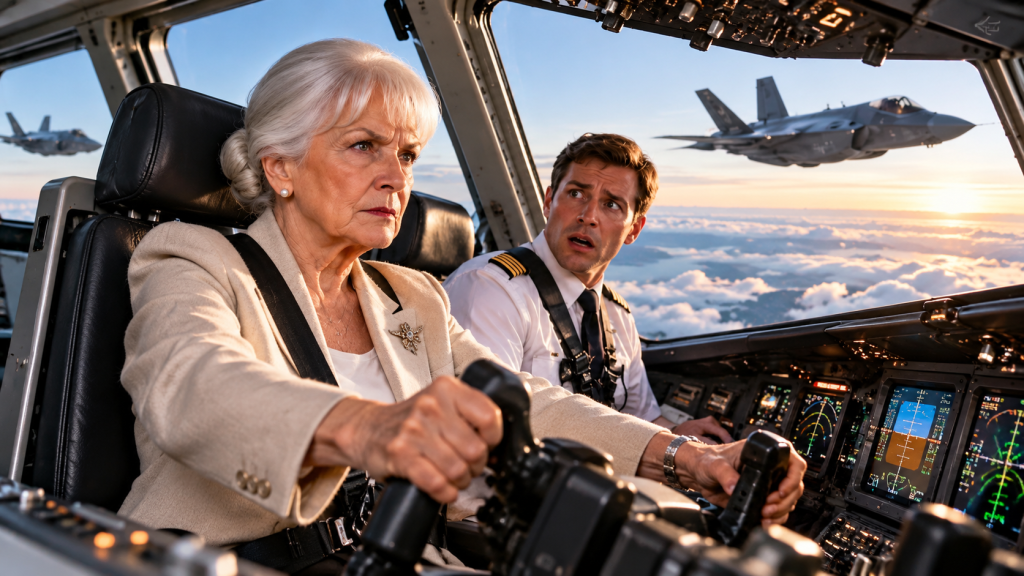
His head snapped toward her. “Good enough?” She glanced at him. “You want perfect conditions, son, become a simulator instructor.” The F-35 on their left wing banked slightly. “Havoc 1 to Widow 6. Visual inspection confirms left main gear is extended but appears twisted approximately fifteen degrees.”
Pauline’s jaw tightened.
“And the right?”
“Looks good.”
“Nose?”
“Appears locked.”
Mark whispered:
“One bad main.”
“Better than none.”
“That’s your definition of good news?”
“It is today.”
A warning tone pulsed through the cockpit.
Mark flinched.
Pauline did not.
She had heard worse.
Forty-three years earlier, a prototype hydraulic line had burst behind her left shoulder at thirty thousand feet.
Twenty-seven years earlier, an experimental stability system had tried to roll her inverted on final approach.
Twenty-two years earlier, she had watched flames lick across the wing of an aircraft the government later denied had ever flown.
Fear was not new.
Age had not removed it.
It had simply taught her what to do while it was present.
“Mark.”
“Yes?”
“Stop looking at my hands.”
He realized he had been.
“Sorry.”
“Read the checklist.”
He reached for it.
His fingers trembled.
“Emergency landing with unsafe gear indication.”
“Go.”
He read.
Pauline answered.
Short.
Precise.
Nothing wasted.
The aircraft shuddered.
A child screamed somewhere behind them.
The sound reached the cockpit even through the sealed door.
Mark swallowed.
Pauline heard him.
“Family?”
“What?”
“You have one?”
“My wife.”
“Kids?”
“A daughter.”
“How old?”
“Six.”
“Good.”
Mark looked at her.
“Good?”
“That means you have somewhere to go when this is over.”
His eyes filled.
“What if—”
“No.”
Pauline’s voice hardened.
“Do not borrow grief before we’ve earned it.”
He stared at her.
Then nodded.
Outside, the two F-35s remained in formation.
Not close enough to interfere.
Close enough to watch.
One slightly ahead.
One slightly behind.
Like silent escorts.
Like witnesses.
“Havoc 1,” Pauline said, “I need a favor.”
“Name it, Widow 6.”
“When we touch, if that left gear collapses, tell tower what you see.”
“Copy.”
“I may not have cockpit visibility once we start sliding.”
“Understood.”
“And tell the trucks not to crowd the runway threshold.”
There was a pause.
“They’re already staged farther down.”
Pauline smiled faintly.
“Somebody down there remembers.”
Another voice came over the radio.
Older.
More controlled.
Not the fighter pilot.
“Nellis Approach to civilian emergency aircraft.”
Pauline froze.
Only for half a second.
Mark noticed.
“Widow 6,” the voice continued, “this is Colonel Daniel Reeves.”
Pauline’s eyes sharpened.
The name struck something buried.
“Daniel Reeves?”
“Yes, ma’am.”
Silence.
Then Pauline whispered:
“You’re Harold Reeves’s boy.”
Another pause.
“Yes, ma’am.”
Mark looked between the radio and Pauline.
“Who’s Harold Reeves?”
Pauline ignored him.
Daniel’s voice softened.
“My father said if I ever heard Widow 6 on the radio, I was supposed to tell you something.”
Pauline’s grip tightened around the yoke.
“Not now, Colonel.”
“Understood.”
Her eyes stayed on the runway.
“Tell me after we land.”
Daniel answered quietly.
“Yes, ma’am.”
That was the first time Mark heard something beneath Pauline’s calm.
Not fear.
Memory.
Heavy enough to bend a voice.
The aircraft descended through nine hundred feet.
Mark called:
“Speed stable.”
“Wind?”
“Crosswind eleven.”
“Good.”
“Sink rate?”
“Seven hundred.”
“Reduce.”
Pauline eased the aircraft.
Her movements were gentle.
Almost tender.
Not fighting the machine.
Listening to it.
Correcting before correction became visible.
Mark watched the nose settle.
The airplane stopped wandering.
Stopped hunting.
For the first time since Captain Evans collapsed, it looked like a machine being flown by someone who knew exactly what it would do before it did it.
Six hundred feet.
“Havoc 1,” Pauline said.
“Go.”
“Any smoke?”
“Light smoke from the left side. No visible fire.”
“Copy.”
Four hundred.
Mark’s breathing accelerated.
Pauline said:
“Mark.”
“Yes?”
“On touchdown, your job is not the aircraft.”
He stared.
“What?”
“Your job is the people.”
She nodded toward the cabin.
“Once we stop, you get them out.”
“What about you?”
“I’ll join you.”
“And Captain Evans?”
“Chloe has him strapped in.”
Three hundred feet.
Mark looked at her.
“I’m sorry.”
Pauline did not look away from the runway.
“For what?”
“What I said.”
“Later.”
“I called your pin a cereal toy.”
“Yes.”
“I threatened to have you arrested.”
“Yes.”
“I thought you were confused.”
“Yes.”
He swallowed.
“And now you’re saving all of us.”
Pauline’s expression did not change.
“Mark.”
“Yes?”
“If we walk away from this, do not turn your embarrassment into worship.”
He blinked.
“What?”
“You were wrong about me.”
“That does not make me magic.”
The runway rushed toward them.
“Learn the right lesson.”
“What lesson?”
“Listen before you decide who is worth listening to.”
Two hundred feet.
Mark said nothing.
One hundred.
Pauline breathed out slowly.
“Here we go.”
The right main gear touched first.
A hard chirp.
Smoke.
Then the left.
For one glorious second, it held.
Then the entire aircraft lurched.
Mark shouted.
The left gear twisted.
Collapsed.
Metal screamed against pavement.
Passengers shrieked.
Pauline drove the right side down.
Kept the nose straight.
The aircraft veered left.
She corrected.
Not too much.
Never too much.
“Havoc 1!”
The fighter pilot’s voice came fast.
“Left gear gone! Left wing low! Sparks but no flame!”
Pauline pulled power.
“Reverse right only.”
Mark obeyed.
“Speed one-twenty.”
The aircraft dragged.
Shook.
Shrieked.
A grinding vibration tore through the fuselage so violently that overhead bins burst open in the cabin.
Bags fell.
Oxygen masks swung.
The left engine nacelle kissed the runway and threw a river of sparks.
“Havoc 1!”
“Still straight! No fire!”
“Speed?”
Mark shouted:
“Eighty!”
“Brake right!”
He applied pressure.
“Sixty!”
The runway edge crept closer.
“Forty!”
Pauline kept the nose centered.
“Twenty!”
The aircraft shuddered.
Then stopped.
For one second, nobody moved.
The silence felt impossible.
Then a fire alarm began screaming.
Mark looked toward Pauline.
She slapped the fuel cutoff to the damaged engine.
“Evacuate.”
He stared.
“Move!”
That snapped him alive.
Mark tore off his headset.
Opened the cockpit door.
“EVACUATE! LEAVE EVERYTHING! MOVE!”
Chloe was already in the aisle.
Her voice changed from gentle flight attendant to command authority.
“SEAT BELTS OFF! LEAVE YOUR BAGS! THIS WAY!”
Passengers stumbled.
Some crying.
Some praying.
Some frozen.
Chloe grabbed a man trying to pull a suitcase from the overhead bin.
“Leave it!”
“My medication—”
“Leave it!”
The man obeyed.
Mark reached Captain Evans.
He was conscious now.
Barely.
“What happened?”
Mark leaned down.
“We landed.”
Evans blinked.
“Who flew?”
Mark looked toward the cockpit.
Pauline was shutting down systems.
“The woman you almost had arrested.”
Evans stared.
“What?”
Mark almost laughed.
“Long story.”
Behind them, an evacuation slide inflated.
Another.
Passengers began pouring out.
The desert wind hit the cabin.
Emergency crews raced alongside.
Chloe turned toward Pauline.
“Ma’am!”
“Go.”
“You too!”
“In a second.”
“No.”
Chloe came forward.
Pauline looked at her.
“You arguing with me?”
“Yes.”
“Good.”
Chloe pointed toward the open door.
“Move.”
Pauline smiled.
“Yes, ma’am.”
She took three steps.
Then stopped.
The silver dart pin on her red jacket had caught against the seat belt harness.
It pulled loose.
Dropped.
Mark saw it fall.
He picked it up.
The metal was old.
Scratched.
On the back, beneath decades of wear, tiny engraved letters remained.
WIDOW 6 — EDWARDS — 1983
Mark stared.
Pauline held out her hand.
“Mine.”
He placed it in her palm.
“I’m sorry.”
She pinned it back on.
“Don’t apologize twice for the same thing.”
Then she moved toward the cabin.
Captain Evans looked at her.
Really looked.
For the first time.
His face changed.
Not recognition exactly.
Something close.
“You…”
Pauline stopped.
“What?”
Evans stared at the pin.
“My father had one of those.”
The world seemed to narrow.
“What was his name?”
“Robert Evans.”
Pauline froze.
Mark looked at her.
The calm disappeared.
Not entirely.
Just enough.
“Bob Evans?”
Captain Evans nodded weakly.
“You knew him?”
Pauline’s eyes filled.
“Oh, Lord.”
Evans stared.
“My father never talked about the program.”
“He couldn’t.”
“He kept a photograph.”
Pauline swallowed.
“What photograph?”
“Five pilots standing beside a black aircraft.”
Pauline closed her eyes.
She knew the picture.
Everybody in it except her was dead.
“Captain Evans.”
Chloe’s voice came from the door.
“We have to go.”
Pauline opened her eyes.
“Later.”
Evans whispered:
“Who are you?”
She looked at him.
“Somebody your father trusted.”
Then they evacuated.
Pauline descended the slide awkwardly.
Not gracefully.
She was seventy-eight years old.
Her knees hated her.
Her shoulder ached.
Her red jacket tore at the elbow.
When she reached the ground, two firefighters tried to grab her.
“I can walk.”
“Ma’am, please move away from the aircraft.”
“I know what an evacuation zone is.”
They stared.
Mark came down behind her.
“She knows.”
Pauline looked at him.
“Helpful.”
He almost smiled.
Then the passengers began recognizing her.
Not from television.
Not yet.
From the cockpit.
Chloe had apparently told someone.
Word moved through frightened people faster than fire.
“That’s her.”
“That’s the woman.”
“She landed us.”
“No, she was just a passenger.”
“She flew the plane.”
“Is that true?”
A teenage boy lifted his phone.
His mother pushed it down.
“Not now.”
Good woman.
Pauline hated cameras.
Always had.
An ambulance team placed Captain Evans on a stretcher.
He reached toward Pauline.
“Please.”
She walked over.
His face was gray.
“What happened to you?”
Pauline asked.
“Probably arrhythmia.”
A medic interrupted.
“We need to move.”
Evans gripped Pauline’s wrist.
“My father.”
She looked at him.
“When we’re both inside.”
He released her.
The stretcher moved away.
Then the sound came.
Two F-35s.
Low.
Fast.
The fighters banked over the runway in perfect formation.
Not showboating.
Not ceremonial.
A final visual check.
Then they climbed into the desert sky.
Every passenger looked up.
Pauline did not.
She watched Captain Evans disappear into the ambulance.
Mark stood beside her.
“Why did they know you?”
Pauline sighed.
“I was hoping we could avoid that.”
He stared.
“You told them you flew a YF-23.”
“I did.”
“That program was in the 1990s.”
“Yes.”
“You said you were a test pilot in 1983.”
“Yes.”
“How many programs were you in?”
Pauline looked at him.
“Enough to become boring at dinner parties.”
He laughed despite himself.
Then stopped.
“I almost threw you back into your seat.”
“Yes.”
His face fell.
Pauline touched his arm.
“Mark.”
He looked at her.
“You panicked.”
“Yes.”
“That matters.”
He nodded.
“But panic is not character.”
He looked confused.
“What you do after recognizing it is character.”
His eyes filled.
Before he could answer, a black government SUV rolled toward them.
Two uniformed officers stepped out.
Then a man in flight suit.
Late forties.
Silver at his temples.
Colonel Daniel Reeves.
He walked straight toward Pauline.
Then stopped three feet away.
For a moment, nobody spoke.
Daniel looked at the red jacket.
The pin.
Her face.
Then he raised his hand in a formal salute.
Every nearby officer froze.
Pauline stared.
“Daniel.”
His voice broke.
“Widow 6.”
She shook her head.
“I’m not in uniform.”
“I don’t care.”
She looked around.
Passengers were watching.
Fire crews.
Medics.
Ground personnel.
Mark.
Chloe.
Pauline sighed.
“Put your hand down before people think I’m important.”
Daniel laughed once.
Then lowered it.
“Too late.”
Pauline’s expression softened.
“You said your father left me something.”
Daniel reached into his flight suit.
Not a letter.
A small metal object.
A brass key.
Pauline stared.
Her face drained of color.
“Where did you get that?”
“My father’s effects.”
“He kept it?”
“For forty years.”
Pauline took the key.
Her fingers trembled for the first time since entering the cockpit.
Mark noticed.
Daniel said:
“He told me never to give it to anyone unless you asked about Raven 12.”
Pauline’s eyes snapped up.
Mark had no idea what that meant.
But several officers nearby suddenly became very interested in pretending they had not heard.
Pauline closed her hand around the key.
“Your father was dramatic.”
“He said you were worse.”
She smiled faintly.
“That sounds like Harold.”
Daniel’s voice softened.
“He died twelve years ago.”
“I know.”
“He wanted you to know he never blamed you.”
Pauline stopped breathing.
Mark glanced at Chloe.
Chloe looked equally confused.
Pauline whispered:
“For what?”
Daniel swallowed.
“For leaving him behind.”
The desert suddenly felt too quiet.
Pauline looked away.
“No.”
Daniel continued.
“He knew why you did it.”
“No.”
“Ma’am—”
“He shouldn’t have been there.”
Daniel’s eyes filled.
“He said the same about you.”
Pauline stared at the runway.
The damaged airliner sat crooked in the distance.
Foam sprayed around its wing.
Emergency crews surrounded it.
And for a moment, Pauline was no longer there.
She was twenty-nine.
Mojave night.
Black aircraft.
No markings.
Fire in the rear compartment.
One seat occupied.
One seat empty.
Harold Reeves on the radio telling her to eject.
Pauline refusing.
Harold laughing.
Then static.
She came back to the present when Daniel touched her arm.
“Ma’am.”
Pauline looked at him.
“I’m sorry.”
Daniel shook his head.
“No.”
“He told me if I ever got to say anything to you, I was supposed to say this exactly.”
Pauline’s eyes filled.
Daniel took a breath.
“‘You brought the aircraft back. You brought the data back. You brought yourself back. That was enough.’”
Pauline turned away.
Nobody spoke.
Not Mark.
Not Chloe.
Not the colonel.
A woman who had just landed a crippled airliner with a collapsed gear stood in the Nevada desert crying silently over a sentence forty years late.
Chloe stepped closer.
Not touching.
Just close.
Pauline wiped her face angrily.
“I hate old men who leave instructions.”
Daniel laughed through his own tears.
“He said you’d say something like that.”
“Of course he did.”
Mark whispered:
“Who was Harold?”
Pauline looked at him.
“My wingman.”
“In combat?”
“No.”
“Test.”
Daniel answered.
“Classified high-altitude reconnaissance prototype.”
Pauline gave him a look.
“Still partly classified.”
Daniel winced.
“Right.”
Mark stared.
“What happened?”
Pauline looked at the key.
“Another day.”
Good.
Some stories are not owed just because someone asks.
That afternoon, Pauline sat in a small medical room at Nellis while doctors checked her blood pressure, shoulder, knees, and general condition.
She complained throughout.
“I’m not the patient.”
“You are now.”
“I landed the airplane.”
“Exactly.”
“This is discrimination against competence.”
The doctor laughed.
“You’re seventy-eight.”
“Age discrimination too.”
Mark sat nearby with a bandage on his forehead.
He had cut himself during the evacuation.
Chloe had a bruised wrist.
Captain Evans was in the base hospital.
Stable.
His heart rhythm had been corrected.
No heart attack.
Likely severe arrhythmia aggravated by stress and dehydration.
The entire aircraft had been evacuated with only minor injuries.
Twenty-three cuts.
Seven sprains.
One fractured wrist.
No deaths.
No fire.
No miracle.
Skill.
Luck.
Maintenance.
Training.
A hundred small things aligning.
Pauline refused every attempt to call it anything else.
Then military public affairs arrived.
She hated them immediately.
A major named Allison Park entered carrying a tablet.
“Ms. Sanders.”
“No.”
The major paused.
“I haven’t asked anything yet.”
“Good. Then we’re done.”
Mark covered his mouth to hide a smile.
Allison looked at Daniel.
He shrugged.
“She’s always like this.”
Pauline glared.
“You were four when I retired.”
“My father told stories.”
“Traitor.”
Allison tried again.
“There are already videos online showing the F-35 escort and the emergency landing.”
Pauline sighed.
“Of course there are.”
“Several passengers are saying an elderly woman landed the aircraft.”
“Technically true.”
“Somebody posted your call sign.”
Pauline’s expression sharpened.
“Who?”
Mark went pale.
Not him.
Chloe shook her head.
Daniel said:
“Radio scanners.”
Of course.
Civilian aviation enthusiasts monitored emergency frequencies.
Widow 6 was already spreading.
Allison continued.
“We need to decide what can be confirmed.”
Pauline stared.
“We?”
“The Air Force.”
“Confirm that the crew landed safely.”
Mark immediately said:
“She landed it.”
Pauline looked at him.
“Mark.”
“No.”
His voice shook.
“You told me to learn the right lesson.”
“Yes.”
“The right lesson is not letting everyone say I did what you did.”
Pauline’s expression softened.
“You helped.”
“After you took over.”
“You declared.”
“After you told me.”
“You managed systems.”
“After you told me what to do.”
“You evacuated the cabin.”
“That part I’ll take.”
Good.
A little spine.
Pauline smiled.
Allison looked between them.
“What exactly happened in the cockpit?”
Mark sat straighter.
“I was overwhelmed.”
The room went quiet.
He continued.
“Captain Evans lost consciousness.”
“The aircraft suffered severe left-engine problems.”
“Autopilot disengaged.”
“I was hand-flying and not handling the workload well.”
Pauline watched him.
No excuses.
Good.
“Ms. Sanders identified the problem from the cabin.”
“I dismissed her.”
“I spoke to her disrespectfully.”
“I threatened to have her arrested.”
Chloe looked down.
Mark continued.
“Then I realized she knew what she was talking about.”
Pauline said:
“You realized after Chloe told you to let me try.”
Mark looked at her.
“Yes.”
Then to Allison:
“Flight attendant Chloe Martinez deserves credit.”
Chloe’s head snapped up.
“What?”
“You said let her try.”
Chloe laughed nervously.
“I was terrified.”
“So was I.”
Mark looked at Pauline.
“She took control.”
“She stabilized the aircraft.”
“She redirected us to Nellis.”
“She coordinated with the fighters.”
“And she landed after the left main gear failed.”
Pauline sighed.
Allison typed.
“You know that statement is going everywhere.”
“It should.”
Pauline looked at Mark.
“You don’t owe me a public self-execution.”
“I know.”
“Good.”
“I owe the passengers accuracy.”
That answer pleased her.
He had learned quickly.
Captain Evans arrived in a wheelchair two hours later.
Against medical advice.
Naturally.
Pauline stood.
“You look terrible.”
“So do you.”
“Good.”
He smiled.
Then his face grew serious.
“My father.”
Pauline nodded toward a chair.
“Sit.”
“I’m already sitting.”
“Excellent progress.”
They moved to a quieter room.
Daniel closed the door.
Mark and Chloe stayed only because Evans asked them to.
Pauline took the brass key from her pocket.
Evans stared.
“I’ve seen one like that.”
Pauline looked at him sharply.
“Where?”
“In my father’s lockbox.”
Daniel froze.
“Your father had one too?”
Evans nodded.
“He said it belonged to a storage cabinet at Edwards.”
Pauline closed her eyes.
Of course.
Two keys.
Harold Reeves.
Robert Evans.
Raven 12.
The past was opening doors whether she liked it or not.
Evans looked at her.
“My father died when I was nineteen.”
“I’m sorry.”
“He never talked about his test work.”
“He couldn’t.”
“He kept one photograph.”
Pauline nodded.
“I know it.”
“Were you in it?”
“Yes.”
“Which one?”
She almost smiled.
“The short one.”
Evans stared.
“You were the only woman.”
“Yes.”
“He wrote a name on the back.”
“What name?”
“Pauline ‘Widow’ Sanders.”
Pauline’s expression tightened.
“I hated that call sign.”
Mark blinked.
“You used it.”
“Because changing a call sign is harder than changing government procurement policy.”
Daniel laughed.
Evans continued.
“My father wrote something else.”
Pauline looked at him.
“What?”
Evans’s voice softened.
“‘Best pilot I ever saw. Worst person to argue with.’”
Pauline’s eyes filled.
“Also accurate.”
Then Evans asked:
“What was Raven 12?”
Pauline looked at Daniel.
He nodded.
She sat.
“Raven 12 was a prototype reconnaissance aircraft.”
“How prototype?”
“Very.”
“Did my father fly it?”
“He helped design test procedures.”
“Harold Reeves?”
“Flight test engineer.”
“And you?”
“Pilot.”
Mark leaned forward.
“What went wrong?”
Pauline stared at the key.
“Everything.”
The room went quiet.
She continued.
“We were testing high-altitude control response.”
“There was a systems failure.”
“Fire.”
“Partial electrical loss.”
“Then navigation.”
“Harold was in the rear station.”
“I was in front.”
“We were supposed to eject.”
“Did you?”
“No.”
“Why?”
“Because the aircraft was heading toward a populated area.”
Daniel’s face tightened.
He had heard this story.
But not from her.
“We turned.”
Pauline continued.
“Barely.”
“Harold lost pressure.”
“His compartment filled with smoke.”
“He ordered me to eject.”
“I refused.”
“Then he released his own harness.”
Mark stared.
“Why?”
“To reach a manual isolation lever.”
Pauline swallowed.
“He knew he might not get back to his seat.”
“Did he?”
“No.”
Nobody moved.
“The fire stopped spreading.”
“The controls came back partially.”
“I landed.”
“Harold died?”
Pauline nodded.
“On the ground?”
“Before.”
Daniel looked down.
Pauline continued.
“Afterward, the program buried almost everything.”
“His family was told it was an industrial accident.”
Evans whispered:
“My father knew.”
“Yes.”
“How?”
“He was on the recovery team.”
Evans looked stunned.
Pauline nodded toward the key.
“Bob and Harold had access to the cabinet containing the raw test logs.”
“The brass keys were part of the old security system.”
“Why keep them?”
“Because engineers are sentimental about useless hardware.”
Daniel smiled sadly.
Evans looked at Pauline.
“Did my father help cover it up?”
The question hurt.
Pauline could see it.
She answered carefully.
“He helped protect classified information.”
“That is not the same as lying for convenience.”
“Did he know Harold died?”
“Yes.”
“Did he know you landed?”
“Yes.”
“Did he know you were blamed?”
Pauline looked at him.
Evans’s face changed.
“Blamed?”
Mark sat forward.
“What?”
Pauline sighed.
“I said another day.”
Daniel interrupted gently.
“Ma’am.”
She gave him a sharp look.
He continued.
“The file was declassified six years ago.”
Pauline froze.
“What?”
“Partially.”
She stared.
“Nobody told me.”
“My father petitioned before he died.”
Pauline looked down.
Daniel continued.
“Raven 12’s accident summary was included in a release.”
Mark asked:
“What did it say?”
Daniel looked at Pauline.
She gave a tired nod.
“It originally blamed pilot decision-making.”
Pauline said.
“Specifically my refusal to eject.”
Evans stared.
“But you saved people on the ground.”
“Probably.”
“Probably?”
“No one knows what would have happened.”
“I refuse to build heroism out of hypothetical bodies.”
Mark looked at her.
“What did the declassified report say?”
Daniel answered:
“That the pilot’s continuation of controlled flight reduced the probability of impact in the populated corridor.”
Pauline groaned.
“That sentence sounds like twelve lawyers wrote it together.”
Daniel smiled.
“They probably did.”
“And Harold?”
“Recognized posthumously for actions that prevented further system failure.”
Pauline closed her eyes.
Finally.
Forty years late.
Still.
Finally.
Evans stared at her.
“My father spent his life angry about this, didn’t he?”
Pauline looked at him.
“Bob was angry about most things.”
Evans laughed through tears.
“That sounds like him.”
“He thought Harold deserved recognition.”
“He thought I did too.”
“You didn’t?”
“No.”
“Why?”
Pauline looked toward the window.
Because recognition had never returned the dead.
Because medals could not answer radios.
Because praise made people tell the wrong story.
Because “legend” was easier than admitting programs were dangerous, institutions protected themselves, and good people sometimes died because somebody approved one more test.
Instead, she said:
“I wanted the lessons remembered.”
“Not the names.”
Daniel whispered:
“Sometimes names carry lessons.”
Pauline looked at him.
“Careful.”
He smiled.
“Yes, ma’am.”
That evening, the airline’s chief executive arrived.
So did investigators from the FAA and NTSB.
Pauline’s mood worsened.
“Wonderful.”
Mark looked confused.
“Why?”
“I dislike meetings.”
“You were a test pilot.”
“Exactly.”
“What does that have to do with meetings?”
“After every flight, twelve people who did not fly it explained what happened.”
Mark laughed.
Then the investigation began.
Not dramatic.
No shouting.
No villain dragged away.
Questions.
Timelines.
Instrument data.
Maintenance history.
Crew training.
Medical records.
The left engine had suffered a severe compressor event after an internal blade failure.
The resulting vibration damaged nearby systems.
The autopilot disconnected.
Captain Evans, already experiencing an undiagnosed arrhythmia, lost consciousness during the highest workload moment.
Mark became task-saturated.
Not untrained.
Not incompetent.
Overwhelmed.
Important distinction.
Pauline insisted on it.
An investigator asked:
“Do you believe First Officer Jensen endangered the aircraft?”
Pauline looked across the room.
Mark sat rigid.
She answered:
“He was in danger of losing control.”
“That’s not what I asked.”
“I know.”
“Did his response fall below expected standards?”
“Yes.”
Mark looked down.
Pauline continued.
“And he recovered.”
The investigator nodded.
“With your assistance.”
“Yes.”
“Would the aircraft have landed safely without you?”
Pauline stared.
“I don’t know.”
“Your best professional judgment?”
“I don’t offer alternative-history fantasies as professional judgment.”
The investigator almost smiled.
“Fair.”
Another asked:
“Why did you believe you could take control of a modern commercial airliner without current type qualification?”
Mark looked at Pauline.
This question mattered.
She answered slowly.
“I did not believe I was ideally qualified.”
“I believed I was more qualified than an unconscious captain and a first officer who was losing situational control.”
The room went silent.
“I knew enough about transport-category systems.”
“I had significant multi-engine experience.”
“I understood energy management.”
“I understood asymmetric thrust.”
“I had flown glass-cockpit conversions during consulting work.”
“I had not flown that exact type.”
“That is why I used Mark.”
Mark looked up.
Pauline continued.
“He knew the airplane.”
“I knew the emergency.”
“Together, we had enough.”
The investigator nodded.
That became the most repeated sentence later.
Not because Pauline wanted it repeated.
Because people like neat lines.
He knew the airplane. I knew the emergency. Together, we had enough.
The investigation found something else.
A maintenance note.
One that should have received more attention.
Two days earlier, another crew reported a brief abnormal vibration from the left engine.
Maintenance inspected it.
No clear fault found.
Aircraft returned to service.
No negligence conclusion yet.
No simple villain.
Again, Pauline insisted.
“Do not turn one mechanic into the reason this happened.”
A reporter later asked why.
She said:
“Because safety failures are usually systems before they become names.”
That quote spread everywhere.
By morning, Widow 6 was international news.
Pauline hated every second.
Videos from passengers showed the F-35s.
A shaky clip showed her walking away from the aircraft in the torn red jacket.
Another captured Daniel saluting.
That one exploded online.
People searched the call sign.
Old aviation forums surfaced.
Former engineers posted vague comments.
One retired colonel wrote:
If that really is Pauline Sanders, half the stories about her are still classified and the other half sound fake even when they’re true.
Another wrote:
She once landed a prototype with half the tail controls frozen.
Pauline denied that.
“It was one-third.”
Mark stared at her.
“You’re correcting the percentage?”
“Accuracy matters.”
The airline wanted a press conference.
She refused.
Nellis wanted a ceremony.
She refused.
The governor’s office called.
She refused.
A national morning show offered an interview.
She said:
“Absolutely not.”
Chloe asked:
“What if they offer money?”
Pauline looked offended.
“I have a pension.”
Chloe laughed.
By the second day, Pauline could no longer walk through the base hospital hallway without somebody recognizing her.
A young airman stopped her.
“Ma’am?”
“Yes?”
“My grandmother saw the video.”
Pauline sighed.
“Is she angry?”
The airman laughed.
“She said you reminded her of herself.”
“Then your grandmother must be difficult.”
“She is.”
“Good.”
The airman hesitated.
“Can I ask you something?”
“You just did.”
He smiled nervously.
“Why did you stop flying?”
The question landed differently.
Pauline looked away.
“Because eventually everybody stops.”
“That’s not really an answer.”
She stared at him.
“You’re brave.”
“Sorry.”
“No.”
She thought.
Then said:
“I stopped because I was tired of funerals.”
The young airman’s smile disappeared.
Pauline continued.
“People romanticize test flying.”
“Some of it was extraordinary.”
“Some of it was terrible.”
“You become very good at remembering empty chairs.”
He nodded.
“Did you miss it?”
“Every day.”
That answer surprised even her.
She walked away before he could ask more.
Mark returned to the airline training center two weeks later.
Not fired.
Not cleared to fly either.
Temporarily removed from line duty pending investigation and additional simulator evaluation.
People online demanded punishment.
Some wanted him fired.
Some called him arrogant.
Some called him dangerous.
Pauline disliked all of it.
She called him.
He answered immediately.
“Ms. Sanders?”
“That makes me sound like your elementary-school teacher.”
“Pauline?”
“Better.”
“How are you?”
“Annoyed.”
He almost laughed.
“That seems normal.”
“Listen to me.”
“Yes.”
“Do not read comments.”
Too late.
Silence.
“I read comments.”
“Of course you did.”
“They hate me.”
“They don’t know you.”
“They know what I said.”
“Yes.”
“They’re not wrong about that.”
“No.”
Mark’s voice tightened.
“I keep replaying it.”
“The aisle.”
“You telling me what was wrong.”
“Me thinking…”
He stopped.
“What?”
“That you were confused because you were old.”
Pauline waited.
He continued.
“I saw your hair before I heard your words.”
There it was.
Clean.
Ugly.
True.
“What are you going to do with that?”
“I don’t know.”
“Yes, you do.”
He was silent.
“Teach it.”
“What?”
“When you return to training, tell people.”
“About you?”
“No.”
“About you.”
He said nothing.
“Tell them what you saw.”
“Tell them why you were wrong.”
“Tell them how quickly professional arrogance becomes operational blindness.”
Mark whispered:
“That sounds harsh.”
“Good lessons often do.”
Six months later, Mark returned to flying.
Not because Pauline intervened.
She refused.
When an airline executive asked if she would write a letter supporting him, she said:
“No.”
The executive looked surprised.
“Why not?”
“Because his company should evaluate him.”
“Not me.”
“But you believe he deserves another chance.”
“I believe second chances should be earned through demonstrated competence.”
“Not celebrity endorsement.”
That annoyed everyone.
Good.
Mark passed additional simulator training.
Crew resource management.
Emergency workload exercises.
Bias awareness workshops.
Line checks.
Psychological evaluation.
He returned first under supervision.
Then fully.
He eventually became one of the airline’s strongest CRM instructors.
Every class began with a photograph.
Not of Pauline.
Of an empty cockpit seat.
Under it were the words:
Who have you already decided is not worth listening to?
He never used her story for entertainment.
He used his own mistake.
Pauline approved.
Quietly.
Chloe also changed careers.
Two years after the incident, she became a lead safety trainer.
She taught cabin crews that passengers sometimes had useful expertise without suggesting crew authority should be surrendered casually.
Important distinction.
She always said:
“You don’t hand the controls to whoever sounds confident.”
“You listen for information.”
She kept the torn strap from the emergency slide harness in her desk.
Why?
“Because I survived.”
Fair.
Captain Evans recovered fully.
His arrhythmia required treatment.
He stopped flying for nearly a year.
When he returned, he flew six more years before retiring.
On his final flight, Pauline sat in 2A.
Not because she wanted attention.
Because Evans called her personally.
“I owe you a landing where nobody screams.”
She agreed.
The flight was boring.
Perfectly boring.
Smooth skies.
No warnings.
No fighters.
No emergencies.
Pauline loved it.
After landing, Evans invited her into the cockpit.
Legally.
On the ground.
He took out the old photograph his father had kept.
Five people beside a black aircraft.
Pauline stared.
There she was.
Twenty-nine.
Hair short.
Arms crossed.
Scowling.
Harold Reeves beside her.
Bob Evans at the edge.
Two others long gone.
Evans said:
“I thought you might want it.”
Pauline touched the photograph.
Then pushed it back.
“No.”
He looked surprised.
“Why?”
“It’s yours.”
“But you’re in it.”
“Your father kept it.”
“That makes it family.”
He nodded.
Then she added:
“Scan it for me.”
He smiled.
“Done.”
The Raven 12 key story continued too.
Daniel arranged access to the old declassified archive at Edwards.
The brass key no longer opened anything.
Of course.
The original cabinet had been replaced decades earlier.
Pauline laughed so hard she had to sit down.
“All that drama for nothing.”
Daniel smiled.
“My father would’ve enjoyed that.”
But the archive held something else.
A recording.
Test-room audio.
The final minutes of Raven 12.
Pauline had never heard it.
She almost refused.
Then changed her mind.
They sat in a quiet room.
Daniel.
Captain Evans.
Pauline.
No press.
No officials.
No ceremony.
The recording crackled.
Young voices.
Calm.
Technical.
Then alarms.
Pauline heard herself at twenty-nine.
“Hydraulic B lost.”
Harold:
“Copy.”
Young Pauline:
“Fire warning aft.”
Harold:
“Isolation failing.”
Then:
“Pauline, eject.”
“No.”
“Eject.”
“Not over the corridor.”
“Turn west.”
“Controls sluggish.”
“Then get us west.”
Static.
Breathing.
Young Pauline:
“Fire moving.”
Harold:
“I can isolate manually.”
“No.”
“I can.”
“Harold, stay strapped.”
“Pauline.”
Then laughter.
Harold’s laughter.
Even during catastrophe.
“Worst person to argue with.”
Pauline covered her mouth.
Daniel cried.
The recording continued.
Then Harold:
“Got it.”
Alarm stopped.
Pauline:
“Harold?”
No answer.
“Harold?”
Static.
Then young Pauline’s voice changed.
Something primal.
“No.”
Again.
“Harold.”
Again.
“Answer me.”
No answer.
Then long minutes of breathing.
A controller.
Vectors.
Altitude.
Young Pauline:
“Raven 12 declaring emergency.”
Controller:
“Raven 12, state souls on board.”
Silence.
Then Pauline’s twenty-nine-year-old voice:
“One.”
The recording stopped.
Old Pauline sat motionless.
Nobody spoke.
Finally, Daniel said:
“My father heard that tape once.”
Pauline looked at him.
“What did he say?”
“That you counted Harold correctly.”
Pauline frowned.
“What?”
“He said you said one soul on board.”
“But there were two bodies.”
Pauline stared.
Daniel continued.
“He thought you were saying Harold was already gone.”
Pauline’s eyes filled.
“No.”
“What?”
“I meant me.”
Daniel froze.
Captain Evans looked confused.
Pauline stared at the dark speaker.
“I thought I had left mine with him.”
Nobody moved.
Then Captain Evans reached across the table.
Not dramatic.
Just placed his hand beside hers.
Not on it.
Close.
Pauline laughed bitterly.
“Look at us.”
“Three old people crying over bad audio.”
Daniel smiled.
“Two old people.”
Pauline glared.
“Colonel.”
“Yes, ma’am.”
“You’re old too.”
Fair.
Years passed.
The airline incident became one of those stories that grew larger online every time it was retold.
Pauline supposedly landed with no hydraulics.
False.
Supposedly both engines failed.
False.
Supposedly one F-35 pilot cried over the radio.
False.
Supposedly the President called during the landing.
Absurd.
Supposedly Pauline had been the first woman to fly seven secret aircraft.
Maybe.
She never clarified.
When asked about rumors, she always said:
“If a story sounds better every time it’s repeated, it is probably getting less accurate.”
People still repeated them.
Of course.
At eighty-one, Pauline finally agreed to one interview.
Not television.
Not news.
An oral-history project at an aviation museum.
One interviewer.
No audience.
She chose it because the interviewer, a twenty-six-year-old aerospace graduate student named Mina Patel, opened with:
“What do people misunderstand about expertise?”
Pauline smiled.
Good question.
“Most people think expertise looks confident.”
“It often doesn’t.”
“What does it look like?”
“Questions.”
“Checklists.”
“People saying ‘I don’t know.’”
“People inviting correction.”
“People who understand where their knowledge stops.”
Mina asked:
“Were you afraid during the Nellis landing?”
“Yes.”
“You looked calm.”
“That is not the same thing.”
“What were you afraid of?”
“Everything.”
“The gear collapsing.”
“Fire.”
“Overcorrecting.”
“The passengers getting hurt.”
“Being too old.”
Mina looked surprised.
“Too old?”
“Yes.”
Pauline leaned back.
“I had not flown an airliner in years.”
“I had not flown that type ever.”
“My reaction time was not what it had been at thirty.”
“My shoulder hurt.”
“My depth perception was different.”
“I knew all of that.”
“Then why take the seat?”
“Because the available alternatives were worse.”
Mina smiled.
“Did Mark Jensen underestimate you because you were elderly?”
“Yes.”
“Did that make you angry?”
“Later.”
“Not then?”
“No time.”
“What lesson should people take from that?”
Pauline thought.
“Not that every grandmother is secretly a test pilot.”
Mina laughed.
“Good.”
“That is the stupid lesson.”
“What’s the right one?”
Pauline’s face became serious.
“Do not confuse appearance with irrelevance.”
“And do not confuse credentials with infallibility.”
“Mark had current credentials.”
“I had relevant experience.”
“Neither was sufficient alone.”
Mina nodded.
“Do you consider yourself a hero?”
“No.”
“Why not?”
“Because hero is what people call competence after surviving.”
“That sounds cynical.”
“It is.”
Pauline smiled.
“Also true.”
The oral history became popular anyway.
Especially the line about appearance and irrelevance.
Pauline hated mugs with it.
Someone sent her one.
She used it.
Hypocrite.
At eighty-three, she stopped driving at night.
She hated that too.
At eighty-four, she had cataract surgery.
At eighty-five, arthritis made stairs annoying.
Age arrived.
Not as insult.
As fact.
Pauline never pretended otherwise.
That was part of what made the Nellis story matter to her.
Mark had been wrong because he assumed age meant incapacity.
But Pauline refused the opposite myth too.
Age did change her.
She tired faster.
Forgot names sometimes.
Needed reading glasses.
Could no longer tolerate five hours in a cockpit simulator without pain.
She did not need to be twenty to matter.
That was the point.
Not that eighty was secretly thirty.
That eighty had value on its own terms.
At eighty-six, Nellis invited her to speak to a graduating class of pilots.
She refused.
Then Daniel called.
“Please.”
“No.”
“My daughter is in the class.”
Pauline went quiet.
“Your daughter?”
“Harold’s granddaughter.”
“That is emotional blackmail.”
“Yes.”
“Effective.”
“Yes.”
She went.
The auditorium was full.
Young pilots.
Bright uniforms.
Sharp posture.
People with more future than history.
Pauline walked to the podium slowly.
No red jacket.
Too warm.
But the silver dart pin was there.
She looked at them.
Then said:
“I was told to give you advice.”
“I dislike advice.”
A few people laughed.
“So I will give you mistakes instead.”
The room quieted.
“I have been too confident.”
“I have been too cautious.”
“I have ignored engineers.”
“I have trusted instruments that were lying.”
“I have distrusted instruments that were correct.”
“I have continued flights I should have stopped.”
“I have stopped flights others wanted continued.”
“I have been brave for stupid reasons.”
“And afraid for intelligent ones.”
Young faces watched.
Pauline continued.
“You will be told to trust your training.”
“You should.”
“But training is not a wall around uncertainty.”
“It is a language for working inside it.”
She looked toward Daniel’s daughter.
A young captain named Maya Reeves.
Pauline’s voice softened.
“You will also be told to respect experience.”
“Do that too.”
“But do not worship it.”
“Old people can be wrong.”
The room laughed.
“I am frequently wrong.”
“Ask Daniel.”
Daniel nodded enthusiastically.
Pauline glared.
Then:
“The danger begins when anybody becomes too impressive to question.”
She touched the silver pin.
“I once flew with people who had brilliant résumés and terrible judgment.”
“I have flown with young people who saved lives because they noticed one detail everyone senior had missed.”
She paused.
“Listen.”
“That is all.”
Afterward, Maya approached.
“Ms. Sanders?”
“Pauline.”
“Okay.”
She hesitated.
“My grandfather…”
Pauline smiled sadly.
“Yes.”
“I wish I’d known him.”
“So do I.”
Maya looked at the pin.
“Did he give you that?”
“No.”
“Who did?”
“Bob Evans.”
“Captain Evans’s father?”
“Yes.”
“Why?”
Pauline smiled.
“Because after one particular landing, he said anybody stupid enough to bring that airplane back deserved a souvenir.”
Maya laughed.
Then asked:
“Were you really called Widow 6 because five test pilots before you died?”
Pauline’s eyes widened.
“What?”
“That’s what people say.”
“Oh, for heaven’s sake.”
“So it isn’t true?”
“No.”
“Then why Widow?”
Pauline sighed.
“A mechanic said every prototype I touched became a maintenance widow.”
Maya laughed.
“That’s much less dramatic.”
“Reality usually is.”
The myth died in that room.
For about three hours.
Then someone posted the corrected story online.
It became dramatic too.
At ninety, Pauline received a letter.
Paper.
Actual paper.
From Mark Jensen.
He had become a captain.
Then a training chief.
The letter read:
Pauline,
Today I retired.
On my last training day, a twenty-three-year-old first officer questioned one of my decisions in the simulator.
My first instinct was irritation.
My second instinct was your face in that aisle.
So I listened.
He was right.
I thought you should know.
Pauline read the line twice.
Then smiled.
That was better than a medal.
She called him.
“You’re old now.”
He laughed.
“I’m sixty-one.”
“Ancient.”
“You’re ninety.”
“Exactly.”
“Thank you.”
“For what?”
“Ruining arrogance for me.”
Pauline smiled.
“You’re welcome.”
Then he said:
“I still have the pin photo.”
“What photo?”
“The dart pin.”
“You took a picture?”
“At Nellis.”
“Without permission?”
“I was sentimental.”
“You were nosy.”
“Also true.”
He paused.
“Do you remember what you told me?”
“I tell people many excellent things.”
“You said not to turn embarrassment into worship.”
Pauline went quiet.
“Yes.”
“I didn’t.”
“I know.”
“And I never forgot the lesson.”
“I know.”
“How?”
“You kept calling me every Christmas.”
He laughed.
“Fair.”
Captain Evans died before Pauline.
Heart failure at eighty-four.
His son invited her to the memorial.
She attended in the red jacket.
Repaired at the elbow.
Old people can be sentimental too.
At the memorial, a photograph stood beside the urn.
Bob Evans.
Captain Evans as a child.
Then later as a pilot.
The five-person Raven 12 photograph.
Pauline stopped in front of it.
Captain Evans’s daughter approached.
“My father said you hated ceremonies.”
“I do.”
“He said you’d come anyway.”
“He was arrogant.”
She smiled.
“He said that too.”
At the service, one speaker described Evans as “a pilot who learned that authority and humility were not opposites.”
Pauline liked that.
Because Evans had once nearly died in a cockpit while his younger first officer panicked.
Afterward, he spent years teaching captains to create crews that could speak up before emergencies became catastrophes.
Everybody changed something.
That was the part people missed.
The dramatic story was Pauline taking the controls.
The important story was what everyone did afterward.
Mark changed training.
Chloe changed cabin safety instruction.
Evans changed command culture.
Nellis reopened parts of an old archive.
Daniel completed his father’s unfinished petition to recognize Harold.
The airline revised emergency policies around incapacitated captains and off-duty qualified personnel.
Nothing glamorous.
Procedures.
Training.
Documentation.
The quiet machinery that prevents future drama.
Pauline preferred that.
At ninety-two, Mina Patel returned for a second oral-history interview.
Pauline was slower now.
Hearing aids.
Cane.
Still sharp.
Mina asked:
“What do you remember most from the Nellis incident?”
Pauline expected to say the gear collapse.
Or the fighters.
Or the radio.
Instead, she said:
“Chloe.”
Mina looked surprised.
“The flight attendant?”
“Yes.”
“Why?”
“Because she said, ‘Let her try.’”
Pauline smiled.
“That was the hinge.”
“What do you mean?”
“Mark had authority.”
“I had knowledge.”
“Chloe created the opening between them.”
She leaned back.
“People like stories about the person who takes control.”
“They forget the person who notices control needs help.”
Mina wrote that down.
“What about the F-35s?”
Pauline rolled her eyes.
“They looked expensive.”
Mina laughed.
“What did it feel like to hear Havoc 1 recognize your call sign?”
“Embarrassing.”
“Really?”
“Yes.”
“Why?”
“Because people were listening.”
“Did part of you feel proud?”
Pauline thought.
Then smiled.
“Yes.”
There.
Honest.
“I had spent decades thinking that part of my life was finished.”
“Then some young pilot said my call sign like it still meant something.”
Her eyes filled.
“That did something to me.”
“What?”
“Reminded me that being finished with a chapter is not the same as being erased from it.”
Mina went quiet.
Pauline continued.
“I think old people fear erasure more than death sometimes.”
“That sounds dark.”
“It is.”
“Also common.”
She looked out the window.
“People stop asking what you know.”
“They start telling you where to sit.”
“They use softer voices.”
“They take things from your hands.”
“They call you sweet.”
Mina smiled.
“You hate sweet.”
“I despise sweet.”
“What should they say instead?”
“Ask me what I want.”
That became another quote.
She hated the tote bags.
At ninety-four, Pauline moved into assisted living.
By choice.
She told everyone that.
Repeatedly.
The apartment overlooked a small municipal airport.
Naturally.
She would sit near the window and watch training aircraft turn base to final.
One afternoon, a caregiver named Luis found her staring at a little Cessna wobbling in crosswind.
“Bad?”
he asked.
“Student.”
“How can you tell?”
“Too many corrections.”
The airplane landed.
Bounced.
Settled.
Pauline smiled.
“See?”
Luis stared.
“You can tell all that from here?”
“No.”
“I’m making things up.”
He laughed.
She liked him.
On her ninety-fifth birthday, Mark visited.
So did Chloe.
Daniel.
Maya Reeves.
Mina.
Even Allison Park, now retired.
They brought no cake shaped like an airplane.
Pauline had threatened violence.
Instead, Mark brought a framed copy of the Nellis emergency transcript.
Pauline stared at it.
“You ignored my instructions.”
“Yes.”
“I said no memorabilia.”
“Correct.”
“Take it back.”
“No.”
She glared.
Then noticed one line highlighted.
Widow 6: Don’t borrow grief before we’ve earned it.
Pauline stared.
Mark said:
“You said that to me.”
“I remember.”
“I use it with my daughter.”
“How is she?”
“Thirty-seven.”
“Still six in your head?”
“Yes.”
“Good.”
Chloe handed Pauline another gift.
A red scarf.
“Not a jacket.”
“Too warm.”
Pauline put it on.
Then Daniel gave her something.
The Raven 12 brass key.
Mounted in a simple wooden frame.
Below it:
YOU BROUGHT YOURSELF BACK. THAT WAS ENOUGH.
Pauline looked at him.
“This is emotional manipulation.”
“Yes.”
“Runs in your family.”
“Yes.”
She kept it beside her bed.
Hypocrite.
A year later, Pauline’s health declined.
Nothing dramatic.
No hidden disease.
No final emergency.
Just age.
Heart weaker.
Lungs slower.
Body tired.
She hated that people used the word “declined.”
“Everything declines.”
she told Luis.
“Mountains decline.”
“Empires decline.”
“Say I’m tired.”
So he did.
Pauline became tired.
Mark called every week.
Chloe visited.
Daniel brought Maya’s children once.
They asked Pauline if she had ever broken the sound barrier.
“Yes.”
They gasped.
“How did it feel?”
“Loud.”
“That’s it?”
“And expensive.”
They were disappointed.
Good.
Children need resistance to myth.
One evening, Pauline asked Luis to open the window.
He did.
A small trainer aircraft passed in the distance.
Pauline listened.
“That engine’s rough.”
Luis smiled.
“You’re making things up again?”
“Probably.”
He sat beside her.
“Were you scared the day at Nellis?”
She looked toward the sky.
“Yes.”
“I thought you weren’t afraid of anything.”
“Only fools and dead people are afraid of nothing.”
Luis considered that.
“Were you afraid of dying?”
Pauline thought.
“No.”
“What then?”
“Failing publicly.”
He laughed.
She did too.
Then her face softened.
“I was afraid I would be right about what was wrong and still not be able to fix it.”
That was more accurate.
Luis nodded.
“What would you say to Mark now?”
“I say things to him constantly.”
“No.”
“About that day.”
Pauline smiled.
“I’d say thank you.”
Luis blinked.
“For what?”
“For eventually moving.”
She laughed.
Then coughed.
Several weeks later, Pauline asked Daniel to come.
He arrived the next morning.
She was awake.
Weak.
Still difficult.
“Colonel.”
“Ma’am.”
“You’re retired.”
“So are you.”
“I retired first.”
“Congratulations.”
She pointed toward the framed key.
“Take it.”
Daniel shook his head.
“No.”
“It belongs to your family.”
“My father wanted you to have it.”
“I had it.”
“Now you.”
Daniel’s eyes filled.
“Okay.”
“And the pin.”
He froze.
“No.”
“Yes.”
“That belongs to you.”
“Not much longer.”
His face broke.
Pauline rolled her eyes.
“Don’t start.”
He laughed through tears.
She unpinned the silver dart.
Her hands were too weak.
Daniel helped.
She placed it in his palm.
“No museum.”
“Okay.”
“No auction.”
“Obviously.”
“No shadow box with dramatic lighting.”
He smiled.
“Okay.”
“Give it to Maya.”
Daniel swallowed.
“I will.”
“Tell her to wear it inside her jacket.”
“Why?”
“Because some things are for the person carrying them.”
Not the audience.
Daniel nodded.
Pauline closed her eyes.
Then opened them again.
“One more thing.”
“What?”
“Tell Mark he was not the worst copilot I ever had.”
Daniel laughed.
“Who was?”
Pauline smiled.
“Classified.”
Of course.
She died two days later.
Quietly.
No aircraft overhead.
No ceremonial formation.
No final radio call.
Just morning light through a window facing an airport.
Luis beside her.
Red scarf on the chair.
The sound of a small airplane somewhere outside.
Her memorial was small because she demanded that long before dying.
No state funeral.
No flyover.
No speeches longer than five minutes.
Mark broke the five-minute rule.
She would have hated that.
He stood at the front holding one folded page.
“I met Pauline Sanders at the worst moment of my professional life.”
People smiled softly.
“I saw an elderly woman standing in an aisle and decided who she was before she finished speaking.”
His voice tightened.
“She was right.”
“I was wrong.”
“And the most important thing she ever taught me was not how to land an airplane.”
Mark looked toward Chloe.
Then Daniel.
Maya.
Captain Evans’s family.
“It was how dangerous certainty becomes when it stops listening.”
He took a breath.
“Pauline hated being called a legend.”
“She said legends are what people create when reality has too many inconvenient details.”
A few people laughed.
“So I won’t call her one.”
He looked at the silver dart pin now resting inside Maya Reeves’s jacket.
“I’ll call her what she was.”
“A pilot.”
“A teacher.”
“A difficult woman.”
That got the biggest laugh.
“A frightened person who knew what to do while frightened.”
“A person who carried grief badly sometimes.”
“A person who survived long enough to become old.”
“And a person who refused to let old mean irrelevant.”
Mark folded the paper.
Then added:
“She once told me not to turn embarrassment into worship.”
“I tried.”
“I failed a little.”
Pauline would have accepted that.
After the memorial, Maya found Mark outside.
She opened her jacket.
The silver pin was attached inside.
Exactly as Pauline instructed.
Mark smiled.
“She’d like that.”
Maya said:
“I think so.”
Then she asked:
“Do you think she knew how much people loved her?”
Mark looked toward the runway beyond the museum.
“Yes.”
“Did she like it?”
“No.”
Maya laughed.
Fair.
Years later, the Nellis incident remained part of aviation safety courses.
Not as proof that random passengers should enter cockpits.
Not as a fairy tale about a grandmother saving the day.
The official case study was more precise.
Captain incapacitation.
Engine failure.
High workload.
Recognition failure.
Crew resource management.
Use of relevant expertise.
Emergency diversion.
Partial gear failure.
Successful evacuation.
The names appeared in a footnote.
Pauline preferred that.
But outside classrooms, people still told the dramatic version.
The elderly woman.
The arrogant copilot.
The F-35s.
The call sign.
The impossible landing.
Stories like sharp edges.
Reality has more curves.
Mark was arrogant.
And frightened.
Pauline was extraordinary.
And limited.
Chloe was young.
And perceptive.
Captain Evans was experienced.
And still vulnerable to a human heart.
The F-35 pilots knew a legend.
And still did not land the airplane for her.
Everybody mattered.
Everybody had a role.
That was closer to truth.
The final public photograph of Pauline Sanders was not taken at Nellis.
Not beside an aircraft.
Not wearing the red jacket.
It came from her ninety-fifth birthday.
She sat in a wheelchair by a window.
Red scarf around her shoulders.
Laughing at something Mark had said.
No salute.
No fighters.
No pin visible.
Just an old woman surrounded by people who listened when she spoke.
In the corner of the photograph, through the glass, a small aircraft was climbing into the evening sky.
Someone later asked Mark what Pauline would have thought of that picture.
He smiled.
“She’d complain the horizon wasn’t level.”
That was probably true.
And if she had been asked what she wanted people to remember about the day she landed a damaged airliner at Nellis, she would not have mentioned the F-35s.
Or the call sign.
Or Raven 12.
Or the applause.
She would have said something simpler.
Listen.
Check.
Ask.
Do not assume.
And when the aircraft starts pulling left, stop arguing about who looks qualified and figure out who knows why.
THE END STORIES! THANK YOU FOR READING GOOD LUCK! ❤️
Related Posts