Lily stood at the top of the stairs in her pajamas. Her eyes were swollen from crying. Her hair was tangled. And for the first time in sixteen years, my daughter looked afraid of me. “Mom?”
Her voice shook. “Please don’t be angry.” I stared at her. Then at Annie. Then at the silver watch inside Rosa’s box. My husband’s face seemed to exist everywhere suddenly. In Lily’s eyes. In Annie’s crooked smile.
In the shape of two girls standing twelve feet apart, neither knowing whether they were allowed to call the other family. I looked back at Lily. “How long have you known?” She gripped the banister. “Almost four months.” Four months.
I felt something inside me crack.
“You have known for four months that your father had another daughter?”
Lily started crying.
“I didn’t know for sure at first.”
“But you suspected.”
“Yes.”
“And you said nothing.”
“Annie asked me not to.”
I laughed once.
Not because anything was funny.
“Annie is seventeen.”
“You are sixteen.”
“I am your mother.”
“I know.”
“Do you?”
Her face folded.
Rosa stepped forward.
“Please don’t blame her.”
I turned sharply.
“I’m not asking you.”
She stopped.
That was crueler than I intended.
But grief had entered my house before sunrise wearing my dead husband’s face, and I had no idea where to put my anger.
Annie stared at the floor.
The blue cardigan Lily had packed for her hung loosely around her shoulders.
Daniel had bought that cardigan for Lily on her thirteenth birthday.
He had been dead nine years by then.
I froze.
No.
That could not be right.
I looked at Lily.
“You told me Dad bought that cardigan.”
Lily wiped her face.
“No.”
My heart stumbled.
“You said—”
“I said it reminded me of Dad.”
I searched my memory.
She was right.
I had turned it into something else.
The cardigan had belonged to my mother.
Lily had inherited it.
Grief had apparently begun rearranging details in my head before any of us noticed.
I looked down at the watch again.
“The watch.”
Rosa’s expression softened.
“It isn’t the one you buried with him.”
“I know what my husband’s watch looked like.”
“I’m sure you do.”
Something in her gentleness irritated me.
I picked it up.
Silver bracelet.
Blue face.
Small scratch near the crown.
My hands shook.
Then I turned it over.
There were initials engraved on the back.
D.R.
And a date.
Seventeen years earlier.
My stomach dropped.
The watch I buried with Daniel had no engraving.
That one had been a gift from me.
Same brand.
Similar face.
Not the same watch.
I sat down because my knees suddenly refused to cooperate.
Rosa whispered:
“Daniel gave me that when we were nineteen.”
I looked at her.
“You told me he gave it to you seventeen years ago.”
“Yes.”
“That was before he met me.”
“Yes.”
“Were you still with him when he met me?”
“No.”
“Are you sure?”
Her face tightened.
“Yes.”
I wanted to believe her.
I also wanted to throw the watch through the window.
Both feelings existed at once.
I pointed toward the sofa.
“Sit.”
Rosa sat.
Annie remained standing.
I looked at her.
“You too.”
She hesitated.
Then sat beside her mother.
Lily slowly came downstairs.
She did not sit beside me.
She chose the chair nearest Annie.
That hurt.
Not because she chose her sister.
Because she had apparently built a whole emotional world while I slept ten feet away.
I asked:
“Start at the beginning.”
Rosa inhaled slowly.
“Daniel and I dated during our last year of high school and part of the year after.”
“Were you in love?”
“Yes.”
The answer came too quickly.
I looked away.
Dead people are difficult to share.
Not physically.
Historically.
Every new story about Daniel seemed to rearrange the man I had loved.
Rosa continued.
“My parents hated him.”
“Why?”
“He had no money.”
I almost laughed.
That sounded like Daniel.
“When I became pregnant, I panicked.”
“Did Daniel know?”
“No.”
“But Lily found a photograph of the two of you while you were pregnant.”
Rosa closed her eyes.
“That’s complicated.”
“Everything today is complicated.”
She nodded.
“I was almost four months pregnant in that photograph.”
“Daniel knew you were pregnant?”
“He knew I was pregnant.”
My chest tightened.
“But I told him the baby belonged to someone else.”
Annie looked at her mother.
Even she appeared surprised.
“You never told me that.”
Rosa took Annie’s hand.
“I wasn’t ready to.”
I felt anger rising again.
“Apparently nobody in this house believes mothers should know anything.”
Lily flinched.
I regretted it immediately.
Not the truth.
The target.
“Sorry.”
I rubbed my face.
“Continue.”
Rosa stared at her hands.
“When my parents found out, they sent me to live with an aunt in Missouri.”
“I came back once for my grandmother’s funeral.”
“That’s when the photograph was taken.”
“Daniel saw me.”
“He asked if the baby was his.”
“I said no.”
“Why?”
“My father had told me if I contacted Daniel, he would cut me off completely.”
I looked around our modest living room.
“Did that work out?”
Rosa gave a sad smile.
“No.”
She continued.
“I thought I was protecting Daniel too.”
“From what?”
“Having to give up his life.”
I almost screamed.
Instead:
“You were both nineteen.”
“Yes.”
“You decided what his life should be.”
“Yes.”
Her answer silenced me.
No excuse.
Just yes.
Rosa continued.
“Annie was born.”
“My parents helped for about six months.”
“Then they decided I had embarrassed them enough.”
“They moved away.”
“I stayed.”
“I cleaned offices.”
“Waited tables.”
“Whatever I could do.”
Annie squeezed her mother’s hand.
Rosa looked at her.
“I never regretted keeping you.”
Annie nodded.
“I know.”
Then Rosa looked at me.
“Daniel did not learn Annie was his until she was almost five.”
I stopped breathing.
Almost five.
Daniel died twelve years ago.
Annie was seventeen now.
The math became cruel immediately.
“How long before he died?”
“Seven months.”
Lily covered her mouth.
I whispered:
“He knew for seven months.”
“Yes.”
“And never told me.”
Rosa’s eyes filled.
“No.”
The room tilted.
There are betrayals that end with death.
And there are betrayals death preserves because nobody remains to answer for them.
I stared at Daniel’s watch.
“How did he find out?”
“I contacted him.”
“After nearly five years?”
“Yes.”
“Why?”
“Annie got sick.”
My heart clenched.
“What happened?”
“Nothing like…”
She looked at Lily.
Then stopped herself.
“Nothing serious now.”
“She needed surgery.”
“Doctors wanted family medical history.”
“I realized I had no right to keep pretending Daniel didn’t exist.”
“So you called him.”
“Yes.”
“What did he say?”
Rosa laughed weakly.
“He hung up.”
Lily blinked.
“He hung up?”
“Yes.”
“Then he called back eleven minutes later.”
Despite myself, I could imagine it.
Daniel pacing.
Running his hand through his hair.
Hanging up because emotion arrived before language.
Rosa continued.
“He asked to meet.”
“We did.”
“I showed him pictures.”
“He cried.”
“He said Annie had his father’s eyebrows.”
Annie touched her face unconsciously.
She did.
I had seen those eyebrows every morning for thirteen years.
I whispered:
“Did he demand a DNA test?”
“Yes.”
“Good.”
Rosa looked almost relieved that I said that.
“I would have demanded one too.”
She nodded.
“The test confirmed he was her father.”
“What happened next?”
“He wanted to meet her.”
Annie looked at her mother.
“You told me the first time I met Dad was an accident.”
Rosa’s face crumpled.
“I’m sorry.”
Annie pulled her hand away.
The secret was expanding.
No longer mine alone.
Rosa whispered:
“He asked me not to tell you who he was yet.”
Annie stared.
“Why?”
“He wanted time to figure out how to tell his wife.”
Me.
I felt sick.
“How many times did he see her?”
Rosa looked at Annie.
“Twice.”
Annie shook her head.
“I remember one.”
“You were little.”
“What was the second?”
“The zoo.”
Annie’s mouth opened.
“That man?”
Rosa cried.
“Yes.”
Annie stood.
“You told me he was your friend.”
“I know.”
“You let me meet my father and didn’t tell me he was my father?”
“I was scared.”
Annie backed away.
“You’re all scared.”
Nobody answered.
She turned toward Lily.
“At least she told me the truth.”
That landed harder than anything else.
Lily stood too.
“Annie.”
“I need outside.”
She opened the front door.
Rosa moved to follow.
I stopped her.
“Give her a minute.”
“She’s my daughter.”
“I know.”
The words came out softer this time.
“She needs to be angry at you without you immediately fixing it.”
Rosa stared at me.
Then nodded.
Lily looked at me.
“Can I go?”
I wanted to say no.
I wanted my daughter beside me.
I wanted to grab her shoulders and demand every detail.
But Annie was outside alone carrying seventeen years of rewritten history.
“Go.”
Lily ran after her.
The door closed.
Rosa and I remained.
Two mothers.
One dead man.
Too much truth.
I asked:
“Why did Daniel not tell me?”
Rosa shook her head.
“I don’t know everything.”
“But you know something.”
“Yes.”
She reached into her bag.
Another envelope.
Of course.
Apparently every secret in my life had decided to become stationery.
“This is a copy.”
“Of what?”
“A letter Daniel gave me.”
My hands went cold.
“For me?”
“No.”
“For Annie.”
My throat tightened.
“When?”
“About two weeks before he died.”
I took it.
The envelope had never been opened.
Annie’s name was written across the front.
“Why didn’t you give it to her?”
“Because he told me to wait until he had told you.”
I stared at Rosa.
“He died.”
“Yes.”
“So you waited twelve years?”
Her face collapsed.
“Yes.”
“Why?”
“At first because she was five.”
“Then because she was eight.”
“Then ten.”
“Then thirteen.”
“And every year it became harder to explain why I had waited.”
I laughed bitterly.
“This family has apparently invented a new religion.”
Rosa looked confused.
“Waiting until truth becomes easier.”
She lowered her eyes.
“It never does.”
“No.”
I looked at the unopened letter.
“We don’t open this.”
Rosa nodded.
“It belongs to Annie.”
For the first time that morning, someone had brought me something secret and I chose not to know.
That mattered.
I put the letter back.
Then I asked:
“What did Lily find?”
Rosa looked toward the door.
“The photograph first.”
“In what?”
“An old wooden sewing box.”
I frowned.
“That box came from Daniel’s mother.”
“Yes.”
The room suddenly became colder.
“Marion.”
Rosa nodded.
“What does Marion know?”
Rosa looked at me.
Too slowly.
I stood.
“What does Marion know?”
“I don’t know everything.”
“But?”
“Daniel told her.”
My heart sank.
“When?”
“After the DNA test.”
I stared.
Daniel’s mother knew.
My mother-in-law.
The woman who sat beside me at Daniel’s funeral.
The woman who helped me choose his suit.
The woman who held four-year-old Lily while I signed paperwork I could barely read through tears.
She knew Daniel had another daughter.
And said nothing.
I picked up my phone.
Rosa stood.
“Maybe not right now.”
I looked at her.
“Everybody in this story has already decided when I should know things.”
She stopped.
I called Marion.
She answered on the fourth ring.
“Good morning, honey.”
Honey.
My jaw tightened.
“Did you know about Annie?”
Silence.
That was answer enough.
“Marion.”
Her voice changed.
“Where are you?”
“At home.”
“Is Lily there?”
“Yes.”
“Is Rosa?”
I closed my eyes.
“You know Rosa.”
Silence again.
“How long?”
She began crying.
“I can explain.”
“How long?”
“Twelve years.”
My chest hurt.
“Before Daniel died?”
“Yes.”
“How long before?”
“About six months.”
I hung up.
Not dramatically.
I simply could not hear her voice anymore.
Rosa whispered:
“I’m sorry.”
“Please stop saying that.”
She nodded.
I walked into the kitchen.
Turned on the tap.
Turned it off.
Opened a cupboard.
Closed it.
My body wanted a task.
Something simple.
Water.
Plate.
Coffee.
Anything that did not have a second family hidden inside it.
Then the front door opened.
Lily came in alone.
“Where’s Annie?”
“Walking.”
“With who?”
“Just around the block.”
“Lily.”
“She asked me not to follow.”
I almost laughed.
Of course.
Lily looked at my phone.
“You called Grandma Marion.”
“Yes.”
Her eyes filled.
“She knew?”
“Yes.”
“I thought so.”
I stared.
“You thought so?”
Lily nodded.
“Because the photograph was in the sewing box she gave me.”
My voice sharpened.
“And you didn’t tell me?”
“I didn’t know.”
“Lily.”
“I didn’t know.”
She started crying again.
“I thought maybe Dad had just dated Rosa.”
“Then I found something else.”
My heartbeat accelerated.
“What?”
She ran upstairs.
Returned holding a folded sheet of paper inside a clear plastic sleeve.
I recognized Daniel’s handwriting instantly.
My knees weakened.
The top half was torn.
Only the bottom remained.
I read.
…should have told you the moment I knew. I was afraid you would think everything between us had been a lie. It wasn’t. But fear doesn’t make this delay right. Annie exists. She is mine. And if I ask you to love me after I tell you, I have to give you the freedom to be angry first.
I stopped reading.
The room blurred.
Below:
I keep waiting for a perfect night to tell you. There won’t be one. After Lily’s recital Friday, I’m telling you everything.
My hands shook.
“What date?”
Lily whispered:
“Dad died Thursday.”
One day.
He had planned to tell me one day later.
That did not erase seven months.
It did not make the secrecy harmless.
But something inside the story shifted.
He had not intended to carry it forever.
He had just assumed tomorrow belonged to him.
It didn’t.
I sat.
“Where did you find this?”
“Under the lining of the sewing box.”
“Where is the other half?”
“I don’t know.”
“Did Grandma Marion?”
“I asked her if Dad ever wrote letters.”
“What did she say?”
“She said no.”
I closed my eyes.
Another lie.
I called Marion again.
This time she answered immediately.
“I’m coming over.”
“No.”
“I need to explain.”
“You need to bring every paper you have that belonged to Daniel.”
Silence.
“All of them.”
She whispered:
“Okay.”
“And Marion?”
“Yes?”
“If you throw one thing away before you get here, you will not come through my door again.”
“I won’t.”
She arrived forty minutes later.
By then Annie and Rosa had returned.
Annie had stopped crying.
That frightened me more than tears.
Marion stepped inside carrying a grocery bag.
Not a dramatic box.
Not a locked case.
A grocery bag.
Seventy-two years old.
Gray hair pinned back.
Face swollen.
She saw Annie.
Stopped.
“Oh.”
Annie stared.
“You’re my grandmother.”
Marion covered her mouth.
“Yes.”
Annie’s voice was flat.
“Did you know about me?”
“Yes.”
“For twelve years?”
Marion began crying.
“Yes.”
Annie looked away.
Marion took one step toward her.
Annie stepped back.
“Don’t.”
Marion stopped.
Good.
She placed the grocery bag on the table.
Inside were photographs.
Letters.
A DNA report.
A birthday card for Annie’s sixth birthday, never sent.
Another for seven.
Eight.
Nine.
My chest tightened.
“You wrote to her?”
Marion nodded.
“Every year.”
“But never sent them?”
“No.”
“Why?”
She cried harder.
“Because after Daniel died, I didn’t know what right I had.”
Annie stared.
“You were my grandmother.”
“I know.”
“You had the right to say hello.”
Marion closed her eyes.
“Yes.”
I looked through the papers.
Then found the missing half of Daniel’s letter.
My hand froze.
“You had this.”
Marion whispered:
“Yes.”
“Why?”
“I found the letter in his desk after the funeral.”
“And you tore it?”
She shook her head.
“It was already torn.”
“Daniel had started rewriting it.”
“Why did Lily have the second half?”
“I put some of his desk things in the sewing box years later.”
“I didn’t know that page was there.”
I looked at the missing beginning.
Daniel had written:
Claire, there is no graceful way to tell you this, so I am going to stop trying to find one. Before we met, I loved someone named Rosa Alvarez. We ended badly. I believed the child she later had belonged to someone else. Seven months ago, Rosa told me the truth. A DNA test confirmed Annie is my daughter.
I covered my mouth.
Marion whispered:
“I should have given you that.”
“Yes.”
“I thought you were already drowning.”
“Yes.”
“You had just buried him.”
“Yes.”
“Lily was four.”
“Yes.”
“I thought if I told you there was another child, you would wonder whether he had cheated.”
“I wondered that today anyway.”
Marion flinched.
I continued reading.
I did not cheat on you with Rosa. I need you to know that first, though I understand it doesn’t excuse what I did next. I met Annie twice. I let her believe I was only Rosa’s old friend because I was terrified of telling a five-year-old I was her father before telling you. That was cowardly.
Annie sat down hard.
She whispered:
“He knew.”
Rosa began crying.
Annie looked at her.
“You said he didn’t tell me because he wasn’t sure.”
Rosa shook her head.
“I said that when you were little.”
“Why does everyone keep changing the truth depending on my age?”
Nobody answered.
Annie looked around the room.
“Do you all understand how insane this is?”
“Yes.”
I said it first.
She looked at me.
“Yes.”
Marion whispered:
“Yes.”
Rosa nodded.
Lily was crying again.
Annie pointed toward her.
“Except her.”
Lily blinked.
“You lied too.”
Annie’s eyes softened.
“For four months.”
“Not twelve years.”
“I still lied.”
“You gave me the truth when I asked.”
That mattered to Annie.
I could see it.
Maybe trust is not about never failing.
Maybe it is about what happens when the truth becomes inconvenient.
I continued reading Daniel’s letter.
I do not know what Annie and I can become to each other. I do know I cannot pretend she does not exist. I also refuse to ask you to become anything to her you do not choose. She is my responsibility before she is yours.
I stopped.
That sentence pierced me.
He had understood at least that much.
If you are furious with me, you should be. I spent seven months telling myself I was protecting you while actually protecting myself from your reaction. There is a difference.
Marion sobbed.
So did I.
The letter ended:
After Lily’s recital tomorrow, I’m telling you. If I lose some of what you think of me, then that is the cost of having waited. I love you. I love Lily. And apparently my heart has room for another daughter I should have known from the beginning. I hope yours does too, but I will not demand it.
Daniel died the next morning.
Not in some symbolic tragedy.
A brain aneurysm.
Breakfast table.
Gone before the ambulance arrived.
I had spent twelve years believing his last unfinished business was ordinary.
A dry-cleaning receipt.
A broken garage latch.
A library book in his car.
Instead, he had been one day away from changing all our lives.
I lowered the letter.
Nobody spoke.
Then Lily asked:
“Mom?”
I looked at her.
“Do you hate Dad?”
Children ask impossible questions because they still believe emotions need single names.
“No.”
“Are you mad?”
“Yes.”
“Even though he was going to tell you?”
“Yes.”
She frowned.
“Can both be true?”
I nodded.
“That is going to be one of the most annoying things you learn about being an adult.”
She almost smiled.
“You can love someone and still believe they failed you.”
“You can understand why someone was afraid and still wish they had been brave sooner.”
“You can be grateful for the truth and furious about the delay.”
Lily looked at Marion.
Then Rosa.
Then me.
“Okay.”
Annie whispered:
“I’m mad at everybody.”
I looked at her.
“That seems reasonable.”
She laughed unexpectedly.
One tiny sound.
Then immediately cried.
Lily moved toward her.
Annie let her.
They hugged.
That was the first moment I saw them not as evidence.
Not Daniel’s daughters.
Not a secret and a witness.
Sisters.
Two teenage girls holding each other in my living room before seven in the morning.
Then I remembered the dress.
“Why did you come home crying yesterday?”
Lily pulled away from Annie.
Her expression changed.
Annie looked embarrassed.
Rosa sighed.
“Tell her.”
Lily sat.
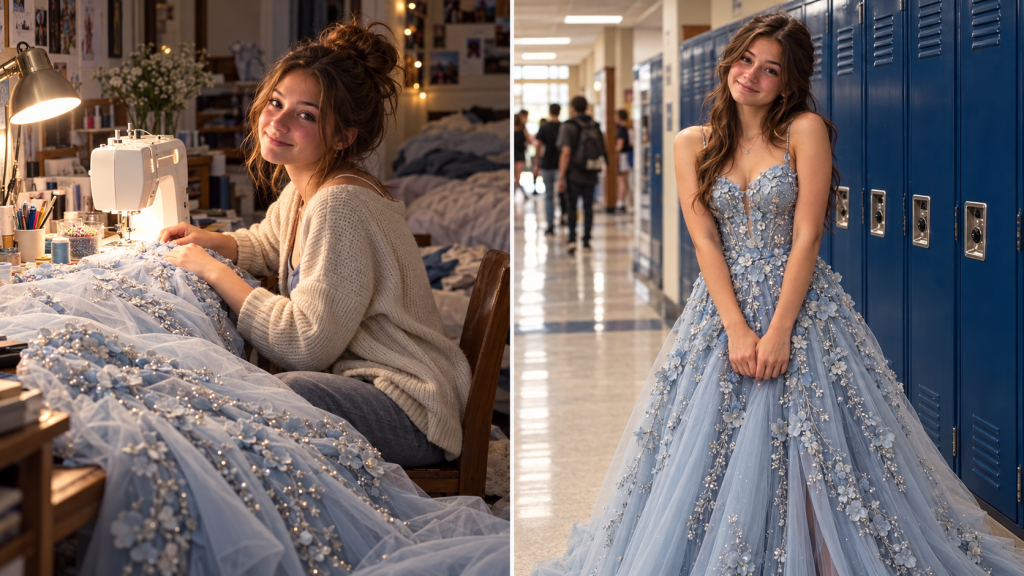
“When Annie wore the dress, people noticed.”
“That was the idea.”
“No.”
“I mean they noticed it was handmade.”
I felt anger flicker.
“Did someone mock her?”
Annie answered:
“A boy asked if I had finally found a charity.”
My jaw tightened.
Lily said:
“I told him to shut up.”
“I assume you used a more colorful word.”
“Maybe.”
Despite everything, I nearly smiled.
Lily continued.
“Then one of the girls said Annie only got the dress because I felt sorry for her.”
Annie looked down.
“And I said she wasn’t charity.”
Lily’s voice began shaking.
“I said she was my sister.”
There it was.
“You told everyone?”
“I shouted it.”
Annie whispered:
“In the hallway.”
Lily covered her face.
“I was so angry.”
“Everyone heard.”
“Annie ran away.”
“I thought I ruined everything.”
Annie looked at her.
“You did ruin my plan to keep it secret until graduation.”
“I’m sorry.”
“I know.”
“Are you still mad?”
“Yes.”
Lily nodded.
“Okay.”
Annie’s mouth twitched.
“But the dress is beautiful.”
Lily started crying.
“You hate the sleeves.”
“I hate the sleeves.”
“I knew it.”
“They make me look like a Victorian lampshade.”
Rosa laughed.
I laughed.
Even Marion laughed through tears.
Lily wiped her nose.
“You said you loved them.”
“I lied.”
“See?”
I pointed at everyone.
“THIS is how it starts.”
For the first time that morning, all of us laughed.
Not because the pain was gone.
Because human beings cannot remain inside one emotion indefinitely.
Even grief needs air.
The concert was that evening.
I assumed Annie would not go.
She did.
At 5:30, Rosa called.
“Can you come over?”
I looked at Lily.
She was already holding her sewing bag.
“We’re coming.”
Annie stood in front of a mirror wearing the dress.
Deep blue.
Soft skirt.
Simple fitted bodice.
Yes, the sleeves were too much.
Lily circled her.
“I can fix them.”
“You have forty minutes.”
“You doubted me before.”
“I continue to.”
Lily smiled.
Then worked.
Cut.
Pinned.
Folded.
Hand stitched.
I watched my daughter transform fabric under pressure with the concentration of a surgeon.
Annie stood still.
Rosa held a flashlight when the room lighting failed.
I threaded needles.
For twenty minutes, none of us discussed Daniel.
That felt healthy.
When Lily finished, the sleeves fell softly from Annie’s shoulders.
Annie looked in the mirror.
Then began crying.
Lily panicked.
“What?”
“Too short?”
“Too tight?”
“I can change—”
“No.”
Annie touched the skirt.
“I look pretty.”
Lily stared.
“You are pretty.”
“No.”
Annie shook her head.
“I know people say that.”
“But…”
She looked at herself again.
“I look like someone who belongs onstage.”
Rosa covered her mouth.
Lily whispered:
“That’s what I wanted.”
Annie turned.
“That’s why you stayed up?”
“Yes.”
“Not because…”
She glanced toward me.
“Because we’re sisters?”
Lily shook her head.
“I started the dress before I knew for sure.”
I stared.
“What?”
Lily looked embarrassed.
“I suspected.”
“But the DNA results came after I started.”
Annie’s face changed.
“So you would have done it anyway.”
“Obviously.”
That mattered more than any test.
Family explained the intensity.
It did not create the kindness.
We drove to the school.
Annie wanted to enter through the side door.
Then stopped.
“No.”
Rosa looked at her.
“What?”
“I’m tired of side doors.”
She walked through the front.
Lily beside her.
The boy who had mocked her stood near the auditorium.
His face changed when he saw Annie.
He started to say something.
His teacher appeared behind him.
“You and I have already discussed your options tonight.”
He shut his mouth.
Good teacher.
No dramatic public humiliation.
No applause.
Just a boundary.
Inside, Annie began shaking.
“I can’t.”
Lily took her hand.
“You can sing behind the curtain.”
Annie looked at her.
“You worked all night so I wouldn’t hide.”
“I worked all night so you could choose.”
I felt that sentence in my chest.
You could choose.
That was what all the adults had stolen from everyone.
Daniel by waiting.
Rosa by hiding paternity.
Marion by hiding the letter.
Even Lily, briefly, by keeping the discovery from me.
Kindness without choice can become control.
Lily had somehow understood that at sixteen.
Annie closed her eyes.
Then:
“I want to go onstage.”
“Okay.”
She did.
I sat between Rosa and Lily.
Marion sat three seats away.
Not beside us.
She had asked permission to come.
Annie walked beneath the lights.
The dress moved beautifully.
The blue cardigan remained backstage.
This was not a moment about Daniel’s old things.
It was Annie’s.
The piano began.
Then she sang.
I had never heard her voice.
Lily was right.
Beautiful was too small a word.
Not because Annie sounded professionally trained.
She didn’t.
Her voice trembled at first.
Then strengthened.
Clear.
Warm.
A little raw.
The kind of voice that made you listen because it seemed to contain a life larger than the person producing it.
Halfway through, I looked at Lily.
She was crying.
Rosa was too.
And I realized I was listening to Daniel’s daughter.
Then immediately corrected myself.
Annie.
I was listening to Annie.
She deserved a name before a relationship.
When the song ended, the audience applauded.
Annie looked toward us.
Not at Rosa first.
Not me.
Lily.
Lily stood.
The entire auditorium did not magically rise.
This was not that kind of story.
But the people around us clapped harder.
Then more stood.
Then others.
A messy, ordinary wave of appreciation.
Annie cried before leaving the stage.
Backstage, she threw her arms around Lily.
“You made me look expensive.”
Lily laughed.
“I hate you.”
“Fix the sleeves permanently and I’ll forgive you.”
Then Annie saw me.
She stopped.
For one second, we both looked uncertain.
What was I to her?
Her father’s widow?
Her sister’s mother?
A stranger with history?
I opened my arms.
Not assuming.
Offering.
Annie walked into them.
She held me tightly.
Then whispered:
“I’m sorry.”
I pulled back.
“For what?”
“Existing and making everything weird.”
My heart broke.
“No.”
I took her face gently.
“You are never required to apologize for existing.”
Tears filled her eyes.
“Your father’s choices created complications.”
“The adults’ choices created secrets.”
“You did not.”
She nodded.
Then whispered:
“Did he love me?”
There it was.
The question underneath everything.
I could have lied.
Made Daniel larger in death.
“He barely knew you.”
Her face fell.
I continued.
“But he wanted to.”
I told her about the letter.
Not every detail.
It was hers to read.
I handed her the sealed envelope Rosa had kept.
“This belongs to you.”
Annie stared.
“Have you read it?”
“No.”
“You didn’t?”
“No.”
“Why?”
“Because your father wrote your name on it.”
She began crying again.
She did not open it backstage.
That was another choice.
She slipped it into her bag.
“Later.”
“Okay.”
That night, after the concert, Lily and I went home alone.
We sat at the kitchen table.
The same table where I had helped her with homework.
Where Daniel once carved a tiny mark accidentally while fixing a chair.
Where four months of secrets had existed while we ate dinner across from each other.
I asked:
“Why didn’t you tell me?”
She looked down.
“I thought it would destroy you.”
There it was.
The family disease.
I closed my eyes.
“Do you hear yourself?”
“Yes.”
“You did exactly what Grandma Marion did.”
“I know.”
“What Rosa did.”
“I know.”
“What Dad did.”
She started crying.
“I know.”
I reached across the table.
“I am not saying that to shame you.”
She looked up.
“I need you to understand something.”
“You are sixteen.”
“You are not responsible for deciding how much truth I can survive.”
“But you were so sad after Dad died.”
“Twelve years ago.”
“You still miss him.”
“I always will.”
“I thought if you found out he hid another daughter…”
“I might stop loving him?”
She nodded.
I squeezed her hand.
“That would be my choice.”
She cried harder.
“I’m sorry.”
“I know.”
“Are you mad?”
“Yes.”
She looked wounded.
I continued.
“And I love you.”
Her face softened.
“Both?”
“Both.”
She gave a tiny smile.
“Annoying adult thing.”
“Exactly.”
Then I asked:
“Why the DNA test?”
“I needed to know before telling anyone.”
“How did two minors arrange that?”
She winced.
“Annie is seventeen.”
“That does not answer my question.”
“We used an over-the-counter sibling kit.”
“With Rosa’s permission?”
“No.”
“Lily.”
“I know.”
I rubbed my forehead.
Teenagers.
Secret relatives.
Consumer genetics.
My husband had been dead twelve years and was somehow still giving me parenting problems.
“We are going to confirm this properly.”
She nodded.
“And no more secret medical testing.”
“Okay.”
“Even if your intentions are good.”
“Okay.”
“Especially then.”
She nodded.
Two weeks later, with Rosa’s consent, the girls completed a properly documented kinship test.
The result was overwhelming.
Half-sisters.
Same biological father.
No ambiguity left.
Rosa stared at the paper.
Then said:
“I spent seventeen years being afraid of one fact.”
I looked at her.
“And?”
“It was still true when I finished being afraid.”
Yes.
Truth is patient that way.
It waits.
Marion’s repair took longer.
I did not speak to her for almost two months.
Lily did.
That was her choice.
I did not make her carry my anger.
Eventually Marion asked if I would meet.
We chose a coffee shop.
Public.
Neutral.
She looked smaller than I remembered.
“I brought something.”
I almost laughed.
“No more boxes.”
She smiled sadly.
“It’s not a box.”
She placed one photograph between us.
Daniel.
Five years old.
Sitting behind a toy sewing machine.
I stared.
“Why?”
“Because you always wondered why he knew how to fix Lily’s hems.”
Despite myself, I laughed.
Marion cried.
Then I did.
Sometimes reconciliation begins with something stupid.
Not the central wound.
Just a doorway.
She said:
“I failed you.”
“Yes.”
“I failed Annie.”
“Yes.”
“I told myself I was honoring Daniel by protecting his memory.”
“You protected the version of him you wanted us to keep.”
“Yes.”
“That was not your choice.”
“No.”
She wiped tears.
“I was afraid Lily would hate him.”
“So you preferred she love a partial truth.”
Marion flinched.
“Yes.”
I looked out the window.
Then back.
“Daniel was good to us.”
“Yes.”
“He also hid Annie.”
“Yes.”
“He planned to tell me.”
“Yes.”
“He waited seven months.”
“Yes.”
“All those things belong to him.”
Marion nodded.
“I know now.”
I did not forgive her that afternoon.
But I started.
Slowly.
She gave Annie the birthday cards she had written and never sent.
Annie read all of them.
Then told Marion:
“I wish you had mailed them.”
Marion answered:
“I do too.”
Annie said:
“I’m not calling you Grandma yet.”
Marion nodded.
“You don’t have to.”
Three months later, Annie called her Grandma accidentally.
She was furious with herself.
Marion pretended not to notice.
Smart woman.
Rosa and I developed something stranger than friendship.
We were not rivals.
There was no affair to fight over.
But we had loved the same man at different times.
She had known Daniel young.
I had known him grown.
Sometimes she told a story and I did not recognize him.
Sometimes I told one and she laughed because some habit had never changed.
“He still folded pizza?”
she asked once.
“In half.”
“He started doing that when he was sixteen.”
“That explains nothing.”
“No.”
We laughed.
Then felt guilty.
Then stopped feeling guilty.
Daniel was allowed to be remembered by more than one person.
One afternoon Rosa asked:
“Do you hate me?”
I thought carefully.
“I hate what you hid.”
She nodded.
“I don’t hate you.”
“Thank you.”
“That is not forgiveness.”
“I know.”
Good.
She learned.
Annie began coming to our house.
At first once a week.
Then more.
Not because I adopted her emotionally overnight.
Because Lily invited her.
They sewed together.
Argued.
Borrowed clothes.
Fought over the bathroom.
One day I heard Lily shout:
“Stop taking my mascara!”
Annie shouted back:
“You stole my boots!”
And something inside me unexpectedly healed.
Ordinary conflict.
No DNA.
No dead father.
No secrets.
Just sisters being irritating.
The first Christmas was difficult.
Annie did not know whether to come.
Rosa worried she was intruding.
Marion overcompensated by buying too many gifts.
I stopped that quickly.
“You do not repair twelve missing Christmases by burying her in presents.”
Marion looked ashamed.
“You’re right.”
Annie whispered to me later:
“Thank you.”
“For what?”
“I don’t want to be the tragic bonus granddaughter.”
I laughed.
“Fair.”
We set one rule.
Nobody had to perform closeness.
If Annie wanted to spend Christmas morning with Rosa and dinner with us, fine.
If Lily wanted time alone with me, fine.
If Marion felt awkward, she could survive it.
Family became less about forcing everyone into one photograph and more about making room for choices.
A year after the concert, Lily applied to three design programs.
She did not get into her first choice.
She cried for two days.
Then Annie showed up wearing the blue concert dress.
Altered again.
Shorter.
Simpler.
She stood in our kitchen.
“Look at this.”
Lily glared.
“What?”
“You made this when you were sixteen.”
“So?”
“So stop acting like one rejection means you have no talent.”
“I hate motivational speeches.”
“Good.”
“I’m not done.”
Lily threw a dish towel at her.
Annie kept talking.
“You made me walk onstage when I wanted to disappear.”
Lily snapped:
“I did not make you.”
Annie smiled.
“Exactly.”
Lily groaned.
“You’ve been listening to my mother.”
“Unfortunately.”
I pretended to be offended.
Lily eventually attended her second-choice school.
It became the right place anyway.
Life does that sometimes.
Not because everything happens for a reason.
I hate that phrase.
Because sometimes terrible things happen for no reason at all.
But human beings can still make something after.
Lily studied costume design.
Not high fashion.
That surprised her.
She fell in love with theater.
The first time she designed costumes for a university production, Annie drove four hours to attend.
She brought the original blue dress.
Lily saw it and groaned.
“You still own that?”
“I’m saving it for your museum.”
“You’re awful.”
“You love me.”
“Debatable.”
They hugged.
Annie did not become a famous singer.
I am glad.
Not because she lacked talent.
Because stories often pretend a beautiful voice must become fame to matter.
Annie became a music teacher.
Elementary school.
The first time I visited her classroom, twenty-one children were shouting something that barely resembled a song.
Annie looked exhausted.
I said:
“You gave up the stage for this?”
She smiled.
“No.”
“I found my stage.”
That sounded like Daniel.
Or maybe I only wanted it to.
Memory does that.
Years passed.
Lily graduated.
Annie married.
Rosa danced at the wedding until her feet hurt.
Marion cried through the entire ceremony.
I sat in the second row.
Not the mother of the bride.
Not the father’s widow.
Just me.
Annie had asked me to sit there.
That was enough.
Before walking down the aisle, she gave me a small box.
I laughed.
“Apparently our family communicates only through boxes.”
She smiled.
“Open it.”
Inside was Daniel’s silver watch.
The one Rosa had brought to my porch years earlier.
I stared.
“Why are you giving me this?”
“I’m not.”
She pointed.
There was a new engraving beneath the old initials.
Tiny.
Two letters.
L + A.
Lily and Annie.
I looked up.
Annie said:
“Mom had it repaired.”
“It works again.”
I pressed the side.
The second hand moved.
After seventeen years.
Tick.
Tick.
Tick.
I began crying.
Annie said:
“I don’t want it to belong to only the past.”
That was exactly right.
She wore the watch around her wrist during the reception.
Too large.
Not elegant with her dress.
She did not care.
Lily fixed the clasp twice.
Marion watched from across the room.
For a moment, I saw Daniel everywhere.
Then I stopped.
Not because he disappeared.
Because the girls had become themselves.
They were no longer his unfinished business.
They were women.
Sisters.
One a designer.
One a teacher.
People with husbands, friends, careers, bad habits, opinions, debts, favorite restaurants, and arguments that had nothing to do with the man who connected them.
That may have been the greatest healing.
Daniel became part of their history.
Not the center of their identity.
Years later, Lily asked me:
“If Dad had lived, do you think you would have stayed married?”
I thought for a long time.
“I don’t know.”
She looked surprised.
“I thought you’d say yes.”
“I would like to think we could have repaired it.”
“But he lied.”
“Yes.”
“He was going to tell you.”
“Yes.”
“Does that matter?”
“Yes.”
“Does it erase it?”
“No.”
She smiled.
“You love complicated answers.”
“I earned them.”
She laughed.
Then asked:
“Do you wish I had never found the photograph?”
I looked at her.
“No.”
“Even though it hurt?”
“Yes.”
“Why?”
“Because Annie existed whether we knew or not.”
“Truth did not create her.”
“It only gave us the chance to know her.”
Lily leaned back.
“That sounds like something you practiced.”
“I’ve had years.”
Then she became quiet.
“I’m still sorry I kept it from you.”
I reached over and took her hand.
“I know.”
“I thought I was protecting you.”
“I know.”
“I won’t do that again.”
I smiled.
“Good.”
Then:
“But if you ever discover I have a secret second husband, please tell me gently.”
She stared.
“Mom.”
“What?”
“That is not funny.”
“It’s a little funny.”
She laughed despite herself.
The old wooden sewing box still sits in Lily’s studio.
She kept it.
But she removed the fabric lining.
No false bottoms.
No hidden pages.
She uses it for thread.
Scissors.
Pins.
Ordinary things.
The photograph of Daniel and Rosa is framed elsewhere.
Not hidden.
The two pieces of Daniel’s letter are preserved together.
Annie keeps the letter he wrote to her.
She never told me everything inside.
I never asked.
That secret belongs to her because it was given to her.
That is different from information withheld about her own life.
It took me years to understand the distinction.
Privacy is chosen.
Secrecy is imposed.
Love needs room for the first.
It should be careful with the second.
Rosa once asked me whether I regretted letting Annie into our family.
I almost laughed.
“Letting?”
She understood immediately.
“Bad word.”
“Yes.”
Annie was not standing at a gate waiting for me to approve her existence.
She was Lily’s sister before I knew.
Daniel’s daughter before he knew.
Rosa’s daughter every day of her life.
My approval did not create those facts.
What I chose was whether I would meet her with resentment or curiosity.
Whether I would make her pay for adults who lied.
Whether I would confuse pain with blame.
I am proud that, eventually, I chose correctly.
Not instantly.
Eventually.
That is the version of goodness I trust now.
Not people who never feel ugly emotions.
People who refuse to turn those emotions into someone else’s punishment.
On the twentieth anniversary of Daniel’s death, all of us went to the cemetery.
Me.
Lily.
Annie.
Rosa.
Marion had died two years earlier.
The girls brought flowers.
Lily brought scissors and thread because a hem on Annie’s coat had come loose.
Of course.
We stood at Daniel’s grave.
Annie had visited before.
But never with all of us.
She touched the stone.
“Hi, Dad.”
I looked away.
Not because it hurt.
Because it belonged to her.
She continued:
“I’m still mad.”
Lily smiled.
“So is Mom.”
I said:
“Do not involve me.”
Annie laughed.
Then:
“I think I understand why you were scared.”
She paused.
“That doesn’t mean you were right.”
Good girl.
She placed her hand on the stone.
“I wish you had told everyone faster.”
Then Lily added:
“And your handwriting was terrible.”
I stared.
“Lily.”
“What?”
“It was.”
Annie laughed.
I laughed.
Even Rosa laughed.
We stood there in the cold, teasing a dead man we had all known differently.
That felt healthier than worship.
Before leaving, I said something quietly after the others walked toward the car.
“Daniel.”
I had not spoken aloud to him in years.
“You should have told me.”
Wind moved through the trees.
No sign.
No answer.
Good.
I continued.
“I would have been furious.”
“I probably would have screamed.”
“I might have slept somewhere else.”
“I might have needed months.”
“But I wish you had trusted me enough to give me the choice.”
My throat tightened.
“I wish you had trusted Annie enough too.”
Then I smiled.
“Your daughters turned out all right.”
I looked toward them.
Lily was crouched beside Annie’s coat, repairing the hem.
Annie complained dramatically.
Rosa was telling them both to hurry.
I whispered:
“Better than all right.”
Then I walked away.
The silver watch eventually stopped again.
Annie did not repair it this time.
She placed it in a drawer.
When Lily asked why, she said:
“Not everything has to keep ticking forever.”
That was true too.
Some things end.
People.
Marriages.
Years.
Secrets.
What matters is what continues.
The dress continued.
Not physically forever.
Fabric wears.
Thread breaks.
Eventually Annie donated it to Lily’s small studio archive when Lily began teaching design workshops for teenagers who could not afford formal classes.
Inside the display case, they placed one card.
Not about Daniel.
Not about DNA.
Not about poverty.
It read:
Made at sixteen for a girl who wanted to sing without hiding.
That was enough.
Because before Annie was my husband’s secret daughter, she was a girl who wanted to sing.
Before Lily was the child who uncovered a family secret, she was a girl willing to stay awake all night with aching fingers because somebody else was afraid to stand onstage.
That is the part of my daughter I had known all along.
So when Rosa stood on my porch at six in the morning and told me:
“You don’t know your daughter at all,”
she was wrong.
I did know Lily.
I knew her kindness.
Her stubbornness.
Her dangerous instinct to carry other people’s pain.
What I did not know was how much she had inherited from all of us.
The belief that love sometimes means keeping difficult truth inside.
That was the inheritance we finally broke.
Not with DNA.
Not with Daniel’s letter.
Not with a silver watch.
With a sixteen-year-old girl learning that protecting someone and deciding for them are not the same thing.
With a seventeen-year-old girl learning she could belong to a family without becoming its secret.
With two mothers learning that our daughters did not need us to rewrite the past.
They needed us to stop hiding it.
And with me learning that discovering a flaw in someone you loved does not erase every beautiful thing they gave you.
Daniel loved me.
Daniel loved Lily.
Daniel had another daughter.
Daniel delayed telling me.
Daniel was afraid.
Daniel was wrong.
Daniel was still loved.
All of those sentences fit inside the same life.
Just like two daughters could fit inside the same father’s story.
Just like one handmade dress could begin as an act of kindness and become the thread that pulled an entire hidden family into the light.
THE END STORIES! THANK YOU FOR READING GOOD LUCK! ❤️
Related Posts