For three full seconds, nobody moved. Mr. Harrison stood in the aisle holding one of the perfume-soaked pages. The rude woman stared at him as though she had just watched the floor disappear beneath her.
Grandma Rose, meanwhile, looked completely calm. “Only if my granddaughter comes too,” she repeated. Mr. Harrison glanced toward the flight attendant. “Can we make that happen?” The attendant gave an apologetic shake of her head. “First class is full.” Grandma immediately shrugged.
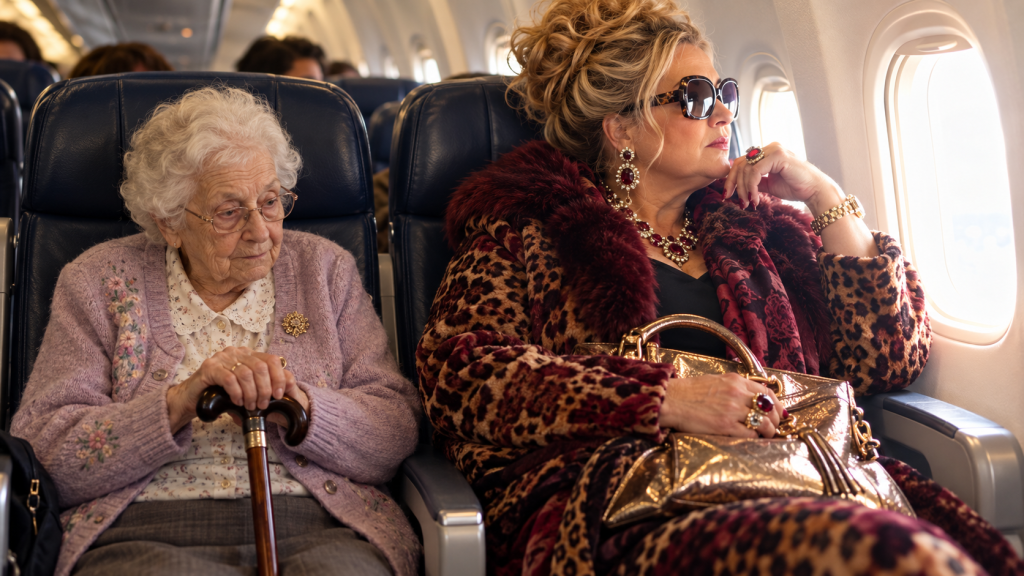
“Then I’m staying here.” I could see the woman beside her almost choke. Mr. Harrison blinked. “Ma’am, you don’t have to do that.” Grandma looked at him. “I spent eighty-six years waiting to see the ocean.” “I can spend two hours in coach.”
Then she nodded toward me several rows back.
“But I’m not taking the fancy seat while she sits alone.”
My eyes burned.
That was Grandma.
Offer her comfort and she immediately looked around to see who else needed it.
Mr. Harrison smiled.
Not the polished corporate smile he had been wearing earlier.
A real one.
“Well,” he said, “then maybe we rearrange the problem.”
The flight attendant looked concerned.
“Sir—”
“I can sit here.”
The rude woman’s head snapped toward him.
“What?”
Mr. Harrison gestured toward Grandma’s seat.
“I’ll take this one.”
Her face went pale.
Then he pointed toward his own first-class seat.
“She takes mine.”
Grandma crossed her arms.
“And my granddaughter?”
The flight attendant hesitated.
Another voice came from the front.
“I’ll swap.”
A woman in a navy suit stood from the first-class cabin.
She looked to be in her early forties and had been watching the entire situation.
Mr. Harrison turned.
“Karen, you don’t have to.”
She smiled.
“I’ve worked for you for twelve years.”
“I’ve survived worse than seat 23B.”
The flight attendant started laughing.
So did half the row.
The rude woman did not.
Karen continued.
“I’ll take your grandmother’s original seat.”
“I’m sorry,” I said. “You really don’t need to do that.”
She shook her head.
“I spend half my life on airplanes.”
“Take the seat.”
Grandma pointed at her.
“You’re sure?”
“Very.”
Grandma narrowed her eyes.
“Do they have those little warm nuts up there?”
Karen grinned.
“Yes.”
Grandma looked at me.
“We’re going.”
I nearly laughed.
Five minutes later, I was sitting beside my grandmother in first class.
At eighty-six years old, on the first flight of her life, she was examining everything.
The wider seat.
The tray table.
The little bottle of water.
The blanket.
The reading light.
She pressed the button that moved the seat backward and jerked in surprise.
“Oh!”
I grabbed her arm.
“What?”
“The chair moved.”
“Grandma, it’s supposed to.”
She pressed it again.
The seat came forward.
She looked delighted.
“This is ridiculous.”
I laughed.
“Good ridiculous?”
“Completely unnecessary ridiculous.”
Then she tucked the blanket around her knees.
“But comfortable.”
I looked back toward coach.
Mr. Harrison had taken Grandma’s original seat.
The woman beside him was sitting perfectly straight now.
Armrest down.
Elbows tucked in.
Bag clutched tightly on her lap.
Apparently personal space had become extremely important to her.
Grandma followed my gaze.
“Don’t stare.”
“She deserves it.”
“Maybe.”
Grandma opened her water.
“But you’ll miss your trip if you spend the whole flight enjoying somebody else’s bad morning.”
I looked at her.
“You just winked at me after her perfume exploded.”
“Yes.”
“You were absolutely enjoying that.”
Grandma took a sip.
“I’m eighty-six.”
“I contain contradictions.”
I laughed so loudly the flight attendant smiled.
Then Grandma became serious.
“Did she ruin my trip?”
“No.”
“Then don’t give her that much power.”
I looked out the window.
Clouds spread beneath us.
Florida waited somewhere ahead.
The ocean.
Grandma’s ocean.
I reached for her hand.
She squeezed mine.
“Thank you,” she whispered.
“For what?”
“For not yelling back there.”
“I wanted to.”
“I know.”
“You stopped me.”
“I know.”
“Why?”
Grandma looked toward the window.
“Because there are some people you can argue with.”
“And some people are already arguing with themselves.”
I frowned.
“What does that mean?”
She nodded toward coach.
“That woman was angry before we arrived.”
“She wasn’t angry because I’m old.”
“She used my age because it was available.”
That stayed with me.
Then Grandma added:
“Still rude, though.”
I laughed.
“Very.”
“Terrible manners.”
“Yes.”
“Her mother would be embarrassed.”
“Probably.”
Grandma smiled.
“Now give me one of those warm nuts.”
About twenty minutes later, Mr. Harrison walked up from coach.
He stopped beside our seats.
Grandma looked at him.
“You escaped.”
“Temporarily.”
“How is my old seat?”
He smiled.
“Cozy.”
Grandma raised an eyebrow.
“Is she still spreading out?”
“No.”
“Miracles happen.”
He laughed.
Then his expression became more serious.
“I wanted to apologize.”
Grandma frowned.
“For what?”
“My employee.”
So that was confirmed.
The woman was not merely someone he knew professionally.
She worked for him.
Grandma shook her head.
“You didn’t teach her manners.”
“No.”
“Then don’t apologize for them.”
Mr. Harrison nodded slowly.
“Her name is Vanessa Cole.”
I glanced toward coach.
Vanessa.
Somehow having a name made her less cartoonish.
Still rude.
But human.
Mr. Harrison continued.
“She’s a regional account manager.”
Grandma said nothing.
He held up the damaged papers.
“She was carrying originals she had been instructed to keep in a document sleeve.”
I winced.
Grandma looked unimpressed.
“That sounds like her problem.”
“It is.”
“I didn’t break the bottle.”
“I know.”
“I didn’t move the bag.”
“I know.”
“Good.”
Mr. Harrison smiled.
“I’m beginning to understand why nobody argues with you.”
“My daughter argues with me all the time.”
“Your granddaughter?”
“Her too.”
I protested.
“I do not.”
Grandma looked at him.
“She does.”
Mr. Harrison laughed.
Then he became serious again.
“I also want you to know that I’m not going to make an employment decision on an airplane.”
Grandma tilted her head.
“I didn’t ask you to.”
“I know.”
“But I heard several passengers joking that she just got fired.”
He looked toward coach.
“That’s not how it works.”
“I need to understand the documents issue.”
“I need to hear from the crew.”
“She’ll have an opportunity to explain.”
Grandma nodded.
“Good.”
I looked at her in disbelief.
“Good?”
She glanced at me.
“What?”
“She humiliated you.”
“Yes.”
“She insulted you.”
“Yes.”
“She took half your seat.”
“Yes.”
“And you want her to get a chance to explain?”
Grandma’s expression softened.
“Honey.”
“I want people to give me a chance to explain if I make a terrible choice.”
“That doesn’t mean the choice disappears.”
Mr. Harrison nodded.
“Exactly.”
Grandma pointed at him.
“See?”
“He understands.”
Then she added:
“Still make her replace whatever she ruined.”
Mr. Harrison almost choked laughing.
“I suspect she will.”
He returned to coach.
I leaned toward Grandma.
“You are too nice.”
“No.”
She shook her head.
“Nice is pretending something didn’t happen.”
“I saw exactly what happened.”
“Mercy and stupidity are not the same thing.”
Before I could answer, the flight attendant came by with drinks.
Grandma ordered ginger ale.
Then whispered:
“Do you think first class has tomato juice?”
“Yes.”
“People drink tomato juice on airplanes?”
“Apparently.”
“Why?”
“I have no idea.”
She looked fascinated.
“Bring me one of those too.”
Ten minutes later, Grandma had two drinks and an expression of scientific curiosity.
She tasted the tomato juice.
Immediately grimaced.
“That is awful.”
I laughed.
“Then why are you drinking it?”
“I waited eighty-six years to fly.”
“I’m not wasting the opportunity.”
That was when she reached into her purse.
Not for tissues.
Not medicine.
Not her glasses.
An envelope.
Old.
Cream-colored.
Bent at the corners.
She held it carefully.
I recognized the handwriting on the front.
My grandfather’s.
My breath caught.
Grandpa Henry had died nine years earlier.
He and Grandma had been married sixty-one years.
“What is that?”
Grandma traced his handwriting with one finger.
“Something your grandfather left me.”
“You never showed me.”
“I know.”
“Have you read it?”
She shook her head.
I stared.
“Nine years?”
“Yes.”
“You kept an unopened letter from Grandpa for nine years?”
“Yes.”
“Why?”
She looked toward the window.
“Because he wrote on the back when to open it.”
She turned the envelope around.
Four words.
WHEN YOU SEE THE OCEAN.
My eyes filled immediately.
“Oh, Grandma.”
She smiled.
“Your grandfather could be very dramatic when he wanted to be.”
“You never told me.”
“If I told you, you would have felt pressured.”
“I was already saving for this trip.”
“I know.”
“Why didn’t you open it before?”
“Because those were his instructions.”
“You ignore instructions constantly.”
“Not dead husbands.”
Fair.
I touched the envelope.
“Are you going to open it on the plane?”
“No.”
“At the hotel?”
“No.”
“When?”
She looked at me as if the answer were obvious.
“When I see the ocean.”
I suddenly understood this trip differently.
I had believed I was giving Grandma something she had missed.
I had not realized I was helping her keep a nine-year-old appointment.
“Did Grandpa ever see it?”
Grandma smiled sadly.
“Oh, yes.”
“He was in the Navy.”
“He saw enough ocean for both of us.”
“Then why didn’t he ever take you?”
That question escaped before I could stop it.
Grandma did not look offended.
She looked tired.
“We planned to.”
“When?”
“About forty times.”
I waited.
She chuckled.
“First after we married.”
“But then your mother came early.”
“You mean she was born early?”
Grandma looked at me.
“No.”
“She came exactly when she intended.”
“Your grandfather and I were simply bad at mathematics before the wedding.”
I stared at her.
“Grandma!”
“What?”
“You’re eighty-six, not innocent.”
I covered my face.
She laughed.
Then continued.
“We saved again when your mother was seven.”
“The furnace died.”
“When she was twelve, Henry’s brother lost his job and moved in with us.”
“When she graduated, we said we would go.”
“Then college cost more than we expected.”
“After she married, we planned a cruise.”
“Then my mother got sick.”
“Every time we saved, life found the money.”
I felt guilty.
“Our family.”
“Life.”
Grandma corrected me.
“Do not turn love into debt.”
“You did not steal my ocean.”
I swallowed.
“Did you resent it?”
“Sometimes.”
The honesty surprised me.
“Really?”
“Of course.”
“I’m not a saint.”
She looked down at the envelope.
“I resented the furnace.”
“I resented medical bills.”
“I resented your grandfather’s brother for eating everything in the refrigerator.”
I laughed.
“Uncle Joe?”
“That man could finish a ham while waiting for dinner.”
Then her smile softened.
“But resentment is not the same as regret.”
I leaned my head against the seat.
“What did Grandpa say about never taking you?”
“He felt guilty.”
“For years.”
“Especially near the end.”
“He kept saying, ‘Rose, I promised you an ocean.’”
“What did you say?”
“I told him I had him.”
She looked at me.
“It sounded prettier than saying I was afraid of flying.”
I stared.
“You were afraid of flying?”
“Terrified.”
“You never told me!”
“I’m not now.”
“You were arguing with a stranger before takeoff.”
“Yes.”
“That distracted me beautifully.”
I laughed through tears.
Then Grandma said:
“Maybe she helped.”
I looked back toward coach.
“Do not give Vanessa credit.”
“Fine.”
We landed a little over two hours later.
Before we left the plane, the captain made the usual announcement.
Weather.
Local time.
Thank you for flying.
Grandma applauded when the wheels touched the runway.
Nobody else did.
She looked around.
“What?”
I whispered:
“People don’t usually clap anymore.”
“That man just brought a building through the sky and put it on the ground.”
“He deserves something.”
The man across the aisle started clapping.
Then another passenger.
Soon half of first class was applauding.
Grandma looked pleased.
“I fixed flying.”
“You did.”
The door opened.
We waited.
Grandma needed extra time standing.
A wheelchair attendant was supposed to meet us at the jet bridge.
As we gathered our things, Mr. Harrison appeared again.
Vanessa stood behind him.
She had been crying.
Not dramatically.
Quietly.
Her makeup had streaked slightly around one eye.
The arrogance from earlier was gone.
I instinctively moved closer to Grandma.
Vanessa noticed.
Her face tightened.
Then she looked at Grandma.
“Mrs…?”
“Rose is fine.”
“Rose.”
Vanessa swallowed.
“I owe you an apology.”
Grandma waited.
Vanessa glanced at Mr. Harrison.
Grandma noticed.
“No.”
Vanessa blinked.
“No?”
“Look at me.”
Vanessa did.
“If you are apologizing because your boss is standing behind you, wait until Monday.”
Mr. Harrison’s eyebrows lifted.
Vanessa went red.
Then, surprisingly, she said:
“You’re right.”
She took a breath.
“He asked me to apologize.”
Mr. Harrison started to speak.
Vanessa raised a hand.
“No.”
“She deserves the truth.”
She looked at Grandma.
“I was going to give you a fake apology.”
The bluntness startled everyone.
Vanessa continued.
“I was embarrassed.”
“My passport is damaged.”
“The contracts are damaged.”
“I have a meeting Monday that I’m terrified about.”
“I wanted to say I was sorry so this could end.”
Grandma watched her.
Vanessa’s eyes filled.
“But the more I sat back there, the worse I felt.”
She looked at me.
“Your granddaughter asked for almost nothing.”
“She just wanted you to have your seat.”
Then back at Grandma.
“And I looked at you like you were an inconvenience because you moved slowly.”
Her voice broke.
“That was ugly.”
Grandma said nothing.
Vanessa continued.
“My mother is eighty-three.”
Grandma’s expression changed slightly.
“She doesn’t fly anymore.”
“Why?”
“She gets confused in airports.”
“So?”
Vanessa blinked.
Grandma repeated:
“So?”
“I don’t understand.”
“You said she doesn’t fly because she gets confused.”
“That means she needs help.”
“Not that she cannot go.”
Vanessa looked down.
“I don’t help.”
There it was.
Something deeper.
“My sister usually does.”
Grandma waited.
Vanessa wiped her cheek.
“I was angry this morning because my mother called me at four asking when I was visiting.”
“I told her I was busy.”
“Then I got to the airport and my client had changed the presentation.”
“My bag broke.”
“I spilled coffee.”
“Then…”
She looked ashamed.
“Then you were there.”
Grandma nodded.
“I was convenient.”
Vanessa’s face crumpled.
“Yes.”
Exactly what Grandma had told me.
She had not been angry because Grandma was old.
She had used Grandma’s age because it was available.
Vanessa said:
“I’m sorry.”
This time Grandma accepted it.
Not warmly.
Not dramatically.
Simply:
“Thank you.”
Vanessa seemed surprised.
“Do you forgive me?”
Grandma gave her a look.
“Young woman, we have known each other for three hours.”
I had to bite my lip.
Grandma continued.
“You apologized.”
“That is good.”
“What you do next is more interesting.”
Vanessa nodded.
Then Grandma pointed toward her phone.
“Call your mother.”
Vanessa blinked.
“What?”
“If that story was true.”
“It was.”
“Then call her.”
“Not for me.”
“For her.”
Vanessa looked like she had been slapped in a gentler way.
“I will.”
Grandma smiled.
“Good.”
Then:
“And keep your elbow on your own side of the armrest.”
Mr. Harrison laughed.
Even Vanessa smiled.
We left.
No dramatic firing.
No cheering crowd.
No police.
No viral video.
Just consequences waiting for Monday.
That felt more real.
At baggage claim, I asked Grandma:
“Do you really believe she’ll call her mother?”
“I don’t know.”
“Then why tell her?”
Grandma shrugged.
“Because people sometimes need one clear next step.”
We collected our suitcase.
The Florida air outside the terminal felt warmer than home.
Grandma stood still for a moment.
Palm trees swayed beyond the parking structure.
She stared.
“What?”
I asked.
“Those are real.”
“The palm trees?”
“Yes.”
I laughed.
“You have seen palm trees.”
“On television.”
She pointed toward one.
“That is not television.”
Fair.
Our hotel was forty minutes from the coast.
Grandma kept staring out the window.
Every few minutes she asked:
“Can you smell it yet?”
“The ocean?”
“Yes.”
“No.”
Ten minutes later:
“Now?”
“No.”
Twenty minutes later:
“Now?”
“Grandma.”
“What?”
“You’ll know.”
“How?”
“I don’t know.”
“You’ve been before.”
“Yes.”
“Then explain.”
I thought.
“It smells…”
“Like what?”
“Salt.”
“That is useless.”
“I know.”
She laughed.
Then, about five miles from the beach, she cracked the window.
Her expression changed.
Not dramatically.
Just a small stillness.
“You smell it?”
I asked.
She nodded.
“I think so.”
We checked into the hotel.
The room had a partial ocean view.
I had paid extra for it.
Not much.
But enough that I had eaten very cheap lunches for two months.
Grandma walked onto the balcony.
Then stopped.
The ocean stretched beyond the road and dunes.
Blue-gray.
Endless.
Her hand went to her mouth.
I stayed behind her.
Did not speak.
She stared for almost a full minute.
Then whispered:
“That’s too much water.”
I laughed through tears.
“Is that your review?”
“It’s ridiculous.”
She began crying.
“So much.”
I put my arm around her.
She leaned into me.
For eighty-six years, the ocean had been an idea.
Postcards.
Movies.
Stories from Grandpa.
Maps.
Now it moved in front of her.
Real.
She whispered:
“Henry.”
My heart broke.
She reached into her purse.
The envelope.
“Now?”
I asked.
She looked toward the water.
“No.”
“Why not?”
“I can see it.”
“But I haven’t met it.”
I understood.
We went downstairs.
The hotel had an accessible beach walkway.
A staff member offered a beach wheelchair.
Grandma refused at first.
“I can walk.”
“On sand?”
“I have legs.”
“You also have arthritis.”
“I had arthritis yesterday.”
“And yesterday you weren’t walking on a beach.”
She glared at me.
“Bossy.”
“Genetic.”
She agreed to the chair.
I pushed her across the sand.
Wind lifted her white hair.
She laughed when it blew into her mouth.
At the shoreline, I stopped.
“Ready?”
“No.”
I waited.
She looked at the waves.
Then down at her shoes.
“Take them off.”
I knelt.
Removed her shoes.
Then socks.
Her feet were tiny.
Veins visible beneath thin skin.
Feet that had worked for eighty-six years.
Factory floors.
Kitchen floors.
Hospital corridors.
Church aisles.
Funerals.
Weddings.
My childhood home.
Grandma looked at them.
“Ugly feet.”
I laughed.
“They’re eighty-six.”
“They’ve had a difficult career.”
A wave came close.
Then retreated.
Grandma gripped the chair arms.
Another.
Closer.
Then the third reached us.
Cold seawater rushed over Grandma’s toes.
She gasped.
Then laughed.
A sound I had never heard from her.
Young.
That is the only word.
For one second, my eighty-six-year-old grandmother sounded seventeen.
“Oh!”
Another wave came.
She lifted both feet.
Then deliberately put them down.
Again.
Again.
She started crying.
I knelt beside her.
“Grandma?”
She shook her head.
“Don’t stop it.”
“I’m not.”
“Don’t move me.”
“I won’t.”
We stayed.
Wave after wave.
Then she reached into her purse.
The letter.
Her hands were shaking too badly to open it.
“Can you?”
I took the envelope.
“Are you sure?”
“Yes.”
I carefully tore the edge.
Inside were two pages.
Grandpa’s handwriting.
Grandma stared.
“Read.”
“Out loud?”
“Yes.”
So I did.
“Rosie…”
Grandma closed her eyes.
Nobody had called her Rosie since Grandpa died.
I continued.
“If you are reading this where I told you to, then either I finally got you to the ocean or somebody better than me did.”
I stopped because my voice broke.
Grandma whispered:
“Keep going.”
I read.
“I know I spent sixty-one years saying next summer.”
“Next anniversary.”
“Next year.”
“Then one day there was no next year left for me.”
Grandma’s tears fell silently.
“I am sorry.”
“I wish I had taken you when we were poor.”
“I wish I had taken you when the car was bad.”
“I wish I had taken you when the roof leaked.”
“I wish I had understood sooner that life does not clear its calendar before it ends.”
I could barely see the page.
Grandma reached for my hand.
I continued.
“But Rose, do not turn this into one more thing you think you missed because of me.”
“You gave me a life bigger than every ocean I ever crossed.”
Grandma covered her face.
I kept reading.
“If you are standing by the water, put your feet in.”
“I know you.”
“You are probably standing ten feet back because you don’t want your shoes wet.”
I laughed through tears.
Grandma looked offended.
“He knows me.”
I continued.
“Take the shoes off.”
“Let the water get you.”
“Do not stand on the shore protecting yourself from a wave.”
Another wave rolled over Grandma’s feet.
She sobbed.
Then the letter changed.
“Also, there is something I never told you.”
Grandma opened her eyes.
I looked at her.
“You knew about this?”
“No.”
I continued.
“Remember 1968, when I told you the transmission failed and we had to cancel Myrtle Beach?”
Grandma’s eyebrows pulled together.
“Yes.”
I read.
“The transmission was fine.”
Grandma stopped crying.
“What?”
I stared at the page.
Grandpa continued from beyond the grave.
“I panicked.”
Grandma’s mouth fell open.
“I had not been on a civilian airplane since the Navy, and the night before we were supposed to leave, I convinced myself something terrible would happen.”
I began laughing.
Grandma stared at the letter.
“That coward.”
I read on.
“I told you the transmission failed because I was embarrassed to admit I was afraid.”
“You spent fifty years believing you were the nervous traveler.”
“I was worse.”
Grandma slapped the arm of the wheelchair.
“I KNEW THAT CAR WAS FINE!”
People nearby turned.
I was crying and laughing at once.
Grandma pointed at the letter.
“That man lied to me about a Buick for fifty years!”
I could barely breathe.
She was furious.
Delighted.
Heartbroken.
Alive.
I continued.
“If you are angry, good.”
“Being angry means you are there.”
Grandma stared.
Then laughed.
“Oh, I hate him.”
“No, you don’t.”
“Temporarily.”
I read the final lines.
“So wherever I am, Rosie, know this.”
“I am not waiting for you.”
“Do not hurry.”
“Stay.”
“Eat dessert.”
“Argue with people who deserve it.”
“Forgive some who don’t.”
“Take another trip.”
“And when the ocean touches your feet, do not say you wish I were there.”
“Say, Henry, you idiot, you should have brought me sooner.”
I stopped.
Grandma was openly sobbing.
Then she looked at the horizon.
And shouted:
“HENRY, YOU IDIOT!”
Three people down the beach laughed.
I laughed so hard my stomach hurt.
Grandma wiped her face.
“He deserved that.”
“Yes.”
She looked at the last line.
I read it.
“I loved every mile with you.”
Silence.
Grandma pressed the letter to her chest.
Another wave reached her.
Then another.
Finally she whispered:
“I loved every mile too.”
We stayed until sunset.
Not because sunsets heal grief.
They do not.
But some moments deserve to be allowed to finish.
That night Grandma ordered key lime pie.
She had never tried it.
She hated it.
“This is sour pudding pretending to be pie.”
“You don’t have to finish it.”
She took another bite.
“Henry said eat dessert.”
“He didn’t specify bad dessert.”
“I’m being obedient.”
The next morning, my phone rang.
Unknown number.
I answered.
“Hello?”
“Is this Rose’s granddaughter?”
“Yes.”
“This is Vanessa Cole.”
I sat upright.
Grandma was still asleep.
“How did you get my number?”
“The airline had your contact information.”
“They did not give it to me.”
“Mr. Harrison forwarded an email you had sent customer relations after the flight and asked whether he could share your address.”
I remembered filling out the incident report.
“What do you need?”
Vanessa hesitated.
“I called my mother.”
I did not answer.
“She cried.”
Still nothing.
Vanessa continued.
“I hadn’t seen her in eleven months.”
That was not my business.
But I listened.
“She asked if I was calling because something happened.”
“I said no.”
“Then she said that was worse.”
I winced.
Mothers.
Vanessa gave a small laugh.
“She’s right.”
“What are you going to do?”
“I changed my return flight.”
“I’m going to spend two days with her after the business meeting.”
“That sounds good.”
“It doesn’t fix what I said to your grandmother.”
“No.”
“I know.”
That mattered.
Then she said:
“I also wanted to tell you something about Monday.”
“You don’t have to explain your job.”
“I know.”
“But people on the flight were making jokes that I was definitely fired.”
“I wasn’t.”
“Okay.”
“I received a formal warning for the document handling.”
“The contracts had digital copies.”
“No client information was lost.”
“That part was embarrassing, not catastrophic.”
I was relieved despite myself.
“And the seat incident?”
“Mr. Harrison reported it to HR because I was traveling on company business.”
“They addressed my conduct.”
She paused.
“I’ve been removed from the client presentation.”
I did not say good.
I did not say she deserved it.
That was between her and her employer.
Vanessa continued.
“The irony is…”
She sighed.
“What?”
“The client is a company that designs travel programs for senior communities.”
I closed my eyes.
Of course.
“You’re joking.”
“I wish.”
I actually laughed.
Vanessa did too.
A little.
Then:
“Mr. Harrison told me if I can’t treat an eighty-six-year-old stranger with basic dignity when nobody important is watching, I have no business explaining senior travel to a client.”
That sounded reasonable.
She went quiet.
“He was right.”
I said nothing.
Then Vanessa asked:
“How is Rose?”
I looked toward the bed.
Grandma’s white hair stuck out from beneath the blanket.
“She saw the ocean.”
Vanessa exhaled.
“Good.”
I smiled.
“Very good.”
When Grandma woke, I told her.
She listened.
Then asked:
“Did she call her mother?”
“Yes.”
Grandma nodded.
“Good.”
“That’s all?”
“What do you want?”
“I don’t know.”
“A speech.”
Grandma adjusted her pillow.
“She made a bad choice.”
“Then she made a better one.”
“Tomorrow she gets another choice.”
“That’s how life works.”
I sat beside her.
“Do you think people change?”
“Yes.”
“Always?”
“No.”
“How do you know when?”
“You don’t.”
“That’s inconvenient.”
“Most truths are.”
We spent four days in Florida.
Not luxurious days.
Not movie-perfect days.
Grandma tired easily.
Her knees hurt.
One afternoon it rained so heavily we never left the hotel.
We ate crackers in bed and watched a terrible game show.
Grandma screamed answers at the television.
She was wrong most of the time.
Would not admit it.
The next morning we went to a small aquarium.
Grandma stared at a jellyfish tank for twenty minutes.
“They don’t look real.”
“They are.”
“How do you know?”
“The sign.”
“You trust signs too much.”
We took photographs.
A ridiculous number.
Grandma insisted I stop photographing her after lunch because, according to her, “Nobody needs evidence of an old woman chewing.”
On our last evening, we returned to the beach.
No dramatic letter this time.
No first touch.
Just us.
Grandma sat with her feet in the water.
I sat beside her in the sand.
She looked toward the horizon.
“I thought it would change me more.”
“The ocean?”
“Yes.”
“What did you expect?”
“I don’t know.”
“Something.”
She considered.
“Maybe I thought I’d feel young.”
“Did you?”
“For about seven seconds.”
I smiled.
“When the water first hit.”
“Yes.”
Then she looked at me.
“But mostly I still feel eighty-six.”
“Sorry.”
“No.”
She shook her head.
“I worked hard for eighty-six.”
“That isn’t an insult.”
I leaned my head against her shoulder.
After a while, Grandma said:
“You spent too much money on this.”
“I knew you were going to say that.”
“You did.”
“Worth it.”
She nodded.
“Maybe.”
“Maybe?”
“I haven’t seen the hotel bill.”
I laughed.
Then she grew quiet.
“When I die—”
“No.”
She looked at me.
“Do not become one of those people.”
“What people?”
“People who believe saying death summons it.”
“You’re eighty-six.”
“Exactly.”
“I have earned the right to finish a sentence.”
I sighed.
“Fine.”
“When you die.”
“When I die, don’t tell people this trip was the happiest moment of my life.”
I stared.
“What?”
“It wasn’t.”
My feelings must have shown.
Grandma squeezed my hand.
“Honey.”
“My happiest moments were small.”
“Your mother being born.”
“Henry dancing with me in our kitchen when the radio barely worked.”
“You falling asleep on my lap when you were six.”
“Sunday dinner when everyone showed up.”
“The ocean is beautiful.”
“But don’t turn my life into a story about an old woman who finally got one thing before she died.”
I swallowed hard.
She continued.
“I had things.”
“So many things.”
“I had people.”
“You especially.”
Tears filled my eyes.
“I just wanted this for you.”
“I know.”
“And that is why it matters.”
She smiled.
“Not because the ocean completed my life.”
“Because you listened when I told you something I still wanted.”
That sentence changed the trip for me.
I had been imagining myself giving Grandma a missing piece.
She did not see herself as incomplete.
She simply still wanted things.
At eighty-six.
That mattered.
The next morning we flew home.
Our seats were together.
Economy.
Armrest down.
Grandma looked around suspiciously.
“No first class?”
“We’re regular people again.”
“Terrible decline.”
I laughed.
The woman beside us this time was a college student who slept almost the entire flight.
Grandma whispered:
“Perfect seatmate.”
Halfway home, she nudged me.
“What?”
“Look.”
She had her phone open.
A message.
Unknown number.
It was Vanessa.
A photograph.
Vanessa sitting at a kitchen table beside an elderly woman with silver hair.
Both smiling awkwardly.
The message read:
Rose told me what to do next. I finally did it. My mother says thank you.
Grandma stared at the picture.
Then typed slowly.
Her fingers were not good with phones.
It took nearly three minutes.
I watched.
She sent:
Good. Now keep doing it when nobody is watching.
I laughed.
“Grandma.”
“What?”
“That’s harsh.”
“No.”
She put the phone away.
“That is the important part.”
Months passed.
Life returned to normal.
Or what passes for normal after a good trip.
Grandma put one photograph from Florida beside Grandpa’s on her dresser.
Not the sunset.
Not the fancy hotel.
A terrible candid photograph of her first wave.
Her mouth open.
Hair everywhere.
Feet in water.
She loved it.
Underneath, she taped a copy of Grandpa’s final line.
I loved every mile with you.
The original letter went back into her dresser.
But now it was open.
Two years later, Grandma turned eighty-eight.
We went back to Florida.
Not because she was dying.
Because she wanted to go again.
That mattered enormously to me.
The first trip had felt like a once-in-a-lifetime rescue from time.
The second was simply vacation.
She complained about the airport.
Bought a terrible souvenir hat.
Sent Vanessa a picture because, somehow, the two of them had remained occasional correspondents.
Yes.
Grandma Rose and the woman who once said people her age should not travel became reluctant pen pals.
Not friends exactly.
Vanessa called her “my accidental conscience.”
Grandma called Vanessa “that airplane woman.”
Vanessa began visiting her mother monthly.
Then moved her closer.
Not because Grandma changed her entire personality with one conversation.
Life is not that neat.
Vanessa still worked too much.
Still missed calls.
Still became impatient.
But she sent Grandma a message once that said:
I hear your voice every time I’m about to say I’m too busy. It is very annoying.
Grandma replied:
Good.
Mr. Harrison sent a Christmas card the first year.
Inside he wrote:
Rose, the contracts survived. More importantly, so did my faith in second chances.
Grandma rolled her eyes.
“Corporate people write like greeting cards.”
But she kept it.
Vanessa remained with the company.
She was not promoted that year.
She told Grandma that herself.
Grandma asked:
“Are you blaming me?”
Vanessa answered:
“No.”
“Good.”
Then:
“I wasn’t ready.”
Grandma liked that answer.
Three years after our first trip, Grandma became too frail to fly.
She did not complain much.
That surprised me.
I asked once:
“Do you wish we could go again?”
She looked at the photograph on her dresser.
“No.”
“Really?”
“I went twice.”
“I’ve become spoiled.”
Then she smiled.
“You go.”
“With who?”
“Someone.”
“What if I want to go with you?”
“You already did.”
That was Grandma’s gift.
She never made love sound like an obligation to stop living after someone left.
At eighty-nine, she moved into my house.
Not because she could not live independently at all.
Because stairs had become dangerous and we were both tired of pretending otherwise.
She insisted on paying rent.
I refused.
She secretly bought groceries.
I gave up.
At ninety, she started forgetting small things.
Where she left her glasses.
Whether she took medication.
Which day the trash went out.
But she never forgot the ocean.
Sometimes she woke after dreaming and said:
“Did Henry ever see me there?”
I would answer:
“Not in person.”
She would smile.
“Good.”
“Why good?”
“Because he would have laughed at my feet.”
At ninety-one, Grandma had a stroke.
Not catastrophic.
But enough.
Speech became harder.
Walking became limited.
I sat beside her hospital bed holding her hand.
She looked frightened.
I had rarely seen that.
I leaned close.
“I’m here.”
She tried to speak.
Could not.
Then she tapped my palm.
Once.
Twice.
Again.
I thought she was trying to spell.
Eventually I understood.
“Water?”
She nodded.
The nurse brought some.
Grandma shook her head.
Then tapped my phone.
I opened it.
She pointed.
Photos.
I scrolled.
Family.
Birthdays.
Christmas.
Then Florida.
Grandma stopped me.
The ocean photograph.
Her first wave.
Her face.
She touched the screen.
Then her chest.
I understood.
“You remember.”
She nodded.
Tears came.
Mine.
Hers.
I whispered:
“You told me it was too much water.”
A crooked smile appeared.
That night, she slept holding my phone beside her.
Grandma recovered enough to come home.
She lived another fourteen months.
People often ask whether I knew the end was coming.
Yes and no.
At ninety-two, every goodbye carries extra weight.
But human beings are talented at assuming there will be one more morning.
One more coffee.
One more complaint.
One more appointment.
Then one afternoon, Grandma asked me to bring Grandpa’s letter.
I did.
She could still read slowly.
She traced the page.
Then looked at me.
“Read.”
I read it again.
All of it.
Even the Buick confession.
Grandma smiled.
When I reached:
I am not waiting for you. Do not hurry. Stay.
she closed her eyes.
I had to stop.
Grandma opened them again.
“Finish.”
So I did.
I loved every mile with you.
She squeezed my hand.
Then whispered, with effort:
“Good trip.”
I nodded.
“The Florida trip?”
She shook her head.
It took me a second.
Then I understood.
“Your life?”
She smiled.
Good trip.
Those were the last clear words Grandma ever said to me.
She died three days later.
Peacefully.
In my house.
Morning sunlight through the window.
Her ocean picture on the bedside table.
Grandpa’s letter beneath it.
At the funeral, people expected me to tell the airplane story.
Everyone loved that story.
The rude woman.
The perfume.
The boss.
The first-class seat.
The wink.
Karma.
It was funny.
Satisfying.
Easy to tell.
Instead, I talked about what Grandma had told me on the beach.
“She did not want her life reduced to something she finally got before she died.”
I looked at the room.
“She had ninety-two years.”
“She had a husband she loved for sixty-one of them.”
“She had children.”
“Grandchildren.”
“Friends.”
“Arguments.”
“Bad pies.”
“Broken furnaces.”
“Good Sundays.”
“And eventually, yes, she had the ocean.”
Then I smiled.
“But the ocean did not complete Rose.”
“She arrived complete.”
“That trip mattered because even at eighty-six she still wanted something new.”
“And because she taught me that age is not the end of wanting.”
I saw several older people in the room wipe tears.
Then I said:
“She also taught me something else.”
“Five minutes after takeoff, a stranger treated her as though being old made her less entitled to space.”
“Grandma’s answer was not to become crueler.”
“It was to take up exactly the space she had paid for.”
“That may sound small.”
“It wasn’t.”
After the funeral, someone touched my arm.
Vanessa.
I had not known she was coming.
She looked older.
Softer.
Beside her stood an elderly woman using a cane.
Vanessa said:
“This is my mother, Elaine.”
Elaine hugged me.
“I heard a lot about Rose.”
I smiled.
“Hopefully not all of it.”
Elaine laughed.
“Apparently she was bossy.”
“Extremely.”
Vanessa looked toward Grandma’s photograph.
“I wanted her to know I kept calling.”
“She knew.”
Vanessa’s eyes filled.
“And visiting.”
“She knew.”
“And I took Mom to Arizona last year.”
Elaine interrupted.
“She complained the entire time.”
Vanessa smiled.
“She gets that from Rose.”
Elaine shook her head.
“I never met Rose.”
“Doesn’t matter.”
We laughed.
Then Vanessa gave me a small envelope.
My stomach dropped.
“Why does everyone in my life have envelopes?”
She smiled.
“This one isn’t dangerous.”
Inside was a photograph taken on an airplane.
Elaine by the window.
Vanessa beside her.
Armrest down.
Both smiling.
On the back, Vanessa had written:
People her age should be traveling wherever they still want to go.
I cried.
Not because it erased what happened.
It did not.
Because Grandma had been right.
An apology mattered.
What came after mattered more.
Years later, I still tell the airplane story.
People always laugh when I reach the part where Grandma winked at me.
They cheer when the rude woman’s boss stands up.
They love the first-class twist.
Everyone loves karma when it arrives quickly.
But that was not the real ending.
The real ending took years.
It was Vanessa calling her mother.
Grandma returning to the ocean a second time.
Mr. Harrison choosing due process instead of public revenge.
Me learning that my eighty-six-year-old grandmother did not need to be treated like fragile cargo.
She needed help sometimes.
Yes.
She also needed dignity.
Choice.
Space.
A chance to still be surprised.
And, occasionally, terrible tomato juice.
I keep the photograph of Grandma’s first wave now.
It sits on my desk.
In it, she looks startled.
Almost offended by the cold water.
Hair everywhere.
Mouth open.
Alive.
Whenever I catch myself thinking I’m too old to try something, too busy to visit someone, too tired to go somewhere, I hear her voice.
“People are already arguing with themselves.”
Or sometimes:
“Don’t give them that much power.”
But mostly, I remember what she told me when I asked whether the ocean had changed her.
She had said:
“I worked hard for eighty-six.”
As though age were not damage.
As though every year was something earned.
Maybe that was the greatest thing Grandma Rose taught me.
Growing old is not the tragedy.
Being treated as though your life has already ended while you are still living is.
At eighty-six, Rose boarded her first airplane.
A stranger tried to take half her seat.
Five minutes later, that stranger learned exactly who had been sitting in front of her.
But Grandma got something better than revenge.
She got the full seat.
The window.
The ocean.
The letter.
And another six years of proving she was nowhere near finished.
THE END STORIES! THANK YOU FOR READING GOOD LUCK! ❤️
Related Posts