I stared at Emily. Then at Leo. Then back at the photograph of eight-year-old Noah holding the red toy airplane. My son was asleep against my chest. His mouth was slightly open. One tiny fist rested beneath his chin.
He had no idea that another little boy with the same father—and the same diagnosis—had already lived through the story David seemed determined to repeat. I whispered: “What do you mean he saw it coming?”
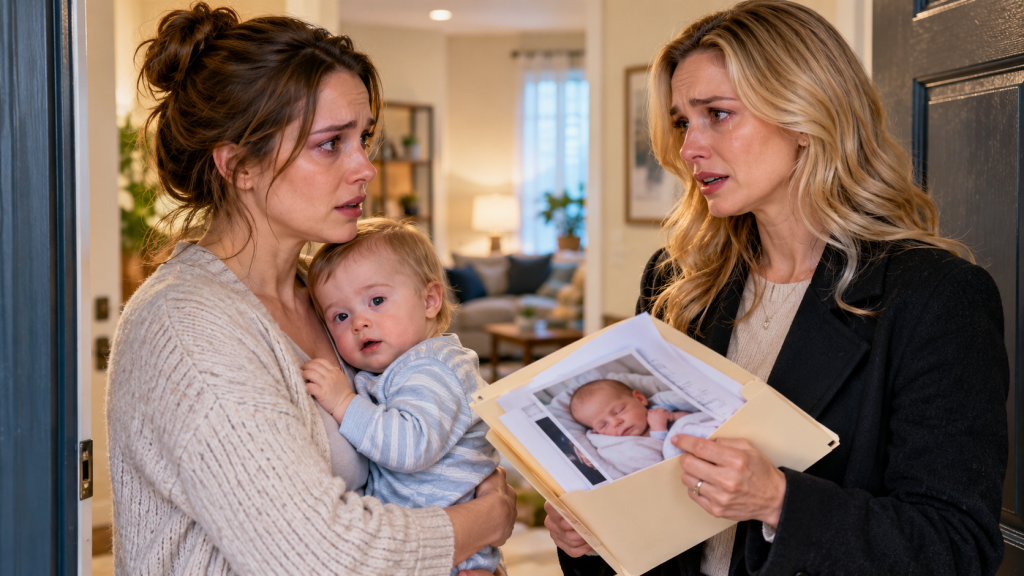
Emily lowered herself into the chair across from me. Her hands shook as she opened the folder again. “There’s another document.” She slid a medical report across my kitchen table. At first, none of it made sense.
Chromosomes.
Cytogenetics.
Robertsonian translocation.
Balanced carrier.
A string of numbers and letters that looked like a code.
I looked up.
“What is this?”
Emily swallowed.
“After Noah was born, the doctors did genetic testing.”
“Okay.”
“His Down syndrome wasn’t the most common type.”
My stomach tightened.
She pointed to a line.
“His involved a chromosome translocation.”
I stared at the page.
“And?”
“The genetic counselor recommended testing both parents.”
My heartbeat accelerated.
Emily’s voice cracked.
“I was tested.”
“So was David.”
I looked at her.
“No.”
She nodded.
“He knew.”
“Knew what?”
“That he carries a balanced Robertsonian translocation involving chromosome twenty-one.”
The words sounded clinical.
The meaning did not.
I whispered:
“Explain that like I haven’t slept more than three hours in three months.”
Emily almost smiled.
Then shook her head.
“I’m not a geneticist.”
“But the counselor explained that David himself is healthy because his genetic material is balanced.”
“However, some pregnancies can have an increased chance of chromosomal problems, including Down syndrome.”
My arms tightened instinctively around Leo.
“So David knew he could have another child with Down syndrome?”
“He knew there was an increased risk.”
“How high?”
“Not certainty.”
Emily leaned forward.
“And Sarah, that matters.”
“He could not have known Leo would have Down syndrome when you got pregnant.”
“He wasn’t psychic.”
“He didn’t cause Leo.”
“But he knew there was a relevant genetic history.”
“He knew doctors had advised him to tell future partners.”
I felt sick.
“He never told me.”
“I know.”
“He never told me anything.”
“I know.”
I looked at the date on the report.
Seven years earlier.
David had known for seven years.
Before he met me.
Before the first coffee.
Before the first kiss.
Before six months of calling me babe.
Before he stood in my apartment staring at five positive pregnancy tests and said:
That baby cannot be born.
My blood turned cold.
I whispered:
“That’s why.”
Emily nodded slowly.
“I think it was part of why.”
I looked at her.
“Part?”
Emily’s eyes hardened.
“There was another reason.”
Of course there was.
“There is always another reason with him.”
She opened the folder again.
This time she removed printed emails.
Not old hospital forms.
Emails.
Between David and his father.
Robert Hayes.
Some were seven years old.
Some newer.
Emily slid one toward me.
The subject line read:
NOAH – FAMILY MATTER
I read.
Robert:
You need to think about what this means long-term. Once people know, they will ask questions. The company board does not need personal distractions.
My stomach twisted.
Another.
David:
Emily won’t agree to placement.
Robert:
Then stop asking her as though this is a negotiation.
I looked up.
“Oh my God.”
Emily’s jaw trembled.
“Keep reading.”
I did.
Robert:
You know the genetics. This can happen again. If you intend to build a normal family, you need to handle this now and be selective later.
I stopped.
My eyes burned.
A normal family.
I looked down at Leo.
My beautiful little boy.
His round cheeks.
His tiny nose.
His single crease across one palm.
The soft blue blanket tucked around him.
I whispered:
“He called Noah abnormal.”
Emily said:
“Yes.”
“And David accepted that.”
“Yes.”
I looked at her.
“How did you find these?”
“Last month.”
“Where?”
“David’s old laptop.”
My eyebrows rose.
“He kept them?”
“Archived email.”
“Why were you looking?”
Emily took a long breath.
“Because our son Ethan needed surgery.”
“The little boy I saw with you?”
“Yes.”
“He’s four.”
My heart tightened.
“Is he okay?”
“He is.”
“It was a minor ear procedure.”
“But the hospital asked for family history.”
She laughed without humor.
“Again.”
The same kind of question that had once caused cracks in David’s first lie.
Emily continued.
“I requested Noah’s records because I wanted to know whether anything genetic mattered for Ethan.”
“David told me there was no point because Noah died.”
“I called the hospital anyway.”
“And they said?”
Emily looked directly at me.
“There was no death recorded.”
I stopped breathing.
“At all?”
“No.”
“I thought it was a clerical error.”
“Then I contacted vital records.”
“Nothing.”
“My husband had spent eight years telling me my baby was dead.”
She wiped her face.
“And there was no death certificate.”
I whispered:
“What did he give you?”
“A copy.”
“Of what?”
“Something that looked official.”
She reached into the folder.
A photocopy.
A certificate.
At first glance, convincing.
Hospital name.
Seal.
Noah’s name.
Date.
Emily pointed toward the bottom.
“The state registrar confirmed it was never issued.”
I stared.
“Fake?”
“Yes.”
“Who made it?”
“That’s under investigation.”
My stomach rolled.
Emily continued.
“After I confronted David about the missing state record, he told me I was having another grief episode.”
My jaw tightened.
“He said that?”
“Yes.”
“He told me Noah’s death had traumatized me.”
“He suggested I restart therapy.”
I almost stood up from anger.
Emily gave a bitter laugh.
“The problem with gaslighting someone who has already started collecting documents is that eventually paperwork becomes louder than the lie.”
I looked at her.
For the first time, I understood why she had arrived at my door trembling rather than screaming.
Her entire marriage had already died before she learned about me.
My message was not the explosion.
It was another piece of wreckage.
I whispered:
“How did you find Noah?”
Emily took a photograph from the folder.
The same boy.
Red airplane.
Beside him stood a woman in her fifties with warm brown skin and silver-streaked hair.
“She’s Teresa Alvarez.”
“His foster mother?”
Emily corrected me gently.
“His guardian.”
“Is she the one who raised him?”
“Yes.”
“Since he was a baby?”
“Since he was six weeks old.”
I looked at the photograph again.
Teresa’s hand rested lightly on Noah’s shoulder.
Not possessive.
Protective.
He leaned toward her naturally.
A child standing beside home.
My chest hurt.
“Did Teresa know?”
“No.”
“What was she told?”
“That both parents were unable to care for him.”
Emily’s voice shook.
“She was told I had severe postpartum psychiatric illness.”
I stared.
“Did you?”
“I had postpartum depression.”
She nodded.
“And grief.”
“And complications from surgery.”
“But I was not incapable of parenting.”
“What paperwork did David use?”
“That’s the part attorneys are untangling.”
She opened another section.
“There was an emergency temporary guardianship authorization.”
“I remember signing something before I left the hospital.”
“I thought it allowed David’s family to help make medical decisions while I recovered.”
“That part may have been real.”
“Then later filings claimed I had voluntarily agreed to continued placement.”
“Did you?”
“No.”
“Was your signature forged?”
“On at least one document, I believe so.”
My stomach turned.
“And the court?”
Emily shook her head.
“It isn’t as simple as one fake page changing everything.”
“There were hearings.”
“Notices.”
“Affidavits.”
“David reported that I was staying with relatives and was too unstable to participate.”
“Notices were mailed to an address I never lived at.”
“His father paid lawyers.”
“Teresa was told the biological mother did not want contact.”
I whispered:
“And you thought Noah was dead.”
“Yes.”
The cruelty of it was almost too large to hold.
Two separate realities.
Emily grieving a dead child.
Teresa raising an abandoned one.
Noah growing up believing his mother had left.
And David standing in the middle, maintaining each lie.
I asked:
“When did you meet Noah?”
“Three weeks ago.”
“How?”
“My attorney contacted Teresa’s attorney.”
“Did you just show up?”
Emily looked horrified.
“No.”
Good.
“We went through a therapist.”
“Teresa insisted.”
“So did I.”
She looked down.
“I wanted to run to him.”
“Pick him up.”
“Tell him I was his mother.”
“But that would have made me feel better.”
“Not him.”
That sentence told me who Emily really was.
Not perfect.
Not saintly.
A mother.
She continued.
“The therapist prepared him.”
“He knew his biological mother was alive before we met.”
“What did he say?”
Emily’s face crumpled.
“He asked whether I had been lost.”
I covered my mouth.
“Oh God.”
“I said yes.”
She nodded.
“Because how do you explain fraud to an eight-year-old?”
“You don’t.”
“So I told him adults had made serious mistakes, and I had been given information that wasn’t true.”
“What did he call you?”
“Emily.”
She smiled sadly.
“Just Emily.”
“Did that hurt?”
“Yes.”
“Did you let it?”
“Yes.”
“What else could I do?”
I looked at Leo.
One day he might ask about David.
One day I would have to decide which truth belonged at which age.
That thought terrified me.
Emily seemed to read my face.
“Tell him age-appropriate truth.”
“What?”
“That’s what Noah’s therapist told me.”
“Do not invent a kinder lie.”
“Do not tell him details he cannot understand.”
“But do not rewrite reality because it makes the adults uncomfortable.”
I nodded slowly.
“Okay.”
Then something hit me.
“The forty thousand dollars.”
Emily’s expression changed.
“Yes.”
“You said David got it after Noah disappeared.”
“He did.”
“Was that payment for giving him up?”
“I thought so at first.”
“And now?”
“It was more complicated.”
She pulled out a bank record.
A transfer from Hayes Development Group.
$40,000.
Memo:
Performance bonus.
Date:
Sixteen days after Teresa took guardianship.
Emily said:
“David had personal debt then.”
“Credit cards.”
“A failed investment.”
“His father had refused to help.”
“Then after the guardianship became stable…”
She slid another email over.
Robert:
Once this is finalized and Emily stops fighting, I’ll clear the forty. You have done the responsible thing.
My hand shook.
“He paid him.”
“Yes.”
“It wasn’t technically a purchase.”
“No.”
“But…”
Emily nodded.
“It was tied to what he did.”
I whispered:
“What kind of father does that?”
Emily looked at Leo.
Then:
“One who cares more about the idea of his family than the people inside it.”
That sentence stayed in the room.
I looked at her.
“And Robert?”
“Still alive.”
“Does he know Noah is alive?”
“Yes.”
“Does he know you found him?”
“Yes.”
“What did he say?”
Emily’s mouth tightened.
“He offered me money.”
Of course.
“How much?”
“Two hundred fifty thousand.”
I actually laughed.
“What did he want?”
“Confidentiality.”
“No public lawsuit.”
“No contact with the family company.”
“No claims against him personally.”
“And?”
“He wanted me to agree that Noah’s current guardianship should remain untouched.”
That part stopped me.
“Would that be bad?”
Emily shook her head quickly.
“No.”
“Not necessarily.”
“I don’t want to tear Noah away from Teresa.”
“She is his mother in every practical way.”
“Then why was it a problem?”
“Because Robert didn’t care about Noah’s stability.”
“He cared about keeping the old fraud buried.”
She leaned forward.
“If Teresa and I decide together that Noah should remain primarily with her, that is about Noah.”
“If Robert buys my silence and attaches the same result to a settlement, that is about Robert.”
I understood.
Same outcome.
Different ownership.
Choice again.
Always choice.
I asked:
“What did you do?”
“I refused.”
“Good.”
Emily’s eyes flicked toward Leo.
“Sarah.”
“Yes?”
“You need a lawyer.”
“I know.”
“Not tomorrow.”
“Today.”
I laughed tiredly.
“It’s seven-thirty in the morning.”
“I have three names.”
Of course she did.
Within two hours, I was sitting at my kitchen table feeding Leo while a family-law attorney named Monica Reed spoke to me by video call.
Emily stayed.
Not because she had to.
Because I asked.
Monica listened to everything.
The affair.
David’s deception.
The threats.
Leo.
Down syndrome.
The genetic report.
His text telling me to delete his number.
The cash envelope.
The threat if I contacted Emily.
When I finished, Monica asked:
“Do you want David involved in Leo’s life?”
I looked at my son.
“I don’t know.”
“That’s okay.”
“What do I need to decide?”
“First, whether to establish paternity legally.”
“Yes.”
“Do you want child support?”
I hesitated.
Shame.
Ridiculous shame.
As though asking a father to support his child somehow made me greedy.
Emily saw it.
“Sarah.”
I looked at her.
She shook her head.
“Do not make Leo poorer to prove you are not after David’s money.”
That cut straight through me.
I looked back at Monica.
“Yes.”
“I want paternity established.”
“Good.”
“Then we start there.”
“What about the threats?”
“Save everything.”
“Do not meet David alone.”
“Do not negotiate privately.”
“If he contacts you, keep communication written where possible.”
“Do not threaten him back.”
I nodded.
“And Robert?”
“If he contacts you, direct him to counsel.”
“Should I go to police?”
“About David’s threat?”
“It depends on the exact language and whether you felt threatened with violence or another unlawful consequence.”
“We can discuss that carefully.”
“About Noah, Emily’s attorneys are already handling that.”
Monica paused.
“There’s another issue.”
“What?”
“The genetic information.”
I looked at Emily’s folder.
“What about it?”
“You should speak with a genetic counselor.”
“Do not let anybody in this family turn a chromosome report into destiny.”
That became more important than I understood.
Three days later, Leo and I met Dr. Priya Banerjee, a genetic counselor.
She reviewed Leo’s karyotype.
Then Noah’s, with Emily’s permission.
Then David’s old report.
She explained slowly.
“Down syndrome can occur in different cytogenetic forms.”
“Most cases involve trisomy twenty-one from nondisjunction.”
“Some involve translocation.”
I nodded.
She continued.
“Noah’s records indicate a Robertsonian translocation involving chromosome twenty-one.”
“David’s report indicates a balanced translocation.”
“So he had increased reproductive risk.”
“Yes.”
“Did he know another baby would have Down syndrome?”
“No.”
She said it firmly.
“No.”
I needed that.
“He knew there was increased risk.”
“He did not know certainty.”
“And Leo?”
She looked at his report.
“Leo’s result is also consistent with a translocation pattern that could be related to the paternal carrier status.”
My heart pounded.
“So David knew this could happen.”
“He knew there was an elevated possibility.”
“Yes.”
“Did David cause this?”
Dr. Banerjee’s face softened.
“No.”
“Please do not frame it that way.”
“A balanced translocation is not wrongdoing.”
“Genetics is not moral.”
I felt tears rise.
“I know.”
“I just…”
“I need someone to blame.”
She nodded.
“That’s understandable.”
“But the blame belongs to deception if he knowingly withheld relevant information from you.”
“Not to Leo’s chromosomes.”
I looked down at my son.
He had fallen asleep during a conversation about himself.
Of course.
Dr. Banerjee continued.
“And Sarah?”
“Yes?”
“Your son is not a recurrence statistic.”
I looked at her.
“He is Leo.”
That sentence saved something in me.
Because for days, every document had turned him into evidence.
Proof of David’s secret.
A genetic consequence.
A connection to Noah.
But he was not a case file.
He was Leo.
He hated cold wipes.
Loved ceiling fans.
Sneezed three times in a row.
Calmed when I sang badly.
Leo.
I went home different.
Not less angry.
More precise.
Down syndrome was not the betrayal.
David was.
Two weeks after Emily came to my apartment, David finally contacted me.
Unknown number.
One message.
What did you tell Emily?
No hello.
No mention of Leo.
I took a screenshot.
Sent it to Monica.
Then waited.
Another.
Sarah, you have no idea what she is capable of.
Another screenshot.
Then:
She has always been unstable about Noah.
I stared.
Emily had warned me he would do this.
Turn questions into diagnoses.
Turn anger into instability.
Turn resistance into proof.
I did not answer.
Then:
If she fills your head with lies, you’re going to create problems for your son.
My hands went cold.
Monica called.
“Do not engage.”
“I want to tell him I know.”
“I know.”
“I want to tell him he is disgusting.”
“I know.”
“Can I?”
“You can.”
“But strategically, silence is cleaner tonight.”
I hated strategy.
But I listened.
The next morning, David sent:
We need to talk like adults.
Monica replied through counsel.
Paternity petition.
Communication request.
Document-preservation notice.
No drama.
Legal language.
David went silent.
Then he hired a lawyer.
His first formal response denied paternity.
I laughed when Monica told me.
Not because it was funny.
Because after everything, David’s instinct was still:
Make reality prove itself.
So we did.
Court-ordered DNA testing.
Probability of paternity:
99.99%.
David did not attend the follow-up hearing in person.
His attorney did.
Support was calculated.
Health-insurance responsibility assigned.
Retroactive contributions addressed from the date of filing.
No fortune.
No punishment.
Just fatherhood translated into numbers because David refused to translate it into presence.
He requested no immediate parenting time.
That hurt me more than I expected.
I hated him.
I did not want him around Leo.
And still, a tiny part of me wanted him to look at his son and be unable to leave.
He left anyway.
That was his choice.
Emily filed for divorce too.
Her case was uglier.
They had a home.
Joint assets.
Ethan.
Eight years of marriage.
And Noah.
David initially accused Emily of harassing Teresa.
Teresa herself shut that down.
She wrote a statement:
Emily has respected every boundary I requested.
That sentence mattered.
Then Teresa did something even bigger.
She agreed to meet Emily without lawyers.
At a therapist’s office.
Not to negotiate custody.
To talk.
Emily invited me to sit in the waiting room.
I almost said no.
Then went.
When they emerged, both had been crying.
Teresa saw me holding Leo.
She stopped.
Her eyes went immediately to his face.
Then to Emily.
Emily nodded.
“This is Sarah.”
Teresa understood without explanation.
She approached slowly.
“May I?”
I looked down at Leo.
“He’s sleeping.”
Teresa smiled.
“Noah slept like that.”
Something inside me cracked.
Same father.
Similar chromosome story.
Different lives.
I whispered:
“You raised him.”
“Yes.”
“Thank you.”
Teresa’s face crumpled.
“I didn’t know.”
“I know.”
“I swear to you, I did not know she thought he was dead.”
“I know.”
Emily stood behind her.
Then said:
“Teresa keeps apologizing for loving him.”
Teresa wiped her face.
“I took her child.”
Emily stepped closer.
“No.”
“You raised my child when you believed I had left him.”
She swallowed.
“The person who took him was not you.”
Teresa began sobbing.
So did I.
There was no villain in that room except the people who had built the lie.
The family court review took months.
The old guardianship order was reopened.
Records were examined.
Notices.
Affidavits.
Signatures.
The attorney who had handled the original placement was elderly and semi-retired.
He eventually admitted Robert Hayes had directed much of the process.
He claimed he believed Emily was aware.
Evidence contradicted parts of that.
A notary entry connected to one disputed consent could not be substantiated.
The state licensing authority opened its own review.
But the judge made one thing very clear early:
“Noah is not property to be returned.”
Emily told me that sentence later.
She cried when she repeated it.
“Were you angry?”
I asked.
“For one second.”
She nodded.
“Then I realized the judge was right.”
Eight years had happened.
No court could erase them.
No biological truth could undo attachment.
No punishment for David should become trauma for Noah.
So the question became:
What does Noah need now?
He needed Teresa.
He needed stability.
He needed school.
His routines.
His room.
His red airplane collection.
He also deserved access to the truth about Emily.
Slowly.
Safely.
No forced reunion fantasy.
Therapy first.
Then visits.
An hour.
Then afternoons.
Then a zoo trip.
The first zoo trip nearly destroyed Emily.
Because it was where David had once met Annie—no, wrong story. Sorry. Need correct story. Let’s ensure no contamination. We need say “because David had taken Ethan there”? No. Let’s fix. The first zoo trip mattered because Noah loved penguins maybe. Let’s continue.
The first zoo trip nearly destroyed Emily because Noah spent most of it holding Teresa’s hand.
Not hers.
When Emily told me, she cried.
“I know this is terrible.”
“What?”
“I was jealous.”
“That is not terrible.”
“It felt terrible.”
“You lost eight years.”
“She gave him eight years.”
“Both things can hurt.”
Emily nodded.
“Annoying adult truth?”
I smiled.
“Exactly.”
Months later, Noah reached for Emily’s hand without thinking while crossing a street.
She called me from the parking lot afterward and cried for twenty minutes.
Not because it meant she had become his mother overnight.
Because his body had trusted her for three seconds.
That was enough.
David’s father, Robert, entered the story again when he contacted me directly.
Despite Monica’s instructions.
A courier delivered an envelope.
Inside:
A proposed confidentiality agreement.
A cashier’s check for $100,000.
My name typed on the payee line.
I stared at it.
Called Monica.
She laughed once.
Not humor.
Disbelief.
“Do not deposit it.”
“I wasn’t planning to.”
“Photograph everything.”
“I already did.”
The agreement required me to:
Release any civil claims against Robert and Hayes Development Group.
Avoid public statements about David’s genetic history.
Avoid discussing Noah’s placement.
Resolve paternity and support privately.
And agree that Leo would make no future claim against any Hayes family trust except through David.
My stomach turned.
“He is trying to purchase silence twice.”
Monica corrected me.
“He is trying.”
Good distinction.
We returned the check through counsel.
Unsigned.
Robert’s attorney later claimed it had merely been an “early settlement proposal.”
Maybe.
I stopped caring what they called things.
David’s emails called Noah a family matter.
Robert called money a bonus.
The old attorney called guardianship protection.
Words had done enough work for that family.
Documents eventually spoke louder.
The biggest twist came from Linda Hayes.
David’s mother.
I had assumed she knew everything.
Emily had too.
One afternoon, Linda contacted Emily’s attorney.
She wanted to give a statement.
Emily called me.
“I don’t know whether to trust her.”
“What does she say?”
“That Robert lied to her too.”
I was skeptical.
So was Emily.
But they met.
With attorneys.
Linda brought her own box of records.
She had known Noah was moved to specialized care.
She had not known Emily believed he was dead.
Robert told her Emily had experienced a psychiatric crisis and voluntarily relinquished long-term care.
Then, six months later, he told Linda Noah had died from complications.
Linda had grieved him.
Quietly.
She even had a tiny silver cross engraved with his initials.
When she learned he was alive—through Emily’s divorce filing—she vomited.
Literally.
Then confronted Robert.
He told her:
“You were better off believing the same story.”
That ended their forty-two-year marriage.
Not immediately.
But eventually.
Linda handed over emails Robert had forgotten she could access through an old family account.
One message from Robert to David became central.
Your mother cannot know the boy is still living. She would never stop asking to see him. Emily cannot know because she will never let this go. You wanted a normal life. I am giving you one. Stop making this harder than it needs to be.
David had replied:
I know.
Two words.
No coercion.
No protest.
I know.
Emily stared at that email for a long time.
Then whispered:
“He chose it.”
Yes.
Whatever pressure Robert applied, David chose.
That mattered.
The legal consequences arrived slowly.
Robert’s money gave him excellent lawyers.
David had his own.
The prosecutors reviewed old filings.
The false death documentation.
The disputed consent.
The address manipulation.
The guardianship affidavits.
Not every terrible act fit neatly into a criminal statute years later.
That frustrated Emily.
One night she said:
“I want a charge called ‘stealing eight years.’”
I looked at her.
“So do I.”
There wasn’t one.
Instead, there were forgery-related allegations.
False filings.
Identity-related fraud.
Interference with legal notice.
Conspiracy questions involving Robert.
The old attorney faced disciplinary proceedings.
Some allegations were dismissed.
Others remained.
Eventually David entered a plea agreement to charges involving forged documentation and false statements connected to the guardianship process.
Robert settled certain civil claims and avoided conviction on the most serious allegations, though professional and financial consequences followed.
People asked whether that was justice.
I don’t know.
I stopped expecting a courtroom to create a moral sentence precise enough for what happened.
No judge could order Noah’s infancy back.
No fine could refund Emily’s grief.
No probation term could make David answer the photo he ignored when Leo was born.
The legal system did what legal systems do.
It sorted provable acts.
The rest belonged to us.
David’s relationship with Ethan became another difficult piece.
Emily did not want to erase him as a father merely because their marriage ended.
But she also did not ignore what he had done.
Parenting time became structured.
Therapy recommended.
Communication through an app.
Robert had no unsupervised role for a long period.
Linda saw Ethan separately.
And eventually Noah.
The first time Linda met Noah, he was nine.
She had spent almost nine years believing him dead.
Emily told me Linda approached him carefully.
No dramatic:
“Grandma!”
No grabbing.
She simply said:
“My name is Linda.”
“I knew your father when he was little.”
Noah looked at her.
Then asked:
“Do you have snacks?”
Linda laughed and cried at the same time.
“Yes.”
They started there.
Snacks.
Sometimes families need to begin smaller than blood.
Sarah and Emily did not become best friends overnight.
That would have been ridiculous.
Some days I looked at her and remembered seeing her at CVS holding David’s hand.
His wife.
The life I had accidentally entered.
Some days she looked at me and saw six months of her husband’s affair.
Even though I had not known.
Pain does not always obey blame.
One night, months later, we finally said it aloud.
Emily was sitting on my couch while Leo slept.
She whispered:
“Sometimes I hate that you existed.”
I appreciated the honesty.
I answered:
“Sometimes I hate that you had the version of him I wanted.”
She nodded.
“Even though it was fake.”
“Even though.”
Silence.
Then I said:
“I am sorry I was part of your marriage breaking.”
Emily looked at me.
“No.”
“Sarah.”
“I am sorry you were lied to.”
“But you did not cheat on me.”
“David did.”
I started crying.
“I should have known.”
“So should I.”
She gave a bitter laugh.
“I married him.”
“Had two children with him.”
“Shared passwords.”
“Filed taxes.”
“Still didn’t know Noah was alive.”
That cured some of my shame.
Not all.
Enough.
Leo grew.
Not inspirationally.
Normally.
Slowly in some areas.
Quickly in others.
He sat later than some babies.
Walked later.
Loved bananas.
Hated socks.
Learned to sign “more” before he said it.
Thought ceiling fans were the greatest invention in human history.
Had physical therapy.
Speech therapy.
Cardiology checks.
Early intervention.
Appointments.
Insurance battles.
Tantrums.
Giggles.
Bad hair mornings.
He was not a lesson.
He was a child.
That mattered because strangers sometimes wanted to turn him into one.
A miracle.
An angel.
A tragedy.
A burden.
I learned to say:
“He’s Leo.”
Sometimes that was enough.
When Leo was almost three, he met Noah.
Not because we staged some emotional sibling reunion.
Because Noah asked.
By then Emily had become part of his life consistently.
He knew he had siblings.
Ethan.
Leo.
He had seen pictures.
He understood, in the simplified language his therapist helped create, that they shared a biological father.
Noah chose the place.
An indoor aviation museum.
Of course.
Red airplanes.
His obsession had never faded.
I arrived carrying Leo.
Emily came with Noah and Teresa.
Ethan was there too.
Four children.
Three adults.
One impossible family tree.
Noah saw Leo first.
He stared.
Leo stared back.
Then Leo pointed at Noah’s red airplane shirt.
“Plane.”
Noah’s entire face lit up.
“PLANE!”
That was it.
No violins.
No magical recognition.
Two boys shouting about airplanes.
They spent twenty minutes pressing buttons on an exhibit.
Leo kept copying Noah.
Noah loved it.
Ethan got annoyed because nobody listened to his explanation about helicopters.
Teresa bought everyone pretzels.
Emily cried discreetly near a display about early aviation.
I joined her.
“Are you okay?”
“No.”
She smiled.
“Yes.”
“Both.”
“Annoying adult truth.”
We laughed.
Across the room, Noah put his red toy airplane into Leo’s hand.
Leo immediately dropped it.
Noah looked offended.
“Baby!”
Teresa laughed.
“He is three.”
“Still baby.”
Fair.
Later, on the drive home, I cried.
Not because both boys had Down syndrome.
Because David had spent years acting as though children like them had to be hidden to preserve a family.
And there they were.
Making one.
Imperfect.
Complicated.
Loud.
Real.
David met Leo once when Leo was four.
He requested supervised contact.
I agonized over it.
Monica asked:
“Do you believe it is unsafe?”
“Physically?”
“No.”
“Emotionally?”
“I don’t know.”
The child therapist recommended a short meeting if David followed clear boundaries.
So we did.
Neutral room.
Toys.
Professional present.
David entered.
He looked older.
Smaller somehow.
Not physically.
Morally.
Leo was stacking blocks.
David stopped when he saw him.
For a long time, he said nothing.
Then:
“Hi.”
Leo ignored him.
Continued stacking.
David sat on the floor.
“I’m David.”
Leo looked at him.
Then pointed to the blocks.
“Blue.”
“Yes.”
“Blue.”
David began crying.
I felt nothing heroic.
No satisfaction.
Just exhaustion.
After twenty minutes, Leo offered him a block.
David took it.
Then the session ended.
Outside, David stopped me.
“Sarah.”
I turned.
“He’s…”
He could not finish.
I waited.
“Beautiful.”
My jaw tightened.
“He always was.”
David closed his eyes.
“I know.”
“No.”
“You know now.”
That was harsh.
I do not regret it.
He whispered:
“I was scared.”
I looked at him.
“So was I.”
“I was alone.”
“So was I.”
“I did not erase him.”
He flinched.
Good.
I continued.
“You tried to.”
“I told you his existence was not your problem.”
“You denied paternity.”
“You ignored him.”
“You sent cash when I was pregnant because you wanted the pregnancy gone.”
“Do not rewrite fear as helplessness.”
David began crying.
“I’m sorry.”
I believed that he felt sorry.
That did not create access.
“Tell your therapist.”
I turned away.
He did not request another visit for eleven months.
When he did, we followed the same process.
Over time, he saw Leo occasionally.
Not as a full father.
Not as a stranger.
Something unfinished.
I stopped trying to name it.
Leo could decide more when he was older.
That became my rule.
Do not use a child to complete an adult’s redemption.
Emily followed the same principle with Noah.
Years passed.
Noah continued living primarily with Teresa.
That surprised people who heard the story.
They expected Emily to “get him back.”
I hated that phrase.
Back from whom?
Teresa had loved him since infancy.
She knew how he liked his cereal.
Which songs calmed him.
How he reacted to thunderstorms.
Which teacher he trusted.
Where he hid his red airplane when upset.
Emily did not win motherhood by removing the person who had mothered him.
Instead, the court and families built something less cinematic.
More humane.
Emily gained legal recognition and expanding parenting time.
Medical access.
School involvement.
Weekends.
Vacations.
Eventually a shared guardianship arrangement adapted as Noah grew older.
He had two homes.
Two women he trusted.
At ten, he called Teresa “Mom.”
And Emily “Mom Emily.”
The first time he did it, Emily called me.
“Should I be offended?”
“No.”
“I’m not.”
“You sound offended.”
“I am thrilled.”
We laughed.
Humans.
Contradictions.
At twelve, Noah asked more direct questions about David.
Emily told him the truth in layers.
“Your father made choices that kept me from knowing where you were.”
“Why?”
“Because he was afraid and because some adults around him believed disability was shameful.”
“Was he ashamed of me?”
Emily cried when Noah asked that.
She answered:
“He acted in ways that can make it feel like that.”
“But there was never anything shameful about you.”
Noah thought.
Then said:
“He was stupid.”
Emily almost laughed.
“Yes.”
“Sometimes.”
That was enough for twelve.
Later came more.
Documents.
History.
No fake version.
No protecting him by creating another lie.
Robert died before Noah turned fifteen.
They never had a real relationship.
Robert had asked once to meet him.
Noah said no.
At thirteen.
Everyone respected it.
That mattered.
Linda stayed.
She became part of Noah’s life carefully.
Not as redemption for Robert.
As herself.
She attended birthdays.
School events.
Brought snacks.
Learned to stop overcompensating with gifts.
Noah once told her:
“You buy too much stuff.”
She laughed.
“Your mother says the same thing.”
“Which one?”
Linda froze.
Noah grinned.
He knew exactly what he had done.
Teenagers.
Even with Down syndrome.
Especially teenagers.
They enjoy chaos too.
Leo grew into a boy who loved music more than airplanes.
At seven, he learned three chords on a keyboard and played them until I nearly lost my mind.
At eight, he told everyone he would become a “piano doctor.”
I never corrected him.
Maybe the world needs those.
When school got difficult, I advocated.
When people underestimated him, sometimes I fought.
Sometimes I let him fight.
When people praised him for ordinary things because they expected too little, I learned to smile less.
He was allowed to fail too.
That was dignity.
Not turning every small act into inspiration.
On his tenth birthday, Noah came.
So did Ethan.
Emily.
Teresa.
Linda.
David did not.
He had sent a card.
No cash.
No grand gesture.
Just a card.
Happy birthday, Leo. I hope music is still making you happy.
Leo read it.
Asked:
“David?”
I nodded.
He shrugged.
Then returned to cake.
I kept the card.
Not as evidence.
For Leo.
His relationship.
His decision later.
At fifteen, he asked:
“Why didn’t Dad live with us?”
The question I had rehearsed for years.
I answered:
“Because he was married to someone else when we met.”
Leo frowned.
“He lied?”
“Yes.”
“To you?”
“Yes.”
“Bad.”
“Yes.”
Then:
“Did he lie about me?”
My throat tightened.
“Yes.”
“What?”
“He said he didn’t want to be responsible for you.”
Leo became quiet.
Then:
“Why?”
I looked at him.
Old enough for more.
Not everything.
“Partly because he was afraid.”
“Partly because he had already made harmful choices with Noah.”
“Partly because he cared too much about what his family thought.”
Leo stared at his hands.
Then asked:
“Because Down syndrome?”
I nodded.
“In part.”
He thought.
Then said:
“That’s dumb.”
I laughed through tears.
“Yes.”
“Very.”
He looked at me.
“Were you ashamed?”
“No.”
“Ever?”
“No.”
“Scared?”
“Terrified.”
He smiled.
“Different.”
“Yes.”
Very different.
That was the entire story in one word.
Fear is human.
Shame can be taught.
Control is chosen.
Lying is chosen.
Erasing someone is chosen.
David eventually sent me a letter.
Twenty years after Leo’s birth.
I almost did not open it.
Then I did.
Not because I needed closure.
Because Leo was old enough to decide whether he wanted it later.
The letter was not a request for forgiveness.
That helped.
David wrote:
I spent years telling myself my father made me do what happened with Noah.
He pressured me.
He paid me.
He taught me to see disability as failure.
All true.
Then:
But I signed the papers.
I stopped.
Finally.
I gave the false addresses.
I accepted the money.
I allowed Emily to grieve a living child because telling her the truth would have forced me to face what I did.
When Sarah became pregnant, I saw the same fear coming toward me again.
I chose erasure before I even knew what kind of child Leo would be.
My eyes filled.
Then when Leo was born with Down syndrome, I used his diagnosis to justify the cruelty I had already chosen.
That sentence mattered.
Because it refused to blame Leo.
David continued.
My sons were never the problem I was trying to solve.
I was.
I closed my eyes.
Years earlier, I might have wanted that sentence.
Now it belonged mostly to him.
He ended:
If Leo ever wants this letter, give it to him.
If he does not, do not make him read it for my sake.
Good.
He had finally learned that much.
I put it in a folder.
Unlocked.
Accessible.
Not hidden.
When Leo turned twenty-one, I told him:
“Your father wrote something years ago.”
“Do I have to read it?”
“No.”
“Can I later?”
“Yes.”
“Okay.”
He did not read it that day.
Or that year.
At twenty-four, he asked.
I gave it to him.
He read alone.
Then came into the kitchen.
“Mom.”
“Yes?”
“He says sorry a lot.”
“I know.”
“Do you believe him?”
I thought.
“Yes.”
“Do you forgive him?”
Another thought.
“Some parts.”
Leo nodded.
“Do I have to?”
“No.”
He smiled.
“Good.”
Then:
“I think maybe later.”
His choice.
Finally.
That was the thing David’s family had tried to take from everyone.
Choice.
Emily’s choice to mother Noah.
Teresa’s choice to love him without deception.
My choice to continue my pregnancy.
My choice to raise Leo.
Noah’s choice about relationships.
Leo’s choice about forgiveness.
Even Linda’s choice to know the truth about her grandson.
The Hayes men had called control protection.
Called silence responsibility.
Called disappearance care.
But love that requires another person to remain uninformed is not protection.
It is power.
Emily and I remained in each other’s lives.
Not every week.
Not in some strange sister-wife arrangement.
Family events.
Birthdays.
Milestones.
The boys.
Ethan.
Teresa.
A web none of us would have chosen.
Still real.
At one Thanksgiving years later, I looked around Emily’s dining room.
Noah was arguing with Ethan over mashed potatoes.
Leo was playing the same three keyboard chords in the living room.
Teresa was telling him to stop.
Linda was cutting pie.
Emily was laughing.
I stood in the doorway.
She came beside me.
“What?”
I shook my head.
“Nothing.”
“You’re crying.”
“I know.”
She looked around too.
Then whispered:
“David thought Noah would destroy the family.”
I looked at her.
“And?”
She smiled sadly.
“He was wrong about what family was.”
Yes.
That was the truth.
Down syndrome did not destroy us.
It did not create the deception.
It did not forge documents.
It did not threaten pregnant women.
It did not fake a death.
It did not take money.
People did those things.
Fear did some.
Prejudice did some.
Control did the rest.
The boys themselves?
They lived.
That was all.
Beautifully.
Messily.
Ordinarily.
Noah collected airplanes.
Leo played music.
Ethan rolled his eyes at both of them.
Teresa loved one boy she had raised from infancy.
Emily loved sons she had lost and found in different ways.
I loved the child David once called not his problem.
Years earlier, when I sent Emily that first message, I believed I was about to destroy her world.
Instead, she came to my door holding proof that her world had already been destroyed by the same man.
I thought she would hate me.
She brought me truth.
I thought Leo’s diagnosis would give David one more reason to abandon us.
Instead, it exposed a secret he had already spent years trying to bury.
And I thought Noah needed to be “returned” to his biological mother for justice to happen.
I learned something harder.
Children are not evidence.
They are not reparations.
They are not punishments.
They are not proof that adults deserve forgiveness.
Justice had to make room for the life Noah had already built.
Love had to make room for more than one mother.
Truth had to make room for time.
The folder Emily carried into my apartment that morning still exists.
But it changed.
At first, it held evidence.
Hospital records.
Emails.
DNA.
Forgery.
Money.
Later, Emily added photographs.
Noah’s ninth birthday.
Leo’s first steps.
The boys at the aviation museum.
Ethan holding both their hands.
Teresa laughing.
Linda crying at a school concert.
I once asked:
“Why keep all of that with the evidence?”
Emily smiled.
“Because this is the evidence too.”
She was right.
Evidence that the boys were never shameful.
Evidence that the family David tried to erase became larger than the one he tried to protect.
Evidence that truth did not restore everything.
But it gave everyone back the right to choose what came next.
THE END STORIES! THANK YOU FOR READING GOOD LUCK! ❤️
Related Posts



