Alistair’s final word seemed to change the temperature in the hospital room. “Fraud.” My father’s fingers slipped from the metal bedrail. My mother looked from Alistair to the attorneys behind him, then down at the transfer documents she had placed across my blanket as if the papers had suddenly become radioactive.
Kirk slept through all of it. His cheek rested against Alistair’s chest. One tiny hand still held the billionaire’s finger with complete indifference to the fact that half the adults in the room looked ready to collapse.
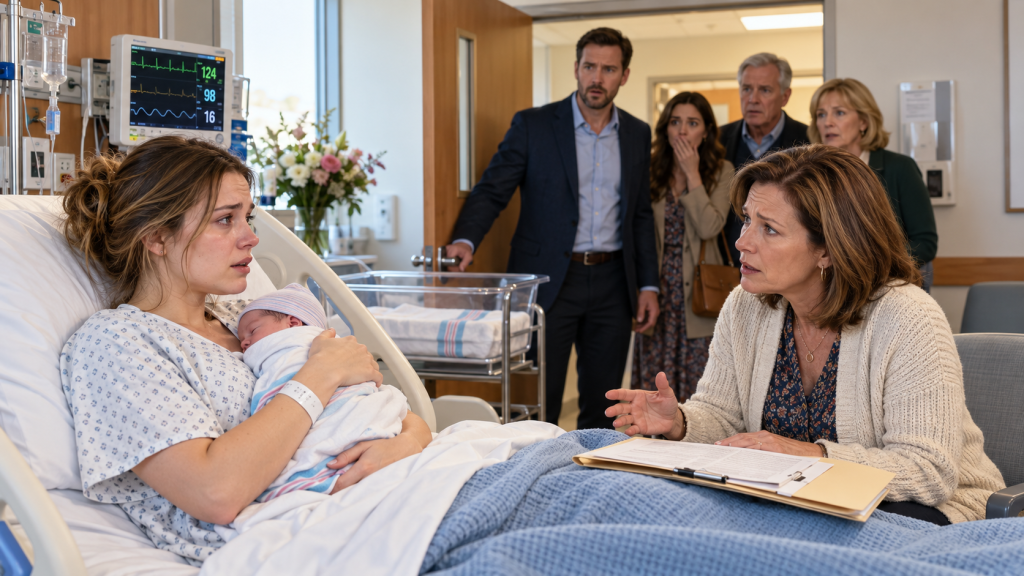
My father recovered first. He always did. For thirty-two years, I had watched him turn panic into authority before anybody else could notice he had ever been afraid. “You are making an extremely serious accusation,” he said.
Alistair’s expression did not change.
“No.”
“One of my attorneys is describing an extremely serious document.”
My mother found her voice.
“This has nothing to do with you.”
Alistair looked down at Kirk.
Then back at her.
“You walked into the hospital room of the woman I love less than an hour after she gave birth to my son.”
“You insulted the child.”
“You threatened his mother.”
“And you tried to make her surrender twelve percent of a company in which I became the largest outside shareholder yesterday.”
His voice remained almost unnaturally calm.
“So I assure you, Mrs. Hale, this has quite a lot to do with me.”
My mother’s face tightened.
“You bought those shares to manipulate Evelyn.”
I finally spoke.
“No.”
Everyone looked at me.
I adjusted the blanket around my son.
“Alistair didn’t know you were coming here with transfer papers.”
My father’s gaze snapped toward me.
“You knew about his purchase?”
“Not until yesterday.”
That part was true.
And it was still something Alistair and I needed to discuss.
But not in front of my parents.
Not yet.
My father looked at him.
“Thirty-one percent does not give you control.”
Alistair nodded.
“I’m aware.”
“You can’t remove me.”
“I didn’t say I could.”
“You can’t force a sale.”
“I have no intention of doing that.”
“Then what exactly is this performance?”
One of Alistair’s attorneys stepped forward.
Her name was Miriam Cole.
She was in her late fifties, silver-haired, composed, and apparently immune to my father’s ability to intimidate a room.
“It is not a performance, Mr. Hale.”
She placed a copy of the disputed authorization on the bedside table.
“Your proposed merger requires approval under Article Eleven of the shareholder agreement.”
My father said nothing.
Miriam continued.
“Any extraordinary transaction involving substantially all operating assets requires sixty-seven percent approval.”
My father’s jaw tightened.
“Correct.”
“Your daughter owns twelve percent.”
“Yes.”
“And she never executed a proxy authorizing Grant Hale to vote her shares.”
My mother interrupted.
“That is Evelyn’s claim.”
Miriam turned toward her.
“It is also what the signature evidence currently suggests.”
My brother’s name entered the room like another person.
Grant.
The golden child.
The son.
The future of Hale Manufacturing.
The man my father had been grooming to replace him since Grant was old enough to wear a tie without getting spaghetti sauce on it.
I whispered:
“What exactly did Grant sign?”
Miriam looked at me.
“Not here.”
My father seized on that.
“There.”
“Even her own lawyer doesn’t know.”
Alistair corrected him.
“Miriam is my lawyer.”
Then he looked at me.
“You need your own.”
That mattered.
It would have been easy for him to say ours.
Easy to turn protection into possession.
Instead, he said yours.
My father scoffed.
“This is absurd.”
I looked at the folder Mother had dropped onto me.
“Then why did you bring those?”
Silence.
I lifted the first page.
IRREVOCABLE TRANSFER OF SHARES
My name.
Grant’s name.
Twelve percent.
Consideration:
Ten dollars and “other familial value received.”
I almost laughed.
“Ten dollars?”
Mother crossed her arms.
“It is an internal family transfer.”
“You were going to take twelve percent of the company for ten dollars?”
“It stays in the family.”
I looked at Kirk.
“So does he.”
Her face hardened.
“That child is not the issue.”
“He was ten minutes ago.”
She looked away.
That hurt more than I expected.
Not because I wanted her approval anymore.
Because some foolish part of me had believed seeing him might change her.
I had imagined she would look at the little crease beside his mouth and remember mine.
I thought perhaps my father would see his grandson’s dark hair and forget whatever speech he had practiced.
But cruelty prepared in advance does not always disappear when confronted with a baby.
Sometimes people simply choose cruelty again.
Alistair handed Kirk back to me.
Gently.
Carefully.
Then he turned to my parents.
“You need to leave.”
My father laughed.
“You don’t control this room.”
The hospital administrator finally spoke.
“No.”
“But Ms. Hale does.”
All eyes turned toward me.
The administrator said:
“She is the patient.”
“Visitors remain only with her permission.”
My mother stared.
“Evelyn.”
I looked at her.
“Leave.”
Her face changed.
Not anger first.
Shock.
That almost hurt worse.
She genuinely had not believed I would say it.
“After everything we’ve done for you?”
I glanced at Kirk.
Then at the transfer agreement.
“You came to my hospital bed with a pen.”
Mother’s eyes filled.
Whether from rage or grief, I did not know.
“Your father built that company for you children.”
“No.”
My voice shook.
“Grandpa built it.”
“Dad expanded it.”
“Hundreds of employees kept it alive.”
“And Grandma left me those shares because she wanted me to have my own vote.”
My father stepped toward the bed.
“Your grandmother expected you to act in the family’s interest.”
“Then why did she leave the shares to me instead of Grant?”
That stopped him.
I had never asked that aloud before.
Neither had they.
The silence answered more than any of us did.
My mother grabbed the folder.
Miriam reached for it at the same time.
“Please leave those documents.”
Mother glared at her.
“They belong to us.”
“They were presented to Ms. Hale for signature.”
Miriam’s voice remained perfectly level.
“And they may be relevant evidence.”
My father looked at me.
“You would use private family papers against us?”
I almost smiled.
“You brought attorneys into board meetings when I was nineteen because I asked why my dividend was smaller than Grant’s.”
“Don’t suddenly become sentimental about paperwork.”
His eyes flashed.
Then he looked at Alistair.
“This is what you wanted?”
Alistair shook his head.
“What I wanted was to meet my son without discussing a fraudulent proxy.”
My father flinched.
Good.
The administrator opened the door.
Two security officers were standing outside.
My parents left without touching Kirk.
Exactly as promised.
The door closed.
And the room became silent.
For nearly a minute, I heard only the soft mechanical hum from the hospital equipment and Kirk’s tiny breathing.
Then I started to cry.
Not delicately.
Not beautifully.
My shoulders shook.
My chest hurt.
Alistair sat beside me immediately.
“Hey.”
I shook my head.
“I’m fine.”
“No, you’re not.”
That made me cry harder.
He did not tell me to calm down.
Did not tell me my parents would regret it.
Did not promise to destroy anyone.
He simply held a tissue near my hand until I took it.
“I wanted them to love him.”
The words came out broken.
“I know.”
“They didn’t even touch him.”
“I know.”
“They looked at him like he was leverage.”
Alistair’s jaw tightened.
Then he looked at Kirk.
“They don’t decide what he is.”
I wiped my face.
“No.”
“They don’t.”
Miriam quietly gathered the hospital transfer documents.
Then she said:
“I’m going to step outside.”
The second attorney followed her.
The administrator left too.
Soon it was only us.
Me.
Alistair.
Our son.
And the first honest silence I had experienced all morning.
I looked at Alistair.
“Now tell me everything.”
He knew exactly what I meant.
“The shares?”
“The shares.”
He exhaled.
“Two retiring shareholders approached Sanders Industrial six weeks ago.”
“Who?”
“Michael Voss and Elaine Porter.”
My stomach dropped.
Together, they held thirty-one percent.
They had been with Hale Manufacturing since before I was born.
“They sold to you?”
“Yes.”
“Why?”
“They were worried.”
“About the merger?”
He nodded.
I stared at him.
“And you didn’t tell me.”
“The negotiations were confidential.”
“That is a corporate answer.”
He went quiet.
I continued.
“You are not just a corporate contact anymore.”
“No.”
“You’re Kirk’s father.”
“Yes.”
“You’re sleeping in my bed.”
A tiny smile touched his mouth.
“Usually.”
“Don’t.”
The smile vanished.
“Sorry.”
“You knew you might own thirty-one percent of my family’s company while I was eight months pregnant.”
“Yes.”
“And you said nothing.”
“I should have told you sooner.”
“Why didn’t you?”
He looked at our son.
Then back at me.
“Because I was afraid you would think I was buying my way into your family.”
I stared.
“And instead?”
“I bought the shares anyway and waited until after closing to tell you.”
“Yes.”
“That is not significantly better.”
“No.”
Good answer.
He leaned forward.
“Evelyn, I did not buy them to control you.”
“But they affect me.”
“Yes.”
“And you made a choice that affects me without giving me information.”
His face tightened.
“Yes.”
I looked at him for a long moment.
Then nodded.
“Remember how this feels.”
“What?”
“This conversation.”
“Because I’m not trading one family that makes decisions for me for another man who thinks he knows what is best.”
Alistair did not defend himself.
He did not tell me he was different.
He said:
“You’re right.”
That helped.
Not enough.
But it helped.
“Why were Michael and Elaine worried?”
He reached for his phone.
Then stopped.
“Do you want to do this now?”
I looked down at Kirk.
Less than two hours old.
Sleeping peacefully.
My body felt like it had been hit by a truck.
I was exhausted.
Bleeding.
Overwhelmed.
I should have been choosing whether to eat soup.
Instead:
“Yes.”
Alistair unlocked his phone.
“They were asked to approve the Meridian acquisition.”
“I know about that.”
At least, I thought I did.
Hale Manufacturing produced specialized ventilation assemblies and industrial cooling components.
The proposed deal with Meridian Systems had been presented as a merger that would “secure our future.”
Dad had talked about national distribution.
New markets.
Expansion.
I had been on maternity leave from my role as director of product development, but before that, I had attended early strategy meetings.
“What didn’t I know?”
Alistair pulled up a document.
“The financing changed.”
“When?”
“Four months ago.”
My heart sank.
“That was after I went on medical leave.”
“Yes.”
“The original proposal was mostly equity.”
“It isn’t anymore.”
“How bad?”
“Eleven-point-eight million in new secured debt.”
I stared.
“Our company cannot comfortably carry that.”
“I agree.”
“What did Dad pledge?”
“The main plant.”
I swallowed.
“Inventory.”
“Receivables.”
“Several equipment lines.”
Alistair paused.
“And the distribution property.”
My stomach turned.
“That’s almost everything.”
“Yes.”
“Why?”
“Because the revised deal gives Hale family management a much larger cash payment at closing.”
I looked at him.
“What?”
He handed me the phone.
A compensation schedule.
My father:
Founder transition payment – $5,000,000
My mother:
Consulting and real-estate advisory payment – $1,600,000
Grant:
Executive retention payment – $1,400,000
I stared.
“And me?”
“There’s more.”
I scrolled.
My name appeared.
Minority shareholder rollover – contingent upon execution of family transfer restructuring.
I looked up.
“What does that mean?”
Alistair’s voice hardened.
“It means the financial model assumed your shares would be transferred to Grant before closing.”
My body went cold.
“They already planned it.”
“Yes.”
“Before Kirk was born.”
“Yes.”
“Before they came here.”
“Yes.”
I thought of Mother’s words.
After the embarrassment you’ve brought on this family, you’re no longer fit to represent us.
The baby was not the reason.
He was the weapon.
I whispered:
“They were always going to take my shares.”
Alistair did not answer.
He did not need to.
I looked at the schedule again.
Then noticed another line.
Austin consolidation: Phase II
“What is this?”
Alistair’s expression changed.
“Evelyn.”
“What is it?”
“The current deal model assumes the Austin manufacturing plant is sold within eighteen months after closing.”
My mouth went dry.
“What happens to production?”
“Moved to Meridian’s facility in Oklahoma.”
“How many jobs?”
“Approximately one hundred and forty local positions are listed for elimination or relocation.”
I stared at him.
Dad had spent months telling employees the merger would protect them.
At the summer barbecue, he had stood beneath a white tent and raised a glass.
This deal keeps Hale Manufacturing in Austin for another generation.
I had applauded.
Everyone had.
“You’re sure?”
“Yes.”
“Show me.”
He did.
There it was.
Not dramatic.
Not hidden in red ink.
A spreadsheet row.
Workforce synergy – Austin operations reduction: 137 FTE.
One hundred thirty-seven people.
Turned into an abbreviation.
I began crying again.
“Evelyn.”
“My father knows these people.”
“I know.”
“Some of them worked there when I was a child.”
“I know.”
“Maria in assembly gave me birthday cards every year.”
Alistair reached toward me.
Stopped before touching me.
I appreciated that.
I whispered:
“They were going to cash out.”
“It appears so.”
“And leave the company carrying the debt.”
“Yes.”
“Grant too?”
“His compensation suggests he expected to remain with Meridian afterward.”
I laughed bitterly.
“The future of the family company.”
Kirk stirred.
I immediately lowered my voice.
Alistair looked at him.
Then at me.
“This does not need to be solved today.”
“No.”
I wiped my face.
“But the next thing does.”
“What?”
“I need my own attorney.”
He smiled faintly.
“I know someone.”
“Not one of yours.”
The smile widened.
“Good.”
By noon, I had one.
Her name was Caroline Beck.
She represented closely held businesses, minority shareholders, and occasionally people whose parents tried to make them sign away millions of dollars while still wearing hospital bracelets.
At least that was how I described her specialty.
Caroline laughed once when I said it.
Then became serious.
“Do not sign anything.”
“I haven’t.”
“Do not resign from the board.”
“I wasn’t planning to.”
“Do not give anyone a proxy.”
“I won’t.”
“And Evelyn?”
“Yes?”
“You are recovering from childbirth.”
“You are allowed to sleep.”
I laughed.
“Apparently every lawyer in Chicago thinks I need to be reminded of that.”
“Then perhaps listen to us.”
For three days, I tried.
I fed Kirk.
Slept in twenty-minute fragments.
Cried for reasons I understood.
Cried for reasons I didn’t.
Alistair changed diapers.
Badly at first.
The man could negotiate a nine-figure industrial acquisition and still somehow put a diaper on backward.
I watched him stare at the tabs.
“This design is irrational.”
“It’s a diaper.”
“There should be clearer labeling.”
“Are you planning a hostile acquisition of Pampers?”
He looked offended.
“I’m identifying a process weakness.”
I laughed so hard my stitches hurt.
For a few seconds, we were just parents.
Then my phone rang.
Grant.
I stared at the screen.
Alistair saw the name.
“You don’t have to answer.”
“I know.”
I answered.
“Hello?”
My brother sounded exhausted.
“Evelyn.”
“Grant.”
“What did you tell Sanders?”
I looked across the room at Alistair.
“Interesting first question.”
“Dad says you’re trying to block the merger.”
“Did you sign my name?”
Silence.
“Grant.”
“It wasn’t like that.”
My stomach turned.
“So yes.”
“You gave me proxy authority last year.”
“For one annual meeting.”
“Dad said it continued.”
“It had an expiration date.”
“He said family proxies were understood to roll forward.”
“That is not how documents work.”
Grant breathed heavily.
“We were trying to save the company.”
“By signing my name?”
“You were on medical leave.”
“Pregnant.”
“Yes.”
“And?”
“You weren’t answering emails.”
“I was hospitalized twice.”
“I know.”
“No.”
“You apparently don’t.”
I stood despite the ache in my body and walked toward the window.
Chicago stretched gray beneath me.
Grant continued.
“Dad said if the financing failed, payroll could be at risk.”
“Did you verify that?”
“Dad handles the banking relationships.”
“So no.”
Silence.
“Did you read the Austin consolidation schedule?”
Another silence.
My stomach dropped.
“You knew.”
“Evelyn—”
“You knew they planned to shut the plant.”
“It wasn’t final.”
“One hundred thirty-seven jobs.”
“It’s a model.”
“It’s people.”
“We would have tried to renegotiate.”
“After closing?”
He said nothing.
“And the $1.4 million retention payment?”
His voice hardened.
“So this is about money now?”
I laughed.
“You forged my proxy while getting paid $1.4 million, and you’re asking if this is about money?”
“I earned that position.”
“So did Maria in assembly.”
“What?”
“Nothing.”
I closed my eyes.
“Did Dad tell you to sign my name?”
Grant went quiet.
“Grant.”
“He told me to execute the proxy.”
“Those are different words.”
“I thought I had authority.”
“Did you physically write my name?”
Silence.
“Did you?”
Finally:
“Yes.”
My knees weakened.
“Why?”
“I panicked.”
“Did Mother know?”
He hesitated.
That hesitation was worse than an answer.
“Grant.”
“She gave me the old proxy.”
I stopped breathing.
“What?”
“She found your signed copy from the annual meeting.”
My stomach turned.
“She said use it as a model.”
I sat down.
Alistair watched my face.
“What exactly did she say?”
Grant’s voice became smaller.
“She said you would come around eventually.”
“And that if we missed the lender deadline because you were being emotional, hundreds of people could lose their jobs.”
I stared at the wall.
There it was.
My mother.
The woman who had called my son fatherless.
The woman who had marched into my hospital room with a transfer agreement.
She had not simply known.
She had helped.
“Did Dad know you copied my signature?”
“I…”
“Grant.”
“He knew I handled it.”
“That is not my question.”
“I don’t know what he knew about the exact signature.”
A careful answer.
Maybe true.
Maybe rehearsed.
Then Grant said something strange.
“Did Sanders show you the blue schedule?”
My eyes narrowed.
“What blue schedule?”
Silence.
“Grant?”
“Nothing.”
“No.”
“What blue schedule?”
“I have to go.”
“Grant.”
He hung up.
I looked at Alistair.
“What?”
I repeated it.
His expression changed immediately.
“I’ve never heard that term.”
I called Caroline.
Then Miriam.
By evening, four lawyers and an accountant were trying to find something called the blue schedule.
It took two days.
The file had been removed from the formal merger data room.
But not before Elaine Porter, one of the retiring shareholders, downloaded it.
She still had a copy.
Blue Schedule was not its official name.
It was what Grant and my father called it because the first internal version had been printed on blue paper for a private strategy session.
The document contained contingency planning.
Some ordinary.
Some devastating.
Page nine made me stop breathing.
Minority consolidation strategy.
My name appeared.
Beside it:
E.H. – 12%
Underneath:
Preferred resolution: voluntary intra-family transfer prior to closing.
Alternative: exercise morality/reputation clause under 1998 family shareholder covenant.
I stared.
“What morality clause?”
Caroline looked grim.
“We’re checking.”
The original 1998 shareholder agreement surfaced that afternoon.
My grandfather had inserted a clause allowing the company to repurchase shares from a family shareholder convicted of certain serious crimes or found by a court to have engaged in intentional conduct causing demonstrable commercial harm.
Not pregnancy.
Not being unmarried.
Not embarrassing my mother at church.
The Blue Schedule treated it as though my parents could remove me for reputational embarrassment.
Caroline shook her head.
“They would almost certainly lose that argument.”
“Then why write it?”
“To pressure you.”
Another line:
Hospital/postpartum timing may provide favorable window for voluntary execution before independent counsel engagement.
I read it twice.
Then a third time.
My hands began to shake.
Caroline whispered:
“I’m sorry.”
They had planned the hospital.
Maybe not my exact delivery hour.
But the vulnerability.
The exhaustion.
The medication.
They had discussed it.
My mother had not spontaneously grabbed paperwork out of anger.
The folder had been waiting.
I handed the page back.
“I want everything preserved.”
“It will be.”
“I want the board to see it.”
“Yes.”
“I want employees protected.”
Caroline leaned back.
“Those goals may conflict.”
“What do you mean?”
“If this becomes public immediately, the lender may freeze credit.”
“The merger may collapse.”
“Suppliers could tighten terms.”
“Employees might panic.”
I stared.
“So what am I supposed to do?”
“Move carefully.”
I hated that phrase.
People always tell the injured person to move carefully after someone else drives recklessly through their life.
But she was right.
Destroying my parents was not the same as saving the company.
I needed to remember that.
The emergency board meeting happened eleven days after Kirk was born.
I attended by video.
My hair was pulled into a messy knot.
Kirk slept in a bassinet beside my desk.
My father appeared from the company conference room in a navy suit.
Mother sat beside him despite not technically being an executive officer.
Grant sat farther down the table.
He looked terrible.
The independent directors were present.
So was Lydia Chen, our chief financial officer.
Alistair joined from his office.
Under the shareholder agreement, his newly acquired stake gave him observer rights pending the next board election.
Caroline sat beside me.
Outside counsel opened the meeting.
“We have three issues.”
“First, the validity of the proxy used to approve the merger financing.”
“Second, undisclosed management compensation connected to the transaction.”
“Third, the accuracy of representations made to shareholders and lenders.”
My father interrupted.
“This is becoming a circus.”
Lydia spoke for the first time.
“No.”
Everyone turned.
She had worked for Hale Manufacturing for sixteen years.
Quiet.
Precise.
Impossible to rattle.
She placed a file on the table.
“This is becoming an audit.”
My father’s face changed.
“What audit?”
“The one I requested after the collateral certificate crossed my desk.”
“You had no authority.”
“As CFO, I had an obligation.”
“You work for me.”
Lydia looked at him.
“I work for the company.”
I almost smiled.
My father did not.
She continued.
“The lender’s collateral certificate represented that all required shareholder approvals had been validly obtained.”
“They had.”
“No.”
She turned toward Grant.
“Mr. Grant Hale provided my department a proxy purporting to be signed by Evelyn Hale.”
Grant looked down.
Lydia continued.
“Yesterday, counsel provided evidence that Ms. Hale disputes signing it.”
My father slammed his palm onto the table.
“Evelyn is rewriting history because Sanders is manipulating her.”
Alistair’s face became cold.
I spoke before he could.
“Do not make him responsible for my no.”
My father looked at the screen.
“What?”
“For my entire life, whenever I disagreed with you, someone had to be influencing me.”
“Grandma.”
“A boyfriend.”
“A friend.”
“Now Alistair.”
I leaned closer to the camera.
“You raised a daughter.”
“Not an empty chair.”
The room went silent.
My mother’s lips tightened.
“We are trying to preserve what your grandfather built.”
I picked up the Blue Schedule.
“By selling the plant?”
Her face changed.
I saw it.
Tiny.
But undeniable.
She knew.
Grant closed his eyes.
My father said:
“That plan was preliminary.”
“One hundred thirty-seven jobs.”
“Preliminary.”
“Five million dollars to you.”
“Compensation for thirty-four years of leadership.”
“1.6 million to Mother.”
“She has supported this company since the beginning.”
“1.4 million to Grant.”
“Retention.”
“And what was my compensation?”
My father said nothing.
I raised the paper.
“Ten dollars?”
One of the independent directors looked sharply toward him.
“What ten dollars?”
Caroline spoke.
“My client was presented with a transfer agreement in her hospital recovery room proposing to convey her twelve-percent interest to Grant Hale for ten dollars and unspecified familial consideration.”
Lydia stared at my father.
“You did what?”
Mother snapped:
“This is private.”
Lydia laughed.
I had never heard her laugh in a board meeting.
“No.”
“If twelve percent of voting stock was being moved immediately before a merger vote, it is corporate governance.”
My father stood.
“I will not be interrogated by employees.”
Lydia did not move.
“Then perhaps you should not have built a company that requires employees.”
That line traveled through the room like electricity.
Outside counsel called for a recess.
Nobody moved.
Then Grant stood.
My father looked at him.
“Sit down.”
Grant did not.
“Dad.”
“Sit.”
“I signed her name.”
The room froze.
Mother whispered:
“Grant.”
He looked at me on the screen.
“I signed it.”
My throat tightened.
My father stared at him.
“You believed you had authority.”
Grant shook his head.
“No.”
“Grant.”
“I knew the old proxy had expired.”
My mother went white.
My father stood perfectly still.
Grant continued.
“Mom gave me the prior one.”
“She told me to copy it.”
Mother whispered:
“You misunderstood.”
Grant looked at her.
“No.”
“You said Evelyn would eventually understand.”
“You said we could fix the paperwork after closing.”
My mother’s mouth opened.
Nothing came.
Grant turned toward my father.
“And you told me if I didn’t get the authorization done, the merger would die and everyone would blame me.”
My father’s face hardened.
“I told you to solve the problem legally.”
Grant laughed.
A broken sound.
“No.”
“You told me to stop behaving like Evelyn was the only child you had to protect.”
My heart stopped.
Dad’s face changed.
There are moments when families stop pretending.
That was ours.
Grant sat again.
Then buried his face in his hands.
Outside counsel immediately ended the meeting pending investigation.
The merger vote was suspended.
The lender froze additional draws.
Meridian announced it would not close until the governance issues were resolved.
By Friday, everyone at Hale Manufacturing knew something was wrong.
Rumors spread.
The plant would close.
Alistair was staging a takeover.
I had sabotaged the company because my parents insulted my baby.
Grant had stolen millions.
Dad was sick.
None of it helped.
So Lydia called me.
“We need to speak to employees.”
“About what?”
“The truth we can responsibly say.”
“Do we know enough?”
“We know the merger is paused.”
“We know payroll is funded for six weeks.”
“Six?”
“That’s without additional financing.”
My heart dropped.
“Dad wasn’t completely lying.”
“No.”
Lydia sighed.
“The company does have a liquidity problem.”
“How bad?”
“If we do nothing, serious.”
“Why?”
She hesitated.
“Your father accelerated expansion last year.”
“The Texas warehouse?”
“Yes.”
“And two equipment lines.”
“I thought those were funded from retained earnings.”
“Partly.”
“And partly short-term debt.”
“Why?”
“He expected the merger to refinance everything.”
I closed my eyes.
“So if we kill the merger, we can kill the company.”
“Potentially.”
The room seemed smaller.
That night, I sat at the kitchen table while Kirk slept against Alistair’s chest.
I told him.
He nodded.
“I know.”
I stared.
“You knew?”
“From diligence.”
Anger flashed through me.
“And you didn’t tell me that either?”
“I learned the full extent three days ago.”
“You could have told me three days ago.”
“Yes.”
“Alistair.”
“I was waiting until the accountants confirmed it.”
I stood.
Kirk startled.
We both immediately lowered our voices.
I whispered:
“Stop deciding when I am ready for information.”
His face changed.
“You’re right.”
“Again?”
“Yes.”
I pressed my palms against the table.
“You cannot protect me by controlling the timing of truth.”
“I know.”
“No.”
“You are learning.”
He looked down.
“Yes.”
That mattered too.
Love did not become trustworthy because the man doing it was richer or gentler.
Control wearing nicer clothes was still control.
I sat again.
“What are the options?”
Alistair answered carefully.
“Meridian deal.”
“No.”
“Not in its current form.”
“Agreed.”
“Bankruptcy?”
“Possible if liquidity collapses.”
My stomach turned.
“Asset sale?”
“Possibly.”
“Refinancing?”
“Yes.”
“With whom?”
He hesitated.
I laughed.
“You.”
“My company could provide bridge financing.”
“Of course.”
“But I don’t think we should.”
That surprised me.
“Why?”
“Because I own thirty-one percent.”
“I’m Kirk’s father.”
“I’m involved with you.”
“If Sanders Industrial becomes lender, shareholder, and family partner all at once, every decision becomes suspect.”
I stared at him.
That might have been the moment I trusted him most.
“What do you suggest?”
“A syndicate.”
“Independent lenders.”
“Maybe I backstop a small portion if necessary, but only if the independent directors approve it after competing proposals.”
“No private rescue.”
“No.”
“Why?”
He smiled faintly.
“Because you made your point about not trading one controlling family for another.”
I reached across the table.
Took his hand.
“Good.”
The company had ten days.
Those ten days felt longer than my pregnancy.
Lydia and a restructuring adviser built a plan.
Sell the unused warehouse my father had purchased too early.
Pause expansion.
Renegotiate vendor terms.
Cut executive bonuses.
Suspend family distributions.
Refinance short-term debt into a three-year facility.
No plant closure.
No $8 million family payday.
No miracle either.
The numbers were ugly.
The company would survive only if everyone gave something up.
My father refused.
At first.
“This plan humiliates us.”
We were sitting in another board meeting.
This time I attended in person.
Kirk was four weeks old.
Alistair stayed home with him.
That was my choice.
Dad stared across the table.
“You want me to surrender control of the company my father left me.”
I shook my head.
“Grandpa did not leave you total control.”
“He left stock to all of us.”
“He trusted me.”
“Then act worthy of it.”
His face flushed.
Mother glared.
“Do not speak to your father that way.”
I looked at her.
“You planned to pressure me while I was postpartum.”
Her lips tightened.
“I was protecting the company.”
“You were protecting a merger that paid you $1.6 million.”
“I have given forty years to this family.”
“No one said you gave nothing.”
I leaned forward.
“That is the problem with you two.”
“You believe sacrifice creates ownership over everybody else’s choices.”
Silence.
Grant was not present.
His attorney had advised him to stop attending while the proxy investigation continued.
Lydia presented the refinancing proposal.
The lenders required:
An independent majority on the board.
Removal of my father as CEO.
Suspension of family consulting payments.
A forensic audit.
No extraordinary transaction for twelve months without enhanced shareholder approval.
My father laughed.
“They want a coup.”
Lydia shook her head.
“They want governance.”
“I am governance.”
“No.”
She looked directly at him.
“You were management.”
That distinction ended an era.
The shareholder vote came five days later.
My father controlled eighteen percent.
Mother held eight.
Grant held fourteen.
Together:
Forty.
Alistair:
Thirty-one.
Me:
Twelve.
Remaining outside shareholders:
Seventeen.
For years, my parents had treated those seventeen percent as passive.
Retired managers.
Employee trusts.
A widow whose husband had helped found the machining division.
People they assumed would follow Dad.
Most did not.
The final vote to approve the governance restructuring and financing plan was:
Fifty-six percent in favor.
Forty percent against.
Four percent abstained.
My twelve percent mattered.
But not because it made me powerful enough to crush my parents.
Because it made them unable to treat everyone else as irrelevant.
My father was removed as CEO.
Not from the family.
Not from history.
From a job.
Lydia became interim CEO.
She deserved it.
When someone suggested I take the role, I laughed.
“I have a six-week-old baby.”
The director blinked.
“So?”
“So I have not slept since Thursday.”
That ended that conversation.
I remained a shareholder.
Later, I accepted a board seat after independent counsel reviewed the conflicts created by Alistair’s ownership.
Transparent.
Documented.
Boring.
I loved boring.
The forensic audit took seven months.
It found serious governance failures.
Undisclosed side compensation.
Improper use of my proxy.
Misleading lender certifications.
Related-party expenses that should have been disclosed.
But it did not reveal some secret billion-dollar theft.
That was important.
My father had not emptied the company.
My mother had not secretly bought an island.
Grant had not stolen employee pensions.
Reality was less dramatic.
And somehow sadder.
They had spent years convincing themselves that because they were the family, rules were flexible around them.
A dinner became company development.
A vacation became strategy.
A family vote became “understood authorization.”
A daughter’s twelve percent became something that could be reassigned when inconvenient.
The biggest crimes often begin as small permissions people repeatedly grant themselves.
Grant’s case moved slowly.
The lender referred the forged proxy and false certification to authorities.
He eventually admitted he had signed my name and submitted the document as valid.
The prosecutor did not treat him like a cartoon villain.
Neither did I.
He entered a plea to a forgery-related offense.
He received probation.
Restitution for investigation costs.
Community service.
And a prohibition against serving as an officer or director of the company during the probationary term.
Some relatives said I should have “dropped the charges.”
I learned quickly that people who have never been forged love to describe fraud as a family misunderstanding.
I did not control the prosecution.
I also did not lie to save him.
Both mattered.
Grant called me after sentencing.
I almost ignored him.
Then answered.
“Hello.”
He said:
“I’m sorry.”
I waited.
He continued.
“I’ve said that before.”
“Yes.”
“And I always added a reason.”
“Yes.”
“So.”
He took a breath.
“I signed your name.”
“I knew I was not authorized.”
“I did it because Dad scared me and because I wanted the merger.”
“I wanted the title.”
“I wanted the money.”
“I told myself I was saving jobs because that made me feel better.”
I closed my eyes.
“Thank you.”
“Do you forgive me?”
I hated that question.
Not because he asked.
Because there was no clean answer.
“Not yet.”
Silence.
Then:
“Okay.”
That was the first respectful thing he had done for me in years.
He did not ask again.
Mother took longer.
For almost a year, she communicated through email.
Mostly about company matters.
Never Kirk.
Then, on his first birthday, a package arrived.
I nearly returned it unopened.
Alistair said:
“Your call.”
Inside was a wooden train.
Nothing expensive.
No card addressed to “our grandson.”
Just:
For Kirk. Happy first birthday. —Margaret
I stared at it.
Alistair asked:
“What do you want to do?”
“I don’t know.”
“That’s allowed.”
I left the train in the box for three months.
Then one evening, Kirk discovered it in the closet while I was searching for wrapping paper.
He squealed.
“Train!”
That was apparently the legal opinion that mattered.
I gave it to him.
Mother emailed me the following week.
Thank you for letting him have it.
I stared at the message.
Then replied:
A gift is not access.
She answered five hours later.
I know.
Progress.
Small.
Not enough.
At eighteen months, she asked to meet him.
I said no.
At twenty months, she asked again.
Still no.
Then she sent a letter.
Not about Kirk first.
About me.
I came to your hospital room because I believed fear would make you obedient.
I read that sentence three times.
I used your exhaustion and vulnerability deliberately.
My throat tightened.
I called your son fatherless because I believed shame would weaken you.
I stopped.
No excuse.
No “we were stressed.”
No “you misunderstood.”
She continued.
I knew Grant had used your old proxy as a model. I told myself you would have agreed if you understood the stakes. That was arrogance.
Then:
I was wrong about the merger.
I was wrong about your shares.
I was wrong about Alistair.
Most importantly, I was wrong to look at Kirk and see a problem before I saw a child.
I cried.
Not because everything was repaired.
Because truth finally had a shape.
She ended:
You do not owe me access to him because I apologized.
If you decide I never hold him, I will live with the sentence I gave myself in that hospital room.
That line broke me.
I showed Alistair.
He read it.
Then looked at me.
“What do you want?”
Not:
She deserves another chance.
Not:
Kirk needs grandparents.
What do you want?
“I want to meet her alone.”
So I did.
A coffee shop.
Public.
No company.
No lawyers.
Mother looked older.
Maybe she was.
Maybe I simply saw her without the armor of my childhood.
She stood when I arrived.
“Evelyn.”
“Mom.”
We sat.
For a while neither of us spoke.
Then she whispered:
“I’m sorry.”
“I read the letter.”
“I know.”
“Why did you do it?”
She looked down.
“Fear.”
“That is too easy.”
“Yes.”
She nodded.
“So is greed.”
“What was it?”
She took a breath.
“Your father was terrified of losing the company.”
“Grant was terrified of disappointing him.”
“And I…”
She stopped.
“What?”
“I was terrified you had stopped needing us.”
I stared.
“That makes no sense.”
“I know.”
She looked at me with wet eyes.
“When you became successful in your own department, your father complained you argued too much.”
“When you started seeing Alistair, even before we knew who he was, you stopped asking us for permission.”
“When you got pregnant and refused to tell us who the father was, I felt…”
She swallowed.
“Powerless.”
There it was.
Not shame.
Power.
I whispered:
“So you tried to take my shares.”
“Yes.”
“That would have made me need you.”
“Yes.”
I leaned back.
For once, she did not dress ugliness in nicer language.
I appreciated it.
Then she said:
“I don’t expect forgiveness.”
“Good.”
Her eyes dropped.
“Not because I never will.”
I continued.
“But because I don’t want forgiveness to become another transaction.”
She nodded slowly.
“Fair.”
Three months later, Mother met Kirk.
At a park.
Alistair beside me.
No grand entrance.
No photographs.
No family announcement.
Kirk was almost two.
He was obsessed with ducks.
Mother arrived carrying nothing.
That mattered.
She did not try to purchase the moment.
She crouched several feet away.
“Hello, Kirk.”
He stared.
Then pointed toward the pond.
“Duck.”
Mother looked.
“Yes.”
“Duck.”
He grabbed my hand.
Then, after a few minutes, hers.
Not because he knew history.
Because he wanted two adults to follow him toward a duck.
Mother froze.
Her eyes filled.
She looked at me.
I nodded once.
She walked.
She did not pick him up.
Not that day.
That also mattered.
My father was different.
For almost three years, he refused to apologize.
He resigned from the board after being removed as CEO.
He kept his eighteen percent.
Collected lawful distributions when they resumed.
Spoke to Grant occasionally.
Rarely to me.
He told relatives Alistair had “stolen the company.”
That was mathematically ridiculous.
Alistair owned thirty-one percent.
Dad still owned eighteen.
The rest belonged to people my father had spent years forgetting existed.
But grievance rarely checks cap tables.
Hale Manufacturing survived.
Barely at first.
The unused warehouse sold.
Executive compensation fell.
The new financing closed.
No plant closure.
Not every job survived.
That is another thing stories often lie about.
We could not save everything.
Twenty-one positions were eliminated through restructuring and attrition.
It hurt.
We funded severance.
Extended benefits.
Helped with placement.
Lydia stood in front of employees and explained the numbers herself.
No slogans.
No “right-sizing.”
No “synergy.”
Just:
“We borrowed too much.”
“We are correcting it.”
“Some of you are paying for decisions you did not make.”
“I am sorry.”
That is leadership.
Not pretending pain is strategy.
Two years later, the company returned to steady profitability.
Three years later, we restored employee profit sharing.
Four years later, an independent valuation placed Hale Manufacturing higher than Meridian had valued it in the proposed merger.
Dad heard.
He did not congratulate anyone.
Grant did.
By then, he was working at a small logistics company across town.
No family title.
No guaranteed office.
He started as an operations manager.
He once told me:
“It’s weird having a boss who isn’t Dad.”
I replied:
“Try having a brother who isn’t Dad’s deputy.”
He laughed.
We were not close.
But we were becoming something.
At Kirk’s fourth birthday party, Grant came.
Mother came.
Dad did not.
Alistair’s parents came.
So did Lydia.
The cake leaned slightly because I insisted on decorating it myself.
Alistair stared at it.
“We can order another.”
“No.”
“The dinosaur is collapsing.”
“He is artistic.”
“He appears injured.”
“Stop criticizing my dinosaur.”
Kirk ran past wearing a green paper crown.
“Daddy!”
Alistair immediately abandoned the cake debate.
Four years earlier, my parents had called that child fatherless.
Now he had a father who attended pediatric appointments, forgot spare clothes, made pancakes shaped like continents, and could still negotiate acquisitions while holding a stuffed giraffe under one arm.
Money did not make Alistair a good father.
Showing up did.
We did not marry immediately.
People assumed we would.
A billionaire.
A baby.
A family scandal.
Surely a wedding would tie the story into a neat bow.
I refused.
Not because I didn’t love him.
Because after the hospital, I needed to know something.
Could Alistair love me without converting love into protection?
Could I disagree with him and remain safe?
Could we share money without him using wealth as authority?
Could I keep my twelve percent without it becoming part of Sanders Industrial by gravity?
So we wrote agreements.
A prenup.
Estate plans.
Guardianship documents.
Separate-company provisions.
Alistair signed them without offense.
Once, while reviewing one section, he said:
“This is romantic.”
I laughed.
“The part where you waive any claim to my Hale shares?”
“Especially that.”
“Why?”
“Because apparently romance in your family requires independent counsel.”
I threw a pillow at him.
We married when Kirk was three.
Small ceremony.
No magazines.
No society pages.
Mother attended.
Grant attended.
Dad declined.
His seat remained empty.
I noticed it.
Of course I did.
Healing does not make absence invisible.
But I did not let an empty chair become the center of my wedding.
Five months later, Dad had a heart attack.
Not fatal.
Serious enough.
Mother called.
“Evelyn.”
I knew immediately.
“What happened?”
She told me.
I went to the hospital.
Alone at first.
Dad looked smaller in the bed.
Hospitals do that to people who build themselves out of authority.
He opened his eyes.
Saw me.
Then looked away.
“You came.”
“Yes.”
“Where’s Sanders?”
“Home with Kirk.”
Dad nodded.
Silence.
Then:
“You look like your grandmother.”
I smiled faintly.
“You usually say that when you’re angry.”
“I know.”
Another silence.
He stared at the ceiling.
“I was wrong about the company.”
I waited.
He continued.
“Lydia sent me the annual report.”
“She shouldn’t have.”
“It’s public to shareholders.”
“Right.”
He almost smiled.
Then:
“You kept the plant.”
“Yes.”
“You kept most of the people.”
“We did.”
“Not you?”
“No.”
“Lydia.”
“The board.”
“Employees.”
“Lenders.”
“Customers.”
“Me sometimes.”
He nodded.
“I always thought if I wasn’t controlling it, it would fall apart.”
I looked at him.
“It almost fell apart because you were controlling too much.”
His mouth tightened.
Then softened.
“I know.”
That was new.
He turned his head toward me.
“Is Kirk…”
He stopped.
“What?”
“How is he?”
“He’s four.”
“I know how old he is.”
“Then ask a better question.”
He closed his eyes.
I almost regretted it.
Almost.
Then he said:
“What does he like?”
I thought.
“Dinosaurs.”
“Pancakes.”
“Trains.”
“Anything with buttons he is not supposed to press.”
Dad smiled.
A real one.
“He sounds like Grant.”
“Don’t insult my child.”
Dad laughed.
Then winced.
I waited.
Finally he said:
“I said I would never hold him.”
“Yes.”
“I remember.”
“So do I.”
His eyes filled.
“I thought if I rejected him first, I could force you back into the family.”
I stared.
“You and Mom really did have the same problem.”
“What?”
“You thought love was something people could be frightened into needing.”
He looked away.
“I’m sorry.”
I said nothing.
He continued.
“I’m not asking to see him.”
“Good.”
“I’m asking if someday you might consider it.”
That was different.
I looked at the man who had once stood at the foot of my hospital bed and told me to sign away my shares.
Then at the patient whose hands now looked old against the white blanket.
Forgiveness is strange.
Sometimes the person who hurt you becomes fragile before you are finished being angry.
Their fragility does not erase the harm.
Your anger does not erase their humanity.
Both can exist.
“I’ll consider it.”
He cried quietly.
That was all I gave him.
It was enough.
Dad met Kirk six months later.
At my house.
Not his.
My terms.
Alistair was present.
Mother too.
Dad stood near the doorway like a man waiting for a job interview.
Kirk walked in carrying a plastic triceratops.
He looked at Dad.
“Who are you?”
Nobody breathed.
Dad swallowed.
“My name is Henry.”
Not Grandpa.
I noticed.
Good.
Kirk held up the dinosaur.
“This is Spike.”
Dad nodded solemnly.
“Hello, Spike.”
Kirk walked closer.
“Do you know dinosaurs?”
“A little.”
“Which one has three horns?”
Dad looked at me.
I raised an eyebrow.
He looked back at Kirk.
“Triceratops.”
Kirk considered him.
Then handed him Spike.
“Okay.”
That was their beginning.
Not a hug.
Not a tearful grandfather scene.
A plastic dinosaur.
Dad did not hold Kirk that day.
Or the next visit.
I did not orchestrate it.
Then, months later, Kirk fell asleep on the sofa during a family dinner.
Dad was sitting beside him.
Kirk shifted.
His head landed against Dad’s arm.
Dad froze.
Looked at me.
I saw the question.
I nodded.
He gently lifted my sleeping son.
For the first time.
Kirk was nearly five.
Dad held him as though he were something breakable.
Then began crying.
Quietly.
Mother covered her mouth.
I felt tears fill my own eyes.
Not because the prophecy had been defeated.
Not because I wanted a sentimental victory.
Because five years earlier, this same man had looked at a newborn and chosen pride.
Now he finally understood what pride had cost him.
He whispered:
“I’m sorry.”
Kirk slept through it.
Maybe that was fitting.
The apology was not Kirk’s burden to receive.
It belonged to the adults who had created the wound.
Years continued.
Kirk grew.
Hale Manufacturing grew more carefully.
Alistair eventually sold part of his thirty-one percent back through a structured employee ownership plan.
His stake fell to nineteen.
Employees collectively gained twelve.
When he first proposed it, I stared at him.
“Twelve?”
He smiled.
“Coincidence.”
“Liar.”
“Symbolism.”
“That’s worse.”
The employee trust became one of the largest voting blocs.
Dad hated the idea.
Then later admitted it was smart.
Grant eventually returned to Hale Manufacturing.
Not as an executive.
Not automatically.
He applied for a director-level operations role seven years after the forgery case.
An independent hiring committee interviewed him.
I recused myself.
He got the job.
When he called me afterward, he said:
“I’m terrified.”
“Good.”
“What?”
“Means you understand the job isn’t inheritance.”
He laughed.
“Still mean.”
“Still accurate.”
Mother became the grandmother she should have been from the beginning.
Not perfectly.
She sometimes overstepped.
I reminded her.
She backed down.
That mattered more than perfection.
Dad never became easy.
But he became more honest.
At seventy-two, he finally sold half his remaining shares.
Not to Grant.
Not to me.
To the employee trust.
When I asked why, he shrugged.
“Turns out people who work somewhere should have a say in what happens to it.”
I stared.
“Who are you?”
He laughed.
“Your father.”
“Debatable.”
He smiled.
Then grew serious.
“I spent my life saying family company.”
“I forgot the second word mattered too.”
Company.
A living thing made from more than blood.
People.
Paychecks.
Craft.
Risk.
Trust.
That lesson came late.
Still came.
When Kirk was ten, he found an old photograph from the day he was born.
Alistair holding him.
Me exhausted in the hospital bed.
The picture had been taken after my parents left.
Kirk studied it.
“Was Grandpa Henry there?”
I looked at him.
Children eventually arrive at the rooms we thought we had locked.
“Yes.”
“Did he hold me?”
“No.”
“Why?”
I considered lying gently.
Then remembered every lesson the last decade had taught me.
“Because he was angry with me.”
Kirk frowned.
“Why?”
“Because I made choices he didn’t like.”
“About Dad?”
“Partly.”
“About me?”
I swallowed.
“Partly.”
Kirk became quiet.
Then asked:
“Did he not like me?”
“At first, he decided things about you before knowing you.”
“That was wrong.”
He nodded.
“Yeah.”
Then:
“Does he like me now?”
I smiled.
“He loves you.”
Kirk considered that.
Then said:
“People are weird.”
I laughed.
“You have no idea.”
He put the photograph back.
No trauma.
No dramatic revelation.
Because children do not always need every adult wound handed to them in full.
They need truth sized to their shoulders.
The full story could wait.
At eighteen, Kirk learned more.
Not because someone exposed it.
Because I told him.
The hospital.
The shares.
The proxy.
The merger.
The words my parents said.
He listened without interrupting.
Then asked:
“Dad really bought thirty-one percent the day before I was born?”
Alistair nodded.
“Yes.”
Kirk stared at him.
“That’s insane.”
“Correct.”
“Mom didn’t kill you?”
“Almost.”
I laughed.
Kirk turned to me.
“Did you know he was rich when you started dating?”
“Yes.”
“That seems inconvenient.”
Alistair looked offended.
“I have other qualities.”
Kirk ignored him.
Then asked:
“Did Grandma really bring transfer papers to your hospital bed?”
“Yes.”
His face hardened.
“Why do you still talk to them?”
That question was harder.
“Because what happened afterward mattered too.”
“Does that erase it?”
“No.”
“Then?”
I thought.
“Forgiveness is not a declaration that something was acceptable.”
“It is not the same as forgetting.”
“It is not automatic access.”
“And sometimes it is not one decision.”
“It is hundreds of smaller decisions made over years.”
Kirk nodded slowly.
“Could you have chosen not to forgive them?”
“Yes.”
“Would that have been okay?”
“Yes.”
He seemed satisfied.
That mattered.
I never wanted our family history to teach him that wounded people owe reconciliation.
Only that reconciliation can be possible when accountability comes first.
My twelve percent eventually became eleven-point-four after a small issuance connected to the employee plan.
For approximately six minutes, I was irrationally annoyed by that.
Then Alistair said:
“You’re upset because your dramatic number changed.”
“It had narrative value.”
“You’re impossible.”
“I gave birth to your son.”
“Twelve years ago.”
“Still counts.”
He kissed me.
We never merged our business interests.
He remained a shareholder.
I remained a shareholder.
We disclosed conflicts.
Recused ourselves when necessary.
The company became less glamorous to my parents.
More professional.
Which was exactly what it needed.
Years later, when Lydia retired, the board asked me whether I wanted to be considered for CEO.
This time, Kirk was fourteen.
I slept.
Mostly.
I said yes.
But I did not accept automatically.
I interviewed.
With independent directors.
Against two external candidates and one internal executive.
Alistair had no vote in the selection committee.
Neither did Dad.
Neither did Grant.
I got the job.
When the chair called, I cried.
Not because my father had finally given me the company.
He hadn’t.
Because nobody gave me anything.
I had earned the opportunity under rules that applied to everyone.
My first day as CEO, I found one object on my desk.
Dad’s old brass company key.
He had used it for decades before electronic badges replaced everything.
A note beneath it:
I spent too long believing this opened every door. It didn’t. Congratulations. —Dad
I held the key for a long time.
Then placed it in the drawer.
Not on the wall.
I did not need a relic of control displayed like a crown.
My first major decision was not an acquisition.
Not a merger.
Not executive compensation.
It was paid parental leave.
Sixteen weeks.
Birth.
Adoption.
Either parent.
The finance committee complained about cost.
I made them calculate turnover.
Recruiting.
Lost productivity.
Then I told the board:
“No employee should be lying in a hospital bed wondering whether their job or ownership disappears because they had a child.”
Nobody argued after that.
I never publicly told them why.
I did not need to turn my trauma into corporate mythology.
The policy was good on its own.
Dad attended the company’s seventy-fifth anniversary celebration.
So did Mother.
Grant.
Alistair.
Kirk.
Hundreds of employees and retirees filled the renovated plant courtyard.
Maria from assembly was there.
Older now.
Retired.
She hugged me so hard my necklace turned sideways.
“You saved this place.”
I shook my head.
“No.”
“We all did.”
She smiled.
“Your father still hates when you say that.”
From behind me, Dad said:
“I’m standing right here.”
Maria turned.
“Then hear it again.”
Everyone laughed.
Dad too.
That was family now.
Not obedience.
People who could tell the truth in the same room and still sit down for dinner afterward.
After the ceremony, I found Dad standing beneath the old Hale Manufacturing sign.
Kirk beside him.
My son was taller than I was by then.
Almost taller than Dad.
Dad looked at me.
“You remember the hospital?”
“Yes.”
“I wish I didn’t.”
“I don’t.”
He frowned.
“Why?”
“Because I need to remember who we were.”
He stared at me.
Then nodded.
“Fair.”
I smiled.
“Careful with that word.”
He laughed.
Alistair walked toward us.
Gray beginning at his temples.
Still handsome.
Still infuriatingly calm.
Dad looked at him.
“You really bought thirty-one percent without telling her?”
Alistair sighed.
“We have discussed this.”
“I’m just confirming you were once an idiot too.”
I crossed my arms.
“He was.”
Alistair looked at Kirk.
“Your family is abusive.”
Kirk smiled.
“Your family.”
Right.
Ours.
That night, after everyone left, I returned to my office alone.
The plant was quiet.
Machines still.
Hallway lights dim.
I opened the bottom desk drawer.
Inside was a folder.
Not the hospital transfer folder.
That had gone into our legal archive years earlier.
This one contained copies.
The ten-dollar share transfer.
The forged proxy.
The Blue Schedule.
The board resolution removing Dad as CEO.
The refinancing agreement.
The employee ownership documents.
My CEO offer letter.
History.
Ugly and beautiful.
I looked at the original transfer proposal again.
Twelve percent.
Ten dollars.
A child who made me unfit to represent the family.
I almost laughed.
Kirk had never destroyed anything.
He had not ruined our name.
He had not cost me my future.
He had simply arrived.
The adults did the rest.
My parents had walked into that hospital believing they held all the leverage.
I was exhausted.
Unmarried.
Bleeding.
Holding a newborn.
They mistook vulnerability for weakness.
That was their first mistake.
Their second was assuming Kirk’s father had disappeared.
Their third was believing Alistair’s money was the most dangerous thing walking toward that hospital room.
It wasn’t.
The dangerous thing was evidence.
The proxy.
The merger schedule.
The financing documents.
The signatures.
The side payments.
The facts.
Alistair’s wealth gave him access to attorneys and information.
But money did not save me.
My vote did.
My refusal did.
Lydia’s integrity did.
Grant’s eventual confession did.
Independent shareholders did.
Employees did.
Documents did.
And, eventually, even my parents’ willingness to admit what they had become helped save what was left of our family.
For years, people told the story as though a billionaire had arrived and rescued me from my cruel parents.
I hated that version.
Alistair hated it too.
Because he knew the truth.
He had walked through the hospital door.
But I was the one who had to say no.
No to the transfer.
No to shame.
No to the fraudulent proxy.
No to a merger that treated workers as spreadsheet reductions.
No to replacing one controlling family with a powerful husband.
No to forgiveness without accountability.
And later, when the apologies became real, I was also the one who decided when yes became possible again.
That was the part everyone missed.
Power was never merely having twelve percent.
Power was finally understanding that twelve percent belonged to me.
My vote.
My child.
My future.
My choice.
And the baby my parents once swore they would never acknowledge?
Kirk grew into the loudest person at every family dinner.
He called my mother Grandma Margaret.
He called my father Grandpa Henry.
He called Alistair Dad.
He occasionally called me unreasonable.
He inherited that from his father.
On his twenty-first birthday, Dad raised a glass.
His hands trembled slightly with age.
He looked at Kirk.
Then at me.
“I once said something in a hospital room that I will regret until I die.”
The table became quiet.
Kirk already knew the story.
Dad continued.
“I said I would never hold this child.”
His voice broke.
“Turns out the punishment for saying something like that is living long enough to understand exactly how much you almost missed.”
Kirk stood.
Walked around the table.
And hugged him.
Not because Dad was entitled to it.
Because Kirk chose to.
Dad closed his eyes.
Held him.
I looked at Mother.
She was crying.
Grant was too.
Alistair squeezed my hand beneath the table.
And I thought about the first hour of Kirk’s life.
The folder on my blanket.
My father’s voice.
My mother’s contempt.
The footsteps in the hallway.
Back then, I thought the story was about who could destroy whom.
My parents thought Alistair could destroy their company.
They were right.
He probably could have.
But he didn’t.
We chose something harder.
We exposed what was broken without burning everything still worth saving.
The merger died.
The company lived.
My parents lost control.
Eventually, they found humility.
Grant lost the future he thought was owed to him.
Years later, he built one he had actually earned.
Alistair learned that protection without consent can still become control.
I learned that boundaries do not require hatred.
And Kirk?
He grew up never knowing the burden my parents tried to place on him.
He was never the scandal.
Never the bargaining chip.
Never the fatherless child.
He was simply our son.
Years later, the ten-dollar transfer agreement still sits in my archive.
Sometimes I look at it and think about how close I came to signing away millions while holding the most valuable thing in that room.
Not the shares.
Not the company.
Not Alistair’s fortune.
Kirk.
And myself.
Because on the day my parents came to take twelve percent of my company, I finally stopped giving away one hundred percent of my voice.
THE END STORIES! THANK YOU FOR READING GOOD LUCK! ❤️
Related Posts