The police officer looked at me across the branch manager’s desk. “Ms. Henderson, we need to know exactly what Richard told you about this account.” I stared at the photograph. My father was standing at the same counter where I had been only minutes earlier.
Same bank. Same polished wood. Same little brass sign asking customers to have their identification ready. Except in the picture, Richard was smiling. Not nervously. Not like a grieving son who had just lost his mother.
He looked comfortable. Confident. Like a man collecting something he already believed belonged to him. I whispered: “He told me there was no money.” The officer wrote something down.
“What else?”
“At the funeral, he threw the passbook into Grandma’s grave.”
The manager’s eyes lifted sharply.
“He did what?”
“He said it was worthless.”
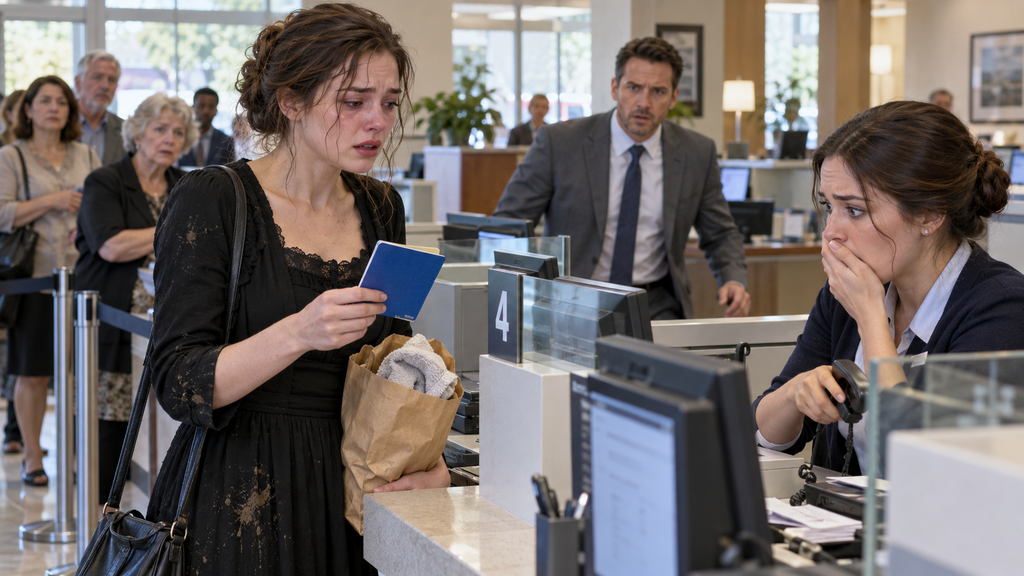
The young teller who had first helped me covered her mouth.
I continued.
“He said if there was anything in it, it was my inheritance.”
The officer leaned forward.
“Did he know you had retrieved it?”
“No.”
“You’re certain?”
“Yes.”
“I waited until everybody left.”
The words sounded insane once I said them aloud.
“I dug it out.”
Nobody laughed.
The officer asked:
“Why?”
I looked at the muddy blue book lying inside a clear evidence sleeve.
“Because Grandma told me not to let him find it.”
The branch manager, Mr. Calloway, glanced at the book.
Then at me.
“What exactly did your grandmother tell you?”
“Two nights before she died, she squeezed my hand and said, ‘Chloe, don’t let Richard find it.’”
“Did she identify the passbook?”
“No.”
“But I knew what she meant.”
The second officer, a woman named Detective Elena Ruiz, had been quiet until then.
She sat across from me with a small notebook.
“Why were you so sure?”
“Because she’d hidden it my entire life.”
“From Richard?”
“Yes.”
“Did she ever explain why?”
“No.”
I swallowed.
“She only said it was for when she was gone.”
Detective Ruiz nodded.
“Did your father know she had it?”
“I think so.”
“Why?”
“Because of what she wrote.”
I pointed toward the passbook.
Mr. Calloway carefully opened the evidence sleeve and turned to the first page.
The note was still visible beneath the smudged blue ink.
If Richard says it’s worth nothing, it’s because he already tried to cash it.
Detective Ruiz read it twice.
Then she asked:
“When do you think Margaret wrote that?”
“I don’t know.”
“Recently?”
“Her handwriting got shakier during the last year.”
“So probably.”
She wrote again.
Then looked at Mr. Calloway.
“Can you explain the account structure without compromising anything you need a warrant for?”
He nodded slowly.
Then turned his monitor slightly away from me.
Not because he was hiding something.
Because suddenly everyone was being careful.
That frightened me more than shouting would have.
“Ms. Henderson, the blue passbook is connected to an old custodial savings account your grandmother maintained.”
I nodded.
“That part I understand.”
“But the red stamp on the final page references a separate restricted account record.”
“The one with the money?”
“Yes.”
“How much is there now?”
He hesitated.
Detective Ruiz looked at him.
“She’s the named beneficiary?”
“Yes.”
“Then tell her what you are permitted to tell her.”
Mr. Calloway took a breath.
“As of this morning, the restricted balance is four hundred seventy-three thousand, eight hundred eleven dollars and twenty-six cents.”
I stopped hearing the room.
The fluorescent lights hummed.
Somebody outside the office laughed.
A printer began feeding paper.
Four hundred seventy-three thousand dollars.
I had checked my account balance before buying groceries three days earlier because I was worried the electric bill would clear before payday.
I whispered:
“No.”
Mr. Calloway’s face softened.
“I’m afraid that is the current figure.”
“Grandma didn’t have that kind of money.”
“The majority did not originate with Margaret.”
I remembered the file.
My name.
The year I was born.
“My mother?”
“Yes.”
“What happened?”
He looked at Detective Ruiz.
She said:
“Tell her the documented history.”
Mr. Calloway folded his hands.
“Your mother, Anna Henderson, died when you were eleven months old.”
I nodded.
Car accident.
That was the story I had always known.
A wet highway.
An eighteen-wheeler.
Instant.
Dad hated talking about it.
Grandma cried every July on the anniversary.
Mr. Calloway continued.
“Anna had a life-insurance policy through her employer.”
“How much?”
“One hundred fifty thousand dollars.”
My mouth went dry.
“She also received a settlement shortly before her death connected to an unrelated workplace injury claim.”
“How much?”
“Approximately seventy-eight thousand.”
“And your maternal grandfather contributed additional funds after Anna’s death.”
I frowned.
“My mother’s father?”
“Yes.”
“I never met him.”
“That appears to have been intentional.”
I looked at him sharply.
“What does that mean?”
He stopped.
Detective Ruiz answered.
“It means there are family issues outside the bank records that we don’t fully understand yet.”
I stared.
Mr. Calloway continued.
“Collectively, those funds were placed into accounts intended for your benefit.”
“Your grandmother became successor custodian after concerns arose about Richard’s handling of the money.”
My chest tightened.
“What concerns?”
He turned one document around.
It was a photocopy of an old withdrawal slip.
Twenty-five thousand dollars.
Purpose:
CHILD HOUSING EXPENSE
My father’s signature underneath.
I almost laughed.
“When was this?”
“Two months after my mother died?”
“Yes.”
“We lived in Grandma’s house then.”
Mr. Calloway said nothing.
I remembered that house.
Peeling green kitchen wallpaper.
A squeaky hallway floor.
Grandma’s tiny bedroom at the end.
My father had lived there too until I was five.
He paid no rent.
Grandma used to joke that Richard’s only household contribution was leaving dirty glasses everywhere.
I pointed at the withdrawal.
“What did he spend it on?”
Detective Ruiz said:
“That is one of the things we’re investigating.”
Another withdrawal.
$18,500.
CHILD TRANSPORTATION
Another.
$12,000.
MEDICAL AND SUPPORT
Another.
$9,700.
EDUCATIONAL PREPAYMENT
My hands began shaking.
“Did any of this go to me?”
Mr. Calloway spoke carefully.
“Some withdrawals may have covered legitimate expenses.”
“Some clearly require explanation.”
“How much did he take?”
“The historical account records show approximately one hundred forty thousand dollars left the custodial funds while Richard had access.”
I whispered:
“And Grandma stopped him?”
“Yes.”
“How?”
“She came here.”
Mr. Calloway opened another scanned document.
An affidavit.
My grandmother’s name at the bottom.
Margaret Henderson.
The date was twenty-three years earlier.
I had been four.
He read part aloud.
“Margaret reported that Richard had been pressuring her to authorize further withdrawals, had misrepresented household expenses, and had attempted to obtain her signature on blank account forms.”
My eyes filled.
Grandma had been fighting him when I was four years old.
While she made chicken soup.
While she taught me letters at her kitchen table.
While she walked me to kindergarten.
She had been going into banks and signing affidavits because my father was trying to take my money.
I asked:
“Why didn’t she tell me?”
Nobody answered.
Because nobody in that office could.
That answer belonged to a dead woman.
Mr. Calloway continued.
“After her report, access controls were tightened.”
“Your father was removed as an authorized custodian.”
“A restricted beneficiary file was created.”
“Future transactions above a low threshold required enhanced review.”
“That’s the red stamp?”
“Yes.”
“And the case file?”
“Yes.”
I looked at the young teller through the glass wall.
“That’s why she recognized my name?”
“Not your name alone.”
Mr. Calloway pointed toward my ID.
“The file contains instructions that if Chloe Henderson ever appears in person with government identification, management is to be notified.”
“For twenty-three years?”
“Yes.”
My eyes burned.
“Why?”
He hesitated.
“Because your grandmother requested that the beneficiary be identified directly rather than through another family representative.”
I almost smiled through tears.
Of course she did.
Even in a bank file, Grandma Maggie had found a way to say:
Talk to Chloe herself.
Not Richard.
Not Susan.
Not family.
Chloe.
Detective Ruiz leaned toward me.
“There’s something else.”
My stomach tightened.
“What?”
She slid the security photograph closer.
“Your father did not come alone yesterday.”
She placed another image beside it.
Susan.
My stepmother.
Designer sunglasses pushed onto her head.
One manicured hand resting on the counter.
I stared.
“She was with him?”
“Yes.”
A third image.
Tyler.
My half-brother.
Standing several feet away, looking at his phone.
I whispered:
“Tyler too?”
Ruiz said:
“We don’t know what he knew.”
That mattered.
At the funeral he had joked about burgers.
He had laughed.
But stupid cruelty at a funeral was not the same as bank fraud.
I forced myself not to decide more than the evidence did.
Grandma had taught me that too.
Maybe not with words.
But with every time she told me:
Don’t accuse when you can ask. Don’t trust when you can verify.
My phone began vibrating inside my purse.
Once.
Twice.
Three times.
Detective Ruiz looked at it.
“Who is calling?”
I pulled it out.
Dad.
The screen felt hot in my hand.
Richard Henderson.
I showed her.
She lifted one finger.
“Don’t answer yet.”
The call stopped.
Immediately, a text arrived.
WHERE ARE YOU?
Then another.
Susan said you didn’t come home last night.
Then:
We need to deal with Grandma’s things today.
Detective Ruiz read the screen without touching my phone.
“Does he usually text in capitals?”
“When he’s angry.”
Another message.
DID YOU TAKE ANYTHING FROM THE CEMETERY?
My blood froze.
I looked at Ruiz.
“How does he know?”
She shook her head.
“He may not.”
Another text.
CHLOE. ANSWER ME.
My breathing shortened.
Mr. Calloway closed the blinds.
Detective Ruiz said:
“Do you feel safe returning to your apartment?”
I thought of the wooden chair under my doorknob.
“No.”
That single word changed everything.
The police did not arrest my father that morning.
That surprised me.
Part of me expected them to march out of the bank, handcuff him, recover every stolen dollar, and declare the nightmare over before lunch.
Real investigations are slower.
Ugly in a different way.
They ask for documents.
Compare signatures.
Verify timestamps.
Interview people separately.
Apply for warrants.
Preserve footage.
Argue about what can actually be proven.
The bank placed the restricted account under a formal fraud hold.
Nobody could touch it.
Including me.
That was fine.
For the first time in my life, I did not care about getting the money quickly.
I cared about keeping Richard away from it.
A victim-services advocate helped me find an attorney.
Her name was Rebecca Sloan.
She specialized in elder exploitation, inheritance disputes, and financial abuse.
By four that afternoon, I was sitting in her office wearing the same grave-stained black dress.
She looked at the mud under my fingernails.
Then at the documents I had been allowed to copy.
“You dug this out of a grave?”
“Yes.”
She nodded once.
“Good.”
I stared.
“Good?”
“I’ve had clients lose evidence in less dramatic ways.”
For the first time all day, I laughed.
It came out broken.
Rebecca did not smile.
She studied the account records.
Then she said:
“We need to separate three things.”
I nodded.
“The money Richard took decades ago.”
“The money still in the restricted account.”
“And whatever he attempted yesterday using Margaret’s death.”
“Can we get the old money back?”
“Some.”
“All?”
“I don’t know.”
I appreciated that answer.
She continued.
“Some transactions may be too old for certain criminal charges.”
“Civil claims can have their own timing problems.”
“But if there was concealment, ongoing fiduciary misconduct, forged documents, or later fraudulent acts tied to the same scheme, that changes the analysis.”
I looked down at my hands.
“So he could get away with it.”
“Parts, perhaps.”
She leaned forward.
“But Chloe, do not make the mistake of believing justice only counts if every old dollar returns.”
I swallowed.
“He stole from a baby.”
“Yes.”
“My own father.”
“Yes.”
She let the silence exist.
Then:
“And now we document it.”
That became my life for the next six weeks.
Document.
Verify.
Wait.
Grandma Maggie’s funeral had lasted forty-two minutes.
Her secrets took months to understand.
The first major discovery came from a safe-deposit record attached to the red-stamped file.
Mr. Calloway called Rebecca.
Then Rebecca called me.
“Your grandmother had a bank box.”
“I knew she had a tin.”
“Not the cookie tin.”
“A safe-deposit box.”
My heart accelerated.
“What’s in it?”
“We don’t know yet.”
The bank required estate documentation and proper access.
Grandma’s will named me as personal representative.
Another fact Dad had neglected to mention.
He had told everyone the estate was “too small to probate.”
Rebecca obtained the original will from Grandma’s attorney.
When we opened the box, I expected jewelry.
Maybe old bonds.
Cash.
Something cinematic.
Instead, it contained paper.
Grandma had apparently trusted paper more than people.
There were envelopes labeled by year.
Bank statements.
Copies of checks.
Letters.
Photographs.
And one small cassette tape.
I stared at it.
Rebecca smiled faintly.
“You own anything that plays that?”
“No.”
“Neither do I.”
We found one.
A dusty recorder borrowed from the law office’s storage room.
Grandma’s voice crackled through the speaker.
Older.
Weak.
Still unmistakably hers.
“If Chloe is hearing this, then I waited too long.”
I covered my mouth.
Rebecca stopped the tape.
“You okay?”
“No.”
“Continue?”
“Yes.”
She pressed play.
Grandma inhaled.
“I told myself I was keeping you safe.”
“I told myself Richard would force you to sign something if you knew before you were old enough to leave him.”
“That was true when you were little.”
“It was less true later.”
My eyes filled.
“And still I waited.”
“Fear becomes a habit, sweetheart.”
“Sometimes old people call it caution because that sounds wiser.”
I started crying.
Rebecca quietly pushed the tissue box toward me.
Grandma continued.
“Your mother Anna loved you before she ever saw your face.”
“She made me promise that if anything happened to her, her money would go to you.”
“Not Richard.”
“You.”
I closed my eyes.
“Your father was not always the man you know now.”
“He was charming.”
“He was funny.”
“He loved your mother in his way.”
“But after she died, something in him changed.”
“Or maybe grief simply removed the part that hid what was already there.”
My throat tightened.
“He began saying the money should reimburse him.”
“For being a widower.”
“For raising you.”
“For losing Anna.”
“He said nobody understood what he had sacrificed.”
Then Grandma laughed bitterly on the tape.
“I told him babies don’t send invoices.”
I almost laughed through tears.
That was Grandma.
Even terrified, she could still insult you properly.
The tape continued.
“He took money before I understood what he was doing.”
“I stopped what I could.”
“I could not undo everything.”
“I am sorry.”
I whispered:
“No.”
As though she could hear me.
“No, Grandma.”
Then came the sentence that changed everything again.
“Richard also took your college fund.”
I froze.
I had known that.
At least, I thought I had.
Dad had told me there was a scholarship account when I was seventeen.
Then, months before tuition was due, he said an investment had collapsed.
He called me irresponsible for choosing an expensive state university.
I took loans.
Worked nights.
Grandma paid for books when she could.
On the tape, she said:
“The account did not collapse.”
“Richard liquidated it.”
My vision blurred.
“He told me it was needed to cover taxes connected to your mother’s trust.”
“It was not.”
“I kept copies.”
Rebecca stopped the tape.
My hands were shaking.
“He took that too.”
“Yes.”
“I spent eight years paying student loans.”
“I know.”
“He used to tell me I should have worked harder for scholarships.”
Rebecca’s jaw tightened.
I stood up.
Walked around the tiny conference room.
Then sat again.
“Play it.”
Grandma’s voice returned.
“If you are angry with me, be angry.”
“I deserve part of it.”
That broke me.
“No.”
“I should have told you when you turned eighteen.”
“I should have told you when you moved out.”
“I kept waiting for a time when Richard could not hurt you.”
“The truth is, I was still afraid of him.”
Silence crackled on the tape.
Then:
“But there is something fear does if you feed it too long.”
“It starts deciding for other people.”
I stared at the recorder.
“You deserved to choose what to do with the truth.”
“I took that choice from you.”
“I am sorry.”
That apology hurt more than any excuse would have.
Because she was right.
She had protected me.
And hidden things from me.
Both were true.
Love does not become harmless merely because fear motivated it.
Grandma continued.
“The remaining account is yours.”
“Not because it will make life easy.”
“Money does not do that.”
“It just makes some problems more expensive and others less frightening.”
I laughed.
Then she said:
“Do not use it to become Richard.”
The room went still.
“Do not make money into revenge.”
“Do not let him teach you that winning means somebody else has to crawl.”
“Protect yourself.”
“Tell the truth.”
“Take what is yours.”
“Then live.”
I lowered my face into my hands and sobbed.
The final envelope in the box was addressed:
FOR CHLOE AFTER THE BANK
Inside was a handwritten letter and one photograph.
My mother.
Anna.
Twenty-five years old.
Holding me as an infant.
I had never seen the picture.
Her dark hair was tied back messily.
She looked exhausted.
Happy.
Real.
Not the formal portrait Dad kept in a drawer.
On the back she had written:
Chloe screamed for forty minutes, then smiled the second Grandma held her. Traitor.
I laughed so suddenly Rebecca jumped.
“What?”
I handed her the picture.
She smiled.
“Your mother had jokes.”
“Apparently.”
The letter was Grandma’s.
Shorter than the tape.
At the bottom:
There is one person you should speak to before you decide what your father stole from you. His name is Samuel Reyes. He was your mother’s attorney. He knows what happened after Anna died.
Samuel Reyes was eighty-two.
Retired.
Living two counties away.
He agreed to meet.
When I walked into his living room, he stared at my face for so long that I became uncomfortable.
Then he whispered:
“You look like Anna when she was angry.”
I almost laughed.
“Apparently I’m angry a lot lately.”
“Good.”
He gestured toward a chair.
“Your mother was too polite.”
Samuel had kept copies.
Of course he had.
Everyone in Grandma’s generation seemed to understand that photocopiers were defensive weapons.
He showed me the original beneficiary instructions.
Anna’s insurance proceeds were intended for me.
My maternal grandfather, Joseph Reyes—Samuel’s older brother—had added $50,000.
I stared.
“Reyes?”
Samuel nodded.
“My mother’s maiden name?”
“Yes.”
“So you’re…”
“Your great-uncle.”
My mouth opened.
Nothing came out.
“You’re family?”
“Yes.”
“Why have I never met you?”
His face fell.
“Because Richard made sure of it.”
Another folder.
Of course.
Letters addressed to me.
Birthdays.
Christmas.
Graduation.
Returned unopened.
Some stamped:
REFUSED.
Some:
NO LONGER AT ADDRESS.
My eyes blurred.
Dad had told me my mother’s family wanted nothing to do with us after she died.
Samuel whispered:
“We tried.”
I picked up one envelope.
My name written in an old man’s careful handwriting.
Age six.
I opened it.
A birthday card with a cartoon horse.
Inside:
Dear Chloe, your grandfather talks about you every day. We hope someday Richard will let us visit. Love, Uncle Sam.
I started crying.
“Grandpa was alive?”
“Until you were nine.”
“Did he see me?”
“Once.”
I looked up.
“At your mother’s funeral.”
I remembered nothing.
I had been a baby.
Samuel continued.
“Richard told Joseph he blamed your mother’s family for encouraging her to keep finances separate.”
“He said if we contacted you again, he would move.”
“Joseph was already ill.”
“He was afraid losing track of you completely would be worse.”
“So everybody stayed quiet?”
Samuel looked ashamed.
“Yes.”
I stood.
“Why?”
“Because we thought we were avoiding a fight.”
I laughed bitterly.
“Everyone in this family protected me by disappearing.”
Samuel closed his eyes.
“That is fair.”
I hated how often honest people said that instead of defending themselves.
It made anger harder.
He continued.
“Your grandmother Maggie kept me informed later.”
“You knew her?”
“Very well.”
That shocked me.
“They spoke?”
“For years.”
“Secretly?”
“Yes.”
“Why didn’t either of you tell me?”
Samuel looked at me.
“Cowardice dressed as caution.”
Grandma’s words again.
I sat down.
He slid one final document toward me.
A court petition from when I was four.
Margaret Henderson had sought removal of Richard from control over my funds.
The case settled.
Richard surrendered financial authority in exchange for no immediate referral for prosecution on disputed withdrawals.
My stomach turned.
“Grandma made a deal?”
“Yes.”
“To keep him from being charged?”
Samuel shook his head.
“To get him away from your money quickly.”
“Why not prosecute?”
“Because everyone believed a criminal case against your only surviving parent might leave you more vulnerable.”
I laughed.
“So once again…”
“Yes.”
He looked at me.
“Adults decided what truth you could survive.”
I stared at the papers.
“What would my mother have wanted?”
Samuel’s eyes filled.
“She would have burned the building down.”
I blinked.
Then he smiled faintly.
“Metaphorically.”
“Anna was not nearly as polite as I suggested.”
For the first time in months, I laughed without pain.
Then came the police search.
Not of my apartment.
Dad’s house.
The warrant was based primarily on the recent attempted withdrawal, suspected forged estate authority, and records Richard had submitted to the bank.
They found documents in his home office.
Copies of Grandma’s account statements.
My birth certificate.
My Social Security number.
A photocopy of the restricted account page.
A partially completed beneficiary-change form.
And, hidden inside a locked filing cabinet, a folder labeled:
CHLOE – FINAL
I hated that title.
Inside were printed bank forms and a draft letter purportedly signed by Grandma.
The letter stated Margaret wanted Richard to receive control of all remaining funds after her death because I was “financially irresponsible and emotionally unstable.”
The signature was false.
Even I could see that.
Grandma’s M had always started with a long rising loop.
This one did not.
Detective Ruiz called me after the search.
“We also found something else.”
My heart sank.
“What?”
“A copy of your driver’s license.”
“That’s not strange.”
“He had one.”
“It is when it was scanned last week.”
I went cold.
“How?”
“We don’t know yet.”
Then I remembered.
Three weeks before Grandma died, Dad had insisted he needed a copy of my license to “update the emergency contact information” for her rehabilitation facility.
I had texted it.
Because despite everything, some part of me still thought normal families shared documents when an elderly relative was sick.
He had used it in the attempted bank request.
Not to impersonate me exactly.
To support a claim that I had authorized him to act for me.
He had submitted a letter with my name.
My supposed signature.
I had never seen it.
Detective Ruiz said:
“That is likely the strongest recent evidence.”
I whispered:
“So now what?”
“Now we keep working.”
Richard was arrested four days later.
Not in a dramatic raid.
Not dragged from Sunday dinner.
He went to the station with an attorney after being informed warrants had been issued.
That almost disappointed Tyler.
Tyler had called me the night before.
Our first real conversation since the funeral.
His voice shook.
“Chloe.”
“What?”
“I need to tell you something.”
I almost hung up.
Then:
“Go ahead.”
“Dad told me Grandma’s account was family money.”
I closed my eyes.
“What did you know?”
“Almost nothing.”
“He said there was an old account that should have transferred back to him after she died.”
“Back to him?”
“Yes.”
“He said Grandma manipulated paperwork years ago.”
“Did you go to the bank with him?”
“Yes.”
“Why?”
“He asked me to drive.”
“And Susan?”
“She knew more.”
My stomach tightened.
“What did she know?”
“I don’t know exactly.”
“Tyler.”
“I swear.”
He sounded close to tears.
“Dad and Susan were arguing in the car afterward.”
“About what?”
“He said the manager refused to release anything without Chloe physically appearing or a court order.”
I froze.
“What did Susan say?”
“She said…”
He stopped.
“What?”
“She said, ‘Then get Chloe to sign before she figures out what Maggie did.’”
I stopped breathing.
“Are you sure?”
“Yes.”
“Did Dad answer?”
Tyler swallowed.
“He said, ‘She signs anything if you make her feel guilty enough.’”
I closed my eyes.
There are sentences that hurt because they reveal hatred.
That one hurt because it revealed familiarity.
He knew me.
He knew exactly how I had survived him.
By apologizing.
By trying harder.
By believing every conflict might become smaller if I surrendered first.
He had turned my coping mechanism into strategy.
Tyler whispered:
“I’m sorry I laughed at the funeral.”
I opened my eyes.
“You should be.”
“I know.”
“You stood there while he threw Grandma’s book into her grave.”
“I know.”
“You thought it was funny.”
“I was trying to…”
“Don’t.”
Silence.
Then he said:
“Okay.”
Good.
No excuse.
I asked:
“Will you tell Detective Ruiz what you heard?”
He hesitated.
“Yes.”
That mattered more than his apology.
Susan hired her own attorney two weeks after Richard’s arrest.
That told me more than any family rumor.
She had not been charged initially.
But records showed she had helped prepare some of the bank paperwork.
Her fingerprints were not metaphorically everywhere.
Her emails were.
One message to Dad:
Once Margaret is gone, Chloe will be too emotional to fight us. Do it fast.
I read that email in Rebecca’s office.
Then quietly put the page down.
“She knew.”
Rebecca nodded.
“Yes.”
“About the old theft?”
“Not necessarily all of it.”
“But she knew about the plan after Maggie’s death.”
“Yes.”
That was enough.
Susan eventually negotiated cooperation.
In exchange for consideration on charges related to submitting false financial documents, she provided access to emails and testified about Richard’s plan.
My relatives called her a traitor.
I found that almost funny.
Apparently helping steal from me was marriage.
Telling the truth afterward was betrayal.
Family language can be very creative when accountability enters the room.
The account itself was released to me eleven months after Grandma died.
Not because the criminal case was over.
It wasn’t.
Because the bank completed its beneficiary review, probate questions were resolved, and the court entered an order confirming the funds were mine.
I sat in a private office with Mr. Calloway.
The same manager who had held that muddy passbook in both hands.
He slid the paperwork toward me.
“Current balance is four hundred eighty-one thousand, two hundred nine dollars and fourteen cents.”
I stared.
The number had changed slightly with interest and adjustments.
I felt nothing at first.
Then I cried.
Not from happiness.
Money that arrives through grief does not always feel like winning.
Mr. Calloway waited.
Then asked:
“Would you like us to transfer the full amount today?”
I wiped my face.
“No.”
That surprised him.
“What would you prefer?”
“Nothing until I understand exactly where it should go.”
His expression softened.
“Good.”
I hired a fiduciary financial adviser.
A boring one.
I mean that as the highest compliment.
She did not promise to double anything.
Did not tell me I was suddenly wealthy.
She asked about debt.
Housing.
Emergency savings.
Retirement.
Taxes.
My student loans.
When she saw the student loan balance, I laughed bitterly.
“My father stole the college money, so I borrowed money to replace money that already belonged to me.”
She shook her head.
“That sentence should not exist.”
“No.”
We paid off the remaining loans.
I moved to an apartment with a working deadbolt and windows that did not rattle every time a bus passed.
I replaced my car.
Not with something glamorous.
A reliable used Honda.
Grandma would have approved.
I set aside an emergency fund.
Invested conservatively.
Then I did one thing Rebecca thought was emotional.
I said:
“It is.”
She asked:
“Is it reckless?”
“No.”
“Then emotional isn’t illegal.”
I created the Margaret Henderson Education Fund.
Not huge.
Fifty thousand dollars.
Scholarships for women returning to school after financial abuse or family coercion.
The first recipient was a thirty-four-year-old mother studying respiratory therapy.
When she sent me a thank-you note, I cried in a grocery-store parking lot.
Grandma had hemmed neighbors’ clothes for ten dollars.
Washed other people’s laundry.
Saved fifty here.
A hundred there.
She would have hated having a fund named after her.
Which made me love it more.
Richard’s case resolved eighteen months after the funeral.
By then, I had stopped imagining some courtroom speech where he confessed everything and begged me for forgiveness.
That did not happen.
His attorneys challenged records.
Argued some old withdrawals had been authorized.
Argued he believed he retained equitable rights to certain funds.
Argued the recent documents were attempts to “clarify” inheritance administration.
The prosecutors focused on what they could prove most cleanly.
The recent attempted fraud.
The forged authorization using my identity.
False documents tied to Grandma’s estate.
Certain old transactions became relevant background but were not charged individually.
That frustrated me.
Then Detective Ruiz reminded me:
“A criminal case is not a biography.”
I wrote that down.
Richard eventually pleaded guilty to fraud and forgery-related charges connected to the attempted withdrawal and false authorization.
The sentence included incarceration.
Not life.
Not decades.
Twenty-eight months.
Followed by supervision.
Restitution tied to documented recent losses and investigation costs.
The older missing money became part of a separate civil settlement.
Some could be traced.
Some could not.
A forensic accountant found approximately $91,000 of the old $140,000 had likely gone to Richard personally or to expenses unrelated to me.
About $31,000 could plausibly be attributed to my housing, medical care, and direct support.
The rest remained uncertain.
Reality was messier than the passbook.
I recovered part through the civil case.
Not all.
I stopped chasing the final ambiguous dollars after Rebecca asked me:
“How much of your life are you willing to spend proving what happened to money from 1999?”
I hated the question.
Then answered:
“Not all of it.”
Grandma’s tape again.
Take what is yours. Then live.
Susan avoided incarceration.
She received probation, financial penalties, and agreed to restitution connected to her role in the recent attempt.
We never reconciled.
I was comfortable with that.
Not every relationship needs a redemption arc.
Some people become lessons with phone numbers you block.
Tyler was harder.
He was my brother.
Annoying.
Weak.
Sometimes cruel.
Also twenty-two and raised by the same father who taught both of us that ridicule was safer than disagreement.
That did not absolve him.
It explained part of him.
We rebuilt slowly.
The first time he asked me for money after the case, my whole body tensed.
Then he said:
“Actually, never mind.”
I looked at him.
“What?”
“My car needs a transmission.”
“How much?”
“Too much.”
“And?”
He rubbed his neck.
“I almost asked because you have money now.”
At least he said it.
I waited.
He continued.
“Then I realized that’s basically Dad with fewer steps.”
I laughed.
“Growth.”
He grinned.
“I hate it.”
I did not give him the money.
I helped him compare repair shops.
That was enough.
Three years after Grandma died, Tyler brought me a small porcelain angel.
The one from Grandma’s kitchen table.
I stared at it.
“Where did you get this?”
“Dad’s garage.”
My throat tightened.
“He took it?”
“Apparently.”
Tyler put it in my hand.
“I figured it should be with you.”
I touched the chipped wing.
For years, the passbook had always sat beside this angel.
Grandma counting deposits.
Me coloring at the table.
Steam from chicken soup fogging the kitchen windows.
For a moment, I could smell her house again.
“Thank you.”
Tyler nodded.
Then:
“Burgers are still on you, though.”
I stared at him.
He froze.
Then I laughed.
Actually laughed.
“Get out.”
He smiled.
That was the first time the old joke stopped hurting.
My father wrote me from prison.
Three letters.
I returned the first unopened.
Opened the second.
It was mostly excuses.
He wrote about losing my mother.
About being twenty-nine and suddenly alone with a baby.
About bills.
Fear.
Grandma’s interference.
He said the insurance money “felt like compensation for everything I had lost.”
That sentence made me furious.
I wrote one reply.
Only one.
Mom died. You did not buy the right to be reimbursed from her child.
I almost stopped there.
Then added:
If you want me to understand you someday, start by understanding that sentence.
His third letter arrived six months later.
Different.
Short.
You were right.
I stared.
Then:
I spent years saying the money was family money because I did not want to admit I knew whose name was on it.
My hands shook.
I told myself raising you entitled me to repayment.
It did not.
I told myself Mom turned you against me.
The truth is, she stood between us because I gave her reasons to.
I cried.
Not because I forgave him.
Because truth from the person who hurt you can arrive too late and still matter.
He continued.
I threw the passbook into her grave because I thought the account was already beyond my reach.
There it was.
The funeral.
Finally.
I wanted to humiliate her one last time.
My stomach turned.
I also wanted you to believe it was worthless so you would not ask questions.
I closed my eyes.
No grand excuse.
Just ugliness.
Then:
I was wrong about many things, but the worst may be that I taught you to doubt your own right to ask what belonged to you.
I stopped reading.
That line was too accurate.
For years, whenever I asked Dad about money, he called me greedy.
When I asked about college funds, ungrateful.
When I questioned why Grandma paid for things he should have, dramatic.
He had taught me that asking for information was a character flaw.
The passbook changed that.
Not because it contained money.
Because it contained records.
Numbers do not care if someone calls you selfish.
Signatures do not become different because a parent raises his voice.
Documents do not apologize to keep the peace.
I finished the letter.
I do not expect you to visit.
I do not expect forgiveness.
I am sorry.
I folded it.
Put it in Grandma’s safe-deposit box.
Not because I treasured it.
Because history belonged together.
When Richard was released, I did not meet him.
Not immediately.
Two years later, I agreed to coffee.
Public place.
Daytime.
Tyler knew where I was.
So did Rebecca, though by then she was technically no longer my lawyer.
She said:
“I have become emotionally invested.”
I told her:
“That sounds unethical.”
She said:
“Don’t make me bill you.”
Dad looked older.
Prison had not transformed him into a different species.
He still had the same hands.
Same eyes.
Same habit of tapping his finger against the coffee cup when uncomfortable.
He looked at me.
“You look like your mother.”
I almost laughed.
“Apparently everyone says that when they run out of things to say.”
He nodded.
“Fair.”
We sat in silence.
Then he asked:
“How much was in the account?”
I stared.
He immediately closed his eyes.
“That was a terrible first question.”
“Yes.”
“I’m sorry.”
I almost smiled.
“Still learning.”
He nodded.
Then:
“Are you okay?”
Better.
“Yes.”
“Do you hate me?”
I thought.
“No.”
His eyes lifted.
“Do you forgive me?”
“No.”
He nodded slowly.
“That makes sense.”
We talked for forty minutes.
Not about the money first.
Grandma.
Mom.
My job.
Tyler.
The cemetery.
Then Dad said:
“I really did love your mother.”
I looked at him.
“I believe you.”
His face crumpled.
That answer hurt him more than if I had called him a liar.
Because love had not prevented what he became.
That was the tragedy.
People want bad men to have never loved anybody.
Life is harder.
Sometimes people love.
Then control.
Then justify.
Then steal.
Human beings can carry contradictions without noticing the weight.
I said:
“Loving Mom doesn’t excuse what you did to her money.”
“I know.”
“Raising me doesn’t make me owe you for food and shelter.”
“I know.”
“Grandma did not turn me against you.”
His eyes filled.
“I know.”
I leaned back.
“Then maybe we have enough truth for one cup of coffee.”
He nodded.
We did not become close.
I did not give him access to my finances.
He never received a key to my home.
He did not become someone I called when I was scared.
Forgiveness, when pieces of it finally came, did not restore those privileges.
Trust is not a family heirloom.
It does not automatically pass down.
It is rented slowly.
Payment due in behavior.
Grandma Maggie’s grave looked different the first time I returned.
Grass had grown.
The mud was gone.
The funeral flowers had disappeared months earlier.
I brought no passbook.
Only the porcelain angel.
I sat beside the stone.
For a while, I said nothing.
Then:
“You should have told me.”
Wind moved through the cemetery trees.
“You were scared.”
“I know.”
“You protected me.”
“I know.”
“You also kept my life from me.”
I swallowed.
“I know.”
Tears blurred her name.
Margaret Henderson.
1939–2026.
I placed my hand against the stone.
“I forgive your fear.”
Then I laughed softly.
“But I’m still mad.”
She would have appreciated that.
Before leaving, I put the porcelain angel at the base of the headstone.
Then reconsidered.
Grandma would have called that wasteful.
Someone would steal it or rain would ruin it.
I picked it back up.
“You’re coming home.”
The passbook now sits in a shadow box in my apartment.
Not because it is valuable.
Technically, Dad was right about one thing.
The physical book itself was almost worthless.
A few pages.
Blue cover.
Faded ink.
Mud stain that never completely came out.
The bank account mattered.
The evidence mattered.
But the passbook became something else.
Proof that worthless and powerless are not the same thing.
Dad looked at that little book and saw paper.
Grandma saw a trail.
I saw a door.
Years later, when the Margaret Henderson Education Fund awarded its tenth scholarship, I told the recipients a shorter version of the story.
Not the criminal details.
Not every family wound.
I held up the blue passbook.
“This is why the fund exists.”
One woman asked:
“How much was in it?”
I smiled.
“That’s not the important number.”
She looked confused.
So I continued.
“The important number was one.”
“One person kept a record.”
“One person refused to let somebody else rewrite everything.”
“One person finally asked the bank a question.”
Afterward, a young woman named Danielle approached me.
Her hands trembled.
“My husband handles everything.”
I listened.
“He says I’m bad with money.”
I felt something inside me go still.
“Are you?”
“I don’t know.”
“Do you know what accounts you have?”
“No.”
“Your debts?”
“No.”
“Your income?”
“Yes.”
“His?”
“No.”
I did not tell her to leave him.
Did not tell her he was a criminal.
I had learned better than to turn patterns into verdicts without evidence.
I simply said:
“You are allowed to know your own financial life.”
She started crying.
That sentence should not have been revolutionary.
For too many people, it is.
On the tenth anniversary of Grandma’s death, I visited the bank.
Mr. Calloway had retired.
The young teller from that first morning was now assistant branch manager.
Her name was Jasmine.
I had never remembered it back then because fear had turned everyone into roles.
Teller.
Manager.
Officer.
Later I learned their names.
That mattered too.
Jasmine smiled when I walked in.
“I remember you.”
“I figured.”
She laughed.
“You looked terrifying.”
“I was wearing cemetery mud.”
“Exactly.”
We sat in her office.
The restricted account no longer existed.
The money had long since been transferred, invested, spent carefully, given partly away.
But the bank still had archived copies of the old case file.
She said:
“I’ve told new employees about that morning.”
I raised an eyebrow.
“Hopefully without my Social Security number.”
She laughed.
“No.”
“Just the lesson.”
“What lesson?”
She looked at me.
“That a weird old document can matter.”
I smiled.
“Yes.”
“It can.”
Before I left, she asked:
“Do you still have the passbook?”
“Yes.”
“Good.”
Walking home afterward, I thought about the cemetery.
Dad’s gloved hand.
The blue book falling onto Grandma’s chest.
The cousins laughing.
Susan’s sunglasses.
Tyler whispering about burgers.
Me standing there in cheap flats, believing I had lost the only person who had ever protected me.
I had not known that beneath my grief was a record twenty-seven years old.
I had not known my mother had planned for me.
That my grandfather had tried to love me from a distance.
That Grandma had fought Richard while packing my lunches and mending my clothes.
I had not known adults could protect you and fail you at the same time.
I had not known money could preserve a lie for decades—or expose one in seconds.
Most of all, I had not known that my father’s favorite weapon was not anger.
It was definition.
He decided what things meant.
My tears meant drama.
My questions meant greed.
Grandma’s caution meant manipulation.
His withdrawals meant reimbursement.
My mother’s money meant family money.
The passbook meant nothing.
For years, I accepted his definitions because children often mistake a parent’s certainty for truth.
Then one morning, a bank teller looked at that muddy blue book and turned pale.
And suddenly somebody else was reading the record.
That was the first domino.
Not the money.
Not the police.
Not even the arrest.
The first domino was evidence being seen by someone Richard could not intimidate into changing its meaning.
After that, everything fell.
The lies about my mother.
The stolen college fund.
The hidden relatives.
The forged authorization.
The attempt after Grandma’s death.
The story that I had inherited nothing.
And at the very end, after the criminal case, the civil settlement, the apologies, the scholarship fund, and years of slowly building a life nobody else controlled, I understood what Grandma had really left me.
Not four hundred eighty-one thousand dollars.
Not a passbook.
Not even proof against my father.
She left me a question.
Whose version of your life are you living?
For most of my childhood, the answer had been Richard’s.
After that morning at the bank, it became mine.
THE END STORIES! THANK YOU FOR READING GOOD LUCK! ❤️
Related Posts