The doorknob turned once, slowly, then stopped. A second later, someone pressed against the front door hard enough to make the old wooden frame groan. My six-year-old granddaughter buried her face against my chest, and I felt something inside me change forever. I had buried my only daughter that afternoon. I had watched her husband abandon their three little girls beside her grave. Now, with Rose’s final letter trembling in my hands, I understood that the nightmare we’d entered was far from over.
“Grandpa,” Lucy whispered, “don’t open it.” I looked at the door. “I’m not going to, sweetheart.” Another message appeared on my phone. Charles, don’t make this difficult. I only want what belongs to me. Arthur. Even now, after everything he’d done, he still believed he could demand whatever he wanted. I looked down at the cream-colored envelope.
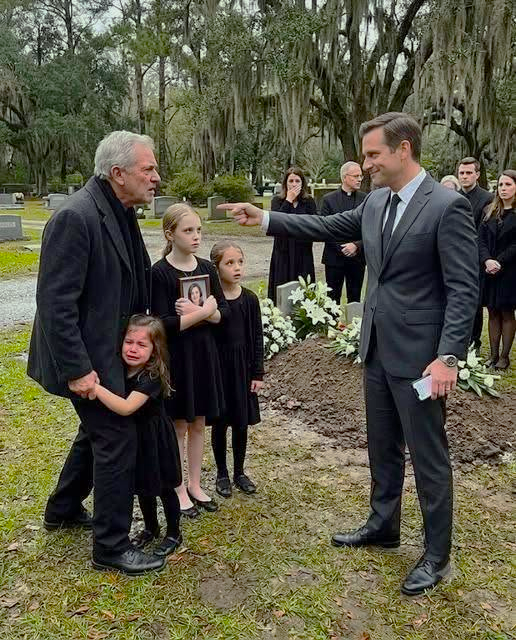
Rose’s handwriting stretched across the front. FOR DAD, WHEN HE FINALLY LISTENS. For thirty-five years, my daughter had called me whenever something frightened her. Sometimes she wanted advice. Sometimes she just needed to hear my voice. But during the last six months of her life, she’d stopped calling so often. I’d told myself she was busy raising three children.
Now I wondered how many times she’d reached for the telephone before deciding not to burden me.
Outside, the person at the door knocked three times.
“Mr. Bennett?” a man’s voice called. “We need to speak with you.”
My name is Charles Bennett. I’m sixty-eight years old, and I spent thirty-seven years repairing electrical systems in schools and government buildings around Savannah. I’ve dealt with hurricanes, house fires, and men who thought intimidation could replace common sense.
But nothing in those thirty-seven years prepared me for the fear I felt that night.
Three little girls stood behind me.
They were all I had left of my daughter.
And someone wanted what she had died trying to protect.
I reached for my telephone.
“Lucy, take your sisters upstairs. Go into my bedroom and lock the door.”
She shook her head.
“Grandpa, Mom said we shouldn’t separate.”
I knelt in front of her.
“Your mama was right about looking after each other. That’s exactly what you’re going to do. Stay together upstairs while I call for help.”
Rachel took April’s hand.
Lucy hesitated.
Then she handed me the shoebox.
“Don’t let him take this.”
“I won’t.”
She looked straight into my eyes.
“Promise?”
I swallowed.
“I promise.”
The three girls hurried upstairs.
I heard the bedroom door close.
Then I dialed 911.
The dispatcher asked for my address, and I gave it as steadily as I could.
“Someone is trying to enter my house,” I said. “My three granddaughters are here. Their father has been threatening to take something from them.”
“Are you inside with the doors locked?”
“Yes.”
“Do not open the door. Officers are on their way.”
Outside, the knocking stopped.
For a few seconds, there was silence.
Then I heard footsteps crossing my front porch.
A car door slammed.
An engine started.
By the time the first patrol car arrived, the vehicle was gone.
Two officers checked the property while I stood in the hallway clutching Rose’s shoebox.
A female officer named Elena Brooks asked whether anyone had entered.
“No, ma’am.”
“Did you recognize the person?”
“No. But I received these messages.”
I showed her Arthur’s texts.
She read them carefully.
Then she looked at the shoebox in my hands.
“Is that what he was asking for?”
“I believe so.”
“What’s inside?”
I hesitated.
There were things in that box my daughter had trusted her children to hide.
Things she’d apparently been too frightened to keep in her own home.
“I don’t know everything yet,” I admitted.
Officer Brooks nodded.
“Then don’t alter or destroy anything. Keep the messages, and let us document what happened tonight.”
She took photographs of the door and arranged for the incident to be reported.
Before leaving, she gave me a card with a telephone number.
“If he comes back, call us immediately.”
After the officers departed, I went upstairs.
Lucy was sitting on the bedroom floor with Rachel beside her.
April had fallen asleep against the bed, still wearing her black funeral dress.
I felt my throat tighten.
A child should not have to sleep in funeral clothes.
A child should not have to know what it means to hide evidence from her own father.
And no twelve-year-old should have to look at her grandfather and ask whether the police could be trusted to protect her.
“Is he gone?” Lucy whispered.
“Yes, sweetheart.”
“Did they find him?”
“Not yet.”
She lowered her eyes.
“Mom said he’d come looking.”
I sat beside her.
“Lucy, I need you to tell me everything your mother told you.”
She looked toward her sleeping sister.
Then she took a breath.
“Mom said if anything happened to her, we were supposed to give you the box.”
“What did she mean by anything?”
Lucy’s lower lip trembled.
“She said she was trying to make things right, but Dad had found out.”
“Found out what?”
Rachel answered before Lucy could.
“That Mom was leaving him.”
I stared at her.
“Leaving Arthur?”
She nodded.
“Mom said we were going to move into a little house near your neighborhood. She said we’d have our own rooms, and you could come for Sunday dinner.”
My heart seemed to stop.
Rose had never mentioned any plans to move.
In fact, the last time I’d seen her, she’d insisted that everything at home was fine.
I looked at Lucy.
“Why didn’t she tell me?”
Tears gathered in her eyes.
“Because Dad checked her phone.”
For a moment, I couldn’t speak.
Then Lucy said something that made the entire room feel colder.
“Grandpa, Mom didn’t think she was going to die. She thought she was going to court on Monday.”
I looked toward the shoebox.
“What court?”
“She said she was going to ask a judge to help us.”
My hands began trembling.
That was when I finally opened Rose’s envelope.
Inside were four folded pages, a small brass key, and a photograph of my daughter standing beside a woman I didn’t recognize.
On the first page, Rose had written:
Daddy, if you’re reading this, something has happened that I couldn’t stop.
I closed my eyes.
For a moment, I could almost hear her voice.
Daddy.
She was thirty-five years old, but she’d always been my little girl.
I unfolded the remaining pages.
I know you’re going to blame yourself for not seeing what was happening. Please don’t. I spent a long time hiding the truth because I was ashamed that my marriage had become something I couldn’t recognize.
Arthur has been taking money from accounts meant for the girls. I found documents with my signature that I never signed. I also discovered a second insurance policy on my life.
The first policy is real. I arranged it years ago to protect Lucy, Rachel, and April. The second one was submitted without my knowledge.
I stopped reading.
Arthur had mentioned insurance money in Rose’s recording.
Now I understood why.
I continued.
Daddy, the woman Arthur has been seeing is named Vivian Keene. She works in insurance and financial services. I believe she helped him obtain private information he had no right to use.
I have copies of the documents, photographs, and recordings. Some are in this box. The originals of the financial paperwork are with an attorney named Miriam Bell.
The little brass key opens a safe-deposit box at Coastal Heritage Bank. The box contains things I couldn’t risk keeping at home.
Then came a sentence that broke my heart.
I wanted to tell you sooner, but Arthur said if I left him, he’d make sure I never saw my girls again. He said nobody would believe me.
I pressed the paper to my chest.
Rachel began crying quietly.
I reached for her hand.
Rose’s final paragraph was written in darker ink, as though she’d pressed harder against the page.
Daddy, if I don’t get the chance to explain, please remember this: I was not planning to abandon my daughters. I was planning to save them.
And if Arthur tries to take them away from you, ask Miriam about the agreement I signed before I died.
I love you. I’m sorry I waited so long to tell you.
Your Rose.
I stared at the signature.
Then I read the letter again.
And again.
Each time, I found another piece of my daughter’s suffering.
A phone she couldn’t use freely.
Money she couldn’t control.
Threats she was too frightened to share.
A secret plan to leave.
And a father who had been standing only twenty minutes away, believing she was happy.
I don’t remember beginning to cry.
I only remember Lucy wrapping her arms around my shoulders.
“Grandpa, Mom said you would help.”
I pulled all three girls close.
“I will, sweetheart.”
“But Dad says grown-ups always say that.”
I looked at her.
“I can’t promise everything will be easy. But I can promise you won’t have to face it alone.”
Lucy rested her head against my chest.
For the first time since the funeral, she cried like the child she was.
And I held her until she fell asleep.
The next morning, I called Miriam Bell.
Her office was in a brick building near Forsyth Park, and her receptionist transferred my call immediately when I mentioned Rose’s name.
“Mr. Bennett?” a woman said.
“Yes.”
“This is Miriam Bell. I’ve been hoping you’d contact me.”
Something in her voice made my heart race.
“You knew my daughter?”
“Yes. Rose came to see me several weeks ago.”
“She left me a letter.”
Miriam was silent.
Then she said, “Are the girls with you?”
“Yes.”
“Are they safe?”
“For now.”
She exhaled.
“Then I’d like you to bring the letter and the girls’ documents to my office. There are some things we need to discuss urgently.”
Before I could answer, she added, “And Mr. Bennett, don’t tell Arthur you’re coming.”
I looked toward the kitchen, where Lucy was helping April spread jelly on toast.
“Believe me,” I said, “I wasn’t planning to.”
An hour later, we sat in Miriam’s office.
She was a woman in her early fifties, with short dark hair and the serious expression of someone who knew that careless words could hurt people.
She didn’t begin with legal documents.
Instead, she brought the girls hot chocolate.
She found colored pencils for April.
She asked Rachel about school.
And when Lucy refused to sit until she knew whether Arthur could take them away, Miriam looked her directly in the eyes.
“Lucy, adults are working on making sure you’re safe. You don’t have to solve this by yourself.”
Lucy studied her.
“Mom said you were nice.”
Miriam’s expression softened.
“Your mother loved you very much.”
Rachel looked down at her cup.
“Then why didn’t she tell us she was sick?”
The room became quiet.
Rose had died in a terrible car accident on a rain-soaked stretch of road outside Savannah.
According to Arthur, she’d been distracted, exhausted, and driving too fast.
Her car had left the road and struck a concrete drainage wall.
She died before help arrived.
That was the explanation we’d been given.
The explanation I’d accepted because grief had left me too broken to question it.
But Rachel’s question made me realize the girls had heard a different story.
Miriam leaned forward.
“Rachel, your mother wasn’t sick when she came to see me.”
Rachel frowned.
“Dad said she was losing her mind.”
My stomach turned.
“What?”
Lucy looked at me.
“He told us Mom was imagining things. He said that’s why she kept writing everything down.”
Miriam closed her eyes briefly.
Then she opened a folder.
“Mr. Bennett, your daughter was preparing to file for divorce. She had also gathered financial records suggesting her husband had misused funds set aside for the children.”
She placed several papers on the table.
One was a draft court petition.
Another was a statement describing Arthur’s threats.
The third was a copy of an insurance application.
The policy amount was printed near the top.
Two million, four hundred thousand dollars.
My breath caught.
“That’s the second policy?”
Miriam nodded.
“Rose believed it was obtained through false representations and a signature she didn’t provide.”
“Who was supposed to receive the money?”
“Arthur.”
I stared at the page.
Two million, four hundred thousand dollars.
Enough to buy a new house.
Enough to finance a business.
Enough to begin the luxurious new life Arthur apparently wanted with Vivian.
And my daughter had died before she could stop him.
I looked at Miriam.
“Do you think he killed her?”
The question hung between us.
April stopped coloring.
Miriam glanced toward the children before answering carefully.
“Mr. Bennett, I don’t know what caused Rose’s crash. The police will need evidence to answer that question. We mustn’t turn our suspicions into conclusions.”
I nodded.
She was right.
But the thought had already taken root.
My daughter had been preparing to leave an abusive marriage.
She had discovered suspicious insurance paperwork.
She had died in a crash days before taking legal action.
And her husband had publicly abandoned their children less than an hour after her burial.
I couldn’t ignore the questions any longer.
Miriam continued.
“Rose also signed documents expressing her wish that you care for the girls if she became unable to do so.”
I leaned forward.
“Then they can stay with me?”
“Her wishes matter, and the evidence of Arthur’s behavior matters. But a parent’s rights aren’t automatically ended by a letter. We’ll need to seek appropriate court orders.”
I felt my stomach tighten.
“What if Arthur demands they come home?”
“Then we present the evidence and ask the court to protect their immediate welfare.”
Lucy reached for my hand.
“Grandpa, I don’t want to go back.”
I squeezed her fingers.
Miriam looked at her gently.
“Lucy, I hear you.”
Then she turned to me.
“We can request an emergency hearing. I’ll also help you contact the appropriate child welfare authorities so their safety concerns are properly documented.”
I nodded.
“Whatever it takes.”
Miriam opened another folder.
“There’s one more thing Rose asked me to give you.”
She handed me a photograph.
It showed Rose standing outside a small yellow house with a white porch.
I recognized the neighborhood immediately.
It was less than a mile from my home.
“She was going to rent this place,” Miriam explained.
I stared at the photograph.
Four bedrooms.
A little garden.
A swing hanging from the porch ceiling.
Rose had been planning a new beginning.
For herself.
For her daughters.
And she’d been planning it close enough that I could visit whenever I wanted.
My eyes filled.
“She really was coming home.”
Miriam nodded.
“Yes, Mr. Bennett.”
I pressed the photograph against my chest.
“She was coming home.”
That afternoon, Detective Brooks called.
She’d reviewed my report from the previous night and wanted to know whether I had additional information about Arthur’s messages.
I told her about Rose’s letter, the financial documents, and the recordings.
She listened quietly.
Then she asked a question that made me sit straighter.
“Mr. Bennett, do you know whether your daughter had a camera in her vehicle?”
I frowned.
“A camera?”
“A dashboard camera. Something that recorded the road while she drove.”
I thought for a moment.
Rose had mentioned buying one after a stranger followed her from the grocery store.
At the time, I’d told her it was a sensible idea.
“Yes,” I said slowly. “I think she did.”
The detective paused.
“Was it still in the car after the collision?”
“I don’t know.”
“Her vehicle was examined after the crash, but no memory card was listed among the items recovered.”
A cold feeling moved through me.
“Could it have been destroyed?”
“Possibly. Or removed. We haven’t established that.”
I looked toward Lucy.
She was sitting on the floor, helping April build a tower from wooden blocks.
Suddenly, I remembered how tightly she’d held Rose’s framed photograph at the cemetery.
How she’d refused to let anyone take it.
Even when we climbed into my car, she’d kept it pressed against her chest.
I covered the phone.
“Lucy, sweetheart, where did your mama keep her car camera?”
She looked up.
“On the windshield.”
“Did she ever take it down?”
“Sometimes.”
“Did she tell you where she put the memory card?”
Lucy stared at me.
Then she looked toward the hallway.
“Grandpa, can I show you something?”
My heart began pounding.
I told the detective to hold on.
Lucy returned carrying the framed photograph.
She laid it on the kitchen table.
Then she carefully turned it over.
The backing had been secured with ordinary metal clips.
Lucy lifted one.
Then another.
She removed the cardboard.
Tucked behind the photograph was a tiny black memory card inside a plastic sleeve.
For a moment, I couldn’t move.
Lucy looked at me.
“Mom said if anybody tried to take the box, we should let them have it. But we were never supposed to give away her picture.”
I stared at my granddaughter.
Twelve years old.
Twelve.
And her mother had taught her to protect something dangerous without explaining why.
“Did you look at what’s on it?” I asked.
She shook her head.
“Mom told us not to.”
I returned to the phone.
“Detective?”
“Yes, Mr. Bennett.”
“I think we found something.”
There was a long silence.
Then she said, “Don’t put it into a computer. I’d like to arrange for an investigator to collect it properly.”
I looked at Lucy.
“All right.”
The detective’s voice softened.
“Mr. Bennett, tell your granddaughter she did the right thing bringing it to you.”
I repeated her words.
Lucy didn’t smile.
She simply looked at her mother’s photograph.
Then she whispered, “I hope it helps Mom.”
That evening, after the investigators collected the memory card and documented how Lucy had protected it, I sat alone in my kitchen.
Rose’s notebook lay open in front of me.
I began reading from the beginning.
At first, the entries were ordinary.
Grocery expenses.
School appointments.
Reminders about April’s dental checkup.
Then, six months before her death, the handwriting changed.
The notes became longer.
More urgent.
Arthur says I’m imagining things.
The savings account is almost empty.
Lucy asked why Daddy gets angry when I talk to Grandpa.
I found Vivian’s bracelet in his coat pocket.
He says if I leave, I’ll regret it.
I turned page after page.
My daughter had recorded things she couldn’t safely say aloud.
Arguments.
Missing money.
Threats.
Dates when Arthur was away overnight.
Then I reached an entry written twelve days before her death.
Vivian came to the house while Arthur was at work. She said I should stop making trouble. She told me Arthur had already chosen his future.
Beneath that was another sentence.
She knew about the insurance policy.
I gripped the notebook.
On the next page, Rose had written:
If Arthur thinks I’m going to let him take the girls’ money and abandon them, he doesn’t know me at all.
I stared at the words.
The daughter I remembered had been gentle.
She cried during sad movies.
She rescued injured birds.
She called me every Father’s Day and told me I was the reason she believed good men existed.
But beneath that gentleness was something I’d nearly forgotten.
Rose had always been brave.
When she was eight, she’d marched into the principal’s office because a boy was bullying her best friend.
At sixteen, she’d organized a fundraiser for a family whose house had burned down.
At twenty-two, she’d worked two jobs while finishing nursing school.
She had never been weak.
She had simply been trying to survive a situation that grew more dangerous whenever she resisted.
I turned another page.
Then I stopped.
At the top, Rose had written a date.
The day before her accident.
Underneath were six words.
I think someone is following me.
My hands began shaking.
I read on.
White van. Same one as last Tuesday. Parked outside the pharmacy. Followed me toward the bridge.
I stared at the words.
A white van.
The same kind of vehicle Arthur had climbed into after Rose’s funeral.
The van with Vivian sitting in the passenger seat.
I reached for my phone.
But before I could call Detective Brooks, a small voice came from the doorway.
“Grandpa?”
April stood there in her pajamas.
She was holding a stuffed rabbit by one ear.
“Why are you crying?”
I quickly wiped my face.
“Just missing your mama, sweetheart.”
She walked toward me.
Then she climbed onto my lap.
“I miss her too.”
I wrapped my arms around her.
For a while, we sat in silence.
Then she looked up.
“Grandpa, is Mommy cold?”
The question pierced me.
I swallowed.
“No, baby.”
“But she’s under the ground.”
I held her closer.
“Your mommy isn’t hurting anymore.”
She thought about that.
Then she whispered, “Daddy said she’s never coming back.”
I closed my eyes.
“That’s true, sweetheart.”
Her lip trembled.
“Then who’s going to sing my bedtime song?”
I felt tears sliding down my cheeks.
“What song did she sing?”
April leaned against my chest.
And in the smallest voice, she began singing the lullaby Rose’s mother used to sing.
My wife, Evelyn, had died six years earlier.
For a moment, hearing that song made me feel as though both the women I’d loved most were sitting beside us.
I couldn’t finish the words.
But April did.
When she reached the final line, she touched my cheek.
“Mommy said love stays even when people go away.”
I kissed her forehead.
“Your mommy was right.”
And that night, I made a promise to myself.
I would not let Arthur turn Rose’s daughters into another part of the life he wanted to discard.
Not while I had breath left in my body.
The next morning, Miriam filed the necessary emergency custody papers.
The authorities also began assessing the children’s situation.
Arthur received notice.
His response arrived that afternoon.
He claimed I’d manipulated the girls into rejecting him.
He claimed I was too old to raise three children.
He claimed Rose had been emotionally unstable before her death and that I’d encouraged her accusations.
Then he demanded the girls return to his home immediately.
I sat in Miriam’s office reading his statement.
At the cemetery, he’d announced that he wanted to send his daughters into foster care.
Now, after discovering that Rose had left evidence behind, he suddenly wanted them back.
I looked at Miriam.
“He’s not doing this because he misses them.”
She didn’t disagree.
Instead, she said, “We’ll put his public statements, messages, and conduct before the judge. The girls’ safety must remain the priority.”
I nodded.
Then she handed me another document.
It was an affidavit signed by a woman named Denise Palmer.
Denise had been Rose’s next-door neighbor.
She described hearing Arthur threaten Rose during an argument.
She also said she’d seen Vivian visiting the house when Rose was away.
The final paragraph caught my attention.
On the evening before Mrs. Bennett’s death, I observed a white van parked across from the residence for approximately forty minutes. I recognized the passenger as the woman who had previously visited the house.
I looked up.
“Vivian.”
Miriam nodded.
“That’s what Denise believes.”
I felt my chest tighten.
“She was watching Rose.”
“We need investigators to establish exactly what happened.”
I looked down at the statement.
The white van.
The suspicious insurance policy.
The missing money.
The crash.
The threats.
All of it was beginning to form a picture I was terrified to see.
That afternoon, Detective Brooks called again.
She asked me to come to the station.
When I arrived, another investigator was waiting with her.
His name was Daniel Price.
He worked on serious traffic investigations.
They brought me into a quiet interview room.
Detective Brooks sat across from me.
“Mr. Bennett, we’ve reviewed the files on the memory card.”
I gripped the arms of my chair.
“Was there anything?”
“Yes.”
She paused.
“And I need you to understand that this is still an active investigation.”
I nodded.
She turned a laptop toward me.
A video began playing.
The timestamp showed the evening Rose died.
Rain struck the windshield.
Streetlights reflected on the wet pavement.
The camera showed Rose driving along a two-lane road.
I recognized the route.
It was the road she’d taken home from Miriam’s office.
A white van appeared behind her.
At first, it stayed several car lengths back.
Then it moved closer.
Rose’s voice came through the recording.
“Oh, no.”
My heart slammed against my ribs.
The van accelerated.
Rose spoke again.
“Not again.”
She reached toward something near the dashboard.
The camera shook.
Then the van moved beside her.
A horn sounded.
Rose cried out.
“Please, just leave me alone!”
I gripped the edge of the table.
The white van moved ahead, slowed sharply, then drifted into Rose’s lane.
Rose braked.
Her car swerved.
The camera showed wet pavement, headlights, and the concrete barrier rushing toward the windshield.
Then the screen went black.
I made a sound I had never heard myself make.
Detective Brooks immediately stopped the recording.
“Mr. Bennett?”
I couldn’t answer.
I’d just heard my daughter’s final words.
Not a goodbye.
Not a prayer.
A plea.
Please, just leave me alone.
I covered my face.
For several minutes, nobody spoke.
Then Detective Price gently said, “We believe the recording raises serious questions about the original account of the collision. We’re examining whether another vehicle deliberately interfered with hers.”
I looked up.
“Was it Arthur?”
“We haven’t identified the driver yet.”
“Was Vivian there?”
“We’re investigating that.”
I stared at the dark laptop screen.
“That van was at the cemetery.”
Detective Brooks nodded.
“We know.”
“How?”
She looked at Price.
Then back at me.
“Because one of the funeral guests photographed it leaving the cemetery. We’ve obtained that image.”
I remembered the smug little smile that crossed Arthur’s face when his phone vibrated beside Rose’s grave.
He’d already been looking toward the future.
A future without his wife.
A future without his daughters.
But perhaps not without the money he thought Rose’s death would bring.
Detective Brooks leaned forward.
“Mr. Bennett, I need to ask you something. Did Rose ever mention a woman named Vivian Keene?”
I nodded.
“She wrote about her in the notebook.”
“Did she say Vivian threatened her?”
“Yes.”
The detective’s expression tightened.
“We’d like to examine those entries.”
I told her where the notebook was.
She arranged to document and collect it.
Then she asked me another question.
“Mr. Bennett, did Rose ever tell you she feared someone might hurt her?”
I looked at my hands.
“No.”
My voice broke.
“She never told me.”
The detective waited.
I swallowed.
“I would have helped her.”
“I believe you.”
“I would have brought her home that very night.”
She nodded gently.
“Mr. Bennett, please remember that Rose was trying to manage a frightening situation. Her silence doesn’t mean she didn’t trust you.”
I looked away.
I wanted so badly to believe that.
But grief has a cruel habit of turning every unanswered question into an accusation against the person who’s left behind.
For days, I replayed the recording in my mind.
The rain.
The white van.
Rose’s frightened voice.
The sudden movement toward the barrier.
I barely slept.
When I closed my eyes, I saw headlights.
When I woke, I heard her crying out.
Yet every morning, I still had three little girls to feed.
Three backpacks to check.
Three pairs of shoes to find.
Three hearts that needed someone steady.
So I learned to grieve quietly while making breakfast.
I learned to cry in the shower where the girls couldn’t hear me.
And I learned that raising children isn’t something a man can measure by the number of years on his birth certificate.
It’s measured by whether he gets up when they need him.
Whether he listens.
Whether he stays.
And I was going to stay.
A week later, the first custody hearing took place.
Arthur arrived with an attorney and a woman wearing a pale blue dress.
Vivian.
I recognized her immediately from the cemetery.
She was younger than Rose.
Perhaps thirty.
Her blonde hair was arranged in perfect waves, and she wore a large diamond ring on her left hand.
My stomach turned.
Rose had been buried less than two weeks earlier.
And Arthur had already given another woman a ring.
He saw me looking at it.
Then he smiled.
That smile told me everything I needed to know about how little he understood the suffering he’d caused.
Inside the courtroom, Arthur’s attorney described him as a grieving father who had spoken rashly during an emotional funeral.
He claimed my age and recent bereavement made me unsuitable to provide long-term care.
He argued that Arthur wanted to rebuild his relationship with his daughters.
I listened quietly.
Then Miriam presented the statements from the funeral witnesses.
More than a dozen people had described Arthur’s announcement.
Several had recorded parts of it on their phones.
His words were unmistakable.
I’m not wasting my life raising children whose mother is already dead.
Miriam also submitted his threatening messages, the children’s reported fears, and documentation of the investigation.
When Arthur was questioned about the funeral, he tried to laugh.
“I was upset.”
The judge looked at him.
“Mr. Bennett, did you tell the mourners you intended to place your daughters in foster care?”
Arthur shifted.
“I may have said something like that.”
“And did you leave the cemetery without making arrangements for their care?”
“My father-in-law offered to take them.”
The judge glanced at the papers.
“According to these statements, he offered after you announced you would not keep them.”
Arthur’s face reddened.
“That’s being taken out of context.”
The judge studied him for a long moment.
Then she said, “The welfare of these children is not a question of context, Mr. Bennett.”
I lowered my head.
For the first time since Rose’s funeral, I felt somebody with authority was truly listening.
The judge maintained the girls’ temporary placement with me while further assessments and proceedings continued.
Arthur was not granted the immediate return he’d demanded.
His contact with the children was restricted pending review of the safety concerns.
It wasn’t the end of the fight.
Miriam made that clear.
But when we walked outside, Lucy looked up at me.
“Do we get to stay tonight?”
I knelt.
“Yes, sweetheart.”
“And tomorrow?”
“Yes.”
She swallowed.
“How long?”
I pulled her close.
“One day at a time, baby. And I’m going to keep working so you can stay safe.”
Rachel wrapped her arms around us.
April joined them.
And there on the courthouse steps, the four of us held one another while the city moved around us.
I thought we’d finally reached a turning point.
Then, three days later, an invitation arrived in my mailbox.
It was printed on thick ivory paper.
Gold lettering.
A satin ribbon.
At the top were two names.
Arthur Bennett and Vivian Keene.
They were getting married.
In ten days.
At Magnolia House, one of the most expensive wedding venues outside Savannah.
I stared at the invitation.
There was no handwritten note.
No apology.
Only a small card tucked inside.
Charles, perhaps you should attend. It might help you understand that life goes on.
I read those words twice.
Then I began laughing.
Not because anything was funny.
Because I couldn’t believe a man could possess so little shame.
My daughter had barely been buried.
His children were frightened of him.
Investigators were examining the circumstances of Rose’s death.
And Arthur was planning a wedding with the woman who had helped him make his wife’s life miserable.
I placed the invitation on the table.
Then Lucy came into the kitchen.
“What’s that?”
“Something from your father.”
She picked up the card.
Her face changed.
“He’s marrying Vivian?”
I nodded.
Her lips pressed together.
“Mom knew.”
I looked at her.
“What do you mean?”
Lucy hesitated.
Then she whispered, “Mom said they were planning a wedding before she died.”
My heart stopped.
“Lucy, how did she know?”
My granddaughter walked toward the shoebox, now empty except for the little brass key and some photographs.
She searched beneath the tissue paper.
Then she pulled out a folded sheet.
“I forgot about this.”
I unfolded it.
It was a printed confirmation from Magnolia House.
The reservation had been made seven weeks before Rose’s accident.
The event description read:
Private Wedding Ceremony — Arthur Bennett and Vivian Keene.
The date was only weeks after Rose’s death.
I stared at the paper.
Seven weeks earlier, my daughter had still been alive.
Her husband had already reserved a wedding venue for himself and his mistress.
And the ceremony was scheduled for a date on which Rose would need to be gone.
For several seconds, I couldn’t breathe.
Then I reached for my telephone.
“Miriam,” I whispered when she answered, “you need to see something.”
Miriam arrived at my house before sunset.
She examined the wedding reservation without speaking.
Then she took out her phone and called Detective Brooks.
I watched her expression grow increasingly serious.
“Yes,” she said. “The reservation date is clearly printed. And the booking was made before Rose’s death.”
She listened.
Then she answered, “We’ll preserve the original. Charles can bring it to you tomorrow.”
When she ended the call, she turned toward me.
“Mr. Bennett, where did Lucy find this?”
“Rose had hidden it in the girls’ box.”
Miriam looked toward the living room, where Lucy was helping Rachel with homework.
“Your daughter was gathering evidence right up until the end.”
I swallowed.
“She must have known something terrible was coming.”
Miriam’s eyes softened.
“She knew she was in danger. But we don’t know how much she understood.”
I looked down at the invitation.
“Arthur booked his wedding while my daughter was still alive.”
“Yes.”
“And he booked it for a date just weeks after her accident.”
Miriam nodded.
“That’s something investigators will certainly want to examine.”
I pressed my fingers against my temples.
“How could he be so certain Rose would be gone?”
Miriam didn’t answer.
She didn’t need to.
The question had become impossible to ignore.
The next morning, we went to Coastal Heritage Bank.
Miriam had arranged the proper legal authority to inventory Rose’s safe-deposit box as part of her estate.
The brass key fitted the lock.
A bank employee brought us into a private room and placed a long metal container on the table.
For a moment, I couldn’t bring myself to open it.
It felt like the last private room inside my daughter’s life.
A place where she’d stored the things she couldn’t safely leave at home.
Finally, Miriam said gently, “Whenever you’re ready.”
I lifted the lid.
Inside were several folders, a small velvet pouch, two USB drives, and a thick envelope sealed with red wax.
There was also a photograph.
Rose was sitting on our old porch with her daughters.
Lucy had her arms around her mother’s neck.
Rachel was laughing.
April, barely four in the picture, was asleep against Rose’s shoulder.
On the back, my daughter had written:
Everything worth fighting for.
I began to cry.
Miriam waited.
Then she carefully examined the documents.
The first folder contained bank records showing repeated transfers from accounts established for the girls.
The second held copies of the disputed insurance application.
The third contained a prepared statement from Rose explaining how she’d discovered the transactions and why she feared Arthur and Vivian.
But it was the sealed envelope that made Miriam stop.
Across the front, in Rose’s handwriting, were the words:
TO BE OPENED IF ARTHUR TRIES TO MARRY VIVIAN AFTER MY DEATH.
I stared at the words.
Miriam looked at me.
“Charles, did Rose ever tell you she was preparing something like this?”
“No.”
“Would you like me to read it?”
My throat tightened.
“Please.”
She opened the envelope carefully.
Inside was a letter and a signed statement.
The letter began:
Daddy,
If Arthur goes ahead with this wedding, he will believe he has won.
He thinks the insurance money will arrive, the girls will become somebody else’s responsibility, and Vivian will help him begin a new life.
But he doesn’t know how much I found.
He doesn’t know I’ve already spoken to people who can prove the signatures were forged.
And he doesn’t know the wedding reservation led me to discover something else.
Miriam stopped.
Her expression changed.
I leaned forward.
“What?”
She continued reading.
The deposit for their wedding was paid using money withdrawn from Lucy’s education account.
For a moment, the room seemed to tilt.
Lucy’s money.
My granddaughter’s future.
Arthur had paid for a wedding to his mistress with funds intended for his eldest daughter’s education.
I felt sick.
Miriam continued.
I have included the account records and the payment confirmation. I also found messages showing that Arthur and Vivian planned to leave Georgia shortly after the ceremony.
I don’t know whether I can stop everything before Monday. But I’m going to try.
If something happens to me, please make sure the girls understand that I never stopped fighting for them.
And Daddy, please don’t spend the rest of your life wishing you’d saved me.
Save my daughters instead.
Miriam’s voice broke on the final sentence.
I bowed my head.
For years, I’d believed fathers were supposed to protect their daughters.
I had taught Rose to ride a bicycle.
I’d driven her to school.
I’d held her hand when she was sick.
I’d walked her down the aisle when she married Arthur.
And now I was reading words written by the little girl I couldn’t bring home in time.
But Rose had given me something to do.
Something more important than regret.
She’d asked me to save her children.
I wiped my eyes.
“Miriam, take whatever the investigators need.”
She nodded.
“We’ll document everything properly.”
“And the girls’ money?”
“We’ll work to identify what can be recovered and ensure their remaining assets are protected.”
I looked at the photograph of Rose and her daughters.
“That’s all I care about now.”
Miriam gently closed the box.
Then she said, “Charles, there’s one more thing.”
She pointed toward the small velvet pouch.
Inside were three silver necklaces.
Each had a tiny heart-shaped pendant.
On the back of each pendant was a name.
Lucy.
Rachel.
April.
I held them in my palm.
Then I found another note.
For my girls, when they’re old enough to understand that love is something we carry, not something we lose.
I closed my fingers around the necklaces.
And for the first time since Rose’s funeral, I felt her love more strongly than her absence.
Three days before Arthur’s wedding, Detective Brooks called.
Her voice was serious.
“Mr. Bennett, we’ve made significant progress.”
I sat down.
“What did you find?”
“Investigators obtained surveillance footage from a service station near the road where Rose crashed.”
I gripped the telephone.
“Was the van there?”
“Yes.”
My breath caught.
“Did they identify it?”
“We have evidence connecting the vehicle to Vivian Keene.”
I closed my eyes.
Detective Brooks continued.
“The van was registered to a business controlled by her family. We’re also reviewing communications between Arthur and Vivian, along with evidence recovered during authorized searches.”
I stared at the wall.
“Do you think they’re responsible?”
“We have reason to investigate their involvement very seriously. But I can’t discuss all the evidence yet.”
I understood.
Still, I couldn’t stop myself.
“Detective, did my daughter suffer?”
There was a long silence.
Then she answered gently.
“Mr. Bennett, I’m sorry. I can’t give you a certain answer to that.”
I pressed my hand over my eyes.
“I just keep hearing her voice.”
“I know.”
“She was scared.”
The detective’s voice softened.
“Whatever happened on that road, Rose was trying to get home.”
I began crying.
For a while, neither of us spoke.
Then Detective Brooks said, “There is something else you should know.”
I sat straighter.
“What?”
“We found evidence that Arthur and Vivian have purchased tickets to leave the country shortly after their wedding.”
The pieces came together.
The marriage.
The insurance.
The missing savings.
The abandoned children.
They weren’t merely planning a new beginning.
They appeared to be planning an escape.
“Can you stop them?” I asked.
“We’re working with prosecutors on the next steps.”
I looked at the calendar.
Arthur’s wedding was three days away.
“Detective, please don’t let them disappear.”
“We understand the urgency, Mr. Bennett.”
After we ended the call, I went into the living room.
Lucy was reading to April.
Rachel was drawing a picture of their mother.
I stood in the doorway watching them.
Three little girls who had lost the person they loved most.
Three little girls whose father had made them feel unwanted.
And somehow, despite everything, they were still finding ways to care for one another.
Lucy looked up.
“Grandpa?”
“Yes, sweetheart?”
“Are you okay?”
I walked over and sat beside them.
“I will be.”
She studied my face.
“Did the police find something?”
I nodded.
“They’re learning more about what happened to your mama.”
Rachel lowered her pencil.
“Was it an accident?”
My heart tightened.
I couldn’t lie to her.
But I couldn’t give her an answer I didn’t yet have.
“We don’t know everything yet, baby.”
She looked down.
“Mom was a good driver.”
“I know.”
“She always told us to wear our seat belts.”
“I know, sweetheart.”
Her eyes filled.
“Then why didn’t she come home?”
I pulled her into my arms.
“That’s what we’re trying to understand.”
April climbed onto my knee.
“Grandpa, when the police are finished, will Mommy come back?”
The room went silent.
Lucy turned away.
Rachel began crying.
I held April close.
“No, sweetheart.”
Her little face crumpled.
“Then I don’t care what they find.”
I kissed her forehead.
“I understand.”
And I did.
Because no matter how many documents we uncovered or how many people faced consequences, none of it would bring Rose through our front door again.
No investigation could return the birthdays she’d miss.
No courtroom could give April one more bedtime story.
No punishment could restore the simple comfort of hearing my daughter laugh in the kitchen.
Justice might answer our questions.
But it would never replace Rose.
That night, I sat beside each girl’s bed until she fell asleep.
Then I went into my daughter’s old bedroom.
I’d kept it almost unchanged since she’d married.
A childhood photograph stood on the dresser.
Her high school graduation picture hung beside the window.
On a shelf sat a little ceramic angel she’d painted when she was ten.
I picked it up.
One wing was crooked.
She’d always been embarrassed by it.
I remembered telling her that imperfect things could still be beautiful.
Now I held that crooked angel against my chest and whispered, “I’m trying, baby.”
I stood there a long time.
Then I heard something outside.
A car moving slowly past the house.
I looked through the curtains.
A dark sedan rolled along the street.
For one frightening moment, I thought Arthur had come back.
But the car continued past the driveway.
I exhaled.
Then I realized something.
I couldn’t keep living as though every shadow belonged to him.
I couldn’t let fear become the girls’ permanent home.
So the next morning, I called a locksmith.
I installed better exterior lights.
I arranged for a security system.
And I contacted the children’s school to make sure staff understood the temporary custody orders and knew whom to call if anyone tried to collect the girls without authorization.
I could not protect them from every sorrow.
But I could give them a house where they didn’t have to wonder whether someone would abandon them.
Two days before the wedding, Miriam came to see me.
She carried a folder.
But this time, she also brought a small bouquet of yellow roses.
“These were Rose’s favorite,” she said.
I stared at the flowers.
“How did you know?”
“She told me during our first meeting.”
Miriam placed them in a vase.
“She said yellow roses reminded her of her mother.”
My wife, Evelyn, had loved yellow roses.
Every spring, she’d planted them beside our kitchen window.
After she died, Rose had continued caring for the bushes.
I touched one of the petals.
“Thank you.”
Miriam sat down.
“Charles, the investigators have received additional information about Arthur’s financial activities.”
I looked at her.
“What kind of information?”
“Records suggesting he was under substantial financial pressure. The second insurance policy was connected to debts he had concealed from Rose.”
I nodded slowly.
“How much did he owe?”
“More than Rose appears to have known. But the exact totals are still being examined.”
I thought about Arthur’s luxury watch.
His expensive cars.
His tailored suits.
I’d always assumed he was successful.
He’d made sure everyone believed it.
“Rose once told me he hated being seen as ordinary,” I said.
Miriam looked at me.
“What do you mean?”
“He was always comparing himself to richer men. Always talking about buying bigger houses, nicer cars, more expensive things.”
I sighed.
“Rose used to say she didn’t care about any of that. She just wanted a peaceful home.”
Miriam’s eyes softened.
“Your daughter understood something important.”
I looked toward the kitchen window.
“Yes. She did.”
Then Miriam opened her folder.
“Charles, one of the documents recovered during the investigation contains a message Arthur sent to Vivian shortly before Rose’s accident.”
My heart began pounding.
“What did it say?”
Miriam hesitated.
“The investigators will determine how it fits with the other evidence, but it suggests Arthur knew Rose was planning to meet her attorney and that he wanted Vivian to stop her from reaching that meeting.”
I stared at her.
“Stop her?”
Miriam nodded.
My hands began trembling.
“She was going to ask for help.”
“Yes.”
“And they knew.”
“Apparently.”
I looked at the floor.
For a long time, I couldn’t speak.
Then I whispered, “They knew she was trying to leave.”
Miriam reached across the table.
“Charles, Rose’s decision to seek help was brave.”
I looked at her.
“And it cost her everything.”
Her eyes filled with tears.
“We don’t yet know everything that happened that night. But whatever the investigation establishes, Rose’s decision to seek safety was not wrong.”
I sat quietly.
Then I nodded.
Because I needed to believe that.
For my daughter.
And for her girls.
The morning of Arthur’s wedding arrived bright and beautiful.
The kind of Georgia morning Rose had always loved.
Warm sunlight poured through the trees.
Birds sang outside my kitchen window.
The sky was clear enough to make the world seem innocent.
I made pancakes for the girls.
Lucy asked for strawberries.
Rachel wanted extra syrup.
April insisted on having hers shaped like a heart.
I tried.
It looked more like a crooked potato.
For the first time in weeks, all three girls laughed.
I stood at the stove, holding the spatula, and felt something warm rise through the grief.
Rose would have loved this.
She would have laughed at the crooked pancake.
She would have kissed April’s forehead.
She would have told Lucy to stop stealing strawberries from the bowl.
And she would have reminded Rachel to keep her elbows off the table.
I could almost hear her.
After breakfast, Miriam called.
“Charles, I need to ask whether you’d be willing to come to Magnolia House.”
I stared at the telephone.
“Arthur’s wedding?”
“Yes.”
My stomach tightened.
“Why?”
“There may be a development today. The investigators know about the event, and your testimony concerning the invitation and the documents may be needed afterward.”
I looked toward the girls.
“Are they coming?”
“Absolutely not. I wouldn’t recommend bringing them anywhere near that situation.”
I exhaled.
“Good.”
Miriam paused.
“Charles, you don’t have to attend.”
I thought about Rose’s final envelope.
The one she’d written specifically because she knew Arthur intended to marry Vivian.
I thought about the money taken from Lucy’s account.
The white van.
The recording of Rose’s final moments.
Then I said, “I’ll come.”
“But not to confront him,” Miriam replied firmly.
“I understand.”
“Let the authorities handle whatever happens.”
I looked toward Rose’s photograph.
“All right.”
I arranged for my sister Margaret to stay with the girls.
She arrived carrying sandwiches, coloring books, and enough cookies to feed an army.
Before leaving, I knelt in front of Lucy.
“Grandpa has to take care of something.”
She studied my face.
“Is it about Dad?”
“Yes.”
Her expression grew serious.
“Are you going to his wedding?”
I hesitated.
Then I nodded.
Lucy looked down.
For a moment, I thought she might ask me not to go.
Instead, she reached into her pocket.
She pulled out a small folded note.
“Mom wrote this.”
I stared at it.
“Where did you find it?”
“In her purse. Before the funeral.”
My throat tightened.
“Why didn’t you give it to me?”
Lucy’s eyes filled.
“Because I wasn’t ready.”
I knelt closer.
“That’s all right, sweetheart.”
She handed me the paper.
Across the front, in Rose’s handwriting, were two words.
For Arthur.
I looked at Lucy.
“Did you read it?”
She shook her head.
“Mom told me that if Dad ever said he didn’t want us, I should give it to you.”
I closed my eyes.
My daughter had known.
She had known the man she’d married might abandon their children.
I tucked the note into my jacket.
Then I hugged Lucy.
“I love you.”
She held me tightly.
“Please come home, Grandpa.”
I kissed her forehead.
“I will.”
Magnolia House stood at the end of a long driveway lined with ancient live oaks.
White ribbons fluttered from the branches.
Flower arrangements decorated the entrance.
Luxury cars filled the parking area.
It looked like something out of a wedding magazine.
I parked near the back.
Miriam was waiting beside the garden wall.
She wore a dark blue suit.
When she saw me, she approached immediately.
“Charles, are you all right?”
“No.”
She nodded.
“That’s understandable.”
I looked toward the building.
“Is Arthur inside?”
“Yes.”
“And Vivian?”
“Yes.”
I noticed several unfamiliar men standing near the entrance.
They weren’t dressed like wedding guests.
Miriam followed my gaze.
“Investigators are present,” she said quietly.
My heart began pounding.
“What’s happening?”
She looked at me.
“Charles, I can’t promise how this will unfold. But the authorities have obtained additional evidence and are taking action today.”
I looked toward the main doors.
For a moment, I imagined walking inside and shouting everything Arthur had done.
I imagined telling the guests about the insurance.
The missing money.
The van.
My daughter’s final words.
But then I remembered Rose.
She had spent her last weeks carefully gathering evidence.
Writing down dates.
Saving documents.
Protecting her daughters.
She hadn’t done all that so I could lose control in a wedding hall.
She had done it because she wanted the truth established.
So I waited.
The ceremony was scheduled for eleven.
At ten fifty-five, the wedding coordinator began directing guests toward the garden.
A string quartet played near a white flower-covered arch.
Arthur emerged from the building wearing a black tuxedo.
He looked pleased with himself.
He greeted guests.
Shook hands.
Laughed.
Then he saw me.
His smile vanished.
For several seconds, he simply stared.
Then he walked toward me.
“Charles.”
I said nothing.
“What are you doing here?”
I looked at him.
“You invited me.”
His jaw tightened.
“I didn’t think you’d actually come.”
“Neither did I.”
He glanced toward Miriam.
“Is this another attempt to cause trouble?”
Miriam answered calmly.
“We’re here in connection with matters involving Rose’s estate.”
Arthur’s expression changed.
“The estate?”
“Yes.”
He gave a nervous laugh.
“Rose didn’t have an estate worth fighting over.”
I looked at him.
“She had three daughters.”
His eyes narrowed.
“Don’t start.”
I felt my anger rise.
But I held it.
“Arthur, I brought something Rose wanted you to have.”
I took the folded note from my pocket.
His gaze dropped to it.
“What is that?”
“Her final message to you.”
For the first time, he looked uncertain.
“Where did you get it?”
“Lucy kept it safe.”
His face hardened.
“That girl needs to stop interfering in adult matters.”
I stared at him.
“That girl is twelve years old. She shouldn’t have had to protect her mother’s belongings from her own father.”
Arthur stepped closer.
“You’re turning my daughters against me.”
“No.”
I looked him straight in the eyes.
“You did that when you told them they were unwanted beside their mother’s grave.”
He glanced toward the wedding guests.
Several people had begun watching.
“Keep your voice down.”
I almost laughed.
He could publicly abandon his children.
But he was worried about someone hearing the truth.
I unfolded Rose’s note.
“She wanted you to read this.”
Arthur reached for it.
Before he could take it, a voice sounded behind him.
“Mr. Bennett?”
We turned.
Detective Brooks stood beside two other officers.
Her expression was serious.
“Arthur Bennett?”
Arthur straightened.
“Yes?”
“We need to speak with you.”
He glanced between us.
“About what?”
“About the investigation into Rose Bennett’s death and related financial offenses.”
For a moment, nobody moved.
Then Arthur laughed.
“This is ridiculous.”
Detective Brooks remained calm.
“Sir, we need you to come with us.”
He looked toward the garden, where guests were beginning to gather.
“My wedding starts in five minutes.”
“I understand.”
He glanced at Miriam.
“Is this her doing?”
“No,” Miriam answered. “This is the result of an investigation.”
Arthur’s face darkened.
“You can’t just walk into my wedding and humiliate me.”
I stared at him.
Humiliate him.
That was what concerned him.
Not Rose.
Not the girls.
Not the evidence.
His reputation.
His precious reputation.
Then Vivian appeared near the garden entrance.
She was wearing a white gown with a long lace train.
Her hair had been arranged in elaborate curls, and a glittering necklace rested against her throat.
When she saw the officers, she stopped.
Her expression changed so quickly that I almost missed it.
Shock.
Recognition.
Fear.
Then she turned.
She began walking away.
One of the investigators spoke into his radio.
Another officer approached her.
“Ms. Keene, we need to speak with you.”
She stopped.
Arthur called out, “Vivian!”
She didn’t turn.
He tried again.
“Vivian, tell them this is a misunderstanding!”
She looked over her shoulder.
And for the first time, I saw something other than arrogance on her face.
She looked frightened.
Not of me.
Not of the guests.
Of Arthur.
Detective Brooks stepped forward.
“Mr. Bennett, the evidence obtained during the investigation supports criminal charges. You’re under arrest.”
The garden fell silent.
The quartet stopped playing.
A woman near the aisle gasped.
Arthur looked around desperately.
Then he pointed toward Vivian.
“She was driving!”
Every eye turned toward him.
Vivian froze.
My heart seemed to stop.
Arthur’s voice rose.
“She was the one in the van! I wasn’t even there!”
Detective Brooks instructed him to stop speaking until his rights had been explained.
But Arthur was no longer listening.
He was staring at Vivian.
“You told me nobody could prove anything!”
A terrible silence spread across the garden.
Vivian’s face drained of color.
For several seconds, she said nothing.
Then she whispered, “You said Rose would never make it to court.”
Arthur stared at her.
The guests stood motionless beneath the white ribbons.
I felt my legs weaken.
Miriam reached for my arm.
The officers moved quickly, separating Arthur and Vivian and continuing the arrests.
I would later learn that investigators had obtained communication records connecting both of them to the movements of the white van, along with financial evidence, surveillance footage, and statements from witnesses.
The case would still have to proceed through the courts.
Their words at the wedding were not a substitute for a trial.
But as I watched Arthur being escorted away, I understood that the future he’d planned so confidently had finally collided with the truth Rose had struggled to preserve.
His bride stood several yards away.
Her white dress trailed across the grass.
Her flowers lay abandoned beside the aisle.
And the man who had walked away from his daughters at their mother’s grave was now being led past guests who could no longer pretend they didn’t know what kind of husband he’d been.
Arthur looked toward me.
For a moment, I thought he might apologize.
Instead, his face twisted with anger.
“You did this!”
I looked at him.
“No, Arthur.”
My voice was quiet.
“Rose did everything she could to tell the truth. You made the decisions that brought you here.”
His mouth opened.
But no words came out.
The officers guided him toward a waiting vehicle.
Vivian was escorted separately.
And just like that, the wedding ended.
No vows.
No celebration.
No honeymoon.
Only the rustling of white ribbons in the breeze and the sound of guests whispering beneath the trees.
I stood there holding Rose’s note.
The paper trembled between my fingers.
Miriam looked at me.
“Charles, you don’t have to stay.”
I nodded.
Then I looked toward the flower-covered arch.
For a moment, I imagined Rose standing there.
Not in a wedding dress.
But in the yellow sundress she used to wear on Sunday afternoons.
Smiling.
Holding her daughters’ hands.
I wished I could tell her that we’d found the evidence.
That her girls were safe for today.
That people were finally listening.
But all I could do was whisper, “I hope I did right by you, baby.”
Miriam touched my shoulder.
“You did.”
I looked down at the folded note in my hand.
Then I opened it.
Rose had written only a few sentences.
Arthur,
You always told me nobody would believe me.
You were wrong.
Our daughters know the truth. My father knows the truth. And one day, everyone else will too.
I hope you remember the girls’ faces when you realize what you’ve lost.
Rose.
I stood there for a long time.
Then I folded the paper and placed it inside my jacket.
Arthur would not receive it that day.
It would be handled through the investigators and attorneys.
But I would keep a copy.
Not because I wanted to remember his downfall.
Because I wanted to remember my daughter’s courage.
The months that followed were difficult.
There were hearings, interviews, expert reports, and enough paperwork to fill a room.
The crash investigation led prosecutors to bring charges against Arthur and Vivian involving Rose’s death, the alleged coordination surrounding the vehicle, and the financial fraud.
The evidence was examined in court.
The defense challenged parts of the recordings and the interpretation of several messages.
Witnesses testified about the van.
Investigators explained the recovered video.
Financial specialists described the disputed policy and transfers from the children’s accounts.
And Miriam helped ensure Rose’s records were properly presented.
Through it all, I tried to keep the girls away from as much of the public attention as possible.
They had already suffered enough.
They didn’t need strangers debating their mother’s final moments.
They needed ordinary things.
School mornings.
Birthday parties.
Bedtime stories.
Clean pajamas.
Someone who knew which cereal they liked.
Someone who remembered that April hated thunderstorms.
Someone who understood that Rachel went quiet when she was frightened.
Someone who could tell when Lucy was pretending to be stronger than she felt.
So I became that person.
Not perfectly.
Some days I was tired.
Some days my knees ached.
Some days I burned the toast and forgot the laundry.
But I stayed.
And slowly, the girls began to believe I would keep staying.
The first time April called my house “home,” I had to turn away so she wouldn’t see me cry.
The first time Rachel laughed without immediately looking guilty, I felt as though the sun had come back.
And the first time Lucy asked whether she could invite a friend over after school, I knew something inside her was beginning to heal.
She was twelve.
She deserved to worry about homework and friendships.
Not insurance policies and criminal investigations.
One evening, nearly a year after Rose’s funeral, Lucy came into the kitchen while I was making dinner.
“Grandpa?”
“Yes, sweetheart?”
“Do you think Mom would be proud of us?”
I turned off the stove.
Then I sat beside her.
“Lucy, your mama was proud of you every day.”
She looked down.
“Even when I was scared?”
“Especially then.”
Tears filled her eyes.
“I keep thinking I should’ve done more.”
My heart broke.
“More?”
She nodded.
“Maybe if I’d told you about Dad sooner, Mom wouldn’t have gotten hurt.”
I pulled her close.
“Oh, Lucy. Listen to me.”
She began crying.
“You were a child. You still are. It was never your job to protect your mother from a grown man who was hurting her.”
She clung to me.
“But Mom told us to hide everything.”
“I know.”
“She trusted me.”
“And you did exactly what she asked. You brought the evidence to someone who could help.”
I kissed her forehead.
“Your mother would never want you to spend your life blaming yourself.”
Lucy cried against my shoulder.
I held her until she stopped trembling.
Then she whispered, “I miss her.”
I closed my eyes.
“So do I, sweetheart.”
Several months later, the criminal cases reached their conclusions.
After extensive proceedings, Arthur and Vivian were convicted of serious offenses connected to Rose’s fatal crash and the fraudulent financial arrangements.
Both received substantial prison sentences.
The disputed second insurance policy did not produce the money Arthur had expected.
Investigators also recovered part of the money improperly taken from the girls’ accounts.
It was not everything.
But it was enough to help rebuild the savings Rose had wanted them to have.
More importantly, the courts continued addressing the girls’ long-term care.
Arthur’s criminal convictions, abandonment, and conduct toward his children were considered in the proceedings.
After further hearings and assessments, I was granted permanent legal guardianship.
The girls could remain together in the home where their mother had grown up.
When Miriam called to tell me, I sat down on the kitchen floor.
I don’t know why.
Perhaps my legs simply stopped holding me.
“Charles?” she asked.
“Yes?”
“Did you hear me?”
I pressed my hand against my mouth.
“They can stay?”
“Yes.”
“All three?”
“All three.”
I closed my eyes.
For the first time since the funeral, the future felt like something we could begin planning again.
That evening, I gathered the girls in the living room.
Lucy sat beside me.
Rachel curled up in the armchair.
April climbed onto my lap.
“I have something to tell you,” I said.
Lucy looked frightened.
“What happened?”
I smiled.
“You’re staying here.”
She stared at me.
“For how long?”
I felt tears rise.
“For as long as you need a home with me.”
Rachel’s mouth fell open.
“Really?”
I nodded.
April wrapped her arms around my neck.
“Forever?”
I kissed her cheek.
“Your home is here, sweetheart.”
Lucy began crying.
She tried to wipe away her tears quickly.
I took her hand.
“You don’t have to be brave every minute.”
That broke her.
She threw her arms around me, and Rachel joined us.
April squeezed between them.
And there, in the same living room where they’d first shown me Rose’s secret box, we held one another and cried.
Not only because we were sad.
But because we were finally safe enough to feel the happiness too.
The next spring, we planted three yellow rosebushes in the backyard.
One for each girl.
Lucy chose the spot nearest the fence.
Rachel wanted hers beside the garden path.
April insisted her rosebush belonged directly beneath her bedroom window.
“That way Mommy can see it when she visits in my dreams,” she explained.
I swallowed.
“That’s a beautiful place for it, sweetheart.”
We worked all morning.
The girls dug holes.
I added soil.
Rachel spilled half a watering can over her shoes.
April accidentally sat in the mud.
Lucy laughed so hard she fell backward onto the grass.
For one beautiful moment, the yard was filled with the kind of laughter I hadn’t heard since Rose died.
Then April stood and looked toward the house.
“Grandpa?”
“Yes?”
“Can we put Mommy’s picture by the window?”
I nodded.
“Of course.”
That afternoon, we placed Rose’s framed photograph on a small table beside the kitchen window.
The same photograph Lucy had protected at the cemetery.
The one that had hidden the memory card.
The one that had helped reveal what happened on the road where Rose died.
I cleaned the glass carefully.
Then I set it where the afternoon sunlight could reach it.
Rose was smiling in the picture.
Her long brown hair fell over her shoulders.
Her eyes were bright.
And for the first time in a long while, I found myself smiling back.
Years began to pass.
Lucy grew into a thoughtful young woman who loved books and dreamed of becoming an attorney.
She said she wanted to help children whose voices were ignored.
Rachel discovered a talent for painting.
Her bedroom walls filled with pictures of flowers, birds, and sunlit houses.
And April, who had once asked whether her mother was cold beneath the ground, became the most talkative child in the family.
She filled our home with songs.
Sometimes she sang the lullaby Rose used to sing.
When she did, I would stop whatever I was doing and listen.
My knees grew stiffer.
My hair turned completely white.
I needed reading glasses for everything.
But I never regretted opening my door to those girls.
Not once.
One Sunday afternoon, we visited Rose’s grave.
The cemetery was quiet.
The air smelled of freshly cut grass.
Lucy placed yellow roses beside the headstone.
Rachel laid down a small painting she’d made.
April brought a folded letter.
She knelt in front of the grave.
Then she began reading aloud.
“Dear Mommy, we’re okay. Grandpa makes good pancakes now, except sometimes they’re still shaped funny. Lucy helps me with homework. Rachel lets me borrow her paints even when I make a mess.”
I covered my mouth.
April continued.
“We planted your flowers, and they’re getting big. I still miss you, but Grandpa says love doesn’t disappear.”
She paused.
Then she whispered, “I think you would like our house.”
Tears streamed down my cheeks.
Lucy put her arm around me.
Rachel held my hand.
When April finished, she carefully placed the letter beneath the flowers.
Then she looked up at me.
“Grandpa, do you think Mommy knows we’re happy sometimes?”
I knelt beside her.
“I hope so, sweetheart.”
She smiled.
“Good.”
We stayed there a little longer.
Then we walked back toward the car.
Halfway down the path, Lucy stopped.
“Grandpa?”
I turned.
She was standing beneath an oak tree, holding Rose’s old notebook.
She’d asked Miriam to return it after the legal proceedings ended.
For years, we’d kept it in a safe place.
Now she held it against her chest.
“I don’t think we should hide this anymore.”
I looked at her.
“What do you want to do with it?”
She considered the question.
Then she smiled faintly.
“I want to keep it somewhere safe. Not because I’m scared of Dad anymore. Because Mom’s words matter.”
My eyes filled.
“They certainly do.”
Lucy opened the notebook to the final page.
There, beneath Rose’s last entry, was a sentence none of us had noticed before.
It was written in tiny letters near the bottom.
If my girls remember only one thing about me, let it be that I loved them more than I was afraid.
I stared at the words.
For a moment, I couldn’t breathe.
Then I looked at Lucy.
At Rachel.
At April.
Three girls who had once stood beside their mother’s coffin while their father announced that he didn’t want them.
Three girls who had carried secrets no child should have to carry.
Three girls who had survived heartbreak, fear, and a loss that would always be part of their lives.
And there they stood.
Together.
Loved.
Safe.
Still growing.
I looked toward Rose’s grave.
Then I whispered, “You did it, baby.”
Not because everything had turned out the way she’d hoped.
Not because justice had erased what happened.
But because the love she left behind had become stronger than the cruelty that tried to destroy it.
That evening, we returned home.
I made spaghetti.
Lucy set the table.
Rachel poured lemonade.
April insisted on lighting a little battery-operated candle beside her mother’s photograph.
We ate together while rain tapped gently against the kitchen windows.
Halfway through dinner, April looked at me.
“Grandpa, can I ask you something?”
“Anything, sweetheart.”
She twirled spaghetti around her fork.
“Do you ever get tired of taking care of us?”
The question struck me harder than I expected.
I put down my fork.
“April, why would you ask that?”
She looked at her plate.
“Because Daddy said children were too much trouble.”
The room grew silent.
Lucy looked away.
Rachel’s eyes filled.
I stood, walked around the table, and knelt beside April’s chair.
“Look at me, sweetheart.”
She raised her eyes.
“Sometimes Grandpa gets tired,” I said gently. “Sometimes I need to sit down. Sometimes I forget where I put my glasses.”
She smiled a little.
“But I will never get tired of loving you.”
Her lip trembled.
“Promise?”
I took her little hand.
“Promise.”
She wrapped her arms around my neck.
Then Rachel joined us.
Lucy came around the table too.
I held all three girls while the rain fell outside.
And in that moment, I understood something Arthur never had.
Children are not obstacles standing between a man and his happiness.
They are human beings who need love, patience, protection, and a place where they belong.
Rose had known that.
She’d known it even when she was frightened.
Even when she was struggling.
Even when she was preparing to leave everything familiar behind to protect her daughters.
And I was going to honor her by making sure those girls never had to beg anyone to want them again.
Later that night, after the children were asleep, I sat alone beside the kitchen window.
Rose’s photograph stood near the candle.
Outside, the yellow rosebushes moved gently in the rain.
I thought about the day of her funeral.
Arthur’s cruel announcement.
The silent mourners.
Lucy’s guarded expression.
Rachel’s empty stare.
April trembling against my coat.
I remembered the white van pulling away from the cemetery.
The hidden notebook.
The memory card.
The final envelope.
The wedding that ended before the vows began.
And the long, painful road that had brought us here.
For years, I had believed the worst moment of my life was the day I buried my daughter.
Perhaps it was.
But it was also the day I learned that grief could ask something of us besides tears.
It could ask us to keep loving.
To keep showing up.
To protect the people who remained.
I reached for Rose’s photograph.
“My sweet girl,” I whispered, “I couldn’t bring you home.”
My voice broke.
“But I brought your babies home.”
I pressed the photograph against my chest.
“And they’re going to be all right.”
The rain continued falling.
The house was quiet.
Upstairs, three little girls slept safely beneath my roof.
And for the first time in years, I felt a measure of peace.
Not because I’d forgotten what happened.
Not because I had stopped missing Rose.
But because I finally understood the meaning of the promise I’d made beside her grave.
I hadn’t simply promised to give her daughters somewhere to sleep.
I’d promised to give them a family that would never abandon them.
A home where love wasn’t conditional.
A place where they could grow up knowing that being wanted was never something they had to earn.
I placed Rose’s photograph back beside the window.
Then I switched off the kitchen light.
Before going upstairs, I looked toward the three yellow rosebushes.
Their branches were beginning to bloom.
And I smiled through my tears.
Because Arthur Bennett had stood beside my daughter’s coffin and declared that his children were burdens he wanted to discard.
He thought walking away would buy him freedom.
He thought money and a new marriage would give him the life he deserved.
But he had been wrong about the most important thing of all.
Those three little girls were never burdens.
They were Rose’s greatest treasures.
And becoming their grandfather, their protector, and the person who got to watch them grow was not the end of my life.
It was the greatest honor I had left.
THE END STORIES! THANK YOU FOR READING GOOD LUCK !❤️
Related Posts



