For several seconds, I could only stare at the document. My wife’s name sat there in black ink. Natalie Mercer. Beside it were words I had never expected to see attached to the woman I had slept beside for nine years.
Petition regarding incapacity. Raymond Mercer. My father. The man currently lying behind double doors while surgeons tried to stop him from bleeding to death. I looked at Priya. “What exactly did Natalie do?”
Priya did not answer immediately. She glanced toward the operating-room doors. Then at the envelope in my hands. “Your father wanted you to read everything before I explained the legal part.” I looked down.
The envelope felt heavier than paper should.
Dad had written my name across the front.
Just:
GRANT
No dramatic warning.
No date.
Underneath:
If I cannot explain this myself, Priya can.
My hands started shaking.
I sat in one of the plastic chairs along the hospital wall.
Priya sat beside me.
I opened it.
Inside were four things.
A letter.
A certified copy of an adoption decree.
A photograph.
And an old hospital bracelet so tiny I could almost circle it with my thumb.
The name on the bracelet was:
BABY BOY ELLEN MERCER
I stared.
“Ellen?”
Priya nodded.
“Raymond’s younger sister.”
My throat tightened.
Dad had a sister.
I knew that.
At least, I knew he once had.
She had died before my earliest memories.
He had mentioned her maybe three times in my entire life.
Never in detail.
The photograph showed Dad when he was young.
Maybe twenty-nine.
Thinner.
More hair.
No gray.
He stood beside a woman holding a baby.
The woman had my eyes.
Not similar.
Mine.
I stopped breathing.
“That’s her?”
“Yes.”
“My mother?”
“Yes.”
I looked at Dad again.
He was smiling in the photograph.
One hand rested against the baby’s back.
My back.
The woman beside him looked exhausted but happy.
I turned the picture over.
A faded message was written there.
Ray, stop holding him like he’s a sack of cement. He’s your nephew, not construction material. —Ellen
I laughed.
And then I started crying.
I pressed my fist against my mouth because the sound that came out of me did not feel like something another human being should hear in a hospital corridor.
Priya waited.
Eventually I unfolded Dad’s letter.
His handwriting was uneven.
Not because he had become confused.
Because his arthritis had gotten worse.
The first sentence destroyed me.
Son, if you are reading this without me beside you, then I am sorry I waited until fear made the decision for me.
I swallowed.
Then kept reading.
I am not your biological father.
I am your uncle by blood and your father by everything else I know how to measure.
My vision blurred.
Your mother was my little sister Ellen.
She was twenty-four when you were born.
She loved you so fiercely that it scared her.
I had to stop.
Priya touched nothing.
Said nothing.
Good.
Dad continued.
The man listed as your biological father never became part of your life.
There was confusion, anger, and eventually a signed surrender of parental rights.
Ellen died in a car accident when you were eleven months old.
My fingers tightened around the paper.
I knew my mother died in a crash.
Dad had told me that much.
What he had never told me was that she was his sister.
Or that he had not been the man she loved.
Or that his becoming my father had started with death rather than birth.
The letter continued.
You had slept at my apartment the night before because Ellen worked a double shift.
That is why you were not in the car.
My stomach turned.
A life can hinge on a babysitting arrangement.
One ordinary night.
One exhausted mother.
One uncle saying:
Leave him here.
Get some sleep.
Then a road.
Rain.
A truck running a red light.
And everything after.
I did not decide to become your father in one noble moment.
That sounded exactly like Dad.
He would have hated being turned into a hero.
I decided it every morning because you woke up screaming at five-thirty and nobody else was coming.
I laughed through tears.
I decided it when you had chicken pox.
When you swallowed a dime.
When you refused to wear anything except the red rain boots for almost a year.
I whispered:
“They were good boots.”
Priya smiled faintly.
I continued.
The adoption became final when you were eleven months old.
Legally, you have been my son ever since.
Not foster son.
Not nephew in my care.
My son.
I looked at Priya.
“So Natalie knowing I was adopted changes nothing legally?”
“Correct.”
“Then why was she researching it?”
“That is where the trust becomes important.”
I looked back at the letter.
Dad had written:
I should have told you when you were old enough to understand.
I did not.
At first because I thought a child needed certainty more than history.
Later because I was afraid the truth would make you believe I had lied about loving you.
My eyes burned.
Then I waited so long that every birthday made the truth harder to give you.
That was cowardice.
I closed my eyes.
Dad.
The man who could stand forty feet above concrete on an unfinished building without trembling.
The man who once pushed a stalled pickup off a railroad crossing by himself.
Afraid to tell me one sentence.
I continued.
Natalie learned before your wedding.
My chest tightened.
I did not tell her.
She found records while helping you collect documents for the marriage license and mortgage paperwork.
She confronted me privately.
I stopped.
“Natalie confronted him?”
Priya nodded.
“According to Raymond.”
I kept reading.
She asked whether you knew.
I said no.
She told me it was my responsibility to tell you.
For one second, something like hope appeared.
Maybe she had wanted honesty.
Then I read the next line.
Then she asked whether my estate plan treated you differently because you were adopted.
The hope died.
I told her no.
She asked what you would inherit.
I stared at the paper.
Dad had always hated discussing money.
Not because he had none.
Because he believed money talked too loudly once you let it into a room.
I told her that was none of her business.
I almost heard him saying it.
Flat.
No apology.
She smiled and said that once she married you, it would become her business too.
My skin went cold.
Priya watched me carefully.
“Keep going.”
I did.
That was the first time I became afraid of her.
I lowered the letter.
My wife.
The woman who had stood in our kitchen three days earlier and told my father to get another job.
The woman who accused him of becoming a financial burden.
The woman who had apparently known for nine years that he was the reason I had any childhood at all.
I looked at Priya.
“She knew what he did for me.”
“Yes.”
“She knew he adopted me.”
“Yes.”
“She knew he paid for college.”
Priya hesitated.
“She knew more than that.”
I stared.
“What?”
“Finish the letter.”
I looked down.
You remember the house as something I helped you buy.
Yes.
I remembered.
Natalie and I had been married three months when we moved in.
I had told everyone Dad sold the last parcel of land he inherited from Grandma Mercer and gave me most of our down payment.
That was the story I understood.
Dad wrote:
That was the explanation I gave because it was simpler than telling you I had transferred the property to a trust for you before the wedding.
My stomach tightened.
The house was not partly mine.
It was never Natalie’s.
I bought it through the trust and made you the beneficiary.
I looked at Priya.
“What does that mean in plain English?”
“It means Raymond purchased the property.”
“Then transferred it into an irrevocable trust established for your benefit before you married Natalie.”
“Who owns it?”
“The trust holds legal title.”
“You hold the beneficial interest.”
“And under the current trust terms, you have the right to occupy the property.”
I stared.
“So Natalie and I…”
“Have been living in an asset your father deliberately placed outside ordinary marital ownership.”
“Why?”
“Raymond’s letter explains that too.”
I kept reading.
I did not do this because I knew your marriage would fail.
I did it because I knew I was old enough that one day I would not be there to help if life went wrong.
My throat closed.
Everybody should have one roof in the world that cannot disappear because a job is lost, a business fails, or somebody else changes their mind.
Dad had never said things beautifully.
That sentence was beautiful anyway.
I made the trust difficult to borrow against.
Not impossible.
Difficult.
I knew you would be annoyed if you found out.
I laughed.
He was right.
But I had spent thirty years on construction sites watching people lose houses they thought nobody could touch.
I wanted better odds for you.
Then:
Two months ago, Priya contacted me because someone had requested documents about challenging the trust.
My chest tightened.
That person was Natalie.
I stopped reading.
My hands went cold.
Priya opened her briefcase.
“Now I can show you.”
She removed a copy of an email.
Natalie’s address.
A law firm I did not recognize.
The subject line:
Raymond Mercer Irrevocable Trust – Capacity Concerns
I read.
My father-in-law was already showing signs of confusion around the time the trust was created. I have reason to believe my husband may not understand how title to our home was structured. I need to know what options exist if the settlor lacked capacity or was unduly influenced.
I looked up.
“Unduly influenced by whom?”
Priya’s face was hard.
“She later suggested you.”
I almost laughed.
“I didn’t even know the trust existed.”
“Exactly.”
Another email.
If the trust were voided, could title then be corrected to reflect Grant and me jointly?
My stomach dropped.
There it was.
Not concern for Dad.
Not concern for me.
Title.
Natalie had been trying to turn my father’s protection into jointly owned property.
“Why?”
I whispered.
“What did she need the house for?”
Priya’s expression changed.
“We have one theory.”
“What?”
“She has debt.”
I stared.
“How much?”
“We do not yet know.”
“Credit cards?”
“Some.”
“Business?”
“Possibly.”
“Natalie doesn’t own a business.”
“She registered one eleven months ago.”
I laughed from shock.
“Of course she did.”
The hospital corridor suddenly felt like every secret in my life had scheduled itself for the same afternoon.
Priya continued.
“Your father saw the trust inquiry.”
“He also noticed Natalie had begun asking him questions about whether he remembered signing various documents.”
My chest tightened.
“The mental-capacity claim.”
“Yes.”
“He became worried she was building a record.”
“For what?”
“To argue the trust was invalid.”
“Or to position herself to seek greater control if Raymond became ill.”
I thought of Dad standing in my kitchen.
I need certified copies of some documents. I need legal help. And there’s a test I have to take.
“What test?”
I asked.
“Part of the money went toward a capacity evaluation.”
Priya said.
“He wanted an independent physician to document that he was competent.”
“And the DNA?”
Her expression softened.
“That was separate.”
“Raymond wanted confirmation of your biological connection before telling you everything.”
I frowned.
“We already had adoption records.”
“Yes.”
“But he was afraid Natalie might frame the adoption revelation as though he had hidden your entire biological identity.”
“He wanted to tell you precisely how you were related.”
“So?”
“Raymond is your mother’s brother.”
“The test confirmed the expected uncle-nephew biological relationship.”
I let out a breath.
“Was that legally necessary?”
“No.”
“Then why spend money on it?”
Priya almost smiled.
“Your father liked proof.”
I laughed through tears.
“That sounds like him.”
There was a long pause.
Then the operating-room doors opened.
A surgeon came toward us.
Everything else disappeared.
I stood so fast my chair hit the wall.
“Mr. Mercer?”
“Yes.”
“I’m Dr. Patel.”
“How is he?”
The doctor removed his surgical cap.
“He made it through the procedure.”
My legs nearly gave out.
I grabbed the chair.
“He’s alive?”
“Yes.”
“The aneurysm was serious.”
“There was internal bleeding.”
“But we repaired it.”
“He is not out of danger yet.”
“He will be in intensive care.”
“But the surgery itself went as well as we could reasonably hope.”
I started crying.
Not gracefully.
Not quietly.
Priya put her hand on my shoulder.
I covered my face.
Dad was alive.
For the first time that day, none of the documents mattered.
Not adoption.
Not Natalie.
Not the house.
Not debt.
Just alive.
Dr. Patel continued:
“He may remain sedated for several hours.”
“When can I see him?”
“Soon.”
Then:
“Are you his son?”
The question hit differently now.
I looked at Priya.
Then at the doctor.
“Yes.”
No hesitation.
“Yes, I am.”
That answer became the first piece of my new life.
Dad woke fourteen hours later.
He looked terrible.
Gray.
Tubes everywhere.
His lips were dry.
When he saw me, he moved one hand weakly.
I took it.
“Hey.”
His eyelids fluttered.
“Grant?”
“Yeah.”
His voice was barely sound.
“You got…”
I leaned closer.
“What?”
“The envelope.”
I laughed through tears.
“You nearly died and that’s your first question?”
He looked annoyed.
Good.
That was Dad.
“I got it.”
His eyes searched my face.
“Mad?”
“Yes.”
He closed his eyes.
“I figured.”
“I’m mad you lied.”
His fingers tightened slightly around mine.
“I know.”
“I’m mad you waited thirty-six years.”
“I know.”
“I’m mad you thought telling me would change whether you were my father.”
His eyes opened.
There.
That hit him.
I leaned closer.
“You idiot.”
His mouth moved.
It might have been a smile.
“You are my father.”
Tears slid from the corners of his eyes into his hair.
I had seen Dad cry exactly twice.
At Grandma Mercer’s funeral.
And when I graduated college.
Now a third.
I whispered:
“You should have told me.”
“I know.”
“We’ll talk about that when you’re strong enough for me to yell properly.”
He almost laughed.
Then winced.
“Don’t laugh.”
I said.
“You’ve been cut open.”
His eyes closed again.
I sat beside him.
For a long time.
Then Dad whispered:
“Natalie?”
I felt the room change.
“No.”
His eyelids lifted.
“What?”
“She is not coming in here.”
Fear flashed across his face.
Not for himself.
“For you?”
I nodded.
“For now.”
He stared.
I continued:
“I know about the trust.”
His expression tightened.
“Priya told me.”
“I know about the adoption.”
Tears appeared again.
“And I know Natalie tried to challenge the trust.”
Dad closed his eyes.
Then whispered:
“Sorry.”
“What are you apologizing for?”
“Bringing trouble.”
That made me angry.
Real anger.
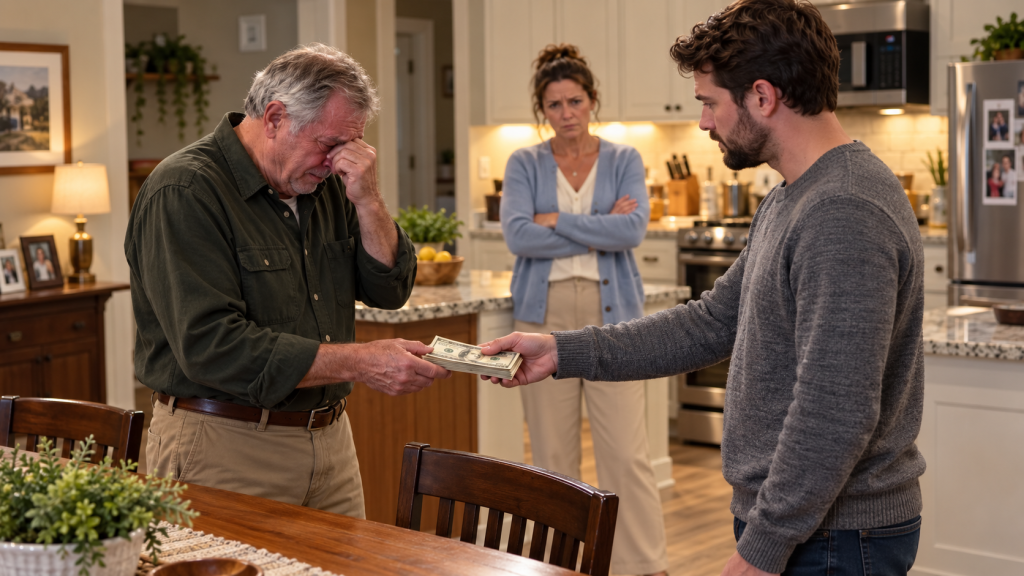
“You asked me for a thousand dollars.”
Dad’s eyes opened.
“You apologized for that.”
“You stood in my kitchen apologizing for needing one thousand dollars when you gave me a house.”
He looked away.
I continued.
“You sold your motorcycle for my college tuition.”
He frowned weakly.
“Who told you that?”
“Uncle Pete.”
“Big mouth.”
“You sold your suit for my school shoes.”
“Those shoes were expensive.”
“I was nine.”
“Your feet were ridiculous.”
I laughed.
Then cried again.
“Dad.”
He looked at me.
“You never have to apologize for asking me for help.”
His face crumpled.
“I didn’t want you thinking…”
“What?”
“That I was becoming…”
He could not finish.
A burden.
That word sat between us.
Natalie had planted it.
Maybe not for the first time.
But loudly enough.
I leaned close.
“You are not a burden.”
He stared at me.
“And if you ever need money again, you ask.”
His mouth twitched.
“How much?”
“Don’t test me.”
That almost became another laugh.
Then he slept.
I stayed.
I did not go home that night.
That turned out to be wise.
Because Natalie tried to enter the house at 8:12 the next morning.
Not our kitchen.
Dad’s hospital room.
I was speaking with Priya near the nurses’ station when I saw Natalie step from the elevator.
Perfect hair.
Cream coat.
Concern arranged carefully across her face.
My whole body went cold.
She spotted me.
“Grant.”
I walked toward her.
“What are you doing here?”
Her expression changed.
“Your father nearly died.”
“How did you know?”
She hesitated.
“The hospital called the house.”
“No, they didn’t.”
Her face tightened.
“Grant.”
“Who told you?”
She sighed.
“Does it matter?”
“Yes.”
“Priya’s office left a message weeks ago and I followed up.”
Priya stepped closer.
“No one from my office disclosed Raymond’s hospitalization to you.”
Natalie looked at her.
Then at me.
“I am his daughter-in-law.”
I said:
“No.”
The word surprised even me.
Natalie blinked.
“What?”
“You don’t get to use family as a credential today.”
Her face hardened.
“Are you seriously doing this here?”
“Yes.”
“Your father is sick.”
“I know.”
“That’s why you aren’t seeing him.”
She stared.
Then laughed softly.
“Grant, you are emotional.”
That sentence opened something in me.
Not rage.
Clarity.
“Did you try to have Dad declared incompetent?”
Her face went still.
Priya said nothing.
Natalie’s eyes flicked toward her.
Then back to me.
“I sought legal advice.”
“About invalidating the trust.”
She exhaled.
“So she told you.”
“Yes.”
“Of course.”
“You knew I was adopted before our wedding.”
Her mouth tightened.
“Raymond told you.”
“No.”
“Priya did.”
Natalie looked surprised.
“Did you think he died?”
Her face changed.
Just slightly.
Enough.
I stared at her.
“Oh my God.”
“Grant.”
“You thought he might die before he could tell me.”
“That is disgusting.”
“Is it wrong?”
Silence.
I stepped closer.
“Is it?”
She whispered:
“I never wanted him to die.”
“That isn’t what I asked.”
Her eyes filled.
“I thought if he became incapacitated, the situation would finally have to be handled.”
“The situation.”
“The house.”
“Your marriage.”
“Our future.”
I laughed bitterly.
“There it is.”
She crossed her arms.
“Do you understand how humiliating it is to discover that the home you live in is controlled by your father-in-law’s trust?”
“No.”
“I understand how humiliating it is to discover my wife knew for nine years and never told me.”
Natalie flinched.
“You would have confronted him.”
“Yes.”
“That was his secret to tell.”
“Then why were you using it against him?”
“I wasn’t.”
“You researched my sealed adoption records.”
“I needed to understand the trust.”
“You hired a lawyer to attack his mental capacity.”
“Because the trust is unfair.”
I stared.
“To whom?”
“To me.”
There.
Finally.
No corporate language.
No concern.
No marriage.
Me.
Natalie continued.
“I have lived in that house for nine years.”
“I paid for renovations.”
“I decorated it.”
“I built a life there.”
“And if you leave me tomorrow, I have no equity.”
My stomach turned.
“You’ve been planning for me to leave?”
“No.”
“Then why is that your first concern?”
Her eyes filled.
“Because marriage is supposed to protect both people.”
“Yes.”
I nodded.
“And you were trying to protect yourself by taking something Dad protected for me.”
“That’s not fair.”
“Stop using that word.”
People who benefit from hidden information love fairness once the information becomes visible.
I asked:
“How much debt do you have?”
Her face changed.
That was enough.
“How much?”
“Grant.”
“How much?”
“About forty thousand.”
I stared.
“That’s not enough to explain this.”
Silence.
“How much?”
Her eyes filled.
“One hundred and eighty.”
I stopped breathing.
“One hundred eighty thousand dollars?”
“Not all personal.”
“What does that mean?”
“I started a business.”
“What business?”
“A staging company.”
I laughed.
“You told me the consulting work was occasional.”
“It grew.”
“Did it make money?”
“Not enough.”
“How long?”
“Eleven months.”
“Credit cards?”
“Business cards.”
“Personal guarantees?”
She looked away.
“Yes.”
My stomach turned.
“Were you going to borrow against the house?”
Silence.
“Natalie.”
Her voice became small.
“I explored it.”
“Without telling me.”
“I was going to tell you.”
“When?”
“After I knew what was possible.”
I laughed.
“After you knew whether my father’s protection could be broken.”
She started crying.
“I was trying to save the business.”
“And I was trying to save us.”
“No.”
I shook my head.
“You were trying to save yourself before you gave me the information needed to say no.”
Her face collapsed.
“Grant, please.”
I looked at the nurse’s station.
Then back at her.
“You need to leave.”
“You’re my husband.”
“Yes.”
“For now.”
She stared.
“What does that mean?”
“It means I am not making a divorce decision while my father is in intensive care.”
Hope flashed across her face.
I stopped it.
“But you are not going home.”
Her mouth opened.
“What?”
“I called an attorney.”
“Already?”
“Yes.”
“And?”
“The trust gives me occupancy rights.”
“You are not a beneficiary.”
“Grant.”
“You will collect your things with a neutral third party present.”
Her face went white.
“You are throwing me out?”
“No.”
“I am asking you to leave while we sort out what belongs to whom.”
“The same courtesy you were going to give me after you challenged Dad’s trust.”
Her face hardened.
“You are choosing him again.”
I stared at her.
“No.”
“I am choosing information.”
Then I walked away.
Dad spent twelve days in the hospital.
Those twelve days changed us.
Not instantly.
Not magically.
He was weak.
Mean when nurses made him walk.
Meaner when they took away solid food.
He called gelatin “hospital revenge.”
I sat beside him anyway.
On day four, I asked about Ellen.
My mother.
He stared out the window.
“She laughed like you.”
“That sounds unfortunate.”
“It was.”
He smiled.
Then told me things.
She loved thunderstorms.
Hated mayonnaise.
Could not parallel park.
Once punched a man who called Dad stupid.
I laughed.
“He probably deserved it.”
“He did.”
“What did she do?”
“Medical assistant.”
“Did she want more children?”
“Yes.”
Dad looked down.
“She wanted a daughter.”
I felt something ache.
“Did she love my biological father?”
He sighed.
“At one time.”
“What happened?”
“He was young.”
“Scared.”
“His family did not want him involved.”
“They fought.”
“After you were born, he came around sometimes.”
“Then disappeared.”
“When Ellen died, I contacted him.”
“What did he do?”
“He said he wasn’t ready to raise a child.”
I stared.
“So he signed away his rights.”
“Eventually.”
“Is he alive?”
Dad hesitated.
“I don’t know.”
I noticed.
“What does that mean?”
“It means I stopped looking.”
I absorbed that.
Not every missing parent needs a dramatic return.
Sometimes a man simply leaves.
The wound is ordinary.
That can hurt more.
Then I asked:
“Why didn’t you tell me Natalie knew?”
Dad looked ashamed.
“I thought she would.”
“What?”
“Tell you.”
I laughed bitterly.
“You trusted her?”
“At first.”
“What changed?”
“The questions.”
“What questions?”
“About the house.”
“Insurance.”
“My will.”
“Whether adoption changed inheritance.”
He swallowed.
“Then one day she asked what would happen if I became incompetent.”
My skin prickled.
“What did you say?”
“I asked if she was planning something.”
“What did she do?”
“Laughed.”
Dad looked at me.
“That scared me more.”
On day seven, he asked:
“Did you give me the thousand?”
I stared.
“Yes.”
“Why?”
“What do you mean why?”
“You didn’t have to.”
“I know.”
“You should take it back from my checking.”
I laughed.
“No.”
“Grant.”
“No.”
“That was emergency money.”
“For what?”
“Our emergency.”
He frowned.
“We don’t share accounts.”
“We share blood apparently.”
He looked offended.
“You’re my uncle.”
Dad’s face went still.
I smiled.
“Got you.”
He tried not to laugh.
Failed.
Then held his incision and swore at me.
That was the first time adoption stopped feeling like a catastrophe.
Humor can do that.
It shrinks terrifying truths to human size.
Dad eventually came home.
Not to his old apartment.
To my house.
The trust house.
Our house, in the way that mattered.
Natalie had moved into a furnished apartment.
Her attorney communicated with mine.
I hired a family-law attorney named Rebecca Sloan.
Apparently every city has one competent woman named Rebecca waiting for a family to collapse financially.
She looked at my records.
Then at me.
“What do you want?”
I said:
“I don’t know.”
“Good.”
I blinked.
“Good?”
“People who arrive certain usually arrive angry.”
“You have enough uncertainty to think.”
That was true.
I did not want revenge.
I wanted chronology.
What had Natalie known?
When?
What had she done?
Why?
The financial review answered some of it.
Her staging company existed.
It was real.
It had clients.
It also lost money.
A lot.
She had funded growth through credit cards and personal loans.
Then hidden the debt because she was embarrassed.
The irony would have been funny in another marriage.
Natalie had mocked Dad for poor financial management while hiding nearly $180,000 of her own debt.
But even that was not the worst part.
Six months earlier, she had applied for a $250,000 business line of credit.
She expected to use our home as collateral.
The lender’s title search revealed the trust.
That was how she discovered the property was protected far more strongly than she had assumed.
She did not tell me.
Instead, she hired counsel.
First to understand.
Then to challenge.
Her emails were painful to read.
If the trust was created by an aging settlor who may have misunderstood what he signed, what evidence is needed to void it?
Dad had been sixty-four when the trust was created.
Working full time.
Operating heavy equipment.
Doing his own taxes.
“Aging settlor.”
I almost laughed.
Another email:
My husband believes the home is essentially his, but he does not understand how limited his control is.
That one hurt.
Because I truly had not understood.
Natalie had.
Another:
Would adoption status affect the beneficiary designation if the trust uses the word descendant?
Priya later explained:
“No.”
“The trust also identifies you by full legal name.”
“The adoption question was never going to help her.”
“So why research it?”
“She was looking for leverage.”
That was the answer.
Not every secret needs to produce money.
Sometimes information itself is currency.
Natalie had kept my adoption because she thought one day it might buy influence.
The divorce became inevitable after that.
Not because of debt.
Debt can be repaired.
Not because of the business.
Businesses fail.
Not because she had once been cruel to Dad in my kitchen.
People can apologize.
It ended because she had possessed a central truth about my identity for nine years and chosen not to tell me because ignorance served her.
I could not unknow that.
At our first mediation session, Natalie cried.
“I loved you.”
I looked at her.
“I believe you.”
That seemed to hurt her more.
She whispered:
“Then why can’t we fix this?”
“Because love is not the only qualification for marriage.”
“What else?”
“Safety.”
She stared.
“I never hurt you.”
I almost smiled.
“You researched whether my father could be declared incompetent.”
“I never filed.”
“You prepared.”
“I was scared.”
“So was Dad.”
“I didn’t know about the aneurysm.”
“This is not about the aneurysm.”
I leaned forward.
“You knew something about me that I did not know about myself.”
“You knew for nearly a decade.”
“And every day you chose the version of me who was easier to control.”
Her face crumpled.
“That’s not fair.”
I sighed.
“There’s that word again.”
She covered her face.
After a moment:
“I thought if I told you, you would become obsessed with your biological family.”
I stared.
“So you were afraid of losing me?”
“Yes.”
“Then you did what Dad did.”
She looked up.
“What?”
“You decided which truth I could handle.”
That sentence changed the room.
Because it was true.
Dad had hidden the adoption from fear.
Natalie had hidden it from self-interest.
Different motives.
Same theft of choice.
Dad later admitted that too.
When I told him what I had said, he sat quietly.
Then:
“She deserved that.”
“So did you.”
His face fell.
I regretted the cruelty.
Not the truth.
He nodded.
“Yes.”
I sat beside him.
“I understand why you did it.”
“That doesn’t make it okay.”
“I know.”
That was the difference between him and Natalie by then.
Dad stopped demanding that intention erase impact.
The divorce took fourteen months.
The trust survived.
Natalie withdrew her incapacity challenge after her own attorney told her the capacity evidence was overwhelming and the legal basis weak.
Her business debt remained hers except for portions that had been paid from marital funds, which were handled in the property settlement.
The house was not awarded to Natalie.
It was not awarded to me either in the ordinary sense.
The trust continued owning it.
I continued holding the beneficial rights Dad had created.
Boring.
Technical.
Exactly what he wanted.
Natalie received a fair division of the assets we actually owned together.
Not nothing.
Not half the trust.
She kept her business.
And its problems.
She eventually restructured the debt rather than declaring bankruptcy.
I learned that through the settlement process.
I did not celebrate her struggle.
I had loved her.
Part of me still did.
That was another uncomfortable truth.
You do not stop loving somebody on the same schedule that you stop trusting them.
Dad moved into the guest room while he recovered.
For six months, our roles reversed.
I drove him to appointments.
Reminded him about medication.
Cooked things with less salt.
He complained constantly.
“You ruined the potatoes.”
“They’re potatoes.”
“They taste like building insulation.”
“You almost died.”
“I’d like flavor before I finish the job.”
I laughed.
He did too.
Slowly, he grew stronger.
One afternoon, I found him in the backyard looking at the fence.
“What are you doing?”
“Thinking.”
“That’s dangerous.”
He ignored me.
“Post is leaning.”
“Dad.”
“What?”
“You are not fixing the fence.”
“It needs fixing.”
“You had major vascular surgery.”
“Months ago.”
“Still no.”
He frowned.
“Whose house is this?”
I smiled.
“Technically, the trust’s.”
He stared.
Then laughed until he had to sit down.
That became our favorite joke.
Whose house is this?
Not mine.
Not his.
Not Natalie’s.
The trust’s.
A legal structure had become our family’s weirdest roommate.
The deeper question remained:
Who was I?
For thirty-six years, I had believed Raymond Mercer was my biological father.
Then one envelope changed biology without changing a single memory.
Dad still taught me to ride a bike.
Still stayed awake when I had pneumonia.
Still showed up to every terrible middle-school band concert.
Still threatened the first boy who broke my nose during a school fight.
Still sold land for my future.
Still called me after every job interview.
Still knew exactly how I took coffee.
DNA had changed a fact.
Not the relationship.
I eventually asked Priya for the kinship report.
She handed it over.
Technical language.
Probabilities.
Maternal relationship consistent with uncle-nephew.
I looked at Dad’s name.
Then mine.
“Do you want to keep this?”
she asked.
“Yes.”
“Why?”
“So if Dad ever annoys me, I can remind him he is only statistically authorized to lecture me.”
Priya laughed.
Dad did not.
“Money wasted.”
he muttered.
“You ordered the test.”
“That was before I knew you’d make jokes.”
“You raised me.”
“Your fault.”
“Apparently.”
We became easier after the truth.
Strangely.
There was no longer a locked room between us.
At thirty-seven, I finally visited Ellen’s grave with Dad.
I had been there before as a child.
I just had not understood who she was.
Her stone read:
ELLEN MERCER
Beloved Daughter, Sister, Mother
Mother.
I stared at that word.
“Did I ever ask?”
Dad stood beside me.
“When I was little.”
“About what?”
“Why your mother wasn’t around.”
“What did you say?”
“That she died.”
“I meant about you.”
Dad looked down.
“You called me Dad before the adoption was finished.”
I laughed.
“How old was I?”
“Not even one.”
“That seems linguistically ambitious.”
“It sounded more like ‘Da.’”
“So you took credit.”
“Absolutely.”
We stood there.
Then Dad handed me a small envelope.
“What is this?”
“Something Ellen wrote.”
I stared at him.
“You had another letter?”
“Not for you exactly.”
“What does that mean?”
“She wrote it when you were born.”
“About you.”
My hands shook.
Inside was one page.
Ellen’s handwriting.
Raymond, if I ever become one of those mothers who forgets she is a person, remind me I once had opinions about movies.
I smiled.
Then:
Thank you for showing up.
I know you pretend I annoy you, but I also know you’d carry this baby through fire if I asked.
My throat closed.
Please teach him tools.
Not the dangerous ones until he is at least five.
I laughed.
Dad said:
“She underestimated me.”
“You gave me a hammer at four.”
“Plastic.”
“Still irresponsible.”
I kept reading.
If anything ever happens to me, I want him to know he was wanted.
I stopped.
Dad looked away.
Not tolerated.
Not inherited.
Wanted.
My eyes filled.
I read the sentence again.
And again.
For decades, Dad had been afraid adoption might make me feel less chosen.
Ellen had already answered that.
Wanted.
I folded the letter carefully.
“Why didn’t you give me this sooner?”
He sighed.
“Because apparently I’m terrible at disclosure.”
I laughed through tears.
“Yes.”
“That appears established.”
He nodded.
“Fair.”
Five years passed.
Dad lived.
Not forever.
Long enough.
He stopped construction consulting.
Took up gardening badly.
Complained about retirement constantly.
Made friends with a widower two streets over named Frank, and together they became a menace to every contractor in the neighborhood.
They would stand at fences watching other people’s renovations and discussing incorrect techniques.
I once asked:
“Do you two have hobbies?”
Dad replied:
“This is a hobby.”
“Judging strangers?”
“Quality control.”
He came to my house every Sunday even after he moved back to his apartment.
Sometimes I cooked.
Sometimes he did.
Sometimes we ordered food and lied about cooking.
We spoke about Ellen.
About my childhood.
About adoption.
About Natalie sometimes.
Eventually, about my biological father.
His name had been Marcus Bell.
Priya located records.
He had died six years earlier.
No secret fortune.
No hidden family waiting to claim me.
He had married later.
Had one daughter.
My half-sister.
Her name was Alison.
I sat with that information for almost a year.
Then contacted her.
She was cautious.
So was I.
We met for coffee.
She had my eyebrows.
I hated that immediately because people should not be able to walk into your life carrying your face.
She said:
“Our father told me he had a son he wasn’t ready to raise.”
I stared.
“He told you?”
“When I was eighteen.”
“What did he say?”
“That he regretted it.”
I swallowed.
“Did he try to find me?”
“No.”
I appreciated her honesty.
She continued.
“He said regret isn’t the same as courage.”
That sentence stayed with me.
Marcus Bell had regretted leaving.
He still left.
Raymond Mercer had been terrified of fatherhood.
He stayed.
Biology gave me one father.
Behavior gave me another.
We did not need to insult one truth to honor the other.
Alison and I became occasional siblings.
Birthdays.
Texts.
Coffee twice a year.
Not some magical missing-family reunion.
We did not share a childhood.
We shared genetics.
That was enough to begin something.
Not enough to pretend it had always existed.
Natalie wrote me three years after the divorce.
Not asking for money.
Not asking to reconcile.
A letter.
She admitted she had eventually closed the staging company.
Sold most of the inventory.
Paid down the debt slowly.
Went to therapy.
She wrote:
The cruelest thing I said about Raymond was that he should get another job.
I paused there.
Then continued.
I knew he had worked all his life.
I knew he had raised you.
I knew more than you did about what he had given up for you.
My jaw tightened.
I said it because I wanted him to feel small.
No excuse.
Good.
I resented that you trusted him more than me.
Instead of becoming more trustworthy, I tried to make him less powerful.
That sentence was honest.
Painfully.
She ended:
I am sorry I treated information about your life as something I could keep until it became useful.
I kept the letter.
Did not respond for six months.
Then sent one sentence.
Thank you for naming it clearly.
That was all.
Forgiveness came later.
Partly.
Not access.
Not marriage.
Not friendship.
But I stopped carrying Natalie as an enemy.
That was mostly for me.
Dad died at eighty-one.
Eight years after the aneurysm.
Not dramatically.
Not because of another secret.
He went to sleep after complaining about the Cubs and did not wake up.
I found him the next morning.
His reading glasses were on his chest.
A woodworking magazine open beside him.
For once in his life, Raymond Mercer left without trying to repair something first.
The grief was different from the hospital.
Then I had almost lost him before I understood him.
This time, I knew.
I knew he was my uncle.
My father.
The man who lied out of fear.
The man who stayed.
The man who sold things to buy school shoes.
The man who had secretly trusted an irrevocable instrument more than his son’s judgment.
The man who once needed one thousand dollars and apologized for asking.
At his funeral, Frank stood beside me.
“He was proud of you.”
I smiled.
“He rarely said it.”
Frank laughed.
“He said it constantly.”
“To you.”
“Yes.”
“That counts.”
I looked toward Dad’s casket.
“Typical.”
Alison came.
So did Priya.
Even Natalie sent flowers.
No dramatic appearance.
No attempt to enter my grief.
Just a card.
He mattered. I am sorry.
That was appropriate.
After the funeral, Priya asked me to stop by her office.
I laughed.
“Not another envelope.”
She smiled.
“One.”
“Of course.”
Dad had updated his estate plan years earlier.
Most of what he owned was modest.
Retirement savings.
His truck.
Tools.
A few investments.
He left some to charity.
Some to me.
Some to a vocational scholarship fund.
Then Priya handed me the final letter.
Dad wrote:
Grant, if Priya gives you this, then apparently my excellent health plan failed eventually.
I laughed and cried at once.
The house is still in trust.
You know that.
I assume you have complained about it at least twice this year.
Correct.
The trust gives you the option, after my death, to terminate it if you want and take full title.
I stopped.
“What?”
Priya nodded.
“He amended the terms after your divorce.”
I looked back at the letter.
I made it difficult to touch because I wanted to protect you while I was alive.
But protection that never gives choice back eventually becomes control.
My eyes filled.
Dad had learned.
If you want the house, take title.
If you want the trust, keep it.
If you want to sell it, sell it.
I will be dead and therefore unable to complain effectively.
I laughed.
Then:
Do not preserve my decisions just because they were mine.
Make your own.
I sat silently for a long time.
Priya asked:
“What are you going to do?”
“I don’t know.”
She smiled.
“Raymond would hate that answer.”
“Exactly why I’m using it.”
I kept the trust for another two years.
Then terminated it.
Took title.
Not because the trust had failed.
Because its job was done.
The first document I signed after taking ownership was not a refinance.
Not a loan.
Not a transfer to a spouse.
It was a new estate plan.
I read every line.
Asked questions.
No yellow tabs without explanations.
No shortcuts.
The house remained mine.
Later, when I remarried, I told my wife everything before the wedding.
Her name was Elise.
A nurse.
Dry sense of humor.
Terrible at folding fitted sheets.
On our third date, I said:
“I was adopted.”
She replied:
“Okay.”
I stared.
“That’s it?”
“Were you expecting music?”
I laughed.
Months later, I told her about the house.
The trust.
Natalie.
The debt.
Dad.
She listened.
Then said:
“Your father sounds exhausting.”
“He was.”
“And wonderful.”
“Yes.”
“Both?”
“Yes.”
“Good.”
That was what I wanted.
Not a saint.
Not a villain.
A man.
We signed a prenup.
Not because Elise asked.
Because transparency felt romantic now.
Everything listed.
Everything discussed.
House.
Retirement.
Debts.
Income.
Expectations.
No secrets held as future leverage.
On our wedding morning, Priya texted:
Read before signing.
I replied:
You people ruined spontaneity.
She wrote:
You’re welcome.
Years later, I stood in the same kitchen where Dad had once asked me for one thousand dollars.
Different paint.
Same room.
Elise was making coffee.
My oldest daughter was doing homework at the table.
Dad’s old hammer hung on the wall above the pantry.
Not because it was expensive.
Because Ellen had written:
Please teach him tools.
Dad did.
Then I taught my daughter.
Carefully.
After age five.
One evening, she pointed to a framed photograph.
Dad.
Ellen.
Baby me.
“Who is that lady?”
I sat beside her.
“Your grandmother Ellen.”
“Grandma?”
“Yes.”
“But Grandpa Raymond was your dad.”
“Yes.”
She frowned.
Children do not fear complexity unless adults teach them to.
I explained.
“Grandpa Raymond was my uncle first.”
“Then he adopted me.”
“So he was both?”
“Yes.”
She thought for three seconds.
“Cool.”
Then went back to homework.
That simple.
All the fear Dad had carried for decades.
A child absorbed the truth in one word.
Cool.
I wished he had seen that.
Then again, maybe that is what every generation does.
Carries terror so the next can call it ordinary.
The thousand dollars Dad borrowed never came back.
Not because he died owing me.
Because I refused repayment.
He tried three times.
The final time, he slipped an envelope into my coat pocket.
I found it after leaving his apartment.
Inside:
Ten one-hundred-dollar bills.
I drove back.
Put it on his kitchen counter.
He glared.
“Take it.”
“No.”
“It’s mine.”
“Exactly.”
“You’re impossible.”
“You raised me.”
He hated that answer.
Eventually, I used the thousand dollars for something else.
After Dad died, I added it to the Raymond and Ellen Mercer Skilled Trades Scholarship.
We funded one student each year entering construction, electrical work, welding, HVAC, or carpentry.
The first recipient was nineteen.
Raised by his grandmother.
Working nights.
Could not afford tools.
I bought him a proper starter kit in addition to the scholarship.
When Priya saw the expense, she said:
“Raymond would approve.”
I smiled.
“He’d complain about the brand.”
“Also true.”
That became the final meaning of the thousand dollars.
Not debt.
Not evidence.
Not betrayal.
A continuation.
Sometimes I think about what would have happened if Dad had never collapsed.
Would he have told me?
Eventually.
Maybe.
Would Natalie have succeeded in challenging the trust?
Probably not.
Would I have discovered her debt?
Eventually.
Would our marriage have survived?
I don’t know.
People love believing that one dramatic event causes everything.
A hospital call.
A sealed envelope.
A hidden adoption.
A secret debt.
Usually the event only removes the walls hiding problems already there.
Dad’s aneurysm did not create Natalie’s secrecy.
It exposed it.
The envelope did not make Raymond my father.
He already was.
The DNA test did not make us family.
It simply explained which branch of the tree we stood on.
The trust did not save me from a bad marriage.
It gave me time to decide what was mine before someone else made that decision first.
And the strangest part?
For years, Natalie had worried that learning Raymond was not my biological father would weaken my attachment to him.
The truth did the opposite.
It showed me exactly how much of fatherhood he had chosen.
He did not stay because biology compelled him.
He stayed because an eleven-month-old baby woke up screaming at five-thirty in the morning and somebody had to get out of bed.
He did.
Again.
Again.
Again.
That is what made him Dad.
Not blood.
Not paperwork.
Not a trust.
Not a DNA test.
Showing up.
Years after his death, I still keep the original hospital envelope.
The paper is yellowing now.
Inside are copies of the adoption decree.
The photograph.
Ellen’s note.
Dad’s letter.
And the tiny hospital bracelet.
Sometimes I read the first line again.
Son, if you are reading this without me beside you, then I am sorry I waited until fear made the decision for me.
He had been wrong about one thing.
Fear did not make the final decision.
He did.
Even terrified.
Even embarrassed.
Even with his hands trembling in my kitchen.
He asked for help.
He gathered the documents.
He hired Priya.
He took the test.
He prepared the truth.
Then his body failed before his courage could finish the conversation.
Fortunately, he lived long enough to finish it later.
That mattered more than the house.
More than the trust.
More than anything Natalie tried to take.
Because after all the legal papers were settled and every secret had become ordinary history, the inheritance I carried most clearly was not property.
It was the lesson Raymond Mercer had spent his life teaching without realizing it:
Family is not the person who has the strongest claim on you.
Family is the person who keeps showing up after the claim is no longer necessary.
THE END STORIES! THANK YOU FOR READING GOOD LUCK! ❤️
Related Posts