➡️ PART 3 — THE PRICE OF BEING TOLD IT WAS JUST A JOKE
Rachel went silent on the phone.
For the first time since I had known her, silence did not feel like something she controlled.
It felt like a wall she had run into.
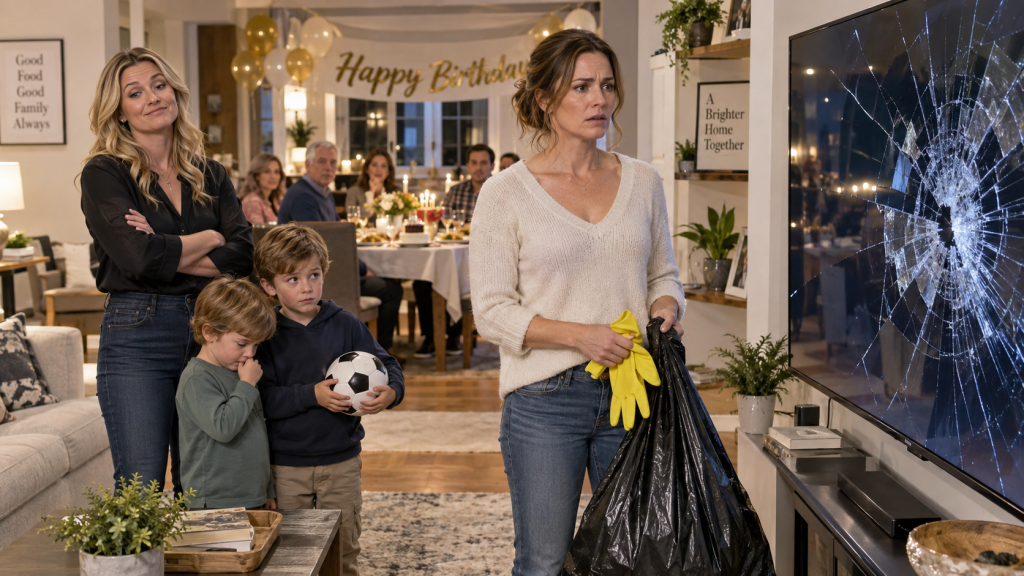
I stood in our living room with the shattered television behind me.
The screen looked almost black now except for a thin white fracture running from the center toward the upper corner.
Two thousand dollars.
Six months of saving.
Gone because my sister-in-law had decided resentment needed an audience.
“Rachel?”
I said.
Her breath came through the speaker.
Then:
“You wouldn’t actually take me to court.”
Not I’m sorry.
Not I shouldn’t have done it.
Not even The boys didn’t understand.
Just disbelief that I might stop absorbing her behavior.
“I hope I don’t have to.”
I answered.
“What does that mean?”
“It means you reimburse us for the damage.”
“All of it?”
“Yes.”
She laughed.
A sharp, angry sound.
“That thing isn’t even worth two thousand anymore.”
“It was installed three weeks ago.”
“That isn’t my problem.”
I looked at the broken screen.
Then at the security footage paused on my laptop.
Rachel handing a soccer ball to her six-year-old.
Pointing.
Smiling.
“No.”
I said.
“It became your problem when you told your children to break it.”
Her voice dropped.
“You’re seriously going to embarrass my boys in court?”
There it was.
The first defense.
The children.
“I’m not taking your boys to court.”
“You’re using footage of them.”
“No.”
I answered.
“I’m using footage of you.”
Silence.
Then:
“They were the ones who kicked it.”
“Because you instructed them.”
“They’re four and six.”
“Exactly.”
My anger finally came through.
“They’re four and six, Rachel.”
“You told two little boys that destroying someone else’s property was something they could earn toys for.”
She said nothing.
I continued.
“They did not create this problem.”
“You did.”
“You’ve always hated me.”
she said.
I closed my eyes.
Of course.
Three years of insults.
Thanksgiving comments.
Birthday digs.
Criticism over paint colors, countertops, clothes, cooking.
But apparently refusing to accept deliberate property destruction meant I had secretly hated her all along.
“I don’t hate you.”
“Please.”
“I don’t.”
“That almost makes this worse.”
She snapped.
“You think you’re better than me.”
“No.”
“You always have.”
“Rachel—”
“New kitchen.”
“New floors.”
“New TV.”
“Look at us, we’re so successful.”
I stared around the room.
The room we had spent almost four years saving to renovate.
My husband, Evan, had laid some of the flooring himself.
I had painted the trim.
We had delayed vacations.
Kept our old furniture longer than we wanted.
Bought cabinets during a warehouse sale.
Nothing had arrived magically.
Still, I suddenly understood.
This had never been about an eighty-five-inch television.
The television had just been large enough for Rachel to aim at.
“You wanted to punish us for renovating our own house?”
I asked.
“I didn’t say that.”
“You told your sons that if we could afford renovations, we could afford another TV.”
She inhaled sharply.
She had forgotten that part was recorded too.
“That was a joke.”
“No.”
“It obviously wasn’t a joke.”
“You don’t get to decide what I meant.”
“I don’t have to.”
“I can see what you did.”
Rachel’s voice became smaller.
“Evan knows about this?”
I looked toward the kitchen.
My husband stood in the doorway.
He had come downstairs five minutes earlier after helping his father load birthday gifts into the car.
He had heard enough.
His face looked unfamiliar.
Not angry in the loud way.
Worse.
Disappointed.
“Yes.”
I said.
Rachel became very quiet.
“Put him on.”
Evan shook his head.
I told her:
“He doesn’t want to talk right now.”
“Of course he does.”
“No.”
“Give him the phone.”
“Rachel—”
“Give me my brother.”
Something in Evan’s face changed.
He held out his hand.
I gave him the phone.
“Rachel.”
he said.
She immediately began crying.
Not subtle crying either.
“You can’t let her do this to me.”
Evan closed his eyes.
I felt something inside me tighten.
There it was.
The familiar moment.
Rachel behaved badly.
Rachel cried.
Everyone reorganized themselves around Rachel’s distress.
I had watched it happen at Christmas dinners, vacations, family reunions.
She could insult someone for an hour and become the injured party within thirty seconds of being confronted.
I waited.
So did Evan.
Then he said:
“She isn’t doing anything to you.”
Rachel stopped crying for half a second.
Then:
“What?”
“You told your kids to break our television.”
“I was mad.”
“That isn’t an explanation.”
“You don’t understand.”
“I watched the video.”
“You only saw part of it.”
“I watched all of it.”
Silence.
Evan continued.
“You gave Tyler the ball.”
“You pointed at the TV.”
“You told him to kick harder when the first hit missed.”
I had not heard that part until we watched the footage together after everyone left.
It had made me physically sick.
Six-year-old Tyler had hesitated.
He had looked at his mother.
Rachel had bent down and whispered something.
The camera microphone had caught it.
Harder. You want the big dinosaur set, right?
Then the second kick.
The crash.
Four-year-old Mason laughing because his older brother laughed.
Children following the emotional weather adults create.
“I didn’t think it would actually break.”
Rachel whispered.
Evan stared at the floor.
“You told them to hit a television with a soccer ball.”
“It was supposed to scare her.”
I stopped breathing.
Evan looked up.
“What?”
Rachel realized too late.
“I didn’t mean—”
“Scare her?”
“I just wanted her to stop acting like everything she has is so precious.”
I laughed.
Could not help it.
Rachel heard.
“Oh, there she is.”
she snapped.
“Always laughing at me.”
“I’m not laughing at you.”
I said.
“I’m laughing because you just admitted this was about me.”
“Everything is about you.”
“No.”
“That seems to be your department.”
Evan held up one hand.
“Enough.”
Both of us stopped.
Then he spoke to his sister.
“You’re going to pay for the damage.”
“I don’t have two thousand dollars.”
“You spent twelve hundred on concert tickets last month.”
“That was different.”
“You bought a designer bag in July.”
“It was on sale.”
“Rachel.”
His voice cracked.
“I don’t care.”
That surprised all three of us.
He continued.
“If you genuinely don’t have two thousand dollars available, we can agree to a payment schedule.”
“But you are paying for what you deliberately caused.”
She began crying again.
“Mom and Dad are going to hear about this.”
Evan looked almost amused.
“They were here when it happened.”
“They think it was an accident.”
“Then perhaps you should tell them it wasn’t.”
Rachel hung up.
We stood in silence.
I looked at Evan.
He looked at the broken television.
Then said:
“I’m sorry.”
I frowned.
“For what?”
“For her.”
“That’s not yours.”
“Yes.”
“No.”
I walked closer.
“You didn’t tell those kids to do it.”
He rubbed his face.
“I’ve spent years asking you to ignore her.”
That stopped me.
He was right.
Not exactly asking.
More like suggesting.
That’s just Rachel.
Don’t let her get to you.
She’s jealous.
You know she has no filter.
Every insult had been converted into a personality quirk because confrontation would make family gatherings uncomfortable.
And because I loved Evan, I had accepted discomfort as my contribution to family peace.
“You did.”
I said quietly.
He nodded.
“I kept thinking if you didn’t react, she’d stop.”
“She didn’t.”
“No.”
“She escalated.”
“Yes.”
He looked at the cracked television.
Then at me.
“I’m sorry I made keeping the peace your job.”
That sentence mattered more than I expected.
My anger softened.
Not disappeared.
Changed shape.
“I helped.”
I admitted.
“How?”
“I kept pretending it didn’t bother me.”
“Because of me.”
“Partly.”
I smiled sadly.
“Partly because I like being the reasonable person.”
He almost laughed.
“Terrible addiction.”
“Apparently.”
We cleaned the living room.
Carefully.
The screen itself had not shattered into loose glass the way a window would, but part of the mounting trim had cracked and fallen.
Evan unplugged the television.
We covered it with an old sheet.
The giant white rectangle on the wall looked like a body at a bad magic show.
I hated it.
Then laughed at myself.
“What’s funny?”
Evan asked.
“We saved six months for a television and now it looks like we’re mourning it.”
He stared.
Then laughed too.
It felt good.
Not because the situation was funny.
Because Rachel had not destroyed the whole evening.
That mattered.
The next morning, my phone contained seventeen messages.
Not from Rachel.
From family.
Of course.
Family information travels faster when it is incomplete.
Evan’s mother:
Please call me before this gets out of hand.
His father:
Your MIL says Rachel says there’s some legal threat over the TV? Can we handle this as family?
An aunt:
Kids make mistakes. Please don’t destroy relationships over objects.
A cousin I had not spoken to in eight months:
Heard what happened. That sucks but court seems extreme.
I stared at the messages.
Rachel had moved quickly.
Not to apologize.
To build an audience.
Evan took my phone.
“Don’t answer.”
“I wasn’t going to.”
“Good.”
Then he picked up his own.
His mother was calling.
He answered.
“Mom.”
I could hear her through the speaker.
“Evan, what on earth is going on?”
“Rachel deliberately told the boys to break our television.”
Silence.
Then:
“She said they were playing.”
“We have video.”
Another silence.
“What kind of video?”
“Our security camera.”
“Oh.”
That one syllable carried the death of several excuses.
His mother lowered her voice.
“Why would Rachel do that?”
“You should ask her.”
“She says Laura is trying to sue her.”
There.
My name.
Laura.
We had been married nine years.
Rachel still loved turning every conflict into something Laura was doing to Rachel.
Evan sat at the kitchen island.
“We sent her a demand for reimbursement.”
“That sounds very legal.”
“It is.”
“Evan.”
“Mom.”
“You cannot take your sister to court.”
“If she pays for the damage, there will be no need.”
“She has children.”
“So do lots of people.”
“She’s struggling.”
“Then she should not deliberately destroy expensive things.”
His mother exhaled sharply.
“You sound cold.”
Evan looked at me.
Then said:
“I’m actually very angry.”
“Different thing.”
His mother tried another direction.
“What about the boys?”
“What about them?”
“They’ll think their aunt hates them.”
“No.”
Evan answered immediately.
“Laura already told them before they left that they were not in trouble with us.”
I had.
Four-year-old Mason had looked near tears while Rachel gathered coats.
Six-year-old Tyler had whispered:
“Are you mad?”
I crouched.
“Not at you.”
“But I broke it.”
“An adult told you to.”
His eyes had filled.
“Mom said you’re rich.”
Children repeat everything eventually.
I smiled sadly.
“We are not rich.”
Then:
“And even if we were, you are not allowed to break someone’s things because they can afford replacements.”
He nodded.
Simple moral structure.
No need for revenge.
Evan’s mother went quiet after hearing that.
Then:
“Rachel says Laura scared them with lawyers.”
“No.”
“She did not.”
“You know what she’s like.”
Evan’s face changed.
There it was.
The family motto.
You know what Rachel’s like.
He answered slowly.
“Yes.”
“I do.”
“That is exactly why this has to stop.”
His mother had no immediate response.
We invited his parents over that evening.
Not for an ambush.
Because Evan wanted them to see the video before forming another opinion.
They came without Rachel.
His father sat on the couch.
His mother stood behind him as though sitting might imply agreement.
Evan opened the security footage.
No commentary.
Played it.
Rachel entered the living room.
Checked toward the dining room.
Reached into the boys’ toy bag.
Pulled out the small soccer ball.
Spoke to Tyler.
Pointed.
First kick.
Miss.
Her whisper.
Harder. You want the big dinosaur set, right?
Second kick.
Impact.
Screen fracture.
Mason laughed.
Rachel covered her mouth.
Then looked toward the dining room.
Her expression was not shock.
It was satisfaction.
Evan paused the video.
His father whispered:
“Jesus.”
His mother said nothing.
Then Evan played the second clip.
Rachel after everyone returned to dinner.
The boys beside her.
Good job. That’s exactly what you were supposed to do. Since you broke the TV like I asked, I’ll buy you whatever toys you want. If they had enough money to renovate their house, they can buy themselves a new one.
When it ended, no one spoke.
His mother sat down.
Finally.
“I didn’t know.”
she whispered.
“I know.”
Evan said.
She looked at me.
“I’m sorry.”
I nodded.
Not forgiveness.
Acknowledgment.
Then she said:
“But court…”
I almost laughed.
There it was.
Still.
His father turned toward her.
“Carol.”
“What?”
“Watch the video again.”
“I saw it.”
“Then why are you talking about Laura’s response before Rachel’s behavior?”
That shut the room down.
I looked at him.
For years, Evan’s father had barely entered family conflicts.
Silence had always been his preferred diplomacy.
Apparently even silence has limits.
Carol pressed her lips together.
“She’s my daughter.”
Evan answered:
“And I’m your son.”
“I know.”
“This is my home.”
“I know.”
“This is Laura’s home.”
“I know.”
“Rachel told her kids to destroy something we saved for because she resents us.”
“I know.”
“Then stop asking us to make her comfortable.”
Carol began crying.
I felt the old instinct.
Soften.
Reassure.
Say it’s fine.
I did none of those things.
She was allowed to be sad.
I was allowed not to fix it.
His father asked:
“What exactly are you asking Rachel to do?”
I handed him the repair and replacement assessment.
The panel could not be economically repaired.
Replacement of the same model, installation, tax.
A little over two thousand dollars.
We were only requesting the original purchase amount.
Not inconvenience.
Not emotional damages.
Not some invented fee.
Two thousand.
He read it.
Then:
“That’s reasonable.”
Carol looked at him.
“Frank.”
“What?”
“You’re siding against our daughter.”
“I am siding against pretending she didn’t do what I just watched her do.”
He looked toward the television.
“Those are different things.”
Carol wiped her eyes.
“She doesn’t have that kind of money sitting around.”
I said:
“We offered installments.”
She looked at me.
“How much?”
“Whatever is reasonable if she proposes it in writing.”
That surprised her.
“You’re not demanding it all tomorrow?”
“No.”
“Rachel said—”
“I know what Rachel said.”
I kept my voice calm.
“This is not about making her panic.”
“It is about making her responsible.”
Carol stared.
Then nodded slowly.
That was the first shift.
Small.
Enough.
Rachel refused the first deadline.
Of course.
No payment.
No proposal.
Instead, she sent me:
Go ahead. Sue me. Let everyone see what kind of person you are.
I forwarded it to our attorney.
Then filed the small claim when the deadline passed.
Not dramatic.
Forms.
Filing fee.
Evidence.
Service.
Paperwork is wonderfully indifferent to guilt trips.
When Rachel received the summons, she called Evan.
Not me.
He answered.
She screamed for seven minutes.
He listened.
Then:
“Are you done?”
Apparently not.
Another three minutes.
Finally:
“You are choosing her over your own sister.”
Evan closed his eyes.
“I’m choosing my wife over your decision to hurt her.”
“That’s the same thing.”
“No.”
“That is absolutely the same thing.”
“It shouldn’t have been necessary.”
Silence.
Then Rachel said something I did not hear.
Evan’s expression changed.
“What did you just say?”
Pause.
Then:
“No.”
He hung up.
I looked at him.
“What?”
He stared at the floor.
“She said you’ve been trying to push her out of the family since we got married.”
My first reaction was anger.
Then exhaustion.
“Do you believe that?”
“No.”
Instantly.
Good.
Then he said:
“But I think she believes it.”
I sat opposite him.
“Why?”
He thought.
“Our family was different before you.”
“Obviously.”
“No.”
“I mean…”
He struggled.
“Rachel was the center of everything.”
“Our parents always worried about her.”
“She needed money.”
“Babysitting.”
Help moving.
Relationship problems.”
“Then I met you.”
“That sounds ominous.”
He smiled faintly.
“I became less available.”
There.
Not because I demanded it.
Because adults eventually build households separate from siblings.
But Rachel experienced ordinary separation as theft.
“When we bought this house, she asked me if I could co-sign her car.”
I frowned.
“You never told me.”
“I said no.”
“Because we were applying for the mortgage.”
“She said you made me.”
I stared.
“Did you tell her I didn’t?”
“Yes.”
“She didn’t care.”
He leaned back.
“Then we renovated.”
“And she kept saying you were showing off.”
“She called my countertops ‘trying too hard.’”
He laughed despite himself.
“Those countertops have been through enough.”
“Respect them.”
Then he became serious.
“I should have drawn boundaries years ago.”
“Yes.”
No point lying.
He winced.
I softened.
“So should I.”
“You didn’t owe her boundaries.”
“I owed myself some.”
That distinction mattered.
The court date arrived eight weeks later.
Small claims court was not the great theatrical battlefield Rachel had apparently imagined.
Fluorescent lights.
Hard benches.
People waiting over unpaid rent, damaged vehicles, security deposits, contractor disputes.
Our television sat on one line of a docket.
Humbling.
Useful.
Rachel arrived with her mother.
Carol looked embarrassed.
Frank did not come.
Rachel wore a cream blazer and carried a thick folder.
She had apparently prepared.
Good.
So had we.
Evan came with me, though the claim was filed jointly because we both owned the television and home.
Our attorney had advised us on the process but did not need to turn a straightforward claim into expensive litigation.
The security footage existed.
Purchase receipt existed.
Rachel’s recorded statements existed.
Her texts existed.
Sometimes facts do not require decoration.
Before court began, Tyler and Mason were nowhere in sight.
I felt relief.
They did not belong there.
Rachel had apparently left them with a friend.
Good choice.
I was grateful even while angry.
People can make one good decision beside many bad ones.
Rachel approached us.
“You can still drop this.”
I looked at her.
“So can you.”
“What does that mean?”
“Pay for the television.”
Her jaw tightened.
“I told you I can’t.”
“Then offer installments.”
“You want to control me.”
“No.”
“I want reimbursement.”
“Same thing to you, apparently.”
Evan stepped between the conversation.
“Rachel.”
She looked at him.
“You really came with her.”
“She’s my wife.”
“I’m your sister.”
“Yes.”
Both.
Human relationships can contain more than one role.
Rachel had never learned that someone loving her did not require someone else losing.
Her case was called.
We stood.
The judge reviewed documents.
Asked questions.
Watched the footage.
Not all of it.
Enough.
Rachel’s argument changed three times.
First:
The boys acted on their own.
The footage contradicted that.
Then:
She had been joking when she told them to hit the TV.
The footage showed repeated instruction.
Then:
She believed the television was insured.
I almost laughed.
The judge asked:
“Even if it were insured, why would that give you permission to intentionally damage it?”
Rachel had no answer.
Then she said:
“They flaunt their money.”
The judge stared.
“What does that have to do with ownership of their television?”
Nothing.
Obviously.
But I watched something happen in Rachel’s face.
For the first time, a neutral person had refused to treat resentment as evidence.
Family arguments blur logic because everyone carries history.
A judge did not care that Rachel thought our kitchen looked expensive.
Did not care whether I once forgot to invite her to a brunch.
Did not care that Evan missed a birthday dinner four years ago.
The question was simple.
Did she cause deliberate property damage?
Yes.
What was the documented loss?
Two thousand dollars.
Judgment was entered in our favor for the documented loss and allowable court costs.
No punitive windfall.
No dramatic speech.
No humiliation.
A number.
Responsibility converted into arithmetic.
Rachel stared at the judge.
Then at us.
Outside the courtroom, she burst into tears.
Carol followed.
I expected another attack.
Instead Rachel said:
“I hate you.”
Not to me.
To Evan.
His face went still.
“You chose her.”
He swallowed.
“Rachel, this is not about choosing between you.”
“It always is.”
“No.”
“It is for you.”
Then she walked away.
Carol hesitated.
For one second, she looked like she might follow automatically.
Then she turned toward us.
“I’ll talk to her.”
Evan nodded.
Carol looked at me.
“I’m sorry it got this far.”
I answered:
“So am I.”
And I meant it.
Court was not the victory.
It was what happened after people refused every smaller exit.
Rachel began paying fifty dollars a month.
Then stopped after three payments.
The judgment allowed enforcement options.
We could have pursued stronger collection immediately.
Instead, Evan sent one written message:
Please restart the agreed payments within thirty days. If you cannot afford fifty, propose a different amount. Ignoring the judgment is not an option.
She proposed twenty-five.
We accepted.
Not because twenty-five dollars mattered greatly.
Because the principle was not speed.
It was acknowledgment.
Meanwhile, we replaced the television.
Not immediately.
For almost three months, the blank wall stayed blank.
At first because money.
The reimbursement had not arrived.
Insurance did not cover deliberate damage by an invited family member in the simple way Rachel had assumed, and even where coverage questions could have been explored, our deductible and the circumstances made a claim unattractive.
So we saved again.
Annoying.
Fair.
Something strange happened without the television.
We read more.
Played cards.
Evan complained.
Then became weirdly competitive about gin rummy.
I hated him briefly.
Love survived.
When we finally bought the replacement, we chose a seventy-seven-inch model.
Smaller.
Less expensive.
Rachel would probably have considered that victory if she knew.
I considered it taste.
The eighty-five-inch had always been slightly ridiculous.
Evan still disagrees.
Marriage requires enduring incorrect opinions.
We installed a protective media console beneath it.
Not because of children.
Because houses evolve.
The boys were not invited over during those months.
That hurt Evan.
It hurt me too.
I liked Tyler and Mason.
They were funny.
Sweet.
Mason once called our robot vacuum “the flat dog.”
They had not become bad children because their mother used them badly.
But until Rachel could respect our home, access was not automatic.
Adults cannot use children as both shield and key.
Christmas approached.
The first major family event after court.
Carol called Evan.
“Rachel will be at our house.”
“I assumed.”
“I want you and Laura there too.”
He looked at me.
I shook my head.
Not yet.
He told her:
“We won’t come this year.”
Silence.
Then:
“You’re dividing the family.”
Evan’s face tightened.
“No.”
“We are not ready to spend Christmas pretending nothing happened.”
“Rachel says she’ll behave.”
“That isn’t enough.”
“What is enough?”
He looked at me again.
Then answered:
“An apology.”
Carol sighed.
“She already paid.”
“Three payments.”
“She’s paying.”
“This is not only about money.”
“What does Laura want her to say?”
I took the phone gently.
“Nothing scripted.”
Carol became quiet.
I continued.
“I want Rachel to understand why involving her children was wrong.”
“I want her to apologize to Evan for putting him between his sister and his wife.”
“And I want her to apologize to us without explaining why we deserved part of it.”
Carol exhaled.
“That may take time.”
“Yes.”
I said.
“It may.”
“Then what happens in the meantime?”
“We spend Christmas separately.”
Boundary.
Not punishment.
People often confuse them because both involve hearing no.
We had Christmas at home.
Just us.
Frank stopped by in the afternoon with pie.
Carol came later.
Separately.
Interesting.
Families reorganize when old defaults stop being mandatory.
They stayed two hours.
No Rachel.
We did not talk about her.
That felt almost revolutionary.
Two days later, a package arrived.
I froze when I saw Rachel’s return address.
Evan opened it.
Inside were two dinosaur toys.
One for Tyler.
One for Mason.
And a note.
I stared.
“What?”
Evan read aloud.
I promised them these for breaking your TV. I never bought them. I don’t know why I’m sending them to you instead of returning them. Maybe because I don’t want them in my house.
Then:
I told the boys I lied when I said breaking your things was okay. Tyler asked if that means he is bad. I told him no. I told him I was the adult and I was wrong.
I sat down.
That was the first thing Rachel had done that mattered more than the money.
The note continued.
I am still angry. I still think you both look down on me sometimes. Maybe that is real. Maybe some of it is me. I don’t know yet.
Better.
Not perfect.
Honest.
Then:
What I did to the boys was worse than what I did to the television. I made them think hurting someone could earn love from me. I hate that.
My throat tightened.
Evan stopped reading.
We sat quietly.
Then he continued.
I am sorry I damaged your house. I am sorry I made your birthday into this. I am sorry I kept making Laura the reason I was unhappy instead of admitting I resented your life.
Evan rubbed his eyes.
Final paragraph:
I’m not asking to come over. I’m not asking you to forgive me. I will keep paying. I just wanted you to know I finally understand why you went through with the claim.
No demand.
No guilt.
No:
But family.
I read the letter twice.
Then put it away.
We did not invite Rachel over immediately.
An apology is information.
Behavior decides what follows.
For the next six months, payments arrived.
Twenty-five dollars.
Every month.
Sometimes fifty.
Once a hundred.
No messages attached.
Just responsibility becoming boring.
That was exactly what I wanted.
Carol stopped carrying messages.
Another improvement.
When Rachel complained, Carol apparently told her:
“I love you. I’m not calling Evan to fix this.”
I learned that later.
I liked Carol more for it.
Families can enable dysfunction because they fear the discomfort of letting someone experience consequences.
Carol had done that with Rachel for years.
She was learning too.
The boys asked about us.
That part hurt.
Tyler sent Evan a birthday card.
Crayon drawing of a television.
I stared.
Evan laughed.
On the front Tyler had written:
THIS ONE IS NOT BROKEN
Children are merciless.
Inside:
SORRY UNCLE EVAN I DID THE BALL. MOM SAID IT WAS HER FAULT BUT I KICKED IT. I WILL NOT KICK YOUR TV AGAIN.
Evan cried.
Actually cried.
I did too.
Then we called Tyler.
“Hey, buddy.”
Evan said.
“Did you get my card?”
“Yes.”
“Do you like the TV?”
“It’s beautiful.”
“I used extra blue.”
“I noticed.”
Then I joined.
“Tyler?”
“Hi Aunt Laura.”
“You never need to apologize again for the television.”
Silence.
“Really?”
“Really.”
“But I kicked it.”
“You were six.”
“Mom said—”
“I know.”
“What matters is you know now that we don’t break people’s things.”
“I know.”
“Good.”
Then Mason shouted in the background:
“I DIDN’T KICK IT!”
Everyone laughed.
He had apparently spent six months building his legal defense.
We invited the boys to the park with us.
Rachel was not included the first time.
Carol brought them.
Was that awkward?
Absolutely.
Healthy boundaries are often deeply awkward.
We ate sandwiches.
Tyler asked whether our new television was bigger.
Evan said smaller.
Tyler seemed disappointed.
Children.
When they left, Evan sat in the car without starting it.
“I miss them.”
“I know.”
“Do you think we’re punishing them?”
The question mattered.
“No.”
Then I thought.
“Maybe they feel some consequence anyway.”
He nodded.
“That’s what scares me.”
“So we keep seeing them in ways that are safe.”
He looked at me.
“Without Rachel?”
“For now.”
No perfect choices.
Only careful ones.
Eventually, Rachel asked to meet.
One year after the birthday dinner.
Coffee shop.
Public.
Neutral.
Just adults.
I nearly said no.
Then agreed.
Not because enough time had passed.
Time itself repairs nothing.
Because her behavior had changed enough that I was curious whether the person behind it had too.
Rachel arrived early.
That shocked me.
She was usually late.
She wore jeans.
No armor.
No designer bag.
We sat.
Evan beside me.
Rachel across.
For a minute, nobody spoke.
Then she said:
“I’m embarrassed.”
I waited.
“I know that’s not the same as remorse.”
Good start.
“I spent months thinking the worst part was everyone finding out what I did.”
She looked at me.
“It wasn’t.”
“What was?”
“Tyler asking if I would still love him if he didn’t break things for me.”
My chest tightened.
There it was.
The cost.
Rachel looked down.
“I told him to do something wrong because I wanted to hurt you without being the one holding the ball.”
The sentence was painfully accurate.
“I used my own kid to keep my hands clean.”
Evan looked away.
She continued.
“That’s disgusting.”
I said nothing.
She did not need me to rescue her from the adjective.
“I’ve been seeing a therapist.”
she said.
I had not expected that.
“Good.”
“I hate it.”
I smiled slightly.
“Probably working.”
She almost smiled.
Then:
“I told her you’ve always thought you were better than me.”
“What did she say?”
Rachel rolled her eyes.
“She asked for examples.”
Evan coughed to hide a laugh.
Rachel glared.
“Don’t.”
Then looked back at me.
“I gave examples.”
“Your kitchen.”
“The vacations.”
“The television.”
“The way you save money.”
I frowned.
“The way I save money?”
“Yes.”
“I know.”
“It sounds stupid.”
“Some of it was real.”
I blinked.
“What?”
“You did correct me.”
“Sometimes.”
“You make this face when I say something financially stupid.”
I almost denied it.
Then remembered several faces.
“Fair.”
Rachel nodded.
“But apparently someone making a face at me is not the same thing as someone humiliating me.”
“No.”
“Apparently.”
She took a breath.
“Mostly I was angry because Evan changed.”
Evan leaned forward.
Rachel continued.
“He used to drop everything for me.”
“I’d call.”
“He came.”
“I needed money.”
“He found it.”
“I needed someone to watch the boys.”
“He did.”
“Then you two got serious.”
“You started saying no.”
Evan answered:
“I grew up.”
She flinched.
“Yeah.”
Then:
“But I decided Laura took you.”
I had known.
Hearing it still hurt.
“Why me?”
I asked.
Rachel looked confused.
“You were there.”
“No.”
“I mean why did resentment become insults?”
She thought.
“Because you never fought back.”
That answer surprised me.
She continued.
“You would just smile.”
“Change the subject.”
“Be polite.”
“I hated it.”
I stared.
“Why?”
“Because it made me feel crazy.”
“If you’d yelled, I could’ve said you were mean too.”
There.
Another ugly truth.
My politeness had not prevented escalation.
It had removed her excuse, which made her angrier.
“I wanted you to snap.”
Rachel said.
“So when the house renovation happened, I kept pushing.”
“The cups?”
“Yeah.”
“My sauce?”
She looked ashamed.
“I like your sauce.”
I stared.
Evan burst out laughing.
I hit his arm.
Rachel laughed too.
For the first time in more than a year, we laughed together.
Then the laughter ended.
The harm remained.
Both could exist.
“I’m sorry.”
Rachel said.
No qualifications.
“I am sorry I treated you like competition for a brother who was never mine to own.”
That sentence landed deeply.
Then:
“I’m sorry I taught my boys that destruction could please me.”
“I’m sorry about the television.”
“And I’m sorry I spent years making you prove you could tolerate me so everyone else could call the family peaceful.”
I looked at Evan.
His eyes were wet.
Mine too.
“I accept the apology.”
I said.
Rachel looked almost shocked.
Then I added:
“That doesn’t mean everything goes back.”
Her shoulders lowered.
“I know.”
“Visits start slowly.”
“I know.”
“No unsupervised time in our house with the boys until we feel comfortable.”
Her face tightened.
Pain.
Then she nodded.
“I understand.”
“If you insult me in my own home, I’m not going to ignore it anymore.”
A tiny smile.
“Fair.”
“And if you ever tell those boys to break another television—”
She laughed through tears.
“I know.”
“Straight to federal prison.”
Evan looked at me.
“That isn’t how law works.”
“Stay out of this.”
For one second, we were a family capable of humor around something that once split us open.
Not repaired.
Repairing.
Different.
Rachel came to dinner two months later.
Just her.
No boys.
One hour.
She complimented the food.
I immediately looked suspicious.
She said:
“I am practicing.”
I laughed.
Then she noticed the new television.
“Smaller.”
Evan groaned.
“Do not start.”
Rachel held up both hands.
“I meant nothing.”
We all stared.
Then laughed.
Progress is humiliating sometimes.
The boys came next.
Tyler stood in the doorway holding his hands behind his back.
“What do you have?”
I asked.
“Nothing.”
Suspicious.
Then he revealed a foam soccer ball.
I stared.
Rachel turned red.
“I told him not to bring that.”
Tyler said:
“It’s soft.”
Evan took it.
Pressed it against the television.
Nothing happened.
“Approved.”
I nearly had a heart attack.
Then laughed.
Tyler laughed.
The television stayed intact.
Another ordinary object reclaiming its ordinariness.
Rachel finished paying the judgment two years after it was entered.
The final payment was one hundred and seventy-five dollars.
She sent it electronically.
Memo:
THE MOST EXPENSIVE SOCCER LESSON IN HISTORY
I replied:
Not even close. Have you seen youth league fees?
She sent back a laughing emoji.
That was the first casual message we had exchanged since before the incident.
I stared at it longer than necessary.
Then put my phone down.
No ceremony.
Debt finished.
Relationship still evolving.
People in the family eventually stopped talking about the television.
Thank God.
Families can turn one event into mythology if you let them.
I refused.
We did not call it:
The TV Incident.
Or:
That Time Rachel Went Crazy.
The boys did not need a family story where their childhood mistake became entertainment.
Rachel did not need permanent public punishment to prove accountability had happened.
She paid.
Apologized.
Changed behavior.
That was enough to allow the story to become smaller.
Years passed.
Tyler became obsessed with soccer.
Of course.
For his tenth birthday, Rachel called me.
“You are going to hate this.”
“What?”
“He wants a soccer goal.”
I laughed.
“Buy him one.”
“You sure?”
“Rachel.”
“I feel like this is karmically dangerous.”
“Put it outside.”
“Far from televisions.”
“Exactly.”
We attended his birthday.
I watched him kick ball after ball into a net.
Hard.
Joyfully.
No adult whispering instructions.
No reward attached to destruction.
Just a kid playing.
At one point, he kicked too wide.
The ball hit a plastic planter.
It cracked.
Tyler froze.
Everyone looked.
Rachel walked over.
I saw his body tense.
Old memory?
Maybe.
She looked at the planter.
Then at him.
“Accident?”
“Yes.”
“Okay.”
“You help me clean it.”
His shoulders relaxed.
“Okay.”
That moment almost made me cry.
Accountability without shame.
Exactly what had been missing.
Later I told Rachel.
She frowned.
“What?”
“You handled that well.”
She understood.
Her face softened.
“I’m trying.”
“I know.”
That was forgiveness in practice, perhaps.
Not erasing what she did.
Not pretending she had always been safe.
Not keeping her frozen in the worst thing she had done either.
Allowing evidence of change to count.
Evan changed too.
That matters.
It would have been easy to write the story as though his only role was standing by me after the television broke.
But he had spent years minimizing his sister’s behavior.
He knew that.
Once he saw it, he stopped making me the family shock absorber.
If Rachel made a rude comment, he responded before I needed to.
Not aggressively.
Simply:
“That’s unnecessary.”
Or:
“Don’t speak to Laura like that.”
The first few times, Rachel looked stunned.
Then annoyed.
Then adjusted.
Boundaries are training wheels for relationships that have forgotten balance.
Eventually they become ordinary.
One Christmas, Rachel made a joke about my pie.
“Looks suspicious.”
I looked at Evan.
He opened his mouth.
I held up one finger.
My turn.
“Then don’t eat any.”
Rachel smiled.
“Actually, it’s good.”
“Correct.”
No hurt.
No war.
I could answer for myself.
Another improvement.
Carol apologized to me years later.
Not only for defending Rachel after the incident.
For something larger.
We were washing dishes after Thanksgiving.
Everyone else had moved into the living room.
She said:
“I think I taught Rachel that family would always clean up after her.”
I turned.
She continued.
“When she was little, if she fought with friends, I called their mothers.”
“If she forgot homework, I drove it to school.”
“If she overspent, we covered her.”
“When she had the boys, I did even more.”
“I called it helping.”
She dried a plate.
“I think I made consequences look like abandonment.”
That was insightful enough that I stayed quiet.
Then:
“And when you held her accountable, I thought you were cruel because I had spent her whole life protecting her from that feeling.”
I leaned against the counter.
“I appreciate you saying that.”
She looked at me.
“You could say I’m sorry.”
I laughed.
“You want me to apologize for accepting your apology?”
“No.”
“Then what?”
She laughed too.
Family.
Messy.
Improving.
Frank remained Frank.
He thought everything could be solved with pie.
Often correct.
The old shattered television remained in our garage for too long.
Not sentiment.
Procrastination.
Every time Evan said:
“We need to recycle that thing.”
I said:
“Next weekend.”
Eventually, one Saturday, Tyler was visiting.
He was eleven.
He saw it leaning against the wall.
“Is that it?”
I had forgotten he had not seen it since he was six.
“Yes.”
He stared at the spiderweb crack.
“I did that.”
I stood beside him.
“You kicked the ball.”
“Same thing.”
I thought carefully.
“No.”
He looked at me.
“You did an action.”
“Your mom created the situation.”
“You were responsible for learning afterward.”
“You did.”
He stared at the screen.
“Do you hate that I did it?”
“I hated what happened.”
“Different thing.”
He nodded slowly.
Then:
“Can we throw it away?”
I laughed.
“Yes.”
“Please.”
We loaded it into Evan’s truck and took it to an electronics recycling center.
Tyler helped carry one side with an employee.
I watched the television disappear through a warehouse door.
No symbolism planned.
Still symbolic.
Some objects become heavy because people postpone releasing the story attached to them.
We drove home lighter.
When Tyler was sixteen, he needed a summer job.
Rachel asked if Evan knew anyone.
Evan said:
“I do, but Tyler needs to call himself.”
Rachel started to say:
“He’s shy.”
Then stopped.
“Right.”
She gave Tyler the number.
He called.
Got the job.
Tiny moment.
Huge change.
Rachel had learned that helping someone does not mean doing the uncomfortable part for them.
Maybe that was the longest consequence of the television.
Not court.
Parenting.
Mason grew up barely remembering the incident.
Good.
Once, at thirteen, he heard Tyler mention it.
“What TV?”
We all looked at each other.
Rachel said:
“Nothing important.”
I liked that answer.
Because he did not need inherited shame.
Our original two-thousand-dollar television became a joke only after enough years passed that nobody was using humor to avoid responsibility.
There is a difference.
At Evan’s fiftieth birthday, Rachel gave him a tiny television ornament.
On the screen:
KICK HERE
He laughed so hard he almost cried.
Then looked at me.
Permission.
I laughed too.
Enough time.
Enough repair.
The joke was finally ours.
Not hers alone.
That night, after everyone left, Evan held the ornament.
“Remember my birthday?”
“The original one?”
“Unfortunately.”
“You got a broken television.”
“I also got cake.”
“Priorities.”
He smiled.
Then:
“I think that was the first time I realized avoiding conflict is not the same thing as keeping peace.”
I looked at him.
“Correct.”
“Could’ve told me sooner.”
“I did.”
“Repeatedly?”
“Repeatedly.”
He nodded.
“Fair.”
Marriage requires occasional historical correction.
I thought about the night Rachel whispered:
Good job. That’s exactly what you were supposed to do.
At the time, I thought the worst part was the conspiracy against the TV.
Years later, I understood the sentence differently.
She had taught two children that affection could be earned by performing someone else’s resentment.
That was the real damage.
The replacement screen cost two thousand dollars.
Undoing that lesson required years of different behavior.
Thankfully, children are capable of learning new lessons too.
So are adults.
People sometimes hear this story and say:
“I would have smashed something of hers.”
I understand the impulse.
I had it for approximately twelve minutes.
A vase.
Her fancy coffee machine.
The car mirror she was weirdly proud of.
Anger is creative.
But what would that have taught anyone?
That property damage becomes acceptable when the injured party does it second?
No.
Rachel had already introduced that logic.
I did not need to continue it.
The most satisfying thing was not revenge.
It was making the situation boring.
Receipt.
Demand.
Deadline.
Court.
Payment.
Boundary.
Apology.
Behavior.
No screaming match could have done what simple accountability did.
Rachel wanted emotional chaos because chaos would let everyone forget who made the first decision.
Paperwork kept returning us to the same question.
Who caused the damage?
She did.
What repairs it?
Reimbursement.
What repairs the relationship?
Something else.
That clarity saved us.
I also learned not every relationship deserves repair.
Ours happened to.
Because Rachel eventually changed.
If she had continued lying?
No.
If she had continued using the boys?
No.
If she had paid only because of court while insulting me every chance she got?
No.
Blood relation is not a lifetime access pass.
Her being my husband’s sister gave her history.
Not immunity.
The reason we have a relationship today is not because family must forgive.
It is because she became someone we could safely have a relationship with again.
That distinction matters.
Rachel once told me, years later:
“You know the weirdest part?”
“What?”
“If you had just yelled at me that night, I would’ve felt better.”
I laughed.
“Why?”
“Because I knew how to fight with you.”
“I didn’t know what to do when you sent documentation.”
“That sounds like you.”
“It was deeply annoying.”
“Thank you.”
“Not a compliment.”
“I took it as one.”
She smiled.
Then:
“You didn’t give me anywhere to hide.”
That was true.
Not because I trapped her.
Because I refused to turn facts into a debate about whether she liked me.
We never became best friends.
That should be said.
Repair does not require fantasy.
Rachel and I still differ.
She is impulsive.
I am annoyingly planned.
She thinks my vacation spreadsheets are evidence of mental illness.
I think showing up at an airport without checking terminal information is a moral failure.
We love each other at a realistic distance.
That is healthier than pretending intimacy simply because our family tree says we should have it.
Evan and Rachel became closer again.
Different than before.
He stopped rescuing.
She stopped testing whether he would.
That made closeness easier.
Dependence had been pretending to be sibling love for years.
Once removed, actual affection had space.
Carol once asked me whether I would have really enforced the judgment aggressively if Rachel never paid.
“Yes.”
She stared.
I laughed.
“What?”
“I thought maybe you were bluffing.”
“No.”
“You’re terrifying.”
“Only administratively.”
She smiled.
The television we bought after the incident lasted nine years.
Nine.
Then one morning, it died.
No soccer ball.
No sabotage.
Electronics simply abandoning us as they do.
Evan stood in front of the black screen.
“No.”
I laughed.
“It’s gone.”
“We can fix it.”
“We probably can’t.”
“We have history.”
“With televisions?”
“With loss.”
I stared.
“You are comparing electronics failure to grief.”
“I’m emotional.”
We replaced it.
Without six months of saving this time.
Life had changed.
Rachel came over that weekend.
Saw the new television.
Looked at it.
Then at me.
“No comment.”
I laughed.
“Growth.”
“Therapy.”
“Expensive.”
“Apparently cheaper than court.”
Fair.
Tyler is twenty now.
Mason eighteen.
Good boys.
Good young men.
Tyler plays club soccer at college.
Every time I watch him kick a ball, some tiny part of me remembers the crash.
Then something better replaces it.
He learned.
His mother learned.
We learned.
That is what accountability is supposed to make possible.
Not permanent shame.
Safer future behavior.
Last Christmas, Tyler handed me a gift.
Large flat box.
I narrowed my eyes.
“What is this?”
“Open it.”
Inside was a framed photograph.
The whole family.
Taken at Thanksgiving.
Rachel beside me.
Evan behind us.
Carol.
Frank.
The boys.
Everyone laughing because the camera timer had fallen over twice.
Below the photograph, Tyler had added a tiny engraved plate:
FRAGILE — DO NOT KICK
I stared.
Then laughed until I cried.
Rachel covered her face.
“I told him it was risky.”
“It was.”
Tyler looked nervous.
“You hate it?”
I hugged him.
“No.”
“I love it.”
Because now the memory belonged to people who had already done the work after it.
Not a weapon.
Not denial.
History with perspective.
That photograph hangs in our living room today.
Near the television.
Not above it.
I have standards.
Sometimes guests read the plate and ask.
I usually say:
“Long story.”
Because it is.
The television took one second to break.
The relationship took years to rebuild.
That is the part short stories usually leave out.
Consequences happen quickly.
Trust returns slowly.
If I could speak to myself on the night of Evan’s birthday, standing behind the wall while Rachel praised her children for damaging our home, I would tell myself not to rush.
Not because my anger was wrong.
Because anger makes you want equivalent pain.
Something broken for something broken.
Humiliation for humiliation.
But equivalent pain does not always create repair.
Sometimes the most powerful answer is smaller.
Clearer.
You did this.
Here is the proof.
Here is what it cost.
Here is what you owe.
Here is the boundary.
What happens next depends on what you choose to do with the truth.
Rachel chose badly first.
Then better.
Then better again.
That is why there was a next chapter.
And I would tell that version of me one more thing.
Stop confusing peace with silence.
I had spent years saying nothing because I did not want to create family tension.
But the tension already existed.
Rachel created it.
My silence merely stored it inside me.
The television made the stored thing visible.
Ugly.
Expensive.
Necessary.
After that, our family had to learn a different version of peace.
One where people were allowed to say:
That was rude.
No.
Pay for what you broke.
Do not involve the children.
I love you, but I won’t help you avoid this consequence.
You may come back when your behavior changes.
Not comfortable.
Peaceful.
Eventually.
Rachel once tried to teach her sons that breaking something could earn them toys.
Years later, I watched her teach them something else.
Mason was seventeen when he backed her car into a mailbox.
Crushed the mailbox.
Damaged the bumper.
He came into the house white-faced.
“I’m sorry.”
Rachel went outside.
Looked.
Returned.
He was crying.
“What’s going to happen?”
he asked.
Rachel said:
“We call the neighbor.”
“We apologize.”
“We replace the mailbox.”
“You contribute from your summer job.”
He nodded miserably.
Then:
“Are you mad?”
“Yes.”
His face fell.
She continued.
“And I love you.”
Both.
That sentence made me look away because my eyes filled.
Consequences without withdrawal of love.
The exact lesson she had failed to teach when he was little.
Now she could.
That was worth more than two thousand dollars.
I do not thank her for breaking our television.
Some lessons do not need disasters to justify themselves afterward.
I would prefer the TV had survived.
I would prefer Tyler had never carried guilt.
I would prefer Evan had drawn boundaries sooner.
I would prefer Rachel had told me:
Your kitchen makes me jealous.
Instead of weaponizing a soccer ball.
But we do not get to select cleaner beginnings after the fact.
We get to decide what we build from what happened.
What did I build?
A boundary.
A stronger marriage.
A more honest relationship with my in-laws.
Eventually, a relationship with Rachel that did not require me to endure constant insults as the entrance fee.
And two nephews who learned that adults can be wrong, apologize, repair damage, and remain loved.
That may be the most valuable thing.
Children do not need perfect parents.
They need parents capable of saying:
I told you something wrong.
It was my fault.
You did not deserve the guilt.
This is how we make it right.
Rachel eventually became that kind of mother.
The original claim paperwork remains in a file cabinet.
I found it last year while reorganizing.
Receipts.
Screenshots.
Demand letter.
Court judgment.
I almost threw it away.
Then kept only one page.
The first written agreement Rachel signed for the payment plan.
At the bottom, beneath the amount, she had handwritten:
I understand that my children are not responsible for this debt.
I had forgotten.
Our attorney suggested the sentence.
At the time, it felt technical.
Years later, it felt like the whole story.
The children were never the debt.
Not financial.
Not emotional.
The adults were responsible.
We finally behaved like it.
I kept that page.
Then shredded the rest.
The broken television is long gone.
The money was repaid.
The court case closed.
The boys grew.
Rachel changed.
We changed.
That is why when someone asks what “lesson she’d never forget” I taught my sister-in-law, I usually disappoint them.
I did not ruin her life.
I did not smash her car.
I did not humiliate her children.
I did not secretly empty an account.
I gave her a receipt.
Evidence.
A deadline.
Then I stopped protecting her from the consequences of her own decision.
The unforgettable lesson was not revenge.
It was responsibility.
For someone who had spent years believing family meant people would eventually excuse her, responsibility felt revolutionary.
And for me?
My lesson was different.
I learned I did not have to become cruel in order to stop being easy to mistreat.
That distinction changed more than the television.
I could remain myself.
Calm.
Fair.
Patient when patience was deserved.
And still say:
No.
You broke it.
You pay for it.
You hurt me.
You apologize.
You want access again.
Show me change.
There is strength in clarity that anger can imitate but rarely sustain.
Sometimes, when the whole family is at our house and the television is playing some game nobody is actually watching, I look around.
Rachel yelling at an official.
Tyler explaining why the referee is wrong.
Mason stealing chips.
Carol telling everyone to lower their voices.
Frank asleep in a chair.
Evan beside me.
The room full.
No one walking on eggshells.
No resentment disguised as jokes.
No children being recruited into adult wars.
Not perfect.
Safe enough to be imperfect.
That is what I wanted all along.
Not an expensive television.
A home where the things inside it—including the people—were treated as though they mattered.
One evening, years after everything, Rachel and I were alone in the kitchen.
She looked toward the living room.
The boys were arguing about a game.
Evan was laughing.
She said:
“I really was awful to you.”
I looked at her.
“You were.”
She laughed.
“Still no sugarcoating.”
“No.”
Then she said:
“Thank you for not hating my kids.”
That one hurt.
I turned.
“Rachel.”
“I know they were little.”
“But you could’ve.”
“No.”
“Why not?”
I thought.
“Because they trusted you.”
She looked down.
“That was the problem.”
“Yes.”
“They did what their mother told them would make her happy.”
Her eyes filled.
I continued.
“I was angry at what happened.”
“I was never angry that two little boys wanted their mom to be proud of them.”
Rachel began crying.
Quietly.
“I still think about that.”
“I know.”
“Do you?”
“Yes.”
Then I touched her arm.
Not absolution.
Human contact.
“They’re okay.”
She nodded.
“So are we.”
I looked toward the living room.
“Yes.”
“We are.”
The eighty-five-inch dream television lasted three weeks.
The lesson lasted much longer.
And in the end, that was probably worth remembering.
Not because a broken screen brought our family closer.
It didn’t.
Truth did.
Boundaries did.
Apologies did.
Changed behavior did.
A cracked television simply made it impossible for us to keep pretending everything else had been fine.
Sometimes that is what breaks first.
An object.
A routine.
A family dinner.
And then, through the fracture, everyone finally sees what had already been broken for years.
The useful part comes afterward.
What do you repair?
What do you replace?
What do you leave behind?
And what do you refuse to break again?
We replaced the television.
We repaired parts of the family.
And the old habit of buying peace with my silence?
That one I threw away for good.
THE END STORIES! THANK YOU FOR READING GOOD LUCK !❤️
Related Posts