The sentence at the bottom of Arthur’s letter made my hands go numb. One of my children tried to have me declared mentally incompetent. I read it again. Then a third time.
The bank manager, Mrs. Kellerman, sat quietly across from me. She had already seen enough grieving families to understand that silence sometimes served people better than sympathy.
I looked down at the twelve notebooks Arthur had hidden in the safe-deposit box. One for every year I had cared for him. Each was labeled in his crooked handwriting.
YEAR ONE.
YEAR TWO.
All the way to:
YEAR TWELVE.
My throat tightened.
“Did he ever tell you what was inside these?”
Mrs. Kellerman shook her head.
“No.”
“He only updated the access instructions three months ago.”
“Three months?”
“Yes.”
“He came in with an attorney.”
“Who?”
“A woman named Rebecca Sloan.”
I almost laughed.
Of course Arthur had an attorney.
The same man who pretended a twenty-dollar haircut was an extravagance had apparently been conducting secret legal meetings while I was cooking him oatmeal.
Mrs. Kellerman continued.
“She is expecting your call.”
My eyes returned to Arthur’s letter.
Below the warning about incompetence, he had written:
Do not accuse anybody until you read the blue notebook.
Blue notebook.
I looked through the stack.
Year Eight had a blue cloth cover.
I opened it.
The first pages were ordinary.
Weather.
Crop yields from years earlier.
Notes about neighbors.
Then the handwriting changed.
Shorter entries.
Darker ink.
March 14. Paul asked whether I still remember where my property papers are. I told him yes. He laughed like I was joking.
Paul.
Arthur’s oldest son.
My brother-in-law.
I swallowed.
Another entry.
April 2. Denise says selling the home place would make life easier for everyone. I asked everyone who. She changed the subject.
Denise was Arthur’s oldest daughter.
Page after page.
Conversations.
Dates.
Questions.
Arthur had recorded everything.
Then I reached an entry from seven years earlier.
June 18. Paul brought papers. Said they were for Medicaid planning. Sarah was at grocery store. He wanted me to sign fast. I told him I don’t sign anything I haven’t read. He got mad.
I turned the page.
June 20. Called Rebecca. Papers were financial power of attorney naming Paul. Not Medicaid paperwork. Rebecca told me to destroy them. I kept copies instead.
My stomach tightened.
There was an envelope taped inside the back cover.
Copies.
Paul’s name.
Arthur’s signature line blank.
A broad power of attorney that would have allowed Paul to sell land, move money, manage accounts, even change certain beneficiary arrangements.
I whispered:
“Oh my God.”
Mrs. Kellerman looked away politely.
I kept reading.
July 3. Paul says I embarrass him because I don’t trust my own son. Trust is earned by telling the truth about papers.
That sounded exactly like Arthur.
Then came a newer entry.
September 9. Denise called Michael. Said Dad is getting confused and Sarah is controlling him.
My heart stopped.
Michael.
My husband.
Arthur’s second son.
I turned the page too quickly and tore the corner.
September 11. Michael came alone. Asked me if Sarah has ever pressured me about money. I told him Sarah has pressured me about exactly three things: taking my pills, wearing socks, and not climbing the porch steps alone.
Despite everything, I laughed.
Tears ran down my face.
Then:
Michael said Denise and Paul think Sarah is isolating me. I told him that is funny because they are never here enough to be isolated from me.
My hand covered my mouth.
Another entry.
September 16. Michael apologized. Said he didn’t believe them. Asked if I wanted him to confront them. I said no. I wanted proof first.
I stopped.
Michael knew.
Not everything.
But something.
My husband had known his siblings were talking about me.
And he had never told me.
I felt anger rise.
Then I turned another page.
October 4. Rebecca says somebody contacted probate lawyer asking what evidence is needed for emergency guardianship over an elderly parent. Could not confirm who.
Next entry.
October 8. Paul told neighbor I cannot manage money anymore. Strange. I managed his money until he was twenty-six.
I almost heard Arthur’s dry voice.
Then:
November 1. Doctor completed capacity exam. Score normal. Mild hearing loss, arthritis, no cognitive impairment.
The test.
Arthur had known.
He had prepared.
I reached the final page.
If Sarah reads this, she needs to know I did not leave her the account because she changed my medicine or washed my sheets. I left it because she stayed when staying cost her something. Those are not the same thing.
My chest tightened.
I kept reading.
And I did not leave my children nothing.
That surprised me.
They will say I did. People get creative when they want to feel cheated.
I laughed through tears again.
The farm is divided among the four of them under my will.
So the land.
Arthur had left them land.
The house goes with the acreage unless Michael wants to buy out the others.
I kept reading.
Sarah gets the investment account because every one of my children had twelve years to notice I was becoming old.
My eyes blurred.
Only one person rearranged her life around it.
Then:
I do not want Sarah to spend the rest of hers being punished for that.
I closed the notebook.
For a long time, I just sat there.
Not richer.
Not triumphant.
Tired.
The money did not feel like a prize.
It felt like Arthur had put twelve years of my life into a number, and numbers were far too small to hold what those years had been.
I called Rebecca Sloan from the bank parking lot.
She answered on the second ring.
“Sarah?”
“Yes.”
Her voice softened.
“I’m sorry.”
“Thank you.”
“Arthur told me you might call today.”
“You knew he was dying?”
“We knew his health was declining.”
“He did not tell me he had an attorney.”
“He told me you had enough to do.”
That made me angry.
Even dead.
I stared through the windshield.
“He shouldn’t have hidden everything from me.”
“No.”
Rebecca surprised me.
“He shouldn’t have.”
I looked down at the phone.
“You agree?”
“Arthur was very good at deciding what other people did not need to know.”
“That is a polite way of saying stubborn.”
“It was one of his defining traits.”
I almost smiled.
Then I asked:
“Who tried to have him declared incompetent?”
Rebecca paused.
“We need to be precise.”
My heart tightened.
“Arthur believed Paul was behind most of the effort.”
“But?”
“But there was never a filed guardianship petition.”
“Someone made inquiries.”
“Someone collected information.”
“Someone requested forms.”
“But nobody ultimately filed.”
“So Paul?”
“We have evidence Paul prepared a broad power of attorney years ago.”
“We have evidence Denise communicated with an elder-law office about guardianship standards.”
I stared.
“Denise?”
“Yes.”
“So both?”
“Possibly.”
“And Michael?”
Silence.
My stomach dropped.
“What did my husband do?”
“Sarah—”
“Tell me.”
“Michael signed a letter last year.”
The parking lot blurred.
“What letter?”
“A family statement expressing concern that Arthur might be vulnerable to undue influence.”
I could not breathe for a moment.
“By me?”
“The letter did not name you.”
“But they meant me.”
Rebecca did not answer immediately.
“Yes.”
My heart broke quietly.
That was worse than shouting.
Michael had slept beside me every night.
Watched me wake up at two to check Arthur’s oxygen.
Watched me cancel trips.
Watched me cook separate food because Arthur could no longer tolerate salt.
And somewhere inside that same year, he had signed a paper implying his father might need protection from the person caring for him.
“Why?”
“You need to ask Michael.”
I stared ahead.
“Did Arthur know?”
“Yes.”
“What did he say?”
Rebecca sighed.
“He was furious.”
“That’s not what he wrote.”
“Arthur edited himself for paper.”
I laughed bitterly.
Then she continued.
“He and Michael argued.”
“Michael later withdrew his support in writing.”
I closed my eyes.
“He withdrew it?”
“Yes.”
“He told me he signed under pressure from Paul and Denise.”
“He said he had not understood how the letter would be used.”
“Did Dad believe him?”
“Eventually.”
“And me?”
“What about you?”
“Did Arthur think I was influencing him?”
Rebecca’s response came immediately.
“No.”
The certainty made me cry.
“No hesitation?”
“None.”
“He was offended by the suggestion.”
“What did he say?”
Rebecca laughed softly.
“He said, ‘If Sarah could influence me, I’d eat oatmeal without brown sugar.’”
I laughed through tears.
That was him.
We arranged to meet that afternoon.
Before I could leave the bank parking lot, my phone rang.
Michael.
I stared at his name.
Did not answer.
He called again.
Then a text.
Where are you? Paul and Denise are asking about Dad’s papers.
Another:
Sarah, call me.
I drove home.
The driveway was full.
Of course.
Death attracts relatives faster than birthdays do.
Paul’s truck.
Denise’s SUV.
Their younger sister, Laura’s sedan.
Michael’s car.
Neighbors had brought casseroles.
Flowers sat on the porch.
Inside, voices filled the living room.
The second I entered carrying Arthur’s pillow, everyone went quiet.
Paul noticed it first.
“You still have that thing?”
I looked at him.
“Yes.”
“Why?”
“Dad gave it to me.”
He rolled his eyes.
“Dad wasn’t exactly himself at the end.”
The sentence landed differently now.
Not grief.
Strategy.
I set my purse down.
“What does that mean?”
Paul shrugged.
“He was confused.”
Denise jumped in.
“Sarah, nobody is accusing you of anything.”
People usually say that just before accusing you of something.
She continued.
“But Dad’s mental state had been declining.”
“No, it wasn’t.”
Paul laughed.
“You’re not a doctor.”
“No.”
“But his doctor was.”
Silence.
That changed their faces.
I looked toward Michael.
He would not meet my eyes.
My chest tightened.
Laura, the youngest, frowned.
“What doctor?”
I said:
“The doctor Dad saw for a capacity evaluation.”
Paul’s face went pale.
Denise recovered first.
“What capacity evaluation?”
I looked directly at her.
“The one he arranged after someone started asking lawyers how to have him declared incompetent.”
The room changed.
Laura looked at Paul.
Then Denise.
“What?”
Paul stood.
“This is ridiculous.”
“Is it?”
“Yes.”
“Dad was eighty-two.”
“He was eighty-two when?”
“When you gave him a power of attorney and told him it was Medicaid paperwork?”
His face emptied.
For one second, I saw the truth before the denial arrived.
“I never did that.”
“Dad kept a copy.”
Michael finally looked at me.
“Sarah…”
I turned.
“Not yet.”
He stopped.
Denise crossed her arms.
“So he had you going through his private documents?”
“No.”
“He left them to me.”
“In what?”
I looked down at the pillow.
Her eyes widened.
“That pillow?”
I said nothing.
Paul laughed.
“Dad hid legal papers in a pillow?”
“No.”
“What did he hide?”
“None of your business yet.”
That made him angry.
“Everything Dad owned is family business.”
“No.”
The word came out calm.
“Everything Dad owned was Dad’s business until he died.”
Laura looked at me.
“Sarah, what happened?”
She sounded genuinely confused.
Of the four siblings, Laura had visited the least.
But she also made the fewest claims.
She lived in Arizona.
Called Arthur every Sunday.
Sent photographs.
Not enough to help with daily care.
But enough to remain present in a different way.
I said:
“Dad left a safe-deposit box.”
Paul stepped toward me.
“What’s in it?”
“Records.”
“Of what?”
“His life.”
Denise said:
“And his money?”
There it was.
Not grief.
Not memory.
Money.
Michael finally spoke.
“Everybody stop.”
Paul turned on him.
“You knew?”
Michael’s face hardened.
“Knew what?”
“About the box.”
“No.”
Paul looked at me.
“How much did he leave you?”
I could have lied.
Instead:
“Four hundred eighty-six thousand dollars.”
The room exploded.
“What?”
Denise shouted.
Laura sat down hard.
Paul stared like I had slapped him.
Michael looked at me with pure shock.
“You’re serious?”
“Yes.”
Paul’s face reddened.
“That money belongs to us.”
“No.”
“You’re his daughter-in-law.”
“Yes.”
“Not his child.”
“Yes.”
“He had four children.”
“Yes.”
“And he leaves half a million dollars to you?”
“Yes.”
Each answer made him angrier.
He pointed at me.
“You manipulated him.”
Michael moved between us.
“Paul.”
“No.”
Paul shoved past him.
“She lived with him.”
“Controlled his food.”
“His medicine.”
“His appointments.”
“She had access to everything.”
I stared.
Then said:
“And you had twelve years.”
The room went silent.
Paul blinked.
I continued.
“You could have cooked.”
“You could have driven to appointments.”
“You could have sat through the nights he cried for your mother.”
“You could have learned which medication made him dizzy.”
“You could have helped him shower when he was too embarrassed to ask.”
“You could have changed the sheets after he wet the bed.”
His face changed.
I kept going.
“You could have done any of it.”
“You didn’t.”
“You don’t get to turn my presence into evidence because your absence is uncomfortable.”
Nobody spoke.
Denise began crying.
Not softly.
Angrily.
“This is unbelievable.”
Laura asked quietly:
“What did Dad leave us?”
I looked at her.
“The farm.”
All three siblings stopped.
“What?”
“His will divides the farm among the four of you.”
Paul’s face shifted.
The property was worth substantial money.
Not millions.
But enough.
Denise whispered:
“All of it?”
“As far as I know.”
Michael finally spoke.
“You didn’t know?”
“No.”
I looked at him.
“There’s a lot I didn’t know.”
He understood.
His face fell.
Paul was not done.
“The investment account came from farm money.”
“Yes.”
“So it came from family property.”
“No.”
“He sold part of the acreage.”
“His acreage.”
“Our inheritance.”
I stared.
“You cannot inherit property before the owner dies.”
His face hardened.
“That’s technical.”
“No.”
“That’s ownership.”
Rebecca would have been proud.
Paul muttered something under his breath.
I looked at Michael.
“We need to talk.”
He nodded.
“Private.”
We went upstairs.
Not to Arthur’s room.
I could not bear that yet.
Our bedroom.
I closed the door.
Michael stood near the dresser.
I held myself together with both arms wrapped around my body.
“You signed a letter.”
His face collapsed.
“Sarah.”
“You signed a statement saying Dad might be vulnerable to undue influence.”
He sat down.
“Yes.”
The honesty hurt.
“Why?”
“Paul called me.”
“Of course.”
“He said Dad had started moving money.”
“He said you were handling more of the finances.”
“I wasn’t.”
“I know.”
“Did you?”
“What?”
“Know then.”
Michael looked down.
“Not at first.”
My chest tightened.
“Tell me exactly what happened.”
He rubbed his face.
“Paul said Dad was making strange decisions.”
“Denise said he talked about leaving money outside the family.”
“What does outside the family mean?”
His silence answered.
“Me.”
“Yes.”
I laughed bitterly.
“Twelve years and I was outside the family.”
“Not to me.”
“You signed the letter.”
“I know.”
“Why?”
“I was scared.”
“Of what?”
“That Dad was slipping.”
“That maybe you didn’t see it because you were with him every day.”
“That maybe he was becoming dependent on you in ways neither of you realized.”
I stared.
“Did you think I was taking advantage of him?”
He covered his face.
“For about two days.”
That hurt worse than twelve years of criticism from his siblings.
“Two days.”
“I’m sorry.”
“Two days.”
“I know.”
I turned away.
Michael continued.
“Then I came home early.”
“You remember?”
I did.
A Tuesday.
Rain.
He was supposed to be in Cleveland.
He walked in while I was helping Arthur trim his nails.
“I watched you with him.”
“I watched him argue with you about taking his blood pressure medicine.”
“I watched you tell him his money was none of your business when he tried to reimburse you for groceries.”
My eyes filled.
“And?”
“And I realized I had been an idiot.”
I looked at him.
“So you withdrew the letter.”
“Yes.”
“Why didn’t you tell me?”
“Because I was ashamed.”
Not enough.
I waited.
He continued.
“And because Dad asked me not to.”
There it was.
Again.
Arthur deciding what truth I did not need.
“He protected you?”
Michael shook his head.
“No.”
“He protected you.”
“What does that mean?”
“He said if I told you, you would never feel comfortable caring for him again.”
“He thought you’d start questioning every decision.”
My anger came fast.
“He had no right.”
“I know.”
“No.”
I pointed toward the floor.
“He made me spend another year caring for him while knowing your siblings were suggesting I was manipulating him.”
“I could have protected myself.”
“I know.”
Michael’s eyes filled.
“I should have told you.”
“Yes.”
“I was afraid you’d leave.”
I laughed bitterly.
“That’s not better.”
“I know.”
He stood.
“I’m not asking you to make it better for me.”
Good.
Finally.
I sat on the bed.
For a long time, neither of us spoke.
Then I asked:
“Did you know about the money?”
“No.”
“The safe-deposit box?”
“No.”
“The account?”
“No.”
“The will?”
“No.”
“Did you expect to inherit?”
“Yes.”
Honest.
“How much?”
“I never knew.”
“Did that influence why you signed the letter?”
His face twisted.
A long silence.
Then:
“Yes.”
My throat tightened.
There it was.
The truth I needed.
“Not because I wanted Dad’s money.”
He rushed.
“But because Paul kept saying Dad was moving things around.”
“And part of me thought…”
He stopped.
“What?”
“That if he left everything to you, I would wonder whether he had been fully himself.”
I closed my eyes.
The cruelty of it was quiet.
Not:
I wanted your money.
Worse.
I trusted the possibility that you might have stolen it more than I trusted twelve years of watching you care for him.
I stood.
“I need space.”
Michael nodded.
“I’ll sleep downstairs.”
“No.”
He looked at me.
“I’m going to my sister’s.”
“Sarah.”
“Don’t.”
I packed one bag.
Not because I had decided to end my marriage.
Because sometimes you need physical distance before emotional truth can breathe.
Arthur’s funeral was three days later.
The church was full.
Neighbors.
Former farmhands.
People who bought soybeans from him thirty years earlier.
Men with weathered hands who called him Art.
Women who brought casseroles he had complained were too salty.
Paul spoke first.
He talked about childhood.
Fishing.
Farm chores.
How hard Arthur worked.
It was beautiful.
That complicated everything.
People who hurt you are still capable of loving the same person you loved.
Denise read a Psalm.
Laura cried through half of hers.
Michael did not speak.
He had asked me if I wanted to.
I said no.
I did not want twelve years turned into a performance.
At the cemetery, I stood behind the children.
Not beside them.
That felt right.
Arthur was their father.
I was the woman he had called sweetheart when pain made him small.
Both truths mattered.
After the burial, Paul cornered Rebecca near the church parking lot.
I could hear him.
“We intend to contest.”
Rebecca’s voice remained calm.
“You are entitled to consult counsel.”
“The account was transferred under undue influence.”
“You are entitled to make whatever claim your attorney believes is supported.”
“You think this is funny?”
“No.”
“She was his caregiver.”
“Yes.”
“That’s suspicious.”
“Caregiving can be relevant.”
Rebecca said.
“It is not automatically coercion.”
“He was dependent on her.”
“Physically.”
“Yes.”
“Financially?”
“No.”
“Mentally?”
“His physician documented capacity.”
Paul’s jaw tightened.
“He could still have been manipulated.”
Rebecca nodded.
“Yes.”
“Which is why evidence matters.”
He looked toward me.
I did not look away.
The contest came.
Not against the will first.
Against the beneficiary designation.
Paul and Denise hired an attorney.
Laura refused to join.
Michael refused too.
That split the family in half.
The claim alleged that I had become Arthur’s dominant caregiver and that the beneficiary change resulted from undue influence.
The problem with their argument was chronology.
Arthur had named me beneficiary four years earlier.
Before his health became severely limiting.
Then he confirmed the designation twice.
Once two years later.
Again three months before death.
Each time with independent bank personnel.
The final confirmation occurred the same day he completed a capacity evaluation.
Rebecca had insisted.
Dad had complained.
Then complied.
There were also the notebooks.
Twelve years of them.
Not all about me.
Most were ordinary.
Rain.
Soybean prices.
Politics.
Bird feeders.
Complaints about doctors.
But they established something stronger than any sentimental speech.
Arthur had been observant.
Consistent.
Specific.
He knew dates.
Amounts.
People.
He wrote about my mistakes too.
That mattered.
Sarah forgot my 4 p.m. pill. She is not perfect, despite what she thinks.
I laughed when Rebecca read that one.
Another:
Sarah burnt the chicken again. If she inherits cooking equipment, sell it.
I cried laughing.
The notebooks did not portray me as a saint.
That made them more credible.
They portrayed a relationship.
Messy.
Affectionate.
Real.
Then the contest uncovered something none of us expected.
Paul had borrowed money from Arthur.
A lot.
Not all at once.
Over sixteen years.
$15,000 after his divorce.
$22,000 for a business.
$8,000 for taxes.
$12,500 for a truck.
$31,000 to keep his house from foreclosure.
The total principal was about $88,500.
Arthur had forgiven most of it in writing.
Paul had told the family Dad “never helped him.”
Denise had borrowed too.
Less.
Around $34,000 over the years.
Laura had received $18,000 when her husband lost his job.
Michael had received help with our first mortgage years earlier.
$25,000.
I knew about that one.
Arthur’s notebooks contained a page titled:
WHAT I ALREADY GAVE THEM
Not because he was calculating love.
Because he was deciding what remained.
Rebecca showed me.
At the bottom, Arthur had written:
Sarah never asked. That is not why she gets the account. She gets it because she gave something nobody else can repay. Time.
I cried for an hour.
The legal case settled before trial.
Paul’s attorney advised him that proving undue influence would be difficult.
Denise wanted to continue.
Paul did not.
Money has a way of making alliances temporary.
The settlement did not require me to surrender the $486,000.
I agreed to one thing voluntarily.
I paid for an independent valuation and administrative costs necessary to divide the farm cleanly among the four children.
Not because I owed them.
Because I knew Arthur would have hated watching his children spend half the land’s value fighting over survey lines.
The farm was appraised.
Michael eventually bought out Laura’s share.
Paul kept his acreage.
Denise sold hers.
No cinematic collapse.
No sibling crawling back.
Just property becoming ordinary paperwork after decades of being “Dad’s farm.”
The safe-deposit account became mine.
After taxes and administrative adjustments, it was a little less than the number I first saw.
I did not care.
The first thing I bought was a new washing machine.
Ours had been making a grinding sound for two years.
Arthur used to complain:
“That thing sounds like a tractor dying.”
I would say:
“Then buy me one.”
He’d say:
“Not my laundry.”
The new machine arrived on a Tuesday.
I stood in front of it and cried.
Grief makes fools of ordinary appliances.
The second thing I did was pay off our remaining mortgage.
Not immediately.
Only after Michael and I had spent eight months in counseling.
Yes.
We stayed married.
Not because his letter did not matter.
Because he eventually learned to stop asking forgiveness before finishing the truth.
At our third counseling session, I said:
“The part I cannot get over is not that you doubted Dad.”
“It’s that you doubted me.”
Michael looked down.
“I know.”
“No.”
“I don’t think you do.”
He waited.
I continued.
“You watched me lose sleep.”
“You watched my body hurt from lifting him.”
“You watched me miss our son’s school events because your father was sick.”
“And when Paul told you I might be influencing him, you believed him enough to sign your name.”
Michael started crying.
I did not rescue him.
That was new for me.
He whispered:
“I was jealous.”
I stared.
“Of what?”
“You and Dad.”
That answer surprised me.
“He trusted you.”
“More than me sometimes.”
“I traveled.”
“You were there.”
“I called him on Sundays and felt like a good son.”
“Then I’d come home and he’d ask Sarah where his medicine was.”
“Sarah what did the doctor say?”
“Sarah where are my socks?”
“Sarah can you help me?”
Michael looked ashamed.
“I felt replaced.”
My anger shifted.
Not disappeared.
Shifted.
“So when Paul said I had too much influence…”
“Part of me liked hearing it.”
He nodded.
“Because it turned my absence into your problem.”
That was one of the most honest sentences my husband had ever said.
I cried.
He did too.
It did not fix anything.
But truth gives repair somewhere to stand.
Michael apologized to Arthur’s grave before he apologized to me again.
I did not know until later.
A neighbor saw him.
He went alone.
Stayed forty minutes.
When I asked what he said, he answered:
“Private.”
I respected that.
Our marriage changed.
Not into something perfect.
Into something more explicit.
If resentment existed, we named it.
If one of us felt ignored, we said it before turning it into a story about the other person.
And money?
Every account became visible.
Not because I distrusted Michael permanently.
Because secrecy had nearly destroyed too much.
The $486,000 remained in my name.
That was Arthur’s gift.
Michael never asked for access.
Not once.
Years later, when we remodeled the kitchen, I asked:
“Do you want to split it?”
He said:
“No.”
“This house is both of ours.”
“Yes.”
“But Dad’s money is yours.”
That answer healed something.
Paul and I did not reconcile quickly.
For two years, we barely spoke.
Then his wife died.
Cancer.
Fast.
Six months from diagnosis to funeral.
Michael asked if I wanted to attend.
I did.
Not because Paul deserved my comfort.
Because grief had taught me not to use funerals as courtrooms.
At the reception, Paul stood alone by the back door.
Older.
Smaller somehow.
He looked at me.
“I owe you an apology.”
I said nothing.
He continued.
“I thought Dad’s money was already ours.”
“That was the problem.”
“Yes.”
“I kept calling it our inheritance before he was dead.”
I nodded.
He swallowed.
“And when he gave something to you, I felt like you had taken something from me.”
“I know.”
“I was wrong.”
“Yes.”
He almost smiled.
“You don’t make this easy.”
“No.”
He looked down.
“I also knew you did more for him than any of us.”
“That made me angrier.”
“Why?”
“Because every good thing you did reminded me of what I wasn’t doing.”
There it was.
The same pattern as Michael.
My care had become evidence against their self-image.
So they turned it into suspicion.
Paul whispered:
“I’m sorry.”
I believed him.
Not enough to forget.
Enough to stop carrying him as an enemy.
Denise took longer.
Seven years.
She sent a letter.
Not to me.
To Michael.
He gave it to me unopened.
“You decide.”
Inside, Denise wrote:
I did contact the elder-law office.
Finally.
I thought Dad had become dependent on Sarah and that dependence must mean vulnerability.
Then:
The truth is I was afraid he would reward her for what I refused to do.
My chest tightened.
I wanted inheritance without wanting responsibility.
That sentence was brutal.
Accurate.
When I realized he had left Sarah the account, I called it manipulation because that hurt less than admitting Dad had noticed who stayed.
I read the letter twice.
Then put it away.
I never wrote back.
We became civil.
That was enough.
Laura surprised me.
She was the only sibling who never challenged the account.
Years after Arthur died, she visited from Arizona.
We sat at my kitchen table.
She touched the new pillow I had placed on one of the chairs.
Then laughed.
“I still can’t believe Dad hid a key inside a pillow.”
“Neither can I.”
“He always did weird things.”
“Yes.”
She looked down.
“I should have come more.”
I did not lie.
“Yes.”
Her eyes filled.
“I called.”
“I know.”
“But calling isn’t bathing someone.”
“No.”
She nodded.
“I’m sorry.”
I reached across the table.
“You were far away.”
“That explains some of it.”
She looked at me.
“Doesn’t erase it.”
That language again.
The family was learning.
Slowly.
The twelve notebooks stayed with me.
Not because the court required it.
Because they became the closest thing I had to Arthur’s voice.
I read one each winter.
Never more than one.
Grief needs pacing.
Year One was mostly farming.
Year Two contained complaints about my cooking.
Year Three had an entry about our son learning to ride a bicycle.
Sarah screamed louder than the kid.
True.
Year Four:
Michael promoted. Sarah proud. I am proud too but did not tell him because he gets big head.
I showed Michael.
He laughed for ten minutes.
Then cried.
Year Five:
Couldn’t button shirt today. Sarah did it. Hate that. She pretended not to notice I hated it. Good girl.
That entry broke me.
Because caregiving dignity often lives in pretending not to see humiliation.
Year Six:
Sarah fell asleep in chair beside bed. Put blanket on her. Took ten minutes. Worth it.
I had never known.
Year Seven:
Asked Lord why He keeps me here if all I do is make work for people. Sarah yelled at me for saying that. Fair.
Year Eight was the blue notebook.
The power-of-attorney attempt.
The family suspicion.
Year Nine:
Sarah’s back hurts. She says fine. Liar.
Year Ten:
Could not walk porch steps. Cried after she left room. Don’t tell her.
I cried reading it.
Year Eleven:
Bought her birthday card. Forgot where I put it. If found after death, count it.
We found it later.
Behind his dresser.
Blank.
Never signed.
I framed it anyway.
Year Twelve was the hardest.
The handwriting barely held together.
One entry:
Sarah says she’s only daughter-in-law. Wrong.
Just that.
Nothing else.
Another:
Need move box papers. Pillow best. Nobody wants old pillow.
I laughed so hard I had to put the notebook down.
Arthur had understood human nature perfectly.
Hide a secret in something nobody values.
His children looked for deeds.
Accounts.
Wills.
Nobody wanted the stained pillow.
Except me.
Because I wanted the thing he had touched.
That was why he chose it.
Not because I was clever.
Because he knew sentiment would protect what greed would discard.
The $486,000 changed our life.
But not the way neighbors imagined.
We did not buy a mansion.
Did not move to Florida.
Did not suddenly become wealthy people who forgot what groceries cost.
We used part to pay the mortgage.
Invested most.
Created a care fund for our own future so our son would never have to choose between helping us and destroying himself.
That mattered deeply.
Caregiving taught me love can be generous and still need structure.
I did not want our son repeating my twelve years because he thought love required exhaustion.
We also created something for caregivers.
Not a huge foundation.
Arthur would have hated that.
A local grant through the county aging-services program.
Small payments.
Respite care.
Grocery cards.
Transportation.
Things caregivers actually need.
The first recipient was a fifty-eight-year-old woman caring for her husband with Parkinson’s.
She used the grant for eight hours of respite each week.
At the end of the first month, she wrote:
I went to the library alone and sat there doing nothing. Thank you.
I cried.
That was the best use of Arthur’s money I ever made.
Not because he had instructed it.
He hadn’t.
Because once money is given, gratitude should not become obedience.
That was another lesson.
Arthur had trusted me with the account.
Not assigned me a mission.
I got to choose.
Ten years after his death, our son Daniel—named before I married into the Mercer family, which remained confusing at every gathering—asked about the pillow.
He was old enough by then to know most of the story.
He held the brass key.
“This tiny thing caused all that?”
“No.”
I smiled.
“People caused all that.”
“The key just opened a box.”
He turned it over.
“Did Grandpa really have almost half a million dollars?”
“Yes.”
“He acted broke.”
“He was frugal.”
“That means acted broke.”
“Fair.”
He laughed.
Then asked:
“Were you mad he hid it?”
“Yes.”
“Even though he gave it to you?”
“Yes.”
“Why?”
“Because love doesn’t make secrecy harmless.”
He thought about that.
Then:
“Did you deserve the money?”
That question surprised me.
I looked at him.
“I don’t know.”
“What do you mean?”
“I didn’t care for Grandpa as an investment.”
“I wasn’t earning shares.”
“The money was his.”
“He chose.”
“That is enough.”
Daniel nodded.
“Would you have done it if he left you nothing?”
“Yes.”
No hesitation.
“That is the part I know.”
He smiled.
“Grandpa knew too.”
Years later, Michael and I finally sold the old family farmhouse.
Not immediately after Arthur’s death.
Michael had bought out his siblings and kept it for years.
For a while, it felt sacred.
Then expensive.
The roof needed replacement.
The barn leaned.
We spent more weekends maintaining memory than living our own lives.
One morning, Michael stood in the yard.
“I think we should sell.”
I expected guilt.
Instead, relief.
“Okay.”
He stared.
“That easy?”
“The house was Dad’s life.”
“It doesn’t have to become ours.”
We sold to a young farming couple.
Not the highest bidder.
The one who wanted to keep farming the land.
Paul objected.
Then remembered it was no longer his decision.
Growth.
On the final day, I walked through Arthur’s bedroom.
Empty.
No hospital bed.
No pill bottles.
No walker.
Just sunlight across the floor.
For a moment, I could see everything.
The old pillow.
His cold fingers.
His final breath.
Twelve years compressed into one room.
I whispered:
“I’m tired, Dad.”
Then laughed.
He would have said:
“Then sit down.”
So I did.
Right there on the floor.
Michael found me.
He sat beside me.
We said nothing.
That was enough.
At seventy, I became the age Arthur had been when he first moved in with us.
That startled me.
In memory, he had always seemed ancient.
Then I looked in the mirror and realized seventy is not ancient.
It is simply a person with more years behind than ahead.
Sometimes.
Maybe.
Our son asked:
“Do you want to live with us when you’re older?”
I said:
“No.”
He looked offended.
“Why not?”
“Because I love you.”
“That makes no sense.”
“It will.”
Michael laughed.
We had already arranged long-term care insurance.
Savings.
Healthcare directives.
Power of attorney with safeguards.
Independent backup.
Everything Arthur had not had.
Not because family care is wrong.
Because love should be chosen as much as possible.
Not silently assigned.
On the twentieth anniversary of Arthur’s death, the caregiver fund had helped eighty-three families.
We held no gala.
No speeches.
Just sent the annual report.
At the bottom was a line I had asked them to print.
In memory of Arthur Mercer, who believed the people doing the quiet work should not be invisible.
Michael read it.
His eyes filled.
“He never said that.”
“No.”
“He lived it late.”
“Sometimes that’s enough.”
Paul died a few years later.
Before he went, he asked Michael to give me something.
An envelope.
Inside was a photocopy of the old power-of-attorney form he had once tried to get Arthur to sign.
Across the top, Paul had written:
This is the worst thing I ever tried to do to Dad. I kept a copy because I needed to remember what fear of losing money made me become. Burn it if you want.
I did not burn it.
I put it beside Arthur’s blue notebook.
Not as punishment.
As context.
Families improve when they stop preserving only flattering evidence.
Denise eventually visited me one winter.
She brought no gift.
Good.
She sat at the kitchen table.
The same place where I first opened Arthur’s pillow.
She looked around.
“Do you still have it?”
“What?”
“The pillow.”
I smiled.
“Yes.”
I had stitched the torn seam closed years earlier.
Not perfectly.
I kept it in a cedar chest.
I brought it out.
The fabric had yellowed more.
Denise touched one corner.
Then started crying.
“I remember Mom buying this.”
I looked at her.
“Really?”
“Yes.”
“At Sears.”
“Dad complained it cost too much.”
Of course he did.
She laughed through tears.
“He slept on it for almost forty years.”
We sat there.
Two women who had loved the same difficult old man differently.
Denise whispered:
“I was jealous of you.”
“I know.”
“I thought Dad loved you more.”
I looked at the pillow.
“No.”
“He needed me more.”
“That can look like love from far away.”
She nodded.
“But need and love aren’t the same thing.”
“No.”
“He loved you.”
Her face crumpled.
“I hope so.”
“He did.”
“How do you know?”
I smiled sadly.
“Because he complained about you in the notebooks too.”
She laughed.
“What did he say?”
I found Year Four.
One entry:
Denise brought pie. Too sweet. She always puts too much sugar. Took two pieces.
She laughed until she cried.
Then took a photograph of the page.
That was enough reconciliation.
Not a dramatic hug.
Not restored childhood.
Just proof that her father had noticed the pie.
Sometimes that is what people actually need.
The $486,000 lasted far longer than Arthur probably imagined.
Because we did not spend the principal recklessly.
The investments grew.
Some funded our retirement.
Some funded the caregiver program.
Some helped our son with a home down payment.
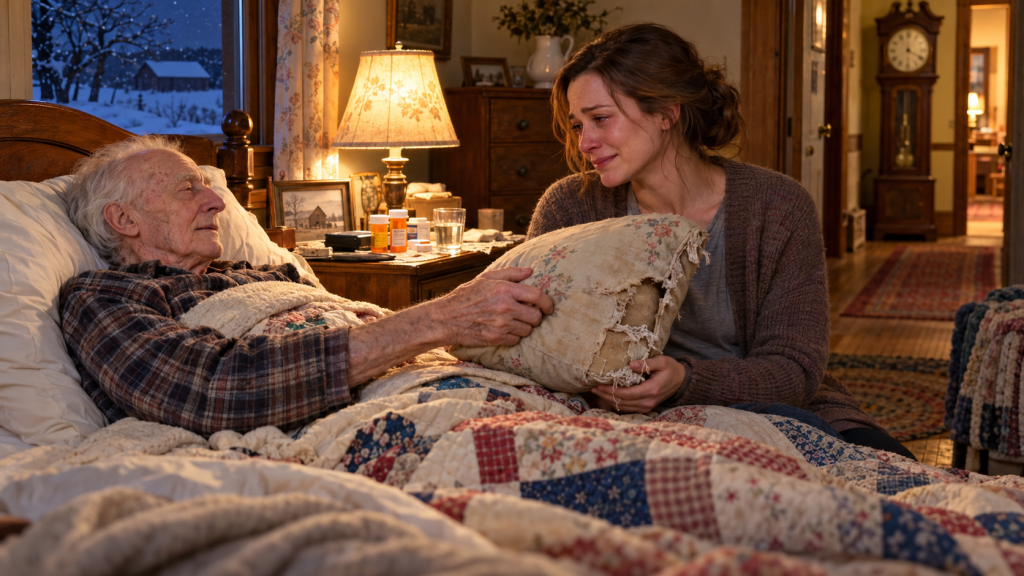
A clear gift.
Written.
No confusion.
No silent expectation.
I learned from every fight Arthur’s family had.
When we gave our son money, I handed him a letter.
This is a gift.
It does not buy access.
It does not create debt.
It does not entitle us to decisions in your marriage.
He laughed.
“Mom, normal people just write a check.”
“Normal people end up in probate court.”
He stopped laughing.
Fair.
When Michael died, many years after Arthur, I found one final surprise.
Not money.
A note in his desk.
Addressed to me.
Sarah, I have spent most of our marriage knowing you were better at staying than I was.
I sat down.
Dad taught me that before I was ready to admit it.
You stayed for him.
Then somehow, after what I did, you stayed long enough for me to become somebody worth staying with again.
I started crying.
Thank you.
No explanation.
No defense.
No request.
Just gratitude.
I placed his note with Arthur’s.
Two Mercer men.
Both imperfect.
Both loved.
Both eventually learned that love without truth becomes a burden.
I am older now than Arthur was the night he moved into our house.
The pillow is still with me.
So is the brass key.
The bank box is long gone.
The account moved decades ago.
The key opens nothing anymore.
Technically.
But I keep it.
Because objects can lose their practical purpose and still retain their story.
Sometimes my granddaughter asks:
“Grandma, why do you have an old key that doesn’t fit anything?”
I tell her:
“It opened a box once.”
“What was in the box?”
“Proof.”
“Of what?”
“That people notice who stays.”
She usually rolls her eyes because children prefer treasure.
So sometimes I simplify.
“Money.”
That gets her attention.
“How much?”
“Enough.”
“Did you buy a horse?”
“No.”
“Then what’s the point?”
Arthur would have liked her.
I tell her:
“The point wasn’t the money.”
She groans.
“Adults always say that when there was definitely money.”
Fair.
One day she will understand.
Maybe.
Or maybe she will learn something different.
That is allowed too.
The older I become, the less interested I am in turning Arthur into a saint.
He should have made a will earlier.
Should have told his children more.
Should not have hidden every fear until the end.
Should not have made me discover half a million dollars through a torn pillow the night after he died.
But he was not trying to create a perfect story.
He was a tired old farmer.
A proud man.
A father disappointed in some of his children and still loving all of them.
A man embarrassed by weakness.
A man who wanted to say thank you without making me feel bought.
So he chose the one thing nobody else wanted.
A torn pillow.
And hid a key inside.
His children looked at it and saw garbage.
I looked at it and heard his final words.
For you, Sarah.
That difference opened everything.
Not just the safe-deposit box.
The notebooks.
The family secrets.
The old loans.
The attempted power of attorney.
The resentment Michael had hidden.
The guilt his siblings carried.
The truth about caregiving.
The truth about inheritance.
And eventually, the truth I needed most:
Arthur had never believed I stayed because I expected a reward.
That was why he trusted me with one.
I spent twelve years believing I was merely doing what somebody had to do.
He spent those same twelve years noticing.
And when he no longer had enough breath to explain any of it, he handed me the ugliest thing in the room because he knew I would understand that love does not always arrive wrapped beautifully.
Sometimes it is stained.
Torn.
Stuffed with old feathers.
And heavy with something hidden inside.
THE END STORIES! THANK YOU FOR READING GOOD LUCK! ❤️
Related Posts