Nurse Caroline stood beneath our porch light with rain glistening on her hair. Her face was swollen from crying. In one hand she clutched the sealed hospital bag. In the other, she held her phone so tightly her knuckles had gone white.
Daniel stepped in front of me. “What are you doing here?” Caroline looked past him. At the baby in my arms. Then at Max. Her expression collapsed. “Oh God.” I instinctively tightened my hold around the newborn.
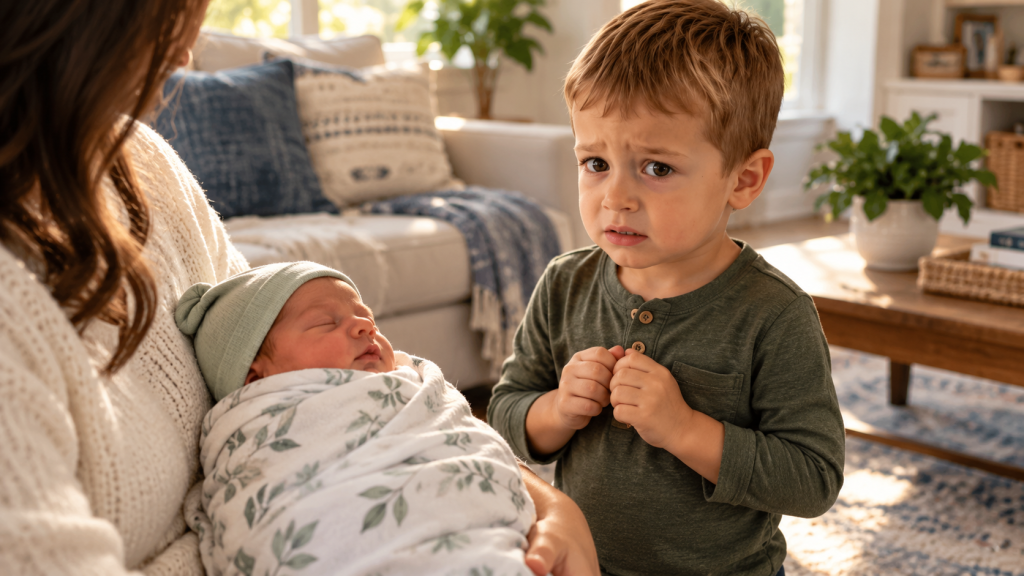
“What is in the bag?” Caroline swallowed. “Your daughter’s original identification band.” Daniel went perfectly still. I felt the room tilt beneath me. “What?” She raised the bag slightly. “And a DNA collection kit.”
My arms went numb.
Daniel whispered,
“Caroline, what did you do?”
Her eyes filled.
“I need you to call the hospital.”
“We’re already going back.”
“Call them before you leave.”
“Why?”
Caroline looked at the sleeping baby against my chest.
“Because the child you brought home is not Lily.”
Max started crying.
“I told you.”
That sentence hurt more than anything.
I looked at my five-year-old son.
He had told us.
Again and again.
We had called it jealousy.
Adjustment.
Big-brother anxiety.
We had listened to every expert explanation except the one coming from the child standing in front of us.
I crouched beside him while still holding the baby.
“You were right.”
Max sobbed harder.
“I told Daddy.”
Daniel closed his eyes.
“I know, buddy.”
“I told the nurse too.”
“I know.”
“You didn’t believe me.”
Daniel knelt.
“No.”
His voice broke.
“We didn’t.”
Max looked at me.
“Where’s my sister?”
I had no answer.
Caroline did.
“She’s alive.”
My head snapped toward her.
“Where?”
“At the hospital.”
Daniel grabbed the doorframe.
“What?”
Caroline hurried on.
“She never left.”
“The other mother is still admitted.”
“Her blood pressure became unstable after delivery.”
“The baby in her room…”
Caroline started crying again.
“That baby is Lily.”
I almost dropped to the floor.
My daughter was alive.
Still in the hospital.
Not missing in some stranger’s house.
Not on a highway.
Not gone.
But someone else had been holding her.
Feeding her.
Calling her by another name.
And I was holding someone else’s newborn.
I looked down at the little face against my chest.
Suddenly every instinct became impossible.
This baby was not mine.
But she was still somebody’s daughter.
Somebody was lying in a hospital room thinking Lily belonged to her.
I whispered,
“Who is she?”
Caroline wiped her face.
“Ava Parker.”
“Her mother is Erin Parker.”
“Room 518.”
Daniel grabbed his keys.
“We’re going now.”
I pointed at Caroline.
“You’re coming.”
She nodded immediately.
“Yes.”
Then Daniel looked at the sealed bag.
“What is the DNA kit?”
Caroline did not answer.
That silence told me the baby switch was only part of the story.
“Caroline.”
Her chin trembled.
“The switch was an accident.”
I stared.
“The DNA test was not.”
Daniel froze.
“What DNA test?”
Caroline looked at him.
“Your mother arranged it.”
For one second nobody moved.
Then Daniel whispered,
“My mother?”
“Yes.”
I felt something cold spread through my body.
“Judith?”
Caroline nodded.
Max looked between us.
“Grandma?”
I sent him upstairs with my mother, who lived six minutes away and had arrived while Caroline was explaining.
Max resisted.
“I want to come get Lily.”
I hugged him.
“You will see her as soon as we know everything is safe.”
“But I know what she looks like.”
“I know.”
“You might get the wrong one again.”
My heart broke.
I held his face.
“We are going to check everything this time.”
He stared at me.
“Promise?”
“Yes.”
I kissed his forehead.
“Promise.”
When the front door closed behind him, I turned toward Caroline.
“Tell me what my mother-in-law did.”
Caroline sat at our dining table.
The same table where Max had colored a “Welcome Home Lily” picture the day before.
She opened the sealed bag.
Inside was a tiny hospital bracelet.
BABY GIRL CARTER
My surname.
A barcode.
My medical-record number.
Lily’s birth date.
There was also a second bracelet.
Cut.
And a swab packet from a private genetics laboratory.
Daniel stared.
“I never authorized this.”
“I know.”
“Then how did she get my DNA?”
Caroline looked ashamed.
“She didn’t need a new sample.”
Daniel frowned.
“What does that mean?”
“She already had one on file.”
I stared at him.
Daniel’s face changed.
Not confusion.
Recognition.
My stomach tightened.
“You know something.”
He looked at me.
“Nora—”
“Do not Nora me.”
Caroline looked between us.
Daniel sat down.
Five years of marriage seemed to shift under my feet.
“What do you know?”
Daniel rubbed both hands over his face.
“My mom tested Max.”
I stopped breathing.
“What?”
“When he was born.”
I could not understand the sentence.
“She what?”
“She had a private paternity test done.”
The room became absolutely silent.
I stared at my husband.
“Our son?”
“Yes.”
“You knew?”
“Afterward.”
“How long afterward?”
“A few weeks.”
“And you never told me?”
He looked sick.
“No.”
I laughed.
One sharp, unbelieving sound.
“You let your mother secretly test our newborn son and never told me?”
“I found out after she had already done it.”
“And then?”
“The result said I was his father.”
“That is not the point.”
“I know.”
“No.”
My voice rose.
“You clearly do not.”
Caroline stood.
“I should go.”
I pointed at the chair.
“Sit down.”
She sat.
Daniel whispered,
“I thought telling you would only hurt you.”
I stared.
“So you protected me by allowing your mother to violate me without my knowledge.”
His eyes filled.
“When you say it that way—”
“How else is there to say it?”
He had no answer.
Caroline quietly slid another piece of paper onto the table.
A photocopy of an invoice.
Five years old.
Private laboratory.
Paternity analysis — alleged father Daniel Carter / child Maxwell Carter.
Paid by:
Judith Carter.
I felt physically ill.
“And this time?”
I asked.
Caroline looked at the swab kit.
“Judith contacted a woman named Denise Keller.”
The name sounded familiar.
Daniel frowned.
“My mom’s friend?”
“Yes.”
Max had said:
The lady from Grandma’s house.
Denise.
I remembered her now.
Tall.
Short silver-blond hair.
Always wearing large earrings.
She had been at Judith’s Christmas party.
She worked for a private genetics company.
“What did Judith want?”
Caroline answered.
“A paternity test on Lily.”
“Why?”
“She said she had doubts.”
Daniel stood.
“Doubts based on what?”
Caroline shook her head.
“I don’t know.”
I did.
Nine months earlier, I had traveled to Boston for a four-day conference.
Judith had made one ugly joke afterward.
Something about business trips creating “temptation.”
I had ignored it because arguing with Judith was like wrestling smoke.
Apparently she had built an entire accusation around it.
Caroline continued.
“Denise contacted me because we went to nursing school together.”
“She asked me to collect a cheek swab after delivery.”
“For money?”
Caroline’s face burned.
“Yes.”
“How much?”
“Two thousand dollars.”
Daniel swore.
Caroline started crying again.
“My husband left last year.”
“I’m behind on rent.”
“My son’s dental surgery—”
I held up one hand.
“Your reasons do not belong in the same sentence as my daughter.”
She closed her eyes.
“You’re right.”
“What happened?”
Caroline forced herself to continue.
“After Daniel took Max for juice, I removed Lily from your room.”
“Without authorization.”
“Yes.”
“How?”
“I said she needed a routine weight check.”
I remembered.
A nurse had taken her.
I had been exhausted.
Barely awake.
I had said okay.
Caroline continued.
“I took her to a small assessment room.”
“Denise was waiting.”
My hands became fists.
“She swabbed Lily.”
“And then?”
“There was an emergency call from another room.”
“A postpartum hemorrhage.”
“I got pulled away.”
“For how long?”
“Maybe eight minutes.”
“Lily was alone?”
“No.”
“Denise stayed.”
I stared.
“You left my newborn daughter with someone who was not hospital staff?”
Caroline’s face collapsed.
“Yes.”
Daniel walked toward the window.
I had never seen rage make him so quiet.
Caroline continued.
“When I came back, another bassinet had been moved into the same holding area.”
“Ava Parker.”
“Why?”
“Her nurse had taken her for a bilirubin check.”
“And?”
“I panicked.”
“You panicked?”
“My badge showed I had transported Lily somewhere she was never ordered to go.”
“I was afraid the scanner would show the unauthorized movement.”
“So what did you do?”
Caroline looked at the floor.
“I bypassed the electronic scan.”
My stomach turned.
Hospital newborn-security systems existed for exactly this reason.
“What happened to the bracelets?”
“The scanner had already flagged one mismatch when another nurse brought Ava in.”
“I removed Lily’s temporary transport band.”
“Then I got called away again.”
“When I came back, the bassinets had been repositioned.”
She began shaking.
“I thought I had the right one.”
“You thought?”
“Yes.”
“You did not check the birthmark?”
“No.”
“The bracelet?”
“I printed a replacement.”
Daniel turned.
“You printed a new identity band for the baby you thought was Lily.”
Caroline nodded.
“And you put Lily’s information on Ava.”
“Yes.”
I stared down at Ava sleeping against me.
A tiny innocent child had been carried into my home because an adult wanted two thousand dollars and another adult wanted proof her daughter-in-law had cheated.
I whispered,
“And Lily?”
“Another nurse took her to Mrs. Parker.”
“Under Ava’s identity.”
“How did you discover it?”
Caroline’s eyes filled.
“Max.”
I looked up.
“What?”
“He came back into the hall.”
“He said, ‘That’s not my sister.’”
My knees weakened.
“He pointed at Ava.”
“He said Lily had a red moon behind her ear.”
“I told him he was confused.”
“Why?”
Caroline began crying.
“Because if he was right, I knew what I had done.”
I closed my eyes.
Five years old.
He had identified what trained adults refused to see.
Caroline continued.
“After your family left, I went to check Mrs. Parker’s baby.”
“She had the birthmark.”
“I checked the original newborn photographs.”
“The footprints.”
“The blood spots.”
“I knew.”
“How long after we left?”
“Thirty minutes.”
Daniel stared.
“You knew for thirty minutes and let us keep driving?”
“I went to my supervisor.”
“What did she say?”
Caroline swallowed.
“She said we needed to notify risk management before contacting either family.”
“How long was that supposed to take?”
“I don’t know.”
“But I knew you lived forty minutes away.”
“And then I thought about Max.”
She looked at me.
“He had already tried to tell all of us.”
“So I took the original band.”
“The swab kit.”
“And came here.”
I was furious with her.
I also understood one thing.
If she had obeyed the hospital bureaucracy, we might have spent another entire night with the wrong babies.
Truth is uncomfortable that way.
Sometimes the person who causes harm also becomes the first person to stop it from becoming worse.
Both facts remain true.
We returned to the hospital at 10:41 p.m.
A security officer met us at the entrance.
So did an administrator.
A pediatrician.
Two police officers.
And a woman in a wheelchair wearing a hospital bracelet.
She was crying.
A man stood beside her.
In her arms was my daughter.
I knew before I saw the birthmark.
I knew.
Every cell in my body moved toward her.
The woman tightened her arms around Lily instinctively.
And I did the same with Ava.
For one strange, painful second, we were two mothers holding each other’s babies and afraid to let go.
The hospital administrator said,
“Mrs. Carter, this is Erin Parker.”
Erin looked at me.
“I’m so sorry.”
I started crying.
“You didn’t do anything.”
“Neither did you.”
She looked at Ava.
“My baby.”
I nodded.
“And that’s mine.”
Her husband, Matt, covered his face.
Nobody knew what to do.
So the pediatrician did what medicine does when emotion becomes impossible.
She created procedure.
Both babies were taken to the nursery with both families present.
The bracelets were removed.
New photographs were compared with birth-room images.
Footprints were checked.
Blood types were confirmed.
Rapid DNA testing was ordered.
Nobody wanted to rely only on faces.
Not anymore.
Max’s “red moon” was there.
Behind Lily’s left ear.
A tiny crescent.
I touched it with one finger.
Then cried so hard a nurse put a chair behind me.
Daniel stood beside me.
He touched Lily’s foot.
She curled her toes.
He broke.
“I’m sorry.”
I did not know whether he meant the switch.
His mother.
Max.
The five-year-old paternity test.
All of it.
I said nothing.
Erin held Ava nearby.
At one point we looked at each other.
She whispered,
“I fed her.”
I nodded.
“I fed yours.”
That sentence could have been devastating.
Instead, it became strangely tender.
For a few hours, when our children were in the wrong arms, they had still been held.
Still fed.
Still loved.
Erin started crying.
“Thank you.”
I shook my head.
“No.”
“Thank you.”
The DNA results came before dawn.
Lily was ours.
Ava was theirs.
There was no biological ambiguity.
No mysterious hidden parentage.
No second twist where Max had somehow imagined everything.
He had been exactly right.
We brought Lily home the next afternoon.
This time, Max came to the hospital.
He stood several feet away from her bassinet.
I knelt beside him.
“Do you want to check?”
He nodded solemnly.
A nurse lifted Lily carefully.
Max looked behind her left ear.
The crescent birthmark was there.
He smiled for the first time in two days.
“That’s her.”
Daniel turned away to cry.
Max stepped closer.
“Hi, Lily.”
She made a tiny squeaking sound.
He touched her hand.
Then whispered,
“I found you.”
I had to sit down.
That should have been the ending.
It wasn’t.
Because when a baby comes home after a mistake like that, the family does not simply close the door and become grateful.
Questions come home too.
Police opened an investigation.
The hospital suspended Caroline immediately.
Denise Keller was interviewed.
Judith was questioned.
Daniel and I were questioned separately.
Hospital security footage confirmed Caroline’s movements.
It also confirmed Max’s story almost minute by minute.
At 2:16 p.m., Daniel and Max left my room.
At 2:22, Caroline removed Lily.
At 2:24, Denise entered the assessment corridor carrying a small handbag.
At 2:28, Caroline handed her an envelope.
Max had been right about that too.
It was cash.
Judith had given Caroline three thousand dollars.
Caroline kept one thousand.
Passed two to Denise for the off-book lab work.
At 2:31, Max reappeared at the end of the hallway holding Bunny.
He watched Lily being wheeled away.
At 2:39, Ava’s bassinet entered.
At 2:43, Max pointed toward Ava and became visibly upset.
At 2:45, Caroline crouched in front of him.
The audio was not recorded.
But we knew what happened.
She told him he was confused.
At 3:08, our family left with Ava.
At 3:38, Caroline checked Lily in Erin’s room.
At 4:17, she reported the discrepancy.
The timeline sat in a police report.
Clinical.
Neat.
Nothing like the terror inside it.
Judith denied everything at first.
Of course she did.
She said Denise misunderstood.
That she had only asked whether DNA testing after birth was possible.
Then police obtained her messages.
Judith to Denise:
I need certainty before they settle into this fantasy.
Denise:
You can buy a legal home test after discharge.
Judith:
No. If she finds out, Daniel will defend her automatically. I need the answer first.
Denise:
This could cost Caroline her job.
Judith:
Everyone has a price.
I read that sentence once.
Never again.
Then another:
I did it with Max. Nothing happened.
That was when the second betrayal became real.
Not just Daniel knowing.
Judith bragging about it.
Nothing happened.
That was how she viewed violation when she escaped consequences.
Daniel read the messages beside me.
He started shaking.
“I should have told you.”
“Yes.”
“If I had—”
“Maybe she wouldn’t have tried again.”
He closed his eyes.
“I know.”
“No.”
I looked at him.
“You need to understand something.”
He waited.
“The hospital made the switching error.”
“Caroline broke protocol.”
“Denise participated.”
“Your mother arranged the test.”
“But you taught Judith that she could cross this boundary and still remain inside our family as though nothing happened.”
He started crying.
“I thought Max’s test was over.”
“It was over for you.”
I put my hand against my chest.
“I didn’t even know it happened.”
He whispered,
“I was ashamed.”
“So you protected yourself.”
“Yes.”
The honesty hurt.
But at least it was honesty.
Daniel slept in the guest room after that.
Not because I stopped loving him.
That would have been easier.
Because I no longer knew what our marriage meant if he could keep something that large hidden for five years.
Judith called constantly.
I blocked her.
She emailed.
Blocked.
She mailed a letter.
I gave it to our attorney unopened.
Daniel stopped answering too.
That surprised her.
She called his office.
Showed up once.
Security sent her away.
Finally she left a voicemail on his work line.
“You are abandoning your mother over a misunderstanding.”
Daniel played it for me.
Then deleted it.
“No.”
he said.
“I’m choosing my children over a pattern I should have stopped years ago.”
That was the first thing he did that made me believe our marriage might survive.
The investigation found no evidence Judith intended a baby switch.
That mattered legally.
Her goal had been unauthorized genetic testing.
The switch happened because Caroline violated identification procedures to hide what she was doing.
That distinction did not make Judith innocent.
It made the truth more precise.
Caroline was charged over falsified medical identification records and unlawful handling of protected medical information.
She also faced nursing-board discipline.
She cooperated fully.
Her license was suspended and later restricted after a lengthy proceeding.
She did not go to prison for decades.
She received probation, community service, and lost the career she had spent years building.
Denise lost her laboratory job.
The private genetics company terminated her and cooperated with investigators.
She pleaded to offenses connected to improper medical testing and records.
Judith faced charges tied to conspiracy, privacy violations, and the unauthorized genetic testing scheme.
She entered a plea rather than take the case to trial.
Probation.
Fines.
Mandatory counseling.
And, most importantly to me, a protective order preventing her from contacting the children for a long period unless we later consented.
People asked whether I thought that punishment was enough.
I never knew how to answer.
What number of months restores the first night home with your daughter?
What fine teaches a five-year-old that adults will believe him next time?
Punishment had its place.
But it could not reverse the thing.
The hospital settlement came later.
It was substantial.
Not lottery money.
Not some ridiculous fortune.
Enough to pay for therapy.
Legal costs.
Education funds for Max and Lily.
And enough that the hospital cared deeply about never repeating the failure.
Their external review found several frightening things.
Manual newborn-ID overrides were too easy.
Transport logs could be altered by one employee.
Temporary bands were not reconciled quickly enough.
Contract staff could enter maternity-adjacent corridors without secondary verification.
Policies existed.
The system had allowed one frightened nurse to bypass too many of them.
The hospital changed procedures.
Two-person verification for newborn transport overrides.
Automatic alerts to charge nurses.
No off-floor movement without matched scanning except during medical emergencies.
Stricter visitor access.
Independent auditing.
None of that comforted me immediately.
But years later, I appreciated that Lily’s story changed something outside our house too.
Erin and Matt Parker received their own settlement.
For several months, we spoke often.
Not because we wanted to become some unusual blended family.
Because nobody else understood what it felt like to look at newborn photographs and ask:
Whose baby was I holding at that exact hour?
Erin once called me at midnight.
“I miss Lily.”
I understood instantly.
Not as her daughter.
As the baby she had held during those hours.
“I miss Ava sometimes.”
I admitted.
We both cried.
That grief embarrassed us at first.
Then a therapist explained it.
“You bonded with babies during a medically and emotionally vulnerable period.”
“That attachment does not threaten your bond with your own children.”
So we stopped feeling guilty.
We exchanged photographs on the babies’ first birthday.
Then less frequently.
Eventually Christmas cards.
That felt right.
Our families did not need to perform a lifelong connection because something traumatic linked us.
We could be grateful for each other without making the mistake our entire identity.
Max had the hardest recovery in ways nobody anticipated.
For weeks, he checked Lily’s birthmark every morning.
At breakfast.
After naps.
Before bed.
Sometimes he would wake us at night.
“Can I check?”
At first, I always said yes.
Then his child therapist, Dr. Ramirez, gently warned us.
“Reassurance can become another form of fear if he believes he must keep verifying she is the correct baby.”
I hated that.
Because Max had been right to verify.
But she was right too.
So we created a ritual.
Once every evening, if Max wanted, he could check.
Then slowly every other day.
Then only when he chose.
Eventually he stopped.
One afternoon, I found him drawing at the kitchen table.
The picture showed our family.
Me.
Daniel.
Max.
A tiny pink blob labeled Lily.
Behind Lily’s ear he had drawn an enormous red moon.
I smiled.
“That’s a big birthmark.”
He frowned.
“So nobody gets confused.”
My heart cracked.
I sat beside him.
“Max.”
“Yeah?”
“It was never your job to keep the adults from getting confused.”
He looked at me.
“But I fixed it.”
“You helped us.”
“No.”
He insisted.
“I fixed it.”
I understood then what he was doing.
He was turning terror into responsibility because responsibility felt safer.
I took his hand.
“You noticed something important.”
“Yes.”
“You told us.”
“Yes.”
“And the adults should have listened immediately.”
He looked down.
“I kept Lily safe.”
“You helped keep Lily safe.”
I squeezed his fingers.
“But Lily is not your responsibility.”
He frowned.
“I’m her big brother.”
“Yes.”
“You can love her.”
“Play with her.”
“Annoy her when she gets older.”
“That’s part of the contract.”
He smiled.
“But you do not have to be the parent.”
“That’s my job and Daddy’s job.”
He thought.
Then:
“Can I still protect her sometimes?”
I kissed his forehead.
“Yes.”
“Sometimes.”
Daniel had heard from the doorway.
After Max went outside, Daniel sat down.
“I failed him.”
I looked at my husband.
“Yes.”
He nodded.
No defense.
“I told him he imagined it.”
“Yes.”
“I remember being irritated.”
“I know.”
“I was thinking, here we go, jealousy.”
I stared at the picture.
Daniel whispered,
“He was asking us for help.”
“Yes.”
He started crying.
That was when I finally cried with him.
Our marriage did not repair because we both felt bad.
Guilt is not repair.
Action is.
Daniel started therapy.
Individual first.
Then couples counseling.
He wrote down every significant thing he had hidden from me.
There were not dozens.
That almost made it harder.
The list was short enough to reveal a pattern.
Max’s paternity test.
A $4,000 loan he had once given Judith without telling me.
Two arguments with his mother about me that he had minimized.
A conversation where Judith called me “temporary” before our wedding.
Nothing criminal.
Nothing equal to the newborn test.
But the pattern was clear.
Daniel had spent our marriage editing his mother for me.
And editing me for his mother.
Trying to prevent conflict.
Trying to keep everybody comfortable.
The result was that Judith never experienced the real cost of crossing boundaries.
Our therapist said:
“Daniel, peacekeeping can become dishonesty when one person is protected from consequences and another is protected from information.”
He looked at me.
“I did that.”
“Yes.”
“I thought I was protecting us.”
“You were protecting the version of us where your mother could stay exactly the same.”
He nodded.
“That’s true.”
We stayed married.
That surprised some people.
They expected either instant divorce or instant forgiveness.
We did neither.
I stayed because Daniel did not minimize what happened.
He testified honestly.
He stopped defending Judith.
He accepted that I might leave.
He slept in the guest room for five months.
He did not complain once.
When I finally asked him to move back into our bedroom, he said:
“Are you sure?”
I answered:
“No.”
He looked startled.
Then I continued.
“I’m sure I want to try.”
That was enough.
Judith did not meet Lily.
Not for years.
She had held Max many times before.
Taken him to the zoo.
Baked cookies with him.
Bought him birthday presents.
That made the boundary harder, not easier.
People kept saying:
“But she loves them.”
I began to hate that sentence.
Love is not a permission slip.
Judith may have loved Max.
She still secretly tested his DNA.
She may have believed she loved Lily before Lily was born.
She still treated that baby’s body as material she had a right to investigate.
Eventually, five years after the switch, Judith requested a mediated meeting.
Not with the children.
With me and Daniel.
I almost said no.
Then I read her therapist’s letter.
It did not ask forgiveness.
It simply said Judith wanted to make a specific apology without requesting restored access.
That mattered.
We agreed.
Judith looked older.
Smaller.
Not dramatically changed.
Just human in a way anger had not allowed me to see before.
She sat across from us.
For once, she did not begin with explanation.
She said:
“I violated both of your children.”
I looked at Daniel.
He looked back at me.
Judith continued.
“With Max, I tested him because I believed I was entitled to certainty.”
“With Lily, I did it again because the first time had taught me I could.”
My throat tightened.
She looked at me.
“I convinced myself I was protecting Daniel.”
“I was not.”
“I was feeding my own obsession.”
I asked,
“What obsession?”
Judith took a breath.
“When Daniel was thirteen, I discovered his father had another child.”
Daniel froze.
“What?”
Judith looked at him.
“Your father had an affair.”
Daniel stared.
“You never told me.”
“No.”
“Why?”
“Because I thought secrets could protect a family.”
The irony was almost unbearable.
Judith continued.
“For years I doubted everything.”
“I doubted your father.”
“I doubted whether your brother was his.”
“I even doubted whether you were.”
Daniel whispered,
“You had us tested?”
Judith cried.
“Yes.”
My husband sat back as though struck.
The obsession went further back than either of us knew.
Judith whispered,
“All three of you were his.”
“I should have stopped there.”
“I didn’t.”
“I carried suspicion forward.”
“When Max was born, I told myself I needed certainty because I had once been fooled.”
“When Lily was born, I did it again.”
She looked at me.
“What happened at the hospital was not what I intended.”
I stiffened.
She raised one hand.
“I know that does not save me.”
Good.
“I did not intend the babies to be switched.”
“But I created the reason Caroline violated the rules.”
“I paid for it.”
“I asked her to cross a line because I believed my fear mattered more than your consent.”
Tears ran down her face.
“I am sorry.”
I asked:
“Why did you suspect Lily?”
Judith looked ashamed.
“Your Boston trip.”
I laughed.
“You built this around a business conference?”
“Yes.”
“Did you have any evidence?”
“No.”
“Did Daniel ever accuse me?”
“No.”
“Did I ever give you a reason?”
“No.”
I leaned forward.
“Then say it.”
She looked confused.
“Say what?”
“You decided suspicion was enough.”
Judith closed her eyes.
“Yes.”
“I decided suspicion was enough.”
That was the apology I needed.
Not:
I was scared.
Not:
I had trauma.
Not:
I meant well.
The truth.
She had turned uncertainty into entitlement.
We did not restore contact immediately.
Another year passed.
Then Max asked about her.
Not because adults pressured him.
Because he remembered.
“Is Grandma still alive?”
“Yes.”
“Does she still want to see me?”
“Yes.”
“Do I have to?”
“No.”
He thought for several days.
Then chose a supervised lunch.
No Lily.
Just Max.
Daniel went.
I did not.
When they returned, Max looked thoughtful.
“How was it?”
“She cried.”
“Did that bother you?”
“A little.”
“What did she say?”
“She said she was sorry she made me feel like I had to prove what I saw.”
I sat beside him.
“How did that feel?”
“Good.”
Then:
“I told her I’m still mad.”
“What did she say?”
“She said okay.”
Progress.
Not redemption.
Progress.
Lily did not meet Judith until she was eight.
By then she knew a simplified version of the story.
“A nurse mixed you up with another baby because some adults broke important rules.”
That was enough when she was small.
Later, she learned more.
At eight, she asked:
“Did Grandma not want me?”
My heart hurt.
“No.”
“She wanted to know whether Daddy was your biological father.”
“Why?”
“Because she had fears that belonged to her.”
Lily frowned.
“Was Daddy my dad?”
“Yes.”
“Then Grandma was wrong.”
“Yes.”
“Okay.”
Children sometimes spend three seconds on questions adults ruin years over.
At ten, Lily asked for the full story.
We told her.
Age-appropriate.
No embellishment.
No turning Judith into a monster.
No turning Caroline into one either.
Lily listened.
Then looked at Max.
“You knew?”
Max was fifteen.
He shrugged.
“You had a red moon.”
Lily reached behind her ear.
“You mean this?”
“Yeah.”
“You were five.”
“I had eyes.”
She laughed.
Then hugged him.
“You saved me.”
Max shook his head.
“No.”
That surprised me.
He had finally learned.
“I noticed.”
“The adults fixed it.”
I had to leave the room because I started crying.
Years earlier he had insisted:
I fixed it.
Now he could put the responsibility where it belonged.
That was healing.
Caroline wrote to us once.
Seven years after the switch.
The envelope came through our attorney.
She had completed her probation.
Worked outside nursing.
She did not ask to see us.
She wrote:
I have spent years trying to understand why I believed financial desperation made one boundary negotiable.
It did not.
She apologized to Max by name.
That mattered.
He told the truth before any of us were ready to hear it.
She apologized to Erin and Matt too.
She had written separately to them.
I did not answer.
But I kept the letter.
Not because forgiveness was owed.
Because accountability should be recognized when it becomes specific.
Denise never contacted us.
That was fine.
Erin Parker sent us a photograph every birthday for the first five years.
Ava had thick curls.
Loved ballet.
Hated peas.
Lily loved swimming.
Hated socks.
They looked nothing alike as they grew.
That amused us.
How had adults confused them?
Easy.
Newborns are tiny.
Swaddled.
Hospital caps.
Exhaustion.
Systems exist because human perception is imperfect.
The true danger had not been that two babies looked alike.
It was that one person bypassed the system built to compensate for that fact.
On the girls’ fifth birthday, Erin mailed a card.
Inside were two photographs.
One of Ava.
One of Lily that I had sent the year before.
She wrote:
Five years ago we each spent a few hours loving the wrong baby. I don’t think the love was wrong.
I cried for twenty minutes.
She was right.
The identities were wrong.
The care was not.
That distinction became precious to me.
Max grew up protective of Lily without becoming responsible for her.
Mostly.
At twelve he threatened a boy who pulled her braid.
I grounded him.
“For protecting her?”
“For threatening to break his skateboard.”
“But he—”
“No.”
“But—”
“No.”
Lily sat on the stairs grinning.
“I told you Mom would be mad.”
Max pointed at her.
“You’re welcome.”
Normal sibling nonsense.
Beautiful.
Daniel became almost obsessive about transparency for a while.
Every conversation with Judith.
Every family expense.
Every decision.
Eventually I told him:
“I don’t need surveillance.”
He looked hurt.
“I’m trying to rebuild trust.”
“I know.”
“But trust is not a live report of every thought you have.”
He frowned.
“What do you need?”
“Tell me the things that affect my choices.”
That became our rule.
Not radical disclosure.
Respectful disclosure.
If information materially changed my ability to consent, decide, protect the kids, or understand our finances, it belonged to both of us.
That was the line he had missed with Max’s secret test.
He never missed it again.
At least not in any way that mattered.
Our marriage became different.
Not less loving.
Less innocent.
There is a kind of trust that exists because nothing has ever gone badly.
And another kind that exists because something did, and both people learned exactly what repair costs.
I prefer innocence.
But I respect repaired trust more than I once did.
Years later, Daniel told me:
“The thing I regret most isn’t only that I hid Max’s test.”
“What is it?”
“That I thought avoiding a fight with my mother was more important than letting you know who you were dealing with.”
I nodded.
“That’s close.”
“Close?”
“The thing you should regret most is that Max had to carry knowledge adults refused to hear.”
Daniel’s eyes filled.
“Yes.”
That was the center of it.
The adults had complicated motives.
Judith had betrayal trauma.
Caroline had money problems.
Denise had blurred professional boundaries.
Daniel had conflict avoidance.
I had postpartum exhaustion.
Hospital management had procedural gaps.
All true.
And in the middle stood a five-year-old saying:
That’s not my sister.
Sometimes adults make truth complicated because complexity allows delay.
Children often say the plain thing.
We learned to listen differently after that.
Not believe every claim automatically.
Children misunderstand things too.
But listen.
Ask.
Check.
Never punish a child for making an adult uncomfortable with a question.
When Max was thirteen, a teacher once told me he had reported a student being bullied.
The teacher said:
“He notices things other kids ignore.”
I smiled.
“He always has.”
I did not tell her why.
That story belonged to him.
When Lily turned sixteen, she asked me:
“Would you have known eventually?”
“The switch?”
“Yes.”
I thought carefully.
“Probably.”
“When?”
“I don’t know.”
“The birthmark would have done it.”
“Maybe.”
“Or medical records.”
“Blood type.”
“Something.”
She frowned.
“So Max just made it faster.”
I looked at her.
“Max made it faster before the mistake had time to become a larger trauma.”
She nodded.
Then:
“Do you ever think about Ava?”
“Sometimes.”
“Do you think her mom thinks about me?”
“I know she does.”
Lily smiled.
“That’s weird.”
“Yes.”
“Bad weird?”
“No.”
“Just human.”
She liked that answer.
Years later, when Max graduated college, Lily gave a speech at our family dinner.
She was seventeen.
Far too confident.
She raised her glass.
“To Max.”
He groaned.
“No speeches.”
“You don’t control me.”
“That is unfortunately true.”
She continued.
“When I was three days old, my brother became the first person in the family to identify me correctly.”
Everyone laughed.
Even Daniel.
Judith was not there.
That boundary remained.
Lily continued:
“He has been annoying ever since.”
More laughter.
Then she became serious.
“But I know something about my brother.”
“If he says something feels wrong, I listen.”
Max looked down.
Lily smiled.
“Not because he’s always right.”
“Because he cared enough once to keep talking when everybody told him he was wrong.”
I cried.
Again.
Apparently motherhood is mostly crying during speeches you did not ask for.
Judith died when Lily was twenty-three.
Our relationship had remained limited.
Occasional supervised visits became holiday cards.
Then short lunches.
She never regained grandmother access automatically.
That was part of accountability.
Before she died, she left letters for both children.
Max’s said:
You were five when you saw what every adult should have checked. I am sorry that my choices created a situation where your fear was necessary.
Lily’s said:
I treated your identity as a question I had the right to answer without your parents. I did not. You were never proof of anything. You were a baby. I am sorry.
Those letters were better than the first apology she ever gave us.
Because she finally understood the deepest wrong.
Babies are not evidence.
Children are not leverage.
DNA is not entitlement.
And fear does not create permission.
Lily kept hers.
Max did too.
Neither turned Judith into a saint because she apologized well at the end.
But neither carried only hatred.
That was their choice.
Daniel and I celebrated our thirtieth anniversary quietly.
Dinner at home.
Max brought his wife.
Lily arrived late with flowers.
At some point, someone found the old stuffed rabbit.
Bunny.
The one Max had gone back for at the hospital.
Its fur was gray.
One ear had been repaired twice.
Lily held it up.
“This thing caused the whole story.”
Max frowned.
“No.”
“You went back for Bunny.”
“That’s why you saw them.”
“So Bunny saved me.”
“Absolutely not.”
“Yes.”
“Bunny is innocent.”
We laughed.
Then Max took the rabbit.
He looked at it more seriously.
“I remember the hallway.”
The room quieted.
“I remember knowing.”
Lily touched his arm.
“You were scared?”
“Yeah.”
“Of what?”
He thought.
“That I’d get in trouble because the adults said I was wrong.”
My chest tightened.
He continued.
“But I knew your moon was gone.”
Lily smiled.
“It’s still here.”
She pulled her hair back.
The little crescent remained behind her ear.
Fainter.
Smaller against an adult face.
Still there.
Max nodded.
“Good.”
That moment felt like the story completing itself.
Not because trauma needs symbolism.
Because sometimes the simplest proof survives.
A tiny mark.
A child who noticed.
A family that eventually learned to believe its own children before its fears.
When I think back to that first night home, I remember the nursery doorway.
Max refusing to enter.
His little face pale.
His whisper:
Mommy… you brought home the wrong baby.
At the time, I thought becoming a big brother had overwhelmed him.
I thought jealousy had dressed itself as certainty.
I was wrong.
The painful part is not that I misunderstood once.
Parents misunderstand their children every day.
The important part is what happens next.
Do we become defensive?
Or curious?
Do we insist our adult explanation must be smarter than the child’s experience?
Or do we check the birthmark?
That night taught me something I have carried ever since.
Trust does not mean assuming the people you love could never cross a line.
Suspicion does not mean you have the right to cross one first.
And listening does not mean believing blindly.
It means respecting another person enough to investigate what they are trying to tell you.
Judith wanted certainty so badly that she created chaos.
Caroline wanted to hide one mistake and created another.
Daniel wanted to avoid conflict and allowed an old violation to become precedent.
I wanted to explain my son’s fear instead of hearing it.
All of us, in different ways, tried to make uncertainty disappear.
Max did something simpler.
He looked.
He remembered.
And he spoke.
The hospital eventually sent us copies of the final review.
I stored them for years.
Then, when Lily turned eighteen, I asked whether she wanted them.
She flipped through the first page.
Then closed the folder.
“Do I need these?”
“No.”
“Then you keep them.”
I did.
Until we moved.
Then I looked at the box.
Hospital reports.
Legal letters.
DNA confirmations.
Settlement documents.
Security stills.
So much paper proving what our children had known before any document existed.
I kept the DNA confirmations.
Medical history matters.
I kept Judith’s final letters.
The rest went into secure shredding.
Daniel watched me carry the box out.
“You sure?”
“Yes.”
“We don’t need proof anymore?”
I smiled.
“We know who our children are.”
That was enough.
A week later, Lily came for dinner.
Max was there too.
She walked into the kitchen, stole a piece of garlic bread, and complained that he had parked too close to her car.
Max rolled his eyes.
“You’re welcome for identifying you.”
Lily laughed.
“You get one more year of using that.”
“You’ve said that for fifteen years.”
“I mean it now.”
“No, you don’t.”
I watched them argue.
Brother.
Sister.
Exactly where they belonged.
And for the first time in a long time, the hospital felt very far away.
THE END STORIES! THANK YOU FOR READING GOOD LUCK! ❤️
Related Posts