“So you didn’t abandon me?” Emily’s voice barely carried across the porch. For twenty years, I had imagined meeting my daughter again in a thousand different ways. I imagined recognizing her across a crowded room.
I imagined someone calling me from an adoption agency. I imagined receiving a letter. I imagined her hating me. I imagined her refusing to speak to me. Never once had I imagined standing on the porch of the house where my parents threw me out, watching my daughter discover that the people who raised her had built her childhood around a lie.
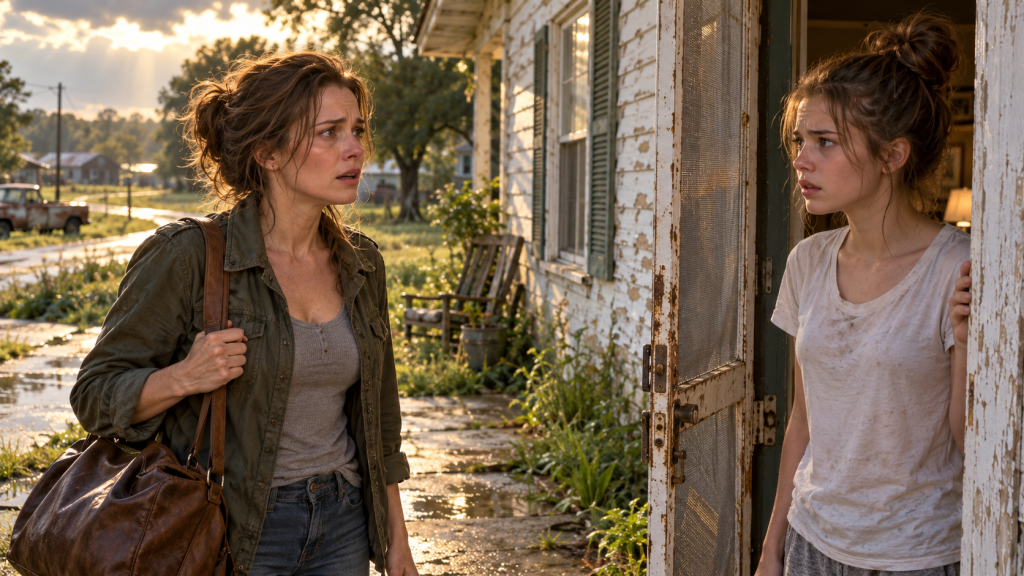
“No,” I whispered. Emily stared at me. I forced myself to breathe. “But I need to tell you the truth carefully.” Her jaw tightened. “Did you leave me?” “I placed you in temporary foster care.” Her expression changed. I continued before fear could fill in the blanks. “I was sixteen.”
“I had no stable housing.”
“I was working whatever jobs I could get.”
“I was sleeping in places that weren’t safe.”
“I loved you so much that I was terrified I was going to fail you.”
My voice broke.
“So I agreed to temporary care while I tried to get stable.”
Emily’s eyes filled.
“How temporary?”
“That was the plan.”
“What happened?”
I looked at my parents.
Neither of them moved.
“The case became permanent.”
Emily’s eyes snapped back to mine.
“You signed me away?”
“No.”
“I signed papers agreeing to temporary placement.”
“Then I moved.”
“I missed notices.”
“I didn’t have an attorney I could afford.”
“I was working twelve-hour shifts.”
“I changed addresses three times in one year.”
“And eventually I was told the foster family intended to adopt you.”
Emily turned to Ruth.
“But you raised me.”
Mom started crying.
“Yes.”
Emily looked at me again.
“Did you know?”
“No.”
The word came out harder this time.
“I swear to you, Emily.”
“I did not know you were here.”
She backed away from all of us.
Dad finally spoke.
“That’s enough.”
Twenty years disappeared.
His tone was exactly the same.
Cold.
Final.
The voice that once told a pregnant sixteen-year-old she was dead to him.
Emily turned on him.
“No.”
Dad froze.
She stepped farther onto the porch.
“No, Grandpa.”
“You don’t get to say that.”
“Emily—”
“You told me my mother died.”
Dad’s jaw tightened.
“We did what we thought was best.”
I laughed.
I couldn’t help it.
Twenty years.
And there it was.
The same sentence people use when they need good intentions to do the work of an apology.
Emily stared at him.
“You told me she died giving birth to me.”
Mom covered her face.
My blood went cold.
I had known they told her I was dead.
But not how.
“You told her I died in childbirth?”
Dad looked at me.
For the first time since I arrived, there was something behind his eyes.
Not shame.
Defiance.
“At the time, you were gone.”
“I was in Denver.”
“We didn’t know where.”
“You never asked.”
“We had a child to protect.”
“She was my child.”
Dad’s face hardened.
“You were sixteen.”
“And you were my father.”
Silence.
That landed.
Emily looked between us.
“What happened when I was three?”
No one answered.
She looked at Ruth.
“Grandma?”
Mom’s hands trembled around her cane.
“The foster family you were with…”
She swallowed.
“They were getting divorced.”
I stared.
I had never known that.
Mom continued.
“The county started looking for relatives.”
“And they called you?”
“Yes.”
My stomach twisted.
“When?”
“When Emily was two and a half.”
“You knew she was in foster care for two and a half years?”
Mom shook her head quickly.
“No.”
“No, Claire.”
“We didn’t.”
“They contacted us when the placement became unstable.”
I stepped closer.
“And what did you say?”
She looked down.
“At first?”
My heart stopped.
“At first what?”
“We said no.”
Emily made a small sound.
Mom started crying harder.
“We said we couldn’t take her.”
I stared at my mother.
My daughter stared at her grandmother.
The porch seemed too small to hold what had just been said.
“You refused her?”
Emily whispered.
Mom reached toward her.
Emily stepped back.
Mom’s hand fell.
“We were ashamed.”
That word.
Again.
That miserable little word had eaten twenty years of my life.
Dad interrupted.
“We were not equipped to raise another child.”
Mom looked at him.
“No.”
Something changed in her voice.
“We were ashamed.”
Dad went silent.
Mom turned back to Emily.
“Your grandfather was still angry.”
“I was angry too.”
“People in town remembered what happened with Claire.”
“We thought taking you would bring everything back.”
I could barely speak.
“So you said no.”
“Yes.”
“What changed?”
Mom stared toward the overgrown yard.
“You got sick.”
Emily frowned.
“What?”
“You were almost three.”
“Pneumonia.”
“You were hospitalized.”
“The social worker called again.”
“She said if family didn’t step forward, you would likely be adopted outside the county.”
Mom looked at me.
“I went to see you.”
My legs felt weak.
She had seen my daughter.
While I was alive.
Working.
Trying to rebuild myself.
She had visited my child.
“I walked into that hospital room.”
Mom whispered.
“You were sleeping.”
“There was a little oxygen tube beneath your nose.”
“You had Claire’s eyebrows.”
She started sobbing.
“I knew.”
“I knew the second I saw you that I could not leave you.”
Emily’s face was wet now.
“And Grandpa?”
Mom looked at Dad.
“He came the next morning.”
Dad stared at the porch floor.
Emily asked,
“Did you want me?”
Dad took too long.
That delay answered more than words could.
Then he said,
“I grew to love you.”
Emily flinched.
I closed my eyes.
There are truths that may be honest and still be cruel.
Mom snapped,
“Thomas.”
“What?”
“It’s the truth.”
Emily wiped her face.
“So you took me.”
“Yes.”
Mom nodded.
“We became your kinship placement first.”
“Then guardians.”
“Then we adopted you.”
My head snapped up.
“Adopted?”
Mom closed her eyes.
“Yes.”
I stared at her.
“You adopted my daughter.”
“Yes.”
“Without telling me.”
Mom started shaking.
Dad stepped forward.
“You had already lost your rights.”
I turned toward him.
“How?”
“The court terminated them.”
“I know that.”
My voice rose.
“I’m asking how you adopted her without ever contacting me.”
Dad’s face became expressionless.
“You had no legal standing by then.”
That sentence told me something.
Not the whole thing.
But something.
Dad was not answering the emotional question.
He was answering like a man who had rehearsed the legal one.
I looked at Mom.
“Did you know where I was?”
She went completely still.
Emily noticed too.
“Grandma?”
Mom sat down on the porch chair as though her legs had stopped working.
Dad said sharply,
“Ruth.”
She looked at him.
And for the first time in my entire life, my mother looked at my father with something other than obedience.
“No.”
She whispered.
“I’m done.”
Dad’s face changed.
“Ruth.”
“I’m done protecting you.”
The air disappeared from the porch.
Mom looked at me.
“Yes.”
My heartbeat became thunder.
“What?”
“We knew you were in Denver.”
I gripped the railing.
“How?”
“You wrote.”
Everything inside me stopped.
“What?”
“You wrote us.”
My mind immediately filled with cheap envelopes.
Stamps counted out from laundromat tips.
Letters I had written at sixteen.
Seventeen.
Eighteen.
Letters I mailed even after I promised myself I never would again.
Please tell me if you hear anything about Emily.
Please just tell me whether she is safe.
I have a room now.
I have a job.
I’m taking classes.
I’m not asking you for money.
Please answer.
I remembered every one.
None received a reply.
My mother was staring at me.
“We kept them.”
I almost fell.
“You kept them?”
“Yes.”
“All of them?”
“Most.”
“How many?”
Mom whispered,
“Twenty-seven.”
I had forgotten the exact number.
She had not.
Emily covered her mouth.
Dad walked toward the door.
“This conversation is over.”
Emily blocked him.
“No.”
He stopped.
She looked tiny for a second.
Then suddenly she looked exactly like I had at sixteen.
Terrified.
And unwilling to move.
“Where are the letters?”
Dad’s eyes narrowed.
“Emily.”
“Where are they?”
Mom whispered,
“The attic.”
Emily turned.
Dad said,
“You are not going through private property.”
Emily laughed.
“Private?”
Her voice cracked.
“You told me my mother was dead.”
“She wrote you twenty-seven letters.”
“And you kept them upstairs?”
Dad’s face hardened.
“We raised you.”
Emily’s eyes flashed.
“That doesn’t make you owner of the truth.”
I felt something inside my chest break open.
Not pain.
Recognition.
She was mine.
Not because of her face.
Not because of DNA.
Because there are moments when a person’s spirit reveals where it learned to survive.
Emily pushed past him.
Mom called,
“Top shelf.”
Dad spun toward her.
“Ruth!”
Mom slammed her cane against the porch boards.
“No!”
Everyone froze.
My mother was crying.
But her voice was stronger than I had ever heard it.
“You threw one daughter into a storm.”
“And then you built another daughter’s life on the lie that she died.”
“I let you.”
“That is my shame.”
“But I will not let you do one more thing today because you’re afraid of what the neighbors might think.”
Dad stared at her.
Mom whispered,
“They already know we are old.”
“They will survive learning we were wrong.”
Emily disappeared inside.
I remained on the porch.
I did not follow.
I suddenly felt sixteen again.
Standing beneath rain.
Waiting to be told whether I had permission to enter a house where every childhood memory still lived.
Mom looked at me.
“You can come inside.”
I stared at her.
Twenty years earlier she had said:
Get out before the neighbors see you.
Now:
You can come inside.
I shook my head.
“Not yet.”
She nodded.
Fair.
A few minutes later, Emily returned.
She was carrying my backpack.
My blue school backpack.
The zipper was broken.
One shoulder strap was stained dark brown where mud had soaked into the fabric twenty years earlier.
I stopped breathing.
“No.”
Emily held it with both hands.
“What is this?”
My knees weakened.
Mom whispered,
“I picked it up the morning after.”
I walked toward it slowly.
“You kept my backpack?”
Mom nodded.
“I couldn’t throw it away.”
I touched the fabric.
It felt smaller than I remembered.
Inside were papers.
Letters.
A damp-damaged biology notebook.
An old Denver bus schedule.
Three photographs.
And bundles of envelopes tied with faded ribbon.
Emily sat down on the porch floor.
She took the first letter.
The envelope had my handwriting.
Mom and Dad
Return address:
A Birmingham apartment I had forgotten.
Emily looked up.
“This was before Denver.”
“Yes.”
She opened it.
My mother flinched.
I said,
“Read it.”
Emily hesitated.
Then unfolded the paper.
My sixteen-year-old handwriting filled the page.
She began reading silently.
Her lips trembled.
Halfway down, she covered her mouth.
“What?”
I asked.
She looked at me.
“You asked them to tell me you loved me.”
I started crying.
“Yes.”
Emily looked at Ruth.
“Did you?”
Mom shook her head.
No excuses.
“No.”
Emily unfolded another.
Denver.
Age seventeen.
Another.
Age eighteen.
One said I had my GED.
One said I had rented a bedroom in a safe house.
One included a photograph of me wearing an ugly retail vest.
One said:
If Emily ever asks whether I tried, please don’t tell her I forgot her.
Emily stopped reading.
Her shoulders shook.
I sat several feet away.
I wanted to hold her.
Every cell in my body screamed to cross that porch and gather my daughter into my arms.
I didn’t.
Because love does not give you automatic rights to another person’s body.
Especially after twenty years.
She eventually asked,
“Why didn’t you come back?”
I closed my eyes.
“Because I thought you had been adopted by strangers.”
“Did you search?”
“Yes.”
“How hard?”
The question hurt.
Good.
She deserved an answer, not protection.
“Not hard enough at first.”
Emily stared at me.
I continued.
“I was poor.”
“I was scared.”
“I had no lawyer.”
“I called the agency.”
“I wrote letters.”
“I went back to the county office twice.”
“They told me the case was closed and records were confidential.”
“When I moved to Denver, I kept trying for a few years.”
“Then I stopped.”
She looked wounded.
I nodded.
“I know.”
“Why?”
“Because every time I tried, I fell apart.”
“That isn’t your fault.”
“It doesn’t make it yours either.”
Silence.
“I told myself that if you had been adopted into a stable family, appearing out of nowhere could hurt you.”
“I told myself I had lost the right.”
“Some of that was respect.”
“Some of it was fear.”
“Some was shame.”
I looked directly at her.
“I will not rewrite myself into a perfect mother because your grandparents lied.”
“I loved you.”
“And I also stopped searching.”
“Both are true.”
Emily began crying again.
That answer cost me something.
But I had spent twenty years surrounded by people who used cleaner stories to protect themselves.
I would not begin my relationship with my daughter that way.
She looked at the letters.
Then asked,
“Did you have other kids?”
“No.”
That surprised her.
“Why?”
“I don’t know.”
“Life.”
“Work.”
“Fear.”
She looked down.
“Because of me?”
“No.”
I answered quickly.
“Not because of you.”
Then more honestly:
“Maybe because of what losing you did to me.”
Emily wiped her cheeks.
“Are you married?”
“No.”
“Ever?”
“Once.”
“For four years.”
“It ended.”
“Why?”
“We wanted different lives.”
She nodded slowly.
“What do you do?”
I almost laughed.
Of all the questions.
“I own a company.”
Dad made a sound from the doorway.
Mom looked at me.
Emily frowned.
“What kind?”
I told her.
The jewelry.
The first boutique.
The platform.
The women we employed.
The Denver offices.
Her eyes widened.
“I’ve heard of your company.”
That shocked me.
“You have?”
She nodded.
“My friend bought a dress from you.”
For the first time all afternoon, something almost normal crossed her face.
Then it disappeared.
“You’re rich.”
Dad looked up.
I saw it.
The smallest movement.
Interest.
There it was.
Even after everything.
I turned toward him.
“Don’t.”
He frowned.
“I didn’t say anything.”
“You didn’t have to.”
Mom looked embarrassed.
Emily looked between us.
“What?”
I shook my head.
“Nothing that matters.”
Dad’s pride returned.
“You come here in an expensive car after twenty years and expect to judge us?”
I stared at him.
“I came here because I wanted to stand in the driveway where you told me I was dead and discover whether it still had power over me.”
His face shifted.
“I did not come here for Emily.”
That hurt to say.
But it was true.
“I didn’t know she was here.”
Emily watched me carefully.
I continued.
“If I had known she was here, I would have been on this porch twenty years ago.”
Dad’s jaw tightened.
“You were a child.”
“Yes.”
“And you punished me for acting like one.”
“You made an adult decision.”
“I got pregnant.”
“That was not a decision to deserve homelessness.”
Mom whispered,
“Claire…”
I looked at her.
“No.”
“You don’t get to soften this anymore.”
“You threw a sixteen-year-old girl into a thunderstorm.”
“She was pregnant.”
“She had no money.”
“No car.”
“No place to go.”
“You gave me two changes of clothes.”
“I could have died.”
Mom cried.
“I know.”
Dad said nothing.
I turned back to him.
“You told yourself you were defending morality.”
“You were defending your reputation.”
His face became red.
“You have no idea what people said.”
I laughed.
“There it is.”
“What?”
“You still think the most important thing that happened that night was what people said about you.”
He stared at me.
Emily looked at him too.
Dad suddenly seemed very old.
Not weak.
Just smaller than the authority he once occupied inside my head.
He said,
“I was ashamed.”
“So was I.”
I answered.
“The difference is I was sixteen.”
He had no response.
Then Emily pulled another document from the backpack.
Not a letter.
Court paperwork.
She frowned.
“What’s this?”
Mom’s face changed.
Dad saw it too.
He moved forward.
“Give me that.”
Emily stood.
“No.”
He stopped.
She read the first page.
Then looked at Mom.
“What does ‘affidavit of diligent search’ mean?”
My skin prickled.
I knew enough business law to understand the phrase.
Not enough family law.
But enough.
“Let me see.”
Emily handed it to me.
The document was old.
A copy.
The print faded.
It appeared to be part of the adoption file.
A statement concerning attempts to locate me before finalizing the adoption.
My name.
Claire Carter.
My last known Birmingham address.
A declaration that my parents did not know my current location.
I looked at Ruth.
Then at the stack of envelopes.
Denver return addresses.
Same time period.
My throat closed.
“You told the court you didn’t know where I was.”
Mom started shaking.
Dad snapped,
“Your parental rights had already been terminated.”
“That isn’t what I asked.”
I held up the paper.
“You signed this.”
Mom whispered,
“Yes.”
Emily looked horrified.
“You lied in court?”
Dad stepped forward.
“It did not affect the outcome.”
I turned on him.
“You do not know that.”
“The termination was already final.”
“But the adoption wasn’t.”
“You had no standing.”
“You keep saying that like it absolves you.”
My hands shook.
“Why lie if it didn’t matter?”
Dad went silent.
That was the answer.
It mattered enough to lie.
Mom covered her face.
“I was scared you would come back.”
The words barely emerged.
Emily whispered,
“Why?”
Mom looked at me.
“Because by then I loved her.”
There are confessions that make you furious because you understand them.
That was one.
Mom’s voice cracked.
“I had already lost you.”
“I told myself Emily was a second chance.”
“If you came back…”
She swallowed.
“I thought you might take her.”
I stared.
“So you stole my chance instead.”
Mom nodded through tears.
“Yes.”
No excuses.
That almost made it worse.
Emily walked off the porch.
“Emily.”
Mom called.
She kept going.
Down the cracked pathway.
Through the rusted gate.
I followed her to the road.
Not too close.
She stood beside my rental car with her arms wrapped around herself.
“I need to leave.”
“Okay.”
She turned.
“You’re not going to tell me not to?”
“No.”
“Where will you go?”
“My friend Jenna’s.”
“Do you have a car?”
“Yes.”
“Okay.”
She stared at me.
“You say okay a lot.”
I almost smiled.
“I’m trying not to control a person I met twenty minutes ago.”
Her face crumpled.
“I’m your daughter.”
“Yes.”
“And you’re my mother.”
“Yes.”
“That’s insane.”
“Yes.”
She laughed through tears.
Then immediately started crying again.
I stayed still.
She looked at me.
“I don’t know what I’m supposed to feel.”
“You don’t owe anyone a correct reaction.”
“What if I’m mad at you?”
“Then be mad.”
“What if I’m mad at them?”
“Be mad.”
“What if I miss them tomorrow?”
“That doesn’t make you disloyal to me.”
That seemed to hit something.
She looked back at the house.
“They raised me.”
“I know.”
“They weren’t horrible to me.”
“I believe you.”
“Grandpa taught me to drive.”
I nodded.
“Grandma stayed up all night when I had appendicitis.”
“I believe that too.”
She stared at me.
“How can both be true?”
I knew exactly what she meant.
“They can love you and still have lied to you.”
“They can have been good to you in a thousand moments and still have done something unforgivable to me.”
“You do not have to simplify people to make your feelings easier.”
Emily started crying harder.
I wanted to reach for her.
I didn’t.
Then she stepped forward herself.
One step.
Then another.
And wrapped her arms around me.
I stopped breathing.
For one second, I was sixteen.
In a hospital bed.
Holding a newborn.
Whispering Emily into her hair.
Then I was thirty-six.
Standing on a county road.
Holding a woman nearly my own height.
My daughter.
I did not squeeze too tightly.
I did not say:
I’ve waited twenty years for this.
I did not make her hug responsible for healing me.
I simply whispered,
“Hi.”
She laughed into my shoulder.
“That’s weird.”
“I know.”
After a minute, she stepped back.
“I need to go.”
“Okay.”
“I’ll text you.”
She frowned.
“I don’t have your number.”
I gave it to her.
She typed her name into my phone.
Emily
I stared at it after she left.
One word.
Twenty years.
The next forty-eight hours were brutal.
Emily did not call.
I stayed at a motel outside town.
I could have afforded the nicest hotel within fifty miles.
I chose the motel because it had a neon vacancy sign and smelled faintly of bleach.
Some part of me needed to prove I could sleep in Alabama without becoming sixteen again.
The first night, I barely slept.
I read copies of my old letters.
Mom had allowed me to take them.
I found one I had written at seventeen.
I have a job at a clothing store now.
I still cry when I see little girls with dark hair.
If Emily has dark hair, please tell me.
She did.
Another:
I bought her a birthday card even though I don’t know where to send it.
Inside the backpack were four unopened birthday cards.
Ages one.
Two.
Three.
Four.
After that, I had stopped buying them.
I cried until sunrise.
At 9:12 a.m., my phone buzzed.
Emily.
Can we meet without them?
I replied:
Yes. You choose where.
She chose a diner near the interstate.
Public.
Neutral.
Smart.
She arrived with a folder.
My stomach tightened.
She sat opposite me.
“I went through everything.”
“What everything?”
“The adoption file.”
“Grandma gave it to me.”
I waited.
Emily looked exhausted.
“I want to know what you knew.”
“Okay.”
“And I want you to tell me when you don’t remember.”
“Okay.”
“And don’t say what you think I want.”
“I won’t.”
She opened the folder.
Then we spent four hours reconstructing a life.
Mine.
Hers.
The part between.
The court had terminated my parental rights when I was seventeen.
Not because I abused Emily.
Not because I hurt her.
Because I failed to complete a reunification plan.
Stable housing.
Consistent visitation.
Parenting classes.
Employment.
Those requirements sounded reasonable on paper.
My life at sixteen made them almost impossible.
I had no car.
Visits were across county lines.
My jobs changed constantly.
I missed appointments.
Then I moved to Denver with a woman I knew from the warehouse who offered me a room and work.
I told one caseworker.
The caseworker changed.
Records did not follow cleanly.
Notices went to old addresses.
By the time I understood what had happened, the termination was final.
Emily listened.
Then asked,
“Why didn’t you appeal?”
“Money.”
“Fear.”
“I didn’t even understand what appeal meant.”
“Did anyone explain it?”
“Maybe.”
I shook my head.
“I was overwhelmed.”
“That is not the same as nobody explaining it.”
“Good.”
Emily nodded.
“You really won’t make yourself look better.”
“I spent twenty years wishing adults had told the truth.”
“I’d be a hypocrite if I started lying now.”
She almost smiled.
Then she slid another page toward me.
The kinship placement request.
My parents had first declined.
Months later, they reversed.
They completed background checks.
Home inspections.
Training.
Everything legally required.
They were not monsters who snatched a baby from a hospital.
They stepped into an existing system after my rights were already gone.
That mattered.
Then came the adoption.
The false statement about not knowing where I was.
That mattered too.
Emily looked at me.
“The lawyer I called this morning said it probably wouldn’t have reversed the termination.”
“You called a lawyer?”
She raised one eyebrow.
“I found out my entire childhood story was fake yesterday.”
“Of course I called a lawyer.”
Fair.
“What did they say?”
“The adoption might have proceeded anyway.”
“Because you no longer had parental rights.”
“Yes.”
“But Grandma and Grandpa were still required to answer truthfully.”
“Yes.”
I nodded.
Emily stared at the coffee.
“So the lie didn’t necessarily steal me legally.”
“No.”
“It stole information.”
“Yes.”
“And choice.”
I looked at her.
“Yes.”
That was the deepest theft.
Not custody.
Truth.
Emily whispered,
“If they had told you…”
“I don’t know what I would have done.”
“Would you have come back?”
“Yes.”
Immediately.
“You’re sure?”
“Yes.”
“What if the court wouldn’t give me back?”
“Then I would have asked to know you.”
Her eyes filled.
“What if they said no?”
“I would have kept asking.”
She looked away.
“You stopped asking before.”
The words cut.
“Yes.”
I did not defend myself.
That mattered.
She watched me.
“I’m sorry.”
“Don’t be.”
“I am.”
“It’s true.”
I took a breath.
“I stopped because I thought you had been adopted by strangers and that I had no right to disrupt you.”
“I wish I had been braver.”
“That regret belongs to me.”
She nodded slowly.
Then:
“Grandma says she wants to apologize to you.”
“I’m not ready.”
“Okay.”
“Grandpa says you’re trying to turn me against them.”
I laughed once.
“Of course he does.”
Emily’s face tightened.
“You think everything he does is evil.”
“No.”
That surprised her.
“I think your grandfather loved you.”
“I think he worked.”
“Provided.”
“Taught you things.”
“Probably showed up for you.”
She nodded.
“He did.”
“I also think he can love you while being incapable of admitting what he did to me.”
“Both can be true.”
She stared at me.
Then whispered,
“That’s what you said yesterday.”
“It’s still true today.”
Emily eventually asked the question I had feared most.
“Why did you name me Emily?”
I smiled.
“My favorite book when I was a kid had a character named Emily.”
“That’s it?”
“That’s it.”
She looked almost disappointed.
“No dead grandmother?”
“No.”
“No symbolism?”
“No.”
“I just liked it.”
She laughed.
“Good.”
“Why?”
“Because everyone in this family makes everything dramatic.”
I laughed so hard I startled the waitress.
That was the first easy moment we had.
Over the next week, I stayed in Alabama.
My Denver team handled the company without me.
That was another gift of the life I built.
I could finally afford time.
Emily and I met every day.
Not all day.
We were careful.
Coffee.
Walks.
Lunch.
One trip to the lake.
She showed me her community college.
She was studying graphic design.
Working part-time at a pharmacy.
Saving to transfer to a university.
She hated tomatoes.
Loved horror movies.
Had my terrible sense of direction.
And when nervous, she twisted the ring on her right hand exactly the way I used to twist a rubber band around my wrist.
I wanted to know everything.
I learned not to ask everything at once.
On the fourth day, she asked:
“Did you bring pictures?”
I had.
Of course I had.
Not of her.
Of me.
The life she had missed.
My first Denver apartment.
GED graduation.
The tiny jewelry table at a craft fair.
The first boutique.
My first employee.
Company launch.
Awards.
A ridiculous magazine cover I hated.
Emily stared at it.
“You look scary.”
“Thank you.”
“That wasn’t a compliment.”
“I’m choosing to receive it as one.”
She smiled.
Then she showed me her pictures.
Kindergarten.
Missing front teeth.
Church Christmas pageant.
Softball.
Prom.
Graduation.
Grandpa beside her.
Grandma beside her.
I looked at every photo.
Some hurt.
None made me jealous.
That surprised me.
I had expected resentment.
Instead I felt gratitude and grief braided together.
They had been there.
I had not.
I could hate the lie and still be grateful my daughter had birthday cakes.
Human beings are inconvenient like that.
Then we reached one photograph.
Emily at age eight.
My mother kneeling beside her.
Behind them, on a shelf, sat my blue backpack.
I stared.
“You grew up seeing it?”
Emily looked closer.
“I guess.”
“Did they tell you what it was?”
“No.”
“Grandma said it belonged to someone from church.”
I laughed bitterly.
Even objects had aliases in that house.
On the sixth day, Ruth came to the diner alone.
Emily had arranged it without telling me until ten minutes before.
I nearly left.
She grabbed my hand.
“You don’t have to stay.”
I looked at Mom through the window.
Old.
Nervous.
Holding her purse like armor.
“I’ll stay.”
Mom sat across from me.
For several seconds, no one spoke.
Then she said,
“I am sorry.”
I waited.
She began crying.
“I threw you out.”
“Yes.”
“I let your father’s shame become more important than your safety.”
“Yes.”
“I knew where you were after you wrote.”
“Yes.”
“I lied during Emily’s adoption.”
“Yes.”
“I let her believe you died.”
“Yes.”
Mom closed her eyes.
“I have rehearsed excuses for twenty years.”
“I don’t want to give you any.”
That was new.
She looked at me.
“I was afraid of your father.”
Dad’s shadow entered the conversation anyway.
Mom raised one hand.
“That is not an excuse.”
“I stayed.”
“I agreed.”
“I signed.”
“I lied.”
“I picked up your backpack the next morning, and instead of driving until I found you, I put it in the attic.”
Her voice broke.
“Every year I kept it was another decision.”
I started crying.
Not because she had apologized.
Because she understood repetition.
Betrayal was not only the storm.
It was every day afterward when they continued the lie.
Mom whispered,
“When Emily came to us, I convinced myself God had given me a chance to fix what I did.”
I looked at her.
“You cannot fix abandoning one daughter by replacing her with the other.”
“I know.”
“Now.”
“Yes.”
Emily sat silently between us.
Mom looked at her.
“And you should never have been asked to become my second chance.”
Emily’s face crumpled.
That was the sentence she needed.
Not:
We loved you.
Not:
We did our best.
You should never have been asked to carry our redemption.
Emily reached for Mom’s hand.
I didn’t.
Not that day.
That was okay.
Forgiveness does not need choreography.
Dad refused to apologize.
For months.
I returned to Denver.
Emily did not come with me.
That surprised people later.
They expected the lost daughter to pack a suitcase and instantly join the wealthy mother.
Real life is not a movie.
She had school.
Friends.
A job.
Grandparents she loved despite everything.
A town she knew.
I went home alone.
But my phone was different.
Every morning:
Good luck with your presentation.
Or:
Look at this ugly dog.
Or:
Grandma burned biscuits again.
At night:
Can I call?
Sometimes we talked for ten minutes.
Sometimes two hours.
Sometimes not at all.
We built a relationship the slow way.
One message at a time.
Six months later, Emily visited Denver.
I booked her a hotel.
She was offended.
“I can stay with you.”
“You can.”
“But you don’t have to.”
She chose my house after all.
On her first night, she wandered through the guest room.
Then said,
“This is nicer than my apartment.”
“That is not difficult.”
She rolled her eyes.
I showed her the company offices.
Employees knew who she was only because I had asked her permission before telling them.
That mattered to her.
No surprise announcements.
No dramatic:
This is my daughter!
Her story belonged to her too.
She interned with our design team the following summer.
Not because I handed her a title.
She applied.
Portfolio.
Interview.
The creative director rejected her first application.
I nearly interfered.
I didn’t.
Emily improved the portfolio.
Applied again.
Got in.
When she found out I knew about the first rejection, she said,
“You didn’t fix it?”
“No.”
“I’m proud of you.”
“Don’t get used to it.”
That was love too.
Dad finally called me eleven months after I returned to Alabama.
I almost did not answer.
“Claire.”
His voice was weaker.
“I’m listening.”
He cleared his throat.
“I want to explain.”
“No.”
Silence.
“You want to apologize.”
“Or we can hang up.”
Another silence.
Then:
“I was wrong.”
I closed my eyes.
Three words.
Twenty years late.
Still heavy.
He continued.
“I believed consequences would restore order.”
I said nothing.
“I thought if we accepted what happened, people would think we approved.”
There was the old world.
Church.
Neighbors.
Shame.
Appearance.
He whispered,
“I cared more about being seen as a good father than acting like one.”
My throat tightened.
Better.
He continued.
“When Emily came to us, I convinced myself raising her proved we had done the right thing somehow.”
“Like everything had been corrected.”
“It hadn’t.”
“No.”
“I know.”
Then he said,
“I loved her.”
“I know.”
“I loved you too.”
That one hurt.
I stared out my Denver office window.
“Then you had a cruel way of showing it.”
“Yes.”
I never expected him to say that.
He continued.
“I don’t know whether you will forgive me.”
“I don’t know either.”
“Can I see you again?”
“Someday.”
He exhaled.
That was all I could offer.
Someday became eighteen months.
I visited Alabama for Emily’s transfer-university graduation.
Dad was there.
Smaller.
Using a cane now.
We stood beside each other for photographs because Emily wanted us both there.
Not because the family was healed.
Because the day belonged to her.
Afterward, Dad said,
“You built something impressive.”
He meant the company.
I looked at Emily laughing with friends.
“So did you.”
He followed my gaze.
His eyes filled.
“We almost kept her from you forever.”
“Yes.”
No comfort.
He nodded.
“I know.”
That became our relationship.
Truth without decoration.
He died four years later.
Heart failure.
Before he died, he asked me to come.
I went.
Not because death creates obligations.
Because I wanted to.
He was awake.
Barely.
He looked at me.
“You came back.”
I almost laughed.
“Yes.”
He whispered,
“I thought you would stay gone.”
“I almost did.”
He nodded.
Then:
“That would have been my punishment.”
I shook my head.
“No.”
He frowned.
“My life isn’t your punishment.”
“My absence isn’t revenge.”
“I built a life because I had to.”
He stared at me.
Then smiled faintly.
“You always were stubborn.”
I almost snapped.
Then laughed.
“Probably.”
His last apology was not eloquent.
“I’m sorry about the rain.”
That sentence broke me.
Not because the rain was the worst part.
Because he remembered it.
For twenty years, I assumed he slept peacefully that night.
Maybe he didn’t.
That did not erase anything.
But it returned some humanity to a memory I had turned into stone.
I held his hand.
For a little while.
Then left before he died.
I do not regret that either.
Some endings do not need witnesses.
Mom lived another nine years.
Our relationship became complicated and real.
She visited Denver.
She toured my company.
The first time she saw a wall displaying photographs of women our business had helped employ after homelessness, she started crying.
“I could have made you one of them permanently.”
I looked at her.
“Yes.”
She nodded.
No defense.
That was why we were able to become something again.
Not mother and daughter as if nothing happened.
Something older.
More careful.
She never asked me to call every Sunday.
Never complained when I took weeks to respond.
She learned access was not automatic.
Emily became the bridge sometimes.
I told her not to.
“You don’t have to manage us.”
“I know.”
“Then stop.”
“I like both of you.”
“That sounds exhausting.”
“It is.”
She laughed.
Eventually, she stopped trying to make holidays perfect.
That was progress too.
At twenty-five, Emily asked for her original birth records.
She wanted everything.
Hospital paperwork.
Foster placement.
Termination order.
Adoption file.
My letters.
Mom gave them all.
We sat in my Denver kitchen for an entire weekend organizing them.
At one point, Emily found a note from a social worker.
Maternal grandparents initially declined placement due to family conflict and community concerns.
She stared at the phrase.
“Community concerns.”
I laughed bitterly.
“Small-town translation: people might gossip.”
She shook her head.
Then found another.
Mother reportedly relocated out of state. Current address unknown.
Beside it was one of my letters postmarked Denver three weeks earlier.
Emily placed them side by side.
“That’s the whole story.”
I knew what she meant.
Official reality.
Actual reality.
Separated by one envelope.
She photographed both.
Later, she incorporated the image into her graduate design project.
She called the piece:
RETURN ADDRESS
It showed two overlapping maps.
One of Alabama.
One of Colorado.
Between them were twenty-seven envelopes.
At the bottom was a single sentence:
Sometimes people are not lost. Sometimes somebody decides not to look.
I cried in the gallery.
Of course.
Emily saw me.
“You cry at everything.”
“I lost twenty years. I’m entitled.”
“Fair.”
Her project won an award.
She never joined my company permanently.
I secretly loved that.
She built her own career.
Brand design.
Nonprofit campaigns.
Eventually a studio.
When investors asked whether she was “the daughter of Claire Carter,” she would smile and say:
“Yes.”
Then make them look at her portfolio.
Perfect.
Mom died when Emily was twenty-nine.
Before she died, she gave Emily the blue backpack.
Emily called me.
“Do you want it?”
I thought about it.
The wet lawn.
Thunder.
My mother’s hands throwing it out.
The attic.
Twenty-seven letters.
“No.”
Emily was surprised.
“You sure?”
“Yes.”
“What should I do with it?”
“Whatever you want.”
She kept one letter.
The first one where I asked my parents to tell her I loved her.
Then she donated the backpack to a small exhibition connected to a youth-housing organization my company funded.
Anonymous.
No names.
The display read:
A backpack should never be the difference between a child having a home and having none.
I visited once.
Did not tell anyone it was mine.
I stood behind two teenage girls reading the card.
One said,
“That’s messed up.”
The other said,
“Yeah.”
Then they moved on.
I smiled.
The worst night of my life had become one object among many.
It no longer owned the room.
When Emily turned thirty, she asked me something I had been expecting for years.
“Do you regret having me?”
I stared at her.
“No.”
“Even knowing what happened?”
“No.”
She frowned.
“Not even a little?”
“I regret being sixteen and alone.”
“I regret losing you.”
“I regret not fighting harder.”
“I regret the years.”
“But you?”
I shook my head.
“No.”
She became quiet.
Then:
“Do you think Grandma regretted taking me?”
“No.”
“Grandpa?”
“No.”
She looked relieved.
I continued.
“The problem was never that people loved you.”
“The problem was they used love to justify stealing truth from someone else.”
She nodded slowly.
That became our family’s final lesson.
Love does not excuse control.
Protection does not excuse deception.
Shame does not become morality just because an entire town participates in it.
And regret is only useful if it changes how you behave afterward.
Twenty years after my parents threw me into a storm, I returned wanting to look them in the eye.
I thought that was the unfinished business.
I thought healing meant proving I had survived.
The beautiful car.
The successful company.
The expensive shoes.
The life they once insisted I had ruined.
None of that mattered when the door opened.
My daughter did.
The real unfinished business had been standing inside that house for almost twenty years, believing I was dead.
People later asked whether discovering Emily made me grateful I went back.
Yes.
But gratitude is too clean a word.
I was furious I had to go back to find her.
Grateful she was there.
Heartbroken she had been lied to.
Relieved she had been loved.
Angry at myself for stopping the search.
Proud of the woman she became without me.
Jealous of photographs I missed.
Thankful there were photographs at all.
Human beings can carry opposite truths without exploding.
I learned that from her.
Years later, Emily and I drove back to the old house one final time.
Mom was gone.
Dad was gone.
The property had been sold.
A young couple was renovating.
New siding.
Fresh porch.
The chain-link fence had disappeared.
We parked across the street.
Emily looked at me.
“This is where it happened?”
“Yes.”
“Where Grandma threw the backpack?”
I pointed.
“Right there.”
She stared at the lawn.
Then:
“Do you want to get out?”
I thought about it.
“No.”
“You sure?”
“Yes.”
I smiled.
“I already went back.”
She understood.
The house was no longer mine.
The driveway was no longer a courtroom.
The lawn was no longer where my life ended.
It was just grass.
Emily started the car.
Before pulling away, she looked at me and said,
“You know what’s weird?”
“What?”
“If they hadn’t lied, our lives would have been completely different.”
“Yes.”
“Maybe worse in some ways.”
“Maybe.”
“Better in others.”
“Probably.”
She nodded.
“We don’t get to know.”
“No.”
Then she smiled.
“But we get now.”
I looked at her.
My daughter.
Not the newborn I lost.
Not the girl at the screen door.
The woman beside me.
“Yes.”
I whispered.
“We get now.”
She drove away.
And this time, when I looked back at the house, I did not see a sixteen-year-old girl walking into a storm.
I saw the front door closing on something that had finally finished hurting me.
Not because it had been erased.
Because the truth had finally caught up with every lie.
THE END STORIES! THANK YOU FOR READING GOOD LUCK! ❤️
Related Posts