Luke was still standing beside the kitchen table when I picked up the photograph. My husband, Daniel, had been dead for nine years. Yet there he was. Young. Terrified. Standing beside my hospital bed with Greg Hale.
And in Greg’s arms were two newborn boys. Two. Not one. My fingers shook so badly the photograph fluttered against the tabletop. On the back, in Daniel’s unmistakable handwriting: We agreed she must never know.
Luke stared at me. “Mom.” I couldn’t answer. “Mom, what did Dad agree to?” “I don’t know.” He laughed bitterly. “Please don’t do that.” “Luke—” “You promised.” “I’m not lying.” He looked at me for several seconds, searching my face.
Then some of the anger drained from his.
“You really didn’t know.”
“No.”
The word broke in my throat.
“I swear to you.”
I looked down at the hospital record again.
Two boys.
Seven minutes apart.
My sons.
I had spent eighteen years believing the second baby had died.
I remembered the delivery only in fragments.
Pain.
Bright lights.
Someone saying there were complications.
Daniel beside my head.
Then darkness.
When I woke, I was exhausted.
Confused.
Empty in the strange way only a woman who has just given birth can understand.
Daniel sat beside me.
He looked like he had been crying.
I asked:
“Where are the babies?”
Babies.
Plural.
Because I knew there had been two heartbeats for months.
Twin boys.
We had prepared two bassinets.
Bought matching little blankets.
Argued over names.
Luke.
And Matthew.
I had almost forgotten the second name.
Not because I did not remember him.
Because remembering hurt too much.
Daniel held my hand and told me the second baby had not survived.
He said there had been sudden respiratory failure.
He said the doctors tried.
He said I had almost died too.
And then he cried so hard that I ended up comforting him.
That memory made me physically sick now.
I whispered,
“Matthew.”
Luke frowned.
“What?”
“That was the name.”
“What name?”
“The name we chose for your brother.”
Luke’s face changed.
“Ben?”
I nodded.
“Before the birth, we planned to call him Matthew.”
Luke sat down slowly.
“So Ben’s real name is Matthew?”
“No.”
I wiped my face.
“His real name is whatever he decides it is now.”
That distinction mattered.
Eighteen years of being Benjamin did not disappear because another name had once been chosen.
Luke covered his face.
“This is insane.”
“Yes.”
“Dad knew.”
I looked at the photograph.
“Yes.”
“And Greg knew.”
“Yes.”
“Ben’s mom?”
I stared at the table.
“I don’t know.”
Luke’s expression hardened.
“We need to ask Greg.”
“No.”
He stood.
“Why?”
“Because we do not walk into a man’s house with evidence that he helped take a newborn from his mother and hope he reacts politely.”
“He’s Ben’s dad.”
“I know.”
“That’s exactly why we need to understand what he did.”
“We will.”
“When?”
“After I call someone who understands what kind of crime or legal mess this might be.”
Luke looked frustrated.
But he nodded.
That surprised me.
Then he asked:
“Who?”
I already knew.
My older sister, Elaine.
She had been with me during most of the pregnancy.
She had also been one of the last people I saw before the delivery.
I called.
She answered on the third ring.
“Hey, sweetheart.”
I had not been called sweetheart without remembering my mother in years.
I said,
“Elaine, I need you to come over.”
Her voice changed instantly.
“What happened?”
“Luke found something.”
“What kind of something?”
“A hospital record.”
Silence.
That silence was too fast.
Too deep.
I stopped breathing.
“Elaine?”
Nothing.
“Elaine.”
Her voice came out as a whisper.
“Oh God.”
My entire body went cold.
“You knew?”
Luke stared at me.
Elaine began crying.
I nearly dropped the phone.
“You knew?”
“Not then.”
“When?”
Another pause.
“After Daniel died.”
The kitchen disappeared around me.
“How long after?”
“About three months.”
Nine years.
My sister had known for nine years.
I sat down.
Luke stood completely still.
I put the call on speaker.
Elaine whispered:
“Please let me explain.”
“No.”
I said it quietly.
“You come here and explain in person.”
She arrived thirty-eight minutes later.
I know because Luke watched the clock.
When the door opened, Elaine looked older than she had that morning.
She saw the photograph on the table.
Then began crying before she even sat down.
Luke asked:
“Did you know Ben was my brother?”
Elaine looked at him.
“Yes.”
He backed away.
“Oh my God.”
“Luke—”
“No.”
He pointed toward the chair.
“Sit.”
She sat.
He had never spoken to his aunt like that.
I did not correct him.
Then I asked:
“Start from the beginning.”
Elaine clasped her hands.
“Daniel contacted me about three months before he died.”
My chest tightened.
Daniel had died from pancreatic cancer.
Fast.
Four months from diagnosis to funeral.
Three months before he died meant almost immediately after he learned he was sick.
“He asked me to meet him without you.”
“Why?”
“He said there was something he had done when the boys were born.”
Luke looked at her.
“The boys.”
Elaine nodded.
“He told me there had been two healthy babies.”
My vision blurred.
“Healthy?”
She swallowed.
“Ben needed extra oxygen for a short period.”
“But he was stable.”
“He did not die.”
I closed my eyes.
For eighteen years, I had mourned a death that never happened.
Grief does not politely disappear when you discover the dead person lived.
It becomes something else.
Anger.
Time theft.
A hole with a person walking around inside it.
Elaine continued.
“Daniel told me the hospital made a mistake.”
I opened my eyes.
“What kind?”
“Not the kind you think.”
She looked at Luke.
“Greg and Rachel Hale had been expecting a baby too.”
Luke’s face tightened.
“Ben’s mom?”
“Yes.”
“Rachel had multiple miscarriages before that pregnancy.”
“I knew that.”
Everyone in our neighborhood knew.
Rachel had spoken openly about infertility.
But she had told people Ben was her miracle baby.
Elaine continued.
“Rachel’s baby died during delivery.”
Nobody spoke.
Luke whispered,
“So…”
Elaine nodded.
“The Hales lost their son the same night you gave birth to twins.”
My skin prickled.
“What happened next?”
Elaine’s face crumpled.
“That is where Daniel never gave me a clean answer.”
“What did he say?”
“He said Greg was desperate.”
“He said Rachel had nearly died and did not yet know the baby was gone.”
“He said Greg kept saying she would not survive another loss.”
I stared.
“And somehow that became taking mine?”
Elaine started crying.
“Yes.”
Luke pushed his chair back.
“That’s kidnapping.”
I looked at Elaine.
“Did Daniel give him Ben?”
Her silence answered before words did.
“Yes.”
My chest tightened so sharply I thought I might pass out.
Luke whispered,
“Dad gave away my brother?”
Elaine wiped tears.
“He told himself it was temporary.”
I laughed.
A horrible sound.
“Temporary.”
“He said Greg was going to care for him until Rachel stabilized.”
“And then?”
“Rachel woke up believing Benjamin was hers.”
I stopped.
Luke stared.
“She didn’t know?”
Elaine shook her head.
“Daniel said she did not.”
“Greg had switched identifying information before she saw the baby.”
“He worked in hospital administration.”
My stomach dropped.
Of course.
Greg had been a billing systems supervisor at the hospital.
Not a doctor.
Not a nurse.
But someone with access.
Someone invisible enough to move paperwork.
I whispered,
“And Daniel?”
“He panicked.”
“Why?”
“Because by the time he realized Greg intended to keep the baby, hospital records had already been altered.”
“He thought confessing would destroy everyone.”
I stood.
“Everyone?”
My voice rose.
“What about me?”
Elaine started sobbing.
“He convinced himself you would not survive knowing.”
I laughed.
“Did people think I was made of glass?”
“No.”
“It was guilt.”
“He was afraid you would never forgive him.”
“That part was accurate.”
Luke said nothing.
His face had gone pale.
I asked:
“How did Daniel explain Ben’s body?”
Elaine looked down.
“There wasn’t one.”
“I know.”
“At the time they told you infection-control restrictions and complications made viewing difficult.”
I remembered.
The nurse who would not look me in the eye.
Daniel saying:
“Please, don’t make this harder.”
I had begged.
I wanted to hold my dead baby.
Just once.
Daniel refused.
Not cruelly.
Desperately.
I thought he was protecting me from seeing something traumatic.
He was protecting himself from exposure.
My stomach turned.
I ran to the sink and vomited.
Luke held my hair.
The absurdity nearly broke me.
My child comforting me because his father had given away my other child.
When I could stand again, Elaine was still crying.
I looked at her.
“What did Daniel want from you?”
Her face changed.
“He wanted me to tell you after he died.”
I stared.
“What?”
“He gave me a letter.”
“Where is it?”
She closed her eyes.
“I destroyed it.”
The room went still.
Luke whispered,
“You what?”
Elaine looked at me.
“I was scared.”
I could barely speak.
“You destroyed the only confession my husband left?”
“I thought I was protecting you.”
I slapped the table so hard the sound made everyone jump.
“Do not use that word.”
Silence.
I continued.
“Not one more person gets to tell me they stole truth from me because they were protecting me.”
Elaine cried.
“You were already losing him.”
“I had Luke.”
“You were barely sleeping.”
“You had just become a widow.”
“And you decided I should also remain a mother who thought one son was dead.”
Her face collapsed.
“Yes.”
“That was not your decision.”
“I know.”
“No.”
“You know now because the lie broke.”
She nodded.
“Yes.”
For a while, nobody spoke.
Then Luke asked:
“Did Dad say why me?”
Elaine looked confused.
“What?”
“Why was I the one Mom kept?”
My heart broke.
“No.”
I turned toward him.
“Do not do that to yourself.”
“But one baby was given away.”
“That was about adults making terrible decisions.”
“Not because one of you was more wanted.”
Luke’s eyes filled.
“How do you know?”
“Because I carried both of you.”
I grabbed his hands.
“I sang to both of you.”
“I bought two cribs.”
“I spent eighteen years grieving a child I thought I lost.”
“You do not get to turn their crime into proof that either one of you mattered less.”
He cried.
So did I.
Elaine said quietly:
“Daniel said there was no choice between the boys.”
“Greg took the baby already in the second bassinet.”
Luke looked at her.
“So random?”
“Yes.”
That hurt differently.
A life built on the physical location of a crib.
One bassinet closer to a door.
A different nurse on shift.
A desperate man’s hand.
It made everything feel terrifyingly fragile.
Luke’s phone buzzed.
He looked.
Then went pale.
“Ben.”
I said:
“Answer.”
He shook his head.
“He says Greg knows the DNA results.”
My entire body tightened.
“How?”
Luke read the message.
“He found the kit packaging in the trash.”
“What else?”
Luke’s face drained.
“Ben says Greg told him to come home.”
I stood.
“Call him.”
Luke dialed.
No answer.
Again.
No answer.
Then a text appeared.
DON’T CALL. HE’S HERE.
Luke looked at me.
“What do we do?”
This time, I did not hesitate.
“We call the police.”
Not because I knew Greg would hurt Ben.
Because I had spent eighteen years seeing what happened when adults kept dangerous secrets inside the family and called it privacy.
No more.
Officers met us near Greg’s house.
I hated every second of it.
A patrol car parked around the corner.
An officer went to the door.
Another stayed with us.
Eventually, Greg came outside.
Ben followed.
Alive.
Unharmed.
Angry.
That mattered.
There had been no hostage situation.
No gun.
No dramatic barricade.
Greg had simply been refusing to let Ben leave with the documents.
That was enough to frighten him.
Ben saw me.
For the first time in eighteen years, I looked at him knowing he was my son.
Not Luke’s friend.
Not Rachel’s boy.
Mine.
Biologically.
But the thought felt almost intrusive.
Ben already had a mother.
She was dead.
Rachel had raised him for six years.
Loved him.
Bandaged knees.
Read bedtime stories.
Probably kissed his forehead the same way I kissed Luke’s.
I could not erase her because I had been robbed.
Ben walked toward me.
Stopped five feet away.
Neither of us knew what to do.
Then he whispered,
“Mrs. Carter?”
I started crying.
“Whatever you want to call me is okay.”
He cried too.
Then Luke walked between us and grabbed him.
They hugged.
Hard.
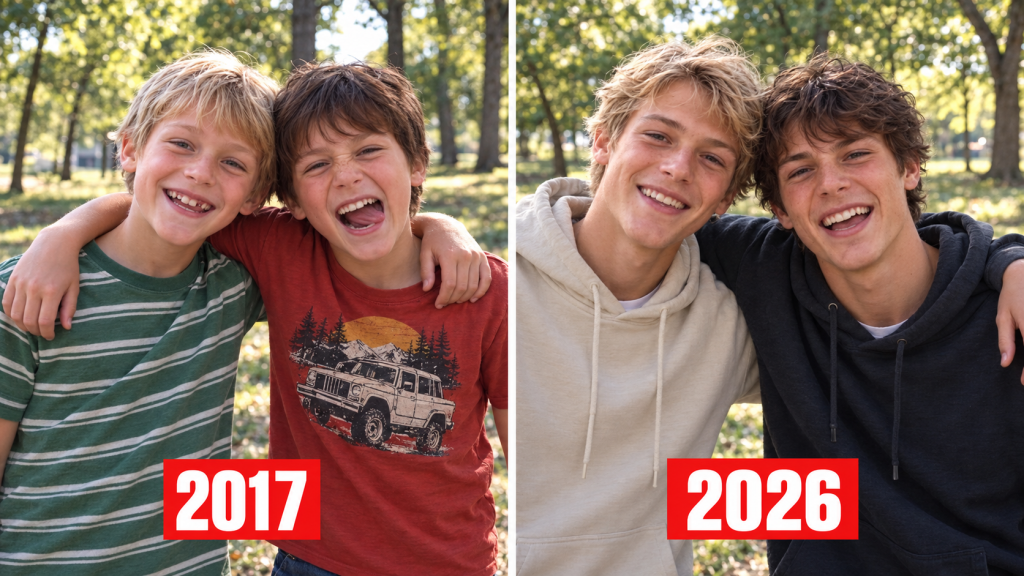
Two eighteen-year-old boys who had spent childhood being mistaken for twins.
Because they were.
Not identical.
But brothers.
People had seen truth in their faces before paperwork ever admitted it.
Greg stood near the porch with an officer.
He looked ruined.
When I saw him, rage swallowed everything else.
I walked toward him.
The officer stepped slightly closer.
Good.
I probably needed that.
Greg whispered,
“I’m sorry.”
I laughed.
“No.”
“Please.”
“You don’t get to start there.”
His face folded.
“I loved him.”
I looked at Ben.
“I’m sure you did.”
That made him look surprised.
I continued.
“That does not make what you did less monstrous.”
He started crying.
“Rachel was dying.”
“No.”
“Rachel was grieving.”
“You stole my child.”
He covered his face.
“I panicked.”
“For eighteen years?”
Silence.
“You had eighteen years to unpanic.”
He shook his head.
“After the first week, I didn’t know how.”
“Tell the truth.”
“I would have lost everything.”
There it was.
Not Rachel.
Not Ben.
Everything.
His life.
His reputation.
His marriage.
Control.
I whispered,
“So you let me lose instead.”
He closed his eyes.
The investigation began.
Slowly.
Messily.
The original hospital records had been altered, but not perfectly.
Old paper archives survived.
Badge access logs.
Archived birth census records.
A retired nurse’s notes.
Financial records.
Greg’s former access privileges.
Daniel’s handwriting on the photograph.
The DNA tests.
Elaine’s testimony.
Enough for authorities to take the matter seriously.
But eighteen years had passed.
People expected immediate arrest.
That did not happen.
The law cares about statutes, evidence, specific offenses, jurisdiction, whether records prove conduct, whether witnesses can testify, whether someone deceased participated, and a thousand things grief does not care about.
Greg eventually admitted more through counsel.
Rachel did not know.
That mattered deeply to Ben.
She had believed he was hers.
Greg had let her believe.
He told investigators Rachel had lost consciousness before doctors told him their biological son had died.
When he saw Daniel with two healthy boys and learned I was unconscious after hemorrhaging, something broke inside him.
He asked Daniel if he could hold one.
Daniel agreed.
Then Greg asked:
“What if we didn’t tell them yet?”
That sentence became the beginning.
Daniel thought hours.
Greg thought forever.
By the time Daniel demanded the baby back, identifying records had been manipulated.
Rachel had already awakened.
Already held Ben.
Already called him by the name she and Greg had chosen for their dead child.
Benjamin.
Daniel lost his nerve.
He told himself exposing the truth would destroy two mothers.
Then every day afterward made confession more expensive.
This did not excuse him.
It explained how cowardice builds architecture.
One compromise.
One delayed confession.
One forged record.
One birthday.
One Christmas.
One year.
Then eighteen.
Authorities found evidence Greg had altered infant discharge records and later obtained replacement documentation through false statements.
Some acts fell outside criminal time limits.
Some did not.
He eventually pleaded to offenses involving falsification of records and identity-related fraud connected to later documentation.
There were also civil cases.
Against Greg.
Against the hospital.
The hospital denied institutional knowledge and argued Greg had acted outside his authority.
That was probably true.
But several failures had allowed one employee’s actions to survive unchecked.
We settled after two years.
Not because money could fix anything.
Because trials are long, uncertain, and sometimes another form of living inside the worst day of your life.
Luke asked me:
“Did we win?”
I said:
“There isn’t a win here.”
He understood.
Ben’s legal identity became another complicated issue.
He did not immediately change his name.
Why would he?
He had been Benjamin Hale for eighteen years.
His school records.
Friends.
Memories.
Rachel’s grave.
All connected to that name.
Eventually, he added Carter as a second middle name.
Benjamin Matthew Carter Hale.
He chose Matthew himself.
Not because I asked.
The day he told me, I cried.
He rolled his eyes.
“You cry a lot.”
“I lost eighteen years.”
“I’m allowed.”
“Fair.”
Our relationship was difficult at first.
People expect reunions to be beautiful.
Some are.
Ours was awkward.
I wanted to ask him everything.
Favorite food.
Childhood fears.
First word.
First injury.
What Rachel sang to him.
What birthdays looked like.
But every question reminded him that I had missed it.
And every answer reminded me.
So therapy taught us something simple.
Stop trying to recover childhood.
Build adulthood.
We started small.
Coffee.
Lunch.
One dinner a week.
Sometimes he came.
Sometimes he didn’t.
I never demanded.
That was important.
I had already had choice stolen from me.
I would not turn love into another claim.
One afternoon, about six months after the truth emerged, Ben asked:
“Do you want me to call you Mom?”
My heart nearly stopped.
But I said:
“I want you to call me whatever feels honest.”
He looked relieved.
“Mrs. Carter feels weird now.”
“Yes.”
“My friends call you Luke’s mom.”
“That remains accurate.”
He smiled.
“What about Claire?”
My name.
Just Claire.
I thought.
“That works.”
For almost a year, I was Claire.
Then one Thanksgiving, he came through the door carrying pie.
He shouted from the hallway:
“Mom, where do you want this?”
The entire house froze.
Ben froze.
Luke froze.
I froze.
Then Ben looked horrified.
“I didn’t mean—”
I crossed the room and hugged him.
He whispered:
“Please don’t make this a huge thing.”
“I won’t.”
I cried into his shoulder.
“You are making it a huge thing.”
“Quiet.”
He laughed.
After that, Mom arrived slowly.
Not replacing Rachel.
Never.
On Mother’s Day, Ben visited Rachel’s grave first.
Then came to see me.
The first year, he apologized.
I stopped him.
“Never apologize for loving the woman who raised you.”
His face broke.
“She wasn’t part of this?”
“No.”
“She didn’t know.”
“I know.”
“Then she gets to remain your mother without competing with me.”
He cried.
So did I.
Luke pretended the pollen was bad.
Coward.
The brothers handled the truth differently.
Luke became obsessed with documents.
He wanted every record.
Every timeline.
Every answer.
Ben avoided them.
For months, he did not want to know the details of his birth.
That caused fights.
Luke once shouted:
“How can you not want to know?”
Ben yelled back:
“Because I have to live inside it.”
That stopped all of us.
Luke thought truth was a puzzle.
Ben understood truth could also be a room you might not be ready to enter.
They apologized.
They remained close.
But being brothers changed something.
As friends, they had chosen each other.
As brothers, suddenly adults expected permanence.
That pressure irritated them.
At nineteen, they stopped living together.
People assumed the revelation had broken them.
It had not.
Ben was messy.
Luke was obsessive.
Apparently genetics did not fix dishes.
Ben moved into another apartment.
Luke said:
“Best decision we ever made.”
Ben replied:
“Love you too.”
They became healthier brothers after they stopped trying to perform twinhood for everyone else.
Elaine took longer.
I did not speak to her for seven months.
That hurt.
She had been my sister for fifty years.
But nine years of silence sat between us.
Eventually, she sent a letter.
Not asking forgiveness.
That helped.
She wrote:
I destroyed Daniel’s confession because I could not bear to be the person who caused you more pain.
That was cowardice disguised as care.
I stared at that sentence for a long time.
Then:
I stole your chance to decide what to do with the truth.
Good.
Specific.
If you never trust me again, I understand.
I called her.
We met at a diner.
She cried.
I cried.
Then I asked:
“Do you remember exactly what Daniel wrote?”
She nodded.
“Most of it.”
We reconstructed what we could.
Not as legal evidence.
That was gone.
But for me.
Daniel had written that he had loved me.
That he knew what he had done was unforgivable.
That every year made confession harder.
That Greg had convinced him the boys were both loved, both safe, and perhaps exposing everything would only satisfy adult guilt while destroying children.
I hated that argument.
Because it contained enough truth to be seductive.
By the time the boys were ten, what would disclosure have done?
Destroyed families.
Yes.
But that did not make secrecy ethical.
The harm was already there.
Silence merely prevented us from responding to it.
Daniel had written:
I kept telling myself I was protecting the life we built. The truth is I was protecting the version of me you believed in.
That line stayed with me.
Because that was the actual center.
Not love.
Not family stability.
Identity.
He could not bear to become the man who gave away his child.
So he let me keep loving a false version of him.
I was furious.
I also missed him.
That combination felt like betrayal at first.
Therapy helped.
Dead people do not have to become saints or monsters.
They can remain complicated.
Daniel had been a loving father to Luke.
A devoted husband in many ways.
He had also committed an act that changed three families and lied to me for the rest of his life.
All true.
I stopped forcing one truth to cancel the others.
Greg’s relationship with Ben was harder.
Ben hated him.
Then missed him.
Then hated himself for missing him.
I told him:
“You are allowed to love someone who did something terrible.”
He looked at me.
“Even if he did it to you?”
“Yes.”
That answer cost me.
But I meant it.
Greg had raised him.
Night feedings.
School pickups.
Flu.
Baseball.
Rachel’s death.
Grief.
Laundry.
College applications.
Love existed there.
So did abduction and deception.
Ben eventually agreed to meet Greg in therapy.
Not reconciliation.
Conversation.
The first meeting lasted twenty minutes.
Ben asked:
“When did you stop thinking you’d return me?”
Greg cried.
He answered:
“By the second morning.”
Ben left.
Did not see him for two months.
Second meeting.
“Did you ever think about Claire?”
Greg said:
“Every day.”
Ben snapped:
“Then why didn’t you tell her?”
Greg answered:
“Because every day you became more my son.”
Ben stood up.
“That answer makes it worse.”
Correct.
Third meeting.
Ben asked:
“Did Mom know?”
Rachel.
Greg said:
“No.”
Ben asked the question three times.
Greg answered no each time.
That mattered most.
Years later, Ben said:
“I can live with the fact that Mom loved me without knowing the truth.”
That preserved something sacred.
Rachel remained innocent in his story.
Not perfect.
Just not complicit.
Greg never regained what they had.
Some relationships do not return to their old shape after truth.
He became someone Ben spoke to occasionally.
Birthdays.
A few lunches.
When Greg developed cancer years later, Ben visited.
Luke did not.
I did not.
Ben asked whether I was angry.
“No.”
“You’re sure?”
“Yes.”
“He hurt you.”
“He raised you.”
“Both matter.”
He hugged me.
That was enough.
There was one more surprise.
Not criminal.
Not devastating.
Just human.
A retired nurse named Margaret Sloan contacted our attorney after seeing a local story about the hospital settlement.
She had worked the maternity floor that night.
She was eighty-one.
She asked to meet me.
We sat in her assisted-living facility.
She took my hands.
“I knew something was wrong.”
My heart tightened.
“How much?”
“Not enough.”
She remembered two Carter boys.
One Hale boy who died.
Then records changing.
She remembered Greg carrying a baby out of one room and returning later without him.
She told a supervisor.
The supervisor said records had been corrected due to a clerical issue.
She believed it.
Mostly.
Then she saw Daniel crying alone in a stairwell.
I whispered:
“Did he say anything?”
“Yes.”
“What?”
Margaret’s eyes filled.
“He said, ‘I made a mistake I can’t undo.’”
I cried.
She continued.
“I asked whether I should call someone.”
“He said no.”
“I wish I had.”
I squeezed her hand.
“You were a nurse with incomplete information.”
“That does not make me feel better.”
“I know.”
She looked at me.
“I’m sorry.”
I believed her.
Not everyone connected to harm had equal responsibility.
That mattered too.
If we make everyone equally guilty, we stop seeing the person who actually chose the wrongdoing.
The hospital later changed newborn identification procedures.
More verification.
More restricted access.
Digital and physical cross-checks.
Could something like what Greg did happen as easily now?
Probably not.
Impossible?
I have learned never to use that word.
Luke went into forensic accounting.
Of course he did.
The boy who wanted every document found a profession built on records.
Ben became a physical therapist.
He said he wanted work where people were more important than paperwork.
That was also predictable.
At twenty-six, Luke got married.
Ben was best man.
During the toast, Ben said:
“We spent eighteen years being asked if we were brothers.”
Everyone laughed softly.
Then:
“Turns out strangers were better at family history than our parents.”
The room went quiet.
Then Luke laughed.
So did I.
Dark humor becomes oxygen eventually.
Ben continued:
“Luke was my brother before DNA told us.”
That line made me cry.
Again.
Then:
“And Claire was my mother before I knew how to call her that.”
That destroyed me.
Luke’s wife handed me tissues before I even asked.
Prepared woman.
At twenty-eight, Ben married.
Before the wedding, he asked if I would sit in the front row.
“Of course.”
Then he hesitated.
“I want a photo of Rachel there too.”
I smiled.
“Good.”
“You’re okay with that?”
“Ben.”
I took his face in my hands.
“I never needed her erased.”
He cried.
“She raised my son when I could not.”
“Even though she did not know that was what she was doing.”
“She loved you.”
“I am grateful.”
We placed Rachel’s photograph beside a small candle near the family seats.
Not as a competition.
As part of the truth.
At the reception, Ben danced with me.
No public mother-son announcement.
Just a song.
Halfway through, he whispered:
“I used to think finding you meant losing her.”
I shook my head.
“No.”
He smiled.
“I know that now.”
Years passed.
The strangest thing was how ordinary everything became.
At first, our family existed in headlines.
Hidden twin.
Hospital records.
DNA.
Betrayal.
Then eventually:
Luke bought a terrible sofa.
Ben got a dog.
They argued over Thanksgiving.
Someone forgot my birthday and blamed the calendar app.
Life rescued us by becoming boring.
I loved boring.
On the tenth anniversary of the day Luke came home with the hospital paper, the boys visited.
Men now.
Not boys.
Luke brought takeout.
Ben brought wine.
We sat at the same kitchen table.
Luke asked:
“Do you ever wish I hadn’t found it?”
I looked at him.
“No.”
“Never?”
“Sometimes I wish the truth had been different.”
“That is not the same thing.”
Ben nodded.
Then asked:
“Do you wish Dad told you?”
Daniel.
I answered:
“Every day.”
Luke looked down.
I continued.
“But I am glad you did.”
He smiled.
Then Ben asked:
“Are you glad you found me?”
I stared at him.
“That may be the stupidest question either of you has asked.”
He laughed.
“Answer.”
“Yes.”
I reached for both their hands.
“Yes.”
Then I said something I had learned the hard way.
“Truth does not guarantee a happy ending.”
“It guarantees that whatever ending comes actually belongs to the people living it.”
They both went quiet.
That was the theft.
Not only eighteen years.
Choice.
I was denied the choice to raise Ben.
Rachel was denied the choice to know her child died.
Ben was denied the choice to know where he came from.
Luke was denied the choice to know he had a brother.
Daniel and Greg made one desperate agreement and forced everyone else to live inside it.
That was what I could never forgive completely.
Not that they were afraid.
People make terrible decisions from fear.
The unforgivable part was renewing the decision every day.
Every birthday.
Every school year.
Every time Luke and Ben stood together and someone laughed:
“You boys could be twins.”
Daniel heard those words.
Greg heard them.
And both men remained silent.
I think about that often.
How truth can stand in a room wearing your own face and people will still insist silence is safer.
They were wrong.
Silence was not safer.
It was simply quieter.
And quiet is not the same thing as peace.
The day Luke came home at eighteen, crying at my door, I thought he was about to tell me he had done something terrible.
Instead, he brought me the worst thing his father had ever done.
And somehow, inside that terrible truth, he also brought my son home.
Not the infant I lost.
That child was gone.
I never got him back.
I got Ben.
Eighteen.
Angry.
Funny.
Messy.
Already shaped by another mother’s love and another father’s failure.
A stranger who looked familiar.
A boy I did not get to raise.
A man I was allowed to know.
That had to be enough.
And eventually, it became more than enough.
Because family is not repaired by pretending stolen years can be returned.
It is repaired by refusing to steal any more.
No more secrets.
No more “for your own good.”
No more adults deciding what truth somebody else is strong enough to survive.
When we did not know what to say, we said:
“I don’t know.”
When something hurt, we said:
“That hurt.”
When one of us needed space, we gave it.
When Ben wanted Rachel honored, we honored her.
When Luke wanted every document preserved, we preserved them.
When I wanted to be furious at a dead husband I still loved, nobody told me grief had to be tidy.
That was how we became a family again.
Not by recovering the old one.
By building a new one where nobody had to disappear for everybody else to stay comfortable.
And on the shelf above my desk sits the photograph that started everything.
Daniel.
Greg.
Two newborn boys.
The six words on the back remain exactly as he wrote them:
We agreed she must never know.
I never covered them.
Never threw the picture away.
Never burned it.
Because someday my grandchildren may ask what happened.
And I will tell them.
Not to punish dead men.
To make sure nobody in this family ever mistakes secrecy for love again.
THE END STORIES! THANK YOU FOR READING GOOD LUCK! ❤️
Related Posts