Wade hit the door again. “Margaret, open it.” I stood in the hallway wearing bedroom slippers, one eye blurred by surgery and the other hidden beneath a plastic shield. The morning sun came through the narrow window beside the door in a white smear.
I could barely make out Wade’s face. But for the first time in years, I could see him clearly. Not with my eyes. With everything else. The banker was still speaking through my phone. “Mrs. Hale, are you safe right now?” I looked at the door.
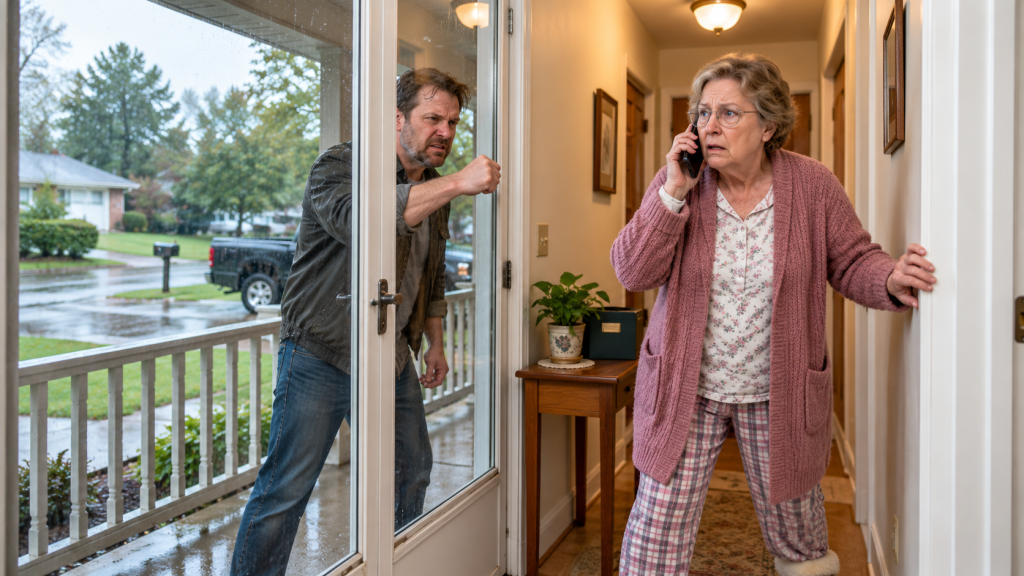
“Yes.” Wade pounded again. “No,” I corrected myself. “Actually, I’m not sure.” The woman’s voice immediately changed. “Do not open the door.” “I wasn’t planning to.” Outside, Wade shouted, “Caroline told you the truth, didn’t she?” That sentence made my stomach turn.
Not What happened?
Not Why is the bank calling?
He already knew.
I tightened my hand around the phone.
The banker said,
“I’m placing a temporary restriction on the account and documenting the transaction as disputed.”
“Thank you.”
“And Mrs. Hale?”
“Yes?”
“Do you recognize an attempted retirement distribution for forty-two thousand dollars submitted yesterday at 3:18 p.m.?”
“No.”
“Did you authorize anyone to make that request?”
“No.”
“Did you authorize your daughter?”
“No.”
Silence.
Then I added,
“She used to have my financial power of attorney.”
“I see that.”
“It was revoked last week.”
Another pause.
“Yes, ma’am. That revocation is why the transaction did not process.”
My knees weakened.
I reached for Royce’s church-pew bench and sat.
A week.
One week.
If Caroline had waited seven more days to punish me for refusing Memorial Day babysitting, I might never have gone to Otis.
If she had not sent that ridiculous typed letter accusing me of having a “transactional relationship with money,” I might never have opened the green accordion file.
If Wade had not been so determined to make me feel guilty, they might have gotten forty-two thousand dollars.
Sometimes arrogance leaves fingerprints.
Outside, tires rolled across the street.
Blue light flashed through my frosted glass.
Wade saw it too.
The pounding stopped.
Then I heard his shoes crossing the porch.
He was leaving.
I stood.
“Officer,” I whispered, though the banker was still on the phone.
A patrol car stopped behind Wade’s truck.
Another pulled in front.
Wade froze at the bottom of my steps.
For a man who had spent years telling everyone how well he handled pressure, he looked remarkably frightened.
One officer approached him.
Another came toward my porch.
I did not open the door until I saw the badge through the glass.
Even then, my hand shook.
“Mrs. Hale?”
“Yes.”
“Did you call regarding someone attempting to enter or pressure you?”
“My lawyer called.”
“Mr. Beaman?”
“Yes.”
Of course Otis had.
He had made me promise.
“If anything strange happens after the revocation, Margaret, you call me before you call your daughter.”
I had laughed at him.
“What do you think they’re going to do, storm the house?”
Otis had stared over his glasses.
“People behave differently when access to money disappears.”
He had been right.
I hated how many people were suddenly right.
The officer looked over my shoulder.
“Are you alone?”
“Yes.”
“May I come inside?”
I stepped back.
Wade was speaking rapidly to the officer near his truck.
I could not hear everything.
Only fragments.
“Family misunderstanding.”
“She knows why I’m here.”
“My mother-in-law.”
“No crime.”
Then my phone buzzed again.
Caroline.
I stared at her message.
Mom, please tell the police to leave. Wade is scared.
I laughed.
I actually laughed.
It was not a happy sound.
A week earlier, I had been the selfish mother choosing cataract surgery over my grandchildren.
Now Wade was scared, and apparently his fear required immediate accommodation.
Mine had never qualified.
Another message came.
Please. There’s an explanation.
I typed one sentence.
Then explain it to the bank.
I turned my phone face down.
The officer inside my house glanced at my eye shield.
“You recently had surgery?”
“Yesterday.”
His expression hardened slightly.
“And Mr. Collins knew that?”
“Yes.”
“Yet he came here at seven in the morning?”
“Yes.”
“Did he tell you why?”
“No.”
From outside, Wade shouted,
“Margaret!”
The officer stepped toward the door.
Wade raised both hands.
“I just need five minutes with her.”
“No.”
My voice carried farther than I expected.
Everyone stopped.
I opened the inner door but left the storm door locked.
Wade stared at me.
His face was red.
“Margaret, listen.”
“No.”
“There’s paperwork that can fix this.”
There it was.
I felt something settle inside me.
“What paperwork?”
His eyes flicked toward the officers.
“Not here.”
“Show me.”
“Margaret.”
“Show me.”
He hesitated.
The officer near him said,
“Sir, does this involve financial documents?”
Wade’s jaw tightened.
“No.”
I stared.
“Then what paperwork?”
He closed his eyes.
A second later, he reached toward his truck.
The officer stopped him.
“Tell me what you’re reaching for.”
“An envelope.”
“Where?”
“Passenger seat.”
The officer retrieved it himself.
White legal envelope.
My name typed across the front.
MARGARET HALE.
The officer opened it after asking Wade.
Inside was a two-page statement.
Otis arrived eleven minutes later.
Gray suit.
Yellow tie.
Hair standing up on one side as though he had dressed while running.
He read the first page on my porch.
Then looked over his glasses at Wade.
“You came here to have a seventy-eight-hour post-operative patient sign a retroactive authorization?”
Wade snapped,
“She’s sixty-eight.”
Otis blinked.
“What?”
“She’s sixty-eight.”
Otis looked at me.
I stared back.
Then he said,
“I stand corrected.”
Even I nearly laughed.
Then his face became serious again.
He held up the document.
“This says Mrs. Hale knowingly approved the nineteen-thousand-four-hundred-dollar loan six months ago.”
Wade said nothing.
Otis continued.
“And that she requested the forty-two-thousand-dollar retirement distribution yesterday.”
“I didn’t request anything,” I said.
Wade looked at me.
“You knew we were struggling.”
That sentence opened something ugly inside me.
“I knew nothing.”
“Caroline told you.”
“She told me you were stressed.”
“That’s the same thing.”
“No.”
I stepped closer to the locked storm door.
“No, Wade. Stress is not permission to use my name.”
His face hardened.
“We were going to put everything back.”
“With what money?”
Silence.
Otis folded the document.
“That’s what I thought.”
Wade looked toward the officers.
“This is a family matter.”
Otis’s mouth tightened.
“Unauthorized debt is not made less unauthorized because the victim knows your children’s birthdays.”
Wade glared at him.
Then at me.
“Caroline agreed.”
My heart hurt.
“I know.”
That took something out of his face.
“You know?”
“She texted me.”
For the first time that morning, Wade looked truly afraid.
“What did she say?”
“That the nineteen-four was her idea.”
His shoulders dropped.
Then, immediately,
“She doesn’t understand what she’s saying.”
I almost admired the speed.
When Caroline was useful, she was his wife.
When she became evidence, she was confused.
“No,” I said. “I think she understands perfectly.”
One officer asked Wade to remain while they documented the complaint.
He was not dragged away in handcuffs.
Life is usually less theatrical than television.
There were questions.
Photographs.
Statements.
Copies of the attempted authorization.
The bank’s fraud department called back.
Otis began making notes.
And I sat at my kitchen table with a plastic shield over one eye while the world I thought I knew rearranged itself around me.
The kettle sat cold on the stove.
I stared at it.
A week earlier, Caroline’s accusation had arrived while that kettle screamed.
You’re choosing yourself over your own grandchildren.
Now, finally, I understood what made that sentence so cruel.
She had already chosen my money over me months before I ever chose surgery over babysitting.
By ten that morning, Wade was gone.
Not cleared.
Not arrested.
Gone with instructions not to contact me directly while the complaint was being reviewed.
Otis stayed.
He made coffee.
Terrible coffee.
Royce used to say lawyers should not be allowed near kitchens because they measure everything except grounds.
I took one sip.
“This is awful.”
Otis nodded.
“I’m gifted in other areas.”
I almost smiled.
Then I asked the question that had been sitting in my throat.
“What happens now?”
“We find out how much they did.”
I looked toward the green accordion file.
“And if it’s more?”
“Then we deal with more.”
My hands started shaking.
Otis noticed.
“Margaret.”
“I gave them seventy-three thousand dollars.”
“I know.”
“No.”
My voice cracked.
“I gave them seventy-three thousand four hundred twenty dollars that I can prove.”
“The things I couldn’t prove were probably another twenty.”
“Thirty.”
“I never asked for it back.”
Otis sat across from me.
“I know.”
“So why steal?”
He was quiet.
That hurt more than an answer.
I whispered,
“Why steal from someone who keeps saying yes?”
Otis leaned back.
“Sometimes repeated generosity teaches gratitude.”
He paused.
“Sometimes it teaches access.”
I looked down.
Royce would have said the same thing more gently.
Or maybe not.
Royce had become less gentle about Caroline’s money habits near the end.
That was why he made the green file.
So we remember the truth if we ever start forgetting.
I touched the cardboard edge.
I had forgotten.
Not the checks.
Not the amounts.
The pattern.
I had turned every rescue into an isolated emergency.
Car trouble was car trouble.
Preschool was preschool.
NICU was NICU.
House down payment was house down payment.
I never placed the emergencies beside one another.
Royce had.
Now the file did.
Otis reached for my phone.
“Call Caroline.”
My stomach tightened.
“Now?”
“If you want answers before Wade tells her what answers to give.”
That sentence hurt.
But I called.
She answered on the first ring.
“Mom?”
Her voice broke on the word.
I said nothing.
“Mom, I’m sorry.”
I closed my eyes.
“Come here.”
“Wade said I shouldn’t.”
“Then don’t bring Wade.”
Silence.
“Are the police still there?”
“No.”
“Is Mr. Beaman?”
“Yes.”
Another silence.
Then:
“I’ll come.”
She arrived forty-five minutes later.
Alone.
No makeup.
Hair tied badly.
Sweatshirt.
She looked nineteen.
That was the problem with children.
They can be forty years old and one frightened expression turns them back into every age you ever carried them through.
I wanted to open my arms.
I did not.
Caroline noticed.
Her eyes filled.
“Mom.”
I pointed toward the chair.
“Sit.”
She sat.
Otis remained in the living room.
Close enough to hear if needed.
Far enough to give us the dignity of ruining our relationship privately.
Caroline twisted her wedding ring.
I looked at her hands.
Those hands had once been so tiny they could wrap around only one of my fingers.
“What did you do?”
She cried immediately.
I did not.
Not yet.
“The loan was my idea.”
“I know.”
“I thought we’d pay it back.”
“With what?”
“Wade’s bonus.”
“What bonus?”
She looked down.
There.
The answer.
“There wasn’t one.”
My stomach tightened.
“What happened to his job?”
She covered her face.
“He lost it.”
“When?”
“January.”
It was May.
Four months.
“He has been going to work every morning.”
“I know.”
“Where?”
“Coffee shops.”
“The library.”
“Sometimes interviews.”
I stared at her.
“You both lied to me for four months?”
She shook her head quickly.
“I didn’t know at first.”
“How long did you know?”
“Since February.”
Three months.
Enough.
“Why was he fired?”
She hesitated.
“Caroline.”
“Expense reports.”
I felt cold.
“What about them?”
“There were discrepancies.”
“What does that mean?”
“He used the corporate card for some personal things.”
My stomach dropped.
“How much?”
“About eleven thousand.”
I stared.
“You married a man who got fired for using money that wasn’t his, and your solution was to use money that wasn’t yours?”
She sobbed.
When I heard myself say it, even I felt the cruelty.
But I did not take it back.
Some sentences hurt because they are sharp.
Others hurt because they fit.
Caroline wiped her face.
“He said he could fix it.”
“Of course he did.”
“He had to repay the firm.”
“So the nineteen-four?”
“Part of it.”
My chest tightened.
“How much?”
“Eleven thousand went to the firm.”
I stared.
The rest?
“Mortgage.”
“Hudson’s preschool.”
“Two credit cards.”
“And the eight hundred dollars you returned to me?”
She looked ashamed.
“That was Wade.”
“I thought it was you.”
“I agreed.”
“Why?”
Her face collapsed.
“Because I was angry.”
There it was.
Not Wade.
Not manipulation.
Her.
“I asked you to watch the kids.”
“You said no.”
“I was having eye surgery.”
“I know.”
“Did you know then?”
“Yes.”
“Did you know the doctor told me not to lift May?”
“Yes.”
“Did you know I was afraid?”
Her eyes filled.
“I didn’t think about it.”
That sentence broke me more than the theft.
Money was numbers.
That was my daughter.
She had not thought about whether her mother was scared before surgery.
She had thought about Hilton Head.
I looked away.
Caroline whispered,
“I was selfish.”
“Yes.”
She flinched.
I continued.
“And you wanted to punish me.”
“Yes.”
The honesty hurt.
But it was the first useful thing she had given me.
I asked,
“Whose idea was the typed letter?”
“Wade wrote it.”
“And you signed it.”
“Yes.”
“Did you believe it?”
She cried.
“I was mad.”
“That wasn’t my question.”
She stared at the table.
“Partly.”
I nodded slowly.
“What part?”
“That money always comes with…”
She stopped.
“With what?”
“History.”
I stared.
She continued.
“Every time we need help, I know you remember the last time.”
“I never bring it up.”
“I know.”
“Then how does it come with history?”
“Because I remember it.”
The answer stopped me.
Caroline cried harder.
“I know what you’ve done.”
“I know every time I call you, there’s another thing.”
“Another emergency.”
“Another check.”
“Another favor.”
“And I hate how it makes me feel.”
I stared.
“So you stole from me because accepting help made you ashamed?”
“No.”
She shook her head.
“I stole because I convinced myself it wasn’t really stealing.”
There it was.
Otis shifted faintly in the other room.
Caroline continued.
“You had given us money so many times.”
“The power of attorney was there.”
“You always said what was yours would be mine someday.”
My stomach turned.
“Someday.”
She closed her eyes.
“I know.”
“No.”
My voice was quiet.
“You need to hear this.”
She looked up.
“An inheritance is not an advance.”
Her face crumpled.
“And being my daughter does not make my bank account a family drawer.”
Tears ran down her cheeks.
“I know.”
“Do you?”
“Yes.”
“Then tell me about the forty-two thousand.”
Her eyes widened.
“That wasn’t me.”
“I know you said that.”
“It wasn’t.”
“What was it for?”
“I don’t know.”
I watched her face.
She seemed genuinely frightened.
“Wade told me he had a plan to fix everything.”
“When?”
“Two days ago.”
“What plan?”
“He wouldn’t say.”
“Did you give him my account information?”
She looked down.
My stomach dropped.
“Caroline.”
“I gave him the old power-of-attorney folder months ago.”
There it was.
Not the withdrawal.
The weapon.
“You gave him everything?”
“He handled paperwork.”
“He said he needed copies.”
I closed my eyes.
“How much access did you give him?”
“I don’t know.”
That was the most frightening answer yet.
Otis came into the kitchen.
“We need to assume all of it.”
Caroline looked at him.
“Am I going to jail?”
Otis did not soften.
“I’m not your lawyer.”
She flinched.
Good.
He continued.
“You need your own attorney.”
Caroline looked at me.
“Mom.”
I held up my hand.
“No.”
She froze.
“I will not rescue you from the consequences of taking nineteen thousand four hundred dollars in my name.”
Her face broke.
“I’m not asking you to—”
“You are.”
I knew my daughter.
The word Mom could be a name.
It could also be a rope.
For years, I grabbed it every time she threw it.
Not today.
I took a breath.
“You need a lawyer.”
“You need to tell the bank the truth.”
“You need to tell investigators exactly what you signed, what you knew, and what Wade did.”
She cried.
“And if that hurts him?”
I looked at her.
“Did that question stop him from hurting you?”
Silence.
Her fingers went to her wedding ring.
Something changed in her face.
“What?”
I asked.
She shook her head.
“Nothing.”
“Caroline.”
She whispered,
“He told me the forty-two thousand was your idea.”
My chest went cold.
“What?”
“He said you called him last week.”
“I did not.”
“He said you wanted to help us quietly because you were tired of fighting.”
I stared.
“He lied to you after I revoked the power of attorney?”
Her mouth fell open.
“You revoked it before?”
“A week ago.”
She looked toward Otis.
Then back at me.
“When?”
“The day after your letter.”
Her face drained.
“Wade knew?”
“I don’t know.”
Otis answered.
“The revocation notice went to institutions. If he tried to use the authority yesterday, the system would have rejected it.”
Caroline sat very still.
Then whispered,
“That’s why he came home angry.”
My skin prickled.
“When?”
“Yesterday afternoon.”
“What did he say?”
“That your bank was incompetent.”
“He said there had been a mistake.”
“He asked where you kept your retirement statements.”
I stared at her.
“And what did you say?”
Her face collapsed.
“I told him.”
The room went silent.
“Where?”
“Green desk drawer.”
I closed my eyes.
“Did he come here?”
“I don’t know.”
My heart started pounding.
Otis immediately stood.
“Do you still keep statements there?”
“Yes.”
We went to the spare room.
The green desk drawer was closed.
Inside were old statements.
But one envelope was missing.
My retirement account summary from February.
I knew because I had placed it there after taxes.
Caroline whispered,
“Oh God.”
Otis looked at me.
“Change every password.”
“I will.”
“Today.”
“I will.”
Caroline covered her mouth.
“He came here.”
I looked at her.
“With whose key?”
She cried harder.
“I gave him mine.”
That was when the last little defense I had been holding for her finally broke.
Not love.
Love remained.
Defense.
Gone.
I looked at my daughter and said,
“You need to leave.”
Her eyes widened.
“Mom.”
“Go get a lawyer.”
“Tell the truth.”
“And do not come back until you understand the difference between needing help and taking what belongs to someone else.”
She sobbed.
“What about the kids?”
My heart twisted.
There it was again.
The place she knew I was softest.
I swallowed.
“I love Hudson and May.”
“They are not bargaining chips.”
“I’m not—”
“You already used them once.”
She went still.
“When?”
“Memorial Day.”
Tears ran down her face.
“You told me I was choosing myself over them because I wouldn’t risk my surgery recovery to babysit.”
She looked down.
“That was using them.”
She nodded.
Barely.
“I’m sorry.”
“I know.”
“Can I hug you?”
The question nearly undid me.
I wanted to say yes.
My whole body wanted to say yes.
Instead, I said,
“Not today.”
Her face crumpled.
She nodded.
Then left.
I stood at the window and watched my daughter walk down my driveway without turning back.
When the car disappeared, I finally cried.
Not because she left.
Because I had let her.
Royce would have been proud.
That thought made me cry harder.
The bank investigation took six weeks.
During those six weeks, my eye healed.
Slowly.
At first, light hurt.
Then colors became sharper.
I had not realized how yellow the world had become through cataracts until white looked white again.
Every morning, I stood by the kitchen window and noticed details I had stopped seeing.
The chipped paint on the fence.
The blue in the hydrangeas.
The tiny crack in Royce’s old birdbath.
My doctor said,
“Your vision will keep clearing.”
He meant my eye.
I heard something else.
Otis and I reviewed everything.
Every account.
Every beneficiary.
Every automatic payment.
Every authorized user.
My credit reports.
My home title.
My insurance.
My retirement.
There were no additional completed loans.
That was the good news.
The bad news was that Wade had tried.
Twice.
One application for a home-equity line against my house had been started but never finalized.
Another credit application had been rejected months earlier because of an identity-verification problem.
My name.
My Social Security number.
My address.
He had been testing doors.
The nineteen-thousand-four-hundred-dollar loan was the only one that opened.
Until the forty-two-thousand-dollar attempt.
I sat across from Otis when he told me.
“How long?”
“Earliest application was eight months ago.”
Eight months.
Before Memorial Day.
Before surgery.
Before Caroline’s angry text.
This was not punishment that spiraled.
It was a pattern that the punishment accidentally exposed.
I whispered,
“Did Caroline know?”
“About the earlier application?”
“Yes.”
“Investigators believe she did not.”
I nodded.
That mattered.
Not enough.
But it mattered.
The completed nineteen-four loan showed Caroline’s involvement clearly.
She had used my information.
Confirmed the electronic authorization.
Participated.
The other attempts pointed mostly toward Wade.
When Caroline’s lawyer finally arranged a meeting, she came without her wedding ring.
I noticed immediately.
She noticed me noticing.
“I left him.”
I said nothing.
She continued.
“He blamed me.”
“For what?”
“Everything.”
Of course.
“He said if I hadn’t texted you, none of this would have happened.”
I almost laughed.
“He may be right.”
Caroline stared.
I continued.
“If you hadn’t texted me that cruel sentence, I might not have called Otis.”
Her face twisted.
“So the worst thing I said to you…”
“May have saved forty-two thousand dollars.”
She cried.
I did not smile.
There was nothing funny about it.
She whispered,
“I’m sorry.”
“I know.”
“No.”
She shook her head.
“I’ve been saying that because I want the pain to stop.”
“That’s not what I mean now.”
I waited.
Caroline took an envelope from her purse.
Inside was a handwritten letter.
She did not ask me to read it immediately.
She just placed it on the table.
Then said,
“I knew the nineteen-four was wrong.”
No because.
No Wade made me.
No stress.
No kids.
“I knew it was your name.”
“I knew you had not agreed.”
“I did it anyway.”
My throat tightened.
She continued.
“I told myself you would help if I asked.”
“Then I used that imaginary yes to excuse not asking.”
That sentence landed.
“I was angry at you for keeping track of money in your head, but I was the one keeping track too.”
“Every time you helped me, I felt smaller.”
“I blamed you for that feeling instead of changing my life.”
Tears filled my eyes.
Caroline wiped hers.
“And when you said no to Memorial Day, I panicked.”
“Because if you could say no to babysitting, maybe you could say no to money too.”
There.
The ugliest truth.
I looked away.
She whispered,
“That scared me.”
I laughed bitterly.
“Imagine how it felt from my side.”
“I’m starting to.”
“Starting?”
She nodded.
“I don’t think I get to say I fully understand yet.”
That answer made me look at her again.
She was changing.
Not changed.
Changing.
There is a difference.
“What happened with Wade?”
“He admitted the forty-two thousand was for the mortgage and a settlement.”
“What settlement?”
“The firm.”
I frowned.
“I thought he repaid eleven thousand.”
“That wasn’t all.”
My stomach dropped.
Caroline continued.
“He had another agreement.”
“What kind?”
“He damaged a client account.”
I stared.
“Did he steal from them?”
“He says it was an unauthorized transfer he meant to reverse.”
I closed my eyes.
Of course he did.
The same story.
Temporary.
Fix it later.
Nobody gets hurt if the money goes back.
That was the family religion he had been preaching.
Caroline whispered,
“The total was thirty-seven thousand.”
I looked at her.
“And he wanted forty-two from me.”
“Yes.”
“Why five extra?”
“Legal fees.”
I laughed once.
It was almost elegant.
Steal money to pay the lawyer helping with the consequences of stealing money.
Caroline looked sick.
“He told me if he didn’t pay, they might refer it criminally.”
“Did they?”
“Yes.”
I sat back.
That explained his desperation.
The pounding.
The retroactive authorization.
He was not trying to save our family.
He was trying to save himself.
Caroline said,
“I gave the investigators everything.”
“Phones.”
“Emails.”
“Accounts.”
“Good.”
She winced slightly.
Not because I was cold.
Because she knew I was not going to praise her for finally doing what truth required.
That was new for both of us.
“What happens to you?”
I asked.
“My lawyer thinks cooperation matters.”
“But I’m still responsible for the loan.”
I nodded.
“As you should be.”
“Yes.”
She swallowed.
“I’m going to repay it.”
“All of it?”
“Yes.”
“Not because I’m asking.”
“I know.”
“Because it’s yours.”
“Yes.”
That mattered.
Months passed.
Wade was charged over conduct connected to the attempted transfer, fraudulent applications, and financial misconduct tied to his former job.
Caroline faced consequences too.
Lighter.
But real.
She entered an agreement that required repayment, financial counseling, and compliance with conditions her attorney explained to her carefully.
I did not ask Otis to make it disappear.
He would not have anyway.
Good lawyers are occasionally useful because they refuse to help us repeat our worst habits.
The bank eventually removed the disputed loan from my responsibility after reviewing the fraud evidence.
The balance did not magically evaporate.
It shifted toward the people responsible.
There were months of paperwork.
Affidavits.
Calls.
Certified letters.
Numbers.
Signatures.
Boring things.
Important things.
The world likes dramatic justice.
Real justice often arrives in envelopes that say RESPONSE REQUIRED WITHIN 30 DAYS.
Wade and Caroline divorced.
I did not celebrate.
I had once danced at their wedding.
Royce had cried during the father-daughter dance because Caroline asked him to stand in after Wade’s father became ill.
Families accumulate memories that do not disappear just because someone later behaves terribly.
Wade remained Hudson and May’s father.
That meant he remained part of the landscape.
But not mine.
Caroline moved into a two-bedroom apartment.
Sold the Subaru.
Pulled Hudson from the expensive preschool.
At first, she apologized for that.
I stopped her.
“Public school is not a tragedy.”
She laughed weakly.
“I know.”
“You used to survive on macaroni.”
“I remember.”
“No, you don’t.”
She had been too little.
That made us both smile.
The first time she asked me to babysit again was nine months after Memorial Day.
She called on a Wednesday.
“Mom?”
“Yes?”
“Hudson has a school thing Friday night.”
“And?”
“I have a work shift I can’t move.”
I waited.
Her voice tightened.
“Would you like to keep May for three hours?”
Not:
I need you.
Not:
You’re their grandmother.
Not:
Family helps family.
Would you like to?
I stared out my kitchen window.
My second cataract surgery had been done by then.
Both eyes clear.
Both.
“I can.”
She exhaled.
“Thank you.”
Then, quickly,
“And if you don’t want to, it’s okay.”
I smiled.
“I said I can.”
“I know.”
“I’m practicing.”
“I noticed.”
Friday night, she arrived with May.
A diaper bag.
Dinner.
Pajamas.
A written schedule.
She handed them to me.
Then paused.
“Too much?”
“No.”
“Too little?”
“Caroline.”
She smiled nervously.
“Right.”
May reached for me.
My granddaughter.
Soft curls.
Warm cheeks.
I took her.
Caroline’s eyes filled.
“You okay?”
I asked.
“Yes.”
She lied.
Then corrected herself.
“No.”
I waited.
“I’m scared you’ll never trust me again.”
I looked at my daughter.
“That depends on what you mean by trust.”
She swallowed.
“I don’t expect access to your accounts.”
“Good.”
“I mean me.”
That was harder.
I looked down at May.
Then back.
“Trust doesn’t come back because the person who broke it is tired of waiting.”
Caroline nodded.
“I know.”
“It comes back through boring things.”
She blinked.
“Boring things?”
“Doing what you said.”
“Showing up when you said.”
“Paying what you owe.”
“Telling the truth when lying would be easier.”
“Accepting no without punishment.”
Tears filled her eyes.
“I can do boring.”
I smiled slightly.
“Good.”
She kissed May.
Then left.
Three hours later, she returned exactly when she said she would.
Boring.
Beautiful.
A year after the bank called, Caroline had repaid six thousand dollars.
Not to me directly.
Through the agreed process.
I saw the statements.
She worked weekends.
Stopped getting manicures.
Canceled streaming services.
Drove an eleven-year-old Honda.
None of those things made her virtuous.
They made her responsible.
There is a difference.
One afternoon, she brought Hudson over.
He was five now.
He climbed onto Royce’s church-pew bench and asked,
“Grandma, why does Mommy say money is not love?”
I nearly dropped my tea.
Caroline froze.
“Hudson.”
“What?”
I looked at her.
She looked embarrassed.
I smiled.
“Because your mommy is learning something.”
He frowned.
“What?”
I sat beside him.
“Love is what people do to care for each other.”
“Money can help.”
“But money isn’t proof that somebody loves you.”
He thought about that.
Then asked,
“So if you don’t buy me a dinosaur, you still love me?”
“Yes.”
He looked suspicious.
“What if it’s a really good dinosaur?”
I laughed until my eyes watered.
Caroline did too.
Healing sometimes arrives disguised as a five-year-old negotiating plastic reptiles.
Two years passed.
Wade eventually accepted a plea arrangement in his financial cases.
There was restitution.
Probation after custody.
Restrictions on financial employment.
Consequences I never imagined when he first sat at our Thanksgiving table calling me “Mom.”
I testified once.
Briefly.
I hated it.
He looked older.
Smaller.
When our eyes met, he looked away.
That hurt more than hatred would have.
After court, Caroline found me in the hallway.
“Are you okay?”
“No.”
She nodded.
“Me neither.”
We sat on a bench.
For a while, neither of us spoke.
Then she said,
“I used to think you kept the green file because you wanted evidence against me.”
I looked at her.
“I know.”
“Now I think Grandpa Royce kept it because he was scared.”
I swallowed.
“Of what?”
“That loving me would make you both stupid.”
I laughed softly.
“He would have phrased it nicer.”
“Probably.”
She stared at her hands.
“I wish he were here.”
“Me too.”
“Would he hate me?”
That question broke my heart.
“No.”
She looked up.
“He’d be furious.”
“Oh.”
“Very.”
She almost smiled.
“But hate you?”
I shook my head.
“No.”
She cried.
I took her hand.
It was the first time I had reached first in two years.
She noticed.
So did I.
Neither of us mentioned it.
Three years after that Memorial Day, the remaining restitution balance from Caroline reached zero.
She brought me the statement.
Not dramatically.
No balloons.
No speeches.
She placed it on my kitchen table.
“Done.”
I read it.
Every dollar.
My throat tightened.
“Okay.”
Her face fell slightly.
I laughed.
“What do you want, a marching band?”
She smiled through tears.
“Maybe one trumpet.”
I stood.
Then hugged her.
Fully.
Not the cautious side hugs we had graduated to.
Not the awkward holiday embrace.
My daughter folded into me and sobbed.
“I’m sorry.”
“I know.”
“I really am.”
“I know.”
“I thought paying it back would make me feel better.”
“Does it?”
“No.”
“Good.”
She laughed against my shoulder.
I held her tighter.
“Money being repaid fixes money.”
“It doesn’t fix trust.”
“I know.”
“But trust is better.”
She pulled back.
“Is it?”
“Yes.”
Her face crumpled.
“How much better?”
“Don’t push your luck.”
She laughed.
So did I.
That summer, Caroline invited me to Hilton Head.
The irony was so perfect I almost refused out of principle.
She said,
“Not as a babysitter.”
I narrowed my eyes.
“No?”
“No.”
“Not as emergency childcare?”
“No.”
“Not because Wade’s firm friends are going?”
She smiled sadly.
“No Wade.”
Just her.
Hudson.
May.
And me.
“Who’s paying?”
She laughed.
“Me.”
I raised an eyebrow.
“Can you afford it?”
That question would once have been criticism.
Now it was simply a question.
“Yes.”
She showed me the budget.
Of course she did.
I laughed.
“You’ve become unbearable.”
“I learned from Otis.”
“God help us.”
We went.
One morning, before the kids woke, Caroline and I sat on a balcony watching the ocean.
She handed me coffee.
“Can I ask you something?”
“Yes.”
“Why didn’t you cut me off completely?”
I looked at the water.
“I did cut you off.”
She frowned.
“Financially.”
“From the accounts.”
“From rescue.”
“I mean emotionally.”
I thought for a long time.
“Because love is not the same thing as access.”
She looked at me.
“I could love you and still protect myself.”
“I could love the children and refuse to let them become tools.”
“I could hope you changed without financing your refusal to change.”
Her eyes filled.
“That sounds hard.”
“It was.”
“Would it have been easier to hate me?”
“Probably.”
She looked down.
“I’m glad you didn’t.”
“So am I.”
She was quiet.
Then:
“I hated you for saying no that weekend.”
“I know.”
“I told myself you were selfish.”
“I know.”
“I don’t think I ever asked if you were scared about surgery.”
“No.”
Her voice broke.
“Were you?”
“Yes.”
“How scared?”
I looked at her.
“Enough that I wrote your name and Otis’s number on a piece of paper beside my bed in case something went wrong.”
Caroline covered her mouth.
I continued.
“Your father used to drive me to appointments.”
“He would make bad jokes.”
“He would ask doctors too many questions.”
“And that week, I realized I had to go without him.”
Tears filled my eyes.
“I was scared.”
Caroline began crying.
“Mom.”
“I’m sorry.”
“I know.”
“No.”
She shook her head.
“I want to say it right.”
I waited.
“I’m sorry that when you needed care, I measured you by how useful you could still be to me.”
That sentence entered the deepest part of me.
I reached across the table.
Took her hand.
“That’s the apology I needed.”
She cried harder.
So did I.
The ocean kept moving below us.
Steady.
Indifferent.
Beautiful.
Five years after the morning Wade pounded on my door, Hudson found the green accordion file.
I had forgotten to put it away after reorganizing the spare-room closet.
He carried it into the kitchen.
“Grandma, what’s C and W?”
My heart jumped.
Caroline was at the sink.
She turned.
Saw the file.
Went still.
I took it from Hudson.
“Old paperwork.”
“Boring?”
“Extremely.”
He lost interest immediately.
Children are merciful that way.
He ran outside.
Caroline stared at the file.
“You still have it.”
“Yes.”
“Do you read it?”
“Not often.”
She nodded.
“Does that bother you?”
“No.”
I believed her.
Then she asked,
“Can I see it?”
I hesitated.
Not because I wanted to protect her.
Because I was not sure what purpose it would serve.
Then I handed it over.
She sat.
Opened it.
Thirteen years of yes.
Apartment deposit.
Hospital bill.
Down payment.
Truck repair.
IVF.
Funeral.
Preschool.
Receipts.
Bank statements.
Little notes in Royce’s handwriting.
At the back, she found the page I had added.
$73,420.
Her fingers trembled.
She whispered,
“I thought you counted because you resented me.”
“No.”
“Dad started the file.”
“Why?”
I sat opposite her.
“To remember patterns.”
She nodded.
Her eyes filled.
“I made you spend a lot of money.”
“Yes.”
She laughed through tears.
“Still direct.”
“I’m sixty-eight plus five now. I’ve earned efficiency.”
She smiled.
Then saw something tucked behind the last divider.
Royce’s handwriting.
A note I had almost forgotten.
Caroline read aloud.
If we ever get afraid that saying no means we don’t love her, read the numbers. Love is not proven by how much damage you absorb.
Her voice broke.
She pressed the note to her mouth.
I had never shown it to her.
For a moment, I wondered if I should have.
Then Caroline whispered,
“He knew.”
“Yes.”
“Before you did.”
“Yes.”
“Before I did too.”
I nodded.
She closed the file.
Then something surprising happened.
She pushed it back toward me.
“Keep it.”
“I planned to.”
“No.”
She smiled faintly.
“I mean don’t throw it away because things are better.”
I looked at her.
She continued.
“I used to think forgiveness meant destroying evidence.”
“I don’t anymore.”
My throat tightened.
“Neither do I.”
The green file went back into the closet.
Not hidden.
Not displayed.
History does not need to sit on the dining table forever.
But it does not need to be burned to prove healing.
Caroline eventually remarried.
Years later.
A man named Samuel.
A high-school science teacher who drove an old pickup and labeled leftovers with dates.
The first time Caroline told me he wanted to marry her, she said,
“I gave him my credit report.”
I nearly choked.
“What?”
“And bank statements.”
“Caroline.”
“He gave me his too.”
I stared.
“Romance is dead.”
She laughed.
“Transparency is sexy now.”
I rolled my eyes.
But I liked him.
Samuel never asked me for money.
That was not why.
He also never acted impressed that I had some.
That mattered more.
Before their wedding, Caroline came over alone.
No crisis.
No request.
She placed a folder in front of me.
I groaned.
“What now?”
“My new power of attorney.”
My body stiffened.
She saw it.
“No.”
She shook her head.
“Not yours.”
“Mine.”
I stared.
“I named Samuel primary and an attorney backup.”
“Not you.”
Relief came so quickly I felt guilty.
Caroline smiled.
“I figured you’ve had enough power of attorney for one lifetime.”
I laughed.
Then she became serious.
“I wanted you to know because…”
She struggled.
“Because I finally understand what one of these means.”
“It isn’t permission.”
“It’s responsibility.”
My eyes filled.
“Yes.”
She nodded.
“I wish I had known that sooner.”
“So do I.”
Samuel and Caroline married in a small garden.
Hudson walked her down the aisle.
May scattered flowers mostly on herself.
I sat in the front row.
When Caroline reached the altar, she looked at me.
Not long.
Just one second.
Enough.
She mouthed,
Love you.
I mouthed it back.
No money changed hands.
No crisis followed.
Nobody needed rescuing.
It was one of the happiest days of my life.
I am seventy-six now.
The cataract surgery turned out beautifully.
Both eyes.
I still drive in daylight.
I avoid nighttime highways because I am old enough to know proving I can do something is not the same as needing to.
Hudson is twelve.
May is eight.
They still stay over sometimes.
By invitation.
Not obligation.
Caroline asks.
I answer.
Sometimes yes.
Sometimes no.
And here is the miraculous part:
When I say no, nothing happens.
No punishment.
No letter.
No silence.
No reversed payment.
No grandchild withheld.
She simply says,
“Okay, Mom. Another time.”
The first few times she did that, I almost cried.
Boundaries can feel shockingly tender when you have lived without them.
Otis retired.
He still sends Christmas cards with terrible handwriting.
On the last one, he wrote:
Still saying no?
I wrote back:
Professionally.
He called me just to laugh.
The church-pew bench Royce built is still by the door.
His green accordion file still lives in the closet.
And the old silver kettle still screams when I forget it on the stove.
Every time it does, I remember that Thursday afternoon.
Caroline’s text.
The rain.
The sentence that was designed to make me feel selfish.
You’re choosing yourself over your own grandchildren.
For years, I believed choosing myself automatically meant choosing someone else less.
That was the lie beneath everything.
The lie that made eighty-hour weeks feel noble.
The lie that made rescuing Caroline feel like motherhood even when she was thirty.
The lie that made saying yes easier than asking whether yes was healthy.
I do not believe it anymore.
Choosing yourself does not always mean abandoning someone else.
Sometimes it means getting the surgery.
Changing the password.
Revoking the power of attorney.
Locking the door.
Letting the bank investigate.
Letting your adult child face what she did.
Sometimes love says yes.
Sometimes love says no.
And sometimes the most loving word in the world is:
Enough.
Caroline learned that.
So did I.
A few months ago, we were sitting in my kitchen while the grandchildren argued over cookies.
The kettle started whistling.
Caroline stood to get it.
Then stopped.
“Mom?”
“Yes?”
“Do you ever wish you hadn’t kept all those receipts?”
I thought about Royce.
The file.
The number.
$73,420.
The nineteen-four.
The forty-two thousand that almost disappeared.
The years afterward.
“No.”
She nodded.
“Me neither.”
Then she smiled.
“I’m glad Grandpa made you remember the truth.”
I looked at her.
“So am I.”
She poured the water.
Set my tea in front of me.
Then kissed the top of my head.
No apology.
No guilt.
No debt.
Just my daughter making her mother tea.
It had taken us years to get there.
Years to learn that family is not a running balance.
That help offered freely should never become an entitlement.
That money cannot purchase gratitude.
That guilt is not love.
That forgiveness without change is just another form of forgetting.
And maybe that is why I kept the green accordion file.
Not to count what Caroline owed me.
But to remember what I owed myself.
The truth.
Because Royce had been right all along.
Sometimes, when we love someone enough, we become tempted to forget the truth to keep the peace.
But peace built on forgetting is only silence.
Real peace came later.
After the bank.
After the lawyers.
After the tears.
After Caroline learned to hear no without turning it into rejection.
After I learned to say no without turning it into guilt.
That peace did not cost $73,420.
It cost something harder.
Honesty.
And for the first time in my life, I could finally afford it.
THE END STORIES! THANK YOU FOR READING GOOD LUCK !❤️
Related Posts