The headlights grew brighter. Richard turned toward the mouth of the alley. “Get behind me.” I almost laughed. Nine nights sleeping in a car had already taught me how useless certain sentences sounded when fear arrived.
“Who is it?” “I don’t know.” The black SUV stopped behind us. For one terrible second, nobody moved. Then the driver’s door opened. My father stepped out. Dad. Same dark jacket he wore to church. Same face I had watched across the kitchen table while he told me three plastic bags were enough to start adulthood.
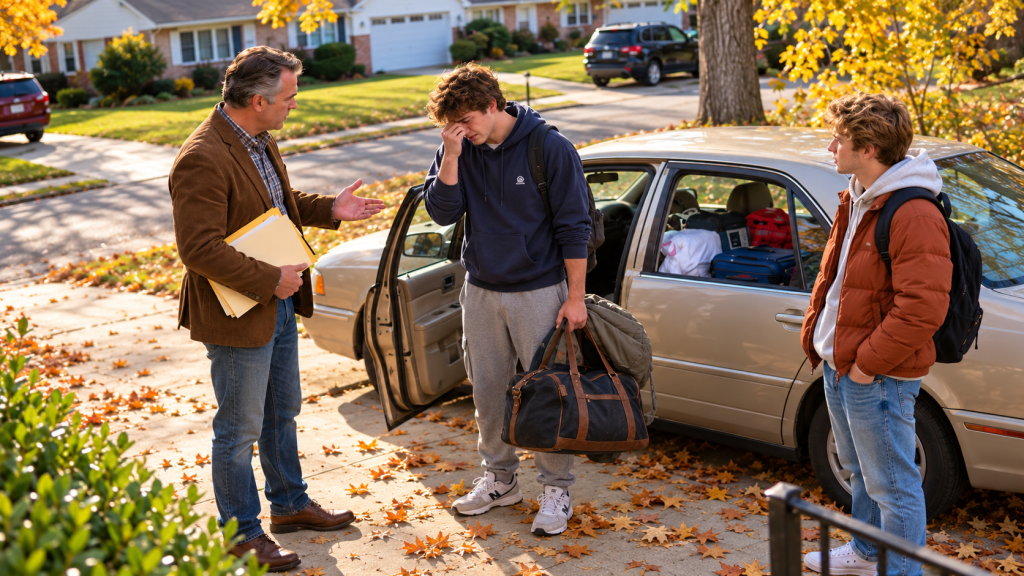
Same man who had stolen three thousand dollars from me and called it rent. He slammed the door. “Nathan.” Richard quietly closed his briefcase. Dad looked at him. “You stay away from my son.” The word son almost made me laugh.
I had been his son when he needed control.
An adult when he needed me gone.
A child again now that someone else had found me.
I held Grandfather’s letter tighter.
Dad saw it.
His face changed.
“You opened it.”
I stared at him.
“You lied to me.”
“Nathan, listen.”
“You told me he was dead.”
“He should have been.”
Richard’s voice sharpened.
“Careful.”
Dad pointed at him.
“You don’t speak.”
Richard did not move.
Dad turned back to me.
“Get in the car.”
“No.”
His eyes narrowed.
“I said get in.”
“No.”
I had never spoken to him like that.
Not because I respected him too much.
Because fear had always done the speaking first.
But hunger does something to a person.
So does sleeping upright in a broken sedan.
So does learning your father stole hundreds of thousands of dollars before taking the last three thousand you had.
Dad took one step closer.
“Nathan, you don’t understand what this man is doing.”
Richard said quietly,
“I’m executing James Brooks’s final instructions.”
Dad laughed bitterly.
“Of course you are.”
He looked at me.
“Your grandfather was a manipulative bastard.”
“He was alive.”
Dad stopped.
That was all I needed.
“You knew.”
He looked away.
“You knew he was alive.”
Silence.
“And you made me believe he was dead.”
“I had reasons.”
“Because he knew what you stole?”
Dad’s head snapped back toward me.
Richard looked at him carefully.
Dad’s face told me I had struck something real.
I whispered,
“Four hundred thousand dollars.”
“Nathan.”
“Was it true?”
Dad looked toward Richard.
Then back.
“It wasn’t that simple.”
There are sentences guilty people love.
It wasn’t that simple.
You don’t understand.
There’s more to the story.
I had heard enough versions of them in the last ten minutes to last a lifetime.
I stepped forward.
“Did you steal it?”
Dad’s jaw tightened.
“I moved money.”
I laughed.
“Where I come from, that’s called stealing.”
“You don’t know where you come from.”
The words came out too fast.
Too sharp.
Richard’s expression changed.
Mine probably did too.
“What does that mean?”
Dad froze.
Then shook his head.
“Nothing.”
“Say it.”
“I said nothing.”
Richard spoke.
“Charles.”
I had never heard anyone use my father’s first name with that kind of warning.
Dad turned.
“Don’t.”
Richard’s voice remained calm.
“You came here voluntarily.”
“You brought yourself into this.”
Dad’s face went pale.
I looked between them.
“What is he talking about?”
Neither answered.
I suddenly understood that the four hundred thousand dollars was not the only secret.
Maybe not even the biggest one.
I held up Grandfather’s letter.
“What else did he know?”
Dad shook his head.
“We’re leaving.”
“No.”
He grabbed my arm.
Richard moved instantly.
“So help me, Charles, remove your hand.”
Dad stared at him.
I pulled away.
For the first time in my life, my father looked unsure of what authority he still had over me.
Then another car entered the alley.
A sedan.
Two people stepped out.
A woman and a man.
Richard relaxed.
Dad did not.
The woman approached first.
“Nathan?”
I nodded.
She held up an identification wallet.
“Laura Mendel. I’m an investigator working with Mr. Hartwell on behalf of the estate.”
The man beside her was a uniformed officer.
Dad cursed under his breath.
Laura looked at him.
“Mr. Brooks, your attorney advised you not to contact Nathan directly.”
My stomach dropped.
“Attorney?”
Dad looked away.
Richard sighed.
“He’s known about the estate proceedings for several weeks.”
I stared at my father.
“Several weeks?”
“Nathan—”
“You knew Grandfather died?”
“Yes.”
“And you knew he left everything to me?”
Silence.
My chest tightened.
“You kicked me out after you knew.”
Dad’s face shifted.
For the first time, something like shame appeared.
Then it vanished.
“You were eighteen.”
I laughed.
“That’s your answer?”
“You were going to be fine.”
I looked around the alley.
The dumpsters.
My dead car.
The grease-stained pavement.
The half-crushed paper bag I had been about to inspect for food.
“Does this look fine?”
He said nothing.
That silence answered more than words ever could.
Richard stepped closer to me.
“Nathan, we need to leave.”
Dad snapped,
“He’s not going anywhere with you.”
The officer looked at him.
“He’s eighteen.”
The same words Dad had used to throw me out.
Now they protected me.
I almost smiled.
Dad heard it too.
I saw the irony hit him.
He looked at me one last time.
“Your grandfather ruined this family.”
I shook my head.
“No.”
My voice surprised even me.
“You did.”
Richard guided me toward the sedan.
As I got in, Dad called after me.
“You take that money, Nathan, and you’ll find out what kind of man James really was.”
I stopped.
Turned.
Then said,
“I already found out what kind of man you are.”
I got into the car.
Dad did not follow.
Richard drove.
For the first five minutes, nobody spoke.
Then my stomach growled so loudly Laura looked at me.
“When did you last eat?”
I stared out the window.
“Yesterday.”
“What?”
“I had half a sandwich.”
Richard’s hands tightened on the steering wheel.
Laura turned toward me.
“Why didn’t you say anything?”
I laughed softly.
“You were explaining that I inherited a company.”
That was the moment I started crying.
Not when Dad appeared.
Not when I learned about the stolen money.
Not even when I learned Grandfather had been alive my whole life.
I cried because someone asked when I had last eaten.
Richard pulled into a diner ten minutes later.
He ordered enough food for three people.
I ate like I was ashamed of being hungry.
Richard noticed.
“Slow down.”
“I’m fine.”
“You’re going to make yourself sick.”
That sounded almost fatherly.
It made me angry.
“Don’t.”
He stopped.
“Don’t what?”
“Act like you know me.”
His expression softened.
“You’re right.”
I hated that answer too.
I wanted someone to argue.
Someone to be wrong in a simple way.
Instead, Richard gave me space.
After I finished, he slid a hotel key across the table.
I stared at it.
“I thought the inheritance condition said I couldn’t accept housing.”
“From your father.”
I looked up.
“Not from the estate.”
“The estate can provide temporary lodging necessary to preserve your safety and complete the conditions.”
My stomach tightened.
“So Grandfather planned for this?”
Richard looked tired.
“He hoped your father would not force you out.”
“But he prepared in case he did.”
“Yes.”
I stared at the key.
A room.
A bed.
A shower.
After nine nights in a car, a hotel room felt less believable than the inheritance.
I whispered,
“What else did he plan?”
Richard took a breath.
“More than I think you’re ready for tonight.”
I laughed bitterly.
“I slept behind a restaurant and found out my dead grandfather was alive.”
“Try me.”
He glanced at Laura.
She nodded once.
Richard opened his briefcase again.
“There is a trust.”
I stared.
“I thought he left everything to me.”
“He did.”
“But because you’re eighteen, your grandfather structured control in stages.”
My stomach sank.
“Meaning?”
“You inherit ownership now.”
“Full operational control later.”
“When?”
“After graduation and completion of a six-month education period with the company’s independent trustees.”
I leaned back.
“So I’m rich but not allowed to touch it.”
“You’re not being punished.”
“It feels familiar.”
He flinched.
Good.
I continued.
“What can I access?”
“A living stipend.”
“Tuition if you continue your education.”
“Housing.”
“Medical care.”
“Transportation.”
“And you can participate in company meetings as beneficiary.”
“How much is the stipend?”
Richard hesitated.
“Enough.”
“That is not a number.”
“Six thousand dollars per month until you graduate.”
I stared.
I had survived nine days on less than twenty dollars.
Six thousand sounded fictional.
Then Richard added,
“But the condition remains.”
“No money, housing, or employment from Dad.”
“Correct.”
“Why?”
“Because James believed Charles would try to create dependency.”
I looked away.
“He already did.”
Richard was quiet.
“What about my car?”
“The estate can repair or replace it.”
I shook my head.
“No.”
He frowned.
“Why?”
“I want that one fixed.”
“It may not be worth fixing.”
“It’s mine.”
Richard studied me for a moment.
Then nodded.
“Then we fix it.”
That small answer mattered.
No argument.
No override.
Just yes.
I looked at the envelope again.
“There’s more, isn’t there?”
Richard nodded.
“Your grandfather also left a recorded statement.”
“For me?”
“Yes.”
“Can I watch it?”
“Tomorrow.”
“Why not now?”
“Because you need sleep.”
I almost snapped at him.
Then realized I could barely keep my eyes open.
For once, someone telling me to rest did not feel like control.
It felt like permission.
At the hotel, I stood under hot water until the mirror disappeared behind steam.
Then I crawled into a bed so soft it hurt.
I thought I would sleep instantly.
I didn’t.
I kept hearing Dad.
You don’t know where you come from.
At 2:13 in the morning, I texted Richard.
What did he mean?
He replied within two minutes.
We’ll talk tomorrow. You deserve the full answer, not a midnight fragment.
I hated that answer.
But he was right.
I slept anyway.
The next morning, Richard brought me to the office of Hartwell, Mendel & Pierce.
The boardroom had more glass than my entire high school.
On the table sat a laptop.
A sealed file.
And breakfast.
I ate first.
That was progress.
Then Richard opened the laptop.
My grandfather appeared on screen.
I stopped breathing.
He looked older than I imagined.
White hair.
Thin face.
Dark eyes.
My eyes.
That hurt more than I expected.
He looked directly into the camera.
“Nathan.”
I leaned forward.
“If you are watching this, then I’m dead, which means I lost the chance to do something I should have done years ago.”
His voice was steady.
“I should have found you sooner.”
My throat tightened.
“I let legal threats, family shame, and my own pride keep me at a distance.”
“I told myself I was respecting boundaries.”
“The truth is, I was afraid your father would disappear with you completely.”
My hands clenched.
Grandfather continued.
“Your father and I destroyed our relationship long before you were born.”
“He believed I loved the company more than him.”
“There were times he was right.”
That surprised me.
I had expected a speech explaining why Dad was evil.
Instead, Grandfather admitted guilt.
“I was hard on Charles.”
“I confused discipline with affection.”
“I rewarded achievement and treated mistakes like character flaws.”
“I helped build the anger he later used to justify what he did.”
He paused.
“But I did not make him steal.”
My breath caught.
“And I did not make him lie to you.”
There.
Context.
Not excuse.
Something I would understand much later.
Grandfather continued.
“When Charles worked for Brooks Holdings, he transferred company funds through accounts tied to your mother.”
My stomach tightened.
“Your mother discovered it.”
I leaned closer.
“Her name was Elena Brooks.”
I had barely heard anyone speak about her.
She died when I was six.
Car accident.
That was the story.
Grandfather’s eyes lowered.
“Elena came to me.”
“She brought records.”
“She wanted Charles to confess and repay the money.”
“He refused.”
My heart pounded.
“Then Elena did something that changed everything.”
Grandfather paused.
“She prepared to leave him.”
I froze.
My mother had planned to leave Dad?
I had never known.
“She asked me to help protect you.”
My eyes burned.
“Not financially.”
“Legally.”
“She feared Charles would use custody to control her.”
Grandfather looked into the camera.
“And she told me something else.”
My stomach dropped.
“She said Charles had begun telling people I was dangerous.”
“That I had threatened him.”
“That I was unstable.”
“She believed he was preparing a story that would make it easier to isolate you from me.”
My hands shook.
“But then Elena died.”
I stopped breathing.
The room disappeared.
Grandfather’s voice softened.
“The police ruled the crash accidental.”
“There was no evidence otherwise.”
“I need you to understand that.”
Richard glanced at me.
Grandfather continued.
“But after her death, Charles cut off every path I had to you.”
“He returned letters.”
“Changed phone numbers.”
“Threatened restraining orders.”
“And eventually, he told you I was dead.”
My chest hurt.
Then Grandfather said,
“There is one more truth.”
I looked at Richard.
He looked back.
This was it.
The thing Dad almost said in the alley.
Grandfather continued.
“You are my grandson.”
“No question.”
“But Charles is not your biological father.”
The words did not make sense.
For a moment, language itself failed.
Then the meaning hit.
I stood so quickly the chair rolled backward.
“No.”
Richard remained still.
Grandfather continued on screen.
“Elena told me shortly before her death.”
I stared.
“No.”
“She had been separated from Charles briefly before you were conceived.”
“She had a relationship with another man.”
My hands shook.
“His name was Daniel Mercer.”
I whispered,
“No.”
Grandfather’s recording continued.
“Elena believed Daniel was your biological father.”
“She never completed legal testing.”
“After reconciling with Charles, he raised you as his son.”
“Years later, he discovered the truth.”
I could barely breathe.
“When?”
Grandfather answered as if he heard me.
“When you were six.”
The year Mom died.
My knees weakened.
I sat again.
“Charles found letters Elena had kept.”
“After that, whatever remained between us disappeared.”
“He blamed me for knowing.”
“He blamed Elena.”
“And eventually, I believe he blamed you.”
That sentence cut deepest.
Not because I knew it was true.
Because suddenly too much made sense.
The difference between how he treated my stepbrother and me.
The coldness.
The way I had always felt like a guest who owed rent.
The money.
The birthday.
Three plastic bags.
Grandfather said,
“None of this changes who raised you.”
“Biology is not permission to erase history.”
“If Charles loved you, that love was real.”
“If he failed you, that failure was real too.”
“You do not have to choose one story.”
Tears ran down my face.
Then he looked almost directly into me.
“And Nathan, do not inherit my company thinking money will answer the question of who you are.”
“It won’t.”
“Money amplifies whatever you bring to it.”
“So finish school.”
“Learn the business.”
“Learn your mother’s story.”
“And decide what kind of man you want to become before strangers start calling you powerful.”
The screen went black.
I sat there.
Silent.
Richard did not speak.
Eventually I whispered,
“Did Dad know Grandfather knew?”
“Yes.”
“And Daniel?”
“Your grandfather located him years later.”
My head snapped up.
“Is he alive?”
Richard hesitated.
“Yes.”
My entire body went cold.
“Where?”
“Colorado.”
“Does he know about me?”
“Yes.”
I stood.
“No.”
Richard remained seated.
“He found out six years ago.”
“Six years?”
“Yes.”
“And he never contacted me?”
“He was asked not to.”
“By who?”
“Your grandfather.”
I stared.
Anger rose again.
“So everybody gets to decide what truth I can handle except me?”
Richard flinched.
“That is fair.”
“No, it isn’t.”
“I meant your anger is fair.”
I paced.
“Grandfather did the same thing Dad did.”
“Not the same.”
“He still chose for me.”
“Yes.”
Richard did not defend him.
That mattered.
“He believed contacting you while you were a minor might trigger Charles to disappear again.”
“He intended to tell you when you turned eighteen.”
“He died three weeks before your birthday.”
I stopped.
Three weeks.
So close.
Richard continued.
“Daniel has written you letters.”
I stared.
“How many?”
“Several.”
“Where are they?”
Richard opened the sealed file.
Inside were envelopes.
My name.
Different handwriting.
Six of them.
I could not touch them.
Not yet.
I whispered,
“I need to finish school.”
Richard nodded.
“Yes.”
“Then I want to finish school.”
That became the first decision I made after inheriting a fortune.
Not buying a car.
Not opening an account.
Not meeting my biological father.
Going back to high school.
The estate moved me into a modest furnished apartment fifteen minutes from campus.
I insisted on modest.
Richard tried to argue.
Then remembered.
The first morning I walked back into school, nobody knew.
I wore the same jeans.
Same backpack.
Same face.
But everything had changed.
My guidance counselor, Mrs. Patel, stopped me outside English.
“Nathan.”
I froze.
She looked at me.
“Where are you staying?”
My stomach tightened.
“How do you know?”
“Your attendance form listed a new address.”
I looked away.
She softened.
“You don’t have to tell me everything.”
That sentence nearly undid me.
Most adults in my life demanded information because they wanted control.
She offered privacy.
So I told her enough.
I had housing.
I was safe.
I planned to graduate.
She nodded.
Then said,
“I’m proud of you.”
I almost cried in the hallway.
I had inherited millions.
That was still the richest thing anyone gave me that week.
Dad came to school twice.
The first time, security turned him away.
The second time, he waited across the street.
I saw him from the library window.
He stood beside his SUV.
Hands in pockets.
Watching.
I did not go outside.
That night, he emailed me.
You need to hear my side.
I deleted it.
Then restored it from trash.
Not because I forgave him.
Because Grandfather had warned me.
Learn the whole story.
So I replied:
Write it. Do not come to school.
His response arrived four hours later.
Long.
Messy.
Angry.
He admitted stealing from Brooks Holdings.
Not in those words.
He called it “borrowing against compensation I was denied.”
He blamed Grandfather.
Said James humiliated him.
Underpaid him.
Promoted outsiders.
Treated him like a child.
Then he wrote about Mom.
Your mother betrayed me.
I stared at that line.
He said Elena had planned to leave.
Said she had lied about Daniel.
Said he found out I was not biologically his after her death.
Then came the sentence that stayed with me.
I raised you anyway.
Anyway.
As though I had been damage he nobly tolerated.
I stopped reading.
The next day, I gave the email to Richard.
He read it.
Then asked,
“What do you want to do?”
That question had become increasingly important.
Not what Grandfather wanted.
Not what Dad wanted.
What did I want?
“I want my three thousand dollars back.”
Richard blinked.
Of everything, that surprised him.
“The estate is worth considerably more.”
“I know.”
“So why the three thousand?”
“Because that was mine before any of this.”
He understood.
An attorney sent Dad a formal demand regarding the money he took from my savings.
Dad ignored it.
So I filed a small civil claim with help.
It was not about needing the money.
It was about naming the act.
When Dad finally appeared at the hearing, he looked furious.
The judge asked whether he had taken funds belonging to me.
Dad said,
“They were in an account I controlled while he was a minor.”
The judge asked,
“Were the funds earned by him?”
“Yes.”
“Did you use them for his benefit?”
Dad hesitated.
“Household expenses.”
“Did you give him notice?”
“No.”
“Did you return them when he turned eighteen?”
“No.”
The judge looked at him.
Then at me.
The judgment was simple.
Dad owed me the amount plus small costs.
No dramatic speech.
No public humiliation.
Just a piece of paper saying what happened was real.
When the check arrived, I did not spend it.
I framed a copy.
Not the check.
The judgment.
Then I put the actual money into an emergency savings account.
My own.
Graduation came three months later.
I wore a borrowed gown.
My class had nearly four hundred students.
When my name was called, I walked across the stage.
Mrs. Patel clapped from the faculty section.
Richard stood in the audience.
Laura too.
And beside them was a man I had never met.
Tall.
Gray at the temples.
Hands shaking.
Daniel.
My biological father.
I knew immediately.
Not because we looked identical.
We didn’t.
Because he looked at me the way someone looks at a photograph they have waited years to see move.
After the ceremony, I stood twenty feet away from him.
Neither of us spoke.
Then he said,
“Hi, Nathan.”
My throat tightened.
“Hi.”
He started crying.
That made it worse.
“I’m sorry.”
I almost laughed.
Apparently every adult in my life owed me that sentence.
“For what?”
“For not fighting harder to meet you.”
I looked at Richard.
He stepped away.
Good.
I looked back at Daniel.
“Did you know who I was?”
“Yes.”
“For six years.”
“Yes.”
“Did you want to contact me?”
“Every day.”
“Then why didn’t you?”
He swallowed.
“Because James convinced me that if I pushed, Charles would move you again.”
“He said he had already lost track of you twice.”
My stomach tightened.
“Twice?”
Daniel nodded.
“Your father moved without telling him.”
“Changed schools once.”
“Changed phone numbers.”
I remembered fourth grade.
Sudden move.
Dad said the landlord sold the house.
Maybe that was true.
Maybe not.
Daniel continued.
“I was afraid my need to know you would make your life harder.”
I stared.
“That still means you chose for me.”
“Yes.”
No argument.
“I’m sorry.”
We stood there.
Then he held out an envelope.
“Your mother wrote this.”
My breath stopped.
“What?”
“She sent it to me shortly before she died.”
My hands shook.
“Why do you have it?”
“She asked me to keep it if I couldn’t safely reach you.”
I took it.
The envelope was old.
Yellowed slightly.
My name in my mother’s handwriting.
I had not seen her handwriting in twelve years.
I sat on a bench.
Opened it.
Nathan,
The first word destroyed me.
I cried before reading the rest.
If you ever receive this, I need you to know something before anyone tells you who your father is. You were wanted.
I covered my mouth.
You were not a mistake between two adults who made a mess. You were wanted before I knew how complicated your life would become.
My vision blurred.
Charles is legally your father and has loved you in ways that mattered. Daniel may be your biological father, but biology does not cancel the years Charles held you when you were sick, taught you to throw a ball, or carried you asleep from the car.
I froze.
Those memories existed.
Dad had once loved me.
Or acted like it.
Maybe both.
Mom continued.
But if anyone ever uses your biology to make you feel like a debt, leave.
I could barely breathe.
A child does not owe gratitude for being raised.
My hands shook.
Parents owe children care because children did not ask to be born.
I cried harder.
If Charles becomes angry after learning the truth, remember that his pain is real, but it is not your responsibility to absorb.
My mother had written my entire childhood before it happened.
Then the final lines:
And if Daniel ever meets you, make him earn the relationship slowly. Blood opens a door. It does not build a home.
I laughed through tears.
That sounded like her.
Even from the grave, she did not make anything easy.
I looked at Daniel.
He was crying too.
“She was right,” he said.
“I know.”
He did not ask for a hug.
That mattered.
I gave him one anyway.
Briefly.
Then stepped back.
“Slowly.”
He nodded.
“Slowly.”
After graduation, the second condition of Grandfather’s will began.
Six months learning Brooks Holdings.
I expected suits.
Boardrooms.
Rich men using words like leverage.
There was some of that.
But the company was stranger and more ordinary than I imagined.
Warehouses.
Small apartment buildings.
Regional logistics.
Commercial properties.
A chain of laundromats Grandfather bought in the 1990s because he believed people always needed clean clothes.
I started at the bottom by choice.
I spent two weeks with maintenance.
One week with accounting.
One with leasing.
Three with warehouse operations.
I asked stupid questions.
Then better ones.
Employees stared at me at first.
The homeless teenage heir.
The story had leaked.
I hated it.
One manager named Luis treated me normally.
On my first day, he handed me work gloves.
“Those shoes are useless.”
I looked down at the only decent pair I owned.
“They’re all I have.”
He nodded.
“Then don’t step on nails.”
That was it.
No pity.
I liked him immediately.
By month three, I discovered something.
The company records still contained unresolved entries connected to Dad’s old theft.
Not four hundred thousand.
More.
Accounting staff had always suspected additional losses.
Grandfather had never proven them.
I brought the files to Richard.
He looked at me carefully.
“What do you want?”
That question again.
“Find the truth.”
A forensic review followed.
Dad had moved roughly four hundred thousand directly.
But he also approved related contracts benefiting a shell business tied to his then-friend and later brother-in-law.
Total harm exceeded seven hundred thousand over several years.
Grandfather knew only part.
When Dad learned the estate was reopening the matter, he finally contacted me directly.
One voicemail.
“Nathan, if you destroy me over this, remember I fed you for eighteen years.”
I listened twice.
Then deleted it.
Not because it did not hurt.
Because Mom had already answered him from twelve years ago.
A child does not owe gratitude for being raised.
The estate’s attorneys handled the rest.
Some claims were too old.
Some were not.
Civil settlements.
Tax issues.
Business restrictions.
Not prison.
Real life rarely delivers perfect symmetry.
Dad did not lose everything.
He lost enough.
He had to sell the SUV.
His wife left less than a year later.
My stepbrother went to live with her.
I did not celebrate that.
Children should not inherit the consequences of adults when it can be avoided.
My stepbrother, Evan, emailed me once.
Did Dad really take your money?
I replied:
Yes.
He asked:
Did he steal from Grandfather too?
Yes.
Then:
Does that mean he never loved us?
I stared at that one for a long time.
Finally I wrote:
No. It means love did not stop him from doing harmful things. Both can be true.
I wished someone had taught me that earlier.
Six months after graduation, I gained broader control of the trust.
Not total.
Grandfather had built guardrails.
At nineteen, I hated them.
At thirty, I would be grateful.
My first major decision was not about investments.
I created an emergency housing fund for students in the county who became homeless before graduation.
Richard asked,
“Why through the company?”
“Because I know what nine nights feels like.”
He nodded.
The program paid for temporary motel rooms, transportation, meals, and document replacement.
No speeches.
No cameras.
No requirement that students become inspiring afterward.
They only had to need help.
The first student was seventeen.
Her mother disappeared for three days.
She had nowhere to sleep.
When the school counselor called, our fund placed her in a supervised emergency program.
I went home afterward and cried.
Because somewhere in another version of my life, that might have been me.
I met Daniel slowly.
Exactly as Mom instructed.
Coffee.
Lunch.
Then longer conversations.
He had married years earlier.
No children.
His wife, Rebecca, knew about me before we met.
She did not call herself anything.
Not stepmother.
Not bonus mom.
Just Rebecca.
I liked that.
One afternoon, Daniel asked,
“Can I show you something?”
He took out a shoebox.
Inside were copies of every birthday card he had written me but never sent.
Age twelve.
Thirteen.
Fourteen.
Fifteen.
Sixteen.
Seventeen.
Eighteen was blank.
“I didn’t write that one.”
“Why?”
“I thought if I finally met you, I should stop talking to an imaginary version of you.”
That was one of the best things he ever said.
We built something.
Not father and son immediately.
Not best friends.
Something honest.
Eventually, I called him Dad once by accident.
He cried.
I pretended not to notice.
Then, three years after I inherited Brooks Holdings, my legal father called.
Charles.
By then, I had stopped calling him Dad in my own head.
His voice sounded older.
“Nathan.”
“Yes.”
“I’m sick.”
My stomach tightened.
“What kind?”
“Heart.”
I closed my eyes.
“What do you want?”
He was quiet.
Then:
“To see you.”
I nearly said no.
Instead:
“Why?”
“Because I don’t want to die like this.”
I laughed softly.
“That sounds like a reason for you.”
He deserved that.
He knew it.
“Yes.”
He paused.
“It is.”
Then:
“But I also owe you something.”
I met him in a hospital two days later.
He looked smaller.
No dark jacket.
No authority.
Just a man in a gown with wires taped to his chest.
I stood by the door.
He looked at me.
“You look like Elena.”
My throat tightened.
“People say that.”
He nodded.
“I used to hate it.”
There.
Even dying, truth could still hurt.
He continued.
“After I found out.”
“About Daniel?”
“Yes.”
“I would look at you and see her betrayal.”
I said nothing.
“You were six.”
“I know.”
“You punished a six-year-old.”
His face twisted.
“Yes.”
“No excuse?”
He closed his eyes.
“No.”
That surprised me.
“I did love you.”
I stared.
“I believe you.”
He opened his eyes.
“You do?”
“Yes.”
Tears filled them.
I continued.
“That doesn’t make what you did smaller.”
He nodded.
“I know.”
We were both quiet.
Then he pointed toward a bag.
“Your money.”
I frowned.
“What?”
“The three thousand.”
“You already paid the judgment.”
“No.”
“The actual money.”
He reached inside the bag.
Pulled out an old savings ledger.
My teenage account.
There were cash withdrawal slips.
Receipts.
A note.
He had used part for Evan’s sports fees.
Part for a debt.
Part for groceries.
Part for something listed only as applications.
I looked at him.
“What applications?”
His face tightened.
“Jobs.”
“Whose?”
“Mine.”
I stared.
“You were unemployed when you kicked me out?”
“For two months.”
Everything shifted slightly.
Not enough to excuse.
Enough to add context.
“Why didn’t you tell me?”
“Pride.”
I laughed bitterly.
“That word has destroyed a lot in this family.”
“Yes.”
He looked toward the window.
“I used your money because I was ashamed.”
“Then I told myself you owed me.”
“The lie made it easier.”
My throat tightened.
He continued.
“When James died and I learned you inherited everything…”
He swallowed.
“I was terrified.”
“Of what?”
“That you would learn all of it.”
I stared.
“So you kicked me out.”
“Yes.”
“You thought if I was unstable, homeless, desperate…”
He closed his eyes.
“You might come back to me for help.”
The cruelty of that plan was breathtaking.
“You took my money so I would need you.”
He whispered,
“Yes.”
I stood.
He began crying.
“Nathan.”
“No.”
“I’m sorry.”
“I know.”
I walked toward the door.
Then stopped.
He said,
“Will you come back?”
I turned.
“I don’t know.”
His face fell.
“That’s fair.”
I almost laughed.
Richard had said the same thing years earlier.
Maybe fair was what remained when love could not fix everything.
I visited Charles three more times.
Not because he earned it.
Because I wanted to understand who I was leaving behind.
He recovered enough to leave the hospital.
Lived another four years.
We never became father and son again in the way we had once been.
But we became something quieter.
Two people who shared history.
Some good.
Some unforgivable.
He apologized to Daniel.
That meeting was terrible.
Then necessary.
He apologized to Evan.
He wrote a statement admitting what he had done to Grandfather’s company.
Not because lawyers required it.
Because I asked.
When he died, I attended the funeral.
I did not speak.
His wife had long since left.
Evan sat beside me.
Daniel stood in the back.
At the cemetery, I placed no flowers.
Then, at the last second, I put the framed copy of the three-thousand-dollar judgment in my car instead of bringing it home.
I realized I did not need it anymore.
I had remembered.
That was enough.
Years passed.
Brooks Holdings grew.
Not because I was brilliant.
Because I hired people who knew more than I did and stopped confusing ownership with wisdom.
Luis eventually became chief operations officer.
Richard retired.
At his retirement dinner, he gave me the original brown envelope Grandfather had sent into that alley.
“I kept the file copy.”
I laughed.
“Of course you did.”
He smiled.
“Lawyers.”
I took the envelope home.
Inside was Grandfather’s letter.
Creased.
Fingerprints.
Grease from the alley still faintly visible at one corner.
I framed that too.
Not because it represented money.
Because it represented interruption.
One hour earlier, I had been hungry enough to search behind a restaurant.
Then someone said my name.
Are you Nathan Brooks?
That question changed everything.
But not because it made me rich.
Money did not fix the nights in the car.
It did not give me back a relationship with my mother.
It did not erase what Charles did.
It did not make Daniel instantly my father.
It did not make Grandfather’s secrecy wise.
It only gave me options.
The rest still required choices.
At twenty-eight, I married a woman named Leah.
She was a public school art teacher.
On our third date, she spilled soup on me.
I liked her immediately.
Before we married, I told her every ugly family story.
Inheritance.
Fraud.
Paternity.
The three thousand.
All of it.
When I finished, she said,
“You have trust issues.”
I stared.
“That’s your takeaway?”
“Yes.”
Then she smiled.
“But you know you have them, which helps.”
We signed a prenup.
No drama.
No insults.
No one said love should make paperwork unnecessary.
I had learned better.
When our son was born, I held him and thought about Charles.
That surprised me.
I thought about the father he had once been.
Before resentment ate him.
Before money became proof of injury.
Before I became a symbol of betrayal instead of a child.
I cried.
Leah asked,
“You okay?”
“Yes.”
I kissed my son’s forehead.
Then whispered something I needed to hear myself.
“You don’t owe me for this.”
Leah looked at me.
“What?”
“Nothing.”
I smiled.
“Just breaking a family tradition.”
When our daughter was born two years later, Daniel came to the hospital.
He held her.
Carefully.
Terrified.
I watched him become a grandfather thirty years late.
Charles never met her.
He had already died.
That hurt.
Then I reminded myself:
Grief does not mean a boundary was wrong.
You can miss someone and still know distance saved you.
The student housing fund expanded statewide.
Eventually, we named it after my mother.
The Elena Brooks Safe Start Fund.
Daniel cried when he saw the sign.
I did too.
The fund’s motto came from something Mrs. Patel once told me after learning part of my story.
Needing help does not make you less deserving of a future.
I kept that sentence.
Every year, around graduation, I visit one of the partner schools.
I never tell students the whole story unless they ask.
Most do not care.
Good.
They should not have to turn my pain into inspiration.
They need housing.
Food.
Transportation.
A chance to finish.
That is enough.
I am thirty-six now.
My old sedan is gone.
Eventually, even I had to admit Richard was right.
It was not worth fixing forever.
But I kept the key.
It sits in the same box as Grandfather’s envelope and Mom’s letter.
Three objects.
A key.
A letter.
A second letter.
The car key reminds me where I slept.
Grandfather’s letter reminds me that money without truth is just another form of control.
Mom’s letter reminds me that biology does not build a home.
People do.
Last year, my son turned eighteen.
We had cake.
Too much cake.
Leah invited half the neighborhood.
At the end of the night, after everyone left, he sat at the kitchen table.
I handed him an envelope.
He groaned.
“Dad, if this is a speech…”
“It’s worse.”
“Legal paperwork?”
“Yes.”
He laughed.
Inside were documents for an account I had been building for him.
Not millions.
Enough to start.
College.
Trade school.
Apartment.
Whatever responsible future he chose.
He stared.
“This is mine?”
“Yes.”
“Any conditions?”
I smiled.
“One.”
He looked suspicious.
“What?”
“You do not owe me your life because I helped you start it.”
He stared.
Then his face softened.
“That’s weirdly intense.”
“You’ll understand someday.”
He hugged me.
I hugged him back.
For a second, I was eighteen again.
Three plastic bags.
No cake.
No money.
Three months of school left.
Then the moment passed.
My son went upstairs.
My daughter yelled at him for stealing her charger.
Leah called from the living room asking whether anyone wanted tea.
Ordinary sounds.
The richest things in my house.
Sometimes I think about James Brooks.
The grandfather who was alive while I believed he was dead.
The man who left me millions but not enough time.
I am grateful to him.
I am angry with him too.
He should have tried harder.
He should have trusted me sooner.
He should have spoken more honestly to Charles while there was still time.
He gave me an inheritance.
He also gave me consequences from secrets he helped maintain.
Both are true.
That may be the most important thing I learned.
Two truths can stand in the same room.
Charles raised me.
Charles hurt me.
James protected me.
James failed me.
Daniel loved me from a distance.
Daniel still chose distance.
My mother made mistakes.
My mother tried to save me.
I was abandoned.
I was found.
I was poor.
Then wealthy.
Neither condition told me who I was.
And that is why the line I remember most is not:
He left everything to you.
It is not:
Your father stole four hundred thousand dollars.
It is not even:
Charles is not your biological father.
It is something Grandfather said in the recording:
Decide what kind of man you want to become before strangers start calling you powerful.
I did.
Or at least I keep deciding.
Every day.
Because power is not money.
Power is what you do when you finally have choices.
Charles used power to create dependence.
James used power to protect and sometimes to control.
I try to use mine to open doors.
Not own people.
That is the inheritance I care about now.
Not Brooks Holdings.
Not the accounts.
Not the buildings.
The chance to end a pattern.
And sometimes, when I drive past that restaurant where Richard found me, I still pull into the parking lot.
I order too much food.
I leave a large tip.
Then I walk around back.
The dumpsters have been replaced.
The alley has been repaved.
Nothing looks the same.
But I remember.
I remember the boy standing there hungry.
Angry.
Ashamed.
Certain nobody was coming.
I wish I could tell him:
Someone is.
Not to rescue you.
Not completely.
Nobody can do that.
But someone is coming with the truth.
And the truth will hurt.
It will break things.
It will make you question every memory you have.
But eventually, it will give you something your father tried to take long before he took your three thousand dollars.
Choice.
So read the letter.
Finish school.
Ask hard questions.
Do not let wealth turn pain into arrogance.
Do not let biology decide family.
Do not let betrayal teach you to become cruel.
And when your own child turns eighteen, give him cake.
Give him a key.
Give him the truth.
Then let him choose what comes next.
Because adulthood should begin with a door opening.
Not closing behind you.
THE END STORIES! THANK YOU FOR READING GOOD LUCK !❤️
Related Posts