Dean’s headlights swept across our kitchen wall. For six years, the sight of his truck had meant relief. It meant somebody had come to fix a broken faucet, carry the groceries, or help my daughters with something I couldn’t manage alone. That night, the headlights made me feel as though someone had opened the door to a nightmare.
Sophie stood beside me, clutching Daniel’s old cellphone. On its screen were three young men standing near a fishing boat. One was tall and broad-shouldered. Another had dark curls falling across his forehead. The youngest was lean, with a serious expression and one hand resting on the boat’s railing.
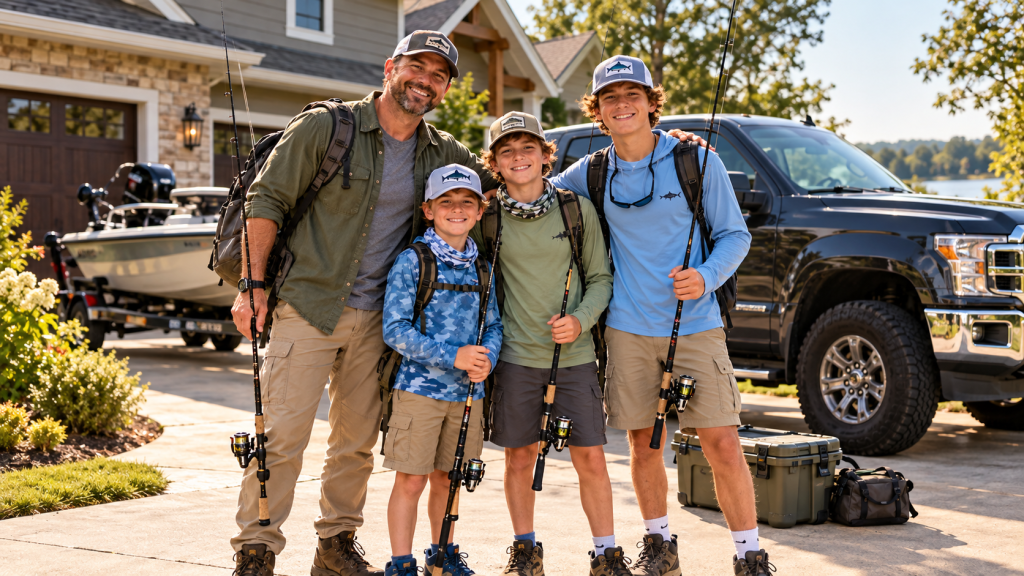
Their faces were older. Their bodies had changed. But I knew those eyes. A mother doesn’t forget her children’s eyes. Even after six years. Even after being told they were dead. “Mom,” Sophie whispered, “what do we do?”
I looked toward the driveway.
Dean was stepping out of his truck.
He wasn’t carrying the usual paper bag of groceries or the little toolbox he brought whenever something needed repairing.
His hands were empty.
And he was looking directly toward the kitchen window.
“Give me the phone,” I whispered.
Sophie hesitated.
“Mom—”
“Please, sweetheart.”
She handed it over.
I slipped it into the deep pocket of my cardigan.
Then I locked the kitchen door.
Dean reached the porch.
The first knock was gentle.
The second was louder.
“Claire?”
My name sounded wrong in his voice.
For six years, I’d listened to that voice tell me to stop searching.
To accept that Daniel and the boys were gone.
To let myself grieve.
Now I wondered whether every word had been designed to keep me from discovering what he had done.
“Claire, open up. It’s Dean.”
Sophie reached for my hand.
I squeezed her fingers.
“Go to the pantry,” I whispered. “Call Detective Morales again. Tell him Dean is here.”
She nodded and disappeared down the hallway.
I stayed beside the kitchen counter.
Through the window, I watched Dean check his phone.
Then he knocked again.
“I know you’re home.”
I didn’t answer.
His expression changed.
“Claire, don’t make this difficult.”
My stomach tightened.
The words were so unlike the comforting brother-in-law I thought I knew that for a moment I could hardly believe I was hearing them.
He moved toward the window.
“That phone belongs to Daniel. I need to see it.”
I stepped backward.
He hadn’t asked whether I’d found anything.
He hadn’t asked what was on the recording.
He knew precisely what he wanted.
And he wanted it before the police arrived.
“Claire!” he called.
Then my own phone rang.
Detective Morales.
I answered immediately.
“He’s outside.”
“I know,” the detective said. “Officers are on their way. Do not open the door.”
My knees weakened with relief.
“He’s asking for Daniel’s phone.”
“Keep it secure. Don’t erase or alter anything.”
I looked toward the kitchen window.
Dean was walking around the side of the house.
“He’s moving toward the back,” I whispered.
“Stay away from the windows. Get yourself and your daughter into a room you can secure.”
I hurried toward the hallway.
Sophie was waiting beside the pantry.
We went into the downstairs bedroom and locked the door.
Then I heard something that made every muscle in my body tighten.
The sound of a key entering the back lock.
Click.
Dean had a key.
Of course he did.
I’d given him one after the accident.
I’d told him I was grateful to have someone I could trust.
The back door opened.
“Claire?”
His footsteps crossed the kitchen.
“Where are you?”
Sophie began crying silently.
I held my finger against my lips and pulled her close.
Dean moved through the hallway.
A floorboard creaked.
Then another.
He stopped outside the bedroom.
“Claire, I know you’re in there.”
I pressed the phone against my ear.
Detective Morales was still speaking.
“Officers are approaching the property. Stay inside.”
Dean tried the handle.
It didn’t turn.
For a few seconds, he was silent.
Then he said something I will never forget.
“You should have left the past alone.”
A cold feeling spread through my chest.
I looked at Sophie.
She was shaking.
And then, from outside, came the sound of approaching sirens.
Dean stepped away from the door.
His footsteps moved quickly toward the kitchen.
A police officer shouted for him to stop.
There was a scuffle of shoes against the floor.
Then silence.
A few minutes later, Detective Morales called my name from the hallway.
“Claire? It’s safe to come out.”
I unlocked the bedroom door.
And for the first time in six years, I saw Dean standing in my house without pretending to be our family’s protector.
He was surrounded by officers.
His hands were visible.
And his face was filled with something I’d never seen there before.
Fear.
Detective Morales had aged since the original investigation.
His hair was almost entirely gray now, and the lines around his eyes were deeper.
But I recognized the same patient expression he’d worn when he came to tell me the damaged boat had been found.
Back then, he’d sat at this very kitchen table and explained that investigators believed Daniel and our sons had drowned.
I remembered the way he’d lowered his eyes when I asked whether they were certain.
We have to follow the evidence, Mrs. Bennett.
Now he stood in my hallway, looking at the old cellphone in my hands.
“May I see what your daughter found?”
I nodded.
He watched the video of Daniel confronting Dean in our garage.
My husband’s voice filled the kitchen.
You forged my name on those land transfers.
I began crying.
It was the first time I’d heard Daniel’s voice in six years.
Not from an old birthday recording.
Not from a saved voicemail.
But from a message I’d never known existed.
A warning.
A piece of evidence he’d hidden before our sons disappeared.
Detective Morales watched it twice.
Then Sophie showed him the photograph.
The three young men.
The fishing boat.
The silver watch.
Morales leaned closer.
“How did this get onto the phone?”
Sophie wiped her eyes.
“I charged it and connected it to our Wi-Fi. It started downloading photographs from Dad’s old cloud account.”
She swallowed.
“The original recording was already stored on the phone. But the newer photograph and the edited map appeared when the gallery synchronized.”
Morales nodded slowly.
“That may explain the recent date.”
Sophie pointed toward the screen.
“The map was updated three months ago.”
She enlarged the image.
A red circle surrounded a place marked OLD RANGER STATION.
Beneath it was a handwritten note.
Follow the service road north. Not the lake trail.
Detective Morales stared.
“Do you know this place?”
I shook my head.
“Daniel used to mention an abandoned ranger station near the northern part of the lake. He said it was closed years ago.”
Morales took out his phone.
“I remember it.”
My heart began pounding.
“Do you think the boys are alive?”
He looked at me carefully.
“Claire, I think we have information that needs urgent investigation. The photograph is important, but we have to establish who those young men are and where it was taken.”
I nodded.
I understood why he couldn’t promise anything.
But he hadn’t told me to stop hoping.
And after six years, that was enough to make me cry.
Then he asked a question that changed the direction of the investigation.
“Who had access to Daniel’s cloud account?”
I stared.
“Daniel did.”
“And the boys?”
“Our oldest, Noah, knew some of his passwords. Daniel used to let him upload fishing photographs.”
Sophie looked up.
“Mom.”
I turned.
“What?”
She pointed toward the image.
“That photograph isn’t from an automatic camera backup.”
Morales frowned.
“How can you tell?”
“Because it was placed in Dad’s shared family album. There’s a caption.”
She opened the image details.
Beneath the photograph were six words.
WE ARE STILL HERE. FIND US.
I covered my mouth.
For a moment, everything went silent.
Then I whispered my oldest son’s name.
“Noah.”
And collapsed into a chair.
My oldest son had been sixteen when he disappeared.
Micah was thirteen.
Jonah was ten.
Now, if the photograph was genuine, they would be twenty-two, nineteen, and sixteen.
Six years.
Six birthdays each.
Six Christmas mornings.
Six summers when I’d watched the lake from a distance and wondered whether their bodies were still somewhere beneath the water.
I thought of the empty chairs at our dinner table.
The clothes I’d kept folded in their drawers.
The birthday cakes I’d stopped baking because I couldn’t bear to count how old they should have been.
Then I looked at the photograph again.
Noah had Daniel’s silver watch.
Micah had grown taller than I remembered.
And Jonah, my baby boy, had a face I had never seen before.
I touched the screen.
“Please be them,” I whispered.
Detective Morales placed a hand on the table.
“We’re going to find out.”
He looked toward the officer standing nearby.
“Preserve the phone for forensic examination. We need the account records, the original files, and any available location data.”
I nodded.
Then I asked the question I was almost afraid to hear answered.
“Where’s Dean?”
“He’s being questioned about the confrontation here. We’ll determine what further legal action the evidence supports.”
I swallowed.
“Don’t let him know what you found.”
Morales studied me.
“We’ll handle the investigation carefully.”
Then he looked toward Sophie.
“Are there other children in the house?”
“My two younger daughters are staying with my sister tonight.”
“Good. For now, please don’t share the photograph publicly or contact Dean.”
I nodded.
He paused at the doorway.
Then turned back.
“Claire, I want you to know something.”
I looked up.
“When we closed the original search, I believed we had followed every reasonable lead.”
His voice softened.
“If your sons are alive, I intend to find out how we missed them.”
I began crying again.
He waited until I could look at him.
Then said, “We’re not finished.”
That night, Sophie slept beside me.
Or rather, neither of us slept.
We lay on my bed, staring into the darkness.
Every so often, she asked a question.
“What if it really is Noah?”
“What if Jonah doesn’t remember us?”
“What if Dad’s alive too?”
I tried to answer.
But there were no answers yet.
Only possibilities.
And after six years of grief, possibilities felt almost unbearable.
Around three in the morning, Sophie whispered, “Mom, I remember the last thing Noah said to me.”
I turned toward her.
“What was it?”
She swallowed.
“He told me not to touch his fishing tackle because I always mixed everything up.”
I smiled through tears.
“That sounds like Noah.”
She nodded.
“I was angry with him. I called him annoying.”
I reached for her hand.
She continued.
“After they disappeared, I kept thinking the last thing I said to him was something mean.”
Her voice broke.
“I was fifteen. I thought we’d have forever to annoy each other.”
I pulled her into my arms.
“Sophie…”
She began sobbing.
“What if he thinks I forgot him?”
I held her tightly.
For six years, I’d told my daughters that grief didn’t mean forgetting.
We had celebrated their brothers’ birthdays.
Kept their photographs on the mantel.
Spoken their names during family prayers.
But I’d never realized how much guilt Sophie carried over an ordinary argument between siblings.
“He won’t think that,” I whispered.
Then I stopped.
Because I couldn’t know what Noah believed.
I couldn’t know what he’d been told.
And I couldn’t promise my daughter that finding her brothers would instantly make everything right.
So I said something simpler.
“If Noah is alive, we’ll tell him how much you missed him.”
Sophie nodded against my shoulder.
“And if he’s angry?”
I kissed her forehead.
“Then we’ll listen.”
She clung to me.
And we waited for morning.
The call came at 7:18 the following morning.
I was standing at the kitchen sink, staring at four untouched coffee mugs, when my phone rang.
Detective Morales.
I answered before the second ring.
“Did you find them?”
There was a pause.
“Claire, we’ve identified the property shown in the photograph.”
My knees weakened.
“Where?”
“Approximately forty miles north of the original search area. The old ranger station is no longer operational, but there’s a service road leading to a private maintenance compound beyond it.”
I gripped the counter.
“Who owns it?”
Morales took a breath.
“A company called North Ridge Timber Holdings.”
I frowned.
“Timber?”
“Yes. We’re examining its ownership records.”
Then he said something that made me close my eyes.
“Dean has a financial connection to the company.”
I began shaking.
Of course he did.
For six years, Dean had told me the investigation was over.
That the lake had taken my husband and sons.
That I needed to focus on my daughters.
And all that time, he apparently had ties to property near the very place Daniel had tried to identify on the map.
“What happens now?” I whispered.
“We’re coordinating with the relevant agencies. We have information supporting an urgent investigation of the compound, and we’re taking steps to locate the people shown in the photograph.”
I pressed a hand to my chest.
“Please tell me they’re alive.”
His voice softened.
“I can’t confirm that yet.”
I closed my eyes.
Then he added, “But we found something else.”
“What?”
“The cloud account used to upload the photograph was accessed from a business in the county near the compound. We’re working with the business owner and reviewing the available records.”
My heart pounded.
“Did someone see Noah?”
“Possibly. The person who accessed the account appears to have been a young man. We’re trying to establish his identity.”
I sank into a chair.
For six years, I’d imagined the lake as the final place my sons had been alive.
Now a detective was telling me that a young man might have uploaded their photograph from a shop only three months earlier.
Somewhere, perhaps, Noah had been trying to reach us.
And nobody had heard him.
Until Sophie turned on that old phone.
By afternoon, the investigation had accelerated.
A search warrant was issued for the compound after investigators combined the new digital evidence with property records and the information from Daniel’s video.
The property was managed by a couple named Wade and Celia Pruitt.
They had operated a remote equipment-repair business there for several years.
The compound included an old lodge, a workshop, storage buildings, and a private road that was difficult to see from the main highway.
According to public records, the Pruitts claimed to employ seasonal workers and maintain the surrounding property.
I stared at the photograph Morales sent me of the entrance.
A weathered wooden sign.
A locked metal gate.
Tall pine trees beyond it.
There was no indication that children had ever lived there.
No family photographs.
No school.
No playground.
Nothing that would make a stranger think three missing boys might have grown up behind those trees.
Then the detective called again.
“Claire, we need you to stay at home for now.”
I gripped the phone.
“Why?”
“We’re going to the property.”
My heart stopped.
“Now?”
“Yes.”
I stood.
“I want to come.”
“I understand. But this is a law enforcement operation. We don’t know what we’ll find, and we can’t put you in danger.”
Tears filled my eyes.
“Those are my children.”
“I know.”
His voice was gentle.
“And if they’re there, the best thing you can do right now is be ready for us to contact you.”
I closed my eyes.
I hated the answer.
But I knew he was right.
So I called Sophie.
Then my sister.
And the four of us sat in the living room, waiting for news that might change our lives.
My younger daughters, Grace and Poppy, had been told only that investigators were following a serious new lead.
I couldn’t bear to tell them their brothers might be alive until someone had confirmed it.
Hope could be beautiful.
It could also be devastating.
At 4:36 that afternoon, my phone rang.
Detective Morales.
My hand shook as I answered.
“Claire?”
“Yes?”
His voice broke slightly.
“We found three young men at the compound.”
I covered my mouth.
He continued.
“They’ve provided names that match your sons.”
For a moment, the room disappeared.
I heard Sophie gasp beside me.
Morales took a breath.
“Claire, Noah, Micah, and Jonah are alive.”
I dropped the phone.
My sister caught it before it hit the floor.
I was crying too hard to speak.
Six years.
Six years of birthdays without candles.
Christmas mornings with three empty chairs.
Six years of listening to the wind against the windows and wondering whether my boys had been cold and frightened in the water.
And now somebody was telling me they were alive.
My sons.
All three.
Alive.
The reunion did not happen immediately.
That was one of the hardest things to accept.
Investigators and medical professionals first needed to make sure the boys were safe, assess their immediate needs, and understand who had been controlling their lives.
Noah was twenty-two.
Micah was nineteen.
Jonah was sixteen.
They were physically alive.
But they had spent six years in circumstances nobody yet fully understood.
Detective Morales explained that the brothers were being taken to a hospital for examinations and support.
I could barely sit still.
“Are they hurt?”
“They’ve reported experiences that require investigation. They’re receiving care.”
“Do they know I’m alive?”
There was a pause.
“Claire, they’ve been told very different things about what happened to you.”
My stomach tightened.
“What things?”
Morales took a breath.
“They were told you and your daughters died shortly after their disappearance.”
I stared at the wall.
For several seconds, I couldn’t speak.
Then I whispered, “What?”
He continued gently.
“At least one of the young men believed that to be true for years. We’re taking care not to overwhelm them with information all at once.”
I began crying.
So while I had spent six years mourning them, my sons had been told to mourn me.
All six of my children had been separated by the same lie.
I thought of Noah.
Sixteen years old.
Old enough to remember his mother’s face perfectly.
Old enough to understand what death meant.
And apparently forced to believe that he’d lost his mother and sisters while trapped somewhere he couldn’t escape.
My heart broke in a new way.
“Can I see them?” I whispered.
“We’re arranging contact with their consent and with support available. I promise we’ll update you as soon as it’s appropriate.”
I nodded.
Then remembered the fourth person who had vanished.
“Daniel?”
The detective fell silent.
I closed my eyes.
“Did you find my husband?”
“We haven’t confirmed what happened to him yet.”
I swallowed.
“Please don’t stop looking.”
“We won’t.”
The next day, I walked into a hospital waiting room with Sophie beside me.
My heart was pounding so violently that I felt dizzy.
An advocate had explained that the reunion would happen slowly.
We shouldn’t expect the boys to run into our arms.
We shouldn’t overwhelm them with questions.
We needed to let them decide how much contact they were comfortable with.
I understood every word.
But nothing could have prepared me for the moment the door opened.
Noah entered first.
My oldest boy.
Except he was no longer a boy.
He was taller than Daniel had been.
His shoulders were broad.
His dark hair was longer than I remembered.
And there was a seriousness in his expression that made him look older than twenty-two.
He stopped in the doorway.
Stared at me.
And whispered, “Mom?”
I covered my mouth.
For a moment, I couldn’t move.
Then I took one step forward.
“Noah.”
His face crumpled.
“Is it really you?”
Tears poured down my cheeks.
“Yes, sweetheart.”
He shook his head.
“They told us you died.”
I sobbed.
“Oh, Noah.”
He took another step.
Then another.
And suddenly he was in my arms.
My son.
My firstborn.
The boy who had once insisted he was too old for bedtime hugs.
He clung to me as though he were afraid I might disappear.
I held him with everything I had.
“I’m here,” I whispered.
He began sobbing.
“I’m sorry, Mom.”
I pulled back.
“For what?”
His face twisted with grief.
“I couldn’t get them home.”
I touched his cheek.
“Sweetheart, you were a child.”
He shook his head.
“I was supposed to look after Micah and Jonah.”
Tears streamed down his face.
“I promised Dad.”
I held him again.
“You kept them alive.”
He buried his face against my shoulder.
And for a long time, neither of us could speak.
Then two more figures appeared in the doorway.
Micah.
And Jonah.
My knees nearly gave way.
Micah stared at me with wide eyes.
Jonah stood behind him, gripping his brother’s sleeve.
I whispered their names.
“Micah. Jonah.”
Micah began crying immediately.
He approached slowly.
Then wrapped his arms around both Noah and me.
Jonah remained near the doorway.
He had been ten years old when he disappeared.
Now he was sixteen.
The youngest of my sons had become a teenager without me.
He looked at my face.
Then whispered, “Are you really our mother?”
I felt my heart break.
I nodded.
“Yes, baby.”
He hesitated.
Then said something I will remember until the day I die.
“I don’t remember what your hugs feel like.”
I began crying harder.
I opened my arms.
“You don’t have to remember.”
He took a hesitant step.
Then another.
And finally, my youngest son came home to me.
Not to our house.
Not yet.
But into my arms.
For the first time in six years, I held all three of my boys.
And I knew that whatever else happened, the world would never be the same again.
It took weeks before I began to understand what my sons had survived.
They didn’t tell me everything at once.
Sometimes Noah spoke for an hour.
Sometimes Micah couldn’t bear to answer a simple question.
Jonah often sat quietly beside me, listening to conversations as though he were still deciding whether the world outside the compound could be trusted.
We worked with counselors experienced in trauma and prolonged coercion.
I learned not to ask the same questions the investigators were asking.
My sons needed a mother.
Not another person demanding that they explain six years of their lives.
But slowly, the truth emerged.
The fishing trip had begun exactly as Daniel planned.
He drove the boys to the lake.
They unloaded their equipment.
Then Dean appeared near the old ranger station, claiming he had urgent news about the land-transfer dispute.
Daniel had been investigating documents connected to a large parcel of timberland inherited from his father.
He and Dean each held an interest in the family property.
But Dean had arranged transfers and financing that apparently depended on documents bearing Daniel’s forged signature.
The money involved was substantial.
More than a million dollars in land value and borrowing arrangements.
Daniel had discovered the problem.
He’d also learned that some of the boxes Dean moved through our garage contained original records that might expose the transactions.
The boys had seen those boxes.
At first, it seemed insignificant.
Then Daniel realized Dean was desperate to prevent anyone from examining them.
He recorded the confrontation on his old phone and hid it at home before leaving for the lake.
He intended to seek legal advice after the weekend.
But Dean was already waiting.
According to Noah, two men accompanied him.
One was Wade Pruitt.
The other was a worker who was later identified during the investigation.
They forced Daniel and the boys away from the boat ramp.
The fishing boat was taken onto the lake and deliberately damaged before being left to wash ashore.
The empty truck remained near the ramp.
By the time search crews arrived, the scene looked like a boating accident.
And the people everyone was searching for were miles away.
I listened to Noah describe that morning.
His hands shook.
“Dad kept telling them to let us go.”
I swallowed.
“What did Dean say?”
Noah stared at the floor.
“He said if Dad didn’t cooperate, he’d come after you and the girls.”
I closed my eyes.
My sons had spent years believing silence was the only way to keep their family alive.
Dean’s associates controlled the compound.
There was no ordinary school attendance.
No unrestricted phone access.
No freedom to leave.
The boys were made to work around the buildings and equipment yard as they grew older.
At first, they believed Daniel would find a way to get them home.
But several months after the abduction, something happened that changed everything.
Daniel tried to escape.
He wanted to reach a road and contact the police.
Noah remembered his father telling him to stay with his brothers.
Then Daniel handed him the silver watch.
The one he’d worn on our wedding day.
“He said, ‘Look after them until I get back.'”
Noah’s voice cracked.
“I waited all night.”
My throat tightened.
“He never came back.”
I reached for his hand.
Noah began crying.
“Wade told us Dad was gone. He said we shouldn’t ask questions.”
I covered my mouth.
For six years, I had believed Daniel died on the lake.
Now I knew he had survived the trip.
That he had tried to save our sons.
And that somewhere in those first months, he’d vanished again.
This time, the boys had been there to experience the loss.
Noah looked at me.
“Mom, I promised him I’d keep them safe.”
I pulled him close.
“You did.”
He shook his head.
“I should have done more.”
I held his face between my hands.
“You were sixteen years old.”
His eyes filled.
“You should have been worrying about homework and fishing trips. Not trying to protect your brothers from grown men.”
He began sobbing.
I wrapped my arms around him.
And for the first time, I understood why my oldest son looked so tired.
He hadn’t simply grown up.
He’d spent six years carrying responsibilities no child should ever have been given.
The photograph had been Noah’s idea.
Three months before Sophie found the phone, he had accompanied one of the workers to a supply business in a nearby town.
For the first time in years, he was briefly allowed to use a device connected to the internet.
He searched for our names.
But he found nothing that matched the stories Dean had told him.
No reliable record of my death.
No evidence that his sisters had been killed.
Instead, he found old articles about the search for Daniel and the boys.
Articles that still described me as their grieving mother.
Then he found a photograph of Sophie from a community college event.
She was smiling beside two friends.
Alive.
His sister was alive.
Noah told me he sat staring at the screen until his hands began shaking.
“I thought I’d imagined her,” he whispered.
I squeezed his hand.
He remembered that Daniel had once used a shared family photo account.
He knew the password because his father had allowed him to upload fishing pictures.
With help from a sympathetic employee at the supply business, Noah uploaded the photograph of himself and his brothers.
He also added the old ranger-station map, marking the service road that led toward the compound.
He hoped the photographs would eventually reach someone in our family.
But he couldn’t risk openly using the employee’s phone for long.
He didn’t know our current telephone numbers.
And he was terrified that if Dean learned what he’d done, Micah and Jonah would suffer.
“Why didn’t you call the police?” he asked himself aloud during one conversation.
He looked at me, ashamed.
“I should have.”
I took his hand.
“Sweetheart, the people holding you controlled almost everything you knew. They spent years threatening you and telling you lies.”
He stared at me.
I continued.
“You were trying to keep your brothers safe. The responsibility for what happened belongs to the adults who took you.”
His eyes filled.
Then he looked toward the photograph.
“I kept hoping somebody would find it.”
Sophie had been sitting beside us.
She began crying.
“I did.”
Noah turned toward her.
She smiled through tears.
“I found it.”
For a long moment, they simply stared at each other.
Then Noah reached for his sister’s hand.
“Thank you.”
Sophie shook her head.
“No. Don’t thank me.”
Her voice broke.
“I thought you were dead.”
He began crying.
“I thought you were too.”
They held each other.
And I watched two siblings begin recovering the years that had been taken from them.
Investigators eventually found evidence concerning Daniel’s final months.
The Pruitts’ records, testimony from people connected to the compound, and a later search of the property led authorities to remains that were identified as my husband’s through forensic testing.
The investigation established that Daniel had died after his attempt to escape.
The exact details were determined through the criminal proceedings that followed.
I won’t describe those details.
They belong to the hardest part of our family’s history, and I refuse to make my husband’s suffering the most important thing about his life.
What matters is that he tried to reach help.
He tried to protect our sons.
And he never voluntarily abandoned us.
For years, I’d wondered whether I’d misjudged him.
Whether he’d been careless.
Whether he’d taken a dangerous risk with our boys.
Now I knew he had been trying to stop his brother from destroying something that belonged to their family.
And that Dean had chosen to destroy the family instead.
When Detective Morales told me Daniel’s remains had been identified, I began crying.
I had spent six years hoping the lake would someday give him back.
Then I spent several weeks hoping he might still be alive somewhere near the compound.
Now the uncertainty was over.
And with it came a different kind of grief.
I could finally bury my husband.
But I could never return the years he’d been missing.
Dean’s role became clearer as the investigation progressed.
He had used forged documents to transfer Daniel’s interest in the family land.
He’d arranged financing through companies that obscured his involvement.
And after Daniel confronted him, he participated in a plan to make the four of them disappear.
The damaged boat was meant to make everyone believe a terrible accident had occurred.
Dean knew the lake.
He knew the search patterns.
He knew the places investigators were likely to examine first.
And while the community searched the water, he helped keep the truth hidden on property connected to his business associates.
Then he came to my house.
Week after week.
Year after year.
Bringing food.
Repairing things.
Telling me to stop asking questions.
I couldn’t stop thinking about that.
Sometimes I remembered him sitting at my kitchen table, comforting Grace after a nightmare.
Sometimes I remembered him carrying Poppy’s birthday cake.
Sometimes I remembered him helping Sophie apply for college.
He had looked directly at the daughters of the brother he’d betrayed.
And acted like their protector.
When investigators later confirmed that Dean had accessed information from a security camera he’d helped install in our house after the disappearance, I felt sick.
He had retained remote access without my knowledge.
That was how he knew Sophie had been sorting through Daniel’s belongings.
It was also why his message arrived so quickly after we found the phone.
He had been watching.
Not every moment.
But enough to realize that the secrets he’d buried were beginning to surface.
The discovery frightened me.
It also made me angry in a way I’d never experienced before.
For years, I’d been grateful to him.
I’d told my daughters to thank him.
I’d invited him to family celebrations.
And he had used our trust to protect himself.
The security system was replaced.
Every access credential was changed.
And I began learning, with the help of professionals and people I could genuinely trust, how to reclaim control of our home.
The court proceedings lasted more than a year.
Dean and the people who had helped him faced serious charges connected to the abduction, fraudulent property transactions, unlawful confinement, and Daniel’s death.
There were hearings, testimony, forensic reports, and difficult days when my sons had to speak about memories they wished they could forget.
We made sure they had independent legal advice and emotional support.
I didn’t ask them to be brave for my sake.
They had already been forced to be brave for far too long.
Eventually, the criminal proceedings resulted in convictions and substantial sentences for those whose responsibility had been established.
The fraudulent land transfers were challenged through separate legal action.
Some financial losses were recovered.
Others never were.
But by then, money had become the least important thing Dean had taken from us.
He had stolen birthdays.
School years.
Friendships.
Ordinary arguments around the dinner table.
He had taken away six years in which my children should have been allowed to grow up together.
No prison sentence could restore those years.
No court could give Daniel back to us.
But the truth had finally been established.
And Dean could no longer stand in my kitchen pretending he was the man who kept our family together.
Bringing the boys home was not as simple as opening the front door.
I wish I could say that after our reunion, we returned to the house, sat down for dinner, and everything became normal.
But there was no normal waiting for us.
Noah had spent six years protecting his younger brothers.
He found it difficult to sleep unless he knew where they were.
Micah became anxious in crowded places.
Jonah hated closed doors and sometimes startled when someone entered a room unexpectedly.
Even ordinary decisions overwhelmed them.
What to eat.
What to wear.
Whether to go outside.
At first, they asked permission for things that should never have required permission.
One afternoon, Jonah stood beside the refrigerator holding a carton of milk.
“Mom?”
I looked up.
“Yes, sweetheart?”
“Can I have some?”
I stared at him.
He looked frightened.
“Only if it’s okay.”
My throat tightened.
I put down the dish towel.
“Jonah, you don’t need permission to have milk in your own home.”
He nodded.
But he didn’t move.
So I walked beside him, opened a cupboard, and handed him a glass.
“This is your house too,” I whispered.
His eyes filled.
“Really?”
I kissed his forehead.
“Really.”
He poured the milk.
Then sat at the kitchen table and drank it slowly.
I turned toward the sink before he could see me crying.
Because sometimes six years of suffering reveals itself not through a dramatic confession, but through a sixteen-year-old boy being afraid to take a glass of milk.
My daughters had their own struggles.
Sophie remembered her brothers clearly.
Grace remembered pieces.
Poppy, who had been only five when they disappeared, knew them mostly through photographs and stories.
The first time she met Noah again, she stared at him for a long moment.
Then whispered, “You used to carry me around on your shoulders.”
Noah smiled through tears.
“I did.”
She looked at him.
“Can you still do that?”
He laughed softly.
“You’re a little bigger now.”
Poppy grinned.
“So are you.”
Everyone laughed.
And suddenly, for a few seconds, the terrible distance between our lives seemed smaller.
Grace was quieter.
One evening, she asked Micah whether he remembered teaching her how to ride a bicycle.
He nodded.
“You kept falling.”
She smiled.
“You told me I was terrible.”
Micah laughed.
“You were.”
Then his face changed.
“I wanted to see you ride without training wheels.”
Grace began crying.
He reached for her.
And I watched two children who had grown into strangers begin finding their way back to each other.
It happened slowly.
A shared joke.
A remembered birthday.
An old photograph.
A board game nobody could finish without arguing.
Sometimes there were tears.
Sometimes someone needed to be alone.
But every day, we learned a little more about one another.
Six months after the boys came home, we finally held Daniel’s funeral.
We chose a quiet ceremony.
No enormous crowd.
No reporters.
Just family, a few old friends, and the people who had never stopped caring about us.
I placed the photograph I’d taken on the morning of the fishing trip beside his urn.
Daniel and our three sons.
Smiling.
Joking.
Completely unaware of what waited for them.
Beside it, Sophie placed the newer photograph.
The one that had appeared on the old cellphone.
Three young men standing near a fishing boat.
Alive.
Different.
But unmistakably ours.
Noah stepped forward carrying Daniel’s silver watch.
For a moment, I thought he intended to place it beside his father’s photograph.
Instead, he turned toward me.
“Dad wanted me to look after Micah and Jonah.”
His voice trembled.
“I thought keeping his watch meant I was still doing what he asked.”
I reached for his hand.
Noah continued.
“But I don’t think he wanted me to carry everything forever.”
Tears filled my eyes.
I shook my head.
“No, sweetheart. He didn’t.”
Noah placed the watch in my palm.
“I want you to keep it for a while.”
I closed my fingers around it.
The metal was scratched.
The strap was worn.
But I remembered fastening it around Daniel’s wrist on our wedding morning.
He had laughed and told me he’d never take it off.
Now it had traveled through six years of hardship and found its way home.
I held it against my heart.
Then looked toward my children.
All six of them.
Three daughters.
Three sons.
Standing together.
And I understood something.
Daniel was gone.
But the family he loved was still here.
We were wounded.
We were grieving.
And we had no idea how long healing would take.
But we were here.
On the first anniversary of the boys’ return, Sophie asked whether we could take another family photograph.
Not at the lake.
Not beside a fishing boat.
Just in our backyard.
The old oak tree was covered in spring leaves.
Poppy insisted everyone wear something blue.
Grace complained that Noah was standing too close.
Micah made a terrible joke.
Jonah laughed so hard he nearly fell off the porch steps.
For a moment, I simply watched them.
I had spent six years trying to imagine what this would look like.
My children together.
The sound of their voices.
The ordinary chaos of a family trying to stand still for a photograph.
Sophie placed her phone on a tripod.
“Everybody ready?”
I nodded.
Then she paused.
“Wait.”
She disappeared into the house.
A minute later, she returned carrying Daniel’s framed photograph.
She placed it on a small table beside us.
I began crying.
Sophie looked at me.
“Is that okay, Mom?”
I smiled through tears.
“It’s perfect.”
We gathered beneath the tree.
Noah stood beside me.
Micah rested a hand on Grace’s shoulder.
Jonah leaned against Poppy.
Sophie hurried into position as the timer began counting down.
And when the camera clicked, all six of my children were smiling.
Not because everything was fixed.
Not because the past had become painless.
But because, for one brief moment, we were together.
That photograph now hangs above our fireplace.
Beside the picture I took on the morning Daniel and the boys disappeared.
For years, the first photograph represented everything I’d lost.
Now the second reminds me of what we found.
I still think about the night Sophie discovered that old phone.
The headlights in the driveway.
Dean’s knocking.
The terrible fear that we were about to uncover something worse than the tragedy we’d spent six years mourning.
And the photograph that changed our lives.
Three young men.
One silver watch.
Six words.
WE ARE STILL HERE. FIND US.
I sometimes wonder what would have happened if Sophie hadn’t persuaded me to sort through Daniel’s things.
If she’d never charged the phone.
If Noah hadn’t remembered his father’s cloud account.
If we’d dismissed the photograph as a mistake.
Those questions can keep a person awake forever.
But I’ve learned not to build my life around what might have happened.
Instead, I remember what did.
My son found a way to send a message.
My daughter found it.
A detective listened.
And three boys who had been stolen from their family were finally brought home.
There are still difficult days.
There always will be.
Sometimes Noah wakes from a nightmare.
Sometimes Micah needs silence.
Sometimes Jonah asks questions about his father that I cannot answer without crying.
And sometimes I stand alone in the kitchen, holding Daniel’s watch, wishing I could tell him our sons survived.
But then I hear laughter from the living room.
Six voices.
Six lives.
Six children who have endured more than any family should have to endure.
And I remember that love isn’t always powerful enough to prevent terrible things from happening.
But it can give us a reason to keep going after they do.
Dean spent six years telling me to let go of the past.
What he never understood was that my children were not the past.
They were my family.
And while there was a chance that even one of them was still waiting to be found, the truth deserved to be pursued.
I couldn’t bring back the years we lost.
I couldn’t bring Daniel home.
But I could make sure my sons never again had to wonder whether their mother was searching for them.
Because I was.
Even when everyone told me the search was over.
Even when grief made every day feel impossible.
And even when the only thing I had left was a mother’s stubborn refusal to stop asking why.
Now, when I look at our family photograph, I no longer count only the empty spaces.
I count the faces.
Noah.
Micah.
Jonah.
Sophie.
Grace.
Poppy.
And I whisper the same words every night before turning off the light.
“You’re home.”
THE END STORIES! THANK YOU FOR READING GOOD LUCK !❤️
Related Posts