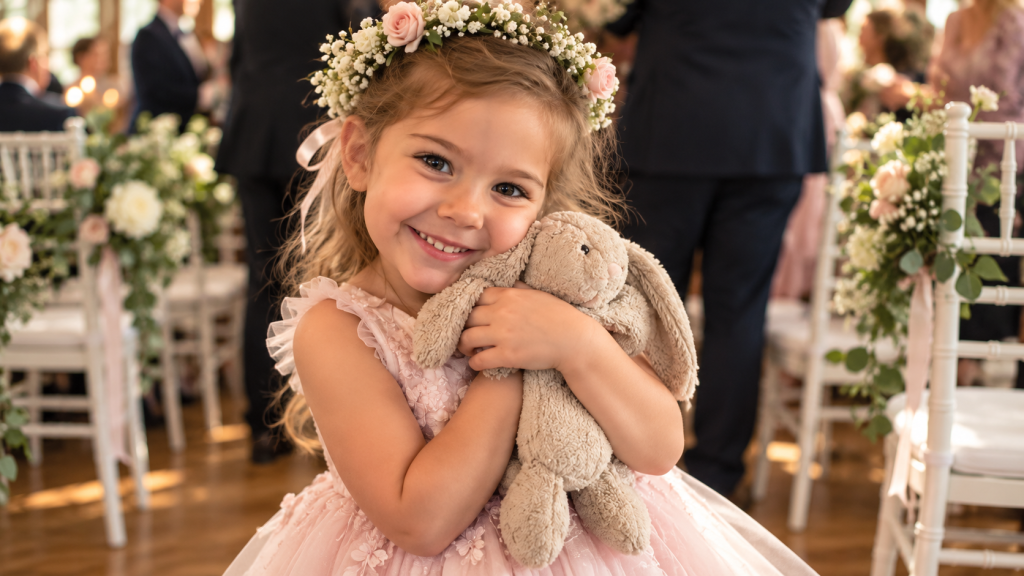
Matthew pounded on the bridal-room door again. “Open the door!” The brass handle shook beneath his fist. Emma jumped. I pulled her against me so quickly that the little flower crown slipped from her hair and landed on the carpet.
“Mommy?” “I’m right here.” Another blow rattled the door. “Julia, what is going on?” That was the first time his voice frightened me. Not because it was loud. Because it was no longer pretending to be gentle.
Five minutes earlier, Matthew had been waiting at the altar in a tailored black tuxedo, smiling beneath stained-glass windows while nearly two hundred guests admired the man I was about to marry. Now there was wood between us.
And he sounded like someone furious that a lock existed.
My phone was still in my hand.
Claire’s message glowed on the screen.
Don’t marry him. He already has a wife. And she is standing outside the church right now.
I read it again.
Then again.
The words did not become less impossible.
Emma pressed Bunny against her chest.
“Mommy, are we going home?”
I looked at my daughter.
Her eyes were enormous.
Waiting.
Trusting.
Five years old.
And somehow she had been braver than I had.
She had told me Matthew was mean.
I had wanted an explanation more comfortable than the truth.
She had said she was afraid.
I had told myself she was adjusting.
She had protected evidence inside a stuffed rabbit because she did not believe the adults around her would listen fast enough.
Shame moved through me like cold water.
“Yes,” I whispered.
“We’re going home.”
Matthew hit the door again.
“Julia!”
I stood.
“Stop pounding.”
Silence.
Then his voice changed instantly.
Soft.
Controlled.
The Matthew everyone loved.
“Baby, open the door.”
Baby.
As if five seconds earlier he had not nearly torn the handle off.
“We need to talk.”
“No.”
A pause.
“What?”
“We are not getting married.”
The silence on the other side was so complete I could hear the organ through the wall.
The same hymn my mother had chosen.
The same flowers I had spent six months planning.
The same wedding that had seemed, an hour earlier, like the beginning of our future.
Matthew laughed quietly.
“You’re nervous.”
“No.”
“Everybody gets scared before a wedding.”
“I’m not scared of the wedding.”
Emma gripped my hand.
I looked at Bunny.
“I’m scared of you.”
Nothing.
Then the handle moved again.
Slower this time.
“Julia.”
“Back away from the door.”
“Open it.”
“No.”
His voice hardened.
“What did she tell you?”
I went still.
Not:
What happened?
Not:
Why are you afraid?
What did she tell you?
He already knew.
I looked at Emma.
Then asked through the door,
“Who?”
Matthew did not answer.
I continued.
“Claire?”
Silence.
“Or your wife?”
Emma sucked in a breath.
On the other side of the door, something hit the wall.
Not the door.
The wall.
A fist, maybe.
Then Matthew said,
“You have no idea what you’re talking about.”
I whispered,
“I know about the account ending in 4417.”
That did it.
No answer.
I waited.
Nothing.
I looked at my phone and called 911.
Matthew heard the dialing tone through the door.
“Julia, don’t.”
I almost laughed.
“Don’t what?”
“Make this worse.”
That sentence.
People who have already burned down your trust always become very concerned when you reach for the fire department.
The dispatcher answered.
I gave the church address.
Said I was locked inside the bridal room with my five-year-old daughter.
Said a man outside the door was agitated and refusing to leave.
Said I had just discovered evidence of attempted financial fraud.
I did not call him my fiancé.
Not anymore.
Matthew lowered his voice.
“I’m walking away.”
“Good.”
“Tell them they don’t need to come.”
“No.”
“Julia.”
“They’re coming.”
I heard footsteps retreat.
Then voices.
Confusion.
Someone from the wedding party asked what was happening.
My maid of honor, Beth, called through the door.
“Julia?”
I unlocked it only after she identified herself.
Beth stepped inside.
The moment she saw my face, she closed the door behind her.
“What happened?”
I pointed toward Emma.
“Take her.”
Beth’s eyes widened.
“Why?”
“Please.”
Emma clung tighter to me.
“No.”
I knelt.
“Sweetheart, Aunt Beth is going to stay with you for five minutes.”
“No.”
Her lower lip trembled.
“I want you.”
I swallowed.
“Okay.”
That was enough.
No more sending her away because adults said something was easier.
I stood with her hand in mine.
Beth looked at the recorder on the vanity.
Then at me.
“What is that?”
“Proof.”
Her face changed.
I played the recording.
Matthew’s voice filled the room.
If you tell your mother again, I’ll send Bunny away too. Understand?
Emma’s tiny whimper followed.
Beth’s hands flew to her mouth.
Then Jason’s voice.
You need to stop scaring her before the wedding.
Then Matthew:
Once we’re married, she won’t matter. Her mother’s house becomes ours, and I’ll decide where the kid stays.
Beth’s face went white.
“Oh my God.”
I stopped the recording.
“That’s not all.”
I showed her the bank message.
The eighty-six-thousand-dollar attempted transfer.
The forged authorization.
Then Claire’s text.
Beth stared at the screen.
“He has a wife?”
“Apparently.”
Before she could answer, someone knocked gently.
Not Matthew.
A woman’s voice.
“Julia?”
I froze.
“I’m Claire.”
Emma whispered,
“Aunt Claire.”
I opened the door.
Claire stood there in a navy dress.
No flowers.
No smile.
Her face looked as if she had not slept.
Beside her stood another woman.
Around forty.
Dark hair.
Gray coat.
No makeup.
She held an envelope so tightly that its edge bent beneath her fingers.
Claire looked at me.
“I’m sorry.”
Then she nodded toward the woman.
“This is Rebecca.”
The woman took one step forward.
Her eyes were red.
“I’m Matthew’s wife.”
The world did not collapse.
That would have been easier.
It simply became very quiet.
I looked at her left hand.
No ring.
She noticed.
“I stopped wearing it last year.”
My voice barely came out.
“How long?”
“Married?”
I nodded.
“Eleven years.”
Beth whispered a curse.
I looked toward the hallway.
Somewhere beyond the closed door, guests were probably still sitting in pews, whispering about a delayed bride.
Eleven years.
Matthew and I had been together for almost three.
I asked,
“Are you divorced?”
Rebecca shook her head.
“Separated.”
“Legally?”
“No.”
My stomach turned.
“Did he tell you about me?”
“Six months ago.”
I stared.
“And you didn’t call me?”
Pain crossed her face.
“I tried.”
“What?”
“I sent messages.”
“Letters.”
“Email.”
Matthew told me the messages were spam from an ex who could not let go.
I had blocked an address at his suggestion.
My chest tightened.
Rebecca pulled papers from the envelope.
Printed emails.
All sent to me.
All warning me.
All missing from my inbox.
“He had access to your email,” she said.
I looked at Claire.
She nodded slowly.
“He knew your password.”
Of course he did.
He helped me set up a new laptop last Christmas.
I thought of all the times he reached for my phone.
All the times he said:
“I’ll handle it.”
That phrase suddenly seemed to be everywhere.
I looked back at Rebecca.
“Why are you here now?”
Her expression changed.
“Because yesterday I found out he filed something using my name too.”
My heart tightened.
“What?”
“A spousal consent document.”
“For what?”
She looked at my wedding dress.
Then said,
“For a loan.”
I stopped breathing.
“Secured against your house.”
My hand tightened around Emma’s.
“That’s impossible.”
“My house is mine.”
“I inherited it.”
Rebecca nodded.
“I know.”
“So how—”
Claire stepped in.
“He forged paperwork showing that Matthew had contributed to renovations and had equitable ownership.”
My stomach turned.
“He paid for almost nothing.”
“I know.”
“How do you know?”
Claire looked ashamed.
“Because I helped him with some of the invoices.”
I stared at her.
“What?”
“I thought it was for tax records.”
“Matthew asked me to change vendor names and reprint receipts.”
“I didn’t understand why.”
“When I realized, I confronted him.”
My mind raced.
The kitchen renovation.
Roof repair.
New windows.
Most had been paid from my inheritance account.
A few expenses from our joint account.
Matthew had constantly insisted that he was “putting money into the house too.”
Had he been creating a paper trail?
Rebecca handed me another page.
“His loan application says he is acquiring a fifty-percent beneficial interest through marriage.”
I laughed.
A horrible, breathless sound.
“We’re not married.”
“Exactly.”
Claire whispered,
“That’s why he needed today.”
My skin went cold.
“What?”
She looked at me.
“He needed the marriage certificate.”
I stared.
“He was planning to use it immediately.”
My knees weakened.
Beth pushed a chair behind me.
I sat.
Emma climbed into my lap.
I did not care about the dress anymore.
Silk wrinkled beneath her shoes.
Good.
Let it wrinkle.
Rebecca continued.
“He has debt.”
“How much?”
“I don’t know all of it.”
“Enough that he has been trying to refinance everything he can touch.”
“His business?”
“Failing.”
I blinked.
Matthew owned a boutique commercial design firm.
He wore expensive watches.
Took clients to restaurants.
Drove a Mercedes.
Told everyone he was having his best year.
Rebecca almost smiled sadly.
“He has always been very good at looking solvent.”
I covered my mouth.
The room smelled like roses and hairspray.
Suddenly, it made me nauseous.
Police arrived seven minutes later.
Matthew was no longer outside the bridal room.
He had moved to the church office.
With Jason.
And, according to Beth’s husband, he was telling guests I was having a panic attack.
A panic attack.
Of course.
When a woman sees clearly at the wrong time, call her unstable.
I gave the officer the recorder.
Not permanently.
They photographed it.
Recorded the contents.
Took my statement.
The bank manager confirmed the transfer attempt by phone.
My signature had been used.
I said clearly:
“I did not authorize it.”
The officer asked whether I wanted to confront Matthew.
“No.”
That answer came easily.
“Do you want him removed from the property?”
The church technically belonged to the parish.
The priest answered that question.
“Yes.”
Matthew refused at first.
I heard the argument from down the hall.
Then his voice rose.
“You’re throwing me out of my own wedding?”
The priest answered calmly,
“There is no wedding.”
That sentence traveled through the hallway.
Through the sanctuary.
Through me.
No wedding.
Not postponed.
Not ruined.
Prevented.
There is a difference.
Matthew demanded to speak to me.
I refused.
He demanded to speak to Emma.
I stood so quickly my chair fell backward.
“No.”
Everyone turned.
I walked into the hallway with Emma behind me and Beth beside her.
Matthew stood twenty feet away between two officers.
His tie was crooked.
His face red.
There were guests behind him.
My guests.
His guests.
Our parents’ friends.
Coworkers.
Neighbors.
People dressed for champagne and dancing.
All watching.
Matthew saw me.
His entire expression changed.
The anger vanished.
He became gentle again.
“Julia.”
I almost admired how fast he could do it.
“Please.”
I said nothing.
“We can fix this.”
“No.”
“You don’t know what Rebecca has been telling you.”
Rebecca stepped into the hallway.
He saw her.
His face changed again.
There.
That one was real.
Fear.
“Rebecca.”
She stared.
“Hello, Matthew.”
He looked at Claire.
Then Jason.
Then me.
He understood.
The rooms of his life had finally opened into one another.
He had spent years keeping people separated because separated people can be lied to differently.
Now everyone was standing in one hallway.
He whispered,
“Julia, she and I have been over for years.”
Rebecca said,
“We are still married.”
Matthew snapped,
“That marriage has been dead.”
Rebecca’s voice remained steady.
“A dead marriage still exists legally until you end it legally.”
A few people behind us murmured.
Matthew looked at me.
“I was going to tell you.”
“When?”
“After the wedding.”
I laughed.
“After?”
“It’s complicated.”
“No.”
I looked at him.
“It was organized.”
That hit him.
I continued.
“You deleted her warnings.”
“You forged my bank authorization.”
“You scared my daughter.”
His face twisted.
“I never touched Emma.”
Emma stepped behind me.
I felt her hand clutch the back of my dress.
I said,
“She was afraid of you.”
“She lies.”
The words came out before he could stop them.
The entire hallway went silent.
Five years old.
Flower crown crooked.
Bunny against her chest.
And the man I had almost married had just called her a liar in front of everyone.
I looked at him.
“Thank you.”
He frowned.
“For what?”
“For making this easy.”
His face went pale.
“Julia.”
“I will never ask her to spend one minute alone with you again.”
“You’re overreacting.”
I shook my head.
“No.”
“I spent almost three years underreacting.”
He opened his mouth.
An officer stepped between us.
“Sir, we’re done.”
Matthew shouted my name as they escorted him out.
I did not follow.
I did not collapse.
I turned around and walked toward the sanctuary.
Beth whispered,
“What are you doing?”
“There are almost two hundred people in there.”
“You don’t owe anyone an explanation.”
“I know.”
That was why I could give one.
I entered the church holding Emma’s hand.
The organ had stopped.
Everyone turned.
The aisle stretched in front of me.
The same aisle I had imagined walking down toward Matthew.
Instead, I walked halfway down and stopped.
No bouquet.
No music.
No groom.
I looked at the guests.
Some faces worried.
Some curious.
Some openly thrilled by the scandal.
People are people.
I took the microphone from its stand.
My hand shook once.
Then steadied.
“There will not be a wedding today.”
A murmur moved through the church.
I continued.
“Five minutes before the ceremony, my daughter asked me to look inside her stuffed rabbit.”
Emma held Bunny tighter.
I did not explain everything.
She deserved privacy.
I said only:
“What she showed me made it clear that proceeding with this marriage would be unsafe for my family.”
Silence.
“Some of you traveled a long way.”
“Some spent money.”
“Some rearranged your holidays.”
“I’m sorry for the inconvenience.”
Then I stopped.
No.
I looked at Emma.
Then corrected myself.
“Actually, I’m not sorry I stopped the wedding.”
A few people smiled.
“I am sorry that some of you came expecting a celebration and found something else.”
“But today still gave me something worth celebrating.”
I looked down at my daughter.
“I listened to my child before it was too late.”
Emma’s eyes filled.
So did mine.
I handed back the microphone.
The applause began somewhere in the back.
I hated it at first.
This was not a victory performance.
Then I saw my mother standing.
Crying.
Then Beth’s husband.
Then others.
Soon most of the church was standing.
Not cheering because a wedding had collapsed.
Standing because Emma and I were leaving together.
I knelt.
“Ready to go home?”
Emma nodded.
Then whispered,
“Can I keep my flower dress on?”
I laughed through tears.
“As long as you want.”
We left through the front doors.
Not the side.
Not hiding.
The photographers were confused.
One asked whether they should stop taking pictures.
I looked at Emma.
She was holding my hand beneath bright afternoon sunlight.
Her crown crooked.
Bunny tucked beneath one arm.
“Take one.”
The photographer hesitated.
“Of what?”
“Us.”
So he did.
That photograph became my favorite from the entire day.
No groom.
No altar.
No ring.
Just a mother and daughter standing on church steps after choosing each other.
The next forty-eight hours were not beautiful.
They were paperwork.
Police reports.
Bank calls.
Password changes.
Credit freezes.
Attorney consultations.
Changing locks.
Security cameras.
Every account I had.
Every email.
Every device.
Matthew’s access disappeared one password at a time.
My attorney, Lena Ortiz, arrived at my house the morning after the canceled wedding.
She carried coffee and three legal pads.
She looked at me and said,
“Before we talk about Matthew, how is Emma?”
That told me I had hired the right person.
“Sleeping.”
“Good.”
“Now tell me everything.”
So I did.
The hidden wife.
The recording.
The forged transfer.
The loan documents.
The house.
The deleted emails.
Claire’s altered invoices.
Lena wrote quietly.
Then asked,
“Has Matthew ever had authority over your accounts?”
“No.”
“Power of attorney?”
“No.”
“Joint ownership of the house?”
“No.”
“Any written agreement promising him ownership after marriage?”
“No.”
“Did you ever sign documents related to an eighty-six-thousand-dollar transfer?”
“No.”
She nodded.
“Good.”
I almost laughed.
“Good?”
“Good for evidence.”
Nothing else was good.
The attempted transfer was stopped.
The bank opened a fraud investigation.
The signature did not match prior authenticated records.
The electronic submission had come from a device associated with Matthew’s office.
That mattered.
Then came the house loan.
More complicated.
Matthew had created a stack of documents suggesting he had invested nearly two hundred thousand dollars in my home.
He had not.
Some receipts were real expenditures from our joint account.
Most were manipulated.
Duplicated.
Recharacterized.
Or connected to his business.
Claire’s testimony helped unravel them.
So did Jason’s.
Jason called me three days after the wedding.
I almost did not answer.
Then I remembered his voice on the recorder.
You need to stop scaring her before the wedding.
I picked up.
“Hello?”
He sounded exhausted.
“Julia.”
“Yes.”
“I’m sorry.”
“For what part?”
He was silent.
That was harsher than I intended.
But I did not take it back.
“For knowing enough to be worried and not knowing enough to stop it.”
I closed my eyes.
“What did you know?”
“That Matthew hated Emma.”
The words hurt.
“He never said hate.”
“But every time she interrupted you, he changed.”
“He called her manipulative.”
“She’s five.”
“I know.”
“He said she was trying to sabotage the relationship.”
“She was four when we started dating.”
“I know.”
His voice cracked.
“He was jealous of a preschooler.”
I sat down.
Jason continued.
“He said once you were married, you would stop letting her ‘run the house.’”
My stomach turned.
“What did that mean?”
“I asked.”
“He said boarding school eventually.”
I stopped breathing.
“What?”
“Not immediately.”
“Later.”
“He talked about private schools.”
“Programs.”
“Giving you and him space.”
I felt sick.
Emma had said:
Don’t leave me alone with him.
I had stopped leaving them alone together.
Thank God.
“What did he do when I wasn’t there?”
Jason hesitated.
“Mostly intimidation.”
“What does that mean?”
“He would take Bunny away.”
“Put toys on high shelves.”
“Tell her if she kept upsetting you, you might get tired of being her mother.”
My hand flew to my mouth.
“No.”
“I’m sorry.”
“No.”
My eyes burned.
“He told her that?”
“Yes.”
“How do you know?”
“Because Claire heard it once.”
I stood.
Rage made the room tilt.
“She knew?”
“Claire confronted him.”
“That’s why she hid the recorder.”
Everything clicked.
Claire had not simply found evidence.
She had created a way for Emma to preserve it.
I called her immediately.
She came over that afternoon.
Emma ran to her.
“Aunt Claire!”
Claire collapsed into tears.
She hugged Emma only after asking,
“Can I?”
Emma nodded.
That detail broke me.
Consent.
Even for a hug.
Claire had learned.
When Emma left to color in the kitchen, I asked,
“Why didn’t you tell me directly?”
Claire looked ashamed.
“I tried once.”
“When?”
“Three months ago.”
My mind raced.
She had asked me to lunch.
Canceled at the last minute.
Or so I thought.
“What happened?”
“Matthew found out.”
“How?”
“He had access to my messages through the family phone plan.”
“He told me if I interfered, he would expose something from my past.”
I stared.
“What?”
“A DUI from college.”
“That’s twenty years ago.”
“I know.”
“But I’m on the board of a youth foundation.”
“He threatened to make it look like I had hidden a recent conviction.”
I stared at her.
“You believed him?”
“I believed he would try.”
She wiped her eyes.
“Then I saw him scare Emma again.”
“So I bought the recorder.”
“Why Bunny?”
“Because it was the one thing Matthew never touched for long.”
I looked toward the kitchen.
Emma was making Bunny “drink” from an empty plastic cup.
Claire continued.
“I showed Emma how to press one button.”
“I told her only to use it when she felt scared.”
“I told her she could show you.”
My chest tightened.
“She didn’t show me until the wedding.”
Claire looked down.
“I think she was afraid you would marry him anyway.”
That sentence cut deeper than all the rest.
I had spent years making sure Emma knew I loved her.
But love means less if a child thinks the adults will choose romance over her truth.
I started therapy with Emma the following week.
Not because she was broken.
Because she had carried too much alone.
The therapist, Dr. Chen, met with us together first.
Emma sat holding Bunny.
Dr. Chen asked,
“When you told Mommy that Matthew was mean, what did you hope Mommy would do?”
Emma looked at me.
I almost could not breathe.
“Make him go away.”
There it was.
Simple.
Five-year-old truth.
Dr. Chen asked,
“And when he didn’t go away?”
Emma shrugged.
“I thought Mommy liked him more.”
My heart shattered.
I cried before I could stop myself.
“Emma.”
She looked alarmed.
I wiped my face.
“No, sweetheart.”
Dr. Chen gently held up one hand.
“Let her finish.”
That was hard.
Necessary.
Emma whispered,
“I thought if I was good, maybe he would stop.”
I covered my mouth.
Five years old.
Already learning the most dangerous lesson in abusive homes:
If I become easier, maybe they will become kinder.
I moved from my chair to the floor beside her.
“I need to tell you something.”
She looked at me.
“I made a mistake.”
“You told me you were scared.”
“I should have listened sooner.”
“I believed a grown-up explanation because it was easier for me than believing something scary.”
Her little forehead wrinkled.
“Are you mad at me?”
“No.”
“Never for telling me.”
I touched Bunny’s ear.
“You did the right thing.”
She looked at me for a long time.
Then asked,
“Even though the wedding stopped?”
“Especially because the wedding stopped.”
That became the beginning.
Not the church.
Not the police.
That room.
That apology.
The legal investigation deepened.
Matthew’s business was worse than Rebecca had known.
He owed more than four hundred thousand dollars.
Vendor debt.
Credit cards.
Personal loans.
Tax problems.
He had been using new money to cover old obligations.
Not a sophisticated criminal empire.
Something more ordinary.
Panic layered over entitlement.
He believed marriage to me would solve it.
My house had no mortgage.
Its value had increased dramatically since my parents left it to me.
My savings were substantial.
My marketing company shares were worth even more.
I had thought Matthew loved that I was independent.
In truth, he had begun calculating what my independence could finance.
That realization made every romantic memory feel contaminated.
The weekend he insisted on replacing my roof.
The time he asked what my house might appraise for.
The evening he joked,
“If we ever got married, your accountant would finally have to explain everything to me.”
I had laughed.
He had been gathering information.
Rebecca brought more.
Months of texts.
Matthew complaining that I was “too careful” with money.
Saying I needed to be “softened up.”
Discussing my house with a lender as though marriage automatically gave him control.
It did not.
Lena made sure I understood that clearly.
“Marriage is not a deed.”
I almost laughed.
Matthew apparently needed that lesson.
Then came the second twist.
The attempted eighty-six-thousand-dollar transfer had not been intended for Matthew’s business.
At least not directly.
It was supposed to go into an escrow account.
For a condo.
I stared at Lena.
“What condo?”
She slid over the paperwork.
A luxury apartment downtown.
Buyer:
Rebecca Collins.
I looked up.
“His wife?”
Lena nodded.
My mind went blank.
“Why would he buy Rebecca a condo?”
Rebecca did not know either.
Until she saw the paperwork.
Then she started crying.
“Divorce settlement.”
“What?”
Matthew had promised her a condo if she agreed to quietly sign divorce papers after his wedding to me.
I stared.
“He was going to marry me before divorcing you?”
Rebecca laughed bitterly.
“Yes.”
“Apparently his schedule was crowded.”
The absurdity almost made us both laugh.
Almost.
He had planned to marry me.
Use my funds.
Buy Rebecca property.
Get her to sign.
Then regularize his legal mess afterward.
As if laws were customer-service problems he could fix after the fact.
Rebecca looked ashamed.
“I told him I didn’t want anything from you.”
“I didn’t know where the money would come from.”
I believed her.
By then, too many documents supported it.
Matthew had told Rebecca his business would cover the condo.
He had told the lender the money was mine.
He had told me nothing.
Different rooms.
Different stories.
Always.
The fraud case moved slowly.
Painfully.
There was no dramatic trial where every lie collapsed in ten minutes.
There were interviews.
Subpoenas.
Digital records.
Lawyers.
Bank documents.
Matthew eventually faced charges related to forged financial authorizations and fraudulent loan documentation.
Other claims remained civil.
The bigamy issue became legally complicated because he had not actually completed the second marriage.
The ceremony had stopped.
No license had been finalized.
That single decision in the bridal room changed everything.
I sometimes wondered what would have happened if Emma had waited ten more minutes.
Ten minutes.
That was all.
The minister would have pronounced us married.
Signatures would have followed.
Photos.
Champagne.
Congratulations.
And Matthew would have walked away from the altar with exactly the document he needed to strengthen the story he had been building.
Ten minutes.
People talk about life-changing moments as though they announce themselves.
Sometimes they are just a child saying:
Mommy, please look inside my Bunny.
Matthew tried to contact me repeatedly.
I blocked him.
Then letters arrived through counsel.
The first was terrible.
He blamed stress.
Debt.
Rebecca.
Claire.
Jason.
Even Emma.
Especially Emma.
Not directly.
He wrote:
I let a child’s jealousy become bigger than it needed to be.
I stopped reading.
Lena preserved it.
I did not respond.
The second letter said:
I never intended to hurt Emma.
Intent.
The favorite hiding place of people who do not want to discuss impact.
No response.
Then, almost a year later, another letter came.
Different handwriting.
Not literally.
Different tone.
I read it.
Julia, I keep writing as though the correct explanation will make what I did less ugly. There isn’t one.
I continued.
Emma told you the truth before anyone else did. I treated her fear as competition because I wanted access to a life she correctly sensed was unsafe.
My throat tightened.
Better.
I frightened a child because I believed she stood between me and what I wanted.
There.
No excuses.
I used Bunny because I knew she loved it. I threatened to take away the thing that comforted her. I understand now how cruel that was.
I cried.
Not for Matthew.
For Emma.
I forged documents. I lied about Rebecca. I deleted warnings. I tried to use your money to solve problems I created. I convinced myself I would repair everything afterward. That belief was arrogance.
I read slowly.
I do not expect forgiveness. I am writing because Emma deserves one true sentence from me: she was right to be afraid of me.
I folded the letter.
For several minutes, I stared out the window.
Then I took it to Dr. Chen.
“Should Emma read this?”
Dr. Chen shook her head.
“Not yet.”
“Why?”
“Because Matthew’s accountability is his job.”
“Emma does not need to become the audience for his growth.”
That sentence stayed with me.
Children should not have to witness an adult’s repentance for it to count.
So I kept the letter.
Years later, Emma read it by choice.
But not then.
My relationship with Claire became complicated.
She had helped save us.
She had also waited too long.
Both were true.
One evening, six months after the wedding, we sat on my back porch.
Emma was inside watching cartoons.
Claire looked at the garden.
“I thought you hated me.”
“I did for about three weeks.”
She laughed weakly.
“Fair.”
I looked at her.
“Why did you stay loyal to him so long?”
“He was my brother.”
“That’s not an answer.”
She nodded.
“No.”
She thought.
“Because our mother always taught us that family problems stayed inside the family.”
My jaw tightened.
“That sounds familiar.”
“She would say loyalty meant never embarrassing each other publicly.”
“So Matthew learned secrets were protection.”
“Yes.”
“And you?”
“I learned silence was love.”
She looked at me.
“It isn’t.”
“No.”
She swallowed.
“I’m sorry my silence made Emma carry the truth.”
That was the apology I needed.
Not:
I’m sorry everything happened.
Not:
I’m sorry Matthew was awful.
Specific.
Her silence.
Emma’s burden.
I nodded.
“I believe you.”
Claire cried.
We did not become sisters.
Not exactly.
But she remained in Emma’s life.
With boundaries.
With honesty.
Jason moved away.
Rebecca completed her divorce from Matthew after the criminal case progressed far enough that the financial picture was clear.
She took no condo.
No secret settlement.
Just what her attorney negotiated from legitimate marital assets.
It was not much.
Matthew had already hollowed out most of his life financially.
Rebecca later sent me a photograph.
Her in a small apartment.
Paint on the walls.
A dog sleeping beside the couch.
On the back she wrote:
First home where every key belongs to someone who lives here honestly.
I kept it.
Not because we became friends.
We did not.
But some people survive the same storm from opposite sides.
You remember them.
My house remained mine.
That sounds obvious now.
At the time, it felt miraculous.
I changed every lock.
Replaced the office computer.
Added cameras.
Then, after six months, I removed one camera from the hallway.
Because Dr. Chen asked me a question.
“Does the camera make you safer or make you remember danger every time you see it?”
I thought about it.
Then took it down.
Safety should not always look like fear wearing better equipment.
Emma healed differently.
For months, she slept with Bunny beneath her chin.
Then one afternoon, she brought him to me.
“Mommy.”
“Yes?”
“Can we fix him?”
The opening beneath the ribbon was still there.
I had never sewn it closed.
I think some part of me wanted to preserve the evidence forever.
The tiny scar in the fabric.
The place where truth had been hidden.
I asked,
“Do you want it closed?”
She nodded.
“Bunny doesn’t need secrets anymore.”
I nearly cried.
We sat at the kitchen table.
I threaded a needle.
Emma chose pink thread even though Bunny was beige.
“It won’t match.”
“I know.”
“Why pink?”
“So we can see where he got fixed.”
Children understand healing better than adults.
Adults want invisible repairs.
Perfect seams.
No evidence.
Emma wanted the scar visible.
Not ugly.
Part of the story.
I sewed the opening shut.
Badly.
The stitches crooked.
She loved them.
Years passed.
Matthew’s case ended with a plea agreement involving financial fraud-related conduct and restitution obligations.
He lost his business.
Sold his car.
Moved.
Attended court-ordered financial and behavioral programs.
I did not follow every detail.
Eventually, I stopped asking Lena for updates unless they affected me.
That was freedom too.
Not knowing everything.
Not needing to.
My life got bigger.
Emma started kindergarten.
Then first grade.
She became loud.
That was my favorite change.
Before the wedding, she had learned to go quiet whenever Matthew entered.
Afterward, her voice came back.
She sang badly in the car.
Argued about vegetables.
Talked through movies.
Asked nine thousand questions per hour.
Once, during a parent conference, her teacher sighed and said,
“Emma certainly isn’t shy about speaking up.”
I almost hugged the woman.
“Good.”
She looked confused.
I smiled.
“Please never discourage that.”
I dated nobody for four years.
Not because I hated men.
Because peace felt new, and I wanted to learn its shape before inviting anyone into it.
People kept telling me,
“You’re still young.”
As if youth created an obligation to couple.
I was thirty-eight.
Then forty.
Then forty-one.
And happy.
Emma and I traveled.
Nothing extravagant.
Road trips.
National parks.
A disastrous camping weekend where it rained through the tent and Bunny smelled like wet socks for three days.
We laughed.
That became one of her favorite memories.
Not the canceled wedding.
Rain.
Mud.
Burnt marshmallows.
Ordinary joy eventually outnumbered the frightening memories.
That is how healing often works.
Not deletion.
Addition.
Then I met David.
At Emma’s school fundraiser.
He spilled coffee on himself within ten minutes.
That helped.
No polished performance.
No charming certainty.
Just a widowed father with a nine-year-old son named Ben and coffee on his sleeve.
We became friends first.
Painfully slowly.
When he asked me to dinner, I said,
“You should know I have rules.”
He smiled.
“So do health departments.”
I almost walked away.
Then laughed.
“My daughter comes first.”
“Of course.”
“No.”
I looked at him.
“I need you to hear the whole sentence.”
He stopped smiling.
Good.
“If she tells me she feels unsafe around you, I will believe her enough to investigate before I defend you.”
David nodded.
“That seems reasonable.”
“I do not share passwords.”
“Okay.”
“You will never have access to my financial accounts just because we are dating.”
“Fine.”
“My house stays mine.”
“Great.”
I stared.
“You’re not offended?”
“Julia.”
He smiled.
“I own a two-bedroom townhouse with a leaking dishwasher.”
“I’m not planning a hostile takeover.”
I laughed.
It took another year before he met Emma privately for more than a few minutes.
Not because he demanded trust.
Because he did not.
That mattered.
After several months, I asked Emma,
“How do you feel about David?”
She shrugged.
“He tells bad jokes.”
“Anything else?”
“He asks before sitting on my beanbag.”
I blinked.
“What?”
“He says it’s mine.”
That tiny detail told me more than grand gestures could.
Later, I told David.
He looked confused.
“Of course I ask.”
Exactly.
Four years after meeting him, David proposed.
Not at a restaurant.
Not with hidden cameras.
Not at a church.
In my kitchen.
Emma was fourteen.
Ben was eighteen.
David looked at both kids first.
Then at me.
Not asking their permission.
Acknowledging that this decision touched a family.
He said,
“I would like to marry you.”
“Only if marriage adds to the home we already have.”
“If it ever starts shrinking anyone inside it, we stop and fix that.”
My throat tightened.
Emma burst out laughing.
“That is the most therapist proposal ever.”
David looked offended.
“I practiced.”
I cried.
Then said yes.
The second wedding was small.
Thirty people.
Backyard.
No church.
No organ.
No giant guest list.
Emma stood beside me.
Before the ceremony, she came into my bedroom holding Bunny.
His fur was worn thin.
One ear permanently bent.
The pink stitches still visible under the ribbon.
“Mom?”
My whole body went still.
For one absurd second, I was back in the bridal room.
White dress.
Five-year-old eyes.
Please look inside Bunny.
Emma saw my face.
Then smiled.
“Relax.”
I laughed.
She handed him to me.
“There’s something inside.”
My heart stopped anyway.
“Emma.”
“Open it.”
There was a new zipper beneath Bunny’s ribbon.
She had added it herself.
Inside was folded paper.
I pulled it out.
A letter.
Her handwriting.
Mom,
The first time I gave you Bunny before a wedding, I was scared you would choose someone else over me.
My eyes filled instantly.
You didn’t.
I looked up.
Emma was crying too.
I kept reading.
You ran with me.
You believed me.
You apologized when you realized you should have listened sooner.
You never made me forgive Matthew.
You never made me responsible for what happened to him.
I could barely see the words.
I know you still feel guilty sometimes.
Stop.
I laughed through tears.
That sounded exactly like her.
You were not perfect.
You were my mom.
And when it mattered most, you chose truth even though it embarrassed you in front of everyone.
I covered my mouth.
David is different.
Not because he says he is.
Because I have watched him for years.
He asks.
He listens.
He doesn’t make the room smaller when he enters it.
My knees weakened.
Then the last line:
You can walk toward this one. I’m not asking you to run.
I collapsed onto the bed.
Emma hugged me.
We both cried into each other’s hair.
When I could finally speak, I whispered,
“You’re sure?”
She pulled back.
“Mom.”
“What?”
“I’m fourteen.”
“I’m sure about everything.”
I laughed.
Then she became serious.
“Yes.”
“I’m sure.”
I married David that afternoon.
No fear.
Not because fear had disappeared from my life.
Because I had learned the difference between fear created by old wounds and warning created by current behavior.
One asks for healing.
The other asks for action.
That distinction took years.
David and I signed a prenup.
Separate property.
Clear finances.
Clear inheritance for both children.
No drama.
No insult.
Just adults writing down what respect looked like.
Emma read none of it.
Because she was a child.
That was another promise I kept.
Children should not carry adult paperwork.
Matthew eventually wrote Emma directly when she turned eighteen.
He had asked through my attorney first.
She chose to receive the letter.
I did not read it.
Not then.
A week later, she brought it to me.
“Do you want to?”
“Only if you want me to.”
She nodded.
Matthew wrote:
Emma, you were five years old and I treated you like an opponent.
I had to stop.
Even after all those years, seeing it written hurt.
You were not difficult.
You were observant.
You were not jealous.
You were protecting your mother and yourself with the limited tools a child had.
Emma sat beside me.
I kept reading.
The adults around you should have protected you sooner.
Claire eventually did.
Your mother did when she understood.
I did not.
Then:
I am sorry I threatened Bunny because I knew Bunny made you feel safe.
Emma’s eyes filled.
I do not ask you to forgive me.
I only want to say clearly that what happened was my responsibility.
There was no request to meet.
No phone number.
No manipulation.
Just accountability.
Emma folded the letter.
“What do you think?”
I asked.
She thought for a long time.
“I think he finally learned how to write an apology.”
I smiled.
“Yes.”
“Do you forgive him?”
I asked.
She shrugged.
“Kind of.”
“What does kind of mean?”
“It means I don’t want anything bad to happen to him.”
“But I also don’t want him in my life.”
I nodded.
“That sounds complete enough.”
She looked at Bunny on the bookshelf.
“Forgiveness doesn’t have to be a reunion.”
“No.”
I smiled.
“It really doesn’t.”
Emma became a child psychologist.
Of course she did.
When she told me her major, I laughed for almost a full minute.
She rolled her eyes.
“Don’t make it weird.”
“I’m not.”
“You are.”
“I’m just saying Bunny deserves an honorary degree.”
She threw a pillow at me.
Years later, she specialized in helping children describe fear before adults teach them to doubt it.
The first paper she published was about how children communicate discomfort indirectly.
Stomachaches.
Silence.
Attachment to objects.
Behavior changes.
Tiny sentences adults wave away.
I read every word.
Cried through half.
At the end, her dedication said:
For the adults who listen before children learn to hide the evidence.
I did not ask whether it was about us.
Some things do not need explanation.
Claire attended Emma’s graduation.
She brought Bunny a tiny graduation cap.
Emma laughed.
Then hugged her.
Rebecca sent flowers.
We had not spoken in years.
The card said:
For the little girl who stopped more damage than she will ever fully know.
I kept that too.
David and I grew older.
Ben married.
Emma moved into her own apartment.
The house my parents left me remained mine throughout my second marriage.
Not because David and I lacked trust.
Because trust does not require unnecessary surrender.
When I eventually added him to certain estate plans, it was my choice.
Discussed.
Documented.
Slow.
Nothing hidden.
That is what love looked like the second time.
Not blind faith.
Informed peace.
I still have my first wedding dress.
People ask why.
It is not sentimental.
Not in the usual sense.
The dress hangs in a preservation box in the attic.
Alongside the photograph from the church steps.
Me.
Emma.
Bunny.
No Matthew.
One afternoon, when Emma was twenty-six, she found the box.
“Why didn’t you throw this out?”
I thought.
“Because it stopped being his wedding dress.”
She smiled.
“What is it now?”
I looked at the photograph.
“My escape dress.”
Emma laughed.
“That’s dramatic.”
“You became a psychologist.”
“I’m allowed drama.”
She sat beside me.
“Do you ever wish you had never met him?”
I almost answered yes.
Then stopped.
“No.”
She looked surprised.
“Really?”
“I wish he had never hurt you.”
“I wish I had listened sooner.”
“I wish Rebecca had found us earlier.”
“I wish Claire had felt safe enough to tell me directly.”
“But if I erase Matthew, I erase the woman I became afterward too.”
Emma frowned.
“That sounds suspiciously like saying everything happens for a reason.”
“No.”
I shook my head.
“I hate that phrase.”
“Bad things do not need a reason to justify them.”
“I’m saying something else.”
“What?”
I looked at her.
“What happened became part of us.”
“But it does not get credit for what we built afterward.”
Emma smiled.
“That I like.”
So do I.
Pain does not deserve gratitude simply because we survived it.
Matthew does not deserve credit for teaching me to listen to my daughter.
Emma taught me.
Claire taught me.
Rebecca taught me.
My own failure taught me.
The courage to correct course belonged to us.
Not him.
Bunny still exists.
Barely.
One ear has been repaired twice.
His left paw is almost flat.
The pink stitches beneath his ribbon are faded.
Emma keeps him in a glass-front cabinet now.
Not because he is precious financially.
Because objects sometimes hold the shape of a life.
When her daughter was born, I asked,
“Are you giving her Bunny?”
Emma looked horrified.
“Absolutely not.”
I laughed.
“Why?”
“He’s seventy percent thread.”
Fair.
Her daughter has a bear.
One day, when she was four, she whispered something to Emma in the kitchen.
I watched my daughter kneel immediately.
Not dismissing.
Not smiling.
Not saying later.
She listened.
The little girl wanted to explain that the babysitter had called her a baby for crying.
Nothing dangerous.
Nothing criminal.
Still, Emma listened as though it mattered.
Because to a four-year-old, it did.
Afterward, Emma looked at me across the room.
We did not say anything.
We did not need to.
That was the legacy.
Not the canceled wedding.
Not the forged money transfer.
Not Matthew’s debt.
Listening.
Years ago, five minutes before I was supposed to walk down an aisle, my daughter asked me to look inside a stuffed rabbit.
I almost said later.
That word still haunts me sometimes.
Later.
Later is where danger survives.
Later is where children learn silence.
Later is where people like Matthew build enough time to finish the paperwork.
But something in Emma’s face stopped me.
Maybe instinct.
Maybe grace.
Maybe motherhood finally becoming louder than hope.
I looked.
I found a recorder.
A lie.
A forged future.
And the truth about the man waiting at the altar.
People used to tell me I was brave for canceling the wedding.
I never felt brave.
I felt terrified.
Humiliated.
Angry.
Heartbroken.
Bravery is often just what fear looks like after the right decision has already been made.
I did not run because I was fearless.
I ran because my daughter’s hand was inside mine.
That was enough.
Matthew once believed that after marriage, Emma “wouldn’t matter.”
He was wrong about almost everything.
But he was most wrong about that.
Emma mattered before him.
During him.
After him.
She mattered more than the flowers.
More than the guests.
More than the money.
More than my embarrassment.
More than the future I had imagined.
And when I finally understood that choosing her did not mean destroying my chance at happiness, everything changed.
Choosing her protected my chance at happiness.
The right future did not require my daughter to become smaller so a man could fit inside it.
The right man never asked.
The right family made room.
That is the lesson I carried from the bridal room.
Not that love is dangerous.
Not that people cannot be trusted.
Something simpler.
When someone you love says they are afraid, do not begin by defending the person they fear.
Begin by listening.
Questions can come later.
Explanations can come later.
Evidence can come later.
But listening has to come first.
Because sometimes the truth arrives loudly.
Police sirens.
Court filings.
Bank alerts.
And sometimes it arrives in a trembling five-year-old voice saying:
“Mommy, please look inside my Bunny.”
I looked.
And because I did, there was no wedding that day.
But there was a rescue.
Mine.
And hers.
Years later, when Emma gave me that second letter before my wedding to David, she wrote:
You can walk toward this one. I’m not asking you to run.
I did.
Slowly.
Eyes open.
Her hand in mine until the aisle began.
Then she let go.
Not because I was leaving her.
Because she knew I wasn’t.
And for the first time in my life, walking toward love did not feel like abandoning anyone behind me.
It felt like all of us moving forward.
Together.
THE END STORIES! THANK YOU FOR READING GOOD LUCK !❤️
Related Posts