The name beneath LEGAL GUARDIAN was not mine. It was not Diego’s. It was not even Mrs. Elvira’s. It was Lucía Rivera. Diego’s younger sister. The same woman whose three-year-old son had been sleeping on my couch that afternoon because Lucía had once again called me from work and said childcare had fallen through.
For several seconds, I could not understand what I was reading. I looked at Mr. Robles. Then at Diego. Then at Mrs. Elvira. Finally, I looked at the police officers standing near my front door. “What does this mean?”
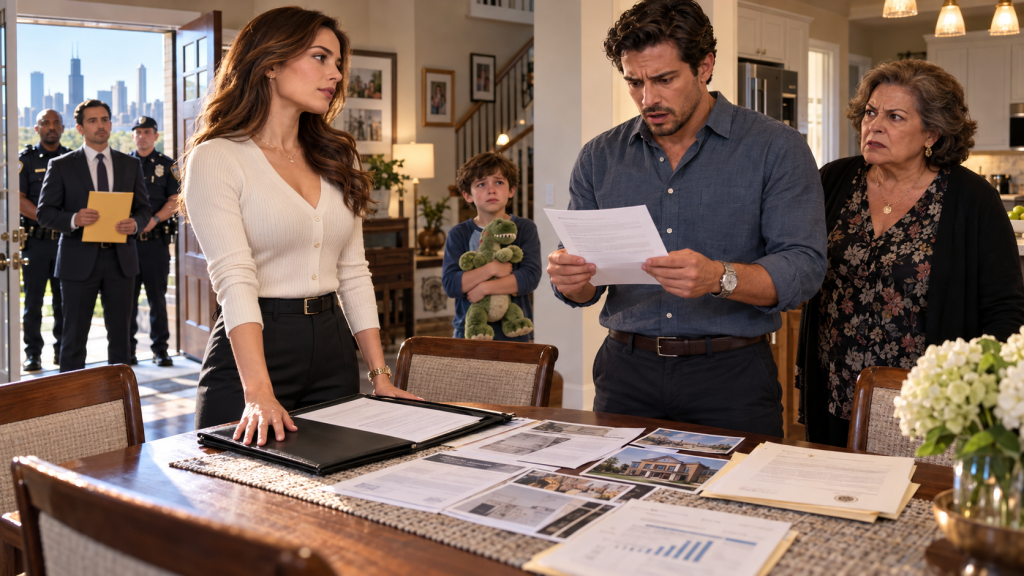
Robles answered carefully. “It does not make Lucía Matthew’s legal guardian.” That mattered. He continued. “This appears to be a private trust application.” “Mrs. Elvira is listed as trustee.” “Lucía is listed as successor trustee and intended guardian if Matthew’s parents become unavailable.”
I stared at him.
“Parents?”
“Yes.”
“Plural?”
“Yes.”
My stomach turned.
Diego grabbed the paper.
“What are you talking about?”
Robles pointed to a paragraph.
“There is supposedly an attached declaration signed by Caroline.”
Diego looked at me.
I shook my head.
“I signed nothing.”
Mrs. Elvira backed toward the wall.
“Those are just planning documents.”
I turned slowly.
“You knew about them.”
She pressed her lips together.
Diego snapped,
“Mom?”
She looked at him.
“I was protecting Matthew.”
“From what?”
Her eyes moved toward me.
That was answer enough.
I laughed.
Not because anything was funny.
Because for eleven years that woman had called me selfish while quietly building documents designed to separate my own child’s financial future from me.
“Say it.”
Elvira lifted her chin.
“You work too much.”
I stared.
“That is your explanation?”
“You are never home.”
“I work ten hours a day because your son refuses to pay half the bills.”
Diego flinched.
Elvira continued as if I had not spoken.
“Matthew needs stability.”
I looked down the hallway.
My eight-year-old son was still standing there in dinosaur pajamas, clutching the stuffed green triceratops he had slept with since he was three.
His face was pale.
He was listening.
Again.
Adults were turning his home into a courtroom around him.
I walked toward him immediately.
“Matthew.”
He looked up.
“Sweetheart, go into your room for a minute.”
“Are they taking me?”
My heart split open.
“No.”
I crouched.
“No one is taking you anywhere.”
“But Grandma said—”
Elvira stepped forward.
“Matthew, honey—”
I stood so fast my chair scraped backward.
“No.”
She stopped.
“You do not speak to him.”
“Caroline, I am his grandmother.”
“And I am his mother.”
The house went silent.
Matthew whispered,
“She said if you left Dad, I would live with Aunt Lucía.”
Diego’s face changed.
“What?”
I knelt again.
“When did she tell you that?”
Matthew looked toward Elvira.
“A while ago.”
“How long?”
He shrugged.
Children measure time differently.
“Before school started.”
That meant months.
I felt cold from the inside out.
“What else did she say?”
He hugged the dinosaur tighter.
“That Dad’s family is my real family.”
Diego closed his eyes.
There it was.
The sentence I had heard about.
Only now I understood the full cruelty of it.
Elvira had not merely told my son I was not “really family.”
She had been teaching him a hierarchy.
Blood on Diego’s side counted.
My labor did not.
My home did not.
My body carrying Matthew did not.
My years raising him apparently did not.
I touched his cheek.
“Listen to me.”
He looked at me.
“I am your mother.”
“You are not going anywhere.”
“Nothing these adults are arguing about changes that.”
He started crying.
I hugged him.
For once, nobody interrupted.
One of the officers quietly asked if there was another adult who could stay with Matthew.
My neighbor, Janet, lived across the hall.
Retired kindergarten teacher.
She had known him since birth.
I called.
She arrived in slippers.
Took one look at the room.
Then at me.
“Do you want questions?”
“No.”
“Good.”
She held out her hand to Matthew.
“Come help me make popcorn.”
He hesitated.
I nodded.
He went.
Before leaving, he turned toward Diego.
“Are you coming home later?”
Diego opened his mouth.
No sound came.
I answered because somebody had to.
“Dad and I will talk.”
Matthew nodded.
Then disappeared across the hall.
The moment the door closed, Diego turned toward his mother.
“What did you tell my son?”
Elvira’s face hardened.
“I told him the truth.”
“No.”
Diego stepped toward her.
“You told him he would live with Lucía?”
“If Caroline ever took him away from you, we needed a plan.”
“We?”
I laughed.
Diego looked at me.
Then back at her.
“There is no ‘we.’”
Elvira stared at him.
“I am your mother.”
“And he is my son.”
“You think I don’t know that?”
“No.”
His voice broke.
“I think maybe you forgot Caroline is his mother too.”
That was the first useful thing Diego said that night.
It did not save him.
But I remembered it.
Mr. Robles placed another document on the table.
“This is the attached declaration.”
My name was typed at the bottom.
My signature was there.
Again.
Not mine.
This one had apparently been copied from the signature page of our prenuptial agreement.
The same source used to open the secret bank account.
The declaration said that, in the event of my “extended incapacity, disappearance, psychiatric instability, or abandonment of the marital home,” I wished for Lucía to be considered as Matthew’s guardian.
I read the phrase twice.
Psychiatric instability.
My hands began to shake.
“Where did this come from?”
Robles said,
“We are still establishing that.”
Elvira looked away.
I stared at her.
“You were preparing to call me unstable.”
She said nothing.
Diego looked horrified.
“Mom.”
Elvira finally snapped.
“What did you expect me to do?”
I blinked.
“Excuse me?”
“She controls everything.”
Her finger pointed at me.
“The house.”
“The accounts.”
“The prenup.”
“She has always held everything over you.”
I almost admired the rewriting.
Diego stared at her.
“She paid for my surgery.”
“She paid because she likes control.”
“She paid my debt.”
“Same reason.”
“She pays Matthew’s tuition.”
“Because she wants to look superior.”
I understood then.
Anything I gave could be transformed into evidence against me.
Generosity became control.
Work became neglect.
Financial competence became domination.
Boundaries became selfishness.
There was no amount of goodness that would ever make me acceptable to a woman who needed me to be the villain in order to excuse what she took.
I sat down.
“Why Matthew?”
Elvira’s anger faded.
“What?”
“The trust.”
“The $96,000.”
“If you wanted money for yourself, why put his name on it?”
She looked at Diego.
Then at me.
For the first time, she hesitated.
Robles answered.
“Because the money would remain under the trustee’s control.”
I looked at him.
“Elvira’s.”
“Yes.”
“Until when?”
“Under the draft, Matthew would receive direct control at thirty.”
I almost smiled from disbelief.
Twenty-two years.
Twenty-two years in which my son’s money could be managed by the woman who had stolen it from me.
Diego dropped into a chair.
“Mom, what did you do?”
Elvira started crying.
Not loudly.
The careful crying of someone who still thinks tears might reorganize the room.
“I wanted something for him.”
“You already had something for him,” I said.
“A mother.”
She looked at me.
“And you tried to turn me into a signature.”
One of the officers stepped forward.
“Mrs. Rivera, we need you to remain here.”
She looked offended.
“In my son’s home?”
I answered.
“My home.”
Her face tightened.
Good.
Not because ownership made me better.
Because she had spent years behaving as if facts changed whenever they inconvenienced her.
They did not.
The apartment became the first major piece investigators could trace.
Six years earlier, less than one month after my father died, I had received a settlement and inheritance distribution totaling $417,000.
I remember the amount because the check terrified me.
Money attached to death always feels heavier.
At the time, Diego carried approximately $98,000 in debt from before our marriage.
Credit cards.
An old personal loan.
A car balance he had hidden.
I was furious when I discovered it.
Then I paid it.
Not all at once.
But enough to prevent collection actions and stabilize us.
Diego promised that would be the last hidden financial surprise.
I believed him.
The rest of my inheritance was supposed to stay separate under our prenuptial agreement.
I thought it did.
It had not.
The secret account opened in my name received an initial deposit of $226,000.
The transfer authorization used my identification and a signature copied from our prenup.
From there, $184,000 went toward Elvira’s apartment.
Another portion covered closing costs, taxes, and repairs.
The remaining money was moved through Rivera Family Services.
Some was used for Diego’s old debt.
Some for Elvira’s expenses.
Some for cash withdrawals nobody could immediately explain.
By the time investigators reconstructed six years of transactions, more than $312,000 had moved through the account.
Not all of it was my inheritance.
Some later transfers came from credit lines opened using my identity.
That explained why the numbers were larger than the original stolen funds.
Debt had been layered over theft.
The apartment was never rented by Diego.
He had paid his mother’s monthly housing costs several times over the years.
But the unit itself belonged to her.
Had belonged to her for six years.
The “urgent apartment deposit” that night?
$8,400 charged to a newly opened credit card in my name.
It was not a security deposit.
It was payment for overdue property taxes, condominium assessments, and repairs.
Diego’s “entire paycheck”?
$3,260.
He had transferred it to Elvira.
That part was true.
Then, because his entire paycheck was gone, he had used credit in my name to cover what his mother actually needed.
He came home proud of himself.
Heroic with stolen oxygen.
When I finally confronted him about that exact detail, weeks later, he cried.
“I thought the card was ours.”
“No.”
“I thought you had opened it.”
“No.”
“Mom said—”
I held up my hand.
“Stop.”
He closed his mouth.
“You are forty-two years old.”
His face fell.
“You do not get to make your mother the author of every mistake.”
“I know.”
“No.”
“You are learning.”
“There is a difference.”
He looked down.
That became one of the central questions in our divorce.
What did Diego know?
When?
About which piece?
The answer was uncomfortable because it was not simple.
He had not known his mother bought the apartment with money stolen from my inheritance.
Evidence supported that.
He had not known Rivera Family Services was legally registered in his name.
He believed, as he said, that it belonged to an uncle.
That was also supported by old family emails.
But he had known his mother regularly moved money through “family accounts.”
He had asked too few questions.
He had benefited from payments.
He had signed documents without reading them.
And the newest credit card?
That one belonged to him.
He had opened it.
Using my information.
He admitted it.
He said Elvira told him I would never approve another advance after we had argued about money.
So he used saved copies of my financial information.
He told himself he would pay it off before I knew.
That sentence appeared everywhere in fraud.
Before she knows.
Before he knows.
Before anyone notices.
As if returning something later changes whether you had permission to take it.
It does not.
Lucía arrived at the police station the following morning with an attorney.
She was terrified.
Her part turned out to be smaller than I feared and uglier than I wanted.
Elvira had asked her two months earlier to sign several pages as “family witness.”
Lucía signed.
Did not read everything.
One page acknowledged that she would accept responsibility for Matthew if “anything happened.”
She thought it was a basic emergency family plan.
It was not.
The document had been attached to the trust materials.
She had no idea my signature on the related declaration was false.
That helped her legally.
It did not impress me personally.
“You signed papers about my child without calling me?”
She cried.
“Mom said you knew.”
I laughed sadly.
“That sentence has financed your entire family.”
She covered her face.
“I’m sorry.”
I believed she was.
I did not immediately forgive her.
Different thing.
Then Lucía told investigators something none of us expected.
The trust was not Elvira’s first attempt to prepare for a custody fight.
Three months earlier, Elvira had asked Lucía whether she knew a therapist willing to “document Caroline’s stress.”
Lucía had refused.
At the time, she thought her mother was simply being spiteful.
Then Elvira asked for screenshots of any messages where I complained about work.
Lucía sent two.
One said:
Ten-hour shift. I’m dead.
Another:
If Diego asks me for money one more time, I’m going to lose my mind.
Ordinary frustration.
Elvira saved them.
In a folder.
Named:
CAROLINE INSTABILITY
I laughed when Robles told me.
Then I cried in the parking garage.
Not because those messages were dangerous.
Any competent judge or attorney would recognize context.
Because I had spent years inside a family where my tiredness was being archived.
Every human moment stored in case it became useful.
I thought of all the evenings I had been careful with my tone.
All the swallowed anger.
All the times I paid because refusing would create a fight.
I had been trying to preserve peace inside a system already collecting weapons.
Matthew’s custody case became my greatest fear.
Not because Elvira’s private papers gave her rights.
They did not.
But because Diego and I were divorcing, and I wanted my son protected without turning him against his father.
My attorney, Elena Vasquez, said something I carried for years.
“Do not confuse accountability with erasure.”
I asked,
“What does that mean?”
“Diego may have committed financial wrongdoing.”
“He may still be Matthew’s father.”
“Those facts have to be handled separately.”
I hated hearing it.
Still true.
The court issued temporary financial orders quickly.
Accounts frozen.
Unauthorized credit lines disputed.
Property access restricted.
The house was confirmed as my separate property subject to specific marital claims for certain improvements.
Diego moved out.
Not to Elvira’s apartment.
That apartment became tied up in the fraud investigation and restitution process.
He stayed with a coworker at first.
Then rented a studio.
For the first time in our marriage, he paid his own rent.
His own electricity.
His own groceries.
One evening, during a court-approved video call with Matthew, he said:
“I burned dinner.”
Matthew laughed.
“What did you make?”
“Chicken.”
“How do you burn chicken?”
“I don’t know.”
I listened from the kitchen.
Something inside me softened.
Not toward the marriage.
That was over.
Toward the possibility that Diego might finally become an adult because nobody was cushioning every consequence.
Matthew struggled more than I expected.
He loved his father.
Loved his grandmother.
Loved Aunt Lucía.
Children do not stop loving people because adults produce evidence.
That would be convenient.
It is not how hearts work.
He started having stomachaches before visits.
Not because Diego mistreated him.
Because he was afraid somebody would say something about me.
So the court ordered both sides not to discuss litigation with him.
Therapy began.
His therapist, Dr. Kendra Moore, taught us a phrase:
“Adult problem.”
Whenever Matthew asked a question too large for his shoulders, we could say:
“That is an adult problem, and adults are handling it.”
Not:
Don’t worry.
Children know when there is reason to worry.
Not:
Everything is fine.
It wasn’t.
Just:
Adults are handling it.
That gave him somewhere to put the weight.
Elvira was prohibited from unsupervised contact for a period while the case was pending.
Not because being a bad mother-in-law automatically removes grandparent contact.
Because she had attempted to manipulate Matthew’s future and had made statements to him undermining his relationship with me.
Eventually, contact became supervised.
Then later, much later, optional.
The criminal cases moved more slowly.
Elvira faced the most serious exposure.
Identity theft.
Forgery-related offenses.
Bank and credit fraud.
Conspiracy involving the false account and trust documents.
The apartment became a major restitution asset.
Her two land parcels mattered too.
Remember the “poor mother” who had nothing?
One property was worth nearly $90,000.
The other around $130,000.
She had a pension.
Savings.
An apartment.
Land.
Yet Diego had spent years telling me she could barely survive.
When I asked him why, he gave the saddest answer.
“Because that’s what she told me.”
I stared.
“You never checked?”
“No.”
“Why?”
He thought.
“Because checking would’ve felt like accusing her.”
There it was.
Trust confused with blindness.
Loyalty confused with never verifying.
I said:
“You checked my grocery receipts.”
His face collapsed.
True.
If I spent $180 at Costco, he asked why.
If his mother said she needed $2,000, he transferred it.
He had not trusted women equally.
He trusted the one who demanded.
Audited the one who provided.
That realization hurt him.
Good.
Some pain teaches.
The forensic accountant traced another surprise.
Elvira had been charging Diego “medicine” costs for nearly four years.
Roughly $600 to $900 every few months.
She did take medication.
But her insurance covered most of it.
A large portion of those payments had gone into savings.
Savings.
While I was paying our son’s tuition.
While Diego complained about the electric bill.
While I postponed replacing my own worn shoes because December was expensive.
I asked Elvira about that once through a recorded civil deposition.
Her attorney objected.
She answered anyway.
“I was saving for emergencies.”
I almost laughed.
“With our money?”
“With my son’s.”
“His money was marital income.”
“He earned it.”
“So did I.”
She looked at me.
“You always had more.”
That was it.
Her morality was arithmetic.
If I had more, taking from me felt less wrong.
If Diego earned something, it belonged upward to his mother.
If I earned something, it belonged sideways to the household.
And if anything remained, apparently she could redirect that too.
The law disagreed.
So did I.
Elvira eventually pleaded guilty to multiple fraud and forgery-related charges.
She did not receive a cinematic fifty-year sentence.
She was older.
Some offenses overlapped.
Some claims were civil rather than criminal.
Her cooperation recovered assets.
She served a finite period of incarceration followed by supervision and restitution obligations.
The apartment was sold.
One parcel of land too.
Insurance and bank recovery covered part of the losses.
By the time everything settled, approximately $247,000 connected to the stolen and fraudulently obtained funds was recovered through property liquidation, account seizures, insurance, and restitution.
Not all of it.
Some money was gone.
Spent years earlier.
Debt does not preserve itself for justice.
Diego’s case was different.
He admitted opening the unauthorized credit account and participating in later transfers.
He entered a plea resolving identity-theft and fraud-related conduct.
Probation.
Restitution.
Financial monitoring.
Professional embarrassment.
He did not go to prison for decades.
He lost something else.
My trust.
And eventually the marriage.
I remember the day the divorce became final.
People assume dramatic relief.
I felt tired.
The judge said words.
Our attorneys exchanged papers.
My marriage became past tense at 10:42 in the morning.
Outside the courthouse, Diego stood beside me.
He had lost weight.
His shirts fit differently.
“Caro.”
I looked at him.
He stopped.
Then corrected himself.
“Caroline.”
Better.
“I’m sorry.”
I waited.
He said:
“I spent years acting like Mom’s needs were emergencies and yours were expenses.”
That sentence surprised me.
He continued.
“I made you pay for my loyalty to her.”
My eyes filled.
“I knew she took too much.”
“I didn’t know how much.”
“But I knew enough to see it was hurting you.”
I said nothing.
He swallowed.
“And I liked being the good son.”
There.
The truth beneath everything.
He liked the applause.
Elvira needed him.
Praised him.
Called him generous.
At home, contributing to rent did not make him heroic.
It made him an adult.
Buying groceries earned no medal.
Paying school tuition was ordinary parenthood.
Giving his mother money felt noble.
Because she made sure it did.
I said:
“You wanted admiration more than partnership.”
He closed his eyes.
“Yes.”
That was the closest we ever came to understanding why our marriage failed.
He asked:
“Do you think you’ll ever forgive me?”
I looked at him.
“I don’t know.”
He nodded.
Then:
“Can I still become better if you don’t?”
That question mattered.
“Yes.”
His eyes filled.
“Yes, Diego.”
“You should.”
And he did.
Not perfectly.
Not quickly.
But enough that Matthew eventually had a father rather than another child for me to manage.
Diego got a smaller apartment.
Kept his finances separate.
Paid child support through automatic transfer.
Never missed after the court order began.
When Matthew needed braces, Diego paid his percentage without complaining.
When school tuition changed, he read the statement.
Actually read it.
Once, he called me.
“I don’t understand this fee.”
I laughed.
“What?”
“The technology charge.”
“Welcome to parenting.”
He laughed too.
Small.
Strange.
Healthy.
We became good co-parents slowly.
Not friends at first.
Then something close to respectful colleagues managing the most important project of our lives.
Matthew.
Elvira’s relationship with Diego broke badly after the arrest.
At first, he blamed her for everything.
That was unfair.
Then he blamed himself for everything.
Also unfair.
Therapy eventually gave him a more accurate sentence:
“My mother manipulated me, and I participated.”
Both.
That mattered.
He stopped sending her money.
Not as punishment.
Because supervision conditions and his own recovery demanded boundaries.
For the first time, Elvira lived within her pension.
She hated it.
Then adjusted.
Human beings often survive boundaries they once called cruelty.
Lucía cooperated fully.
She received no serious criminal penalty because investigators found she had not knowingly participated in the core financial scheme.
But she had signed documents irresponsibly.
She knew that.
Our relationship changed.
She stopped dropping her son off without asking.
That sounds small.
It was enormous.
The first time she called and said:
“Could you watch Nico Saturday?”
I replied:
“No, I have plans.”
There was a pause.
Then:
“Okay.”
No guilt.
No:
But you’re family.
No:
What am I supposed to do?
Just okay.
I hung up and stared at my phone.
It felt almost revolutionary.
I did not need a courtroom to enforce every boundary.
Some only needed me to say them.
The black folder stayed in my dining room drawer for years.
Deed.
Prenup.
Receipts.
Statements.
Police reports.
I kept adding to it.
At first because lawyers needed documents.
Then because I needed proof.
Proof I had paid.
Proof I had owned the house.
Proof the account was fake.
Proof the signatures were false.
Proof I was not imagining the years.
Dr. Moore, Matthew’s therapist, once asked me:
“What happens if the folder disappears?”
I frowned.
“The records exist elsewhere.”
“That isn’t what I asked.”
I hated her instantly.
She smiled.
Therapists enjoy this.
Eventually I understood.
The folder had become emotional evidence.
I needed it nearby because for years Diego and Elvira had trained me to question whether I was selfish for expecting fairness.
The folder said:
No.
You paid.
You worked.
You were there.
You were not crazy.
Still, healing meant eventually knowing those things without opening it.
Matthew grew.
At ten, he stopped carrying the dinosaur everywhere.
At twelve, it lived on a shelf.
At fourteen, he claimed he had forgotten it existed.
At sixteen, I found it hidden in a moving box when we repainted his room.
I held it up.
He turned red.
“Mom.”
“What?”
“Put Mr. Chomps down.”
“Mr. Chomps?”
“That was his name.”
“You told me dinosaurs didn’t need names.”
“I was eight.”
I smiled.
For a second I saw the little boy in the hallway again.
Red eyes.
Green dinosaur.
Adults shouting about guardianship.
Then the sixteen-year-old took it gently from me.
He put it back on the shelf.
Not hidden anymore.
That felt right.
When he was seventeen, Elvira requested to see him without supervision.
By then she had completed her sentence and several years of restitution.
The court no longer controlled the relationship the way it once had.
Matthew was nearly an adult.
I told him:
“Your decision.”
He looked surprised.
“What do you want?”
“I want you safe.”
“That’s not an answer.”
“It is the only answer that belongs to me.”
He thought for a week.
Then agreed to meet her at a café with Diego nearby.
Not me.
I did not need to supervise every chapter.
When he came home, I asked:
“How was it?”
He shrugged.
“She looks smaller.”
People often do after childhood fear loses scale.
“What did she say?”
“She apologized.”
“For what?”
He looked at me.
“For telling me you weren’t really family.”
My throat tightened.
“What else?”
“For putting Aunt Lucía’s name on those papers.”
“Did she ask you to forgive her?”
“No.”
Good.
“She said she used me because she wanted Dad to stay tied to her.”
I sat down.
That was more honest than I expected.
Matthew continued.
“She said if Dad thought you could take me away, he would never leave her side.”
There was the deeper emotional motive.
Money had been part of Elvira’s control.
So had fear.
She needed Diego positioned between women.
Mother versus wife.
Blood versus marriage.
Her crisis versus my bills.
If Diego became fully loyal to his own household, she lost power.
So she built dependency and called it family.
Matthew asked:
“Mom?”
“Yes?”
“Why did Dad believe her?”
I thought for a long time.
“Because people usually believe the story they have practiced the longest.”
He frowned.
“What story?”
“That he was responsible for keeping his mother happy.”
“And you?”
I smiled sadly.
“I practiced one too.”
“What?”
“That being a good wife meant carrying more without complaining.”
He nodded.
“Both bad stories.”
“Yes.”
“Very.”
He smiled.
Then asked:
“Can we get tacos?”
I laughed.
“Fine.”
Life moved.
That is the part revenge stories forget.
There is always laundry after betrayal.
Dentist appointments.
Traffic.
Permission slips.
Flu season.
College applications.
The world does not stay frozen at the table where someone’s smile died.
My clinic career grew.
I became a department supervisor.
Then, at fifty-one, I did something Diego once told me was “too risky.”
I opened a small outpatient practice with two colleagues.
We wrote everything down.
Ownership percentages.
Spending authority.
Exit terms.
Signatures.
Independent bookkeeping.
My partners teased me.
“You love documentation.”
I smiled.
“You have no idea.”
The practice succeeded slowly.
Not millionaire success.
Real success.
Bills paid.
Employees treated well.
Patients returned.
I discovered how peaceful money feels when nobody is hiding it.
The house remained mine.
I considered selling.
Did not.
Too many people assume reclaiming a place means you must abandon it to heal.
Sometimes yes.
Sometimes no.
I changed it instead.
Painted the dining room.
Replaced the table.
Removed Elvira’s spare key from the lock system.
Changed the front door.
Not because the old door was broken.
Because I wanted one thing in the house to close differently.
The night the new door was installed, Matthew came downstairs.
“Why are you staring at it?”
“I like it.”
“It’s a door.”
“Exactly.”
He rolled his eyes.
Teenagers are terrible at symbolism.
Good.
Children should not have to carry every metaphor their parents invent.
Diego eventually visited the house again for Matthew’s graduation party.
The first time he crossed the threshold after the divorce, he stopped.
“You changed everything.”
“Not everything.”
He looked toward the kitchen.
New table.
Different light fixture.
No black folder in sight.
“Looks good.”
“Thank you.”
He handed me a grocery bag.
“What’s this?”
“Milk.”
“Bread.”
“Tortillas.”
I stared at him.
He smiled awkwardly.
“I remembered.”
The night everything ended, he had arrived with nothing.
No milk.
No bread.
Only a speech about what he had given someone else.
Years later, he walked into my house carrying ordinary groceries.
Not romantic.
Not redemption in a bag.
Just evidence he had learned that care lives in boring places.
I took the bag.
“Thank you.”
He nodded.
That was enough.
Elvira wrote me one letter after completing restitution.
I almost threw it away.
Then read it.
The first line said:
I spent years calling your money family money while calling my money mine.
I kept reading.
I told myself Diego owed me because I raised him. I treated motherhood like a debt that should pay interest forever.
My eyes filled.
Then:
I hated your prenuptial agreement because it was proof there were things I could not reach.
There it was.
I used Matthew because I knew nothing frightened my son more than losing him.
And finally:
You were not taking my family. I was trying to keep my son from becoming fully responsible to the family he chose.
I put the letter down.
No dramatic forgiveness.
No sudden desire to call her.
But for the first time, I felt that she understood the shape of what she had done.
I answered once.
Three sentences.
I received your letter. I appreciate that you named your choices without blaming me. I do not want a close relationship, but I hope you continue changing.
She respected it.
No surprise visits.
No guilt through Matthew.
No requests for money.
Years later, that respect mattered more to me than an emotional apology would have.
Matthew left for college at eighteen.
Diego and I drove separately.
Of course.
We both arrived with too much stuff.
Of course.
At the dorm, Diego tried assembling a desk lamp without instructions.
I watched.
“You haven’t changed that much.”
He laughed.
Matthew said:
“Please don’t start.”
We both answered:
“We’re not.”
Then looked at each other.
And laughed.
Our son stared.
“This is disturbing.”
Good.
Ordinary embarrassment.
Exactly what I wanted for him.
Before we left, Matthew hugged Diego.
Then me.
Longer.
He whispered:
“Thanks for not making me choose.”
My eyes filled immediately.
I held him tighter.
“You never had to.”
He stepped back.
“I know now.”
That mattered.
On the drive home, I cried for forty miles.
Not because I was sad.
Because the eight-year-old with the dinosaur had made it out of our war without being drafted into either army.
Years later, Matthew became an accountant.
I laughed when he told me his major.
“Seriously?”
“What?”
“After our family?”
“Exactly.”
He specialized in forensic accounting for a while.
Then corporate compliance.
Apparently trauma sometimes develops a sense of humor.
When he got his first full-time paycheck, he called me.
“Mom.”
“Yes?”
“I need advice.”
My heart jumped.
“What happened?”
“What percentage should I save?”
I laughed so hard I had to sit down.
He said:
“This is serious.”
“It is.”
We talked.
Emergency fund.
Retirement.
Rent.
Insurance.
Then I said:
“And when Grandma calls asking for your entire paycheck—”
“Mom.”
“What?”
“She’s ninety.”
“Boundaries have no age limit.”
He laughed.
Good.
Diego remarried eventually.
Not quickly.
A woman named Renee.
Before the wedding, he asked to meet me for coffee.
I almost declined.
Curiosity won.
He said:
“I signed a prenup.”
I nearly choked.
“What?”
He smiled.
“I thought you’d appreciate that.”
“I appreciate literacy.”
He laughed.
Then became serious.
“I read every page.”
“Good.”
“I also told Renee everything.”
“The fraud?”
“Yes.”
“Your mother?”
“Yes.”
“The credit card?”
“Yes.”
I looked at him.
“That must have been uncomfortable.”
“It was.”
“And?”
“She chose with the truth.”
That sentence stayed with me.
She chose with the truth.
That was what I had been denied for years.
Information.
Consent.
Choice.
I wished them well.
Actually meant it.
Forgiveness had arrived quietly somewhere along the way.
Not reunion.
Not forgetting.
Not undoing.
Just the point where his name no longer tightened something inside me.
Elvira died when Matthew was twenty-seven.
He visited her near the end.
I did not.
My choice.
Diego did.
Lucía did.
Before she died, she asked whether I would take back the old family Bible she had once kept.
I said yes.
Not for me.
For Matthew if he wanted it.
Inside the cover, Elvira had written births and marriages going back three generations.
At the bottom, years earlier, she had added:
Matthew Rivera — grandson.
Nothing about me.
I stared at the page.
Then turned it.
On the back, in shaky handwriting added much later, she had written:
Caroline — his mother. I should have understood that was enough.
I closed the book.
That was the last thing she ever said to me.
Indirectly.
Enough.
Years later, when I finally emptied the dining-room drawer, I found the black folder.
Dusty.
Thicker than before.
I carried it to the kitchen table.
The same place where Diego had opened it all those years earlier.
I went through it slowly.
Property deed.
Prenup.
Old hospital receipt from his drunken crash.
Credit-card statements.
My father’s settlement records.
The fraudulent account documents.
The Rivera Family Services registration.
The trust application.
The forged declaration.
Photocopies of the apartment deed.
Court orders.
Restitution confirmations.
Divorce decree.
So much paper for something I now understood in one sentence:
They mistook my generosity for permission.
I removed the original property deed and legal documents I still needed.
Scanned what mattered.
Then shredded the rest.
The machine jammed halfway through the old credit-card statement.
Of course it did.
I laughed alone in the kitchen.
Pulled the paper backward.
Tried again.
This time it disappeared.
Years of evidence turned into narrow strips.
Not erased.
Finished.
The house became quieter as I grew older.
Matthew married.
A kind woman named Elena.
No relation to my former mother-in-law, thank God.
At their wedding, Diego and I sat on opposite sides of the aisle.
Not enemies.
Not family in the old way.
Parents.
When Matthew danced with me, he whispered:
“Remember Mr. Chomps?”
I smiled.
“I still have him.”
His eyes widened.
“You liar.”
“I found him in your closet.”
“That was private.”
“You abandoned him.”
“Do not use that word at my wedding.”
I laughed.
Then cried against his shoulder.
He was taller than Diego.
Stronger than either of us had been at his age.
More importantly, he understood that love did not mean owing anyone his adulthood.
When his own daughter was born, he asked me to come stay for two weeks.
I said yes.
Two weeks.
Not indefinitely.
I cooked.
Helped with laundry.
Held the baby at 2:00 a.m.
Then went home.
On the last morning, Elena hugged me.
“Thank you for helping without taking over.”
I smiled.
“That took years of expensive education.”
Matthew laughed from the kitchen.
“Therapy?”
“Divorce.”
He nearly dropped a bottle.
Dark humor.
We earned it.
One afternoon, long after the crisis had become family history instead of daily life, Matthew arrived at my house carrying groceries.
Milk.
Bread.
Tacos.
I stared into the bag.
He looked confused.
“What?”
“Nothing.”
“Mom.”
I smiled.
“Your father once came home with no food because he gave away his entire paycheck.”
Matthew laughed.
“I know.”
“You know?”
“Dad told me.”
I raised an eyebrow.
“He tells that story?”
“Yeah.”
“How?”
Matthew smiled.
“He says it was the night he learned that being generous with someone else’s sacrifice is not generosity.”
I went quiet.
That was good.
Very good.
Matthew placed the milk in my refrigerator.
Then he turned.
“Do you regret marrying him?”
The question surprised me.
I thought of Diego young.
Funny.
Charming.
Holding newborn Matthew with tears streaming down his face.
I thought of bills.
Arguments.
Elvira.
The black folder.
The forged account.
The divorce.
Then Matthew.
“No.”
He looked surprised.
“Really?”
“I regret what we tolerated.”
“I regret what he did.”
“I regret what I ignored.”
“But you exist.”
“I don’t use you to justify pain.”
“That would be unfair.”
“I simply don’t need my life to divide neatly into mistakes and victories.”
He nodded.
Then asked:
“Do you regret helping Grandma?”
That was harder.
I thought about medicine I paid for.
Food.
Utilities.
Emergency bills.
Money she did not always need.
“No.”
“Why?”
“Because generosity was not the mistake.”
I looked at him.
“Giving without boundaries was.”
That was the lesson I wanted him to inherit.
Not suspicion.
Not bitterness.
Not “never help family.”
Help.
Love.
Share.
But know where your responsibility ends.
Know that a person who loves you can still exploit you.
Know that understanding someone’s fear does not require financing it.
Know that being family does not grant automatic access to your money, identity, home, child, or future.
And never confuse guilt with duty.
I was sixty-two when everything happened.
For years, Elvira spoke to me as if my independence were selfishness.
Diego acted as if earning more meant I should automatically carry more.
I nearly believed them.
Then came the black folder.
The police.
The apartment.
The account.
The trust.
The forged signature.
The $96,000 transfer.
People sometimes ask which revelation hurt most.
It was not the $312,000.
Not the apartment.
Not even the credit card in my name.
It was Matthew asking:
“Are they taking me?”
Money can be repaid.
Credit repaired.
Property sold.
But when adults use a child’s sense of belonging as leverage, the damage reaches somewhere numbers cannot.
That was why the final victory was never Elvira losing the apartment.
It was never Diego losing his comfortable life.
It was never the restitution check.
The victory was Matthew growing up knowing he did not belong to a side.
He belonged to himself.
And I did too.
The night Diego came home boasting that he had given his entire paycheck to his mother, I asked him what he would eat tomorrow and where he would sleep.
He laughed.
I remember that laugh clearly.
Confident.
Dismissive.
Certain I would do what I had always done.
Pay.
Cook.
Fix.
Forgive.
Absorb.
He believed my threat was drama because my boundaries had always arrived padded with rescue.
That night, for the first time, they didn’t.
I did not throw him into the street in anger.
The law handled the house.
The divorce handled the marriage.
The courts handled the fraud.
Time handled the rest.
I simply stopped volunteering to be the floor beneath every bad decision.
And once I stopped, something remarkable happened.
Everyone discovered they could stand.
Diego learned to pay rent.
Lucía learned to arrange childcare before calling me.
Elvira learned to live on what she actually had.
Matthew learned love did not require taking sides.
And I learned that closing a door does not always mean shutting someone out.
Sometimes it means finally keeping yourself in.
Years later, my front door was replaced again.
Old age.
Warped frame.
Nothing symbolic.
The carpenter asked:
“Do you want the same kind of lock?”
I looked at the new brass handle.
Then smiled.
“Yes.”
“One key for you?”
I thought about it.
“Two.”
“One for me.”
“One for Matthew.”
He nodded.
Simple.
No spare hidden under a mat.
No endless copies.
No relatives walking in without knocking.
Two keys.
Choice.
That evening Matthew came over.
I handed him the second one.
He held it up.
“Big responsibility.”
“Don’t get excited.”
“It does not come with my bank passwords.”
He laughed.
“Fine.”
“Or guardianship papers.”
“Mom.”
“Or access to my credit.”
“Please stop.”
I smiled.
He put the key on his ring.
Then hugged me.
And for the first time in my life, giving someone access did not feel like surrender.
Because this time, I chose it.
THE END STORIES! THANK YOU FOR READING GOOD LUCK !❤️
Related Posts