Andrew stood beneath the patio light with my passport in one hand and my canceled-flight confirmation in the other. For one second, nobody moved. Not me. Not Rosa. Not Eleanor. Not even the pregnant woman visible through the glass behind them.
The music inside had stopped. The white balloons floated above the living room like pale witnesses. Andrew looked at me as though I were the ghost. “Valerie?” My own name sounded wrong in his mouth. I tightened my grip on Rosa’s wrist.
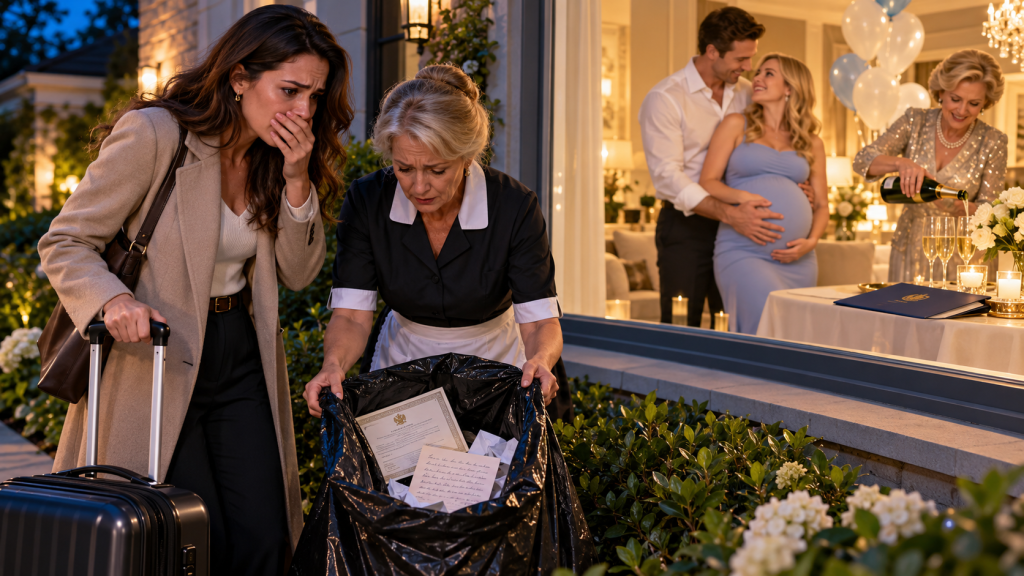
She was shaking. So was I. But fear does strange things when it finally becomes specific. For months, I had been afraid of something I could not name. A marriage growing colder. Messages deleted. Doors closing quietly. My mother-in-law watching me with those calculating eyes.
Now the fear had a document.
A death certificate.
A life-insurance policy.
A forged signature.
A car that was no longer in my driveway.
Specific fear is terrible.
But it is usable.
Andrew took one step toward me.
“What are you doing here?”
I almost laughed.
My house.
My passport in his hand.
A prepared death certificate in a trash bag.
And he wanted to know what I was doing there.
Eleanor appeared behind him.
Her champagne glass was gone.
So was her smile.
“You promised you were going to Europe.”
I looked at her.
“No.”
Her eyes narrowed.
“No?”
“I lied.”
The pregnant woman came closer to the window.
Andrew lowered his voice.
“Valerie, this is not what you think.”
I looked down at the paper in my hand.
Cause of death blank.
Location prewritten.
A body that did not exist.
A plan that apparently did.
“What exactly do I think, Andrew?”
He glanced at Rosa.
Then the bag.
Then me.
I saw the calculation begin behind his eyes.
The same calculation his mother had probably made a thousand times.
What does she know?
What can we deny?
Who can we blame?
I decided not to wait for the answer.
I pulled out my phone.
“I already sent photos of everything to my lawyer.”
It was a lie.
For the moment.
But Andrew did not know that.
His face changed.
Eleanor reacted first.
“Give me the phone.”
I stepped backward.
“No.”
“Valerie.”
“No.”
Andrew said,
“Mom, stop.”
She looked at him.
He did not take his eyes off me.
“Let’s all calm down.”
I almost smiled.
The favorite sentence of guilty people.
Calm down.
Meaning:
Do not act while you still understand what happened.
Do not call anyone before we rename it.
Do not let fear become evidence.
I said,
“Where is my car?”
Andrew did not answer.
“Where is my car?”
He exhaled.
“With a mechanic.”
Rosa whispered,
“That’s not true.”
Eleanor spun toward her.
“You’re fired.”
Rosa actually laughed.
Not because it was funny.
Because firing a woman standing beside your forged death certificate was almost absurd enough to break the terror.
I said,
“Rosa, stay with me.”
She nodded.
Andrew stepped closer.
“Valerie, come inside.”
“No.”
“We need to talk privately.”
“No.”
“This has gone far enough.”
I stared at him.
“My death certificate is dated tomorrow.”
His face tightened.
“You don’t understand the document.”
“Explain it.”
Silence.
I held it up.
“Explain it.”
He looked at his mother.
That look told me more than any confession.
Not surprise.
Coordination.
Maybe not equal guilt.
But shared knowledge.
I whispered,
“Oh my God.”
Andrew said quickly,
“It was a contingency.”
“A contingency for what?”
He swallowed.
“Legal planning.”
“For my death?”
“No.”
I looked at the paper again.
“It literally says certificate of death.”
Eleanor stepped forward.
“Valerie, you are hysterical.”
There it was.
The word.
The old female cage.
Hysterical.
As if I were reacting to a misplaced dinner reservation instead of evidence that my husband had prepared a life after my disappearance.
I turned to Rosa.
“Call 911.”
Andrew lunged for her phone.
I moved between them.
“Don’t.”
He froze.
Maybe because he heard something in my voice he had never heard before.
Maybe because two neighbors’ porch lights had come on.
Maybe because people like Andrew are bravest in private.
Rosa dialed.
Eleanor whispered,
“You stupid girl.”
I looked at her.
“No.”
For the first time, the insult did not land.
I was done accepting definitions from people trying to erase me.
Rosa gave the address.
Said there were fraudulent documents.
Possible planned harm.
A missing vehicle.
Evidence concerning life insurance.
The dispatcher told us to stay outside if we felt unsafe.
Good.
I had no intention of going inside.
Andrew paced.
The pregnant woman finally stepped out through the patio doors.
Up close, she looked younger than I expected.
Maybe thirty.
Maybe less.
One hand rested over her stomach.
She stared at me.
Then at the death certificate.
Her face slowly changed.
“What is that?”
Andrew snapped,
“Go inside, Claire.”
So.
Claire.
She did not move.
“What is that, Andrew?”
Eleanor said,
“Claire, this does not concern you.”
Claire looked at her.
Then at me.
I held up the paper.
“It says I’m supposed to die tomorrow.”
Claire went white.
Andrew said,
“Stop saying that.”
I turned on him.
“Then tell me why it exists.”
He said nothing.
Claire whispered,
“You told me she signed everything.”
My chest tightened.
Andrew stared at her.
“Claire.”
She backed away.
“You said she wanted out.”
I felt something colder than anger.
Not because of the affair.
The affair suddenly felt almost small.
I asked,
“What did he tell you?”
Andrew said,
“Do not talk to her.”
Claire ignored him.
“He told me you knew about us.”
I laughed once.
He had told his mistress I knew.
Classic.
“He said your marriage was basically over.”
Claire continued.
“He said you wanted to travel.”
“That you hated Texas.”
“That you were taking a cash settlement and starting over.”
I stared at the hundred thousand dollars still inside my carry-on.
Settlement.
Not gift.
Not rest.
A payment made to look voluntary.
I looked at Eleanor.
“You gave me the money so there would be proof I took cash and left.”
Her expression hardened.
She did not deny it.
Andrew said,
“It wasn’t like that.”
I turned toward him.
“How was it?”
He rubbed both hands over his face.
“Valerie, please.”
“No.”
I pointed to Claire.
“You told her I surrendered the marriage.”
I pointed to the house.
“You forged documents surrendering my assets.”
I lifted the death certificate.
“And this?”
He went quiet.
Sirens approached in the distance.
That sound changed everyone.
Eleanor looked toward the street.
Andrew stopped pacing.
Claire began crying.
Rosa squeezed my arm.
Then Eleanor said something so quiet I almost missed it.
“You were never supposed to come back.”
The whole garden froze.
Andrew closed his eyes.
“Mom.”
Too late.
I stared at her.
Not rage.
Not anymore.
Clarity.
“Thank you.”
Her face shifted.
“For what?”
“For finally saying something true.”
Police arrived at 8:31 p.m.
Two patrol cars first.
Then another unit after the initial officers saw the documents.
The house became a controlled scene.
Nobody was arrested in the first five minutes.
That surprised me.
Part of me expected movies.
Handcuffs.
Shouting.
Confession.
Instead came questions.
Who owns the property?
Who moved the vehicle?
Who created the death certificate?
Who purchased the insurance?
Who has access to Valerie’s signature?
Where did the hundred thousand come from?
What does the handwritten note mean?
Who is Rosa?
Who is Claire?
When did Valerie last see her car?
Who was supposed to drive it?
Names.
Dates.
Devices.
Evidence.
Reality is administrative.
That is one reason liars underestimate it.
They think emotion controls everything.
Then a detective asks for a timestamp.
Suddenly drama has to survive records.
The hundred thousand dollars mattered immediately.
The cash was banded.
Serial numbers.
Bank wrappers.
Eleanor claimed it came from her private savings.
It did not.
Investigators later traced most of it to a line of credit Andrew had drawn against company assets without properly disclosing the purpose.
That was the first financial crack.
The second came from my life-insurance policy.
Two million dollars.
I knew I had a policy.
I did not know it had been increased.
Years earlier, Andrew and I each carried $500,000 policies because we co-owned part of his consulting company.
Six weeks before the trip, mine had been increased to two million.
The insurance application contained my electronic approval.
False.
The IP log traced to the home office.
On a day I had been in Austin for a conference.
Andrew said his assistant must have processed it.
His assistant denied that.
Then the insurer produced a recorded confirmation call.
A woman answered security questions as me.
I listened to the audio with my lawyer three months later.
It was Eleanor.
Not perfectly.
But enough.
My date of birth.
Mother’s maiden name.
Last four digits of my Social Security number.
All information available in the family file cabinet.
She spoke softly.
Confidently.
Like she had every right to be me.
That recording made me physically sick.
The death certificate turned out not to be an official issued certificate.
Not yet.
It was a partially completed fraudulent template prepared using copied county formatting.
That mattered legally.
No registrar had certified me dead.
No government office had officially accepted the lie.
But whoever created it intended it to appear authentic after the planned “accident.”
The handwritten note was more damaging.
Andrew tried to explain it.
He said:
“It was hypothetical.”
The detective asked:
“Why would you write ‘no one must find Valerie’s body because there won’t be one’?”
Andrew stared at the table.
He had no good answer.
There rarely is one when handwriting survives.
The car was found the same night.
At a commercial storage facility outside Dallas.
Not burned.
Not damaged.
Just parked.
Inside the trunk were items taken from my closet.
Shoes.
A scarf.
Old medication bottles.
Copies of travel documents.
A small makeup bag.
My spare phone charger.
A suitcase.
Things meant to suggest I had been in the vehicle.
The police found no body.
Obviously.
No “accident” had happened.
And thank God, nobody had been injured.
That distinction mattered deeply to me later.
The plan had been interrupted before the most dangerous stage.
People online would eventually imagine flames, chase scenes, murder attempts.
The truth was quieter.
And still horrifying.
Someone had been preparing a story in which I vanished.
The hired driver Rosa mentioned was identified.
His name was Marcus Bell.
He was not a professional killer.
Not some underworld figure.
He was a repossession contractor with gambling debt and a prior fraud conviction.
Andrew knew him through a former business associate.
The messages between them became crucial.
Andrew wrote:
Need the vehicle moved south tomorrow. Make it look abandoned after trouble.
Marcus replied:
No injuries. No people. Just the car.
Andrew:
Correct. Nobody inside.
That sentence changed the prosecution’s theory.
It also changed mine.
They were not planning to kill me physically.
At least the evidence never proved that.
They were planning something stranger.
A fake death.
A disappearance.
A fraud built around absence.
The car was supposed to be found damaged and burned enough to create confusion.
My personal belongings would be inside.
Then Andrew would report me missing after supposedly receiving alarming messages from “me.”
The death certificate template would become part of a larger attempt to pressure insurers and banks once enough time passed or enough fabricated evidence existed.
It was reckless.
Illegal.
Dangerous.
But different from murder.
Accuracy matters.
Even when the truth already feels monstrous.
The plan depended on one thing.
Me being overseas.
Visible in another country.
Using cash.
Not contacting anyone reliably.
Why?
Because Andrew and Eleanor had another story prepared.
I had gone to Europe willingly.
Then vanished.
Maybe left with a lover.
Maybe suicidal.
Maybe unstable.
Maybe running from debt.
Confusion was the point.
They did not need every version to be believable.
They needed enough versions to delay questions while they moved property and money.
The forged asset-waiver documents were meant to suggest I had already surrendered my interests.
The fake death plan would come later if needed.
And the $100,000?
It was not just bait.
It was evidence.
Cash in my possession.
No electronic trail of spending.
Easy to say I left voluntarily with money.
The beauty of their scheme, in their minds, was that every suspicious fact could be turned against me.
I had accepted cash.
Packed a suitcase.
Gone to the airport.
Promised not to return early.
Canceled communication.
And vanished.
They almost made my own movements look like consent.
That realization stayed with me for years.
Control is most dangerous when it teaches your actions to testify against you.
Rosa became the witness who broke the plan open.
She had worked for Eleanor for twelve years before working in our house.
She knew where everything lived.
Keys.
Files.
Passwords written on sticky notes.
Receipts.
Family secrets.
For years, they treated her like furniture.
That was their mistake.
Invisible people see everything.
Rosa first became suspicious when Eleanor asked her to pack my jewelry separately.
Then to pull old medication from the bathroom.
Then to clean out my desk before I “returned.”
Rosa asked why.
Eleanor said:
“Valerie won’t be needing these.”
That phrase bothered her.
Then she saw the death-certificate template in the office printer tray.
She took a copy.
Good.
The original was later recovered from Andrew’s locked drawer.
Rosa also saved security footage from the garage showing Marcus collecting my car.
Andrew had disabled the main camera feed from the app.
But he forgot the system uploaded motion clips to a secondary storage account.
Rosa knew.
Because she had helped install it.
Again:
Invisible people remember systems.
At the first hearing, Andrew looked at her like betrayal had come from nowhere.
I wanted to scream.
She had cleaned our house for four years.
He still did not know how observant she was.
Claire cooperated too.
That was the next twist.
The pregnant woman I had seen through the window was not part of the fraud.
Not originally.
She was part of the affair.
Yes.
And she had benefited from Andrew’s lies.
Yes.
But she genuinely believed I had accepted a financial settlement and left the marriage.
Andrew showed her the forged waiver.
The fake “agreement.”
Even a text conversation supposedly between him and me.
Those texts came from a second number.
Created under my name.
Eleanor helped.
Claire showed investigators everything.
Messages where Andrew told her:
Valerie wants a clean break.
And:
She doesn’t want the company.
And:
Mom is giving her money so she can start over comfortably.
Claire asked:
Is she okay with the baby?
Andrew replied:
She said she expected it.
Expected it.
I had not even known Claire existed.
She cried when telling me later.
We met once with lawyers present.
I did not want to become friends.
But I wanted to hear her.
She said:
“I am sorry.”
I looked at her.
“For sleeping with my husband?”
“Yes.”
“Did you know he was married?”
“Yes.”
At least she did not lie.
“He told me it was ending.”
I nodded.
“That’s what married men say.”
She looked down.
“I know that now.”
I asked:
“What did you think the celebration was?”
Her eyes filled.
“Our engagement.”
That hurt more than I expected.
The white balloons.
Champagne.
Eleanor smiling.
They were celebrating Andrew proposing to the mother of his unborn child while I was supposedly flying over the Atlantic.
Claire said:
“He told me the divorce paperwork would be filed the next morning.”
I almost laughed.
Some paperwork certainly would have been filed.
Just not the kind she imagined.
Then she said:
“I didn’t know about your death certificate.”
“I believe you.”
That surprised her.
“How?”
“Because your face when you saw it looked like mine.”
She cried.
Her son was born seven months later.
Not “our son,” like Andrew said through the window.
Her son.
A child.
Not a symbol.
Not a weapon.
Not an heir to my stolen property.
That distinction mattered later.
The company became another battlefield.
Andrew and I owned shares together.
I held thirty-eight percent.
He held forty-two.
The remaining twenty belonged to a silent investor named Charles Wynn.
The forged waiver supposedly transferred my shares to Andrew for nominal consideration as part of “voluntary marital separation.”
Charles was furious.
Not because he loved me.
Because any false ownership transfer threatened the company.
His lawyers froze major transactions.
Then a forensic audit began.
That audit uncovered something nobody expected.
Andrew had been moving money long before the fake-death plan.
Not millions.
But enough.
Company funds had paid for Claire’s apartment.
Travel.
Gifts.
Prenatal care.
Part of Eleanor’s loan.
The hundred thousand cash.
Approximately $420,000 in questionable or undisclosed personal expenditures over three years.
Some legitimate compensation.
Some reimbursements.
Some not.
Andrew kept saying:
“I was going to restore it.”
There it was again.
The anthem.
I was going to put it back.
The company board removed him from day-to-day control pending investigation.
Charles bought an additional temporary voting proxy from me.
I did not trust him blindly.
I hired independent counsel.
That became a theme in my life.
No blind trust.
Not because trust is foolish.
Because verification is not betrayal.
Eleanor’s role ran deeper than I expected.
For years, she had handled the family bookkeeping informally.
She knew accounts.
Insurance.
Property structures.
Tax folders.
She saw herself as guardian of the family.
That word came up repeatedly.
Guardian.
She believed Andrew was brilliant but weak with money.
She believed I was financially competent but emotionally “temporary.”
She believed Claire, pregnant with a boy, represented continuity.
That disgusted me.
Not because of Claire.
Because Eleanor had reduced women to functions.
Me:
Asset.
Claire:
Mother of grandson.
Herself:
Guardian.
She did not see people.
She saw positions in a family system.
And once she decided my position had expired, she began removing me.
Investigators found an email from Eleanor to Andrew six months before the trip.
If Valerie walks away angry, she will take everything she can. If she leaves by choice, we control the narrative.
Andrew replied:
She won’t leave by choice.
Eleanor:
Everyone leaves for the right price.
Then:
If not, we create the right circumstances.
I read that in my lawyer’s office.
For a long time, I said nothing.
My attorney, Priya Desai, waited.
Finally I whispered:
“She gave me a price.”
“Yes.”
“One hundred thousand dollars.”
“Yes.”
I laughed.
Then cried.
That was what my five-year marriage was worth in Eleanor’s strategy.
One envelope.
Three weeks.
Disappear happily.
Priya said something I never forgot.
“The amount tells us what they thought would move you.”
I looked at her.
“The fact that you came back tells us they were wrong.”
The divorce took nearly two years.
Not because I wanted delay.
Because everything was tangled.
Marriage.
Company.
Insurance.
Property.
Criminal investigation.
Civil claims.
Fraudulent documents.
Andrew initially fought me.
Then changed lawyers.
Then stopped.
His first attorney treated me like an enemy.
His second apparently told him the evidence was catastrophic.
Good lawyer.
Andrew eventually agreed to a structured divorce settlement.
The forged documents were void.
My company shares restored.
Property divided based on actual ownership.
My legal fees partially compensated through settlement.
No magical total victory.
Some money was gone.
Some value lost.
The company suffered.
Clients left.
Employees lost bonuses.
Fraud harms people who never enter the story.
That mattered.
I remember sitting across from three longtime employees who were terrified the company would collapse.
I felt ashamed.
Not because I had done it.
Because my marriage had become a financial earthquake under their jobs.
Charles and I stabilized operations.
Reduced executive spending.
Sold an unnecessary office property.
Restored credit relationships.
Brought in an outside CFO.
The company survived.
Barely.
Two years later, it was healthier than before.
I eventually sold part of my stake.
Kept twelve percent.
Enough to benefit.
Not enough to spend my life in Andrew’s shadow.
The criminal case was slower.
The fake-death conspiracy created dramatic headlines.
I hated them.
DALLAS WIFE RETURNS EARLY, UNCOVERS OWN DEATH PLOT.
It sounded like entertainment.
What those headlines did not show was paperwork.
Months of interviews.
Repeated authentication.
Handwriting experts.
Digital forensics.
Insurance review.
Vehicle analysis.
Financial tracing.
Prosecutors ultimately did not charge Andrew or Eleanor with attempted murder.
The evidence did not support that.
They did face serious charges related to insurance fraud conspiracy, forgery, identity theft, fraudulent financial transactions, attempted asset diversion, and obstruction-related conduct.
Marcus faced charges for his role moving the car and agreeing to damage it as part of the fraud.
Eleanor received a substantial sentence.
Andrew did too.
Not life.
Not forever.
Enough.
He lost professional licenses connected to financial management.
Paid restitution.
Surrendered company control.
Faced civil judgments.
His reputation collapsed.
Again, none of that felt like victory.
It felt like consequence.
Andrew wrote me from custody.
His first letter began:
I never meant to hurt you.
I stopped reading.
Returned it.
Months later, another came.
I opened that one.
It said:
I keep wanting to explain the difference between making you disappear on paper and wanting you dead.
My hands shook.
Then:
I realize now that the distinction matters legally, but not emotionally. I was willing to let the world believe you were dead so I could keep what I wanted.
That sentence made me continue.
He wrote:
I told myself I was avoiding a divorce war. In truth, I wanted the benefits of your absence without giving you the dignity of choosing to leave.
Finally.
Accuracy.
He did not ask forgiveness.
Good.
He apologized to Rosa too.
She never responded.
Her choice.
Rosa became family to me in a way I never expected.
Not because she saved my life.
I do not use that phrase.
The evidence never showed anyone planned to kill me.
She saved my identity.
Maybe that is closer.
She saw documents designed to turn me into someone absent.
And she kept copies.
After the case, I paid for her attorney.
Then tried to give her money.
She refused.
“I worked for you,” she said.
“You don’t owe me for doing the right thing.”
I laughed.
“You hid in a garden with my fake death certificate.”
She smiled.
“That was extra.”
Eventually she accepted a severance package when I sold the house.
Not charity.
Earned.
She opened a small cleaning company with her daughter.
Five years later, she employed fourteen people.
Every Christmas she sent me cookies.
Terrible cookies.
I ate them anyway.
Claire raised her son mostly alone.
Andrew had limited contact based on circumstances and later legal arrangements.
I kept my distance.
She once sent me a photograph of the boy.
I stared at it for a long time.
Dark hair.
Andrew’s eyes.
Her smile.
I felt nothing bad.
That surprised me.
Children should not inherit adult shame.
I replied:
He’s beautiful.
She wrote:
Thank you for not hating him.
I answered:
He didn’t do anything.
Simple.
That should not have been extraordinary.
Eleanor never met her grandson freely the way she expected.
That was one of the consequences she seemed to feel most.
She had built the entire scheme around the fantasy of preserving a family line.
Instead, she fractured every relationship around it.
Control does that.
It grabs so tightly that eventually nothing can remain in the hand.
Years passed.
I traveled to Europe eventually.
Alone.
Not because Eleanor paid me.
Because I wanted to.
Paris first.
Then Florence.
Then Lisbon.
I used none of the hundred thousand.
That money remained evidence for a long time, then became part of restitution accounting.
I bought my own ticket.
At the airport, I nearly laughed.
Terminal D.
Same place.
This time, nobody asked me to promise when I would return.
I sat near the gate drinking terrible coffee.
The announcement came.
Boarding.
My hands trembled.
Not fear.
Memory.
I texted Rosa:
Actually getting on the plane this time.
She replied:
Check your own suitcase.
I laughed so loudly a stranger looked at me.
Paris was beautiful.
Eleanor had been right about one thing.
I walked for hours.
Ate alone.
Slept without wondering who was whispering in my house.
On the third day, I stood beside the Seine and cried.
Not because I missed Andrew.
Because I remembered the woman who had accepted an envelope and wondered whether she was imagining the danger.
I wanted to reach backward through time and tell her:
You are not imagining it.
But also:
You are going to become more than the worst thing they planned.
Trauma makes people think survival should become identity.
I resisted that.
I did not start a podcast.
Did not write a revenge book.
Did not build my life around being “the woman whose husband faked her death.”
For a while, the media wanted me.
I declined most interviews.
One reporter asked:
“Don’t you want to tell your side?”
I said:
“The court record has my side.”
She looked disappointed.
Good.
My life was not content.
I eventually moved away from Dallas.
Not immediately.
Eventually.
Denver.
Smaller house.
Mountain light.
A neighborhood where no one knew Eleanor.
I worked as an independent strategy consultant.
Less money at first.
More peace.
I dated badly.
Then better.
Then met Nathan Cole.
He was a widower with a teenage daughter and an unreasonable commitment to labeling leftovers.
The first time he told me he had updated his life-insurance beneficiary, I went silent.
He noticed.
“What?”
“Nothing.”
“That was not nothing.”
I told him a little.
Not all at once.
He listened.
Then said:
“If we ever combine finances, you get every password.”
I laughed.
“That sounds terrible.”
“It is.”
Later, we did combine some.
Not everything.
We had prenups.
Separate counsel.
Independent insurance verification.
He joked our romance came with audit controls.
Perfect.
He never asked me to stop checking documents.
Eventually, I checked less.
That was trust.
Not the absence of information.
The absence of fear around information.
I married Nathan six years after my divorce became final.
Small ceremony.
Rosa attended.
Priya attended.
My mother cried.
No Eleanor.
No Andrew.
No white balloons.
I wore blue.
Because I wanted to.
At dinner, Nathan’s daughter raised a glass.
“To Valerie, who apparently reads every contract.”
Everyone laughed.
I raised mine.
“To survival skills.”
Later that night, Nathan asked:
“Happy?”
I thought.
Then answered:
“Yes.”
No performance.
No suspicion.
Just yes.
Andrew was released years later.
He contacted me once through proper channels.
Asked if I would meet.
I said no.
Two years after that, I changed my mind.
Not because I needed closure.
Because I was curious whether the man I had married still existed inside the person who had finally lived with consequences.
We met in a lawyer’s conference room.
Neutral.
Boring.
Perfect.
Andrew looked older.
Gray at the temples.
Thinner.
No expensive watch.
He sat across from me.
“Thank you for coming.”
I nodded.
He said:
“I rehearsed an apology.”
“Don’t.”
He almost smiled.
“Okay.”
Silence.
Then he said:
“I loved you.”
I looked at him.
“I know.”
His eyes filled.
“I also used you.”
“Yes.”
“I thought those things couldn’t both be true.”
“So did I.”
He looked down.
“I was wrong.”
“Yes.”
He took a breath.
“Claire told me once that I wanted women to become roles instead of people.”
I raised an eyebrow.
“She’s right.”
He nodded.
“You were wife.”
“Mom was protector.”
“Claire was future.”
“And I was what?”
He looked at me.
“The person whose choices complicated my plans.”
That hurt.
Because it was true.
He continued.
“I convinced myself that if you left with money, I wasn’t stealing anything.”
I said:
“You forged my surrender.”
“Yes.”
“You tried to let the world think I was dead.”
“Yes.”
He swallowed.
“I know.”
No excuse.
Finally.
I asked:
“Why the death certificate?”
He looked ashamed.
“Because Mom said the disappearance needed an endpoint.”
My stomach tightened even after all those years.
He continued.
“We thought if the car was found and you stayed abroad long enough, everything would become legally easier.”
“It wouldn’t.”
“I know that now.”
I almost laughed.
“Your plan was terrible.”
He actually smiled.
“Criminally terrible.”
Then the smile vanished.
“I am sorry.”
I nodded.
“I believe you.”
His eyes filled.
“Do you forgive me?”
I thought.
Then said:
“I don’t organize my life around that question anymore.”
He nodded slowly.
Fair.
We never met again.
That was enough.
Eleanor outlived Andrew’s sentence by several years.
She wrote me once near the end of her life.
Her handwriting shook.
I gave you one hundred thousand dollars because I thought every person had a number.
Then:
I was wrong.
And:
I spent my life thinking family could be preserved by arranging people. I did not understand that people are not furniture.
That line almost made me laugh.
She continued.
You frightened me because you could leave. I mistook freedom for disloyalty.
I kept the letter.
Not as forgiveness.
As evidence of change.
People can change too late.
It still matters.
It just does not erase consequence.
When Eleanor died, I sent flowers.
No note.
No funeral.
That was the boundary I could live with.
The Dallas house was sold during the divorce.
I never went back after the final move.
Rosa supervised movers.
Priya handled closing.
Some people thought I should have kept it.
Taken the victory.
But I did not want to win a house full of ghosts.
Property is not justice.
Money is not justice.
Even prison is not justice by itself.
Justice, for me, became something smaller.
My name stayed mine.
My signature stayed mine.
My life stayed mine.
They tried to build a future that required my absence.
I built one that did not require their permission.
That was enough.
The $100,000 became a strange symbol.
For years, whenever someone said:
“You were lucky you got suspicious,”
I wanted to scream.
Suspicion was not luck.
It was exhaustion finally refusing to call itself paranoia.
The hug at the airport.
The repeated warning not to return early.
Andrew’s complete lack of surprise.
The phrase:
Mom will keep an eye on the house.
None of those things proved a crime.
Together, they made me look.
Looking saved me.
Not because intuition is magic.
Because patterns matter.
When kindness arrives from someone who never gives it, notice.
When a spouse is relieved by your absence, notice.
When people encourage you to disconnect from everyone at the exact moment paperwork is moving, notice.
Not proof.
Notice.
Then verify.
That lesson followed me into everything.
Business.
Love.
Friendship.
Not suspicion.
Attention.
There is a difference.
Years after the case, Nathan and I sat on our porch in Denver while snow started falling.
He handed me an envelope.
I stared at it.
“What is this?”
He smiled.
“Open it.”
Inside was a travel voucher.
Two tickets to Portugal.
I looked at him.
“No cash?”
He laughed.
“No death certificate either.”
I hit him with the envelope.
Dark humor had become possible.
That was healing.
We traveled.
Returned when we wanted.
Nobody celebrated my disappearance.
Nobody moved my car.
Nobody prepared a story without me.
I came home to my own life.
And sometimes, when people hear what happened, they ask me the same question.
“What would have happened if you had actually gone to Europe?”
I do not answer.
Because there is no useful life in imaginary graves.
Maybe the plan would have failed.
Maybe a bank would have caught the signatures.
Maybe Rosa would have called me.
Maybe police would have found the car too soon.
Maybe Andrew would have panicked.
Maybe Eleanor would have changed the plan.
Maybe.
Maybe.
Maybe.
I do not live there.
I live in the timeline where I walked out of Terminal D.
Where I returned two blocks away.
Where I saw white balloons.
Where Rosa whispered:
“Don’t go in.”
Where a trash bag contained a paper version of my death.
Where my husband stepped into the garden holding my passport and discovered the woman he had planned to erase was standing right in front of him.
Alive.
Watching.
Listening.
And no longer willing to believe anything simply because family said it softly.
They thought disappearance was something they could arrange.
A ticket.
Cash.
A forged signature.
A missing car.
A story repeated often enough.
They forgot one thing.
A woman is not gone just because other people have prepared paperwork for her absence.
I came back before their lie had time to become official.
Then I spent years doing something much harder.
I stayed present in my own life.
And that, more than any courtroom, was how I survived them.
THE END STORIES! THANK YOU FOR READING GOOD LUCK !❤️
Related Posts