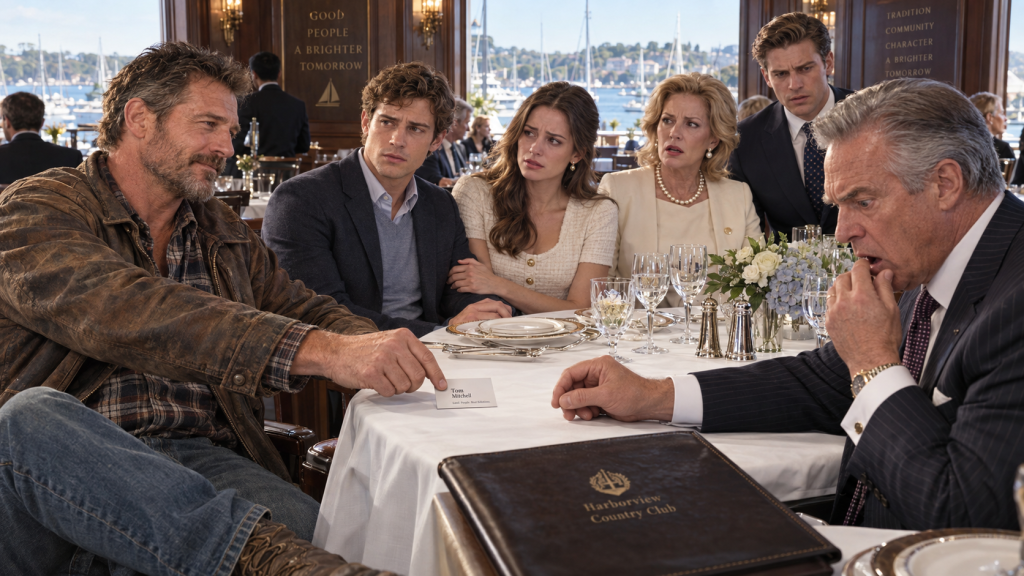
I never told my son about my $120,000 monthly income. When his wealthy girlfriend’s family invited me to their exclusive country club, I pretended to be poor just to test their character. They looked down on me and had no idea I was the investor who controlled their future.

“No offense, Tom, but Michael is not prepared to support the life our daughter expects.”
Richard Bradford said it without raising his voice. That made it worse.
Across the private dining alcove, my son’s face tightened. Jessica’s hand moved toward his under the white tablecloth, but her mother noticed and lifted one eyebrow.
I set down my fork.
The Brookshire Country Club overlooked Boston Harbor, all polished silver, mahogany panels, and people who never looked at a menu price. I had arrived in faded jeans, scuffed work boots, a six-dollar flannel shirt, and the leather jacket I had owned since 1995.
Twenty years earlier, I had belonged to this club. I knew the harbor view, the private wine cellar, and the old portrait over the fireplace. I had resigned after Sarah died because none of it mattered without her.
Nobody at the table knew that.
Michael had gripped the steering wheel the whole way there, rehearsing apologies for my clothes before anyone had even insulted me. When the valet saw my dented Honda, Christopher laughed under his breath. Richard pretended not to notice. Patricia noticed everything.
I noticed, too.
For thirty-five years, I had sat across from men who hid panic behind expensive tailoring. I knew the difference between confidence and performance.
Richard was performing.
I just did not yet know why.
The Bradfords had been measuring me from the moment I entered.
Patricia studied my clothes.
Christopher smirked at my car.
Richard studied my son as if Michael were applying for financing instead of asking to marry his daughter.
“You live in South Boston?” Patricia had asked.
“I do.”
“And you rent?”
“I own the apartment.”
Richard smiled politely. “Property values may eventually give you a small return.”
I let the comment sit.
They believed I was a retired finance worker living on a modest pension. Michael believed the same thing.
He did not know that my investments generated roughly $120,000 every month.
He did not know because I had never told him.
Eight years earlier, after his mother died, Michael fell apart. He abandoned graduate school, buried himself in credit-card debt, and called me whenever another bill became impossible.
At twenty-three, he declared bankruptcy.
Then he rebuilt himself.
He worked two jobs, returned to school, earned his architecture degree, and stopped asking anyone to rescue him. I kept my wealth quiet because I needed him to discover that he could stand without it.
Now he was twenty-eight, sitting beside the woman he loved while her family treated him like a financial risk.
Jessica was the only Bradford who had welcomed me without hesitation. She had stood, hugged me, and looked directly into my eyes.
Her parents looked at my boots.
The waiter returned.
Richard ordered lobster. Patricia chose Wagyu beef. Christopher never opened his menu long enough to see the prices.
“I’ll have the chicken breast,” I said. “Plain. Water is fine.”
A glance passed around the table.
Michael’s ears turned red.
I kept eating.
The questions came dressed as conversation.
Where had I studied?
A state school.
What did I drive?
A 2008 Honda Civic.
Did I still belong to a club?
Not anymore.
Each answer made Christopher’s smile grow.
Jessica tried to redirect them toward Michael’s latest architecture project, but Richard cut her off.
“Marriage requires planning,” he said. “Children require resources.”
“I just received a promotion,” Michael replied.
“That is encouraging,” Patricia said, in the tone people use with a child showing them a drawing.
Michael’s fingers curled beneath the table.
Richard leaned back in his tailored suit.
“Jessica has been raised with certain standards. Travel. Education. Security. We have to know she won’t be forced to struggle.”
“Dad,” Jessica warned.
“I’m protecting you.”
“No,” she said. “You’re embarrassing Michael.”
Richard ignored her.
He looked at me.
“You understand. You’re a father.”
“I understand exactly.”
The table quieted.
“You want proof that Michael can provide for your daughter,” I said.
“A natural concern.”
“And you’ve spent this entire lunch deciding whether our family has enough standing for yours.”
Patricia froze with her wineglass halfway to her mouth.
Christopher stopped smiling.
Richard folded his napkin with careful fingers. “I would not phrase it so bluntly.”
“How would you phrase it?”
He cleared his throat.
“Values matter. Background matters. Resources matter.”
“Standing matters,” I said.
“Yes.”
“And you believe we have none.”
Michael stared down at his plate.
Jessica looked furious.
“Mr. Warren,” she said, “I’m sorry.”
“You have nothing to apologize for.”
I turned back to Richard.
He believed he had finished the conversation. He thought I would swallow the insult because men in worn jackets were expected to be grateful for invitations.
Instead, I asked, “How is Riverside Development going?”
His expression changed by half an inch.
That was enough.
“I’m sorry?”
“Your Cambridge property portfolio. Twenty million in renovation costs. Delayed financing. Difficult quarter.”
Christopher’s head snapped toward his father.
Patricia lowered her glass.
Richard’s butter knife stopped moving.
“How do you know about Riverside?”
I ignored the question.
“And Hartford? The acquisition collapsed when your bridge financing disappeared. That put pressure on your firm, didn’t it?”
The confidence left his posture.
Michael looked at me as if I had started speaking another language.
Richard leaned forward.
“Who exactly are you?”
I reached into the same worn leather jacket they had dismissed all afternoon.
My fingers closed around my wallet.
Inside was a business card I had carried for years but rarely used anymore.
The Bradfords watched my hand.
Jessica’s eyes moved from me to her father. Michael sat perfectly still.
I placed the card facedown on the white tablecloth and rested one finger on it.
“You wanted to understand our family’s resources,” I said. “You wanted to know whether my son was worthy of your daughter.”
No one interrupted.
“So let’s discuss resources.”
I slid the card across the table.
It stopped beside Richard’s untouched wine.
He stared at it, then at me.
“Pick it up.”
For the first time that afternoon, he obeyed.
Richard turned the card over.
His eyes moved across the first line.
Then all the color left his face..
PART 2 — THE CARD ON THE TABLE
Richard Bradford turned my business card over.
At first, his expression did not change.
Then he read the second line.
His thumb stopped moving.
The blood seemed to leave his face so slowly that I could almost watch him understand one word at a time.
THOMAS WARREN
Founder & Executive Chairman
Warren Meridian Capital
Beneath that was the Boston office number.
No title about wealth.
No list of assets.
No explanation of what the company did.
Richard did not need one.
He knew the name.
That was enough.
Across the table, Patricia leaned toward him.
“What?”
Richard did not answer.
Christopher reached for the card.
His father pulled it away before he could touch it.
That interested me.
Michael looked at me.
“Dad?”
I kept my eyes on Richard.
The confident man who had spent lunch evaluating my family’s financial worth now seemed unable to decide where to put his hands.
Finally he whispered:
“You’re Thomas Warren.”
“I’ve been Thomas Warren since 1959.”
Christopher stopped smiling.
Patricia looked from the card to my flannel shirt as if one of them had to be counterfeit.
Jessica stared at me.
But Michael—
Michael looked hurt.
Not impressed.
Not proud.
Hurt.
I noticed that immediately.
And suddenly I knew the most difficult conversation at that table was not going to be with Richard Bradford.
Richard cleared his throat.
“Warren Meridian.”
“Yes.”
“The private investment firm.”
“One of them.”
His eyes narrowed.
“One of them?”
I almost smiled.
“Warren Meridian is my family office and investment company.”
“We manage my capital, several long-term partnerships, and some co-investment vehicles.”
Richard glanced down at the card again.
“How large?”
There it was.
Even now.
Numbers first.
I leaned back.
“Large enough that the number won’t improve this lunch.”
Jessica lowered her eyes to hide a smile.
Christopher did not find anything funny.
Patricia finally spoke.
“I’m confused.”
I believed her.
“We were told you were retired.”
“I am.”
“From finance?”
“Yes.”
“But you own an investment company.”
“I founded one.”
“That doesn’t sound retired.”
“It is when other people attend most of the meetings.”
Richard was no longer listening to the family conversation.
His mind had gone somewhere else.
Riverside.
Hartford.
Bridge financing.
Covenants.
Men like Richard could move from dinner to balance sheets without shifting their posture.
I watched the realization reach him.
“North Atlantic.”
he said.
I said nothing.
His eyes lifted.
“The North Atlantic Private Credit Fund.”
Still nothing.
Patricia looked at him.
“What about it?”
Richard ignored her.
“Warren Meridian is the anchor investor.”
“Largest outside limited partner.”
I corrected.
His jaw tightened.
“Twenty-eight percent.”
“Closer to thirty-one after the latest close.”
Christopher whispered:
“Jesus.”
Jessica looked at him.
“Can we not?”
He ignored her too.
Apparently manners only mattered when poor people violated them.
Michael’s face had become unreadable.
He looked at me.
“Dad, what is he talking about?”
I finally turned toward my son.
Wished I could answer him somewhere else.
Not beneath a chandelier while the Bradford family watched our relationship split open.
But secrets do not ask where you would prefer to explain them.
“Warren Meridian invests in private credit.”
Michael frowned.
“I know what private credit is.”
Of course he did.
He was an architect, not an idiot.
I had spent so many years protecting the secret that sometimes I forgot how much of the world he had learned without me.
“I am one of the principal investors behind a fund that has been reviewing financing for Bradford Development.”
Silence.
Michael slowly looked at Richard.
Then back at me.
“His company?”
“Yes.”
Richard spoke quickly.
“It is not quite that simple.”
“No.”
I said.
“It isn’t.”
I turned toward Michael.
“That distinction matters.”
The fund was not mine.
I could not wake up angry one morning and cancel a corporation’s financing because someone insulted my Honda Civic.
That is not how serious investment firms work.
North Atlantic had an investment committee.
Independent managers.
Credit officers.
Outside counsel.
Other capital partners.
Warren Meridian had significant influence because we supplied a large portion of the fund’s capital and I retained a seat on its advisory committee.
But influence is not ownership.
And money entrusted to an investment structure carries duties larger than one man’s pride.
I wanted everyone at the table to understand that before Richard imagined I had just threatened his livelihood.
So I said it plainly.
“Your Riverside financing will not be decided at this table.”
Richard watched me.
“I have no intention of retaliating against your company because you were rude to me.”
His jaw tightened.
“I was not—”
Jessica interrupted.
“You were.”
Richard looked at her.
She did not back down.
Good.
I continued.
“Now that there is a personal connection between our families, I will disclose it.”
“I will recuse myself from any formal decision involving your application where appropriate.”
Richard stared.
Perhaps that surprised him more than the money.
Christopher looked almost disappointed.
“What?”
I asked.
He blinked.
“Nothing.”
“No.”
I smiled.
“You expected me to say I could destroy you.”
His face reddened.
“I didn’t say that.”
“You didn’t have to.”
Patricia set down her wineglass.
“Thomas, I think everyone is a little overwhelmed.”
Thomas.
Interesting.
For the previous ninety minutes, I had been Mr. Warren whenever she remembered my name at all.
Amazing what a business card could do to syllables.
“I’m still the man who ordered plain chicken.”
I said.
Patricia’s face tightened.
Jessica covered her mouth.
Even Michael almost smiled.
Almost.
Then his expression closed again.
“Dad.”
One word.
I knew that tone.
He had used it at seventeen when he found out I had sold his first car after he drove drunk.
At twenty-three, when I refused to pay another credit-card bill.
After Sarah died, when grief turned every disagreement into proof that one of us loved her more correctly.
“Yeah.”
I said.
Michael looked at me.
“How much money do you have?”
The country club disappeared.
The Bradfords disappeared.
For one moment, I saw only my son.
I could have dodged.
Net worth is complicated.
Private investments are illiquid.
Markets move.
Income varies.
All true.
All cowardly.
“My investment income averages around one hundred twenty thousand dollars a month.”
Michael’s face emptied.
Jessica stared.
Christopher whispered something I did not hear.
Patricia physically leaned back.
Richard closed his eyes.
Michael did not move.
“A month.”
“Yes.”
“How long?”
There it was.
The question I had feared more than anything Richard could ask.
“Years.”
“How many?”
“Long enough.”
Michael laughed once.
A terrible sound.
“No.”
He shook his head.
“Don’t do that.”
“Do what?”
“Give me one of your careful finance answers.”
His eyes were wet now.
“How long did you have money like that?”
I swallowed.
“Before your mother died.”
Michael pushed back from the table.
His chair did not fall.
I almost wished it had.
A loud noise would have been easier than the silence.
“You had that kind of money when I went bankrupt?”
Jessica touched his arm.
He pulled away.
Not from her.
From everybody.
“Michael.”
I said.
“You watched me go bankrupt.”
The sentence landed harder than Richard’s insult ever could.
“Yes.”
I said.
Because lying now would finish whatever secrecy had already damaged.
Michael stared.
Christopher looked fascinated.
I turned toward him.
“This is a family conversation.”
Something in my voice finally made him lower his eyes.
Michael looked at me.
“I called you.”
“I know.”
“I told you I couldn’t pay the cards.”
“I know.”
“I was eating ramen four nights a week.”
“I know.”
“I sold Mom’s watch.”
That one cut.
Sarah’s old stainless-steel watch.
Nothing especially valuable.
Michael sold it six months after she died.
I had bought it back quietly from the consignment dealer and kept it in my safe.
He did not know that either.
Another secret.
Jesus.
Maybe I had spent eight years convincing myself secrecy was wisdom because control sounded uglier.
“I know.”
I whispered.
Michael’s eyes filled.
“And you had money.”
“Yes.”
Jessica turned toward me.
Her face was no longer warm.
Good.
If she loved my son, she should be angry.
I deserved some of it.
Richard looked as though he wanted the floor to open.
His snobbery had become irrelevant inside a larger wound.
Michael asked:
“Why?”
I had practiced that answer in my head for years.
It sounded worse out loud.
“Because every time I rescued you, you fell further.”
His jaw tightened.
“That’s not an answer.”
“It is part of one.”
“You could’ve paid everything.”
“Yes.”
“How much did I owe?”
“About sixty-eight thousand when you filed.”
Richard’s eyebrows lifted.
Of course I knew the number.
I knew every number.
Michael saw that too.
“You knew exactly.”
“Yes.”
“And you let it happen.”
“Yes.”
Patricia whispered:
“Perhaps we should give them some privacy.”
For the first time all afternoon, she said something I liked.
Jessica immediately replied:
“I’m staying.”
Michael looked at her.
She reached for his hand again.
This time he let her take it.
Richard stood.
“We can move to—”
“No.”
Michael said.
His voice was calm.
“Sit down.”
Richard did.
Interesting how the table had changed.
I looked at my son.
“After your mother died, you were twenty-two.”
“Twenty-three.”
“Twenty-three.”
I corrected.
“You stopped going to class.”
“You maxed out three cards.”
“You borrowed from me.”
“I paid your rent twice.”
“You borrowed again.”
“You started gambling online.”
Michael flinched.
Jessica looked at him.
That history was apparently new to her too.
He looked ashamed.
I immediately regretted the setting.
“That is not an accusation.”
I said.
“It’s context.”
Michael stared at the table.
“I stopped.”
“Yes.”
“You stopped because the bankruptcy attorney told you the accounts were being closed.”
He looked up sharply.
I continued.
“I thought if I paid everything, the only lesson would be that there was always a larger wallet behind you.”
His face hardened.
“So you taught me a lesson.”
“Yes.”
“And who gave you the right?”
There it was.
The question that dismantled eight years of self-justification in one sentence.
I had answers.
I was his father.
He was grieving.
He was reckless.
I was terrified.
None of those answers gave me the right to design his adulthood without telling him the truth.
I looked at him.
“No one.”
Michael’s anger faltered.
I continued.
“I thought I was doing what your mother would have done.”
His face changed.
“Don’t.”
“You’re right.”
I stopped.
Sarah did not belong inside my defense.
She was dead.
I had spent too many years borrowing her imagined opinion whenever I needed certainty.
“I made the decision.”
I said.
“Not your mother.”
“Me.”
Jessica squeezed Michael’s hand.
He asked:
“Did you ever plan to tell me?”
“Yes.”
“When?”
I almost laughed at the cruelty of the question.
There had never been a date.
After graduation.
After his first job.
After he paid off the new cards.
After he stopped asking for help.
After he became stable.
After he got engaged.
There was always another milestone that made silence easier.
“I kept moving the line.”
I admitted.
Michael nodded slowly.
“That sounds like no.”
It did.
“I was afraid.”
His eyes lifted.
“Of what?”
“That the money would become your life.”
He stared.
“It became yours.”
That hurt because it was true.
For thirty-five years, I had thought about capital almost every day.
Deals.
Rates.
Risk.
Companies.
Funds.
The irony was almost embarrassing.
I had hidden wealth from Michael because I did not want money defining him while allowing money to define the way I parented him.
I leaned back.
“I was also afraid people would treat you differently if they knew.”
Michael looked toward the Bradfords.
“Great job.”
Jessica whispered:
“Michael.”
“No.”
He looked at me.
“He literally invited me here to be judged for not having enough money.”
“I know.”
“And you came dressed like that on purpose.”
Silence.
He understood.
Of course he did.
My son was not stupid.
The only person I had fooled completely was myself.
“Yes.”
I said.
Jessica stared.
Richard’s face tightened.
Michael laughed.
“You tested them.”
“Yes.”
“You pretended to be poor.”
“Not exactly poor.”
“Dad.”
“Yes.”
“I wanted to know how they would treat me if they thought I had nothing useful to offer them.”
Michael looked disgusted.
“And how is that different from what they were doing to us?”
The question silenced the table.
Even Richard looked at me differently.
Not triumphant.
Recognizing.
I had walked into Brookshire convinced I was morally superior because I knew the answer while everyone else took the exam.
I had measured their character without their consent.
Different method.
Same arrogance.
Jessica spoke first.
“He’s right.”
I nodded.
“I know.”
Richard looked surprised.
Apparently wealthy men were supposed to defend themselves longer.
I was tired.
“I thought I was protecting Michael.”
I said.
Then looked at my son.
“I’ve apparently made that phrase do too much work.”
Michael looked away.
Nobody spoke for several seconds.
The waiter appeared at the edge of the alcove.
Saw six faces that clearly did not need dessert.
Quietly disappeared.
Excellent judgment.
Richard finally said:
“Thomas.”
I turned.
“I owe you an apology.”
“Which part?”
His mouth tightened.
Fair.
He continued.
“For how I spoke about Michael.”
I looked at my son.
“That apology belongs to him.”
Richard followed my eyes.
For the first time that afternoon, he looked directly at Michael without evaluating him like an asset.
“I’m sorry.”
Michael did not answer.
Richard continued.
“I was condescending.”
“Yes.”
Michael said.
“I treated your career as insufficient because it did not match the financial life Patricia and I built for Jessica.”
“Yes.”
“I was wrong.”
Michael studied him.
Then asked:
“Would you know that if my dad weren’t rich?”
Richard’s face went still.
Jessica looked at her father.
There was no safe answer.
So, to his credit, Richard told the truth.
“I don’t know.”
That mattered more than a polished apology.
Patricia’s eyes filled.
“Michael, we want Jessica secure.”
“I know.”
he said.
“But you keep using that word like security only means money.”
Patricia looked down.
Michael continued.
“My mother died when I was twenty.”
I corrected gently.
“Twenty-one.”
He gave me a look.
Not now.
Right.
“My mother died.”
he said.
“I lost two years of my life after that.”
“I built them back.”
“I have a profession.”
“I pay my bills.”
“I love your daughter.”
“I don’t have your standard of wealth.”
“If that makes me unsafe to marry, then say it.”
Jessica turned toward her parents.
Neither spoke.
So she did.
“It doesn’t.”
Patricia looked at her.
“Jess—”
“No.”
Jessica’s voice shook.
“You keep talking about the life I expect.”
“Did anyone ask what life I expect?”
Her mother’s face changed.
Jessica continued.
“I don’t want a husband who funds a version of me you designed.”
“I want Michael.”
“I like his apartment.”
“I like that he brings coffee from the terrible place downstairs because the owner knows his name.”
“I like that he measures restaurants by whether the bread is warm.”
Michael almost smiled.
“I like that he worries about spending too much on hotels because it means we argue and then find some weird little place we remember forever.”
Patricia looked close to tears.
“That sounds romantic now.”
“It sounds like my life.”
Jessica replied.
“That should count.”
Richard rubbed his forehead.
The performer was disappearing.
For the first time, I could see the tired man beneath the tailored suit.
Maybe that was what I had noticed when I asked about Riverside.
Panic.
Not contempt alone.
Contempt is sometimes fear wearing expensive shoes.
I asked:
“How bad is it?”
Richard’s head lifted.
Patricia stiffened.
Christopher stared at his father.
“Thomas.”
Richard warned.
“Not here.”
“You brought finances here.”
I reminded him.
He closed his eyes.
Point taken.
Riverside Development was a twelve-building redevelopment project in Cambridge.
Mixed-use.
Commercial.
Residential.
Labor costs had risen.
Materials had risen.
Rates had moved against them.
A primary lender refused to expand its facility.
The Bradford group needed new private-credit capital to refinance short-term debt and complete construction.
None of this meant Richard was broke.
The family still had substantial assets.
But wealth on paper and liquidity in a bad quarter are different animals.
A man can own fifty million dollars of property and still lie awake over payroll.
Richard had been sleeping poorly for months.
I could see it now.
“You’re worried about Jessica because Riverside is struggling.”
I said.
Richard did not answer.
Jessica’s face changed.
“Dad?”
Patricia whispered:
“Richard.”
He looked at his wife.
Something passed between them.
A secret.
Christopher noticed too.
“What?”
he demanded.
“How bad?”
Richard rubbed both hands over his face.
“Not now.”
Christopher’s chair moved.
“No.”
he said.
“You don’t get to tell him his son isn’t financially prepared when your own company is drowning.”
“Christopher.”
Patricia snapped.
Too late.
Richard looked suddenly seventy instead of sixty-two.
“Riverside is not drowning.”
“What is it doing?”
Christopher asked.
“Taking a long swim?”
Jessica almost laughed from nerves.
Richard glared.
Then exhaled.
“We have liquidity pressure.”
“How much?”
Christopher asked.
“Enough.”
There it was.
Every family eventually found the same word when numbers became embarrassing.
Enough.
I looked at Richard.
“You thought Jessica needed to marry someone who could maintain her lifestyle because you were no longer sure you could keep subsidizing it.”
Jessica’s head snapped toward him.
“Dad?”
Richard’s face hardened.
“That is not fair.”
“Is it false?”
Silence.
Jessica slowly withdrew her hand from Michael’s.
Not rejection.
Shock.
“Have you been paying my rent because you can’t afford it?”
Richard looked offended.
“We can afford your apartment.”
“That’s not what I asked.”
She had inherited his precision.
He sighed.
“We’ve been reducing discretionary expenditures.”
Patricia looked away.
Christopher cursed under his breath.
The family’s financial reality was apparently new to him too.
Interesting.
The wealthy Bradfords knew as little about their own money as Michael knew about mine.
Everyone at the table had secrets.
Some simply wore better shoes.
Jessica looked close to tears.
“You could have told me.”
“I didn’t want you worrying.”
Richard said.
There it was again.
Protecting.
I almost laughed at how often families used that word before admitting they had withheld someone’s reality.
Jessica shook her head.
“You were interviewing Michael about whether he could support me because you’re scared you won’t be able to.”
Richard’s expression collapsed.
“Yes.”
Finally.
One honest syllable.
She stared.
Then quietly said:
“That’s horrible.”
“I know.”
Christopher leaned back.
“So how bad is Hartford?”
Richard glanced at him.
“The acquisition is gone.”
“We know that.”
“What did it cost?”
“Several million in deposits, fees, and unwind costs.”
Christopher’s face drained.
Patricia whispered:
“You said most was recoverable.”
“Most is not all.”
Silence.
Christopher looked toward me.
Not smirking now.
“How much control does your fund have?”
There was the question.
He wanted the lever.
The rescue.
I answered carefully.
“North Atlantic is considering a financing proposal.”
“That’s all.”
“Can you make it happen?”
“No.”
“But you can influence it.”
“Yes.”
“So can you?”
Jessica turned toward him.
“Christopher.”
“What?”
He looked genuinely confused.
“If Dad’s company needs financing and his dad—”
He pointed toward me.
“—controls the money, why are we pretending that doesn’t matter?”
I looked at him.
“Because it matters too much.”
He frowned.
“If I use investment capital to reward people for treating my son well, I’m corrupt.”
I said.
“If I punish a business because its owner insulted my boots, I’m childish.”
“If I approve bad credit because our children are dating, I’m irresponsible.”
Christopher looked away.
Richard stared at me for a long time.
Then said quietly:
“Thank you.”
I shook my head.
“Don’t.”
“For what?”
“For not using this.”
“I’m not doing you a favor.”
I said.
“I’m doing my job.”
The exact sentence I once taught Michael.
Maybe professionalism is simply refusing to turn power personal.
Then Richard asked:
“Are you actually on the committee?”
“Advisory side.”
“I don’t run underwriting.”
“But you’ve seen our file.”
“Yes.”
“How much?”
“Enough to ask about Riverside and Hartford.”
His jaw tightened.
“Anything else?”
I looked at him.
There was more.
I had not planned to discuss it.
Not at lunch.
Not with Michael.
Not with Jessica.
But Richard had just admitted his family did not know how serious the pressure had become.
And one item in the diligence package had bothered me from the beginning.
At the time, Jessica Bradford had been only a name on a schedule.
Now she was sitting four feet away.
I looked at my son’s girlfriend.
“Jessica.”
She straightened.
“Yes?”
“Do you own a condominium on Beacon Street?”
Richard went completely still.
Jessica frowned.
“Yes.”
Patricia lowered her eyes.
Christopher stopped moving.
Michael looked between them.
The condo had been left to Jessica by her grandmother five years earlier.
Not Richard’s.
Not Patricia’s.
Jessica’s.
Mortgage-free.
She rented it while living closer to work.
That much she told me.
“Why?”
she asked.
I looked at Richard.
“Your Riverside financing package includes a sponsor-liquidity schedule.”
His face tightened.
Jessica asked:
“What does that have to do with my condo?”
Richard spoke.
“Thomas.”
I ignored him.
“The schedule lists anticipated proceeds from a disposition of a family residential asset.”
Jessica frowned.
“So?”
“The address corresponds to your Beacon Street property.”
Silence.
Jessica stared at her father.
“What?”
Richard leaned forward.
“It is not what it sounds like.”
That sentence has never improved a situation.
Jessica’s face went pale.
“You’re selling my condo?”
“No.”
“Then why is it in your financing package?”
“We discussed restructuring family assets.”
“No.”
“You discussed.”
Richard looked toward Patricia.
She looked down.
Jessica saw it.
“Mom?”
Patricia’s eyes filled.
“We thought if Riverside needed additional sponsor equity—”
“You thought you could sell my apartment?”
“No.”
Richard snapped.
“Of course not without your consent.”
Jessica stared.
“Did you ask me?”
No answer.
“There’s your consent.”
Michael said quietly.
Nobody needed the lesson explained.
Richard rubbed his forehead.
“It was a potential source.”
“Nothing binding.”
I nodded.
That was accurate.
The sources-and-uses document I had seen was not a sale contract.
It was a financing scenario.
An asset planners believed might become available.
No transaction had occurred.
No deed changed.
But Jessica looked as though the ground had shifted anyway.
Because somebody had planned with her property before asking her.
Interesting how quickly I recognized the injury when it belonged to someone else.
Maybe Michael had been right about me too.
Jessica looked at her mother.
“Did Grandma leave that condo to me?”
“Yes.”
“Not the family?”
“Yes.”
“Then why is it on Dad’s spreadsheet?”
Patricia whispered:
“Because Riverside supports all of us.”
Jessica laughed once.
“Apparently everything supports all of you.”
That was cruel.
And wounded.
Patricia flinched.
Richard’s voice became firmer.
“We would have asked.”
Jessica looked at him.
“When?”
No answer.
“After the financing was lined up?”
She asked.
“After you told the lender the asset was available?”
“After everyone was counting on me?”
Richard’s face changed.
He heard it.
So did I.
Make the plan first.
Ask later.
Turn refusal into destruction.
A powerful way to obtain consent without technically taking it.
I looked down at my hands.
Michael had accused me of something similar.
I had designed his adulthood around lessons I chose without telling him why.
Different stakes.
Same paternal certainty.
That realization hurt.
Jessica stood.
“I need air.”
Michael rose too.
She shook her head.
“Not because I don’t want you.”
Her voice softened.
“I just need five minutes where nobody explains my future.”
Michael sat back down.
That impressed me.
Six months earlier, maybe he would have followed.
Now he let her leave.
One of the hardest ways to love someone is not going after them when they ask for room.
As Jessica disappeared toward the terrace, my phone vibrated.
I almost ignored it.
Then saw the name.
Eleanor Shaw.
Chief Investment Officer at Warren Meridian.
Eleanor ran most of the work I pretended retirement had removed from my life.
She knew I was at lunch with the Bradfords because I had disclosed the personal connection that morning.
The message read:
Need to speak before Monday’s North Atlantic call. Something in Riverside file doesn’t reconcile.
My stomach tightened.
I typed:
What?
Her answer came immediately.
Support letter attributed to Jessica Bradford. $6M contingent family liquidity. Signature issue. Counsel flagged metadata.
I stopped breathing.
Richard saw my face.
“What?”
I did not answer.
Another message appeared.
Didn’t know until today that Jessica Bradford is your son’s girlfriend. Need confirmation before we proceed. Do not discuss conclusions. Just determine whether she knowingly executed the letter if appropriate through counsel.
I stared at the words.
Support letter.
Six million dollars.
Not the Beacon Street condo alone.
Something more.
I looked at Richard.
His face had gone still.
Too still.
Christopher noticed.
“What happened?”
I put the phone facedown.
Not because I wanted drama.
Because Eleanor had explicitly warned me not to turn a diligence concern into a dinner-table accusation.
Facts first.
Always.
“Richard.”
He looked at me.
“Does Jessica have a trust?”
Patricia went pale.
Christopher whispered:
“What trust?”
Richard did not answer.
That was enough to make Michael sit straighter.
“What is going on?”
he asked.
I looked toward the terrace doors.
Jessica was still outside.
Alone.
I hated what I was about to do.
But the question concerned her.
She had the right to hear it.
“Would someone ask Jessica to come back?”
Richard said quickly:
“No.”
Everyone looked at him.
His own reaction betrayed more than any accusation I could have made.
I felt something cold settle in my stomach.
“Why not?”
I asked.
Richard’s jaw tightened.
“Because you are discussing confidential company documents.”
“No.”
I said.
“I’m about to ask an adult woman whether she signed something bearing her name.”
Jessica returned before anyone called her.
She must have seen our faces through the glass.
“What now?”
Nobody answered.
She looked at Michael.
He looked at me.
So I said:
“Jessica, I need to ask you one narrow question.”
Her shoulders stiffened.
“Okay.”
“Do you have a trust established by your grandmother or another relative?”
She looked confused.
“Yes.”
Richard stood.
“This is inappropriate.”
Jessica turned.
“Sit down, Dad.”
He did not.
She looked directly at him.
“I said sit down.”
He slowly returned to the chair.
The daughter he had spent lunch trying to protect was beginning to sound remarkably capable of protecting herself.
Jessica looked at me again.
“Yes.”
“My grandmother established trusts for me and Christopher.”
Christopher blinked.
“Mine too?”
Patricia closed her eyes.
Apparently another family secret.
“Wonderful.”
Christopher muttered.
Jessica ignored him.
“The trustee controls mine until I’m thirty.”
“How old are you?”
“Twenty-nine.”
“Do you know approximately what it holds?”
“No.”
“Dad always said I didn’t need to worry about it yet.”
Richard looked like a man watching his own sentences return with weapons.
I chose every word carefully.
“The Riverside financing materials include a support letter attributed to you.”
Jessica stared.
“What does that mean?”
“It appears to represent that certain family liquidity may be available under specified conditions.”
“How much?”
“Six million dollars.”
Her face lost all color.
“No.”
Richard said:
“Thomas.”
I lifted one hand.
“I am not saying the document is valid.”
“I am not saying anyone forged anything.”
“Counsel has identified a discrepancy.”
“That is all I know.”
Jessica looked at her father.
“Did I sign it?”
Richard stared at the table.
Her voice changed.
“Dad.”
Patricia began crying.
Christopher stood now.
“What did you do?”
Richard finally looked up.
“It was part of a preliminary package.”
“That is not what I asked.”
Jessica whispered.
“Did I sign it?”
Richard opened his mouth.
No answer.
I felt every instinct in me telling me to conclude.
He forged it.
He used her money.
He lied.
But suspicion is not proof.
I had spent a career learning that.
So I waited.
Jessica did not.
“Show me.”
she said.
I shook my head.
“I don’t have the document on my phone.”
“Can you get it?”
“Through proper channels.”
“How long?”
“Probably today.”
She turned to her father.
“Do you have a copy?”
Richard’s silence answered more than he intended.
Patricia suddenly said:
“She signed papers at Thanksgiving.”
Everyone turned.
Jessica frowned.
“What papers?”
“For estate planning.”
“I signed beneficiary forms.”
“Trust updates.”
“Charitable documents.”
Patricia looked at Richard.
“Richard?”
His face had gone gray.
Jessica stared at her mother.
“Was there a Riverside support letter in those papers?”
Patricia began shaking.
“I don’t know.”
That was believable.
Terrifyingly believable.
A stack of documents.
Family office papers.
Sign here.
Initial there.
Trust Dad.
People with money can be just as careless about signatures as people without it.
Sometimes more.
Because lawyers make carelessness look organized.
Jessica sat down slowly.
“I want every document I signed.”
Richard whispered:
“You’ll have them.”
“Today.”
“Yes.”
“And I want my own lawyer.”
That landed.
Patricia looked wounded.
“Jessica—”
“No.”
Jessica shook her head.
“I love you.”
“I’m not accusing anyone yet.”
“But I am done asking the people who benefit from my signature to explain what it means.”
I almost looked at Michael.
Did not.
I did not need to.
I had heard the lesson too.
Michael spoke softly.
“Jess, do you want to leave?”
She looked at him.
“Yes.”
He stood.
No lecture.
No demand.
He simply picked up her coat.
Before leaving, Jessica turned toward me.
“Mr. Warren.”
“Yes?”
“Did knowing who my family was change whether you approved of me?”
The question surprised me.
“No.”
“Did my family’s money?”
“No.”
“What did?”
I thought.
“You stood when I arrived.”
She frowned.
“That’s it?”
“No.”
“You apologized when other people were rude even though the rudeness wasn’t yours.”
“You defended Michael before you knew who I was.”
“And when you found out who I was, you looked more worried about him than impressed by me.”
Her eyes filled.
“That’s enough.”
Then I added:
“But I owe you an apology too.”
“For what?”
“For testing you without telling you there was a test.”
Jessica considered that.
Then nodded.
“Yes.”
“You do.”
Fair.
She left with Michael.
The alcove became unbearably quiet.
Christopher stood near the window.
Patricia cried without making sound.
Richard stared at my card as though it had started everything.
It had not.
It merely changed who everybody believed had power.
That difference mattered.
I reached for the card.
Turned it face down.
Again.
Where it had begun.
Richard looked at me.
“What happens now?”
I knew what he meant.
Not dinner.
Riverside.
His company.
His family.
Maybe his future.
I answered carefully.
“Now your financing team deals with North Atlantic.”
“Your counsel deals with ours.”
“Jessica gets independent advice.”
“And I step out of anything I should not be influencing personally.”
He stared.
“You could end this.”
“No.”
I shook my head.
“Your documents might.”
That was worse.
Because paperwork cannot be charmed.
Richard’s face crumpled for the first time.
Not financially.
Emotionally.
“I was trying to save the company.”
I believed him.
That did not answer the question of what he had done.
“Then save it without making your daughter collateral.”
He closed his eyes.
Patricia covered her mouth.
Christopher turned away.
No one spoke.
I left Brookshire alone.
No valet jokes this time.
The young man brought my dented Honda as carefully as if it were a Bentley.
That almost made me laugh.
Same car.
Same jacket.
Same man.
Only their information had changed.
That was the ugliest part of status.
People often call it respect when what they really mean is updated valuation.
I tipped the valet the same amount I had planned before lunch.
Then sat behind the wheel.
Did not start the engine.
My phone showed three messages.
One from Eleanor.
Counsel locating original support letter and signature packet. Don’t draw conclusions.
Good.
One from Michael.
We need to talk. Not tonight.
That hurt.
But it was fair.
The third came from Jessica.
Thank you for not pretending the document proved something before I saw it.
I stared at that one.
For thirty-five years, I had built a career on waiting for evidence.
For eight years, I had apparently forgotten to apply that discipline to my own son.
I had decided what Michael needed.
Decided what money would do to him.
Decided when he was ready for the truth.
Then I had walked into a country club to test whether another family believed they had the right to decide his future.
Maybe Richard Bradford was not the only father at lunch who needed to learn humility.
I started the Honda.
Rain had begun over the harbor.
Boston lights blurred across the windshield.
Before pulling away, I looked once more at the country club where twenty years earlier Sarah and I had celebrated our fifteenth anniversary.
She had worn a blue dress.
Ordered the cheapest wine despite being able to afford anything on the list.
When I asked why, she said:
Because expensive doesn’t become good just because someone printed a larger number beside it.
I laughed aloud in the empty car.
God, I missed her.
Then I wondered what she would have said about Michael.
Not the imaginary Sarah I had used for eight years to defend my choices.
The real one.
She probably would have looked at me and said:
Tom, you arrogant idiot. Tell your son the truth.
That sounded more like her.
My phone rang.
Eleanor.
I answered.
“What did counsel find?”
She did not waste time.
“The support letter exists.”
My hands tightened around the wheel.
“Signature?”
“Appears to be Jessica Bradford’s.”
“Appears?”
“There’s an electronic version and a wet-signature scan.”
“Metadata on the electronic package is inconsistent with the date represented.”
My stomach tightened.
“What inconsistency?”
“The file was generated after the date printed on the signature page.”
That did not automatically mean fraud.
Documents get rescanned.
Recompiled.
Updated.
I knew better than to leap.
“What about the original?”
“Counsel is requesting it.”
“Any indication she knowingly approved the commitment?”
“Not yet.”
Then Eleanor paused.
“There’s something else.”
I closed my eyes.
Of course.
“What?”
“The letter is not only a six-million-dollar support statement.”
“It references a separate personal guaranty.”
I stopped breathing.
“How much?”
“Fifteen million.”
The rain suddenly sounded louder against the windshield.
“And whose guaranty?”
Eleanor was silent for one beat too long.
Then:
“Jessica Bradford.”
I stared at the dark club entrance.
Twenty-nine years old.
Her father had spent lunch asking whether my son possessed enough money to protect her.
Meanwhile, somewhere inside Riverside’s financing file sat a document suggesting she had personally guaranteed fifteen million dollars of her family’s risk.
Maybe knowingly.
Maybe not.
We did not know yet.
That distinction was everything.
Eleanor continued.
“Tom.”
“Yes?”
“There’s another signature.”
“On what?”
“The acknowledgment attached to the guaranty.”
“Who?”
A pause.
Then she said:
“Michael Warren.”
My heart stopped.
For several seconds, I could not understand the words.
“My Michael?”
“The document lists Michael Warren, architect, Boston address.”
The world narrowed.
“He didn’t sign anything for Riverside.”
“Are you sure?”
“Yes.”
Then I remembered the table.
Michael filling out something before lunch?
No.
He had never mentioned Richard’s business.
He had looked genuinely shocked.
My pulse pounded.
“What is his signature supposedly acknowledging?”
“That he is aware of Jessica’s contingent obligations and waives any future spousal claim that could interfere with enforcement if they marry.”
I went cold.
Michael and Jessica were not even engaged yet.
This document had anticipated their marriage.
Used his name.
Used hers.
Planned around both of them.
“Send it to counsel.”
I said.
“Already done.”
“Do not call Richard.”
“I wasn’t going to.”
“Do not call Michael yet.”
Eleanor paused.
“Tom.”
I closed my eyes.
There it was.
My oldest instinct.
Control the information.
Protect first.
Tell later.
I heard Michael’s voice from lunch.
Who gave you the right?
I opened my eyes.
“No.”
I corrected myself.
“Forget that.”
Another pause.
Then Eleanor said:
“Good.”
I almost laughed.
“Send me the document.”
“Tom, you’re personally involved.”
“I know.”
“Do not investigate it yourself.”
“I know.”
“Your counsel should handle preservation and verification.”
“I know.”
“Then why do you sound like you’re about to break into someone’s office?”
“Because I’m still learning.”
That made her laugh once.
Barely.
Then she hung up.
The document arrived two minutes later.
I did not open the signature page first.
I opened the metadata summary.
Dates.
Routing.
Email domains.
IP records incomplete.
Questions.
Not answers.
Then I opened the guaranty acknowledgment.
Michael’s name sat at the bottom.
A signature resembling his.
Not perfect.
Not obviously fake.
I had seen his handwriting thousands of times.
That meant nothing legally.
I refused to decide from a PDF.
Then I looked at the date.
Four months earlier.
The same weekend Michael told me he had attended a Bradford family charity event.
The same weekend he said Jessica’s father had finally started “warming up” to him.
My stomach turned.
Maybe Michael had signed something he did not understand.
Maybe he had signed nothing.
Maybe Richard knew.
Maybe Christopher handled documents.
Maybe an assistant made an error.
I did not know.
That phrase had rarely felt so important.
I called Michael.
He declined the call.
Fair.
I sent one message.
I know you said not tonight. Something came up that directly involves your name on a Riverside document. I will not discuss it by text. Please call when you are somewhere private. This is not about our argument.
Thirty seconds later, my phone rang.
“Dad.”
His voice was cold.
“What document?”
I looked at the PDF.
“A purported acknowledgment connected to a financial guaranty by Jessica.”
Silence.
“What?”
“It carries your name and a signature represented as yours.”
Another silence.
Then:
“I never signed anything like that.”
I closed my eyes.
Not proof.
But now we had a direct denial.
“Are you sure you didn’t sign a packet at a Bradford event?”
“No.”
“Think carefully.”
“I said no.”
His anger rose.
“I know what I sign.”
Then he stopped.
Breathing changed.
“What guaranty?”
“Fifteen million dollars.”
Silence.
Then Michael whispered:
“Jessica?”
“Yes.”
“Does she know?”
“I don’t know.”
“Dad.”
“I am not hiding it.”
I said immediately.
“I just learned.”
He went quiet.
That mattered.
Maybe both of us noticed.
“Send it to me.”
he said.
“No.”
His voice sharpened.
“Dad—”
“Not because I’m controlling it.”
I said.
“Because counsel is preserving the file, and I don’t know what I’m authorized to distribute yet.”
“I will have counsel contact you directly.”
Michael was silent.
Then:
“Okay.”
One word.
Not surrender.
Not obedience.
Understanding.
I almost cried.
“Michael.”
“What?”
“I’m sorry.”
He exhaled.
“We’re not doing that now.”
“Fair.”
Then:
“Is Jessica with you?”
“Yes.”
“Tell her only this until counsel can speak to her: there is a document bearing her name that may create a serious financial issue, and she should not sign or discuss anything with her family without independent legal advice.”
Michael paused.
Then said:
“You sound like yourself again.”
The sentence hit harder than anger.
“What does that mean?”
“You’re giving me information instead of a lesson.”
Then he hung up.
I sat in the Honda for another ten minutes.
Rain running down the glass.
Country club lights behind me.
My business card in my jacket.
My son’s anger still fresh.
A fifteen-million-dollar guaranty I did not yet understand.
A family company under pressure.
A young woman whose parents had spent lunch discussing whether my son could provide enough security while apparently planning around her assets.
And somewhere inside all of it, my own arrogance.
I had arrived at Brookshire believing I would test their character.
By the time I left, I understood character was not revealed by how people behaved after learning I was wealthy.
It was revealed by what each of us did when we possessed information another person did not.
Richard had planned around Jessica’s assets.
I had planned around Michael’s ignorance.
Patricia had allowed financial fear to masquerade as standards.
Christopher had treated money like rank.
Jessica had defended Michael before she knew anything.
And Michael—
my son—
had built himself without knowing there had been a net beneath him all along.
Not because I gave him freedom.
Because I had hidden the net.
Those were not the same thing.
My phone lit up again.
A message from Michael.
Only six words.
Jessica says she never signed it.
I stared at the screen.
Then another message appeared.
Neither did I.
No proof yet.
But now two people had denied two signatures on documents supporting a financing request already under scrutiny.
This was no longer a country-club insult.
No longer a test.
No longer a father wondering whether another family thought his son was good enough.
It was a documentation problem with real money attached.
Real obligations.
Real consequences.
And the first rule of every investigation I had ever respected returned to me with almost painful clarity:
Do not decide who is guilty because you dislike them.
Preserve the records.
Separate facts from assumptions.
Let the evidence tell you what happened.
I started the Honda.
Then drove home.
Not to punish the Bradfords.
Not to rescue Michael.
Not to save Jessica.
For once, I intended to do something much harder.
Tell everyone what I actually knew.
Admit what I did not.
And let the people whose names appeared on those papers speak for themselves.
PART 3 — THE MONEY WAS NEVER THE MEASURE
By Monday morning, the country-club lunch had become the least important thing in the file.
That surprised me.
For two days, I had replayed Richard Bradford’s face when he turned over my business card.
The color leaving it.
The silence around the table.
The way everyone who had dismissed my boots suddenly recalculated the man wearing them.
I thought that would be the moment I remembered.
It wasn’t.
What stayed with me was Michael asking:
“You had all that money when I was bankrupt?”
Everything else became paperwork.
That question became personal.
And personal wounds take longer to audit.
Warren Meridian’s counsel took control of the document review before breakfast Monday.
I recused myself formally from any decision involving Riverside Development.
Not symbolically.
In writing.
No investment-committee vote.
No recommendation.
No private calls to North Atlantic’s managers.
No hint that anyone should punish Richard because he had insulted my son.
Eleanor handled everything.
She had known me thirty-two years.
Long enough to recognize when anger tried to dress itself as financial judgment.
Her first email contained one sentence:
Stay away from the underwriting team until I tell you otherwise.
I replied:
Understood.
Then she sent another.
I mean it, Tom.
I almost admired her lack of faith.
Michael and Jessica hired separate counsel.
That mattered.
Not my lawyers.
Not Richard’s.
Not the trust attorney Patricia had used for years.
Jessica chose a woman named Helen Price, a financial-litigation attorney recommended by a colleague from her hospital foundation board.
Michael chose Daniel Ross, whose first instruction to him was almost identical to Eleanor’s instruction to me:
“Do not confront anyone until the original documents are preserved.”
Facts first.
For once, every person involved was being told the same thing.
It felt almost revolutionary.
The electronic files revealed the first real answer.
The support letter carrying Jessica’s signature had not originated from her email.
It had been assembled inside Bradford Development’s finance department.
That alone proved nothing improper.
Companies prepare documents for clients and owners constantly.
Then counsel compared the signature page with paperwork Jessica had actually signed at Thanksgiving.
The image was identical.
Not similar.
Identical.
Same pen hesitation.
Same pressure mark beneath the final curve.
Same tiny scan defect near the bottom edge.
A forensic document examiner later described it more carefully, but the first conclusion was simple:
The signature image had almost certainly been copied from another scanned document.
Jessica had signed something.
Just not the letter where her signature appeared.
Michael’s signature was worse.
Four months earlier, Bradford Development had sponsored a community-design project for a youth center.
Michael’s architecture firm volunteered preliminary design work.
As project architect, Michael signed a limited intellectual-property acknowledgment permitting the charity to use certain drawings in fundraising materials.
That signature had been scanned.
The signature appearing beside the fifteen-million-dollar guaranty acknowledgment was the same scan.
Same pixel break.
Same image boundaries.
Same slight gray shadow from the original sheet.
Michael had signed a design release.
Somewhere between that document and Riverside’s financing package, his signature had learned an entirely new profession.
Jessica called me when her attorney received the preliminary report.
I answered cautiously.
“Jessica.”
Her voice sounded exhausted.
“It’s copied.”
“I heard.”
“Did you know before me?”
“No.”
Good question.
I deserved it.
She was quiet.
Then:
“My father says he never told anyone to forge anything.”
“I believe that is what he says.”
“You don’t believe him?”
“I don’t know.”
I had become almost religious about those three words.
She laughed weakly.
“You really do sound like compliance.”
“Occupational damage.”
Then she asked:
“Did the financing fund reject Riverside?”
“Not because of me.”
“That wasn’t my question.”
Fair.
“No final decision yet.”
The decision came three days later.
North Atlantic suspended consideration of the Riverside facility pending resolution of document-integrity concerns.
Not rejected permanently.
Suspended.
Richard’s company was told it could reapply after providing verified sponsor-capital information, complete disclosures regarding the disputed support package, and confirmation from independent counsel regarding all guarantees.
In practical terms, the suspension was devastating.
Construction loans do not become more patient because a family is embarrassed.
Riverside had deadlines.
Contractors.
Debt maturities.
Interest.
But the fund did not walk because Richard insulted me.
It paused because a fifteen-million-dollar guarantee contained a signature the alleged signer denied.
That was enough.
It should be enough.
Richard called me anyway.
I almost let it ring.
Then answered.
“Tom.”
His voice sounded older.
“Richard.”
“You know what this suspension does to us.”
“Yes.”
“You could explain that this was administrative.”
“No.”
Silence.
Then:
“You know we intended to provide family support.”
“That is not the same thing as Jessica providing a legal guaranty.”
“You know what I mean.”
“I do.”
“That is why I won’t translate it into something safer.”
He breathed heavily.
“You think I forged my daughter’s signature.”
“I have not said that.”
“You think I knew.”
“I don’t know what you knew.”
I paused.
“But somebody inside your organization used her signature on a document she says she never signed.”
Silence.
“And somebody did the same with my son.”
More silence.
“That deserves an answer before anyone discusses money.”
He whispered:
“I was trying to keep the company alive.”
I believed that.
I had seen men do much worse for reasons they could explain beautifully.
“I know.”
“Riverside employs four hundred people directly and hundreds more through contractors.”
“I know.”
“If the financing collapses, this doesn’t hurt only my family.”
“I know.”
His voice rose.
“Then help me.”
There it was.
The request everyone eventually made of the person they believed held the lever.
I closed my eyes.
“I cannot.”
“Won’t.”
“No.”
I said it carefully.
“Cannot.”
“Because now that our children are personally involved, any intervention by me creates another conflict.”
He said nothing.
Then I added:
“And because even without that conflict, this file needs to survive scrutiny without my friendship, anger, sympathy, or influence.”
Richard laughed bitterly.
“We’re not friends.”
“No.”
“We aren’t.”
That hurt him.
Probably because once, in another life, we might have been.
The investigation reached Martin Vale the following week.
Chief Financial Officer of Bradford Development.
Fifty-six.
Twenty years with Richard.
Immaculate reputation until then.
Martin’s emails told most of the story.
Riverside’s financing package had been weakening for weeks.
North Atlantic wanted additional proof of sponsor liquidity.
The Bradfords had assets.
But many were illiquid.
Properties.
Trust interests.
Partnership holdings.
Things that look enormous on a balance sheet and less impressive when someone needs cash by Friday.
Martin began assembling possible support sources.
Jessica’s condo.
Family trust distributions.
Christopher’s trust.
Richard’s personal guarantees.
Asset sales.
Then he asked Richard about using Jessica’s expected trust access as additional comfort.
Richard replied:
Jess will support the family if necessary. Prepare what the lender needs and we’ll formalize later.
That sentence became central.
Not:
Forge her signature.
Not:
Use old paperwork.
But also not:
Ask Jessica first.
Again.
Plan first.
Consent later.
Martin then emailed an associate.
Use the Thanksgiving family packet for signature backup. Need draft support letter in package today.
The associate later told investigators she believed the signature pages were temporary placeholders.
Draft only.
Not intended to leave the finance department until fresh signatures came back.
Then the deal accelerated.
A deadline moved.
A lender call changed.
The draft package was uploaded into the diligence room.
No replacement signatures ever came.
Weeks later, the support letter was referenced as though executed.
Nobody stopped the train because every person assumed someone else had checked the ticket.
That is how serious failures often happen.
Not with one villain pressing a red button.
With five competent people each assuming one dangerous thing was somebody else’s responsibility.
Michael’s signature entered even later.
North Atlantic counsel had asked whether Jessica’s anticipated marriage might complicate enforcement against future shared assets.
It was a technical concern.
The correct response would have been:
Jessica is unmarried. Any future spouse will address legal issues if and when relevant.
Instead, Martin’s team prepared an acknowledgment.
Someone searched the Bradford files for Michael’s signed charity paperwork.
A signature was lifted.
Placed.
Uploaded.
Again, apparently as a “placeholder.”
There are words professionals use when they need misconduct to sound temporary.
Placeholder became one of them.
Did Richard know the signatures were copied?
That took longer.
His emails never said so.
Martin initially claimed Richard understood the package was being “papered provisionally.”
Richard denied understanding that to mean signatures would be reused.
The associate said Richard never instructed her directly.
Patricia knew almost nothing about the finance documents.
Christopher knew even less.
The final conclusion was messier than anger wanted.
Richard had authorized his team to prepare support structures involving assets that did not belong solely to him.
He had assumed Jessica would agree later.
He had pushed for speed.
He had failed to create a culture where someone felt safe stopping the package.
But evidence did not show him personally telling anyone to forge his daughter’s signature.
Martin bore more direct responsibility for approving the document assembly and allowing unverified versions into a live financing room.
The associate had followed instructions but cooperated immediately.
Outside counsel reviewed each person separately.
The consequences followed the evidence.
Not my temper.
Martin resigned.
Then faced professional and legal consequences tied to the falsified documentation.
I never learned every detail because by then I was intentionally outside the process.
Some matters remained civil.
Some regulatory.
Some potentially criminal.
Bradford Development corrected its submissions.
Richard informed lenders that Jessica and Michael had not executed the disputed documents.
That correction cost him credibility.
Good.
Credibility is supposed to cost something when you spend it carelessly.
Riverside survived.
Barely.
Not through North Atlantic.
Another lender eventually refinanced a smaller portion after Richard sold two non-core properties and brought in an equity partner on terms he hated.
The Bradford family lost control of a significant share of the project.
Hartford remained dead.
A vacation property in Nantucket was sold.
Patricia quietly stopped referring to “our place on the island.”
Christopher went to work inside the company for the first time in his life because suddenly family wealth required actual labor.
Reality has a strange sense of humor.
The Bradfords did not become poor.
That matters.
Stories like this often demand complete reversal.
Rich family insults modest family.
Secret millionaire appears.
Rich family loses everything.
Poor family laughs.
Life is usually less obedient.
Richard remained wealthy.
Just less powerful than before.
Less liquid.
Less certain.
And perhaps for the first time, unable to mistake his daughter’s assets for extensions of his own balance sheet.
That was consequence enough.
Jessica’s condo remained hers.
Her trust remained under the independent trustee until her thirtieth birthday, exactly as her grandmother had designed.
Her attorney reviewed every family-office document bearing her name.
Several were legitimate.
Some she remembered signing.
One harmless tax acknowledgment she had forgotten completely.
The support letter and guaranty were not hers.
They were formally withdrawn.
Any purported obligations were disclaimed.
Michael’s acknowledgment was withdrawn too.
No fifteen-million-dollar debt appeared magically against either of them.
The paperwork was corrected.
Not erased from memory.
Corrected.
And then came the conversation I had been avoiding.
Michael asked me to meet him at a diner in Cambridge.
Not Brookshire.
No mahogany.
No harbor view.
Laminated menus.
Coffee that arrived before we ordered.
Sarah would have preferred it immediately.
Michael was already there when I arrived.
He wore a navy sweater.
Looked tired.
I sat across from him.
Neither of us mentioned the Bradfords at first.
Then he said:
“You bought Mom’s watch back.”
My heart stopped.
“How do you know?”
“Jessica found the consignment receipt in the estate papers you sent me.”
I closed my eyes.
Of course.
Another secret emerging because secrets eventually rot through their containers.
“Yes.”
“When?”
“The week after you sold it.”
“Why didn’t you give it back?”
I looked at the coffee.
“Because I thought you needed to feel the consequence.”
Michael laughed once.
Not kindly.
“Of course you did.”
Fair.
“I told myself that if I returned it, I would be rescuing you again.”
“So you kept Mom’s watch in a safe for eight years.”
“Yes.”
“Did you wear it?”
“No.”
“Did you sell it?”
“No.”
“What did you do with it?”
“Opened the box sometimes.”
His face changed.
Grief recognizes grief even when anger is louder.
I continued.
“Your mother wore it nearly every day for nineteen years.”
“I know.”
“She used to take it off before kneading bread because flour got under the links.”
Michael looked down.
“I know.”
We sat there with Sarah between us.
Not imaginary this time.
Real.
Specific.
Flour in the bracelet links.
Blue dress.
Cheap wine.
A woman who had died and left two men turning grief into competing management strategies.
Michael finally said:
“You know what hurts?”
“What?”
“Not that you could have paid my debt.”
I looked up.
“I thought that was the whole thing.”
“No.”
He shook his head.
“I’m glad you didn’t just write a check.”
That surprised me.
“I was a disaster.”
“I would have burned through more.”
He looked out the window.
“What hurts is that you knew I was drowning and made the drowning part of your plan.”
I could not defend that.
“I thought bankruptcy would reset you.”
“It did.”
“I know.”
“That doesn’t make it your lesson to assign.”
There it was again.
Who gave you the right?
No one.
“I’m sorry.”
I said.
Michael’s expression remained hard.
“I believe you.”
That was not forgiveness.
It was something more useful.
“I should have told you I had money.”
I continued.
“Maybe not the full amount when you were twenty-three.”
“But enough that you understood the choices were real.”
“I could have said: I can help, but I won’t erase this.”
“I could have paid for therapy without pretending it was a normal expense.”
“I could have helped you get proper advice before the bankruptcy instead of watching until you asked.”
Michael’s eyes filled.
“Yes.”
He whispered it.
Not accusing.
Mourning.
That hurt more.
“I was scared.”
I said.
“I know.”
“I had just lost Sarah.”
“I know.”
“You were gambling.”
“I know.”
“You were lying to me about cards.”
“I know.”
“I thought if I told you there was real money—”
“You’d lose me.”
Michael finished.
I nodded.
He looked at me for a long time.
“Dad.”
“Yes?”
“You almost lost me by not telling me.”
That was the sentence I had earned.
I reached into my coat.
Not the old leather one.
This time a plain wool coat.
I placed a small box on the table.
Michael stared.
“You brought it?”
“Yes.”
Inside was Sarah’s watch.
Scratched crystal.
Steel band.
The same watch she wore while raising him.
Michael did not touch it at first.
Then he lifted it with both hands.
His face broke.
I had seen my son cry at his mother’s funeral.
At bankruptcy court.
At graduation.
This was different.
Quiet.
Almost private despite me sitting two feet away.
“I thought it was gone.”
“I know.”
“Why now?”
“Because it was always yours to regret selling.”
I swallowed.
“Not mine to turn into evidence that you learned something.”
He closed the box.
Then slid it back toward me.
My heart sank.
“I can’t.”
I whispered.
Michael shook his head.
“No.”
“Keep it until I get married.”
I stared.
“What?”
“If Jess and I make it there.”
His voice softened.
“I want to wear it.”
I laughed through tears.
“It’s a woman’s watch.”
“It’s 2026, Dad.”
“Fair.”
Then he pushed the box toward me.
“For now, you keep one secret because I asked you to.”
That distinction undid me.
Permission.
Again.
The word every family in this story had needed earlier.
Michael and Jessica did not marry immediately.
Thank God.
The country-club lunch had exposed too much to reward anyone with an engagement ring on schedule.
Jessica moved out of the apartment her parents had been subsidizing.
Not because she suddenly hated comfort.
Because she wanted to know what her own life actually cost.
She rented a smaller place with her own salary.
Michael did not move in.
Not at first.
They spent a year learning what remained after family money stopped arranging the edges.
Apparently quite a lot remained.
Richard entered therapy too.
I learned that from Jessica much later.
Not my business.
Still interesting.
He apologized to Michael again without mentioning me.
Better.
He apologized to Jessica without saying:
I was trying to protect you.
Better still.
According to her, he said:
“I treated the likelihood of your yes as permission to proceed before you gave it.”
Excellent sentence.
Probably therapist-assisted.
Still counts.
Patricia struggled more.
She had built her identity around providing a certain life.
Travel.
Schools.
Clubs.
Security.
When Jessica rejected several financial offers afterward, Patricia interpreted it as rejection of her.
Eventually Jessica told her:
“I am not punishing you by paying my own rent.”
That sentence helped.
Some mothers must learn that a child becoming independent is not retroactive criticism of being cared for.
Tom Warren learned a related lesson.
So did Richard.
Parents are remarkably inventive at finding flattering names for control.
Christopher changed too.
Slowly.
He apologized for laughing at my car.
I told him I did not care.
He said:
“I know.”
“Which somehow makes it worse.”
Correct.
He joined Bradford Development full-time and discovered that meetings begin before lunch.
A brutal awakening.
Within three years, he became genuinely useful.
Richard hated when I said that.
We eventually became civil enough for me to say it.
As for the Honda—
I kept it another two years.
Not as performance.
Not to prove wealth did not matter.
Because it still ran.
Then the transmission died on Interstate 93.
A tow-truck driver looked at the mileage and said:
“Sir, this car has completed its service to the nation.”
I bought a Volvo.
Michael accused me of selling out.
I reminded him I had never claimed poverty was a spiritual practice.
We laughed.
That laugh mattered.
I also stopped hiding my finances from him.
Not every investment.
He did not need monthly statements.
But I told him enough.
Approximate net worth.
Income range.
Estate structure.
Who would manage things if I became incapacitated.
Which assets were liquid.
Which were not.
What he would inherit.
What he would not.
It was the most uncomfortable three hours of my life.
More uncomfortable than negotiating nine-figure deals.
At one point Michael said:
“You own part of a shipping terminal?”
“Yes.”
“How long?”
“Twelve years.”
“You’re ridiculous.”
Fair.
I changed my estate plan too.
Not because Michael demanded more.
He actually demanded less.
He did not want unrestricted access to a huge inheritance if I died suddenly.
That surprised me.
“I spent eight years building a life without knowing about it.”
he said.
“I don’t want your death to turn me back into twenty-three.”
So we designed structures together.
Transparent.
Independent trustees for some assets.
Direct inheritance for others.
Charitable provisions.
No mysterious conditions designed to manipulate his behavior from the grave.
I refused to become one of those dead fathers who turns a trust document into a final parenting lecture.
If Michael made mistakes after I was gone, they would be his.
A terrible freedom.
A necessary one.
Jessica turned thirty.
Her trust vested according to its terms.
She did not buy a yacht.
Did not quit work.
Did not suddenly become irresponsible.
This embarrassed both Richard and me slightly.
We had spent years imagining inherited money as a wild animal that had to be carefully caged.
Jessica transferred much of it into a diversified portfolio, funded a maternal-health program, and bought a terrible ceramic dog at an art fair because she liked it.
Michael hated the dog.
That became their most serious financial conflict for several weeks.
Healthy.
They married two years after the country-club lunch.
Small wedding.
Not Brookshire.
A converted greenhouse outside the city.
Warm bread.
Cheapish wine.
Sarah would have approved.
Richard offered to pay.
Jessica declined most of it.
I offered too.
Michael looked at me.
I raised both hands.
“Not a test.”
He laughed.
They accepted a fixed contribution from each family and paid the rest themselves.
Adults.
Choices.
Clear numbers.
Miraculous.
The morning of the wedding, Michael came to my hotel room.
He wore Sarah’s watch.
It looked too small on his wrist.
Perfect anyway.
He held out his hand.
“What do you think?”
I could not speak immediately.
Then:
“She’d laugh.”
“I know.”
“She’d say the band needs adjusting.”
“I know.”
“She’d probably tell you the suit is too expensive.”
“It was on sale.”
“Liar.”
He smiled.
Then hugged me.
No speech.
No grand forgiveness.
Just my son holding me while wearing the watch his mother once took off before kneading bread.
Some repairs do not need documentation.
Richard walked Jessica down the aisle.
When they reached Michael, Richard did not say:
Take care of her.
Did not say:
She expects a certain life.
He simply kissed her cheek.
Then told Michael:
“She chose you.”
Michael answered:
“I know.”
That was enough.
At dinner, Richard and I ended up beside each other.
Neither of us had arranged it.
Possibly Jessica had.
She inherited strategic cruelty from somewhere.
Richard raised his glass.
“To being wrong.”
I looked at him.
“About what?”
“Nearly everything that day.”
I laughed.
Then lifted mine.
“To eventually noticing.”
We drank.
No friendship.
Something better than hostility.
Respect with history.
Riverside eventually succeeded.
Not spectacularly.
It finished late.
Over budget.
The new equity partner made most of the upside.
Richard kept enough ownership to remain proud and irritated.
North Atlantic never financed it.
That mattered to me.
No one could later say I rescued him because our children married.
No one could say I destroyed him either.
His business survived on terms negotiated without my personal thumb on the scale.
Character should not be proven by who you can punish when you are finally powerful enough.
Sometimes it is proven by refusing.
Years later, I returned to Brookshire Country Club.
Not for business.
Michael invited me to a charity dinner Jessica was hosting.
I almost wore the old flannel.
Then thought better of it.
Testing people had become a habit I was trying to quit.
I wore a normal suit.
The same valet area.
Different Honda absent.
Different version of me.
Inside, the portrait above the fireplace still hung crooked.
I mentioned it to a manager.
He looked horrified.
Apparently money still made people take decorating comments too seriously.
Some things never change.
During dinner, a young waiter accidentally spilled water near my plate.
He went white.
“I’m so sorry, sir.”
I looked at him.
For one second, I saw the entire absurd machinery of status.
The jacket.
The room.
My name now known here.
The assumption that my inconvenience might matter more because of it.
“It’s water.”
I said.
“You’re fine.”
He smiled.
Moved on.
Small thing.
Still worth noticing.
Michael later asked:
“Were you disappointed nobody insulted your shoes?”
“I wore better shoes.”
“Coward.”
“Growth.”
He laughed.
Then became serious.
“Do you regret not telling me sooner?”
“Yes.”
No hesitation.
“Do you regret letting me go bankrupt?”
I thought.
That answer remained complicated.
“I regret thinking the bankruptcy belonged to me as a lesson.”
He nodded.
“That’s different.”
“Yes.”
“I still think you needed consequences.”
“So do I.”
“I just wish I had treated you like a participant in your own life instead of a problem I was engineering.”
Michael smiled faintly.
“That sounds expensive.”
“Therapy.”
he guessed.
“Very.”
Then he asked:
“Do you regret the country-club test?”
I looked around.
Mahogany.
Silver.
People pretending not to notice other people’s watches.
“Yes.”
“Completely?”
“No.”
He laughed.
I continued.
“It showed me things.”
“About them?”
“About me.”
That was the part I had not expected.
I walked into that room wanting evidence that the Bradfords were shallow.
I got it.
Some of it.
But I also discovered that I had spent years making decisions about Michael for exactly the reason Richard made decisions about Jessica.
Because I thought I knew what protection looked like.
Richard used money openly.
I used secrecy.
Both methods had the same flaw.
They reduced adult children to anticipated reactions.
Jessica joined us.
“What are you two being philosophical about?”
“Your father.”
Michael said.
“And his?”
She looked at me.
“Dangerous subject.”
“Very.”
Then she smiled.
“Dad wants to know if you’ll play golf next month.”
“No.”
“Why?”
“I hate golf.”
“He says you used to belong here.”
“I made mistakes in my forties.”
She laughed.
Then walked away.
No tension.
No valuation.
Just family.
Not perfect.
Real.
I am older now.
Older than Richard was at that lunch.
Closer to Arthur—
No.
Different story.
That’s what age does.
It fills your life with examples.
Michael has children of his own.
Two boys.
They know I have money.
Not every number.
Enough.
Their parents decide what they understand at each age.
But Michael made one request before the first was born.
“No secret tests.”
I promised.
Then corrected myself.
“No secret tests that affect their choices.”
He stared.
“Dad.”
“Fine.”
“No secret tests.”
Progress occasionally requires simpler language.
My grandsons know my old Honda from photographs.
They think I was poor.
Michael encourages this because apparently revenge matures slowly.
One of them once asked:
“Grandpa, were you homeless?”
I said:
“No.”
Michael said:
“He dressed like it voluntarily.”
Jessica nearly fell off the sofa laughing.
Family mythology is rarely accurate.
Maybe that is okay when nobody’s rights depend on it.
The old business card from Brookshire still exists.
I found it in a drawer years later.
Creased slightly where Richard had held it too tightly.
For a long time, I thought the card represented the moment power changed hands.
It didn’t.
Power had already been everywhere in that room.
Richard had social power.
Money.
Status.
A private club.
I had financial influence he could not see.
Patricia had family power.
Jessica had the power to choose Michael.
Michael had the power to walk away from all of us.
The problem was never that some people had power.
The problem was how confidently we assumed power entitled us to decide for someone else.
I threw the card away.
Not ceremonially.
Trash can.
Tuesday morning.
Then I drove to meet Michael for breakfast.
He paid.
I let him.
Years ago, I would have slipped the waiter my card first.
Not because I needed to.
Because paying was one of the ways I reassured myself I was still the father.
Now I let my son buy eggs.
Growth can be embarrassingly cheap.
People love the short version of this story.
The wealthy family looked down on me.
They thought I was poor.
Then they learned I was the investor whose capital could affect their company.
Everyone imagines the satisfying moment.
The card turning over.
Richard going pale.
Christopher losing his smirk.
It is a good scene.
I understand why people like it.
But it was not the important one.
The important moment came seconds later when my son looked at me and asked why I had let him struggle while hiding the truth.
That was the day I stopped believing money was the only thing being measured.
Richard had measured Michael by income.
I measured Richard by manners.
Patricia measured security by lifestyle.
Christopher measured people by visible status.
And I measured my own parenting by whether Michael eventually became self-sufficient.
We all used the wrong ruler.
Character is harder.
It shows up when you can profit from someone’s ignorance and choose not to.
When a person says no and your plan changes.
When your child disappoints you and you do not rewrite their life.
When an investment becomes personal and you step away.
When you discover someone has less money than you and nothing about your voice changes.
When you discover they have more and nothing changes then either.
That is what I wanted Michael to learn all those years ago.
The irony is that I had to learn it from him.
He built a life without my wealth.
Then, when he discovered it, he did not ask for a check.
He asked for the truth.
That should have told me everything.
Money was never the inheritance he needed most.
Agency was.
Respect was.
The right to know enough about his own life to choose what kind of man he wanted to become.
And Jessica?
She married him anyway.
Not because he became secretly rich through me.
Not because Riverside survived.
Not because her parents approved.
She married him because she had chosen him before anybody turned over a business card.
That was the one decision at Brookshire nobody needed to correct.
Sometimes I still hear Richard’s voice.
“Michael is not prepared to support the life our daughter expects.”
He was wrong.
But not because Michael eventually stood to inherit money.
That would make the story smaller than it was.
Michael supported the life Jessica expected by showing up.
Working.
Listening.
Building.
Arguing.
Apologizing.
Paying his half of the mortgage on the home they later bought together.
Making terrible coffee.
Learning to assemble cribs badly.
Remembering pediatric appointments.
Ordinary things.
The expensive life was never the important one.
The shared life was.
And when my first grandson was born, Michael handed him to me and said:
“Dad.”
“Yes?”
“No lessons.”
I looked down at the tiny face.
“None?”
“Not today.”
I smiled.
“Okay.”
This time, okay meant exactly what it sounded like.
And for once, that was enough.
THE END STORIES! THANK YOU FOR READING GOOD LUCK !❤️
Related Posts