For several seconds, nobody moved. The silver locket lay between us. Anna’s face, tiny and faded behind scratched glass, smiled up from the kitchen table as if eighteen years had been nothing more than a long afternoon.
I looked at Chloe. Then Maya. Then the towels. Then the sentence written in Anna’s hand. Julian knows why I had to disappear. My best friend. The man who had dragged me out of that empty yellow nursery when I could no longer remember how to live. The man who had driven me three states away.
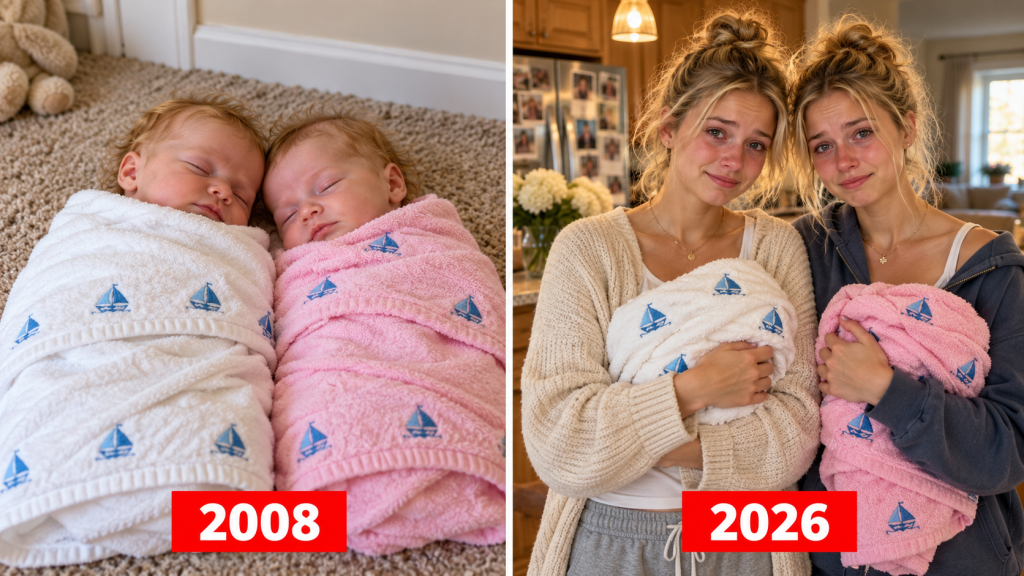
The man who had somehow led me to the exact changing room where Anna’s newborn daughters were waiting. I had called that coincidence for eighteen years. Suddenly coincidence felt like another word for a lie I had not yet understood.
“Call him.”
Chloe flinched.
“Dad—”
“Call Julian.”
Maya wiped her face.
“We already did.”
I stared at her.
“When?”
“Before dinner.”
The room tilted.
“What did he say?”
Chloe whispered,
“He asked whether we had opened the towels.”
A coldness moved through me.
Not surprise.
Not confusion.
Recognition.
I reached for my phone.
My fingers shook so badly I nearly dropped it.
Julian answered on the first ring.
“Michael.”
I said nothing.
Silence stretched between us.
Then he breathed out slowly.
“They found the letter.”
Not a question.
I gripped the edge of the table.
“You knew.”
“Yes.”
One word.
Eighteen years collapsed into it.
“You knew Anna was alive after the crash.”
“Yes.”
Chloe began crying.
Maya covered her mouth.
My voice came out low.
“Come here.”
“Michael—”
“Come here.”
“I can explain.”
“Then explain it to my face.”
He arrived twenty-six minutes later.
I know because I watched the clock.
Twenty-six minutes in which my daughters sat beside me on the kitchen floor because none of us wanted chairs anymore.
Twenty-six minutes staring at objects I had believed were the beginning of their story.
They were not.
They were evidence from the middle.
Julian knocked once.
I opened the door.
He had aged with me.
Gray near the temples.
Bad knee.
Reading glasses he constantly lost.
For eighteen years, he had been Uncle Julian.
Birthday cakes.
School plays.
Emergency rides.
The man Chloe called when her first car would not start.
The man who taught Maya to throw a baseball badly because he threw one badly too.
He stepped inside and saw the towels.
His face broke.
“God.”
I closed the door.
“You have five minutes before I decide I never want to see you again.”
Julian looked at the girls.
Then at me.
“They are Anna’s daughters.”
“I know.”
“She gave birth the night after the funeral.”
“I know.”
“She asked me to put them where you would find them.”
My body went still.
Chloe whispered,
“You left us there?”
Julian’s eyes filled.
“Yes.”
Maya stood.
“You abandoned two newborn babies on a beach?”
“No.”
The word came out quickly.
“No. I never left you alone the way it looked.”
I stepped between him and them.
“Careful.”
Julian nodded.
Fair.
He took a breath.
“There was a lifeguard station fifty yards away.”
“I had another person watching from the boardwalk.”
“You were inside the changing room less than four minutes before Michael heard you.”
I stared at him.
“You knew exactly when I would walk past.”
“Yes.”
“You took me there.”
“Yes.”
“Why?”
His eyes met mine.
“Because Anna asked me to give her daughters to the safest person she knew.”
I laughed.
It was not amusement.
It was pain looking for somewhere to go.
“The safest person she knew?”
Julian nodded through tears.
“You.”
I slammed my palm against the table.
The girls jumped.
I immediately hated myself for it.
I stepped back.
Lowered my voice.
“If she trusted me that much, why did she let me bury her?”
Julian looked down.
That question had no gentle answer.
Finally he said,
“Because she believed knowing she was alive would get you killed.”
The room changed.
Maya whispered,
“What?”
Julian reached inside his coat.
I tensed.
He slowly pulled out a key.
Old.
Brass.
A small paper tag tied around it.
A.R.
“I’ve kept something for eighteen years.”
I stared at him.
“What?”
“A storage box Anna left.”
“Where?”
“A bank.”
Of course.
Another locked place.
Another secret someone had decided I was not ready to enter.
I asked,
“What’s in it?”
“Records.”
“Letters.”
“A video.”
“Medical documents.”
“And the truth about why the girls aren’t biologically yours.”
Chloe squeezed my arm.
I felt her doing what she had done since childhood.
Checking me.
Making sure I was okay.
I hated that immediately.
I turned to both girls.
“Listen to me.”
They looked at me.
“Whatever is in that box changes facts.”
“It does not change us.”
Maya’s lip trembled.
“You don’t know that yet.”
“Yes.”
I did.
“I know one thing.”
“I changed your diapers.”
“You threw cereal at me for three years.”
“You both got chickenpox during the same week.”
“Chloe broke my nose with a soccer ball.”
“That was Maya.”
Chloe laughed through tears.
For half a second, normal life entered the room.
Good.
I pointed at Maya.
“Then Maya broke my nose.”
She smiled despite herself.
I continued.
“You two are my daughters.”
“No DNA report gets a vote.”
That was the first thing I knew with complete certainty.
Everything else could burn.
That could not.
We went to the bank the next morning.
I did not sleep.
Neither did Chloe or Maya.
Julian offered to drive.
I told him no.
He accepted it.
At 9:13 a.m., a bank manager opened a safe-deposit box that had apparently been paid automatically through an account Julian maintained for nearly two decades.
Inside were three envelopes.
A flash drive.
A bundle of medical records.
A small knitted hat.
Yellow.
My knees nearly failed.
I recognized it.
Anna had knitted it during the pregnancy.
I had teased her because one side was larger than the other.
She said babies did not care about symmetry.
I picked it up.
Eighteen years disappeared.
I was back in the yellow nursery.
Anna sitting cross-legged on the floor.
Laughing.
Alive.
I sat down.
Chloe whispered,
“Dad?”
“I’m okay.”
I was not.
But I would be.
The first envelope said:
MICHAEL
The second:
CHLOE AND MAYA — WHEN THEY ARE READY
The third:
LEGAL
I looked at Julian.
“You knew their names?”
He nodded.
“Anna named them.”
I closed my eyes.
Another thing I had thought belonged to me.
When the adoption became final, I had named them Chloe and Maya after weeks of indecision.
Apparently Anna had chosen the same names first.
No.
Not coincidence.
Julian had suggested them.
I remembered sitting in his apartment with paperwork spread across the coffee table.
He had said:
“What about Chloe?”
Then later:
“Maya sounds good with it.”
I looked at him.
“You named my daughters for her.”
His face crumpled.
“Yes.”
The betrayal was so intimate I almost could not breathe.
Not because I disliked the names.
Because he had been carrying Anna into my life in pieces while letting me believe every piece was mine.
I said,
“Get out.”
Chloe touched my shoulder.
“Dad.”
“No.”
I looked at Julian.
“Wait outside.”
He nodded.
No argument.
When he left, Maya whispered,
“Are you going to hate him?”
I stared at the closed door.
“I don’t know.”
That was honest.
We played the video first.
Anna appeared on the screen.
Alive.
Very pregnant.
Her hair tied back.
Face swollen from crying.
The timestamp showed it had been recorded eleven hours before the twins were born.
I stopped breathing.
“Michael.”
Her voice.
I had not heard it in eighteen years.
Not in dreams accurately.
Not anymore.
Memory erodes sound first.
Now there she was.
My daughters grabbed each other’s hands.
Anna looked directly into the camera.
“If you’re watching this, then either the girls found what I hid, or Julian finally decided the danger is over.”
She swallowed.
“I don’t know how old they are.”
“I don’t know whether you hate me.”
“You should.”
I whispered,
“Don’t.”
Ridiculous.
She could not hear me.
Anna continued.
“You were told I died because I asked people to let you believe it.”
Chloe started sobbing.
I kept watching.
“There is no version of that decision that is fair to you.”
“There is only the reason.”
Then Anna told us about Gabriel Shaw.
Not a lover.
Not a secret boyfriend.
Her boss.
Regional director at the medical consulting firm where Anna had worked.
I remembered him.
Tall.
Gray suit.
Expensive watch.
He had attended our engagement dinner.
Shook my hand.
Told me I was lucky.
I had forgotten his face until Anna said his name.
Then memory returned with teeth.
Six months before the pregnancy, Anna attended a company retreat in Wisconsin.
One night after a dinner, she became ill.
Disoriented.
She remembered little.
The next morning, she woke in her hotel room with injuries and fragments of memory involving Shaw.
She told no one.
Not me.
Not police.
She convinced herself she had misunderstood.
Then another employee approached her quietly weeks later.
Same retreat.
Different year.
Same man.
Same pattern.
Anna began collecting information.
Messages.
Hotel bookings.
Internal complaints that had disappeared.
Settlement payments.
Nondisclosure agreements.
She discovered Shaw had been accused by multiple women over almost a decade.
Then she discovered she was pregnant.
I paused the video.
The room was silent.
Chloe whispered,
“Dad…”
I stared at the floor.
I had spent eighteen years believing the child Anna carried died with her.
Then one night believing that child had somehow become two.
Now I understood something worse.
The pregnancy had begun in violence.
Maya asked,
“Are we…”
I turned toward her immediately.
“No.”
She stopped.
I knew the question.
I refused the shame inside it.
“You are not what happened to her.”
Maya cried.
Chloe leaned into her.
I started the video again.
Anna said the dates made it possible, but not certain, that Shaw was the biological father.
She had not known until testing late in pregnancy confirmed I was not.
She had intended to tell me.
She said that three times.
I was going to tell you.
I was going to tell you.
I was going to tell you.
Then Shaw learned she had copied company records.
He confronted her in the parking garage.
He told her exactly where I worked.
The route I took home.
The name of my mother.
The color of the nursery.
Anna looked into the camera.
Her voice shook.
“He said if I destroyed him, he would destroy everything I loved first.”
I stopped the video again.
The yellow nursery.
He knew about it.
That detail made the past suddenly physical.
I remembered one evening seeing a dark sedan parked across the street.
I had thought nothing of it.
Julian had come over two nights later and insisted we go for drinks.
Had he known then?
My hands shook.
The video continued.
Anna went to Julian because Julian had worked briefly as an investigative reporter before changing careers.
That part of his life had always been an old joke between us.
He knew an attorney.
A victim advocate.
A physician named Dr. Elise Ward.
Together, they helped Anna collect copies of records and contact federal investigators looking into Shaw for financial crimes connected to the company.
Then everything accelerated.
Someone broke into Anna’s car.
Our house alarm triggered twice.
A stranger followed her from a prenatal appointment.
Then Anna was forced off the road.
She survived.
That was the “crash.”
She had not been killed.
She was taken to a small hospital under her own name initially.
Julian reached her before I did.
So did Dr. Ward.
And Anna panicked.
Shaw’s people had found her once.
She believed they would find her again.
The decision to declare her dead was not made by federal agents.
Not officially.
Not cleanly.
It was a desperate private scheme.
A hospital records clerk altered status entries.
Dr. Ward signed false documentation.
A funeral director agreed to a closed symbolic burial.
There had been no body in the casket.
Only weighted material.
The official record had been manipulated using a chain of falsified documents that should never have existed.
My hands went numb.
I had buried an empty coffin.
I remembered placing my palm on it.
Whispering goodbye.
Apologizing to my unborn daughter because I had failed to protect either of them.
There had been nothing inside.
I stopped the video.
This time I could not continue.
I stood.
Walked to the corner of the bank consultation room.
Pressed both hands against the wall.
Chloe came toward me.
I shook my head.
Not because I didn’t want her.
Because I did not want my daughter to become responsible for holding me up.
“I need one minute.”
She stopped.
Good.
I breathed.
Once.
Again.
Again.
Then turned.
“Play it.”
Anna appeared again.
She had gone into labor early the next morning.
Twins.
Chloe first.
Maya six minutes later.
She held them for less than a day.
That part destroyed all three of us.
Anna described their hair.
Their cries.
The way Maya opened one eye before the other.
The way Chloe curled her fingers around Anna’s little finger.
Those were details I knew too.
Details I thought belonged only to me.
Then Anna said:
“I cannot take them with me.”
Maya whispered,
“Why?”
Anna answered from eighteen years ago.
“If Shaw learns they survived, he has a path to me.”
“If he knows they are his, he has another way to control them.”
“And if I keep them, Michael will search for me until someone follows him.”
She cried.
Not beautifully.
Not cinematic.
Her face folded.
“I know what I am asking Julian to do is unforgivable.”
“I am asking him to let Michael believe he found them.”
“To give the girls a life that has no visible line back to me.”
“To give them the safest father I know.”
I covered my mouth.
Chloe sobbed.
Maya whispered,
“She picked you.”
I could not answer.
Anna continued.
“I do not know if he will want them.”
That broke me more.
“He will be grieving.”
“He may walk away.”
“If he does, Julian will stay close until social services find them a family.”
“But I know Michael.”
“I think he will come back.”
I thought of the hospital nursery.
The first time I saw the twins after police took them for medical examination.
One slept.
One screamed.
I stood behind glass.
Then came back the next day.
Then again.
Then again.
Anna had known me.
That did not excuse what she did.
But she had known me.
Near the end of the video, she said:
“The girls are not a replacement for the baby Michael thinks he lost.”
“They are themselves.”
“Please never tell him God sent them to replace anything.”
“He hated when people said that after his father died.”
I laughed through tears.
She remembered.
Of course she remembered.
Then the last part.
“I am going somewhere Michael cannot follow.”
“If I survive long enough for the danger to end, I will not simply appear.”
“I gave up that right.”
“The girls must decide.”
“And Michael must decide.”
“I love him.”
“I am sorry.”
The video ended.
Nobody spoke.
For a long time, the only sound was the air-conditioning vent above us.
Finally Maya asked,
“Is she alive now?”
I looked toward the glass door.
Julian was sitting outside.
Head down.
I opened the door.
He stood.
“Is Anna alive?”
Julian closed his eyes.
“Yes.”
Chloe gasped.
Maya made a sound I had never heard before.
I stared at my best friend.
“Where?”
“Vermont.”
Eighteen years of grief turned into anger so quickly it frightened me.
“You have known where she was this entire time.”
“Not the entire time.”
“How long?”
“Twelve years.”
I stepped toward him.
“You saw me at her grave.”
“Yes.”
“You came with me on the tenth anniversary.”
“Yes.”
“You stood beside me.”
“I know.”
“And she was alive.”
“Yes.”
I wanted to hit him.
I did not.
Violence would not make truth cleaner.
Instead I said,
“You watched me mourn a living woman.”
Julian began crying.
“I watched you raise two children she believed would die if she came back.”
“Stop making it noble.”
His mouth closed.
Good.
I continued.
“You decided for me.”
“Yes.”
“You decided I could not handle the truth.”
“Yes.”
“You decided the girls could not know their mother.”
“Yes.”
“You lied every birthday.”
“Yes.”
“Every time they asked where they came from.”
“Yes.”
His voice broke.
“I did.”
I hated him then.
Completely.
For perhaps fifteen minutes.
Maybe an hour.
Hatred is easier before memory interferes.
Then I remembered him staying overnight when both twins had stomach flu.
Driving Chloe to urgent care.
Loaning me money when I lost my second job.
Building bunk beds.
Teaching Maya to drive.
He had lied to us.
He had also loved us.
Again.
Two truths.
I asked,
“Why didn’t she come back after Shaw was arrested?”
Julian swallowed.
“He wasn’t arrested until nine years ago.”
“What?”
“The first case collapsed.”
Of course it did.
Money.
Lawyers.
Fear.
Some witnesses refused to testify.
Anna remained hidden.
Later, federal investigators reopened the financial side.
Another survivor came forward.
Then another.
Records Anna had preserved helped.
Shaw was eventually convicted on financial offenses, obstruction, and several crimes involving women who chose to testify.
Not every allegation led to conviction.
But enough truth survived.
He went to prison.
He died four years ago.
“Four years,” I said.
Julian nodded.
“She could have come home four years ago.”
“Yes.”
“Why didn’t she?”
“Because by then Chloe and Maya were fourteen.”
“And?”
“She believed appearing would destroy their lives.”
I laughed bitterly.
“She has a talent for making decisions for people.”
Julian did not defend her.
“No argument.”
That helped more than justification would have.
Chloe asked,
“Did she know about us?”
Julian looked at her.
“Yes.”
“How?”
“I sent one photograph a year.”
My head snapped toward him.
“You what?”
“Only school portraits.”
“No addresses.”
“No schedules.”
“Nothing identifying.”
“You sent photographs of my children to a woman I thought was dead.”
“Yes.”
My anger returned full force.
Julian whispered,
“I know.”
Maya asked,
“Did she write?”
Julian looked toward the envelopes.
“Every year.”
The bank room went silent.
“Where are they?” Chloe asked.
“In another box.”
I stared at him.
“Of course there’s another box.”
He almost smiled.
Wrong time.
His face collapsed instead.
“I promised her eighteen.”
I said,
“You promised the wrong person.”
That sentence ended our friendship for almost a year.
Not forever.
But for a year.
I told Julian not to call.
He obeyed.
The girls were free to speak with him if they chose.
They did sometimes.
I did not ask what they discussed.
They were eighteen.
Their relationship with him was theirs.
I was learning not to repeat the same sin in a different direction.
The legal documents told us the biological truth.
Anna had preserved prenatal DNA testing.
It identified Gabriel Shaw as the biological father with extremely high probability.
After we disclosed everything to attorneys, new testing using archived evidence and Shaw’s legally retained DNA profile confirmed it.
The girls asked me whether I wanted the report.
I said no.
Then changed my mind.
Not because I needed proof they were not mine.
I already knew.
Because I needed to understand what Anna had been carrying.
The report sat on my desk for three days.
Finally I opened it.
Numbers.
Markers.
Probability.
Science can say who contributed chromosomes.
It cannot say who sat beside a child vomiting at two in the morning.
It cannot say who signed permission slips.
Who packed lunches.
Who taught apologies.
Who stayed.
I folded the report.
Put it away.
Never looked at it again.
The revelation triggered legal problems we had not expected.
Anna was alive on paper in one state and dead in another.
The death record had to be challenged.
The hospital falsification was investigated.
Dr. Ward had lost her medical license years earlier after unrelated irregularities brought the old record to light, though Anna’s case had remained sealed in a broader investigation.
The records clerk was dead.
The funeral director had retired.
Julian had made false statements during the original missing-mother inquiry.
Anna had used another identity for years.
Nothing was solved by one dramatic confession.
Attorneys became involved.
State investigators.
Family-court specialists even though the twins were now adults.
The adoption itself was reviewed.
That terrified me.
I knew Chloe and Maya were eighteen.
Nobody could simply remove them from my home.
Still, when a lawyer said “fraud in the origin record,” my body remembered every fear I had carried during their adoption.
Chloe saw my face.
“Dad.”
“I’m fine.”
“You keep saying that.”
“Habit.”
Maya grabbed my hand.
“Even if every paper in the country catches fire, you’re still Dad.”
There are moments when children return what you spent a lifetime giving them.
That was one.
Nothing undid the adoption.
They were adults.
The legal process corrected records rather than rewriting our family.
Anna cooperated fully.
So did Julian.
There were consequences.
Not the kind movies would demand.
No one received a thirty-year sentence.
Prosecutors considered the extreme circumstances, the documented threats, the age of the conduct, the absence of financial gain, Anna’s later cooperation, and the fact that much of the original falsification had been committed by professionals who were no longer practicing or alive.
Anna paid penalties.
Her legal identity was restored.
Some old documents were formally voided.
Julian entered an agreement regarding false statements and obstruction of parts of the original inquiry.
He paid fines.
Completed community-service requirements.
More importantly to me, he stopped calling what he had done “protecting us.”
He learned to call it what it was.
A choice.
A frightened choice.
A loving choice in some ways.
A violating choice in others.
Intent does not erase impact.
Chloe wanted to meet Anna immediately.
Maya did not.
That became the first major disagreement between my daughters as adults.
Chloe said,
“She gave birth to us.”
Maya replied,
“Then left.”
“She was scared.”
“So were we when we found out.”
“She thought we’d be killed.”
“She could have come back later.”
“She didn’t think she had the right.”
“She could have asked.”
I listened.
Did not referee.
Finally Chloe turned to me.
“What do you think?”
A trap.
Not intentional.
Still a trap.
I said,
“I think you are allowed to meet her.”
“And Maya is allowed not to.”
“And neither of you owes the other the same feeling.”
That became our rule.
Same history.
Different rights to it.
Chloe met Anna first.
Not alone.
A therapist named Dr. Rachel Kim arranged a neutral office.
I drove Chloe.
Waited outside.
I did not meet Anna that day.
I sat in a parking lot for ninety-three minutes staring at a maple tree.
Every time the office door opened, my pulse jumped.
Finally Chloe came out.
Her face was swollen from crying.
I stood.
She walked into my arms.
I held her.
Did not ask.
Five minutes later, she said,
“She looks like us.”
I swallowed.
“Yeah?”
“My hands are hers.”
I looked at Chloe’s fingers.
How many times had I held them?
Bandaged them?
Painted nails badly?
Biology had been there the whole time.
Quiet.
Never threatening until people named it.
“What did she say?”
Chloe leaned against the car.
“She said she isn’t my mother.”
That surprised me.
“What?”
“She said, ‘Michael is your parent. I am your birth mother, and if you ever decide I become something more, that has to happen because you choose it.’”
I looked away.
That sounded like Anna.
Or perhaps like the woman Anna had become.
Chloe continued.
“She apologized.”
“For leaving?”
“For everything.”
“Did she explain?”
“Yes.”
“Did it help?”
Chloe thought.
“A little.”
Then:
“It also made me angrier.”
Good.
Healing was allowed to be untidy.
Maya waited seven months.
Anna never pressured her.
That mattered.
She sent no gifts.
No letters directly.
No “tell Maya I love her.”
Nothing.
Then one afternoon Maya came into my study.
“I want to meet her.”
I closed the laptop.
“Okay.”
“You don’t have to come.”
“I know.”
“Are you mad?”
“At you?”
“Yes.”
“No.”
“Are you mad at her?”
I thought.
“Yes.”
Maya smiled faintly.
“Thanks for not lying.”
When Maya met Anna, she went alone into the therapist’s office.
She stayed forty minutes.
When she returned, she looked strangely calm.
“What happened?”
“She asked if I wanted answers.”
“And?”
“I asked one question.”
“What?”
Maya looked at me.
“Why did you trust him with us if you couldn’t trust him with the truth?”
That question traveled through me.
“What did she say?”
“She cried.”
“That wasn’t the answer.”
Maya nodded.
“She said she trusted you with our lives.”
“She did not trust herself with yours.”
I sat down.
Maya continued.
“She thought if she told you she was alive, you would come for her.”
I almost laughed.
“She was right.”
“I know.”
“And she thought you’d die.”
I said nothing.
Maya looked at me.
“Would you have gone?”
“Yes.”
No hesitation.
“I would have torn the earth apart looking for her.”
Maya nodded.
“That’s what she said.”
Anna and I met one week later.
Eighteen years after I buried an empty coffin.
The same therapist’s office.
I arrived early.
Of course I did.
Anna arrived late by four minutes.
Of course she did.
Some things survive catastrophe.
When the door opened, I knew her immediately.
Older.
Gray threaded through dark hair.
Thinner.
Lines around her mouth.
But Anna.
Alive.
My body did not know what to do.
Part of me wanted to run to her.
Part wanted to leave.
Part wanted to scream.
So I did none.
She stopped six feet away.
“Michael.”
I had imagined hearing my name in her voice for almost two decades.
Reality was smaller.
Quieter.
I said,
“Anna.”
She cried instantly.
I did not.
Not yet.
She sat across from me.
For several minutes, we said nothing.
Finally she whispered,
“I’m sorry.”
I looked at her.
“For dying?”
She closed her eyes.
“I deserve that.”
“No.”
I leaned forward.
“Don’t tell me what you deserve.”
“That’s the problem.”
“You spent eighteen years deciding what everyone deserved.”
Her eyes opened.
I continued.
“You decided I deserved a lie because the truth might endanger me.”
“You decided the girls deserved me but not you.”
“You decided fourteen was too fragile.”
“Then fifteen.”
“Then sixteen.”
“Then seventeen.”
“You kept deciding.”
She cried.
“Yes.”
“I was afraid.”
“I know.”
“I had reasons.”
“I know.”
“He threatened you.”
“Yes.”
“He threatened me.”
“Yes.”
“You were assaulted.”
Her face folded.
“Yes.”
My anger softened.
Not disappeared.
Softened.
I said:
“I understand why you ran.”
She nodded.
“I do not understand why you stayed gone after the danger ended.”
She wiped her eyes.
“Because by then you had built the life I wanted them to have.”
“You don’t get to call that kindness.”
“I know.”
“You could have contacted me privately.”
“I know.”
“You could have sent one sentence.”
“I know.”
“You could have given me the right to hate you with accurate information.”
She covered her mouth.
That was when I finally cried.
Not loudly.
Just eighteen years arriving.
“I loved a dead woman.”
Anna whispered,
“I know.”
“I stayed single for six years because I thought loving someone else would betray your memory.”
“I know.”
“I took the girls to your grave.”
She sobbed.
“I know.”
That stopped me.
“You knew?”
“Julian told me once.”
I stood.
Walked to the window.
She said quickly,
“I told him never to tell me again.”
I turned.
“Why?”
“Because it was unbearable.”
I laughed.
“Unbearable?”
She flinched.
Good.
I hated wanting that.
“I was kneeling in front of an empty grave with your daughters.”
She whispered,
“I know.”
“No.”
My voice cracked.
“You know facts.”
“You were not there.”
Silence.
Then Anna said something that finally sounded honest.
“You’re right.”
No defense.
No explanation.
Just right.
I sat down again.
After a long time, she said:
“I never married.”
I almost laughed.
“I did not ask.”
“I know.”
“I thought you should know.”
“Why?”
“Because part of me kept thinking—”
“No.”
I stopped her.
She looked startled.
“No what?”
“Do not turn this into a love story.”
That was cruel.
Necessary.
“We are not twenty-eight.”
“You are not coming back from a trip.”
“I do not get my fiancée returned eighteen years late.”
Anna cried silently.
I continued.
“I loved you.”
“I may always love a version of you.”
“But I am not rebuilding a romance out of this.”
She nodded.
“I understand.”
I believed her.
That surprised me.
We met three more times that year.
Not dates.
Not reconciliation.
Conversations.
She told me about Vermont.
The name she had used.
The bookstore where she worked.
The apartment above a bakery.
The panic attacks.
The years she slept with a chair under the doorknob.
The annual letters.
The first time Julian told her I had filed adoption papers.
She said she cried for two days.
I asked,
“Why?”
“Because you stayed.”
I stared at her.
“What did you think I would do?”
“I didn’t know.”
“You knew.”
She nodded.
“Yes.”
“I hoped.”
There was the truth.
She had gambled on my love without asking permission.
That was wrong.
It also gave me my daughters.
Some contradictions never become comfortable.
They simply become true.
We eventually read the annual letters.
All eighteen.
I thought they would destroy me.
Some did.
First birthday:
I wonder if Chloe still twists her left foot when she sleeps. Maya did it in the hospital.
Fifth birthday:
Julian says they started kindergarten. I asked no details. I do not want to know where.
Tenth:
I dreamed Michael was angry with me. In the dream, that was a relief because at least he knew I was alive.
Fourteenth:
Shaw is still alive. I tell myself that is why I stay away. I am beginning to fear it is no longer the whole reason.
That one mattered.
Sixteenth:
Cowardice can wear the clothes of sacrifice for years if nobody forces you to undress it.
Anna had known.
Seventeenth:
If they hate me, let them. Hatred is still theirs. I took too many choices already.
By eighteen, the last letter contained only three paragraphs.
Chloe and Maya,
You do not owe me a relationship because I gave birth to you. You do not owe Michael less love because you learned I exist. Blood is information. Parenting is action. I gave you blood. He gave you a childhood.
Then:
Michael, I am sorry I made your love useful to my fear.
That sentence stayed with me.
Useful to my fear.
Yes.
She trusted me enough to give me everything.
But not enough to tell me why.
Julian and I did not speak for eleven months.
Then my water heater exploded.
Not emotionally.
Literally.
At 6:20 on a Sunday morning, water began pouring across the basement floor.
I called a plumber.
Then instinctively called Julian.
My thumb pressed his name before pride could intervene.
He answered.
“Michael?”
I stared at the phone.
Then said,
“My basement is flooding.”
He paused.
“On my way.”
He arrived with towels, a shop vacuum, and no emotional speech.
Good.
We spent three hours moving boxes.
At one point he held up a plastic bin marked:
GIRLS — ELEMENTARY SCHOOL
He laughed faintly.
“You kept everything.”
“I’m a father.”
“That’s not an explanation.”
“Shut up.”
For a minute, we were ourselves.
Then we weren’t.
I turned off the vacuum.
“Why did you do it?”
Julian looked down.
“I told you.”
“No.”
“You told me Anna asked.”
“I’m asking why you agreed.”
His face changed.
Because that was different.
He sat on the bottom stair.
“I was afraid.”
“Of Shaw?”
“Yes.”
“And?”
Julian looked at me.
“Of losing you.”
I frowned.
He continued.
“If I told you Anna was alive, there was no universe where you stayed home.”
True.
“You would have gone.”
“Yes.”
“And if something happened to you…”
He stopped.
I understood.
Julian had already watched me collapse after Anna’s supposed death.
He believed the only thing keeping me alive was eventually the twins.
He had chosen certainty over consent.
“I thought I could keep you alive,” he said.
“By lying.”
“Yes.”
“And then?”
“Then one year became two.”
“Two became five.”
“Every time I almost told you, the lie had grown bigger.”
I nodded.
Silence grows roots.
I had learned that from other people’s secrets too.
Julian whispered:
“I’m sorry.”
I looked at him.
“No ‘I was protecting you’?”
He shook his head.
“I was protecting you.”
“But I was also controlling what you were allowed to know.”
“Both are true.”
Good.
Finally.
I sat beside him.
“I don’t forgive you yet.”
“I know.”
“You don’t get to be offended.”
“I’m not.”
“I may never trust you the same way.”
His eyes filled.
“I know.”
That was the beginning.
Not restoration.
Beginning.
Over the next years, Julian became part of our lives again.
Different.
More honest.
He stopped carrying secret messages between Anna and the girls.
If Chloe wanted to call Anna, Chloe called Anna.
If Maya wanted space, Julian respected it.
No more hidden routes.
No more guardians of truth.
Anna built a relationship with Chloe faster.
Chloe visited Vermont.
Saw the bookstore.
Met Anna’s friends.
Called her Anna at first.
Then sometimes “Mom” by accident.
Each time she apologized to me.
I finally said,
“Stop.”
She looked confused.
“You don’t have to protect me from what you call her.”
Tears filled her eyes.
“You’re Dad.”
“I know.”
That answer surprised both of us.
But I did know.
Deeply.
Maya moved slower.
For three years, she saw Anna twice annually.
Then more.
Never called her Mom.
Anna did not ask.
Good.
There were jealous moments.
Mine.
I will admit them.
When Chloe posted a photograph with Anna.
When Maya said,
“Anna makes the same face I do when she reads.”
When they discovered medical similarities I could never give them.
Migraines.
A crooked second toe.
The same allergy to shellfish.
Biology created little bridges I had not built.
Sometimes that hurt.
Then one evening, Chloe called me because her tire blew on the highway.
Not Anna.
Me.
I drove forty minutes.
Changed it badly.
Complained the entire time.
She handed me a bottle of water and said,
“You look smug.”
“I am.”
“Why?”
“Nothing.”
But I knew.
Parenthood had never been a competition.
I had only become afraid after blood entered the room.
Fear was understandable.
It did not deserve authority.
The girls eventually learned about Gabriel Shaw beyond the DNA report.
Not everything.
Enough.
They read public court records.
Survivor statements that women had chosen to make public.
Financial-case documents.
They learned Anna had not been the only one.
Chloe became furious.
Maya became quiet.
Neither wanted contact with Shaw’s surviving family.
Fine.
They owed nobody genealogical completion.
A distant cousin contacted Chloe through the DNA site.
She ignored it.
Maya deleted her account entirely.
Also fine.
They decided together that Shaw’s name would not become part of their identity.
Not secrecy.
Choice.
When they were twenty-four, Maya said,
“I used to think DNA would tell me who I was.”
I asked,
“Did it?”
She laughed.
“No.”
“It told me why my eyebrows look like this.”
Useful.
Anna moved closer when the girls were twenty-five.
Not into our town.
Two hours away.
Close enough for dinner.
Far enough to preserve independence.
She asked me first.
That irritated me.
“You don’t need my permission.”
“I know.”
“Then why ask?”
“Because I spent years making decisions that affected you without asking.”
Fair.
I said,
“Move wherever you want.”
She did.
We became something strange.
Not friends exactly.
Not former lovers exactly.
Co-keepers of a history nobody else fully understood.
Sometimes we had coffee.
We spoke about the girls.
Julian.
Old music.
Once she asked,
“Do you ever think about what our life would have been?”
I said,
“No.”
A lie.
She smiled sadly.
“Me too.”
We left it there.
She dated eventually.
A woman named Claire.
That surprised me.
Not because Anna dated a woman.
Because after all those years of imagining she had frozen her life around me, I realized she had continued becoming someone I did not know.
Good.
She deserved that.
So did I.
I never remarried.
Not as a memorial.
Not because I was broken.
I had relationships.
Loved twice.
Almost married once.
Then discovered I liked my house quiet.
My daughters teased me.
Anna did not.
The empty grave was resolved legally.
Officials opened it as part of correcting the death record.
I was invited to attend.
I declined.
I had already buried emptiness once.
I did not need to watch people prove it.
The stone was eventually removed.
For months, I kept it in storage.
Then the cemetery asked what I wanted done.
I thought about keeping it.
Why?
Proof?
Punishment?
A monument to being deceived?
No.
I asked them to destroy it.
Anna was alive.
The grave had finished lying.
The yellow nursery was long gone.
When the twins came home as infants, I repainted it pale green.
Two cribs.
Then toddler beds.
Then bunk beds.
Then desks.
Years after they moved out, I renovated the room into a study.
While removing an old baseboard, I found a tiny streak of yellow paint underneath.
I sat on the floor for a long time.
That color had once meant a child I believed died.
Then grief.
Then absence.
Now it was just paint.
That was healing too.
The towels stayed with Chloe and Maya.
One white.
One pink.
Blue sailboats fading almost gray.
For years they kept them wrapped in archival paper.
Then when they were thirty, we returned to the beach.
All four of us.
Me.
Chloe.
Maya.
Anna.
Julian was invited.
He declined.
He said some circles were not his to close.
That showed growth.
The beach had changed.
New bathrooms.
Different boardwalk.
Expensive condos where cheap motels used to stand.
I could not even identify the exact changing room.
Good.
Places should be allowed to change too.
Chloe brought the towels.
Anna touched the embroidery.
Her hands shook.
“I did those badly.”
Maya laughed.
“You did everything badly back then.”
Anna laughed too.
Then cried.
Fair.
We sat on the sand.
No speeches.
No dramatic forgiveness.
After a while Chloe asked me:
“Dad, do you regret finding us?”
I looked at her.
“That is the dumbest question you have ever asked.”
Maya grinned.
Chloe threw sand at me.
Good.
Then she became serious.
“I mean knowing everything now.”
I looked at Anna.
Then the ocean.
Then my daughters.
“No.”
That answer was easy.
“I regret the lies.”
“I regret what happened to Anna.”
“I regret that Julian made choices for me.”
“I regret eighteen years of grief built partly on false information.”
“But you?”
I shook my head.
“Never.”
Maya asked:
“Even though we weren’t yours?”
I stared at her.
She immediately corrected herself.
“Biologically.”
“Thank you.”
I pointed at her.
“Important word.”
They smiled.
I continued.
“I did not become your father because our blood matched.”
“I became your father one Tuesday morning when Chloe had a fever and social services asked whether I still wanted to proceed with placement.”
“I said yes.”
“I became your father again when Maya screamed through three consecutive nights.”
“I became your father when I signed the adoption papers.”
“When I learned which cereal you hated.”
“When I showed up.”
“When I stayed.”
Anna stared at the sand.
I added:
“And Anna is your mother in a way I am not.”
“She carried you.”
“Gave birth to you.”
“She made choices that saved you.”
“And choices that hurt you.”
“You are allowed all of it.”
No ranking.
No winner.
Family had suffered enough from people deciding only one truth could fit at a time.
Anna looked at me.
“Thank you.”
I nodded.
Then Maya held up the pink towel.
“What do we do with these?”
Chloe shrugged.
“Keep them?”
Anna said,
“You don’t have to.”
Chloe looked surprised.
Anna continued.
“They were supposed to carry information.”
“They did.”
“They don’t have to carry your lives too.”
Maya smiled.
We did not burn them.
Too theatrical.
Did not throw them into the ocean.
Littering is not closure.
Chloe eventually framed a small photograph of both towels and stored the originals safely.
Then life moved on.
Chloe became an emergency-room nurse.
Of course.
The baby who screamed first grew into a woman who ran toward emergencies.
Maya became an elementary-school art teacher.
She filled classrooms with paper, glue, paint, and unreasonable amounts of glitter.
Both choices felt like them.
Not destiny.
Not trauma fulfilling a prophecy.
Just lives.
Chloe married first.
At the wedding, she asked me to walk her halfway down the aisle.
Halfway.
Then she walked the rest herself.
I loved that.
Anna sat in the first row.
Not beside me.
Nearby.
When I reached my seat, she whispered,
“You did good.”
I looked at her.
“We did damage too.”
She nodded.
“Yes.”
Then Chloe turned at the altar and smiled at both of us.
Enough.
Maya never married.
She had a long-term partner named Elise and three rescue dogs who believed furniture belonged to them.
Also enough.
When Chloe had her first baby, everything inside me shook again.
She called from the hospital.
“Dad.”
“You okay?”
“Yeah.”
“The baby?”
“Perfect.”
I cried before she finished.
A girl.
They named her Anna Rose.
I froze.
Chloe laughed.
“Don’t make it weird.”
“I am absolutely going to make it weird.”
“She has two names.”
“I know how names work.”
“Dad.”
Fine.
When I held my granddaughter, Anna stood across the room.
The living Anna.
Gray-haired now.
Hands folded.
Waiting.
Chloe looked at her.
“Do you want to hold her?”
Anna started crying before she even moved.
She asked,
“Are you sure?”
Chloe smiled.
“Yes.”
Consent.
Again and again.
That became the repair.
No one taking.
No one deciding.
Asking.
Years later, Anna became ill.
Nothing dramatic at first.
Heart disease.
Manageable.
Then less manageable.
The girls cared for her in shifts.
So did Claire.
I visited.
Not as a husband.
Not as the man she once promised to marry.
As Michael.
The person who had shared the strangest history of her life.
One afternoon, she said:
“I’m afraid.”
I sat beside her.
“Of dying?”
She smiled weakly.
“I already tried that once.”
I laughed despite myself.
Good.
Then she said,
“Of leaving them.”
I looked through the doorway.
Chloe was arguing with a nurse about medication timing.
Maya was drawing something with Anna’s granddaughter.
“They know how to survive being left.”
Anna closed her eyes.
“I hate that.”
“So do I.”
She looked at me.
“Did you ever forgive me?”
The question had waited decades.
I thought.
“I forgave parts.”
She nodded.
“What parts?”
“I forgave you for being afraid.”
“For not telling me about the assault immediately.”
“For not knowing what to do.”
Her eyes filled.
“And the rest?”
“I stopped needing to call it forgiveness.”
She looked confused.
I continued.
“I understand you.”
“I don’t approve of everything.”
“I don’t carry anger every day.”
“You don’t owe me more.”
“And I don’t owe the past a perfect conclusion.”
Anna smiled.
“That sounds like you.”
“It took me years.”
She reached for my hand.
I let her hold it.
“I loved you,” she whispered.
“I know.”
“I love you.”
I looked at her.
“I know.”
Then I said:
“I love you too.”
Not romance.
Not resurrection.
Love after categories had failed.
Anna died four months later.
This time, she actually died.
This time there was no secret hospital.
No false certificate.
No empty coffin.
No hidden twins.
The girls saw her body.
So did I.
That mattered more than I expected.
Death should not need proof.
But sometimes it does.
At the funeral, Chloe asked me whether I wanted to speak.
I said no.
Then changed my mind.
I stood before a small group of people who knew Anna from different lives.
Vermont.
Chicago.
Before.
After.
I said:
“Anna once believed disappearing was the only way to protect the people she loved.”
“She was wrong about some things.”
“Right about others.”
“She saved evidence.”
“She saved her daughters.”
“She also left wounds that took years to name.”
“She spent the rest of her life learning that love without choice can still hurt people.”
Then I looked at Chloe and Maya.
“But she trusted one thing correctly.”
“She trusted that those two girls would be loved.”
I sat down.
No sainthood.
No villain.
A person.
Afterward, Julian approached me.
Older now.
Walking with a cane.
We stood beside Anna’s actual grave.
He said,
“Feels different.”
“Yes.”
“What?”
“There’s someone in this one.”
Dark humor.
We both laughed.
Anna would have too.
Julian looked at the stone.
“I’m sorry.”
I sighed.
“You’ve said that for thirty years.”
“I’m still sorry.”
“Good.”
He smiled.
“Still not forgiven?”
I looked at him.
“Some parts.”
He nodded.
Fair.
We walked back to the cars together.
The beach towels remained in the family.
Not as sacred relics.
Not really.
One day Chloe’s daughter asked why Grandma had two ugly old towels in a preservation box.
Chloe told her a simple version.
“When Aunt Maya and I were babies, we came home wrapped in these.”
The child asked:
“Were you cold?”
Chloe smiled.
“Probably.”
“Who warmed you up?”
She pointed at me across the room.
“Him.”
That was enough.
I was seventy-one the last time I went back to the beach.
Alone.
The boardwalk had been rebuilt again.
Children ran past me carrying plastic buckets.
A father was trying to put sunscreen on a screaming toddler.
A woman laughed under an umbrella.
Normal life.
I stood near where I thought the old changing rooms had been.
For years, people told me I had “rescued” Chloe and Maya.
I never liked the word.
I did not rescue them.
I heard them.
Then I came back the next day.
And the next.
And the next.
That was different.
Rescue sounds like one heroic moment.
Parenthood was thousands of ordinary ones.
Packing lunches.
Losing patience.
Apologizing.
Working extra shifts.
Learning braids badly.
Sitting beside hospital beds.
Paying tuition.
Waiting for teenagers to come home.
Answering the phone.
Staying.
I once believed the worst day of my life was the day Anna died.
Then I learned she had not died.
For a while, I thought that made the grief fake.
It did not.
Grief responds to what we believe we have lost.
My pain had been real even though the information underneath it was false.
That realization helped me forgive myself for eighteen years of mourning.
I had not been stupid.
I had been deceived.
Different.
And the twins?
They had never been compensation for my dead child.
Anna had been right about that too.
They did not replace anyone.
They arrived as Chloe and Maya.
Two babies with different cries.
Different tempers.
Different lives.
My daughters.
Not because fate handed them to me.
Not because Anna chose me.
Not because paperwork said so.
Because after everything else became complicated, one thing stayed simple.
I stayed.
On my last visit to that beach, I sat on a bench until sunset.
The sky turned orange.
Then pink.
Then the deep blue that comes just before dark.
For a moment, I could almost hear newborn crying beneath the sound of the waves.
I remembered pulling back the curtain.
Two babies.
One white towel.
One pink.
Tiny blue sailboats.
I remembered thinking the universe had done something impossible.
I know better now.
The universe had done nothing.
People had.
Some bravely.
Some badly.
Some out of fear.
Some out of love.
Often both.
And somehow, out of all those flawed choices, two children grew into women who knew the truth and still knew where home was.
My phone buzzed.
A message from Maya.
Dad, Chloe says you forgot dinner again.
Then Chloe:
If you’re at the beach, bring your jacket. You’re seventy-one, not immortal.
I laughed.
Typed:
On my way.
Then stood.
No towel.
No letter.
No hidden truth left to carry.
Just the road home.
For eighteen years, I thought I had found two abandoned babies on a beach.
Eventually, I learned the truth was more complicated.
They had been left.
They had been placed.
They had been protected.
They had been deceived.
So had I.
But one truth survived every correction.
I was their father.
Not by blood.
Not by accident.
By every morning that came after I opened that curtain.
And in the end, that was the only truth none of us ever needed to rewrite.
THE END STORIES! THANK YOU FOR READING GOOD LUCK !❤️
Related Posts