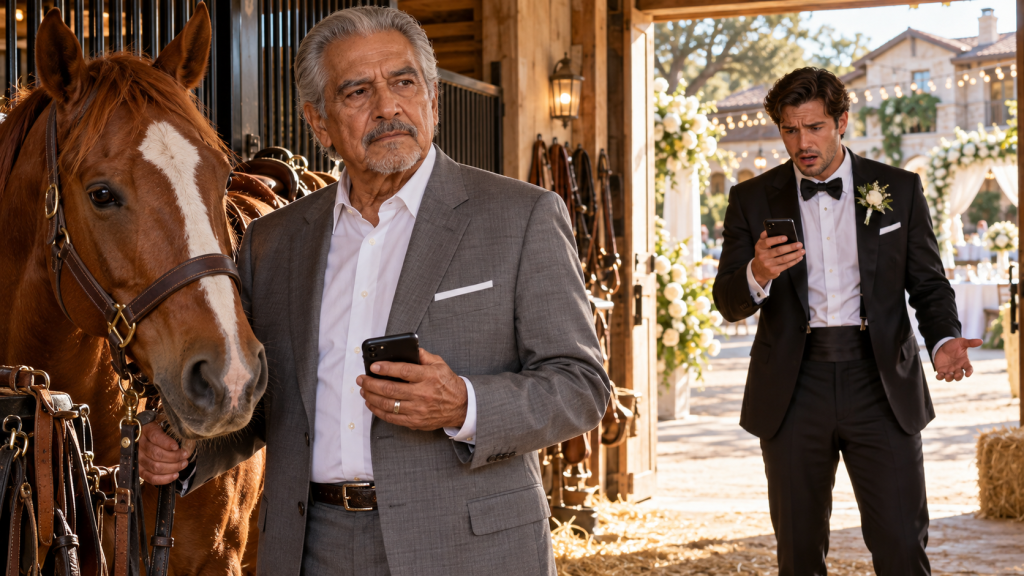
The headlights stopped outside the stable. One vehicle. Then another. Then a third. The sound of car doors closing carried across the gravel. Austin looked at me. “Dad, what did you do?” I looked at my son for a long moment.
The question would have been funny if it had not hurt so much. What did I do? I had slept on a cot beside saddles and bridles while he and his bride slept in the bedroom where his mother died. I had been removed from my own wedding table because I smelled like the land that paid for every chandelier above their heads.
I had been handed a brochure for assisted living before breakfast. And somehow, standing there with his credit cards declined, Austin still believed I was the person who had suddenly done something. I picked up Lightning’s brush.
Put it back on the hook.
Then I said quietly:
“I stopped paying for your choices.”
Victoria stepped into the stable.
“What does that mean?”
Her wedding elegance was gone.
The silk robe had been replaced by cream trousers and a cashmere sweater, but something colder had replaced the smile she had worn the night before.
She looked at Henry.
Then at the folders.
Then at me.
“Mr. Valdes, whatever family disagreement you’re having with Austin, freezing accounts during our wedding weekend is vindictive.”
Henry adjusted his glasses.
“They are Ernest’s accounts.”
Victoria stared at him.
“The joint household account is ours.”
“No.”
Henry shook his head.
“It is an account owned by Ernest Valdes on which Austin has been an authorized user.”
Austin frowned.
“You said it was mine.”
I looked at him.
“No, son.”
“I said you could use it.”
“There is a difference.”
His face tightened.
“How much of my money isn’t actually mine?”
That sentence went through me like a blade.
Henry looked down.
I didn’t.
I answered.
“Enough that you should have asked that question fifteen years ago.”
Austin went pale.
Outside, footsteps approached.
Victoria whispered:
“Ernest, the investors don’t need to hear family business.”
I almost smiled.
“They already are family business.”
“What does that mean?”
Before I could answer, a woman appeared in the stable doorway.
Late forties.
Dark green suit.
Hair pulled into a low knot.
Behind her stood two men I recognized from the wedding reception.
And behind them—
Rafael del Bosque.
Victoria’s father.
He had spent most of the previous evening telling anyone who would listen about the greatness of “legacy families.”
He had also shaken my hand for approximately three seconds.
Then wiped it on a cocktail napkin.
He stopped when he saw me.
The woman in green looked around the stable.
“I’m Miranda Chen, general counsel for Green Peaks Group.”
Henry nodded.
“Henry Suarez.”
They shook hands.
Miranda’s eyes moved toward Austin.
“Mr. Valdes, we received notice this morning that the exclusivity payment failed.”
Austin looked confused.
“Exclusivity payment?”
Victoria spoke quickly.
“It’s being handled.”
Miranda looked at her.
“By whom?”
“Us.”
Henry opened the first folder.
“Then perhaps we should begin with the fact that neither of them owns the property.”
Silence.
A horse shifted in the next stall.
One of the investors frowned.
“What?”
Henry turned the deed toward them.
“Golden Sun Ranch consists of multiple parcels, agricultural rights, lease interests, groundwater rights, grazing permits, and operating entities.”
“The controlling interests are owned by Ernest Valdes through the Golden Sun Stewardship structure.”
“No transaction involving the principal ranch assets can occur without his written authorization.”
Miranda stared at the documents.
Then at Austin.
“Your term sheet states that you control the family ranch.”
Austin looked at Victoria.
She stepped forward.
“Austin is Ernest’s only child.”
Miranda’s expression did not change.
“That was not my question.”
Rafael intervened.
“This is obviously a misunderstanding.”
“No.”
Henry said.
“It is not.”
He opened another file.
“The title position is not ambiguous.”
“The water rights are not ambiguous.”
“Mr. Ernest Valdes’s authority is not ambiguous.”
Miranda’s jaw tightened.
Then she looked directly at Austin.
“You represented to Green Peaks that your father had transferred operational control to you following your mother’s death.”
Austin’s mouth opened.
Nothing came out.
I watched him.
Not Victoria.
My son.
The boy who once cried because he accidentally stepped on a beetle.
The teenager who called me from college at two in the morning because his car broke down.
The man who had looked away while his wife told me I smelled like a stable.
“Austin?”
I said.
He swallowed.
“I thought I would control it.”
“That is not what she asked.”
He rubbed his forehead.
“Dad, Mom always said the ranch would stay in the family.”
“Yes.”
“And I’m your son.”
“Yes.”
“I assumed—”
Miranda interrupted.
“You did not write ‘I expect to inherit someday.’”
She pulled a document from her own leather portfolio.
“You signed a representation stating you possessed authority to negotiate site control.”
Austin looked at it.
His face drained.
Victoria said:
“That was preliminary.”
Miranda turned to her.
“It allowed us to spend nearly nine hundred thousand dollars on geological review, infrastructure engineering, environmental analysis, and transaction costs.”
Rafael said sharply:
“Miranda, nobody needs theatrics.”
Her head turned slowly.
“This is not theater, Rafael.”
“You introduced the opportunity.”
My stomach tightened.
Henry glanced at me.
That was new.
I looked at Rafael.
“You brought Green Peaks here?”
Rafael smiled faintly.
“Ernest, development is not a crime.”
“No.”
I nodded.
“Lying about who owns the land might become a more complicated conversation.”
His smile vanished.
Victoria stepped between us.
“My father did not lie.”
Miranda opened another document.
“This proposal came through Del Bosque Strategic Holdings.”
Henry’s eyebrows lifted.
“Interesting.”
Victoria turned toward Miranda.
“That’s a consulting entity.”
Miranda looked at her.
“It is owned by your father.”
No one moved.
Then Henry asked:
“What compensation was Del Bosque Strategic Holdings to receive if the transaction closed?”
Miranda hesitated.
Rafael said:
“That is confidential.”
Henry looked almost amused.
“Not if it concerns an attempted transaction involving my client’s property.”
Miranda answered before Rafael could stop her.
“Two-point-five percent advisory fee.”
I did the math.
On a transaction potentially worth hundreds of millions, that was not a fee.
That was a fortune.
Victoria’s face changed.
Not fear.
Anger.
At Miranda.
She had not expected Green Peaks to say it aloud.
I looked at my daughter-in-law.
“This wasn’t Austin’s idea.”
Victoria’s eyes met mine.
“It was an opportunity.”
“For whom?”
“For the family.”
I nodded.
“Which family?”
Silence.
Rafael stepped forward.
“Ernest, your ranch is worth more developed than it will ever produce in cattle.”
“I know what my ranch is worth.”
“Do you?”
He smiled.
“Because land-rich old men often confuse heritage with economics.”
I felt Henry move beside me.
I lifted one hand.
No.
Let him speak.
Rafael continued.
“The region is changing.”
“Industrial users need land.”
“Technology companies need power.”
“Municipal expansion needs water.”
“You’re sitting on an asset that could secure your family for generations.”
I looked at him.
“My family has been secure.”
His gaze flickered toward Austin.
“Apparently not all of them.”
That landed.
Austin looked away.
I said:
“What did you want my water for?”
Nobody answered.
Henry turned toward Miranda.
“Perhaps you can explain.”
Miranda looked uncomfortable now.
“There were several proposed uses.”
“Explain the one involving the water rights.”
She opened her portfolio.
“Green Peaks evaluated a mixed-use industrial project on the eastern acreage.”
“Data infrastructure.”
“Light manufacturing.”
“Energy storage.”
“There was also a separate water-supply agreement.”
Henry’s face hardened.
“Separate with whom?”
Miranda looked toward Rafael.
Then at Victoria.
“Bosque Development Partners.”
My stomach turned.
I looked at Rafael.
“Your company.”
He said nothing.
Henry asked:
“At what rate?”
Miranda answered.
“A fixed long-term price.”
“How long?”
“Forty years.”
Henry’s eyes narrowed.
“And market escalation?”
“Limited.”
“How limited?”
Miranda named the percentage.
Henry actually laughed.
Not because it was funny.
Because it was outrageous.
I knew enough about the water market to understand what they had tried to do.
They did not merely want part of Golden Sun.
They wanted the veins beneath it.
Our senior groundwater rights were the reason the ranch had survived drought years that ruined neighboring properties.
Eleanor had protected those rights with more ferocity than any house or bank account.
I looked at Victoria.
“You weren’t selling the ranch.”
She crossed her arms.
“This is unnecessarily dramatic.”
“You were stripping the water from it.”
“No.”
“We were monetizing an underused resource.”
The phrase was so polished that I almost admired it.
Almost.
I said:
“Cattle drink water.”
“So do families.”
“So do workers.”
“So do the pecan groves your wedding pictures were taken under.”
Victoria shook her head.
“You’re emotional because you’re attached to the old way of doing things.”
I stared at her.
There it was.
Old.
Old rancher.
Old suit.
Old hands.
Old way.
Old man who could be moved to a facility while younger, smarter people converted his life into spreadsheets.
I looked at Austin.
“Did you know about the forty-year water agreement?”
He did not answer.
“Austin.”
He whispered:
“I knew there was a water component.”
“Did you read it?”
“No.”
I laughed softly.
Of course.
No.
He had not read the petition either.
Or so he claimed.
He had not read the investor papers.
He had not read the water agreement.
He had not read the things that would remove me from my home.
Apparently my son had reached thirty-eight years old believing ignorance became innocence if you dressed it well enough.
Henry opened the second folder.
“The water agreement is not today’s worst document.”
Austin closed his eyes.
Victoria snapped:
“Henry, if you violate attorney-client—”
Henry looked at her.
“I have never represented you.”
That silenced her.
He pulled out the draft petition.
My name appeared at the top.
IN THE MATTER OF ERNEST VALDES, AN ALLEGED INCAPACITATED PERSON
Even seeing it again hurt.
There are insults that fade because you know they are absurd.
Then there are insults shaped like paperwork.
They sit differently.
Henry read from the petition.
“Petitioner alleges that Ernest Valdes has demonstrated increasing confusion, impaired judgment, inability to manage complex assets, and resistance to necessary medical care.”
I looked at Austin.
He stared at the floor.
Henry continued.
“Petitioner requests temporary authority to manage financial affairs pending evaluation.”
Miranda closed her portfolio.
“This was not disclosed to Green Peaks.”
Victoria said:
“It was never filed.”
Henry looked at her.
“Because Ernest did not leave willingly.”
Her mouth tightened.
Then Henry turned a page.
“Attached to the draft is Austin Valdes’s declaration.”
Austin whispered:
“I didn’t know what I was signing.”
I looked at him.
Henry did not raise his voice.
“The electronic record shows the document was sent to your personal email.”
“I sign things Victoria sends me.”
“There were three required initials.”
“I trusted my wife.”
“Page nine contains a paragraph stating that your father ‘frequently becomes disoriented regarding ownership and estate matters.’”
Austin looked at me.
“I didn’t write that.”
“That was not my question.”
I said it before Henry could.
My son’s eyes filled.
“Dad.”
“Did you read it?”
“No.”
The stable was silent.
I nodded slowly.
“Then you signed away your father’s dignity without taking ten minutes to read how they planned to do it.”
His face crumpled.
“I didn’t think—”
“That is the problem.”
I did not shout.
I didn’t need to.
“I spent your entire life fixing what happened when you didn’t think.”
“A car loan.”
“A business lease.”
“Tax penalties.”
“Credit cards.”
“Investments you didn’t understand.”
“Every time, I told myself you were young.”
“You were learning.”
“You needed one more chance.”
I looked toward the main house.
“Yesterday, you let your wife move me into a stable.”
“Today I find your signature under a document saying I’m confused.”
Austin’s eyes filled with tears.
“I’m sorry.”
I looked at him.
“I believe you are sorry.”
Hope flashed across his face.
Then I continued.
“That does not make you innocent.”
The hope disappeared.
Good.
Some lessons arrive only after comfort leaves.
Miranda looked toward Rafael.
“I believe Green Peaks should suspend all discussions.”
Rafael’s expression hardened.
“This is premature.”
“No.”
She replied.
“This is overdue.”
Then she looked at me.
“Mr. Valdes, Green Peaks will provide your counsel with copies of every document we received concerning Golden Sun.”
Henry nodded.
“Thank you.”
“We will also review whether any payment was made to parties who lacked authority to receive it.”
Victoria spoke sharply.
“There was no payment.”
Miranda looked at her.
“Not to you directly.”
My stomach tightened.
Henry noticed.
“To whom?”
Miranda opened another file.
“A four-point-two-million-dollar site-control and exclusivity deposit was transferred to Bosque Strategic Holdings.”
Rafael’s face changed.
Barely.
Enough.
Austin stared at his father-in-law.
“Four million?”
Victoria said:
“It was refundable.”
Miranda turned.
“Three million was refundable.”
“The remaining one-point-two million covered advisory and development costs.”
Henry asked:
“Has that amount been spent?”
Nobody answered.
I looked at Austin.
He looked genuinely shocked.
“Victoria?”
She turned on him.
“Don’t.”
“What?”
“Do not stand there pretending you had nothing to do with this.”
“I didn’t know about four million dollars.”
“You wanted the ranch deal.”
“I wanted investors.”
“You wanted to stop living on your father’s allowance.”
The sentence struck him.
And me.
Austin’s face reddened.
“I told you we should wait.”
“You told me you were tired of being treated like a child.”
“I am.”
Victoria laughed.
“Then act like an adult for the first time in your life.”
I watched my son absorb that.
Cruel.
But not entirely false.
Then Austin said something I never expected.
“Did your father get paid?”
Victoria froze.
“Answer me.”
Rafael stepped forward.
“Do not speak to my daughter that way.”
Austin turned toward him.
“Did you take money for land you knew I did not own?”
Rafael’s face hardened.
“You represented that control would transfer.”
“I said I was the only heir.”
“You said your father had no interest in managing a major transaction.”
“I never said I owned it.”
Victoria snapped:
“You signed the term sheet.”
Austin stared at her.
“You told me it was nonbinding.”
“It largely was.”
Miranda interrupted.
“Not the representations section.”
Austin turned pale.
Henry sighed.
“Maybe everyone should stop using the phrase ‘I didn’t read it’ as though it improves the facts.”
No one argued.
Then headlights appeared again.
One more vehicle.
An older black sedan.
It stopped outside.
A woman climbed out.
Mid-sixties.
Silver hair.
Boots.
She carried a laptop case.
I recognized her immediately.
Dr. Helen Navarro.
Eleanor’s physician.
Austin stared.
“Why is Dr. Navarro here?”
Henry answered.
“Because your mother expected this day might come.”
The blood left Austin’s face.
Victoria looked at Henry.
“What exactly does that mean?”
He reached for Eleanor’s leather briefcase.
The one he had carried into the stable.
For twenty minutes, it had sat unopened on the tack table.
I had known what was inside.
At least some of it.
Henry placed the briefcase before me.
“Ernest?”
I looked at the worn leather.
Eleanor had carried that case to bank meetings, veterinarian appointments, water-board hearings, and once to Austin’s elementary school because she had gone directly from a loan renegotiation to his Christmas play.
There was a faint scratch across one corner.
I remembered when she made it.
Barbed wire.
She cursed for three full minutes.
I almost smiled.
Then I opened it.
Inside was an envelope.
A flash drive.
A sealed statement.
And the last letter my wife ever wrote about our son.
Austin stared.
“What is that?”
I answered:
“Your mother’s final insurance policy.”
His eyes filled immediately.
“Against me?”
I thought about that.
Then shook my head.
“No.”
“Against what we might become when money got louder than love.”
Henry connected the drive to his laptop.
Dr. Navarro entered quietly.
She greeted me first.
Then Austin.
He could barely look at her.
Victoria whispered something to Rafael.
He ignored her.
Henry turned the computer.
Eleanor appeared on the screen.
Not the Eleanor from our wedding photographs.
Not the healthy woman riding Lightning across the north pasture.
This Eleanor was thin.
A scarf around her shoulders.
Cancer had hollowed her cheeks.
But her eyes were still hers.
Sharp.
Steady.
Unimpressed by nonsense.
Austin made a sound.
“Mom.”
I closed my eyes for one second.
I had watched the recording only once.
Six months before she died.
I had refused to watch it again.
Until now.
Eleanor looked into the camera.
“My name is Eleanor Maria Valdes.”
“The date is March fourteenth.”
“I am making this statement voluntarily.”
“My physician, Dr. Helen Navarro, has evaluated me today and can confirm that I understand the nature of my property, my family relationships, and the decisions I am making.”
Dr. Navarro stood beside the screen.
Victoria’s jaw tightened.
Eleanor continued.
“If you are watching this because someone says Ernest is confused, weak, or incapable of managing Golden Sun, then somebody has become exactly as predictable as I feared.”
Austin covered his mouth.
I stared at my wife.
Even dead, she could fill a room.
She continued.
“The ranch belongs to Ernest.”
“Not because I loved Austin less.”
“Because Ernest built it with me.”
“He risked beside me.”
“He borrowed beside me.”
“He slept in calving sheds beside me.”
“He signed every note I signed.”
“He survived every drought I survived.”
Her voice weakened for a moment.
Then steadied.
“Our son grew up on Golden Sun.”
“That makes it part of his story.”
“It does not automatically make it his property.”
Victoria looked away.
Eleanor continued.
“Austin has always believed the ranch would eventually be his.”
“Some of that belief is our fault.”
My chest tightened.
There it was.
She had never spared us either.
“We let him confuse inheritance with entitlement.”
“We gave too quickly.”
“Fixed too quickly.”
“Paid too quietly.”
“And each time we rescued him, we taught him that consequences were problems his parents could remove.”
Austin started crying.
I did not look at him.
Eleanor continued.
“I do not believe my son is cruel.”
“I believe he is weak where approval is concerned.”
“He wants to be admired.”
“He wants people who look expensive to think he belongs beside them.”
“He does not understand yet that belonging purchased through performance is never secure.”
Victoria’s face hardened.
Rafael stared at the screen.
Eleanor spoke more slowly now.
“And I have concerns about the Del Bosque family.”
Victoria stepped forward.
“This is outrageous.”
Miranda held up one hand.
“Let it play.”
Eleanor continued.
“Three months ago, Victoria asked me what would happen to Golden Sun if Ernest became medically incapable.”
“She said she was asking because marriage requires planning.”
“I answered carefully.”
“Two weeks later, Rafael del Bosque’s office requested historical water-production reports through an intermediary.”
Rafael’s face went white.
Henry looked at him.
Interesting.
Eleanor continued.
“I cannot prove their intentions.”
“So I will not pretend to.”
“But I can protect what is ours until Ernest has time to judge those intentions himself.”
“That is why we changed the structure.”
Austin stared at me.
“You knew Mom suspected Victoria?”
“Some of it.”
“Why didn’t you tell me?”
I said nothing.
The recording continued.
“Austin, if you are watching this, you may be angry with me.”
“That is allowed.”
“You may believe I distrusted you.”
“That is partly true.”
His face crumpled.
“I did not distrust your heart.”
“I distrusted your hunger to be approved of.”
“And hunger can make good people sign terrible documents if the right person tells them it is sophisticated.”
Austin bent forward.
Both hands over his face.
Victoria stared at him.
For the first time, she seemed uncertain.
Eleanor continued.
“Ernest, do not punish him simply because I was right.”
That sentence struck me.
I looked at the screen.
My wife’s eyes seemed to look through twenty feet of stable air directly at me.
“Do not make humiliation your revenge.”
“Do not take pleasure in watching your son become poor.”
“Do not confuse boundaries with cruelty.”
“But do not rescue him from the cost of what he knowingly chooses.”
I stopped breathing.
That was Eleanor.
Always one sentence ahead of my worst instinct.
She continued.
“If Austin stands beside someone who tries to remove you from your own home, let him feel the weight of where he stood.”
“If he returns because the money disappeared, do not believe him yet.”
“If he returns after learning to live without your money, listen.”
Austin sobbed.
Quietly.
Eleanor’s voice softened.
“My boy, if you ever see this—”
She smiled.
Not at the camera.
At him.
At the child he had once been.
“I loved you before Golden Sun had a second barn.”
“I loved you when all we owned was debt and six hundred acres of dry grass.”
“I loved you when you failed algebra.”
“I loved you when you lied about denting your father’s truck.”
“I loved you when you left for college.”
“There is no ranch large enough to make me love you more.”
“And no inheritance small enough to make me love you less.”
Austin lowered his hands.
Tears covered his face.
Eleanor continued.
“But love is not ownership.”
“And blood is not a deed.”
The recording ended.
Nobody spoke.
Only Lightning breathing.
Leather creaking.
The hum of Henry’s laptop.
Then Austin whispered:
“Play it again.”
I shook my head.
“Not today.”
He looked at me.
“Please.”
“No.”
His face tightened.
“Why?”
“Because your mother is not evidence for you to consume until you feel better.”
That sounded harsher than I intended.
But not wrong.
He nodded.
Then Miranda spoke.
“I think Green Peaks has heard enough.”
Rafael turned.
“You cannot walk from this based on one emotional family recording.”
Miranda looked at him.
“We are walking because the people negotiating with us apparently had no authority to negotiate the property.”
“Because material ownership representations were inaccurate.”
“Because a related party stood to receive a substantial undisclosed benefit from a water contract.”
“And because there is now evidence suggesting the property owner may have been targeted for an incapacity proceeding while those negotiations were ongoing.”
She closed her folder.
“Our litigation team will contact everyone involved.”
Victoria said:
“You’re threatening us?”
“No.”
Miranda replied.
“I’m documenting our next step.”
Then she looked at me.
“Mr. Valdes, Green Peaks will cease all physical access to your ranch immediately.”
“No surveying.”
“No testing.”
“No site visits.”
“If you want our reports, your attorney can request them.”
I nodded.
“Thank you.”
She hesitated.
“For what it is worth, I am sorry you learned about our involvement this way.”
I looked at her.
“You thought you were buying from my son.”
“Yes.”
“He thought he was selling what he expected to inherit.”
She did not answer.
I almost smiled.
“Expensive lesson all around.”
Miranda nodded.
“Potentially.”
Then she and the other Green Peaks representatives left.
Rafael did not.
He looked at Henry.
Then at me.
“This can still be resolved privately.”
I laughed.
“Everything you’ve done depended on me remaining private.”
His eyes narrowed.
“You think I’m afraid of a ranch lawyer?”
Henry smiled.
“No.”
“You should be afraid of documentation.”
Rafael looked at Victoria.
“Come.”
She did not move.
“Victoria.”
She looked at Austin.
“Are you coming?”
My son stared at her.
“Did you know about Mom asking questions?”
Victoria’s face tightened.
“She was sick.”
“That isn’t an answer.”
“She was suspicious of everyone.”
“Did you ask her what happened if Dad became incapable?”
“Yes.”
“Why?”
“Because you were marrying me.”
“That makes no sense.”
“We needed to understand succession.”
“Before we were married?”
“Yes.”
Austin shook his head.
“Did you and your father approach Green Peaks before Mom died?”
Silence.
My chest tightened.
I had not known the timing.
Neither had Henry.
Rafael said:
“That is irrelevant.”
Austin turned.
“It’s not irrelevant to me.”
Victoria exhaled sharply.
“We had preliminary conversations.”
“How preliminary?”
“Austin.”
“How long?”
She looked away.
He whispered:
“How long?”
“Eight months.”
The air left him.
Eleanor had died six months before the wedding.
Eight months meant Victoria had been discussing the ranch while Eleanor was still alive.
While my wife was receiving treatment.
While Austin was sitting beside her bed saying he hoped she would recover.
My hands shook.
I gripped the edge of the tack table.
Victoria saw.
For the first time, her voice softened.
“Ernest, we were not planning for Eleanor to die.”
I looked at her.
“I did not accuse you of that.”
“I know how this sounds.”
“No.”
I said quietly.
“I think you’re finally hearing how it sounds.”
Rafael stepped toward his daughter.
“That is enough.”
Austin blocked him.
Not aggressively.
Just one step.
“Did I know?”
Rafael stared at him.
“What?”
“Eight months ago.”
“Did I know you were talking to Green Peaks?”
Victoria answered.
“No.”
Austin closed his eyes.
Rafael said:
“Because you were not ready to think strategically.”
My son laughed.
Broken.
“So you waited until after Mom died.”
“We waited until the timing was appropriate.”
Austin looked at him.
Then said:
“That word is starting to disgust me.”
Timing.
I understood.
Rafael’s face went cold.
“You are making a mistake.”
Austin looked at Victoria.
“Did you marry me for the ranch?”
She recoiled.
“No.”
“Don’t lie now.”
“I loved you.”
“Loved?”
She stared.
“Love.”
He looked toward the main house.
“At our wedding, you sent my father to the back because he didn’t look good enough for your investors.”
Victoria crossed her arms.
“I was managing optics.”
“You asked him to sleep in a stable.”
“It was your idea to ask for the bedroom.”
His head snapped toward her.
“That is not what I said.”
“You said you wanted the master suite.”
“I said it would be nice.”
“And you told me your father would agree.”
“I didn’t tell you to move him into a tack room.”
“But when I did, you let me.”
That silenced him.
Victoria stepped closer.
“You keep trying to separate yourself from me because things went wrong.”
“That’s convenient.”
Austin looked at her for a long time.
Then nodded.
“You’re right.”
She seemed surprised.
He continued.
“I let you.”
“I signed things.”
“I liked telling people Golden Sun would be mine.”
“I liked the way they looked at me when I said it.”
His eyes moved toward me.
“I didn’t ask Dad because I didn’t want the answer.”
That was the first adult thing I had heard him say all morning.
I did not reward it.
Not yet.
Rafael turned to Victoria.
“We’re leaving.”
She hesitated.
Then followed him.
Before she reached the door, I said:
“Victoria.”
She stopped.
“This is still my house.”
She looked back.
“I know that now.”
“You have until tomorrow evening to remove your personal things from the master suite.”
Her face hardened.
“You’re evicting us the morning after our wedding?”
“No.”
I shook my head.
“You may stay in the guest cottage for fourteen days.”
“No charge.”
“That gives you time to make arrangements.”
“But you will not sleep another night in Eleanor’s room.”
She stared at me.
“You are enjoying this.”
I thought about Eleanor’s recording.
Do not make humiliation your revenge.
I answered carefully.
“No.”
“I’m ending it.”
There was a difference.
Victoria left.
Rafael followed.
Austin remained.
He looked suddenly younger.
Not because he had become innocent.
Because money had stopped holding him upright.
He stared at the deed.
Then at me.
“Dad…”
I lifted one hand.
“Not now.”
His eyes filled.
“I need to explain.”
“No.”
“I didn’t know what they were doing.”
“You knew enough.”
He flinched.
I continued.
“You knew your wife wanted me out of the house.”
“You knew there were investors.”
“You knew you were representing yourself as the future owner.”
“You signed documents you did not read because reading might have forced you to ask uncomfortable questions.”
“You watched me walk toward a stable on your wedding night.”
I pointed toward the door.
“You do not get to explain all of that into a smaller shape before lunch.”
Austin looked down.
“What do you want me to do?”
I looked at him.
“For the next fourteen days?”
“Find somewhere to live.”
He swallowed.
“And after that?”
“I don’t know.”
He looked horrified.
My son had always lived inside the certainty that his parents knew the next step.
For the first time, I didn’t give him one.
He whispered:
“Are you disowning me?”
“No.”
“Then what?”
“I’m stopping.”
“Stopping what?”
“Parenting a thirty-eight-year-old like he is eighteen.”
His face tightened.
Then he nodded.
I turned toward Henry.
“Change the master-suite access.”
“Today.”
Henry nodded.
“Security codes too.”
“Yes.”
Austin said:
“You don’t trust me?”
I looked at him.
“No.”
The word hurt both of us.
But it was true.
And truth is sometimes cruel only because the lie before it was so comfortable.
The next two weeks were uglier than the wedding.
Not louder.
Worse.
Lawyers.
Emails.
Invoices.
Account statements.
People who had toasted our family on Saturday stopped returning calls by Tuesday.
The four-point-two-million-dollar Green Peaks payment became the center of a civil dispute.
The money had gone to Bosque Strategic Holdings.
Of the one-point-two-million-dollar advisory portion, more than seven hundred thousand had already been spent.
Consultants.
Travel.
A deposit on a Dallas condominium.
Wedding expenses routed through a planning subsidiary.
And a transfer that paid down part of Rafael’s business debt.
Green Peaks demanded an accounting.
Rafael blamed Victoria.
Victoria blamed her father.
Both blamed Austin for misrepresenting control.
Austin hired his own lawyer.
For the first time in his life, I did not pay for one.
He called me three days after moving into the guest cottage.
“Dad, the retainer is twenty-five thousand dollars.”
“Yes.”
“I don’t have twenty-five thousand.”
“You own a car worth ninety.”
Silence.
“You want me to sell my car?”
“I want you to solve your own problem.”
“That car was a wedding gift.”
“From me.”
He went quiet.
I waited.
Then:
“Right.”
He sold the car.
Bought a used pickup.
For several days, I felt guilty.
Then I remembered Eleanor.
Do not rescue him from the cost of what he knowingly chooses.
So I let the guilt sit.
Guilt does not always mean you are wrong.
Sometimes it means you are changing a pattern that benefited someone you love.
The deeper review of Austin’s finances was painful.
Over twelve years, Eleanor and I had paid or covered nearly two-point-one million dollars for him.
Not in one giant check.
That would have been easier to notice.
Tuition.
Graduate school he never finished.
Two business failures.
Mortgage shortfalls.
Credit-card debt.
A loan after a restaurant partnership collapsed.
A tax bill.
A boat.
God help me.
A boat.
I stared at that line for five full minutes.
Henry sat across from me.
“You forgot the boat?”
“I tried.”
He almost smiled.
The automatic monthly transfer I had canceled after the wedding was twenty-four thousand dollars.
Twenty-four thousand.
Every month.
Austin had called it his “distribution.”
I had called it helping.
Eleanor had called it dangerous.
She had been right.
Again.
I found one of her old notes in the ranch office.
Written in the margin of a household ledger:
Ernest, love is not supposed to make consequences disappear.
I sat alone with that sentence until sunset.
Then I cried.
Not because Austin had betrayed me.
Because I saw the part I had played in making him believe someone would always catch him.
That was mine to own.
Not his choices.
My pattern.
There is a difference.
Victoria moved out before the fourteen days ended.
She went to Dallas.
Austin went with her.
For six weeks, neither called.
Then, one morning, I found a package on the porch.
No return address.
Inside was Eleanor’s silk scarf.
The one Victoria had worn during brunch the day after the wedding.
I had not realized she took it.
There was a note.
I should not have touched anything that belonged to her.
—Victoria
No apology about the ranch.
No apology about the stable.
Just the scarf.
I folded it.
Put it back in Eleanor’s drawer.
And felt nothing.
That frightened me.
Anger at least feels alive.
Indifference can feel like a grave.
But I did not chase emotion.
I had spent enough years forcing things into the shape I thought they should have.
The legal consequences arrived slowly.
Green Peaks did not buy Golden Sun.
The company sued Bosque Strategic Holdings to recover improperly retained portions of the exclusivity payment and costs arising from inaccurate ownership representations.
Rafael’s company counterclaimed.
Then financial records surfaced showing he had been struggling for years.
His “legacy family” image had been held together by debt, refinanced properties, and borrowed prestige.
The proposed water agreement was not merely an investment.
It was supposed to rescue his business.
He needed Golden Sun’s water rights to increase the value of several failing developments outside Austin.
If the deal had closed, Bosque Development would have secured decades of below-market water access.
Golden Sun would have received money up front.
Then paid for the decision during every drought afterward.
That was what Eleanor had sensed.
Not a grand criminal conspiracy.
Something more ordinary.
Greed wearing the language of strategy.
Victoria had known her family was in trouble.
Not every detail.
Enough.
She had convinced herself she was creating a deal where everyone won.
Austin would become a major ranch owner.
Her father’s developments survived.
Green Peaks acquired land.
I retired somewhere “safe.”
Everybody benefited.
Except the person whose consent was missing.
Me.
That is how many forms of exploitation begin.
Not with someone saying:
I want to hurt him.
With someone saying:
He’ll be better off after we decide for him.
The incompetency petition was never filed.
That mattered legally.
It also meant the worst thing Austin signed did not become a court order.
There was no instant arrest.
No sheriff dragging Victoria away.
No judge screaming from the bench.
Life rarely gives such clean satisfaction.
Austin’s lawyer argued that he signed documents without understanding their full purpose.
Victoria’s lawyer argued that she relied on Austin’s representations about future control.
Rafael said everyone had misunderstood preliminary planning.
Green Peaks said it had been misled.
The civil cases lasted nearly eighteen months.
Eventually, money was returned through settlements.
Rafael sold two properties.
Victoria surrendered claims to certain consulting fees.
Austin paid part of Green Peaks’ losses because his signature had carried legal consequences even when his attention had not.
He sold investments.
The expensive watch.
The Dallas club membership.
The second car.
He did not become homeless.
He became normal.
That was apparently devastating.
I watched from a distance.
Not with pleasure.
Eleanor had been very specific about that.
Austin and Victoria remained married for nine months after the wedding.
At first, they united against me.
That hurt.
I heard through lawyers that Victoria said I had “weaponized inheritance.”
Austin told friends I had humiliated them because I could not handle losing control.
One of those friends called me.
I said:
“Austin is allowed to tell the story he needs right now.”
Then hung up.
Three months later, that story began changing.
Not because I argued.
Because bank statements do not care who is charismatic.
Austin discovered more of Victoria’s communications with Rafael.
Victoria discovered Austin had hidden personal debts from her.
He had told her he owned investment accounts that were, in reality, assets he expected to inherit.
She had built projections around money that did not exist.
He had built confidence around property he did not own.
Two people had married partly in love and partly in projection.
When the projections collapsed, love had to stand alone.
Apparently it was not strong enough.
They separated.
Then divorced.
I was sad.
Not because I wanted them together.
Because weddings should not begin with crystal chandeliers and end with depositions before the cake photographs have even been delivered.
Austin called me the night Victoria filed.
I answered.
He said:
“She left.”
I sat on the porch.
Lightning grazed beyond the fence.
“I’m sorry.”
He laughed bitterly.
“You hated her.”
“No.”
“You should have.”
“Hatred is too expensive.”
He went quiet.
Then:
“She says I lied to her about what I owned.”
“Did you?”
“I thought it would be mine.”
“That isn’t what she asked.”
He exhaled.
“I told her I had control.”
“Yes.”
“I thought I would.”
“Yes.”
“She says that’s lying.”
“What do you think?”
Long silence.
Then:
“Yes.”
I looked toward Eleanor’s roses.
Some had started blooming.
“That sounds like progress.”
Austin almost laughed.
“Mom would hate that sentence.”
“No.”
“She would say it more beautifully.”
He started crying.
I waited.
Then he said:
“Can I come home?”
The question nearly broke me.
I wanted to say yes.
Immediately.
My son.
Hurting.
Marriage collapsing.
That old instinct rose in me like muscle memory.
Fix it.
Bring him back.
Pay.
Protect.
Remove pain.
Then Eleanor spoke from memory.
If he returns because the money disappeared, do not believe him yet.
I closed my eyes.
“Why?”
Austin went quiet.
“What?”
“Why do you want to come home?”
“Because I have nowhere else.”
There it was.
I swallowed.
“Then not yet.”
His breath caught.
“Dad.”
“You have somewhere.”
“Where?”
“A hotel.”
“A rental.”
“A friend.”
“Your used pickup.”
“I slept in worse at your age.”
“That’s cruel.”
Maybe.
I sat with it.
Then answered:
“It would be cruel if I wanted you to suffer.”
“I don’t.”
“I want to know whether you can build one week of your life without me paying for it.”
He said nothing.
“I love you.”
“That isn’t changing.”
“But Golden Sun is not your emergency exit.”
He hung up.
I cried after he did.
Boundaries are much easier to recommend when they are not being placed around someone you carried asleep from the truck as a child.
Austin rented a studio apartment.
I know because three months later he invited me there.
I almost did not go.
Then Henry said:
“Eleanor told you to listen if he learned to live without your money.”
So I drove into Austin.
The apartment was on the third floor.
No elevator.
I climbed slowly.
Austin opened the door wearing jeans and a plain T-shirt.
No designer logo.
No polished loafers.
Inside:
One couch.
Folding table.
Two chairs.
A mattress.
I looked around.
He said:
“Don’t.”
“What?”
“Don’t look pleased.”
I smiled despite myself.
“I’m not pleased.”
“You are.”
“I’m pleased you own your own plates.”
He laughed.
Then cried.
He turned away.
I sat.
On the folding table was a folder.
I stared.
“If that’s another incapacity petition, I’m leaving.”
He laughed harder.
For the first time in nearly a year, I heard my son laugh like himself.
“No.”
He pushed it toward me.
“Budget.”
I opened it.
Income.
Rent.
Legal payments.
Debt.
Groceries.
Gas.
I looked up.
“You made this?”
“Yes.”
“Without Henry?”
“Yes.”
“Without me?”
“Yes.”
I nodded.
“Miracles remain possible.”
He smiled.
Then became serious.
“I got a job.”
My eyebrows rose.
“Doing what?”
“Procurement.”
“For a construction supplier.”
“Salary?”
He told me.
It was good.
Not glamorous.
A fraction of what he had spent each year before.
“How?”
“I knew somebody.”
He looked embarrassed.
“At first.”
“Then they interviewed me.”
“Apparently years of watching Mom negotiate vendors accidentally taught me something.”
That made my throat tighten.
He continued.
“I’m not asking for money.”
“Good.”
“I’m asking something else.”
I waited.
He looked directly at me.
“I want to apologize without asking you to fix how I feel afterward.”
The room became very quiet.
I said:
“Go ahead.”
He took a breath.
“I knew Victoria treated you like you were beneath us.”
I said nothing.
“I told myself she was adjusting to ranch culture.”
“I told myself you didn’t care about clothes or fancy dinners.”
“That you were tough.”
“That insulting you was different because you could take it.”
His eyes filled.
“I used your strength as permission to be weak.”
That hurt because it was precise.
He continued.
“When she moved you from the table, I saw it.”
“I looked away.”
“When she asked for the master suite, I knew you would hate it.”
“I let her ask because I wanted to impress her.”
“When she suggested the stable, I told myself you liked it there.”
He laughed bitterly.
“That might be the ugliest thing I told myself.”
I stared at him.
He continued.
“I signed the petition without reading it.”
“That was negligent.”
“But there’s something worse.”
My stomach tightened.
“What?”
“I knew it was about transferring authority.”
Silence.
His voice broke.
“I didn’t know the wording.”
“But I knew it would make it easier for me to control business decisions if something happened.”
I felt cold.
“You lied in the stable.”
“Yes.”
I stood.
Austin stood too.
“Dad—”
I lifted a hand.
He stopped.
“You said you thought it was estate planning.”
“I did.”
“Partly.”
“That’s not an answer.”
He nodded.
“No.”
“I knew it was more than that.”
My chest hurt.
“Why tell me now?”
He looked destroyed.
“Because I keep hearing Mom say, ‘Do not rescue him from the cost of what he knowingly chooses.’”
He wiped his face.
“And I realized I was still trying to make what I chose sound like something that happened to me.”
I stared at my son.
There are moments when an apology makes the injury worse before it makes anything better.
This was one.
Because now I knew.
He had not merely been careless.
He had been willing.
Not willing to destroy me.
Not in his own mind.
But willing to take control from me if circumstances made it convenient.
I whispered:
“I need to leave.”
He nodded.
“I know.”
I walked toward the door.
Then turned.
“Austin.”
He looked up.
“Thank you for telling me.”
Hope entered his face.
I stopped it.
“That is not forgiveness.”
“I know.”
“Good.”
I left.
In the truck, I cried so hard I could not drive for twenty minutes.
Truth does not always feel better when it arrives.
Sometimes it simply gives pain the correct name.
But a wound named correctly can finally heal in the right direction.
For nearly a year, Austin and I spoke rarely.
Birthday.
Christmas.
Eleanor’s death anniversary.
He did not ask for money.
Not once.
He did not ask about the ranch.
That mattered more.
Then one June morning, he showed up at Golden Sun before sunrise.
5:17 a.m.
I was walking toward the south barn.
He stood beside his used pickup.
Work boots.
Old jeans.
Coffee.
I looked at him.
“You’re early.”
“You always said early is on time.”
“Your mother said that.”
“You said if you weren’t fifteen minutes early she would make you sleep with the calves.”
“That is also true.”
He smiled.
Then looked nervous.
“I want a job.”
I stopped.
“No.”
He nodded.
“Okay.”
Then started walking toward his truck.
I stared.
“That’s it?”
He turned.
“You said no.”
I almost laughed.
“What job?”
He came back slowly.
“Anything I’m qualified for.”
“That’s an excellent way to avoid saying management.”
“I’m not qualified for management here.”
I studied him.
“Who told you that?”
“Me.”
Interesting.
I crossed my arms.
“What are you qualified for?”
He thought.
“Purchasing.”
“Vendor negotiation.”
“Basic financial review.”
“I can learn equipment scheduling.”
“I know the property.”
“Not as well as I thought.”
I looked toward the east pasture.
Then:
“We need an assistant procurement coordinator.”
Austin blinked.
“That sounds invented.”
“It was called ‘help Maria with everything she hates.’”
He laughed.
“Salary?”
I told him.
His expression changed.
“That’s less than my current job.”
“Yes.”
“Benefits?”
“Yes.”
“Housing?”
“No.”
“Company vehicle?”
“For work only.”
He smiled.
“Mom would love this.”
“Your mother would negotiate another five percent.”
“Can I?”
“No.”
“Worth trying.”
I almost smiled.
Then I became serious.
“You report to Maria Espinoza.”
His face fell.
“Dad.”
“What?”
“She hates me.”
“Then she is immune to your charm.”
He laughed.
“Fair.”
“You get no title related to ownership.”
“Understood.”
“You get no authority over trusts, land sales, or water rights.”
“Understood.”
“If you are late three times, Maria fires you.”
“Can she?”
“Yes.”
“She has been waiting years.”
Austin smiled.
Then his eyes filled.
“Why are you giving me a chance?”
I looked at him.
“I’m giving you a job.”
“Those are different things.”
He nodded.
Right.
He started the following Monday.
Maria made him inventory pipe fittings in ninety-seven-degree heat.
He complained to me exactly once.
I said:
“Talk to your supervisor.”
He never complained to me again.
Austin’s redemption was not cinematic.
That is important.
He did not transform because he woke at dawn for three weeks.
He missed one supplier deadline.
Maria tore into him.
He blamed the vendor.
She said:
“No.”
“You failed to confirm.”
He came to me furious.
I said:
“Why are you telling me?”
He stared.
Then laughed.
“Old habit.”
“Go fix it.”
He did.
Months later, a contractor offered him football tickets.
Expensive ones.
Austin returned them because ranch policy prohibited gifts above a small value.
Maria told me.
I said nothing to Austin.
I did not want him performing ethics for applause.
Another year passed.
He moved closer to the ranch.
Still rented.
Still paid his own bills.
Still no automatic transfer.
One morning, he brought his budget to the office.
I groaned.
“What now?”
“I paid off the last personal credit card.”
I looked at him.
“Congratulations.”
“That’s it?”
“What do you want?”
“A parade.”
“Ask Maria.”
He laughed.
Then grew quiet.
“Dad?”
“Yes?”
“Do you ever trust me again?”
I put down my pen.
“Some things.”
“Not the ranch.”
“Not yet.”
His eyes dropped.
I continued.
“Trust is not one door.”
“It’s a house.”
“Some rooms reopen before others.”
He nodded slowly.
“Mom?”
“Your mother would have said that better.”
“Probably.”
I changed my estate plan.
Not because I hated Austin.
Because I had finally learned that inheritance should not be a substitute for character.
Golden Sun was valued then between three hundred eighty-five and four hundred ten million dollars depending on water pricing, development assumptions, cattle operations, and long-term land estimates.
People heard “four hundred million” and imagined cash in a bank.
It wasn’t.
It was land.
Rights.
Businesses.
Debt-free improvements.
Long-term leases.
Water.
History.
And responsibility.
I did not want Austin selling it the year after my funeral because a man in a navy blazer told him liquidity was sophisticated.
So Henry and I built the Golden Sun Stewardship Trust.
The ranch would never be untouchable forever.
Nothing is.
But sale of core acreage or senior water rights would require independent trustees, environmental review, and supermajority approval.
Long-term ranch employees received profit participation.
A worker-support fund was established.
A conservation portion protected the south garden, Eleanor’s rose garden, the original homestead, and key watershed acreage.
Austin would have an economic interest.
Not immediate control.
Control had to be earned through years of involvement, financial competency, and trustee review.
When I told him, he was quiet.
Then asked:
“How much do I get?”
I stared.
His face broke into a smile.
“I’m kidding.”
I pointed at him.
“Not funny.”
“It was a little funny.”
I almost laughed.
Then he became serious.
“Do I have to stay working here to inherit?”
“No.”
He looked surprised.
“Why not?”
“Because I am not buying your obedience with death.”
That silenced him.
I continued.
“If you leave and become a teacher in Vermont, you are still my son.”
“If you stay, you work because the work matters.”
“If you inherit economic benefits someday, they are not payment for loving me.”
His eyes filled.
“That sounds like Mom.”
“Yes.”
“I finally listened.”
Victoria returned to Golden Sun four years after the wedding.
I had not seen her since the civil settlement.
She wrote first.
Asked permission.
I appreciated that.
She arrived alone.
No silk.
No father.
Simple blue dress.
We sat on the porch.
She looked toward the roses.
“I forgot how beautiful it is.”
I said nothing.
She continued.
“I used to see acreage.”
“That’s because acreage is what you were trying to sell.”
She smiled sadly.
“Yes.”
Fair.
She folded her hands.
“My father died last year.”
“I heard.”
“He never admitted he was wrong.”
“I’m sorry.”
She looked at me.
“Are you?”
“I’m sorry he died before you got the thing you needed.”
That made her eyes fill.
She nodded.
“Thank you.”
Then:
“I came to apologize.”
I waited.
She did not start with “if.”
Good sign.
“I treated you like labor at your son’s wedding.”
“You are labor.”
“Yes.”
“So was Eleanor.”
“Yes.”
“So was Austin, eventually.”
She smiled faintly.
“I thought work made you provincial.”
“I thought wealth was the proof somebody had escaped needing to work.”
She looked toward her hands.
“I was ashamed that my father’s business was failing.”
“He told me Golden Sun could save us.”
“I told myself the deal was smart.”
“I told myself Austin would own it eventually.”
“I told myself you would be safer retired.”
She looked at me.
“All those sentences were easier than saying I wanted something that belonged to you.”
I nodded.
“That sounds accurate.”
Her voice broke.
“I should never have asked you to sleep in the stable.”
“No.”
“I should never have participated in the petition.”
“No.”
“And I should never have used age as an excuse to treat consent like an obstacle.”
That sentence mattered.
I sat with it.
Then she asked:
“Do you forgive me?”
I looked at the roses.
Wind moved through them.
Eleanor had planted the first one when Austin was two.
I said:
“I don’t organize my life around hating you.”
Victoria waited.
“That is what I have.”
She nodded.
“It’s enough.”
She stood.
Before leaving, she looked toward the stable.
“Is that the same tack room?”
“Yes.”
“Do you still sleep there?”
“Only when a mare is foaling and I’m too stubborn to go inside.”
She smiled.
Then became serious.
“I’m sorry that I made it something else.”
I nodded.
She left.
We never became family again.
That was okay.
Some apologies are not doors.
They are receipts.
Proof that someone finally understands what they did.
Austin stayed at Golden Sun.
Seven years.
Then ten.
Maria eventually promoted him.
Not me.
When she retired, she told me:
“He’s good now.”
I raised an eyebrow.
“At procurement?”
“At listening.”
“That seems less measurable.”
“Harder to teach.”
Austin became director of operations in his late forties.
No ownership title.
No “heir.”
Just work.
At meetings, he introduced himself:
“Austin Valdes, operations.”
The first time I heard him do it, something inside me loosened.
He no longer needed people to know who he might become after I died.
He was finally willing to be who he was while I was alive.
Years after the wedding, we hosted another large event in the south garden.
Not a wedding.
A scholarship dinner for agricultural students and ranch workers’ children.
Crystal chandeliers again.
White tents.
Politicians.
Businesspeople.
All the same furniture that once represented everything I disliked.
I wore boots.
My gray suit had finally been retired.
Austin came over.
“You’re at table one.”
I looked suspicious.
“Why?”
“Because you’re paying.”
I laughed.
Then:
“Where’s Maria?”
“Also table one.”
“Good.”
“Why?”
“If you tried seating staff by the kitchen again, she’d kill you.”
He looked ashamed.
Even after all those years.
“I think about that night more than I want to.”
“Good.”
He looked at me.
“Good?”
“Memory can be useful if you don’t turn it into self-punishment.”
He nodded.
Then noticed the old stable through the lights.
“I still can’t believe I asked you to sleep there.”
“You didn’t exactly ask.”
He winced.
“Thank you for improving the memory.”
I smiled.
Then said:
“Come with me.”
We walked to the tack room.
Years earlier, I had removed the cot.
Not because I hated the room.
Because I hated what it had represented that night.
We renovated the space.
Added insulation.
A real table.
Lockers.
A refrigerator.
Coffee.
A shower.
It became a staff break room.
On the wall was a photograph of Eleanor sitting on a fence rail with mud on her boots and her hair tied back.
Beneath it, a small brass plaque:
NO ONE WHO WORKS THIS LAND STANDS BENEATH THE PEOPLE WHO PROFIT FROM IT.
Austin read it.
His eyes filled.
“Was that Mom?”
“No.”
“Too dramatic?”
“Mine.”
He laughed.
Then asked:
“Did you build this because of what we did to you?”
“Partly.”
I looked around.
“But I also realized we had a terrible break room.”
He smiled.
Then leaned against the old tack cabinet.
“Dad?”
“Yes?”
“When did you forgive me?”
I looked at him.
“I don’t know.”
He frowned.
“You don’t?”
“No.”
“There wasn’t a day.”
“Trust returned in pieces.”
“Forgiveness probably did too.”
He nodded.
Then asked:
“Do you forgive yourself?”
That surprised me.
“For what?”
“For paying every bill.”
“For never making me stand on my own.”
“For knowing Mom was worried and still letting me think Golden Sun was basically mine.”
I looked at Eleanor’s photograph.
That question stayed with me.
Finally:
“Mostly.”
Austin waited.
I continued.
“Your mother and I protected the ranch correctly.”
“But we were not always honest enough with you about succession.”
“We let assumptions grow because correcting them would have caused conflict.”
“That was cowardice.”
His eyes softened.
“It doesn’t make what I did your fault.”
“No.”
“I know.”
That mattered.
“Parents can contribute to a weakness without owning what an adult child does with it.”
He nodded.
“I learned that in therapy.”
I looked at him.
“You’re in therapy?”
“For six years.”
“You never told me.”
“You’re not entitled to every part of my life.”
I stared.
Then laughed.
“Your mother would love you right now.”
“I know.”
When I turned eighty, Austin gave me a box.
I groaned.
“If this is paperwork—”
“It’s not.”
Inside was the assisted-living brochure.
Serene Dawn.
The same one Victoria slid across the breakfast table decades earlier.
I stared at it.
Then at him.
“Why do you have this?”
“I found it in one of your old jackets.”
I had forgotten.
He sat beside me.
“I want to ask something.”
“Go ahead.”
“If you ever actually need help…”
I stiffened.
He held up both hands.
“Listen.”
I did.
“If you ever need help, I want you to choose it.”
“Home care.”
“An apartment.”
“A facility.”
“Me.”
“Someone else.”
“Whatever.”
He swallowed.
“But I want it to be your choice for as long as you can make it.”
My throat tightened.
“That’s better.”
He smiled.
“Than the first attempt?”
“Substantially.”
We laughed.
Then he said:
“I visited Serene Dawn.”
I looked at him.
“Why?”
“Because for years I let myself remember it as the horrible place Victoria wanted to dump you.”
“That wasn’t fair either.”
He was right.
The facility had problems.
Understaffing.
Old hallways.
Limited amenities.
But people there were not abandoned simply because they lived there.
Some residents chose it.
Some families visited daily.
Some nurses cared deeply.
The cruelty had never been the building.
The cruelty was choosing it for me because my presence interfered with a business plan.
Austin continued.
“I donated money to upgrade their courtyard.”
I stared at him.
“You did?”
“Anonymously.”
“Not anymore.”
He laughed.
“Apparently.”
I looked toward Eleanor’s roses.
My son had finally learned something even I had missed.
Never turn a place into a symbol so completely that you forget the people living inside it.
At eighty-four, I stopped riding horses alone.
My decision.
No petition.
No ambush.
Lightning was long gone by then.
His granddaughter, Sol, was gentler.
Austin still worried.
I enjoyed making him ask carefully.
“Dad, would you consider—”
“No.”
“I haven’t finished.”
“Still no.”
He would roll his eyes.
I enjoyed that too.
Eventually I accepted more help.
A housekeeper.
A ranch nurse twice a week.
Then daily assistance after a fall.
I stayed in the main house.
Not because I had won it.
Because it was still the best place for me.
One evening Austin sat beside my bed.
Not Eleanor’s old bed.
I had changed the mattress years after she died.
That mattered.
Grief should not turn a room into a shrine forever.
He held a folder.
I glared.
“Why does this family keep approaching me with folders?”
He smiled.
“Annual trust report.”
“Read it.”
He did.
Golden Sun had changed.
Cattle remained.
So did pecans.
Solar leases covered part of the northern acreage, negotiated carefully.
A small water-recycling project served nearby communities without transferring our senior rights.
Employee profit participation had grown.
The ranch was still enormously valuable.
But what pleased me most was not the number.
It was that nobody could make one reckless signature and erase a century of work.
When Austin finished, he closed the folder.
“Dad?”
“Yes?”
“I don’t want to inherit four hundred million dollars.”
I looked at him.
“That’s convenient because you won’t.”
He laughed.
Then grew serious.
“I mean it.”
“I used to think the ranch was proof you loved me.”
“That leaving it to me would mean I mattered.”
His voice trembled.
“Now I think the best thing you did was make me learn that I mattered before I owned any of it.”
I looked away.
My eyes burned.
“You took your time.”
“So did you.”
Fair.
Then he asked:
“Do you remember the night Mom changed the ownership?”
“Yes.”
“What did she say after you left Henry’s office?”
I smiled.
“She said, ‘Now we find out whether we raised a son or an heir.’”
Austin winced.
“Ouch.”
“She was dying.”
“She had less patience.”
He laughed softly.
Then:
“Which one did you get?”
I looked at my son.
Gray in his beard now.
Hands rougher.
Not because rough hands are morally superior.
Because he had finally done enough real work to stop being ashamed of them.
I said:
“Eventually?”
“Yes.”
“A son.”
He cried.
So did I.
I survived another six years.
Long enough to see Austin become a grandfather.
Long enough to watch my great-granddaughter Elena run through the south garden and get scratched by one of Eleanor’s roses.
She screamed as though betrayed by nature itself.
Austin picked her up.
I shouted from the porch:
“Don’t tell her the rose is bad.”
He looked at me.
“Why?”
“Because she grabbed it.”
Elena yelled:
“The rose hurt me!”
I laughed.
“Then both things can be true.”
She glared at me.
Six years old.
Furious.
Very much a Valdes.
Later Austin sat beside me.
“You realize you turned a child getting scratched into a philosophy lesson.”
“I’m old.”
“I’m allowed.”
He smiled.
Then looked toward the stable.
“You ever regret not telling me immediately that you owned everything?”
I thought.
“Yes.”
That surprised him.
“Really?”
“Yes.”
“Your mother was right to protect the property.”
“She was right that people reveal themselves.”
“But secrets can become tests.”
“And tests can become their own kind of manipulation if you keep them too long.”
Austin listened.
I continued.
“I should have told you sooner that nothing was automatically yours.”
“Not because that would have prevented what you did.”
“Maybe it would have.”
“Maybe not.”
“But clarity should come before temptation whenever possible.”
He nodded.
“Does that mean Mom was wrong?”
“About some things.”
His eyes widened.
“Careful.”
“She might hear you.”
I looked toward the roses.
“She always did.”
We laughed.
Then I became serious.
“Your mother was brilliant.”
“She was also human.”
“Do not honor people by turning them into gods.”
Austin nodded.
That was one of the last lessons I gave him.
Not the ranch.
Not the money.
Permission to remember his mother accurately.
When I finally moved out of the master bedroom, it was not because Victoria won.
It was because walking upstairs became foolish.
Austin and the ranch staff converted the downstairs library into a bedroom.
I approved every plan.
Every rail.
Every doorway.
Every ridiculous grab bar.
Austin asked permission so often I finally yelled:
“Just pick a toilet, son.”
He laughed until he cried.
One evening, I asked him to bring Eleanor’s leather briefcase.
The same one from the stable confrontation.
He placed it on my bed.
Inside were copies of the old deed.
The trust.
Her letter.
I had read her letter hundreds of times.
Austin had never seen the whole thing.
I handed it to him.
“Now?”
He looked frightened.
“Yes.”
He read silently.
Halfway through, he stopped.
His face crumpled.
“What?”
I asked.
He shook his head.
Then read aloud.
Austin may fail Ernest.
Ernest may fail Austin.
Do not confuse a failure with the whole person unless the failure becomes the person’s chosen way of living.
Austin covered his mouth.
I had forgotten that line.
He kept reading.
If our son learns, let him come back slowly.
If he refuses to learn, love him from whatever distance protects your dignity.
Then:
Do not give him Golden Sun simply because blood makes paperwork easy.
Give responsibility only where responsibility has grown.
Austin looked at me.
“She left me a chance.”
“Yes.”
“She didn’t trust me.”
“Not then.”
His eyes filled.
“But she believed I could change.”
“Yes.”
He lowered the letter.
“Did you?”
I took a long breath.
“At the wedding?”
“No.”
He nodded.
“Fair.”
“Later?”
“Yes.”
“When?”
I smiled.
“When you sold the Italian car and bought that ugly pickup.”
Austin laughed through tears.
“That truck was reliable.”
“It was beige.”
“So?”
“Beige is not a color.”
He shook his head.
Then took my hand.
His palm was rough.
I remembered the child.
The man.
The failure.
The return.
All of him.
When I died, the ranch did not become Austin’s.
Not exactly.
That had been the point.
Golden Sun remained in the stewardship structure.
Employees kept their participation.
Conservation protections remained.
Water rights remained protected.
Austin became one of several trustees after satisfying the requirements we had set years earlier.
Not because I had finally decided he deserved a prize.
Because by then he had demonstrated competence, accountability, and patience over decades.
He inherited substantial wealth.
More than enough.
Less than the ranch’s headline value.
He did not contest.
Henry told me later—
No.
That is not true.
I was not there to hear it.
This part comes from the letter Austin placed beside my grave one year after my funeral.
He wrote:
Dad,
The ranch is still here.
Maria’s nephew now runs procurement.
The east well passed inspection.
Elena keeps picking roses despite all available evidence.
And no, I did not sell the water rights.
Then:
For most of my life, I thought inheritance meant receiving what someone built.
You taught me too late—but not too late—that inheritance is also receiving responsibility for what must not be destroyed.
He wrote:
I am sorry it took humiliating you for me to understand dignity.
I am sorry Mom had to protect you from me.
I am grateful you eventually stopped protecting me from myself.
And finally:
You told me once that I was your son before I was your heir.
I finally understand why that order mattered.
The letter stayed beneath a small stone near Eleanor’s grave until rain blurred some of the ink.
That was fine.
Not every sentence needs to survive forever.
Golden Sun did.
Not unchanged.
Nothing living survives unchanged.
But still itself.
The south garden remained.
The original stable remained.
The tack room still served coffee to workers who laughed beneath Eleanor’s photograph.
And in the main office, Austin hung the old assisted-living brochure inside a frame.
Not as revenge.
As a warning.
Beneath it, he added one sentence:
CARE WITHOUT CONSENT IS CONTROL WE HAVE RENAMED TO FEEL KIND.
Next to it was another frame.
A copy of the original deed.
My name.
Ernest Valdes.
Not because ownership made me important.
Because there had been one morning when everyone in the room assumed an old rancher could be moved aside simply because younger people had plans.
They were wrong.
The lesson was never:
Respect old people because they might secretly own four hundred million dollars.
I would hate that lesson.
A poor man deserves dignity too.
A tenant deserves consent.
A field hand deserves a chair at the table.
A father without a single acre still deserves not to be treated like inconvenient furniture.
The money only revealed what everyone was willing to do when they believed I had no power.
That was Eleanor’s real test.
Not whether Austin knew who owned the ranch.
Whether he could respect a man when he thought the man had nothing left to give him.
At the wedding, he failed.
At breakfast, he failed again.
For years afterward, he had to live with that.
But failure did not become his permanent identity.
That mattered too.
We live in a world that loves one moment.
One video.
One betrayal.
One sentence.
One villain.
One victim.
Real families are harder.
Austin humiliated me.
He also changed.
Victoria tried to remove me from my own home.
She later understood what she had done.
Rafael never truly did.
Eleanor protected me brilliantly.
She also used secrecy in ways I later questioned.
And I—
I loved my son so much that I spent years helping him avoid the very consequences that might have helped him grow sooner.
Nobody in our story came out spotless.
That was not the goal.
The goal was truth.
Responsibility.
Boundaries.
And enough grace to let changed behavior matter without pretending the old behavior never happened.
The night of Austin’s wedding, I slept in a stable because my son believed his new life required making me smaller.
Years later, that same son stood beside my bed and asked permission before moving a chair six inches closer.
People can change.
Not because they cry when they lose access to money.
Not because they say sorry while consequences are fresh.
Not because a dead mother leaves a beautiful speech.
People change when the applause is gone.
When the cards are still declined.
When nobody is watching.
When they read the documents.
When they pay their own bills.
When they tell the truth that makes them look worse.
When they accept that forgiveness may arrive slowly—or not at all.
When they stop asking what they will inherit and start asking what they are responsible for.
That is what Austin eventually did.
And that is why, in the end, I did not leave Golden Sun to an heir.
I left responsibility to a son who had finally become strong enough to carry it.
THE END STORIES! THANK YOU FOR READING GOOD LUCK !❤️
Related Posts