Dana Reyes stared at the forged deployment orders for so long that the kitchen seemed to shrink around us. Eli kept coloring at the counter. Blue crayon. Green dinosaur. Five years old. Completely unaware that someone had tried to rearrange his life using a document that did not exist.
Finally Dana looked up. “How did you get this petition?” “My attorney.” “You already have an attorney?” “I’m a lawyer.” “That isn’t what I asked.” Fair. I almost smiled. “No.” “I retained outside counsel yesterday.”
“Why yesterday?” “Because Monica sent my cousin a message saying, ‘By Wednesday, Eli will finally be somewhere stable.’” Dana’s expression changed. “Do you have that message?” “Folder two.” She opened it again. Found the screenshot. Read it. Then slowly sat back.
Outside my front window, a car door closed.
I turned.
Monica was standing across the street.
She was not alone.
Our aunt Denise was beside her.
So was our cousin Lauren.
Monica wore cream slacks, a navy blouse, and the expression of someone waiting for a verdict she believed had already been decided.
For months, she had told people I was too busy for Eli.
Too military.
Too controlled.
Too “married to the Navy.”
She had smiled when relatives repeated it.
She had turned my discipline into coldness.
My schedule into abandonment.
My uniform into evidence.
Now she stood across from my house watching Child Protective Services through my window.
Waiting for my son to be taken.
Dana followed my gaze.
“That’s your sister?”
“Yes.”
“She knew I was coming?”
“I didn’t tell her.”
Dana’s face hardened.
She closed the third folder.
Then she stood.
“Ms. Bennett, I need to make a phone call.”
I nodded.
“Please do.”
She stepped into the living room.
Eli climbed off his stool.
“Mom?”
I crouched.
“What?”
“Are we still going to the park?”
The question almost undid me.
Not the investigation.
Not the forged orders.
Not Monica standing outside.
The park.
His whole world had been waiting politely while adults tried to tear it apart.
“Yes.”
I touched his cheek.
“Maybe later than we planned.”
He frowned.
“Because of Aunt Monica?”
My body went still.
I had not said Monica’s name.
Not once.
“What makes you ask that?”
He looked toward the window.
“She said I might come live with her.”
My throat tightened.
“When?”
He shrugged.
“Last time.”
“When she babysat?”
“Yes.”
“What exactly did she say?”
Dana returned just in time to hear me ask.
She lifted one hand.
“Rachel.”
I stopped.
Right.
Do not interview your own child.
Eleven years in military justice, and fear had made me forget my own rules.
I nodded.
Dana crouched to Eli’s level.
“Hey, Eli?”
He hugged his dinosaur picture to his chest.
“Yes?”
“I’m going to ask you one question, and then we’re going to let you get back to coloring.”
“Okay.”
“Did your aunt ever tell you that you might live with her?”
He nodded.
“Yes.”
“Did she tell you why?”
Eli thought.
“Because Mommy has to go on a ship.”
Everything inside me went cold.
Dana asked:
“Did Mommy tell you she was going on a ship?”
“No.”
“Aunt Monica did?”
“Yes.”
“When?”
“After pancakes.”
Dana stood.
No follow-up.
Good.
She looked at me.
“We’re changing course.”
My chest tightened.
“What does that mean?”
“I’m not authorizing removal based on the information currently before me.”
For one second, my knees almost gave out.
But she continued.
“That does not mean the case is closed.”
“I understand.”
“We still need to complete a safety assessment.”
“Yes.”
“Interview collateral sources.”
“Yes.”
“Verify your childcare.”
“Yes.”
“And authenticate the military records.”
“You should.”
She watched me carefully.
Then said:
“You really are a lawyer.”
I almost laughed.
“Unfortunately.”
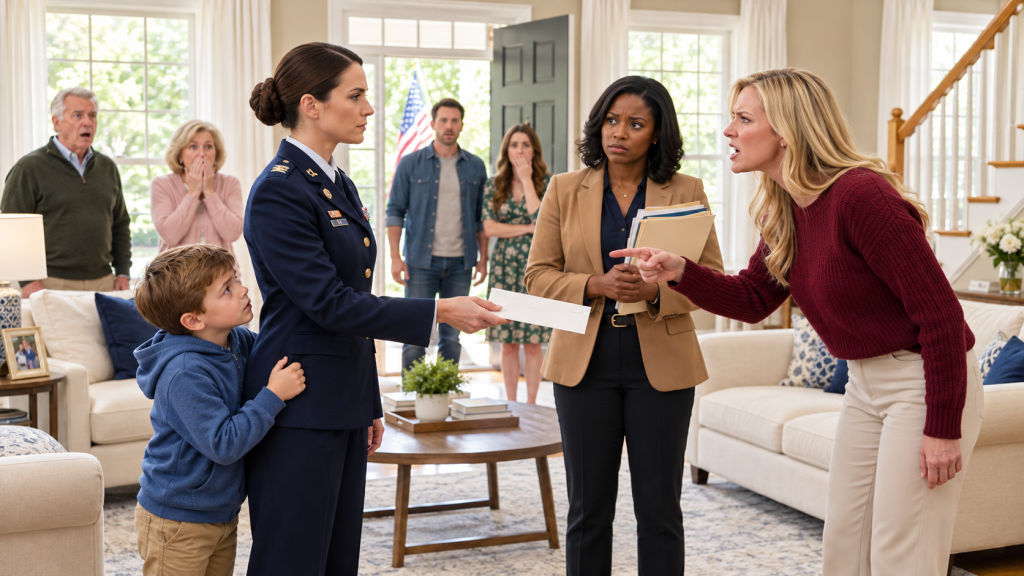
Outside, Monica started walking toward my house.
Dana saw her.
“I would prefer she not enter.”
“So would I.”
Another knock came thirty seconds later.
Three sharp taps.
Different from Dana’s.
I opened the door only halfway.
Monica smiled.
Too brightly.
“Hey.”
I looked at her.
She glanced over my shoulder.
“Is everything okay?”
I stared.
“You tell me.”
Her smile flickered.
“What?”
Dana stepped into view.
“Ms. Monica Bennett?”
Monica’s face changed.
“Yes.”
“I’m Dana Reyes with Child Protective Services.”
“I know.”
That was the wrong answer.
Dana caught it.
“So you were aware of today’s visit?”
Monica realized the mistake too late.
“I mean—I assumed.”
“How?”
She glanced at me.
“Rachel has been unstable lately.”
I almost laughed.
Not because it was funny.
Because “unstable” had become her favorite word.
Vague enough to frighten people.
Soft enough to avoid proof.
Dana said:
“I’d like to speak with you separately.”
Monica nodded immediately.
“Of course.”
Then looked at me.
“Whatever helps Eli.”
That sentence came dressed as concern.
I had heard versions of it for months.
I stepped onto the porch and closed the door behind me.
“Monica.”
She turned.
“What?”
“The deployment order.”
Her eyes changed.
Barely.
Enough.
“What deployment order?”
I knew then.
Not suspected.
Knew.
I had spent years cross-examining people who believed the trick was to look calm.
It isn’t.
The trick is to answer the question before your face answers for you.
Monica’s face had already testified.
I said:
“The one attached to your guardianship petition.”
She went pale.
“I don’t know what you’re talking about.”
Dana watched her.
I continued.
“The one saying I deploy to the Mediterranean next week.”
Monica’s mouth tightened.
“You told Mom last year you might deploy again.”
“Our mother has been dead for three years.”
Silence.
Our aunt Denise shifted uncomfortably across the street.
Monica corrected herself.
“You told me.”
“No.”
“I told you I was eligible for future sea duty.”
“That’s not the same thing.”
She crossed her arms.
“Rachel, I’m not doing this with you.”
“No.”
I nodded.
“You did it without me.”
Her face hardened.
Dana stepped between us verbally, not physically.
“I think we should continue this conversation elsewhere.”
Monica looked at her.
“Are you taking Eli?”
Dana did not answer.
Monica’s confidence cracked.
Just slightly.
“Are you?”
Dana said:
“I’m not discussing case decisions on the porch.”
Monica looked at me.
The satisfaction she had worn across the street was gone.
Good.
Not because I wanted revenge.
Because for the first time, she understood that paperwork could be examined by people who did not love her.
That matters.
Family lies often survive because relatives argue feelings.
Institutions ask for dates.
Signatures.
Metadata.
Those are less forgiving.
Dana stayed another two hours.
She inspected the home.
Food.
Smoke detectors.
Medication storage.
Eli’s room.
Emergency contacts.
School records.
She called his after-school program.
They confirmed I had never failed to pick him up.
She contacted his pediatrician.
No history of unexplained injury.
No missed well-child visits.
No concerns about neglect.
Then she asked about the bruises.
I showed her the bicycle photographs.
The playground incident report.
The soccer note.
And one image from a family barbecue.
Eli’s right knee was purple.
Monica had submitted a cropped photograph labeling it:
Large unexplained injury observed after child returned from mother’s care.
The full photograph showed something else.
Monica standing behind Eli.
Holding the bicycle he had fallen from.
Timestamp:
6:14 p.m.
My house security camera showed Monica bringing him home at 6:31.
In the video, she said:
“He wiped out, but he’s fine.”
Dana watched twice.
Then wrote something in her notebook.
“What?”
I asked.
She looked up.
“Nothing I can characterize yet.”
Fair.
I respected her more every minute.
Not because she believed me.
Because she was willing to verify me.
Those are different things.
By 7:22 p.m., Dana closed her bag.
“I’m going to recommend no emergency removal tonight.”
The word tonight hit me.
“What about tomorrow?”
“We’ll continue the investigation.”
I nodded.
She continued.
“I also need you to understand something.”
“What?”
“Your sister may have filed a false or misleading report.”
“Yes.”
“But CPS is not a criminal court.”
“I know.”
“We do not prosecute people from your kitchen.”
“I know.”
“And if she genuinely believed some concerns, her report is not automatically malicious simply because the broader picture appears wrong.”
“I know.”
Dana studied me.
“You keep saying that.”
“Because I do.”
I looked at Eli.
He had fallen asleep on the couch with one shoe still on.
“My job involves watching people confuse accusation with proof.”
“I’m not doing that now.”
Dana’s face softened slightly.
Then she said:
“Good.”
She picked up the folders.
“I need to copy these.”
“You can take them.”
“You have originals?”
“Digital and hard-copy duplicates.”
She almost smiled.
“Of course you do.”
Then she paused by the door.
“Who verified the orders were forged?”
“My command administrator and executive officer.”
“Did they put it in writing?”
“Yes.”
“Folder three?”
“Yes.”
She laughed once.
“Of course.”
Then she left.
I locked the door.
Closed the blinds.
And stood in the silent living room.
Only then did I start shaking.
People think composure means absence of fear.
It doesn’t.
Sometimes composure is fear arranged into useful order.
I had spent the afternoon answering questions.
Presenting evidence.
Correcting dates.
Watching my son color while somebody evaluated whether he belonged with me.
Now nobody was watching.
So I sat on the kitchen floor and cried.
Not elegantly.
Not quietly.
I pressed both hands over my mouth because I did not want Eli waking and thinking something was wrong.
Something was wrong.
Everything was wrong.
My own sister had tried to take my child.
I wanted to call her.
Demand an explanation.
I wanted to drive to her apartment.
I wanted eleven years of legal training to disappear for ten minutes.
Instead, I called my attorney.
Her name was Amelia Grant.
Former family-law prosecutor.
Civilian practice.
Sharp enough that even I felt underprepared talking to her.
She answered:
“Rachel?”
“CPS left.”
“And?”
“No removal.”
I heard her exhale.
“Good.”
“Temporary.”
“Everything is temporary until the paperwork catches up.”
I closed my eyes.
“Monica knew they were coming.”
Silence.
“How do you know?”
“She was across the street.”
“Witnesses?”
“Dana saw her.”
“Good.”
“I hate that your first response is ‘good.’”
“You hired a lawyer.”
“Fair.”
I told her about Eli saying Monica had told him I was going on a ship.
Amelia went quiet.
“That matters.”
“I know.”
“Do not ask Eli more.”
“I know.”
“Do not contact Monica directly.”
I hated that.
“I know.”
“Rachel?”
“Yes?”
“Your military instincts are going to want to organize this into an adversarial case.”
“It is an adversarial case.”
“No.”
She said.
“It may become one.”
“But right now your priority is making Eli’s world boring.”
That stopped me.
Boring.
Breakfast.
School.
Bath.
Stories.
No whispered phone calls in front of him.
No relatives turning him into a witness.
No asking:
What did Aunt Monica say?
I understood immediately.
“Okay.”
“Also, your command?”
“Already informed.”
“Conflict?”
“I’m completely recused from anything involving investigation.”
“Good.”
“Stop saying good.”
“No.”
I almost smiled.
Then she said:
“One more thing.”
“What?”
“Monica’s guardianship petition requested temporary possession of your residence.”
I sat up.
“What?”
Amelia had not mentioned that before.
“Page seventeen.”
“I focused on the forged orders.”
“Read seventeen.”
I opened the PDF on my phone.
There it was.
Monica requested authority to reside in my townhouse with Eli “to minimize disruption to the child’s schooling and community ties” if I were unavailable due to deployment.
My stomach tightened.
The house.
Not mine exactly.
Mortgage.
Equity.
Stable neighborhood.
Three bedrooms.
Near Eli’s school.
Monica rented a one-bedroom apartment forty minutes away.
I whispered:
“She wanted to move into my home.”
Amelia said:
“Maybe.”
“Don’t do that.”
“Do what?”
“Say maybe when we both know what this looks like.”
She was quiet.
Then:
“It looks like she wanted guardianship structured so Eli stayed in his current home.”
“That could be child-focused.”
“Or personally useful.”
“Yes.”
I looked at the petition again.
There was another line.
Temporary authority to manage education funds and dependent-related accounts.
My pulse changed.
“Amelia.”
“Yes.”
“She asked for control over Eli’s custodial account.”
“Yes.”
My grandmother—Eli’s great-grandmother—had left him an education account.
Not millions.
Enough to matter.
A little over $186,000.
I was custodian until he reached the age set by the account terms.
Monica had once joked:
“That kid has more money at five than I do at thirty-six.”
At the time, I laughed.
Now I didn’t.
“She asked for that too.”
“Yes.”
“Would she get it?”
“Not automatically.”
“Then why ask?”
“Because whoever drafted this petition either misunderstood how the account works or hoped the court would grant broad temporary authority before anyone objected.”
My hands went cold.
“Who drafted it?”
“Attorney listed is Samuel Pike.”
“Do you know him?”
“Not personally.”
“I do.”
I frowned.
“How?”
“He called me this morning.”
My stomach dropped.
“What?”
“He wanted to discuss ‘a family resolution.’”
I stood.
“What does that mean?”
“He said Monica would withdraw the emergency petition if you agreed to name her primary caregiver during any future deployment and gave her guaranteed access to Eli.”
I stared at the wall.
“That’s coercive.”
“It’s a negotiation attempt.”
“I didn’t say illegal.”
Amelia went quiet.
Then:
“He also asked whether you’d consider transferring custodianship of the education account to a neutral third party.”
“Neutral?”
“Yes.”
“Who?”
“He suggested Monica.”
I laughed.
A flat, humorless sound.
“Neutral.”
“Exactly.”
There it was.
Not proof of theft.
Not yet.
But a motive was becoming visible.
Care.
Control.
Money.
Housing.
Resentment.
And perhaps something sadder than all of them.
Monica wanted my son.
Not symbolically.
Literally.
The next morning, I took Eli to school.
Same lunchbox.
Same backpack.
Same argument about socks.
He asked:
“Is Aunt Monica picking me up?”
“No.”
“Why?”
I kept both hands on the steering wheel.
“She won’t be babysitting for a while.”
“Did she do something bad?”
Children make morality sound like a light switch.
Bad.
Good.
On.
Off.
I said:
“She made some choices that the adults need to sort out.”
“Is she mad at me?”
“No.”
Immediate.
“You didn’t do anything.”
“Did you?”
My chest tightened.
“No.”
He looked out the window.
Then:
“Okay.”
That was enough for now.
At school, I told his counselor only what she needed to know.
No Monica pickup.
No release without my written authorization.
No conversations about the case with Eli unless coordinated through proper channels.
The counselor nodded.
Then asked:
“Do you want us to watch for anxiety?”
That question nearly undid me.
“Yes.”
“Please.”
I kissed Eli goodbye.
He ran toward the classroom without looking back.
Normal.
Beautiful.
I sat in my car for ten minutes before I could drive.
By Thursday, the forged deployment order had become a separate problem.
My command was furious.
Not theatrically.
Professionally.
The fake order used:
Official letterhead.
My correct rank.
My duty station.
A copied digital signature from Captain William Hayes.
A real old deployment code.
And a personnel routing format that had been discontinued two years earlier.
That last detail helped expose it.
Captain Hayes called me into his office.
My executive officer was present.
So was command legal counsel.
Not me.
Someone else.
Exactly as it should be.
Hayes put the forged order beside a real set.
“Did you provide your sister copies of previous orders?”
I thought.
“Yes.”
“When?”
“Two years ago.”
“Why?”
“Family Care Plan.”
That was the moment.
I remembered.
A six-week overseas exercise.
Not deployment.
Temporary duty.
Eli was three.
Monica had been my alternate caregiver.
I gave her a binder.
Emergency contacts.
Medical authorization.
School information.
Copies of travel orders.
Everything a responsible parent is supposed to prepare.
My throat tightened.
“She had old orders.”
Hayes nodded.
“It appears someone used one as a template.”
Command counsel said:
“We’ve preserved the electronic file provided in the guardianship petition.”
“Law enforcement may request it.”
“NCIS?”
I asked.
“Possibly.”
He held up one hand.
“Do not get ahead of the referral.”
Right.
I hated how often people had to tell me that.
I was trained to anticipate.
Fear turned anticipation into pursuit.
Captain Hayes looked at me.
“Commander, I need you to hear something.”
“Yes, sir.”
“This command has no concerns about your current parental fitness.”
Something inside me broke.
I looked down.
Professional tears are humiliating.
I had cross-examined officers under pressure.
Argued motions.
Advised commands after deaths.
Never cried in Captain Hayes’s office.
Until then.
He pretended not to notice for exactly six seconds.
Then slid a tissue box toward me without comment.
That kindness was worse.
I took one.
“Thank you, sir.”
He said:
“You also need to take leave.”
“No.”
“That was not a suggestion.”
“Sir—”
“Commander.”
I shut up.
He continued.
“You are a parent under active CPS review and family court litigation involving fraudulent military documentation.”
“You are not coming into my legal shop pretending you can compartmentalize this perfectly.”
My face warmed.
He was right.
I hated him.
Briefly.
Then he said:
“We can cover your docket.”
“You go be Eli’s mother.”
I nodded.
“Yes, sir.”
That afternoon, I picked up my son at 2:45.
We went to the park.
Finally.
He went down the slide twenty-three times.
I counted.
That was the most useful thing I did all week.
Monica’s story began collapsing through people, not documents.
First Lauren.
Our cousin.
She called me Friday night.
I almost did not answer.
Then Amelia said relatives might be evidence.
I answered.
Lauren immediately said:
“I’m sorry.”
I stared at the ceiling.
“For what part?”
Silence.
Then:
“She told me you were leaving Eli alone.”
“Did you believe her?”
“At first.”
“Why?”
“She had pictures.”
“What pictures?”
“The bruises.”
“The pantry.”
I sat up.
“Pantry?”
Lauren went quiet.
“What pantry?”
“She sent a picture of your kitchen shelves.”
I had never seen that in the CPS packet.
“What did it show?”
“Almost no food.”
My stomach tightened.
“When?”
“Three weeks ago.”
I remembered.
Monica had babysat on a Sunday.
I had grocery delivery scheduled that evening.
The pantry had been low.
Not empty.
But low.
“Did you take that picture?”
“No.”
“Monica did.”
“Yes.”
“What did she say?”
“That you kept Eli on cereal and takeout because you were never home.”
I closed my eyes.
I cooked four nights a week.
Meal-prepped Sundays.
Kept fruit, yogurt, frozen vegetables, pasta, eggs, snacks.
Not perfect.
Fed.
Safe.
But one photograph of bare shelves could create a story.
Lauren continued.
“She asked me to take pictures too.”
“I know.”
“I did once.”
My throat tightened.
“What?”
“At Mom’s birthday.”
“Eli had a bruise on his arm.”
“From the trampoline.”
“Yes.”
“I took a picture.”
My jaw tightened.
“Did you send it to Monica?”
“Yes.”
“Why?”
“Because she said she was documenting a pattern.”
“Did she tell you she planned to call CPS?”
“Not at first.”
“When did you know?”
“About a month ago.”
I sat very still.
“And you said nothing to me.”
Lauren started crying.
“I thought if I warned you and she was right, I’d be helping you hide something.”
That sentence hurt.
Not because it was irrational.
Because it was exactly how manipulation works.
Turn warning someone into complicity.
Turn silence into virtue.
I said:
“Why are you calling now?”
“Because she told me you were being deployed.”
“And then my dad called your base.”
I froze.
“Uncle Mike called my command?”
“Not officially.”
“He has a friend who works near there.”
“He asked if ships were leaving.”
“Rachel, nothing lined up.”
“So I asked Monica.”
“What did she say?”
“She said your orders were classified.”
I actually laughed.
“Classified.”
“I know.”
“Now.”
Lauren whispered:
“I’m sorry.”
I rubbed my forehead.
“Send Amelia everything.”
“Everything?”
“Messages.”
“Photos.”
“Voice notes.”
“Do not delete anything.”
She hesitated.
“Will Monica get arrested?”
“I don’t know.”
“I’m not promising outcomes.”
“She’ll hate me.”
I thought about that.
Then said:
“That belongs to her.”
Not you.
I did not say it.
Lauren needed to learn it herself.
The aunt who had stood across the street with Monica called next.
Denise.
She did not apologize.
At least not immediately.
She said:
“Your sister has been very worried about Eli.”
I almost hung up.
Instead:
“What did she tell you?”
“That you were drinking.”
I froze.
“I barely drink.”
“I know that now.”
“What did she show you?”
“A picture of wine bottles.”
I laughed.
“From my recycling?”
Silence.
“You’re kidding.”
“She said there were seven bottles.”
“After a retirement dinner at my house.”
“I had twelve people over.”
Denise exhaled.
“I didn’t know.”
“No.”
“You didn’t ask.”
She went quiet.
I continued.
“What else?”
“That you left Eli overnight with neighbors.”
“I left him with my licensed overnight caregiver when I had duty.”
“She said neighbor.”
“Her name is Ms. Howard.”
“She’s a retired pediatric nurse.”
“I know that now.”
Again.
Now.
Everybody knew things now.
After Monica had assembled a version of my life from pieces.
True pieces.
Wrong story.
That is more dangerous than an obvious lie.
Obvious lies collapse quickly.
Manipulated context can stand for months.
Denise said:
“She also said your command had disciplined you.”
I laughed.
“For what?”
“Unprofessional conduct.”
“What proof?”
“She showed me an email.”
My stomach tightened.
“Send it to Amelia.”
Later, the email arrived.
It was real.
Partly.
Three years earlier, I had received a routine counseling memorandum after missing an administrative deadline during a major case.
Not misconduct.
Not discipline.
Monica had cropped the message to leave only:
Commander Bennett’s failure to meet required timelines is unacceptable and must be corrected immediately.
No header.
No context.
No follow-up showing the issue closed.
She had not created that one.
She had weaponized it.
Somehow that hurt more.
She had gone through my files.
My home.
My old care-plan binder.
My recycling.
My child’s bruises.
My professional correspondence.
Month after month.
Not an angry sister.
A campaign.
Dana returned Monday.
This time she brought her supervisor.
I expected fear.
Instead I felt tired.
I had stopped experiencing each visit as a threat and started seeing it as process.
Maybe that was what confidence actually looked like.
Not believing you cannot be harmed.
Knowing you can survive scrutiny.
Dana sat at my table.
“I’ve completed several collateral contacts.”
I nodded.
She continued.
“Your son’s school reports no concerns.”
“His pediatrician reports no concerns.”
“His after-school program reports consistent attendance and pickup.”
“The home assessment was satisfactory.”
“We also reviewed the injury photographs.”
I waited.
She looked at me.
“At this time, the allegations of physical mistreatment and unsafe supervision are not supported by the evidence we reviewed.”
My eyes burned.
“What about neglect?”
“Same.”
I let out a breath.
Not relief.
Not fully.
Then she continued.
“We are closing the safety component without removal.”
I covered my mouth.
Eli was at school.
Thank God.
I did not want him seeing me cry again.
Dana’s supervisor slid a paper toward me.
“There may be a separate administrative finding regarding malicious or intentionally false information if evidence supports it.”
“But that process is separate.”
“I understand.”
Dana looked at me.
“One more thing.”
My stomach tightened again.
“The photographs submitted to CPS appear to have come from multiple sources.”
“Yes.”
“Your sister submitted them as though she had personally observed the injuries.”
I stared.
“Did she?”
“Not all.”
“Some were forwarded to her.”
“That matters.”
“Yes.”
She hesitated.
“Also, one image was altered.”
My body went cold.
“Altered how?”
“Not fabricated.”
“Cropped and color-adjusted.”
“Which?”
“The bruise on Eli’s upper arm.”
I remembered it.
Trampoline.
Small purple mark.
“What did she do?”
“Increased contrast and saturation.”
My stomach turned.
“She made it look worse.”
“Yes.”
I closed my eyes.
Dana continued.
“We cannot determine who made the edit solely from the image submitted.”
“Law enforcement may.”
I nodded.
Then asked the question that had lived under everything.
“Why?”
Dana looked at me.
“That isn’t something CPS can answer.”
But someone eventually did.
Monica.
Not willingly.
Not at first.
The emergency guardianship hearing happened eleven days after the knock.
Monica sat across the courtroom beside Samuel Pike.
She looked smaller.
Not remorseful.
Contained.
That was different.
Amelia sat beside me.
I wore a dark civilian suit.
No uniform.
That choice was deliberate.
Monica had spent months turning the Navy into evidence that I was less of a mother.
I did not need rank in that room.
I needed facts.
The judge reviewed:
The forged deployment order.
The genuine command certification.
My current duty status.
The Family Care Plan history.
The CPS status report.
School records.
The petition.
And a sworn statement from Captain Hayes confirming he had never signed the order attached to Monica’s filing.
Samuel Pike looked furious.
Not at us.
At Monica.
That told me something.
The judge asked:
“Mr. Pike, did your client provide you this military document?”
He stood.
“Yes, Your Honor.”
“Did you independently verify it?”
“No.”
“Why not?”
“My client represented it had been given to her by a family source.”
The judge looked at Monica.
“Ms. Bennett, where did you obtain it?”
Monica’s lawyer whispered to her.
She answered:
“I received it electronically.”
“From whom?”
“I don’t remember.”
My chest tightened.
The judge did not react dramatically.
No shouting.
No movie speech.
She simply said:
“You filed a sworn petition seeking emergency authority over a child based in substantial part on a military order that the issuing command states is not authentic.”
“That is a serious problem.”
Monica looked down.
The judge denied emergency guardianship.
Then ordered that Monica have no unsupervised contact with Eli pending further review.
No dramatic slam of a gavel.
Just words.
But those words changed my son’s life.
Afterward, in the courthouse hallway, Monica walked toward me.
Amelia stepped between us.
Monica said:
“I need to talk to my sister.”
Amelia looked at me.
My choice.
I shook my head.
“No.”
Monica’s face cracked.
“Rachel.”
“No.”
“You don’t understand.”
I almost laughed.
“That sentence has done enough damage.”
“I was trying to protect Eli.”
“From what?”
She looked around.
Then whispered:
“You.”
There it was.
I had expected money.
Jealousy.
Maybe resentment.
Instead she still believed part of her story.
I stared at her.
“Explain.”
Amelia touched my elbow.
“You don’t have to.”
“I know.”
I looked at Monica.
“Explain.”
She swallowed.
“You’re never there.”
“That’s false.”
“You’re always working.”
“I work full-time.”
“You leave him with other people.”
“Licensed childcare.”
“You miss things.”
“So do most parents.”
“You’re going to deploy again eventually.”
“Maybe.”
“And then what?”
“My Family Care Plan.”
“With strangers?”
“People I choose.”
Her eyes filled.
“You used to choose me.”
That sentence changed the temperature.
I stared.
“What?”
“You used to choose me.”
Monica’s voice broke.
“When Eli was three, I was your alternate caregiver.”
“He stayed with me when you traveled.”
“He slept in my apartment.”
“I knew his medicine.”
“His preschool.”
“His bedtime.”
“Then you stopped calling.”
I blinked.
“You told me you were too busy.”
“No.”
“You said your job changed.”
“You stopped asking.”
She laughed bitterly.
“Because you made it clear you had everything handled.”
My anger shifted.
Not disappeared.
Shifted.
Monica continued.
“You don’t need anyone.”
“That’s what everybody says about Rachel.”
“Rachel can handle it.”
“Rachel has the Navy.”
“Rachel has rank.”
“Rachel has benefits.”
“Rachel has a house.”
“You know what I had?”
Amelia said quietly:
“Monica, this is not appropriate without counsel.”
Monica ignored her.
“I had a divorce.”
“I lost my job.”
“I lost two pregnancies.”
I froze.
I knew about one miscarriage.
Not two.
She continued.
“And every time I saw Eli, I thought—”
She stopped.
Tears spilled.
I understood before she finished.
Not completely.
Enough.
“You wanted him.”
She covered her mouth.
“I loved him.”
“That is not the same thing.”
“I know.”
“Do you?”
She cried.
“I thought you were wasting what I would have given anything to have.”
The words hit hard.
There it was.
Not just money.
Not just the house.
A sister standing beside my life measuring it against the one she lost.
She continued.
“Then you left him with Ms. Howard overnight.”
“I was on duty.”
“I know.”
“Now.”
She laughed bitterly.
“I kept seeing all these pieces.”
“Bruises.”
“Childcare.”
“You working late.”
“You talking about future deployments.”
“And I started thinking maybe everybody was wrong about you being perfect.”
“I have never claimed to be perfect.”
“No.”
“That’s worse.”
I stared.
“What?”
“You never even need to.”
“Everyone assumes it.”
My anger returned.
“This is about Mom.”
Monica’s face changed.
There.
Another door.
Our mother.
Three years dead.
The woman who framed my commissioning certificate.
Who called me “our responsible one.”
Who called Monica “our emotional one.”
Labels that sound affectionate until you live inside them long enough.
Monica whispered:
“Mom trusted you with everything.”
“She left me her jewelry.”
“She left you executor.”
I closed my eyes.
God.
Old wounds.
Monica continued.
“Then she left Eli that education account.”
“Not me.”
“It was for her great-grandson.”
“I know.”
“Do you?”
She flinched.
I continued.
“You are talking about a child’s college fund like it was a vote against you.”
“I know how it sounds.”
“It sounds exactly how it is.”
Monica looked away.
Then said:
“I needed a place to live.”
There it was.
Finally.
The house.
I felt something inside me go still.
“Your lease?”
“Ending.”
“When?”
“Next month.”
“Debt?”
She nodded.
“How much?”
She whispered:
“Seventy-four thousand.”
Amelia exhaled beside me.
I did not.
I had gone past surprise.
Monica continued.
“Credit cards.”
“Medical debt.”
“Divorce.”
“I was drowning.”
“And my house looked like a solution.”
Her face collapsed.
“I told myself keeping Eli in his home was better for him.”
I whispered:
“While I went where?”
She looked at me.
“I thought if the court believed you were deployed—”
“No.”
“Say it.”
She cried.
“I thought you’d have to go.”
“Based on fake orders?”
“I thought once the guardianship was temporary, we could sort it out.”
I almost laughed.
“Sort out what?”
“My motherhood?”
“My house?”
“My child?”
She sobbed.
“I know.”
“No.”
I stepped closer.
“You are only beginning to know.”
Amelia touched my arm again.
This time I listened.
I stepped back.
Monica whispered:
“I never wanted to hurt Eli.”
I looked at her.
“You told a five-year-old his mother was leaving on a ship.”
She went white.
“I—”
“You told him he might live with you.”
Silence.
“You made him carry uncertainty so he would be easier to move.”
Her face broke.
“I didn’t think of it like that.”
“That is the problem.”
Then I walked away.
I did not feel victorious.
I felt sick.
Because the person who tried to take my son was not a stranger.
She was the sister who slept beside me during thunderstorms when we were kids.
The woman I once trusted with Eli’s medicine.
The person my son called Aunt Monnie.
That kind of betrayal does not produce clean anger.
It produces grief.
The criminal investigation took months.
And reality was less satisfying than relatives wanted.
No one kicked down Monica’s door.
No federal agents dragged her away from Thanksgiving.
The fake order had to be traced.
The device examined.
The document history established.
Her lawyer stopped letting her talk.
Smart.
Eventually investigators recovered enough to show that the false deployment order had been created using an old PDF from my Family Care Plan binder.
The modified file had been generated on a laptop associated with Monica.
A scanned signature from an unrelated command document had been pasted into the order.
The altered file was then provided to her attorney.
Monica initially claimed someone had helped her.
No evidence supported that.
Samuel Pike withdrew from representing her once it became clear he could become a witness regarding document provenance.
That was awkward.
For him.
Not my problem.
The image editing also traced back to software on Monica’s laptop.
Not sophisticated.
Contrast.
Saturation.
Cropping.
No fake bruises.
She had made ordinary evidence look ominous.
That distinction mattered.
Eventually, state prosecutors filed charges related to document forgery and false statements connected with the guardianship petition.
The knowingly false CPS reporting issue was reviewed separately.
Not every allegation became a criminal count.
Good.
Overcharging a case does not make justice stronger.
It makes it fragile.
I stayed out of the prosecution.
Completely.
I did not call colleagues.
Did not use rank.
Did not request favors.
Did not ask Navy lawyers to “make sure” anything happened.
That was one of the hardest things I did.
I knew systems.
Knew people.
Knew language.
And because I knew it, I understood exactly why I should stay away.
Monica’s case belonged to prosecutors and her defense counsel.
My job was Eli.
Nothing more.
The family did not handle it well.
Some relatives apologized.
Others became defensive.
Aunt Denise said:
“We were just worried.”
I replied:
“Worry should make you ask questions.”
Not collect evidence for a story you already chose.
Uncle Mike called me.
“I should have checked sooner.”
“Yes.”
Lauren cried.
“I lost my cousin.”
I said:
“No.”
“You chose not to call me.”
“She may still hate you.”
“That is between you and her.”
I refused to become family prosecutor.
That surprised everyone.
Especially me.
For years, my identity had been tied to argument.
Evidence.
Responsibility.
I could have spent months forcing every relative to admit exactly where they failed.
Instead I made one rule:
If anyone wanted access to Eli, they did not discuss Monica, CPS, court, the Navy, or custody in front of him.
One violation.
Then distance.
Simple.
Aunt Denise tested it once.
She said at dinner:
“It’s just terrible what Monica did because she loved him so much.”
I put down my fork.
“Denise.”
She stopped.
Right.
No second warning.
Boundaries become easier when people believe you mean them.
Eli started therapy.
Not because he was broken.
Because adults had disrupted his sense of safety.
The therapist explained that to me carefully.
“He may worry that routine changes mean separation.”
I saw it.
If I took a suitcase from the closet, he asked:
“Are you leaving?”
If I wore my dress uniform:
“Ship?”
The first time, I almost cried in front of him.
Instead I knelt.
“No.”
“Work dinner.”
“Will you come back?”
“Yes.”
“What time?”
“Before you wake up.”
He thought.
Then:
“Promise?”
That word.
I had spent years avoiding promises I could not control.
Military parents learn that plans change.
Orders change.
Weather changes.
Duty changes.
But some promises are about effort, not fate.
“Yes.”
“I promise.”
I returned at 10:42 p.m.
He was asleep.
The next morning he asked:
“You came back?”
“I did.”
He smiled.
That was therapy too.
Consistency.
Not speeches.
Three months later, Monica sent Eli a birthday card.
It came through attorneys.
No direct contact.
I read it first.
So did his therapist.
It said:
Dear Eli,
Happy sixth birthday. I hope you get chocolate cake and the dinosaur set you wanted.
I made some choices that confused and hurt people. None of them were your fault. You do not have to write back.
Love, Aunt Monica.
I stared at it.
No:
I miss you so much.
No:
Your mother is keeping you from me.
No guilt.
No justification.
Improvement.
Eli read it.
Then put it under his bed.
Two weeks later I found it beside his dinosaur books.
I did not ask.
His relationship.
His pace.
Monica eventually entered a plea agreement.
Not prison.
That surprised some relatives.
It did not surprise me.
No one had been physically injured.
She had no prior record.
She admitted creating the false military order and making false statements in the guardianship matter.
Other counts were resolved or dismissed as part of the agreement.
She received probation.
Community service.
Mandatory counseling.
Financial penalties.
And restrictions on contact with Eli unless permitted through family court.
She also had to reimburse part of my documented legal expenses under the civil resolution.
Not all.
I still lost money.
A lot.
People asked:
“Doesn’t that make you angry?”
Of course.
But I had my son.
Money was not the central loss.
Trust was.
No court could order that restored.
The family court process lasted longer.
Monica requested supervised contact after nearly a year.
My first instinct was no.
Permanent.
Never.
Amelia asked:
“What does Eli’s therapist think?”
I hated that question.
Because it meant the answer was not mine alone.
The therapist said:
“Not yet.”
Good.
Six months later:
“Maybe.”
I hated that more.
She explained:
“Eli still has positive attachment memories.”
“He also has anxiety associated with her.”
“If contact resumes, it must be gradual, structured, and child-led.”
I said:
“She tried to take him.”
“I know.”
“She lied to him.”
“I know.”
“She manipulated his injuries.”
“I know.”
“And you think he should see her?”
“I think you should separate what she deserves from what may help him make sense of a relationship that mattered to him.”
That sentence stayed with me.
What Monica deserved.
What Eli needed.
Not the same question.
Eventually, supervised video contact began.
Ten minutes.
A therapist present.
I was in the next room.
The first call, Eli stared at the screen.
Monica cried immediately.
The therapist interrupted.
“Monica.”
She wiped her face.
“Sorry.”
Good.
She had to learn not to make her emotion his job.
She smiled.
“Hi, buddy.”
Eli said:
“Hi.”
Silence.
Then:
“Do you still have the blue dinosaur?”
She nodded.
“Yes.”
“You left it at my apartment.”
He frowned.
“That’s mine.”
“Yes.”
“I should give it back.”
He thought.
“Okay.”
No apology.
No custody.
No court.
Dinosaurs.
That was enough.
The call ended after eight minutes.
Eli came into the kitchen.
“How do you feel?”
I asked.
He shrugged.
“Hungry.”
I laughed.
“Excellent.”
Grilled cheese.
Normal life is underrated.
Contact grew slowly.
Not because Monica demanded it.
Because Eli sometimes asked.
At seven:
“Can Aunt Monica come to my soccer game?”
The therapist said no.
Too much.
At eight:
“Can she send me a present?”
Yes.
At nine:
“Can I see her in person?”
We arranged a supervised visit.
Neutral office.
No overnight.
No home.
No secrets.
Eli hugged her.
I had not expected that.
My body reacted before my mind did.
Jaw tight.
Hands cold.
Then I remembered:
His love is not betrayal.
Children should not have to hate someone to prove loyalty to someone else.
That became one of the hardest lessons of my life.
After the visit, he said:
“Aunt Monica looks different.”
“How?”
“Older.”
I laughed.
“She is.”
Then:
“She said sorry.”
“What did she say?”
“That she told people stuff that wasn’t true.”
“Anything else?”
“She said she shouldn’t have told me you were going on a ship.”
My throat tightened.
“How did that feel?”
“Good.”
He looked out the car window.
Then:
“I still don’t want to sleep at her house.”
“You don’t have to.”
Ever?
I almost said it.
Stopped.
The future belonged to future Eli.
Not frightened me.
So:
“Not now.”
He nodded.
That was enough.
Monica and I did not speak directly for nearly three years.
Then our father had a stroke.
We ended up in the same hospital corridor.
Of course.
Families have a cruel sense of timing.
She sat twelve chairs away.
No lawyer.
No therapist.
No caseworker.
Just us.
Our father was stable.
Not dying.
Still, the air felt fragile.
Monica stood.
“Can I sit closer?”
I looked at the empty chair beside me.
Then nodded.
She sat.
For a long time, neither of us spoke.
Finally:
“I’m sorry.”
I stared ahead.
“You’ve said that.”
“I know.”
She folded her hands.
“I used to think if I could explain enough, you’d understand.”
“I understand.”
She looked at me.
That surprised her.
I continued.
“I understand you were grieving pregnancies.”
“Your marriage.”
“Money.”
“Mom.”
“I understand you envied my stability.”
“I understand you loved Eli.”
“I understand you convinced yourself I was absent.”
“I understand you thought you could give him something I wasn’t giving.”
Tears filled her eyes.
Then I looked at her.
“And none of that made you entitled to my child.”
She nodded.
“I know.”
“You forged federal-looking military paperwork.”
“Yes.”
“You recruited relatives to document my son.”
“Yes.”
“You told him I was leaving.”
“Yes.”
“You tried to move into my home.”
Her face collapsed.
“Yes.”
I let the silence sit.
Then:
“Do you understand that there is no explanation that makes those things smaller?”
“Yes.”
Good.
She looked at me.
“I was jealous of you.”
“I know.”
“No.”
She shook her head.
“Not your job.”
“Not really.”
“Your certainty.”
I almost laughed.
“My certainty?”
“You always knew what to do.”
“No.”
“You looked like you did.”
“That isn’t the same thing.”
“I know now.”
She smiled sadly.
“Back then, I thought you got Mom’s trust.”
“The career.”
“The house.”
“Eli.”
“Everything.”
“And I got every version of almost.”
My anger softened slightly.
Not enough to erase anything.
Enough to listen.
Monica continued.
“When I lost the second pregnancy, I came to your house.”
“You weren’t home.”
“Ms. Howard was there with Eli.”
“I watched him run to her.”
“He loved her.”
“And something inside me became ugly.”
I closed my eyes.
There it was.
A moment.
Not an excuse.
A beginning.
“She had a key.”
Monica whispered.
“I used to have a key.”
My throat tightened.
She continued.
“I went home and started telling myself strangers were raising your son.”
“Ms. Howard wasn’t a stranger.”
“I know.”
“Now.”
She looked at me.
“Then I started looking for proof.”
That sentence mattered.
Not discovering proof.
Looking for it.
Once you decide the conclusion first, evidence becomes decoration.
Monica said:
“Every bruise looked important.”
“Every late pickup.”
“Every work email.”
“Every empty shelf.”
“I stopped asking what things meant.”
“I only asked whether they could fit the story.”
I looked at her.
“You sound like a lawyer.”
She almost smiled.
“Therapy.”
“Better.”
Silence.
Then she said:
“I don’t expect you to trust me again.”
“Good.”
“But I want you to know I am not trying to become Eli’s mother anymore.”
My chest tightened.
“That sentence should never have existed.”
“I know.”
She cried quietly.
Then:
“I want to be whatever he safely lets me be.”
That was the first thing she said that gave me hope.
Not for us.
For her.
People begin changing when they stop negotiating for the outcome they originally wanted.
Dad recovered.
Mostly.
Monica and I remained careful.
Birthdays.
Hospital updates.
Family group texts.
No sudden sisterhood.
No nostalgic rewriting.
Then one Christmas, five years after CPS knocked on my door, Eli—now ten—asked:
“Can Aunt Monica come?”
I froze.
“To Christmas?”
“Yes.”
I looked at him.
“Why?”
He shrugged.
“She’s family.”
Children.
They say enormous things like they’re asking for ketchup.
I told him:
“I’ll think about it.”
Then I called his therapist.
Yes.
Still.
Therapy had become less crisis and more maintenance.
The therapist said:
“What do you want?”
That annoyed me.
“I’m asking you.”
“No.”
“You’re asking me to make your family decision feel clinical.”
I hated good therapists.
She continued.
“Is Monica currently safe?”
“As far as I know.”
“Has she respected boundaries?”
“Yes.”
“Has Eli’s contact been positive?”
“Yes.”
“Then what are you afraid of?”
I knew.
Immediately.
“That if I let her back in, it means what she did wasn’t serious.”
The therapist said:
“No.”
“Access after years of accountability does not rewrite history.”
That sentence changed things.
Monica came.
Three hours.
No overnight.
No one discussed the case.
She brought mashed potatoes.
Too salty.
Dad complained.
Monica laughed.
Eli beat her at Uno.
I watched from across the room.
Waiting for danger.
None came.
That was almost disappointing.
Hypervigilance wants to be proven useful.
Instead, Christmas was boring.
Beautifully boring.
Years passed.
I stayed in the Navy long enough to retire.
Not because Monica said my service harmed Eli.
Not to prove she was wrong.
Because I still wanted the work.
And because I no longer let other people define what my uniform meant inside my home.
When I did receive actual deployment-related orders years later, the irony felt almost cruel.
Not a long combat deployment.
A temporary overseas assignment lasting several months.
I sat Eli down.
He was thirteen.
I showed him the orders.
Real ones.
He looked at them.
Then at me.
“Why are you showing me paperwork?”
I smiled.
“Family history.”
He rolled his eyes.
Then I explained.
Dates.
Care plan.
Where he would stay.
With whom.
His choice mattered now.
He chose my close friend Commander Leah Monroe and her family.
Not Monica.
Monica did not complain.
That mattered.
She said:
“Whatever makes him feel safest.”
I noticed.
Said nothing.
Eli asked:
“Does Aunt Monica get to visit?”
“If Leah and you are comfortable.”
He nodded.
That was the first time my military service and Monica’s role existed in the same sentence without danger.
Healing is strange.
Sometimes it looks like scheduling.
The assignment went well.
I called Eli every night I could.
Missed some.
He survived.
So did I.
When I came home, he stood at the airport taller than I remembered.
I hugged him too long.
He complained.
Teenagers.
Good.
Monica stood behind him.
Not holding him.
Not positioning herself as substitute mother.
Just there.
She smiled.
I nodded.
That was enough.
At sixteen, Eli asked to read the CPS report.
My first instinct:
No.
Then I remembered every adult who had once decided what truth someone else could handle.
I said:
“Not alone.”
He frowned.
“Why?”
“Because records are not neutral.”
“They contain allegations.”
“Language.”
“Statements people made while afraid.”
“You deserve context.”
He thought.
“Therapist?”
“Yes.”
“Fine.”
We reviewed a redacted copy.
No unnecessary private details from relatives.
No criminal case file.
Just the core.
Eli read slowly.
Then stopped at the bruise photograph.
“That looks terrible.”
“It was edited.”
He looked at the original.
Then back.
His face changed.
“Aunt Monica did that?”
“Yes.”
He stared.
Then:
“Why?”
I waited.
He knew some.
Not all.
I said:
“She was hurting.”
“Jealous.”
“Scared.”
“In debt.”
“She also loved you.”
“None of those things gave her permission.”
Eli nodded.
Then found the forged deployment order.
He laughed.
“What?”
“It says you’re going to the Mediterranean.”
“Yes.”
“You hate ships.”
I stared.
“I am in the Navy.”
“You still hate ships.”
Fair.
Then he became serious.
“Did she really want me?”
My throat tightened.
“Yes.”
“Like… as her kid?”
“Yes.”
He looked down.
“Was that because she loved me?”
“Partly.”
“What was the other part?”
I chose carefully.
“She had lost things.”
“She thought having you would fix some of them.”
“That is too much responsibility to put on a child.”
Eli nodded.
Then:
“Do you hate her?”
“No.”
He looked surprised.
“Did you?”
“Yes.”
“When?”
“For a while.”
“What changed?”
I thought.
“Hatred required too much attention.”
He smiled.
“That sounds like you.”
“Rude.”
Then:
“I don’t hate her either.”
“I know.”
“You’re not mad?”
“No.”
His love is his.
I had learned that.
The hard way.
At eighteen, Eli graduated high school.
Monica attended.
She sat with the family.
Not beside me.
Close enough.
After the ceremony, Eli hugged her.
Then me.
He said:
“Mom, you’re crying.”
“Incorrect.”
“You have mascara on your chin.”
“Evidence can be misleading.”
He laughed.
Then Monica approached.
“Rachel?”
“Yes?”
She handed me an envelope.
I stiffened.
“What?”
“Relax.”
“Bad family associations.”
“It’s not legal.”
I opened it.
A photocopy.
The first page of the old guardianship petition.
Across the top, Monica had written in thick black ink:
I THOUGHT LOVE MEANT I KNEW BETTER. IT DOESN’T.
Underneath:
THANK YOU FOR MAKING SURE ELI GREW UP KNOWING THAT HIS VOICE MATTERED MORE THAN MY NEED TO BE FORGIVEN.
I stared.
Then folded it.
“You’re still dramatic.”
She laughed through tears.
“Yes.”
I looked at her.
“I forgive you.”
Her face crumpled.
I raised one hand.
“Do not make this a scene.”
She laughed harder.
“I’m trying.”
I continued.
“Forgiveness does not mean I think what happened was acceptable.”
“I know.”
“It does not mean I would ever make you his legal guardian.”
She smiled sadly.
“I know.”
“It means I am tired of carrying the courtroom in my head.”
Tears slipped down her face.
She nodded.
“That’s more than enough.”
For once, she did not ask for more.
That was how I knew she had changed.
Years later, when Eli became a father, he asked me to help with his estate plan.
I laughed.
“What?”
He said:
“You’re literally a lawyer.”
“Retired.”
“Convenient.”
His wife, Marisol, sat beside him.
Their daughter was six months old.
Tiny.
Perfect.
Terrifying.
Eli asked:
“Who should we name as backup guardian?”
The question made the room tilt.
For half a second, I was back in my kitchen.
Three folders.
Dana Reyes.
Monica across the street.
A five-year-old asking if we were still going to the park.
Eli noticed my face.
“Mom?”
“I’m okay.”
Marisol asked:
“Should we not do this now?”
“No.”
I smiled.
“We should.”
We talked.
Not about who loved the baby most.
Not who wanted her.
Not who was related most closely.
We talked about:
Values.
Stability.
Location.
Health.
Parenting style.
Finances.
Willingness.
And one thing I insisted on.
“Ask them.”
Eli laughed.
“Obviously.”
“No.”
I looked at him.
“Not obviously.”
“People put names on documents without asking all the time.”
“Ask.”
So they did.
Their first choice accepted.
Their second choice accepted.
Monica was not listed.
She knew.
She never complained.
That mattered too.
I am older now.
Gray in my hair.
Retired from the Navy.
Eli jokes that I still organize vacations like operational plans.
He is not wrong.
Monica lives two states away.
She never had children.
That fact no longer defines her.
She works with a nonprofit helping women rebuild finances after divorce and medical debt.
The irony is not lost on either of us.
Once, she told me:
“I spent years thinking getting what you had would fix me.”
“Now?”
“Now I know I needed a budget and therapy.”
I laughed so hard I nearly choked.
She laughed too.
People can change.
That does not mean they were secretly good all along.
It means change is behavior over time.
Repeated.
Boring.
Often uncelebrated.
Monica never again forged anything.
Never pressured Eli.
Never used family to corner me.
Never tried to turn apology into access.
That is why she eventually became my sister again.
Not because blood demanded it.
Because behavior made it possible.
I kept the three folders.
Of course I did.
Folder one:
Eli’s records.
School.
Doctor.
Childcare.
Photographs.
The ordinary evidence of an ordinary safe childhood.
Folder two:
Monica’s messages.
Her campaign.
Her requests for photographs.
Her comments about me.
Folder three:
The forged deployment order.
Guardianship petition.
Command verification.
The papers that stopped me from having to shout.
For years, they sat in a locked cabinet.
Then one day, after Eli had his daughter, I opened them.
I expected anger.
Instead I felt something else.
Gratitude.
Not toward Monica.
Toward the woman I had been.
The one who noticed.
Documented.
Stayed calm.
Not because calmness is morally superior to fear.
But because I knew my sister was building a story.
And I had prepared truth.
Still, age changed how I remembered that afternoon.
For a long time, I told it like this:
CPS came to take my son.
My sister thought she had won.
I placed three folders on the table.
Her lies collapsed.
That version is satisfying.
It is also incomplete.
Dana did not arrive as my enemy.
She arrived because someone alleged a child was unsafe.
She did not owe me immediate belief because I wore a uniform.
She asked questions.
Checked records.
Called people.
That is what I wanted the system to do.
Even when it terrified me.
The folders did not “destroy” Monica.
They did something more important.
They created enough pause for verification.
That is what evidence should do.
Not become a weapon.
Create space between accusation and consequence.
And Eli—
He was never evidence.
That took me longer to understand.
He was not the child who proved I was a good mother.
He did not owe me perfect grades.
Perfect behavior.
No bruises.
No anxiety.
No love for Monica.
He was a child.
Then a teenager.
Then a man.
His life was not my defense exhibit.
That became the lesson I carried longest.
When Eli was thirty-one, he found me going through the folders.
He stood in the doorway.
“You still have those?”
“Yes.”
“Why?”
“I’m sentimental.”
“You are clinically incapable of throwing away paperwork.”
“Also true.”
He sat beside me.
Then looked at folder three.
“Can I?”
I handed it over.
He found the forged order.
Read it.
Then smiled.
“What?”
I asked.
He looked at the fake deployment date.
“Park day.”
I froze.
“What?”
“The day CPS came.”
“You promised we’d go to the park.”
I stared at him.
“You remember?”
“Yes.”
“I remember waiting.”
My throat tightened.
“Do you remember Dana?”
“A little.”
“Monica outside?”
He nodded.
“Mostly I remember you tying my shoe.”
That sentence broke me.
Of all the things.
The report.
The court.
The fake orders.
The legal fees.
The relatives.
The investigation.
My son remembered his sneaker.
He continued.
“You kept saying, ‘Other foot.’”
I laughed through tears.
“I was trying not to panic.”
“You looked normal.”
“Good.”
He stared at the folder.
Then said:
“You know what’s weird?”
“What?”
“I never thought you were going to lose me.”
I stopped breathing.
“Really?”
“No.”
“I was scared Aunt Monica was mad.”
“I was confused about the ship.”
“But I didn’t think you were disappearing.”
I covered my mouth.
For years, I had carried that day as the afternoon my son almost got taken.
In his memory, I had stayed.
That was what mattered.
Eli closed the folder.
“You can throw these away, you know.”
I looked at him like he had suggested burning the Constitution.
“No.”
He laughed.
“Of course not.”
I did eventually throw away duplicates.
Not the originals.
I am still me.
But I moved the folders from the locked cabinet to a storage box.
No longer battle plans.
Just history.
Monica visited last Christmas.
She brought a gift for Eli’s daughter.
One gift.
Reasonable.
No attempt to become favorite aunt through spending.
Progress.
The little girl climbed into Monica’s lap and demanded a story.
I watched from the kitchen.
For one second, an old fear rose.
Then passed.
Monica looked over at me.
Maybe she saw it.
Maybe not.
She did not ask to take the child overnight.
Did not say:
I’m better with kids.
Did not compare.
She simply read the book.
When the little girl got bored and ran away halfway through, Monica laughed.
No injury.
No claim.
No need.
That was what healing looked like between us.
Not forgetting what happened.
Not pretending anyone had been entitled to forgiveness.
Building enough years of different behavior that the old pattern no longer controlled every new moment.
I sometimes think about the sentence Monica used at the beginning.
“He needs a real home, Rachel—not a barracks with cartoons on the walls.”
At the time, I heard contempt.
Now I hear something else too.
She thought home was a person who was always physically present.
I thought home was stability, structure, and showing up reliably even when duty sometimes pulled me away.
We were both reacting to childhood.
Our mother had been affectionate but inconsistent.
Our father traveled constantly.
Monica learned:
If you love someone, keep them close.
I learned:
If you love someone, make sure everything still works when you are gone.
Neither belief was automatically wrong.
Both become dangerous when taken too far.
Monica turned closeness into possession.
I sometimes turned preparation into emotional distance.
That was something I had to own too.
After the CPS case, I changed small things.
Not because the allegations were true.
Because scrutiny can still reveal places to grow.
I stopped answering work email during dinner unless urgent.
I put Eli’s school events on the same calendar priority as command commitments whenever possible.
I said:
“I don’t know.”
More often.
I let people help.
I stopped treating competence like a moral obligation.
That made me a better mother.
Not because Monica had been right to attack me.
Because even false accusations can accidentally point near a real insecurity.
The mature response is not to accept the lie.
It is to examine yourself without surrendering to it.
That distinction saved me.
If there is one image I remember most clearly, it is not Monica’s face when she saw the folders.
It is not the judge denying guardianship.
Not the forged order.
Not the edited bruise.
Not even Eli hugging Monica years later.
It is the moment Dana stood in my kitchen and told me:
“I’m not authorizing removal based on the information currently before me.”
Currently.
At the time, that word terrified me.
Later, I respected it.
She did not promise me forever.
She told me what the evidence supported that day.
That is how responsible decisions are made.
Not through certainty people do not actually have.
Through careful, temporary conclusions that can be tested against more truth.
I built an entire career around that principle.
It took my sister trying to take my son for me to understand how much it mattered in my own home.
The three folders never won the case by themselves.
People did.
Dana asking questions.
Teachers telling the truth.
Doctors keeping records.
Childcare workers remembering pickup times.
Captain Hayes verifying signatures.
Lauren finally forwarding messages.
My attorney slowing me down when I wanted to turn grief into strategy.
Eli’s therapist reminding me his relationship with Monica belonged to him.
Even Monica, eventually, telling the truth about why she had done it.
Evidence mattered.
But integrity was people choosing not to make the evidence say more than it actually did.
That is harder.
And more important.
My name is Rachel Bennett.
I served in the Navy.
I raised my son.
Sometimes at the same time.
Sometimes badly.
Mostly well.
I missed things.
I made mistakes.
I needed childcare.
I worked late.
I wore a uniform to parent-teacher conferences twice because I had no time to change.
None of that made me neglectful.
And none of my rank made me automatically good.
I was a mother because I did the work.
Day after day.
Lunches.
Fevers.
Bedtime.
Discipline.
Apologies.
Appointments.
Homework.
Parks.
Sneakers.
The ordinary things no court filing can fully measure.
Monica mistook imperfection for evidence.
Then reshaped evidence until it matched what she needed to believe.
For a while, I hated her for that.
Eventually, I learned something harder.
People do not always become dangerous because they stop loving you.
Sometimes they become dangerous because they decide their love gives them authority over your life.
That is why boundaries matter.
That is why evidence matters.
That is why children must never become prizes adults compete to deserve.
Eli was not mine because I defeated Monica.
He was my son before the first knock.
During every investigation.
After every order.
And long after the folders stopped mattering.
The day CPS arrived, I thought I was protecting my motherhood.
Years later, I understand I was protecting something bigger.
His right to grow up without adults using him to settle their grief, envy, fear, or unfinished childhoods.
That was the real victory.
Not watching my sister’s smile disappear.
Watching my son grow into a man who never had to doubt that he belonged to himself.
THE END STORIES! THANK YOU FOR READING GOOD LUCK !❤️
Related Posts