Captain Russell Danner did not raise his voice. That was the first thing I noticed. He stood on the gravel shoulder with one hand resting near his belt, the August heat shimmering between him and the young deputy, and spoke so quietly that I had to lean toward the open passenger window to hear him.
“Deputy Collins,” he said, “step over here with me.” The deputy swallowed. “Yes, sir.” His name was Collins. Until then, I had not paid attention to the nameplate on his uniform. I had been too busy watching my mother stand in the sun. Captain Danner motioned toward the patrol vehicle.
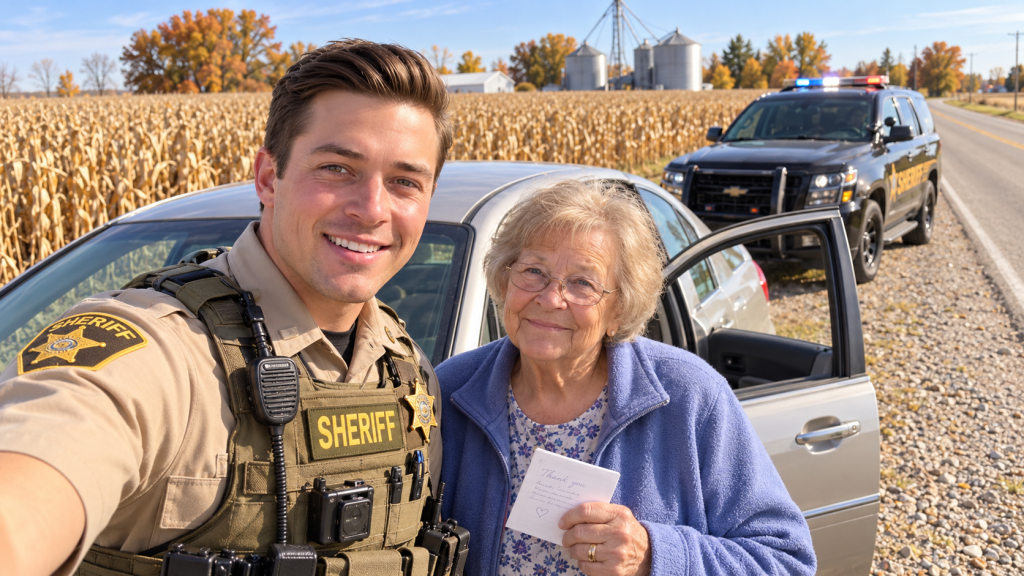
“Bring your citation book.” Collins obeyed. Mom opened the Buick’s driver-side door and sat slowly behind the wheel. For forty minutes, she had refused to show weakness. Now, with the deputy facing away, I saw her press one hand against the center of her chest. I was out of the passenger seat before she could stop me.
“Mom.”
“I’m fine.”
“You’re not fine.”
“I said I’m fine.”
Her voice was still calm, but I knew the difference between calm and tired.
I had known it since I was eight years old.
My mother could hide pain from strangers.
She had never been particularly good at hiding it from me.
I opened the back door and grabbed the small cooler we had brought for the church gathering.
There were two bottles of water inside.
I twisted one open and handed it to her.
“Slowly.”
She gave me a look.
“I raised you.”
“And now I’m bossing you.”
“That seems to be the natural order of aging.”
Despite everything, I laughed.
She took a careful drink.
Captain Danner glanced toward us.
Then his expression changed.
He left Collins beside the patrol car and hurried back.
“Shirley, are you dizzy?”
“No.”
“Nauseous?”
“No.”
“Headache?”
“A little.”
Danner looked at me.
“How long exactly was she standing?”
I checked the time on my phone.
“Forty-three minutes.”
His jaw tightened.
He turned toward Collins.
“Call EMS.”
Mom immediately shook her head.
“Russell, absolutely not.”
“It is ninety-one degrees.”
“I am aware of the weather.”
“You were standing on blacktop.”
“Gravel.”
“Shirley.”
She looked at him.
He looked back.
For a few seconds, I saw something between them that I did not understand.
Not authority.
History.
The kind people earn after surviving enough difficult nights together.
Mom sighed.
“Fine.”
Captain Danner pressed his radio.
“Dispatch, send a medical unit to County Road 6 at my location. Non-emergent evaluation for heat exposure.”
The answer came instantly.
“Copy, Captain.”
Then the dispatcher added:
“Is Mrs. Hagen conscious and alert?”
Mom closed her eyes.
Danner almost smiled.
“Yes, Beth. Mrs. Hagen is conscious, alert, and already irritated.”
The radio crackled.
“Then she’s probably fine.”
Mom laughed.
So did Danner.
Deputy Collins did not.
He stood beside his patrol car holding his citation book like it had suddenly become evidence.
I watched him.
The confidence he had carried when he first walked toward our Buick was gone.
But I did not feel triumphant.
That surprised me.
For forty minutes, I had wanted someone to humiliate him the way he had humiliated Mom.
Now that he looked frightened, it did not make the sun feel cooler.
It did not return those forty-three minutes.
It did not undo the way he had laughed at a document issued by his own county.
Captain Danner walked back to him.
“What was the basis for the stop?”
Collins answered:
“Driving unusually below the limit.”
“How far below?”
“Approximately seven miles per hour.”
“Any weaving?”
“No, sir.”
“Lane departure?”
“No.”
“Equipment violation?”
“No.”
“Expired registration?”
“No.”
“Anything indicating impairment?”
Collins hesitated.
“She appeared cautious.”
Danner stared at him.
“Caution is not impairment.”
“No, sir.”
“Did dispatch return the license as valid?”
Collins looked toward his patrol car.
“I was having difficulty with the temporary document number.”
“That was not my question.”
Collins lowered his eyes.
“Dispatch confirmed her identity.”
“When?”
Another hesitation.
Mom looked at me.
I felt my stomach tighten.
Danner said:
“When did dispatch confirm Shirley Hagen’s identity?”
Collins’s voice dropped.
“About twelve minutes into the stop.”
The world seemed to stop.
I stared at him.
“Twelve minutes?”
Mom turned.
Captain Danner’s expression went completely still.
“What exactly was confirmed?”
Collins swallowed.
“Name.”
“Date of birth.”
“License status.”
“And?”
“Temporary credential issued three days ago.”
The lemon bars.
The church gathering.
The melted powdered sugar.
The forty-three minutes.
Every detail suddenly shifted.
I stepped forward.
“You knew her license was valid?”
Collins looked at me.
Danner raised one hand.
“Jeffrey.”
It was the first time he had said my name.
I stopped.
But anger had already reached my throat.
“You knew after twelve minutes.”
Collins looked toward the ground.
“I was still assessing the situation.”
“What situation?”
Mom spoke softly.
“Jeffrey.”
I turned.
She shook her head.
Not now.
I wanted to scream.
Instead I walked back toward the Buick and stood beside her open door.
Captain Danner continued questioning Collins.
“Why did you keep her outside?”
“I wanted clear observation.”
“For what?”
“I thought there might be an issue with the document.”
“Dispatch confirmed the document.”
“I wasn’t certain the return matched what she handed me.”
“Did you contact the issuing courthouse?”
“No.”
“Did you request a supervisor?”
“No.”
“Did you ask Mrs. Hagen if she had any medical limitations before ordering her to remain outside?”
“No.”
“Did she request to sit in her vehicle?”
“Yes.”
“What did you tell her?”
Collins’s face flushed.
Danner already knew.
The body camera would know too.
“You can sit down when I tell you to, ma’am.”
I could hear the sentence as clearly as when he first said it.
Danner exhaled through his nose.
Then he looked at the body camera attached to Collins’s chest.
“Is that activated?”
“Yes, sir.”
“Has it been activated for the full stop?”
Collins froze.
Only for a moment.
But long enough.
Danner’s eyes sharpened.
“Deputy.”
“It should be.”
“Should be?”
“Yes, sir.”
Danner extended his hand.
“Do not touch it.”
Collins stepped back.
Danner pressed his own radio.
“Dispatch, notify Watch Commander Miller. I want this stop flagged for immediate body-camera preservation and vehicle video preservation. Unit Fourteen is out of service pending supervisor review.”
A different voice answered.
“Copy.”
Collins looked stunned.
“Captain, I—”
Danner faced him.
“This is not a disciplinary finding.”
“It is an evidence-preservation instruction.”
“Do you understand?”
“Yes, sir.”
“You will wait by your vehicle until Watch Commander Miller arrives.”
“Yes, sir.”
Mom whispered:
“Russell.”
Danner turned.
She looked at him.
“Do not decide the boy’s whole career on the side of the road.”
Collins looked up.
I stared at her.
Boy.
He had left her standing in August heat for forty-three minutes and she was worried about his career.
Danner’s face softened slightly.
“I’m not.”
“Good.”
“I’m deciding this stop needs review.”
Mom nodded.
“That is fair.”
That word.
Fair.
Not revenge.
Not punishment.
Fair.
I did not understand how she could still want fairness.
Then the ambulance arrived.
Two paramedics examined her in the Buick.
Her blood pressure was elevated.
Pulse slightly fast.
No signs of severe heat illness.
They recommended she go to the emergency department because of her age and prolonged exposure.
Mom refused transport.
Of course.
She agreed to let me drive her to urgent care later.
Captain Danner made her sign the refusal form.
She complained about his handwriting.
He complained about hers.
The paramedic looked between them.
“You two know each other?”
Danner smiled.
“For too long.”
Mom said:
“Since he had hair.”
Danner touched his bald head.
“Cruel woman.”
For the first time, Deputy Collins looked confused for a reason unrelated to fear.
He was beginning to understand that this was not simply an older woman who happened to know one captain.
People were responding to her name.
Dispatch.
Command.
Old history.
And yet Mom did not seem proud of it.
If anything, she looked embarrassed.
That confused me too.
Watch Commander Patricia Miller arrived fifteen minutes later.
She was a lieutenant, broad-shouldered, gray-haired, and serious.
The moment she saw Mom, she stopped.
“Shirley?”
Mom raised one hand.
“Please do not start.”
Miller’s face softened.
“I heard the radio.”
“So did half the county, apparently.”
Lieutenant Miller approached.
“Are you okay?”
“Yes.”
“The paramedics cleared me.”
“They recommended evaluation.”
“Russell talks too much.”
Danner said:
“I’m standing right here.”
Miller turned to Collins.
“Deputy, I need your body camera and vehicle system preserved according to policy.”
“Yes, ma’am.”
“You will return to station with Captain Danner.”
Collins’s face drained further.
“Am I suspended?”
“No finding has been made.”
“You’re being removed from patrol for the remainder of this shift while the stop is reviewed.”
Mom looked at Collins.
For the first time since the radio call, he met her eyes.
He seemed younger now.
Twenty-five, maybe twenty-six.
Not the authority figure I had been watching through the windshield.
Just a young man who had made a string of decisions and was now standing inside the consequences.
He said quietly:
“Mrs. Hagen…”
Mom waited.
“I’m sorry.”
Danner started to speak.
Mom raised one hand.
She looked at Collins for several seconds.
Then said:
“You are sorry because your captain arrived.”
Collins’s face fell.
“That does not mean you are not sorry.”
“But those are not the same thing.”
I saw Danner glance at her.
Mom continued.
“You don’t owe me a roadside speech.”
“You owe the next person a better stop.”
Collins swallowed.
“Yes, ma’am.”
Mom nodded.
“That would be enough for today.”
Then she turned toward me.
“Jeffrey.”
“Yes?”
“We are late to church.”
I stared at her.
“You are not going to church.”
“The lemon bars—”
“Are soup.”
She looked toward the passenger seat.
The powdered sugar had dissolved into the strawberries.
The entire pan looked glossy and defeated.
Mom sighed.
“Fine.”
Danner laughed.
Miller did too.
Even I smiled.
Mom looked at the officers.
“If anyone asks, the deputy ruined the lemon bars.”
Collins almost smiled.
Almost.
Then Danner said:
“Jeff, take her home.”
“I will.”
“Urgent care.”
“Yes.”
Mom glared at both of us.
“I am standing right here.”
Danner said:
“That has been part of the problem.”
She rolled her eyes.
I drove.
For the first ten minutes, neither of us spoke.
County Road 6 stretched behind us.
The Buick’s air conditioner blew hard enough that Mom complained she was freezing.
I ignored her.
Eventually she said:
“You’re angry.”
“Yes.”
“At him?”
“Yes.”
“At me?”
I glanced over.
“Why would I be angry at you?”
“You have that face.”
“What face?”
“The one you had when you were twelve and I wouldn’t let you quit baseball halfway through the season.”
“I am fifty-two years old.”
“You still have the face.”
I gripped the steering wheel.
Then said:
“Why didn’t I know?”
She looked toward the window.
“Know what?”
“Don’t do that.”
“What?”
“You know exactly what.”
She sighed.
“What did you think I did at the courthouse?”
“I told you.”
“You answered phones.”
“Mostly.”
She laughed softly.
“Oh, Jeffrey.”
The laugh embarrassed me more than Collins’s attitude had.
Because suddenly I heard how casually I had described thirty-four years of her life.
Mostly answers phones.
As though my mother had spent three decades transferring calls and doodling beside a switchboard.
I said:
“What did you actually do?”
She took a long breath.
“I was a dispatcher.”
“I know that now.”
“No.”
“You knew the word.”
“That is different.”
She looked at me.
“I started when you were nine.”
I remembered that.
Mom had been a receptionist for a dentist before then.
After Dad left, she needed work with benefits.
A county job opened.
Overnight communications.
I remembered sleeping at Grandma’s twice a week because Mom worked nights.
I remembered cereal boxes left on the counter.
Notes in her handwriting.
Jeff, lunch money is by the toaster. Love you.
I remembered being annoyed that other mothers attended school events while mine slept during the day.
I had never asked what kept her awake at night.
Mom continued.
“We dispatched sheriff’s units, volunteer fire, county EMS, public works after hours, animal control when they were available, emergency management during storms.”
I stared ahead.
“All from the courthouse basement?”
“For most of my career.”
“There was no separate communications center back then.”
“What was it like?”
She smiled faintly.
“Loud.”
Then:
“And quiet.”
“That makes no sense.”
“It does if you’ve done it.”
She folded her hands.
“Some nights nothing happened for forty minutes.”
“Then everything happened in forty seconds.”
She told me about tornado warnings.
Missing children.
Domestic calls.
Farm equipment accidents.
Heart attacks.
Drunk drivers.
Fires.
Officers whose voices changed when routine suddenly became dangerous.
She told me about maps taped to walls before digital mapping existed.
About memorizing county roads.
About knowing which volunteer firefighter lived closest to which township.
About learning voices.
That mattered most.
“Dispatchers learn voices,” she said.
“You know who is scared even when they don’t say it.”
“You know which deputy becomes too fast when nervous.”
“Which one goes quiet.”
“Which firefighter jokes when the situation is bad.”
“Which medic needs an exact address twice because they’re already moving.”
I glanced at her.
“Did you really know Danner when he had hair?”
She smiled.
“Unfortunately.”
“What happened?”
“He was twenty-three.”
“New deputy.”
“Thought he was immortal.”
“That sounds familiar.”
She looked at me.
“Do not start.”
I laughed.
Then she told me the story.
It happened twenty-nine years earlier.
Winter.
Two in the morning.
A domestic disturbance at a farmhouse outside town.
Danner was the closest unit.
The call initially sounded routine.
Then the line disconnected.
A child had whispered the address before the phone went dead.
Danner arrived.
Radioed that he saw a vehicle.
Then nothing.
Mom called him.
No answer.
Again.
No answer.
Another dispatcher thought his radio might have failed.
Mom heard something else.
“I heard breathing.”
“On the radio?”
“Yes.”
“A stuck microphone.”
Danner’s shoulder mic had apparently keyed accidentally.
No words.
Just breathing.
Then a faint sound.
Metal.
Mom remembered Danner had once mentioned the old farmhouse had a detached machine shed behind it from a previous trespassing call.
She sent backup there instead of only to the house.
They found Danner behind the shed after he had been struck and disarmed during a confrontation.
He survived.
The suspect was arrested.
No heroic gunfight.
No cinematic rescue.
Just a dispatcher who remembered a property detail from an old call and heard fear inside breathing.
I stared at Mom.
“You saved his life.”
She frowned.
“No.”
“Mom.”
“I did my job.”
“You sent them to the shed.”
“Other people responded.”
“Paramedics treated him.”
“Deputies found him.”
“I was sitting in a chair with a headset.”
I almost laughed.
“That is the most Mom answer imaginable.”
She smiled.
“We don’t rescue people alone, Jeffrey.”
“Anyone who says otherwise usually wasn’t there.”
I thought about the radio.
The instant recognition.
Captain Danner’s face.
Lieutenant Miller.
The dispatcher asking whether Mom was conscious.
“How many people knew you?”
“Too many.”
“Why?”
She shrugged.
“Thirty-four years is a long time.”
That was all she would say.
Urgent care found dehydration and mild heat exhaustion.
Nothing serious.
They gave her fluids.
Told her to rest.
She argued with the nurse about whether she needed a wheelchair to the exit.
The nurse won.
I enjoyed that.
On the drive home, Mom finally said:
“Do not put this on Facebook.”
I looked at her.
“Why would I?”
“You have that look.”
“What look?”
“The same one you had when you were sixteen and wanted everyone to know you beat Kyle Patterson in wrestling.”
“I did beat Kyle Patterson.”
“He had the flu.”
“That is irrelevant.”
She smiled.
Then became serious.
“I do not want this turned into a story about an old dispatcher getting revenge on a young deputy.”
I was quiet.
“That is exactly what people will make it.”
“Then don’t help them.”
“What should it be about?”
Mom looked out the window.
“A valid license.”
“A bad stop.”
“Heat.”
“Procedure.”
“A young deputy who needs to learn.”
“That is enough.”
I did not agree.
Not then.
I wanted more.
I wanted the deputy embarrassed.
Suspended.
Maybe fired.
I wanted public recognition for Mom.
I wanted everyone who had ever underestimated her to hear the radio recording.
Especially me.
That last part took longer to admit.
I wanted the world to praise her because I was ashamed I had not.
Three days later, Captain Danner came to Mom’s house.
No uniform.
Khakis.
Polo shirt.
A folder under one arm.
Mom made iced tea.
Of course.
I was there because she had asked me to help replace a loose porch railing.
Really, she knew I wanted to hear what happened.
Danner sat at the kitchen table.
“The review is ongoing.”
Mom nodded.
“I figured.”
“The body camera was activated.”
“Good.”
“The vehicle camera too.”
“Good.”
“The records show dispatch confirmed your temporary license at 2:18.”
“What time did he stop us?” I asked.
“2:05.”
Mom looked at me.
Thirteen minutes.
Danner continued.
“The stop ended at 2:54 when I arrived.”
Forty-nine minutes total.
Forty-one with Mom outside, according to the video timeline.
I felt anger rising again.
Danner said:
“Collins wrote in his initial report that he continued detention because he suspected the temporary credential might have been altered despite the dispatch return.”
Mom asked:
“Did he identify a reason?”
“Not one clearly documented before the tow decision.”
“What about the speed?”
“He stated slow driving drew his attention.”
“That is not illegal.”
“No.”
“Anything else?”
“No.”
Mom took a sip of tea.
“So what happens?”
Danner looked uncomfortable.
“Professional Standards reviews the stop.”
“Training reviews the policy issues.”
“Command determines discipline if warranted.”
Mom nodded.
“Good.”
I stared.
“That’s it?”
Both looked at me.
“What do you mean, Jeffrey?” Mom asked.
“He left you in ninety-one-degree heat.”
“I know.”
“He knew the license was valid.”
“He knew dispatch returned it as valid.”
“Same thing.”
“No.”
Danner looked at Mom.
She looked back.
I threw up my hands.
“Why is everyone being so careful?”
Mom answered:
“Because careful is what we wanted from him.”
That silenced me.
She continued.
“You do not fix carelessness with more carelessness.”
Danner smiled faintly.
“Still dispatching.”
“Apparently.”
Then his face became serious.
“There is more.”
Mom looked at him.
“What?”
“Collins has had two prior complaints.”
My stomach tightened.
Mom did not react.
“What kind?”
“One for discourtesy.”
“One for extending a roadside detention after identification was confirmed.”
I leaned forward.
“There. That’s a pattern.”
Danner held up a hand.
“One complaint was not sustained.”
“The other resulted in counseling.”
“Why?”
“Insufficient video on the first. Different circumstances.”
“What different circumstances?”
He hesitated.
Mom said:
“Russell.”
Danner looked at her.
“I can’t disclose complainant details casually.”
She nodded.
“Good.”
I was frustrated again.
Mom glanced at me.
“Privacy still matters when you’re angry.”
I hated how often she was right.
Danner continued.
“The important point is that Professional Standards will see the history.”
Mom asked:
“Is his training officer being interviewed?”
“Yes.”
“Dispatch too?”
“Yes.”
“Good.”
I stared at her.
“You know this process better than I do.”
“I spent thirty-four years listening to people complain about it.”
Danner laughed.
Then he reached into the folder.
“There is something else.”
He placed a printed image on the table.
A still frame from the deputy’s body camera.
Mom standing beside the Buick.
Flowered dress.
Handbag.
Sun.
Her face calm.
Danner said:
“The footage shows you asked at 2:34 whether you could sit inside the vehicle.”
Mom nodded.
“It also shows Deputy Collins looked at the MDT before responding.”
“MDT?” I asked.
“Mobile data terminal.”
The computer in the patrol car.
Danner continued.
“At that point, your license return had been displayed for more than ten minutes.”
I felt sick.
Mom stared at the image.
“So he knew.”
Danner nodded slowly.
“Yes.”
Not legal interpretation.
Not final discipline.
Just fact.
He knew the document had returned valid.
Then told her she could sit when he said so.
Mom looked at the photograph for a long time.
For the first time, I saw anger.
Not explosive.
Something quieter.
Disappointment.
She said:
“Then he needs to answer for that.”
Danner nodded.
“Yes.”
I looked at her.
“You’re angry.”
She gave me a tired smile.
“I’m seventy-one, not holy.”
That became the first thing she said that made me feel better.
A week later, Collins was placed on administrative duty while the investigation continued.
Not fired.
Not arrested.
Not paraded publicly.
Desk assignment.
Policy review.
Mandatory remedial training pending findings.
Local gossip began anyway.
Small counties are built from fences, churches, weather, and information moving faster than official channels.
Someone had heard the radio.
Someone knew Danner had responded.
Someone knew Mom’s name.
By Friday, a woman at the grocery store stopped her beside the tomatoes.
“Shirley Hagen!”
Mom closed her eyes.
Here we go.
The woman hugged her.
“My husband says you dispatched the night of the flood.”
Mom smiled politely.
“Possibly.”
“You told him not to drive through Miller’s Crossing.”
“If he tried, I probably did.”
“He says you saved his truck.”
“I saved the county the cost of rescuing him.”
The woman laughed.
Mom escaped.
Then the cashier said:
“Mrs. Hagen, my dad remembers you.”
By the time we reached the parking lot, Mom looked furious.
“This is your fault.”
“I haven’t told anyone.”
“Someone has.”
“It is a small county.”
She sighed.
“I retired for a reason.”
That afternoon, the sheriff’s office posted a short public statement.
No names beyond what was already legally releasable.
It acknowledged a citizen complaint involving prolonged roadside detention during extreme heat.
It said an administrative review was underway.
The department emphasized temporary licenses issued by the state and county were valid when properly documented.
No victory speech.
No heroic tribute.
Mom approved.
I did not understand why until later.
A reporter called.
Then another.
Mom declined both.
The third reporter showed up at church.
That made her angry enough to speak.
Her name was Andrea Pike, a local television journalist.
She approached Mom after service.
“Mrs. Hagen, could I ask you about the traffic stop?”
Mom looked at her.
“Did you come to church to worship or interview me?”
Andrea flushed.
“Interview.”
“At least you’re honest.”
I tried not to laugh.
Andrea said:
“People are talking about your dispatch career.”
“That is unfortunate.”
“Why?”
“Because the stop should not become acceptable only because I used to work with law enforcement.”
The reporter stopped.
Mom continued.
“If another seventy-one-year-old woman with no connection to the department had been left in the heat, would you be here?”
Andrea stared.
“That is the story.”
Not who I am.
“What happened.”
I felt something shift inside me.
All week, I had been telling everyone who would listen:
She was a dispatcher for thirty-four years.
She knew half the department.
She saved Danner.
She mattered.
As though the stop became worse because the deputy had chosen the wrong old woman.
Mom was saying something different.
He should not have needed her résumé.
Respect was not a reward for hidden importance.
Andrea lowered her microphone.
“That is fair.”
Mom nodded.
“Now you can interview me.”
The segment aired that evening.
Mom sat in our living room wearing a blue blouse.
No makeup beyond what she normally wore.
She looked annoyed by the lights.
Andrea asked:
“Why did you ask Deputy Collins to say your name over the radio?”
Mom answered:
“Because after forty minutes, I thought someone in dispatch might recognize the name and ask what was happening.”
“Did you expect Captain Danner?”
“No.”
“Did you know your license had already been returned valid?”
“No.”
“What did you think the deputy was doing?”
“Checking.”
“Were you angry?”
“Yes.”
The answer surprised Andrea.
Mom continued.
“But I was more worried about making the stop harder.”
“Why?”
“Because roadside arguments rarely improve roadside judgment.”
“Did you feel intimidated?”
Mom thought.
“Yes.”
That word hit me.
My mother.
The woman everyone remembered as the voice that kept deputies calm.
Had been intimidated.
Andrea asked:
“What do you want to happen to the deputy?”
Mom paused.
“I want the review to be honest.”
“If this was a training failure, fix training.”
“If it was a judgment failure, address judgment.”
“If policy was violated, follow policy.”
“I do not need his life ruined.”
“I need the next person treated better.”
Then came the sentence that spread farther than any story about her dispatch career.
“A badge should not require a citizen to have an impressive biography before courtesy becomes available.”
The clip went everywhere locally.
Not viral in the millions.
Enough.
County groups.
Local news.
Regional newspaper.
People argued.
Some said Mom was defending the deputy too much.
Others said she was attacking law enforcement.
She found both interpretations irritating.
“I spent thirty-four years supporting deputies,” she told me.
“That is why standards matter.”
I began to understand.
Loyalty was not pretending institutions never failed.
Sometimes loyalty meant refusing to let failure become normal.
The administrative findings came six weeks later.
Captain Danner asked Mom if she wanted a private briefing before the public summary.
She said yes.
I went with her only because she invited me.
Lieutenant Miller sat in the room too.
No Collins.
Danner opened the folder.
“The investigation sustained several findings.”
I watched Mom’s face.
Nothing.
“First, Deputy Collins prolonged the detention without adequately documented reasonable grounds after license validity was confirmed.”
Mom nodded.
“Second, he failed to follow department guidance regarding exposure and accommodation for an elderly motorist during high-heat conditions.”
Another nod.
“Third, his communication was found discourteous and inconsistent with professional conduct standards.”
Mom asked:
“The tow?”
“Unsupported under the circumstances established in the review.”
“And the citation?”
“No citation was ultimately validly issued.”
“Good.”
Danner continued.
“The review did not find evidence that he selected you because of age or any protected status.”
I frowned.
Mom glanced at me.
Facts, not assumptions.
Danner said:
“The body camera also showed no threat, physical force, or explicit insult beyond what you heard.”
“Then what discipline?” I asked.
Mom gave me a look.
Danner answered anyway.
“Collins received a suspension without pay, extended field retraining, and six months of performance monitoring.”
“Not fired?”
“No.”
I felt disappointed.
Then ashamed of the disappointment.
Mom asked:
“Who decided?”
“Sheriff.”
“Professional Standards recommendation?”
“Same.”
“Training unit?”
“Supported.”
She nodded.
“That seems serious.”
“It is.”
I looked at her.
“You’re okay with that?”
She turned.
“Jeffrey, you wanted him fired before anyone reviewed anything.”
“Yes.”
“Would that have taught him more?”
“I don’t know.”
“Neither do I.”
“Then why—”
“Because institutions should have proportional consequences.”
“Not satisfying ones.”
I shut my mouth.
Danner looked relieved.
Then he said:
“Collins asked to speak with you.”
Mom’s expression changed.
“Today?”
“If you are willing.”
She thought for a long time.
Then:
“Yes.”
I immediately said:
“I’m staying.”
Mom looked at me.
“I did not ask.”
“I’m staying.”
Danner tried not to smile.
Mom sighed.
“You are still twelve.”
Collins entered five minutes later.
No patrol uniform.
Plain shirt.
Dark pants.
He looked exhausted.
He sat across from Mom.
His hands were clasped.
For several seconds, he could not look at her.
Then he said:
“Mrs. Hagen, I’m sorry.”
Mom waited.
He continued.
“I’ve had six weeks to think about what I did, and I know saying I was trying to be cautious isn’t enough.”
Her face remained neutral.
“I confirmed your license.”
“Yes.”
“And still kept you outside.”
“Yes.”
“Why?”
He swallowed.
“I thought something was wrong because the temporary paper looked different from the ones I’d seen.”
“Then dispatch confirmed it.”
“Yes.”
“Why didn’t that end the issue?”
His eyes dropped.
“I didn’t want to be wrong.”
Mom leaned back.
“That sounds backward.”
“It was.”
He looked up.
“I had already challenged you.”
“I had already joked about the license.”
“When the return came back valid, I felt like backing down would make me look foolish.”
I stared at him.
There it was.
Pride.
Not corruption.
Not hatred.
Something smaller and more familiar.
He had preferred extending my mother’s discomfort over admitting his first judgment was wrong.
Collins continued.
“Then your son questioned me, and I felt like I was losing control of the stop.”
I almost spoke.
Mom put one finger against the table.
Not my turn.
Collins said:
“When you asked to sit down, I knew I should have let you.”
“Why didn’t you?”
“Because I was angry.”
“At me?”
“At myself.”
Mom looked at him for a long time.
Then said:
“That is dangerous.”
“Yes, ma’am.”
“You understand why?”
“Yes.”
“Tell me.”
He seemed surprised.
Then:
“Because I used authority to protect my pride.”
The room became very still.
Mom nodded.
“Good.”
Not good that he had done it.
Good that he could name it.
Collins continued.
“I’ve replayed the body camera.”
“Too many times.”
“The part I hate most is your face when I tell you to sit when I say.”
“I thought I sounded in control.”
“I sound…”
He stopped.
Mom waited.
“Small.”
She looked at him.
“Yes.”
No cruelty.
Just yes.
Collins’s eyes filled.
“I’m sorry.”
“I believe you.”
His face lifted.
Mom continued.
“That does not erase it.”
“I know.”
“What are you going to do?”
He looked confused.
“About what?”
“Your career.”
“I’m completing retraining.”
“No.”
“What are you going to do?”
He thought.
Then:
“Slow down.”
Mom nodded.
“Good start.”
“And?”
“Ask supervisors sooner.”
“Good.”
“And?”
He swallowed.
“Not treat uncertainty like disrespect.”
For the first time, Mom smiled.
“That one.”
Collins nodded.
She stood.
The meeting was over.
He stood too.
Then hesitated.
“Mrs. Hagen?”
“Yes?”
“I didn’t know who you were.”
Mom smiled gently.
“That was never the problem.”
I felt the sentence move through the room.
Collins nodded slowly.
“I know.”
We left.
In the parking lot, I said:
“That was it?”
Mom looked at me.
“What else did you want?”
“I don’t know.”
“A dramatic apology.”
“Public humiliation.”
“Something.”
She unlocked the Buick.
“Those things are mostly for spectators.”
I stared.
“You really forgive him?”
“I did not say that.”
“What did you say?”
“I believe he is sorry.”
“That’s different.”
“Yes.”
We got into the car.
Mom started the engine.
Then looked at me.
“Jeffrey.”
“Yes?”
“Do you know why I asked him to say my name?”
“Because dispatch would recognize you.”
“Yes.”
“But not because I wanted him embarrassed.”
“Then why?”
She put the car in reverse.
“Because systems are safest when somebody else can hear what is happening.”
That sentence stayed with me for years.
Not because of police.
Because of everything.
Families.
Hospitals.
Workplaces.
Power.
Silence protects mistakes.
Witness changes things.
The next surprise came months later.
Captain Danner called and invited Mom to a dispatch center anniversary event.
She refused.
He called again.
She refused again.
Then Beth, the dispatcher whose voice we had heard on the radio that day, came to Mom’s house personally.
Beth was fifty-three.
I remembered her vaguely.
She hugged Mom in the kitchen.
“You’re coming.”
“No.”
“Yes.”
“I hate ceremonies.”
“We know.”
“Then respect my boundary.”
Beth smiled.
“No.”
I laughed.
Mom glared at me.
Beth said:
“We’re naming the training room.”
Mom froze.
“No.”
“The commission approved it.”
“No.”
“Too late.”
“Beth.”
“The Shirley Hagen Communications Training Room.”
Mom looked genuinely horrified.
“You people have lost your minds.”
Beth kissed her cheek.
“You trained half of us.”
“I yelled at half of you.”
“Same thing.”
Mom looked at me for help.
I held up both hands.
“Not involved.”
Traitor, her expression said.
She attended.
The event was small.
Current dispatchers.
Retirees.
Deputies.
Firefighters.
EMS.
County employees.
No giant crowd.
No politician giving a twenty-minute speech about a woman he barely knew.
Mom had apparently threatened Danner personally if he allowed that.
On the wall outside the training room was a plaque.
Not about the traffic stop.
Thank God.
It read:
SHIRLEY HAGEN COMMUNICATIONS TRAINING ROOM
In recognition of thirty-four years of calm judgment, service, and commitment to the principle that every voice deserves to be heard.
I read the sentence twice.
Every voice deserves to be heard.
Mom stood beside me.
“This is excessive.”
“No.”
“It is.”
“No.”
She looked at me.
“You really didn’t know, did you?”
The question had no accusation.
That made it worse.
I shook my head.
“No.”
She touched my arm.
“That’s okay.”
“It isn’t.”
“Jeffrey.”
“I spent thirty-four years saying you answered phones.”
She laughed.
“I did answer phones.”
“You know what I mean.”
“Yes.”
I looked toward the room where dispatchers were telling stories about her.
“I never asked.”
Mom became quiet.
Then:
“Children don’t always ask who their parents were before dinner.”
“I wasn’t a child for most of those years.”
“No.”
“But you had your own life.”
“That sounds like an excuse.”
“It is context.”
I smiled despite myself.
She was borrowing my own lesson back.
Mom looked at the plaque.
“I did not need you to understand my job to know you loved me.”
My eyes filled.
“But I wish I had understood.”
“Then understand now.”
Simple.
Again.
She refused to let regret become performance.
At the event, people told stories.
That was where I finally learned what “mostly answering phones” had contained.
A firefighter named Gus remembered a warehouse fire in 1998.
The roof was unstable.
Radio traffic chaotic.
Mom repeated evacuation orders until every unit acknowledged.
“Your mother’s voice,” he said, “could cut through twenty people yelling.”
A retired deputy remembered getting lost during a nighttime search because GPS failed.
Mom guided him using fence lines and an old quarry road.
An EMT remembered delivering a baby in a farmhouse before the ambulance reached the hospital.
Mom had stayed on the phone with the grandmother.
The baby was now twenty-six.
Standing near the back of the room.
I stared.
Mom whispered:
“They are exaggerating.”
The young woman approached.
“Mrs. Hagen?”
Mom smiled.
“Hello, Molly.”
“You remember me?”
“Your grandmother mailed photographs every Christmas until you were twelve.”
Molly laughed.
Then hugged her.
I looked away because I was crying.
Captain Danner eventually stood beside me.
“You all right?”
“No.”
“Good.”
I stared.
He smiled.
“Means you’re paying attention.”
I wiped my face.
“Did you really almost die behind that shed?”
Danner groaned.
“Shirley told you.”
“Yes.”
“She makes it sound dramatic.”
“She said she only did her job.”
“That sounds like Shirley.”
He looked across the room at her.
Then said:
“You know what she doesn’t tell people?”
“What?”
“She called me every year on the anniversary.”
“Of the assault?”
“Yes.”
“For how long?”
“Twenty-nine years.”
“Why?”
“First year because she thought I might be having a hard time.”
“Second because she remembered.”
“After that it became a joke.”
He smiled.
“She’d call and say, ‘Still alive?’”
“I’d say, ‘Unfortunately.’”
My throat tightened.
“She never told me.”
Danner shrugged.
“Not everything kind needs witnesses.”
That sentence humbled me.
After the training-room ceremony, life settled.
The traffic stop stopped being county gossip.
Another story replaced it.
Then weather.
Then elections.
Then football.
The normal rotation of local attention.
Deputy Collins returned to patrol after completing retraining.
Mom did not track him.
I did.
Quietly.
At first.
I checked public sheriff’s updates.
Asked Danner questions he mostly refused to answer.
Mom caught me after a month.
“You are stalking his career.”
“I’m observing.”
“You sound like him now.”
That ended it.
Nearly a year later, we saw Collins again.
Not on County Road 6.
At a grocery store.
Mom was comparing peaches.
I was pushing the cart.
Collins came around the corner in uniform.
He stopped.
Mom looked up.
For a moment, nobody spoke.
Then he walked toward us.
“Mrs. Hagen.”
“Deputy Collins.”
“How are you?”
“Buying peaches.”
He smiled.
“So… good?”
“Depends on the peaches.”
I almost laughed.
Then he looked at me.
“Mr. Hagen.”
“Jeffrey is fine.”
He nodded.
Mom asked:
“How is patrol?”
“Better.”
“Better?”
“I slow down.”
She studied him.
“Good.”
Then he said:
“I stopped a man last month with a paper license.”
Mom raised an eyebrow.
“Oh?”
“New resident.”
“Printer ink was faded.”
“He was nervous.”
“I remembered you.”
“What did you do?”
“Called dispatch.”
“Confirmed it.”
“Let him sit in his truck.”
Mom smiled.
“Look at that.”
Collins smiled too.
Then he said:
“I tell the story in training.”
I stared.
“What story?”
He looked embarrassed.
“Mine.”
“Not yours.”
He nodded toward Mom.
“I tell new deputies about the stop.”
“What I did wrong.”
“Why?”
Mom asked.
“Because I think they listen differently when the person teaching says, ‘I did this.’”
Mom became very quiet.
Then she extended her hand.
Collins looked surprised.
He shook it.
“That is useful,” she said.
His eyes filled.
“Thank you.”
“No.”
Mom squeezed his hand once.
“Thank you for using it.”
We walked away.
I looked at her.
“Now do you forgive him?”
She sighed.
“You are obsessed with categories.”
“I like clarity.”
“You like endings.”
That was true.
I wanted stories to finish.
Bad act.
Consequence.
Apology.
Forgiveness.
Done.
Mom knew better.
“Some things stop hurting before they become simple,” she said.
I wrote that down later.
Years passed.
County Road 6 changed.
A solar farm replaced part of the cornfield.
The sheriff’s office replaced radios.
Dispatch moved into a modern communications center above ground.
Mom turned seventy-five.
Then seventy-eight.
She finally stopped driving at night.
Not because of the stop.
Cataracts.
Surgery helped.
She still drove five miles under the limit.
People survived.
At eighty, she gave up the Buick.
That was a larger battle than anything involving Deputy Collins.
“I can still drive.”
“Yes.”
“My doctor says I can still drive.”
“Yes.”
“Then why are we selling the car?”
“Because you told me last week you no longer like interstate traffic.”
“That is not the same.”
“No.”
I sat beside her at the kitchen table.
“Do you want to keep driving?”
She looked at me.
Long pause.
Then:
“No.”
“Do you want to admit that?”
“Also no.”
I laughed.
She did too.
We sold the Buick to a young teacher.
Before handing over the keys, Mom opened the glove compartment.
Inside was the yellow temporary license.
The one from County Road 6.
I stared.
“You kept it?”
“Apparently.”
“You should frame it.”
“Absolutely not.”
She held it for a second.
Then handed it to me.
“You keep it.”
“Why?”
“Because you are sentimental.”
“I am not.”
“You kept the lemon-bar pan.”
“That is cookware.”
“You kept it because it was dented that day.”
I had.
I hated that she knew.
I folded the temporary license carefully and put it in my wallet.
For years afterward, I carried it without meaning to.
A piece of yellow paper.
Valid.
Mocked.
Confirmed.
Ordinary.
That last word mattered.
The license had never been special.
Mom’s name did not make it valid.
The courthouse did.
Procedure did.
Facts did.
Her history only made the radio answer dramatic.
At eighty-two, Mom suffered a minor stroke.
Her speech returned almost completely.
Her right hand remained weak.
The first night in the hospital, I sat beside her.
She woke at two in the morning and whispered:
“Jeffrey?”
“I’m here.”
“Did you call dispatch?”
I laughed so loudly the nurse came in.
“What’s funny?”
“Nothing.”
Mom smiled.
Even half-drugged, she knew.
Recovery frustrated her.
She hated needing help with buttons.
Hated physical therapy.
Hated the walker.
One afternoon, she threw a towel across the room because she could not fold it evenly.
I stared.
She glared.
“Do not say anything.”
“I wasn’t.”
“You were thinking.”
“That’s still legal.”
She laughed despite herself.
Then started crying.
I sat beside her.
For once, I did not try to fix it.
She said:
“I spent my whole life being useful.”
I thought of everything I had learned.
“You don’t have to be useful to matter.”
Mom looked at me.
“That sounds suspiciously mature.”
“I had a good teacher.”
She rolled her eyes.
But she leaned against me.
A year later, she returned to the communications center for the final time.
Not a ceremony.
She wanted to see the training room.
Beth had retired.
Captain Danner too.
Lieutenant Miller was gone.
A new generation.
One dispatcher recognized her.
Then another.
They showed her updated systems.
Maps.
Screens.
Call-routing technology.
Mom looked impressed.
Then complained the chairs were too comfortable.
“We stayed awake because ours hurt.”
The young dispatchers laughed.
On the wall was her plaque.
Beneath it someone had added a framed copy of the department’s updated training note on roadside heat exposure and temporary-document verification.
Mom stared.
“What is that?”
The supervisor said:
“Policy update after your stop.”
She frowned.
“They named it after me?”
“No.”
“Good.”
“It’s just part of standard training now.”
Mom smiled.
“That is better.”
That sentence explained her more than the plaque ever could.
She did not want a policy named Shirley.
She wanted the next Shirley unnecessary.
Captain Danner died when Mom was eighty-four.
Heart failure.
She sat in the second row at his funeral.
Collins, now a sergeant, sat several seats behind us.
Afterward he approached.
His hair was thinner.
Mine too.
Mom used a cane.
Collins said:
“He talked about you.”
Mom smiled sadly.
“Mostly lies, I’m sure.”
“He said you saved his life.”
Mom’s face tightened.
“He knew better than to say that while alive.”
Collins smiled.
Then looked at me.
“Jeffrey.”
“Sergeant.”
He laughed.
“Still checking?”
“Not anymore.”
“Good.”
Mom looked at his stripes.
“Sergeant.”
“Yes, ma’am.”
“Does that mean people have to listen to you now?”
“Unfortunately.”
“Then be careful.”
His smile faded into something more respectful.
“I remember.”
Good.
We left.
On the drive home, Mom cried quietly for Danner.
I pretended not to notice until she said:
“You can stop pretending.”
I handed her a tissue.
She blew her nose.
Then said:
“Russell was an idiot at twenty-three.”
“I heard.”
“He got better.”
I looked at her.
“So did Collins.”
“Yes.”
That was all.
Maybe that was what she had always been protecting.
The possibility that a person could be more than his worst forty minutes.
Not free from consequences.
More.
At eighty-six, Mom stopped living alone.
Her choice.
Mostly.
She moved into a small senior apartment near me.
Not because she needed nursing care.
Because stairs had become enemies.
She brought too much furniture.
Thirty-seven framed photographs.
Three casserole dishes she never used.
The lemon-bar pan.
Of course.
I found it while unpacking.
“You kept this.”
She smiled.
“You kept saying I kept it.”
“Apparently you were right.”
The dent from County Road 6 remained near one corner.
I ran my finger over it.
Mom said:
“Do not turn that into symbolism.”
“Too late.”
She groaned.
I hung the pan on a kitchen hook.
Not as a monument.
Because it fit there.
A year later, a high-school student interviewed Mom for a local-history project.
The student asked:
“What was the most important call of your career?”
I expected Danner.
The tornado.
The baby.
Mom thought for a long time.
Then said:
“A man called because his wife wasn’t breathing.”
I had never heard this story.
“What happened?”
The student asked.
“He was panicking.”
“I kept him on the line.”
“EMS arrived.”
“Did she live?”
“No.”
The room became quiet.
“Then why was it important?”
Mom looked toward the window.
“Because afterward he called back.”
“Why?”
“To say thank you.”
“He said she did not die alone because he was holding her hand while I stayed on the phone.”
Mom folded her weak right hand over her left.
“Dispatch cannot always change the outcome.”
“Sometimes the job is making sure a person is not alone inside it.”
I looked away.
That sentence became something I understood later.
When Mom was eighty-nine, heart failure began slowly.
Swollen ankles.
Shortness of breath.
Fatigue.
Doctors adjusted medication.
She improved.
Then worsened.
Hospital.
Home.
Hospital.
The familiar geography of aging.
One evening, she called me.
Not emergency.
Just:
“Come over.”
I went.
She was sitting beside the window.
The sunset turned everything orange.
I sat.
“What?”
She handed me an envelope.
I laughed.
“What is this?”
“My final instructions.”
“That sounds ominous.”
“It should.”
I opened it.
Funeral preferences.
No open casket.
No long sermon.
No politician speaking.
No one using the phrase “hero dispatcher.”
I laughed.
She pointed.
“I mean it.”
“There is a line here that says no one may exaggerate your cooking.”
“Yes.”
“Who would?”
“You.”
“Fair.”
Then I reached the bottom.
If Collins comes, tell him I meant what I said. The next person mattered more than the apology.
My eyes filled.
“Mom.”
“What?”
“You’re not dying tonight.”
“I know.”
“I’m organizing.”
“Dispatch habit.”
She smiled.
Then:
“Jeffrey.”
“Yes?”
“Do you still carry that temporary license?”
I froze.
Then took my wallet out.
It was not in there anymore.
I had moved it to a desk drawer years earlier.
“I still have it.”
“Why?”
I thought.
“Because I was ashamed.”
Her face softened.
“Of what?”
“Not knowing you.”
She shook her head.
“You knew me.”
“I knew your lemon bars.”
“You knew I drove too slow.”
“You knew I hated thunderstorms.”
“You knew I called you every Sunday.”
“That counts.”
I looked at her.
“But I didn’t know what you did.”
“Work is not the whole person, Jeffrey.”
“I know.”
“I still feel like I made you small.”
She reached over with her weaker hand.
Touched my wrist.
“You were my son.”
“You saw me as Mom.”
“That was never small to me.”
I cried.
She did not.
Mom had always rationed tears like county funding.
Then she said:
“The problem that day was not that Collins did not know my résumé.”
“I know.”
“What was it?”
I answered:
“He decided you were suspicious before the facts supported it, and then he protected that first judgment instead of correcting it.”
She smiled.
“Good.”
“Do I pass?”
“Barely.”
I laughed through tears.
Mom lived another fourteen months.
Long enough to turn ninety.
Long enough for the sheriff’s communications center to send ninety birthday cards.
Long enough for Collins to visit once.
He arrived off duty carrying lemon bars.
Store-bought.
Mom took one bite.
“Terrible.”
He laughed.
“I didn’t bake them.”
“Coward.”
He sat beside her.
They talked about his children.
His oldest wanted to become a paramedic.
His youngest hated school.
Mom gave advice as though she had been invited.
Collins accepted it as though he had.
Before leaving, he said:
“Mrs. Hagen, I’ve wanted to ask you something for years.”
Mom looked at him.
“Dangerous.”
“Why did you shake my hand at the grocery store?”
I remembered.
The peaches.
The story he told in training.
Mom thought.
Then said:
“Because you changed your behavior when nobody was watching me anymore.”
Collins’s eyes filled.
She continued.
“Anybody can perform remorse in front of a captain.”
“I heard you used the stop in training after the news died.”
“That mattered.”
He nodded.
“Thank you.”
Mom frowned.
“You say thank you too much.”
He laughed.
Then hugged her.
Only after asking.
She allowed it.
He left.
Mom watched through the window.
“Nice man.”
I stared.
“You called him a boy for five years.”
“He grew up.”
“So did you.”
She gave me a look.
“Careful.”
Mom died on a Sunday morning in March.
No dramatic final speech.
No radio crackle at the exact moment.
No symbolic storm.
I was beside her.
So was my wife, Laura.
Mom had been sleeping more.
Around six, she opened her eyes.
Looked at me.
“Jeffrey.”
“I’m here.”
“Coffee.”
“The nurse says no.”
Mom frowned.
“Bad nurse.”
I laughed.
Then she whispered:
“Stay.”
I took her hand.
“I’m staying.”
Her breathing slowed.
Not suddenly.
Gradually.
I remembered what she had told the student.
Sometimes the job is making sure a person is not alone inside the outcome.
So I did not talk much.
I did not tell her to fight.
I did not demand one more day.
I held her hand.
Her last breath was quiet.
For several minutes afterward, I remained there.
Then I cried like a child.
Not the fifty-something son who had once watched a deputy underestimate his mother.
Not the man who had learned her entire career too late.
Just her boy.
The funeral was exactly as she ordered.
Short.
No politicians.
No hero language.
Captain Danner was gone.
Beth came.
Lieutenant Miller came.
Sergeant Collins came in plain clothes and sat near the back.
Dispatch sent representatives.
So did the fire department.
Church women brought food.
Too much food.
The lemon bars came from three different people.
None as good as Mom’s.
I gave the eulogy.
I had rewritten it fourteen times because every version sounded like I was trying to prove she had been important.
The night before the funeral, I heard her voice in my head.
Work is not the whole person, Jeffrey.
So I started again.
I said:
“My mother worked thirty-four years in county communications.”
“Many of you knew her voice before you knew her face.”
“That was important.”
“But it was not the most important thing about her to me.”
I looked at the photograph beside the casket.
Mom in her seventies.
Flowered dress.
Not the road dress.
A different one.
“She made terrible meatloaf.”
People laughed.
“She drove seven miles below the limit.”
More laughter.
“She saved rubber bands in a kitchen drawer because she believed civilization would collapse if she ever threw one away.”
Beth laughed loudly.
“She called me every Sunday, even when we had spoken Saturday.”
“She never understood why anyone paid more than twenty dollars for a haircut.”
“She remembered birthdays.”
“She hated being praised.”
“She believed apologies mattered less than changed behavior.”
Collins lowered his head.
I continued.
“And yes, once, on a hot August afternoon, she asked a deputy to say her name over a radio.”
“Many people remember that story because the radio answered.”
I paused.
“But my mother taught me something afterward.”
“The important part was never that people recognized Shirley Hagen.”
“The important part was that Shirley Hagen should not have needed to be recognized.”
The church became very still.
“She deserved fair treatment before anyone knew what she had done.”
“So does everybody.”
My voice broke.
“I spent years feeling guilty because I had described her work as answering phones.”
“She told me I had known her in other ways.”
“She was right.”
“As usual.”
People smiled.
“The greatest privilege of being her son was not learning that half the county respected her.”
“It was learning that she did not require hidden importance to believe she deserved dignity.”
“I hope I remember that.”
Then I looked toward the back.
At Collins.
“And I hope all of us do.”
I sat down.
After the service, Collins approached me.
He held something.
A laminated copy of an old dispatch log.
“What is this?”
He smiled.
“Found in archives.”
The date was the night Danner was injured.
Mom’s handwritten notation appeared beside the call.
Possible officer down behind machine shed. Send closest two. EMS stage south road.
Nothing dramatic.
No heroism.
Instructions.
Work.
Collins said:
“I thought you might want it.”
My eyes filled.
“Thank you.”
Then he hesitated.
“Your mother changed my life.”
I looked at him.
“Not by calling your name over the radio?”
He smiled sadly.
“No.”
“By not letting me make the worst stop of my career the only thing I became.”
I thought of Mom.
The next person.
I nodded.
“She would like hearing that.”
He looked toward the church doors.
“I miss her.”
“So do I.”
We shook hands.
Years have passed since then.
County Road 6 is still there.
Hot in August.
Flat.
Cornfields in some sections.
Solar panels in others.
A new gas station near the intersection where there once was nothing.
I drive it occasionally.
Not because I am sentimental.
At least that is what I tell myself.
One August afternoon, I pulled onto the shoulder where I believed Mom had stood.
Maybe I was wrong by fifty feet.
Memory is less precise than maps.
I got out.
The heat rose from the pavement.
Ninety degrees.
No shade.
I stood there for five minutes.
That was enough.
Forty minutes became impossible to imagine.
I got back into my car.
Turned on the air conditioning.
Then opened the glove compartment.
Inside was the yellow temporary license.
I had moved it there after Mom died.
The paper was faded now.
Her name still visible.
SHIRLEY HAGEN.
I held it in my hands.
The deputy had laughed because it looked ordinary.
Temporary.
Fragile.
Paper instead of plastic.
He assumed something that looked unofficial must be untrustworthy.
Then Mom asked him to say her name.
He thought she was invoking status.
She was not.
She was opening the room.
Calling in another set of ears.
Another person.
Another chance for the situation to be seen differently.
That may be why the moment has stayed with me.
Not because her name had power.
Names do not make facts true.
Reputations do not make people more deserving.
Titles do not manufacture dignity.
What changed the stop was that another voice entered it.
Unit Fourteen… could you repeat that name?
A question.
That was all.
The first question cracked certainty.
Then another.
How long has she been outside?
Then another.
Is the license valid?
Then another.
Why is she still standing?
Questions changed what pride had tried to freeze.
That is what I carry from Mom now.
Ask the next question.
Not because every authority figure is wrong.
Not because every old woman is secretly famous.
Not because every traffic stop hides a dramatic history.
Ask because certainty should be able to survive examination.
Mom spent thirty-four years listening before sending anyone anywhere.
She taught dispatchers to repeat addresses.
Confirm identities.
Check details.
Slow people down when panic wanted speed.
Then, at seventy-one, standing beside a Buick on a road with no shade, she used the same principle on herself.
Confirm.
Repeat.
Let somebody else hear.
The irony would have amused her if she had been less hot.
Sometimes people still tell the story badly.
They say:
“That deputy messed with the wrong old lady.”
I correct them.
“No.”
“He treated a motorist badly.”
That was the issue.
They say:
“He had no idea she was important.”
I correct them again.
“She did not need to be important.”
They say:
“Then the whole department came running because she was famous.”
No.
One captain came because dispatch recognized a retired colleague’s name and heard enough context to question what was happening.
The rest came later.
Process came later.
Review came later.
Discipline came later.
Change came later.
That version is less exciting.
It is also better.
Because a world where you need a hidden résumé to be treated with dignity is not justice.
It is favoritism with a satisfying soundtrack.
Mom would have hated that.
She wanted ordinary people protected by ordinary standards.
Nothing more glamorous.
That is why her training room mattered.
Not the name on the wall.
The policies taught inside it.
A few years ago, the communications center renovated.
Someone asked whether the Shirley Hagen name should remain.
The county emailed me.
I laughed when I read it.
Mom would have objected to the question itself.
I replied:
Keep it only if the room is useful. If the space needs another purpose, take the plaque down. She would rather have good training than permanent lettering.
They kept it.
For now.
Inside, new dispatchers learn crisis communication.
Radio discipline.
Location verification.
Officer safety.
De-escalation.
High-heat risk.
Temporary credential procedures.
And, according to Collins, who eventually became a training lieutenant before retiring, one particular story about a young deputy who became so invested in being right that he stopped paying attention to facts.
He tells the story in first person.
That matters.
He does not make Mom a magical old woman.
He makes himself accountable.
According to him, he ends the lesson with a question.
“What should I have done the moment dispatch confirmed the license?”
The recruits always answer:
“End the detention or explain any new lawful basis.”
He says:
“Correct.”
Then:
“What did I do instead?”
Nobody wants to answer.
He makes them.
“You protected your pride.”
“Yes.”
Then he tells them:
“If your authority requires you to keep someone uncomfortable because admitting you were wrong feels embarrassing, the problem is no longer the stop.”
That sounds like Mom.
I once asked Collins whether he stole the line.
He said:
“Probably.”
Good.
She would approve.
I am sixty-five now.
Older than Captain Danner was the day he pulled behind us.
Older than many people I once considered ancient.
Sometimes my daughter drives me.
That is an adjustment.
One afternoon, she said:
“Dad, you’re becoming Grandma.”
I said:
“That is the nicest thing you have ever told me.”
She meant because I complained she was driving too fast.
Still counts.
My granddaughter knows the County Road 6 story.
Unfortunately.
Family stories mutate quickly.
Her version includes six patrol cars, a helicopter, and Grandma Shirley personally firing the deputy.
I correct her every time.
She finds reality disappointing.
When she turned twelve, I showed her the temporary license.
She held it carefully.
“So Grandma was famous?”
“No.”
“She kind of was.”
“No.”
“Everybody knew her.”
“A lot of people knew her.”
“That’s famous.”
I smiled.
“What matters is that the paper was valid before anybody knew her name.”
She frowned.
“That’s boring.”
“Yes.”
“Most important truths are.”
She rolled her eyes.
Then asked:
“Was she scared?”
I thought of Mom standing beside the Buick.
Flowered dress.
Handbag.
Heat.
Calm face.
“Yes.”
My granddaughter looked surprised.
“She didn’t look scared.”
“People can be scared and still behave calmly.”
“Is that bravery?”
“Sometimes.”
Then I remembered something.
“No.”
“What?”
“Sometimes it is training.”
She did not understand.
That is okay.
She has time.
I used to think the lesson of that day was that my mother had secretly been extraordinary.
She had.
But not because a radio knew her.
She was extraordinary in ordinary ways.
Thirty-four years showing up for night shifts.
Remembering roads.
Listening to frightened voices.
Raising a son.
Making lemon bars.
Calling Danner once a year.
Keeping rubber bands.
Standing in heat without becoming cruel.
Allowing a young deputy to become more than one bad afternoon.
Admitting later that she had been afraid.
Those things do not fit neatly into plaques.
They fit into lives.
The deputy thought he was dealing with a seventy-one-year-old woman carrying a strange yellow paper.
He was.
Nothing about that description was incorrect.
His mistake was believing those facts made her easier to dismiss.
That is the part I refuse to romanticize away.
Mom did not become worthy when dispatch recognized her.
She had already been worthy beside the road.
Before the radio.
Before Danner.
Before the story.
And perhaps the greatest lesson she ever dispatched was the one she sent without a headset:
Dignity should arrive before biography.
Facts should matter more than pride.
Authority should survive questions.
And a name should never have to be famous before someone bothers to say it correctly.
The last time I drove County Road 6, I did something childish.
I lowered the window.
The corn rustled beside the road.
Heat pressed against the car.
I held Mom’s temporary license in one hand.
Then I said aloud:
“Shirley Hagen.”
No radio answered.
No captain arrived.
No one needed to.
I smiled.
Put the paper back in the glove compartment.
And drove home at forty-eight miles per hour.
Exactly the way she would have wanted.
THE END STORIES! THANK YOU FOR READING GOOD LUCK !❤️
Related Posts



