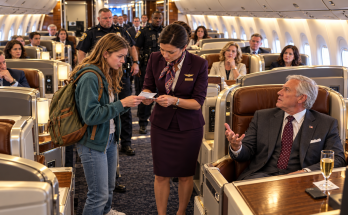
The young man held up his phone, and the stranger beside me went so pale that I thought he might collapse right there in the aisle. For four hours, that man had treated me as though I were invisible. He had taken my armrest. My legroom. My comfort. And nearly every ounce of patience I possessed.
Yet the moment a twenty-something passenger raised a phone, all that arrogance disappeared. “What did you record?” the man demanded. His voice was no longer loud. It was sharp. Nervous. Almost pleading. The young man didn’t move. “Enough.” The flight attendant stepped between them.
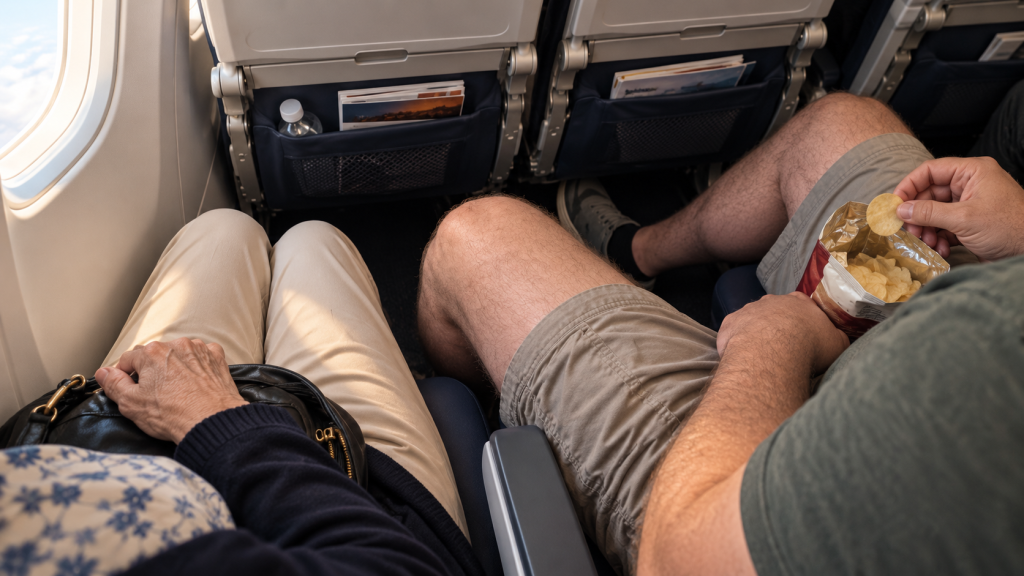
“Gentlemen, I need everyone to remain calm.” The man who had occupied the seat beside me pointed at the younger passenger. “He’s lying.” The young man raised an eyebrow. “About what?” “You know exactly what.” “No,” the young man answered. “I know exactly what you said to me.
The cabin had grown strangely quiet.
Passengers who had spent the last several hours watching movies or sleeping were now turning their heads.
A woman across the aisle slowly removed her headphones.
An older gentleman lowered his newspaper.
Somewhere behind us, a baby began fussing.
And I sat by the window with my aching hip, wondering how an ordinary flight to meet my granddaughter had turned into something I would never forget.
The flight attendant glanced at the younger passenger.
“Sir, please tell me what happened.”
He swallowed.
“My name is Nathan.”
He pointed toward the man beside me.
“When I boarded, he was standing near row twenty-eight. He told me there had been a seating mix-up.”
The older man’s jaw tightened.
Nathan continued.
“He said his company had purchased seat 18B, but the airline hadn’t updated his boarding pass.”
“That is what happened,” the man snapped.
Nathan shook his head.
“No. You told me the cabin crew already knew.”
The attendant frowned.
“Sir, no authorized seat change is reflected in our records.”
The man opened his mouth.
Then closed it.
Nathan looked down at his phone.
“And when I asked whether I should check with a flight attendant, he said I didn’t need to bother anyone.”
He paused.
“Then he offered me fifty dollars to take his seat in row twenty-eight.”
A ripple of murmurs moved through the cabin.
The man threw up his hands.
“So what? People trade seats all the time.”
Nathan looked at him.
“Then why did you tell me you were an airline executive?”
The silence that followed was extraordinary.
Even the baby stopped crying for a moment.
I turned toward the stranger.
He stared at Nathan.
Then at the flight attendant.
Then at me.
And for the first time, I saw something other than contempt in his eyes.
Fear.
“An airline executive?” the attendant repeated.
Nathan nodded.
“He said he could make sure I got upgraded on my next trip if I cooperated.”
The man laughed.
But it was a brittle, unpleasant sound.
“This is ridiculous.”
He pointed at Nathan.
“Some kid gets confused, and suddenly I’m being interrogated?”
Nathan’s expression hardened.
“I’m twenty-six.”
“Congratulations.”
“And I wasn’t confused.”
The attendant held out her hand.
“May I see your boarding pass again, sir?”
The man hesitated.
Then pulled his phone from his pocket.
He held up the screen.
28B.
There it was.
Simple.
Undeniable.
The attendant nodded.
“Thank you. Please return to your assigned seat.”
He looked around.
“Are you serious?”
“Yes, sir.”
“We’re halfway through the flight!”
“That doesn’t change your seat assignment.”
He glanced at me.
Then gave a humorless laugh.
“Fine. You know what? Fine.”
He reached for his jacket.
The jacket that had spent most of the flight draped across the divider between us.
But before he could leave, Nathan spoke again.
“There’s something else.”
The man froze.
I felt my stomach tighten.
The flight attendant turned.
“What is it?”
Nathan looked uncomfortable now.
Almost as though he regretted speaking.
Then he said quietly, “He took a picture of her.”
I stared at him.
“Of whom?”
Nathan looked at me.
“You.”
For a moment, I thought I had misheard.
“Me?”
He nodded.
My mouth went dry.
The man shook his head immediately.
“I did no such thing.”
Nathan raised his phone.
“I saw you.”
The man stepped toward him.
“Put that away.”
The attendant moved between them.
“Sir, return to your seat.”
But Nathan wasn’t finished.
“He held his phone toward her while she was trying to move away from him.”
I felt cold.
I remembered the stranger laughing.
Remembered him shifting his knee farther into my space.
Remembered seeing his phone resting against his stomach.
I had thought he was checking messages.
Nathan continued.
“And I heard him talking to someone through his earbuds.”
The man went perfectly still.
“What did he say?” the attendant asked.
Nathan looked at me with an expression I couldn’t quite understand.
Pity.
Anger.
Embarrassment.
“He said…”
Nathan swallowed.
“He said, ‘I’ve got this little old lady pinned against the window, and she’s too polite to do anything about it.’”
My heart seemed to stop.
I stared at the man.
The cabin was silent.
Then Nathan added the words that hurt far more than I expected.
“He was laughing.”
For sixty-one years, I had tried to be the kind of woman who made life easier for everyone around her.
I held doors.
I remembered birthdays.
I sent thank-you cards.
I stayed late when coworkers needed help.
I gave people the benefit of the doubt.
And when someone was rude, I usually told myself they were having a difficult day.
My late husband, Peter, used to say I could find an excuse for a hurricane.
“If the wind blew your roof off,” he’d tease, “you’d probably apologize for building your house in its way.”
I always laughed.
But sitting on that airplane, hearing a stranger describe how he had deliberately humiliated me, I suddenly understood the darker side of my lifelong politeness.
Some people saw courtesy as kindness.
Others saw it as an invitation.
I looked at the man.
“You were laughing at me?”
He rolled his eyes.
“Oh, come on.”
I waited.
He sighed.
“It was a joke.”
A joke.
Four hours of aching joints.
Four hours of twisting my body toward the window.
Four hours of asking for the space I had paid for.
A joke.
I felt something inside me settle.
Not break.
Settle.
Like a door finally closing against a storm.
I looked him directly in the eyes.
“What was funny?”
He blinked.
“What?”
“Explain the joke.”
His mouth opened.
Nothing came out.
I continued.
“Was it my age?”
He looked away.
“My size?”
Silence.
“Or the fact that you thought I was too polite to defend myself?”
A woman across the aisle whispered, “Exactly.”
The man glanced around.
His face reddened.
“This has gotten completely out of proportion.”
“No,” I said softly.
“I think it’s finally being seen in proportion.”
He stared at me.
Then, with a sharp movement, grabbed his jacket.
“Unbelievable.”
The flight attendant gestured toward the rear of the cabin.
“Your seat is this way, sir.”
He squeezed into the aisle.
As he passed Nathan, he leaned close.
I couldn’t hear what he whispered.
But Nathan’s face changed.
The attendant noticed.
“Sir?”
The man straightened immediately.
“Nothing.”
He walked toward row twenty-eight.
And for the first time in four hours, I could breathe.
The flight attendant turned toward me.
“Ma’am, are you all right?”
I opened my mouth.
Then closed it.
Such a simple question.
Yet I didn’t know how to answer.
My hip hurt.
My back ached.
My hands were trembling.
And beneath the relief was a strange sadness I couldn’t explain.
I had been sitting beside a man who considered me too insignificant to deserve the full seat I had purchased.
Worse, he had deliberately enjoyed watching me struggle.
“I think so,” I whispered.
The attendant crouched slightly so we were at eye level.
“My name is Melissa.”
I nodded.
“I’m Eleanor.”
“Eleanor, I’m sorry you experienced that.”
I looked down.
“You didn’t know.”
“Still, you should have been comfortable in your seat.”
My throat tightened.
I nodded.
Melissa glanced toward Nathan.
“Sir, would you be comfortable keeping your original seat here?”
Nathan smiled faintly.
“Absolutely.”
He looked at me.
“If that’s okay with you, ma’am.”
I almost laughed.
Permission.
Such a small, ordinary courtesy.
And after four hours beside a man who had refused to acknowledge my boundaries, hearing someone ask what I wanted felt unexpectedly moving.
“Yes,” I said.
“That’s fine.”
Nathan placed his backpack beneath the seat in front of him.
Then sat down.
He was tall.
Not as tall as the other man, but tall enough that his knees nearly touched the seat ahead.
He adjusted himself carefully.
Kept his legs within his space.
And left the shared armrest clear.
I noticed.
He noticed me noticing.
Then smiled.
“See? It can be done.”
I laughed.
The sound surprised me.
It felt as though I hadn’t laughed in days.
Melissa smiled too.
“Can I get you some water?”
“Yes, please.”
“And perhaps an ice pack for your hip?”
I blinked.
“How did you know?”
“You mentioned the pain when you asked me for help earlier.”
My eyes filled.
She had remembered.
“Thank you.”
Melissa touched my shoulder lightly.
“I’ll be right back.”
And suddenly I felt terribly close to crying.
Nathan waited until the flight attendant had moved away.
Then he turned toward me.
“I’m sorry.”
I looked at him.
“For what?”
“For not saying something sooner.”
I shook my head.
“You didn’t do anything wrong.”
He looked uncomfortable.
“I saw how he was sitting.”
I stared at him.
“You did?”
He nodded.
“From the beginning.”
I looked down.
“I thought nobody noticed.”
“People noticed.”
His voice softened.
“They just didn’t know what to do.”
I considered that.
Then asked, “Why did you record him?”
Nathan hesitated.
“At first, I wasn’t recording you.”
I frowned.
“What do you mean?”
He looked at the phone in his hand.
“I started recording when he approached me before takeoff.”
“Why?”
Nathan gave a small, embarrassed laugh.
“Because I’ve had problems with people pretending to have authority before.”
I waited.
He continued.
“My younger sister has a disability. A few years ago, someone tried to pressure her out of an accessible seat she’d been assigned at a concert.”
My heart tightened.
“What happened?”
“She moved.”
He looked toward the window.
“She thought she had to.”
I felt a familiar ache.
Nathan continued.
“By the time she realized the person had lied, the event was over.”
I nodded slowly.
“So when this guy started telling me he worked for the airline, something felt off.”
“And you recorded him?”
“I recorded part of what he said. Then I made a note of his boarding pass when he showed it to me.”
He looked toward the back of the aircraft.
“I should have checked with the crew right away.”
I shook my head.
“You’re not responsible for his behavior.”
Nathan smiled sadly.
“Neither are you.”
The words stayed with me.
Neither are you.
I turned toward the window.
Far below us, clouds stretched like white fields across the sky.
For the first time since boarding, I sat without shrinking.
Melissa returned with water and a cold pack wrapped in a towel.
She also brought a form so I could document the seating incident.
I filled it out carefully.
Time.
Flight number.
Seat assignment.
What had happened.
What the man had said.
The pain in my hip.
The repeated requests.
The jacket.
The armrest.
The deliberate encroachment.
I didn’t exaggerate.
I didn’t need to.
The truth was ugly enough.
Nathan offered to provide his account as a witness.
Melissa thanked him.
Then she glanced toward the rear of the cabin.
Her expression tightened.
I followed her gaze.
The man was standing again.
Speaking sharply to another flight attendant.
He gestured toward the front.
Toward us.
I couldn’t hear his words.
But I recognized the posture.
The aggressive tilt of his head.
The finger pointing.
The expression of a man accustomed to people giving way when he raised his voice.
Melissa’s jaw tightened.
“Please excuse me.”
She walked down the aisle.
Nathan watched her go.
“Something tells me he’s not finished.”
I sighed.
“Neither do I.”
Five minutes later, the overhead speaker chimed.
A flight attendant reminded passengers to remain in their assigned seats and keep the aisle clear.
The man returned to his seat.
But not before turning his head toward me.
Even from ten rows away, I could see the anger in his face.
I looked away.
I refused to give him another moment of my attention.
Then my phone vibrated.
A message from my daughter, Hannah.
Mom! How’s the flight? Baby Olivia and I are counting the minutes!
My heart softened immediately.
Olivia.
My first granddaughter.
Born eleven days earlier.
I had seen photographs.
Videos.
Tiny fingers.
A little pink mouth.
Wisps of dark hair.
But I had not held her yet.
I had spent the entire flight imagining the moment.
Hannah standing at the airport.
Olivia wrapped in a blanket.
My arms around both of them.
For four years after Peter died, I had struggled to find my place in the world.
My husband had been my best friend for thirty-six years.
We had raised our daughter together.
Built a home.
Shared thousands of ordinary mornings.
When he died, the silence left behind was so large that I sometimes turned on the television just to hear another voice.
Then Hannah announced she was pregnant.
I cried for an hour.
Not because a grandchild could replace anyone.
No one could replace Peter.
But because life had placed something new and beautiful in front of me.
A little person I had not yet met.
A reason to buy tiny socks.
A reason to knit blankets.
A reason to imagine Christmas mornings again.
I typed back.
Had a difficult seatmate, but things are better now. Can’t wait to meet my girls. Love you.
Hannah responded almost instantly.
Difficult how? Are you okay?
I smiled.
My daughter knew me.
I typed:
I’ll explain later. I’m safe. Save me a hug.
Then I put the phone away.
I wasn’t going to let one rude stranger steal the joy of meeting my granddaughter.
At least, that was what I believed.
Until Melissa returned.
And quietly asked whether I would be willing to speak with the captain after we landed.
“Has something else happened?” I asked.
Melissa hesitated.
“We’ve received additional information from another passenger.”
My stomach tightened.
“What kind?”
She glanced toward Nathan.
Then back at me.
“I don’t want to discuss details in the cabin while we’re still investigating the report.”
I nodded.
“Of course.”
She lowered her voice.
“But the captain has been informed of the seating dispute and the passenger’s conduct.”
I looked at her.
“Am I in trouble?”
Melissa’s face softened immediately.
“No, Eleanor.”
I felt foolish for asking.
But the words had escaped before I could stop them.
For most of my life, when someone became angry near me, my first instinct was to wonder what I had done wrong.
Melissa seemed to understand.
“You reported a problem. You have every right to do that.”
I swallowed.
“Thank you.”
She smiled.
“We’ll help you leave the aircraft comfortably when we arrive.”
I nodded.
Then she returned to her duties.
Nathan looked at me.
“You okay?”
I gave a tired smile.
“I’m trying to be.”
He nodded.
Then looked toward the back of the plane.
“I think that man is going to regret making this flight so memorable.”
I laughed softly.
But I had no idea how right he would be.
An hour before landing, the trouble started again.
I was reading a small paperback novel when someone touched my shoulder.
I looked up.
A woman in her late forties stood in the aisle.
She had short blonde hair and tired blue eyes.
Her expression was serious.
“Excuse me,” she whispered.
“Yes?”
“Are you Eleanor?”
I nodded.
She glanced toward the back of the cabin.
“Can I speak with you for a moment?”
Nathan looked up.
The woman noticed him.
“It’s about the man who was sitting here.”
My stomach tightened.
“What about him?”
She hesitated.
Then said, “I know him.”
Something in her voice made me close my book.
“Who is he?”
She looked toward row twenty-eight again.
Then back at me.
“His name is Richard Caldwell.”
I waited.
“He’s my former boss.”
Nathan sat straighter.
The woman lowered her voice.
“And I need you to understand something.”
Her hands trembled.
“He didn’t just behave badly because he thought he could get away with it.”
I stared at her.
“What do you mean?”
She swallowed.
“I think he recognized you.”
For a second, I couldn’t speak.
“Recognized me?”
The woman nodded.
I shook my head.
“I’ve never met him.”
“Are you sure?”
“Yes.”
She studied my face.
Then asked, “Was your husband’s name Peter?”
The world seemed to go silent.
My fingers tightened around the book.
“Yes.”
Her expression changed.
“Peter Lawson?”
I stared at her.
“How do you know that?”
The woman took a shaky breath.
“My name is Claire Bennett.”
She sat in the empty aisle seat across from us after its occupant invited her to use it briefly.
Then she said something that made the blood drain from my face.
“I used to work for the company your husband sued.”
Peter had never liked talking about the lawsuit.
It happened six years before his death.
He had worked as a mechanical engineer for a manufacturing company called Westbrook Industrial.
For twenty-two years, he had been proud of his job.
He was meticulous.
Careful.
The kind of man who checked a machine twice even when everyone else insisted it was fine.
Then one afternoon, a young technician was badly injured when a safety mechanism failed.
Peter helped investigate.
He discovered that managers had ignored repeated warnings about the equipment.
The company initially called it operator error.
Peter refused to accept that explanation.
He documented the maintenance problems.
Preserved reports.
Spoke to investigators.
And eventually testified during litigation.
The case was settled.
Safety procedures changed.
Several senior managers left.
But Peter’s career suffered.
He was passed over for promotion.
Colleagues stopped inviting him to lunch.
One supervisor told him he had embarrassed the company.
Peter never complained much at home.
He would simply sit at our kitchen table.
Drink his coffee.
And say, “I’d rather lose a job than pretend that boy deserved what happened to him.”
I had loved him fiercely for that.
But I hadn’t thought about the case in years.
Until now.
I looked at Claire.
“Richard worked at Westbrook?”
She nodded.
“He was a regional operations director.”
My heart tightened.
“Was he involved in the lawsuit?”
She hesitated.
“He was one of the managers whose decisions came under scrutiny.”
I stared at her.
Then toward the back of the aircraft.
Richard Caldwell.
The man who had laughed at my size.
Pressed his body into my seat.
Called me a little old lady.
Was he really a stranger?
Or had I spent four hours sitting beside a man who knew exactly who I was?
My mouth went dry.
“Why would he recognize me?”
Claire looked down.
“There were photographs of you and Peter in some of the local news coverage.”
I remembered.
Peter and I standing outside the courthouse.
His hand around mine.
A reporter taking photographs.
He had hated the attention.
I had worn a blue coat.
The same coat I still kept in my closet because Peter loved it.
Claire continued.
“And Richard attended a hearing where your husband testified.”
I shook my head.
“But that was years ago.”
“Yes.”
“How could he remember me?”
Her eyes filled.
“Because Richard talked about your husband for years afterward.”
A chill moved through me.
“What did he say?”
Claire looked deeply uncomfortable.
Then whispered, “He blamed Peter for losing his position.”
I felt as though the air had been pulled from the cabin.
Nathan looked from Claire to me.
“Are you saying he recognized her and deliberately harassed her?”
Claire swallowed.
“I can’t know exactly what he intended.”
Then she looked at me.
“But I heard him on the phone before we boarded.”
My heart began pounding.
“What did he say?”
Claire’s eyes filled.
“He mentioned Peter Lawson.”
I gripped the edge of my seat.
“Why?”
“He said he thought he’d just seen Peter’s wife at the gate.”
I stared at her.
“And then?”
Claire looked down.
“He laughed.”
My stomach twisted.
“He said something like, ‘Wouldn’t it be something if she ended up sitting next to me?’”
For a moment, I couldn’t speak.
The sound of the engines seemed impossibly loud.
I remembered the boarding area.
I had been sitting near the window, looking at pictures of Olivia.
A tall man walked past me.
I barely noticed him.
Had that been Richard?
Had he seen me?
Recognized me?
Then deliberately arranged to sit beside me?
The seat switch suddenly made a terrible kind of sense.
I looked at Nathan.
“He was supposed to be in your seat.”
Nathan nodded.
“Ten rows back.”
I turned toward Claire.
“Did he say anything else?”
She took a breath.
“He made a comment about Peter thinking he was better than everyone.”
My chest tightened.
Claire continued.
“And he said you looked exactly as he remembered.”
I looked down at my hands.
For four hours, I had believed I was dealing with a selfish stranger.
Now there was reason to suspect it had been personal.
A small, ugly act of retaliation against the wife of a man who had refused to hide a workplace safety problem.
My eyes burned.
Peter.
Even after death, his courage had followed us.
Claire leaned closer.
“Eleanor, I want to be careful.”
I nodded shakily.
“I know.”
“I can’t tell you what Richard was thinking.”
She swallowed.
“But I do know his resentment toward Peter lasted a very long time.”
I looked at her.
“Why are you telling me this?”
Her expression softened.
“Because I heard what happened earlier.”
I stared at her.
She continued.
“I watched him walk to the back of the plane. I saw how angry he was when the crew told him to return to his assigned seat.”
Her voice trembled.
“And I realized I couldn’t stay quiet again.”
“Again?”
Claire looked down.
For several seconds, she said nothing.
Then she whispered, “I was at Westbrook when your husband reported the safety problems.”
I waited.
“I knew he was telling the truth.”
My heart tightened.
“But I didn’t support him publicly.”
Her eyes filled.
“I had two children. A mortgage. I was afraid I’d lose my job.”
I stared at her.
She began crying.
“Peter stood alone in meetings where he should have had people beside him.”
My vision blurred.
Claire wiped her cheeks.
“He never blamed me.”
She swallowed.
“Once, after a terrible meeting, he even asked whether my youngest daughter was feeling better. She’d been sick.”
A tear slipped down my face.
That was Peter.
Always Peter.
Even when people disappointed him, he remembered their children.
Claire looked at me.
“I’ve carried that guilt for years.”
I reached toward her.
She took my hand.
“You didn’t hurt that technician,” I whispered.
“No.”
“But you wish you’d spoken up.”
She nodded.
“Yes.”
I squeezed her hand.
“Then perhaps this is your chance to do it differently.”
Claire began crying harder.
And I realized something.
The man at the back of the plane had spent years nursing resentment.
But Peter’s kindness had survived in someone else’s memory.
And I would not let Richard turn that into another reason to feel ashamed.
When Melissa returned, Claire asked to speak with her privately.
I watched them step toward the galley.
Claire spoke quietly.
Melissa listened.
Then asked a few questions.
Claire nodded.
After several minutes, Melissa returned.
Her expression was serious.
“Eleanor, I understand you’ve received some additional information.”
“Yes.”
“Would you like us to document that as part of your report?”
I nodded.
“Please.”
Melissa glanced toward the back.
“We’ll record the witness accounts and pass the relevant information to our ground team.”
Nathan leaned forward.
“What about the video?”
Melissa looked at him.
“Please preserve the original recording. Someone may ask you to provide it through the appropriate process.”
Nathan nodded.
“I will.”
I looked toward the rear of the plane.
Richard was sitting with his arms folded.
Staring straight ahead.
For a moment, our eyes met.
He looked away first.
And something inside me changed.
I wasn’t frightened of him anymore.
I was disgusted by what he might have done.
But I was no longer willing to make myself smaller to avoid his anger.
The descent began forty minutes later.
The captain announced that we would be landing soon.
Passengers raised their tray tables.
Seat belts clicked.
Windows filled with evening sunlight.
I should have been thinking about Olivia.
About Hannah.
About the little pink blanket I’d knitted for my granddaughter.
Instead, my mind kept returning to Peter.
To his work.
To the lawsuit.
To the way he had taught Hannah to stand up for herself.
I remembered one afternoon when she was thirteen.
A girl at school had been bullying a younger student.
Hannah witnessed it.
She wanted to help but was frightened.
Peter listened quietly.
Then said, “You don’t have to fight every battle, sweetheart.”
Hannah looked relieved.
“But when someone is being hurt, you should find a safe way to help.”
She frowned.
“What if everyone gets mad at me?”
Peter smiled gently.
“Then make sure the people you’re trying to impress are worth impressing.”
I had laughed at the time.
Now I wished more than anything that he were sitting beside me.
I imagined telling him about Richard.
He would probably shake his head.
Make a dry joke.
Then ask whether my hip was all right.
He would never have wanted me to confront a hostile stranger alone.
But he would have wanted me to stand up for myself.
I touched the wedding ring hanging on the chain around my neck.
“I’m trying, Peter,” I whispered.
Nathan glanced toward me.
“Did you say something?”
I smiled faintly.
“Just talking to my husband.”
He looked toward the ring.
Then nodded gently.
“Sounds like he was a good man.”
My eyes filled.
“He was.”
The plane landed just after six.
Passengers applauded lightly as the wheels touched the runway.
I let out a breath I felt I’d been holding since takeoff.
Almost there.
Soon I would see Hannah.
Soon I would hold Olivia.
Soon the whole miserable flight would be behind me.
But as we taxied toward the gate, Melissa approached our row.
“Eleanor?”
I looked up.
“Yes?”
“Would you mind remaining seated briefly after the other passengers begin to leave?”
My stomach tightened.
“Is something wrong?”
She shook her head.
“We want to help you avoid any further confrontation.”
I nodded.
“Of course.”
Nathan looked at her.
“Should I stay too?”
“If you’re willing, that would be helpful.”
“Absolutely.”
Melissa smiled gratefully.
Then moved toward the front.
Behind us, I heard Richard complaining.
“I have a connection.”
Another flight attendant answered calmly.
“Sir, please remain seated until we reach the gate and receive instructions.”
He muttered something.
I couldn’t make it out.
Then I heard the words that made several passengers turn around.
“This is discrimination.”
I closed my eyes.
Nathan let out a quiet breath.
“You’ve got to be kidding me.”
I almost laughed.
The man who had spent hours mocking my size and age was now describing a request to follow airline procedures as discrimination.
The irony was almost too much.
When the aircraft door finally opened, most passengers began collecting their bags.
I remained seated.
Nathan stayed beside me.
Claire waited across the aisle.
Several people smiled sympathetically as they passed.
One elderly woman stopped.
She touched my shoulder.
“I saw what happened,” she whispered.
My throat tightened.
“Thank you.”
She smiled.
“You handled yourself beautifully.”
I almost corrected her.
I hadn’t felt beautiful.
I had felt cramped.
Angry.
Embarrassed.
Exhausted.
But perhaps courage didn’t always feel graceful from the inside.
Perhaps sometimes it felt like a small woman with a painful hip refusing to give up the seat she’d paid for.
The woman moved on.
Then a teenage boy passed our row.
He looked at Nathan.
“Dude, that was wild.”
Nathan smiled awkwardly.
“Yeah.”
The boy turned toward me.
“Ma’am, that guy was awful.”
I laughed softly.
“He certainly wasn’t my favorite travel companion.”
The boy grinned.
Then kept walking.
And for the first time, I felt the warmth of strangers rather than their indifference.
Richard was among the last passengers to approach the front.
He had his bag slung over one shoulder.
His face was flushed.
Two flight attendants stood near the aircraft door.
He stopped when he saw Melissa.
“Can I go now?”
She spoke calmly.
“Sir, a representative has asked to speak with you at the gate.”
His expression hardened.
“About what?”
“The incident during the flight.”
He laughed sharply.
“An incident? Over a seat?”
Melissa remained composed.
“Please proceed as directed.”
Richard looked toward me.
I was standing in the aisle now, waiting with Nathan.
Our eyes met.
And he smiled.
Not warmly.
Not politely.
The same ugly smirk he’d worn when he told me I was too tiny to need my seat.
Then he said, loud enough for everyone nearby to hear, “I hope you’re happy, lady.”
My heart pounded.
I took a breath.
And answered quietly.
“I’m going to meet my granddaughter.”
His smile faltered.
I continued.
“So yes. I intend to be very happy.”
For one beautiful second, Richard seemed unable to think of a response.
Then Nathan laughed.
Claire smiled.
And Melissa gestured toward the open door.
“This way, sir.”
Richard walked off the aircraft.
Without another word.
I thought that would be the end of it.
A report.
An unpleasant memory.
Perhaps an apology from the airline.
I had no desire to spend my first days as a grandmother chasing revenge against a rude man.
I wanted nothing more than to hold Olivia.
But as Nathan helped me retrieve my carry-on bag, Claire approached again.
“Eleanor?”
I turned.
She looked worried.
“There’s something I didn’t tell the flight attendant.”
My stomach tightened.
“What?”
She glanced toward the exit.
Then spoke quietly.
“Richard’s been making threats.”
I stared at her.
“Against whom?”
She swallowed.
“Against people he believes ruined his career.”
I felt cold.
“Peter?”
She shook her head.
“Peter is gone.”
Her voice trembled.
“But Richard still talks about his family.”
For a moment, I couldn’t move.
I thought of Hannah.
Her husband, Michael.
Baby Olivia.
My little granddaughter waiting beyond the airport doors.
I gripped the handle of my suitcase.
“What kind of threats?”
Claire looked frightened.
“Mostly angry comments. Things like making people pay for what they did.”
My heart began racing.
“Did he ever mention Hannah?”
She hesitated.
“I don’t remember hearing her name.”
I exhaled shakily.
Claire touched my arm.
“I don’t want to scare you unnecessarily. But I thought you should know.”
I nodded.
“Thank you.”
Then I did something I had never done in my younger years.
I decided not to minimize it.
I told Melissa what Claire had said.
And asked how to add that information to the incident report.
At the gate, an airline supervisor met us.
His name was Mr. Harrison.
He was professional and calm.
He apologized for the experience and explained how the airline would review the reports and available evidence.
A security officer was also present.
Richard stood several yards away with his luggage.
He looked furious.
But he wasn’t shouting now.
He was speaking to another representative.
His gestures were sharp.
His mouth moved rapidly.
At one point, he pointed toward me.
Mr. Harrison noticed.
“Eleanor, please stay here.”
I nodded.
Nathan remained beside me.
Claire stood on my other side.
For a moment, I felt oddly protected.
Not because these people were physically imposing.
But because they were willing to acknowledge what had happened.
Mr. Harrison asked me several questions.
I answered carefully.
Then Nathan provided his account of the unauthorized seat switch and the recording he had made before departure.
Claire explained the prior connection to Peter’s workplace and what she recalled hearing at the gate.
The supervisor listened.
He did not make promises about outcomes before reviewing the evidence.
He simply said, “We’ll take this seriously.”
Those words mattered.
Because sometimes the first wound is what someone does to you.
And the second is what happens when everyone else pretends it didn’t matter.
Richard suddenly raised his voice.
“I want to speak to whoever is in charge!”
The security officer turned toward him.
“Sir, please lower your voice.”
“This is unbelievable!”
Mr. Harrison excused himself.
We watched him approach Richard.
They spoke for several minutes.
Richard gestured angrily.
Then he looked toward us.
And something in his expression changed.
Recognition.
Not of me.
Of Claire.
He stared at her.
Then took one step forward.
“Claire?”
She stiffened.
I felt her hand tighten around her purse strap.
Richard’s face darkened.
“You.”
The security officer moved slightly closer.
Claire lifted her chin.
“Hello, Richard.”
He looked from her to me.
Then back.
“You’ve got to be kidding.”
Claire remained silent.
Richard gave a harsh laugh.
“Of course.”
He pointed toward me.
“This is about Peter.”
My heart stopped.
There it was.
My husband’s name.
Spoken aloud by the man who had spent four hours tormenting me.
I stepped forward.
“Then you did recognize me.”
Richard froze.
For one brief second, he looked almost surprised that he’d said too much.
Then he shrugged.
“Everybody remembers a troublemaker.”
My chest tightened.
Claire’s face went pale.
Nathan stared at him.
And the security officer said firmly, “Sir, that’s enough.”
But Richard’s anger had taken hold.
“Your husband cost good people their careers,” he snapped at me.
I stood perfectly still.
“My husband told the truth.”
Richard laughed bitterly.
“Oh, that’s what he told you?”
I looked into his eyes.
“He told me a young man had been injured because safety warnings were ignored.”
Richard’s jaw tightened.
I continued.
“He told me he couldn’t live with himself if he stayed quiet.”
Richard’s face reddened.
“Peter thought he was a hero.”
My eyes filled.
“No.”
My voice remained steady.
“He thought people deserved to go home safely after work.”
A long silence followed.
Claire began crying quietly.
Richard looked away.
I took a breath.
“And if you sat beside me today because you wanted to punish him through me, you should know something.”
He turned back.
I felt Peter’s ring against my chest.
“You didn’t make me ashamed of him.”
My voice broke.
“You reminded me why I was proud.”
Richard stared at me.
For once, he said nothing.
Mr. Harrison and the security officer concluded the discussion away from us.
I did not know what consequences Richard might face.
Nor did I need to.
I had reported what happened.
Other passengers had provided their observations.
The airline would review the matter under its procedures.
And any further threats would be documented.
That was enough for the moment.
I was exhausted.
My hip hurt.
My eyes burned.
But I had one more thing to do.
I turned to Nathan.
“Thank you.”
He smiled.
“You’re welcome.”
“No.”
I took his hand.
“I mean it.”
His expression softened.
“You didn’t owe me anything,” I said. “But you spoke up.”
He looked embarrassed.
“I just told them what happened.”
I smiled through tears.
“Sometimes that’s everything.”
Claire stepped closer.
“Eleanor?”
I turned.
She was crying.
“I wish I had said something for Peter.”
My heart tightened.
I took her hands.
“Peter would have appreciated your honesty today.”
She shook her head.
“I don’t know if he could’ve forgiven me.”
I thought about my husband.
His gentleness.
His stubborn integrity.
The way he remembered birthdays and brought groceries to elderly neighbors.
I smiled sadly.
“He wasn’t a man who enjoyed holding grudges.”
Claire began crying harder.
I squeezed her hands.
“And whatever happened years ago, you made a different choice today.”
She nodded.
Then whispered, “Thank you.”
We hugged.
Two women connected by an old injustice.
And by one new moment of courage.
I walked into the arrivals hall twenty minutes later.
And everything changed.
The noise.
The lights.
The crowds.
The rolling suitcases.
All of it faded when I saw my daughter.
Hannah stood near the barrier.
Her blonde hair was pulled into a messy bun.
Her face looked tired.
Beautifully tired.
The way new mothers sometimes look when their hearts are full and their sleep has disappeared.
Beside her stood Michael.
And in his arms was a tiny bundle wrapped in a pink blanket.
My granddaughter.
Olivia.
I stopped walking.
My eyes filled instantly.
Hannah saw me.
“Mom!”
She hurried toward me.
I dropped the handle of my suitcase.
She wrapped her arms around me.
And I held her.
My daughter.
The little girl I once carried through grocery stores.
The teenager who rolled her eyes when I sang in the car.
The young woman who cried on my shoulder after her first heartbreak.
Now a mother herself.
“Mom,” she whispered, “I’ve missed you.”
I began crying.
“Oh, sweetheart.”
She pulled back.
Then studied my face.
“Are you okay?”
I nodded.
“Yes.”
She frowned.
“You look upset.”
I laughed through tears.
“It’s been quite a flight.”
“What happened?”
I glanced toward the baby.
“Later.”
Then I whispered, “Please.”
Hannah smiled.
“Of course.”
She stepped aside.
And Michael came forward.
“Ready to meet someone?”
My breath caught.
He gently placed Olivia in my arms.
She was so small.
So warm.
Her little fingers curled against the blanket.
Her eyes were closed.
A tiny wrinkle appeared between her eyebrows.
I stared down at her.
And the entire world seemed to stop.
“Oh,” I whispered.
A tear landed on the edge of the blanket.
“Oh, my darling girl.”
Hannah began crying too.
I touched Olivia’s cheek.
“So you’re the one everybody’s been talking about.”
Michael laughed softly.
Olivia moved her mouth.
I smiled through tears.
“Hello, sweetheart.”
My voice trembled.
“I’m Grandma.”
And for the first time since Peter died, I felt the strange, wonderful sensation of a new chapter opening in front of me.
Not replacing the old one.
Not erasing grief.
Just adding something beautiful.
That night, after dinner, Hannah sat beside me on the couch.
Olivia slept in her bassinet.
Michael was washing dishes.
The house smelled of warm bread and baby lotion.
Hannah tucked her feet beneath her.
“Okay, Mom.”
I looked at her.
“Okay what?”
She raised an eyebrow.
“What happened on the plane?”
I sighed.
“It’s a long story.”
She smiled.
“I have a newborn. My schedule belongs to chaos now. I can handle a long story.”
I laughed.
Then I told her.
Everything.
The man.
The seat.
The armrest.
The aching hip.
The mocking comments.
The blanket.
The handwritten note.
The unauthorized seat switch.
Nathan.
Claire.
And finally, Richard Caldwell.
The moment I said his name, Hannah went still.
“Wait.”
I looked at her.
“What?”
“Richard Caldwell?”
I nodded.
She sat straighter.
“From Westbrook?”
“Yes.”
Hannah stared at me.
Then covered her mouth.
“Oh my God.”
I frowned.
“What?”
She shook her head.
“Mom, I remember him.”
My heart tightened.
“You do?”
She nodded.
“I was in college when Dad’s lawsuit was happening.”
“I know.”
“He came to the courthouse one day.”
I stared at her.
Hannah’s expression darkened.
“He was standing outside talking to a reporter.”
My stomach tightened.
“And?”
“He said Dad was ruining the company because he wanted attention.”
I closed my eyes.
I remembered that day.
Peter had come home exhausted.
He sat at the kitchen table and stared at his hands.
When I asked what happened, he shook his head.
“Nothing worth repeating.”
He never told me Richard had spoken publicly against him.
Hannah continued.
“I was so angry.”
She looked down.
“I wanted to confront him.”
“What stopped you?”
“Dad.”
My heart tightened.
Hannah smiled sadly.
“He said something I’ve never forgotten.”
I looked at her.
“What?”
She took a breath.
“He said, ‘Don’t spend your life trying to convince people who benefit from misunderstanding you.’”
Tears filled my eyes.
Peter.
Always Peter.
I covered my mouth.
Hannah reached for my hand.
“Mom?”
“Yes?”
“You know Dad would be proud of you, right?”
I began crying.
She moved closer.
“He would.”
I shook my head.
“I was scared.”
“So?”
“I didn’t handle it perfectly.”
Hannah laughed softly.
“Dad never said courage had to be perfect.”
I smiled through tears.
She squeezed my hand.
“You stood up for yourself.”
I looked toward Olivia’s bassinet.
“And that’s something I want her to learn from you.”
My heart broke open.
In the gentlest possible way.
The next morning, I woke before everyone else.
Old habits.
For thirty-six years, Peter and I had been early risers.
He made coffee.
I toasted bread.
We sat together before the world became noisy.
Now, in Hannah’s guest room, I reached automatically toward the empty side of the bed.
Then remembered.
For a moment, grief settled over me.
But it wasn’t as sharp as it used to be.
I stood.
Put on my slippers.
And walked quietly into the kitchen.
A photograph of Peter stood on a shelf beside the window.
He was smiling.
Holding Hannah at her high school graduation.
I picked it up.
“Peter,” I whispered.
I smiled through tears.
“You wouldn’t believe what happened yesterday.”
I told him.
Not aloud exactly.
Just in the quiet way widows sometimes continue conversations with the people they’ve loved.
I told him about Richard.
About the seat.
About Nathan.
About Claire.
About our granddaughter.
Then I looked toward the living room where Olivia slept.
“Oh, Peter,” I whispered.
“She’s beautiful.”
My eyes filled.
“She has Hannah’s nose.”
I laughed softly.
“And I think she might have your stubborn little chin.”
A tear slid down my cheek.
“I wish you were here.”
The kitchen remained quiet.
Outside, morning sunlight touched the windows.
I held the photograph against my chest.
Then placed it back on the shelf.
And went to make coffee.
Two days later, an email arrived from the airline.
I read it while Olivia slept in my arms.
The message acknowledged my complaint and confirmed that the incident was under review.
It asked whether I would consent to being contacted for clarification.
It also explained how to submit documentation of any medical expenses related to my discomfort, should that become necessary.
I appreciated the response.
But I wasn’t particularly interested in compensation.
I wanted the airline to understand that smaller passengers were not automatically comfortable simply because they occupied less physical space.
I wanted staff to know how easily bullying could hide behind a complaint about legroom.
And I wanted Richard’s behavior documented accurately.
I replied politely.
Then set the phone aside.
Olivia stirred.
Her tiny hand opened.
One finger curled around mine.
I smiled.
“That’s right, little girl.”
I kissed her forehead.
“You hold on to whatever matters.”
The following afternoon, Nathan sent me a message.
We had exchanged numbers at the airport so he could provide his account if needed.
Hi, Eleanor. Just wanted to make sure you arrived safely and met your granddaughter.
I smiled.
Then sent him a photograph of Olivia’s tiny hand holding mine.
I did. She’s wonderful. Thank you again for helping.
He replied almost immediately.
Worth every minute of that flight drama. Congratulations, Grandma.
I laughed.
Then another message arrived.
Also, my sister says you’re her new hero.
My eyes filled.
I typed back.
Tell her she doesn’t need to be loud to deserve respect.
Nathan responded with a heart.
I placed the phone down.
And smiled.
A week passed.
I spent my days helping Hannah.
Holding Olivia.
Making soup.
Folding tiny clothes.
Watching my daughter discover the overwhelming tenderness of motherhood.
Sometimes I took Olivia while Hannah slept.
Sometimes Michael and I cooked dinner.
Sometimes all three of us sat in the living room, simply staring at the baby as though she were the most extraordinary thing ever created.
And perhaps to us, she was.
During those days, the flight began to feel distant.
A ridiculous, unpleasant story.
Something I might eventually tell at dinner parties.
Then, on Tuesday morning, Claire called.
I answered immediately.
“Hello?”
“Eleanor?”
Her voice sounded worried.
“Claire?”
“Yes. I’m sorry to bother you.”
“You’re not bothering me.”
She took a breath.
“I wanted to tell you something before you heard it somewhere else.”
My stomach tightened.
“What happened?”
There was a pause.
Then she said, “Richard’s former employer has contacted me.”
I frowned.
“Westbrook?”
“No. His current consulting firm.”
I stared at the window.
“Why?”
Claire sounded uncomfortable.
“They’re reviewing a complaint involving his behavior toward a client.”
I sat straighter.
“What does that have to do with the flight?”
“Apparently, there have been several reports about him misrepresenting his authority.”
My heart tightened.
She continued.
“And they received information about the incident on the airplane.”
I closed my eyes.
“From whom?”
“I don’t know.”
Claire swallowed.
“But someone contacted me because I used to work with him.”
I considered that.
Then asked, “Is he blaming me?”
There was a long pause.
“Eleanor…”
I gripped the phone.
“Please tell me.”
Claire sighed.
“He’s been telling people you deliberately humiliated him.”
I looked down.
Of course.
The story had already changed.
The man who spent four hours forcing me against the window was now the victim of a woman who placed a folded blanket on his seat.
I felt a weary sadness.
Not fear.
Not even anger.
Just exhaustion.
“Has he mentioned Peter?”
Claire hesitated.
“Yes.”
My chest tightened.
“What has he said?”
She took a breath.
“That your husband ruined his career, and now you’re trying to do the same.”
I closed my eyes.
For several seconds, I said nothing.
Then I whispered, “I didn’t contact his employer.”
“I know.”
“I didn’t ask anyone to punish him.”
“I know.”
“I only wanted my seat.”
Claire’s voice broke.
“I know, Eleanor.”
I looked toward Olivia sleeping in her bassinet.
And something inside me hardened.
“I won’t apologize for that.”
Claire exhaled.
“Good.”
I forwarded the information to the airline contact handling my complaint.
Then I did something else.
I wrote down everything I remembered.
Not merely the facts of the flight.
The things Richard said about Peter.
Claire’s account of his resentment.
The confrontation at the airport.
The way he reacted when she appeared.
I kept my account factual.
Careful.
Chronological.
Then I placed it in a folder on my laptop.
Peter had always believed good records mattered.
I smiled sadly.
“You taught me well,” I whispered.
Three days later, Nathan called.
“Eleanor, I have a question.”
I smiled.
“Hello to you too.”
He laughed.
“Sorry.”
“What’s happening?”
He hesitated.
“Someone posted a video from the plane.”
My stomach tightened.
“What?”
“It’s short. Mostly the part where that guy was yelling.”
I sat down.
“Who posted it?”
“I don’t know.”
“Is it your recording?”
“No. Mine was taken before takeoff. This looks like somebody filmed the confrontation from farther back.”
I closed my eyes.
The last thing I wanted was attention.
Especially attention I couldn’t control.
Nathan continued.
“People are sharing it.”
My heart raced.
“Is my face visible?”
“A little.”
I covered my mouth.
“Oh, no.”
“Eleanor, listen.”
He spoke gently.
“The comments I’ve seen are mostly supporting you.”
I shook my head.
“That doesn’t make it comfortable.”
“I know.”
He paused.
“I just didn’t want you surprised.”
I took a breath.
“Thank you.”
After we hung up, I sat quietly.
Then told Hannah.
She listened.
Looked at the clip I showed her.
And immediately understood why I was upset.
“Mom, we don’t have to engage with this.”
I nodded.
“I don’t want strangers discussing me.”
“Then we won’t help spread it.”
She sat beside me.
“And if somebody asks you about it, you can decide whether you want to answer.”
I looked at her.
“Really?”
She smiled.
“Really.”
I laughed softly.
“I suppose that’s obvious.”
Hannah squeezed my hand.
“Maybe. But people sometimes forget that being mistreated publicly doesn’t mean you owe the public your whole life.”
My eyes filled.
My daughter.
So wise.
So much stronger at thirty-two than I had been at sixty-one.
Perhaps Peter and I had done something right.
The video circulated for several days.
I avoided reading comments.
I refused requests from strangers asking for my side of the story.
I didn’t want to become a symbol.
I didn’t want people arguing about me.
I wanted to enjoy my granddaughter.
But one evening, Hannah sat beside me with her laptop.
“Mom, there’s something I think you’d want to know.”
I looked up.
“What?”
She turned the screen toward me.
It was an email.
From a young woman named Rachel.
She explained that she had recognized Richard in the video.
He had been a senior consultant at a company where she previously worked.
She described a pattern of belittling junior employees, particularly women.
Then came a sentence that made my throat tighten.
When I complained, I was told he was important and I should learn to be less sensitive.
I stared at the words.
Less sensitive.
Too emotional.
Overreacting.
Making everything a problem.
How many ways could people invent to tell someone their discomfort did not matter?
The woman continued.
Seeing another person refuse to accept his behavior made me realize I wasn’t imagining what happened to me.
I began crying.
Hannah touched my shoulder.
“You okay?”
I nodded.
“Yes.”
The email ended:
Thank you for showing that we don’t have to become cruel in order to defend ourselves.
I sat quietly.
Then whispered, “I only moved a blanket.”
Hannah smiled through tears.
“Sometimes that’s where standing up for yourself begins.”
The airline completed its review several weeks later.
A representative called me personally.
She apologized for the discomfort and disruption.
She confirmed that the witness statements, crew reports, and available documentation had been considered.
She explained that the airline had addressed the passenger’s conduct under its internal procedures, though she could not disclose every detail.
I understood.
She also asked whether there was anything the crew could have done differently.
I thought carefully.
“Yes.”
She waited.
“When someone asks twice for the space they’ve paid for, I think it’s worth checking on them.”
The representative was quiet.
I continued.
“I know flight attendants are busy. And I know tall people can struggle in economy seats.”
“Yes.”
“But being physically larger doesn’t mean another passenger’s space stops belonging to them.”
She agreed.
I took a breath.
“And when someone repeatedly dismisses a request, please don’t assume the quieter passenger is comfortable.”
There was a pause.
Then she said, “Thank you for explaining that.”
My eyes filled unexpectedly.
“Thank you for listening.”
When the call ended, I sat back.
I didn’t feel triumphant.
I felt finished.
The airline had heard me.
My complaint had been documented.
I had said what I needed to say.
And now, at last, I wanted to move on.
But life has a strange way of returning the past when you least expect it.
Three months after the flight, I attended a community fundraiser with Hannah.
It was held at a small hotel ballroom.
The event supported workplace safety education and scholarships for students entering technical fields.
Peter would have loved it.
He believed deeply in training young people to recognize hazards before someone got hurt.
Hannah had been invited through her work.
She asked whether I wanted to accompany her.
At first, I hesitated.
Crowded rooms had never been my favorite.
But then she smiled.
“Mom, it’s for a cause Dad cared about.”
That settled it.
I wore my navy dress.
The silver earrings Peter had given me for our twenty-fifth anniversary.
And the wedding ring on its chain.
We arrived just after six.
The ballroom was filled with people.
Engineers.
Educators.
Safety specialists.
Families.
A small display near the entrance honored workers injured in industrial accidents.
I stopped beside it.
Read the names.
Then found a photograph of a young technician.
He was smiling.
Barely twenty-three.
The caption explained that his injuries had led to important safety reforms.
My eyes filled.
I remembered Peter sitting at our kitchen table.
Tired.
Angry.
Determined.
I’d rather lose a job than pretend that boy deserved what happened to him.
Hannah stood beside me.
“Mom?”
I nodded.
“I’m okay.”
She squeezed my hand.
“Dad would be proud of this.”
I smiled through tears.
“Yes.”
Then a voice behind us said, “He would.”
I turned.
And found myself looking at Claire Bennett.
“Claire?”
She smiled.
“Hello, Eleanor.”
I hugged her.
“What are you doing here?”
She laughed softly.
“I volunteer with one of the groups sponsoring the event.”
Hannah smiled.
“You must be Claire.”
Claire nodded.
“And you must be Hannah.”
They shook hands.
Then Claire looked at me.
Her expression softened.
“I hoped you might come.”
I smiled.
“Why?”
She hesitated.
“Because there’s someone I’d like you to meet.”
My stomach tightened.
“Who?”
Claire looked toward the memorial display.
“The young technician Peter helped.”
I stared at her.
“What?”
She nodded.
“He’s here.”
My heart stopped.
The young man from the lawsuit.
The man whose injury had changed my husband’s career.
The man Peter had fought to protect.
I had never met him.
Peter had spoken about him often.
But after the case, the family wanted privacy.
And we respected that.
Now Claire was telling me he was in the same room.
I covered my mouth.
“Really?”
She nodded.
“Would you like to meet him?”
I looked at Hannah.
My daughter smiled through tears.
“Mom…”
I nodded.
“Yes.”
His name was Thomas Reed.
He was thirty-one now.
Tall.
Broad-shouldered.
With dark hair and gentle eyes.
A faint scar crossed his forehead.
He walked with a slight limp.
When Claire introduced us, he stared at me.
Then his face changed.
“Mrs. Lawson?”
My eyes filled.
“Yes.”
He stepped forward.
“I’m Thomas.”
“I know.”
My voice broke.
“Peter told me about you.”
Thomas’s eyes filled.
“He told me about you too.”
I began crying.
He hesitated.
Then asked, “May I hug you?”
I nodded.
And he wrapped his arms around me.
For several seconds, I couldn’t speak.
When we stepped apart, Thomas wiped his eyes.
“I’ve wanted to meet you for years.”
I stared at him.
“Why?”
He looked toward the memorial display.
“Because your husband changed my life.”
My throat tightened.
Thomas continued.
“After the accident, I thought everything was over.”
He swallowed.
“I couldn’t work for months. I was scared. Angry. I felt like nobody cared what happened.”
I listened.
“Then Peter came to see me.”
My heart broke.
“He did?”
Thomas nodded.
“He sat beside my hospital bed.”
Tears filled his eyes.
“And he told me the truth.”
I covered my mouth.
“He said the accident wasn’t simply my fault.”
My vision blurred.
“He told me there had been warning signs.”
Thomas paused.
“And he said he wouldn’t pretend otherwise just to keep his job.”
I began sobbing.
Hannah put her arm around me.
Thomas continued.
“Your husband helped me believe I wasn’t worthless.”
He took a breath.
“After everything settled, I went back to school.”
My eyes widened.
“You did?”
He smiled.
“Occupational safety.”
I gasped.
Thomas laughed softly.
“I’m a safety instructor now.”
Tears streamed down my face.
“I teach people how to prevent the kind of accident that happened to me.”
I covered my mouth.
Peter.
Oh, Peter.
Thomas reached into his jacket pocket.
“I have something for you.”
He handed me a folded card.
On the front was a photograph.
Peter.
Standing beside Thomas at a hospital entrance.
My husband looked slightly awkward.
Thomas wore a brace on one leg.
Both were smiling.
I had never seen the photograph before.
My hands trembled.
“Where did you get this?”
“My mother took it.”
Thomas smiled sadly.
“Peter didn’t want a copy. Said he hated having his picture taken.”
I laughed through tears.
“He did.”
Thomas nodded.
“But Mom kept it.”
He pointed to the back.
“There’s something written there.”
I turned the card over.
Thomas’s handwriting.
Your husband helped me stand again when I believed my life was over.
I began crying harder.
Thomas took my hand.
“I wanted you to know that what he did mattered.”
I could barely speak.
“Thank you.”
He smiled through tears.
“No, Mrs. Lawson.”
His voice broke.
“Thank him for me.”
During the fundraiser, Thomas gave a short speech.
He spoke about safety.
Responsibility.
The importance of listening when workers report problems.
He didn’t name Richard.
He didn’t need to.
He talked about how easy it was for organizations to dismiss warnings as complaints.
How dangerous it could become when people with authority valued their reputations more than other people’s well-being.
Then he paused.
“There was a man who helped me.”
My heart tightened.
“His name was Peter Lawson.”
Hannah took my hand.
Thomas continued.
“He was an engineer.”
His voice trembled.
“He had a family. A career. A reputation.”
I felt tears rise.
“He could have stayed silent when I was injured.”
Thomas looked around the room.
“He didn’t.”
Silence settled across the ballroom.
“He told the truth, even when doing so cost him professionally.”
My chest tightened.
“And because of him, people were forced to pay attention to problems they’d been ignoring.”
Thomas looked toward our table.
His eyes found mine.
“Peter passed away several years ago.”
My vision blurred.
“But his courage is still helping people.”
He smiled gently.
“Every time a worker reports a danger and someone listens, part of what Peter fought for lives on.”
Applause rose through the room.
I covered my face.
Hannah wrapped her arms around me.
For years, I had remembered the lawsuit mainly for how much it hurt Peter.
The disappointment.
The bitterness he tried to hide.
The strain.
The exhaustion.
But that night, I saw something else.
The good that had survived it.
The lives touched.
The people protected.
The courage that kept moving forward long after Peter was gone.
After the event, Claire walked us toward the exit.
She looked happier than I’d seen her on the plane.
“I wanted you to meet Thomas,” she said.
I smiled through tears.
“I’m so glad you did.”
She nodded.
Then hesitated.
“There’s something else.”
I looked at her.
“What?”
She took a breath.
“I spoke with Richard recently.”
My heart tightened.
Hannah moved closer.
“Why?”
Claire looked at me.
“He reached out.”
I stared at her.
“About what?”
“He wanted to know whether I’d spoken to his consulting firm.”
I sighed.
Claire continued.
“I told him I had answered questions truthfully when asked.”
I nodded.
“He wasn’t pleased.”
“I imagine not.”
She gave a small, sad smile.
“Then he asked whether I thought Peter would have done the same thing.”
My chest tightened.
“What did you say?”
Claire’s eyes filled.
“I told him Peter would have told the truth.”
I closed my eyes.
She continued.
“And I told Richard that he had spent years blaming Peter for the consequences of his own choices.”
I looked at her.
Claire swallowed.
“He didn’t like hearing that.”
I almost smiled.
“No.”
She looked toward the ballroom.
“But I think he needed to.”
For a long moment, we stood quietly.
Then I asked, “Do you think he’ll change?”
Claire considered.
“I don’t know.”
I nodded.
Neither did I.
But suddenly, I understood that his future wasn’t my responsibility.
I didn’t need him to apologize before I could feel whole.
I didn’t need him to admit everything before I could enjoy my life.
I didn’t need him to become kinder in order for me to stop shrinking.
I simply needed to keep living as though my dignity mattered.
Because it did.
On the drive home, Hannah sat beside me.
The city lights blurred beyond the windows.
She looked toward the photograph of Peter and Thomas resting in my lap.
“Mom?”
“Yes?”
“I wish Dad could’ve seen tonight.”
My eyes filled.
“Me too.”
She was quiet for a moment.
Then said, “He always thought he hadn’t accomplished enough.”
I nodded.
After leaving Westbrook, Peter sometimes worried that his career had ended too early.
He missed the work.
The people.
The feeling of solving difficult problems.
He never regretted telling the truth.
But he did grieve what it cost.
I looked down at the photograph.
“He would have been so proud of Thomas.”
Hannah smiled.
“Yes.”
I traced Peter’s smiling face.
Then whispered, “I wish someone had told him how much he mattered.”
My daughter took my hand.
“You did.”
I looked at her.
She smiled through tears.
“Every day, Mom.”
My heart broke gently.
And for a long time, we drove in silence.
The months passed.
I returned home after spending six wonderful weeks with Hannah and Olivia.
The flight back was uneventful.
The man beside me was tall.
He smiled politely.
Kept his belongings to himself.
And offered to help lift my suitcase into the overhead bin.
Halfway through the flight, he noticed me stretching my leg.
“Everything okay?” he asked.
I smiled.
“Yes.”
He glanced at the armrest.
“Would you like it?”
I laughed softly.
“No, thank you. We can share.”
He nodded.
“Sounds fair.”
That was all.
No argument.
No humiliation.
No one claiming I deserved less because I was small.
Just two strangers sharing a row.
It was such an ordinary experience.
And after what happened on the first flight, I found it almost beautiful.
Back home, I unpacked.
Placed Olivia’s photographs on the mantel.
Hung Thomas’s photograph of Peter beside our wedding picture.
Then sat in my favorite chair.
The house was quiet.
But not empty.
Not the way it had felt after Peter died.
There were new memories now.
Olivia’s tiny fingers.
Hannah’s laughter.
Nathan’s kindness.
Claire’s honesty.
Thomas’s gratitude.
And the unexpected lesson of an uncomfortable flight.
I smiled.
Then reached for my notebook.
Peter had given it to me years earlier.
He said I should write down the stories I wanted to tell.
For a long time, the pages remained mostly blank.
But that evening, I began.
I wrote about the man on the plane.
The way he laughed.
The way I moved toward the window.
The way my hip began to ache.
The way I finally stopped accepting his behavior.
I wrote about the folded blanket.
The handwritten note.
Nathan.
Melissa.
Claire.
Richard’s name.
Peter’s courage.
And the moment I held Olivia.
Then I paused.
At the bottom of the page, I wrote a sentence.
Being small does not mean I deserve a smaller place in the world.
I stared at it.
Then smiled.
Because at sixty-one, I was finally learning something I wished I had understood at twenty-one.
A year later, Olivia turned one.
Hannah invited me to her birthday party.
Naturally, I booked a flight.
This time, I chose an aisle seat.
Not because I was afraid of another Richard.
Because my hip preferred the extra freedom to stretch during the flight.
As I settled in, a young woman approached carrying a baby.
She looked exhausted.
Her hair was falling out of its ponytail.
Her diaper bag slipped from her shoulder.
She stopped beside my row.
“I’m so sorry,” she whispered.
“I need to get into the window seat.”
I smiled.
“Of course.”
I stood carefully.
Moved into the aisle.
And gave her room.
She lowered herself into the seat.
The baby began crying.
Her face turned red.
“Oh, please, not now.”
I smiled gently.
“Long morning?”
She looked close to tears.
“You have no idea.”
I laughed softly.
“Actually, I might.”
She glanced at me.
I pointed toward the baby.
“I’m a grandmother now.”
Her expression softened.
“Really?”
“My first granddaughter turns one this week.”
She smiled.
“Congratulations.”
“Thank you.”
The baby cried harder.
The young woman looked embarrassed.
“I’m sorry.”
I shook my head.
“You don’t need to apologize for a baby being a baby.”
She stared at me.
Then began crying.
Not loudly.
Just a few exhausted tears.
I reached into my bag.
Pulled out a small packet of tissues.
And handed it to her.
She laughed weakly.
“Thank you.”
We talked for a while.
Her name was Emily.
She was traveling alone with her six-month-old son.
Her husband was overseas for work.
She hadn’t slept properly in days.
I listened.
Then, when she asked, I helped hold the diaper bag while she settled her baby.
Nothing extraordinary.
Just small kindnesses.
But I remembered how much one person’s behavior could change an entire flight.
And I decided I wanted to be the kind of seatmate people felt relieved to sit beside.
Halfway through the flight, Emily looked at me.
“Can I ask you something?”
“Of course.”
She smiled.
“How did you become so calm?”
I almost laughed.
“Calm?”
She nodded.
“You seem like nothing bothers you.”
I thought of Richard.
The four hours of cramped discomfort.
The confrontation.
The humiliation.
The old lawsuit.
The tears.
Then I smiled.
“Oh, plenty bothers me.”
Emily laughed.
“Really?”
“Absolutely.”
I looked toward the baby sleeping peacefully in her arms.
“But I’ve learned that being kind doesn’t mean I have to accept being treated badly.”
She nodded slowly.
I continued.
“And standing up for myself doesn’t mean I have to stop being kind.”
Emily looked thoughtful.
“That’s a good way to put it.”
I smiled.
“Took me sixty-one years to learn.”
She laughed.
“Well, I’m thirty. Maybe I’ll learn a little faster.”
I squeezed her hand.
“I hope you do.”
When the plane landed, Emily thanked me.
Her baby was sleeping.
She looked less exhausted than when we’d boarded.
At the gate, she turned back.
“Eleanor?”
“Yes?”
“Thank you for being so nice.”
I smiled.
“Of course.”
She hesitated.
“Not everyone is.”
I felt a small ache.
“I know.”
Then she looked at me.
“You made this flight easier.”
My eyes filled.
What a beautiful thing to hear.
Not that I’d been impressive.
Not that I’d won an argument.
Not that I’d taught someone a lesson.
Just that I’d made a difficult journey a little easier.
I smiled.
“Then I’m glad we sat together.”
She waved goodbye.
And disappeared into the crowd.
Hannah met me at arrivals.
Olivia was walking now.
Not gracefully.
Not steadily.
But with the fierce determination of a tiny person convinced the world existed to be explored.
When she saw me, Hannah pointed.
“Look, Olivia! Grandma!”
Olivia stared.
Then smiled.
A huge, toothy smile.
And began toddling toward me.
My heart nearly burst.
I crouched.
“Come here, sweetheart!”
She took several wobbly steps.
Then fell into my arms.
I laughed.
Hannah laughed.
And Olivia squealed as though she had accomplished the greatest feat in human history.
Perhaps she had.
I held her close.
Kissed her little cheeks.
And whispered, “Oh, my darling girl.”
She grabbed my necklace.
The chain carrying Peter’s wedding ring.
Her tiny fingers curled around it.
I smiled through tears.
“That’s Grandpa Peter’s.”
Olivia looked at me solemnly.
Then giggled.
My heart ached.
I wished he could see her.
But somehow, in that moment, he felt close.
In Hannah’s smile.
In Olivia’s laughter.
In the small acts of kindness he’d taught us.
And in the quiet strength I was finally learning to carry.
That evening, after the birthday decorations were arranged and Olivia was asleep, Hannah asked whether I would tell her the airplane story again.
I laughed.
“Again?”
She smiled.
“Yes.”
“Why?”
“Because I think there’s something important in it.”
I raised an eyebrow.
“About rude men?”
She laughed.
“Among other things.”
Then she became serious.
“Mom, I spent so much of my childhood watching you make space for everybody.”
I looked at her.
“You always let people go first.”
I smiled faintly.
“That isn’t a bad thing.”
“No.”
She shook her head.
“It isn’t.”
Then she took my hand.
“But sometimes you gave up things you didn’t have to give up.”
My throat tightened.
Hannah continued.
“I remember you letting other people decide where we went, what we did, what we ate.”
I laughed softly.
“Your father always let me choose dinner.”
She smiled.
“Dad did.”
Then she hesitated.
“But other people didn’t.”
I looked down.
She continued.
“I remember Aunt Susan talking over you.”
I winced.
Susan.
My older sister.
Loud.
Opinionated.
Convinced her decisions were automatically the best ones.
“She means well,” I began.
Hannah smiled.
“See?”
I blinked.
“What?”
“That.”
I looked at her.
She laughed gently.
“You always explain other people’s behavior before you’re willing to admit it hurt you.”
I sat quietly.
Because she was right.
Hannah squeezed my hand.
“Mom, I love how kind you are.”
My eyes filled.
“But I also love seeing you stand up for yourself.”
I looked at her.
She smiled.
“And I want Olivia to grow up knowing she doesn’t have to make herself smaller just because somebody else wants more room.”
A tear slipped down my cheek.
I looked toward the nursery.
Where my granddaughter slept.
Then back at Hannah.
And I finally understood why this story mattered beyond one uncomfortable flight.
It wasn’t really about a seat.
It was about permission.
The permission I had spent most of my life giving other people to decide how much space I deserved.
And the permission I had finally given myself to say enough.
Two years after the flight, I attended another workplace safety event.
Thomas invited me.
He had established a small scholarship in Peter’s name.
It helped students pursuing careers in occupational safety and engineering ethics.
When he called to tell me, I cried so hard he had to pause.
“Eleanor?”
I laughed through tears.
“I’m here.”
He smiled.
“I hope you don’t mind.”
“Mind?”
My voice broke.
“Thomas, it’s the most beautiful thing anyone could do.”
He was quiet.
Then said, “Peter mattered.”
I closed my eyes.
“Yes.”
“And I want people to remember why.”
The scholarship ceremony was held in a university auditorium.
Students gathered with their families.
Thomas gave a speech about courage.
Not the dramatic kind.
The everyday kind.
The courage to report a problem.
To question a dangerous decision.
To stand beside someone who is being dismissed.
Then he invited me onto the stage.
I was terrified.
Public speaking had never been my strength.
I could manage a conversation.
A church luncheon.
A book club.
But an auditorium?
My knees trembled as I approached the podium.
Thomas smiled encouragingly.
I looked at the audience.
Then at the photograph of Peter displayed behind me.
My husband.
Smiling.
Strong.
Kind.
I took a breath.
“Peter used to say something whenever I worried about upsetting people.”
The room became quiet.
“He said, ‘You can be considerate without being invisible.’”
My eyes filled.
“I wish I had listened to him sooner.”
A few people smiled.
I continued.
“My husband wasn’t loud.”
“He wasn’t interested in being important.”
“He simply believed that if you knew someone was in danger, you shouldn’t pretend you didn’t.”
I looked toward Thomas.
My voice broke.
“Sometimes telling the truth costs something.”
The room was silent.
“But silence can cost someone else far more.”
I took a breath.
“And while Peter was brave in ways I admired, I also want to say something about ordinary kindness.”
I smiled.
“Because courage isn’t always confronting someone.”
“Sometimes it’s noticing.”
“Sometimes it’s asking whether a person is okay.”
“Sometimes it’s being a witness.”
“Sometimes it’s refusing to laugh when someone else is being humiliated.”
My voice trembled.
“And sometimes it’s reminding a stranger that they deserve the seat they paid for.”
Soft laughter moved through the room.
I smiled through tears.
Then looked at Peter’s photograph.
“He taught me that dignity belongs to everyone.”
I paused.
“I’m still learning.”
Applause rose around me.
I stepped away from the podium.
Thomas hugged me.
And for the first time in years, I felt that Peter’s story was no longer only about what had been taken from him.
It was also about what he had given.
After the ceremony, a woman approached me.
She was in her seventies.
Small.
Soft-spoken.
She wore a green cardigan and carried a cane.
“Mrs. Lawson?”
I smiled.
“Yes?”
She took my hand.
“I wanted to thank you.”
I frowned.
“For what?”
She smiled.
“For what you said about being invisible.”
My heart tightened.
She continued.
“My husband died ten years ago.”
I nodded sympathetically.
“I’m sorry.”
“Thank you.”
She looked down.
“Since then, my children make most of my decisions for me.”
I listened.
“Where I should live.”
“What I should buy.”
“When I should travel.”
She laughed sadly.
“They mean well.”
I recognized the phrase.
So familiar.
So automatic.
She looked at me.
“But sometimes I think they’ve forgotten I’m still here.”
My eyes filled.
I squeezed her hand.
“Have you told them?”
She hesitated.
“No.”
“Would you like to?”
She looked surprised.
Then smiled slowly.
“Yes.”
I smiled.
“Then I hope they listen.”
She squeezed my hand.
And whispered, “Maybe it’s time I took up a little more space.”
I laughed through tears.
“There’s plenty of room.”
I never saw Richard Caldwell again.
I heard occasional updates through Claire.
His consulting firm reviewed several complaints concerning his conduct.
There were professional consequences.
He eventually left the organization.
But I made no attempt to follow his career.
I had no interest in measuring my happiness by his misfortune.
He had taken enough of my attention during that flight.
I wasn’t giving him the rest of my life.
Whether he learned anything was his responsibility.
Whether he changed was his decision.
And whether he ever regretted what he did to me was something I no longer needed to know.
I had learned to stop waiting for cruel people to validate the pain they caused.
One spring morning, shortly before my sixty-fifth birthday, I was sorting old photographs when I found a picture of Peter and me on our honeymoon.
We were standing beside a lake.
I wore a yellow sundress.
Peter had his arm around my shoulders.
We looked impossibly young.
I smiled.
Then noticed something.
On the back, Peter had written:
TO MY FAVORITE TRAVEL COMPANION. MAY WE ALWAYS MAKE ROOM FOR EACH OTHER.
I sat down.
My eyes filled instantly.
Room.
Such a simple word.
Such an enormous meaning.
Peter had always made room for me.
Not just in cars.
Not just on couches.
Not just at dinner tables.
In decisions.
In conversations.
In dreams.
In the life we built together.
When I wanted to return to school, he encouraged me.
When I wanted to visit my sister, he drove me to the airport.
When I was tired, he cooked.
When I disagreed with him, he listened.
Not perfectly.
We argued.
We made mistakes.
But he never treated my needs as something that took away from his worth.
And perhaps that was why the flight had hurt so much.
Because after decades beside someone who made room for me, I had forgotten how casually others might refuse.
I held the photograph.
Then whispered, “You were right, Peter.”
A tear slipped down my cheek.
“Love makes room.”
That summer, Hannah visited me with Olivia.
My granddaughter was nearly four.
She talked constantly.
Asked questions about everything.
Why clouds moved.
Why birds sang.
Why Grandma had gray hair.
Why the moon sometimes appeared during the day.
She was delightful.
Exhausting.
Wonderful.
One afternoon, we visited a small seaside café.
Olivia insisted on sitting beside me.
Hannah ordered sandwiches.
I ordered soup.
Olivia ordered macaroni and cheese with the solemn importance of someone negotiating a business contract.
When the food arrived, she began spreading her crayons across the table.
One rolled into my place.
Then another.
Soon her coloring book covered half my napkin.
I smiled.
“Olivia?”
She looked up.
“Yes, Grandma?”
“Could you move your book a little?”
She frowned.
“Why?”
“Because I need room for my soup.”
She considered that.
Then pushed the book toward herself.
“Okay.”
I smiled.
“Thank you.”
She grinned.
“Everyone needs room!”
Hannah burst out laughing.
I stared at my granddaughter.
Then began laughing too.
“Exactly, sweetheart.”
Olivia nodded proudly.
“Even tiny people.”
My eyes filled.
Even tiny people.
I looked at Hannah.
She smiled.
And I realized the lesson had already passed into another generation.
Not through a lecture.
Not through anger.
But through ordinary kindness.
A little girl learning that her comfort was not more important than someone else’s.
And that making room for another person did not make her smaller.
On my sixty-fifth birthday, Hannah gave me a small silver bracelet.
It was delicate.
Beautiful.
Engraved with a short sentence.
I held it toward the light.
YOU DESERVE YOUR SPACE.
I began crying.
Hannah laughed softly.
“Mom, don’t cry.”
“Too late.”
She hugged me.
Olivia climbed into my lap.
“Grandma, why are you crying?”
I smiled through tears.
“Happy tears.”
She looked suspicious.
“Are those real?”
I laughed.
“Very real.”
She studied my bracelet.
Then asked, “What does it say?”
Hannah smiled.
“It says Grandma deserves her space.”
Olivia nodded seriously.
“Because she’s not tiny.”
I burst out laughing.
“Actually, sweetheart, I am rather tiny.”
Olivia frowned.
Then shook her head.
“No.”
She placed both little hands against my cheeks.
“You’re big in my heart.”
I started crying all over again.
Hannah covered her mouth.
And for one unforgettable moment, I felt Peter beside us.
Not physically.
Not in some way I could explain.
But in the love he had helped build.
A love that made room.
A love that listened.
A love that never asked anyone to become smaller in order to belong.
That evening, after the party, I sat alone on my porch.
The sun was setting.
The air smelled of honeysuckle.
My new bracelet rested against my wrist.
Peter’s ring hung around my neck.
The house was quiet.
But my heart was full.
I thought about the flight.
The stranger.
His arrogance.
The way he spread his legs wider whenever I moved away.
The way he laughed when I asked for room.
The way he called me tiny.
As though size determined worth.
As though age diminished dignity.
As though a quiet woman traveling alone should be grateful for whatever space a louder person allowed her to occupy.
Then I thought about the moment he returned from the restroom.
The folded blanket.
The handwritten note.
His shocked face.
His furious question.
What the hell did you do?
At the time, I thought I had done something clever.
Something slightly mischievous.
Something that might make him understand how ridiculous his behavior had become.
But looking back, I understood that the blanket had never been the most important part.
The most important thing was that I stopped apologizing.
I stopped moving.
I stopped accepting the idea that my comfort mattered less because my body required fewer inches.
And once I did that, other people began speaking too.
Nathan.
Melissa.
Claire.
The passengers who had noticed but stayed silent.
One person spoke.
Then another.
Then another.
And suddenly the man who had treated me as invisible could no longer pretend nobody could see what he was doing.
There is a particular loneliness in being dismissed.
Especially when you’re older.
Sometimes people speak over you.
Sometimes they assume you’re confused.
Sometimes they decide you don’t need much.
Not much space.
Not much attention.
Not much say.
As if growing older means gradually surrendering the right to be considered.
But I had lived sixty-one years before that flight.
I had raised a daughter.
Loved a husband.
Buried him.
Survived grief.
Worked.
Paid taxes.
Helped neighbors.
Held frightened hands.
Made difficult decisions.
Laughed.
Cried.
Started again.
And none of that became less important because I happened to be five-foot-two.
The man beside me saw a small woman.
He thought that meant I would be easy to push aside.
What he didn’t see was a lifetime.
A whole person.
A history.
A heart.
A future.
And an extraordinary amount of love waiting for me at the other end of the flight.
A few months later, Nathan invited me to his wedding.
I was astonished.
When the invitation arrived, I called him immediately.
“Nathan!”
He laughed.
“Hi, Eleanor.”
“What is this?”
“A wedding invitation.”
“I can see that.”
He laughed harder.
“Then why are you asking?”
I smiled.
“Because you don’t have to invite me.”
He became quiet.
Then said something that made my eyes fill.
“I know.”
I waited.
“But I’d like you there.”
My throat tightened.
“Why?”
He smiled through the phone.
“Because some people meet on airplanes and spend the rest of their lives trying to forget each other.”
I laughed.
“And?”
“And some people meet on airplanes and remind each other what kindness looks like.”
I covered my mouth.
He continued.
“My sister wants to meet you.”
“The one you told me about?”
“Yes.”
“She says anyone who can make a bully lose an argument with a blanket deserves a place at the wedding.”
I laughed so hard I had to sit down.
“Tell her that’s the nicest thing anyone’s said about my blanket.”
Nathan laughed too.
Then his voice softened.
“Seriously, Eleanor. We’d love to have you.”
I wiped my eyes.
“Then I’ll be there.”
At the wedding, Nathan’s sister hugged me.
Her name was Lucy.
She was twenty-three.
Bright-eyed.
Funny.
Full of energy.
After the ceremony, she took my hands.
“Eleanor, I’ve wanted to meet you forever.”
I laughed.
“I’m not nearly as interesting as Nathan makes me sound.”
She grinned.
“That’s what heroes always say.”
I shook my head.
“I’m not a hero.”
Lucy looked at me.
Then smiled gently.
“Maybe not.”
She paused.
“But Nathan said you reminded him that people deserve respect even when they don’t demand it loudly.”
My eyes filled.
She continued.
“And I needed to hear that.”
I squeezed her hands.
“You deserve respect, Lucy.”
She nodded.
“I know that now.”
We hugged.
And I realized something beautiful.
The flight hadn’t only changed my story.
It had become part of other people’s stories too.
Not because I wanted attention.
But because dignity has a way of spreading when someone remembers to protect it.
At the reception, I sat beside Claire.
She had become a dear friend.
We met for coffee occasionally.
Exchanged holiday cards.
Talked about Peter.
About our families.
About books and gardening.
She was no longer simply a woman connected to an old workplace dispute.
She was part of my life.
She leaned toward me.
“Remember the first time we met?”
I laughed.
“How could I forget?”
She smiled.
“You looked furious.”
“I was furious.”
“And Richard looked like he was about to explode.”
I laughed harder.
“He did.”
Claire’s expression softened.
“I still wish I’d spoken up sooner.”
I took her hand.
“You spoke up when you could.”
She nodded.
Then looked toward the dance floor.
Nathan was dancing with his bride.
Lucy was laughing.
Friends crowded around them.
Claire smiled.
“Sometimes I think about all the things that happened because of that flight.”
I considered.
Then nodded.
“Me too.”
She looked at me.
“What would Peter say?”
I smiled through tears.
I knew exactly what he would say.
“He’d ask whether the airline served decent coffee.”
Claire burst out laughing.
I laughed too.
Then I looked toward the happy couple.
“And he’d be glad we all found each other.”
Years later, when Olivia was old enough to understand the story, she asked me to tell it again.
We were sitting on the porch.
She was eight.
Her knees were scraped from playing outside.
Her hair was tied in crooked braids.
She sat cross-legged beside me with a bowl of strawberries.
“Grandma?”
“Yes, sweetheart?”
“Tell me about the mean airplane man.”
I smiled.
“Again?”
She nodded enthusiastically.
“Again.”
So I told her.
About the flight.
The cramped seat.
The armrest.
The jacket.
The man’s rude comments.
The way I tried to move away.
The moment he went to the restroom.
The blanket.
The note.
His shocked face.
The passenger who helped.
The flight attendant who listened.
And how the man eventually had to return to the seat printed on his boarding pass.
Olivia listened with enormous eyes.
When I finished, she frowned.
“Grandma?”
“Yes?”
“Why didn’t he just ask for more room?”
I smiled.
“That’s a very good question.”
She considered.
“Or buy a bigger seat?”
I laughed.
“Another good question.”
She looked down at her strawberries.
Then asked, “Did he know he was hurting you?”
I paused.
“Yes.”
Her face changed.
“Then that’s mean.”
I nodded.
“It was.”
Olivia considered that.
Then looked at me.
“Did you hurt him back?”
I shook my head.
“No.”
“Did you yell?”
“No.”
“Then what did you do?”
I smiled.
“I asked for help. I made sure the crew knew what was happening. And I stopped giving away my space.”
Olivia nodded slowly.
Then smiled.
“Good.”
I reached for her hand.
“Sweetheart, you should always try to be considerate.”
“I know.”
“But you don’t have to let somebody hurt you just to keep them happy.”
She looked at me.
“Even if they’re bigger?”
“Especially then.”
She grinned.
Then leaned against my shoulder.
“I love you, Grandma.”
I kissed her hair.
“I love you too.”
That night, after Olivia went to bed, I sat beside Hannah in the kitchen.
She poured us tea.
Then smiled.
“She loves that story.”
I laughed.
“I’ve noticed.”
Hannah looked thoughtful.
“Do you know why?”
I raised an eyebrow.
“Because it involves a grown man losing an argument with a blanket?”
She burst out laughing.
“Maybe partly.”
Then she shook her head.
“But I think she likes knowing that people can stand up for themselves without becoming mean.”
I considered that.
Then nodded.
“That’s a good lesson.”
Hannah smiled.
“You taught her.”
My eyes filled.
I shook my head.
“I think Peter taught me first.”
Hannah looked toward his photograph.
Then smiled softly.
“Maybe.”
She took my hand.
“But you were the one who lived it.”
When I think about that flight now, I don’t remember Richard’s face first.
I remember the window.
The clouds.
The ache in my hip.
The way I had pressed myself against the side of the plane until I could barely move.
And then I remember the moment the space beside me became empty.
The sudden relief.
The realization that the seat had been mine all along.
He had never owned those extra inches.
He had simply behaved as though he did.
And I had spent too long accommodating him because I didn’t want to make trouble.
That realization changed something much larger than how I behaved on airplanes.
I began asking for what I needed.
At restaurants.
At appointments.
In family conversations.
With friends.
Not rudely.
Not aggressively.
Just clearly.
If I needed more time, I said so.
If something hurt, I spoke up.
If I disagreed, I didn’t immediately apologize.
And if someone tried to make me feel selfish for having boundaries, I remembered a man in an expensive quarter-zip who thought my size made me easy to dismiss.
Then I remembered that he was wrong.
On my seventieth birthday, my family gathered around the dinner table.
Hannah.
Michael.
Olivia.
Nathan and his wife.
Claire.
Thomas.
Lucy.
And a few old friends.
The room was filled with laughter.
Someone had made an enormous chocolate cake.
Olivia insisted on lighting the candles.
Nathan raised his glass.
“I have a toast.”
Everyone turned toward him.
He grinned.
“To Eleanor.”
I laughed.
“Oh, no.”
He continued.
“The only woman I know who could turn a folded airplane blanket into a life lesson.”
Everyone burst out laughing.
I covered my face.
Nathan smiled.
“But seriously…”
His voice softened.
“Eleanor taught me something.”
The room grew quiet.
He looked at me.
“That speaking up doesn’t always mean being the loudest person.”
My eyes filled.
“And that when someone is treated unfairly, even a small act of support can matter.”
He raised his glass.
“To making room for one another.”
The others lifted their glasses.
“To Eleanor!”
I began crying.
Of course I did.
I had always been sentimental.
Peter used to tease me that I couldn’t watch a supermarket commercial without reaching for tissues.
And at seventy, I saw no reason to change.
I looked around the table.
At the people who had become part of my life.
At the family that had grown.
At the friendships born from one miserable flight.
And I smiled.
Because the man who had tried to make me feel insignificant had unknowingly reminded me how much I mattered.
Not to him.
He never understood.
But to the people who loved me.
And, finally, to myself.
Later that evening, when the guests had gone, Olivia helped me clear the table.
She was a teenager now.
Tall.
Bright.
Opinionated.
Beautiful.
She carried plates into the kitchen.
Then stopped beside me.
“Grandma?”
“Yes?”
“Can I ask you something?”
“Of course.”
She looked thoughtful.
“Do you ever regret what happened on that plane?”
I considered the question.
Then shook my head.
“I regret that someone behaved so badly.”
She nodded.
“But I don’t regret speaking up.”
She smiled.
“Good.”
I looked at her.
“Why do you ask?”
Olivia shrugged.
“Sometimes I worry about people thinking I’m difficult.”
My heart tightened.
I knew that feeling.
So well.
I set down the plates.
Then took her hands.
“Sweetheart, there is a difference between being difficult and having needs.”
She listened.
“Some people won’t like it when you say no.”
She nodded.
“Some won’t like it when you disagree.”
I smiled gently.
“And some will call you difficult simply because you stop making everything easy for them.”
Olivia’s eyes filled.
I squeezed her hands.
“But don’t confuse their disappointment with proof that you’ve done something wrong.”
She nodded slowly.
Then hugged me.
“Thanks, Grandma.”
I held her close.
And whispered, “Anytime.”
That night, I stood alone by the living room window.
The house was quiet.
Moonlight fell across the garden.
On the mantel stood three photographs.
Peter and me on our wedding day.
Thomas and Peter outside the hospital.
And Olivia as a newborn, sleeping in my arms.
Three different chapters.
Three different kinds of love.
All connected.
I touched Peter’s photograph.
“Seventy,” I whispered.
“Can you believe it?”
I smiled.
He would have made a joke.
Something about me finally becoming old enough to complain about airline seats professionally.
I laughed softly.
Then my eyes filled.
“I miss you.”
The room remained still.
I looked toward the garden.
Then whispered, “But I’m doing okay.”
And I was.
I had grown older.
Lost people.
Gained people.
Learned lessons.
Made mistakes.
Found courage in unexpected places.
And discovered that even a terrible experience could reveal something worthwhile about the world.
Not because cruelty was necessary.
Not because suffering was a gift.
But because people could choose how to respond.
Nathan chose to speak.
Melissa chose to listen.
Claire chose to tell the truth.
I chose to stop shrinking.
And together, those choices changed the meaning of one difficult day.
If there’s one thing I’ve learned, it’s that respect should never depend on how loudly a person demands it.
You deserve consideration when you’re young.
When you’re old.
When you’re tall.
When you’re short.
When you’re confident.
When you’re frightened.
When you’re traveling alone.
When you’re surrounded by family.
When your voice is strong.
And when it trembles.
You don’t have to become rude to defend yourself.
You don’t have to humiliate someone who humiliates you.
You don’t have to win every argument.
But you do have the right to say, “This is my space.”
And expect that boundary to matter.
Sometimes the world will respect it immediately.
Sometimes you will need help.
Sometimes other people will need to speak up.
And sometimes the person who refuses to respect you will become angry when you stop giving way.
That anger doesn’t mean you’re wrong.
It means the arrangement they preferred has changed.
I often think about the exact moment Richard returned from the restroom.
His expensive shoes stopped in the aisle.
His face reddened.
His eyes landed on the folded blanket and my handwritten note.
Then he shouted:
“What the hell did you do?”
At the time, I smiled because I knew I’d finally surprised him.
But if he asked me that question today, I would answer differently.
I wouldn’t mention the blanket.
Or the note.
Or Nathan’s recording.
Or the airline’s investigation.
I would simply look him in the eyes and say:
“I remembered that I matter.”
Because that was what happened.
A sixty-one-year-old widow, flying alone to meet her first granddaughter, remembered that being polite didn’t mean being powerless.
She remembered that her comfort counted.
That her age didn’t diminish her dignity.
That her small body deserved the same respect as anyone else’s.
And that she didn’t have to keep apologizing for existing.
I had boarded that airplane thinking only about the tiny girl waiting at the other end.
I stepped off carrying something else.
A lesson.
A friendship.
A renewed sense of confidence.
And a deeper appreciation for the husband who had spent thirty-six years making room for me.
Years later, whenever Olivia asks what her grandfather was like, I tell her about his kindness.
His jokes.
His terrible singing.
His love of pancakes.
His stubborn determination to do the right thing.
I tell her how he stood up for an injured worker.
How he listened to people others dismissed.
How he believed dignity wasn’t something you earned through wealth, age, or position.
It was something every person deserved.
Then I tell her about the airplane.
Because in a strange way, that story belongs to Peter too.
Richard thought he could humiliate me because Peter was gone.
He thought he could make me feel small.
He thought he could turn an old resentment into a few hours of petty cruelty.
But he forgot something.
Peter’s love hadn’t disappeared when he died.
It had become part of me.
Part of Hannah.
Part of Olivia.
Part of Thomas’s work.
Part of Nathan’s courage.
Part of Claire’s decision to speak up.
And even though Peter wasn’t sitting beside me that day, the lessons he taught me were.
I just needed to remember them.
On a warm Sunday morning, I sat on my porch drinking coffee.
Olivia was visiting.
She sat beside me reading a book.
The garden was blooming.
A gentle breeze moved through the trees.
I stretched my legs comfortably in front of me.
Then smiled.
Olivia looked up.
“What?”
“Nothing, sweetheart.”
She narrowed her eyes.
“You’re smiling at something.”
I laughed.
“Just a memory.”
“The airplane?”
I looked at her.
“How did you know?”
She grinned.
“Because you always make that face when you remember the blanket.”
I burst out laughing.
She laughed too.
Then she looked toward the garden.
“Grandma?”
“Yes?”
“I’m glad that man didn’t ruin your trip.”
My heart softened.
“So am I.”
She leaned against my shoulder.
“Because then you might not have been happy when you met me.”
I turned toward her.
“Oh, Olivia.”
I wrapped my arm around her.
“Nothing in this world could have taken away the happiness of meeting you.”
She smiled.
“Really?”
“Really.”
I kissed her hair.
“That man was only part of one difficult day.”
I looked toward the flowers.
“You have been part of the happiest years of my life.”
She hugged me.
And for a long time, we sat together in the sunshine.
Two generations.
One story.
And all the space in the world.
I don’t know whether Richard Caldwell ever truly understood what happened that day.
Perhaps he still thinks I overreacted.
Perhaps he still blames Peter.
Perhaps he tells the story differently.
Perhaps he has forgotten it completely.
I no longer care.
His opinion doesn’t determine the value of my experience.
And his willingness to acknowledge it isn’t necessary for me to move forward.
What matters is that I know what happened.
I know I asked politely.
I know he refused.
I know I endured more than I should have.
I know I eventually asked for help.
And I know that when people stood beside me, I stopped feeling alone.
That’s the part I carry with me.
Not the humiliation.
The solidarity.
Not the anger.
The courage.
Not the stranger who tried to take more than his share.
The strangers who reminded me I deserved mine.
That afternoon, after Olivia went inside, I remained on the porch.
The sunlight warmed my face.
The breeze moved gently through my hair.
My hip was no longer aching.
My hands were steady.
And the woman who had once pressed herself against an airplane window to avoid upsetting a rude passenger felt very far away.
I wished I could reach back through time.
Sit beside her.
Take her hand.
And whisper something before the plane even left the runway.
You paid for that seat.
You are allowed to be comfortable.
You are allowed to ask for respect.
And you do not need to become smaller to make someone else feel bigger.
I smiled.
Then looked toward Peter’s favorite rosebush.
A single yellow flower had opened that morning.
I stood.
Walked into the garden.
And touched its petals.
“Peter,” I whispered.
“I finally learned.”
The wind rustled softly through the leaves.
I smiled through tears.
Then went back inside.
There were birthday photographs to organize.
A granddaughter to hug.
Friends to call.
Places to visit.
And more life to live.
I had spent sixty-one years believing that being kind meant giving other people room.
Now I understood something better.
Real kindness makes room for everyone—including yourself.
And sometimes, the most powerful thing a quiet woman can do is stop moving aside.
Not to hurt anyone.
Not to win.
Not to make a scene.
But simply because she finally understands that she belongs.
That was the lesson I carried off the airplane.
The lesson I passed to Hannah.
The lesson I taught Olivia.
And the lesson I hoped every person who had ever been pushed aside would eventually discover.
You don’t need to be six-foot-three to stand tall.
You don’t need a loud voice to be heard.
And you don’t need anyone else’s permission to occupy the space that is rightfully yours.
I was sixty-one.
Five-foot-two.
A widow.
A mother.
A brand-new grandmother.
And I had never felt taller in my life.
THE END STORIES! THANK YOU FOR READING GOOD LUCK !❤️
Related Posts