For a moment, I thought I had misunderstood him. The hospital corridor seemed to stretch endlessly in both directions, its fluorescent lights trembling above polished floors, while the sounds of medical equipment echoed behind the closed doors of the intensive care unit.
My wife was fighting to stay alive. Our unborn daughter was gone. And someone had already prepared paperwork declaring Clara dead. I stared at the document. Then I looked at Colonel Andrew Mercer, my chief of staff. “Say that again.” His expression remained grave.
“Sir, an electronic death certificate has been submitted using your wife’s identity. The hospital has confirmed it did not originate from their authorized medical staff.” I felt something cold move through my chest. “Submitted where?” “Through an external records service. State authorities have been notified, and the transaction has been flagged for investigation.”
I looked down at the page.
CLARA ELIZABETH COLE.
Her full name.
Her date of birth.
Her identifying information.
And a date of death that had not happened.
Below it was the name of a physician I had never heard of.
The signature appeared official.
The document was a lie.
A carefully prepared, horrifying lie.
I turned toward the ICU.
Behind those doors, doctors were trying to save my wife.
Outside, someone was already attempting to erase her from the world.
“Who filed it?” I asked.
Mercer hesitated.
“The originating account appears connected to a private medical records contractor. Investigators are working to determine who actually submitted it.”
I stared at him.
Then my eyes returned to the other document.
The transfer authorization dated tomorrow.
My wife’s forged signature.
The missing money.
And the mysterious page forty.
Suddenly, I understood.
They hadn’t simply tried to frighten Clara into signing the papers.
They had prepared a future in which she would never be able to challenge them.
“General?”
Mercer’s voice sounded distant.
I forced myself to look at him.
“Yes?”
“There is something else.”
My fingers tightened around the folder.
“What?”
He lowered his voice.
“The transfer authorization appears designed to move assets from an account associated with your wife into a private holding company. The paperwork includes a declaration that the transfer would become effective following her death.”
I stared at him.
Then looked toward the nine men standing across the corridor.
Clara’s father.
And her eight brothers.
Their laughter had disappeared.
Her father, Richard Vale, stood beside a vending machine with his arms folded.
His expensive suit was immaculate.
His gray hair was perfectly arranged.
He looked like a respected businessman waiting for an inconvenient meeting to end.
Not a man whose pregnant daughter had been carried into an ICU after a violent assault.
Not a father who had been present while his own grandchild was lost.
I watched him.
Then whispered, “They expected her to die.”
Mercer didn’t immediately answer.
Instead, he said carefully, “The documents suggest someone planned to use a fraudulent report of her death. The investigators will determine who participated and what they intended.”
I nodded.
He was right.
I had spent three decades learning that suspicion was not proof.
But that night, I had never wanted proof more desperately.
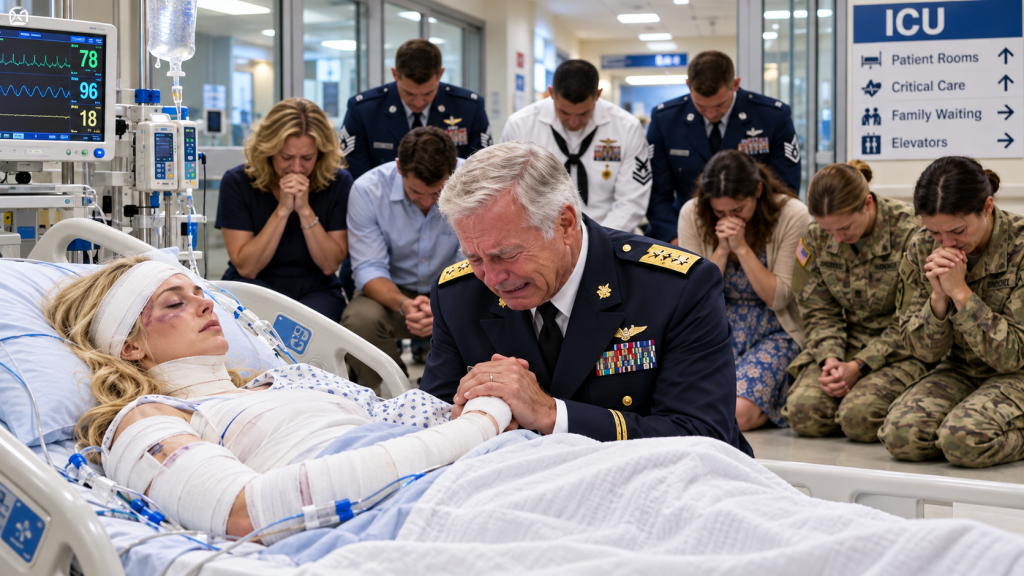
The ICU doors opened.
A physician stepped into the corridor.
Her surgical mask rested beneath her chin.
She looked exhausted.
“General Cole?”
I moved toward her immediately.
“My wife?”
“She experienced another medical emergency, but we’ve stabilized her for now.”
I felt my knees weaken.
“Can I see her?”
“In a moment.”
She glanced toward the folder in my hand.
Then looked at me again.
“Sir, I need you to understand how serious her condition remains.”
I nodded.
“We’re monitoring internal injuries and complications related to the trauma. She may need further procedures. The next several hours are critical.”
My throat tightened.
“Is she going to survive?”
The physician’s expression softened.
“We’re doing everything we can. I can’t promise you an outcome.”
I closed my eyes.
Behind me, someone cleared his throat.
It was Richard Vale.
“Doctor, I’m Clara’s father. I have a right to know what’s happening.”
The physician looked toward him.
Before she could answer, I spoke.
“Clara’s medical team will follow her documented wishes and applicable privacy requirements.”
Richard sneered.
“Still hiding behind rules, Cole?”
I turned slowly.
For thirty years, I had worn a uniform.
I’d learned to control my voice in the worst situations imaginable.
But nothing in my career had demanded more restraint than looking into the eyes of the man whose family had helped destroy mine.
“Richard,” I said quietly, “my wife is fighting for her life.”
He lifted his chin.
“And you think that’s our fault?”
I looked at him.
“The investigators will determine responsibility.”
His expression hardened.
Then he smiled.
A small, cruel smile.
“You’re going to regret making enemies of this family.”
I held his gaze.
“No.”
My voice remained steady.
“You should regret what happened to Clara.”
He stepped closer.
Two police officers moved into the corridor.
Richard noticed them.
His confidence flickered.
Only for a second.
Then he straightened his jacket.
“You don’t frighten me, General.”
I looked toward the officers.
Then back at him.
“I’m not trying to.”
And I turned away.
Because my wife needed me more than Richard Vale needed another audience.
When I entered Clara’s room, the first thing I saw was her hand.
Small.
Pale.
Resting against the white sheet.
Her wedding ring was still there.
The gold band I’d slipped onto her finger eleven years earlier.
I remembered that day.
A little chapel in North Carolina.
Rain against the windows.
Her laughing because I’d been so nervous I almost dropped the ring.
She’d whispered, “Relax, Daniel. I’m not going anywhere.”
Now I stood beside her hospital bed, terrified that those words might become a memory I couldn’t bear.
I sat down.
Took her hand carefully.
And whispered, “I’m here, sweetheart.”
Her eyes remained closed.
Machines hummed around us.
I brushed a strand of hair away from her forehead.
Then looked at the empty space where her hand had rested protectively over her stomach.
Our daughter.
The little girl we’d already named.
Hope Elizabeth Cole.
I lowered my head.
And finally began to cry.
Clara and I had spent years hoping for a child.
There had been disappointments.
Long medical appointments.
Quiet conversations in the middle of the night.
Mornings when Clara tried to smile through tears.
Then, eight months earlier, she’d walked into our kitchen holding a little white pregnancy test.
Her hands were trembling.
I thought something was wrong.
“Clara?”
She smiled.
Then burst into tears.
“Daniel.”
I stood immediately.
“What happened?”
She held out the test.
And whispered, “We’re going to have a baby.”
I remembered staring at it.
Then at her.
Then back at the test.
And laughing.
Not because it was funny.
Because I couldn’t find words large enough for the happiness filling my chest.
I lifted her into my arms.
She laughed.
“Careful, General.”
I kissed her forehead.
“Yes, ma’am.”
That evening, we sat on the porch imagining our future.
She wanted a daughter with my stubbornness.
I said no child deserved such a burden.
She laughed until tears ran down her cheeks.
And for eight beautiful months, our world grew around the promise of a little girl.
Now that promise was gone.
And the people responsible for Clara’s injuries were trying to profit from her death.
“Daniel?”
The whisper was so faint I almost missed it.
I lifted my head.
Clara’s eyes had opened slightly.
I leaned forward.
“Sweetheart?”
Her lips moved.
I reached for the call button and alerted the nurse.
Clara tried to speak again.
“Hope…”
My throat tightened.
I took a shaking breath.
She looked at me.
And I saw the question in her eyes.
The question she already knew the answer to.
I closed my eyes for a moment.
Then gently kissed her hand.
“Our little girl didn’t survive.”
A tear slipped down Clara’s cheek.
Her lips trembled.
Then she made a sound I will hear for the rest of my life.
Not a scream.
Not a sob.
Just a broken breath.
As though grief had reached into her chest and taken the air from her lungs.
I leaned closer.
“I’m so sorry.”
She began crying.
I held her hand.
And cried with her.
For several minutes, neither of us spoke.
There were no words that could make our daughter live.
No rank that could change what had happened.
No order I could give.
No battle I could fight.
Nothing.
Only my wife’s hand in mine.
And the terrible knowledge that we’d entered the hospital as three.
But only two of us had the possibility of leaving.
When Clara finally stopped crying, her eyes moved toward the door.
“Dad?”
I knew immediately whom she meant.
Not my father.
Hers.
Richard Vale.
The man she’d spent her entire life trying to please.
I swallowed.
“He’s outside.”
Her expression changed.
Fear.
Real, unmistakable fear.
She tried to raise her head.
Pain crossed her face.
“Don’t…”
I leaned closer.
“Don’t what, sweetheart?”
Her voice trembled.
“Don’t let him near me.”
My heart broke again.
I squeezed her hand.
“I won’t.”
She closed her eyes.
Then whispered, “Page forty.”
I leaned closer.
“We found references to it.”
Her fingers tightened weakly around mine.
“No.”
She struggled to breathe.
“The original.”
I nodded.
“We’re working on it.”
Clara opened her eyes.
Then whispered something that made my blood run cold.
“Not the copy.”
I stared at her.
She swallowed painfully.
“Under the nursery floor.”
I thought I’d misunderstood.
“The nursery?”
Clara gave the smallest nod.
“Blue rug.”
Her eyes closed.
I leaned forward.
“Clara?”
A nurse entered.
“Sir, she needs to rest.”
I nodded.
But before I stepped away, Clara opened her eyes one final time.
“Daniel.”
“Yes, sweetheart?”
Her voice was barely audible.
“Don’t trust Michael.”
Then she slipped back into exhausted sleep.
I stood beside the bed.
Unable to move.
Michael.
Her oldest brother.
The man who had organized our wedding.
The man who called himself the responsible one.
The man who always offered to settle disputes between Clara and her father.
The man who’d once told me that family loyalty meant never allowing outsiders to interfere.
I looked toward the door.
And realized that the most dangerous person in Richard Vale’s family might not be Richard himself.
Outside the ICU, Mercer waited.
I pulled him aside.
“Clara says the original records are beneath the blue rug in the nursery.”
His expression sharpened.
“Understood.”
I raised a hand.
“We do this properly. No shortcuts.”
“Yes, sir.”
“The house may be relevant to a civilian criminal investigation. Contact the detective handling the case. Tell him what Clara said and let the appropriate investigators determine how to recover the evidence.”
Mercer nodded.
“And Michael Vale,” I added.
He looked up.
“Sir?”
“Clara specifically warned me not to trust him.”
Mercer grew serious.
“I’ll make sure that information reaches the detectives.”
I glanced toward the elevator.
Richard and his sons were no longer standing together.
Three remained in the corridor.
The others had disappeared.
My heartbeat quickened.
“Where’s Michael?”
Mercer looked around.
Then answered quietly.
“He left approximately ten minutes ago.”
I felt something turn to ice inside me.
“Did anyone record when he left?”
“Hospital security can review the cameras.”
I nodded.
“Tell the detective.”
Then I walked toward the window at the end of the corridor.
Outside, the city lights stretched beneath the dark sky.
Somewhere beyond those lights stood our home.
A quiet house on the edge of town.
A house where Clara had spent months preparing a nursery.
Where she’d painted the walls pale yellow.
Where a tiny wooden crib stood beside a window.
Where little dresses hung inside a closet.
And where a blue rug covered the floor.
Clara had hidden something beneath that rug.
Something important enough to protect even while she was fighting for her life.
I closed my eyes.
And whispered, “What did you discover, sweetheart?”
At three forty in the morning, Detective Samuel Reed returned to the hospital.
He carried a tablet and a thick notebook.
His expression was grave.
“General Cole.”
I stood.
“Detective.”
“We received the information concerning the nursery.”
I nodded.
“And?”
“We’re seeking the proper legal authorization to recover the material. We also have officers documenting who has attempted to access the property.”
My chest tightened.
“Has anyone been there?”
Reed hesitated.
“Your home security provider reported an attempted access using an old guest code.”
I stared at him.
“Which code?”
He looked down.
Then answered.
“One assigned to Michael Vale.”
For a moment, the corridor disappeared.
I remembered Michael standing in our kitchen last Christmas.
Laughing.
Holding a glass of bourbon.
Telling Clara she needed to stop asking questions about their father’s business.
I remembered his hand resting on my shoulder.
“Daniel, you’re a good man. Just don’t let Clara get herself worked up over things she doesn’t understand.”
I’d ignored the remark.
Clara hadn’t.
That evening, she sat beside me on the couch.
Her expression was troubled.
“Michael thinks I’m stupid.”
I looked at her.
“No, sweetheart.”
She shook her head.
“He does.”
I took her hand.
“Then he’s wrong.”
She smiled faintly.
But the sadness never quite left her eyes.
Now I understood.
Michael hadn’t been dismissing a harmless disagreement.
He’d been trying to silence someone who knew too much.
“Did he get inside?” I asked Reed.
“No. The attempted access was unsuccessful, and the residence has been secured pending the appropriate search process.”
I exhaled.
Then looked toward the ICU.
“Clara knew he’d come.”
Reed nodded slowly.
“That’s possible.”
He closed his notebook.
Then said, “General, we’re also examining the financial records you provided.”
I waited.
“The transactions involve more than one private company.”
My stomach tightened.
“How many?”
“At least seven entities are under review.”
I stared.
He continued.
“Some appear connected to contracting activity. Others may have been used to conceal beneficial ownership.”
I nodded.
“And the missing money?”
“We’re coordinating with the appropriate financial investigators.”
He paused.
“Sir, your wife’s name appears in several records.”
My chest tightened.
“Because they forged her signature.”
“That’s one possibility we’re examining.”
I looked directly at him.
“Clara is a financial analyst. She discovered something.”
Reed nodded.
“That may explain why they were pressuring her.”
Then he said something unexpected.
“But we also found evidence that she tried to report concerns before the assault.”
I stared at him.
“What?”
Reed opened his tablet.
“There are communications indicating your wife contacted a federal oversight office several weeks ago.”
My throat tightened.
“Why didn’t she tell me?”
He hesitated.
“We don’t know.”
I looked down.
Clara and I shared almost everything.
Our hopes.
Our fears.
Our arguments about paint colors and dinner plans.
But she’d been carrying this alone.
I thought about her growing quiet over the previous month.
The way she closed her laptop when I entered the room.
Not because she was hiding something from me maliciously.
Perhaps because she was frightened.
Perhaps because she believed involving me would place my military position under scrutiny.
Perhaps because she wanted to protect the life growing inside her.
I swallowed.
“What did she report?”
Reed looked toward the ICU doors.
Then answered.
“Potential diversion of funds and falsified certifications involving a defense-related contractor.”
My heartbeat quickened.
He continued.
“And your wife identified a specific page in the underlying records.”
I whispered, “Forty.”
Reed nodded.
“Yes.”
By dawn, the nine men had been separated for questioning.
The police had obtained statements.
Hospital staff had preserved relevant observations.
Security recordings were being examined.
And the attempted forged death certificate was under investigation.
But Richard Vale still believed he could control the situation.
I learned that when he approached me near the cafeteria.
He wasn’t laughing now.
His expensive suit looked wrinkled.
His eyes were bloodshot.
Yet his voice retained the same arrogance.
“Daniel.”
I turned.
“Richard.”
He glanced around.
“We need to settle this privately.”
I stared at him.
“Our daughter is dead.”
For a moment, he looked confused.
Then he realized I meant the baby.
He sighed.
“It’s a tragedy.”
Something inside me tightened.
A tragedy.
As though Hope had been lost in a storm.
As though there had been no confrontation over financial documents.
No frightened mother.
No violence.
I looked at him.
“Clara nearly died too.”
Richard folded his arms.
“She was always emotional.”
I felt my hands close into fists.
Then I deliberately opened them.
I wasn’t going to give him the confrontation he wanted.
“Speak with the investigators,” I said.
He stepped closer.
“Listen carefully. This family has resources you can’t imagine.”
I stared at him.
Then answered quietly.
“I imagine you’ve spent years relying on that.”
His eyes narrowed.
He lowered his voice.
“Your wife signed documents she had no business questioning.”
I felt my pulse quicken.
“She refused to sign.”
Richard smiled.
“That’s what she told you?”
I said nothing.
He continued.
“Daniel, there are things you don’t understand.”
I looked at him.
“Then explain them to the detectives.”
His expression hardened.
“Be careful what you dig up.”
I held his gaze.
Then said the words that ended our conversation.
“Richard, my wife is alive. And she remembers.”
For the first time, genuine fear crossed his face.
That afternoon, Detective Reed called.
The original records had been recovered from our home through the authorized search.
I sat beside Clara’s bed when the call came.
She was still heavily medicated.
But her breathing had stabilized enough that the doctors were cautiously hopeful.
I stepped into the hallway.
“Reed?”
“General, we located the concealed compartment beneath the nursery floor.”
I closed my eyes.
“And?”
“There was a sealed document packet and a digital storage device.”
My heartbeat quickened.
“Page forty?”
“Yes.”
I gripped the phone.
“What does it show?”
Reed paused.
“It’s a significant piece of evidence. We need to complete authentication and coordinate with the financial investigators before drawing conclusions.”
I exhaled.
I knew that was the proper answer.
But I wanted answers now.
I wanted to know why my wife had nearly died.
Why our daughter was gone.
Why her family had spent years treating me like someone beneath them.
And why someone had prepared Clara’s death certificate before she stopped breathing.
Reed continued.
“There is one thing I can tell you.”
I waited.
“The original page contains handwritten notations that do not appear in the altered copy.”
My throat tightened.
“Whose handwriting?”
“We’re examining that.”
He paused.
“But the names referenced on the page include Richard Vale, several members of his family, and an entity your wife was investigating.”
I closed my eyes.
Then Reed added something that made me go completely still.
“General, your name appears in the margin.”
I couldn’t speak.
My name.
On page forty.
The records Clara had hidden.
The evidence her family wanted destroyed.
I stared at the ICU doors.
Then whispered, “In what context?”
Reed answered carefully.
“We’re still determining that.”
My mind raced.
For thirty years, I’d guarded the integrity of my service.
I knew the consequences of even the appearance of improper influence.
I knew how easily dishonest people could exploit a respected name.
And now my name appeared in records tied to questionable defense contracting transactions.
I looked down.
Then asked, “Does the page contain my signature?”
“Not on the material we’ve reviewed.”
I swallowed.
“Then please make sure the appropriate authorities examine every connection. I will cooperate fully.”
Reed paused.
“Understood, General.”
I ended the call.
And stood motionless.
Because suddenly, the investigation wasn’t only about Clara’s family.
Someone had apparently wanted to use my name too.
I returned to Clara’s bedside.
Her eyes were open.
She looked exhausted.
But when she saw me, she tried to smile.
“Daniel.”
I sat beside her.
“Sweetheart.”
Her fingers moved toward mine.
I held them.
“We found the records.”
Tears filled her eyes.
“Page forty?”
I nodded.
“Yes.”
She closed her eyes.
Relief crossed her face.
Then she whispered, “Did they see the names?”
I leaned closer.
“They’re examining everything.”
She swallowed.
“Your name…”
My heart tightened.
I nodded.
“I know.”
Her eyes filled with fear.
“Daniel, I didn’t sign it.”
I stared at her.
“What?”
She struggled to speak.
“I didn’t let them use you.”
I squeezed her hand.
“Clara, listen to me.”
Her breathing became uneven.
“I tried…”
I leaned closer.
“You don’t have to explain everything right now.”
A tear slipped down her cheek.
“They said if I didn’t sign…”
Her voice broke.
I gently touched her forehead.
“Sweetheart, you’re safe here.”
She began crying.
Then whispered, “They said they’d ruin you.”
For a moment, I couldn’t breathe.
That was why she hadn’t told me.
Not because she distrusted me.
Because someone had threatened to destroy my career if she refused to cooperate.
And she had tried to protect me.
While carrying our daughter.
While living under the pressure of her father’s family.
While discovering evidence that could expose a powerful financial scheme.
My heart broke.
I leaned forward.
Kissed her forehead.
And whispered, “You should never have had to carry that alone.”
She began sobbing.
I held her hand.
“You hear me?”
She nodded faintly.
“Never.”
Over the following days, Clara gradually became stronger.
Her condition remained serious.
There were complications.
Procedures.
Painful treatments.
Long nights.
And moments when I feared the hospital would call me with devastating news again.
But she kept fighting.
Sometimes she was awake for only a few minutes.
Sometimes she could barely speak.
Other times she cried quietly while looking at the ceiling.
And every time, I sat beside her.
Not as a general.
Not as a man with authority.
Just her husband.
A man who had lost his daughter.
And who was terrified of losing his wife.
On the fifth evening, Clara looked toward the empty chair beside her bed.
“Daniel?”
“Yes?”
“Did you put the car seat away?”
The question struck me like a blow.
I swallowed.
“No.”
Her eyes filled.
“It’s still in the car?”
I nodded.
“Yes.”
She began crying.
I reached for her hand.
“Sweetheart…”
She shook her head.
“I can’t…”
Her voice broke.
“I can’t go home and see the nursery.”
My eyes filled.
I nodded.
“Then we won’t rush.”
She looked at me.
“Promise?”
I squeezed her hand.
“I promise.”
We had spent months preparing that room.
Clara chose a pale yellow wall color because she said it looked like morning sunlight.
I assembled the crib.
Badly.
She laughed and made me redo one side.
We hung little wooden stars above the changing table.
Folded tiny blankets.
Washed baby clothes.
And placed a stuffed elephant beside the rocking chair.
Every detail had been a promise.
A life waiting to begin.
Now I couldn’t imagine walking through the doorway.
But I knew that one day we’d have to decide what to do with those things.
And I knew the decision had to belong to both of us.
One morning, Clara asked to speak with Detective Reed.
Her doctors approved a limited interview.
She was exhausted.
In pain.
Still recovering.
But she insisted.
I sat nearby, with the arrangements properly documented.
Reed spoke gently.
“Mrs. Cole, we can stop whenever you need.”
Clara nodded.
Then took a slow breath.
“I found the transfers.”
He waited.
She continued.
“My father asked me to review some corporate documents.”
Her voice was weak.
“At first, I thought he needed ordinary financial help.”
I looked at her.
For years, Richard Vale had treated Clara like an inconvenience.
Mocked her independence.
Called her too sensitive.
Yet when he needed someone capable of understanding complicated records, he’d turned to her.
Clara swallowed.
“I found payments that didn’t match the stated purpose.”
Reed took notes.
“Then?”
“I asked questions.”
Her eyes filled.
“My father said I’d misunderstood.”
She took another breath.
“But I hadn’t.”
Clara described the documents.
Contracts.
Invoices.
Certification records.
Transactions involving shell companies.
And the way some payments appeared to move through entities controlled by her brothers.
She had compared dates.
Names.
Amounts.
And supporting records.
Then discovered that page forty of an original agreement contained disclosures absent from a later copy.
That was when she became frightened.
“What made you frightened?” Reed asked.
Clara closed her eyes.
“Michael.”
My heartbeat quickened.
She continued.
“He told me I was asking dangerous questions.”
Reed waited.
“He said my father had spent decades building the family business.”
Her voice trembled.
“And that I had no right to destroy it.”
I watched a tear slip down her cheek.
Then she whispered, “He said I should remember who raised me.”
Reed asked what she understood that to mean.
Clara stared at the blanket.
“That I owed them silence.”
She then described the threats.
If she refused to sign the disputed transfer papers, her family would attempt to implicate me.
They claimed they had records connecting my office to improper procurement decisions.
Clara said she didn’t believe I had done anything wrong.
But she feared the allegations alone could damage my career.
So she began preserving records.
She contacted an oversight office.
And hid the original materials.
Then her father discovered she’d retained them.
“What happened on the day of the assault?” Reed asked.
Clara’s breathing changed.
I leaned forward.
“You can stop, sweetheart.”
She shook her head.
“No.”
A tear slipped down her cheek.
“I need to say it.”
Reed nodded.
“Take your time.”
Clara closed her eyes.
Then began.
She had gone to her father’s house because Michael told her they wanted to settle the matter peacefully.
He said Richard had agreed to answer her questions.
Clara wanted to believe him.
Despite everything.
Despite the insults.
Despite the pressure.
Despite the threats.
She wanted to believe her father still loved her enough to choose honesty.
When she arrived, all eight brothers were present.
Richard sat at the head of the dining table.
The disputed documents lay before him.
And Michael stood beside the door.
Clara immediately felt uneasy.
She asked why everyone was there.
Richard smiled.
“Because this concerns the family.”
She looked at the papers.
Then said she wouldn’t sign.
That’s when the room changed.
Richard became angry.
He accused her of betrayal.
Said she was humiliating him.
Said her husband had made her arrogant.
One brother laughed.
Another told her to stop pretending she understood finance.
Then Michael moved toward her.
He demanded to know where the original records were.
Clara refused to answer.
Richard stood.
And the argument became physical.
Clara’s voice broke.
“He pushed me.”
Tears filled her eyes.
“I fell against the table.”
Reed listened.
She continued.
“Then they surrounded me.”
I felt my heartbeat pounding.
She swallowed.
“I tried to leave.”
Her breathing became uneven.
One of the nurses gently checked her condition.
After a pause, Clara continued.
“They wouldn’t let me.”
She closed her eyes.
“They wanted the records.”
Then she whispered.
“And Michael said nobody was leaving until they knew where page forty was.”
For several seconds, I couldn’t move.
I had known Clara’s injuries were serious.
I had suspected multiple attackers.
But hearing her describe the betrayal in her own voice was something else entirely.
Her father.
Her brothers.
The people she’d grown up trusting.
Had gathered around a heavily pregnant woman and refused to let her leave.
And our child had died.
I looked down.
My hands were shaking.
I folded them together.
Because I knew Clara needed me steady.
Reed asked carefully whether she could identify who had physically assaulted her.
Clara answered as precisely as she could.
She distinguished what she remembered clearly from what she couldn’t.
She described Richard pushing her.
Michael restraining her near the doorway.
And several brothers participating in the confrontation.
She also explained that some memories were fragmented because of the trauma.
Reed didn’t pressure her to fill gaps.
He documented what she said.
Then ended the interview when her doctors advised it.
Before leaving, he thanked her.
Clara closed her eyes.
And whispered, “Please don’t let them use Hope’s death to hide what they did.”
Reed’s expression softened.
“We’ll follow the evidence, Mrs. Cole.”
After he left, Clara looked at me.
Her face was wet with tears.
“Daniel.”
I leaned closer.
“Yes?”
“Are you angry?”
The question stunned me.
“Angry?”
She nodded weakly.
“With me.”
My heart shattered.
I stared at my wife.
The woman who had been assaulted.
Who had nearly died.
Who had lost our daughter.
Who had tried to protect me from a scheme she hadn’t created.
And she was afraid I blamed her.
I gently held her face.
“Clara Elizabeth Cole.”
Her eyes met mine.
“I love you.”
She began crying.
“You didn’t cause this.”
Her lips trembled.
“You hear me?”
She nodded.
“I love you.”
I kissed her forehead.
“And nothing your family did changes that.”
That night, I returned home for the first time since the assault.
I had arranged for the house to be secured and for the investigators to finish the necessary work before I entered.
When I opened the front door, silence greeted me.
The living room was exactly as we’d left it.
Clara’s favorite blanket lay across the couch.
A half-finished crossword puzzle rested on the coffee table.
There was a grocery list on the refrigerator.
Milk.
Bread.
Strawberries.
Baby wipes.
I stared at those last two words.
Then closed my eyes.
For a moment, I couldn’t move.
I walked toward the nursery.
Stopped outside the door.
And rested my hand against the frame.
I remembered Clara standing there two weeks earlier.
One hand resting on her stomach.
The other holding a tiny yellow dress.
She smiled.
“Do you think Hope will like yellow?”
I laughed.
“She’s going to like whatever her mother chooses.”
Clara grinned.
“Diplomatic answer, General.”
I kissed her forehead.
“Thirty years of training.”
She laughed.
Then took my hand and placed it against her stomach.
Hope kicked.
I felt it.
A tiny movement beneath my palm.
Our daughter was alive.
Strong.
Waiting.
I remembered laughing with pure happiness.
Now I stood outside that room, knowing I’d never feel her kick again.
I opened the door.
And broke down.
I sank into the rocking chair.
The one Clara had insisted we buy.
The one she’d imagined sitting in while feeding our daughter.
A little knitted blanket rested over the arm.
I picked it up.
Held it against my chest.
And cried.
Not quietly.
Not carefully.
I cried until my throat hurt.
Until my shoulders shook.
Until the room blurred around me.
For thirty years, people had expected me to remain composed.
A leader.
A commander.
A man who could make difficult decisions under pressure.
But that night, I was none of those things.
I was Hope’s father.
And my little girl was gone.
At some point, my phone rang.
Mercer.
I answered.
“General?”
I tried to speak.
Only a broken breath came out.
His voice changed.
“Sir?”
I swallowed.
“I’m home.”
He was silent for a moment.
Then asked gently, “Are you alone?”
“Yes.”
Another pause.
“Would you like someone there?”
I stared at the yellow blanket.
For a moment, pride tried to answer for me.
No.
I’m fine.
I can manage.
Then I thought about Clara.
About the weight of the grief pressing against my chest.
And I whispered, “Yes.”
Mercer didn’t hesitate.
“I’ll come.”
He arrived twenty minutes later.
No uniform.
No entourage.
Just a friend carrying two cups of coffee.
He found me sitting in the nursery.
When he saw the blanket in my hands, his expression changed.
He didn’t offer empty reassurances.
Didn’t tell me to be strong.
Didn’t say everything happened for a reason.
He simply sat beside me.
And after a long silence, whispered, “I’m sorry about Hope.”
I closed my eyes.
Tears slipped down my face.
He placed a hand on my shoulder.
And we sat together until morning.
The next several weeks became a blur.
Clara underwent additional treatment.
Her injuries slowly began to heal.
The medical team monitored her closely.
There were setbacks.
Moments of fear.
And days when recovery felt impossibly distant.
But gradually, she became stronger.
She could sit up.
Speak more comfortably.
And eventually walk short distances with assistance.
Every small improvement felt enormous.
The first time she stood beside her hospital bed, I nearly cried.
She noticed.
Then smiled faintly.
“General Cole.”
I looked at her.
“Yes, ma’am?”
“Stop looking so terrified.”
I laughed through tears.
“I’m trying.”
She squeezed my hand.
“So am I.”
Meanwhile, the investigation continued.
The original page forty became crucial.
Forensic examination established differences between the original agreement and the altered copy.
The handwriting.
The omitted disclosures.
The dates.
The financial relationships.
The underlying records.
All became part of a larger inquiry.
The names appearing on the page were not treated as automatic proof of wrongdoing.
Investigators traced the transactions independently.
Reviewed communications.
Interviewed witnesses.
And examined who had authorized each transfer.
That work revealed a network of financial misconduct extending beyond the Vale family.
The company at the center of the scheme, Blackstone Meridian Holdings, had presented itself as a reputable defense contractor.
Its public image was polished.
Patriotic.
Respected.
Its executives attended charity galas.
Donated to veterans’ organizations.
And spoke frequently about service.
But the financial records told a different story.
Investigators uncovered transactions that raised serious concerns about false billing and concealed ownership.
Several contracts had been supported by certifications that did not match underlying records.
Funds had moved through entities linked to Richard Vale and members of his family.
And the altered agreement appeared intended to obscure who actually benefited.
Then came another surprise.
My name had been inserted into a supporting memorandum.
Not as a signatory.
Not as someone receiving money.
But as a supposed source of influence over procurement decisions.
The allegation was false.
Investigators examined the claim and sought corroboration.
None was found in the records reviewed.
Instead, evidence suggested someone had included my name to make the company appear better connected than it was.
Clara had discovered the reference.
And that discovery explained why Michael had threatened her.
He knew she would understand what such an allegation could do.
Even if it was untrue.
When I learned that, I sat beside Clara’s hospital bed and told her.
She stared at me.
“Are they investigating you?”
I nodded.
“Any relevant allegation has to be examined.”
Fear filled her eyes.
“Daniel…”
I squeezed her hand.
“Sweetheart, that’s how the process should work.”
She began crying.
“I tried to protect you.”
I smiled sadly.
“I know.”
She looked down.
“I didn’t want them destroying your career.”
I leaned closer.
“Clara, my career is not worth more than your safety.”
Her eyes filled.
I continued.
“And if an allegation needs to be examined, I will cooperate. I don’t need anyone to hide records for me.”
She began crying harder.
I kissed her hand.
“You did the right thing by preserving the truth.”
One morning, Detective Reed called with news.
Michael Vale had been taken into custody pursuant to charges arising from the investigation.
I stood beside the hospital window.
Listening.
Reed explained that other members of the family were also facing legal scrutiny.
Some had been charged.
Others remained under investigation.
The evidence concerning Clara’s assault was being handled separately from the financial misconduct.
I thanked him.
Then ended the call.
For a long time, I stared at the city below.
Michael.
The brother Clara had trusted most.
The one who used to carry her schoolbooks when she was little.
The one who gave a speech at our wedding about loyalty.
Now facing charges connected to the events that nearly killed her.
I felt no satisfaction.
Only a terrible sadness.
Because no arrest could bring Hope back.
When I told Clara, she closed her eyes.
“Michael?”
I nodded.
“Yes.”
A tear slipped down her cheek.
“He used to protect me.”
My throat tightened.
She continued.
“When we were children, he would walk me home from school.”
I sat beside her.
“He told me nobody would ever hurt me while he was around.”
Her voice broke.
“And then…”
She couldn’t finish.
I held her hand.
“I know.”
She began sobbing.
And I held her through the grief of losing not just her daughter, but the family she’d believed she had.
Richard Vale hired powerful attorneys.
Issued statements.
Denied wrongdoing.
And attempted to portray the confrontation as a family misunderstanding.
His representatives challenged the evidence.
Questioned witnesses.
And argued that Clara’s memories were unreliable because of her injuries.
But the investigation had more than her account.
There were medical records.
Communications.
Financial documents.
Witness statements.
And evidence preserved before anyone understood how significant it would become.
One particularly important witness was Richard’s longtime housekeeper, Maria Alvarez.
She had worked for the family for almost twenty years.
Clara had always treated her kindly.
Helped her daughter with college applications.
Remembered her birthday.
And asked about her family.
Maria had been in the house on the day of the assault.
She heard the argument.
Saw Clara trying to leave.
And witnessed part of the confrontation.
For weeks, she had been frightened to speak.
Richard’s family controlled her employment.
She worried about losing her livelihood.
But eventually, she contacted investigators.
And told them what she knew.
When Clara learned Maria had come forward, she began crying.
“Maria?”
I nodded.
“Yes.”
“She was there?”
“She provided information about what she witnessed.”
Clara covered her mouth.
Then whispered, “I hope she’s safe.”
I took her hand.
“The investigators are aware of her concerns.”
Clara looked down.
Then said something that reminded me why I’d fallen in love with her.
“She shouldn’t lose everything because she told the truth.”
I squeezed her hand.
“I agree.”
Even after everything, Clara was thinking about someone else’s safety.
Months passed.
Clara eventually returned home.
But not to the home we’d known before.
The nursery remained closed at first.
We made arrangements for medical care.
Counseling.
And support.
Neither of us was ready to dismantle the room.
Nor were we ready to keep it exactly as it had been forever.
We gave ourselves time.
Some days, Clara wanted to talk about Hope.
Other days, she couldn’t bear to hear her name.
I learned not to force either.
Grief was not a military operation.
There was no timetable.
No objective that could be completed by working harder.
We had to live through it.
Together.
One afternoon, Clara asked to open the nursery.
I stood beside her in the hallway.
“Are you sure?”
She nodded.
“Yes.”
I took her hand.
Then opened the door.
The room smelled faintly of lavender.
Sunlight fell across the pale yellow walls.
The crib stood beneath the window.
The little wooden stars moved gently above it.
Clara stepped inside.
Then stopped.
Her eyes filled.
“Oh, Daniel.”
I wrapped an arm around her.
She walked slowly toward the dresser.
Opened the top drawer.
And lifted a tiny white cardigan.
She held it against her chest.
Then began sobbing.
I pulled her close.
And we cried together.
After a while, Clara sat in the rocking chair.
She looked toward the window.
Then whispered, “I want to remember her.”
I sat beside her.
“We will.”
She swallowed.
“I don’t want the only thing people know about Hope to be how we lost her.”
My eyes filled.
I nodded.
“Then we’ll tell her story differently.”
Clara looked at me.
“How?”
I considered.
Then smiled sadly.
“We can begin with how much we loved her.”
She began crying.
I took her hand.
“We can remember the first time she kicked.”
“The night you made me drive across town for strawberries.”
Clara laughed through tears.
“That was your fault.”
I smiled.
“Of course.”
She wiped her face.
“And the little yellow dress?”
I nodded.
“The one you said she’d wear home.”
Clara pressed the cardigan against her chest.
Then whispered, “She mattered.”
My throat tightened.
“Yes.”
I kissed her forehead.
“She always will.”
We created a memory box.
Inside, we placed the little cardigan.
The yellow dress.
A photograph from an ultrasound appointment.
A handwritten letter Clara had written while pregnant.
And the tiny knitted blanket from the rocking chair.
We also included a photograph of us standing on the porch during Clara’s pregnancy.
Her hands resting over her stomach.
My arm around her shoulders.
Both of us laughing.
It was one of my favorite pictures.
Not because we looked perfect.
But because it captured a moment when we were happy.
And Hope had been part of that happiness.
Clara wrote a letter to our daughter.
She didn’t show it to me immediately.
One evening, she sat beside the window for almost an hour.
Writing.
Stopping.
Crying.
Then writing again.
When she finished, she folded the page.
Placed it in the memory box.
And asked whether I wanted to read it.
I nodded.
The first sentence broke me.
My sweet Hope, you never opened your eyes to see our faces, but you changed the way we saw the world.
I couldn’t continue for several minutes.
Then I read the rest.
Clara wrote about the little things.
The music she played while pregnant.
The way Hope moved whenever she heard my voice.
The plans we made.
The name we’d chosen.
And the love that had filled our home before her birth.
Near the end, she wrote:
You were never a number on a medical record or a tragedy in somebody else’s story.
You were our daughter.
You were wanted.
You were loved.
And you will always belong to us.
I folded the letter.
Held Clara.
And cried.
As the criminal and financial proceedings moved forward, I made a decision concerning my military career.
I requested a temporary step back from certain responsibilities while the relevant matters involving my family and the false references to my name were examined.
I cooperated with authorized reviews.
Provided records.
Answered questions.
And allowed the process to proceed without trying to influence the outcome.
Some people told me I should be furious that my service was being scrutinized.
But I believed something simple.
Accountability had to apply to everyone.
Including me.
And if my name had been used improperly, the clearest way to establish that was through an honest review.
Eventually, the relevant examination found no substantiated wrongdoing on my part in connection with the alleged procurement influence.
I was relieved.
But I didn’t celebrate.
Because the greater loss remained.
My daughter was still gone.
Clara was still recovering.
And the family that should have protected her had become the source of her deepest pain.
One afternoon, Mercer visited our home.
He sat across from me in the study.
“Sir.”
I smiled faintly.
“Andrew, we’ve known each other twenty years. You can stop calling me sir in my kitchen.”
He laughed.
“Habit.”
I poured coffee.
Then asked how things were going.
We talked about ordinary matters.
Work.
Mutual friends.
His children.
Then he grew quiet.
“Daniel?”
I looked up.
“Yes?”
“Have you thought about retirement?”
The question surprised me.
I stared at him.
For thirty years, the Army had been my life.
Service.
Responsibility.
Leadership.
A sense of purpose larger than myself.
But now I looked toward the hallway.
Clara was resting in the living room.
The nursery was down the hall.
And I understood that my priorities had changed.
“I have,” I admitted.
Mercer nodded.
“Whatever you decide, you’ve earned the right to make that choice.”
I looked down.
Then whispered, “I don’t want to miss any more of my life.”
I retired the following year.
The ceremony was respectful.
Quiet.
Filled with familiar faces.
Clara sat in the front row.
She wore a pale blue dress.
Her hair had grown longer.
There were still difficult days.
Still appointments.
Still moments when grief overwhelmed her.
But she’d regained much of her strength.
When I looked at her during the ceremony, she smiled.
And somehow, that smile meant more than every commendation I’d received.
Afterward, we stood outside beneath the afternoon sun.
Mercer approached.
He shook my hand.
“Congratulations, General.”
I laughed.
“Retired General.”
He smiled.
“Still General to me.”
Clara slipped her arm through mine.
“Can I have my husband back now?”
Mercer laughed.
“Yes, ma’am.”
He stepped away.
I looked at Clara.
Then smiled.
“Ready to go home?”
She nodded.
“Yes.”
And we did.
The proceedings concerning Richard Vale and his sons unfolded over several years.
They involved complicated financial evidence.
Multiple defendants.
Contested allegations.
And separate questions concerning the assault on Clara.
Not everyone faced identical charges.
Not every allegation resulted in a conviction.
And the process was far less dramatic than the instant justice people often imagine.
But the evidence did result in substantial legal consequences for those whose wrongdoing was established.
Richard’s business empire was dismantled through a combination of legal proceedings, financial claims, and the loss of contracts and professional relationships.
Michael faced particularly serious consequences for his role.
Several brothers cooperated with investigators.
Others contested the allegations.
And the once-united family fractured under the weight of the truth.
I learned about many of the developments through our attorneys.
I didn’t attend every hearing.
Didn’t watch every news report.
Didn’t spend my retirement waiting for updates about the men who had harmed Clara.
I had once imagined that seeing them brought low would provide peace.
But the truth was more complicated.
Their downfall couldn’t restore Hope.
It couldn’t erase Clara’s injuries.
It couldn’t return the years of trust she’d lost.
Real healing required more than watching people face consequences.
It required building a life that belonged to us.
One evening, Clara sat beside me on the porch.
The sun was setting.
The air smelled of freshly cut grass.
She held a cup of tea.
For a long time, neither of us spoke.
Then she whispered, “Daniel?”
I turned.
“Yes?”
“Do you ever wish you’d never met my family?”
I considered.
Then looked at her.
“No.”
She stared.
“Really?”
I smiled sadly.
“If I’d never met your family, I might never have met you.”
Her eyes filled.
I continued.
“And loving you has been the greatest privilege of my life.”
A tear slipped down her cheek.
She reached for my hand.
Then whispered, “Even after everything?”
I squeezed her fingers.
“Especially after everything.”
We began traveling.
Slowly.
Carefully.
At first, just weekend trips.
A cabin in the mountains.
A quiet beach.
A small town with a bookstore Clara loved.
We didn’t travel to escape our memories.
We traveled because life still held things worth seeing.
Beautiful places.
Interesting people.
New experiences.
And the possibility of joy.
On one trip, we visited a coastal town in Maine.
The mornings were cool.
The ocean smelled of salt.
And the little inn where we stayed overlooked a rocky beach.
One morning, Clara woke before sunrise.
I found her standing beside the window.
Wrapped in a blanket.
Watching the waves.
I approached quietly.
“Couldn’t sleep?”
She shook her head.
“Just thinking.”
I stood beside her.
For a moment, we watched the ocean.
Then she whispered, “I used to think I’d never feel happy again.”
My throat tightened.
I took her hand.
“And now?”
She smiled faintly.
“Sometimes I do.”
I looked at her.
She continued.
“And then I feel guilty.”
I understood.
Grief can make happiness feel like betrayal.
As though smiling means forgetting.
As though laughter means love has faded.
I squeezed her hand.
“Clara, loving Hope doesn’t require us to suffer every minute.”
Tears filled her eyes.
She nodded.
“I know.”
Then she rested her head against my shoulder.
And we watched the sunrise together.
Several months later, Clara approached me with an idea.
We were sitting at the kitchen table.
She had been reading about organizations that support families after pregnancy and infant loss.
She looked thoughtful.
“Daniel?”
“Yes?”
“I want to do something for Hope.”
My chest tightened.
“What kind of thing?”
She hesitated.
“Something that helps other families.”
I put down my coffee.
She continued.
“Maybe a fund that helps parents with counseling or practical expenses after losing a baby.”
I listened.
She swallowed.
“I don’t want her name remembered only because of what my family did.”
My eyes filled.
I reached across the table.
“Then let’s build something beautiful in her memory.”
The idea grew slowly.
We consulted professionals.
Worked with established organizations.
Reviewed practical needs.
And created a small charitable fund dedicated to supporting families dealing with pregnancy and infant loss.
We named it Hope’s Light.
At first, it supported a limited number of families through an existing nonprofit partner.
Then more people became involved.
Medical professionals.
Counselors.
Volunteers.
Parents who understood the grief.
We made sure the program was managed transparently.
Clara insisted on independent oversight.
Clear records.
Proper financial controls.
And open reporting.
After everything her father’s companies had done, she wanted Hope’s name associated with integrity.
Not prestige.
Not appearances.
Real help.
The first time Clara met a family supported by the program, she cried afterward.
We were sitting in the car.
She held a handwritten thank-you note.
Her hands trembled.
“Daniel…”
I looked at her.
“Yes?”
“They lost their daughter too.”
My heart tightened.
I nodded.
She looked down.
“They said the counseling helped.”
A tear slipped down her cheek.
“And they didn’t know how they would’ve paid for it.”
I took her hand.
Clara smiled through tears.
“Hope helped someone.”
My chest tightened.
I nodded.
“Yes.”
She pressed the note against her heart.
“And that matters.”
Years passed.
Our marriage changed.
Not because love disappeared.
But because grief reshaped us.
There were days we communicated beautifully.
And days we struggled.
Sometimes Clara wanted to talk about Hope when I couldn’t.
Sometimes I needed silence when she wanted closeness.
We learned to say those things honestly.
To ask for space.
To offer comfort.
And to remember that grief didn’t always arrive on the same schedule for both of us.
One winter evening, Clara found me sitting alone in the nursery.
We had transformed the room into a peaceful reading space.
The crib was no longer there.
The walls remained yellow.
A bookshelf stood near the window.
And the memory box rested on a high shelf.
I sat in the rocking chair.
Holding the little knitted blanket.
Clara approached quietly.
“Daniel?”
I looked up.
Tears filled my eyes.
“I miss her.”
Her expression softened.
She sat beside me.
“I know.”
I swallowed.
“Some days I wonder who she would’ve become.”
Clara took my hand.
I looked toward the window.
“Would she have liked music?”
“Would she have had your smile?”
“Would she have been stubborn?”
Clara laughed through tears.
“Definitely stubborn.”
I smiled sadly.
“Poor child.”
She leaned against me.
We laughed.
Then cried.
And for a while, we imagined the daughter we’d loved but never had the chance to know.
The story of page forty eventually became public through court records and reporting on the financial case.
People were fascinated by the documents.
The hidden ownership.
The altered agreement.
The false death certificate.
The family betrayal.
And the fact that a retired general had been married to the woman who helped expose the scheme.
Some called it extraordinary.
Others focused on Richard Vale’s fall from prominence.
But when reporters asked me about the case, I tried to keep one thing clear.
My rank had not solved it.
The evidence had.
Clara’s courage had mattered.
The witnesses who spoke honestly had mattered.
The investigators who followed proper procedures had mattered.
And the people who refused to let influence replace accountability had mattered.
One journalist asked me something I will never forget.
“General Cole, did you enjoy seeing the men who mocked your rank brought to justice?”
I considered.
Then answered.
“No.”
The journalist looked surprised.
I continued.
“I lost my daughter.”
The room went quiet.
“My wife nearly died.”
I swallowed.
“Nothing about that is enjoyable.”
I looked directly at the interviewer.
“What matters is that wrongdoing was examined and those responsible were held accountable according to the evidence.”
I paused.
“And that my wife survived.”
When the interview ended, Clara took my hand.
Her eyes were wet.
“Thank you.”
I looked at her.
“For what?”
She smiled sadly.
“For not making this about your uniform.”
My throat tightened.
I squeezed her hand.
“It was always about you.”
One spring morning, we received a letter from Richard Vale.
He had written from custody.
Clara held the envelope for several minutes before opening it.
I sat beside her.
“Do you want me to read it?”
She shook her head.
“No.”
Then she opened it.
Her eyes moved slowly across the page.
I watched her expression change.
Sadness.
Anger.
Something that looked almost like disbelief.
Finally, she lowered the letter.
I waited.
She whispered, “He says he’s sorry.”
My heart tightened.
I nodded.
She continued.
“He says he never meant for Hope to die.”
Tears filled her eyes.
I reached for her hand.
Clara looked at me.
“Daniel…”
“Yes?”
“He still talks about what happened as though he lost control of an argument.”
Her voice broke.
“As though our daughter was an accident he can explain away.”
I swallowed.
She folded the letter.
Then placed it on the table.
“I don’t know if I’ll ever forgive him.”
I squeezed her hand.
“You don’t have to decide today.”
She nodded.
Then whispered, “I don’t want to answer.”
“Then don’t.”
She looked toward the window.
And for the first time, I saw something like freedom in her expression.
She no longer believed she owed her father access simply because he was her father.
Clara eventually chose not to maintain contact with Richard.
It wasn’t an impulsive decision.
She discussed it with her counselor.
Considered what she wanted.
And set a boundary she could live with.
I respected it.
We did not use silence as a weapon.
We simply protected the life we were rebuilding.
Several years after the assault, we held the annual Hope’s Light gathering in a small botanical garden.
Families came.
Volunteers.
Medical professionals.
Counselors.
And friends.
There were flowers.
Soft music.
A quiet remembrance ceremony.
And a path lined with little lanterns.
Each lantern represented a child whose family wanted to honor them.
Clara stood beside me holding a small white candle.
Her hands trembled.
I squeezed her fingers.
She looked at me.
Then smiled through tears.
“Ready?”
I nodded.
“Yes.”
We walked toward a table near the garden.
A little sign stood beside our candle.
HOPE ELIZABETH COLE.
FOREVER LOVED.
Clara touched the sign.
Then whispered, “Hello, sweetheart.”
My throat tightened.
I placed my hand beside hers.
And together, we lit the candle.
After the ceremony, a young couple approached.
They had recently lost a baby.
The mother looked exhausted.
The father held her hand tightly.
They thanked us for the support they’d received.
Clara listened.
Then gently said, “I’m sorry about your little boy.”
The mother began crying.
Clara reached for her hand.
And for a few moments, they stood together.
Two mothers.
Different stories.
The same kind of grief.
I watched.
And felt something shift inside me.
Hope’s life had been brief.
Far too brief.
But the love we carried for her was becoming part of something larger.
Not a replacement for her.
Never that.
But a way to honor her.
As the years passed, Clara regained confidence in herself.
She returned to financial work, though in a different capacity.
She began consulting for organizations that wanted stronger financial controls and transparent reporting.
At first, she doubted herself.
The investigation had been exhausting.
Her father’s family had spent years making her question her intelligence.
Sometimes she still heard Michael’s voice in her memory.
You don’t understand what you’re looking at.
But she did.
She always had.
One afternoon, Clara returned home after giving a presentation.
She stood in the doorway.
Holding her notes.
Looking stunned.
I rose from the couch.
“Sweetheart?”
She smiled.
Then began crying.
I moved toward her.
“What happened?”
She laughed through tears.
“They asked me to lead the next project.”
I grinned.
“Of course they did.”
She shook her head.
“Daniel, they actually listened.”
My chest tightened.
I took her hands.
“Why wouldn’t they?”
Her smile faded slightly.
“Because for years, my brothers treated me like I was foolish.”
I looked into her eyes.
“Then they were wrong.”
She began crying again.
I pulled her close.
And whispered, “I’m proud of you.”
That evening, we went out to dinner.
Nothing extravagant.
A little restaurant Clara loved.
Warm bread.
Good food.
A table near the window.
She wore a dark green dress.
And for the first time in a long time, I saw the woman I’d married looking genuinely excited about her future.
Halfway through dinner, she raised her glass.
“To page forty.”
I laughed.
“That’s a strange toast.”
She smiled.
“Maybe.”
Then her expression softened.
“But I spent years believing my father and brothers knew more than I did.”
I reached across the table.
She continued.
“And page forty proved I was right to ask questions.”
I nodded.
“Yes.”
She lifted her glass slightly.
“To never apologizing for wanting the truth.”
I smiled.
And raised mine.
“To the truth.”
One evening, almost ten years after the assault, Clara and I sat on our porch watching the sun disappear behind the trees.
The air was warm.
Birds moved through the garden.
A little wind chime rang softly beside the door.
We were older.
Quieter.
Our faces carried lines that hadn’t been there before.
But when Clara smiled at me, I still saw the young woman in the chapel who laughed because I nearly dropped our wedding ring.
She rested her head against my shoulder.
“Daniel?”
“Yes?”
“Do you ever think about that night at the hospital?”
I stared toward the garden.
“Yes.”
She nodded.
“Me too.”
For a long time, neither of us spoke.
Then she whispered, “I remember hearing your voice.”
My throat tightened.
“When?”
“In the ICU.”
I looked at her.
She continued.
“I couldn’t always open my eyes.”
Her voice trembled.
“But I could hear you.”
I swallowed.
“What did you hear?”
She smiled sadly.
“You kept telling me to come back.”
My eyes filled.
She took my hand.
“And I wanted to.”
A tear slipped down my cheek.
She continued.
“I wanted to come back to you.”
I closed my eyes.
Then kissed her forehead.
“I’m glad you did.”
That night, after Clara went inside, I remained on the porch.
I thought about Richard Vale.
His eight sons.
The hospital corridor.
Their laughter.
The moment Mercer stepped from the elevator and addressed me by rank.
I remembered the silence that followed.
The fear in their faces.
The sudden realization that the man they’d mocked was someone they hadn’t understood.
For years, that moment had seemed like the beginning of the story people wanted to tell.
The poor government clerk revealed as a general.
The arrogant family humiliated.
The powerful men suddenly afraid.
But that wasn’t the moment that changed my life.
Not really.
The moment that changed my life was when Clara opened her eyes in the ICU and asked about Hope.
The moment I had to tell her our daughter was gone.
The moment I realized there was no title, no authority, and no amount of strength that could protect us from grief.
People often think power means the ability to make others afraid.
But I learned something different.
Power can mean refusing to become cruel after being harmed.
It can mean allowing investigators to do their work without interference.
It can mean admitting when you’re frightened.
Asking for help.
Crying with your wife.
And building something beautiful from love that has nowhere else to go.
I had spent thirty years leading soldiers.
Making decisions.
Carrying responsibility.
But the hardest thing I’d ever done was sit beside Clara after Hope died and admit that I couldn’t fix what had happened.
I could love her.
Support her.
Help her find care.
And stand beside her through the long process of rebuilding.
But I couldn’t erase the pain.
And learning to accept that changed me.
One morning, Clara found me looking through an old photograph album.
It contained pictures from our marriage.
Our wedding.
Vacations.
Birthday dinners.
And the months she carried Hope.
She sat beside me.
“What are you doing?”
I smiled.
“Remembering.”
She leaned closer.
Then stopped at a photograph.
It showed her standing in the nursery.
Eight months pregnant.
One hand on her stomach.
The other holding a tiny stuffed elephant.
She was laughing.
Her face glowed with happiness.
Clara touched the photograph.
For a moment, neither of us spoke.
Then she whispered, “Look how happy we were.”
My throat tightened.
I nodded.
“Yes.”
She looked at me.
“Were we foolish?”
The question surprised me.
I shook my head.
“No.”
Her eyes filled.
“But we didn’t know what was coming.”
I took her hand.
“Neither does anyone else.”
She looked down.
I continued.
“Our happiness wasn’t foolish because something terrible happened afterward.”
Her face crumpled.
I squeezed her fingers.
“It was real.”
She began crying.
Then leaned against me.
And together, we remembered the joy that had existed before the loss.
The following year, Hope’s Light opened a small family support center.
It was modest.
A few counseling rooms.
A quiet garden.
A library of resources.
And a room where parents could sit without feeling pressured to explain their grief.
Clara helped design it.
She chose soft colors.
Comfortable chairs.
Natural light.
And a little corner where families could write messages to the children they were remembering.
At the entrance, a simple plaque read:
HOPE’S LIGHT
EVERY CHILD MATTERS. EVERY FAMILY DESERVES COMPASSION.
The first time we stood before it, Clara began crying.
I put my arm around her.
She whispered, “We did it.”
I nodded.
“Yes.”
She looked at the plaque.
Then smiled through tears.
“Hope has a place in the world.”
My throat tightened.
I kissed her forehead.
“She always did.”
At the opening ceremony, Mercer attended.
He was retired too.
His hair had gone almost completely white.
He approached me carrying a small wrapped package.
“Daniel.”
I smiled.
“Andrew.”
He handed me the gift.
“For the center.”
I opened it.
Inside was a framed photograph.
Clara and me.
Taken at my retirement ceremony.
She was smiling.
I had my arm around her.
Beneath the photograph, Mercer had written:
COURAGE IS NOT ALWAYS FOUND ON A BATTLEFIELD.
My eyes filled.
I looked at him.
He smiled gently.
“Thought it belonged here.”
I shook his hand.
Then pulled him into an embrace.
“Thank you.”
Later, Clara and I stood together as visitors entered the new center.
Some were nervous.
Some exhausted.
Some carried photographs.
Others carried only grief.
We greeted them gently.
Not as people who had solved sorrow.
But as people who understood that sorrow should not have to be carried alone.
One afternoon, a father approached me after a support meeting.
He looked about thirty.
His eyes were red.
His shoulders slumped.
He hesitated.
“General Cole?”
I smiled gently.
“Daniel is fine.”
He nodded.
Then whispered, “How did you keep going?”
The question struck me.
I considered.
Then looked toward the garden.
“Not all at once.”
He frowned.
I continued.
“One day.”
“Sometimes one hour.”
“Sometimes just the next breath.”
His eyes filled.
I took a slow breath.
“And I let people help me.”
He began crying.
I placed a hand on his shoulder.
“You don’t have to be strong every minute.”
He looked at me.
Then whispered, “Thank you.”
After he left, I sat alone for a while.
I thought about the night Mercer came to our house.
The nursery.
The yellow blanket.
The coffee.
The silence.
He hadn’t fixed anything.
But he hadn’t left me alone.
And that had mattered.
Years later, when people asked whether I regretted retiring early, I always smiled.
No.
I missed parts of military life.
The camaraderie.
The purpose.
The people.
But I had found another purpose beside Clara.
One that didn’t require a rank.
One that demanded patience rather than command.
And one that allowed me to spend the rest of my life helping families feel less alone.
Richard Vale died many years after the trial.
Clara learned the news through her attorney.
She sat quietly after the call.
I sat beside her.
For a long time, neither of us spoke.
Then I asked gently, “How do you feel?”
She looked down.
“I don’t know.”
I nodded.
She continued.
“He was my father.”
Her eyes filled.
“And he was also the man who…”
Her voice broke.
I took her hand.
She whispered, “I don’t know how to grieve someone who hurt me so badly.”
I squeezed her fingers.
“You don’t have to find the perfect way.”
She looked at me.
I continued.
“Whatever you feel is allowed.”
She began crying.
And I held her.
Clara chose not to attend his funeral.
That was her decision.
I supported it.
She did, however, spend an afternoon looking through photographs from her childhood.
Some showed Richard smiling.
Holding her as a baby.
Standing beside her at school events.
For a while, she cried.
Then she closed the album.
“I wish he’d chosen differently.”
My throat tightened.
I nodded.
“Me too.”
She looked toward the window.
Then whispered, “But I can’t change what he chose.”
I took her hand.
“No.”
She swallowed.
“I can only decide what I do with the rest of my life.”
I smiled gently.
“Yes.”
And she did.
She continued helping families.
Speaking about financial transparency.
Supporting organizations that wanted stronger protections.
And living with a courage that had nothing to do with pretending she wasn’t afraid.
On the twentieth anniversary of our wedding, we returned to the small chapel in North Carolina.
It looked almost the same.
White walls.
Wooden pews.
A simple stained-glass window.
The rain had stopped just before we arrived.
Clara stood beside me wearing a blue dress.
I held her hand.
For a moment, we looked toward the place where we’d once exchanged vows.
She smiled.
“Do you remember dropping the ring?”
I laughed.
“I didn’t drop it.”
She raised an eyebrow.
“You almost did.”
I grinned.
“Allegedly.”
She laughed.
The sound filled the little chapel.
Then her expression softened.
“Daniel?”
“Yes?”
“If you knew everything we would go through…”
I looked at her.
She swallowed.
“Would you still marry me?”
My throat tightened.
I took both her hands.
Then answered without hesitation.
“Yes.”
Her eyes filled.
I continued.
“I would still choose you.”
A tear slipped down her cheek.
“Even knowing about Hope?”
My voice broke.
“Especially knowing that we would love her.”
Clara began crying.
I pulled her close.
And whispered, “I would choose every beautiful moment with you again.”
We stood there for a long time.
Remembering the beginning of our marriage.
The promises.
The laughter.
The hopes.
And the life that had unfolded in ways neither of us could have imagined.
Then Clara pulled away.
Smiled through tears.
And whispered, “I would choose you too.”
That evening, we visited a quiet garden near the chapel.
We carried a single white rose.
Clara placed it beside a small memorial stone we’d arranged with permission.
It bore Hope’s name.
And the words:
OUR DAUGHTER. OUR LOVE. ALWAYS.
We stood together.
Hand in hand.
The evening wind moved gently through the trees.
Clara whispered, “Happy anniversary, Hope’s mommy and daddy.”
I looked at her.
My eyes filled.
Then I squeezed her hand.
“Yes.”
I smiled through tears.
“We’re still here.”
The years that followed weren’t perfect.
We argued sometimes.
Forgot appointments.
Worried about money for the support center.
Dealt with ordinary illnesses.
And occasionally burned dinner.
Life didn’t become a beautiful storybook simply because we’d survived a terrible event.
But it became ours.
And that mattered.
Sometimes I found Clara standing in the garden.
Looking toward the sky.
She’d smile when she noticed me.
I’d walk over.
Put my arm around her.
And we’d stand quietly.
No explanations.
No forced optimism.
Just two people who understood each other’s silence.
One autumn morning, I found an old folder in my study.
It contained copies of the records from the Vale case.
Including the references to page forty.
I stared at it for a long time.
The document had once felt like the center of everything.
The thing that would expose Richard.
Protect Clara.
Clear my name.
And bring the truth into the open.
It had mattered enormously.
But now, years later, I realized it no longer defined our lives.
It was evidence.
Important evidence.
But our story had become larger than that.
I closed the folder.
Placed it in the appropriate archive.
And walked into the kitchen.
Clara was making tea.
She looked up.
“Everything okay?”
I smiled.
“Yes.”
She raised an eyebrow.
“You sure?”
I walked toward her.
Took her hand.
And kissed her forehead.
“More than okay.”
She laughed.
“What’s gotten into you?”
I smiled.
“Just grateful.”
She looked at me.
Then smiled softly.
“Me too.”
Sometimes people still recognize me.
They call me General Cole.
Ask about my military career.
Mention the case.
Or tell me they remember the story about the arrogant family who laughed at a government desk clerk before learning he was a general.
I understand why that detail captures attention.
The reversal.
The humiliation.
The sudden silence.
But whenever someone asks what I consider the most important part of the story, I give a different answer.
My wife survived.
Not because that erased everything else.
It didn’t.
We still lost Hope.
Still endured grief.
Still watched a family collapse beneath the consequences of its choices.
But Clara lived.
She laughed again.
Worked again.
Loved again.
And helped other people find courage when their lives felt shattered.
That is what matters most to me.
One evening, Clara and I sat beneath the stars.
We were older now.
Our hair silver.
Our steps slower.
The garden was quiet.
A little lantern glowed beside the porch.
Clara rested her head against my shoulder.
“Daniel?”
“Yes, sweetheart?”
“Do you think Hope would’ve been proud of us?”
My eyes filled.
I looked toward the sky.
I thought about the daughter we’d never had the chance to raise.
The little girl who might have loved yellow dresses.
Music.
Strawberries.
And stories before bedtime.
Then I looked at Clara.
At the woman who had survived so much.
Who had chosen compassion without surrendering the truth.
Who had transformed grief into support for other families.
I swallowed.
“I hope so.”
Clara smiled through tears.
“Me too.”
I kissed her forehead.
Then whispered, “I know we’re proud to be her parents.”
She closed her eyes.
And nodded.
The last time I visited the hospital where everything began, it was for a Hope’s Light event.
The building looked familiar.
The same entrance.
The same elevators.
The same long corridors.
For a moment, walking through the doors brought back the worst night of my life.
The phone call.
Clara’s injuries.
The doctor’s face.
The news about Hope.
Richard’s laughter.
Mercer stepping from the elevator.
The folder.
The forged death certificate.
And page forty.
I stopped beside the elevator.
Clara noticed.
She took my hand.
“Daniel?”
I looked at her.
“Yes?”
“You okay?”
I took a slow breath.
Then nodded.
“Yes.”
She squeezed my fingers.
“We can leave if you want.”
I looked toward the corridor.
Then back at her.
“No.”
I smiled gently.
“Let’s go help someone.”
We walked toward the conference room where the event was being held.
Inside were families.
Medical professionals.
Volunteers.
And people who’d come to learn about supporting parents after pregnancy and infant loss.
Clara spoke first.
Her voice was steady.
Warm.
She told them about Hope.
Not the details of the assault.
Not the sensational parts of the financial case.
But about a little girl who had been loved before she was born.
About the grief of losing her.
And about how important compassionate support had been during recovery.
I watched from the front row.
My heart filled with pride.
When Clara finished, the room grew quiet.
Then people began applauding.
She looked toward me.
And smiled.
I stood.
Not as a general.
Not as a decorated officer.
But as her husband.
And applauded the bravest woman I had ever known.
After the event, a nurse approached us.
She was older.
Her hair was gray.
Her eyes were gentle.
She looked at Clara.
“Mrs. Cole?”
Clara smiled.
“Yes?”
The nurse hesitated.
“I don’t know if you remember me.”
Clara studied her face.
Then her expression changed.
“You were in the ICU.”
The nurse nodded.
“I was one of your nurses.”
Clara’s eyes filled.
The nurse continued.
“I remember how frightened your husband was.”
I looked down.
She smiled gently.
“He sat beside you whenever he could.”
Clara reached for my hand.
The nurse’s eyes filled.
“And I remember how hard you worked to recover.”
Clara began crying.
“Thank you.”
The nurse squeezed her hand.
Then said something that stayed with me.
“We don’t always get to see what happens after someone leaves the hospital.”
She looked around the room.
“At what you’ve built.”
Her voice broke.
“I’m glad I got to see this.”
When we left the hospital, the evening sky was turning gold.
Clara stood beside me near the entrance.
For a moment, we looked back at the building.
Then she whispered, “I used to think this place was where my life ended.”
My throat tightened.
I looked at her.
She smiled sadly.
“But it wasn’t.”
I nodded.
“No.”
She took my hand.
“It was where everything changed.”
I squeezed her fingers.
Then whispered, “And where you fought your way back to me.”
We walked toward the car.
Slowly.
Together.
And for the first time, the hospital didn’t feel only like a place of loss.
It was also a place where Clara had survived.
Where nurses had cared for her.
Where doctors had worked to save her life.
Where our daughter had been mourned.
And where the first fragile steps toward our future had begun.
I still remember Richard Vale’s voice.
“What are you going to do, Cole? Cry about it?”
For years, those words haunted me.
Not because they humiliated me.
But because they were spoken by a man who had just watched his daughter suffer.
A man who believed a father’s pain was weakness.
A man who saw cruelty as strength.
I think about those words differently now.
Yes.
I cried.
I cried beside my wife.
I cried in our daughter’s nursery.
I cried when I packed away the little yellow dress.
I cried when Clara took her first steps after the hospital.
I cried when we lit Hope’s candle.
And I cried when I watched my wife speak to families who understood our loss.
I cried because I loved.
And because love sometimes leaves you with nothing else to do.
Richard thought tears made a man weak.
But the strongest men I’ve known were never afraid to love deeply.
Never afraid to admit pain.
And never afraid to stand beside someone who needed help.
The nine men in that hospital corridor thought they knew who I was.
A desk clerk.
A man with no influence.
Someone beneath them.
They laughed because they believed wealth gave them the right to measure another person’s worth.
Then an Army officer stepped from the elevator.
Addressed me by rank.
And their laughter stopped.
But that moment wasn’t their greatest mistake.
Their greatest mistake had happened much earlier.
When they decided Clara’s love for her family made her easy to control.
When they assumed she would remain silent.
When they believed they could destroy evidence.
And when they treated her refusal to sign dishonest papers as something they could punish.
They underestimated my wife.
Not my rank.
Not my authority.
My wife.
The woman who preserved the original records.
The woman who warned investigators.
The woman who fought to survive.
And the woman who eventually helped ensure the truth could be examined.
If someone asks me now what was written on page forty, I explain that it contained information connecting financial arrangements to concealed interests and transactions that required investigation.
It was important.
But it wasn’t magical.
It didn’t convict anyone by itself.
It didn’t replace witness statements.
Medical evidence.
Forensic analysis.
Or the careful work of investigators and prosecutors.
It was one part of a much larger record.
A record Clara had risked everything to preserve.
And when the truth finally emerged, the people involved faced consequences according to their actions.
Not because I was a general.
Not because I demanded revenge.
But because evidence mattered more than their reputation.
One night, long after the case ended, I woke before dawn.
Clara was sleeping beside me.
The room was quiet.
Moonlight touched the curtains.
I listened to her breathing.
Steady.
Peaceful.
For a moment, I remembered the ICU.
The machines.
The fear.
The terrible uncertainty.
Then I reached for her hand.
She stirred.
“Daniel?”
I smiled.
“Go back to sleep.”
She opened one eye.
“Everything okay?”
I looked at her.
At the woman I loved.
At the life we’d built.
At the years we still had together.
And whispered, “Yes.”
She smiled sleepily.
Then squeezed my hand.
“I love you.”
My throat tightened.
“I love you too.”
I lay awake for a while longer.
Thinking about Hope.
About the life we’d imagined.
About everything we’d lost.
And everything we’d managed to build afterward.
I didn’t feel victorious.
I felt grateful.
Not for what happened.
Never for that.
But for the people who helped us survive.
The doctors.
The nurses.
The investigators.
The witnesses.
Mercer.
The counselors.
And the families who eventually became part of Hope’s Light.
Before Clara woke that morning, I went into the garden.
The air was cool.
Birds were beginning to sing.
I walked toward a small tree we’d planted in Hope’s memory.
It had grown tall over the years.
Its branches reached toward the sky.
At its base rested a little stone.
HOPE ELIZABETH COLE.
I knelt beside it.
Touched the name.
Then whispered, “Good morning, sweetheart.”
The wind moved gently through the leaves.
I closed my eyes.
And for a moment, I imagined what it might have been like to hear a little girl’s laughter in our yard.
To watch her run toward me.
To carry her on my shoulders.
To hear her call me Daddy.
The ache never completely disappeared.
But it had become something I could carry.
Because love doesn’t vanish simply because the person we love is gone.
I stood.
Brushed the dirt from my hands.
And looked toward the house.
Clara was standing on the porch.
Wrapped in her favorite blue sweater.
Holding two cups of coffee.
She smiled when she saw me.
“Morning, General.”
I laughed.
“Morning, ma’am.”
She held out a cup.
I walked toward her.
Took it.
And kissed her forehead.
For a while, we stood together watching the sunrise.
Then Clara whispered, “Beautiful morning.”
I nodded.
“Yes.”
She leaned against me.
And we watched the light fill the garden.
Once, I believed the most important thing I could do was protect my family from danger.
Now I understand that protection doesn’t always mean preventing every painful thing.
Sometimes it means standing beside someone after the worst has happened.
Helping them find care.
Listening when they need to speak.
Allowing them to grieve.
And reminding them that their life still belongs to them.
Clara taught me that.
Hope taught me that.
And the years after the hospital taught me that strength and tenderness were never opposites.
They were parts of the same love.
Today, when I look back at the night Richard Vale and his sons laughed at me, I don’t remember their expressions first.
I remember Clara’s hand.
Resting against the hospital sheet.
Her wedding ring catching the light.
Her fingers moving weakly toward mine.
And the moment she opened her eyes and whispered my name.
Because while nine men were trying to protect their money and reputation, my wife was fighting to remain alive.
And nothing in that corridor mattered more.
Page forty eventually helped expose the truth.
The forged death certificate became evidence of an appalling attempt to manipulate official records.
The financial scheme unraveled under scrutiny.
And the men who believed themselves untouchable discovered that reputation could not erase authenticated evidence.
But the greatest victory was quieter.
Clara came home.
She learned to laugh again.
We honored Hope.
And we built a future where our daughter’s name meant compassion rather than cruelty.
There is no happy ending to losing a child.
I would never pretend otherwise.
I would give every medal.
Every title.
Every professional accomplishment.
For one chance to hold Hope in my arms.
But that chance isn’t mine to have.
So I honor her through the love we continue to give.
Through the families we support.
Through the small tree in our garden.
And through the moments when Clara and I speak her name without fear.
Our daughter lived only within the promise of those eight months.
But she changed us forever.
And she will always be part of our family.
I turned toward Clara.
The morning light touched her face.
She smiled.
“What are you thinking about?”
I took her hand.
I considered everything.
The hospital.
The investigation.
The loss.
The years of grief.
The slow rebuilding.
Then I looked into her eyes.
And answered.
“Us.”
She smiled softly.
“Us?”
I nodded.
“The family we made.”
Her eyes filled.
She squeezed my hand.
Then whispered, “Still together.”
I kissed her forehead.
“Still together.”
And as the sun rose over our garden, I finally understood something I hadn’t known when I stood in that hospital corridor.
Richard Vale and his sons thought power meant having enough money to silence people.
They thought dignity came from status.
They thought a man was weak if he cried.
And they thought a woman was powerless if she refused to obey.
But every one of those beliefs was wrong.
Power without integrity eventually destroys itself.
Rank without responsibility means little.
Wealth without compassion cannot make a family.
And love without respect is not protection.
Clara’s family had spent years measuring people by their titles.
They mocked me because they thought I was a government clerk.
They dismissed Clara because she challenged their authority.
They believed they could rewrite records.
Invent stories.
And force the world to accept their version of events.
But page forty remained.
The evidence remained.
And the truth survived their efforts to bury it.
More importantly, Clara survived.
And the woman they tried to silence went on to help other people find their voices.
I still wear my wedding ring.
Clara still wears hers.
They aren’t symbols of a perfect marriage.
We never had one.
They’re reminders of a promise we kept through circumstances we couldn’t have imagined.
To stand beside each other.
To tell the truth.
To share our grief.
And to choose love even when life became painfully uncertain.
The world remembers me as General Daniel Cole.
A decorated officer.
A man who spent thirty years in uniform.
But when I look in the mirror, those aren’t the titles that matter most.
I’m Clara’s husband.
Hope’s father.
And a man who learned that the greatest courage of his life had nothing to do with commanding soldiers.
It was finding the strength to keep loving after unimaginable loss.
Years ago, Richard Vale stood outside an ICU and laughed at me.
He thought my grief made me weak.
He thought his money made him powerful.
And he thought the documents he’d tried to hide would never be found.
But the truth was already waiting beneath the floor of our daughter’s nursery.
Page forty.
The original records.
The names.
The financial connections.
The evidence Clara had preserved.
And once that evidence was examined, the story Richard had spent years controlling began to unravel.
He never understood that I didn’t need to destroy him.
His own choices had created the consequences he faced.
I only needed to stand beside my wife.
Cooperate with the truth.
And refuse to let grief turn me into the kind of man who believed cruelty was strength.
That was the real meaning of the moment the laughter stopped.
Not that they’d discovered I was a general.
But that they were beginning to understand that the truth couldn’t be dismissed as easily as the man they had mocked.
And in the end, when all the investigations were finished, when the courtroom doors closed, when the headlines faded, and when everyone else moved on, two people remained in a quiet house surrounded by the memories of a daughter they would always love.
Clara.
And me.
Still learning.
Still grieving.
Still laughing sometimes.
Still holding each other’s hands.
Still choosing to live.
Because the greatest victory wasn’t revenge.
It wasn’t watching Richard’s empire collapse.
It wasn’t the revelation of my military rank.
And it wasn’t even the discovery of page forty.
The greatest victory was that the people who tried to destroy our lives did not get to decide what those lives would become.
They took something from us that could never be replaced.
But they couldn’t take our love.
They couldn’t take Clara’s courage.
They couldn’t erase Hope’s existence.
And they couldn’t prevent us from building a future that honored her.
On the final evening of that summer, Clara and I sat beside Hope’s tree.
The sunset turned the sky gold.
A gentle breeze moved through the leaves.
Clara rested her head against my shoulder.
Then whispered, “Daniel?”
“Yes, sweetheart?”
“Do you think we did enough?”
I looked toward the little stone.
Our daughter’s name.
The garden.
The house behind us.
The years we’d spent helping families through Hope’s Light.
Then I looked at Clara.
And answered.
“We loved her with everything we had.”
Tears filled her eyes.
I squeezed her hand.
“And we’re still loving her.”
She smiled through tears.
Then closed her eyes.
And for a long time, we sat in the quiet.
Not waiting for justice.
Not waiting for revenge.
Not waiting for someone to tell us we’d won.
Just grateful to be together.
Richard Vale had once asked me what I was going to do.
He’d laughed.
Mocked my grief.
And treated my wife’s injuries as an inconvenience.
For years, I thought about what I should have said to him.
Something sharp.
Something powerful.
Something that would wipe the smile from his face.
But now I know the answer.
I would have said:
“I am going to love my wife. I am going to mourn my daughter. I am going to let the evidence speak. And I am going to spend the rest of my life making sure their names stand for something far greater than your cruelty.”
And that is exactly what I did.
I did not become the monster my anger could have made me.
I became a husband who stayed.
A father who remembered.
And a man who understood that justice matters most when it is pursued without abandoning the values that make it worth seeking.
The sun finally disappeared behind the trees.
Clara squeezed my hand.
“Ready to go inside?”
I looked toward Hope’s stone one last time.
Then smiled.
“Yes.”
We stood slowly.
Walked toward the house.
And stepped into the warm light of the kitchen.
Two cups waited on the counter.
A little music played softly.
Dinner was almost ready.
Nothing extraordinary.
Nothing dramatic.
Just a quiet evening.
A husband.
A wife.
And a love that had survived more than either of us once believed possible.
Before turning off the porch light, I looked back toward the garden.
The little tree moved gently in the darkness.
And I whispered the words I had spoken so many mornings before.
“Good night, Hope.”
Then I closed the door.
Took Clara’s hand.
And went inside.
They had laughed at a man they thought was powerless.
They had underestimated a woman they believed they could silence.
And they had hidden the truth in documents they thought nobody would ever examine.
But the records survived.
The witnesses spoke.
The law took its course.
And Clara lived to see her courage matter.
In the end, page forty revealed their secrets, but it was Clara’s strength that revealed who the real heroes of our story had always been.
Not the wealthiest men.
Not the most influential men.
Not even the highest-ranking man.
But the people who chose truth when lies were easier.
Compassion when cruelty was tempting.
And love when grief threatened to swallow everything.
I was General Daniel Cole.
But that was never the most important thing about me.
The most important thing was that when my wife needed someone to stand beside her, I stayed.
When our daughter needed to be remembered, I remembered.
And when the people who harmed them expected me to answer with vengeance, I chose something they had never understood.
Accountability.
Integrity.
And a love stronger than their contempt.
That is how our story ends.
Not with applause.
Not with triumph over a courtroom.
Not with nine frightened men finally recognizing a general.
But with my wife’s hand in mine.
Our daughter’s name beneath a growing tree.
And the knowledge that, despite everything we lost, the love we shared had never been something they could take.
THE END STORIES! THANK YOU FOR READING GOOD LUCK !❤️
Related Posts