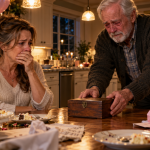
My sister tried to grab the envelope before I could finish tearing it open. “Clara, give me that!” Her voice cracked through the living room like a gunshot. I stepped backward, clutching the papers against my chest. Rebecca had never frightened me before. Not when we were little girls fighting over the same doll.
Not when she screamed at me for refusing to lend her money. Not even when she called me selfish for spending so much time caring for our mother. But the woman standing in front of me that evening was different. Her expensive black dress was wrinkled. Her lipstick had smudged.
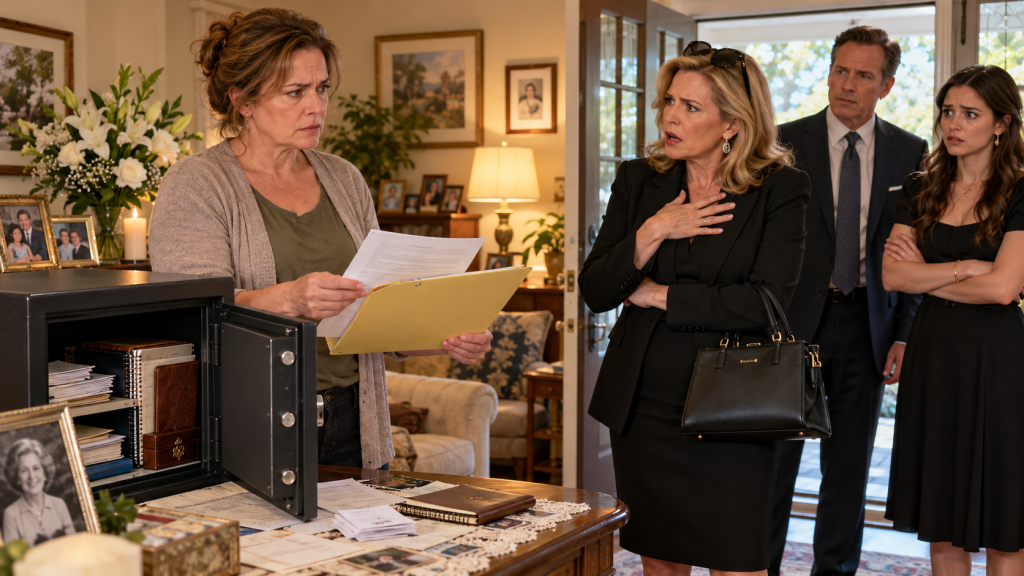
And her eyes kept moving between the envelope and the front door, as though she were calculating which escape would be easier. “Why?” I whispered. She stopped. “Why are you so afraid of what Mom wrote?” Rebecca swallowed. “Because your grief is making you unreasonable.”
I looked at the envelope.
Across the front, in my mother’s trembling handwriting, were seven words.
OPEN THIS ONLY IF REBECCA COMES FOR THE HOUSE.
My hands shook as I unfolded the first sheet.
And there, beneath the date and my mother’s signature, was a sentence that made my blood run cold.
Clara, if you are reading this, your sister has come to collect something she believes I still owe her.
I stopped breathing.
The next line was worse.
But the house is not the only thing Rebecca tried to take from me.
“Stop reading!”
Rebecca lunged forward.
Her husband, Michael, caught her arm.
“Rebecca!”
“Let go of me!”
Daniela stepped backward, her face white.
“Mom, what is happening?”
My sister spun toward her daughter.
“Daniela, go wait in the car.”
“No.”
The answer surprised everyone.
Daniela looked at me.
Then at the open safe.
Then at the yellow folder containing Mom’s will.
“I want to know what Grandma meant.”
Rebecca’s voice hardened.
“This is family business.”
Daniela stared at her.
“Grandma was my family too.”
For the first time that evening, my sister had no answer.
I looked down at the letter again.
My mother’s handwriting had always been beautiful.
Even when her arthritis worsened, she insisted on writing birthday cards herself.
She said a handwritten message carried something no store-bought card ever could.
Now the letters trembled unevenly across the page.
Some words had been corrected.
Others were faint.
But the meaning was unmistakable.
My daughter Clara,
If Rebecca comes asking about the house, please do not allow her tears to make you doubt yourself.
You have already given more than any mother should ask of her child.
I felt my throat tighten.
I know you sold your car.
I know you left your job.
I know you sometimes skipped meals because you were afraid there wouldn’t be enough money for my medicine.
Tears began sliding down my face.
I remembered those days.
The endless appointments.
The hospital parking lots.
The nights when Mom apologized for needing help.
The mornings when I sat at the kitchen table trying to decide which bill could wait.
I had never told her about the skipped meals.
Apparently, she’d noticed.
I swallowed and continued.
Rebecca believes that because she is my daughter, she is entitled to everything I own.
But she has already taken more than her share.
My eyes lifted toward my sister.
Rebecca stood completely still.
Three years ago, she persuaded me to sign documents connected to a loan for Daniela’s wedding arrangements.
She told me the paperwork would not endanger my home.
That was not true.
Daniela made a small sound.
“Mom?”
Rebecca shook her head.
“Don’t listen to this.”
I continued reading.
When the payments stopped, the bank contacted me.
I discovered my home had been placed at risk.
Clara found out and paid what she could to prevent the loss.
Rebecca promised she would reimburse her.
She did not.
My sister’s husband lowered his head.
And suddenly, I knew he had been aware of far more than he’d admitted.
I turned the page.
But there is something worse.
My hands began trembling.
Six months ago, Rebecca came with another set of papers.
She said she had found a way to settle the old debt.
She told me that signing would protect Clara from further financial problems.
I looked up.
Rebecca’s face had gone gray.
I whispered, “What papers?”
She said nothing.
I lowered my eyes.
I later learned the documents were intended to transfer ownership of my house.
I did not understand that when Rebecca first presented them.
When I refused to proceed, she became angry.
She told me Clara had manipulated me.
She said I would die soon anyway.
The words blurred.
I covered my mouth.
My mother.
The woman who had raised us.
Who made cinnamon toast every Sunday.
Who stayed awake sewing dresses when we couldn’t afford new clothes.
Who cried whenever either of us was sick.
Rebecca had looked at that woman and told her she would die soon anyway.
I couldn’t read anymore.
For a moment, I stared at the floor.
Then I whispered, “Did you say that to her?”
Rebecca’s expression hardened.
“Clara, she was confused.”
I looked up.
“Did you?”
She swallowed.
“I was frustrated.”
“Did you tell our mother she would die soon?”
Rebecca looked away.
Daniela began crying.
Michael closed his eyes.
And I knew the answer.
My voice came out strangely calm.
“You couldn’t leave a bridal shower to say goodbye to her.”
Rebecca stared at me.
“But you found time to tell her she was dying when you wanted her house.”
She opened her mouth.
I raised my hand.
“Don’t.”
The room fell silent.
Then I looked at Daniela.
Her wedding was only three weeks away.
She wore an enormous engagement ring.
Her expensive purse sat beside the sofa.
And I wondered how much of that beautiful celebration had been funded by money taken from a frightened old woman.
“Daniela,” I said gently, “did you know your grandmother’s house was collateral for the wedding loan?”
Her eyes filled.
“Mom said Grandma offered to help.”
I swallowed.
“Did you ever speak to Grandma about it?”
Daniela shook her head.
“No.”
Rebecca immediately interrupted.
“Because she didn’t need to.”
I looked at my sister.
“And why not?”
“Because I was handling everything.”
I gave a bitter laugh.
“That seems to be the problem.”
Michael finally spoke.
“Rebecca, enough.”
She turned.
“What?”
He looked pale.
“I told you this would happen.”
My heart stopped.
Rebecca stared at him.
“Michael.”
He shook his head.
“No.”
His voice trembled.
“I can’t keep pretending I knew nothing.”
I slowly turned toward him.
“What do you mean?”
He looked at the safe.
Then at the photograph of Rebecca leaving the notary’s office with Mom in a wheelchair.
“I was there that day.”
A heavy silence settled over the room.
Rebecca’s eyes widened.
“Michael, don’t.”
He looked at me.
“I drove them.”
For several seconds, nobody moved.
I stared at my brother-in-law.
“Why?”
He swallowed.
“Rebecca told me your mother wanted to update her estate documents.”
I held up the photograph.
“And did you know she was trying to transfer the house?”
His face twisted.
“Not at first.”
Rebecca laughed bitterly.
“Oh, please.”
Michael turned toward her.
“You told me it was a harmless precaution.”
She crossed her arms.
“It was.”
He shook his head.
“Then why did you make me stop at the bank afterward?”
My stomach tightened.
“The bank?”
Michael looked at me.
His eyes filled.
“Rebecca wanted to confirm whether the transfer would allow her to refinance the property.”
I felt as though the floor had disappeared.
Not only had she tried to take Mom’s home.
She had already been planning how to borrow against it.
I remembered Mom sitting at the kitchen table after that supposed trip.
She had been unusually quiet.
Her hands shook while she drank tea.
When I asked what was wrong, she said she was tired.
I made her soup.
Helped her into bed.
And never imagined she’d spent the afternoon fighting to keep her own house.
I looked toward the photograph again.
Mom in her wheelchair.
Rebecca holding the handles.
The lawyer standing beside them.
I swallowed.
“Who stopped the transfer?”
Michael looked down.
“Your mother.”
I stared.
He nodded.
“She refused to sign the final authorization.”
Rebecca snapped, “Because Clara had filled her head with nonsense.”
“No,” Michael said firmly.
“Because she read what was in front of her.”
That surprised me.
Mom had been seriously ill.
Weak.
Often exhausted.
But even at her weakest, she’d insisted on understanding important decisions.
She used to say, “Being old doesn’t mean I’ve stopped thinking.”
Now I imagined her sitting in a notary’s office, reading documents through tired eyes while her daughter pressured her to sign.
And somehow finding the strength to say no.
Tears streamed down my face.
I picked up the letter again.
There was one final paragraph.
Clara, I want you to understand that I did not change my will because Rebecca failed to attend appointments or because you cared for me.
I changed it because the house had already been put at risk, because I wanted to protect the place you fought to save, and because I wanted my wishes to be respected.
I swallowed.
Rebecca is still my daughter.
I love her.
But loving someone does not mean allowing them to take what is not theirs.
The last sentence made me sob.
And Clara, my darling girl, please promise me that after I’m gone, you will stop giving up your entire life to rescue people who refuse to take responsibility for their own choices.
I lowered the letter.
For a long time, nobody spoke.
Then Daniela whispered, “Grandma knew.”
I looked at her.
She was staring at the notebook.
Her face was wet.
“Grandma knew about all of this.”
I nodded.
“Yes.”
Daniela covered her mouth.
Then she looked at Rebecca.
“Mom, how could you?”
Rebecca began crying.
Real tears this time.
But I had learned something painful over the years.
Tears could express sorrow.
They could also express fear.
And I wasn’t going to decide which kind they were simply because Rebecca wanted me to.
My sister reached toward me.
“Clara, please.”
I stepped away.
She stopped.
“I’m your sister.”
I stared at her.
“I know.”
“We’re all we have left.”
I looked toward the framed photograph of Mom.
She was smiling in the picture.
Wearing her blue dress.
Holding a birthday cake.
Her eyes bright with laughter.
“No, Rebecca.”
My voice broke.
“We had Mom.”
Rebecca began sobbing.
I continued.
“And you chose not to be there.”
Her face crumpled.
“Please don’t say that.”
I shook my head.
“You missed her last birthday because you had a shopping appointment.”
“You missed her surgery because you were on vacation.”
“You missed the hospital when she died because Daniela was opening presents.”
Tears slipped down my cheeks.
“And you missed her funeral because facing the truth was less convenient than sending flowers.”
Rebecca looked down.
I swallowed.
“But you arrived immediately when you heard about money.”
Michael took a slow breath.
Then asked quietly, “Clara, can we see the police report?”
I looked at him.
He seemed genuinely frightened.
I turned toward the yellow folder.
Inside was a copy of the report Mom and I had made after discovering the attempted property transfer.
The report documented our concerns.
It did not mean anyone had been convicted.
It did not prove every accusation.
But it preserved what had happened.
Dates.
Names.
Documents.
Statements.
And the fact that Mom had disputed the proposed transfer.
I placed the copy on the table.
Michael looked down.
Then whispered, “I didn’t know she reported it.”
Rebecca’s head snapped toward him.
“You said you wouldn’t get involved.”
He stared at her.
“Rebecca, your mother was being pressured to sign away her home.”
She began crying harder.
“And you expect me to pretend that’s normal?”
For the first time, Daniela looked at her father differently.
“Dad, did you know the wedding money came from Grandma?”
Michael’s face tightened.
“I knew your mother had arranged financing.”
Daniela stared.
“But you didn’t ask where?”
He closed his eyes.
“I should have.”
Her voice broke.
“Dad.”
He looked at her.
“I know.”
I watched them.
A family unraveling in my living room.
Not because I had said something cruel.
But because the truth had finally entered a room that had been arranged to keep it out.
Then my sister did something unexpected.
She sat down.
Slowly.
As though her legs could no longer support her.
She looked at the floor.
And whispered, “I was afraid.”
I stared.
Of all the things I expected her to say, that wasn’t one of them.
“Afraid of what?”
She shook her head.
“Losing everything.”
Michael looked up sharply.
Rebecca wiped her eyes.
“The wedding expenses were higher than we planned.”
Daniela frowned.
“Mom, you said everything was paid for.”
Rebecca began crying.
“I thought I could manage it.”
I stared.
She continued.
“The venue.”
“The deposits.”
“The flowers.”
“The catering.”
“Everything kept getting more expensive.”
Daniela looked devastated.
“So you used Grandma’s house?”
Rebecca shook her head.
“I didn’t think it would get this bad.”
I felt anger rise.
“Rebecca, you had three years to make it right.”
She looked at me.
“You don’t understand.”
I stared.
“No.”
My voice broke.
“I understand perfectly.”
I leaned toward her.
“When Mom needed medicine, I sold my car.”
“When the loan payment came due, I emptied my savings.”
“When she needed someone to stay overnight, I slept on a chair beside her bed.”
I swallowed.
“And when you wanted a wedding nobody could afford, you decided her home was available.”
Rebecca lowered her head.
Daniela stood.
She looked at her mother.
Then whispered, “Cancel it.”
Rebecca looked up.
“What?”
“The wedding arrangements.”
My sister stared.
“Daniela…”
Her daughter shook her head.
“I don’t want any of it if Grandma was hurt to pay for it.”
The room went silent.
Rebecca began crying.
“Sweetheart, you’ve dreamed of this wedding for years.”
Daniela’s voice cracked.
“I dreamed of marrying Aaron.”
She wiped her tears.
“I didn’t dream of bankrupting my grandmother.”
I looked at my niece.
For the first time that evening, I saw the little girl I remembered.
The one who used to run through Mom’s garden catching butterflies.
The one who made handmade birthday cards.
The one who once asked Grandma to teach her how to bake lemon cake.
Somewhere beneath the expensive wedding arrangements and her mother’s expectations, that little girl still existed.
I felt my anger toward Daniela soften.
Not disappear.
But change.
Rebecca stood suddenly.
“You don’t mean that.”
Daniela looked at her.
“Yes, I do.”
She picked up her phone.
Then whispered, “I’m calling Aaron.”
My sister stared in disbelief.
“You’ll embarrass us.”
Daniela stopped.
Turned.
And said something that silenced the room.
“Mom, Grandma died thinking you cared more about money than about her.”
Her voice broke.
“I’m not going to repeat that mistake.”
Rebecca sank back onto the sofa.
And began sobbing.
I wanted to feel victorious.
I thought exposing the truth might bring some strange satisfaction.
But standing there, watching my sister collapse, I felt only exhaustion.
Because even when justice is necessary, it doesn’t always feel good.
Sometimes it feels like standing among the ruins of people you once loved and realizing none of you can return to the way things were.
I asked them to leave.
Not screaming.
Not threatening.
Simply quietly.
“I need you to go.”
Rebecca looked up.
“Clara…”
I shook my head.
“No.”
She swallowed.
“Please.”
I took a breath.
“We’ll handle the legal issues through the attorney.”
My voice trembled.
“But tonight, I need to be alone in my mother’s house.”
Michael stood.
Daniela gathered her purse.
Rebecca remained sitting.
Then she looked at the photograph of Mom.
Her expression changed.
For one moment, I saw something that resembled genuine grief.
She whispered, “I didn’t think she’d really die.”
The words made my chest tighten.
I stared.
“Rebecca, she was seventy-eight.”
My sister began crying.
“I know.”
“She’d been sick for years.”
“I know.”
I swallowed.
“Then what did you think would happen?”
Rebecca covered her face.
“I thought there would always be more time.”
For a moment, the room seemed to hold its breath.
Because beneath every selfish choice she’d made, perhaps that was the lie she’d told herself.
There would be more time.
Another weekend.
Another phone call.
Another chance to apologize.
Another opportunity to visit.
Another day to become the daughter Mom had needed.
But death doesn’t wait for convenient schedules.
And regret doesn’t return the people we’ve lost.
Rebecca stood slowly.
She looked at me.
Then whispered, “Can I take one photograph of her?”
I stared.
For a moment, I wanted to say no.
Then I looked at Mom’s smiling face.
I thought about how much she had loved both of us.
Even after everything.
I nodded.
“One.”
Rebecca approached the bookshelf.
She selected a photograph of Mom in her garden.
Wearing a straw hat.
Holding a basket of tomatoes.
She touched the frame.
Then began crying.
And for the first time that evening, I believed she was grieving something besides money.
But grief didn’t erase what she’d done.
And I was finally learning that I didn’t have to confuse compassion with surrender.
After they left, the house became silent.
I stood in the living room.
The yellow folder lay open.
The safe door remained ajar.
Mom’s notebook rested beside the photographs.
And the black dress my sister wore had left a faint perfume in the air.
I closed the front door.
Locked it.
Then leaned against it.
For a long time, I didn’t move.
Finally, I sank to the floor.
And cried.
Not elegant tears.
Not quiet tears.
The kind that make your whole body shake.
The kind that rise from a place so deep you don’t know it exists until something tears it open.
I cried for Mom.
For the years of exhaustion.
For the nights I’d spent listening to her breathe.
For the hospital hallway.
For the funeral.
For the birthday cards Rebecca never answered.
For the fact that even now, after Mom was gone, I was still the one cleaning up the damage.
Eventually, I crawled toward the sofa.
Pulled Mom’s old knitted blanket over my shoulders.
And fell asleep.
The next morning, sunlight entered through the yellow curtains.
For a moment, I forgot.
I expected to hear Mom calling from her bedroom.
“Clara, sweetheart, is there any coffee?”
I almost answered.
Then the silence reminded me.
She was gone.
I pressed my face into the blanket.
And whispered, “Good morning, Mom.”
That morning, I began reading her notebook.
Not the pages about Rebecca.
The ordinary ones.
Mom had always kept notebooks.
Shopping lists.
Recipes.
Appointments.
Little reminders.
I found notes about my childhood.
Clara lost her first tooth today.
Rebecca wants red shoes for her birthday.
Both girls fought over the blue bicycle.
I laughed through tears.
Then turned another page.
Clara stayed home when I was sick.
Rebecca sent flowers.
My throat tightened.
Another page.
Clara helped me into the shower.
Rebecca said she would visit Sunday.
Then another.
Sunday came. No Rebecca.
I closed my eyes.
The handwriting became shakier as the years passed.
And the entries grew shorter.
But the longing remained.
On one page, Mom had written:
I wonder if Rebecca knows how much I miss her.
I stared at the sentence.
Then began crying again.
Because Mom had never stopped being Rebecca’s mother.
Even when she was angry.
Even when she was hurt.
Even when she’d changed her will.
She still missed her daughter.
That afternoon, I called our attorney.
His name was Thomas Whitfield.
He’d helped Mom prepare her final estate documents.
He was a patient man in his late fifties who had known our family for years.
When he answered, I told him about the confrontation.
The envelope.
The attempted transfer.
Michael’s statements.
Daniela’s reaction.
And Rebecca’s insistence that she deserved half.
He listened carefully.
Then said, “Clara, I’m glad you preserved the documents.”
I swallowed.
“What happens now?”
He took a breath.
“First, we’ll make sure the estate is administered according to the law and your mother’s valid instructions.”
I nodded.
“And Rebecca?”
“She has the right to seek legal advice and raise any challenge she believes is supported.”
My stomach tightened.
“So she could take the house?”
“Not simply because she demands it.”
I felt a small measure of relief.
He continued.
“But we should prepare carefully, especially given the allegations involving prior transactions.”
I nodded.
“Okay.”
Then he said something important.
“Clara, don’t try to solve this by arguing with your sister.”
I closed my eyes.
“Believe me, I don’t want to.”
“Let the documents and proper process do the work.”
I spent the following week organizing everything.
Receipts.
Bank statements.
Medical records.
Loan documents.
Mom’s will.
The notebook.
The photograph.
The report.
And the letter she’d left for me.
I made copies.
Stored originals securely.
And followed the attorney’s advice.
For the first time in years, I wasn’t working to keep Mom alive.
I was working to protect the wishes she’d left behind.
It felt strange.
Lonely.
But also necessary.
A few days later, Daniela called.
I stared at the screen.
My niece.
For years, she’d been closer to her mother than to me.
She had visited Mom occasionally when she was younger, but as she grew older, the visits became less frequent.
Now she was calling.
I answered cautiously.
“Hello?”
“Aunt Clara?”
Her voice was small.
“Yes?”
“Can we talk?”
I hesitated.
“About what?”
She swallowed.
“Grandma.”
We met at a little café near the park.
Daniela arrived without makeup.
Her eyes were swollen.
Her engagement ring still glittered.
But she looked younger somehow.
Less polished.
More frightened.
She sat across from me.
Then whispered, “I didn’t know.”
I studied her.
“About the loan?”
She nodded.
“Mom told me Grandma wanted to help with the wedding.”
I looked down.
“She did love you, Daniela.”
Her eyes filled.
“I know.”
I continued.
“But she didn’t understand that she was risking her home.”
Daniela began crying.
“I feel horrible.”
I took a breath.
“Then use that feeling to make better decisions.”
She nodded.
For a long time, she stared into her coffee.
Then whispered, “Aaron and I talked.”
I looked up.
“And?”
“We’re postponing the wedding.”
I felt a pang of sympathy.
“Are you sure?”
She nodded.
“Yes.”
She wiped her eyes.
“We need to understand our finances.”
I smiled sadly.
“That’s wise.”
She swallowed.
“And we don’t want to begin our marriage pretending everything is fine when it isn’t.”
I looked at her.
For the first time, I felt hopeful.
Not because she was canceling an expensive celebration.
But because she was learning to distinguish appearances from what mattered.
Then Daniela reached into her purse.
She removed a small envelope.
My stomach tightened.
Another envelope.
After everything, I was beginning to dread them.
She placed it on the table.
“What’s this?” I asked.
She swallowed.
“Something for Grandma.”
I opened it.
Inside was a photograph.
Daniela at six years old.
Sitting beside Mom.
Both covered in flour.
They were baking cookies.
On the back, in Daniela’s childish handwriting, were the words:
GRANDMA MAKES THE BEST COOKIES.
My throat closed.
I stared.
Daniela began crying.
“I found it in an old box.”
She wiped her eyes.
“I used to love going to her house.”
I nodded.
“She loved having you.”
Daniela covered her mouth.
Then whispered, “I wish I’d gone more often.”
I looked at her.
She was twenty-eight.
Old enough to know better.
Young enough to change.
And carrying a regret that would never completely disappear.
I reached across the table.
Took her hand.
Then said gently, “You can’t change the visits you missed.”
She nodded.
“But you can decide what kind of person you want to be now.”
Her eyes filled.
She squeezed my fingers.
And for a moment, I saw Mom’s kindness in her face.
Then Daniela said something unexpected.
“Aunt Clara, there’s another thing you should know.”
My stomach tightened.
I stared.
“What?”
She looked down.
“Mom has been hiding letters.”
I froze.
“What letters?”
She swallowed.
“From Grandma.”
I felt cold.
Daniela continued.
“I found them in Mom’s dresser.”
My hands began trembling.
“Letters Mom wrote to Rebecca?”
She nodded.
“Yes.”
I swallowed.
“What did they say?”
Daniela’s eyes filled.
“She kept asking Mom to come home.”
I looked toward the window.
The world outside continued moving.
Cars passed.
People walked.
A little boy laughed beside his father.
And I sat in a café learning that Mom had reached for Rebecca again and again.
Not only through telephone calls.
Not only through messages.
But through handwritten letters.
Daniela opened her purse.
Then removed three envelopes.
She placed them on the table.
“I brought copies.”
My eyes filled.
I stared at my mother’s handwriting.
Then carefully opened the first.
Rebecca,
I know we’re not speaking much lately.
I know you’re busy.
But I miss you.
The garden is blooming.
Remember how you used to pick tomatoes before they were ripe?
I laughed thinking about it today.
Please come for lunch when you can.
Love, Mom.
I covered my mouth.
The next letter was shorter.
My dear Rebecca,
I had another appointment today.
Clara took me.
The doctors want me to rest more.
I would love to see you.
You don’t have to bring anything.
Just yourself.
Love, Mom.
The third letter was written only weeks before Mom died.
The handwriting trembled.
Rebecca,
I’m tired.
I don’t know how many good days I have left.
There are things we need to talk about.
Not money.
Not houses.
Just us.
I don’t want my last memory of you to be an argument.
Please come.
Mom.
I began sobbing.
Daniela cried too.
For several minutes, neither of us spoke.
Then I looked at her.
“Did your mother read these?”
Daniela nodded.
“Yes.”
My voice broke.
“And she didn’t go?”
She lowered her head.
“No.”
I stared at the letters.
And something inside me changed.
For days, I’d been angry because Rebecca failed to attend Mom’s funeral.
But now I understood that the funeral wasn’t the only moment she’d missed.
She had missed dozens.
Hundreds.
Small chances to repair a relationship while Mom was still alive.
And now no amount of money could buy them back.
I folded the letters carefully.
Then looked at Daniela.
“Thank you for showing me.”
She nodded.
Her eyes filled.
“Aunt Clara?”
“Yes?”
“Do you hate my mom?”
The question surprised me.
I considered.
Then answered honestly.
“I love her.”
Daniela looked up.
My throat tightened.
“But I’m very angry with her.”
She nodded.
“And I don’t trust her right now.”
Tears slipped down her cheeks.
“I understand.”
I squeezed her hand.
“Those things can all be true at once.”
Over the following months, Rebecca challenged aspects of Mom’s estate plan.
Her attorney questioned whether Mom had understood the will when she signed it.
Our attorney presented the available medical documentation.
Witness statements.
The recorded explanation Mom had provided.
And evidence showing she’d received independent advice.
The proceedings were difficult.
Emotionally exhausting.
And sometimes humiliating.
I hated discussing Mom’s health in a room full of strangers.
I hated hearing my sister suggest that the woman who insisted on doing crossword puzzles in the hospital couldn’t understand a simple property decision.
But I followed the process.
Answered questions.
And allowed the evidence to be examined.
One day, the attorney asked about my mother’s mental condition six months before her death.
I sat quietly.
Then answered.
“She was physically weak.”
He nodded.
“And confused?”
I swallowed.
“Sometimes she was tired.”
I looked toward the judge.
“But when she was rested, she knew who we were.”
“She knew where she lived.”
“She understood her finances when they were explained clearly.”
“And she knew what she wanted.”
The attorney leaned forward.
“Are you a physician?”
“No.”
I took a breath.
“That’s why the medical records and professional assessments matter.”
The room became quiet.
I wasn’t going to pretend my mother’s illness had been simple.
It hadn’t.
Some days she struggled.
Some days medication made her drowsy.
Some days she forgot what she’d eaten.
But that didn’t mean she lacked understanding at every moment.
And it didn’t give anyone permission to use her vulnerability as an opportunity.
When Rebecca testified, I watched her carefully.
She wore a gray suit.
Her hair was perfectly arranged.
Her expression serious.
She described her relationship with Mom as loving but complicated.
She admitted they’d argued.
But insisted Mom always intended to divide everything equally.
Then she said something that hurt more than I expected.
“Clara controlled access to our mother.”
I stared.
What?
Her attorney asked her to explain.
Rebecca looked toward me.
“She was always there.”
“She handled appointments.”
“She managed medications.”
“She spoke to doctors.”
Her voice trembled.
“I felt pushed out.”
For a moment, I couldn’t believe what I was hearing.
Pushed out?
I had called her repeatedly.
Begged her to come.
Offered to switch days.
Asked her to stay with Mom while I went to work.
And she had always been too busy.
Now she was telling a court that I had excluded her.
I felt tears rise.
But I remained silent.
Because this time, I wasn’t going to fight my sister with emotion alone.
Our attorney introduced selected communications.
Messages I’d preserved.
Rebecca, Mom has a specialist appointment Thursday. Can you take her?
Sorry, can’t.
Mom wants to see you this weekend.
Maybe next week.
She’s having a difficult night. Could you call her?
I’m at dinner.
Rebecca, Mom is asking for you.
Tell her I love her.
The messages were read.
One after another.
Each one felt like a small knife.
Not because they surprised me.
Because they confirmed what I’d lived through.
Then came the hospital call.
The attorney asked whether Rebecca remembered being told Mom had died.
She swallowed.
“Yes.”
“And did you attend the hospital?”
“No.”
“Why not?”
Rebecca looked down.
“My daughter’s bridal shower.”
A silence settled over the room.
She began crying.
Then whispered, “I didn’t understand how serious it was.”
I closed my eyes.
Because I had said the words clearly.
Mom died.
There was nothing left to misunderstand.
The proceedings continued.
The evidence concerning Mom’s estate plan was reviewed.
The court considered the challenge under the applicable standards.
And eventually, the will was upheld.
The house remained subject to the estate’s proper administration according to Mom’s valid instructions.
Rebecca did not receive half simply because she demanded it.
When I heard the decision, I didn’t smile.
I didn’t look at my sister.
I didn’t feel triumphant.
I simply closed my eyes.
And whispered, “Thank you, Mom.”
But the financial misconduct allegations were another matter.
The attempted property transfer and prior loan raised separate questions.
The relevant authorities continued reviewing the documents.
Investigators examined the circumstances.
Records from the lender and notary.
Statements.
Signatures.
Communications.
And financial transactions.
The investigation didn’t unfold like a movie.
There were no dramatic confessions in dark rooms.
No sudden discovery that solved everything overnight.
There were interviews.
Requests for documents.
Delays.
And complicated questions about who knew what and when.
Eventually, evidence supported legal action concerning the disputed attempted transfer and related representations.
Rebecca faced serious consequences.
Some matters were resolved through legal agreements.
Others required additional proceedings.
There were obligations to address documented losses where legally established.
And the future was no longer something she could control through intimidation.
For the first time in her adult life, my sister couldn’t simply cry, demand sympathy, and expect everyone else to absorb the damage.
She had to answer for her decisions.
Daniela’s wedding was postponed for nearly a year.
During that time, she and Aaron reorganized their finances.
Canceled unnecessary expenses.
Found a smaller venue.
And began planning the kind of marriage they could actually afford.
One afternoon, Daniela visited me.
She sat at Mom’s kitchen table.
The same table where she’d eaten cookies as a little girl.
She looked around.
Then smiled sadly.
“I miss her.”
My throat tightened.
“Me too.”
She touched the table.
“Do you remember how Grandma used to let us decorate cookies?”
I laughed softly.
“She let you put so much frosting on them they couldn’t dry.”
Daniela smiled.
“Mom hated the mess.”
I laughed.
“Grandma loved it.”
Her eyes filled.
Then she whispered, “I wish she’d seen me get married.”
My throat tightened.
I reached for her hand.
“I know.”
Daniela looked down.
Then said something that surprised me.
“Aunt Clara, would you come to the wedding?”
I stared.
“Of course.”
She smiled through tears.
Then swallowed.
“And…”
I waited.
“Would you sit in Grandma’s place?”
My eyes filled.
I looked at her.
She continued.
“I know nobody can replace her.”
Her voice broke.
“But you were the one who stayed with her.”
I covered my mouth.
Daniela began crying.
“And I think she’d want you there.”
I couldn’t speak for a moment.
Then I reached across the table.
Took my niece’s hand.
And whispered, “I’d be honored.”
The wedding was held the following spring.
A small garden ceremony.
White flowers.
Simple decorations.
A modest cake.
And a bride who looked happier than she had at the expensive bridal shower that kept her mother away from Grandma’s deathbed.
Daniela walked down the aisle holding a small bouquet.
Her eyes filled when she saw Aaron.
He smiled.
And I remembered what she’d said months earlier.
I dreamed of marrying Aaron.
Not impressing strangers.
Not throwing the most extravagant party.
Not proving anything.
Just marrying the man she loved.
When the ceremony ended, Daniela approached me.
She was crying.
“Aunt Clara.”
I stood.
She hugged me.
Then whispered, “I wish Grandma were here.”
My throat tightened.
I kissed her cheek.
“She would’ve loved seeing you happy.”
I wore Mom’s pearl earrings that day.
Not because they were expensive.
They weren’t.
She bought them years earlier at a little jewelry shop after saving for months.
She wore them to weddings.
Graduations.
And special family dinners.
That afternoon, as I watched Daniela dance, I touched one of the pearls.
And whispered, “She’s here in the ways that matter.”
Rebecca attended the wedding.
She looked older.
Thinner.
Quieter.
Her relationship with Daniela had changed.
There was still love.
But also boundaries.
And difficult conversations.
I watched them speak briefly after the ceremony.
Rebecca hugged her daughter.
Daniela hugged her back.
Then they separated.
No dramatic reconciliation.
No public scene.
Just two people trying to understand what their relationship would become.
Near the end of the reception, Rebecca approached me.
I was standing beside the garden.
The evening lights glowed softly.
Music drifted through the air.
She stopped a few feet away.
“Clara?”
I turned.
“Rebecca.”
For a moment, neither of us spoke.
Then she looked toward the reception.
“Daniela looks beautiful.”
I nodded.
“Yes.”
Her eyes filled.
“Mom would’ve loved this.”
My throat tightened.
“She would.”
Rebecca swallowed.
Then whispered, “I keep thinking about the hospital.”
I looked at her.
She continued.
“The call.”
“The music.”
“The way you said Mom died.”
Her voice broke.
“I remember every word now.”
I said nothing.
She looked down.
“And I keep wondering why I didn’t leave.”
My chest tightened.
Finally, I answered.
“I’ve wondered that too.”
She began crying.
For a moment, she looked exactly like the sister I remembered from childhood.
The girl who hid under the bed during thunderstorms.
The girl who cried when our father died.
The girl who used to braid my hair when Mom worked late.
But the woman in front of me had also made choices that harmed our mother.
I couldn’t forget one truth simply because I remembered another.
Rebecca wiped her eyes.
“Clara, I know I hurt you.”
I looked down.
She continued.
“And Mom.”
Her voice broke.
“I don’t expect you to forgive me.”
I took a breath.
“Good.”
She looked up.
The word had surprised her.
I swallowed.
“Because I’m not ready.”
Tears slipped down her face.
She nodded.
“I understand.”
We stood quietly.
Then I said something I’d been carrying for months.
“Rebecca, Mom waited for you.”
Her face crumpled.
I continued.
“Every Sunday.”
“Every birthday.”
“Every hospital admission.”
“She asked if you’d called.”
“She kept thinking you’d come.”
Rebecca began sobbing.
I swallowed.
“And the last week, when she could barely speak, she still whispered your name.”
My sister covered her face.
I looked toward the garden lights.
Then back at her.
“She loved you.”
My voice broke.
“Even after everything.”
Rebecca’s shoulders shook.
I continued.
“But she needed you to love her in ways she could feel.”
For a long time, Rebecca couldn’t speak.
Then she whispered, “I was a terrible daughter.”
I took a breath.
“I think you made terrible choices.”
She looked up.
I continued.
“What you do next is up to you.”
She nodded slowly.
Then looked toward the sky.
“I can’t change what I did.”
“No.”
“I can’t bring her back.”
“No.”
She began crying again.
Then whispered, “What can I do?”
I thought carefully.
Then answered.
“Stop lying.”
She stared.
I continued.
“Stop blaming everyone else.”
“Stop treating relationships like things you can manage with money.”
“And stop expecting forgiveness to arrive simply because you want relief from guilt.”
Rebecca lowered her head.
I swallowed.
“Start there.”
She nodded.
Then walked away.
And for the first time, I didn’t feel responsible for making her feel better.
Months passed.
The estate matters became more settled.
The house remained mine according to Mom’s wishes, subject to the ordinary responsibilities of ownership and any remaining obligations.
I made careful plans.
Not extravagant ones.
I paid necessary expenses.
Set aside funds for maintenance.
And considered returning to work part-time.
For five years, my life had revolved around Mom’s care.
Now I was forty-nine.
Living alone.
And unsure what to do with mornings that no longer began with medication schedules.
At first, the freedom felt unbearable.
I would wake early.
Make coffee.
Then stand in the kitchen wondering what I had forgotten.
No blood sugar checks.
No appointment reminders.
No folded towels outside Mom’s bathroom.
No soft voice calling my name.
Just silence.
I had thought the hardest part would be watching Mom die.
But sometimes, the hardest part was learning how to live afterward.
One morning, I found myself standing outside her bedroom.
The door was half open.
Her slippers were still beside the bed.
Her favorite blue sweater hung over the chair.
I had avoided changing anything.
Part of me believed moving her things would mean accepting she was gone.
I stepped inside.
Sat on the edge of the bed.
And began crying.
After a while, I looked toward the window.
Mom loved morning sunlight.
She always said it made the room feel hopeful.
I stood.
Opened the curtains.
And let the light enter.
Then I whispered, “Mom, I don’t know what to do now.”
The room remained quiet.
But I remembered her letter.
Please promise me that after I’m gone, you will stop giving up your entire life to rescue people who refuse to take responsibility for their own choices.
I closed my eyes.
Then whispered, “I’m trying.”
That afternoon, I called an old friend.
Her name was Helen.
We had worked together years earlier.
Before Mom became too ill for me to continue my job.
Helen answered immediately.
“Clara?”
I smiled through tears.
“Hi.”
She sounded delighted.
“Oh, my goodness. How are you?”
I swallowed.
“I’m trying to figure that out.”
Her voice softened.
“I heard about your mom.”
I nodded.
“Thank you.”
She paused.
Then said, “Would you like to have lunch?”
I stared.
Lunch.
Such a small thing.
I hadn’t had a leisurely lunch with a friend in years.
I felt tears rise.
Then smiled.
“Yes.”
We met the following week.
Helen hugged me outside the restaurant.
She didn’t ask for every painful detail.
Didn’t demand that I explain my family drama.
She simply sat beside me.
Ordered coffee.
And listened.
At one point, she asked, “What do you want to do now?”
I stared.
The question felt unfamiliar.
What did I want?
For years, I’d known what Mom needed.
When her appointments were.
Which medications had to be refilled.
How much money remained.
What meals she could tolerate.
But what did I want?
I looked down.
Then whispered, “I don’t know.”
Helen smiled gently.
“Then maybe that’s where you start.”
I began slowly.
Walking in the mornings.
Reading novels I’d neglected.
Taking a weekend trip with friends.
Returning to work part-time.
And eventually volunteering with an organization that supported family caregivers.
I didn’t pretend to be an expert.
I simply knew what it felt like to spend years taking care of someone you loved.
I knew the exhaustion.
The isolation.
The strange guilt that came with wanting one afternoon to yourself.
And the grief that followed even when you’d given everything you could.
During my first volunteer session, a woman approached me.
She looked exhausted.
Perhaps fifty.
She said she’d been caring for her father for three years.
Her siblings rarely helped.
She was angry.
Ashamed of being angry.
And terrified she’d regret every impatient thought when her father died.
I listened.
Then said something I wish someone had told me earlier.
“You’re allowed to need help.”
Her eyes filled.
She whispered, “But he’s my dad.”
I nodded.
“And you’re still a person.”
She began crying.
I thought about Mom.
Her letter.
The nights when I was too tired to eat.
The way I’d convinced myself that accepting help would mean I wasn’t a good daughter.
And I realized that part of honoring Mom meant refusing to repeat every painful habit that had nearly consumed me.
Over time, I found purpose in those conversations.
Not because Mom’s illness had been a blessing.
It hadn’t.
I would have given anything for more healthy years with her.
But because I could use what I’d learned to help someone else feel less alone.
One afternoon, Daniela visited with a box.
She placed it on the kitchen table.
“Aunt Clara?”
I smiled.
“Yes?”
“I found something while going through Mom’s old things.”
My stomach tightened.
After everything, I still felt uneasy whenever anyone arrived carrying papers.
I looked at the box.
“What is it?”
Daniela smiled sadly.
“Grandma’s recipes.”
My heart stopped.
Inside were index cards.
Yellowed.
Stained.
Covered in Mom’s handwriting.
Lemon cake.
Chicken soup.
Cinnamon rolls.
Sweet bread.
The holiday stuffing she made every December.
I stared.
“Where did you find these?”
Daniela smiled.
“Grandma gave some to Mom years ago.”
My eyes filled.
She continued.
“I thought you should have copies.”
I touched a card.
Mom had written little notes in the margins.
Add more cinnamon if Clara is visiting.
I began crying.
Daniela laughed softly.
“She knew you loved cinnamon.”
I smiled through tears.
“Yes.”
We spent that afternoon baking.
Daniela put too much flour in the bowl.
I forgot to preheat the oven.
We laughed.
Then cried.
Then laughed again.
When the lemon cake finally came out, it was slightly uneven.
The frosting slid down one side.
Mom would’ve laughed.
I could almost hear her.
Clara, sweetheart, it doesn’t have to look perfect to taste good.
Daniela cut two slices.
We sat at the kitchen table.
Then she looked toward Mom’s photograph.
“Grandma would’ve liked this.”
My throat tightened.
“Yes.”
I smiled.
“She would’ve.”
Over the next few years, Daniela became a regular visitor.
She brought groceries occasionally.
Helped organize old photographs.
Joined me at Mom’s grave.
And sometimes simply came for coffee.
We didn’t pretend she had been close to Mom at the end.
She hadn’t.
But she was making an effort to remember her honestly.
And I appreciated that.
Rebecca’s life changed too.
Her marriage became strained.
Michael had difficulty rebuilding trust after the financial deception.
They sought counseling.
Some things improved.
Others didn’t.
Their relationship was no longer something they could maintain through appearances alone.
Rebecca found work after years of relying on arrangements that left her less financially independent than she’d realized.
She began addressing debts.
Following the obligations imposed through the legal process.
And taking responsibility for matters she had previously avoided.
It wasn’t easy.
But for the first time, she was doing work that couldn’t be delegated to someone else.
We remained distant.
Sometimes she called.
Sometimes I answered.
Sometimes I didn’t.
I stopped explaining myself every time I needed space.
And slowly, I learned that boundaries didn’t make me cruel.
They made relationships clearer.
One Christmas, Rebecca asked whether she could visit Mom’s grave with me.
I considered.
Then agreed.
We met at the cemetery.
The air was cold.
The grass damp.
Rebecca carried a bouquet of white roses.
I brought Mom’s favorite yellow flowers.
For a moment, we stood beside the headstone without speaking.
Then Rebecca knelt.
Placed the roses.
And whispered, “Hi, Mom.”
Her voice broke.
“I know I’m late.”
I closed my eyes.
Tears rose immediately.
Rebecca continued.
“I keep thinking about all the times you asked me to come.”
She began crying.
“I thought there would always be another day.”
Her shoulders shook.
“I’m sorry.”
I stood quietly.
Not trying to comfort her.
Not trying to stop her tears.
Because this was something she needed to face.
And I couldn’t face it for her.
After a while, Rebecca stood.
She looked at me.
Her eyes were swollen.
“Clara?”
I nodded.
“Yes?”
“Do you think she forgave me?”
The question hurt.
I looked toward the headstone.
Then answered honestly.
“I don’t know.”
Rebecca lowered her head.
I continued.
“But I know she loved you.”
Her eyes filled.
“And I know she wanted you to become someone who didn’t keep hurting the people who cared about you.”
Rebecca began crying again.
Then nodded.
We stood quietly.
After a few minutes, she asked, “Could we have coffee sometime?”
I considered.
Then said, “Maybe.”
She nodded.
“I understand.”
I looked at her.
“Rebecca, I need you to know that rebuilding trust will take time.”
Her eyes filled.
“I know.”
“And it may never look like it did before.”
She swallowed.
“I understand.”
I nodded.
“Then we’ll see.”
It wasn’t a reconciliation.
Not yet.
But it was an honest beginning.
And that mattered.
The fifth anniversary of Mom’s death arrived quietly.
I woke early.
Made coffee.
Then walked into her bedroom.
It was no longer arranged exactly as she’d left it.
I’d turned it into a small reading room.
Bookshelves.
A comfortable chair.
A desk.
And photographs of family.
But I kept her blue sweater folded in a drawer.
And her favorite lamp beside the window.
I sat in the chair.
Opened her notebook.
And read the first pages again.
Not the accusations.
Not the legal concerns.
The ordinary moments.
Clara made soup today.
Daniela called.
The roses are blooming.
I hope Rebecca visits.
Then I turned to the final entry.
It was dated two weeks before she died.
The handwriting was uneven.
But the words were clear.
I am tired.
Clara was here all night.
She thinks I don’t notice how exhausted she is.
I do.
I wish I could give her back the years she spent taking care of me.
But I hope she knows they were not wasted.
Every day she stayed, she made me feel loved.
I covered my mouth.
Tears streamed down my face.
Then I read the last sentence.
Now I want her to go live.
I sat there for a long time.
Then closed the notebook.
And whispered, “Okay, Mom.”
That afternoon, I made a decision.
Not about money.
Not about Rebecca.
Not about the house.
About myself.
I registered for a class I’d wanted to take for years.
Creative writing.
I’d always loved stories.
As a child, I wrote little plays for Mom to watch in the living room.
She would sit on the sofa, applauding as though I were performing on Broadway.
When I grew older, life became practical.
Work.
Bills.
Family obligations.
Then caregiving.
The dream of writing faded into the background.
But now, sitting in Mom’s house, I remembered the little girl who once wanted to tell stories.
And I thought perhaps it wasn’t too late.
The first day of class, I was nervous.
Everyone seemed younger.
More confident.
I sat near the back.
Opened my notebook.
And listened.
The instructor asked us to write about a moment that changed our lives.
I stared at the blank page.
Then wrote the first sentence.
My sister didn’t come when our mother died, but she came when she heard about the inheritance.
I stopped.
Looked at the words.
And began crying.
The instructor approached quietly.
“Are you all right?”
I wiped my eyes.
“Yes.”
I smiled sadly.
“I think I found my story.”
I wrote slowly.
Over weeks.
Then months.
Not simply about betrayal.
But about Mom.
Her garden.
Her recipes.
The little songs she hummed while washing dishes.
The way she folded towels.
The kindness of neighbors who brought food.
The loneliness of caregiving.
The exhaustion.
The love.
And the complicated truth that sometimes the people closest to us are also the ones who hurt us most.
I wrote about Rebecca.
Not to humiliate her.
But to understand what had happened.
I described the phone call.
The bridal shower.
The funeral.
The wreath.
The yellow folder.
The safe.
The letter.
And the night my sister stood in our mother’s living room demanding half.
I also wrote about myself.
The years I’d spent believing I had to take care of everyone.
The resentment I rarely admitted.
The exhaustion I carried.
And the way I confused being needed with being valuable.
When I finished the first draft, I read it aloud in class.
My hands shook.
My voice broke several times.
But I kept going.
When I finished, the room was silent.
Then one woman began crying.
Another reached for a tissue.
And the instructor said gently, “Thank you for trusting us with that.”
After class, a woman approached.
Her name was Margaret.
She was caring for her father.
Her siblings lived nearby but rarely visited.
She looked at me.
Then whispered, “I thought I was the only one who felt angry while caring for someone I loved.”
My throat tightened.
I took her hand.
“No.”
I smiled sadly.
“You’re not.”
That moment changed something inside me.
For years, I’d thought my experience was simply a private family tragedy.
But now I saw that many people carried similar burdens.
The caregiver who was always expected to show up.
The sibling who disappeared when work became difficult.
The elderly parent who feared becoming a burden.
The family that confused inheritance with entitlement.
And the grief that arrived after years of exhaustion.
I decided to keep writing.
One evening, Daniela came over and found me at the desk.
She smiled.
“What are you working on?”
I hesitated.
Then said, “A story.”
Her eyes brightened.
“Can I read it?”
I looked at the pages.
Then at her.
“Maybe when it’s finished.”
She nodded.
“Okay.”
Then she smiled sadly.
“Is it about Grandma?”
I swallowed.
“Yes.”
Her eyes filled.
“Good.”
I looked up.
She continued.
“People should know what kind of woman she was.”
I smiled through tears.
“Yes.”
“They should.”
Years passed.
I kept the house.
Maintained it carefully.
And filled it with ordinary life.
Friends came for dinner.
Daniela brought her children.
Neighbors stopped by.
The garden bloomed.
And the old safe remained in the closet.
But I changed what I kept inside.
The financial documents were still there, properly organized.
But beside them, I placed something else.
Mom’s recipes.
The photograph of her in the garden.
A copy of the final letter.
And a small notebook filled with stories about her life.
Because I didn’t want the safe to become a monument to betrayal.
I wanted it to preserve the person we’d almost forgotten while fighting over what she owned.
One Sunday, Daniela visited with her little daughter.
Her name was Lily.
She was five.
Curious.
Full of questions.
She ran into the kitchen.
“Aunt Clara!”
I laughed.
“Hello, sweetheart.”
She climbed onto a chair.
Then spotted Mom’s photograph on the shelf.
“Who’s that?”
I smiled.
“Your great-grandmother.”
Lily studied the picture.
“She looks nice.”
My eyes filled.
“She was.”
Lily tilted her head.
“Did she like cookies?”
I burst out laughing.
“Oh, sweetheart.”
I smiled through tears.
“She loved them.”
That afternoon, Daniela and I baked lemon cookies using Mom’s recipe.
Lily spilled flour.
Got frosting on her nose.
And laughed so loudly I could almost hear Mom laughing with her.
At one point, Lily looked up.
“Did Great-Grandma teach you this?”
I nodded.
“Yes.”
She smiled.
“Then I’m learning from her too.”
My throat closed.
I looked at Daniela.
She was crying.
And suddenly, the years we’d lost felt less final.
Because Mom’s love was still traveling through our family.
Not through money.
Not through property.
But through small things.
Recipes.
Stories.
Kindness.
And the way we chose to treat one another.
One evening, after Daniela and Lily left, I walked into the living room.
The house was quiet.
Mom’s photograph sat on the mantel.
I picked it up.
Then smiled.
“Look at us, Mom.”
My voice trembled.
“Still making your cookies.”
I laughed softly.
“Still making a mess.”
Then I whispered, “I miss you.”
I sat on the sofa.
Held the photograph.
And allowed myself to cry.
Not because I was lonely in the same way I had been after her death.
But because grief doesn’t end simply because life becomes beautiful again.
Sometimes happiness makes you miss someone more.
Because you wish they were there to see it.
One autumn afternoon, Rebecca called.
It had been several months since we’d spoken.
I answered cautiously.
“Hello?”
“Clara?”
Her voice sounded nervous.
“Yes?”
“Would you meet me for coffee?”
I considered.
Then nodded.
“All right.”
We met at a little café near the park.
Rebecca arrived early.
She looked older.
Her expensive purse was gone.
She wore a simple sweater.
Her hair was shorter.
She stood when I approached.
“Hi.”
I nodded.
“Hello.”
We sat.
For a while, neither of us spoke.
Then Rebecca reached into her bag.
My stomach tightened.
Another envelope.
I almost laughed.
It seemed our family had spent years delivering painful truths in paper form.
She placed it on the table.
“I want you to have this.”
I looked down.
“What is it?”
She swallowed.
“A letter.”
I stared.
“From whom?”
Her eyes filled.
“Me.”
I hesitated.
Then opened it.
The handwriting was neat.
Careful.
The first line made my throat tighten.
Clara,
I owe you more than an apology.
I looked up.
Rebecca was crying.
I continued.
For years, I treated your care for Mom as something convenient.
I told myself you were naturally better at it.
That you had more patience.
That you didn’t mind.
But the truth is that I let you carry what I didn’t want to face.
My eyes filled.
I was afraid of seeing Mom become weak.
I was afraid of hospitals.
I was afraid of death.
And instead of admitting that fear, I made excuses.
I swallowed.
Then I made choices that hurt her financially and emotionally.
I wanted a life that looked successful.
I wanted Daniela’s wedding to impress people.
I wanted to appear generous without making the sacrifices generosity requires.
Tears slipped down my cheeks.
I used Mom’s love as something I could borrow against.
And when she needed me, I wasn’t there.
I stopped reading.
Rebecca looked down.
Her hands trembled.
Then I continued.
I cannot return the time.
I cannot change the hospital call.
I cannot attend the funeral I missed.
I cannot make Mom hear the apology I was too proud to give while she lived.
But I can stop pretending I was treated unfairly.
I can fulfill my legal responsibilities.
I can rebuild my relationships without demanding immediate forgiveness.
And I can try to become someone who honors Mom through her actions, not through the inheritance she left.
I closed my eyes.
The final lines blurred.
Clara, I am sorry.
Not because I lost the house.
Because I lost sight of what mattered while our mother was still alive.
Rebecca.
I folded the letter.
For a long time, I didn’t speak.
Rebecca sat across from me.
Waiting.
Finally, I whispered, “Thank you for writing this.”
Her eyes filled.
She nodded.
“I meant every word.”
I looked at her.
“I hope so.”
She swallowed.
“I know I have to show you.”
I nodded.
“Yes.”
Then Rebecca asked something that surprised me.
“Could you tell me about Mom’s last days?”
I stared.
For years, I’d wanted her to ask.
I’d wanted her to care.
I’d wanted someone to share the memories I’d carried alone.
Now she sat across from me, looking frightened.
And I realized that even after everything, I still needed to talk about Mom.
I took a breath.
“Yes.”
Rebecca’s eyes filled.
“Please.”
I told her about the hospital room.
The blue curtain.
The machines.
The way Mom asked for water even when she couldn’t drink much.
The little jokes she made with the nurses.
The afternoons when she watched sunlight move across the wall.
And the final night.
Rebecca began crying.
I continued.
“Mom was tired.”
“She’d been fighting for weeks.”
“Sometimes she was confused.”
“But that night, she knew I was there.”
I swallowed.
“She held my hand.”
Rebecca covered her mouth.
“And she asked about you.”
My sister began sobbing.
I closed my eyes.
“She whispered your name.”
I took a breath.
“And I told her I loved her.”
My voice broke.
“I told her she could rest.”
Rebecca leaned forward.
Her shoulders shaking.
“Did she suffer?”
The question hurt.
I considered.
Then answered carefully.
“She was very ill.”
I swallowed.
“But the team worked to keep her comfortable.”
Rebecca nodded through tears.
I continued.
“And I stayed with her.”
She covered her face.
For several minutes, neither of us spoke.
Then Rebecca whispered, “Thank you.”
I looked up.
“For what?”
“For being there when I wasn’t.”
My throat tightened.
I stared at her.
Then nodded.
“Someone needed to be.”
She lowered her head.
“I know.”
That conversation didn’t erase the past.
It didn’t return Mom.
It didn’t make Rebecca’s choices harmless.
But it was the first time my sister had listened to the story of our mother’s final days without trying to defend herself.
And that mattered.
Afterward, we began meeting occasionally.
Coffee.
A walk.
Sometimes lunch.
We didn’t immediately become close again.
Some days old resentment returned.
Sometimes a careless comment hurt.
Sometimes I needed distance.
But Rebecca began respecting that.
She stopped demanding.
Stopped assuming.
And gradually learned to ask rather than take.
One afternoon, she visited the house.
Not to discuss property.
Not to inspect the safe.
Just to see Mom’s garden.
She stood beside the roses.
Then whispered, “I forgot how much she loved these.”
I nodded.
“She spent hours out here.”
Rebecca touched a leaf.
Then smiled sadly.
“She used to make us pull weeds.”
I laughed.
“And you always pretended you had a stomachache.”
Rebecca began laughing through tears.
“I did.”
I grinned.
“And Mom knew.”
She looked at me.
“Of course she did.”
We laughed.
And for one brief moment, we were little girls again.
Before the resentment.
Before money.
Before hospitals.
Before the years of missed visits.
Just two sisters standing in our mother’s garden.
Then Rebecca grew quiet.
“Clara?”
I looked at her.
“Yes?”
“Do you think we could ever be sisters again?”
My throat tightened.
I considered.
Then answered honestly.
“We already are.”
Her eyes filled.
I continued.
“But being sisters doesn’t automatically mean we know how to treat each other well.”
She nodded.
I smiled sadly.
“We’re going to have to learn.”
Rebecca began crying.
Then whispered, “I’d like that.”
I nodded.
“Me too.”
On the tenth anniversary of Mom’s death, we gathered in the garden.
Not a large event.
Just family.
Friends.
Neighbors.
Daniela.
Her husband.
Their children.
Rebecca.
Michael.
And a few people who remembered Mom from the pharmacy, the bakery, and the neighborhood.
Mr. Julian, the baker who once brought flowers to her funeral, arrived carrying sweet bread.
His hair had turned almost completely white.
He smiled when he saw me.
“Clara.”
I hugged him.
“Mr. Julian.”
He looked toward Mom’s photograph.
Then sighed.
“She loved the cinnamon rolls.”
I laughed softly.
“She did.”
He smiled.
“Always asked for the ones with extra icing.”
My eyes filled.
“Yes.”
We placed Mom’s photograph on a little table beneath the roses.
Beside it were her favorite flowers.
A bowl of lemons from the tree she planted.
And a plate of the cookies she taught us to make.
I looked around.
People were talking.
Laughing.
Sharing memories.
And for the first time, the anniversary of her death felt less like reopening a wound and more like honoring a life.
Rebecca approached carrying a small wooden box.
I looked at her.
“What’s that?”
She smiled nervously.
“Something I found.”
My stomach tightened slightly.
She noticed.
Then laughed sadly.
“Don’t worry. No property documents.”
I smiled.
“Good.”
She opened the box.
Inside were old photographs.
Us as children.
Mom holding us at the beach.
Our father standing beside a Christmas tree.
Rebecca and me wearing matching dresses.
I gasped.
“Where did you get these?”
Rebecca smiled.
“I found them in storage.”
My eyes filled.
She continued.
“I thought they belonged here.”
I looked at her.
Then whispered, “Thank you.”
She nodded.
We began arranging the photographs beside Mom’s picture.
For a while, we didn’t speak.
Then Rebecca held up one photograph.
It showed us sitting on Mom’s lap.
I was perhaps five.
Rebecca eight.
We were laughing.
Mom had her arms wrapped around both of us.
Rebecca stared at it.
Then whispered, “She really loved us.”
My throat tightened.
“Yes.”
I took the photograph.
“She did.”
Later, when everyone gathered, I stood beside the roses.
I hadn’t prepared a speech.
But suddenly, I wanted to say something.
I looked toward the people who had known Mom.
Then began.
“Thank you all for coming.”
My voice trembled.
“Ten years ago, we lost a woman who meant something different to each of us.”
I looked toward Mr. Julian.
“To some, she was a neighbor.”
“To others, a customer.”
“A friend.”
“A grandmother.”
I looked toward Rebecca.
“And to us, she was Mom.”
My throat tightened.
I continued.
“She wasn’t perfect.”
“None of us are.”
“But she was generous.”
“Stubborn.”
“Funny.”
“And incredibly loving.”
I smiled through tears.
“She believed food could solve most problems.”
Everyone laughed.
“She was probably wrong about that.”
More laughter.
“But she kept trying anyway.”
I looked toward the house.
Then said quietly, “After Mom died, our family went through a painful time.”
The garden became still.
I continued.
“We argued.”
“We made mistakes.”
“And we had to learn that love doesn’t excuse harm.”
I swallowed.
“But we also learned that remembering someone isn’t about fighting over what they left behind.”
My eyes filled.
“It’s about carrying forward what was good in them.”
I looked toward Rebecca.
She was crying.
Then I smiled sadly.
“And Mom gave us more good things than we can count.”
When I finished, everyone applauded softly.
I stepped down.
Rebecca approached.
For a moment, she hesitated.
Then opened her arms.
I looked at her.
And this time, I hugged her.
Not because everything had been forgotten.
But because over the years, she’d worked to become someone I could welcome into my life again.
She whispered, “Thank you.”
I closed my eyes.
“For what?”
“For giving me time to change.”
My throat tightened.
I pulled back.
Then said gently, “You did the changing.”
She smiled through tears.
“Yes.”
Then whispered, “But you gave me the chance.”
We stood together.
Two sisters.
Older.
Wiser.
Still imperfect.
But finally able to share a memory of our mother without turning it into a battle.
That evening, after everyone left, I sat alone in the garden.
The lights glowed softly.
The air smelled of roses.
Mom’s photograph rested on the table.
I picked it up.
Then smiled.
“You would’ve liked today.”
My voice trembled.
“Everybody came.”
I laughed softly.
“Even Mr. Julian brought the extra icing.”
Tears filled my eyes.
Then I whispered, “I hope you’re proud of us.”
For a long time, I sat quietly.
Thinking about the hospital.
The phone call.
Rebecca’s voice over the music.
The funeral.
The expensive black dress.
The demand for half.
The yellow folder.
The safe.
And the letter that changed everything.
At the time, I believed the story was about inheritance.
Who deserved the house.
Who would receive the money.
Who had legal rights.
And who had sacrificed more.
But years later, I understood that the deeper story was about something money could never measure.
Presence.
Mom didn’t need expensive flowers.
She didn’t need extravagant promises.
She didn’t need someone to arrive after her death wearing black and declaring how much they’d suffered.
She needed someone to sit beside her when she was frightened.
To bring water.
To help her stand.
To listen when she repeated stories.
To answer when she called.
And to remember that even when her body grew weak, she was still a person deserving dignity.
I had been there.
Not perfectly.
Not without frustration.
Not without exhaustion.
But I had stayed.
And I learned that staying matters.
Sometimes more than grand gestures.
Sometimes more than beautiful words.
And certainly more than promises made after the chance to fulfill them has passed.
But I also learned something about myself.
I had spent years believing I had to carry everything because I was the responsible daughter.
The dependable one.
The one who could handle anything.
And that belief nearly destroyed me.
Mom’s final gift wasn’t simply the house.
It was permission.
Permission to rest.
To rebuild.
To have a life beyond caregiving.
To stop rescuing people from consequences they refused to face.
And to understand that taking care of myself wasn’t a betrayal of the woman I’d loved so deeply.
I looked toward the house.
The windows glowed warmly.
The garden was blooming.
The safe remained in the closet.
But I no longer thought about it with fear.
Inside were documents.
Letters.
Photographs.
And memories.
Not treasures measured only in money.
But pieces of a life.
I thought about Rebecca too.
The sister who failed us.
The woman who arrived demanding half.
The daughter who ignored Mom’s final calls.
And the person who eventually faced her choices and began changing.
I didn’t excuse what she’d done.
I never would.
But I was grateful that our family didn’t have to remain frozen in the worst moment of its history.
People can change.
Not because someone forgives them automatically.
Not because tears erase consequences.
But because they choose to stop repeating harmful behavior.
And because they accept that rebuilding trust requires time and consistent action.
Rebecca had learned that.
Slowly.
Painfully.
And imperfectly.
But she’d learned.
As for me, I learned that love can survive without surrender.
That boundaries can coexist with compassion.
And that honoring someone who’s gone means living in a way that reflects the best of what they taught us.
One evening, years later, Daniela’s daughter Lily came to visit.
She was older now.
Curious.
Always asking questions.
She found Mom’s notebook on the shelf.
“Aunt Clara?”
I smiled.
“Yes?”
“What’s this?”
I looked toward the notebook.
My heart tightened.
“Your great-grandmother wrote in it.”
Lily’s eyes widened.
“Can I read it?”
I considered.
Then gently took it from her.
“Some parts are private.”
She nodded.
“But I can tell you stories about her.”
Lily smiled.
“Really?”
“Of course.”
We sat on the sofa.
I told her about Mom’s garden.
Her cinnamon rolls.
The way she laughed so hard she’d wipe tears from her cheeks.
The songs she sang while cooking.
The terrible jokes she repeated every Christmas.
Lily laughed.
Then asked, “Was she nice?”
My eyes filled.
“Yes.”
“She was.”
Lily considered.
Then asked, “Did she love everyone?”
I smiled sadly.
“She tried.”
My throat tightened.
“She loved her family very much.”
Lily nodded.
Then whispered, “I wish I met her.”
I took her hand.
“Me too.”
Later, Lily asked why Mom’s photograph was beside the old safe.
I smiled.
“Because she left us things she wanted protected.”
Lily looked curious.
“Like money?”
I laughed softly.
“Some money.”
She tilted her head.
“What else?”
I looked toward the photograph.
Then answered.
“Her stories.”
“Her recipes.”
“Her wishes.”
“And reminders about what matters.”
Lily smiled.
Then said something beautifully simple.
“Those sound better than money.”
I began crying.
Then laughed.
“Yes, sweetheart.”
“They do.”
That night, after Lily left, I opened the safe.
I took out Mom’s letter.
The one marked in red ink.
OPEN THIS ONLY IF REBECCA COMES FOR THE HOUSE.
I unfolded it.
Read the final paragraph.
And felt the same familiar ache.
Clara, please promise me that after I’m gone, you will stop giving up your entire life to rescue people who refuse to take responsibility for their own choices.
I smiled through tears.
Then whispered, “I did, Mom.”
I had returned to work.
Made friends.
Written stories.
Traveled.
Learned to rest without guilt.
And allowed my relationship with Rebecca to be defined by what we both chose to do, rather than by obligation alone.
I looked toward the photograph.
Then whispered, “I finally did.”
Sometimes I wonder what would’ve happened if Rebecca had come to the hospital that day.
If she’d left the bridal shower.
Driven to Austin General.
Walked into Mom’s room.
Held her hand.
And told her she loved her before the final breath.
Perhaps the grief would have been easier for her.
Perhaps the family conflict would’ve unfolded differently.
Perhaps Mom would’ve found some peace in hearing both daughters’ voices.
I don’t know.
And I never will.
But I know something else.
We cannot measure love solely by what people say they feel.
We have to look at how they treat others when the relationship asks something difficult of them.
When someone is sick.
When help is inconvenient.
When there is no reward.
When nobody is watching.
That’s where love becomes visible.
In the ordinary acts.
The appointments.
The meals.
The calls.
The willingness to be present.
And while caregiving should never fall unfairly on one person, while families should share responsibility whenever possible, I learned that the small acts of showing up can mean more than any inheritance.
Mom understood that.
She didn’t leave the house to me because she wanted a competition between daughters.
She made her decision after serious financial problems and because she wanted to protect the home I’d struggled to save.
Her will reflected her choices.
Her concerns.
And her desire for stability.
Rebecca was allowed to challenge it.
But she wasn’t entitled to rewrite our mother’s intentions merely because she disliked them.
That distinction mattered.
And the courts ultimately respected it.
One Sunday morning, I was making coffee when Rebecca called.
I answered.
“Hello?”
“Clara?”
I smiled.
“Yes?”
“Are you busy?”
I looked toward the garden.
The roses were blooming.
The kitchen smelled of cinnamon.
And the sunlight entered through the yellow curtains.
“Not particularly.”
She hesitated.
“Would you like to come over for lunch?”
I smiled.
“What are you making?”
She laughed.
“Mom’s chicken soup.”
I raised an eyebrow.
“Do you remember the recipe?”
Rebecca laughed harder.
“Probably not.”
I grinned.
“Then we’d better prepare for disaster.”
She laughed.
And for a moment, it sounded like we were little girls again.
I agreed to come.
Then hung up.
For a while, I stood in the kitchen smiling.
Not because everything was perfect.
But because I could finally enjoy a conversation with my sister without worrying that the next sentence would contain a demand.
I looked toward Mom’s photograph.
Then whispered, “We’re trying.”
And perhaps that was enough.
Not perfection.
Not forgetting.
Not pretending.
Just two daughters learning, far too late, that love isn’t something you can claim through blood or inheritance alone.
It’s something you practice.
Something you choose.
Something you show.
I put on my coat.
Picked up a little container of Mom’s cinnamon cookies.
And stepped outside.
The morning air was warm.
Birds sang near the porch.
The flowers moved in the breeze.
As I locked the door, I glanced back at the house.
The same house my sister once tried to claim.
The house our mother fought to protect.
The house I’d nearly lost while paying her debts.
The house where I spent years caring for her.
And the house that eventually became something more than property.
A place where I learned to grieve.
To set boundaries.
To rebuild my life.
And to hold on to the memories that mattered.
I smiled.
Then whispered, “See you later, Mom.”
When Rebecca opened her door that afternoon, she was wearing an apron.
Her hair was messy.
There was flour on her cheek.
And the kitchen smelled suspiciously smoky.
I stared.
“Rebecca.”
She smiled nervously.
“Hi.”
I looked past her.
“Did you burn the soup?”
She sighed.
“Maybe.”
I burst out laughing.
She began laughing too.
Then she stepped aside.
“Come in.”
I entered.
And for the first time in many years, I didn’t feel as though I was walking into a battle.
I felt as though I was visiting my sister.
She looked at the container in my hands.
“Are those Mom’s cookies?”
I smiled.
“Yes.”
Her eyes filled.
Then she whispered, “Thank you.”
I nodded.
“Of course.”
We sat at the kitchen table.
Ate slightly burned soup.
Shared cookies.
And talked.
Not about money.
Not about property.
Not about legal documents.
About Mom.
Our childhood.
Daniela.
The grandchildren.
The years we’d lost.
And the time we still had.
At one point, Rebecca reached across the table.
She took my hand.
Her eyes filled.
“Clara?”
I smiled gently.
“Yes?”
“I’m glad you came.”
My throat tightened.
I looked at her.
Then nodded.
“Me too.”
That evening, when I returned home, the sky was turning orange.
I stood beside Mom’s roses.
Then smiled.
I thought about the phone call from the hospital.
The bridal shower.
The funeral.
The black dress.
The demand for half.
The yellow folder.
The safe.
And the letter that changed everything.
For years, I believed the most important question was whether Rebecca deserved an inheritance.
But now I understood that the deeper question was what we did with the time we had while Mom was alive.
We couldn’t change that time.
We couldn’t return to the hospital.
We couldn’t arrange one more visit.
We couldn’t give Mom another Sunday afternoon in the garden.
But we could decide how we lived afterward.
I could protect the home she’d left me.
I could honor her wishes.
I could stop sacrificing my entire life to rescue people who refused accountability.
And I could choose whether to rebuild a relationship with my sister, slowly and honestly, without pretending the past hadn’t happened.
Rebecca could face what she’d done.
Accept consequences.
Repair what she could.
And become more present for the people who were still alive.
Neither path erased our grief.
But both offered a chance to live differently.
And perhaps that was the final gift Mom left us.
Not the house.
Not the savings.
Not the safe.
But the possibility of learning, at last, that love is not an entitlement.
It is a responsibility.
I touched one of the roses.
Its petals were soft.
The evening air warm.
And for a moment, I felt Mom’s presence in the things she’d loved.
The garden.
The house.
The quiet.
The familiar smell of home.
I smiled through tears.
Then whispered, “I love you, Mom.”
The wind moved gently through the flowers.
I closed my eyes.
And remembered her final night.
Her hand in mine.
Her tired eyes.
The way she looked at me when she could no longer speak much.
Then the faint squeeze of her fingers.
I had always wondered whether she’d known how much I loved her.
Now, after reading her letter, I knew.
She had known.
And she had wanted me to live.
So I did.
I kept the house.
But I didn’t let it become a prison of memories.
I filled it with laughter.
Friends.
Family.
New stories.
And life.
I kept Mom’s notebook.
But I didn’t spend every day rereading the painful pages.
I treasured her recipes.
Her little jokes.
Her ordinary reminders.
And the love she left behind.
I kept boundaries with Rebecca.
But I didn’t allow anger to become the only thing connecting us.
Over time, we found a way to speak.
To listen.
And eventually, to share memories without trying to win.
And I kept Mom’s final letter.
Not as a weapon.
Not as proof that I was the better daughter.
But as a reminder.
That love should never require someone to disappear inside another person’s needs.
One day, years later, Daniela’s daughter Lily stood beside me in the garden.
She held a yellow rose.
“Aunt Clara?”
I smiled.
“Yes?”
“Why do you love these flowers so much?”
I looked toward the house.
Then at Mom’s photograph in the window.
I smiled through tears.
“Because someone I loved planted them.”
Lily considered.
Then asked, “Is she gone?”
I nodded.
“Yes.”
Her little face grew serious.
“Do you miss her?”
My throat tightened.
“Every day.”
She looked down at the flower.
Then gently placed it in my hand.
“Then you can have this one.”
I began crying.
I knelt beside her.
And hugged her.
“Thank you, sweetheart.”
She smiled.
Then whispered, “Maybe it will help.”
I laughed through tears.
“Yes.”
I kissed her forehead.
“It does.”
And in that small moment, I understood something.
Mom’s love hadn’t ended when she died.
It lived in the stories we told.
The recipes we shared.
The flowers we planted.
And the kindness we chose to pass forward.
It lived in the people who remembered her.
And in the people who never met her but learned about her through us.
The house could someday be sold.
The savings could be spent.
The safe could rust.
The documents could fade.
But the love Mom gave us would remain as long as we chose to carry it.
And that was an inheritance no one could demand half of.
I looked at Lily.
Then toward the roses.
And smiled.
My sister hadn’t come when Mom died.
She hadn’t attended the funeral.
But she had arrived when she heard about the house.
For a long time, that was the beginning and end of how I understood our story.
Now I know it was only the beginning.
What followed was painful.
Complicated.
And sometimes ugly.
But it taught me that grief doesn’t excuse selfishness.
That blood doesn’t automatically create entitlement.
That caregiving deserves recognition without becoming a competition.
And that love without responsibility can hurt the very people it claims to cherish.
It also taught me that people can change when they stop defending their worst decisions and begin making better ones.
I don’t know whether Mom would have forgiven Rebecca completely.
That’s not mine to decide.
But I know she loved her.
And I know she wanted both daughters to become better than the mistakes they’d made.
I hope we’ve honored that wish.
Not perfectly.
But sincerely.
One evening, before going to bed, I opened the safe for the last time that year.
I placed Mom’s letter inside.
Beside the notebook.
The photographs.
And the small recipe card for cinnamon cookies.
Then I closed the door.
Turned the key.
And stood quietly.
For years, I thought the safe held the answer to everything.
The money.
The documents.
The evidence.
The truth about Rebecca.
But in the end, the most important thing Mom left me was something I didn’t need a key to protect.
The courage to live my own life.
I turned off the light.
Walked toward the stairs.
Then stopped beside Mom’s photograph.
She was smiling.
Her eyes bright.
Her blue dress neatly pressed.
A plate of cookies in her hands.
I touched the frame.
Then whispered, “Good night, Mom.”
And for the first time in a long time, I didn’t feel the need to apologize for being happy.
Because I had finally kept the promise she asked me to make.
I was living.
Not only surviving.
Not only taking care of everyone else.
Living.
And that, more than the house, more than the savings, more than any inheritance, was the gift my mother wanted me to accept.
She had spent her life teaching us how to love.
It took losing her for us to understand that love isn’t something we collect when a person dies.
It’s something we give while they’re still here.
And every time I open the front door, walk into her garden, or hear a child laughing in the kitchen, I remember the woman who gave me more than a home.
She gave me the example of a life lived with kindness.
And the courage to choose a better one for myself.
That is the inheritance I treasure most.
And no one can take it away.
THE END STORIES! THANK YOU FOR READING GOOD LUCK !❤️
Related Posts