The flashlight moved across my kitchen window again. Slowly. Deliberately. As if whoever stood outside was searching for something. I stopped breathing. The small brass key rested in my right hand. Ernest’s yellowed letter lay open on the table. And my sister-in-law Diane’s last words still echoed through my mind.
“Dad wasn’t supposed to give that to you.” I stared toward the dark glass. Then the light disappeared. For one brief moment, I thought whoever was outside had gone away. Until someone knocked. Three sharp knocks against the kitchen window. I nearly screamed. “Maria.” A man’s voice came from the darkness.
“Open the door. We need to talk.” My blood turned cold. I recognized him. Frank. Diane’s husband. The same man whose voice I’d heard in the background of her phone call. The man who’d whispered, “Ask about the pillow.” My hands began shaking. “Frank? What are you doing here?”
His shadow shifted outside.
“Just open up.”
I looked toward the hallway.
My ten-year-old son, Noah, was asleep upstairs.
My husband, Daniel, was still in Philadelphia.
And Ernest had been dead less than twelve hours.
I swallowed.
“It’s nearly midnight, Frank.”
He sounded impatient.
“I know what time it is.”
“Then come back tomorrow.”
There was a pause.
Then he said something that made my stomach twist.
“Maria, Diane told me you have something that belongs to the family.”
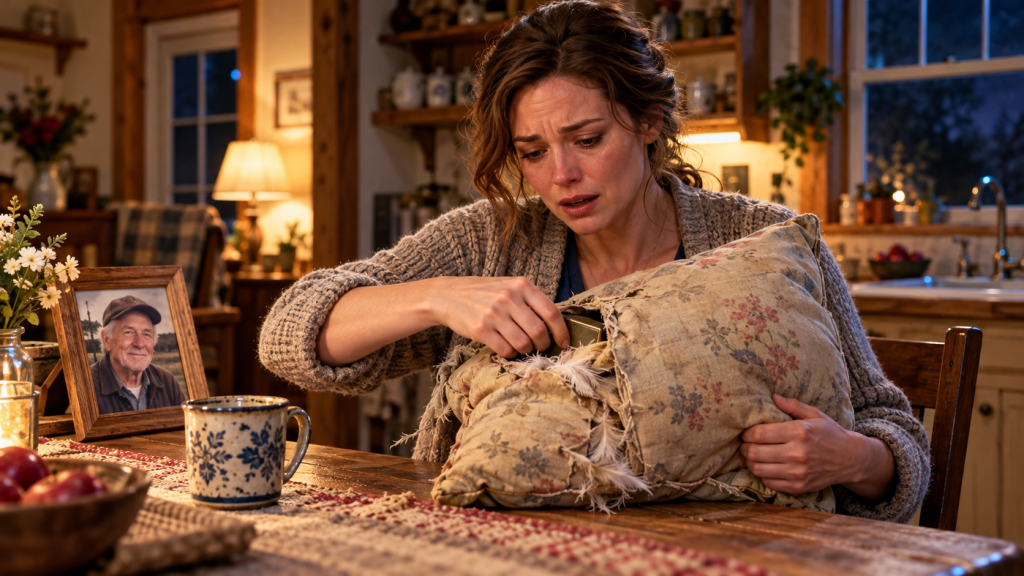
I looked at the pillow.
Its torn fabric.
The feathers scattered across my kitchen table.
The envelope Ernest had stitched into the lining.
And the key he’d hidden there.
I took a breath.
“Ernest gave me his pillow.”
Frank laughed sharply.
“It’s a dirty old pillow.”
“Then why are you standing outside my house in the middle of the night asking for it?”
Silence.
Then his voice changed.
“Maria, don’t make this difficult.”
I stepped away from the window.
My heart hammered.
I reached for my phone and called Daniel.
He answered on the third ring.
“Maria?”
His voice was exhausted.
He’d been working an overnight maintenance shift outside Philadelphia.
“What’s wrong?”
I tried to speak calmly.
“Frank is outside the kitchen window.”
Daniel went silent.
Then asked, “Frank? Diane’s husband?”
“Yes.”
“What does he want?”
I looked at the pillow.
Then whispered, “Something your father gave me before he died.”
Daniel’s breathing changed.
“Maria, lock every door.”
“They’re already locked.”
“Good. Don’t let him in.”
My eyes filled.
“Daniel, I’m scared.”
His voice softened immediately.
“I know, sweetheart.”
Then he said, “Call the police if he refuses to leave or tries to enter. I’m leaving now.”
I swallowed.
“Please be careful.”
“I will.”
Outside, Frank knocked again.
Harder this time.
“Maria!”
I stepped toward the hallway.
“Frank, leave my property.”
His voice rose.
“Diane knows Dad hid things!”
I froze.
He continued.
“You have no idea what you’re getting yourself into.”
My stomach tightened.
“Then you can explain it tomorrow through an attorney.”
For several seconds, he said nothing.
Then I heard him mutter something.
Footsteps crossed the gravel.
A truck door slammed.
An engine started.
And finally, the headlights disappeared down the driveway.
I stood motionless.
For a long time, I couldn’t move.
Then I walked toward the front door.
Checked the lock.
Checked the back door.
And returned to the kitchen.
The pillow lay where I’d left it.
Such a small, ugly thing.
A torn rectangle of faded cotton.
The kind of pillow most people would have thrown away without thinking.
Yet within its seams, Ernest had hidden something important enough that relatives were appearing at my house after midnight.
I looked toward the ceiling.
Then whispered, “Dad, what have you left me?”
I gathered the key, letter, photograph, and pillow.
Placed them carefully in a clean box.
Then carried everything to my bedroom.
I didn’t sleep.
Every sound made me sit upright.
Every car passing on the road made my heart race.
And every time I closed my eyes, I saw Ernest’s face.
His thin cheeks.
His tired smile.
His trembling hand reaching toward that pillow.
“For you, Maria… only for you.”
At two in the morning, headlights swept across the driveway.
My heart jumped.
Then I heard Daniel’s truck.
I hurried downstairs.
He came through the door looking exhausted.
His work jacket was still dusty.
His dark hair was damp with rain.
When he saw me, he dropped his bag.
“Maria.”
I ran into his arms.
And finally, after holding myself together all evening, I began crying.
Daniel held me tightly.
“Oh, sweetheart.”
I shook my head against his chest.
“I don’t understand any of this.”
He kissed my hair.
“I know.”
“Your dad’s gone.”
His arms tightened.
I began sobbing harder.
“And instead of grieving him, I’m frightened of what your sister is going to do.”
Daniel held me for a long time.
Then guided me toward the sofa.
“Show me what you found.”
I brought him the box.
He stared at the pillow.
His expression softened.
“Dad loved that old thing.”
I nodded.
“He wouldn’t let me replace it.”
Daniel gave a sad smile.
“I remember.”
Then I handed him the letter.
He read slowly.
His expression changed.
When he reached the sentence about the abandoned farmhouse, he looked up.
“Maria…”
I swallowed.
“What?”
He stared at the photograph.
Then whispered, “That’s Grandma Anna’s house.”
I frowned.
“Your grandmother?”
He shook his head.
“No. My mother.”
I stared at him.
“Your mom’s old farmhouse?”
He nodded.
“The place where she grew up.”
I looked down at the photograph.
The sagging porch.
The boarded windows.
The old maple tree beside the driveway.
I knew the property.
Everyone in the family did.
It sat beyond the cornfield, down a narrow gravel road.
For years, I’d believed it had been sold after my mother-in-law died.
That’s what Diane told everyone.
That’s what Robert, Daniel’s older brother, repeated whenever someone asked.
And Ernest never argued.
At least, not in front of me.
Daniel rubbed his forehead.
“Dad said they had to sell it years ago.”
I nodded.
“That’s what I thought.”
He stared at the writing on the back.
They told me it was sold. It never was.
Then he looked toward me.
“Why would he write that?”
I swallowed.
“I don’t know.”
Daniel read the letter again.
Then whispered, “Helen Brooks.”
I looked at him.
“Do you know her?”
He nodded.
“She handled some legal papers for Dad years ago.”
He stared at the little key.
Then said, “We need to call her.”
For the first time all night, I felt a little less afraid.
Because whatever Ernest had hidden, there was someone who might understand.
And perhaps someone who could tell us why his children seemed desperate to take the pillow away from me.
The next morning, I called the number written beneath Helen Brooks’s name.
A woman answered.
“Brooks Legal Services.”
“My name is Maria Miller,” I said. “I’m calling about Ernest Miller.”
There was a pause.
Then the woman’s voice softened.
“Mrs. Miller, I’m very sorry for your loss.”
Tears rose immediately.
“Thank you.”
She continued.
“Ms. Brooks has been expecting your call.”
I went still.
“Expecting me?”
“Yes.”
The woman paused.
“Mr. Miller left instructions that you should contact her after his death.”
My heart began pounding.
I looked toward Daniel.
He was standing beside the kitchen table.
Listening.
I swallowed.
“Can I speak with her?”
A moment later, another voice came on the line.
“Maria?”
“Yes?”
“This is Helen Brooks.”
Her voice was gentle.
“I wish we were speaking under happier circumstances.”
My throat tightened.
“Do you know about the pillow?”
There was a long silence.
Then she answered.
“Yes, Maria.”
I gripped the phone.
“And the key?”
“Yes.”
My eyes filled.
Then Helen said something that made me sit down.
“Ernest was very worried someone would try to take that pillow from you.”
I stared at the wall.
“Why?”
She took a breath.
“Because he believed certain family members wanted to prevent you from finding out what he’d discovered.”
My stomach tightened.
I looked toward Daniel.
He was watching me.
I swallowed.
“What did he discover?”
Helen paused.
“I’d rather explain the details in person, with the records in front of us.”
I nodded.
“Of course.”
Then she asked, “Is Daniel with you?”
“Yes.”
“Good. Ernest hoped he would accompany you.”
My eyes filled.
She continued.
“And Maria?”
“Yes?”
“Please keep the key, letter, and pillow secure. Don’t give them to anyone who hasn’t been authorized through the appropriate legal process.”
I swallowed.
“I won’t.”
Helen arranged an appointment for that afternoon.
Before ending the call, she said something I would remember for years.
“Maria, Ernest spoke about you often.”
My throat tightened.
“He did?”
Her voice softened.
“Very often.”
Then she added, “He said he trusted you with something he couldn’t trust money to explain.”
The call ended.
I sat quietly.
Then looked toward Daniel.
He crouched beside me.
“What did she say?”
I swallowed.
“She knew about the pillow.”
His expression changed.
“And?”
I looked down at Ernest’s letter.
Then whispered, “Your father was trying to protect something.”
Daniel took my hand.
For a moment, he looked like a little boy again.
Lost.
Grieving.
Confused.
His father had been buried in the family cemetery only hours earlier.
And now everything Ernest had believed about the old farmhouse seemed uncertain.
Daniel lowered his head.
“I should’ve spent more time with him.”
My eyes filled.
“Daniel…”
He shook his head.
“No.”
His voice broke.
“You were here every day.”
I swallowed.
He continued.
“You bathed him.”
“Fed him.”
“Sat up with him.”
“And I kept saying work was too busy.”
I looked at my husband.
The man I’d loved for twelve years.
He wasn’t cruel.
He wasn’t careless with money.
He worked hard.
He loved our son.
But he had allowed me to carry far more of Ernest’s care than either of us wanted to admit.
I took a breath.
“You did help when you were home.”
Daniel nodded sadly.
“Not enough.”
For a moment, neither of us spoke.
Then he whispered, “I’m sorry.”
My throat tightened.
I reached for his hand.
“I needed you more than I knew how to say.”
He closed his eyes.
“I know.”
I wasn’t ready to unpack twelve years of exhaustion in one conversation.
Not while Ernest’s belongings still sat beside the bed.
Not while relatives were demanding papers.
Not while my heart felt as though someone had torn it open.
But hearing Daniel acknowledge the truth mattered.
More than he probably realized.
That afternoon, we drove to Helen Brooks’s office.
I carried the pillow in a clean canvas bag.
Daniel brought the key and letter.
Noah stayed with my friend Rebecca, who lived two miles away and had known him since he was a baby.
When we arrived, Helen met us at the door.
She was a woman in her sixties with short silver hair, thoughtful brown eyes, and a quiet manner that reminded me of Ernest.
She shook Daniel’s hand.
Then turned toward me.
“Maria.”
I nodded.
“Hello.”
Her eyes softened.
“Ernest described you exactly.”
I gave a shaky laugh.
“How?”
She smiled gently.
“He said you always looked exhausted but smiled at him anyway.”
That was all it took.
My face crumpled.
I covered my mouth.
Helen stepped forward.
“I’m sorry.”
I shook my head.
“No.”
My voice broke.
“It’s just…”
I couldn’t finish.
She placed a hand gently on my shoulder.
“Take your time.”
We sat in her office.
Helen poured water.
Then placed several folders on the table.
I looked at the documents.
Then at her.
“Please tell us what happened.”
She nodded slowly.
“Before we discuss the estate, there’s something you need to understand about the old farmhouse.”
Daniel leaned forward.
“Mom’s house?”
“Yes.”
Helen opened the first folder.
“The property originally belonged to Anna’s parents.”
My heart tightened.
She continued.
“After her parents died, ownership passed to Anna. Following her death, Ernest became the owner under the applicable estate arrangements.”
I nodded.
“So it was his?”
“Yes.”
Daniel frowned.
“But Dad told us it had been sold.”
Helen looked toward him.
“That is what he believed for many years.”
I swallowed.
“And it wasn’t?”
She shook her head.
“No.”
The room seemed to grow colder.
Helen continued.
“The property remains connected to Ernest’s title, though there have been attempts to deal with it that require legal resolution.”
Daniel stared.
“Attempts?”
Helen opened another document.
“Several years ago, Robert began managing certain informal arrangements involving the surrounding land.”
I frowned.
“What arrangements?”
“Seasonal use of fields, access for agricultural equipment, and discussions with prospective buyers.”
Daniel rubbed his forehead.
“But the house was abandoned.”
Helen nodded.
“The house was largely unoccupied. The surrounding acreage still had value.”
She paused.
“Robert apparently led Ernest to believe a sale had occurred to resolve old debts and taxes.”
I felt my heart pounding.
“Was that true?”
Helen shook her head.
“The records I’ve examined do not support a completed sale at that time.”
I looked down at the photograph.
The old farmhouse.
The boarded windows.
The overgrown driveway.
How many times had we driven past it?
How many times had Ernest looked toward the place where his wife grew up and believed it no longer belonged to him?
Daniel’s voice broke the silence.
“Why didn’t Dad tell us?”
Helen looked at him gently.
“He didn’t discover the discrepancy until much later.”
She opened another folder.
“Two years ago, Ernest received a notice relating to the property.”
I frowned.
“What kind?”
“A tax and title inquiry. He contacted me because he was confused.”
She paused.
“When we examined the records, it became clear that the property had not been sold in the way he’d been told.”
My hands began trembling.
“What did he do?”
Helen looked toward the window.
“First, he cried.”
I covered my mouth.
Helen continued quietly.
“He sat in this very office and asked me whether it was possible he’d spent years grieving a home that was still his.”
Daniel lowered his head.
His shoulders shook.
Helen waited.
Then she continued.
“After that, we began reviewing the history of the property and the documents connected to it.”
I swallowed.
“Did Robert know?”
Helen’s expression grew serious.
“That question is part of the dispute. I can tell you certain transactions and representations are being challenged, but we’ll distinguish what the records establish from what individuals have claimed.”
I nodded.
Then asked the question that had been haunting me.
“Why did Ernest hide the key in his pillow?”
Helen looked directly at me.
“Because he trusted you.”
My eyes filled.
She continued.
“And because he didn’t want the documents in his bedroom or study to disappear before the proper people could examine them.”
Daniel frowned.
“Did someone try to take them?”
Helen paused.
“Ernest told me that a family member had searched through his belongings and repeatedly asked him to sign papers.”
My stomach tightened.
“Diane?”
Helen answered carefully.
“She was among the people he identified as pressuring him about the property.”
I closed my eyes.
Diane.
The sister-in-law who visited twice a month, stayed fifteen minutes, and always seemed to leave with another question about the land.
The woman who brought fruit but never stayed when Ernest needed bathing.
The woman who complained that caring for an elderly parent was too stressful.
And now the woman whose husband had appeared outside my kitchen window after midnight.
I opened my eyes.
“What are we supposed to do?”
Helen took a breath.
“First, we need to follow the legal requirements concerning Ernest’s estate and the documents he left. The key itself doesn’t give anyone unrestricted access to a bank box.”
I nodded.
She continued.
“I have authority and records connected to his estate planning. We’ll arrange access and inventory through the proper process.”
Daniel looked at the key.
“And what’s in the box?”
Helen’s expression softened.
“Ernest told me it contains his original property records, correspondence, and personal letters.”
Then she looked directly at me.
“And something he wanted you to receive.”
My throat tightened.
“What?”
Helen smiled sadly.
“He asked me not to spoil that part.”
For a moment, I could almost hear Ernest laughing.
That quiet little chuckle he made when Noah told him a joke.
I wiped my cheeks.
Then whispered, “He was always stubborn.”
Helen smiled.
“So he told me.”
Before we left, Helen opened another folder.
“There is one document I can discuss with you today.”
Daniel looked up.
“What?”
“Ernest’s most recent will.”
I went completely still.
Helen continued.
“He reviewed his estate plan with me. We documented his instructions and arranged for the will to be executed with the required formalities.”
My heart began pounding.
Then she looked toward Daniel.
“And your father made a decision that he knew some of his children would find difficult.”
Daniel stared.
“What decision?”
Helen paused.
Then answered.
“He directed that the old farmhouse and its associated acreage go to Maria, subject to proper administration of the estate and resolution of the title issues.”
For a moment, I didn’t understand the words.
They seemed to hang in the air.
Then I whispered, “Me?”
Helen nodded.
“Yes.”
I stared at her.
“But I’m not his daughter.”
Her eyes softened.
“That’s not how Ernest described you.”
Tears filled my eyes.
I shook my head.
“No.”
My voice broke.
“I didn’t care for him because I wanted property.”
Helen nodded.
“I know.”
“I didn’t even know he owned anything.”
“I believe you.”
I covered my face.
“Then why would he do that?”
Helen reached for a sealed envelope.
Across the front was Ernest’s handwriting.
For Maria, when she asks why.
My heart stopped.
Helen placed it gently in front of me.
“He knew you’d ask.”
I stared at the envelope.
My fingers trembled as I opened it.
Inside was a folded sheet of paper.
The writing was uneven.
Some letters were shaky.
But I recognized every line.
Ernest.
I began reading.
Maria,
If Helen has given you this letter, then I am no longer sitting in your kitchen asking for more oatmeal.
I laughed through tears.
Because Ernest had asked for oatmeal nearly every morning.
Even when I’d offered eggs.
Toast.
Pancakes.
He always wanted oatmeal.
I continued.
You once told me you were only my daughter-in-law.
I remembered those words.
You were tired that day.
I knew it.
I knew you were carrying more than anyone should have expected.
My throat closed.
The memory came rushing back.
Me standing beside his bed.
Exhausted.
Crying.
“Dad, I’m only your daughter-in-law… sometimes I feel like I can’t do this anymore.”
I had felt ashamed afterward.
For years, I’d believed those words made me selfish.
Now Ernest was writing about them.
I continued through my tears.
Maria, you were not wrong to be tired.
You were not wrong to need help.
You were not wrong to wish someone else would come and sit with me sometimes.
I began sobbing.
Daniel reached for my hand.
I could barely see the page.
You gave me something my own children sometimes forgot to give.
Your time.
You sat beside me when I couldn’t sleep.
You held my hand when I called for Anna.
You washed my blankets when I was sick.
You listened to the same stories even when I’d forgotten I’d told them before.
And when I could no longer walk to the porch, you opened the curtains so I could see the sun.
I pressed the letter against my chest.
“Oh, Dad.”
Helen waited quietly.
Daniel was crying beside me.
After a moment, I continued.
I want you to have Anna’s farmhouse.
Not because you earned it by suffering.
No amount of property could repay twelve years of care.
I want you to have it because you know what a home is supposed to feel like.
My hands shook.
I don’t want that house turned into another argument about money.
I want someone to open its windows again.
I want children to laugh in the kitchen.
I want roses by the fence.
And if you choose to sell it, that is your decision too.
The gift is yours.
Not another responsibility I am placing on your shoulders.
I stopped reading.
That final sentence broke me.
Because Ernest knew.
He understood that I had spent twelve years carrying responsibilities.
And even in death, he was trying not to hand me another burden.
I wiped my eyes.
Then read the last paragraph.
Maria, when Anna died, I thought the best part of my life was over.
Then you came into this family.
You brought warmth into my last years.
And you reminded me that being old didn’t mean I had stopped being someone worth loving.
Thank you, my daughter.
Love, Dad.
The room disappeared behind my tears.
I could hear Daniel crying.
Helen moved a box of tissues closer.
And I sat there holding a letter from a man who had spent twelve years depending on me.
A man who couldn’t give me money.
Who often couldn’t remember what day it was.
Who sometimes apologized because his hands shook too much to hold his spoon.
Yet somehow, he’d seen everything.
Every sleepless night.
Every moment of exhaustion.
Every small act of love I’d thought nobody noticed.
I pressed the letter against my heart.
Then whispered, “I would’ve cared for you without any of this.”
Helen nodded.
“I know.”
Her voice softened.
“And Ernest knew too.”
For several minutes, nobody spoke.
Then Daniel reached for the photograph.
He studied the old farmhouse.
His mother’s childhood home.
A place he’d believed lost forever.
Then he looked at me.
“Maria…”
I turned.
His eyes were red.
“I had no idea.”
I swallowed.
“Neither did I.”
He shook his head.
“No.”
His voice broke.
“I mean I had no idea how much Dad saw.”
I looked at him.
Daniel continued.
“I thought he was too weak to notice how tired you were.”
Tears rolled down my face.
He took my hand.
“And I let myself believe that because it made leaving for work easier.”
I lowered my head.
He whispered, “I’m sorry.”
I didn’t tell him it was all right.
Not immediately.
Because some things were not all right.
Twelve years of caring for Ernest had been filled with love.
But also exhaustion.
And moments when I desperately needed help.
It wouldn’t have been honest to pretend otherwise.
So I held Daniel’s hand.
And said quietly, “I need us to remember this when someone else in our family needs care.”
He nodded.
“We will.”
Helen allowed us a moment.
Then gently cleared her throat.
“There’s something else you should know.”
I looked up.
My stomach tightened.
“What?”
She folded her hands.
“Ernest knew his will might be challenged.”
Daniel frowned.
“By Diane?”
Helen answered carefully.
“He was concerned about disagreements among the children.”
I swallowed.
She continued.
“He asked me to arrange an independent assessment of his decision-making capacity when he finalized the documents. We also retained records of the meetings and the properly executed will.”
I stared.
“Because he thought they’d say he didn’t know what he was doing?”
Helen nodded.
“That was one concern.”
Daniel rubbed his forehead.
Then whispered, “Dad planned for all of this?”
Helen smiled sadly.
“He was physically frail, Daniel.”
She paused.
“But he was not without judgment.”
Then she said the words that made the hair rise on the back of my neck.
“And he left a separate statement explaining why he no longer trusted certain family members with the old property.”
I swallowed.
“Can we read it?”
Helen’s expression grew serious.
“Parts of it concern ongoing disputes and need to be handled through the estate process.”
She paused.
“But I can tell you this.”
I leaned forward.
“Ernest discovered that someone had been receiving money connected to his land without giving him a complete accounting.”
Daniel went still.
“What money?”
Helen opened a folder.
“Payments for the use of part of the acreage.”
My heart pounded.
“What payments?”
She looked toward us.
“Seasonal agricultural leases and access agreements.”
I stared.
Then whispered, “But Dad barely had money for medicine.”
Helen nodded.
“I know.”
My throat tightened.
“And someone was collecting income from land that belonged to him?”
Her expression was grave.
“That is one of the issues under investigation.”
I looked toward Daniel.
His face had gone pale.
Then he whispered a name.
“Robert.”
His older brother.
The one who claimed to manage everything involving the old farm.
The one who always said there wasn’t enough money to repair Ernest’s wheelchair.
The one who’d insisted the farmhouse was worthless.
The one who had once told me I should be grateful Dad wasn’t living in a nursing home because it would cost us a fortune.
Daniel covered his face.
“Oh, God.”
I stared at the photograph.
Then at the pillow.
And finally, I understood why somebody might have wanted to throw it away.
The pillow wasn’t valuable.
But the things hidden inside could lead to documents that challenged a story the family had been telling for years.
Helen closed the folder.
“Maria, Daniel, please understand something.”
We looked toward her.
“This may take time.”
She paused.
“The estate needs proper administration. The title questions must be resolved. If there has been unauthorized use of property or diversion of income, those issues require evidence and appropriate legal action.”
I nodded.
She continued.
“And no one should assume that because Ernest intended a gift, all legal disputes disappear overnight.”
I swallowed.
“I understand.”
Then I looked down at his letter.
The words blurred again.
Thank you, my daughter.
For twelve years, I’d wondered whether I had done enough.
Now, after his death, Ernest was telling me that I had given him something worth more than land.
I closed my eyes.
And cried.
We had barely returned home when Diane called.
Daniel looked at his phone.
Then at me.
“It’s my sister.”
I was standing near the kitchen sink, holding Ernest’s letter.
For a moment, neither of us spoke.
Then I said, “Answer it.”
Daniel hesitated.
“I don’t want another fight today.”
“Neither do I.”
I looked toward the pillow resting on the table.
“But pretending she isn’t going to ask won’t make her stop.”
Daniel accepted the call.
“Hello, Diane.”
Her voice was so loud I could hear it without the speaker.
“Where have you been?”
Daniel frowned.
“Why?”
“Robert says somebody saw your truck outside Helen Brooks’s office.”
My stomach tightened.
Daniel closed his eyes.
“Diane, Dad’s attorney is handling his estate.”
“And you went without telling us?”
“We made an appointment.”
She gave a sharp laugh.
“You mean Maria made an appointment.”
I felt my chest tighten.
Daniel looked toward me.
Then said firmly, “Maria has every right to speak with Helen.”
Diane went silent.
For a moment, I felt an unfamiliar surge of gratitude.
My husband wasn’t allowing her to dismiss me.
Then Diane asked, “Did Helen show you anything?”
Daniel’s expression hardened.
“What do you mean?”
“Documents, Daniel.”
“What documents?”
She became impatient.
“Don’t play stupid.”
I could hear Frank speaking in the background.
Then Diane lowered her voice.
“Did you open the bank box?”
I went cold.
Daniel looked directly at me.
He hadn’t mentioned the box.
Neither had I.
Nor had Helen.
Daniel took a breath.
“Why are you asking about a bank box?”
There was a pause.
Then Diane said, “Dad was confused near the end.”
Daniel’s face tightened.
“He knew who we were.”
“That’s not what I mean.”
“Then say what you mean.”
She sighed.
“Maria spent years putting ideas in his head.”
My eyes filled.
Twelve years.
Twelve years of helping Ernest swallow medicine.
Twelve years of changing sheets.
Twelve years of missed holidays, canceled plans, and nights when I slept in a chair because he was frightened.
And now, after his death, Diane was accusing me of manipulating him.
Daniel’s voice turned cold.
“Don’t say that about my wife.”
Diane laughed.
“Oh, please. You were never home, Daniel. You have no idea what Maria was telling him.”
My husband’s expression changed.
For a moment, he looked wounded.
Because there was enough truth in one part of her accusation to hurt.
He hadn’t always been home.
He hadn’t seen every difficult night.
But he had seen enough to know how much I’d given.
He took a breath.
“I know Maria cared for Dad.”
Diane scoffed.
“That’s what daughters-in-law are supposed to do.”
Daniel stared at the phone.
Then said quietly, “No, Diane.”
She stopped talking.
He continued.
“Maria married me.”
His voice trembled.
“She didn’t sign a contract promising twelve years of unpaid nursing care.”
I covered my mouth.
Daniel looked toward me.
“And I should have made sure she had more help.”
For several seconds, nobody spoke.
Then Diane snapped, “You’re letting her turn you against your own family.”
Daniel closed his eyes.
“Maria is my family.”
Tears streamed down my face.
Not because the words were extraordinary.
They were words a husband should be able to say.
But after so many years of being thanked for my patience while everyone left the hard work to me, hearing Daniel say them felt like being seen.
Diane’s voice became sharp.
“Fine. Then tell Maria to give me that pillow.”
I stared.
Daniel looked toward it.
“Why?”
Silence.
Then Diane said, “Because Dad was supposed to be buried with it.”
My heart skipped.
That was a lie.
Ernest had looked me in the eyes and said the pillow was for me.
Daniel knew it.
I knew it.
And Diane had never once mentioned burying him with anything.
My husband took a breath.
“Diane, Dad gave it to Maria.”
She snapped, “He didn’t know what he was saying!”
Daniel’s eyes filled.
Then he said something that ended the conversation.
“Then you can explain your concerns to the attorney.”
He hung up.
For a long moment, we stood silently.
Then Daniel turned toward me.
“Maria, I’m sorry.”
I wiped my cheeks.
“For what?”
He looked down.
“For the way they’ve treated you.”
I swallowed.
He continued.
“And for letting it happen.”
I stepped toward him.
He opened his arms.
And we held each other.
That evening, Noah found us sitting at the kitchen table.
He was still struggling to understand that Grandpa Ernest wasn’t coming back.
He looked at the old pillow.
Then at me.
“Mom?”
I smiled sadly.
“Yes, sweetheart?”
“Are you keeping Grandpa’s pillow?”
I nodded.
“He gave it to me.”
Noah approached.
Touched the faded fabric.
Then whispered, “It smells like him.”
My heart broke.
I pulled him close.
“I know.”
He looked toward Daniel.
“Dad, can we keep it forever?”
Daniel’s eyes filled.
“If Mom wants to.”
Noah nodded seriously.
Then said something that made me cry.
“Grandpa always said Mom was his favorite person.”
I looked down at him.
“What?”
Noah stared.
“He did.”
My throat tightened.
“When?”
Noah shrugged.
“When you were making soup.”
I swallowed.
“What did he say?”
My son looked thoughtful.
Then smiled faintly.
“He said you were the kindest person he’d ever known.”
I pressed my fingers against my mouth.
Noah continued.
“And I asked if Grandma Anna was kinder.”
Daniel gave a watery laugh.
I stared at my son.
“What did Grandpa say?”
Noah smiled.
“He said Grandma Anna would probably agree with him.”
I began sobbing.
Daniel wrapped his arms around us both.
And for one precious moment, the pillow stopped feeling like evidence in a family dispute.
It became what Ernest had intended it to be.
A piece of him.
A reminder of love.
A final gift from a man who had noticed far more than anyone realized.
Three days later, Helen arranged for the relevant bank records and safe-deposit box contents to be inventoried through the proper estate process.
Because she had retained the necessary authority and documentation, she was able to coordinate access without pretending that the little key alone granted ownership of everything inside.
Daniel and I were present for the inventory with the appropriate bank personnel.
I held the brass key in my palm.
My hands trembled.
When the metal box was brought into the private room, I felt my heart pound.
Helen looked toward me.
“Are you ready?”
I swallowed.
“Yes.”
She helped arrange the careful opening and documentation of the contents.
Inside were three sealed folders.
A small wooden box.
A faded photograph album.
And a bundle of envelopes tied with blue ribbon.
I stared.
Not gold.
Not stacks of money.
Not diamonds.
Just the things an old farmer had spent years protecting.
Helen opened the first folder.
Property records.
Deeds.
Tax receipts.
Letters from surveyors.
Correspondence concerning the old farmhouse.
And copies of communications with Robert.
The second folder contained financial records.
There were agreements concerning agricultural use of the land.
Payments.
Dates.
And several entries that didn’t match the amounts Ernest had apparently been told.
Helen explained that a full accounting was still needed before anyone could conclude precisely what had happened.
But the records gave the estate concrete transactions to investigate.
Then she opened the third folder.
My breath caught.
At the top was a handwritten note.
I did not sell Anna’s home.
Beneath it were several letters from Ernest.
One was addressed to Robert.
Another to Diane.
Another to Paul, Daniel’s younger brother.
And another to Daniel.
Daniel looked toward Helen.
“Dad wrote to all of us?”
She nodded.
“He did.”
My husband swallowed.
“Can I read mine?”
Helen checked the envelope.
Then handed it to him.
Daniel opened it with shaking fingers.
I watched his expression change as he read.
At first, he seemed confused.
Then tears filled his eyes.
Finally, he lowered the paper.
And covered his face.
I reached for his hand.
“Daniel?”
He shook his head.
For several seconds, he couldn’t speak.
Then he whispered, “Dad knew.”
My throat tightened.
“Knew what?”
Daniel looked at me.
His eyes were full of tears.
“He knew I felt guilty.”
He handed me the letter.
I read carefully.
Daniel,
You were a good son in more ways than you realize.
You worked hard. You helped pay for the house. You made sure I had medicine.
But I want you to understand something.
Maria gave me her days.
And days are something nobody can earn back.
I swallowed.
The letters blurred.
Don’t let her spend the rest of her life taking care of everybody while forgetting herself.
Take care of her.
Not because she took care of me.
Because she’s your wife, and you love her.
Daniel began crying again.
I set down the letter.
Then took his hand.
For a long time, we simply sat together.
Eventually, Helen opened the little wooden box.
Inside was a woman’s wedding ring.
Simple gold.
Worn thin at the bottom.
Beside it rested a small photograph of Ernest and Anna standing outside the farmhouse.
Anna was smiling.
Her dark hair was tied back.
Ernest looked young and proud.
And between them stood a little boy.
Daniel.
No more than four years old.
My husband stared.
“Oh, Mom.”
His voice broke.
He reached toward the photograph, then stopped.
Helen carefully showed us the note beneath it.
Ernest had written:
Anna wanted her ring kept in the family.
Maria has been a daughter to me.
I would like her to have it, if she wishes.
I began crying.
Daniel looked toward me.
Then smiled through tears.
“She would’ve loved you.”
I shook my head.
“I never met her.”
“I know.”
He swallowed.
“But she would’ve.”
I looked toward the ring.
Not because it was expensive.
It wasn’t.
Its value was in the hands that had worn it.
The woman who’d raised four children.
Who’d loved Ernest.
Who’d worked beside him in the fields.
And whose absence he’d mourned for decades.
I whispered, “Thank you, Anna.”
Then Helen turned toward the bundle of envelopes.
“These are personal letters.”
I looked up.
“To whom?”
She smiled sadly.
“Mostly to Maria.”
My heart stopped.
Helen gently untied the blue ribbon.
There were twelve envelopes.
Each marked with a year.
The first was from the year I married Daniel.
The last was dated only months before Ernest died.
I stared.
“He wrote these?”
Helen nodded.
“He told me he’d kept notes over time, even when his handwriting became difficult.”
I opened the first envelope.
Inside was a small card.
Maria made chicken soup today.
I told her I didn’t like carrots.
She laughed and said I could pick them out.
I haven’t heard someone laugh in this house like that since Anna died.
I began crying.
The next envelope held another memory.
Noah was born today.
Maria placed him in my arms.
His hands are so small.
I thought my heart had forgotten how to feel this happy.
I pressed my hand against my mouth.
Daniel was crying beside me.
The third envelope contained a photograph of Ernest holding Noah as a baby.
The fourth described the winter I slipped on the porch and insisted I was fine, even though I’d bruised my knee.
The fifth recalled the first time Ernest became too weak to walk to the garden.
The sixth described me reading him a newspaper article while he ate breakfast.
They weren’t grand declarations.
They were ordinary things.
Things I’d forgotten.
Things I never imagined he was recording.
Then I opened the envelope from the year I nearly gave up.
The year I’d cried beside his bed.
My hands shook.
Inside was a folded sheet.
Maria cried today.
She said she couldn’t do it anymore.
I wish I could have stood up and told her to go rest.
I wish I could have made her tea.
I wish I could have called my children and made them understand.
I covered my mouth.
Tears streamed down my face.
I continued.
She thinks she’s failing me.
But she isn’t.
I’m afraid I’m failing her.
I couldn’t read another word.
I bent forward.
And sobbed.
Daniel moved beside me.
Held me.
And I cried against his shoulder until my chest hurt.
For twelve years, I’d wondered whether Ernest understood how difficult the days could be.
Now I knew.
He understood.
He had seen my exhaustion.
Noticed my tears.
And carried his own sadness because he couldn’t make things easier for me.
Helen waited quietly.
Then said something that made the moment even more painful.
“Maria, he used to ask me whether it was possible to repay someone for giving you their time.”
I looked up.
She smiled sadly.
“I told him time wasn’t a debt that could be calculated.”
My eyes filled.
She continued.
“He said he knew.”
Then she whispered, “But he wanted to leave you something that would give some of your time back.”
I looked toward the old farmhouse photograph.
And finally understood why Ernest had chosen it.
He wasn’t simply giving me property.
He was trying to give me a future in which I could choose what to do with my days.
But before we could leave the bank, Helen’s phone rang.
She looked at the screen.
Her expression changed.
“Excuse me.”
She stepped aside.
Spoke quietly.
Then returned.
Her face was serious.
“Daniel, Maria, there’s been a development.”
My stomach tightened.
“What?”
Helen took a breath.
“Someone has attempted to record another document concerning the farmhouse.”
Daniel stood.
“What document?”
Helen looked directly at us.
“A deed purporting to transfer the property to a company controlled by Robert and Frank.”
I felt the blood drain from my face.
Daniel stared.
“But Dad’s dead.”
Helen nodded.
“The document is dated before his death.”
My heart hammered.
Then she said the words that turned my grief into something colder.
“Ernest told me he never signed it.”
For a moment, the room was silent.
Then Daniel whispered, “Robert.”
His older brother.
The man who’d told everyone the farmhouse was worthless.
The man who’d collected payments connected to the land.
And now the man whose company was apparently connected to a document claiming ownership of the property Ernest intended for me.
Helen closed the folder.
“We’re going to address this through the appropriate legal process.”
I swallowed.
“Can they take it?”
Her expression softened.
“We have grounds to dispute the purported transfer, along with evidence and records that need to be examined. We’ll seek the available protections.”
My eyes filled.
Then I looked down at Ernest’s letter.
The gift is yours. Not another responsibility.
I took a slow breath.
And whispered, “Dad, I wish you hadn’t had to fight this.”
Daniel looked toward me.
Then took my hand.
“We’ll do this together.”
For the first time, I believed he truly meant it.
That evening, as we returned home, Noah was waiting by the window.
He ran toward us when we entered.
“Mom!”
I smiled.
“Hi, sweetheart.”
He hugged me.
Then looked toward Daniel.
“Did you find Grandpa’s treasure?”
Daniel glanced at me.
I smiled through tears.
“In a way.”
Noah’s eyes widened.
“Was it gold?”
I laughed softly.
“There was a little gold ring.”
He grinned.
“I knew it!”
Then he frowned.
“But Grandpa said the best treasures weren’t money.”
My heart tightened.
I crouched.
“What did he say they were?”
Noah considered.
Then smiled.
“People who stay.”
I closed my eyes.
For a moment, I could almost hear Ernest’s voice.
People who stay.
I hugged my son.
And whispered, “Grandpa was right.”
The following morning, Paul arrived.
Of Ernest’s four children, Paul had always been the quietest.
He lived several hours away and worked as a mechanic.
He didn’t visit often.
But unlike Diane and Robert, he usually called Ernest on Sundays.
He’d send photographs of his children.
And sometimes he’d ask whether Dad needed anything.
Not enough to share the daily burden.
But enough that I knew there was affection there.
When I opened the door, Paul stood holding a cardboard box.
His eyes were red.
“Maria.”
I swallowed.
“Hello, Paul.”
He looked toward the floor.
“Can we talk?”
I hesitated.
Then stepped aside.
Paul sat at the kitchen table.
Daniel joined us.
For a few moments, nobody spoke.
Then Paul looked toward me.
“I heard what happened with Frank.”
My stomach tightened.
“How?”
He swallowed.
“Diane called me.”
Daniel folded his arms.
“What did she say?”
Paul gave a bitter laugh.
“That Maria was trying to steal Dad’s inheritance.”
I felt tears rise.
But Paul shook his head.
“I didn’t believe her.”
I looked up.
He continued.
“I know how much you did for Dad.”
His voice broke.
“And I know how little the rest of us did.”
Daniel lowered his head.
Paul wiped his eyes.
Then whispered, “I’m sorry, Maria.”
I swallowed.
“For what?”
He looked around the kitchen.
At the chair where Ernest used to sit.
At the window where I’d opened the curtains for him.
At the little table where I made his oatmeal.
Then he said, “For treating your kindness like it was endless.”
I began crying.
Paul continued.
“We all had reasons we couldn’t come.”
“Work.”
“Children.”
“Distance.”
“Money.”
He shook his head.
“But somehow, you were always the one who had to find a way.”
For a long time, I couldn’t speak.
Then I whispered, “I loved him.”
Paul nodded.
“I know.”
My voice broke.
“But I was tired.”
He began crying.
“I know that too.”
Then he pushed the cardboard box toward us.
“I came because there’s something you need to see.”
Daniel frowned.
“What is it?”
Paul opened the box.
Inside were old letters.
Bank statements.
And a folder marked with Robert’s name.
My stomach tightened.
Paul took a breath.
“Dad called me last year.”
I stared.
“What did he say?”
Paul looked toward Daniel.
“He asked whether I remembered the farmhouse being sold.”
Daniel nodded.
“Everyone thought it was.”
Paul swallowed.
“Well, I started looking through some old records.”
He pulled out a copy of an email.
Dated three years earlier.
Sent from Robert to a company that leased equipment storage space near the old farmland.
In the email, Robert represented himself as managing the property on Ernest’s behalf.
The attached payment instructions directed money to an account that wasn’t Ernest’s.
Daniel stared.
“What is this?”
Paul shook his head.
“I don’t know every detail.”
He looked toward me.
“But when I asked Robert about it, he told me to stay out of family business.”
My stomach tightened.
Paul continued.
“I contacted Dad.”
His voice broke.
“He started crying.”
I looked down.
Paul wiped his cheeks.
“He said he thought the property had been sold years ago.”
Daniel closed his eyes.
Paul continued.
“So I told him to speak to Helen Brooks.”
My heart stopped.
I stared at him.
“Paul…”
He shook his head.
“I should’ve come sooner.”
His voice broke.
“I should’ve asked more questions.”
For the first time, I understood how Ernest had rediscovered the truth.
Not through some dramatic inheritance revelation.
But because one of his children had finally questioned a story the family had repeated for years.
Paul looked at me.
“Maria, I didn’t know Dad was leaving you the farmhouse until recently.”
I swallowed.
He continued.
“But I’m not going to fight you for it.”
Daniel looked up.
“Paul…”
He shook his head.
“Dad made his choice.”
Then he smiled sadly.
“And after everything Maria did, I can’t pretend I don’t understand why.”
I began crying.
Paul reached across the table.
And gently squeezed my hand.
“I’m sorry we left you carrying so much.”
That afternoon, we took the documents to Helen.
She examined them carefully.
Then said, “These may be important.”
Paul nodded.
“I kept the originals.”
“Good.”
She explained that the emails and payments needed to be verified and considered alongside other evidence.
The documents supported further investigation.
They did not automatically resolve the ownership dispute.
But they gave the estate additional leads.
Before we left, Paul looked toward me.
“Maria?”
I turned.
“Yes?”
“If Dad wanted you to have the farmhouse, I hope you get it.”
My eyes filled.
He swallowed.
“And if you ever need help fixing it, call me.”
I smiled through tears.
“Thank you, Paul.”
He hugged me.
And for the first time since Ernest died, I felt that not all of his children had forgotten what family was supposed to mean.
The inheritance dispute did not end quickly.
Diane and Robert contested the will.
They claimed Ernest had been too frail to understand what he was signing.
They accused me of influencing him.
And through their attorneys, they questioned why a daughter-in-law should receive property rather than the children.
Their accusations hurt.
Even when I knew they weren’t true.
Because every time I read one, I remembered a night beside Ernest’s bed.
A spoonful of soup.
A clean blanket.
A fever.
A whispered prayer.
A frightened old man asking whether Anna was coming home.
Then I would read another paragraph claiming I had cared for him because I wanted his property.
And I would cry.
One evening, I sat at the kitchen table surrounded by documents.
Daniel came home from work.
He found me staring at a legal letter.
“Maria?”
I looked up.
My eyes were swollen.
He sat beside me.
“What happened?”
I slid the letter toward him.
He read it.
His face hardened.
Then he looked at me.
“Don’t believe this.”
I swallowed.
“Daniel, I know I didn’t manipulate him.”
He nodded.
“I know.”
My voice broke.
“But I keep wondering whether everyone else will believe them.”
Daniel took my hand.
“Maria, you cared for Dad long before anyone knew there was property.”
Tears filled my eyes.
He continued.
“You cared for him when we thought he had nothing.”
I lowered my head.
“And you would’ve kept caring for him.”
I nodded.
“Yes.”
Daniel squeezed my hand.
“Then whatever happens with the estate, nobody can take that truth away.”
I began crying.
He moved closer.
And held me.
The legal proceedings took months.
Then more than a year.
Independent witnesses were interviewed.
Estate documents examined.
Property records reviewed.
And the history of the disputed deed investigated.
Helen had preserved Ernest’s planning records.
They included notes from meetings, independent witnesses to his properly executed will, and contemporaneous evidence of his intentions.
A physician who had assessed Ernest during the relevant period was able to provide information concerning his mental condition.
The evidence did not support the claim that he lacked the ability to understand the decisions he was making when he executed the will.
Meanwhile, the disputed property transfer faced separate scrutiny.
The purported signatures.
The acknowledgments.
The company ownership.
The timing.
And the earlier payment arrangements all required examination.
No one arrived at my house one afternoon and handed me instant justice.
There were no magical confessions.
No sudden courtroom speeches that resolved every issue in an hour.
There was paperwork.
Waiting.
Legal costs.
Difficult testimony.
And days when I wondered whether Ernest’s final gift would become nothing but another source of grief.
But Helen stayed steady.
Daniel stayed beside me.
Paul provided what he knew.
And I learned to stop treating every angry letter as a command to defend myself personally.
Then, one Tuesday morning, Helen called.
“Maria?”
I stood.
“Yes?”
Her voice sounded unusually warm.
“I have news.”
My heart began pounding.
“What is it?”
She took a breath.
“The court has upheld the will against the challenge that was brought.”
For a moment, I couldn’t speak.
Then I whispered, “What?”
Helen repeated the news.
The evidence supported Ernest’s valid estate plan.
The challenge had not succeeded.
His expressed wishes would be honored through the estate administration, subject to the remaining property matters.
I sat down.
My hands trembled.
Then I began crying.
Daniel hurried into the room.
“Maria?”
I looked up.
Tears streaming down my face.
“The will.”
He froze.
“What?”
I smiled through tears.
“They couldn’t overturn it.”
Daniel dropped into the chair beside me.
Covered his face.
And cried.
But there was still the property dispute.
The title records.
The attempted transfer.
The money associated with the land.
Those questions required more time.
Eventually, the records and proceedings established that the disputed transfer had not been validly authorized by Ernest.
The unauthorized claim was set aside through the appropriate process.
The property’s title was cleared as part of the resolution.
Financial claims connected to the use of the land were also addressed through legal proceedings and settlement of documented obligations.
There were consequences for the people responsible for substantiated misconduct.
Not every accusation led to a criminal conviction.
Not every dollar was recovered.
But the estate was able to establish the property rights Ernest had tried so hard to protect.
And when the final paperwork was completed, the farmhouse and its acreage passed to me in accordance with Ernest’s will.
I was standing in Helen’s office when she handed me the documents.
For a long time, I simply stared.
My name.
Maria Miller.
The old farmhouse.
The adjoining land.
The place Anna had called home.
The place Ernest had believed lost.
And the place he’d chosen to leave me.
Helen smiled gently.
“It’s yours, Maria.”
My throat tightened.
I looked down at the deed.
Then whispered, “I wish Dad were here.”
Helen’s eyes filled.
“I know.”
I pressed the papers against my chest.
Then I thought of Ernest.
His tired smile.
His trembling hands.
The way he’d ask me to open the curtains.
And the final words he’d managed to speak.
“For you, Maria… only for you.”
I began sobbing.
Because he hadn’t been talking only about the pillow.
He had been telling me that he wanted something of his own life to become part of mine.
That afternoon, Daniel drove me to the farmhouse.
The gravel road was overgrown.
The porch sagged.
Weeds grew through the cracks.
And one shutter hung crooked beside a dusty window.
I stepped out of the truck.
Stared at the old building.
Then whispered, “Oh, Dad.”
Daniel stood beside me.
For a moment, neither of us spoke.
Then he asked, “What do you want to do with it?”
I looked at him.
He smiled gently.
“You don’t have to decide today.”
My eyes filled.
He continued.
“Dad said it was your choice.”
I looked toward the old maple tree.
The cracked steps.
The front door Ernest had once painted blue.
And something inside me stirred.
Not greed.
Not triumph.
A feeling I hadn’t experienced in a long time.
Possibility.
I turned toward Daniel.
“I want to open the windows.”
He smiled.
“Then let’s start there.”
We couldn’t enter the farmhouse immediately.
A contractor needed to examine the structure.
There were loose boards.
Water damage.
Old wiring.
And a roof that had been neglected for years.
But a few weeks later, after the building was assessed and the necessary repairs began, Daniel and I finally stepped inside.
The air smelled of old wood and dust.
Sunlight slipped through the gaps around the shutters.
An ancient rocking chair stood beside the fireplace.
The kitchen cabinets were faded blue.
And beneath the staircase hung a small wooden sign.
WELCOME HOME.
I stopped walking.
For a moment, I couldn’t breathe.
Daniel stood beside me.
“What is it?”
I pointed.
His expression softened.
“Mom made that.”
I looked at him.
“Anna?”
He nodded.
“She painted it when I was little.”
I walked closer.
The letters were uneven.
Hand-painted flowers decorated the corners.
And beneath them, almost hidden by time, were two tiny initials.
A + E.
Anna and Ernest.
My eyes filled.
I touched the edge of the sign.
Then whispered, “You were both here.”
We explored the rooms slowly.
Daniel showed me where he used to sleep.
Where his mother kept sewing supplies.
Where the family gathered for Christmas.
And where Ernest would stand beside the back door, brushing mud from his boots before supper.
For years, I’d known Ernest as a frail old man.
A man whose hands trembled.
Whose knees hurt.
Who sometimes needed help remembering whether he’d taken his medicine.
But here, walking through his old home, I could almost see the younger man he’d once been.
Strong.
Laughing.
Working.
Loving.
A husband.
A father.
A farmer.
A man with dreams before age and illness narrowed his world.
Daniel stopped in the kitchen.
His eyes filled.
“Dad used to make coffee right there.”
I smiled sadly.
“Did he?”
He nodded.
“And Mom would tell him he made it too strong.”
I laughed softly.
“Sounds familiar.”
Daniel smiled.
Then whispered, “I forgot so much of this.”
I took his hand.
“Maybe we can remember together.”
The repairs took nearly a year.
We didn’t rush.
The farmhouse was mine, but owning it didn’t magically create the money or energy needed to restore it.
We made a budget.
Consulted professionals.
Prioritized safety.
And repaired one section at a time.
Paul helped replace damaged porch boards.
Daniel spent weekends painting.
Noah helped pull weeds and complained dramatically about every mosquito.
I laughed more during those weekends than I had in years.
One Saturday, Noah stood beside the old maple tree.
He was holding a small gardening shovel.
“Mom?”
I looked up.
“Yes?”
“Can we plant something for Grandpa?”
My heart tightened.
I smiled.
“What would you like to plant?”
He thought carefully.
Then said, “An apple tree.”
I stared at him.
“Why an apple tree?”
Noah grinned.
“Because Grandpa always said apple pie was better than birthday cake.”
I began laughing through tears.
“He certainly did.”
So we planted a young apple tree.
Near the fence.
Where the sunlight was strong.
Noah patted the soil around its roots.
Then stood.
He looked toward the sky.
And whispered, “This one’s for you, Grandpa.”
I covered my mouth.
Daniel placed an arm around my shoulders.
And we stood together, watching our son honor the man who had loved him so much.
Months later, Diane came to the farmhouse.
I was working in the garden when her car appeared.
For a moment, I felt the old fear return.
The late-night flashlight.
The phone call.
The accusations.
The legal dispute.
Everything.
She stepped out slowly.
She looked older.
Tired.
Her expensive coat seemed out of place beside the muddy driveway.
I set down my gloves.
“Diane.”
She nodded.
“Maria.”
For a moment, neither of us spoke.
Then she looked toward the farmhouse.
“You’ve fixed it.”
I nodded.
“We’re working on it.”
Her eyes moved toward the porch.
The new windows.
The blue front door.
The flower beds.
Then she whispered, “Mom would’ve liked it.”
I felt my throat tighten.
“Daniel thinks so too.”
Diane looked down.
For a long moment, she said nothing.
Then she took a breath.
“I know you probably hate me.”
I studied her face.
“I don’t hate you.”
She looked surprised.
I continued.
“But I’m deeply hurt by what happened.”
Her eyes filled.
She nodded.
“I know.”
I waited.
She looked toward the old apple tree.
Then whispered, “I thought Dad didn’t understand what he was doing.”
I swallowed.
“Did you?”
She hesitated.
Then looked away.
“Maybe I didn’t want to believe he understood.”
The honesty surprised me.
I said nothing.
She continued.
“When I found out he’d left you the farmhouse, I was furious.”
My chest tightened.
“I know.”
She swallowed.
“I thought he was punishing us.”
I looked toward the windows.
Then answered quietly.
“Diane, Ernest didn’t leave me this place because he stopped loving his children.”
Her eyes filled.
“He loved all four of you.”
Diane began crying.
I continued.
“He asked about you.”
“He remembered your birthdays.”
“He kept the photographs you sent.”
“And when he was strong enough, he’d sit beside the window hoping someone would visit.”
She covered her mouth.
Tears slipped down her cheeks.
Then she whispered, “I should have come more.”
I nodded.
“Yes.”
For a moment, we simply stood there.
The wind moved through the grass.
A bird called from the fence.
Then Diane looked at me.
“Do you think Dad forgave me?”
The question broke my heart.
I took a careful breath.
“I can’t tell you what he never said.”
She lowered her head.
My voice softened.
“But I know he loved you.”
She began crying harder.
Then whispered, “I’m sorry for what I said about you.”
I nodded.
She continued.
“And for what Frank did that night.”
I looked toward her.
“And for trying to make you feel like you didn’t belong.”
My eyes filled.
I swallowed.
“Thank you for saying that.”
She looked up hopefully.
“Can we start over?”
I took a moment.
Then answered honestly.
“I don’t know.”
Her expression fell.
I continued.
“Trust takes time, Diane.”
She nodded slowly.
“And an apology doesn’t erase the things that happened.”
“I know.”
I looked toward the farmhouse.
Then back at her.
“But I hope you find peace with your memories of your father.”
She wiped her cheeks.
Then quietly returned to her car.
I watched her drive away.
For a long time, I stood beside the garden.
Feeling sadness.
Relief.
And something I couldn’t quite name.
Daniel came outside.
He’d seen Diane’s car.
“Are you okay?”
I nodded.
“I think so.”
He moved closer.
“What did she want?”
I looked toward the road.
“She apologized.”
His expression changed.
“Really?”
I nodded.
He took my hand.
“And?”
I smiled sadly.
“I told her it would take time.”
Daniel squeezed my fingers.
“That’s fair.”
I looked toward the farmhouse.
And realized something.
I could wish Diane well without pretending nothing happened.
I could accept that people sometimes grow.
And still choose how close I wanted them to be.
Ernest had spent his last years teaching me about kindness.
But he had never asked me to become a doormat.
Robert’s relationship with the family remained more distant.
The disputes involving his property dealings had serious consequences.
He was responsible for complying with the legal resolutions and obligations arising from his actions.
He did not immediately acknowledge the harm he’d caused.
And I stopped waiting for him to do so.
I had spent twelve years making sure Ernest was comfortable.
I wasn’t going to spend the next twelve trying to force people to feel remorse.
That was something they had to find themselves.
One evening, Daniel and I sat on the farmhouse porch.
The sun was setting.
The new apple tree moved gently in the breeze.
Noah was inside working on a school project.
Daniel handed me a cup of tea.
I smiled.
“Thank you.”
He sat beside me.
For a while, neither of us spoke.
Then he asked, “Maria, are you happy?”
I looked at him.
The question surprised me.
For years, people had asked whether Ernest had eaten.
Whether I’d given him his medicine.
Whether Noah had finished his homework.
Whether dinner was ready.
Whether the laundry was done.
But I couldn’t remember the last time someone had asked me that question.
Are you happy?
I looked toward the garden.
Then smiled.
“I’m learning how to be.”
Daniel’s eyes filled.
He nodded.
Then whispered, “I’m glad.”
I leaned against him.
For a moment, the years of exhaustion returned.
The nights without sleep.
The ache in my back.
The fear that Ernest might stop breathing while I stepped out of the room.
The guilt I felt whenever I wished someone else would take over.
Then I remembered his letter.
You were not wrong to be tired.
My eyes filled.
I smiled through tears.
And whispered, “Dad really understood.”
Daniel squeezed my hand.
“Yes.”
As the farmhouse became livable, I began thinking about what to do with it.
At first, I’d imagined selling it.
Using the money to make our own lives easier.
Taking a vacation.
Setting aside funds for Noah.
Maybe moving somewhere closer to Daniel’s work.
But each time I visited, I felt a connection I couldn’t explain.
The old kitchen.
Anna’s welcome sign.
The porch.
The apple tree.
The sunlight moving across the wooden floor.
I didn’t want to turn the house into another obligation.
Ernest had specifically asked me not to.
But I also didn’t want it sitting empty.
Then one afternoon, I attended a local caregiver support meeting.
A woman named Rachel led the group.
She worked with families caring for elderly relatives.
People sat in a circle.
Some looked exhausted.
Some frightened.
Some angry.
Some guilty for being angry.
I listened as one woman spoke.
“My mother has dementia.”
Her voice broke.
“I love her.”
She wiped her eyes.
“But sometimes I feel like I’m disappearing.”
I felt a sharp ache in my chest.
Because I knew that feeling.
The way your life narrows.
The way every hour belongs to someone else’s needs.
The guilt you feel for wanting a moment of your own.
Another woman said quietly, “My siblings tell me how wonderful I am for taking care of Dad.”
She laughed bitterly.
“But nobody offers to stay with him so I can go to the grocery store.”
I closed my eyes.
I’d lived that story.
For twelve years.
When it was my turn to speak, I took a breath.
“My name is Maria.”
My hands trembled.
“I cared for my father-in-law for twelve years.”
Several people looked toward me.
I continued.
“He was a good man.”
My voice broke.
“And I loved him.”
I swallowed.
“But there were days when I was so tired I could hardly think.”
Tears filled my eyes.
I looked around the circle.
Then whispered, “I thought being exhausted meant I wasn’t loving enough.”
A woman beside me began crying.
I continued.
“Now I know I needed help.”
The room was silent.
Then Rachel leaned forward.
“Maria, that is one of the most important things caregivers need to hear.”
I looked at her.
She smiled gently.
“Needing rest doesn’t mean your love is insufficient.”
I began crying.
Not because the words were new.
Ernest had written something similar in his letter.
But because I realized how many people needed to hear them.
That evening, I drove to the farmhouse.
Sat on the porch.
And thought about the support group.
The tired faces.
The quiet voices.
The people who felt invisible.
Then I remembered Ernest’s words.
I want you to have it because you know what a home is supposed to feel like.
I looked toward the open windows.
The flowers.
The kitchen.
And suddenly, I had an idea.
I didn’t want to open a nursing home.
I wasn’t trained or equipped for that.
And I certainly didn’t want to become responsible for caring for another household of people.
I’d learned too much about my own limits.
But perhaps the farmhouse could become a place where caregivers occasionally gathered.
A place for coffee.
Conversation.
Information.
Support.
A place where someone could sit down and say, “I’m tired,” without being judged.
I discussed the idea with Daniel.
He listened.
Then smiled.
“Maria, I think Dad would’ve loved that.”
My eyes filled.
“Do you?”
He nodded.
“But only if it’s something you want.”
I smiled sadly.
“That’s exactly what Dad would say.”
We worked with Rachel and local community organizations to explore what would be practical.
There were insurance questions.
Accessibility improvements.
Safety considerations.
And limits on what events could be held.
We addressed them one at a time.
Eventually, the farmhouse began hosting a small monthly gathering for family caregivers.
Nothing grand.
No expensive program.
Just people sitting together in a bright room.
Drinking tea.
Sharing experiences.
Learning about respite resources.
And reminding one another that they mattered too.
The first gathering had six people.
I baked apple muffins.
Rachel brought printed resources.
Daniel arranged the chairs.
And Noah placed a small vase of flowers on the table.
When everyone arrived, I stood near the fireplace.
My heart pounded.
Then I smiled.
“Welcome.”
I paused.
“My father-in-law spent his final years depending on my care.”
My voice trembled.
“He was a man who worked hard his entire life.”
I looked toward his photograph on the mantel.
“And he taught me that love can be quiet.”
Tears filled my eyes.
I continued.
“But he also taught me something else.”
I swallowed.
“That caring for someone doesn’t mean you stop being a person yourself.”
Several women nodded.
A man near the window wiped his eyes.
I smiled.
“So this is a place where you’re allowed to be tired.”
My voice broke.
“Where you’re allowed to ask for help.”
“And where you don’t have to pretend everything is easy.”
For a moment, the room was silent.
Then one woman began clapping softly.
Others joined.
I covered my mouth.
And cried.
Because Ernest’s old farmhouse had finally become what he’d wanted.
A place with open windows.
Laughter.
Warmth.
And people who needed somewhere to belong.
Years passed.
The gatherings continued.
Sometimes six people came.
Sometimes twelve.
Sometimes a caregiver arrived exhausted and spent the first twenty minutes saying almost nothing.
And that was all right.
I learned that helping others didn’t always require solving their problems.
Sometimes it meant listening.
Sometimes it meant offering a chair.
Sometimes it meant telling someone where to find professional support.
And sometimes it meant saying, “You need rest too.”
I also learned to take my own advice.
I rested.
Took vacations.
Spent more time with Noah.
Went hiking with Daniel.
Read books.
And sometimes spent an entire afternoon in the farmhouse garden doing absolutely nothing.
For the first time in my adult life, I stopped feeling guilty about sitting still.
One autumn afternoon, Noah came to find me.
He was fourteen now.
Tall.
Quiet.
With Daniel’s smile and Ernest’s stubborn chin.
I was sitting on the porch reading.
“Mom?”
I looked up.
“Yes?”
“Can I ask you something?”
I smiled.
“Of course.”
He sat beside me.
For a moment, he looked toward the apple tree.
Then he asked, “Do you ever miss taking care of Grandpa?”
The question surprised me.
I took a moment before answering.
“Yes.”
Noah looked confused.
“Even when it was hard?”
I smiled sadly.
“Especially when I remember the good parts.”
He nodded.
I continued.
“I miss making his oatmeal.”
“Listening to his stories.”
“Helping him watch the birds outside.”
My eyes filled.
“And I miss hearing him say goodnight.”
Noah looked toward the garden.
Then whispered, “I miss him too.”
I took his hand.
For a while, we sat quietly.
Then he asked, “Do you think Grandpa knew how much you loved him?”
I smiled through tears.
“Yes.”
Noah looked up.
“How do you know?”
I glanced toward the farmhouse.
The windows.
The porch.
The flowers.
Then I answered.
“Because he made sure I knew how much he loved me.”
Noah smiled.
Then leaned against my shoulder.
And I felt something warm settle in my heart.
The following spring, we held a small family gathering at the farmhouse.
Nothing formal.
Just Daniel.
Noah.
Paul and his family.
A few close friends.
And some people from the caregiver support group.
We planted roses along the fence.
Yellow roses.
Ernest’s favorite.
Daniel placed a wooden plaque near the porch.
It read:
ANNA AND ERNEST’S HOUSE
A place for kindness, rest, and belonging.
I stood in front of it.
My eyes filled.
Daniel took my hand.
“Do you like it?”
I nodded.
My voice broke.
“It’s beautiful.”
Then Paul approached.
He was holding something wrapped in a cloth.
“Maria?”
I turned.
“Yes?”
He smiled sadly.
“I found this while sorting through some of Dad’s old tools.”
He unwrapped the cloth.
Inside was a small wooden picture frame.
The glass was scratched.
The edges were worn.
But inside was a photograph of Ernest standing in a cornfield.
He was younger.
Strong.
Smiling.
And beside him stood Anna.
My throat tightened.
Paul continued.
“I thought it belonged here.”
I took the frame carefully.
Then whispered, “Thank you.”
We placed it inside the farmhouse.
Beside the fireplace.
Underneath Anna’s old welcome sign.
That evening, after everyone left, I sat alone in the living room.
The house was quiet.
Sunlight fell across the wooden floor.
The rocking chair stood beside the window.
And Ernest’s photograph rested on the mantel.
I looked at it.
Then whispered, “Dad, we did it.”
For a moment, I remembered the night he died.
The freezing wind.
The ticking clock.
His hand growing still inside mine.
And the old pillow he’d struggled to point toward.
I remembered holding that pillow against my chest while everyone else argued about what should be thrown away.
At the time, I thought it was simply his final comfort.
A worn piece of fabric carrying his scent.
Something I could hold when I missed him.
I never imagined it would lead me to his family’s lost farmhouse.
To hidden letters.
To painful truths.
To legal battles.
And ultimately, to a future I hadn’t known was possible.
But the greatest thing inside that pillow had never been the brass key.
It wasn’t the property records.
It wasn’t the wedding ring.
And it wasn’t the inheritance.
It was the proof that Ernest had seen me.
He’d seen the nights I didn’t sleep.
The tears I tried to hide.
The exhaustion I felt guilty for admitting.
The meals I cooked.
The medicine I measured.
The blankets I warmed.
The stories I listened to.
And the love I gave when I didn’t expect anything in return.
For twelve years, I believed I was giving Ernest the final chapter of his life.
Now I understood that, in his own quiet way, he had also been helping me write the beginning of mine.
I took his letter from the drawer beside the fireplace.
The paper was fragile now.
Folded along the same lines I’d opened on that terrible night.
I read the final paragraph again.
Maria, you brought warmth into my last years.
Thank you, my daughter.
My eyes filled.
I held the letter against my heart.
And whispered, “Thank you, Dad.”
Outside, I heard Daniel calling my name.
“Maria?”
I smiled.
“Coming!”
I folded the letter carefully.
Placed it back in the drawer.
And walked toward the door.
Daniel stood on the porch.
Noah was laughing beside the apple tree.
The afternoon sun turned the fields golden.
And the farmhouse windows stood open.
For a moment, I stopped.
Looked back into the room.
And imagined Ernest sitting in the old rocking chair.
His hands resting on the arms.
His tired face peaceful.
His eyes watching the life returning to the house he’d thought he’d lost forever.
I smiled through tears.
Then whispered something I wished I could tell every caregiver who had ever felt invisible.
Your kindness matters, even when nobody seems to notice.
Your exhaustion doesn’t make your love smaller.
And caring for someone should never mean giving up your right to be cared for too.
I stepped onto the porch.
Daniel reached for my hand.
Noah called for me to come see how much the apple tree had grown.
I laughed.
And walked toward them.
Behind me, inside the farmhouse, Ernest’s old pillow rested in a glass-fronted cabinet.
Not because it was valuable.
Not because it contained another secret.
But because it reminded me of the man who had taught me one final lesson.
The world may measure a person’s worth by what they earn.
By what they own.
By what they leave behind.
But Ernest had owned little that anyone considered impressive.
No pension.
No expensive car.
No savings large enough to impress his children.
His most valuable asset had been tied up in an old, neglected property.
And the last thing he’d physically handed me was a torn pillow.
Yet that pillow carried a lifetime of gratitude.
A father’s love.
A husband’s memories.
A family’s forgotten history.
And one final message to a daughter-in-law who had spent twelve years believing her quiet sacrifices would never be remembered.
I looked toward the apple tree.
Its young branches moved in the breeze.
Noah was laughing.
Daniel was smiling.
And the afternoon felt beautiful.
I understood then that Ernest hadn’t given me the farmhouse so I would spend the rest of my life protecting his past.
He had given it to me so I could choose my future.
And that was exactly what I intended to do.
I squeezed Daniel’s hand.
Then looked up toward the bright Pennsylvania sky.
“Rest peacefully, Dad.”
My voice trembled.
“You don’t have to worry about us anymore.”
The wind moved gently through the roses.
And for the first time since Ernest died, I felt something deeper than grief.
Peace.
Because the man who had seemed to leave me nothing but a torn pillow had actually left me something no amount of money could buy.
The knowledge that my love had never gone unnoticed.
And a place where that love could continue growing, long after he was gone.
THE END STORIES! THANK YOU FOR READING GOOD LUCK !❤️
Related Posts