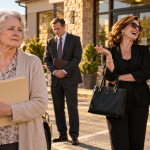
The woman beside Sterling stepped into the aisle, and every conversation in the cathedral stopped. Eleanor Whitmore had been moving toward the side exit. Now she stood frozen beneath a stained-glass window, one gloved hand clutching her handbag. “Mrs. Whitmore,” the woman repeated, “we need to discuss your son’s brakes.”
Eleanor’s expression hardened. “Who are you?” “My name is Dr. Lena Ortiz. I’m an automotive forensic engineer. Mr. Vale retained me to review the available evidence concerning David’s crash.” I stared at her. The room seemed to tilt. Four days earlier, two police officers had stood in my living room and told me David’s car had left Pacific Coast Highway and plunged down a steep embankment.
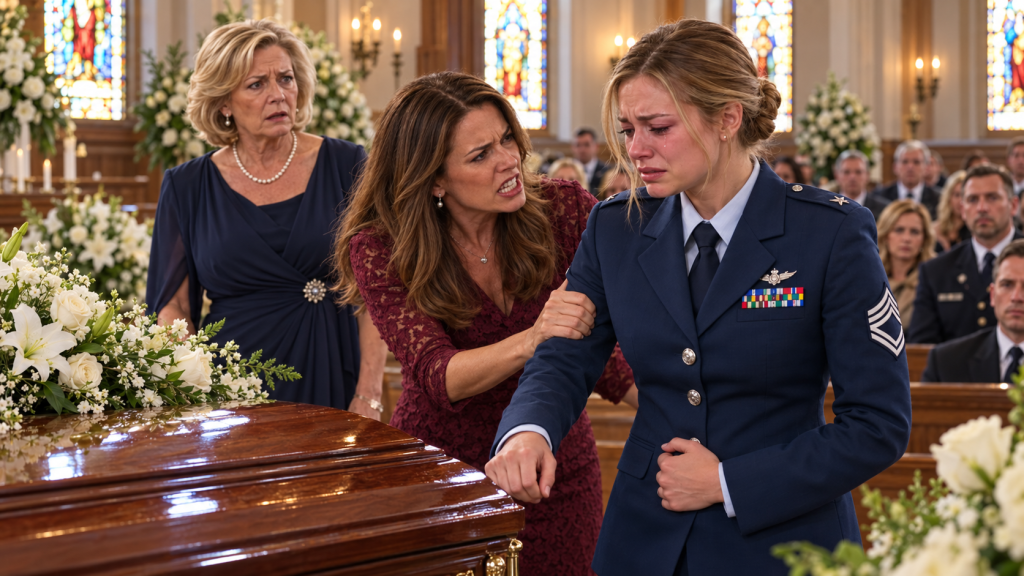
They had spoken carefully. They had said the investigation was continuing. I remembered asking whether he’d suffered. Neither officer had answered directly. Since then, I’d barely been able to think beyond the next breath. And now someone was talking about his brakes. “What about them?” I whispered. Sterling turned toward me.
“Sarah, I hoped we could discuss this privately after the service.”
I looked at the photograph in his hand.
David’s wrecked car.
A repair invoice.
Eleanor’s name.
My voice sounded strange.
“Tell me.”
Lena glanced toward the mourners.
“There’s evidence of automotive work recorded shortly before the collision. The available photographs and paperwork raise questions we believe investigators should examine. We haven’t established the cause of the crash.”
Eleanor laughed sharply.
“That’s absurd. David was an inexperienced driver on a dangerous road.”
I turned toward her.
David had driven that stretch of highway for fifteen years.
He knew every curve.
Every overlook.
Every place where morning fog collected against the cliffs.
He was careful enough to check his tire pressure before a long trip.
And Eleanor knew it.
“How did you know his car had been serviced?” I asked.
Her mouth tightened.
“Because I arranged the appointment.”
The cathedral went silent.
Eleanor seemed to realize she’d said too much.
She straightened her shoulders.
“David complained about the brakes. I arranged for someone to look at them. There’s nothing suspicious about a mother caring for her son.”
Sterling studied her.
“Which service provider?”
“A reputable mechanic.”
“His name?”
“I don’t remember.”
“You authorized a service two days before your son’s death, but you don’t remember the mechanic?”
Eleanor’s eyes flashed.
“This is my son’s funeral. I will not be interrogated by hired strangers.”
I looked toward the casket.
White lilies surrounded David’s photograph.
In it, he was laughing.
His dark hair fell across his forehead, and there was a little crease beside his left eye that appeared whenever he was genuinely happy.
I suddenly wanted everyone to stop talking.
I wanted David to come walking down the aisle, smiling apologetically, telling us there had been some terrible mistake.
But he was lying inside that polished wooden coffin.
And the people around him were arguing about money and brakes.
A sharp pain ran through my left hand.
I looked down.
My ring finger was swollen where Chloe had pulled off my wedding band.
A faint red mark circled the skin.
Then my stomach tightened.
I caught my breath.
Sterling noticed immediately.
“Sarah?”
I pressed my palm against my belly.
“I’m all right.”
But my voice trembled.
Our son shifted beneath my hand.
The movement nearly undid me.
David had been so excited about becoming a father.
He’d spent an entire Sunday assembling the crib, even though the instructions were simple enough to finish in an hour.
He kept pretending he couldn’t find the correct screws because he wanted an excuse to sit in the nursery and talk about the baby.
Now he would never hear our son’s first cry.
And his mother was standing across from me, accusing me of carrying another man’s child.
Chloe still held my wedding ring.
I looked at her.
“Give it back.”
She folded her hand tighter.
“Sarah—”
“My ring.”
Her eyes moved toward Eleanor.
I understood then how much of their cruelty came from the same place.
Neither of them could make a decision without first checking what Eleanor wanted.
“Chloe,” I said, “David put that ring on my finger. You don’t get to take it away.”
Her face flushed.
For a moment, I thought she would refuse.
Then she stepped forward and placed it in my palm.
I closed my fingers around the warm metal.
David had chosen a simple gold band because he knew I disliked jewelry that caught on things.
Inside, he’d engraved six words.
Wherever you are, I am home.
I held the ring against my chest.
Sterling moved beside me.
“Sarah, the service can continue. We don’t have to settle any of this here.”
I looked at David’s casket.
Then at the people watching us.
Some appeared horrified.
Others embarrassed.
A few were still studying the forged DNA report as though it might contain some hidden justification for what they’d witnessed.
I took a breath.
“Put that folder away.”
Eleanor lifted her chin.
“You cannot silence the truth.”
I turned toward her.
“No. But I can refuse to let an unverified accusation become the last thing people remember about my husband’s funeral.”
Then I looked toward the officiating minister.
“Reverend Hale, would you please continue?”
His eyes filled.
“Of course, Sarah.”
I turned to the congregation.
My voice shook, but I made myself speak clearly.
“David was kind. He was funny. He made strangers feel as though they belonged in the room. He loved his family, even when loving them was difficult.”
Eleanor looked away.
“He was going to be a father,” I continued. “He loved our son before he could hold him.”
My hand rested on my stomach.
“And if there are questions about David’s death, they’ll be answered by evidence. Not by shouting over his coffin.”
For the first time that morning, nobody interrupted me.
We finished the funeral.
I don’t remember every word.
I remember the organ.
The sunlight falling across the aisle.
The weight of David’s ring in my palm.
And the final moment when the pallbearers lifted his casket.
I wanted to run forward.
To stop them.
To tell them I wasn’t ready.
Instead, I stood still, because our son was moving beneath my heart, and I had to keep breathing for both of us.
After the burial, Sterling accompanied me to a private room at the funeral home.
Lena came with us.
So did a woman I’d noticed sitting near the back of the cathedral.
Colonel Naomi Jackson.
She had served with me for years.
Most people in the room knew her only as my friend.
Naomi embraced me carefully.
“Sarah, how are you feeling?”
I tried to answer.
Instead, I began crying.
She held me until I could breathe again.
Then she stepped back and looked at my swollen finger.
“Who did that?”
“Chloe.”
Naomi’s expression darkened.
I shook my head.
“Not now.”
She nodded.
“Okay.”
Sterling waited until I’d sat down.
Then he placed a small box on the table.
“David asked me to give you this if anything happened to him.”
I stared at it.
It was made of dark walnut.
Across the lid were the initials D.W.
David Whitmore.
My husband.
I touched the wood.
“He made this?”
Sterling shook his head.
“He commissioned it. He told me he wanted something your son could keep.”
I lifted the lid.
Inside were three envelopes.
One was addressed to me.
One read:
FOR OUR SON, WHEN HE IS OLD ENOUGH.
The third said:
IF MY DEATH IS QUESTIONED.
My hands began trembling.
I looked up.
“Sterling, what was David afraid of?”
The attorney’s face grew serious.
“That’s what we need to discuss.”
Before he could continue, my stomach tightened again.
This time, the discomfort didn’t disappear immediately.
Naomi noticed my expression.
“Sarah?”
I swallowed.
“It’s probably nothing.”
She crouched beside me.
“Probably isn’t a medical assessment.”
Despite everything, I almost smiled.
I was used to giving orders in situations where hesitation had consequences.
Naomi had spent years reminding me that I wasn’t exempt from ordinary human limits.
She looked at Sterling.
“We’re taking her to be checked.”
“I agree,” he said.
I glanced toward the envelopes.
“David—”
“Will still be here when you return,” Sterling said gently.
I closed my eyes.
He was right.
There was no deadline on grief.
At the hospital, my obstetrician, Dr. Camille Warren, examined me and monitored the baby.
The tightening eased.
There was no evidence that labor had begun.
Our son’s heartbeat sounded steady through the monitor.
The rapid, rhythmic sound made tears slide down my cheeks.
Dr. Warren sat beside the bed.
“Your baby looks reassuring right now, Sarah. But you’ve been through an enormous physical and emotional strain.”
I nodded.
She looked at my finger.
“What happened there?”
I hesitated.
Then explained.
Her expression changed.
She examined the swelling, discussed how to care for it, and reminded me to return if I experienced bleeding, fluid leakage, decreased fetal movement, persistent contractions, or other concerning symptoms.
When she left, Naomi sat beside me.
For several minutes, neither of us spoke.
Then I whispered:
“They accused me of cheating on David.”
Naomi looked at me.
“I know.”
“At his funeral.”
Her face tightened.
“I know.”
“And nobody defended me.”
Naomi reached for my hand.
“Sarah, there were people in that cathedral who should have spoken. Their silence was wrong.”
I looked away.
She continued.
“But Eleanor’s accusation doesn’t become true because she said it loudly.”
I closed my eyes.
“I keep thinking David must have known.”
“Known what?”
“That his family would do something like this.”
Naomi was quiet.
Then said:
“He knew enough to prepare Sterling. That doesn’t mean he knew every detail.”
I nodded.
But one question wouldn’t leave me alone.
If David had been afraid of his own family, why hadn’t he told me?
That evening, Sterling came to the hospital with a copy of the estate documents and the envelopes.
He waited until Naomi stepped outside.
Then he sat across from me.
“Sarah, I need you to understand the difference between what David suspected and what we can prove.”
I nodded.
“Tell me everything.”
David had founded Whitmore Pacific, a logistics and infrastructure company, with his father twenty years earlier.
After his father’s death, David had become its controlling shareholder.
Eleanor held a smaller interest.
Chloe had inherited shares too.
For years, David had managed the business while Eleanor acted as the family’s social and charitable figurehead.
Then, six months before his death, David’s financial team discovered unusual payments to several consulting companies.
The services supposedly included overseas procurement support, equipment assessments, and project development.
But some invoices had no verifiable work behind them.
Millions had moved out of the company.
And Eleanor had insisted that the payments were legitimate.
“How much?” I whispered.
Sterling hesitated.
“More than eighteen million dollars is under review.”
I stared at him.
Eighteen million.
A number so large it barely seemed real.
“Was Eleanor stealing?”
“We have evidence of suspicious transactions, not a final determination of criminal responsibility. David authorized an independent audit.”
“And she knew?”
“Yes.”
I looked down.
“What happened?”
Sterling’s expression darkened.
“She demanded that he stop.”
David refused.
He had arranged meetings with outside auditors, company directors, and attorneys.
He also began restructuring his personal estate plan.
Three months before his death, he funded a trust with his separately owned residence and his controlling shares, naming an independent corporate trustee and establishing benefits for me and our child.
There were detailed provisions for my lifetime security and for our son’s upbringing.
Eleanor could not simply order me out of the house.
Nor could Chloe seize the company shares by waving an alleged DNA test.
The trust had been created through valid documents and transferred assets, not merely promises in a will.
David had taken care to make his wishes enforceable.
I stared at Sterling.
“He told me he was updating our estate planning.”
Sterling nodded.
“He didn’t tell you the full reason.”
“Why?”
“He said he didn’t want to burden you during your pregnancy.”
I closed my eyes.
Another person who thought protecting me meant withholding the truth.
I was tired of being protected that way.
Sterling leaned forward.
“David was wrong not to explain everything. But he was trying to preserve your security while investigating a situation he didn’t yet understand.”
I looked at him.
“Did he think someone might hurt him?”
Sterling hesitated.
Then handed me the third envelope.
I opened it.
Inside was a short, handwritten statement.
If anything happens to me before the audit is complete, please examine my recent communications with Eleanor, the outside contractors, and the servicing records for my car.
I hope these precautions prove unnecessary.
Sarah must not be pressured into surrendering any rights because of an allegation involving our child.
The baby is mine. I know it. I love him. And I want Sarah protected from anyone who tries to turn my death into an opportunity.
I covered my mouth.
The words blurred.
David hadn’t written a theatrical prediction of his murder.
He’d written the concerns of a man who knew something was wrong and didn’t want his family left defenseless.
That made the letter more frightening.
I looked up.
“What did you find about the car?”
Lena, who’d remained in the hallway, joined us at Sterling’s invitation.
She placed the repair invoice beside David’s statement.
“Two days before the crash, someone authorized work at a private automotive service facility.”
She pointed to the name.
Eleanor Whitmore.
“The vehicle was later released. The recorded work doesn’t match everything shown in photographs obtained through authorized insurance and investigative channels.”
My stomach tightened.
“Are you saying someone tampered with his brakes?”
“I’m saying there’s enough inconsistency to justify a complete forensic examination. We must distinguish damage from the crash from anything that may have happened beforehand.”
I nodded.
“Who is investigating?”
“The California Highway Patrol is handling the collision investigation, and the relevant law enforcement agencies have been informed of these concerns.”
I looked at David’s handwriting again.
Please examine the servicing records for my car.
He’d been worried.
And nobody had told me.
That night, after Sterling and Lena left, Naomi returned to my room.
She sat beside the bed.
For a long time, I stared at the ceiling.
Then I whispered:
“I can command thousands of soldiers.”
Naomi looked at me.
“Yes.”
“I can make decisions during crises. I can stand in rooms where every person is waiting for me to speak.”
My voice broke.
“But I couldn’t even stop Chloe from taking my wedding ring.”
Naomi’s expression softened.
“Sarah, being a major general doesn’t mean nobody can hurt you.”
I closed my eyes.
She continued.
“You weren’t supposed to be commanding anyone at David’s funeral. You were supposed to be allowed to grieve.”
Tears rolled down my cheeks.
Naomi took my hand.
“Your rank isn’t what makes Eleanor wrong.”
I turned toward her.
“Then what does?”
“The fact that you are a human being who deserved dignity. And David’s wife. And the mother of his child.”
I pressed my palm against my stomach.
Our son moved.
A small, steady kick.
I swallowed.
“David wanted to name him Daniel.”
Naomi smiled.
“After his grandfather?”
“Yes.”
I began crying again.
“He said Daniel Whitmore sounded like someone who would either become a judge or get kicked out of preschool for asking too many questions.”
Naomi laughed softly.
Then she held me while I cried for the man who would never get to discover which prediction came true.
I returned to the house two days later.
The drive through the estate gates felt longer than usual.
David and I had lived there for five years, but I’d never thought of the place as an estate.
To me, it was simply home.
The stone path where he’d insisted on planting lavender.
The kitchen where he made terrible pancakes every Sunday.
The nursery upstairs, with its pale green walls and unfinished shelf of children’s books.
When I stepped inside, I expected to hear him call from his study.
“Sarah? Is that you?”
Instead, the house was silent.
A silence so complete that I stopped breathing for a moment.
Then I saw his jacket hanging beside the front door.
The navy one he wore whenever the coastal mornings turned cold.
I pressed my face against it.
It still smelled faintly of his cologne.
And I began crying.
Our house manager, Mrs. Alvarez, appeared quietly in the hallway.
She had worked for David long before we married.
She’d watched him fall in love with me.
She’d baked cookies when we decorated the nursery.
And she’d cried beside me the night the officers arrived.
“Mrs. Whitmore,” she whispered, “I’m so sorry.”
I shook my head.
“Please call me Sarah.”
She nodded.
Then her expression grew troubled.
“There’s something you should know.”
I looked up.
“Eleanor came yesterday.”
My stomach tightened.
“What?”
“She arrived with a locksmith and two men carrying boxes.”
I stared at her.
“She said she was taking possession of David’s personal effects.”
My heart pounded.
“Did she get inside?”
Mrs. Alvarez shook her head.
“The security supervisor asked for proof of authority. She didn’t have any.”
I exhaled.
“Good.”
Mrs. Alvarez hesitated.
“She told them you’d been removed from the family.”
I closed my eyes.
Even after the funeral.
Even after Sterling explained the trust.
Eleanor still believed she could simply declare me unwelcome.
I called Sterling.
He listened carefully.
Then said, “The trustee has confirmed your occupancy rights under the trust. Eleanor has no authority to change the locks or remove property.”
“She’s still trying.”
“I know. We’ll document the incident and make sure the security company has the relevant instructions.”
I looked toward David’s jacket.
“Sterling, I don’t want this house turned into a battlefield.”
His voice softened.
“Neither did David.”
That afternoon, I opened the first envelope from the walnut box.
I sat in the nursery, surrounded by the things David had chosen.
A stuffed elephant.
A small wooden rocking horse.
A blanket he’d insisted was the softest one in the world.
Then I unfolded his letter.
My Sarah,
If you’re reading this, something has happened that I hoped we would have many years to prepare for.
I know you’ll be angry that I didn’t tell you everything.
You have every right to be.
Tears filled my eyes.
I discovered financial activity in the company that I couldn’t explain. Some of the people involved are family. I wanted facts before I made accusations that could destroy relationships.
But as the investigation continued, I became concerned about how far certain people might go to protect themselves.
You are carrying our son. You have enough to think about without spending your nights wondering whether my mother’s business decisions have endangered us.
That was my reasoning. I don’t know whether it was the right decision.
I laughed through tears.
Even in a letter written before his death, David was admitting he might have been wrong.
I have placed the home and my controlling shares under arrangements designed to protect you and Daniel.
No one gets to decide that you are suddenly less my wife because I’m no longer there to defend you.
And no one gets to treat our son as a bargaining chip.
Sarah, promise me one thing.
Don’t let my family make you feel that you have to prove you were worthy of loving me.
I knew who you were.
I loved you because of it.
I pressed the letter against my chest.
Then I read the final paragraph.
I’ve watched you lead people through situations that would overwhelm most of us. I’ve watched you come home exhausted and still find time to listen to someone else’s troubles.
But you’re not required to be strong every minute.
Let people help you.
Let yourself grieve.
And when Daniel asks about me, tell him I was the luckiest man alive because his mother chose me.
Forever yours, David.
I folded the letter.
Then I lay on the nursery rug and cried until the sunlight faded from the windows.
For years, I’d believed the hardest part of losing David would be learning how to live without him.
I hadn’t understood that grief also meant learning how to live with everything he had left unsaid.
The following week, Eleanor gave an interview to a local television reporter.
I didn’t watch it when it first aired.
Naomi called and warned me.
“Sarah, don’t turn on the television until you’ve spoken to Sterling.”
I sat down.
“What did she do?”
Naomi sighed.
“She repeated the paternity allegation.”
My stomach tightened.
“In public?”
“Yes.”
I closed my eyes.
The funeral had already humiliated me.
Now Eleanor was trying to make the humiliation permanent.
Sterling sent me a transcript.
Eleanor claimed she’d received a confidential DNA report proving David wasn’t the father of my baby.
She suggested that the marriage had been troubled.
She implied that David had been reconsidering his estate plans.
And then she said something that made my hands go cold.
“Sarah has always been secretive about her professional life. David deserved a wife who was transparent with him.”
I stared at the words.
Secretive.
Because I didn’t advertise my military responsibilities at charity dinners?
Because I didn’t introduce myself by rank when David’s family gathered for holidays?
I’d spent years respecting the boundary between my service and our private life.
Now Eleanor was using my discretion as evidence of dishonesty.
I called Sterling.
“Can we prove the DNA report is false?”
“We can establish that the document she displayed isn’t a valid paternity determination. We have asked for the claimed laboratory records, specimen identifiers, and chain of custody. None have been produced.”
“Then why does she keep saying it?”
He paused.
“Because public doubt may help her challenge your credibility even where the legal documents are clear.”
I looked toward the nursery.
“She doesn’t care what it does to Daniel.”
Sterling’s voice hardened.
“Her conduct certainly hasn’t reflected concern for him.”
A formal notice demanding that Eleanor stop repeating the unsupported allegation followed.
My attorneys documented the statements and assessed the legal remedies available.
I refused to be drawn into a public argument about my unborn child.
A television interview couldn’t change David’s estate plan.
Nor could it make a fabricated laboratory report genuine.
But it could hurt.
And it did.
Three nights later, Chloe called.
I almost let the phone ring.
Then I answered.
“Hello?”
For a moment, all I heard was breathing.
Then she whispered:
“Sarah, I need to tell you something.”
I sat upright.
“What?”
“The DNA report.”
My heartbeat quickened.
She began crying.
“It wasn’t real.”
I closed my eyes.
“Go on.”
Chloe swallowed.
“I made it.”
I stared at the wall.
“What do you mean, you made it?”
“I found a sample laboratory report online. I changed the names and the result. Mother said she needed something official-looking to convince people that David’s child wasn’t his.”
My stomach turned.
“You forged a paternity report?”
Chloe sobbed.
“Yes.”
I gripped the phone.
“And you put it on his coffin.”
“Mother did that.”
I felt anger rise.
“You handed it to her.”
Silence.
“Chloe, you stood beside your brother’s body while your mother called his pregnant wife an incubator.”
She began crying harder.
“I know.”
“And then you ripped my wedding ring off.”
“I know.”
My voice broke.
“Why?”
Chloe was quiet for a long time.
Then whispered:
“Because Mother said if the trust could be challenged, we’d get the company back.”
I closed my eyes.
There it was.
Not concern for David.
Not grief.
Control.
“Did you believe the baby wasn’t his?”
Chloe sobbed.
“No.”
I stared at the ceiling.
“You knew?”
“David told me how excited he was about Daniel. He showed me the nursery pictures.”
My throat tightened.
“And you accused me anyway.”
She whispered:
“Yes.”
I covered my face.
There was no answer that could make that moment acceptable.
Then Chloe said:
“Sarah, I think Mother knew something about the crash.”
My entire body went cold.
“What?”
She took a shaky breath.
“Two days before David died, I heard her arguing with Julian Voss.”
I frowned.
“Julian?”
“Whitmore Pacific’s chief financial officer.”
I remembered him.
Tall.
Silver-haired.
Always courteous.
He’d attended our wedding.
He’d stood near Eleanor at the funeral and quietly disappeared when Sterling arrived.
“What were they arguing about?”
Chloe’s voice shook.
“David had scheduled a board meeting. He was going to present findings from the audit.”
I held the phone tighter.
“Go on.”
“Julian said if David reached that meeting, everything would come out.”
My blood turned cold.
“And Mother?”
Chloe began crying.
“She said, ‘Then we need to make sure he doesn’t.’”
For several seconds, I couldn’t breathe.
“Chloe, did she say anything else?”
“No. I left the room. I was frightened.”
“Why didn’t you tell anyone?”
She sobbed.
“Because I thought they meant they would stop the meeting. I didn’t think—”
She broke down.
I sat motionless.
David’s car had gone off the cliff the next day.
The meeting had never happened.
“Chloe,” I said carefully, “you need to tell the investigators exactly what you heard.”
She inhaled sharply.
“Mother will never forgive me.”
I closed my eyes.
“David is dead.”
Silence.
I continued.
“Your brother is dead. Whatever happened, he deserves the truth.”
Chloe began crying again.
“I know.”
After the call, I contacted Sterling.
He instructed me not to question Chloe further and arranged for her attorney to help her make a formal statement.
I understood why.
If the case became criminal, everything would need to be documented properly.
Emotions weren’t evidence.
Suspicion wasn’t proof.
And a frightened sister’s memory couldn’t be treated as a verdict.
But it was a reason to keep investigating.
The next morning, investigators contacted Sterling with an update.
Lena’s concerns about the vehicle had led to additional examination.
The work order from the private service facility was inconsistent with the shop’s routine records.
More importantly, the technical review had identified evidence suggesting intentional interference with the braking system before the collision.
The findings were being evaluated alongside the crash damage, vehicle data, and other evidence.
It wasn’t a complete answer yet.
But it changed the direction of the investigation.
I was sitting at the kitchen table when Sterling told me.
The clock above the stove ticked softly.
I could see David’s coffee mug beside the sink.
I hadn’t moved it.
“Are you saying David didn’t simply lose control?” I whispered.
Sterling spoke carefully.
“The investigators now have evidence indicating that the vehicle may have been deliberately compromised.”
I closed my eyes.
My husband had driven away that morning expecting to come home.
He’d kissed me.
He’d put one hand on my belly and told Daniel to behave himself.
Then he’d smiled and said:
“I’ll be back before dinner.”
I gripped the edge of the table.
He hadn’t come back.
“Sterling,” I whispered, “did someone kill my husband?”
He was quiet.
Then answered:
“That’s what the investigators are trying to determine.”
That afternoon, I opened the second envelope in the walnut box.
The one addressed to our son.
I hadn’t been able to read it before.
It felt too private.
Too painful.
But now I needed to hear David’s voice again, even if it was only through words.
Hello, Daniel.
If you’re reading this, you are probably old enough to be embarrassed by the fact that your father wrote you a letter before you were born.
I laughed through tears.
Your mother says I talk too much.
She’s right.
But there’s something important I want you to know.
Being a good man isn’t about being the strongest person in the room.
It’s about what you do when someone weaker needs your help.
It’s about telling the truth when lying would be easier.
And it’s about never confusing love with ownership.
I stared at that sentence.
Never confusing love with ownership.
David had written those words before his death.
Before Eleanor stood beside his coffin claiming his wealth belonged to his “actual family.”
Before Chloe tried to take my wedding ring.
Before anyone knew what had happened to his car.
I felt tears slide down my cheeks.
Your mother is brave, but she is also gentle. I hope you inherit both.
I hope you ask questions.
I hope you make mistakes and learn from them.
I hope you fall in love with someone who makes ordinary mornings feel extraordinary.
And I hope that when you think of me, you never feel required to become the man I was.
Become the man you choose to be.
I’ll love you either way.
I pressed the letter against my stomach.
“Did you hear that, sweetheart?” I whispered.
Our son kicked.
I began crying.
Because David had understood something his mother never had.
Love wasn’t something you possessed.
It was something you gave.
And he had left enough of it behind to fill a lifetime.
The first time I returned to Whitmore Pacific’s headquarters after David’s death, I nearly turned around in the parking garage.
The building stood above the waterfront, its glass windows reflecting the morning sky.
David had loved the view.
He’d once taken me to the roof and pointed toward the shipping terminals.
“Every container down there represents somebody waiting for something,” he’d said. “Medicine, machinery, food, birthday presents. The work matters because the people at the other end matter.”
That was the David I knew.
Not the wealthy executive Eleanor liked to display at charity events.
Not the man whose company shares she wanted to control.
Just a person who believed business should have a purpose beyond making rich people richer.
Sterling met me in the lobby.
“You don’t have to attend,” he said.
“I know.”
“The independent trustee is handling the ownership issues. The board has already received the relevant documents.”
I nodded.
“Then why am I nervous?”
His expression softened.
“Because David should be here.”
I looked away.
“Yes.”
The meeting had been arranged so the company’s directors could receive a formal update concerning the disputed financial transactions, the independent audit, and the trust’s ownership position.
I had been invited to attend as David’s widow and a beneficiary of the trust.
I wasn’t there to exercise military authority.
I wasn’t there to command anyone.
And I wasn’t there to pretend I knew more about the company than its auditors.
I was there because David had spent twenty years building something he cared about.
And I wanted to understand what had happened to it.
The conference room was nearly full when we entered.
Eleanor sat near the far end of the table.
She wore a tailored black suit and a pearl necklace.
Chloe wasn’t there.
Neither was Julian Voss.
A company attorney had informed us that Julian had been placed on administrative leave pending the independent review.
Eleanor looked at me with undisguised contempt.
“I didn’t realize grieving widows were being invited to board meetings.”
Sterling pulled out a chair.
“Sarah was invited by the board.”
Eleanor lifted her chin.
“She has no business experience.”
I sat down.
“Then I suppose I should listen carefully.”
A few directors exchanged glances.
The meeting began.
An independent auditor named Frances Ng presented the preliminary findings.
The suspicious transactions included payments for consulting work that could not be verified.
Some invoices referenced overseas projects that company staff couldn’t locate.
Others used vendor descriptions copied from legitimate contracts.
Several recipient companies had overlapping ownership information or connections to people associated with Julian.
The audit had not established every ultimate beneficiary.
But it had identified a pattern.
Money leaving Whitmore Pacific.
Paperwork suggesting services that might never have been provided.
And efforts to prevent employees from examining the transactions too closely.
Frances displayed an internal email.
David had sent it six weeks before his death.
I want the board to receive an independently verified account of every questioned payment. No family relationship or executive position should exempt anyone from review.
My throat tightened.
I could hear his voice.
Calm.
Measured.
Determined.
Eleanor interrupted.
“My son was under tremendous stress. He became obsessed with minor accounting discrepancies.”
Frances looked at her.
“Mrs. Whitmore, the amounts under review exceed eighteen million dollars.”
Eleanor’s expression hardened.
“David was never good at delegating.”
I stared at her.
Then asked quietly:
“Is that why you wanted him to cancel the meeting?”
She turned sharply.
“What?”
“The meeting he was driving to when he died.”
A hush fell over the room.
Sterling touched the edge of my folder.
A quiet reminder.
The collision investigation was ongoing.
I couldn’t turn suspicion into certainty simply because Eleanor was sitting in front of me.
I took a breath.
“I understand the board is investigating the financial records. I’m asking whether David’s concerns were taken seriously before his death.”
Frances nodded.
“They were by some people. Others resisted providing documents.”
Eleanor leaned forward.
“Sarah, perhaps you should return to whatever ceremonial Army duties have kept you so busy. This company is far beyond your understanding.”
A director across the table frowned.
Sterling began to speak.
I gently raised my hand.
Then looked at Eleanor.
“Twenty-four years ago, I entered military service. Today I serve as a major general in the United States Army.”
The room went quiet.
Eleanor stared.
I continued.
“That doesn’t make me an expert in this company’s accounting. It doesn’t give me authority over its directors, and it doesn’t decide who owns David’s shares.”
I rested my hands on the table.
“But I do understand the importance of accountability. And I understand that people entrusted with responsibility must answer questions about how they used it.”
Eleanor’s mouth opened.
Then closed.
One of the directors, a retired banker named William Hart, looked at me with new recognition.
“General Whitmore,” he said quietly, “I didn’t realize you were David’s wife.”
I gave a faint smile.
“Most days, being David’s wife mattered much more to me than my rank.”
My voice cracked.
I swallowed.
“And right now, I’d give anything to have him sitting in this chair instead.”
Nobody spoke.
Even Eleanor looked away.
The meeting continued.
The independent trustee’s representative explained that David’s controlling ownership interest had been properly transferred into his trust before his death.
The board would continue operating under the company’s governing documents, with the independent trustee exercising the rights attached to those shares.
Eleanor’s interests would be respected according to their actual legal status.
But she could not claim David’s shares merely by questioning his marriage or his unborn child.
The trustees and directors would not treat an unauthenticated paternity report as evidence capable of overriding properly executed documents.
I watched Eleanor’s face.
She’d spent weeks trying to make me believe David’s death had erased my place in his life.
Now she was hearing the same answer from attorneys, directors, and a trust company.
He had made arrangements.
She couldn’t simply sweep them away.
After the meeting, Frances Ng approached me in the hallway.
“Sarah?”
I turned.
“Yes?”
She looked nervous.
“I worked closely with David during the audit.”
My throat tightened.
“I know. He mentioned you.”
She smiled sadly.
“He was proud of you.”
I looked down.
Frances continued.
“He said his wife understood leadership better than anyone he’d ever met.”
I swallowed.
“That’s generous.”
“He also said you would be furious when you discovered he’d kept the investigation from you.”
Despite everything, I laughed.
“That sounds more accurate.”
Frances handed Sterling a sealed packet.
“These are additional records the audit team has recovered from the archived systems.”
Sterling accepted it.
Frances looked toward me.
“One of David’s last instructions was to preserve every communication involving the service arrangements for his car.”
My stomach tightened.
“Did he think someone was going to hurt him?”
She hesitated.
“He told me he was concerned that someone had gained unauthorized access to the vehicle.”
I stared at her.
“What happened?”
Frances swallowed.
“His parking attendant reported seeing the car taken away for service without the usual request being made through David’s office.”
I felt cold.
“Who authorized it?”
She looked toward Sterling.
“The records identify someone from Eleanor’s office.”
That evening, Lena reviewed the additional documents.
The vehicle had been collected from a company parking facility during a conference.
A driver associated with Eleanor’s household had signed the collection log.
The repair shop’s official paperwork described a routine inspection.
But the individual who collected the vehicle had provided a different destination address on a separate dispatch record.
The inconsistencies suggested a chain of custody more complicated than the invoice Eleanor had admitted authorizing.
“Can you tell who actually worked on the car?” I asked.
Lena nodded slowly.
“Investigators have identified individuals connected to the facility. Interviews and electronic records are still being assessed.”
I looked down.
“Does this prove Eleanor ordered someone to damage the brakes?”
“No,” Lena said firmly. “It establishes that people acting through her office arranged access to the car. Intent and knowledge are separate questions.”
I nodded.
That distinction mattered.
I wanted the truth.
Not simply a conclusion that punished the person who’d humiliated me.
Two days later, Chloe met with investigators.
She provided a statement about the conversation she’d overheard between Eleanor and Julian.
She also supplied messages concerning the fabricated DNA report.
The electronic files showed she’d altered a template to make it appear to be a laboratory result.
Eleanor had approved the wording and instructed her to bring the folder to the funeral.
There had been no prenatal paternity testing.
No properly documented fetal sample.
No valid laboratory result.
The number that had shattered my dignity in front of hundreds of mourners was something Chloe had typed into a document.
0.00%.
A lie dressed as science.
When Sterling told me the investigators had received Chloe’s records, I felt no triumph.
I remembered her yanking my ring.
The pain.
The whispers.
The people who had looked away.
Then I remembered David carrying her on his shoulders in a photograph from their childhood.
She’d been his little sister.
He’d defended her whenever Eleanor was too harsh.
He’d paid for her education.
Celebrated her accomplishments.
Sent her flowers when she got her first job.
And Chloe had stood beside his coffin and helped humiliate the woman carrying his child.
I didn’t know whether I could forgive her.
But I was glad she’d told the truth.
The next morning, I received a call from the investigating officer.
Her name was Detective Marissa Santos, working with the collision investigation team.
She explained that investigators had obtained additional evidence connecting the vehicle’s unauthorized service to payments associated with the financial scheme.
There were transaction records.
Communications.
And an interview with a former employee of the service facility.
The employee, Tomas Delgado, had admitted that a man acting for Julian Voss paid him to permit unauthorized work on David’s car.
He maintained that he hadn’t understood the full purpose at the time.
The investigators were testing his account against independent evidence.
I listened without moving.
Then asked:
“Did he know David would die?”
Detective Santos paused.
“That’s one of the questions we’re investigating.”
My throat tightened.
“Do you think the crash was intentional?”
“The forensic findings increasingly support deliberate interference with the vehicle. We are examining who planned it, who carried it out, and what each person knew.”
I looked toward David’s photograph.
“Thank you for telling me.”
Her voice softened.
“Mrs. Whitmore, I’m sorry.”
After the call, I sat in the nursery.
I looked at the little wooden rocking horse.
Then at David’s letter.
If anything happens to me before the audit is complete…
He’d written those words because he’d sensed danger.
And still, he’d gone to work.
Still, he’d driven toward the board meeting.
Still, he’d tried to uncover the truth rather than let millions disappear beneath polite excuses.
I placed my hand against my belly.
“Your daddy was brave,” I whispered.
Then I corrected myself.
“He was frightened too. Being brave didn’t mean he wasn’t.”
That night, I heard a noise outside the nursery.
I froze.
The house was supposed to be quiet.
Mrs. Alvarez had gone home.
The security team remained at the main gate, but the inside of the house was empty.
Then I heard it again.
A faint metallic sound from downstairs.
I took my phone and moved into the hallway.
I didn’t go looking for an intruder.
Instead, I stepped back into the bedroom, locked the door, and called security.
“Someone may be inside the house,” I said.
The supervisor immediately directed staff toward the residence and contacted law enforcement.
I sat on the bed, keeping my phone connected.
My heart pounded.
Our son shifted.
I pressed a hand against my stomach.
“It’s all right, sweetheart,” I whispered, though I wasn’t sure whom I was trying to reassure.
A few minutes later, security called back.
They had found an exterior service door open.
A man had fled the property when the guards approached.
There was no sign that he’d entered the living areas.
But the lock showed damage.
And a small storage room near David’s study had been disturbed.
I stared at the phone.
David’s study.
His documents.
His files.
Suddenly, the house felt less like a refuge and more like another place where people might come looking for something he’d left behind.
Sterling arrived with the police later that evening.
The officers documented the attempted entry and reviewed the property’s camera recordings.
A security camera captured a man wearing a dark jacket approaching the service entrance.
His face wasn’t clear.
But his vehicle appeared briefly at the edge of the driveway.
The footage was preserved for investigators.
Sterling looked deeply troubled.
“Sarah, I’d like you to stay somewhere with better immediate security until we understand this.”
I shook my head.
“This is my home.”
“I know.”
I looked toward David’s study.
“He protected it for me.”
Sterling’s voice softened.
“He protected your right to live here. He didn’t ask you to put yourself at unnecessary risk.”
I closed my eyes.
He was right.
The bravest thing I could do that night wasn’t to stand my ground.
It was to protect our baby.
I spent the next several nights with Naomi and her family.
Her husband made dinner.
Their teenage daughter left a stack of pregnancy magazines beside my bed.
Naomi made sure I attended my scheduled appointments and rested when I needed to.
For a few days, I allowed myself to be cared for.
I hadn’t realized how difficult that would feel.
Then Sterling called.
“Sarah, investigators have identified the vehicle seen near your property.”
I sat upright.
“Who was driving?”
He took a breath.
“A private contractor who previously worked for Julian Voss.”
My stomach tightened.
“Why was he at our house?”
“That remains under investigation. But investigators are examining whether the attempted entry was connected to the search for David’s financial records.”
I looked down.
“And what about Eleanor?”
Sterling was quiet.
Then he said:
“There are indications she authorized the vehicle service arrangements. We still don’t know whether she understood what Julian intended.”
I closed my eyes.
“Sterling, I need to ask you something.”
“Of course.”
“If Eleanor helped arrange the work that caused David’s crash, why did she stand beside his coffin and accuse me of cheating?”
He hesitated.
Then answered:
“Perhaps because blaming you kept people from asking questions about her.”
I stared out the window.
The possibility made my stomach turn.
Eleanor hadn’t just tried to take my home.
She might have tried to turn my grief into a distraction.
That night, I dreamed about David.
We were in the kitchen.
He was making pancakes.
He wore the blue sweater I loved.
I kept trying to tell him about Eleanor, the car, and the audit.
But every time I spoke, he smiled and said:
“Sarah, the pancakes are burning.”
I woke with tears on my face.
For a moment, I could almost smell breakfast.
Then the room came into focus.
Naomi’s guest bedroom.
The little lamp beside the bed.
My husband was still gone.
I began crying.
Not because of the financial investigation.
Not because of Eleanor.
Because I wanted one more ordinary morning.
One more terrible pancake.
One more chance to tell David that whatever trouble he’d discovered, we could have faced it together.
Two weeks after the attempted break-in, investigators arrested Julian Voss.
I learned about it from Detective Santos, not from the news.
She called late in the afternoon and asked whether I was somewhere private.
I was sitting in Naomi’s kitchen with a glass of water and an untouched plate of fruit.
“Yes,” I said.
Her tone was careful.
“Mr. Voss has been taken into custody on warrants connected to the financial investigation and David’s death. The charges will be addressed in court, and the investigation remains active.”
I gripped the phone.
“Did you find out what happened to his car?”
“We have substantially more evidence than we did when we first spoke.”
My heart pounded.
She explained that investigators had obtained communications between Julian, the service contractor, and people responsible for arranging access to David’s vehicle.
Financial records showed payments made shortly before and after the unauthorized work.
Technical findings supported the conclusion that the braking system had been intentionally compromised before David drove along Pacific Coast Highway.
The investigation had also identified planning communications that prosecutors believed demonstrated Julian’s intent to stop David from reaching the board meeting.
“Did Eleanor know?” I whispered.
Detective Santos was quiet.
“We have evidence she was involved in arranging access to the car. Her knowledge of the intended interference, and whether she understood the danger to David, are matters we are still investigating.”
My hands shook.
“Did she help Julian kill him?”
“I can’t answer that with certainty today.”
I closed my eyes.
For weeks, I’d wanted a simple answer.
A name.
A reason.
Someone to blame.
But the truth was proving uglier and more complicated than one dramatic confession.
That evening, Chloe came to Naomi’s house.
She arrived with swollen eyes and trembling hands.
Naomi let her into the sitting room.
I remained seated.
“Sarah,” Chloe whispered.
I didn’t answer.
She looked down.
“Mother knows Julian has been arrested.”
I nodded.
“She called me this morning.”
“What did she say?”
Chloe began crying.
“She said everything was getting out of control.”
I stared at her.
“David is dead.”
Her face crumpled.
“I know.”
“Your brother is dead, Chloe. What part of that was still under anyone’s control?”
She covered her mouth.
I took a breath.
“Why are you here?”
She hesitated.
“Because I found something in Mother’s desk.”
My stomach tightened.
“What?”
“A letter.”
She placed a copy on the table.
It was addressed to Eleanor.
Dated the day after David’s crash.
Written by Julian.
I stared at the first sentence.
Eleanor, you told me the audit had to be stopped before David exposed us.
My hands began trembling.
The letter continued.
I understand you’re frightened, but you cannot keep calling me and asking what happened to the car. We both know what was arranged.
I looked up.
“Where did this come from?”
Chloe wiped her cheeks.
“Mother printed it. I found it with the files about the trust.”
My throat tightened.
“Have you given this to the investigators?”
“Yes. My attorney helped me turn over the original along with the other documents.”
I nodded.
That was the right thing to do.
I wasn’t going to take it into my own hands or use it to confront Eleanor.
Chloe sat opposite me.
“Sarah, I never thought David would die.”
I looked at her.
“Did you know they were planning something?”
She began crying.
“I knew Mother wanted the audit stopped. I knew Julian was helping her. I thought they were trying to block him through the company.”
I watched her carefully.
“Then why did you help fake the DNA test?”
She looked down.
“Because after David died, Mother said everything would collapse unless we kept control of his shares.”
I felt sick.
“So she told you to destroy my reputation.”
Chloe nodded.
“And you agreed.”
“Yes.”
For a long moment, neither of us spoke.
Then Chloe whispered:
“David would hate what I’ve become.”
I looked at her.
“David loved you.”
She sobbed.
“He did.”
“But loving you doesn’t mean he would excuse what you did.”
She nodded.
“I know.”
I leaned forward.
“If you want to honor him, tell the truth. All of it. Even the parts that make you look terrible.”
Chloe wiped her cheeks.
“I will.”
The next day, Eleanor’s attorney contacted Sterling.
Eleanor wanted to speak with me.
I refused.
Then she sent a handwritten letter.
I read it only after discussing it with my own counsel.
Sarah,
I never wanted David dead.
Julian told me he could prevent David from reaching the meeting. He said the car would be unavailable and David would lose the chance to present the audit findings.
I believed we would have more time to resolve the company problems privately.
When I learned what had happened, I was terrified.
I made terrible decisions.
I know you despise me.
Please believe that I loved my son.
I stared at the words.
I never wanted David dead.
Perhaps that was true.
Perhaps Eleanor had thought she was authorizing an interruption.
Perhaps Julian had hidden his intentions from her.
But she’d agreed to interfere with David’s choices.
She’d concealed information after his death.
She’d used a fabricated paternity report to attack his widow.
And she’d tried to take control of the property he’d deliberately protected.
Whatever her intentions before the crash, the cruelty afterward had been entirely her own.
I didn’t answer her letter.
I forwarded it to Sterling.
The investigators would determine its significance.
I wasn’t going to turn my grief into a private negotiation over her guilt.
A week later, I went into labor.
It began just after midnight.
A tightening low in my abdomen.
Then another.
I’d been sitting in David’s nursery, reading his letter to Daniel for what felt like the hundredth time.
At first, I thought I was simply exhausted.
But the contractions became regular.
I called Dr. Warren’s on-call service, then Naomi.
Within minutes, I was on my way to the hospital.
I remember gripping the car door.
Looking out at the dark road.
And thinking:
David was supposed to be here.
He was supposed to carry the hospital bag.
Make nervous jokes.
Ask too many questions about the monitors.
He was supposed to hold my hand.
Instead, Naomi sat beside me in the hospital room.
She adjusted my pillow.
Helped me breathe through the contractions.
And listened when I began crying.
“I can’t do this without him.”
She leaned close.
“Sarah, I know you wanted David here.”
I shook my head.
“He promised.”
My voice broke.
“He promised he’d be here when Daniel was born.”
Naomi’s eyes filled.
“I know.”
She squeezed my hand.
“And I wish more than anything that he could be.”
The labor was long.
There were moments when I felt strong.
And moments when I felt frightened and unbearably alone.
I wasn’t a general in that room.
I wasn’t a beneficiary of a trust.
I wasn’t the woman Eleanor had humiliated in front of a cathedral full of people.
I was simply a mother trying to bring her child safely into the world while grieving the man who should have been standing beside her.
Then, shortly after sunrise, I heard a cry.
A small, fierce sound.
The doctor smiled.
“Sarah, your baby is here.”
Tears flooded my eyes.
Our son was placed against my chest.
He was warm.
Red-faced.
Furious about the sudden change in circumstances.
Exactly as David had predicted.
I held him carefully.
“Hello, Daniel,” I whispered.
He opened his tiny mouth and cried again.
I laughed through tears.
“Your daddy said you’d have opinions.”
Naomi stood beside the bed, crying too.
I looked down at his little face.
He had David’s dark hair.
The same serious crease between his eyebrows.
And when he settled against me, I felt something I hadn’t felt since the night the police officers came to our door.
Not happiness without grief.
Not peace without pain.
Hope.
I kissed Daniel’s forehead.
“Your daddy loved you,” I whispered.
“He loved you before he ever saw your face.”
Tears ran down my cheeks.
“And I promise you, sweetheart, nobody is going to make you earn your place in this family.”
The next afternoon, Sterling visited.
He brought a small wrapped package.
“David left something else for the baby,” he said.
I stared at him.
“What?”
Sterling smiled sadly.
“He insisted I keep it safe until Daniel arrived.”
Inside was a tiny pair of blue knitted booties.
David had bought them months earlier.
Attached was a note.
For the little person who will someday teach me that I know absolutely nothing about being in charge.
I laughed through tears.
Then I held the booties against Daniel’s blanket.
David had never held our son.
But he’d imagined him.
Loved him.
Prepared for him.
And somewhere inside all the grief and investigations, that love remained untouched.
The weeks after Daniel’s birth were unlike anything I’d ever experienced.
There were sleepless nights.
Bottles and blankets.
The smell of baby shampoo.
The tiny sounds Daniel made when he stretched his arms above his head.
And there were moments when grief arrived so suddenly that I could barely stand.
Sometimes I would reach across the bed before remembering David wasn’t there.
Sometimes I’d hear Daniel laugh in his sleep and instinctively turn to tell his father.
Then I’d see the empty space beside me.
And the loss would feel new all over again.
But slowly, our home began changing.
The nursery was no longer a room full of plans David wouldn’t get to see completed.
It became Daniel’s room.
There were little socks beside the crib.
Books stacked on the shelf.
Photographs of David placed where our son could see them as he grew.
And above the rocking chair, I hung a framed sentence from David’s letter.
Never confuse love with ownership.
I returned to the estate with Daniel when my doctor cleared us to do so.
Security had been strengthened, and the investigation into the attempted entry continued.
Mrs. Alvarez stood waiting in the foyer when we arrived.
The moment she saw Daniel, she began crying.
“Oh, Sarah.”
I smiled.
“Would you like to meet him?”
She nodded quickly.
I placed him carefully in her arms.
She looked down at his face.
Then whispered:
“He has David’s eyes.”
My throat tightened.
“Yes.”
She began crying harder.
“David would have been so happy.”
I looked toward his photograph.
“I know.”
The criminal proceedings moved slowly.
Investigators collected more records.
Witnesses gave statements.
Attorneys challenged evidence.
The prosecutors built their case without relying on rumor or the dramatic accusations that had filled David’s funeral.
The strongest evidence concerned the financial scheme, the unauthorized access to his vehicle, communications arranging the work, and the forensic findings from the crash.
Julian Voss had used company money to support a network of false consulting transactions.
When David began uncovering the payments, Julian faced the possibility of losing his position and being prosecuted.
Investigators established that Julian had arranged the deliberate interference with David’s vehicle.
The evidence showed a plan to prevent him from reaching the board meeting by making the car dangerous to operate.
David had driven toward that meeting believing his car was safe.
He never arrived.
Eleanor’s conduct was examined separately.
The evidence established that she had been involved in obstructing the audit and authorizing arrangements through which the car was taken for unauthorized service.
But proving that she knew Julian intended a potentially fatal act was a separate issue.
Her own communications indicated that she’d expected David to be delayed or stranded.
Other records showed she became aware of serious irregularities after the crash and failed to disclose them.
Rather than help investigators immediately, she had concentrated on controlling the family’s wealth and discrediting me.
I had wanted a clear answer about Eleanor.
Was she a grieving mother?
A conspirator?
A woman who had helped create danger without understanding its consequences?
The evidence revealed pieces of all three.
But whatever she had intended, her conduct after David’s death remained unforgivable to me.
She had seen me standing beside his casket, eight months pregnant and barely able to breathe.
And she’d chosen that moment to humiliate me.
She hadn’t been forced to do that by Julian.
She had made that choice herself.
Julian was eventually convicted of offenses including the killing of David and financial crimes connected to Whitmore Pacific.
The court imposed a lengthy prison sentence.
Other participants in the vehicle scheme faced consequences according to their established roles.
Eleanor entered a separate plea involving her participation in the financial misconduct and her efforts to obstruct the investigation.
She also faced civil claims arising from the transactions.
Her cooperation and the limitations of the evidence concerning her knowledge of Julian’s lethal plan were addressed through the legal process.
Nothing could bring David back.
But the facts were finally placed on a record that could not be rewritten by family gossip.
Chloe cooperated with investigators concerning the forged paternity report and the events leading up to the funeral.
Through counsel, she acknowledged fabricating the document and her role in its public use.
The matter had consequences for her, both legal and personal.
Her apologies did not erase what she’d done.
For months, I kept my distance.
Then one afternoon, she sent me a letter.
Sarah,
David spent his life protecting me.
At his funeral, I repaid that love by hurting the two people he most wanted protected.
I don’t expect forgiveness.
I only want you to know I’ve stopped blaming Mother for the choices I made myself.
I was cruel.
I was cowardly.
And I’m sorry.
I read it twice.
Then placed it in a drawer.
I didn’t answer immediately.
I didn’t know whether I could forgive her.
But I recognized something different in those words.
For the first time, Chloe wasn’t explaining away her behavior.
She was taking responsibility.
Months later, I agreed to meet her.
We spoke for nearly two hours.
She cried.
I cried.
I told her exactly what she’d taken from me that day.
Not merely a wedding ring.
The dignity of grieving beside my husband’s body without being attacked.
She listened.
And she didn’t defend herself.
I didn’t promise her a place in Daniel’s life that afternoon.
I told her trust would have to be rebuilt slowly.
She accepted that.
Eleanor requested to see Daniel.
Her attorney passed along the message.
She said she wanted to hold her grandson.
The same child she’d publicly called illegitimate.
I sat with the request for several days.
Then I wrote a brief reply.
Eleanor,
Daniel is David’s son.
He was loved before he was born and will never be required to prove his worth to anyone.
Your relationship with him, if there is ever to be one, cannot begin with a demand.
I am not prepared to arrange contact.
Sarah.
I didn’t submit Daniel to a DNA test to satisfy Eleanor.
The funeral document had no legitimate specimen or laboratory result behind it.
David had acknowledged our son in his estate planning and his letters, and the trust documents had been administered according to their terms.
Eleanor’s accusation had never created an obligation for me to expose Daniel to another ordeal.
If he ever needed accurate biological information for medical or legal reasons, I would help him obtain it appropriately.
But I wouldn’t allow his identity to become a prize in a battle Eleanor had started.
Whitmore Pacific survived the investigation, though it changed considerably.
The independent board removed compromised leadership.
Financial controls were rebuilt.
Claims were pursued against those responsible for the diverted funds.
Employees who’d raised concerns were finally heard.
Sterling kept me informed about the trust and Daniel’s future interests.
I remained involved where my rights and responsibilities required it, but I didn’t pretend to be the company’s operational leader.
My own career mattered too.
After maternity leave and the necessary arrangements with my command, I gradually returned to military service.
Some people seemed surprised.
They assumed David’s wealth meant I would never need to work again.
But I’d never served because I needed a wealthy husband to approve of my choices.
I served because I believed in the responsibility I’d accepted.
And becoming Daniel’s mother had deepened, not erased, the importance of that commitment.
On Daniel’s first birthday, I took him to the cemetery.
It was a clear morning.
The same kind of bright California day David had loved.
I carried a small bouquet of white lilies.
Daniel sat in his stroller, looking around with enormous curiosity.
When we reached David’s grave, I knelt beside the stone.
“Hello, sweetheart,” I whispered.
My throat tightened.
“Your little boy is one.”
Daniel made a cheerful sound.
I laughed through tears.
“He’s already stubborn.”
I looked at David’s name.
“He laughs when I sing badly. He loves strawberries. And he makes the exact face you used to make when somebody interrupted your coffee.”
Tears slid down my cheeks.
“I wish you could see him.”
I took a photograph from my bag.
It showed David kneeling beside the unfinished crib.
He was smiling at the camera, holding a screwdriver.
I’d taken it six weeks before his death.
I placed the photograph beside Daniel’s stroller.
“That’s Daddy,” I told him.
Daniel reached for it.
I smiled.
“Yes, sweetheart. That’s your daddy.”
Then I took out the final letter from the walnut box.
The one David had written for our son.
I read it aloud.
My voice broke more than once.
But I finished.
Because Daniel deserved to know the kind of man his father had wanted to be.
Not a perfect man.
Not a man who never made mistakes.
A man who tried to protect the people he loved, who believed in honesty, and who wanted his child to become someone kind.
When I finished, Daniel reached toward my face.
His little fingers touched my cheek.
I laughed through tears.
“I’m okay, sweetheart.”
Then I looked back at the grave.
“David,” I whispered, “I wish you’d told me what was happening.”
The words had been waiting inside me for a year.
“I wish you’d trusted me with the danger.”
I took a shaky breath.
“But I know you loved us.”
The wind moved gently through the trees.
“And I promise you something.”
I looked at Daniel.
“He will grow up knowing the truth about you.”
Not the scandal.
Not Eleanor’s lies.
Not the money.
The truth.
That his father loved terrible jokes.
That he always gave away the last piece of cake.
That he once drove forty minutes in the rain because I mentioned wanting a certain kind of soup.
That he cried when he first heard Daniel’s heartbeat.
That he made people feel important.
That he believed doing the right thing mattered, even when it came at a cost.
I touched the wedding ring on my finger.
The same ring Chloe had ripped away beside David’s casket.
I’d worn it again after the swelling disappeared.
Not because I couldn’t imagine loving or living again.
Because it reminded me of a promise that had been real.
Wherever you are, I am home.
For a long time, I’d thought those words meant home was wherever David stood.
Now I understood something else.
Home was also what we’d built together.
The love he’d left behind.
The child resting in his stroller.
The life I was still allowed to live.
I rose slowly.
Then took Daniel’s hand.
“Come on, sweetheart,” I whispered.
“Let’s go home.”
As I pushed the stroller down the cemetery path, I thought about the day Eleanor slammed that DNA report onto David’s coffin.
She believed she was taking everything from me.
My dignity.
My marriage.
My home.
My child’s place in the family.
But David had already protected the things she thought she could claim.
And he had left something even more important behind.
The certainty that I never needed Eleanor’s permission to belong.
My mother-in-law tried to erase my son at his father’s funeral.
She thought a forged DNA report could destroy our marriage, steal our home, and rewrite David’s final wishes.
But she was wrong.
David had known who I was.
He had known who our son was.
And although he couldn’t stand beside us that day, his love and the arrangements he’d made continued to protect us.
I had entered that cathedral believing I was burying the only future I’d ever wanted.
I walked away a widow, frightened and heartbroken.
But I didn’t walk away powerless.
I walked forward carrying a life David and I had created together.
And when Daniel someday asks me whether his father loved him, I won’t need a document, a courtroom, or anyone else’s approval to answer.
I’ll show him the letters.
I’ll tell him the stories.
I’ll hold him close.
And I’ll say:
“Your daddy loved you before you were born. And that love never needed anyone’s permission.”
THE END STORIES! THANK YOU FOR READING GOOD LUCK !❤️
Related Posts