For a moment, the entire wedding venue seemed to stop breathing. My mother stood in the front row, one hand pressed against her chest, glaring at Claire as though she’d committed some unforgivable offense. Claire stood beside me in her father’s enormous black wedding suit. Her bouquet lay in her maid of honor’s hands.
And on her phone was a video that apparently showed my own mother holding the scissors used to destroy the wedding dress I’d spent months imagining. “That’s ridiculous,” my mother snapped. “Claire, put that phone away.” Nobody moved. Then my brother Ben stepped out from beside me. “Mom,” he said quietly, “what exactly is she talking about?”
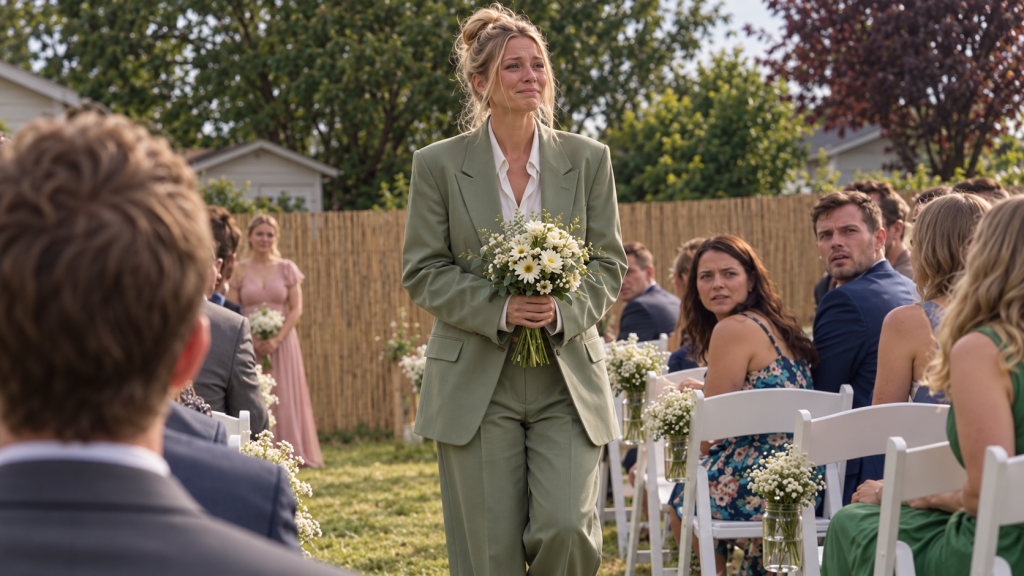
My mother turned toward him. “Benjamin, don’t you dare encourage this.” “Answer the question.” 0I had never heard my brother speak to her that way. Neither, judging by her expression, had she. Claire’s hand was trembling so badly that she almost dropped her phone. I reached toward her instinctively, but stopped before touching her.
I’d spent the last five minutes thinking about how embarrassed I was.
Now I was beginning to understand how frightened she must have been.
“Claire,” I whispered, “can I see it?”
She looked at me.
For a terrible second, I thought she might refuse.
Then she nodded.
Her maid of honor, Tessa, took the phone and opened the video.
The recording came from a security camera mounted above the bridal suite’s entrance. The camera covered the doorway and the garment storage alcove, not the private dressing area.
The timestamp read 8:17 the previous evening.
At first, nothing happened.
Then my mother appeared.
She was wearing the blue coat she’d worn to our rehearsal dinner.
She entered using the spare access card provided to designated family members.
I felt my stomach tighten.
“Why were you there?” I asked.
My mother opened her mouth.
But on the screen, she was already walking toward the garment rack.
She pulled the ivory dress from its protective cover.
For a moment, she simply stood looking at it.
Then she reached into her handbag.
Silver scissors flashed beneath the camera.
My mother raised them toward the delicate lace.
And cut.
Once.
Twice.
Again.
I watched her slash the bodice, pull at the fabric, and tear the zipper from its stitching.
Then she took something white from her handbag and placed it inside the garment bag.
The note.
You don’t belong in this family.
My chest felt hollow.
I lowered the phone.
“Mom.”
She was staring at the grass.
“Mom, tell me that isn’t what it looks like.”
She didn’t answer.
I heard someone behind us begin crying.
Then my mother lifted her chin.
“Fine. I damaged the dress.”
A collective gasp moved through the guests.
“But somebody had to make that girl understand what she was getting herself into.”
I stared at her.
“That girl?”
Claire closed her eyes.
My mother continued, her voice rising.
“You have no idea what she’s been doing behind your back.”
I turned toward Claire.
She was no longer looking at my mother.
She was looking at me.
Waiting.
Not for a defense of the suit.
Not for an explanation of the scissors.
She was waiting to find out whether I would choose to believe her.
I thought about the little arguments I’d dismissed during our engagement.
The times Claire said my mother made her uncomfortable.
How I’d told her Mom was simply opinionated.
How I’d said she’d grow to love Claire once she understood her better.
And suddenly, those reassurances sounded unbearably foolish.
I turned toward my mother.
“You’re going to leave.”
Her expression changed.
“What?”
“You’re not staying for the ceremony.”
She gave a short, incredulous laugh.
“I’m your mother.”
“I know.”
“You would throw your own mother out of your wedding?”
I looked at Claire’s ruined dress hanging inside the clear bag.
Then at the tears running down her face.
“You destroyed something she loved. You threatened her. You offered her money to leave me.”
My voice cracked.
“And you did it because you were certain I’d protect you instead of her.”
My mother stepped backward.
“You’re making a mistake.”
“No,” I said. “I made one by not listening sooner.”
She stared at me as though she no longer recognized her son.
Then she looked toward Ben.
“Are you going to stand there and let him humiliate me?”
Ben swallowed.
For a second, I thought he might intervene.
Instead, he said, “Mom, you humiliated yourself.”
My mother’s face went white.
And for the first time in my life, she had nothing to say.
The officiant, Reverend Collins, approached us quietly.
“Would you like a few minutes?”
I looked toward Claire.
Her face was pale beneath her carefully applied makeup.
I wanted to tell everyone to leave so I could hold her.
I wanted to promise I’d make everything better.
But I’d already spent too much time making promises without understanding what Claire needed.
So I asked her.
“Do you want to continue?”
She looked at me.
The silence stretched.
Then she whispered, “I don’t know.”
Those three words hurt more than any accusation.
Because twenty minutes earlier, I’d been certain I was about to marry the woman I loved.
Now she wasn’t certain she wanted to stand beside me.
I nodded.
“Then we don’t have to decide right now.”
My mother scoffed from the front row.
“Oh, please. Are we really going to cancel an entire wedding over one dress?”
Ben turned toward her.
“Mom. Stop.”
She raised both hands.
“I am the only person here thinking rationally!”
Claire flinched.
I stepped between them.
“You’re leaving now.”
My mother stared.
Then, perhaps realizing nobody intended to support her, she gathered her handbag.
My aunt Judith hurried after her.
Before leaving, Mom turned at the entrance.
“You’ll regret choosing someone who makes you turn against your own family.”
I looked at her.
“Claire is the family I came here to build.”
She left.
The gate closed behind her.
I turned back toward the altar.
And realized the day we’d planned for almost a year might be over.
I hadn’t expected to feel relief when my mother left my wedding.
But I did.
And that frightened me almost as much as the things she’d done.
Claire’s mother, Helen, guided us toward the private garden behind the venue.
Tessa followed with the ruined gown.
Ben quietly asked the guests to return to their seats while we decided what to do.
Outside the garden wall, I could hear the wedding musicians stop playing.
Then the sound of people talking.
Whispering.
Wondering.
Claire sat on a wooden bench beneath a flowering tree.
Her father’s suit jacket swallowed her shoulders.
The trousers were folded awkwardly above her shoes.
A few hours earlier, I would have struggled to understand why she was wearing it.
Now, watching her pull the oversized cuffs over her trembling hands, I understood that it wasn’t a costume.
It was the closest she could come to having her father beside her.
I sat at the other end of the bench.
“Claire, I’m sorry.”
She gave a shaky laugh.
“Which part?”
I looked down.
“The fact that I was embarrassed when I first saw you.”
She swallowed.
I continued.
“I thought you’d decided to turn our wedding into some kind of statement without telling me.”
“I didn’t want a statement.”
Her voice broke.
“I wanted my wedding dress.”
I looked at the garment bag leaning against the garden wall.
“It was beautiful,” I whispered.
Claire nodded.
“There’s something you don’t know about it.”
She pulled back one oversized cuff.
“Dad’s old handkerchief was sewn into the lining.”
My chest tightened.
“What?”
“He carried it when he married Mom. I wanted something of his close to me when we said our vows.”
She began crying.
“I spent three months finding somebody who could sew it in without damaging the lace.”
Helen pressed a hand against her mouth.
I stared at the ruined gown.
Suddenly, the cuts were no longer just damage to expensive fabric.
My mother had destroyed something Claire had made to carry her father’s memory into our marriage.
Claire looked at me.
“I wanted him here so badly.”
I moved closer.
“Claire—”
She shook her head.
“Every time we talked about the wedding, people kept asking who would walk me down the aisle. They meant well, but it hurt.”
Her voice grew quieter.
“I wasn’t going to let my grief ruin the day. I wanted to walk to you smiling.”
Tears filled my eyes.
“And last night, I found the dress.”
She took a shaking breath.
“I saw the cuts, the note, and everything I’d worked so hard to make beautiful lying in pieces.”
I covered my face.
She continued.
“I called you. Twice.”
I looked up.
“My phone was in Ben’s room. We were getting ready.”
“I know.”
She smiled sadly.
“Your mother told me you were exhausted and didn’t want to deal with another bridal crisis.”
The words made my stomach twist.
“She said that?”
Claire nodded.
“She told me if I loved you, I’d spare you the drama.”
I thought about my mother standing in the front row, calling Claire a liar.
And for the first time, I understood that this hadn’t been one terrible incident.
It had been a deliberate attempt to make Claire believe I wouldn’t stand beside her.
I reached for her hand.
“She was wrong.”
Claire looked at me.
“I know that now.”
Then she whispered something that nearly stopped my heart.
“But I didn’t know it yesterday.”
Helen sat beside her daughter and wrapped an arm around her shoulders.
For several minutes, the three of us said nothing.
Then Helen looked at me.
“There’s something you should know about yesterday.”
I felt my stomach tighten.
“What?”
She reached into her handbag and removed an envelope.
It was cream-colored, with my name written across the front.
Claire looked startled.
“Mom?”
Helen squeezed her hand.
“I think he needs to understand what happened.”
She passed me the envelope.
Inside was a photograph taken outside a bridal boutique.
Claire stood wearing the ivory gown.
Her hair was loose around her shoulders, and she was laughing at something outside the frame.
I’d never seen her look so happy.
I stared at it.
“She was beautiful.”
Helen smiled through tears.
“She kept saying she couldn’t wait for you to see her.”
Claire lowered her head.
Then Helen handed me a second photograph.
It showed the gown after my mother had finished with it.
The lace was shredded.
The embroidered bodice had been cut so deeply that several pieces hung loose.
And tucked inside the ruined fabric was the note.
I read the words again.
You don’t belong in this family.
My hands began shaking.
I looked toward Claire.
“Why didn’t you show me this yesterday?”
She wiped her eyes.
“Because your mother called before I could.”
I went still.
“What did she say?”
Claire stared at the grass.
“She told me she’d spoken to you.”
My heart tightened.
“And?”
“She said you knew what happened. That you were furious I’d apparently turned the wedding into a family argument.”
I stared at her.
“Claire, I never spoke to her about your dress.”
“I know.”
Her voice broke.
“But yesterday, I believed her.”
I looked toward Helen.
She nodded sadly.
“Claire was ready to cancel the wedding.”
My stomach dropped.
“Cancel?”
Helen looked at her daughter.
“She told me she couldn’t marry into a family where someone hated her enough to do that, especially if the man she loved wouldn’t protect her.”
I pressed a hand against my mouth.
Claire whispered, “I was going to leave a letter for you.”
A cold feeling spread through my chest.
Instead of marrying me, she’d been preparing to disappear.
Not because she stopped loving me.
Because my mother’s deception had convinced her I didn’t want to hear her pain.
I looked at Claire.
“What changed your mind?”
She glanced down at the black suit.
“Mom opened Dad’s closet.”
Helen smiled through tears.
“I’ve kept some of Elliot’s clothes all these years. I couldn’t bring myself to give them away.”
Claire touched the jacket.
“When I saw the suit, I remembered him standing beside me in the kitchen when I was little.”
She swallowed.
“He used to put his jacket over my shoulders when I was cold. I’d walk around pretending to be an important businesswoman.”
Helen laughed softly.
“He called you Miss Hayes, Chief Executive of Everything.”
Claire smiled.
Then her eyes filled again.
“I looked at that suit and thought about what Dad would’ve said if someone tried to make me feel ashamed of who I was.”
I asked quietly, “What would he have said?”
She looked at me.
“He would’ve told me to stand up straight.”
I began crying.
“And he would’ve told me that anybody who loved me should be proud to stand beside me, no matter what I was wearing.”
I took her hand.
“He’s right.”
Claire studied my face.
Then asked, “Would you have been?”
I didn’t answer immediately.
Because there was a difference between wanting to give the right answer and being honest.
Finally, I said, “This morning, when you walked toward me, I was embarrassed. I won’t pretend otherwise.”
She looked down.
“But that was before I knew what happened.”
I swallowed.
“And I should’ve asked whether you were okay before I worried about what everyone else thought.”
Her eyes filled.
“I needed you to ask.”
“I know.”
That was the first moment I understood the real damage my mother had caused.
She hadn’t only destroyed a wedding gown.
She’d exposed how much Claire had learned to endure quietly because she feared being described as difficult.
And how often I’d encouraged that silence without realizing it.
Ben found us twenty minutes later.
He looked grim.
“Can I talk to you?”
I stood.
Claire squeezed my hand before letting go.
I followed my brother toward the side of the venue.
He stopped beneath a tree and stared at me for a moment.
“Mom’s gone.”
I nodded.
“Good.”
He swallowed.
“Aunt Judith went with her.”
“Also good.”
Ben rubbed his forehead.
Then said, “There’s something I should’ve told you years ago.”
I frowned.
“What?”
He looked toward the garden.
“Remember when Rachel broke off our engagement?”
Of course I remembered.
Ben had been twenty-nine.
Rachel was a schoolteacher he’d dated for almost four years.
One summer, they’d announced their engagement.
Three months later, everything ended.
Ben told us they had different priorities.
I’d never questioned it.
I looked at him.
“What about Rachel?”
His eyes filled.
“She didn’t leave because we’d grown apart.”
My chest tightened.
“Then why?”
Ben took a breath.
“Mom went to her school.”
I stared at him.
“What?”
“She told Rachel our family didn’t approve of her. Said I’d lose my financial support if I married someone who didn’t understand our standards.”
I felt sick.
“Mom told her that?”
He nodded.
“Then she offered Rachel twenty-five thousand dollars to break things off quietly.”
I could barely speak.
“What did Rachel do?”
“She refused the money.”
His voice broke.
“But she believed Mom when she said I knew about it.”
I stared at him.
Ben wiped his eyes.
“Rachel asked me whether I’d defend her if Mom kept interfering.”
“And?”
He looked away.
“I told her Mom didn’t mean any harm. That she was just protective.”
The words sounded horribly familiar.
I’d said almost exactly the same thing to Claire.
Ben continued.
“Rachel told me she couldn’t build a marriage where every disagreement became a battle against my mother.”
I swallowed.
“Then she left?”
He nodded.
“I let her.”
For a moment, neither of us spoke.
Then he whispered, “I spent years blaming Rachel for walking away. But eventually I realized she was the only person in that situation who’d made a clear decision.”
I looked toward the garden.
Claire was sitting beside Helen, her father’s jacket draped around her shoulders.
I thought of all the times I’d told her not to take my mother’s remarks personally.
The comments about her job.
The insinuations about her upbringing.
The endless suggestions that I could have married someone more suitable.
My chest tightened.
“Why didn’t you tell me?”
Ben laughed bitterly.
“Because I was ashamed.”
He looked at me.
“And because I thought Mom would be different with you.”
I shook my head.
“She wasn’t.”
“No.”
Then he said something that felt like a warning.
“Don’t let Claire become your Rachel.”
When we returned to the garden, Claire was standing beside the ruined gown.
She’d taken the embroidered veil from its damaged packaging.
The tiny blue flowers she’d sewn herself were still visible along the edge.
I watched her smooth the fabric.
Then I said, “Claire, I don’t want you making a decision because two hundred people are waiting for a wedding.”
She looked up.
I continued.
“I love you. I want to marry you. But if today’s been ruined for you, we can stop.”
Her eyes filled.
“What about the guests?”
“We’ll explain.”
“The food?”
“They can still eat.”
“The money we’ve spent?”
I took a breath.
“I’d rather lose every dollar than make you feel you have to stand up there while your heart is breaking.”
She stared at me.
Then whispered, “You’d really postpone?”
“Yes.”
“For how long?”
“As long as we need.”
She began crying.
I stepped closer.
“Claire, there’s one thing I need to say.”
She looked at me.
“I can’t promise my mother will change.”
Her expression tightened.
“But I can promise I won’t keep asking you to endure her behavior to make my life easier.”
For several seconds, she didn’t speak.
Then she reached for my hand.
“I still want to marry you.”
My heart surged.
“But I don’t want to do it today.”
I nodded.
“Then we won’t.”
She leaned against me.
And I held her while the wedding music remained silent beyond the garden wall.
For the first time that afternoon, I didn’t feel the need to rescue the ceremony.
I needed to protect the person I’d come there to marry.
Those were not the same thing.
Reverend Collins helped us gather the wedding party in a small room beside the reception hall.
Ben stood near the door.
Tessa held Claire’s bouquet.
Helen sat beside her daughter, one hand resting gently on her knee.
I explained that we were postponing the ceremony.
Nobody argued.
Nobody told us we’d regret disappointing the guests.
Instead, the officiant nodded.
“Then the kindest thing we can do is respect that decision.”
I looked at him with such gratitude that he smiled.
A few minutes later, I walked back to the ceremony space with Claire beside me.
Our guests stood as we approached.
The chairs were arranged beneath a wooden arch covered in white roses.
The aisle was lined with candles.
Everything looked exactly as we’d imagined it.
Except our wedding had become something neither of us recognized.
I took the microphone.
My voice shook.
“Thank you all for coming today.”
I paused.
“Claire and I have decided not to hold our ceremony this afternoon.”
A murmur moved through the audience.
I glanced toward Claire.
She squeezed my hand.
I continued.
“Something happened that hurt someone I love very much. I wish I’d understood sooner how serious it was.”
My throat tightened.
“We still intend to build a life together. But we’re not going to make a promise about protecting each other while ignoring what that promise means.”
The venue was silent.
Then I looked toward the reception area.
“Dinner has already been prepared. We’d be grateful if you’d stay, eat, and spend some time with us. But we understand if you’d rather go home.”
I handed the microphone back.
For a moment, nobody moved.
Then an elderly woman in the second row stood.
Claire’s grandmother.
She was eighty-six and walked with a cane.
Slowly, she approached us.
She looked Claire up and down.
Then smiled.
“Well, sweetheart.”
Claire swallowed.
“Grandma, I’m sorry.”
Her grandmother shook her head.
“Don’t you apologize.”
She reached for the oversized jacket.
“Your daddy wore this suit the day he promised to love your mother.”
Tears filled Claire’s eyes.
Her grandmother continued.
“It was too big for him then too. He’d borrowed it from his older brother, and your mother had to pin the trousers so he wouldn’t trip.”
A surprised laugh escaped Claire.
“I never knew that.”
Her grandmother grinned.
“He was so nervous he forgot his own vows.”
People nearby began laughing.
Then the old woman touched Claire’s cheek.
“And do you know what your grandfather told him?”
Claire shook her head.
“He said, ‘The suit doesn’t make the husband. The promises do.'”
Claire began crying.
Her grandmother kissed her forehead.
“Today you found out what those promises need to mean before you’ve even made them.”
She looked at me.
“And young man, don’t waste what you’ve learned.”
I nodded, too emotional to speak.
Then she raised her cane toward the reception hall.
“Now, somebody show me where the chicken is. I came a long way for lunch.”
The laughter that followed was quiet and relieved.
And for the first time since Claire walked down the aisle, I felt the possibility that our day might contain a good memory after all.
We held the reception without the wedding.
There was no first dance.
No cake cutting.
No announcement introducing us as husband and wife.
But people ate together, told stories, and quietly showed Claire how much she was loved.
Tessa collected photographs from the years before Elliot died.
Helen brought out an old album she’d kept in her car.
Someone found a picture of Claire at six years old wearing her father’s suit jacket, the sleeves dangling almost to her knees.
When the photograph was passed around, Claire laughed through her tears.
I kept that laugh in my heart.
Because it reminded me that happiness and sorrow don’t always arrive separately.
Sometimes they sit at the same table.
At the end of the evening, Claire and I left through the garden gate.
The photographer asked whether we’d like one picture before we went.
Claire hesitated.
Then looked toward me.
“Do you mind?”
I smiled.
“Not at all.”
We stood beneath the white roses.
She was still wearing Elliot’s oversized suit.
I wore the dark blue suit I’d chosen for the wedding.
Our hands were linked.
Neither of us smiled broadly.
But when the photographer asked us to look at each other, Claire’s expression softened.
The camera clicked.
Later, that photograph became one of my favorites.
Not because it showed a perfect wedding.
Because it showed the moment we stopped pretending love was always easy.
The next morning, my phone was overflowing with messages.
Most came from guests offering support.
Some asked whether we were all right.
Others simply said they loved us.
Then I saw my mother’s message.
I hope you’re satisfied. Your fiancée has turned the entire family against me.
I stared at it.
A second message arrived.
I spent thirty-four years being your mother, and you threw me out in front of everyone.
I took a breath.
Then another.
I began typing an angry reply.
Deleted it.
Started again.
Finally, I wrote:
You destroyed Claire’s dress and tried to force her out of our relationship. That was your decision, not hers. I need time away from you. Please don’t contact Claire or try to change the story with our relatives.
I sent the message.
Then switched off my phone.
Claire was sitting at the kitchen table in one of my old T-shirts, drinking coffee.
She looked up.
“Everything okay?”
I sat beside her.
“Mom’s blaming you.”
She closed her eyes.
“Of course she is.”
I took her hand.
“I’m not going to ask you to answer her.”
She studied me.
“Are you angry with me for making you choose?”
The question hurt.
“Claire, you didn’t make me choose.”
Her eyes filled.
“My mother behaved cruelly. I decided how to respond.”
She stared at our joined hands.
Then whispered, “I don’t want to be the reason you lose your family.”
I squeezed her fingers.
“You’re not.”
For a moment, she said nothing.
Then she looked up.
“Are you sure?”
I thought about Ben.
About Rachel.
About years of family dinners where everybody laughed nervously when Mom insulted someone.
About how often I’d watched people become smaller to keep her happy.
And suddenly I understood something.
I’d been confusing avoiding conflict with keeping the family together.
But conflict had always been there.
We’d simply expected the people with less power to carry it quietly.
“I’m sure,” I said.
Two days later, Aunt Judith called.
I almost ignored her.
She’d left the wedding with my mother, and I assumed she was calling to defend her.
Instead, she began with a question.
“Have you seen the fifty-thousand-dollar check?”
I sat straighter.
“What check?”
“The one Margaret offered Claire.”
I swallowed.
“I know she offered her money.”
Judith sighed.
“She told me it was a loan.”
I frowned.
“A loan?”
“She said she wanted to help Claire settle some debts before the marriage.”
I closed my eyes.
“Claire doesn’t have debts she needed Mom to settle.”
Judith went quiet.
Then said, “I know that now.”
My chest tightened.
“Why are you calling?”
She hesitated.
“Because I went to the bridal suite with Margaret.”
I sat perfectly still.
“What?”
“I didn’t know she was planning to cut the dress. She told me she wanted to leave a family gift in the garment bag.”
I pressed a hand against my forehead.
“Did you see her with the scissors?”
Judith began crying.
“Yes.”
I waited.
“By then she’d already cut the fabric. I begged her to stop.”
“Why didn’t you call anyone?”
Her voice cracked.
“She said she’d tell people I helped her if I interfered.”
I stared at the wall.
“And you believed her.”
“Yes.”
I felt exhausted.
My aunt continued.
“I should have stopped her. Or told somebody immediately.”
“Yes,” I said quietly. “You should have.”
She cried harder.
Then she told me she’d written down everything she remembered and was willing to speak to Claire and cooperate with any formal complaint.
I thanked her for finally telling the truth.
But after the call ended, I sat in silence.
Because I was beginning to understand how my mother had controlled people for years.
She didn’t always need to shout.
Sometimes she simply made everyone afraid of what would happen if they disagreed with her.
And fear, given enough time, can begin to look like loyalty.
A week after the wedding, I met my mother at a café near her house.
Claire didn’t come.
She hadn’t asked me to confront Mom on her behalf. In fact, she told me I could postpone the conversation until I felt ready.
But I needed to understand something.
Not why my mother disliked Claire.
I already knew she believed Claire came from the wrong background, worked an insufficiently impressive job, and wasn’t the kind of woman she had imagined beside her son.
I wanted to understand why she’d believed those opinions gave her the right to destroy another person’s happiness.
Mom was sitting near the window when I arrived.
Her eyes were red.
For a moment, I felt the old instinct to comfort her.
Then I remembered Claire standing at our wedding in an oversized suit because her gown had been cut apart.
I sat down.
Mom reached for my hand.
I moved it gently away.
She looked hurt.
“Are you really going to treat me like a stranger?”
“No,” I said. “I’m going to talk to you as your son.”
She lowered her eyes.
“I’ve been miserable.”
“I imagine so.”
“Your brother barely speaks to me.”
I nodded.
“Ben told me about Rachel.”
Her face changed.
For a moment, she looked genuinely startled.
Then she sighed.
“That was years ago.”
“Did you offer Rachel money to leave him?”
Mom stared at her coffee.
Finally, she whispered, “Yes.”
I closed my eyes.
“Why?”
“Because she wasn’t right for him.”
I opened my eyes.
“Did Ben ask you to make that decision?”
She didn’t answer.
I leaned forward.
“Mom, how many people have you hurt because you thought you knew what was best for your sons?”
Her eyes filled.
“I only wanted you boys to have good lives.”
“Then why did you make the women we loved feel unwanted?”
She began crying.
“After your father died, I felt like everything was slipping away. You had your careers, your homes, your lives. I was afraid nobody would need me anymore.”
I looked at her.
For a moment, I saw something other than the formidable woman who had dominated our family for years.
I saw a lonely mother who didn’t know how to let her children grow up.
But that didn’t excuse what she’d done.
I took a breath.
“Mom, loving someone doesn’t mean you get to control their choices.”
She wiped her cheeks.
“I know.”
“Do you?”
She looked up.
“Because you didn’t just say something cruel to Claire. You tried to buy her silence. You destroyed her dress. You lied to both of us.”
Her face crumpled.
“I was afraid she’d take you away.”
I stared at her.
“Then you should have tried to make her feel welcome.”
For several seconds, she couldn’t speak.
Finally, she whispered, “What do you want me to do?”
I looked at her.
“I want you to take responsibility.”
She nodded shakily.
“Claire has the video. She has photographs of the dress. She’s considering how to handle the damage formally, and you need to respect that.”
Mom looked frightened.
“Could I get into trouble?”
I held her gaze.
“Yes.”
She began crying again.
I didn’t rush to reassure her.
Then I said, “You also need to stop contacting our relatives to blame Claire.”
She nodded.
“And if you ever want a healthier relationship with Ben or me, you need to accept that our partners aren’t your competition.”
My mother stared at me.
“Are you saying I won’t be invited when you finally marry?”
I felt a sharp ache.
“Not to the wedding we’re planning now.”
She covered her mouth.
“Please.”
I swallowed.
“I love you, Mom. But loving you doesn’t mean pretending nothing happened.”
For a long time, neither of us spoke.
Then I stood.
She reached toward me.
“Will you ever forgive me?”
I looked at her.
“I don’t know how long that will take.”
Her eyes filled.
“But I hope you’ll change because what you did was wrong, not because you’re afraid of being excluded.”
I walked away before either of us could say something we’d regret.
Outside, the afternoon sunlight was bright.
I sat in my car and cried.
Because setting a boundary with someone you love can hurt terribly, even when it’s necessary.
And because I was finally learning that difficult choices don’t become wrong simply because they make somebody unhappy.
Claire and I postponed the wedding for nearly three months.
During that time, we talked more honestly than we ever had.
About my mother.
About the times Claire had felt dismissed.
About the ways I’d avoided uncomfortable conversations because I thought doing so would protect our happiness.
I began counseling to examine why I’d spent so much of my life trying to keep everyone pleased.
Claire joined me for some sessions.
Not because she needed to be convinced to forgive my mother.
Because we wanted to build a marriage in which neither of us had to hide our hurt to protect the other’s comfort.
We also dealt with the gown.
The damage was documented, and Claire sought advice about her options. My mother eventually agreed to cover the documented loss and repair costs without asking Claire to sign away her right to speak about what happened.
Claire chose not to turn the dispute into a public spectacle.
That choice was hers.
And I respected it.
Then something unexpected happened.
The seamstress who had worked on Claire’s original dress called us.
Her name was Mina.
She’d spent thirty years restoring vintage gowns.
“I’ve been thinking about your dress,” she told Claire.
Claire looked uncertain.
“What about it?”
“I can’t make it exactly what it was.”
Her voice softened.
“But I think I can make something beautiful from what’s left.”
Claire was quiet.
Then asked, “How?”
Mina explained that several damaged lace panels could be removed and replaced. The embroidered fabric could be incorporated into a simpler design.
And the handkerchief from Elliot’s suit could be preserved.
Claire listened.
Then looked toward the oversized jacket hanging near our bedroom door.
“I have an idea,” she whispered.
Two months later, Mina invited us to her studio.
Claire stepped from behind the changing screen wearing a beautiful, simple ivory dress.
It had delicate embroidered flowers at the neckline.
A long, flowing skirt.
And inside the lining was the handkerchief her father had carried at his own wedding.
But that wasn’t all.
Over the dress, Claire wore Elliot’s old black suit jacket.
Mina had carefully adjusted the shoulders and sleeves while preserving the original label.
ELLIOT HAYES, 1994.
When Claire turned toward the mirror, she began crying.
Not because she looked like the bride she’d imagined months earlier.
Because she looked like herself.
A woman carrying something from her father’s past into her own future.
I stood behind her.
“Claire?”
She turned.
“What do you think?”
My eyes filled.
“I think you’re beautiful.”
She smiled.
“And the jacket?”
I stepped closer.
“I wouldn’t change a thing.”
She laughed through tears.
Then whispered, “Neither would I.”
Our second wedding was nothing like the first.
We invited thirty people.
Close friends.
The relatives who had supported us.
Ben, Tessa, Helen, and Claire’s grandmother.
My mother wasn’t there.
I won’t pretend her absence didn’t hurt.
But when I looked toward Claire, standing beneath the same wooden arch where everything had fallen apart three months earlier, I knew we’d made the right decision.
This time, she wasn’t walking down the aisle because she felt pressured to complete a ceremony.
She was walking toward me because she wanted to.
Helen accompanied her for the first few steps.
Then Claire continued alone.
Her father’s suit jacket rested beautifully over her shoulders.
The embroidered ivory dress moved gently in the breeze.
And as she approached, I noticed something pinned near her heart.
A small silver photograph frame.
Inside was a picture of Elliot on his wedding day.
When Claire reached me, she smiled.
“Surprised?”
I laughed through my tears.
“A little.”
She glanced down at her jacket.
“At least you know what I’m wearing this time.”
I squeezed her hands.
Then whispered, “I’d marry you wearing a bedsheet.”
She laughed.
“Please don’t give me ideas.”
Reverend Collins smiled.
And this time, the ceremony began.
When it was time for our vows, I took a breath.
“Claire, I used to think loving someone meant making life comfortable for them.”
My voice shook.
“I thought being a good husband meant avoiding conflict, keeping everyone happy, and promising everything would work out.”
I looked into her eyes.
“But you taught me something different.”
Tears rolled down her cheeks.
“Love means listening when the truth is uncomfortable. It means standing beside you when doing so is difficult. And it means never allowing somebody else’s cruelty to become something you’re expected to endure for my convenience.”
I swallowed.
“I can’t promise we’ll never face another painful day.”
Claire squeezed my hands.
“But I promise that when we do, you won’t have to face it alone.”
She began crying.
Then it was her turn.
She looked toward her mother.
Toward her grandmother.
Then back at me.
“My dad used to say that the clothes we wear aren’t nearly as important as the hearts we carry beneath them.”
She smiled through tears.
“I came to our first wedding feeling as though someone had taken away my chance to be a bride.”
Her voice broke.
“But somewhere along the way, I learned that nobody could take away my right to decide how I wanted to be loved.”
She looked directly at me.
“And you showed me you were willing to learn what loving me required.”
I began crying.
She laughed softly.
“Even when the lesson came with terrible timing and an enormous black suit.”
Everyone laughed.
Then she whispered, “I choose you. Not because everything has been perfect. But because we’re willing to tell each other the truth, even when it isn’t easy.”
Reverend Collins pronounced us husband and wife.
And when I kissed Claire, I felt something I hadn’t experienced at our first wedding.
Peace.
Not the peace of pretending nothing could go wrong.
The peace of knowing we could face difficult things honestly.
Later that evening, we took a photograph beneath the garden arch.
Claire’s dress was glowing in the setting sunlight.
Elliot’s black jacket rested over her shoulders.
Ben stood beside us, grinning.
Helen was crying.
And Claire’s grandmother kept telling the photographer to hurry because the cake was waiting.
When we received the pictures, I framed two.
The first showed us on the day our wedding was interrupted.
Claire in her father’s enormous suit.
Me beside her, confused and shaken.
The second showed us three months later.
Married.
Smiling.
Standing beneath the same flowers.
I hung them side by side in our living room.
Because I never wanted to forget either day.
One reminded me how easily a person can hurt someone by refusing to listen.
The other reminded me what can happen when people choose to change.
My mother eventually began taking responsibility for what she’d done. Our relationship remained distant, and rebuilding trust would require more than apologies.
Claire didn’t owe her forgiveness.
And I stopped expecting her to provide it simply because my mother was family.
One evening, nearly a year after our wedding, Claire found me looking at the photographs.
She slipped her arms around my waist.
“What are you thinking about?”
I smiled.
“How wrong I was when I first saw that suit.”
She laughed.
“You looked absolutely horrified.”
“I was.”
She leaned against me.
Then I said, “Now I think it was the most beautiful thing you could’ve worn.”
Claire grew quiet.
“Why?”
I turned toward her.
“Because you were brave enough to walk toward me when you had every reason to walk away.”
Her eyes filled.
She rested her forehead against mine.
“And you were brave enough to see what was happening.”
I kissed her gently.
Outside, rain began tapping against the windows.
Inside, our home was warm and quiet.
And on the wall were two photographs of the same couple, taken three months apart.
One captured the day everything we expected was torn apart.
The other captured what we chose to build afterward.
My bride walked down the aisle wearing an old man’s oversized suit, and at first, I thought our wedding had been ruined.
What I didn’t know was that the suit belonged to the man who had taught her what love should look like.
And when I finally understood that, I realized the greatest gift Claire brought to our marriage wasn’t a beautiful dress, a perfect ceremony, or even the promise to spend our lives together.
It was the courage to demand a love that never required her to become smaller.
THE END STORIES! THANK YOU FOR READING GOOD LUCK !❤️
Related Posts