➡️ PART 3 ENDING PART➡️
A man’s voice answered from somewhere near my son.
“Tell her the truth before she finds out why I’m really here.”
For a moment, nobody on the speakerphone said anything.
Not Grady.
Not Kelsey.
Not Corbin.
Certainly not me.
Then my son whispered:
“Aaron, stay out of this.”
The man replied calmly.
“I tried.”
Something in his tone made the hair rise along my arms.
There was no anger in it.
No embarrassment.
No hint of an affair being discovered.
Just exhaustion.
The exhaustion of somebody who had already heard too many lies and had decided he would not carry one more.
I looked at Corbin.
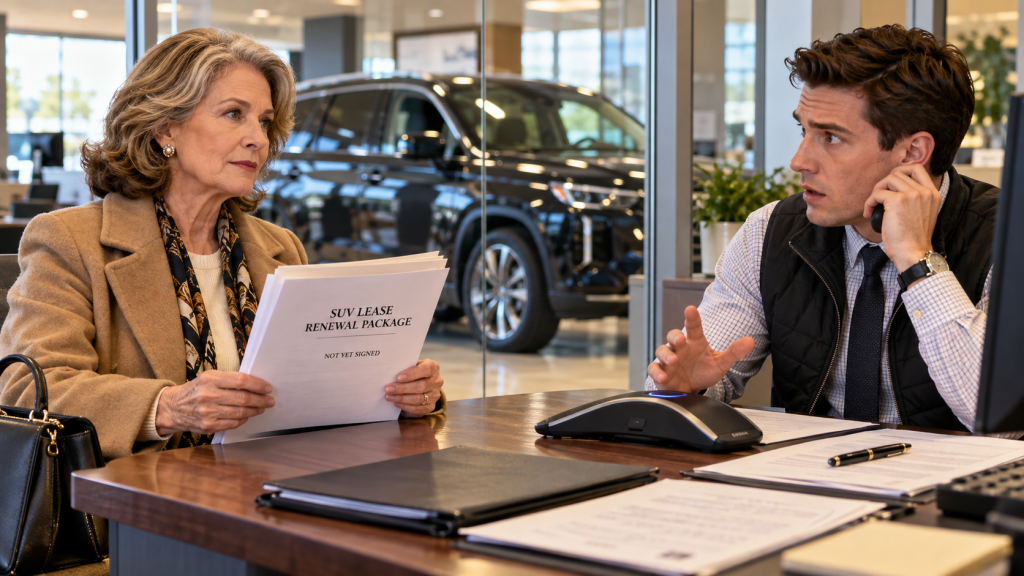
He had gone from polite finance manager to unwilling witness in less than five minutes.
“Mr. Whitlow,” he said carefully, “we still need the vehicle returned today.”
Grady spoke too quickly.
“Fine. I’ll bring it.”
“And the account holder will need to complete the turn-in.”
“I said I’ll handle it.”
Corbin glanced at me.
I leaned closer to the phone.
“No, Grady.”
Silence.
I had spent thirty-four years recognizing my son’s silences.
There was the silence of being caught sneaking cookies at eight.
The silence of getting a speeding ticket at seventeen.
The silence of needing money at twenty-six.
This was different.
This was calculation.
“What?” he finally asked.
“I’ll handle my lease.”
“Mom.”
“The vehicle belongs to the leasing company. The contract belongs to me. Your name is listed as an authorized driver.”
I paused.
“So is Aaron Vale’s.”
Kelsey’s voice came through immediately.
“What do you mean the contract belongs to you?”
Grady said:
“Kelsey.”
“No.”
Her voice sharpened.
“What does she mean?”
Then Aaron again.
“Exactly what it sounds like.”
Grady snapped:
“Shut up.”
Kelsey’s voice rose.
“You told me the SUV was in your name.”
“I told you I handled it.”
“No.”
“You told me your credit got approved.”
That sentence did something to me.
Not because I was surprised.
I already knew he had lied to her about that.
But hearing the lie from her mouth made it real in a different way.
My son had spent three years driving a vehicle I paid for while letting his wife believe his financial strength had made it possible.
Then he had called me to tell me I was no longer welcome at their house.
Corbin looked as though he wished his desk had an emergency exit.
I said:
“Bring the SUV here by noon.”
Grady lowered his voice.
“Mom, this does not need to become a scene.”
I almost laughed.
“A scene?”
“Yes.”
“You called this dealership pretending to be me.”
“I did not pretend to be you.”
“Someone told them the account holder would sign whatever.”
“I said you’d approve it.”
“Without asking me.”
“We were going to ask.”
“When?”
Silence.
I looked at Corbin.
“Was the additional driver added recently?”
He clicked through the account.
“Fourteen days ago.”
My chest tightened.
Two weeks.
About the same time I had been told to stop coming over.
“Who submitted it?”
Corbin hesitated.
Then looked at me.
“The request came through the online account portal.”
“My portal?”
“Yes, ma’am.”
I had never used it.
Not once.
The dealership mailed paper because that was what I preferred.
“Was there a signature?”
“Electronic authorization.”
“Whose name?”
He did not want to answer.
I already knew.
“Mine.”
“Yes.”
The room became very cold.
Grady spoke through the phone.
“Mom, I can explain.”
I looked at the pay—no, wrong story. The lease packet in front of me.
My name.
My credit.
My liability.
My son’s explanation could wait.
“Bring the car.”
Then I added:
“And bring every key.”
I ended the call.
Corbin stared at the phone.
Then at me.
“Mrs. Whitlow.”
“Yes?”
“I think I need to get our compliance manager.”
“Please do.”
He stood quickly.
I stayed in the chair.
My hands were perfectly still.
That frightened me more than shaking would have.
When I was young, anger made me loud.
At sixty-three, anger made me precise.
I spent thirty-one years at the county assessor’s office.
You learn something when your job involves property records.
People talk emotionally about ownership.
The county talks in documents.
“My house.”
Not if your name is not on the deed.
“My land.”
Not if somebody else holds title.
“My inheritance.”
Not until the estate says so.
“My car.”
Not when your mother has made thirty-five payments and the financing company has never heard of you outside the authorized-driver section.
Paperwork is not love.
But paperwork is very good at revealing where assumptions end.
The compliance manager arrived twelve minutes later.
Her name was Sonya Bell.
Mid-forties.
Silver-framed glasses.
She read the account.
Asked me whether I had ever created portal credentials.
“No.”
Whether I had authorized Grady to act on my behalf.
“No.”
Whether I had approved Aaron Vale.
“No.”
Whether Grady knew enough personal information to create access.
“He knows my birthday.”
“Address?”
“Yes.”
“Email?”
“Yes.”
“Last four digits of Social Security?”
I stared at her.
Unfortunately:
“Yes.”
She nodded.
“We’re freezing all online activity on the account.”
“Good.”
“We’ll preserve the access logs.”
“Good.”
“Would you like us to contact law enforcement?”
That stopped me.
My son.
For all my anger, the word police landed differently when attached to him.
“I want to understand what happened first.”
She nodded.
“That’s reasonable.”
Then:
“But I want to be clear, Mrs. Whitlow. An electronic authorization submitted in your name is not something we can treat casually.”
“I understand.”
She looked at Corbin.
“Vehicle gets returned today. No transfer. No renewal. No buyout request processed until compliance review is complete.”
Corbin nodded.
The SUV stopped being an emotional argument and became an object with a deadline.
That was useful.
I drove home.
Not to Grady’s townhouse.
Mine.
I made coffee.
Then I opened a file drawer.
If you have spent three decades around assessors, auditors, clerks, and records officers, you either become disorganized in rebellion or become the sort of person who can produce a receipt from 2019 before somebody finishes asking for it.
I am the second kind.
I pulled every folder with Grady’s name.
Car.
Townhouse.
Medical.
Transfers.
Emergency.
Dog.
I spread six years of my son across the dining-room table.
The SUV was obvious.
Thirty-five payments.
$612 each.
$21,420.
Insurance contributions:
Another $6,300.
Townhouse deposit:
$18,000.
Vet bill when Winston ate the sock:
$2,184.
Kelsey’s dental work:
$4,600.
A water-heater emergency:
$1,900.
Moving expenses:
$3,200.
A “temporary” credit-card rescue:
$7,500.
Furniture after they moved:
$5,800.
Wedding gap after the venue bill increased:
$9,000.
There were smaller things.
Always smaller things.
$300 for tires.
$475 for a deductible.
$210 for dog boarding.
$600 when Grady told me payroll had made an error.
$1,100 for something labeled “plumber” in my check register.
I added.
Then stopped.
Then added again.
Not because I wanted a total.
Because suddenly I needed one.
$82,489.
That did not include birthday checks.
Christmas.
Meals.
Groceries.
The casserole dishes left at the door.
I sat back.
Eighty-two thousand four hundred eighty-nine dollars.
I had never thought of it as eighty-two thousand dollars.
I thought of it as:
My son needs help.
The car is safer than his old one.
The deposit gets them out of that terrible apartment.
Dental pain is miserable.
The dog cannot die from a sock.
They will pay me back later.
I can afford it.
I am his mother.
That is how large totals hide inside loving people.
One reasonable yes at a time.
At eleven-fifteen, my phone rang.
Kelsey.
Not Grady.
I let it ring twice.
Then answered.
“Hello.”
“Karen.”
She sounded strange.
Not angry.
Not polished.
“Where is Grady?”
“Driving the SUV to the dealership.”
Good.
“Aaron is following him.”
I said nothing.
Then Kelsey asked:
“Did you really pay for it?”
“All of it.”
Silence.
“The lease payment?”
“Yes.”
“For three years?”
“Thirty-five months.”
She breathed in.
I could almost hear her rearranging her marriage in real time.
“He told me he leased it after his promotion.”
“He did not.”
“He said his credit score finally crossed seven-fifty.”
I almost admired the specificity of the lie.
“He was not on the credit application.”
“Oh my God.”
I closed my eyes.
Kelsey and I had never liked each other.
That is the truth.
Before the wedding, she treated every question as criticism.
After the wedding, I often felt she treated my existence as an obligation she had inherited with Grady.
But right then she did not sound like the woman who handed me casserole dishes at the door.
She sounded like someone standing inside a house and realizing one wall was painted scenery.
“Karen.”
“Yes?”
“Did you pay our deposit?”
My hand tightened around the phone.
“Eighteen thousand.”
She made a small sound.
Then:
“No.”
“Yes.”
“He told me it came from his annual bonus.”
“He did not have an eighteen-thousand-dollar bonus.”
“I didn’t know what he made then.”
“I know.”
“Did you pay for my dental work?”
“Yes.”
“How much?”
“Four thousand six hundred.”
Another silence.
“My insurance paid part of it.”
Now it was my turn.
“What?”
“My out-of-pocket was seventeen hundred.”
I sat very still.
“He asked me for forty-six.”
Kelsey stopped breathing.
Neither of us spoke.
That was the first moment I understood the problem was bigger than my money.
“Did you know I paid anything?”
I asked.
She answered carefully.
“I knew you helped sometimes.”
“What does sometimes mean?”
“The dog.”
“Anything else?”
“He said you gave us a wedding gift.”
“How much?”
“Five thousand.”
“I paid nine toward the venue alone.”
“Oh my God.”
“And furniture.”
“He told me that came from a zero-interest store promotion.”
“No.”
“Water heater?”
“I paid it.”
She was crying now.
Quietly.
“What about the seven thousand five hundred last year?”
“What seven thousand?”
I closed my eyes.
Of course.
“Credit cards.”
“We never had a seven-thousand-dollar credit-card balance.”
My stomach sank.
“What did he say?”
“That he had unexpected medical debt from before we married.”
“What medical debt?”
“I don’t know.”
I looked at the spreadsheet in front of me.
The totals had changed meaning again.
This was no longer a mother who had overhelped.
This was a son who had been requesting money under explanations his wife did not know existed.
“Why is Aaron there?”
I asked.
Kelsey became quiet.
“Karen.”
“Tell me.”
“He’s my brother.”
That I knew in the general sense.
Kelsey had an older brother named Aaron who lived in Cincinnati and worked in emergency medicine.
I had never met him.
Kelsey’s family had always kept to themselves around me.
“He’s staying with us temporarily.”
“Why?”
Silence.
I waited.
Then Kelsey said:
“Because I found out about the debt.”
There it was.
“What debt?”
“Grady’s.”
“How much?”
She started crying harder.
“Sixty-three thousand that I know of.”
I stood up.
I do not know why.
Maybe my body needed a different shape for that number.
“Credit cards?”
“Some.”
“What else?”
“Personal loans.”
“From whom?”
“Two online lenders.”
“Aaron.”
That explained the mornings.
“He loaned Grady money?”
“No.”
Kelsey paused.
“He loaned me money.”
I frowned.
“For what?”
“To hire a lawyer.”
The room disappeared.
“What?”
“I was going to leave Grady.”
I sat back down.
“When?”
“I don’t know now.”
“What does that mean?”
“I found the debt six weeks ago.”
Her voice shook.
“I found a card statement in a drawer.”
“Then another.”
“Then a loan.”
“Then I started asking questions.”
“What did he say?”
“That he had gotten behind because he was supporting us.”
I almost laughed.
Supporting them.
With my money.
Kelsey continued.
“He said the car payment was high.”
“I pay the car.”
“I know that now.”
“He said the townhouse had drained his savings.”
“I paid the deposit.”
“I know.”
“He said he helped me with dental work.”
“I paid that too.”
“I know.”
Her voice broke.
Then:
“I thought he was angry with you because you kept reminding him of things you had given us.”
I stared.
“What?”
Kelsey swallowed.
“He said you held money over him.”
“When?”
“All the time.”
I laughed in disbelief.
I had never once mentioned the SUV payment to Kelsey.
Never brought up the deposit.
Never asked for repayment.
Not because I was a saint.
Because I was embarrassed by how much I was doing.
I knew if I said the total aloud, even I might have to admit the arrangement had become ridiculous.
“What exactly did he say?”
Kelsey hesitated.
“That you liked having financial leverage.”
My chest tightened.
“He told me that when you came over, you were looking at everything we bought.”
I stared at the dining room.
“He said you made comments after leaving.”
“What comments?”
“He said you asked why we could afford restaurant meals but still took your help.”
I had never said that.
Had I thought it once?
Yes.
Said it?
No.
“He said you called me high maintenance.”
I stood again.
“I never called you that.”
Silence.
“He said you thought I spent too much.”
“I barely know what you spend.”
“Kelsey.”
“Yes?”
“The reason I stopped asking about your lives was because every question seemed to make you angry.”
She laughed bitterly through tears.
“Because he told me you were reporting back on me.”
To whom?
Him.
Of course.
A triangle.
He had built one carefully.
To me:
Kelsey needs privacy.
Kelsey doesn’t want you around.
Kelsey thinks you interfere.
To her:
Mom judges you.
Mom keeps score.
Mom thinks you are high maintenance.
As long as Kelsey and I disliked each other, we never compared notes.
My son had made our resentment useful.
“Why did you ask me not to come over?”
I asked.
“I didn’t.”
The answer was immediate.
I went cold.
“What?”
“I told Grady I needed space from him.”
My entire body stiffened.
“From him.”
“Yes.”
“I asked Aaron to stay with us because I didn’t want to be alone while I figured out the finances.”
She drew a shaky breath.
“I told Grady I didn’t want him inviting anyone over while we were fighting.”
“He told me you wanted privacy from me.”
“I never said that.”
There it was.
The Tuesday phone call.
Nothing personal, Mom.
Kelsey just feels watched.
Maybe holidays.
We’ll see.
My son had used his wife’s marital boundary to exile me.
Why?
Because if I stopped coming over, I would not see Aaron.
I would not ask who he was.
I would not discover Kelsey had learned about the debt.
And Kelsey would not discover the person allegedly holding money over them was still paying for the car in the driveway.
The white sedan suddenly made perfect sense.
“Why was Aaron added to the SUV?”
I asked.
Kelsey exhaled.
“That’s the part I didn’t understand until today.”
“Tell me.”
“Aaron’s car was damaged two weeks ago.”
“Is the white sedan his?”
“Hospital fleet car. He can use it for commuting while he’s on call, not personal errands.”
“So he needed the SUV.”
“For two days.”
“Why?”
“He was helping me move documents and some boxes to his storage unit.”
Move.
The word landed.
“You were leaving.”
“I was preparing in case I did.”
“And Grady told you he could add Aaron.”
“Yes.”
“He said it was his vehicle.”
“Yes.”
My son had forged my electronic authorization so his brother-in-law could legally appear as a driver on a car my son did not own, because admitting the truth about the car would expose the larger financial lie that was causing his wife to consider leaving him.
It would almost have been elegant if it were not my life.
Then Kelsey whispered:
“Karen?”
“Yes?”
“I’m sorry.”
I stared at the table.
“For what?”
“For believing him.”
That was not enough.
She knew it.
“And for how I treated you.”
Closer.
“I was rude.”
“Yes.”
“I excluded you.”
“Yes.”
“I thought…”
She stopped.
“What?”
“I thought you were trying to make me feel indebted.”
I looked at the $82,489 total.
“I suppose I made that easy to believe.”
“No.”
Her answer surprised me.
“You never mentioned the money.”
“That should have told you something.”
“It should have.”
Silence.
Then:
“I handed you your casserole dish at the door.”
“Yes.”
“I knew that hurt you.”
I closed my eyes.
This mattered more than the lease.
Maybe because cruelty is most painful when it was deliberate.
“Why did you do it?”
She cried.
“Because Grady had just told me you complained I was using you for meals.”
I stared.
“I never said that.”
“I know.”
“Now.”
“Yes.”
“But I still chose the door.”
She swallowed.
“I wanted you to know you weren’t coming in.”
There.
Her responsibility.
Not erased by Grady’s lie.
“Thank you for not pretending that was his fault.”
“I won’t.”
Good.
I leaned back.
“Bring me every financial document you found.”
She went quiet.
“Why?”
“Because if my son has been using my money as part of whatever story he tells about his finances, I need to know whether my identity is anywhere else.”
“I have copies.”
“When?”
“Aaron can bring them.”
“Not today.”
“Okay.”
“Today the SUV goes back.”
Another silence.
Then Kelsey said something I did not expect.
“Good.”
At eleven-fifty, I was back at the dealership.
The SUV came into the lot at eleven-fifty-eight.
Three minutes before Grady would later insist he had been “early.”
He parked.
Got out.
Kelsey was not with him.
Aaron followed in the white sedan.
He was taller than I expected.
Early forties.
Dark hair.
Hospital badge clipped to his belt.
He looked tired.
Not guilty.
Grady looked furious.
Not ashamed yet.
Furious.
“Mom.”
“Keys.”
He stared.
“Can we talk first?”
“Keys.”
His face hardened.
“I’ve driven here like you wanted.”
“Thank you.”
“Now can we act like adults?”
I almost admired the nerve.
“Keys, Grady.”
He tossed them onto Corbin’s desk.
Not violently.
Close enough.
Corbin picked them up without comment.
Sonya was present too.
She asked for the second key.
Grady pulled it from his pocket.
Then she asked:
“Any additional copies?”
“No.”
Aaron said:
“There’s one at the townhouse.”
Grady spun toward him.
“What?”
“Kelsey found it in the kitchen drawer.”
I looked at my son.
“You made another key?”
“It’s not a key. It’s a programmed fob.”
“That costs four hundred dollars.”
He said nothing.
“Who paid?”
Silence.
Of course.
My card had probably been used.
I would find out later.
Aaron stepped forward.
“Mrs. Whitlow?”
“Yes.”
“I’m Aaron Vale.”
“I know.”
“I’m sorry my name is on your contract.”
His directness disarmed me.
“Did you know?”
“No.”
He looked at Grady.
“I was told Grady owned the SUV.”
Grady rubbed his forehead.
“Aaron.”
“No.”
The doctor’s voice remained calm.
“You lied to Kelsey.”
“You lied to your mother.”
“You put her electronic signature on a document that added my name.”
“I am not standing here while you make me part of it.”
Grady’s face went red.
“You came into my house and turned my wife against me.”
Aaron’s expression changed.
“No.”
He stepped closer.
“You ran up sixty-three thousand dollars in debt, lied about where your money came from, and then called me when Kelsey found it because you thought a doctor in the room would make you look reasonable.”
That detail was new.
“You called him?”
I asked.
Grady looked away.
Aaron answered.
“Yes.”
“Why?”
“Kelsey called me afterward.”
Grady muttered:
“This is none of your business.”
I almost smiled.
“My name is on the lease you falsified.”
His mouth closed.
Sonya looked at me.
“We need to complete the inspection.”
“Please.”
Grady followed us.
I turned.
“You don’t need to.”
“It’s my car.”
Corbin actually inhaled audibly.
I looked at my son.
“No.”
One word.
His entire expression changed.
“It’s not.”
He looked toward the SUV.
Then at the showroom windows.
Customers.
Employees.
Aaron.
His mother.
For the first time, I think the lie embarrassed him more than the truth embarrassed me.
“It’s the car I drive.”
“Yes.”
“The one I maintained.”
“With my money.”
“I paid for gas.”
I stared.
“I am happy for you.”
Aaron looked away, possibly to hide a smile.
Grady’s face reddened.
“This is humiliating.”
I lowered my voice.
“No.”
“It is.”
“You know what was humiliating?”
He stared.
“Listening to you tell me I was no longer welcome at your house while I was paying six hundred twelve dollars a month for the vehicle sitting in your driveway.”
His eyes changed.
“You volunteered.”
“Yes.”
That stopped both of us.
Because he was right.
Mostly.
I had volunteered.
At first.
I had not been held at gunpoint.
I had not been tricked into the first payment.
“I did.”
I continued.
“And that was my mistake.”
He stared.
“Helping you was not my mistake.”
“Helping you without making you responsible for the help was.”
His face tightened.
“I never asked you to pay forever.”
“No.”
“You simply never told me to stop.”
Silence.
“Every month the payment left my account.”
“You knew.”
“I knew.”
“Every month you let your wife believe it left yours.”
His mouth closed.
There it was.
The distinction.
My overhelping was mine.
His deception was his.
Both could be true.
The vehicle passed inspection.
Within mileage.
Small scratch on the rear bumper.
Normal wear.
No excess charge beyond a modest disposition fee.
Corbin printed the turn-in receipt.
I signed.
Not Grady.
Me.
When the final page slid across the desk, I felt something strange.
Not victory.
Relief.
For thirty-five months, the SUV had been one more invisible cord between my bank account and my son’s lifestyle.
One signature cut it.
Corbin handed me a copy.
“Vehicle is officially returned.”
Grady stared at him.
“What am I supposed to drive?”
The question was so absurd I almost laughed.
Aaron answered before I could.
“Whatever you can afford.”
My son turned.
“You shut up.”
I said:
“No.”
Both men looked at me.
“Aaron’s right.”
Grady stared.
“Mom.”
“What did you think was going to happen?”
“I thought we were renewing.”
“You were.”
He stopped.
“I wasn’t.”
“That’s not fair.”
There are sentences that tell you someone has never understood the arrangement.
That was one.
I folded the receipt.
“Fair?”
“You give me three days’ notice?”
“The lease company gave us a month.”
“You opened the packet.”
“You didn’t.”
“You always handle that stuff.”
Exactly.
I looked at him.
“Not anymore.”
His anger finally cracked.
Underneath was fear.
Real fear.
“How am I supposed to get to work?”
There he was.
My son.
Not the liar.
Not the grown man who forged a signature.
The little boy who called me when his bike chain came off because he assumed I could solve the road between him and wherever he needed to go.
I loved him.
That did not mean I was leasing another car.
“You take Kelsey’s car if she agrees.”
“She needs it.”
“Bus.”
He stared.
“I work twenty-two miles away.”
“Carpool.”
“Mom.”
“You buy something used.”
“With what money?”
There.
I waited.
He looked away.
“With what money, Grady?”
Silence.
Aaron folded his arms.
My son’s face collapsed.
“I don’t have any.”
I already knew.
But hearing it mattered.
“How much do you have?”
“Mom.”
“How much?”
He whispered:
“Eight hundred.”
“Checking?”
“Yes.”
“Savings?”
No answer.
“Grady.”
“None.”
I nodded.
“Debt?”
He stared at Aaron.
Then me.
“Sixty-three.”
“Kelsey said sixty-three she knows about.”
His expression changed.
Meaning:
There was more.
“How much?”
“I don’t know exactly.”
“You do.”
“No.”
“You know approximately.”
He closed his eyes.
“Seventy-eight.”
Aaron’s jaw tightened.
Apparently that was new to him too.
“Seventy-eight thousand?”
“Yes.”
My chest hurt.
Not because I planned to pay it.
Because I understood how long my son had been drowning while building a boat out of lies.
“What for?”
“Cards.”
“Personal loan.”
“Some trading losses.”
I stared.
“Trading?”
“Crypto mostly.”
Of course.
“A vacation.”
“What vacation?”
He looked ashamed.
“Kelsey’s thirtieth.”
The resort in Mexico.
Instagram photos.
I had sent them $500 spending money as a gift.
“How much?”
“Six thousand.”
“On credit?”
“Yes.”
“Anything else?”
He rubbed both hands over his face.
“Normal stuff.”
I almost shouted.
Instead:
“Nothing about this is normal.”
He looked at me.
“The bills were manageable.”
“While I paid your car.”
Silence.
“While I paid emergencies.”
Silence.
“While you asked me for dental money your wife did not need.”
His head snapped up.
“Kelsey called you.”
“Yes.”
His face went pale.
That frightened him more than the dealership.
Of course.
The whole system depended on us not comparing notes.
“What did she say?”
“Enough.”
“Mom.”
“You told her I called her high maintenance.”
His shoulders dropped.
“You told her I kept score.”
No answer.
“You told her I criticized her spending.”
“I was trying to keep the peace.”
I laughed.
There it was.
The sentence every manipulator eventually borrows from cowards.
Keep the peace.
“With whom?”
He said nothing.
“You kept her angry at me.”
“I didn’t—”
“You kept me angry at her.”
“No.”
“Yes.”
My voice rose.
Corbin looked toward us.
I lowered it.
“You told me she wanted me gone.”
“She needed space.”
“From you.”
His face changed.
“You told me she needed privacy from me.”
“She didn’t want people around.”
“You made that specific.”
He looked away.
I felt something break.
Not love.
Trust.
Different thing.
“Why?”
He whispered:
“I didn’t want you two talking.”
Finally.
The truth.
“Why?”
“You’d compare things.”
“Yes.”
“I knew.”
He looked seventeen.
He was thirty-six.
“I knew.”
The showroom became quiet around us.
I asked:
“When did it start?”
He sat down.
Not dramatically.
As if his knees had stopped participating.
“The car.”
Of course.
“I couldn’t qualify.”
“I know.”
“You offered.”
“Yes.”
“I told Kelsey I got approved.”
“Why?”
He looked at his hands.
“Because she already thought I was bad with money.”
“Were you?”
“Yes.”
There.
“I wanted one thing that made me look like I had my life together.”
“The SUV?”
“Yes.”
“That was three years ago.”
He nodded.
“What happened after?”
His voice was low.
“Once I told her that, I couldn’t tell her you were paying.”
“So every time I helped—”
“I made it sound like mine.”
“Your bonus.”
“Yes.”
“Your savings.”
“Yes.”
“Your insurance.”
“Yes.”
I sat across from him.
Aaron stayed standing.
Not intruding.
Witness.
My son continued.
“Then when you came around, I was afraid you’d mention something.”
“So you told Kelsey I was controlling.”
He closed his eyes.
“Yes.”
“And when she got angry at me?”
“I let her.”
That hurt more than the money.
“Did you enjoy it?”
His eyes opened.
“No.”
“Did it make your life easier?”
A long pause.
“Yes.”
Honesty.
Ugly.
Necessary.
“I’m sorry.”
I looked at him.
“For what?”
His face crumpled.
“All of it.”
“No.”
I shook my head.
“Do not apologize in bulk.”
He stared.
“Bulk apologies are for the person apologizing.”
I pointed toward the returned SUV.
“Be specific.”
Tears filled his eyes.
“I lied to Kelsey about the car.”
“Yes.”
“I lied about the deposit.”
“Yes.”
“I asked you for money using reasons that weren’t true.”
“Yes.”
“I made you and Kelsey dislike each other so neither of you would compare what I said.”
“Yes.”
“I used your electronic signature.”
My throat tightened.
“Yes.”
“I told you not to come over because I was scared you’d see Aaron.”
“Yes.”
“And I let you think Kelsey was the reason.”
“Yes.”
He wiped his face.
“I’m sorry.”
This time the words had somewhere to land.
They still did not repair anything.
But they were shaped correctly.
Aaron drove Grady home.
Not me.
I called Kelsey.
She did not ask me to come inside.
I appreciated that.
Instead, she met me the next morning at a coffee shop.
She brought a file box.
My son’s marriage, apparently, also fit inside paper.
Bank statements.
Credit cards.
Loan documents.
Emails.
A copy of the form adding Aaron to the SUV.
My electronic signature at the bottom.
Not mine.
The name mine.
The act not.
I stared at it.
Kelsey said:
“I’m sorry.”
“For what?”
“For this part?”
“Yes.”
“I asked him if Aaron could be added.”
I looked up.
“I believed it was Grady’s account.”
“I know.”
“I watched him do it.”
My chest tightened.
“What did he do?”
“He logged into a portal.”
“Did you see the login?”
“No.”
“He had an email verification.”
Likely my email.
“How?”
Kelsey shook her head.
“I don’t know.”
We discovered later.
Three years earlier, when I helped him fill out the original lease paperwork, I forwarded him a scan of my driver’s license and a copy of the lease.
My email password at the time had been an old family phrase he knew.
He had guessed it.
Not recently.
Years ago.
He had been receiving and deleting dealership messages when necessary.
Not constantly.
Enough.
The violation made me feel dirtier than the money.
I changed every password.
Froze my credit.
Pulled my reports.
Met with my bank.
Called my insurance agent.
Went through everything.
No other account had been opened in my name.
Thank God.
But there was something else.
Three electronic payments to a credit-card company I did not recognize.
$900.
$1,200.
$750.
My bank records showed I had sent Grady money on those dates because he told me:
Vet emergency.
Home repair.
Dental balance.
He had paid his cards.
Not directly from my account.
From money I sent.
Still.
The reasons were lies.
I printed every transfer.
Then I stopped.
I could have turned my life into an audit.
I nearly did.
Old habits.
Former assessor.
Records give comfort because they make betrayal measurable.
But measuring everything does not always make it heal.
I needed enough information to protect myself.
Not enough to torture myself.
Kelsey and I sat in that coffee shop for three hours.
We compared notes.
The first hour was almost comical.
“He told you I said what?”
“He said you were angry I bought the sofa.”
“I thought your mother bought the sofa.”
“She did.”
We stared.
Apparently neither of us paid for the sofa.
Good.
One less crime.
Then:
“He said you complained about our Mexico trip.”
“I sent you money for the Mexico trip.”
Kelsey covered her face.
“He told me you refused to help.”
“I gave him five hundred.”
“He gave me five hundred and said he’d saved it.”
I laughed.
Could not help it.
Kelsey laughed too.
Then immediately started crying.
“I feel so stupid.”
I knew that feeling.
“You’re not.”
“I believed him.”
“So did I.”
“You’re his mother.”
“You’re his wife.”
We sat with that.
Then I said:
“We both believed different versions because he knew exactly what each of us wanted to believe.”
Kelsey looked up.
“What did you want to believe?”
“That he needed me.”
The answer surprised me.
It should not have.
I loved being useful.
Not consciously.
But every emergency made me important.
Every payment let me solve something.
When Grady called:
Mom, the dog—
Mom, the car—
Mom, the dentist—
I became necessary.
After retirement, perhaps more than I wanted to admit.
My job ended in March.
People stopped needing my assessments.
My reports.
My memory of parcel numbers.
Grady still needed me.
Money had become one of the easiest ways I knew how to mother an adult son who had stopped letting me close in other ways.
That was mine to examine.
Kelsey said softly:
“I wanted to believe he was taking care of us.”
There.
Her side.
“He wanted to believe both things too.”
I said.
She nodded.
“Provider to me.”
“Son who needed help to you.”
And in the middle, Grady never had to become honest enough to be either.
Kelsey looked toward the window.
“I’m still leaving him.”
I did not react.
Not my marriage.
“Temporarily?”
“I don’t know.”
“Okay.”
She looked surprised.
“You’re not going to tell me what to do?”
“No.”
A tiny, sad smile.
“Maybe we really didn’t know each other.”
“No.”
We had known stories about each other.
Different thing.
Then I said:
“But I need to tell you something.”
She waited.
“Grady lying does not erase how you treated me.”
Her face dropped.
“I know.”
“I need you to understand that.”
“I do.”
“You were cold before you had proof of anything.”
“Yes.”
“You sent gifts back.”
She looked confused.
“Gifts?”
“Christmas.”
Her mouth opened.
Then closed.
“I never sent your gifts back.”
I stared.
“What?”
“I thought you stopped sending them.”
The room went cold again.
“No.”
I had mailed packages two Christmases.
Returned unopened.
Address labels marked refused.
Grady.
Of course.
“He told me you didn’t want gifts from me around.”
Kelsey shook her head.
“No.”
We both sat very still.
“How many things did he manage between us?”
she whispered.
Too many.
Some we would never reconstruct.
That was when I stopped wanting to.
There is a point where truth becomes archaeology.
You can spend years excavating every fragment.
Or you can secure the foundation and build differently.
Kelsey reached across the table.
Then stopped before touching my hand.
Good.
“Karen.”
“Yes?”
“I’m sorry for the things that were mine.”
That was the right apology.
“The casserole dish.”
“Yes.”
“Not inviting you in.”
“Yes.”
“Calling you intrusive to my sister.”
I had not known about that one.
She winced.
“Sorry.”
I almost laughed.
“Continue.”
She did.
By the time we left, we were not friends.
We were no longer enemies either.
That was enough.
Grady moved into a furnished studio near his office.
He did not have an SUV.
He took two buses and a train for six weeks.
Then bought a twelve-year-old Honda Civic with 128,000 miles.
Cash.
Not from me.
Aaron helped him inspect it.
Not pay for it.
That distinction became family religion.
Kelsey stayed in the townhouse through the lease term.
Her name was actually on that lease.
Not mine.
The deposit had been my money.
The home was theirs.
Or hers temporarily.
I stopped paying anything.
Not the car.
Not Winston’s food.
Not streaming services.
Not the small monthly transfer I had forgotten I was still sending.
Nothing.
The first month felt cruel.
My brain kept inventing emergencies.
What if Grady cannot get to work?
He did.
What if Kelsey cannot cover the townhouse?
She adjusted.
What if the dog gets sick?
They bought pet insurance.
Apparently adults become resourceful when mothers stop pre-solving every possible consequence.
Grady began therapy.
Not because I required it.
Kelsey did.
If there was to be any chance of reconciliation, she wanted individual counseling first.
He also met with a nonprofit credit counselor.
Closed several cards.
Consolidated what he could.
Sold electronics.
Canceled subscriptions.
He called me two months after the dealership.
“Can we talk?”
“About money?”
“No.”
“Then yes.”
That became our rule for a while.
He came to my house.
My house.
He sat at the dining table where the $82,489 spreadsheet had once been.
I had put it away.
He looked around.
“You changed the curtains.”
“Yes.”
“They’re nice.”
“Thank you.”
Small talk.
Then:
“I told my therapist something.”
I waited.
“I resented you.”
That did not surprise me.
“For helping me?”
“Yes.”
Interesting.
He looked ashamed.
“Every time you paid for something, I felt smaller.”
“Then why did you keep asking?”
“Because being rescued felt good for five minutes.”
He stared at his hands.
“Then I hated myself.”
“And me.”
“Yes.”
Honest.
“I started telling myself you liked control.”
“Did you believe it?”
“Sometimes.”
My chest tightened.
“Was I controlling?”
He thought.
“Not with the money.”
Interesting qualifier.
“What did I control?”
“You came over a lot.”
I laughed.
“You told me to.”
“Sometimes.”
“You gave me a key.”
“Kelsey hated the key.”
“No one told me.”
“I know.”
“Did I use it without knocking?”
“Twice.”
I remembered.
Once when bringing groceries after Grady had the flu.
Once when the dog walker canceled and Grady asked me to let Winston out.
Still.
From Kelsey’s perspective:
Mother-in-law with a key.
Appearing.
I nodded.
“I should have asked both of you.”
He looked surprised.
“Really?”
“Yes.”
“Your lying does not mean I was perfect.”
That is the problem with finding out someone manipulated a relationship.
It is tempting to conclude every conflict was manufactured.
Usually not.
Grady exploited real friction.
He did not invent all of it.
I had overhelped.
Overvisited.
Assumed invitations based on old patterns.
Kelsey had been territorial.
Rude.
Quick to judge.
Grady poured gasoline between two people who already carried matches.
“I’m sorry for using the key without checking.”
He nodded.
“Thank you.”
Then I said:
“That does not put me back on the hook for your Honda.”
He laughed.
A tiny one.
“No.”
Good.
He continued.
“I think I wanted you to help without seeing me need help.”
I understood that.
Impossible.
“I wanted your money invisible.”
“Yes.”
“So Kelsey could see me as successful.”
“Yes.”
“And you could still see me as your son.”
“I would have seen you as my son without paying your car.”
“I know that now.”
We sat quietly.
Then:
“Are you going to report the signature?”
The question had been waiting.
I had talked to an attorney.
The dealership had completed its review.
Their logs showed the portal access originated from Grady’s home network.
My email account had been accessed.
The electronic authorization used my identity.
I could pursue it.
The dealership also could.
They had chosen to close the internal issue after removing the authorization and documenting fraud concerns, but they had encouraged me to file a report if I wanted a formal record.
I had not decided.
“I don’t know.”
He nodded.
“I understand if you do.”
“Do you?”
“Yes.”
“Because being sorry does not make it not fraud.”
“I know.”
Good.
“I’m not asking you not to.”
Good.
That mattered.
In the end, I filed an identity-theft report documenting the unauthorized use.
Not because I wanted my son arrested.
Because my attorney told me something I already knew from thirty years in county government:
If it is not documented, later people can pretend it did not happen.
The report created a record.
I did not push for prosecution.
The dealership did not either.
Grady signed an affidavit acknowledging he had created the account access and submitted the authorization without my permission.
It stayed in the file.
That was consequence.
Not dramatic.
Real.
He hated it.
Good.
He should.
Kelsey and Grady separated for nine months.
Not because of the SUV.
Because the SUV had been one thread in an entire fabric.
They went to counseling eventually.
Not immediately.
Kelsey needed time without becoming Grady’s recovery manager.
She told him:
“I am not going to be the person who checks whether you’re telling the truth every day.”
That sentence impressed me.
He needed to become truthful when nobody was checking.
During those nine months, Kelsey and I spoke occasionally.
Not often.
Birthdays.
Dog updates.
Once over coffee.
She apologized again for the funeral—wrong story. Not relevant. No. She apologized for the door incident. Good.
I told her she did not need to keep apologizing.
She said:
“I’m not trying to get forgiveness faster.”
That was a good sentence.
Maybe counseling helped her too.
She told me Grady had often framed my support as something he tolerated for my sake.
“He made it sound like taking your money was kindness to you.”
I laughed.
Then realized I had partly allowed that.
Any time he said:
“You don’t have to.”
I answered:
“I want to.”
He learned to perform reluctance.
I learned to feel generous.
Nobody discussed whether help was still healthy.
That changed.
I made rules.
Not for them.
For me.
No loans without written terms.
No recurring payments for able-bodied adult relatives.
No signing financial products for anyone.
No credit.
No co-signing.
No “temporary” ownership arrangements.
Gifts were gifts.
Amounts I could lose.
Given once.
No secret expectations.
If I could not say no without fearing the relationship would change, I did not give.
That rule saved me more than money.
It saved me from using money to purchase closeness I was afraid to ask for directly.
My retirement became mine.
I joined a hiking group.
Terrible decision at first.
My knees disagreed.
Then loved it.
I took a pottery class.
I was awful.
I made a bowl shaped like Ohio after a flood.
Kelsey said it was artistic.
Liar.
I traveled with my sister to Savannah.
Then Charleston.
Then Maine.
I spent money on myself without explaining why Grady might need it later.
That was harder than it should have been.
At sixty-four, I replaced my fifteen-year-old sedan.
Cash.
Not luxury.
New enough.
Safe.
Grady saw it.
“Nice.”
“Thank you.”
“What did you do with the old one?”
“Traded it.”
He laughed.
“I wasn’t asking.”
“I know.”
We both knew why that was funny.
He never asked me for a car again.
Two years after the dealership, his Honda died.
Transmission.
He called.
“Mom.”
I immediately became alert.
Then he said:
“I’m not asking for money.”
I relaxed.
Mostly.
“I need the name of that mechanic you used.”
I smiled.
“Tom Jenkins.”
“Thanks.”
“That’s it?”
“That’s it.”
He paused.
“Actually.”
My shoulders tightened.
“Can you give me a ride to work tomorrow?”
I laughed.
“Yes.”
A ride.
Not a lease.
He got into my passenger seat at seven the next morning.
We drove twenty-two miles.
He bought coffee.
No resentment.
No secret debt.
No pretending.
That ride felt more loving than thirty-five SUV payments.
Because it ended when I dropped him off.
Help should often have edges.
Kelsey and Grady eventually reconciled.
Slowly.
She moved back after he had been debt-plan compliant for over a year.
Not debt-free.
Compliant.
There is a difference.
She kept her own account.
They opened one shared household account.
Both could see everything.
No cards hidden.
No online lenders.
No crypto.
At least not for Grady.
Kelsey told him if he wanted to buy imaginary internet coins again, he could do so after retirement with money specifically budgeted for entertainment.
I liked her more every year.
Funny how that happened after my son stopped narrating her to me.
Funny how she liked me more after he stopped narrating me to her.
We started speaking directly.
That changed everything.
When she wanted privacy, she said:
“Karen, we’re staying home this weekend.”
I said:
“Okay.”
No offense.
No interpretation.
When she wanted help:
“Could you let Winston out Thursday?”
“Yes.
Or no.
Both acceptable.
When I wanted to visit:
“Are you free Sunday?”
Not:
I’ll stop by.
Simple.
Healthy.
Almost boring.
I came to love boring.
On their fifth wedding anniversary, Kelsey invited me to dinner.
At the door, she held out a casserole dish.
I stared.
She smiled.
“You left it here last week.”
I looked at the dish.
Then at her.
“Am I being dismissed?”
She laughed so hard Grady came from the kitchen.
“What?”
Kelsey was crying.
“Your mother.”
I walked in.
Without asking.
Then stopped.
Old reflex.
Kelsey noticed.
“You can come in.”
That mattered.
We ate.
No money talk.
No old stories.
Just dinner.
At one point Grady complained about his car insurance rate.
I looked at my plate.
He immediately said:
“I am not asking.”
Everyone laughed.
That is how shame becomes survivable.
Not denial.
Humor after accountability.
The $82,489 remained in my records.
I never asked Grady to repay it.
People have opinions about that.
Some say I should have demanded every dollar.
Maybe.
But much of it had been given freely at the time.
Poorly.
Without boundaries.
Still freely.
I did ask him to repay money obtained under explicitly false pretenses after we could document it.
Dental difference.
Fake plumber emergency.
Credit-card “medical” request.
Several transfers.
Total:
$14,350.
We made a written agreement.
Five years.
No interest.
He paid $240 most months.
Sometimes more.
Never less without telling me first.
The first payment arrived with memo:
NOT A CAR PAYMENT
I laughed.
The last payment came four years and seven months later.
He had gotten a raise.
He transferred $1,470.
Memo:
DONE
I stared at the screen.
Then called him.
“You’re finished.”
“Yes.”
“How do you feel?”
“Poor.”
I laughed.
“Good.”
Then he became serious.
“Mom.”
“Yes?”
“Thank you for making me pay it.”
That surprised me.
“Why?”
“Because otherwise I think every apology would still feel theoretical.”
That sentence told me he had changed.
Not perfectly.
But truly.
Kelsey never repaid me for the casserole dishes.
A scandal.
Aaron became part of the family in a strange way.
Before all this, I had never met him.
Afterward, he became the person who texted me pictures of Grady’s terrible used cars whenever Grady asked him to inspect them.
He married a pediatrician named Lucy.
At their wedding, he introduced me as:
“The woman whose car I apparently drove without permission.”
I said:
“Once.”
He corrected:
“Technically zero times. I never got the chance.”
True.
His name made it onto the lease.
He never drove the SUV.
The whole fraud had been committed for a hypothetical favor.
Somehow that made it more absurd.
Years later, Corbin from the dealership mailed me a handwritten card.
He had become sales manager.
Inside:
Mrs. Whitlow, you remain the only customer who ever turned in a luxury SUV and made three employees reconsider their family finances.
I laughed.
He added:
We updated identity-verification procedures for online driver additions after your case.
Good.
Even minor systems can learn.
Grady turned forty.
Then forty-five.
Debt shrank.
Marriage survived.
He and Kelsey decided not to have children.
Not because of the debt.
Personal choice.
I admit I grieved quietly.
Not because they owed me grandchildren.
Because I had imagined them.
Then I remembered something important.
Other people’s lives are not future rooms we are entitled to furnish.
I let that go.
They became the sort of couple who traveled modestly and had an unreasonable number of plants.
Winston died at thirteen.
I paid nothing toward the final vet bill.
Not because I did not care.
Because Grady and Kelsey had prepared.
They had pet insurance.
An emergency fund.
When Grady called crying after they put Winston down, I drove over.
Not with a check.
With food.
Kelsey opened the door.
Then stepped aside.
I went in.
We cried.
That was family.
At seventy, I sold my house.
Too much yard.
Too many stairs.
Grady immediately said:
“Do you need help going through things?”
Not:
How much did you get?
Progress.
He spent three weekends carrying boxes.
Kelsey labeled them.
Aaron arrived once and complained my first-aid cabinet contained medicine from the previous administration.
I told him to mind his business.
Doctor.
I moved into a two-bedroom condo with an elevator and a balcony.
Paid off.
In my name.
Only.
Grady joked:
“Am I an authorized occupant?”
“No.”
He smiled.
“Fair.”
The old SUV story became family history.
Not legend.
Not weapon.
History.
Sometimes at Thanksgiving somebody would mention cars.
Kelsey would say:
“Ask Grady who owned his favorite SUV.”
Grady would groan.
I would smile.
Then conversation moved on.
That mattered.
Accountability should not become permanent humiliation.
Once a person truly changes, keeping them trapped in their worst behavior can become its own form of control.
I did not want that either.
My son had lied.
Used me.
Forged an authorization.
Triangulated his wife and mother.
Those facts stayed true.
They did not remain the only facts about him.
He also confessed.
Paid back what we identified.
Accepted legal documentation.
Went to therapy.
Changed his financial behavior.
Rebuilt his marriage.
Rebuilt our relationship.
Stopped asking love to arrive disguised as rescue.
People can become safer without becoming innocent.
That distinction saved us.
At seventy-four, I had knee surgery.
Grady took me.
Kelsey stocked my refrigerator.
I tried to hand them gas money.
Grady stared at me.
“Seriously?”
“Yes.”
“No.”
“I’m not going to owe you.”
He laughed.
“Mom.”
Then he used my own sentence against me.
“This is a gift.”
I stared.
“An amount we can afford.”
Kelsey smiled.
“Given once.”
“No secret expectations.”
I hated both of them.
Mostly affectionately.
They stayed three nights.
Then left when I told them I wanted my house back.
No offense.
That was love with boundaries.
Beautiful thing.
One afternoon during recovery, Grady sat on my balcony.
I was half asleep.
He said:
“Do you know why I told you maybe holidays?”
My eyes opened.
The Tuesday call.
Decades ago emotionally.
“Because you were panicking.”
“Yes.”
“But there was more.”
I waited.
He looked ashamed even all those years later.
“I wanted to hurt you a little.”
That surprised me.
“Why?”
“Because you had asked the week before if we were saving enough.”
I remembered.
A harmless mother question in my mind.
Probably not harmless to a man buried in debt.
“I felt exposed.”
“So you punished me.”
“Yes.”
I looked at him.
“Thank you for telling me.”
He blinked.
“You’re not mad?”
“Oh, I’m mad retroactively.”
He laughed.
Then I continued.
“But I already knew you were not acting from your best self.”
He nodded.
“I think I wanted to prove I could cut you off.”
“While I paid the car.”
He covered his face.
“I know.”
The irony never got less ridiculous.
“I wanted independence.”
“With my money.”
“Yes.”
We both started laughing.
Then he cried.
Quietly.
“I was such an idiot.”
“Yes.”
“Mom.”
“What?”
“You were supposed to say no.”
“I’m retired. I don’t lie professionally anymore.”
He smiled.
Then I said:
“I was part of it.”
He looked at me.
“I trained you to expect rescue.”
“No.”
“Some.”
“Mom.”
“I need to own that.”
I looked toward the balcony railing.
“Every time you struggled, I solved.”
“When you were little, that was my job.”
“When you became an adult, I did not adjust fast enough.”
He listened.
“I liked being needed.”
“That was my ego.”
His face softened.
“You loved me.”
“Yes.”
“And I had an ego.”
Both.
Again.
There was rarely one guilty person and one pure person in the most durable family problems.
There were degrees.
Responsibilities.
Boundaries.
But not purity.
At seventy-six, I finally shredded the original SUV lease.
Not the fraud report.
That stayed with important records.
The lease itself.
Thirty-five payments.
Authorized drivers.
My name.
Grady’s.
Aaron’s.
I held it over the shredder.
Grady happened to be visiting.
“What’s that?”
“Your baby.”
He stared.
Then laughed.
“Oh God.”
“Kelsey’s caption.”
“Never giving her up.”
“Apparently we did.”
He took the top page.
Looked at it.
“Can I keep this?”
“Why?”
“I don’t know.”
I thought.
Then took it back.
“No.”
He looked surprised.
“Why not?”
“Because we do not need a family relic for every bad year.”
I fed it into the shredder.
The machine chewed the paper into strips.
Grady watched.
Then nodded.
“Good.”
Some stories should survive.
Some paperwork should not.
The fraud report remained because truth matters.
The lease could become confetti.
When I was eighty, I stopped driving.
My choice.
Eyes still fine.
Reflexes slower.
I sold my car.
Grady offered to drive me anywhere.
I refused to become dependent on one person again.
Not because he was unreliable.
Because independence had changed meaning for me.
I used rideshare.
Senior shuttle.
Friends.
Grady.
Kelsey.
Different options.
No single cord.
Once a week, usually Friday, Grady took me grocery shopping.
The first time, I tried to pay him for gas.
He stared.
I stared back.
Neither spoke.
Then we both laughed.
Friday groceries became our thing.
We talked in the car.
Not secretly.
Not through Kelsey.
Not through money.
Directly.
He told me about work.
I told him about condo politics.
He said retirement communities had more drama than high school.
Correct.
One Friday, years after everything, we passed the dealership.
Different name now.
Corbin probably retired.
The lot full of SUVs.
Grady looked over.
“That place.”
“Yes.”
He smiled.
“Worst Friday of my life.”
I thought.
“Top ten for me.”
“Only top ten?”
“I gave birth to you.”
He laughed.
Then became quiet.
“I’m glad you turned it in.”
I looked at him.
“I wasn’t then.”
“I know.”
“If you had renewed it, I think I would’ve kept lying.”
That hurt.
Not because I doubted.
Because he was probably right.
The unsigned packet in my drawer had done what years of quiet discomfort had not.
It created an edge.
A deadline.
A no.
People sometimes imagine boundaries destroy relationships.
Sometimes boundaries are the first thing that makes an honest relationship possible.
If I had signed, Grady would have had three more years to pretend.
Kelsey might have stayed longer inside a marriage built on false finances.
I might have continued paying.
Aaron’s name might have stayed on a lease he had no idea was fraudulent.
Nothing would have exploded.
That was the danger.
Bad systems are often comfortable enough to continue.
My no made everyone uncomfortable.
Good.
Discomfort was overdue.
Near the end of my life, Kelsey helped me organize paperwork.
Funny.
The woman I once believed wanted me gone.
She sat at my dining table with labeled folders.
Medical.
Condo.
Insurance.
Estate.
Vehicle—
She stopped.
Then looked at me.
“No vehicle.”
I smiled.
“Finally.”
Grady was executor.
Not because he was my son automatically.
Because by then he had become reliable enough that I trusted him with responsibility.
Kelsey was backup.
Aaron was medical power of attorney alternate after Grady.
I told them everything while I was alive.
No surprises.
No hidden accounts.
No tests.
No dramatic reading where somebody learned love through numbers.
My will was ordinary.
Grady received what remained after charitable gifts.
Kelsey received personal items separately.
Not because I expected divorce.
Because I loved her directly by then.
That mattered.
Aaron received my casserole dish.
He hated that.
I put it in writing.
He deserved consequences for his role in the speakerphone incident.
When I told him, he laughed for five minutes.
Grady asked once:
“Why leave anything to Kelsey separately?”
I looked at him.
“Because my relationship with her is not held through you anymore.”
He went quiet.
Then smiled.
“That’s good.”
It was.
That might have been the greatest repair of all.
We stopped being connected only through one man’s version of each other.
One Tuesday—of course it was Tuesday—Grady came over with lunch.
I was eighty-two.
He placed sandwiches on the table.
Then said:
“I was thinking about that phone call.”
“What phone call?”
He stared.
I smiled.
“I know.”
“Mom.”
“I’m old, not dead.”
He laughed.
Then:
“I said maybe holidays.”
“Yes.”
“God.”
“Yes.”
“I thought I had power.”
“You did.”
He looked surprised.
“Really?”
“Yes.”
“You had the power to hurt me.”
His face softened.
“That’s different from the power you thought you had.”
He looked down.
“What power did I think I had?”
“To decide whether I belonged in your life.”
Silence.
I touched his hand.
“You could decide access to your house.”
“You could decide how often we saw each other.”
“You could decide whether I got a key.”
“All reasonable.”
“But you could not decide whether I was your mother.”
His eyes filled.
“And I could not decide whether you were my son by paying your bills.”
There.
The whole story.
Not the SUV.
Not the debt.
Not Kelsey.
Not Aaron.
Belonging.
We had both confused it with leverage.
Grady used access.
I used rescue.
Neither was love at its healthiest.
We learned.
Slowly.
He squeezed my hand.
“I’m sorry.”
I smiled.
“That one can be bulk.”
He laughed through tears.
“Finally.”
When people hear the story, they usually love the dealership scene.
Of course they do.
The mother walks in wearing her good coat.
The finance manager calls the entitled son.
The son discovers the luxury SUV is not his.
The mother turns it in.
Consequences.
Very satisfying.
But that is not the part I think about.
I think about the spreadsheet on my dining table.
$82,489.
All those yeses.
I think about Kelsey at the coffee shop discovering her husband’s confidence had been subsidized by the woman she thought was controlling him.
I think about Grady sitting across from me admitting:
I didn’t want you two talking.
I think about how easy it is to manage people who do not speak directly to one another.
Families do it all the time.
“She said.”
“He thinks.”
“They don’t want.”
“Mom would be upset.”
“Kelsey needs privacy.”
Maybe holidays.
We’ll see.
Secondhand relationships are fragile.
I stopped having them.
If Kelsey had a problem with me, Kelsey told me.
If I had a question, I asked Kelsey.
If Grady needed something, he said exactly what it was.
No invented third-party feelings.
No money wrapped in fake emergencies.
No doors closed by proxy.
That was the real change.
And I think about the car.
Not because I miss it.
Beautiful SUV.
Terrible symbol.
For three years, Grady drove around believing it made him look independent.
Kelsey looked at it and saw her husband’s success.
I looked at it and saw something I could provide.
All three of us were wrong.
It was a leased vehicle.
Nothing more.
Paper.
Metal.
Payments.
Meaning we poured into it.
When I stopped paying, the vehicle did not destroy our family.
It exposed what needed repair.
That is different.
There is one thing I would change if I could go back.
Not the turn-in.
I would do that again.
Not refusing renewal.
Absolutely again.
I would change the thirty-four years before that moment.
I would teach my son earlier that help is not endless simply because love is.
I would let him fail small.
Miss a payment.
Drive an ugly car.
Wait.
Save.
Tell a girlfriend:
“I can’t afford that.”
I would teach myself that watching your adult child struggle is not evidence you failed as a mother.
Sometimes struggle is where adulthood finally gets enough room to arrive.
I protected Grady from too many small consequences.
Life eventually sent him larger ones.
That is how postponed lessons work.
But I would not blame myself for his lies.
Those were his.
He chose them.
He owned them.
Then, eventually, he chose differently.
That was his too.
Kelsey once asked me, years later:
“Did you ever hate me?”
I thought.
“No.”
“Really?”
“I resented you.”
“That’s polite hate.”
“Maybe.”
She smiled.
“Did you think I took him away?”
Sometimes.
I did not say that first.
Then decided honesty mattered.
“Yes.”
She nodded.
“I thought you were trying to keep him from growing up.”
We looked at each other.
Both partly right.
Both mostly wrong.
Then she said:
“Grady really benefited from us not comparing notes.”
I laughed.
“Best thing he ever organized.”
She laughed too.
That is what happens when old pain loses power.
It can become funny without becoming false.
Aaron still claims he was the hero.
He says his one sentence on speakerphone saved the family.
I remind him he was an unauthorized driver on a lease he never drove.
He says details.
At my eightieth birthday, he handed me a tiny gift box.
Inside was a toy SUV.
The tag read:
PAID IN FULL BY SOMEONE ELSE.
I nearly threw it at him.
I kept it.
Maybe some relics are allowed.
It sits on my bookshelf.
Not because of anger.
Because I like remembering the exact moment I stopped confusing generosity with obligation.
Friday.
Nine in the morning.
Good coat.
Lease packet.
One signature missing.
Sometimes the most important thing you do for a relationship is refuse to sign the next version of the old arrangement.
No more.
Not because love ended.
Because love needed another shape.
I loved my son when I paid $612 a month.
I loved him when I turned the SUV in.
The second one helped him more.
That took me years to understand.
People say mothers give everything.
I used to think that was beautiful.
Now I think it can become dangerous if nobody explains the rest.
Give love.
Give time.
Give meals.
Give rides.
Give help when you choose.
But do not give away every boundary and call the emptiness devotion.
Your child does not become stronger because you make every consequence disappear.
And you do not become more loved because people need your bank account.
I know that now.
By the time Grady truly became independent, the thing I loved most was that he stopped needing me in the old ways.
He called anyway.
That was the proof.
Not because rent was due.
Not because the dog swallowed something.
Not because his car needed a signature.
He called because it was Tuesday.
“Hey, Mom.”
“Hey.”
“How are you?”
No emergency.
No hidden ask.
Sometimes we spoke five minutes.
Sometimes forty.
When I hung up, nobody owed anyone anything.
That was worth more than every payment I ever made.
And every so often, usually when Grady complains about his current car making some noise, I ask:
“Want me to lease you an SUV?”
He groans.
Kelsey laughs.
Aaron, if present, volunteers to be added as a driver.
Family.
Recovered enough to joke.
Honest enough to remember.
So no, I do not regret putting that renewal packet in a drawer unsigned.
By Friday, my son learned who the car belonged to.
Over the next several years, all of us learned something harder.
Who our lives belonged to.
Mine belonged to me.
Grady’s belonged to him.
Kelsey’s belonged to her.
Love connected us.
It did not transfer ownership.
That was the mistake we had all been making in different ways.
Once we stopped, family became much lighter.
No leverage.
No hidden invoices.
No locked doors disguised as somebody else’s request.
Just people.
Showing up.
Asking directly.
Helping when they could.
Saying no when they needed to.
And staying family afterward.
That was the part that mattered.
The SUV was returned on Friday.
The relationship took longer.
But we got that back too.
THE END STORIES! THANK YOU FOR READING GOOD LUCK !❤️
Related Posts