For a moment, the only sound was the ocean. Waves crashed against the rocks below the beach house, and a warm September wind moved through the hydrangeas my late husband had planted along the driveway. Twenty-nine people stood before me in expensive clothes.
Some held champagne glasses. Others clutched cream-colored invitations to what they apparently believed would be a celebration. My son, Cullen, stood beside the suitcases I’d placed on the covered porch. His new wife, Blythe, was staring at her father. And her mother, Laurelai, had finally stopped smiling.
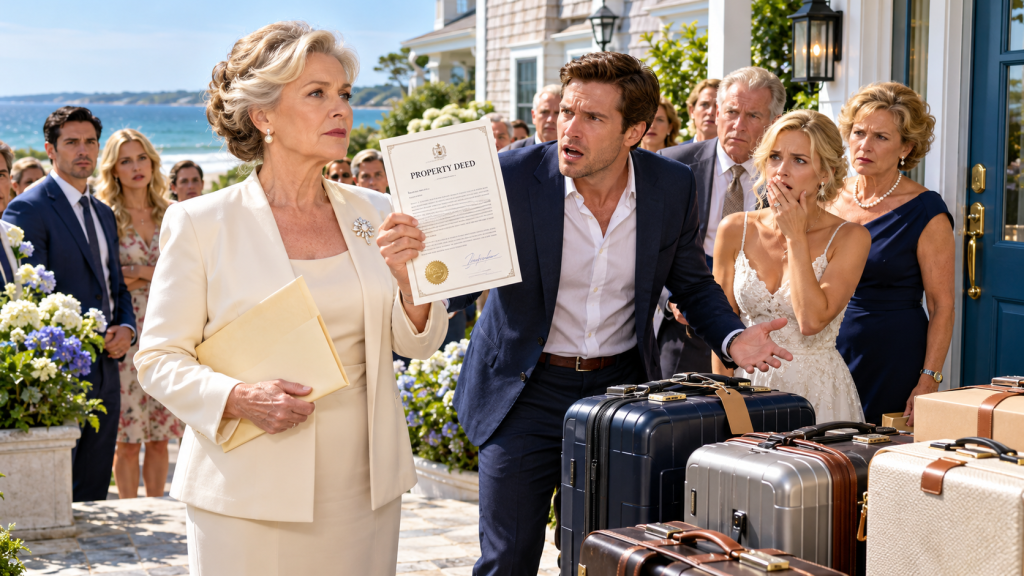
I looked directly into Cullen’s eyes. “What else did you give her?” He swallowed. “Mom, please. Can we discuss this inside?” I almost laughed. Inside. The house he’d assumed was already his. The house where he’d moved my husband’s photograph into a drawer so his new wife could rearrange the mantel.
The house I’d spent six summers rebuilding with Nile, one broken window and one rotten floorboard at a time.
“No, Cullen,” I answered quietly. “You brought an audience to my front door. You can tell me what happened right here.”
His eyes filled.
Then he whispered, “I gave Laurelai a copy of Dad’s letter.”
My fingers tightened around the cream-colored envelope.
Nile’s letter.
The last handwritten instructions my husband had left concerning our beloved beach house.
The paper I’d kept in a locked document safe because every line was precious to me.
“What letter?” Laurelai demanded.
I turned toward her.
“You know exactly which letter.”
She folded her arms.
“I’ve seen numerous family documents.”
Cullen shook his head.
“Mom, I gave her the letter, a copy of the deed, and the identification documents from your safe.”
A murmur swept through the crowd.
My attorney, Helen Ward, closed her briefcase.
“Cullen, I need you to be very careful about what you say next. These matters may be investigated, and you should obtain independent legal advice.”
He looked at her.
For the first time since stepping out of the luxury car, my son seemed to understand that this wasn’t an argument about sleeping arrangements.
It was about documents.
Signatures.
Ownership.
And the possibility that someone had tried to use my property to obtain six hundred thousand dollars without my permission.
I took a breath.
“Cullen, why did you give her those things?”
He stared at the wooden porch.
“She said she needed proof the house was going to become ours.”
“Proof for whom?”
“The bank.”
I looked toward Laurelai.
She stared straight ahead.
Cullen continued.
“And I signed a statement saying you had promised me the house.”
The words struck harder than I’d expected.
I knew about the false deed.
I’d suspected someone had copied my signature.
But the thought of my own son signing a statement that falsely represented my intentions made something deep inside me ache.
“You knew I hadn’t given it to you,” I said.
He nodded.
“You knew the title was still in my name.”
“Yes.”
“Then why would you sign that?”
His voice cracked.
“Because Laurelai said it was just a formality. She said everyone understood the house was supposed to be mine eventually.”
I watched his face.
“And did you tell her I’d agreed to let you move in permanently?”
He closed his eyes.
“Yes.”
I swallowed.
“Even though you never asked me?”
Another nod.
Laurelai abruptly stepped forward.
“This is getting ridiculous. Cullen is your only son. Surely you always intended for him to inherit the property.”
I looked at her.
“Inheriting something after its owner’s death is not the same as owning it while that person is alive.”
She flushed.
“There’s no need to be unpleasant.”
Helen stepped beside me.
“Mrs. Bellamy, a proposed inheritance does not authorize a present transfer of title or a mortgage. Nor does a family member’s expectation of receiving property substitute for the owner’s consent.”
Several guests shifted uncomfortably.
Blythe’s father, Miles, looked down at the document on his phone.
Then he raised his eyes toward Laurelai.
“Did you know the signature wasn’t genuine?”
Laurelai gave an incredulous laugh.
“Of course not.”
He stepped closer.
“Did you know that notary hadn’t been commissioned for three years?”
She said nothing.
His face changed.
“Laurelai.”
She turned sharply.
“Don’t interrogate me in front of strangers!”
Miles stared at her.
“They aren’t strangers. They’re the people you invited to witness a transfer of property you apparently had no right to promise.”
The silence afterward was so complete that I could hear the gulls circling over the beach.
Then a woman in a pale pink dress raised her hand.
“I’m sorry,” she said nervously, “but are you telling us there isn’t going to be an investment announcement?”
I turned toward her.
“What investment announcement?”
She looked at Laurelai.
“She said the property was becoming the flagship location of a luxury coastal retreat venture.”
My stomach dropped.
“A what?”
The woman opened her handbag and removed a glossy brochure.
On its cover was a photograph of my beach house.
My home.
Its gray shingles.
Its wraparound porch.
Its blue front door, painted by Nile himself.
Beneath the image were four words.
THE POINT COLLECTION — COMING SOON
For a moment, I couldn’t move.
The woman continued.
“We were told the newlyweds were being given the property and that guests would have an opportunity to hear about the investment.”
Another man nodded.
“I received a prospectus last week.”
A third person held up a printed page.
I stared at Laurelai.
“So this wasn’t merely a welcome-home party.”
She opened her mouth.
I continued.
“You invited people to watch me hand over my house so you could convince potential investors you controlled the property.”
Her face reddened.
“That is an outrageous interpretation.”
Helen took the brochure and examined it.
Then she looked at me.
“I think we should preserve copies of all these materials.”
Miles turned toward his wife.
“How much money have you taken from anyone?”
Laurelai glared at him.
“Don’t be dramatic.”
“Answer me.”
She looked away.
For the first time, Blythe seemed genuinely frightened.
“Mom?”
Laurelai shook her head sharply.
“Nobody has done anything wrong.”
And that was when a gentleman near the back of the gathering spoke.
“Then perhaps you can explain the twenty-five-thousand-dollar reservation deposit my company transferred last month.”
Every face turned toward him.
Laurelai went completely still.
The man stepped forward.
“I’m Andrew Pierce. I was told I’d receive an interest in a coastal hospitality venture secured by this property.”
He held up his telephone.
“I have the payment confirmation.”
Helen looked at him.
“Please preserve that record and any related communications. You should also seek independent advice about your position.”
I stared at the brochure bearing Nile’s blue front door.
A house I’d bought with my husband after a devastating hurricane.
A house filled with photographs, books, and memories.
A house where I could still hear him laughing when the wind rattled the kitchen windows.
Someone had transformed it into a sales pitch.
And they’d done it while I was still alive.
I expected to become furious.
Instead, I felt extraordinarily calm.
Perhaps it was shock.
Perhaps it was the kind of clarity that arrives when a situation becomes too ugly to excuse.
I looked around at the people standing on my lawn.
“Thank you for coming,” I said.
Several guests exchanged embarrassed glances.
“But I’m afraid you’ve been invited under false pretenses.”
I held up the legitimate deed Helen had brought.
“This property is mine. It has not been transferred to Cullen, Blythe, Laurelai, or any investment company.”
I paused.
“I have not authorized a six-hundred-thousand-dollar mortgage, and I have not approved any hospitality development here.”
Andrew Pierce lowered his head.
The woman in pink looked devastated.
I continued.
“If anyone has paid money because they were told otherwise, please preserve your documents and obtain independent legal advice.”
Laurelai stepped forward.
“You have absolutely no authority to make allegations about my business.”
I looked at her.
“I’m speaking about my house.”
She pointed toward Cullen.
“Your son was promised this property!”
I turned to him.
He couldn’t meet my eyes.
“Was he?”
She stared.
Then I asked softly, “By whom?”
Laurelai had no answer.
I handed the brochure to Helen.
Then looked toward my neighbor, Frances Miller, who had been standing beside the garden gate.
Frances was seventy-three, sharp-eyed, and had known Nile since the year we bought the property.
She was the one who’d first shown me the invitation.
“Frances, would you mind helping people find their cars?”
She smiled.
“Gladly.”
Within minutes, the gathering began to disperse.
There was no applause.
No triumphant music.
No dramatic victory.
Just embarrassed footsteps on the gravel driveway and quiet conversations among people who’d discovered they had been invited to celebrate something that didn’t belong to their hosts.
Andrew Pierce asked Helen for her business card.
Miles stood apart from his wife, looking increasingly troubled.
And Blythe sat on one of the folding chairs with her wedding ring pressed against her lips.
I watched Cullen.
He hadn’t moved.
Finally, he approached me.
“Mom.”
I looked at him.
His eyes were red.
“I’m sorry.”
For a moment, I wanted to embrace him.
I remembered him at six years old, racing barefoot down this very porch.
I remembered Nile teaching him how to hold a fishing rod.
I remembered the three of us eating sandwiches on the unfinished kitchen floor because we hadn’t installed the countertops yet.
Then I remembered Cullen’s words from the airport.
People with status.
The invitation I’d never received.
The lie that I was too ill to attend.
The suitcases in my bedroom.
And the statement he’d signed without my knowledge.
“I hear you,” I said.
His face crumpled.
“Can we come inside?”
I looked toward the blue door.
Then back at my son.
“Not today.”
He stared.
“Mom, we gave up our apartment.”
“You told me that.”
“We have nowhere to go.”
I took a breath.
“Cullen, you and Blythe are adults. You had the money for a wedding and a honeymoon in Hawaii. You can arrange somewhere to stay while you work out your next steps.”
He began crying.
“You’ve never turned me away before.”
The words hurt.
But I knew exactly what Nile would have said.
Sometimes a child doesn’t learn to stand until you stop catching every fall.
I touched Cullen’s arm.
“I’m not turning you away from being my son.”
My voice trembled.
“I’m refusing to hand you my home.”
He stared at me.
And for the first time in his life, I let that distinction remain between us.
That evening, I sat alone on the porch while the last light faded over the water.
The suitcases were gone.
Cullen and Blythe had collected them with the help of a driver. Helen had arranged for the exchange to be documented, and the belongings had been kept dry and protected until they left.
Laurelai had driven away separately.
Miles had refused to get into her car.
I didn’t know where any of them were staying.
And for the first time in my life, I allowed myself not to solve that problem immediately.
Frances came over carrying two mugs of tea.
She had always possessed the extraordinary ability to arrive precisely when someone needed company.
“Thought you might want one,” she said.
I took the mug.
“Thank you.”
She sat beside me.
For a while, we listened to the ocean.
Then she glanced at the blue front door.
“Nile would have been furious.”
My throat tightened.
“He would.”
She smiled faintly.
“Not about the house.”
I looked at her.
“About the way they treated you.”
I closed my eyes.
Nile had been a gentle man.
But he had never mistaken gentleness for surrender.
When we first bought the beach house, a contractor tried to charge us twice for the same repairs.
Nile had calmly spread the invoices across the kitchen table and asked him to explain every charge.
The contractor had turned red.
I’d worried Nile was being unnecessarily difficult.
He’d smiled afterward and said, “A person who respects you won’t be offended when you ask for the truth.”
Now I wished I could hear his voice just once more.
Frances reached for my hand.
“You know what I remember about this place?”
I shook my head.
“The summer the roof blew off.”
I laughed through tears.
“Which time?”
“The second time. You and Nile spent three days carrying ruined shingles into a dumpster.”
I remembered.
The terrible storm.
The smell of wet wood.
Nile standing on the ladder in an old yellow raincoat.
Frances continued.
“Everyone told you to sell the place.”
I smiled.
“They did.”
“But Nile said the house wasn’t finished telling its story.”
My eyes filled.
I looked toward the porch railing.
He’d carved our initials into the underside of one support beam after we finally completed the renovations.
N and M.
Beneath them, the year.
I reached down and touched the wood.
“He loved this place.”
Frances nodded.
“So do you.”
Then she looked at me.
“Don’t let anyone make you feel guilty for protecting it.”
I squeezed her hand.
“Thank you.”
She smiled.
“Now drink your tea before it gets cold. You’re not the only stubborn old woman on this street.”
For the first time that day, I laughed freely.
Helen returned the following Monday with a specialist in property records.
They reviewed the legitimate deed, the forged document, and the materials connected to the mortgage application.
The first good news was that the house remained securely titled to me.
No completed transfer had been recorded.
No mortgage arising from the suspicious application had been registered against the property.
The lender had already been notified that the signature was disputed.
But the application remained a serious matter.
“The documents were prepared to make it appear that Cullen had a valid ownership interest,” Helen explained.
I stared at the false deed.
“How?”
“The application package included a copy purporting to transfer the house to your son. Your signature appears on it, along with a notarial certificate.”
“But the notary retired three years ago.”
“Correct. We confirmed that. The purported notarization is inconsistent with official records.”
I looked away.
“And my signature?”
Helen took a breath.
“We have reason to believe an image of your signature was taken from another document and placed on the purported deed.”
I remembered the safe.
The envelope I’d found resealed with tape.
The identification papers Cullen had given Laurelai.
I felt sick.
Somebody had entered my home, opened private records, and used them to create the appearance of my consent.
Helen continued.
“We’re preserving everything for the appropriate authorities and reviewing the possibility of other unauthorized filings.”
I nodded.
“What about Laurelai’s investment company?”
“That’s being examined separately. The brochures and investor payment records suggest she made representations about the property that require investigation.”
She paused.
“Other people may have claims arising from money they transferred.”
I looked toward the window.
I had assumed Laurelai’s extravagant arrival had been intended to shame me into handing over the keys.
Now I understood that a public transfer might have been useful to her for another reason.
She wanted witnesses.
People who could later say they’d seen me acknowledge Cullen’s ownership.
The thought chilled me.
“Was Cullen involved in preparing the forged deed?”
Helen looked at me carefully.
“We don’t know exactly what he understood. His signed statement and his decision to provide your documents are serious matters. He needs his own attorney, and investigators will need to establish what happened.”
I closed my eyes.
My son.
The little boy who had once cried because he’d accidentally broken a seashell I’d brought home.
The teenager who always made his father a birthday card, even after he thought he was too old for such things.
The young man who had helped carry Nile’s coffin.
He had handed our private papers to someone who wanted my home.
It was almost impossible to hold those memories and that truth in the same heart.
But I had to.
That afternoon, Helen asked whether I wanted to revisit the document I’d originally prepared for Cullen.
It was still in the cream-colored envelope.
The real draft.
The one he had seen and mistaken for a completed transfer.
I nodded.
“Yes.”
Helen spread the pages across my dining table.
They were part of an estate-planning proposal I’d discussed with her several months earlier.
The plan would have placed the beach house into a properly structured family trust if I chose to execute it.
I would have retained control of the property and the right to live there throughout my lifetime.
Cullen would have been named as the primary successor beneficiary, with safeguards intended to protect the home from being used recklessly as collateral.
Nothing had been signed or made effective.
I had wanted to present him with the plan when he married.
Not because marriage magically entitled him to the house.
But because Nile and I had always imagined the point remaining a place where future generations could gather.
There would have been conversations.
Legal explanations.
Questions about maintenance.
Agreement about what the house was for and what it wasn’t.
Most importantly, I would have retained my home.
I touched the unsigned pages.
“I thought he’d be happy.”
Helen’s expression softened.
“He might have been, if he’d been willing to understand what you were offering.”
I swallowed.
“I never intended to give him immediate ownership.”
“I know.”
“I wanted him to feel secure about the future.”
Helen nodded.
“And you wanted to remain secure in the present.”
I stared at her.
It sounded so simple when she said it that way.
Yet I’d spent days feeling guilty for protecting the place where I lived.
I folded the document.
“Cancel the proposal.”
Helen looked up.
“Are you sure?”
“For now, yes.”
I took a breath.
“I may establish a different plan later. But I don’t want Cullen named in a structure I’ve no longer had time to consider honestly.”
She nodded.
“We can review your estate plan without making permanent decisions in anger.”
That mattered to me.
I wasn’t interested in cutting my son out of everything simply because he’d hurt me.
But neither was I willing to reward his behavior by pretending nothing had happened.
For once, I could let the future remain undecided.
After Helen left, I opened the small wooden box where I kept Nile’s original letter.
The paper was soft from years of careful handling.
His handwriting slanted gently toward the right.
He’d written it during the final months of his illness, when he knew we might not have much time left together.
I remembered finding him one afternoon at the kitchen table, looking out toward the sea.
“What are you writing?” I’d asked.
He’d smiled.
“Instructions.”
“For what?”
“How to live with an old fool who won’t always be around to fix the gutters.”
I’d laughed.
Then he’d folded the page before I could read it.
After he died, I found the letter among his estate papers.
Now I unfolded it again.
My darling,
When we bought this house, everyone said we were crazy.
The roof was damaged, the windows leaked, and the garden was more sand than soil.
But you stood on that broken porch and said you could already hear our grandchildren laughing there someday.
I began crying.
We hadn’t had grandchildren.
Not yet.
But Nile had never stopped imagining a future bigger than ourselves.
I continued.
I know Cullen loves this place. I hope it will remain part of his life.
But please remember that it belongs to you first.
You spent years hauling lumber, cleaning plaster dust, and sleeping on a mattress on the floor while we made it into a home.
Don’t let anybody turn all that work into a bill you owe them.
I pressed a hand against my mouth.
The next paragraph was underlined.
If the day comes when you decide to pass the house along, do it because the person receiving it understands what it means.
Not because someone demands it.
Not because you are lonely.
And certainly not because you’re afraid of disappointing our son.
Tears spilled onto the page.
We raised Cullen to be loved, not obeyed.
Those are different things.
I laughed through my tears.
Only Nile could have written something so direct and made it feel like a warm embrace.
Then came the final lines.
Keep your own key, my love.
Keep your own chair beside the window.
And whenever the world becomes too loud, come back to the point and listen to the waves.
I’ll be there in every bit of this place we built together.
I folded the letter carefully.
Then looked toward the blue door.
For years, I had thought protecting Cullen meant making his life easier.
Now I began to understand that I might have confused removing obstacles with teaching him how to face them.
Nile had spent his life trying to explain the difference.
I wished I’d listened more carefully while he was alive.
The first unexpected visitor came on Wednesday.
Miles arrived alone.
He looked as though he hadn’t slept.
His expensive jacket was creased.
His silver hair, usually immaculate, was windblown.
When I opened the door, he held out a folder.
“Mrs. Whitmore, may I speak with you?”
I hesitated.
Then stepped onto the porch and closed the door behind me.
“My name is not Whitmore,” I said gently. “But you may call me by my first name.”
He flushed.
“I’m sorry. I’ve had rather a difficult few days.”
“I imagine you have.”
He looked toward the ocean.
Then whispered, “I owe you an apology.”
I waited.
“I believed Cullen when he said the house was being transferred to him.”
I nodded.
“Your son sounded so certain,” Miles continued. “And Laurelai showed me a document that appeared official.”
He looked down.
“I should have verified it.”
“Yes,” I said.
He accepted that without protest.
Then he handed me the folder.
“These are the financial records I was able to obtain concerning Laurelai’s investment company.”
I looked at him.
“Why bring them to me?”
“Because I’m afraid she has placed your property at the center of something far more serious than I understood.”
My stomach tightened.
He continued.
“Laurelai’s venture has been struggling for almost two years. Several investments failed. She borrowed money to cover operating expenses, and then began seeking additional funding.”
I looked toward the sea.
“So she wanted my house as collateral.”
“Apparently.”
His voice broke.
“But there’s more.”
I turned.
Miles swallowed.
“She told prospective investors that the newlyweds were about to receive the house as a wedding gift, and that the property would then be available to support the venture.”
“She couldn’t promise that.”
“I know.”
He glanced toward the folder.
“And some people appear to have paid reservation deposits before the wedding even took place.”
I stared.
“Did you know?”
He shook his head.
“Not until the gathering at your house.”
I studied him carefully.
“Then why did you call me asking about the paperwork?”
He looked ashamed.
“Because Laurelai told me Cullen had completed the deed with your attorney. She said you simply hadn’t announced it publicly.”
He paused.
“I thought I was calling to resolve a misunderstanding.”
I took a breath.
“Miles, I need you to understand something. Your wife may have used my home in these arrangements, but I am not responsible for repairing her business.”
He nodded immediately.
“I know.”
“And Cullen cannot promise my property on my behalf.”
“I know that too.”
He lowered his eyes.
Then said, “I think the hardest part is discovering how much I was willing to believe because believing it was convenient.”
I looked at him.
For the first time, I felt a flicker of sympathy.
Not enough to take responsibility for his problems.
But enough to recognize that he, too, had been forced to confront unpleasant truths.
I accepted copies of the records for Helen to review.
Then Miles said something I hadn’t expected.
“Blythe wanted to tell you about the wedding.”
I stared.
“What?”
“She asked Cullen whether they should invite you.”
I felt a sharp ache.
He continued.
“Laurelai told them the guest list had to remain exclusive. She said the investors attending the ceremony would expect a certain kind of presentation.”
I looked away.
“People with status.”
Miles nodded sadly.
“Yes.”
Then he added, “But Cullen made the final decision not to invite you.”
Those words hurt.
And they mattered.
I didn’t want another person to blame.
I wanted the truth.
My son had made a choice.
He would have to live with it.
The next two months were filled with things I never expected to do at seventy-one.
I met with attorneys.
Reviewed property records.
Answered questions from investigators.
Preserved text messages and photographs.
And learned more about unauthorized financing than I had ever wanted to know.
The proposed mortgage never closed.
The lender confirmed it would not rely on the disputed deed, and Helen helped ensure the public property records reflected my continuing ownership.
The false documents and the representations made to prospective investors were referred to the appropriate authorities.
Laurelai retained her own attorney.
So did Cullen.
Blythe was interviewed about what she had known and what she had told others.
Miles provided the financial records he’d discovered.
Andrew Pierce and several other prospective investors supplied evidence of payments they had made.
The process wasn’t quick.
It wasn’t neat.
And it didn’t end with a dramatic arrest on the beach.
There were investigations, civil claims, and difficult questions about responsibility.
Some investors pursued recovery of their money.
Laurelai’s business faced substantial legal and financial consequences.
I didn’t know how every proceeding would end.
But I knew something important.
My house was not hers to mortgage.
And whatever had happened inside her business, I no longer had to pretend that protecting my own home made me cruel.
Blythe came to see me one chilly afternoon in November.
She had called first.
That surprised me.
For months, she had behaved as though permission were an unnecessary formality whenever my property was involved.
Now she asked whether I would be willing to speak.
I agreed to meet her on the porch.
She arrived wearing jeans, a plain blue sweater, and very little makeup.
Her eyes were tired.
“Thank you for seeing me,” she said.
I nodded.
She sat opposite me.
For a moment, neither of us spoke.
Then she whispered, “Cullen and I have moved into a small apartment.”
“I hope it’s comfortable.”
She gave a sad smile.
“It’s fine.”
I waited.
She looked toward the ocean.
“I thought you should know we’re paying for it ourselves.”
I nodded.
“That’s a good start.”
Her eyes filled.
Then she reached into her handbag.
I tensed.
But she only removed a photograph.
Nile.
The same photograph I’d found face down in the drawer.
Its frame had been cleaned.
The glass polished.
“I found this behind some of our things before we left,” she said.
I stared.
“Why did you remove it from the mantel?”
Her cheeks reddened.
“I thought the living room would look better with a large painting.”
I looked at her.
“And why wasn’t I asked?”
She stared at the photograph.
“Because I behaved as though it was already our house.”
I said nothing.
Her voice trembled.
“I didn’t understand what it meant to you.”
I looked toward the railing Nile had built.
“You didn’t have to understand every memory to know that someone else’s home deserves respect.”
Blythe nodded.
“I know.”
Then she said something that surprised me.
“I knew you weren’t sick.”
My stomach tightened.
She looked up.
“At the wedding. I knew there was nothing wrong with your health.”
I stared.
“Then why tell everyone I was too unwell to attend?”
Tears filled her eyes.
“Because Laurelai said people would ask questions if Cullen’s mother wasn’t there.”
I waited.
“And?”
Blythe began crying.
“Because we didn’t want them to know we’d excluded you.”
There it was.
The truth beneath the polished wedding photographs.
Not a misunderstanding.
Not an unfortunate scheduling problem.
A deliberate decision to keep me away and then invent a respectable explanation for my absence.
I looked at her.
“Why didn’t you want me there?”
She wiped her cheeks.
“Some of the guests were important to my mother’s business. She wanted everything to look impressive.”
I nodded slowly.
“And a seventy-one-year-old widow from the coast wasn’t impressive enough.”
Blythe covered her face.
“I was horrible.”
I looked toward the water.
For a moment, I remembered Cullen calling from the airport.
The happiness in his voice.
The careless way he’d said the wedding was for people with status.
It had taken me days to admit just how deeply those words wounded me.
Not because I wanted an expensive dress or a seat at the most prestigious table.
Because I had wanted to watch my only son get married.
I had wanted to hear his vows.
See his face when his bride walked toward him.
Remember Nile beside me, smiling through tears.
I’d wanted to be there as his mother.
Nothing more.
Nothing less.
“Blythe,” I said quietly, “you cannot give me that day back.”
She began crying harder.
“I know.”
“And I don’t want another celebration arranged to make everyone feel better about what happened.”
She nodded.
“What I need is to know that the next time someone in your family tells a lie about me, you won’t join them.”
She looked up.
“I won’t.”
I studied her.
“I hope that’s true.”
Then I stood.
She rose too.
For a moment, she seemed to expect a hug.
I didn’t offer one.
Instead, I held out my hand for Nile’s photograph.
She gave it to me.
“Thank you for returning this.”
Blythe nodded.
Then she walked toward her car.
I watched her leave.
And I realized that not every apology needed to end in an embrace.
Sometimes acknowledging the truth was enough for one afternoon.
Cullen didn’t visit again until Christmas Eve.
I’d invited Frances and two other neighbors for supper.
We had just finished eating when I heard a knock.
My son stood outside in an old wool coat.
For a moment, I almost didn’t recognize him.
He looked thinner.
Older.
The bright confidence he’d worn at the airport was gone.
“Mom.”
I swallowed.
“Cullen.”
He held a small wrapped box.
“Can I come in?”
I hesitated.
Then nodded.
He stepped inside and glanced around.
His eyes settled on Nile’s photograph.
It stood in its rightful place above the fireplace.
For several seconds, Cullen simply stared.
Then he whispered, “I should never have moved Dad’s picture.”
I looked at him.
“No.”
He nodded.
Then he handed me the box.
“I brought something.”
I opened it.
Inside was a little brass key ring.
It was shaped like a lighthouse.
Nile had given it to Cullen when he was sixteen.
I remembered the day vividly.
Our son had received his driver’s license, and Nile had attached the house key to the ring.
“Now you can visit whenever you want,” he’d told him. “But remember, a key means someone trusts you.”
Cullen’s eyes filled.
“I found it in my desk.”
I turned the little lighthouse over in my hand.
The metal was worn smooth.
“I remember this.”
He swallowed.
“Dad told me the key meant I belonged here.”
I nodded.
“It did.”
Cullen looked at the floor.
“I thought belonging meant I owned the place.”
My throat tightened.
For a long time, neither of us spoke.
Then he whispered, “I was wrong.”
I looked at my son.
He was crying.
“I wanted Blythe’s family to think I was successful,” he continued. “They talked about property, investments, connections. I didn’t want to be the man whose mother had helped him.”
I stared.
“Cullen, your father and I helped you because we loved you.”
“I know.”
He shook his head.
“But I started acting as though accepting help meant I was less of a man.”
His voice broke.
“So I lied about having the house because I wanted them to see me as somebody important.”
I felt my eyes fill.
“Son, did you think we’d ever been ashamed of you?”
He looked up.
“No.”
“Then why were you ashamed of us?”
His face crumpled.
He covered his mouth.
That question seemed to reach somewhere the lawyers, documents, and arguments had not.
He sat down.
And cried.
Not dramatically.
Not to manipulate me.
He simply sat with his face in his hands, grieving what he’d done.
I let him.
For years, I had been quick to soothe Cullen whenever life disappointed him.
I’d given him money.
Protected him from consequences.
Explained away behavior that should have required an apology.
But that night, I understood that allowing someone to feel ashamed of a harmful choice wasn’t the same thing as abandoning them.
Sometimes it was the first step toward making a better one.
Finally, Cullen looked up.
“Mom, I’m going to cooperate fully with the investigation.”
I nodded.
“I think that’s right.”
“I signed a statement I shouldn’t have signed. I gave Laurelai documents that weren’t mine to give. I convinced myself it was harmless because I thought you’d say yes eventually.”
He wiped his eyes.
“I can’t keep blaming her for choices I made.”
I looked at him.
“That’s the first honest thing you’ve said to me about this.”
He nodded.
“I know.”
Then he whispered, “Can you ever forgive me?”
I looked toward Nile’s photograph.
I thought about the house.
The wedding.
The suitcases.
The money people had tried to borrow against my property.
And the hurt I’d carried since the morning Cullen called to announce he’d married without inviting me.
“I don’t know how long rebuilding trust will take,” I answered.
He lowered his eyes.
“But I haven’t stopped loving you.”
His face crumpled.
I continued.
“You are still my son. That doesn’t mean you are entitled to my home, my documents, or my money.”
He nodded.
“I understand.”
“And it doesn’t mean I can immediately forget what happened.”
“I know.”
I reached across the table.
“Maybe we begin by getting to know each other again without pretending everything is fine.”
Cullen took my hand.
“I’d like that.”
For the first time in months, I believed him.
Not because he’d promised me anything grand.
But because he’d finally stopped asking me to solve his problem for him.
Spring came slowly to the coast.
The winter storms left seaweed tangled along the dunes, and the paint on the porch railing needed another coat.
For the first time since Nile died, I decided to do the work myself.
Not because I couldn’t hire someone.
Because the smell of fresh paint reminded me of the summers we’d spent rebuilding the house.
I bought a can of blue paint, put on Nile’s old work shirt, and spent an entire afternoon touching up the front door.
Frances watched from her porch.
“You’re getting paint on your shoes!”
I laughed.
“Nile used to say that meant I was working properly.”
She grinned.
“Then he would’ve been proud.”
As I stepped back to inspect the door, I thought about the extraordinary chain of events that had begun with one telephone call.
A wedding I wasn’t invited to.
A lie about my health.
A miniature replica of my house on a wedding cake.
Suitcases in my bedroom.
A forged deed.
A crowd waiting for keys I had never promised.
Sometimes I still woke in the night wondering whether I’d been too harsh.
Then I remembered my son’s expression when he admitted giving Laurelai access to my private documents.
I remembered the false signature.
The investment brochures.
The people who’d transferred money because they believed the house was available to support a business venture.
And I knew that refusing to participate had been necessary.
Not cruel.
Necessary.
Over the following months, Cullen continued taking responsibility.
He provided a full account of his involvement in the paperwork to his legal adviser and cooperated with the relevant inquiries.
He didn’t pretend that Laurelai alone had caused the trouble.
He acknowledged that he’d made false statements about the house and shared documents without permission.
The authorities continued reviewing the suspected falsification and the representations made to investors.
Civil claims concerning the investment payments remained a separate matter.
It wasn’t a simple story with one villain and everyone else innocent.
And that was part of what made it painful.
Good people could make selfish decisions.
Frightened people could become dishonest.
People who loved one another could still cause extraordinary harm.
Cullen began learning that consequences weren’t automatically proof that someone wanted to destroy him.
Sometimes they were the necessary cost of being responsible for his own choices.
One afternoon, he sent me a copy of a letter.
He had written to everyone who attended his wedding.
It was brief.
He explained that I’d been healthy and that my absence had not been due to illness.
He acknowledged that he and Blythe had chosen not to invite me.
He apologized for allowing guests to believe something untrue.
And he made it clear that the beach house remained my property.
I read the letter twice.
Then called him.
“Cullen?”
“Hi, Mom.”
“I received the copy.”
He sounded nervous.
“Was it all right?”
My eyes filled.
“Yes.”
He exhaled.
“I should’ve done that a long time ago.”
I looked toward Nile’s photograph.
“Yes, son.”
Then I added, “Thank you for doing it now.”
We didn’t say anything grand afterward.
We didn’t need to.
For the first time, my son had corrected a public lie without asking me to protect him from the embarrassment.
That mattered.
By summer, Cullen and Blythe were living more modestly.
They were still married, though they’d begun counseling and were trying to understand how ambition, appearances, and the desire to impress other people had affected their decisions.
I didn’t know whether their marriage would survive.
That wasn’t mine to decide.
Blythe occasionally sent me photographs of the garden she was growing in pots outside their apartment.
I answered politely.
Sometimes warmly.
But I didn’t pretend we had developed a close relationship overnight.
Trust had been damaged.
It would take consistent behavior to rebuild.
Laurelai’s business troubles continued through legal proceedings and financial negotiations.
Miles had distanced himself from her business affairs and was addressing his own responsibilities with independent advice.
I followed only what was necessary to protect my interests.
I no longer wanted my days consumed by somebody else’s recklessness.
Instead, I did something I’d been postponing for years.
I took sailing lessons.
At seventy-one.
Frances laughed so hard when I told her that she nearly spilled her coffee.
“You?”
“Why not?”
“You get seasick on ferries.”
I smiled.
“Then I’ll learn whether a smaller boat makes any difference.”
It turned out I wasn’t particularly talented.
My first lesson was an awkward combination of tangled ropes, nervous laughter, and forgetting which direction the wind was coming from.
But when the little sailboat finally began gliding across the water, I felt something I hadn’t experienced in years.
Freedom.
Not the freedom of having millions in property.
Not the freedom of being able to refuse someone a favor.
The freedom of being allowed to do something simply because I wanted to.
Nile would have loved that.
He’d always said I spent too much time taking care of everyone else.
Now, at last, I was learning to take care of myself.
On the anniversary of the day we finished rebuilding the beach house, I invited Cullen for lunch.
Just Cullen.
I made his favorite chicken salad sandwiches and served lemonade on the porch.
He arrived carrying a small toolbox.
I raised an eyebrow.
“What’s that?”
He smiled.
“Frances told me the latch on your garden gate was sticking.”
I laughed.
“That woman knows everything.”
He shrugged.
“Thought I might help.”
I studied him.
“Help, or earn your way back into my good graces?”
He smiled sadly.
“A little of both, maybe.”
I nodded.
“At least you’re honest.”
After lunch, he repaired the latch.
It took him nearly an hour.
Nile would have finished it in fifteen minutes.
But I didn’t say that.
When Cullen finally stepped back, the gate swung smoothly.
He looked pleased.
“There.”
I smiled.
“Thank you.”
He sat beside me.
For a while, we watched the waves.
Then he asked, “Mom, are you ever going to give me the house?”
The question startled me.
I turned toward him.
His expression was serious.
But not demanding.
“I don’t know,” I answered.
He nodded.
“I figured.”
I looked at him.
“Why do you ask?”
He smiled faintly.
“Because I wanted to know whether I could hear you say no without getting angry.”
I stared.
Then I began laughing.
He laughed too.
After a moment, he added, “I think I’m getting better at it.”
I squeezed his hand.
“So do I.”
He looked toward the blue door.
“Can I tell you something?”
“Of course.”
He swallowed.
“I don’t want the house because it’s worth nearly two million dollars anymore.”
I waited.
“I want to be the kind of person you’d trust to look after it.”
My throat tightened.
For the first time, I heard an echo of Nile’s values in my son’s voice.
I looked at him.
“Then keep becoming that person.”
He nodded.
And we let the conversation end there.
No deed.
No promise.
No condition attached to my affection.
Just a mother and son sitting beside the ocean, learning how to speak honestly to each other.
That evening, after Cullen left, I carried Nile’s photograph onto the porch.
I placed it on the little table beside my chair.
The sunset had painted the horizon orange and pink.
The breeze smelled of salt and flowers.
And the house behind me creaked softly, as old houses do when the temperature changes.
I looked at Nile’s smiling face.
“Well, darling,” I whispered, “we’ve had quite a year.”
I laughed.
Then I cried a little.
Because I still missed him.
Because our son had hurt me.
Because the family I’d believed I had wasn’t quite the family I actually had.
But also because I’d discovered something important.
At seventy-one, I was not too old to protect myself.
I was not too old to change my plans.
And I was not too old to learn that love and entitlement are very different things.
My son thought the beach house was his because he’d grown up believing that everything I owned would eventually belong to him.
His new family thought they could turn that assumption into a signature, a mortgage, and a profitable business opportunity.
But the house was never merely a financial asset.
It was the place where Nile and I had rebuilt our lives after a hurricane.
Where we’d celebrated birthdays.
Where we’d watched storms roll across the water.
Where my husband had painted a blue door with his own hands and told me we were finally home.
And it was still mine.
I looked toward the front door.
The fresh paint gleamed in the fading sunlight.
Then I reached into my pocket and took out my key.
My own key.
The one that opened the home I had worked for, paid for, and loved.
Nile had written four words that I would never again forget.
Keep your own key.
I smiled.
“I will, my love.”
Then I stepped inside, closed the blue door gently behind me, and turned the lock.
Not to shut my family out forever.
But to remind myself that love should always be welcomed through a door opened freely, never forced through one someone else believes they’re entitled to own.
And for the first time in a long while, the beach house felt completely peaceful again.
THE END STORIES! THANK YOU FOR READING GOOD LUCK !❤️
Related Posts