The paper trembled between my fingers. Three dates. Two hospital names. And one sentence that made my blood run cold. Ask why Ben has been missing from daycare all week. I looked at my sister. Sarah’s face was almost colorless. Her eyes kept darting toward the man standing at the end of the hospital corridor.
Darren. I’d met him only a handful of times since he married my sister eighteen months earlier. He was charming in public, always smiling, always offering to carry someone’s groceries or pay for dinner. But I remembered something about him that had bothered me from the beginning.
He never seemed to let Sarah finish a sentence. Whenever she spoke, Darren answered for her. Whenever she hesitated, he corrected her. And whenever I invited her somewhere without him, there was always a reason she couldn’t come. Now, watching him attempt to push past a hospital security guard to reach my frightened niece, I understood that those small moments might have meant much more than I’d realized.
“Sarah,” I whispered, “where is Ben?”
Her mouth opened.
No sound came out.
I gripped her hand.
“Look at me. Where is your son?”
Before she could answer, Darren raised his voice.
“This is ridiculous! That’s my stepdaughter. My wife is standing right there. You people have no right to keep my family apart!”
A security officer moved directly in front of him.
“Sir, please lower your voice.”
Darren pointed toward me.
“She’s the problem! She’s been trying to interfere in our marriage for months!”
I felt Lily’s fingers tighten around mine.
She had been standing quietly beside me, her eyes fixed on the floor.
I crouched slightly.
“Sweetheart, would you like to go back into the room with Emma?”
She nodded immediately.
A nurse stepped forward and gently guided both girls through the doorway.
Only after Lily disappeared from view did I realize how hard my heart was pounding.
A hospital social worker approached us.
Her badge read OLIVIA MARTIN — CHILD PROTECTION SERVICES.
“Mrs. Bennett,” she said to Sarah, “would you come with me? We need to speak somewhere private.”
Sarah looked toward Darren.
He stopped arguing long enough to stare at her.
It was a look I had never seen him give her before.
Cold.
Warning.
Possessive.
Sarah flinched.
Olivia noticed.
“Your husband won’t be joining us,” she said calmly.
For a moment, Sarah seemed unable to move.
Then she turned toward me.
“Will you stay?”
I squeezed her hand.
“Of course.”
And together, we followed Olivia into a small consultation room.
The door closed behind us.
For the first time since arriving at the hospital, Darren couldn’t hear what my sister was saying.
Sarah sat down.
Looked at the folded paper in my hand.
And began to cry.
“Ben is five,” she whispered.
Olivia nodded.
“Take your time.”
Sarah wiped her cheeks.
“He’s supposed to be at Darren’s mother’s house.”
I leaned forward.
“Supposed to be?”
She looked at me.
“Darren took him on Monday.”
My stomach tightened.
“Why?”
“Because I told him I wanted to leave.”
Those seven words seemed to take all the air out of the room.
I stared at my sister.
She continued.
“Last Sunday, after the children were asleep, I told Darren I couldn’t live like this anymore. I said I wanted us to separate.”
Her hands twisted together.
“He became furious. He said I was destroying our family.”
Olivia remained still, listening.
Sarah took a shaky breath.
“The next morning, Ben was gone.”
I felt sick.
“What do you mean, gone?”
“Darren told me his mother had taken Ben to stay with her for a few days. He said I needed time to calm down before I made decisions I’d regret.”
“Did you agree?”
She shook her head.
“No.”
Her voice broke.
“I tried calling his mother, but she didn’t answer. Darren said Ben was safe and warned me that if I involved anyone, he’d tell the authorities I was unstable.”
Olivia leaned forward slightly.
“Sarah, when did you last speak directly with Ben?”
“Thursday night.”
“What did he say?”
Sarah covered her mouth.
“Just ‘Mommy.’ Then the call ended.”
I felt tears gathering.
My nephew was five years old.
He loved dinosaurs, peanut-butter sandwiches, and sleeping with a stuffed blue elephant.
The previous Christmas, he’d insisted I wrap a present for the family dog because he didn’t want anyone left out.
And now he had been away from his mother for nearly a week, with no reliable information about where he was.
“Sarah,” I asked carefully, “do you know his grandmother’s address?”
She nodded.
“Yes.”
Olivia took out a pen.
“Please give it to me.”
My sister did.
Olivia immediately stepped outside to coordinate a welfare check with law enforcement.
I stared at Sarah.
“Why didn’t you tell me?”
She looked devastated.
“I tried.”
I swallowed.
“When?”
“Three weeks ago. I called you from the grocery store, remember?”
I did.
She’d asked whether I had time to talk.
I’d been rushing into a meeting at work.
I told her I’d call later.
When I finally did, Darren answered her phone and said Sarah had gone to bed with a migraine.
My stomach turned.
“I thought you were sick.”
She nodded miserably.
“He took my phone after I called you. He said if I started telling family stories about our marriage, I’d never see the children again.”
I reached for her hand.
“Sarah…”
She began crying harder.
“I was afraid he’d find out I’d told you.”
I wanted to apologize.
To tell her I should have recognized the warning signs.
But this wasn’t the moment to make her comfort me.
Instead, I moved my chair closer.
“I’m listening now.”
She nodded.
And then my sister began telling me about the life she’d been living behind the front door of her beautiful suburban house.
It hadn’t begun with shouting.
That was the part she said frightened her most.
When Sarah first met Darren, he’d been attentive and generous.
He remembered every birthday.
Bought flowers for no reason.
Made elaborate pancakes for Lily and Ben on Sunday mornings.
He told everyone how fortunate he was to have married a woman with two wonderful children.
After her first marriage ended, Sarah had been lonely.
The children’s father lived in another state and maintained contact, but she carried most of the daily responsibility herself.
Darren seemed delighted to become part of their lives.
“I thought he was giving us stability,” she whispered.
Then things began changing.
He wanted to manage the household budget because he was supposedly better with money.
He suggested Sarah reduce her work hours because the children needed her.
He complained that I interfered too much.
He said my daughter Emma was becoming a bad influence on Lily because she asked too many questions.
Gradually, Sarah stopped visiting.
Stopped attending her book club.
Stopped telling me what was happening at home.
“Every time I disagreed with him,” she said, “he told me I was being dramatic.”
I felt a painful flash of recognition.
My sister had always been confident.
She was the one who organized family holidays, remembered everyone’s appointments, and stood up for strangers when someone treated them unfairly.
But the woman sitting before me seemed afraid to choose the wrong words.
“What happened with Lily?” I asked softly.
Sarah looked toward the closed door.
Her face collapsed.
“Darren started calling her difficult.”
Olivia returned just then.
She had been arranging the welfare check and now sat with us again.
Sarah continued.
“Lily asked questions. Sometimes she argued about bedtime or chores. Normal things.”
She swallowed.
“Darren said I was raising her to be disrespectful.”
I kept my voice gentle.
“Did you see him hurt her?”
Sarah began shaking.
“I saw him grab her arm once. Hard enough that she cried.”
She covered her face.
“He told me she’d fallen while he was helping her.”
I took a breath.
“And you believed him?”
Sarah stared at the floor.
“I wanted to.”
There was a long silence.
Then she whispered, “But I didn’t really.”
Olivia spoke gently.
“Sarah, thank you for telling us. We don’t need you to reconstruct everything right now. The children’s safety is the immediate priority.”
Sarah nodded.
I looked at the paper in my hand.
The three dates.
The two hospitals.
“Are these the times the children needed medical care?”
Sarah wiped her eyes.
“Yes.”
She pointed to the first date.
“That was when Ben hurt his wrist. Darren said he fell from a chair.”
Her finger moved to the second.
“Lily had a bruise on her shoulder. Darren said she’d bumped into a door.”
Then the third.
“Ben had a head injury. Darren told the hospital he’d fallen while playing outside.”
My stomach tightened.
“Why two hospitals?”
Sarah’s voice dropped.
“Because Darren didn’t want anyone asking why the children kept getting hurt.”
Olivia quietly took a copy of the paper.
I looked at my sister.
“How did you know that?”
Sarah began crying again.
“Because the last time, he told me exactly which emergency department we were going to.”
She looked up.
“He said we couldn’t go back to the first hospital because the nurses were starting to ask too many questions.”
For several seconds, I couldn’t speak.
Then Olivia asked, “Sarah, would you be willing to tell the child protection investigator what you’ve told us?”
My sister hesitated.
She looked toward the door.
Then whispered, “If I do, will you help me get Ben back?”
Olivia’s expression softened.
“We’re taking his safety seriously. The welfare check is underway, and we’ll keep working with you and the appropriate authorities.”
Sarah nodded.
Then she said something that broke my heart.
“I don’t need my marriage saved.”
Tears spilled down her cheeks.
“I just need my children safe.”
The first call came forty-three minutes later.
Olivia had stepped outside to speak with the officers checking on Ben.
I sat beside Sarah, holding her hand while she stared at the wall.
Then the door opened.
Olivia returned with a police officer.
My sister stood so suddenly that her chair scraped across the floor.
“Did you find him?”
Olivia nodded.
“Ben is at the address you provided.”
Sarah pressed both hands against her mouth.
“Is he okay?”
“He’s awake and speaking with the officers. We have concerns about his welfare, and arrangements are being made for an appropriate medical assessment.”
My sister began crying.
“Can I see him?”
Olivia exchanged a brief glance with the officer.
“We’re working on getting him to a safe place and arranging contact. We need to make sure we do this carefully.”
Sarah nodded, trying desperately to steady herself.
Then the officer said something neither of us expected.
“Darren’s mother says she believed you were receiving inpatient psychiatric treatment.”
My sister froze.
“What?”
“She says her son told her you were hospitalized and that Ben needed to remain with her until you recovered.”
Sarah stared at him.
“I’ve never been hospitalized for anything like that.”
The officer nodded.
“That’s one of the reasons we’re looking into what she was told.”
I felt anger rise.
Darren hadn’t merely separated Ben from his mother.
He had told his own mother a story designed to make Sarah seem incapable of caring for him.
Sarah sank into her chair.
“He said he would make everyone think I was unstable.”
I put my arm around her.
Olivia crouched beside her.
“Sarah, your concerns are being taken seriously. Right now, we’re focused on keeping both children safe.”
My sister nodded.
But then she looked toward the corridor.
“Where’s Darren?”
The officer answered.
“He’s speaking with another officer. We’ve asked him to remain away from the children’s treatment area.”
Sarah’s hands began trembling again.
“He’ll be furious.”
I reached for her hand.
“Sarah, you don’t have to face him alone.”
She looked at me.
For a moment, she seemed unable to believe those words.
Then she whispered, “I don’t want to go home.”
I squeezed her fingers.
“Then you won’t go home with him.”
An hour later, Lily’s examining doctor returned.
She spoke privately with Sarah and explained that Lily had injuries requiring care and documentation.
The findings raised concerns, but the doctor was careful not to claim that the physical examination alone could establish exactly what had happened.
A specialist trained in speaking with children would conduct any further interview.
The doctor also explained the importance of not repeatedly questioning Lily.
I felt grateful for that.
Every instinct in me wanted answers.
I wanted to know what Darren had done, when it began, and how my sister had lived beneath the same roof without being able to stop it.
But Lily wasn’t a witness I could interrogate.
She was a child.
And she needed to know that the adults around her would take responsibility without making her carry it.
When I returned to the family room, she was sitting beside Emma.
My daughter had arranged two stuffed animals on the table, pretending they were visiting a veterinarian.
Lily was watching quietly.
She looked up when I entered.
“Auntie?”
“Yes, sweetheart?”
“Are you mad at Mommy?”
The question caught me off guard.
I sat beside her.
“Why would you ask that?”
Lily stared at the stuffed animals.
“Because she told me not to tell people what happens at home.”
I felt a terrible ache.
I kept my voice calm.
“You’re not in trouble for telling anyone something that worries you.”
She nodded.
“Is Mommy in trouble?”
I considered my words carefully.
“Your mom is getting help, sweetheart. Right now, everyone is working to keep you and Ben safe.”
Her eyes filled.
“Can I see Ben?”
“We’re working on that.”
She looked down.
Emma reached over and took her hand.
“You can have my rabbit until he gets here.”
Lily stared at the small stuffed animal.
Then whispered, “Thank you.”
I turned away for a moment because I couldn’t let them see me crying.
My eight-year-old daughter had no idea how serious the situation was.
But she understood something essential.
Her cousin was frightened.
And sharing a stuffed rabbit was one way to make the room feel less lonely.
Ben arrived later that afternoon.
He came through the hospital doors holding a social worker’s hand.
His blue dinosaur backpack hung from one shoulder.
The moment Sarah saw him, she made a sound I had never heard from another human being.
It was relief and heartbreak together.
“Ben!”
He looked up.
For half a second, he stood frozen.
Then he ran toward her.
“Mommy!”
Sarah dropped to her knees and wrapped both arms around him.
They held each other so tightly that I could see her shoulders shaking.
“I thought you forgot me,” Ben whispered.
Sarah began crying harder.
“Oh, baby. Never. Never, never.”
He buried his face in her neck.
“Darren said you were sick.”
She kissed his hair.
“I’m here now.”
He pulled back.
“Can I come home?”
Sarah looked at Olivia.
Then at her son.
“We’re going to make sure you have somewhere safe to stay, sweetheart.”
Ben nodded.
He seemed exhausted.
There were dark shadows beneath his eyes, and he held his backpack as though someone might take it away.
A pediatric team examined him.
They found concerns that required follow-up, including an older injury that had not received the care expected.
Nothing about the situation was treated as proof based on one observation.
But the combination of Ben’s medical findings, the earlier records, the family’s statements, and the circumstances of his separation from Sarah raised serious safeguarding concerns.
For that evening, both children remained in a protected setting while the hospital team and child welfare authorities worked with Sarah on a safety plan.
I stayed with Emma nearby.
When I told her Ben had been found, she smiled for the first time in hours.
“Does that mean Lily won’t be scared anymore?”
I looked at my daughter.
“I hope she’ll feel safer.”
Emma thought about that.
Then said, “Maybe we can all have pancakes tomorrow.”
I smiled through tears.
“That’s a wonderful idea.”
That night, Sarah finally told me why she’d asked me to watch Lily for the weekend.
We were sitting in a quiet waiting area.
The girls were resting, and Ben was asleep.
My sister held a paper cup of tea she hadn’t touched.
“I didn’t ask you because I needed a break,” she whispered.
I looked at her.
“I know.”
She shook her head.
“No. You don’t.”
I waited.
She swallowed.
“I wanted Lily away from Darren long enough to feel safe telling someone what was happening.”
My eyes filled.
She continued.
“I knew he was monitoring my phone. He checked my messages and wanted to know everywhere I went. But he trusted you to keep Lily for a weekend because he wanted her out of the house.”
I frowned.
“Why?”
Sarah looked down.
“She had started asking when we were leaving.”
I felt cold.
“Leaving?”
“She heard me tell Darren I wanted to separate. Afterward, she asked whether we could live with you.”
I stared.
Sarah began crying.
“He became angry whenever she mentioned it.”
I reached for her hand.
“So you sent her to me.”
She nodded.
“I thought if she had a quiet weekend with you and Emma, she might feel safe enough to tell you herself. I didn’t know whether she’d say anything.”
I took a slow breath.
“And Ben?”
Her face crumpled.
“I was trying to find him. Darren wouldn’t give me an address I could verify until yesterday. When I finally learned where Ben was, I wrote it down with the hospital dates.”
“Why didn’t you call the police immediately?”
She looked devastated.
“I was terrified. Darren said he’d already spoken to people about getting emergency custody. He claimed he had proof I couldn’t look after the children.”
I squeezed her hand.
“Sarah…”
She shook her head.
“I know what I should have done. Every day I told myself I’d call. Then I imagined him finding out while Ben was still with his mother, and I froze.”
She began crying.
“I kept thinking I could get both children away without making him angry.”
For years, I’d imagined that if I ever faced a dangerous situation, I’d act decisively.
Call the police.
Leave the house.
Protect everyone.
But looking at my sister, I understood how fear can narrow a person’s world until every choice seems capable of making something worse.
I didn’t tell her she’d done everything perfectly.
I didn’t pretend the children hadn’t needed help sooner.
I simply said, “You’re asking for help now. And we’re going to keep asking until the children are safe.”
Sarah rested her head against my shoulder.
For a long time, we sat without speaking.
Then she whispered, “I thought you would hate me.”
My throat tightened.
“Sarah, I wish you’d been able to tell me earlier.”
She nodded miserably.
“But I don’t hate you.”
She began crying again.
I held her.
And I realized that sometimes the most important thing we can offer another person is somewhere they can finally stop pretending everything is fine.
The next morning, a detective named Elena Ruiz met with us.
She had a quiet voice and the patient expression of someone who understood that frightened families rarely tell their stories in a neat, orderly way.
She explained that specialists would speak with the children using age-appropriate methods.
Sarah and I shouldn’t rehearse answers with them or ask them to repeat distressing experiences.
We could listen if they wanted to talk, reassure them they weren’t in trouble, and make sure they knew which adults were helping.
Then Detective Ruiz placed a folder on the table.
“Sarah, we need to discuss some documents recovered during the welfare check.”
My sister went still.
“What documents?”
The detective opened the folder.
Inside was a photocopy of a form titled:
TEMPORARY CARE AUTHORIZATION.
It purported to give Darren’s mother permission to make decisions about Ben for an extended period.
Sarah stared.
“I didn’t sign that.”
Detective Ruiz nodded.
“Your signature appears on the copy.”
My sister leaned forward.
“That’s not my handwriting.”
I looked at the page.
The signature looked similar to Sarah’s.
But the final letters were unnaturally straight.
And beneath it was a date from the previous Monday.
The morning Ben disappeared from home.
“Where did they get that?” Sarah whispered.
“Ben’s grandmother provided it. She believed you had signed it before entering treatment.”
Sarah covered her mouth.
The detective continued.
“She also gave us messages Darren sent claiming you were suffering a psychiatric crisis. We’re working to verify the origin of those communications.”
My sister began shaking.
“He told me he’d make me look crazy.”
I reached for her hand.
Then Detective Ruiz said something that made me sit upright.
“There’s another concern. Someone contacted Ben’s daycare on Monday and requested that his enrollment be discontinued.”
I stared.
“Discontinued?”
She nodded.
“The staff documented the call because the explanation seemed unusual. They were told Ben would be leaving the area for an extended period.”
Sarah looked horrified.
“I didn’t call his daycare.”
Detective Ruiz nodded.
“That’s what we need to establish.”
My mind raced.
The three hospital visits.
The sudden separation.
The alleged psychiatric crisis.
The daycare withdrawal.
Darren wasn’t simply trying to keep Sarah quiet.
He was creating a paper trail suggesting that she’d stopped caring for her own children.
And he had begun doing it before she ever reached the hospital.
By Monday afternoon, the picture had become even more troubling.
Ben’s grandmother, Patricia, had agreed to speak with investigators.
She was a retired elementary school secretary, a woman I’d met twice at family gatherings.
I’d always thought her kind.
According to what she later told Sarah, Darren had arrived at her house carrying Ben’s backpack and a folder of papers.
He said Sarah had suffered a breakdown.
He claimed she was receiving treatment.
And he told Patricia that keeping Ben away from his mother was necessary until professionals decided otherwise.
Patricia believed him at first.
But several things bothered her.
Ben kept asking when he could call Mommy.
Darren insisted every conversation be supervised.
And when Patricia offered to drive Ben to daycare, Darren became furious.
He said the children needed to stay out of public view until the family situation was resolved.
Then, on Friday night, Patricia overheard Darren discussing plans to take Ben out of state.
That was when she began to worry.
When officers arrived for the welfare check the following day, she cooperated and provided every document Darren had given her.
Including a set of printed travel reservations.
A one-way departure was scheduled for the following Monday.
I stared at Sarah when the detective explained this.
“That was two days away.”
Sarah covered her mouth.
For a moment, she seemed unable to breathe.
Then she whispered, “If I hadn’t sent Lily to you…”
I reached for her hand.
“We don’t know what would have happened.”
But we both understood how frightened she was.
Darren had been making plans without her knowledge.
And those plans involved taking her young son somewhere she might have struggled to find him.
That evening, Sarah explained the message that had terrified me on the drive to the hospital.
Turn around. Now.
“I didn’t mean come back home,” she said.
I looked at her.
“What did you mean?”
“Look behind you.”
She swallowed.
“Darren had put a location tracker inside Lily’s backpack weeks earlier. He said it was for emergencies.”
I stared.
“He knew where we were going?”
Sarah nodded.
“When I saw him checking the location on his phone, I knew he’d discovered you weren’t at the pool anymore.”
She wiped her eyes.
“He grabbed his keys and left. I tried calling you, but I couldn’t reach you. I sent the shortest warning I could think of.”
“Why didn’t you say he was following?”
She looked ashamed.
“Because he was watching my phone. I was frightened he’d see the message before I could get away.”
I remembered staring at those three words at the stoplight.
I had thought my sister was ordering me to return Lily to her.
Now I knew she’d been trying to tell me to look for danger.
I squeezed her hand.
“I wish I’d understood.”
Sarah shook her head.
“You did the important thing.”
“What?”
“You kept driving.”
I looked at her.
For the first time since Saturday morning, we managed a small, exhausted smile.
Over the following weeks, the children began receiving the kind of support they should have had long before that afternoon at the pool.
A court issued temporary protective orders after reviewing the initial evidence.
Following a safety assessment, Sarah was able to care for Lily and Ben away from Darren, with restrictions on his contact while the investigations continued.
She didn’t return to the marital house.
Instead, she moved into a small rental home near mine.
It had two bedrooms, a narrow backyard, and a kitchen with yellow curtains.
Nothing about it was luxurious.
But the first evening we helped her move in, Ben stood in the doorway and asked a question that made me turn away to hide my tears.
“Does Darren have a key?”
Sarah knelt beside him.
“No, sweetheart.”
Ben looked around.
“Can he come in?”
“Not without permission. The grown-ups helping us have made rules to keep us safe.”
He considered that.
Then looked at his mother.
“Can I put my elephant on my bed?”
Sarah smiled through tears.
“Of course.”
He ran down the hallway.
Lily remained beside the front door.
She studied the lock.
Then asked, “Can I close it?”
Sarah nodded.
“Yes.”
Lily pushed the door shut.
The latch clicked.
She stood quietly for several seconds.
Then whispered, “Good.”
I will remember that one word for the rest of my life.
Not because it was dramatic.
Because it reminded me how much safety can mean to a child who has spent too long feeling afraid.
Emma struggled too.
For several nights after the hospital visit, she asked whether Lily was going to be okay.
She wanted to know why adults sometimes frightened children.
She asked whether she should have noticed something sooner.
That question broke my heart.
I sat beside her on the bed.
“Emma, you did notice that Lily needed help.”
She looked up.
“But I didn’t know what was wrong.”
“You weren’t supposed to know everything.”
Her eyes filled.
“I just saw she looked scared.”
I pulled her close.
“That’s enough to tell a trusted adult. After that, it’s the adults’ job to get help.”
She rested her head against me.
“Will Lily be mad I said something?”
I smiled gently.
“I don’t know how she’ll feel about everything, sweetheart. But she knows you care about her.”
Emma nodded.
Then whispered, “I just wanted her to feel better.”
I kissed her forehead.
“So did I.”
We arranged for Emma to speak with a child counselor as well.
She hadn’t been the child directly harmed, but witnessing a frightening situation had affected her.
I wanted her to understand that caring about someone didn’t mean she had to carry their pain alone.
The investigation continued through autumn.
Specialists interviewed the children carefully, without requiring them to tell their experiences over and over to relatives.
Medical records from both hospitals were reviewed.
The daycare staff supplied attendance records and notes about the unusual withdrawal request.
Patricia provided the documents Darren had given her.
Sarah shared messages, photographs, and the notes she had quietly preserved.
I gave investigators what I knew about the events at the pool and hospital.
I never tried to fill gaps with guesses.
The facts were serious enough without exaggeration.
Eventually, prosecutors filed charges relating to Darren’s alleged conduct, including document falsification and interference with the children’s care. Other allegations concerning their treatment were handled through the appropriate criminal and child-protection processes.
The proceedings took time.
There were hearings.
Statements.
Arguments.
And difficult days when Sarah worried that nobody would believe her.
But she was no longer facing those days alone.
She had legal support.
A counselor.
A safe home.
Her children.
And family members who were finally listening.
One afternoon, after a particularly exhausting hearing, she came to my house and sat at the kitchen table.
“I hate that it’s taking so long,” she whispered.
I poured her tea.
“I know.”
She stared at the cup.
“Sometimes I worry I’ve ruined the children’s lives.”
I sat opposite her.
“Sarah, the harm wasn’t caused by you asking for help.”
Her eyes filled.
“I should have acted sooner.”
“Maybe there are things you wish you’d done differently. You can talk about those with people who will help you understand them.”
I reached across the table.
“But don’t mistake regret for responsibility for Darren’s actions.”
She began crying.
“I keep thinking about all the little signs.”
I nodded.
“So do I.”
We sat quietly.
Then I said, “We can’t go back and change what we understood last year.”
She looked up.
“But we can make sure we don’t ignore what we know now.”
She squeezed my hand.
And for the first time in months, I saw something familiar return to her face.
Determination.
The same determination she’d had as a teenager when she stood beside me against the school bully who used to torment me.
I had missed that version of my sister.
But now I understood she hadn’t disappeared.
She’d been surviving.
By the following spring, Sarah had returned to work part-time.
She found a position at a small accounting office where her supervisor understood that school meetings and therapy appointments sometimes needed to come first.
She began making decisions for herself again.
Small decisions at first.
What color to paint the kitchen.
Whether to cut her hair.
Which groceries to buy.
Then larger ones.
Where she wanted to live.
How to manage her finances.
What boundaries would protect her children as the legal process continued.
She wasn’t suddenly fearless.
Some nights she still checked the locks more than once.
Sometimes a car slowing outside the house made her nervous.
But she was learning that feeling frightened didn’t mean she was powerless.
Lily and Ben were healing in their own ways.
Ben began sleeping through the night again.
He returned to daycare and made a friend named Mateo, who shared his fascination with dinosaurs.
Lily slowly became more talkative.
She laughed more often.
Started drawing again.
And one afternoon, when Sarah asked what she wanted for her birthday, Lily said something that made us all smile.
“A big cake. With purple flowers. And everybody has to sing really loudly.”
For a child who had spent months choosing her words carefully, that request felt extraordinary.
We bought the biggest cake we could find.
And we sang terribly.
Emma laughed so hard she forgot the second verse.
Ben got frosting on his nose.
Sarah cried while taking photographs.
And Lily stood in the middle of the kitchen, smiling as everyone sang her name.
It wasn’t a perfect family celebration.
But it was a safe one.
And that made it beautiful.
About a year after the afternoon at the pool, the legal proceedings reached a significant resolution.
Darren admitted responsibility for offenses involving the false documents and his interference with Sarah’s care of Ben. The remaining allegations and protective arrangements were addressed through the relevant legal processes, with the children’s safety remaining the priority.
The court imposed consequences and restrictions consistent with those findings.
Sarah didn’t celebrate when the proceedings ended.
She sat quietly beside me afterward.
Then said, “I thought I’d feel happier.”
I looked at her.
“How do you feel?”
“Relieved.”
She paused.
“And sad.”
I nodded.
She looked down at her hands.
“I wanted my children to have a good stepfather. I wanted a marriage that lasted. I believed we could become a happy family.”
Her eyes filled.
“And now I’m grieving something that never really existed.”
I took her hand.
“You can grieve what you hoped for and still be glad you left.”
She leaned against my shoulder.
We stayed like that for a long time.
Then she whispered, “Thank you for taking Lily to the hospital.”
I shook my head.
“Sarah, you don’t need to thank me.”
She looked at me.
“Yes, I do.”
Her voice trembled.
“Because when I couldn’t find the courage to explain what was happening, you listened to my daughter.”
I squeezed her hand.
“And when you were ready, we listened to you too.”
That summer, Lily asked whether we could go swimming again.
The question surprised me.
We were sitting in my backyard, watching Emma teach Ben how to blow bubbles through a straw.
Lily looked at the little inflatable pool beside the garden fence.
“Auntie?”
“Yes?”
“Do you think we could go back to the big pool sometime?”
I put down my lemonade.
“Would you like that?”
She nodded.
Then hesitated.
“Maybe.”
I smiled gently.
“We don’t have to decide today.”
She considered that.
Then said, “I think I want to learn to swim all the way across.”
I looked at her.
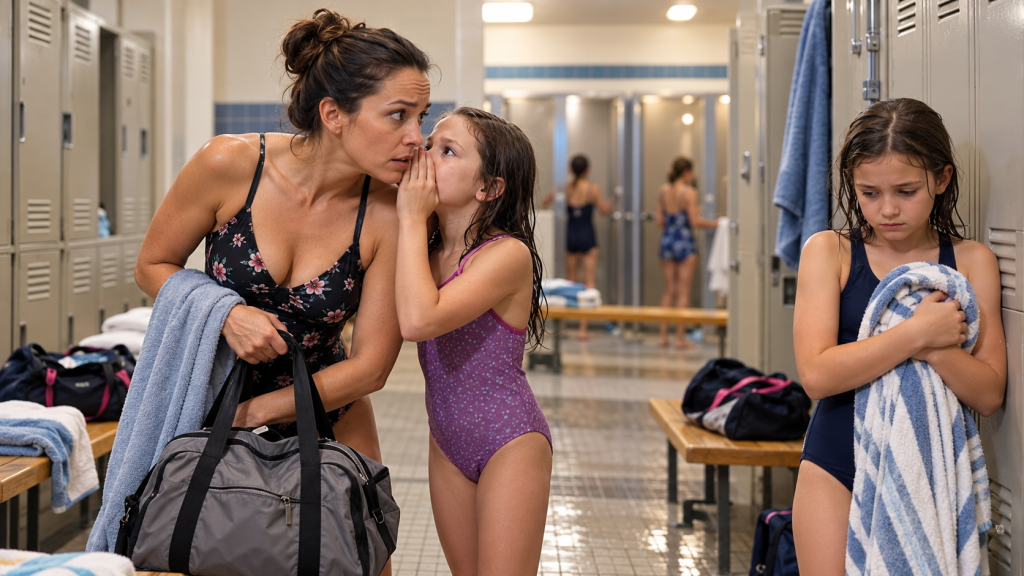
For a moment, I remembered the locker room.
Her frightened expression.
The towel clutched tightly against her.
The careful way she had chosen her words.
Then I looked at the girl sitting beside me now.
She was still healing.
Still learning that adults could be trusted to listen.
But she was beginning to imagine things she wanted to do, rather than things she needed to avoid.
“Then we’ll find a swimming class you like,” I said.
She smiled.
“Can Emma come?”
“Of course.”
“And Mommy?”
“Absolutely.”
Lily looked thoughtful.
“Can Ben come too?”
I laughed.
“Something tells me Ben would be very upset if we left him behind.”
She giggled.
And for the first time, I could think about swimming without remembering only fear.
We chose a different recreation center.
A quiet one with small children’s classes and a patient instructor.
Sarah came with us.
So did Emma and Ben.
Lily spent the first few minutes sitting at the edge of the pool, watching the other children.
Nobody rushed her.
Nobody told her she had to be brave.
When the instructor asked whether she’d like to enter the water, Lily considered the question.
Then she nodded.
She stepped down carefully.
Held the railing.
And smiled.
Emma waved from the next lane.
“You can do it, Lily!”
Lily laughed.
Then began kicking through the water with the instructor beside her.
Sarah stood next to me.
Tears were streaming down her cheeks.
I took her hand.
“Look at her.”
She nodded.
“I am.”
We watched Lily move slowly through the water.
Not perfectly.
Not without hesitation.
But willingly.
When she reached the other side, she looked back at us.
“Mommy! Auntie! Did you see?”
Sarah laughed through her tears.
“Yes, sweetheart!”
Lily grinned.
“I did it!”
And in that moment, I understood something I would carry with me for the rest of my life.
Healing doesn’t always arrive as a dramatic transformation.
Sometimes it arrives quietly.
A child sleeping peacefully through the night.
A mother choosing the color of her own curtains.
A little boy carrying his favorite backpack back to daycare.
A girl laughing as she learns to swim.
And a family discovering that safety isn’t merely the absence of danger.
It’s the presence of people who listen.
People who believe that children deserve dignity.
People who take concerns seriously without demanding that frightened children prove their pain to everyone around them.
Sometimes I still think about the message Sarah sent that Saturday morning.
Turn around. Now.
At the time, I thought she wanted me to return her daughter.
I didn’t know she was trying to warn me about Darren.
I didn’t know Ben had been kept away from her.
I didn’t know how long my sister had lived in fear.
But I knew something wasn’t right.
And I knew Lily deserved help.
That was enough to keep driving.
I have thought many times about what might have happened if I’d called Sarah first.
If I’d argued with Darren.
If I’d tried to settle everything within the family because involving professionals seemed too frightening.
Or if I’d allowed myself to believe that noticing a problem meant I had to know every detail before asking for help.
Instead, we went to the hospital.
Trained professionals cared for Lily.
They listened to Sarah.
They helped locate Ben.
And step by step, the children gained the protection they needed.
I couldn’t undo what had happened.
Neither could Sarah.
But we could make sure the children weren’t left alone with it.
One evening, Lily came to my house carrying a drawing.
It showed four people standing beneath a bright yellow sun.
Emma.
Ben.
Lily.
And me.
At the bottom she’d written:
THANK YOU FOR LISTENING.
I knelt beside her.
“It’s beautiful, sweetheart.”
She looked at me.
“Can you put it on your refrigerator?”
I smiled.
“Right in the middle.”
She hugged me.
I held her gently.
Then she whispered, “Auntie, when I get scared, can I still tell you?”
My eyes filled.
“Always.”
She pulled back.
“Even if it’s something little?”
I smiled through tears.
“Especially then.”
Because I had learned that children don’t always know how to explain when something is wrong.
Sometimes they whisper.
Sometimes they become quiet.
Sometimes they ask for help in ways that seem ordinary until you notice the fear behind them.
And sometimes the most important thing an adult can do is listen without judgment, seek appropriate help, and remind a child of a truth no one should ever make them doubt.
You did nothing wrong. You deserve to be safe. And you do not have to face this alone.
I placed Lily’s drawing on my refrigerator that night.
And every time I saw it, I remembered that terrible Saturday.
The locker room.
The drive.
The hospital.
The folded paper.
And two frightened children whose lives began changing because the adults around them finally worked together to protect them.
Our family didn’t become perfect afterward.
But it became more honest.
More careful.
More willing to ask difficult questions.
And far more determined to make sure every child in it knew that their voice mattered.
That was the ending I had once feared we might never reach.
Not a life without painful memories.
But a future in which those memories no longer decided what was possible.
THE END STORIES! THANK YOU FOR READING GOOD LUCK !❤️
Related Posts