For several seconds, nobody moved. The grocery store seemed to grow strangely quiet around us. The cash registers continued beeping in the distance. Someone pushed a shopping cart across the tile floor. A little boy was asking his mother whether he could have a candy bar.
But all I could hear was the manager’s last sentence. “It’s about the pension you think you’ve been receiving.” My mother gripped the edge of the checkout counter. “What do you mean, think I’ve been receiving?” Daniel Mercer’s face had turned almost gray. He looked down at the sealed envelope, then toward the young cashier who had humiliated her only minutes earlier.
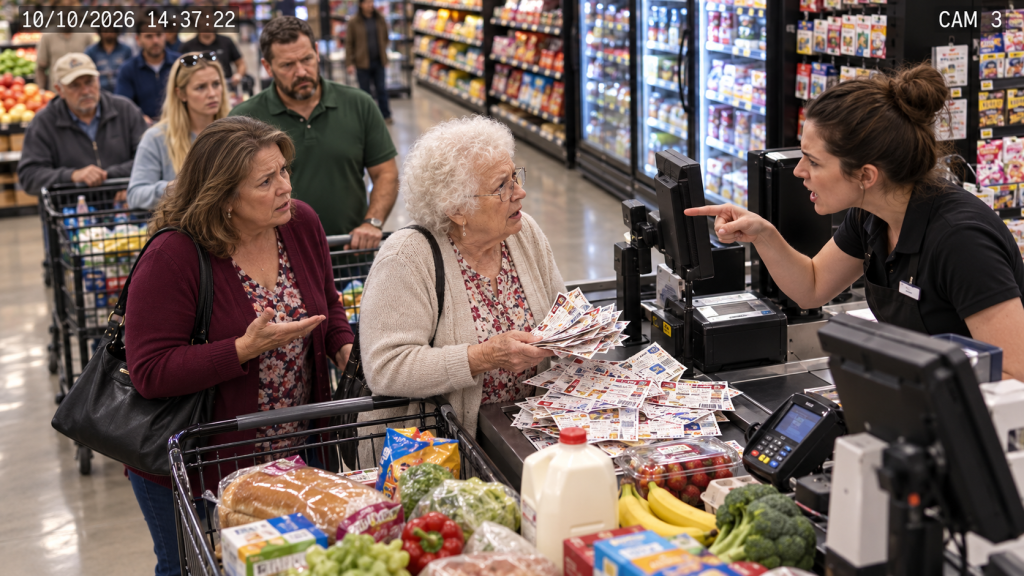
“Mrs. Whitaker,” he said softly, “would you mind coming into my office? I think your husband would have wanted you to hear this privately.” My mother’s fingers trembled. For forty years, she’d bought groceries in that store. For twenty-seven of those years, my father had accompanied her every Saturday morning, pushing the cart while she checked prices and complained affectionately about the cost of coffee.
Three years after his death, she still sometimes reached for a second carton of his favorite orange juice before remembering she lived alone.
Now the manager was holding an envelope bearing Dad’s handwriting.
And my mother looked as though the past had suddenly reached out and touched her shoulder.
“Will my daughter come with me?” she asked.
“Of course.”
I took her hand.
The cashier, whose name tag read COLE, shifted impatiently.
“Are we seriously stopping the whole line over an old coupon?”
Daniel turned.
The look on his face silenced the young man immediately.
“Cole, please go to the break room. I’ll speak with you shortly.”
“But—”
“Now.”
Cole removed his hands from the register.
His cheeks reddened as he walked away.
Daniel turned toward the customers.
“I’m very sorry for the delay. Another cashier will help you immediately.”
Then he looked at Mom.
“Please, Mrs. Whitaker. Right this way.”
She followed him through a door marked EMPLOYEES ONLY.
I walked beside her.
Her hand was cold.
And for the first time since Dad’s funeral, I realized how little I truly knew about the final months of my parents’ marriage.
Daniel’s office was small and neat.
A framed photograph of the original grocery store hung above his desk.
In the picture, the building had only two aisles and a hand-painted sign reading MERCER’S MARKET — EST. 1978.
Beside it was another photograph showing Daniel as a teenager, standing proudly next to an older man with silver hair.
His father.
The man whose signature appeared on Mom’s faded coupon.
Daniel pulled out two chairs.
Then he placed the sealed packet on the desk.
My mother stared at it.
“Tom wrote that,” she whispered.
I nodded.
There was no mistaking his careful lettering.
Dad had been a school maintenance supervisor for most of his working life, and he wrote everything in the same blocky handwriting.
Birthday cards.
Grocery lists.
Notes stuck to the refrigerator.
Even the final message he’d left me before undergoing treatment for the illness that eventually took him.
Daniel sat opposite us.
“Your husband came here six months before he passed away,” he began.
Mom’s eyes filled.
“He was very sick by then.”
Daniel nodded.
“He was. But he was also very determined.”
He glanced at the envelope.
“He told me there was something wrong with his financial records. Something involving money he had spent his entire life setting aside for you.”
My mother frowned.
“Tom handled our retirement paperwork.”
“I know.”
“After he died, his younger brother Wesley helped me with everything.”
Daniel’s expression changed.
“Wesley Whitaker?”
Mom nodded.
“Yes. He was an accountant. Tom trusted him with the estate paperwork.”
I saw Daniel’s jaw tighten.
He opened a drawer and removed a second folder.
“This is a copy of a statement Tom asked me to keep with the envelope. He was concerned about transactions Wesley had arranged while Tom was ill.”
Mom stared.
“Wesley?”
Her voice carried such genuine disbelief that I felt my heart sink.
Uncle Wesley had been at our house almost every Sunday since Dad died.
He helped Mom with her bank statements.
Drove her to the pharmacy.
And brought her a small check each month that he called her pension payment.
Whenever I suggested helping Mom organize her finances, Wesley would smile and say, “Your father asked me to take care of everything. Don’t worry the poor woman with paperwork.”
I had believed him.
Mom had believed him.
Apparently, Dad had stopped believing him before he died.
Daniel pushed the envelope toward her.
“It’s addressed to you, Mrs. Whitaker. Only you should decide whether to open it.”
My mother’s lips trembled.
She looked at me.
I squeezed her hand.
“It’s your letter, Mom.”
She nodded.
Then carefully broke the seal.
Inside was a handwritten letter, several pension statements, copies of bank transactions, and a smaller envelope.
The smaller envelope had two words written across it.
FOR LATER.
Mom unfolded the letter.
She began reading.
Then stopped after the first sentence.
Tears filled her eyes.
“Could you read it?” she whispered to me.
I took the paper.
And there, in Dad’s familiar handwriting, were words that changed everything.
My darling Ruth,
If you are reading this, then I have failed to do something I should have done while I was still sitting beside you.
I should have told you the truth about our money.
For years, I believed Wesley was handling things properly. I trusted him because he was my brother, because he understood paperwork better than I did, and because I was ashamed of how confused I became when I was sick.
But I found withdrawals I cannot explain.
I also found that the income I arranged for you may not be reaching you in the way I intended.
I stopped.
Mom’s hand flew to her mouth.
I continued.
Ruth, I chose a reduced retirement payment while I was alive so that you would receive a survivor pension after my death.
I did that deliberately.
You should never have to choose between buying groceries and filling a prescription because of the money I left for you.
My eyes blurred.
Dad had spent years telling us he didn’t need much.
He repaired old furniture instead of buying new.
Wore the same winter coat for fifteen years.
And drove a faded pickup truck long after everyone told him to replace it.
I’d always assumed he was simply frugal.
Now I understood that every decision had been connected to protecting Mom.
I swallowed and kept reading.
The statements in this envelope show the benefits I selected and the accounts Wesley has been helping manage.
I have asked questions he hasn’t answered.
I am not well enough to sort through this alone.
That does not excuse my silence.
I am asking you to take these papers to someone independent. Someone who does not owe Wesley a favor and who will explain every number to you.
Then came the sentence that broke my mother’s heart.
Please don’t let my brother convince you that being a good wife means remaining ignorant of your own money.
Mom began sobbing.
I put the letter down and wrapped my arms around her.
For years, she had worried that Dad hadn’t saved enough.
She’d blamed herself whenever bills became difficult.
She’d stopped going to the hairdresser.
Canceled her book club membership because the annual dues had increased.
And clipped coupons every Sunday, trying to stretch the small payment Uncle Wesley handed her each month.
Meanwhile, Dad had left behind a warning none of us had known existed.
Daniel waited quietly until Mom could breathe again.
Then he said, “Mrs. Whitaker, there’s more in the packet.”
Mom wiped her cheeks.
I looked up.
“What?”
Daniel opened one of the pension statements.
“Your husband’s retirement plan included a survivor benefit. According to the election document he preserved, you were designated to receive a monthly benefit of approximately two thousand three hundred and fifty dollars after his death, subject to the plan’s terms.”
I stared.
Two thousand three hundred and fifty dollars.
Mom was receiving nine hundred and fifteen.
Every month.
For three years.
“That can’t be right,” Mom whispered.
Daniel slid the statement toward us.
“The documents need to be verified with the pension administrator. But your husband was worried that the money would be deposited into an account Wesley controlled.”
I felt cold all over.
“Mom,” I asked, “where does Wesley send your pension?”
She looked at me.
“He deposits it into my checking account.”
“How much?”
“Nine hundred and fifteen dollars.”
“Has it always been that amount?”
She nodded.
“Wesley told me the pension was smaller than Tom expected because of taxes and adjustments.”
My stomach dropped.
I looked at Daniel.
He looked back at me.
Neither of us needed to say what we were thinking.
If the statements were accurate, someone had been withholding a substantial part of Mom’s retirement income.
And that someone might have been a member of our own family.
The first person who spoke was my mother.
“No.”
Her voice was barely audible.
I turned toward her.
“Mom?”
She shook her head.
“Wesley wouldn’t do that.”
I wanted to believe her.
Uncle Wesley was sixty-eight, tall and soft-spoken, with the same gray eyes as my father.
At Dad’s funeral, he’d stood beside Mom through the entire service.
When her knees weakened during the burial, he held her arm.
He had been the one to arrange the pension paperwork.
The one who told us she wouldn’t have to worry about complicated financial decisions.
The one who always seemed to know what was best.
“Ruth,” Daniel said gently, “we don’t know everything yet. These papers raise questions. They don’t answer all of them.”
She looked at him.
“Tom trusted his brother.”
Daniel nodded.
“And when he became concerned, he tried to protect you.”
Mom stared at the letter.
Then whispered something I will never forget.
“Why didn’t he just tell me?”
I looked at her.
She wasn’t asking Daniel.
She wasn’t asking me.
She was asking the man who had been gone for three years.
The man who had promised to love her through sickness and health.
Who knew every wrinkle on her face.
Who could always tell when she was worried simply by the way she folded a dish towel.
Dad had left a warning.
But he’d also left her alone with the consequences of his silence.
And I realized that love, however sincere, could still make mistakes when it confused protection with secrecy.
Daniel lowered his eyes.
“I asked him that once,” he said.
Mom looked up.
“What did he say?”
“He said he was afraid.”
“Of Wesley?”
Daniel shook his head.
“Of frightening you while he was dying.”
My mother closed her eyes.
For a long time, nobody spoke.
Then she straightened in her chair.
It was a small movement.
But I recognized it immediately.
It was the same way she sat when I was a child and someone had been unfair to me at school.
The same way she carried herself when Dad lost his job for three months and she went out to find extra work without complaining.
The same way she had stood beside his hospital bed and refused to let exhaustion overcome her.
She looked at Daniel.
“I want to know where my money went.”
For the first time that morning, there was no fear in her voice.
Only determination.
Daniel offered to drive us home.
Mom refused.
“I’ve still got groceries to pay for.”
He looked startled.
“Mrs. Whitaker, after what happened at the register, there won’t be any charge today.”
Mom shook her head.
“Daniel, I didn’t come here asking for free food.”
“I know.”
“I came because I needed milk, bread, vegetables, and the chicken that’s on sale.”
Her voice was steady now.
“And I brought coupons because your store printed them and invited people to use them.”
Daniel nodded slowly.
“You’re absolutely right.”
She looked at him.
“That young man embarrassed me for doing something perfectly ordinary.”
His expression darkened.
“Yes, ma’am. He did.”
“And he’d have done the same thing if I hadn’t had that old coupon, wouldn’t he?”
Daniel was silent for a moment.
Then he said, “I believe he would have.”
Mom folded her hands.
“Then please don’t make this about me being special because my husband helped your father.”
I stared at her.
She continued.
“The next seventy-five-year-old woman who comes through that checkout line might not have a special coupon. She might not have a husband who once saved anybody’s business.”
Her eyes filled.
“But she still deserves to buy her groceries without being humiliated.”
Daniel’s face softened.
“You’re right.”
“Then make sure your cashiers understand that.”
He nodded.
“I will.”
Mom gave him a small, tired smile.
“And thank you for remembering Tom.”
Daniel looked toward the photograph of his father.
“I don’t think our family could ever forget him.”
He accompanied us back toward the registers.
The store had returned to its ordinary rhythm.
A child was crying beside the cereal aisle.
Someone was asking where to find baking powder.
A woman in a work uniform was hurrying through the produce department with a shopping list in her hand.
I looked at all those people differently.
I wondered how many were worrying about money.
How many had counted the items in their baskets before choosing the shortest checkout line.
How many were carrying private grief that nobody could see.
Mom’s cart was still beside the register.
Daniel arranged for another cashier to process her groceries.
He honored every valid coupon.
Then, with Mom’s permission, he applied a store credit to cover the remainder of that purchase.
She objected gently.
He smiled.
“Consider this an apology from the store, Mrs. Whitaker. Not payment for what your husband did.”
After a moment, she accepted.
But as we walked toward the parking lot, she turned and looked at me.
“Do you know what I want most?”
I expected her to say she wanted the missing money.
Or answers from Wesley.
Instead, she whispered, “I wish your father were here so I could ask him why he was so afraid to tell me.”
I put my arm around her.
“I know, Mom.”
Her voice broke.
“We were married forty-nine years. I thought he knew he could tell me anything.”
I held her closer.
She wiped her eyes.
Then lifted her chin.
“Well, he’s not here. So we’ll find the answers ourselves.”
And we did.
The first thing we learned was that Dad’s records were genuine.
Two days after our visit to the grocery store, Mom and I met with the pension administrator.
Before the appointment, she insisted on putting on her good navy dress.
The same one she wore to church on special occasions.
When I asked why, she said, “If I’m going to find out where my retirement went, I’d prefer to look like myself.”
I laughed.
For the first time since the grocery store incident, she smiled.
The pension representative reviewed the beneficiary designation and payment records.
Dad had elected a survivor annuity.
He’d accepted smaller retirement payments during his own lifetime so Mom would receive income after his death.
The current payment was indeed approximately $2,350 a month.
It had been sent regularly.
Every month.
For thirty-six months.
The representative showed us the receiving account information.
Mom stared at the final four digits.
“I don’t recognize that number.”
I looked at her.
“Mom, didn’t Wesley open an account for your pension?”
She nodded.
“He said it would be easier if he kept everything in one place.”
The account turned out to be held jointly in Mom’s and Wesley’s names.
After Dad died, Mom had signed paperwork giving Wesley access to help manage bills.
She remembered sitting at his dining-room table only weeks after the funeral, surrounded by documents she couldn’t bear to read.
Wesley had pointed to several signature lines.
“I’ll handle everything, Ruth,” he’d told her.
And she had signed.
Not because she was foolish.
Because she was grieving.
Because she trusted him.
Because for nearly fifty years, she’d allowed Dad to manage most of their retirement paperwork and had never needed to think about which bank held which benefit.
The pension payments had gone into that account.
Then, each month, Wesley transferred $915 to the ordinary checking account Mom used for groceries and household expenses.
The rest had been withdrawn or moved elsewhere.
I asked the representative to confirm the total.
The payments over three years were substantial.
The difference between what Mom had received and what had been deposited was more than fifty thousand dollars.
Mom gripped the arm of her chair.
“More than fifty thousand?”
I nodded.
Her face turned pale.
Then she whispered, “I’ve been putting things back on the shelf because I couldn’t afford them.”
I thought of all the times she’d refused invitations.
All the birthdays when she insisted she didn’t need presents.
The winter she kept the thermostat so low that I worried about her catching cold.
The prescription she’d asked the pharmacist to refill later because she wanted to wait until her next payment.
I had offered help.
She’d always refused.
“Your father worked hard to make sure I wouldn’t become a burden,” she would say.
Now I understood that what she considered a modest pension had been only part of the income intended for her.
I reached for her hand.
She looked at me.
Then she said something that made my throat close.
“Your father gave up part of his own retirement every month so I could have that money.”
Her eyes filled.
“And his brother took it.”
We hired an attorney named Evelyn Price.
She was sixty-one, direct, and wonderfully unimpressed by anyone who claimed family relationships were a substitute for financial records.
She reviewed the bank information and Dad’s documents carefully.
Then she explained that being a joint account holder did not automatically make every withdrawal lawful or establish that Wesley was entitled to use funds belonging to Mom for his personal purposes.
But she also warned us that the precise account agreement, the ownership of deposited funds, and the evidence of authorization would matter.
“We need a complete accounting,” she said.
Mom nodded.
“Then get one.”
Evelyn smiled slightly.
“I intend to.”
She helped Mom arrange for her survivor payments to go into an account solely under her control, following the pension administrator’s procedures.
Mom also revoked the financial authorization she’d previously given Wesley and reviewed other accounts for which he might have access.
A bank fraud and elder financial exploitation review began.
Evelyn requested records and sent formal correspondence to Wesley.
She was careful not to promise that all the money would be recovered.
“Some funds may be traceable,” she explained. “Other amounts may be more difficult to retrieve. We need to find out what happened before we can determine the next steps.”
I nodded.
Mom looked at her.
“Can I ask you something?”
“Of course.”
“Am I foolish for signing those papers?”
Evelyn’s expression softened.
“No, Mrs. Whitaker.”
Mom looked down.
“I should have read everything.”
“Everyone should have the opportunity to understand what they’re signing,” Evelyn answered. “And the people helping them have a responsibility to explain honestly, especially when they’re entrusted with someone else’s money.”
My mother’s eyes filled.
Evelyn continued.
“You were grieving, and you relied on a family member who presented himself as trustworthy. That doesn’t make you responsible for any misuse of your funds.”
Mom took a slow breath.
Then nodded.
I watched something change in her face.
She had spent days blaming herself.
Now, finally, she was beginning to ask questions without feeling ashamed.
Wesley called the following Sunday.
Mom’s telephone rang just after lunch.
I was sitting beside her at the kitchen table, sorting the medical invoices Evelyn had requested.
When Wesley’s name appeared on the screen, Mom’s hands trembled.
“Should I answer?”
I looked at her.
“Only if you want to.”
She took a breath.
Then put the call on speaker.
“Hello, Wesley.”
His familiar voice filled the kitchen.
“Ruth, sweetheart, what’s going on with your pension?”
My mother went still.
“I’ve been reviewing the payments.”
A pause.
“With whom?”
“An attorney.”
His tone changed immediately.
“Ruth, why would you bring a lawyer into family business?”
Mom looked at me.
Then answered quietly.
“Because I learned I haven’t been receiving all my pension money.”
Silence.
Then Wesley gave a short laugh.
“Oh, Ruth. Those statements are confusing. You know that.”
“I know what two thousand three hundred and fifty dollars means.”
Another pause.
“There’s more to it than that.”
“Then explain it.”
He sighed loudly.
“Your brother-in-law managed years of expenses for you. Taxes, repairs, paperwork, bank fees—”
Mom interrupted.
“Wesley, which expenses?”
He was silent.
She looked down at the pages in front of her.
“I have my property tax receipts. I pay my own utilities. My insurance comes directly out of my checking account.”
“Ruth, you don’t understand the whole picture.”
That sentence made me clench my jaw.
I’d heard Mark use similar words during my own divorce years earlier.
My mother had spent her adult life hearing men explain that finances were too complicated for her.
But this time she didn’t retreat.
“Then show me the picture.”
Wesley sighed.
“You’ve always been too trusting of people who sound official.”
Mom’s expression changed.
“Do you mean my attorney?”
“She’s probably filling your head with ideas.”
My mother took a breath.
“Wesley, you need to provide the records.”
He went quiet.
Then said, “Tom trusted me.”
Mom closed her eyes.
For a moment, I thought she might break.
But when she spoke again, her voice was stronger.
“Tom also left me a letter.”
Silence.
Absolute silence.
Then Wesley asked, very softly, “What letter?”
Mom looked at me.
I could see the answer settling over her.
He hadn’t known about the envelope.
He hadn’t known Dad had preserved copies of the records.
And now, for the first time, he sounded afraid.
Mom swallowed.
“I’ll let my attorney discuss it with you.”
Then she ended the call.
She placed the phone on the table.
Her hands shook.
But there was a small, unmistakable light in her eyes.
“I did it,” she whispered.
I put my arms around her.
“Yes, Mom.”
She began crying.
“I said what I needed to say.”
And I realized how much courage can be hidden inside a conversation that lasts less than five minutes.
The accounting took several weeks.
When the records finally arrived, Evelyn invited us to her office.
She placed a carefully organized report on the table.
“I want you to understand this one step at a time,” she told Mom.
Mom nodded.
The pension deposits were there.
So were the monthly transfers Wesley had made to her.
But the remaining withdrawals told a very different story.
Payments had gone toward a vehicle loan.
A home-equity debt.
Credit card balances.
And an account connected to a small property-management business Wesley owned with his adult son.
There were also transfers that required further explanation.
I stared at the figures.
“Wesley used her pension to pay his own bills?”
Evelyn folded her hands.
“The records show significant transfers to accounts associated with Wesley and his business. He has offered several explanations, but he hasn’t produced documentation establishing that Ruth authorized those expenditures.”
Mom looked down.
She seemed strangely calm.
“How much?”
Evelyn told us the amount identified so far.
More than sixty thousand dollars across the period reviewed, including suspicious transactions made while Dad was still alive.
My throat tightened.
Mom stared at the wall.
Then she whispered, “All those years.”
I reached for her hand.
She didn’t squeeze back immediately.
Instead, she asked Evelyn, “Will I have to go to court?”
“Possibly. We can pursue recovery through the appropriate legal process, and the suspected misuse has been referred for investigation. We may also have an opportunity to resolve the financial claims through an agreement.”
Mom nodded.
Then she looked at me.
“I want him to tell me why.”
I hesitated.
“Mom—”
“Not because I want him to make excuses.”
Her eyes filled.
“Because he sat at my table every Sunday.”
I said nothing.
“He ate my pot roast. He brought flowers on Tom’s birthday. He looked me in the eyes and told me my husband would have wanted him to look after me.”
Her voice broke.
“I want to know how somebody can do that while taking money from a widow.”
There was no easy answer.
But several days later, Wesley agreed to meet with us through our attorneys.
I barely recognized him.
He looked older than he had the previous Sunday.
His shoulders were stooped.
His gray hair was uncombed.
For years, I’d thought of him as the organized one in the family.
The practical brother.
The person who always knew which forms to file and which office to call.
Now he sat across from Mom, turning his wedding ring around his finger.
Mom looked directly at him.
“Why?”
Wesley lowered his eyes.
“Ruth, it’s complicated.”
She shook her head.
“No. The accounts may be complicated. The question isn’t.”
He swallowed.
For a long time, he said nothing.
Then he whispered, “I was in trouble.”
Mom remained silent.
“My business was failing. I had debts I couldn’t cover. I thought I could borrow some money temporarily and replace it once things improved.”
I stared at him.
“Borrow?”
He flinched.
I leaned forward.
“You didn’t ask her.”
“I know.”
“You didn’t tell her.”
“I know.”
“And you gave her a fraction of the pension while using the rest.”
His face crumpled.
“I kept thinking I’d put it back.”
Mom looked at him.
“Every month?”
He couldn’t answer.
She stared.
“Every time you brought me that little deposit, did you tell yourself you’d put the difference back?”
His eyes filled.
“Ruth—”
“Did you?”
He nodded miserably.
“Yes.”
Mom’s voice broke.
“I was frightened of becoming poor.”
He began crying.
She continued.
“I stopped buying fresh fruit some weeks because it cost too much. I wore my old shoes even when they hurt my feet. And every Sunday you came to my kitchen and told me I was doing wonderfully with my little pension.”
Wesley covered his face.
“I’m sorry.”
Mom looked toward the window.
Then she asked the hardest question.
“Did Tom know?”
Wesley lowered his hands.
His expression changed.
“He confronted me shortly before he died.”
My heart seemed to stop.
“What?”
Wesley looked devastated.
“He found a few transfers. He asked me about them.”
I stared.
“What did you tell him?”
“I said they were temporary accounting adjustments.”
Mom closed her eyes.
Wesley continued.
“He didn’t believe me.”
The room was silent.
Then he whispered, “He told me that if anything happened to him, Ruth was to receive every penny she’d been promised.”
Mom began crying.
Wesley’s voice broke.
“I promised him.”
I stared at my uncle.
He had sat beside Dad’s hospital bed.
Held his hand.
Promised to protect Mom.
Then spent three years breaking that promise one month at a time.
My mother wiped her eyes.
For a long moment, she said nothing.
Then she looked straight at him.
“Tom trusted you because you were his brother.”
Wesley nodded.
“I know.”
“And I trusted you because Tom loved you.”
His face crumpled.
She took a shaky breath.
“But you mistook our trust for permission.”
Wesley began sobbing.
Mom stood.
“I hope you repay what you can. I hope you tell the truth to everyone investigating this.”
She looked at him.
“And I hope one day you understand that I would have helped you if you’d come to me honestly.”
Wesley looked up, startled.
Mom continued.
“I couldn’t have given you sixty thousand dollars. But I would have listened. I would have made you supper. I would have helped you find someone who knew how to deal with your debts.”
Her voice broke.
“Instead, you decided I wasn’t entitled to choose.”
Then she turned and walked out.
I followed.
And I knew the woman leaving that room was not the same woman who’d entered the grocery store with a handful of coupons.
The financial consequences unfolded gradually.
Wesley entered a repayment agreement as part of resolving the civil claims, supported by the sale of assets he could no longer afford to keep.
A substantial portion of Mom’s money was returned.
Not all of it.
Some funds had been spent and could not be recovered immediately.
The investigation into his conduct continued, and we learned not to confuse a financial agreement with the end of every possible legal consequence.
But Mom’s ongoing pension was now arriving directly into an account she controlled.
Every month, she received a statement she could read and understand.
She began paying her bills herself, with help when she wanted it.
Sometimes she called me to ask what a particular bank term meant.
Sometimes we sat together and went through her budget over tea.
She didn’t pretend to understand everything immediately.
Neither did I.
But that was the wonderful difference.
Now, when she had a question, someone answered it instead of telling her not to worry.
One afternoon, I found her sitting at the kitchen table with her calculator.
She was smiling.
“What are you doing, Mom?”
She looked up.
“Working out whether I can afford to replace the refrigerator.”
I glanced toward the old white appliance that had been humming unevenly for years.
“Can you?”
She smiled wider.
“Yes.”
I laughed.
“Then buy one.”
She looked at me.
“Just like that?”
“Just like that.”
Her eyes filled.
Then she began to laugh.
It was the sound I’d missed since Dad died.
Not a polite smile.
Not a brave little chuckle.
A real laugh.
The next week, she bought a refrigerator with a beautiful stainless-steel finish.
She made me stand in the kitchen while the delivery men installed it.
Then she opened the doors three times.
“Look at all that room,” she whispered.
I smiled.
“Planning to store enough food for the whole neighborhood?”
She laughed.
“Don’t tempt me.”
But then her expression softened.
“Your father would have loved this.”
I nodded.
“He would.”
She rested her hand against the cool door.
“He always said we should enjoy our retirement while we still could.”
I looked at her.
“Then maybe it’s time you started.”
Several weeks later, Daniel Mercer called.
He asked whether Mom would be willing to return to the store for a conversation.
She hesitated.
“Is this about the coupon?”
“Partly,” he answered.
She looked at me.
Then smiled.
“All right. But I’m not interested in another crowd watching me.”
Daniel chuckled.
“No crowd, Mrs. Whitaker. Just coffee.”
When we arrived, he took us into his office.
Cole, the young cashier, was already there.
He stood when Mom entered.
His face turned red.
“Mrs. Whitaker,” he began, “I owe you an apology.”
Mom sat down.
Cole swallowed.
“I was rude to you. I made fun of your coupons and said things I never should have said.”
He looked toward Daniel.
Then back at Mom.
“I’ve been given time away from the register and retraining on how to treat customers. I understand why what I did was wrong.”
Mom watched him quietly.
Cole continued.
“I didn’t know about your husband.”
My mother raised her hand.
“Young man, stop there.”
He froze.
She looked at him.
“You didn’t need to know about my husband.”
Cole stared.
“You didn’t need to know he’d helped this store. You didn’t need to know how old my coupon was or what it meant to me.”
Her voice softened.
“You only needed to know that I was a customer trying to buy groceries.”
Cole lowered his head.
“Yes, ma’am.”
Mom studied him.
“Do you have grandparents?”
He nodded.
“My grandmother’s seventy-eight.”
“Does she use coupons?”
His face reddened.
“All the time.”
Mom nodded.
“Then think about how you’d feel if someone spoke to her the way you spoke to me.”
Tears gathered in Cole’s eyes.
“I’d be angry.”
“So was my daughter.”
I laughed softly.
Mom gave me a little smile.
Then she turned back to Cole.
“Everyone has a difficult day now and then. But difficult days don’t give us permission to make somebody else feel small.”
Cole nodded.
“I’m sorry.”
Mom reached across the desk.
He hesitated.
Then shook her hand.
“Thank you for apologizing,” she said.
Daniel stood beside them.
He looked genuinely moved.
Then he handed Mom a small card.
On the front was the old Mercer grocery logo.
Beneath it were the words:
THE THOMAS WHITAKER PROMISE.
Mom stared.
Daniel explained that the store had established a permanent hardship-assistance program for customers who were having trouble affording essential groceries.
It would be administered discreetly, without requiring customers to tell their stories in front of a checkout line.
“My father believed a grocery store should be a place where people could feed their families with dignity,” he said.
He looked toward the faded coupon Mom had brought.
“And your husband helped him keep that promise when the business nearly collapsed.”
Mom’s eyes filled.
Daniel continued.
“We thought it was time we put that gratitude into something more useful than a piece of paper.”
My mother covered her mouth.
“Oh, Daniel.”
He smiled.
“We’d like your permission to name the program after Tom.”
For a long moment, she couldn’t speak.
Then she nodded.
“He would have loved that.”
Daniel looked relieved.
“And we’d also like to honor my father’s personal promise to you. We can arrange help with groceries whenever you need it, without putting you through another uncomfortable conversation at the register.”
Mom smiled through tears.
“Thank you.”
Then she reached for her purse.
Daniel laughed.
“Mrs. Whitaker, please don’t tell me you’re going to pull out another coupon.”
She grinned.
“Actually, I was.”
We all laughed.
For the first time since that terrible Tuesday, the store felt like a place of kindness again.
That evening, I helped Mom carry her groceries into the kitchen.
She had bought fresh strawberries.
A roast.
Her favorite coffee.
And a little bouquet of yellow flowers.
None of them were extravagant purchases.
But every item seemed to bring her pleasure.
As we unpacked, I noticed the smaller envelope from Dad’s packet lying on the table.
FOR LATER.
We had been so occupied investigating the pension that neither of us had opened it.
Mom followed my gaze.
“I suppose it’s later now,” she said.
I looked at her.
“Would you like me to read it?”
She shook her head.
“No, sweetheart. I think I’ll do this one myself.”
She sat down beneath the kitchen window.
Then carefully opened the envelope.
Inside was a photograph and a folded sheet of paper.
She picked up the photograph first.
I leaned closer.
It showed Mom and Dad standing outside the original Mercer grocery store in 1989.
Dad was wearing his old brown jacket.
Mom’s hair was dark and curled around her shoulders.
They were laughing.
In the background stood Daniel’s father, smiling beside a handwritten sign announcing that the store had reopened following the warehouse fire.
Mom touched Dad’s face in the photograph.
“Oh, Tom.”
She smiled through tears.
Then she unfolded his final letter.
I watched her read silently.
Her expression changed several times.
She laughed.
Then cried.
Then pressed the paper against her heart.
Finally, she handed it to me.
“Read it, sweetheart.”
I took the page.
My dearest Ruth,
If you’ve reached this letter, I hope someone has helped you understand the papers I left behind.
I wish I had been brave enough to speak plainly when I first became worried. I thought I was protecting you from another burden while you were already caring for me.
I see now that silence can become its own kind of burden.
I have asked Daniel Mercer to keep this packet because I trust him. I chose the old coupon because I knew you had treasured it for years, and I thought you might turn to it if things became difficult.
Perhaps that was another foolish decision from an old man who was trying to plan for a future he wouldn’t see.
I stopped.
My mother’s eyes filled.
I continued.
Ruth, you never needed me to make every decision for you.
You were the strongest person in our marriage.
You simply trusted me to handle the paperwork.
I hope that if I cannot put things right, you will find someone who can help you do it yourself.
And please remember something about the coupon.
I never gave Daniel’s father that money because I expected anything in return.
I gave it because thirty families needed their paychecks, and we had enough savings to help.
He insisted on writing that promise afterward. I kept the coupon because it reminded me that kindness can outlive the moment when it is given.
But I don’t want you spending the rest of your life believing you must earn kindness.
You deserve kindness simply because you’re human.
My voice trembled.
The last lines were almost impossible to read.
Buy the strawberries, Ruth.
Take the trip you’ve always wanted.
Replace the old refrigerator.
Laugh loudly.
Let our daughter help you sometimes.
And when you miss me, don’t spend every day looking backward.
You still have a life to live, sweetheart.
Please live it.
All my love,
Tom.
I lowered the letter.
My mother was crying quietly.
For a long time, neither of us spoke.
Then she looked toward the new refrigerator.
And laughed.
“He knew.”
I smiled through tears.
“He knew what?”
She shook her head.
“That I’d never replace that ridiculous refrigerator while it was still running.”
We laughed together.
Then she reached for my hand.
“Your father made mistakes.”
I nodded.
“He did.”
“He should have told me everything.”
“Yes.”
She looked down at the letter.
“But he loved me.”
I squeezed her hand.
“I know.”
She folded the paper carefully.
Then whispered, “And now I get to decide what happens next.”
Six months later, Mom went on her first vacation since Dad died.
She took a three-day train trip through the mountains with two women from her church.
She sent me photographs of waterfalls, little cafés, and herself standing beside a bright red train.
In every picture, she was smiling.
She still clipped coupons on Sundays.
Some habits were too deeply woven into her life to disappear.
But now she clipped them because she enjoyed saving money, not because every purchase frightened her.
She joined a community group that helped older adults understand basic financial paperwork and avoid exploitation.
She never pretended to be an expert.
Instead, she told people what had happened to her.
And whenever another woman said she felt embarrassed because she didn’t understand her pension or bank statements, Mom would take her hand.
“Neither did I,” she’d say. “That’s why we ask questions.”
Daniel’s grocery assistance program continued growing.
Several local businesses contributed.
Families received help quietly.
And the employees learned that dignity was not a reward reserved for important customers.
It was something every person deserved.
As for Cole, he remained at the store after completing his training and accepting responsibility for his behavior.
The next time Mom went through his checkout line, he greeted her politely.
He scanned her coupons without complaint.
Then helped place the heavier groceries into her cart.
Mom thanked him.
That was all.
And that ordinary, respectful exchange was exactly what she had wanted.
Sometimes I think about the moment Daniel Mercer turned over that yellowed coupon.
The way his face went pale.
The way my mother stood trembling beside me, embarrassed because she’d tried to save a few dollars.
We had walked into the grocery store believing the worst thing that could happen was an unkind cashier.
Instead, we uncovered years of financial betrayal, a secret letter from my father, and a promise that had survived almost four decades.
I learned that kindness doesn’t need an audience.
My father had helped thirty families because they needed help.
He hadn’t asked anyone to name a building after him.
He hadn’t expected a reward.
And he had never imagined that the old coupon would one day lead his wife toward the truth about her own money.
But I also learned something more difficult.
Love does not excuse secrecy.
Family does not excuse betrayal.
And needing assistance does not make an older person less deserving of independence.
My mother wasn’t foolish because she’d trusted someone.
And she wasn’t suddenly worthy of respect because we’d discovered her husband’s generosity.
She had always been worthy of respect.
Even when her purse held nothing but coupons.
Even when her pension was small.
Even when the cashier treated her as though her presence was an inconvenience.
Today, that old coupon sits inside a small frame on her kitchen shelf.
Beside it is the photograph of Mom and Dad outside Mercer’s Market.
Whenever I visit, I notice the same three things.
Dad’s enormous smile.
Mom’s hand resting on his arm.
And the faded handwritten promise at the bottom of the coupon.
Whatever this family needs, this store will provide. No expiration.
But my favorite words are no longer on that coupon.
They’re on the final page of Dad’s letter.
You still have a life to live, sweetheart.
Please live it.
And at seventy-five, my mother finally is.
THE END STORIES! THANK YOU FOR READING GOOD LUCK !❤️
Related Posts