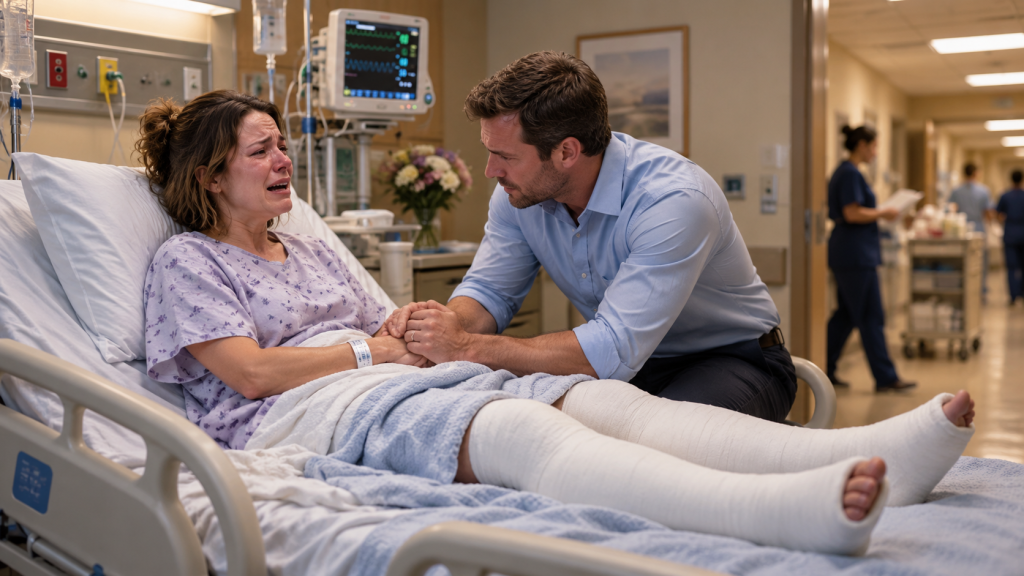
For a moment, I forgot the pain. I forgot the plaster casts covering both legs, the fractured ribs, and the frightening pressure gathering beneath my abdomen. All I could think about was Detective Elaine Brooks standing beside my hospital bed, holding a recording that might explain why I had nearly died.
“The person asking about the insurance wasn’t Caleb,” she said. I stared at her. “Then who was it?” She hesitated. And somehow, that hesitation frightened me more than the question itself. “Rebecca, do you know a woman named Vivian Walker?” My breath caught.
Vivian. My husband’s mother. The woman who had held my hand during childbirth. Who brought homemade soup whenever Emma caught a cold. Who sat beside me at the hospital after the accident and whispered that everything would be all right. “That’s my mother-in-law,” I said. Detective Brooks nodded.
“She made the call.”
I shook my head.
“No.”
The word escaped before I could stop it.
“That can’t be right.”
The detective’s expression remained gentle.
“We have the recording and the account records. She identified herself and asked several questions about the death benefit on a policy insuring your life.”
I looked toward the doorway.
Just minutes earlier, Caleb had tried to drag me out of my hospital bed.
When I refused, he had struck my abdomen twice.
And now I was being told that his mother had contacted an insurance company before anyone had called for help after my car accident.
I felt as though the world had tilted beneath me.
“Why would she do that?”
“We’re still investigating.”
The detective lowered her voice.
“But the timing is concerning.”
My mouth went dry.
“What time?”
“Five fifty-three that evening.”
I remembered the accident only in broken fragments.
The road curving beneath a cloudy sky.
The sudden feeling that something was terribly wrong with my car.
The desperate pressure of my foot against the brake pedal.
A guardrail.
Then shattered glass.
“The first emergency call was logged at five fifty-nine,” Detective Brooks continued. “Your hospital admission was recorded at six forty-two.”
I stared at her.
“She called before anyone reported the crash?”
“According to the available records, yes.”
I began shaking.
And then a thought struck me so hard that I almost forgot how to breathe.
“Emma.”
Detective Brooks leaned closer.
“What about Emma?”
“My daughter. She’s eight years old.”
Tears flooded my eyes.
“She’s staying with Vivian.”
For the first time, the detective’s expression changed.
She straightened immediately.
“Since when?”
“Since the accident. Caleb said it would be easier while I recovered.”
My voice cracked.
“She’s been with Vivian for three weeks.”
I tried to sit up.
A terrible pain tore through my stomach.
The heart monitor began sounding faster.
“Please,” I gasped. “You have to get my daughter.”
Nurse Marisol stepped forward.
“Rebecca, don’t move.”
But I couldn’t stop trembling.
If Vivian had been involved in whatever happened to my car, then my little girl was living under her roof.
Sleeping in her guest room.
Eating breakfast at her table.
Calling her Grandma.
“Please,” I whispered again.
Detective Brooks was already reaching for her radio.
“We’ll arrange an immediate welfare check and coordinate a safe plan for Emma.”
I closed my eyes.
Then the pain beneath my ribs became unbearable.
Someone called my name.
The monitor shrieked.
And the ceiling lights dissolved into a white blur.
When I opened my eyes again, I was in a different hospital room.
The lights were dimmer.
A tube delivered oxygen beneath my nose.
And there was a fresh bandage across my abdomen.
For one terrifying moment, I thought I had returned to the first day of the accident.
Then I heard a familiar voice.
“Rebecca?”
I turned my head.
My older sister, Hannah, was sitting beside the bed.
I hadn’t seen her in almost a year.
Her dark hair was pulled into a loose knot, and her eyes were red.
But when she saw me looking at her, she smiled through tears.
“Oh, thank God.”
I tried to speak.
My throat felt raw.
“Emma?”
Hannah took my hand.
“She’s safe.”
I began crying immediately.
“Where?”
“With me.”
I stared.
Hannah squeezed my fingers.
“The police checked on her. Vivian cooperated with the initial arrangements, and the hospital social worker helped coordinate care while you were in surgery.”
I closed my eyes.
Relief washed through me so powerfully that I started trembling.
“Is she okay?”
“She’s frightened. She misses you. But she’s safe.”
I looked at my sister.
Then remembered the pain.
The shouting.
Caleb’s fists.
“What happened to me?”
Hannah’s expression tightened.
“The doctors found internal bleeding. You needed another operation.”
My stomach turned.
“Because of Caleb?”
“The doctors documented new injuries following the assault. They’re still evaluating everything, but they said the blows were medically serious.”
I stared at the ceiling.
Three weeks earlier, I had nearly died in a car accident.
Now my husband had almost killed me in a hospital room.
And both events seemed connected to something neither of us yet fully understood.
Hannah brushed a strand of hair from my forehead.
“Rebecca, there’s something else.”
I turned toward her.
“What?”
Her eyes filled.
“I tried to contact you.”
I frowned.
“When?”
“Before the accident. For months.”
I stared.
“Caleb told me you didn’t want to speak to me.”
Hannah shook her head.
“He told me the same thing about you.”
A cold feeling spread through my chest.
“What?”
She opened her handbag and took out her phone.
Then showed me messages she’d received from my number.
Please stop calling. I need some distance.
Hannah, you’re making my marriage harder.
I don’t want you involved in our lives anymore.
I stared at the screen.
“I didn’t write those.”
Hannah began crying.
“I know that now.”
I remembered Caleb borrowing my phone.
He always had a reason.
A banking code.
A delivery confirmation.
A problem with his own battery.
Sometimes he returned it an hour later.
Sometimes he told me I’d accidentally changed a setting and he’d fixed it.
For years, I had believed him.
“Hannah,” I whispered, “I thought you were angry with me.”
She shook her head.
“I thought you’d chosen him over everyone else.”
We stared at each other.
Then she leaned forward and carefully wrapped her arms around me, avoiding my injuries.
“I’m so sorry.”
I began sobbing.
For eleven years, Caleb had slowly convinced me that the people who loved me were difficult, selfish, or disloyal.
And I had mistaken my growing loneliness for the natural price of marriage.
Now my sister was holding me in a hospital room.
And I realized how deliberately that loneliness might have been created.
The following morning, a hospital social worker named Joanna Ellis came to see me.
She spoke calmly and explained that I could request restrictions on Caleb’s visits.
I didn’t hesitate.
“I don’t want him near me.”
She nodded.
“We’ll document that and coordinate with hospital security.”
I swallowed.
“And Emma?”
“Your sister is caring for her under the current safety arrangements. We’ll make sure you understand the next steps and have support with any necessary family-court matters.”
I stared at my hands.
My wedding ring was still there.
A thin gold band Caleb had placed on my finger eleven years earlier.
I remembered our wedding day.
The white flowers.
The music.
The way he held my face and promised that I would never have to face life’s hardships alone.
Now I was lying in a hospital bed, frightened that he might return.
Joanna waited until I looked up.
“Rebecca, would you like to speak with a domestic violence advocate?”
I nodded.
“Yes.”
It was the first time I’d ever agreed to use those words about my marriage.
Domestic violence.
For years, I’d told myself Caleb simply had a temper.
That financial stress made him irritable.
That sometimes I provoked arguments by asking too many questions.
But the injuries beneath my bandages were real.
And so was the terror I had felt when he raised his fist.
I looked at Joanna.
“Can I ask something?”
“Of course.”
“Do women ever know they’re in danger and still convince themselves everything is normal?”
Her expression softened.
“Yes.”
I began crying.
She handed me a tissue.
Then said quietly, “What matters now is that you have people helping you make decisions about your safety.”
I looked toward the window.
For the first time in years, I didn’t feel that I had to explain away Caleb’s behavior.
I could simply tell the truth.
He had hurt me.
And I did not want him to hurt me again.
Detective Brooks returned four days later.
By then, the second operation had stabilized me, although even turning my head too quickly made me feel weak.
My legs remained in casts.
The surgical team had explained that my recovery would be longer than anyone originally expected.
Before Caleb entered my room, they had been discussing a transfer to a rehabilitation facility.
Now the timetable had changed.
I would need additional healing, careful monitoring, and months of physical therapy.
But when Detective Brooks entered, I wasn’t thinking about learning to walk again.
I was thinking about Vivian.
She took a seat beside my bed.
“How are you feeling?”
“Tired.”
She nodded.
“I understand.”
I studied her.
“Is Caleb in jail?”
“He was arrested following the hospital assault. The investigation into your collision is separate and ongoing.”
I took a shaky breath.
“And Vivian?”
“She’s been interviewed.”
I stared at the detective.
“Did she tell you why she called the insurance company?”
Detective Brooks opened her notebook.
“She initially said she was concerned about the family’s finances if you didn’t survive the accident.”
I looked at her.
“But she called before anyone reported it.”
“That’s one of the inconsistencies we’re investigating.”
I closed my eyes.
“Can I hear the recording?”
She considered the request.
Then said, “I can share what we are currently able to disclose, but I don’t want to compromise the investigation.”
I nodded.
She read a short excerpt from the documented call.
Vivian had asked whether an accidental death benefit would be paid if the insured person died in a motor vehicle collision.
She had also asked how soon a spouse could submit a claim.
Then she asked whether benefits would still be payable if an investigation into the cause of the collision remained open.
I stared at her.
“My mother-in-law asked all that?”
Detective Brooks nodded.
“The insurer’s representative did not confirm eligibility and explained that any claim would require verification.”
I swallowed.
“Was the policy in my name?”
“Yes.”
“How much?”
The detective hesitated.
“The policy documents we obtained show a base death benefit of nine hundred thousand dollars, with an additional accidental death benefit that could have increased the total.”
For a moment, I couldn’t speak.
Nine hundred thousand dollars.
Plus more if I died in an accident.
Caleb had spent three weeks complaining about my hospital bills.
He had called me a burden.
Told me I was wasting his money.
And all along, a policy existed that might have paid more than a million dollars if my accident had killed me.
I stared at Detective Brooks.
“I never bought a policy like that.”
She nodded.
“We’re examining how it was obtained.”
“I would remember.”
I thought of the paperwork Caleb brought home seven months earlier.
He’d told me we were updating our household financial records.
There had been forms to sign.
Some were connected to his construction business.
Others, he claimed, concerned our mortgage.
I remembered sitting at the kitchen table while Emma did her homework.
Caleb had placed a thick folder beside my plate.
“Just sign where I marked,” he’d said.
I’d asked whether I should read everything first.
He laughed.
“Rebecca, you used to be an accountant. You know how much paperwork there is. It’s routine.”
I’d signed some pages.
But I didn’t remember signing a life insurance application.
I looked at the detective.
“Could he have used something I signed for another purpose?”
“That’s one possibility being investigated.”
She paused.
“We have also found discrepancies in the electronic application records.”
My stomach tightened.
“What kind?”
“Information suggesting that not every authorization came directly from you.”
I stared at my wedding ring.
For eleven years, Caleb had told me that money was his responsibility.
He decided what we could afford.
Which accounts we needed.
Which documents mattered.
And when I tried to ask questions, he accused me of distrusting him.
I had once managed accounts for a manufacturing company.
I’d been good at it.
But somewhere along the way, I’d allowed my husband to convince me that keeping track of our own finances was unnecessary.
Now I was lying in a hospital bed, learning that my life had been insured for an amount I didn’t even know existed.
“Detective,” I whispered, “what else haven’t I been told?”
Her expression softened.
“We’re working to find out.”
The next revelation came from Hannah.
She arrived that evening carrying a small cardboard box.
“Emma asked me to bring this.”
I looked at it.
Inside were several of my daughter’s drawings.
A pink paper bracelet.
A little plastic dolphin from a school field trip.
And a folded note.
I opened the note carefully.
In Emma’s handwriting were the words:
Mommy, I miss you. Aunt Hannah says the doctors are helping you get better. I am being very brave, but sometimes I cry. I hope that’s okay. Love, Emma.
I covered my mouth.
My daughter had spent twenty-one days without her mother at home.
And somehow, someone had made her think that crying was something she needed permission to do.
I looked at Hannah.
“Tell her it’s okay.”
Hannah nodded.
“I already did.”
My eyes filled.
“Tell her she doesn’t have to be brave every minute.”
“I will.”
I looked through the drawings.
One showed our house.
Another showed Emma holding my hand.
The third was a picture of a car beside a bright yellow sun.
I stared at it.
There was a little silver star drawn near the windshield.
“What’s this?”
Hannah leaned closer.
“Oh. Emma said that’s the star she gave you for your dashboard.”
I remembered.
Three days before the crash, Emma had brought home a small decoration she’d made at school.
She asked me to hang it from the rearview mirror.
Caleb complained that it looked childish.
But I loved it.
I’d attached it to a short ribbon and hung it where I could see it whenever I drove.
I looked at Hannah.
“Is it still in the car?”
She shook her head.
“The police have the vehicle.”
I nodded.
Then a memory surfaced.
Not of the crash itself.
Of the morning before it.
I had been standing at the kitchen sink when Caleb came in from the garage.
His shirt was dirty.
There was a faint smell of engine oil on his hands.
I asked what he’d been doing.
He told me he was checking the lawn mower.
Except we hadn’t owned a lawn mower in nearly two years.
We paid someone to maintain the yard.
I remembered noticing the contradiction.
Then deciding it wasn’t worth another argument.
I looked at Hannah.
“Can you call Detective Brooks?”
Her face changed.
“Why?”
“I remembered something.”
And for the first time since the accident, I understood that memories I’d dismissed as unimportant might matter very much.
The investigation continued without dramatic announcements.
Detective Brooks was careful about what she told me.
She never claimed that one suspicious call or one mechanical finding proved the entire case.
Instead, she explained that investigators were comparing physical evidence, financial records, communications, and witness accounts.
A specialist examining the car had identified interference with a brake component that was inconsistent with ordinary wear.
Video from a nearby property placed Caleb at our garage at an unusual hour before the crash.
That footage alone didn’t establish what he was doing.
But it gave investigators a period to examine alongside other evidence.
The financial records told another troubling story.
Caleb’s construction company had been struggling for almost eighteen months.
Several projects had lost money.
A commercial lender had demanded repayment on a business loan.
And Caleb had personally guaranteed obligations that he apparently had little ability to satisfy.
I learned that he owed more than four hundred thousand dollars across business debts and related guarantees.
He hadn’t told me.
Instead, he’d continued buying expensive clothes, driving his luxury truck, and assuring everyone that business was excellent.
I remembered the way he’d criticized me for buying new shoes for Emma.
The way he complained whenever our daughter needed money for school activities.
The way he’d told me that grocery prices were proof I didn’t understand budgeting.
And suddenly, so many arguments began to look different.
He hadn’t merely wanted to control our expenses.
He had wanted to prevent me from seeing how much trouble he was in.
Hannah sat beside me as I reviewed the preliminary financial information with my attorney.
I stared at one transaction.
A transfer from our joint household account to a life insurance company.
Then another.
And another.
The premiums had been paid for months.
While I clipped coupons and worried about the cost of Emma’s school supplies, Caleb had been quietly paying for insurance on my life.
I looked at Hannah.
“I was an accountant.”
Her expression softened.
“Rebecca…”
“I used to balance financial statements for a living. How could I not see this happening?”
She took my hand.
“Because he deliberately kept you from seeing the accounts.”
I shook my head.
“I should have insisted.”
“Maybe you wish you had. But the person concealing information is responsible for that choice.”
I looked down.
Hannah continued.
“You spent years trying to prevent arguments. That’s different from agreeing to be deceived.”
I began crying.
And for once, I allowed myself to cry without apologizing.
Vivian visited the hospital once.
She wasn’t allowed into my room.
But she left a letter with the patient advocate, asking whether I would accept it.
I almost refused.
Then I saw her handwriting on the envelope.
I’d known that handwriting for eleven years.
Birthday cards.
Christmas recipes.
Little notes tucked into Emma’s lunch bag.
I wondered whether I would ever be able to look at it again without remembering the insurance call.
I opened the letter while Hannah sat beside me.
Rebecca,
I know you must be frightened and angry. I never wanted you to get hurt.
Caleb told me his business was in terrible trouble. He said you had agreed to increase your life insurance because you both wanted Emma protected.
He asked me to call the company because I knew more about insurance than he did.
I thought I was helping my son understand the paperwork.
I never imagined he would do something so terrible.
I stopped reading.
Hannah watched me.
“Keep going?”
I nodded.
The next paragraph was worse.
On the day of the accident, Caleb told me there might be an emergency involving you. I asked what he meant. He said he was afraid something would happen on the road because your car had been having problems.
I should have called you.
I should have asked more questions.
Instead, I called the insurer.
My hands began shaking.
I looked at Hannah.
“She knew he expected something to happen.”
Hannah stared at the letter.
“Rebecca, give that to your lawyer.”
I nodded.
I folded it carefully and placed it back in the envelope.
Then I looked toward the window.
Vivian had called the insurance company while I was driving.
She had asked about the money Caleb might receive if I died.
And she had done it after her son warned her that something could happen to my car.
Whether she knew about the sabotage was still a matter for investigators.
But one truth was painfully clear.
She had chosen to protect her son’s interests rather than warn me of a possible danger.
I would never forget that.
Six weeks after the assault, I left the hospital.
Not walking.
Not triumphantly.
I left in a wheelchair, with two exhausted legs, a collection of scars, and a rehabilitation plan that seemed longer than the rest of my life.
Hannah had prepared the guest bedroom at her house.
She’d borrowed a shower chair, rearranged furniture to make space for my wheelchair, and placed a little vase of sunflowers beside the bed.
But nothing mattered as much as the person waiting in the living room.
Emma.
When she saw me, she stood very still.
Her eyes filled.
“Mommy?”
I held out my arms.
“Hi, sweetheart.”
She ran toward me.
Then stopped a few feet away.
Her face crumpled.
“Will I hurt you?”
I started crying.
“No, baby. Just come slowly.”
She climbed carefully onto the edge of my wheelchair and wrapped her arms around my shoulders.
I held her as tightly as my healing ribs allowed.
Her hair smelled like strawberry shampoo.
I pressed my face against it.
For three weeks after the accident, I’d dreamed of this moment.
Then Caleb’s attack had stolen more time.
Now she was finally in my arms.
“I’m sorry,” I whispered.
Emma pulled back.
“For what?”
“For being away so long.”
She frowned.
“Aunt Hannah says you were getting better.”
“I was.”
She looked at my casts.
“Are your legs still broken?”
“They’re healing.”
“Will you walk again?”
I swallowed.
“The doctors are helping me work toward that. It may take time.”
Emma considered this.
Then she reached into her pocket.
She pulled out a little plastic star attached to a short ribbon.
My breath caught.
“The one from my car.”
She nodded.
“Detective Brooks gave it back after she was finished with it. Aunt Hannah helped me clean it.”
I stared at the small decoration.
One point was scratched.
The ribbon was frayed.
But the silver star was still intact.
Emma placed it in my hand.
“I made it so you could think of me when you drove.”
I began crying.
“Oh, sweetheart.”
She looked worried.
“Do you still like it?”
I pulled her close.
“I love it.”
Then she whispered something that made my heart ache.
“Grandma Vivian told me you might never come home.”
I closed my eyes.
Emma continued.
“She said Daddy was very upset and I had to behave because everyone was worried about money.”
I took a slow breath.
“Emma, none of the money problems are yours to solve.”
She looked up.
“Even if Daddy’s angry?”
“Even then.”
Her eyes filled.
“Is Daddy coming here?”
I shook my head gently.
“No, sweetheart. He isn’t allowed to come here.”
She was silent.
Then asked, “Because he hurt you?”
I stared at my little girl.
I had spent eleven years protecting Caleb’s image.
Explaining his anger.
Excusing his behavior.
Convincing myself that keeping our troubles private was part of being a good wife.
But Emma had lived in the same house.
She had heard the arguments.
She knew more than I wanted to admit.
I took her hand.
“Yes,” I answered quietly. “Daddy hurt me, and the adults helping us are making sure we’re safe.”
Her eyes filled.
“Did you make him mad?”
I felt something break inside me.
“No, Emma.”
My voice trembled.
“Nothing I said or did made it okay for him to hurt me.”
She looked at me.
“Really?”
“Really.”
For several seconds, she was silent.
Then she leaned forward and pressed her forehead against mine.
“I’m glad you’re home.”
I closed my eyes.
“So am I, baby.”
Physical therapy began with exercises so small they felt almost insulting.
Move my toes.
Tighten a muscle.
Practice shifting my weight.
Sit upright without dizziness.
Breathe deeply despite the discomfort in my ribs.
I had imagined rehabilitation as a determined woman rising from a wheelchair and walking toward the sunlight.
The reality involved shaking hands, sore muscles, setbacks, and days when simply moving from the bed to a chair felt like climbing a mountain.
One morning, I began crying halfway through an exercise.
My physical therapist, Marcus, stopped.
“What’s happening?”
I looked at him.
“I’m tired.”
He nodded.
“Then we’ll rest.”
I shook my head.
“No. I’m tired of needing help.”
He pulled up a chair.
For a moment, neither of us spoke.
Then he said, “You spent years taking care of other people, didn’t you?”
I looked up.
“How did you know?”
He smiled gently.
“Because people who are used to helping everyone else often find it difficult to be the one receiving help.”
Tears filled my eyes.
“I feel useless.”
His expression changed.
“Rebecca, needing assistance while you heal does not make you useless.”
I stared at my legs.
He continued.
“Your worth didn’t disappear when you were injured.”
For a moment, I couldn’t speak.
Caleb had called me a burden.
And I had started believing that my inability to walk made him right.
I looked toward the parallel bars.
Then whispered, “Can we try again?”
Marcus smiled.
“Of course.”
It took me several attempts to stand safely with assistance.
When I finally managed it, I cried.
Not because I’d conquered anything enormous.
But because for the first time, my body was doing something I’d feared it might never do again.
Marcus smiled.
“There you go.”
I looked down at my trembling legs.
Then whispered, “I’m still here.”
The investigation reached a turning point in early winter.
Detective Brooks asked my attorney, Nadia Foster, to arrange a meeting.
Nadia had been helping me with the assault case, financial protection, and the first steps toward ending my marriage.
She was a calm woman with sharp eyes and a habit of letting people finish speaking.
At the meeting, Detective Brooks placed a folder on the table.
“We’ve identified additional evidence concerning the insurance application and your car,” she said.
My stomach tightened.
“Does it prove Caleb did it?”
She took a breath.
“The evidence now supports charges alleging that he deliberately interfered with your vehicle and intended to cause your death. The final determination belongs to the court.”
I gripped the arms of my wheelchair.
Hannah reached for my hand.
Detective Brooks continued.
“Investigators recovered communications between Caleb and Vivian concerning the policy and its accidental death provision.”
I looked at her.
“What did they say?”
She opened the folder.
One message from Caleb to his mother had been sent five days before the crash.
Make sure you understand exactly what happens if it’s an accident.
My mouth went dry.
Vivian’s reply came the following morning.
I checked the policy. You need to stop talking about this.
I stared.
Detective Brooks turned another page.
On the afternoon of the crash, Vivian sent Caleb a message.
You promised you weren’t going to do anything.
My hands began shaking.
“What time?”
“Five thirty-seven.”
Twenty-two minutes before the first emergency call.
Then Caleb replied.
Stay out of it.
I began crying.
Vivian had known her son was talking about my death.
She’d been frightened enough to warn him.
But she had not called me.
Instead, sixteen minutes later, she called the insurance company.
I looked at the detective.
“She knew.”
Detective Brooks answered carefully.
“The messages establish that she had serious concerns. Investigators are still determining the full extent of her knowledge and conduct.”
I swallowed.
“And Caleb?”
“There’s more.”
She explained that a forensic review had identified evidence linking Caleb to the interference with my car.
Investigators had also obtained records contradicting parts of his account of where he had been before the collision.
The findings were supported by communications and financial records that prosecutors believed established motive and planning.
Then she placed another document on the table.
It was titled:
DURABLE POWER OF ATTORNEY.
I stared.
My name appeared at the top.
Rebecca Walker.
And below it was a signature that looked like mine.
I felt cold.
“I never signed that.”
Nadia leaned forward.
“That’s consistent with what you’ve told us.”
Detective Brooks nodded.
“Investigators are examining how it was prepared. We also found an attempted insurance-related authorization submitted after your accident.”
I stared.
“What kind of authorization?”
“Documents intended to let Caleb control aspects of your financial affairs while you were incapacitated.”
I leaned back.
So even after I survived the collision, there had been another plan.
If I died, Caleb hoped to collect the insurance money.
If I lived, he wanted control over my finances.
My assets.
Any compensation I might receive.
Everything.
And when I refused to leave the hospital, when I insisted that my injuries were real and that I needed care, he became violent.
I looked at Nadia.
“He wasn’t coming to take me home.”
She shook her head gently.
“He may have had several motives. We can’t know every thought in his mind, but the documents show attempts to gain financial authority you say you never granted.”
I stared at the false signature.
For eleven years, I’d believed that being a good wife meant trusting my husband with everything.
Now I was looking at paperwork suggesting he had tried to claim authority over my life even after I was too injured to defend myself.
I began to cry.
Hannah wrapped her arm around my shoulders.
Then Nadia spoke.
“Rebecca, there is something I need you to remember.”
I looked at her.
“These documents do not become valid merely because Caleb wanted them to be. We are challenging the purported authority and taking steps to protect your accounts and property.”
I nodded.
She continued.
“And you have the right to decide what happens next.”
I looked down at my hands.
For years, I hadn’t believed that.
Now, slowly, I was beginning to.
Vivian’s second letter arrived in January.
This time, I didn’t open it alone.
Nadia read it first and advised me to preserve it.
Then I sat with Hannah beside the living-room window and unfolded the pages.
Vivian’s handwriting shook across the paper.
Rebecca,
I lied when I said I never imagined Caleb could hurt you.
I knew his finances were worse than he admitted. I knew he was desperate. I heard him talk about how much money he would have if something happened to you.
I told myself he was speaking out of fear and frustration.
Then he began asking about accidental death benefits.
I knew something was terribly wrong.
I should have warned you immediately.
My eyes filled.
I kept reading.
On the afternoon of the crash, he told me you would be driving alone.
I asked him what he meant.
He told me to mind my own business.
I was afraid of my son. I was also afraid of what he had become.
And instead of doing the right thing, I called the insurance company as though knowing more about the money could somehow make the danger less real.
I stopped.
Hannah said nothing.
The last paragraph was short.
I cannot ask you to forgive that choice.
I only hope you believe me when I say I love Emma.
I folded the letter.
For a long time, I stared out the window.
Vivian had loved my daughter.
I believed that.
She had also failed to warn her mother about a danger she suspected.
Both things could be true.
And neither erased the other.
I handed the letter to Hannah.
“Please make a copy for Nadia.”
She nodded.
Then asked, “Do you want to answer?”
I shook my head.
“Not now.”
I looked toward the hallway where Emma was humming softly while drawing at the kitchen table.
Then I said, “Love isn’t enough if you refuse to protect the people you claim to love.”
Hannah squeezed my hand.
And for once, nobody argued.
The criminal case took nearly a year to reach its conclusion.
During that time, I learned that justice rarely arrives in the way people imagine.
There was no single moment when all the evidence appeared and every question disappeared.
There were hearings.
Expert reports.
Witness statements.
Arguments over records and timelines.
And long afternoons when I wondered whether I had the strength to keep going.
Caleb initially denied everything.
He claimed the car’s mechanical failure was an unfortunate accident.
He said the financial documents were routine.
He insisted the hospital assault had been a misunderstanding caused by stress.
But Nurse Marisol testified about what she had witnessed.
The hospital documented my new injuries.
Investigators presented evidence concerning the vehicle, the insurance application, and the communications that preceded the collision.
As the proceedings continued, Caleb’s explanations became increasingly difficult to reconcile with the records.
Eventually, he pleaded guilty to serious charges arising from the attack in my hospital room and the deliberate interference with my vehicle.
The court imposed a substantial prison sentence.
The financial allegations were addressed through additional proceedings, including the disputed documents and attempted claims.
Vivian’s conduct was investigated separately.
Her statements, letters, and communications became part of that examination.
I did not attend every hearing.
My recovery and Emma’s well-being mattered more than watching every legal argument.
But I attended the sentencing.
Hannah sat beside me.
Nadia sat on my other side.
And Caleb stood across the courtroom in clothes that looked nothing like the expensive suits he’d once worn to business dinners.
For eleven years, he’d been the loudest voice in our marriage.
That day, he had no authority over my words.
When the judge allowed me to speak, I stood carefully with the assistance of my cane.
My legs were stronger.
But they still hurt.
I held the lectern and looked toward the man I’d once promised to love forever.
“Caleb,” I began, “I spent eleven years believing that a good marriage required me to be patient with everything.”
His expression tightened.
“I was patient when you criticized me. Patient when you controlled our finances. Patient when you discouraged my friendships.”
I took a breath.
“I told myself that if I loved you enough, eventually you would treat me with the same kindness I tried to show you.”
My voice trembled.
“Then I survived a car crash that nearly killed me.”
I looked directly at him.
“And you came to my hospital bed and hurt me because I couldn’t get up.”
The courtroom was silent.
“For a long time, I wondered what I had done to make you stop loving me.”
I paused.
“Now I understand that I was asking the wrong question.”
Caleb lowered his eyes.
“I didn’t cause your cruelty. And my injuries didn’t make me less valuable.”
Tears filled my eyes.
“I am still a mother. Still a daughter. Still a sister. Still a woman who deserves to be safe.”
I looked toward the judge.
“I cannot recover the years I spent being afraid of my husband’s anger.”
My hands tightened around the lectern.
“But I can make sure my daughter never grows up believing that love requires her to accept violence.”
Then I sat down.
Hannah took my hand.
And for the first time since the accident, I felt that something enormous had finally been lifted from my shoulders.
Not the physical pain.
Not the grief.
But the burden of believing I had to defend my right to exist.
My divorce was finalized the following spring.
The court addressed our property, financial obligations, and Emma’s care in light of the evidence and the circumstances.
I received primary legal and physical responsibility for my daughter, subject to the court’s protective arrangements and future review as appropriate.
I began rebuilding my financial life with the help of an independent adviser.
Some accounts needed careful investigation.
Some debts were disputed.
There were legal expenses and practical problems I hadn’t anticipated.
But I no longer had to ask Caleb for permission to examine a bank statement.
I could make decisions.
Ask questions.
Disagree.
And change my mind.
After months of rehabilitation, I began taking on part-time accounting work from home.
At first, I managed basic records for a local nonprofit organization.
A few hours a week.
Then more.
My old skills returned more quickly than my confidence.
I remembered how to read financial reports.
How to reconcile accounts.
How to find mistakes hidden inside ordinary-looking numbers.
I had spent years being told that my professional experience no longer mattered.
Now, each completed project reminded me that the woman I had been before my marriage had never truly disappeared.
She had simply been waiting for room to breathe.
Emma began seeing a counselor who helped her understand what had happened in ways appropriate for her age.
She still missed her father sometimes.
I never punished her for that.
Children don’t stop loving a parent simply because the adults around them have learned terrible things.
When she asked difficult questions, I answered carefully and honestly.
I told her that her father’s choices were his responsibility.
That she hadn’t caused them.
That loving someone didn’t mean agreeing with what they’d done.
And that she was allowed to feel sad, angry, confused, or relieved.
One evening, she asked whether I was ever frightened anymore.
We were sitting at the kitchen table.
She was coloring a picture of a garden.
I looked at her.
“Sometimes.”
She stopped coloring.
“Even now?”
I nodded.
“Sometimes I remember the hospital, and it makes me nervous.”
Emma thought about that.
Then whispered, “What do you do?”
I smiled gently.
“I remind myself that we’re safe. I talk to Aunt Hannah. I ask for help when I need it.”
She looked down.
Then pushed her drawing toward me.
It showed a little house surrounded by sunflowers.
Two stick figures stood outside.
One tall.
One small.
Above them, she’d written:
MOMMY AND ME.
I felt tears rise.
“It’s beautiful, sweetheart.”
She smiled.
“That’s our new house.”
I looked at her.
“Do you like it?”
She nodded.
“Because nobody yells here.”
I couldn’t speak.
She picked up her crayons again.
Then added a third figure beside the house.
It was Hannah.
I laughed through my tears.
“Aunt Hannah too?”
“Of course,” Emma said seriously. “She brings cookies.”
I pulled my daughter into my arms.
And I realized that the home she needed had never been about expensive furniture or a perfect family photograph.
It was about knowing she could be herself without being frightened.
On the second anniversary of the accident, I returned to the hospital.
Not as a patient.
As a visitor.
I carried a bouquet of yellow roses and a handwritten card.
I had called ahead to make sure Nurse Marisol was working that afternoon.
When she saw me standing near the nurses’ station with a cane, her eyes widened.
“Rebecca?”
I smiled.
“Hello, Marisol.”
For a moment, she stared.
Then her face softened.
“Oh, sweetheart.”
She stepped forward and hugged me gently.
I began crying.
“I wanted to thank you.”
She shook her head.
“You don’t have to.”
“Yes,” I whispered. “I do.”
I handed her the flowers.
“That day, when Caleb was hurting me, I thought nobody was coming.”
Marisol’s eyes filled.
I continued.
“Then you opened the door.”
She held the flowers against her chest.
“I was doing my job.”
I smiled through tears.
“You were doing more than that.”
For a moment, neither of us spoke.
Then I looked toward the hallway.
The same corridor where Caleb had been escorted away.
The same place where Detective Brooks had told me my car might have been deliberately damaged.
The same hospital where I’d learned that my husband had tried to turn my life into an insurance payment.
For a moment, the old fear stirred.
Then I looked at my cane.
At the shoes on my feet.
At the woman standing beside me.
And I realized I had walked back into that building under my own power.
Marisol followed my gaze.
“How are your legs?”
I laughed softly.
“Stubborn.”
She smiled.
“That sounds familiar.”
I nodded.
“They’re getting stronger.”
Then I took a breath.
“So am I.”
That evening, Hannah came over for dinner.
Emma helped set the table.
We made roast chicken, mashed potatoes, and green beans.
Nothing fancy.
But the kitchen was filled with conversation.
Emma told us about a class project.
Hannah complained about her office printer.
I laughed so hard at one of her stories that I nearly spilled my water.
Later, after Emma went to bed, I stepped onto the porch.
The air was cool.
The neighborhood was quiet.
And somewhere in the distance, a dog barked.
I rested my hand against the railing.
Two years earlier, I had been lying in a hospital bed, unable to move, listening to a heart monitor.
Beep. Breathe. Beep.
I remembered believing that the sound was the only thing holding me together.
Now I stood beneath a sky full of stars.
My legs still hurt on cold evenings.
Some movements remained difficult.
There were days when I needed to rest more than I wanted.
And there were memories I knew would never disappear entirely.
But my life was no longer organized around Caleb’s anger.
I could sleep without wondering which version of my husband would come through the door.
I could work.
Laugh.
Raise my daughter.
Call my sister whenever I wanted.
And make ordinary decisions without preparing myself for an argument.
I looked through the window.
Emma’s drawing was attached to the refrigerator.
MOMMY AND ME.
Hannah had added a small paper heart beside it.
I smiled.
For eleven years, I had believed the greatest thing I could give my daughter was an unbroken family.
Now I understood that a family wasn’t truly whole simply because the adults remained married.
A home should be a place where a child can breathe.
Where kindness doesn’t depend on obedience.
Where mistakes can be discussed without fear.
And where nobody has to earn the right to be treated with dignity.
I looked down at the faint scars on my hands.
For a long time, I had thought of them as reminders of everything I’d lost.
My health.
My marriage.
My independence.
The life I believed I’d have.
But that night, I saw something different.
They were also reminders of everything I’d survived.
The crash.
The surgery.
The assault.
The long rehabilitation.
The terrible discoveries.
And the difficult work of beginning again.
I thought about the moment Caleb demanded that I get out of my hospital bed.
He had called me useless.
A burden.
An expense he was tired of paying.
And when I refused to obey him, he tried to hurt me into surrendering.
But he had never understood the most important thing about me.
My strength was not measured by how easily I could stand.
It was measured by whether I could still choose to protect myself when standing was impossible.
That afternoon, with both legs broken and my body barely able to move, I had wrapped my hands around the hospital rail.
And I had said one word.
No.
That word didn’t stop the violence by itself.
I needed the nurse who intervened.
The doctors who treated me.
The detective who investigated.
The sister who welcomed me home.
The professionals who helped me protect Emma.
And the many people who reminded me that asking for help wasn’t weakness.
But that word was the beginning.
The first boundary I refused to abandon simply because someone became angry.
I took a deep breath.
Then stepped carefully away from the railing.
One foot.
Then the other.
I still needed my cane.
I might always need it on some days.
But I was moving forward.
Inside, Emma called from her bedroom.
“Mommy?”
I turned.
“Coming, sweetheart.”
She called again.
“Can you read me one more story?”
I smiled.
“Of course.”
Then I walked inside.
Not into the life I’d once imagined.
Into a life I was finally free to build.
And this time, nobody else would decide how much I was worth.
THE END STORIES! THANK YOU FOR READING GOOD LUCK !❤️
Related Posts