Lupita’s voice was barely louder than a whisper. But the ballroom had become so quiet that everyone heard her. “I’ve kept copies of the messages ordering housekeeping to hide something much worse.” Victor Haines turned toward her. For the first time that morning, the man who had managed my hotel for eighteen months looked genuinely frightened.
“Lupita,” he said slowly, “you need to be very careful about what you’re suggesting.” She stood beside the service entrance, her hands clasped so tightly that her knuckles had turned white. “I have been careful, Mr. Haines.” Her voice trembled. “I’ve been careful for six months.”
I looked at her. Then at Miriam, our finance director, who was standing beside the ballroom stage with a folder full of reservation records. And finally at my daughter, Lily. She was holding my hand, looking from one frightened adult to another. “Mommy,” she whispered, “is something wrong?”
I crouched beside her.
“Something at the hotel needs fixing, sweetheart.”
She looked worried.
“Like when Daddy used to fix the lights?”
My throat tightened.
My husband, Adrian, had been the sort of man who could never walk past a loose cabinet handle without reaching for a screwdriver.
Even during the final months of his illness, he insisted on checking the little things around the house.
I brushed a strand of hair from Lily’s forehead.
“Something like that.”
She looked toward the roses I had placed on a nearby table.
“Are we still going to Daddy’s garden?”
“Yes,” I whispered. “We are.”
I straightened and spotted Naomi Hart near the front row.
Naomi had worked as my executive assistant for nearly eight years. She knew Lily almost as well as I did and had been helping organize the gala.
“Naomi, could you take Lily to the private sitting room beside the east courtyard? Stay with her, please.”
Naomi immediately came forward.
“Of course, Clara.”
Lily hesitated.
“Will you come soon?”
I kissed her forehead.
“As soon as I can.”
She took Naomi’s hand.
Just before they left, Lily turned back.
“Mommy?”
“Yes?”
“Don’t forget Daddy’s flowers.”
I looked at the roses.
Three bent stems.
One missing petal.
“I won’t, sweetheart.”
Only after she disappeared through the ballroom doors did I turn toward Lupita.
“Please tell me what you’ve found.”
Victor stepped forward.
“Clara, I strongly recommend we discuss this privately. We have important investors here, and—”
“Then let’s begin by making sure our guests are safe.”
He stopped.
I looked directly at Lupita.
“Are you talking about a safety issue?”
Her eyes filled.
“Yes, ma’am.”
The word seemed to settle over the entire room.
Safety.
Not merely stolen money.
Not a few fraudulent reservations.
Something that might put the people sleeping inside my hotel at risk.
I took a slow breath.
“Lupita, tell me.”
She reached into the pocket of her uniform and withdrew a folded sheet of paper.
Then she handed it to me.
It contained a printed exchange of messages.
The first was from Tomas Rivera, our former maintenance supervisor.
The west emergency stairwell door on Level Seven is failing its release test. The fire alarm panel also shows an unresolved fault affecting part of that wing. These deficiencies must be addressed immediately.
Beneath it was Victor’s response.
Do not circulate this to guest services. We have a conference next week. Keep those rooms available and get me a repair estimate after the event.
Another message followed.
This one was addressed to housekeeping.
No incident reports involving the west stairwell are to be entered without my approval.
I stared at the page.
Then looked at Lupita.
“When was this?”
“Four months ago.”
“And was the repair completed?”
She shook her head.
“I don’t know, ma’am. Tomas kept asking. Then he was fired.”
Victor’s voice became sharp.
“Tomas was dismissed for insubordination.”
Lupita turned toward him.
“He was dismissed because he refused to sign a work order saying something had been repaired when it hadn’t.”
A murmur moved through the ballroom.
I looked at Miriam.
“Do we have the maintenance payment records?”
She nodded.
“That’s part of what I’ve been reviewing.”
She opened her folder.
“According to the accounts, $186,000 was paid to a company called Haines Facilities Solutions for fire-safety upgrades and emergency maintenance.”
My stomach tightened.
“Haines?”
Victor raised his chin.
“It’s an independent contractor.”
Miriam continued.
“The registered managing member is your brother, Martin Haines.”
The silence afterward was terrible.
I looked at Victor.
“Did your brother’s company perform those repairs?”
He hesitated.
“Clara, managing a hotel is complicated. You can’t understand every operational decision by looking at a few invoices.”
I stared at him.
For a moment, I remembered something Adrian used to say.
When someone answers a simple question with a speech, ask it again.
I lowered my voice.
“Did his company perform the repairs?”
Victor looked away.
“We need to review the documentation.”
I turned toward Miriam.
“Preserve everything.”
She nodded.
“Already underway.”
Then I looked toward the event coordinator at the back of the ballroom.
“Please suspend the program.”
Victor stepped forward.
“Clara, that’s completely unnecessary!”
I faced him.
“If there’s a possibility that our emergency systems aren’t functioning properly, we’re not continuing a celebration until we know whether the building is safe.”
He looked around at the investors.
Several were whispering.
One had already taken out his phone.
Victor lowered his voice.
“You’re going to destroy the hotel’s reputation.”
I looked at him.
“No, Victor.”
My voice remained steady.
“Concealing a safety problem would destroy it.”
I had never intended to announce my ownership that morning.
In fact, I had planned to attend only the final hour of the gala.
The trip was supposed to be quiet.
Lily and I were going to stay overnight in Suite 904, have breakfast together, and place roses beneath the magnolia tree Adrian had planted in the hotel’s east courtyard.
Then we would go home.
It was a ritual we had followed every year since he died.
I wanted my daughter to remember him in a place he had loved.
Not through long speeches about loss.
Not through photographs of him lying in a hospital bed.
But through the hotel gardens where he had taught her to chase butterflies.
Yet here I stood, surrounded by employees and investors, discovering that the business Adrian and I had spent eleven years building might have been used to enrich the very man we’d entrusted to protect it.
I reached for the microphone.
“Ladies and gentlemen, I’m Clara Vance.”
Several people nodded.
Others looked startled.
“My husband and I founded this hotel eleven years ago. Since his death, I’ve remained its owner while delegating much of the daily operation to our management team.”
I paused.
“We’ve discovered discrepancies requiring immediate review, including concerns about maintenance records. I don’t want to speculate about findings that haven’t been independently verified.”
Victor shifted beside the stage.
I continued.
“Guest safety comes before this event. We’re contacting the appropriate safety authorities and arranging an inspection. Our staff will provide clear directions if any rooms need to be taken out of service.”
An older gentleman in the front row stood.
“Are you saying the building is unsafe?”
“I’m saying we have credible concerns that must be checked. I won’t tell you the building is safe merely because it’s convenient for me to say so.”
He studied me.
Then nodded.
“Fair enough.”
I lowered the microphone.
Victor approached.
His face had turned hard.
“You’ve just cost us millions.”
I looked at him.
“If the repairs were completed, an inspection will establish that.”
He said nothing.
“And if they weren’t,” I continued, “then you’ve put my guests and employees at risk.”
His jaw tightened.
“You don’t know what you’re talking about.”
I looked at the marble wall at the far end of the ballroom.
EVERY GUEST DESERVES TO FEEL SEEN.
My own words.
Words I’d written after watching Adrian carry an elderly woman’s suitcase up three flights of stairs at our first tiny inn, long before we could afford a proper service elevator.
I turned back.
“I know exactly what kind of hotel I intended to own.”
Then I called the fire marshal’s office.
By late morning, the gala had been suspended.
The ballroom had emptied.
The hotel’s legal counsel, an independent building-safety consultant, and municipal fire officials had been contacted.
Our operations team began preparing alternative accommodations in case rooms needed to be closed.
I instructed security to preserve relevant camera footage and access records.
I also placed Victor on administrative leave, suspended his system privileges, and directed him to return company keys and equipment through the proper process.
He protested.
Of course he did.
He accused me of humiliating him.
Of destroying his career.
Of allowing a housekeeper to dictate corporate policy.
That last accusation nearly made me lose my temper.
Instead, I looked him in the eyes.
“Lupita didn’t create these maintenance records.”
He stared.
“She brought them to my attention.”
I paused.
“And she had the courage to do it in front of the man who controls her paycheck.”
Victor’s face reddened.
He looked toward Lupita.
She was standing near the service doors, holding a stack of clean tablecloths as though she still wasn’t certain she had permission to remain.
“She’ll regret this,” Victor muttered.
I stepped between them.
“No,” I said.
“She won’t.”
Security accompanied him out of the administrative area.
And only then did Lupita begin to cry.
I found Lupita in the employee break room twenty minutes later.
She was sitting at a small table, twisting a tissue between her fingers.
Her housekeeping cart stood outside in the hallway.
Even after everything she’d revealed, she’d tried to return to work.
I sat opposite her.
For a moment, she looked frightened.
“Ms. Vance, I wasn’t trying to embarrass the hotel.”
“I know.”
“I didn’t want the guests to hear.”
“I understand.”
She swallowed.
“But when I saw you standing there, and Mr. Haines telling everyone the hotel was doing wonderfully, I couldn’t stay quiet.”
I reached across the table.
“Lupita, what happened?”
She stared at the tissue.
Then whispered, “A guest almost got hurt very badly.”
I waited.
“Her name was Mrs. Calder. She was seventy-nine. She stayed on the seventh floor with her grandson.”
My stomach tightened.
“Go on.”
“One evening, there was smoke from an electrical problem near the service corridor. The alarm sounded, and people started toward the emergency stairs.”
She paused.
“Mrs. Calder had trouble walking. She reached the west stairwell, but the door didn’t release properly. She couldn’t get through.”
I felt cold.
“Was she alone?”
“Her grandson was with her.”
I closed my eyes.
Lily was six.
I could picture her standing in a hallway, frightened by an alarm, holding my hand while we searched for a safe exit.
Lupita continued.
“I was bringing supplies upstairs. I found them at the door. I called security, and we helped them reach another exit.”
“Was anyone injured?”
“Mrs. Calder fell while everyone was trying to move. She hurt her wrist and needed medical attention.”
I stared.
“Was an incident report filed?”
Lupita nodded.
“I wrote one.”
“Where is it?”
Her voice broke.
“Mr. Haines told me to delete it.”
I looked at her.
She wiped her eyes.
“He said the guest had panicked and the stairwell problem had already been fixed. He said there was no reason to frighten everyone over a minor incident.”
I felt anger rising.
“And you deleted it?”
She nodded miserably.
“From the computer.”
Then she reached into her pocket.
“But I kept a copy.”
She handed me a folded form.
It contained the date, room number, names of the employees involved, and a description of what had happened.
At the bottom, in handwriting, was a sentence that made my throat tighten.
Guest asked repeatedly whether the door would be repaired before another child needed it.
I stared at those words.
“Why didn’t this reach corporate?”
Lupita looked ashamed.
“I tried.”
She opened her phone and showed me an email she’d sent to the hotel’s employee reporting address.
A message had come back.
Your concern has been forwarded to the general manager for appropriate handling.
Victor.
The very man she was reporting.
She watched my face.
“I thought someone else would read it.”
My stomach dropped.
I had approved that reporting system two years earlier.
The documents I’d reviewed described it as a confidential way for employees to raise concerns.
But I had never checked where the messages actually went.
I’d trusted Victor’s assurance that every complaint was handled professionally.
And while I’d been staying away from the hotel because it reminded me too painfully of Adrian, employees had been sending concerns into a system controlled by the person they were afraid of.
I looked at Lupita.
“I’m sorry.”
She blinked.
“Ma’am?”
“I’m sorry you tried to report this and nobody with the authority to help heard you.”
Tears filled her eyes.
“I didn’t know what else to do.”
“You kept the records.”
She nodded.
“You told the truth today.”
Her mouth trembled.
I continued.
“That matters.”
She wiped her cheeks.
Then whispered, “I thought I’d lose my job.”
I took a breath.
“You will not lose your job because you raised a good-faith safety concern.”
She looked at me uncertainly.
I added, “And if anyone retaliates against you, I want to know immediately. We’re arranging an independent reporting channel so you don’t have to depend on the people you’re reporting.”
For a moment, she simply stared.
Then she began crying.
I waited.
Sometimes the most important thing an employer can do is allow an employee to speak without demanding that she stop being emotional.
Finally, Lupita looked up.
“There’s one more thing.”
I felt my stomach tighten.
“What?”
“Mr. Rivera gave me a copy of the repair estimate before he was fired.”
She pulled another sheet from her bag.
The estimate was for replacement of the defective door hardware and related alarm work.
I read the total.
$38,400.
I stared at the number.
Then thought of Miriam’s records.
One hundred and eighty-six thousand dollars paid to Victor’s brother.
For work the maintenance supervisor said still needed doing.
Lupita watched me.
“Mr. Rivera said the hotel could afford to fix it.”
I looked at her.
“He’s right.”
And I realized that the most disturbing part of the scandal might not be that money had been stolen.
It was that someone had been willing to leave a dangerous problem unresolved while charging the hotel for solving it.
The fire officials arrived shortly after two that afternoon.
I met them with our engineering staff and the independent consultant.
They examined the affected stairwell, the fire alarm system, and the available inspection and maintenance records.
I didn’t pretend to understand every technical detail.
But I understood their conclusion.
The west stairwell door had a malfunction affecting its required operation.
The alarm system had unresolved issues that could not be treated as routine paperwork.
Some maintenance records claimed work had been completed without adequate supporting evidence.
The officials required immediate corrective action and restrictions on affected areas while the hazards were addressed.
We began relocating guests from the affected wing.
Some moved into rooms elsewhere in the hotel after those areas were cleared for continued occupancy.
Others were offered accommodations at neighboring properties.
Transportation was arranged.
Refunds and other appropriate assistance were provided.
I instructed our team to give every guest an explanation that was honest without creating unnecessary panic.
We weren’t going to pretend a room was unavailable because of an imaginary plumbing problem.
We weren’t going to claim everything was fine while officials investigated.
And we weren’t going to treat guests as inconveniences because their plans had been disrupted.
A young father approached me near the elevators.
His wife held a sleepy toddler against her chest.
“Are we going to have to pay for another hotel?” he asked.
“No,” I answered. “Our team is arranging and covering your replacement accommodations because we’re unable to provide the room you booked.”
He stared at me.
“Really?”
“Yes.”
His shoulders relaxed.
“Thank you.”
Then his wife asked, “Is anyone in danger?”
I answered carefully.
“The inspection identified safety deficiencies, so we’re restricting the affected areas and moving guests while the problems are addressed. I don’t want anyone staying somewhere we can’t confidently confirm is safe.”
She nodded.
“That’s all we needed to know.”
As they walked away, I looked toward the reception desk.
Patrick wasn’t there.
Neither was Karl.
Both had been temporarily removed from guest-facing duties while the circumstances of the previous night and other booking irregularities were reviewed.
I knew that humiliating them publicly would accomplish nothing.
But I also knew that ignoring their conduct would tell every employee that our values mattered only when the owner was watching.
By evening, I was exhausted.
I found Lily sitting beside Naomi in the east courtyard.
The roses were arranged on the stone bench beneath Adrian’s magnolia tree.
Lily looked up when she saw me.
“Mommy!”
She ran toward me.
I knelt and held her tightly.
“Sorry I took so long.”
She patted my cheek.
“It’s okay.”
Naomi stood.
“She’s been very patient.”
Lily looked pleased.
“I had two cookies.”
I smiled.
“Only two?”
She leaned closer.
“Maybe three.”
For the first time that day, I laughed.
Naomi quietly stepped away to give us privacy.
I sat with Lily beneath the magnolia tree.
Adrian had planted it the spring before she was born.
He said he wanted something beautiful outside the hotel that would continue growing long after we were gone.
I used to tease him.
“You’re forty-two, Adrian. Why are you talking about what happens after we’re gone?”
He would smile.
“Because the good things we build shouldn’t depend on us standing beside them forever.”
Now I understood his words differently.
I placed the roses near the small bronze plaque bearing his name.
Lily traced the letters with her finger.
“Daddy liked this tree.”
“He loved it.”
“Did he make the hotel?”
I smiled sadly.
“We made it together.”
She looked toward the windows.
“Did he make the people here nice?”
I swallowed.
“He tried to make this a place where people would be kind to one another.”
She considered that.
“That man wasn’t nice last night.”
“No.”
“He made you sad.”
I looked at her.
“Yes, sweetheart.”
She was quiet for a moment.
Then asked, “Did Daddy make a bad hotel?”
The question struck harder than anything Victor had said that morning.
I looked toward the building.
Its windows reflected the evening sky.
From the outside, it was still beautiful.
But I had learned that marble floors and chandeliers could hide things an owner desperately needed to know.
“No, Lily,” I whispered.
“Daddy and I built a hotel we wanted to be good. But good things need people to look after them properly.”
She nodded.
“Like the magnolia tree?”
I smiled through tears.
“Exactly like the magnolia tree.”
She looked up at its branches.
“If nobody waters it, it gets sick.”
“Yes.”
She took my hand.
“Then you should water your hotel, Mommy.”
I laughed softly.
And then I cried.
Because my six-year-old daughter had understood something I’d spent eighteen months trying not to face.
The hotel had been left in other people’s hands.
But it was still mine to care for.
And grief, however deep, could not be an excuse to look away forever.
That night, I did something I hadn’t done since Adrian became seriously ill.
I stayed in the hotel until every guest affected by the closure had received assistance.
Not from a leather chair in the executive office.
Not through an email marked urgent.
I stood beside our guest services team and watched the work being done.
Families needed transportation.
Business travelers needed new reservations.
One elderly couple worried about refrigerated medication left in their room.
A woman preparing for her daughter’s wedding wanted to know whether her dress could be collected safely.
Every situation mattered.
Every person had a reason for being there.
Some were patient.
Some were angry.
All of them deserved clear information.
When the last affected guest had been accommodated, I sat down in the lobby.
My feet ached.
My jacket was wrinkled.
And I had never felt more certain that something fundamental needed to change.
Miriam approached carrying two cups of coffee.
“You look terrible,” she said.
I laughed.
“Thank you.”
She sat beside me.
For several minutes, we drank in silence.
Then I asked, “How long have you suspected Victor?”
She looked down.
“About six weeks.”
I turned toward her.
“Why didn’t you call me earlier?”
Her expression tightened.
“I should have.”
I waited.
She continued.
“When I joined the central finance team earlier this year, the first discrepancies looked like ordinary timing differences. Some executive bookings were recorded as canceled locally, but payment references suggested those guests had still occupied rooms.”
She took a breath.
“I asked Victor for reconciliation reports. He told me the records had been transferred between systems during an upgrade.”
“And you believed him?”
“At first.”
I nodded.
She continued.
“Then I found the maintenance invoices. Those payments didn’t match the supporting work orders.”
She looked at me.
“I started preserving copies. I was preparing to escalate it through our corporate counsel when your reservation appeared in the cancellation report.”
I stared at her.
“So my booking wasn’t a normal system error.”
“No.”
She shook her head.
“Your reservation was still active in the corporate holding block. But someone had marked the corresponding local booking as canceled and associated the payment with the outside company.”
I felt cold.
“Who?”
“That part requires forensic review. But the activity came through credentials assigned to the general manager’s office.”
I stared toward the reception desk.
Patrick had told me nothing existed under my name.
Then he’d found the reservation after Lupita insisted he check.
“Did Patrick know?”
Miriam hesitated.
“We’ve recovered messages that may help answer that.”
She opened her tablet.
One exchange had been sent shortly before I arrived.
Patrick wrote:
Woman with a child at the desk says she has a corporate suite. Name Clara Vance. Main system shows nothing. What do I do?
Victor replied:
Do not let her near the executive guests. Tell her we’re sold out. I’ll deal with it tomorrow.
I stared.
“He knew my name.”
Miriam nodded.
“Victor certainly did.”
I looked toward the darkened ballroom.
So Patrick hadn’t merely misjudged a tired mother in scuffed boots.
He had been instructed to send me away.
He may not have known I owned the hotel.
But he knew someone with a confirmed corporate booking was asking for help.
And he’d chosen the instruction that made the problem disappear instead of the effort required to solve it.
I looked at Miriam.
“Did he receive money?”
“We’re investigating discretionary bonuses connected to some disputed reservations. His name appears on several approvals, but we need to establish what he understood.”
I nodded.
“And Karl?”
“We haven’t found evidence linking him to the diverted payments. His conduct last night is still unacceptable.”
I leaned back.
For a moment, the hotel lobby looked unbearably familiar.
The polished floors.
The enormous chandelier.
The words carved into marble.
I had been proud of this place.
Now I wondered how many people had walked away from the desk feeling the way I had felt the previous evening.
Ashamed.
Dismissed.
As though their money wasn’t good enough.
As though their presence needed justification.
I turned toward Miriam.
“Review every complaint.”
She nodded.
“All of them?”
“All of them. Not just the ones Victor approved for escalation.”
She looked at me.
I continued.
“I want to know how many people we turned away. How many complaints were buried. How many employees tried to warn us.”
My voice broke slightly.
“And I want to know what it cost them when nobody listened.”
The following week, I visited Mrs. Calder.
Her name was Ruth Calder.
She lived in a small house twenty minutes from the hotel, surrounded by rosebushes and ceramic birds.
When she opened the door, she stared at me.
“Can I help you?”
“Mrs. Calder, my name is Clara Vance. I own the Harborlight Hotel.”
Her expression changed immediately.
“Oh.”
I swallowed.
“I’ve come to apologize.”
She looked at me for several seconds.
Then stepped aside.
“Come in.”
Her living room smelled of cinnamon and old books.
A framed photograph of a little boy stood on the mantel.
Her grandson.
I recognized him from the incident report Lupita had preserved.
His name was Ethan.
He was nine years old when the stairwell incident occurred.
Mrs. Calder offered me tea.
I accepted.
Then she sat opposite me.
“I wrote to your hotel three times,” she said.
I looked down.
“I know.”
“Nobody answered.”
“I’m sorry.”
She nodded.
“I reported the stairwell door. I told them it wouldn’t open properly and that my grandson had been frightened.”
Her voice trembled.
“They sent me a voucher for breakfast.”
I closed my eyes.
A breakfast voucher.
After an elderly woman and a child had encountered a malfunctioning emergency exit during an alarm.
She watched me.
“I didn’t want special treatment.”
“I know.”
“I wanted someone to fix that door.”
My eyes filled.
“That’s what should have happened.”
She looked toward her grandson’s photograph.
“Ethan wouldn’t sleep properly for weeks. Every time he heard an alarm, he cried.”
I swallowed.
“How is he now?”
“Better.”
She smiled sadly.
“But he still checks where the exits are whenever we go somewhere new.”
I looked at her.
“Mrs. Calder, the hotel should have responded immediately. We should have investigated your report, arranged the necessary repairs, and helped you with the consequences of what happened.”
She remained quiet.
I continued.
“I can’t undo that evening. But we’re correcting the safety deficiencies, reviewing the records, and arranging to address the expenses and losses resulting from the incident.”
She looked at me carefully.
“Are you here because somebody found out?”
The question stung.
I could have offered a polished answer.
Instead, I told her the truth.
“Yes.”
Her expression didn’t change.
I swallowed.
“An employee kept records that management suppressed. Until she spoke, I didn’t know your report had been hidden.”
Mrs. Calder looked toward the window.
Then said something I will never forget.
“Well, at least somebody at that hotel remembered we were people.”
My eyes filled.
I thought of Lupita.
Standing beside the service doors in her housekeeping uniform.
Trembling because she’d risked her job to tell the truth.
I looked back at Mrs. Calder.
“She did.”
The older woman nodded.
“Then please thank her for me.”
I promised I would.
As I stood to leave, Mrs. Calder reached for my hand.
“Mrs. Vance?”
“Yes?”
“Don’t build your hotel around the kind of people who can afford its rooms.”
I stared at her.
She continued.
“Build it around the kind of people you hope will walk out of them.”
I carried those words home with me.
And I never forgot them.
The independent audit took nearly four months.
Those months were difficult.
Our hotel lost several major bookings.
The affected wing remained closed until the required work was completed and the appropriate officials were satisfied with the repairs.
Some investors withdrew.
Others demanded explanations.
There were uncomfortable meetings, financial losses, and newspaper stories I would rather Lily never read.
But there was also something I hadn’t expected.
Employees began speaking.
A maintenance worker produced copies of repair requests that had been marked completed without the work being done.
A night auditor provided records of discrepancies in executive bookings.
Several former employees described complaints they’d raised that never reached anyone outside Victor’s office.
And the financial review uncovered payments that had been hidden behind legitimate-looking invoices.
The auditors identified more than $400,000 in questionable transactions associated with the reservation-diversion arrangement and maintenance contracts.
Some of the money had passed through the company controlled by Victor’s brother.
Some had been spent.
Other amounts were traceable.
The evidence was referred to the appropriate authorities, and our legal team pursued recovery through civil proceedings.
The investigation also revealed something deeply personal.
Victor had circulated an internal memorandum claiming that I had approved reductions in maintenance spending.
My name appeared beneath it.
So did an electronic signature.
But I had never seen the document.
The underlying system records indicated it had been created through an administrative account controlled by Victor’s office.
For a long time, I stared at that signature.
He hadn’t merely hidden information from me.
He had apparently used my name to make employees believe the decisions were mine.
One former supervisor told our investigators that Victor had repeatedly insisted I wanted costs reduced because I was preparing to sell the hotel.
The supervisor believed him.
Others did too.
I sat in my office after hearing that and looked at Adrian’s photograph.
For eighteen months, I had stayed away because walking through the hotel without him felt unbearable.
Victor had used that absence to tell people whatever story served him.
I couldn’t change his dishonesty.
But I could no longer ignore my responsibility to establish oversight that didn’t depend on trusting one man.
So we rebuilt the systems.
Not just the ones behind the front desk.
The ones that determined whether employees could raise concerns without fear.
The ones that verified maintenance work had actually been completed.
The ones that ensured payments went to legitimate companies for services genuinely provided.
And the ones that made sure complaints from guests were read by people with the authority to do something about them.
We established independent reporting channels, regular safety reviews, stronger financial controls, and procedures to protect employees who spoke up in good faith.
I also began visiting the hotel regularly without turning every visit into a ceremony.
Sometimes I ate in the staff dining room.
Sometimes I worked from a small office near housekeeping.
Sometimes I simply walked through the lobby and watched how people were treated.
I learned that owning a hotel from a distance was not the same as understanding the lives of the people who kept it running.
That realization hurt.
But it made me a better owner.
Patrick’s employment ended after the internal investigation confirmed that he’d deliberately denied valid reservations and participated in improper booking practices.
He had received discretionary payments connected to some of the disputed transactions.
Karl was not shown to have taken part in the financial scheme, but the review uncovered earlier complaints about his disrespectful treatment of guests.
Those complaints had never been properly addressed.
His employment also ended following the company’s review.
Neither man received a public humiliation.
There was no ceremony in which I marched them through the lobby.
I had no interest in making cruelty a spectacle simply because I now possessed the authority to do so.
But consequences mattered.
And our employees needed to understand that respecting guests was a requirement, not a performance reserved for important people.
Victor and his brother faced legal proceedings arising from the financial misconduct and falsified records.
Eventually, substantial claims were resolved through a combination of restitution arrangements, civil judgments, and criminal proceedings.
Not every dollar was recovered.
Not every loss could be measured in money.
The hotel had lost business.
Employees had endured fear.
Guests had been mistreated.
And a woman named Ruth Calder had spent months wondering whether anyone cared that she and her grandson had been frightened in an emergency stairwell.
No financial settlement could erase all of that.
But we could stop pretending it hadn’t happened.
One afternoon, several months after the gala, Lupita came to my office.
She looked nervous.
I smiled.
“Please come in.”
She sat across from me.
“Ms. Vance, I heard you’ve been discussing a new position.”
I nodded.
“We’re establishing a staff safety and guest-care advisory group. I’d like you to be part of it, if you’re interested. The additional responsibilities would be paid, and you’d receive the training and support to do the work properly.”
Her eyes widened.
“Me?”
“Yes.”
She looked down.
“But I work in housekeeping.”
I smiled gently.
“And you were the person who recognized a problem, preserved the records, and refused to stop caring when someone told you it wasn’t your business.”
She was silent.
I continued.
“I don’t want you to be responsible for fixing the hotel’s failures by yourself. That’s management’s job. But I would value your voice when we’re deciding whether our new procedures actually work for the people using them.”
Tears filled her eyes.
“Can I ask for something?”
“Of course.”
“Please don’t make this about how brave I was.”
I stared at her.
She continued.
“I was frightened every day. I almost threw those papers away.”
Her voice trembled.
“Other people raised concerns too. Tomas did. Some of the front desk employees did. They shouldn’t have needed to risk their jobs just to be heard.”
My throat tightened.
“You’re right.”
She wiped her eyes.
“I don’t want a special plaque.”
I smiled sadly.
“What do you want?”
She thought for a moment.
Then answered, “I want the next employee who sees something wrong to know somebody will listen before a guest gets hurt.”
I sat quietly.
I had spent weeks reviewing budgets and restructuring departments.
But Lupita had expressed the purpose of it all in one sentence.
I nodded.
“Then that’s what we’ll work toward.”
She smiled.
And for the first time since I’d met her, she looked entirely comfortable sitting across from the owner of the hotel.
The following spring, the Harborlight reopened its repaired west wing.
The necessary inspections had been completed.
The records were available for review.
Formerly affected guests had received communications explaining what had happened and what steps had been taken.
We also invited staff to walk through the safety improvements and ask questions.
I didn’t want anyone relying on assurances they couldn’t verify.
Tomas Rivera, the maintenance supervisor Victor had fired, came back to review the work with our new engineering leadership.
He didn’t immediately accept an offer to return.
He had found another job.
And he was understandably cautious.
But he agreed to advise us during the transition.
When I thanked him for refusing to sign a false completion report, he shook his head.
“Ms. Vance, that door needed fixing.”
“I know.”
“That’s all I was trying to tell them.”
His simplicity made my eyes fill.
Sometimes integrity is not dramatic.
Sometimes it’s a maintenance supervisor refusing to sign a form that says a broken door has been repaired.
Sometimes it’s a housekeeper keeping a copy of a complaint.
Sometimes it’s a frightened guest insisting that an unsafe experience matters.
And sometimes it’s a tired mother standing in a lobby and saying, I have a reservation.
On the next anniversary of Adrian’s death, Lily and I returned to the hotel.
This time, nobody arranged an executive welcome.
Nobody lined up to greet us.
I didn’t want flowers at the entrance or a photographer waiting beside the staircase.
I wore my old leather jacket.
The same scuffed boots.
And carried a small bouquet of red roses.
Lily wore a yellow dress she’d chosen herself.
She was seven now, and she’d recently lost her first front tooth.
As we walked through the lobby, she looked up at the marble wall.
“Mommy, are those your words?”
I followed her gaze.
EVERY GUEST DESERVES TO FEEL SEEN.
I nodded.
“Yes, sweetheart.”
She frowned.
“Did Daddy help?”
I smiled.
“He helped me understand what they meant.”
We walked toward the reception desk.
A young employee looked up.
“Good afternoon. Welcome to the Harborlight. How may I help you?”
I smiled.
“We have a reservation under Clara Vance.”
She checked the system.
Then smiled back.
“Of course. Your room is ready.”
She hadn’t looked at my boots.
Hadn’t questioned whether my daughter belonged in the lobby.
Hadn’t asked whether I could afford the hotel.
She simply welcomed us.
As a guest.
Before recognizing that I was the owner.
And that was exactly how it should have been.
Later that afternoon, Lily and I sat beneath Adrian’s magnolia tree.
The branches had grown fuller.
The white blossoms were beginning to open.
Lily placed the roses beside the plaque.
Then she sat quietly next to me.
“Mommy?”
“Yes?”
“Do you think Daddy would like the hotel now?”
I looked toward the windows.
For a moment, I imagined Adrian walking through the lobby.
His shirt sleeves rolled up.
His hands full of tools.
Stopping to greet the housekeepers by name.
Asking whether the breakfast staff needed another coffee machine.
Checking that an elderly guest had found her room.
He had never believed luxury was something people wore.
He believed it was something people experienced when they were treated with dignity.
I wiped a tear.
“I think he’d be glad we’re taking better care of it.”
Lily smiled.
Then she leaned against me.
“I miss him.”
I wrapped my arm around her.
“So do I.”
We sat quietly.
After a while, she asked, “Do you remember when that man said we should go to another motel?”
I nodded.
“Yes.”
She looked thoughtful.
“I didn’t like that.”
“Neither did I.”
She turned toward me.
“Was it because we weren’t dressed fancy?”
I took a breath.
“That may have been part of it.”
She frowned.
“But clothes don’t tell people if you’re nice.”
I smiled through tears.
“No, sweetheart. They don’t.”
She looked down at her yellow dress.
Then asked, “What if somebody comes here and doesn’t have fancy clothes?”
I pulled her closer.
“Then I hope they’ll be treated exactly as we’d want to be treated.”
She considered that.
“Even if they don’t own the hotel?”
I laughed softly.
“Especially then.”
That evening, I stood alone in the lobby for a few minutes.
The chandelier cast warm light across the marble floor.
Soft music drifted from the lounge.
A family was checking in near the front desk.
An older man was asking the concierge for directions.
A housekeeper passed carrying fresh towels.
The hotel looked much as it had on the night I arrived with Lily asleep against my shoulder.
But I knew it wasn’t the same.
There had been investigations.
Repairs.
Difficult decisions.
Lost money.
Painful apologies.
And changes that would need continuous attention long after the headlines faded.
I had learned that a beautiful building wasn’t proof of a healthy business.
That an elegant uniform didn’t make someone respectful.
That a confident manager wasn’t necessarily an honest one.
And that the people lowest in an organizational chart sometimes saw problems long before the people at the top were willing to recognize them.
Most importantly, I had learned that ownership wasn’t merely the right to make decisions.
It was the responsibility to discover what those decisions meant for other people.
I looked toward the front desk.
Then toward the words Adrian and I had chosen eleven years earlier.
Every guest deserves to feel seen.
For a long time, I’d believed those words were enough to explain the kind of business we wanted to build.
Now I understood that words carved in marble were only a beginning.
They meant nothing unless someone was willing to honor them when doing so was difficult.
When a guest was angry.
When a repair was expensive.
When an employee had bad news.
When telling the truth could cost the hotel money.
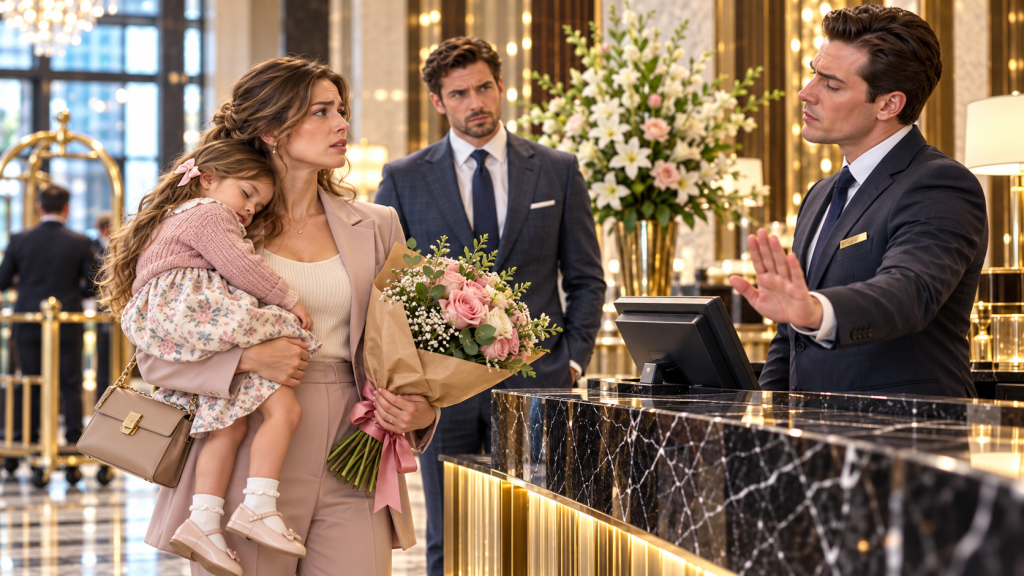
And when the person standing at the desk wore scuffed boots, carried bruised flowers, and had a sleeping child in her arms.
I remembered Patrick’s voice.
You might want to look for a cheaper motel down the road.
Then Lupita’s.
A tired mother holding a sleeping child is standing in our lobby asking for help. That makes it everyone’s business.
I closed my eyes.
Those two sentences had revealed more about my hotel than any quarterly report.
One had treated a person as an inconvenience.
The other had recognized her humanity.
And only one represented the place Adrian and I had wanted to create.
Lily came running toward me from the courtyard.
“Mommy! Come see!”
I smiled.
“What is it?”
“The magnolia tree! One of the flowers opened!”
She grabbed my hand and pulled me toward the garden.
I followed her into the evening light.
And as we walked, I realized that the greatest lesson of that terrible visit had nothing to do with the fact that I owned a luxury hotel.
People deserve respect before anyone knows their name, their position, their wealth, or what they can do for you.
That was what Lupita had understood.
What Victor had forgotten.
What Patrick and Karl had failed to practice.
And what I intended my daughter to remember long after the hotel belonged to another generation.
Outside, the magnolia blossoms moved gently in the breeze.
Lily knelt beside the roses.
I sat beside her.
And for the first time since Adrian died, looking at the place we had built together didn’t make me feel only what I’d lost.
It reminded me of what was still worth protecting.
Not the marble.
Not the suites.
Not even the name above the entrance.
The people.
Always the people.
THE END STORIES! THANK YOU FOR READING GOOD LUCK !❤️
Related Posts


