The first thing I noticed was not the deed. It was my son’s hands. Jesse stood beneath the pale November sky with his knitted cap twisted between his fingers. There was a small scar beside his mouth, silver in the morning light, and his hands were rougher than I remembered.
They were a working man’s hands. But I remembered them differently. Little hands reaching for mine at the grocery store. Ten-year-old hands holding a fishing pole his father had given him. Sixteen-year-old hands that had written a goodbye note on our kitchen table.
I’m sorry, Mom. I’ll only drag you down. For eleven years, I had wondered whether those hands were still warm. Whether he had enough to eat. Whether somebody had been kind to him when he was frightened. And now he was standing on my doorstep.
Alive.
“Mom?”
His voice broke.
I took one step toward him.
Then another.
The cardboard box beneath my arm slipped and fell to the porch. My old coffee mugs scattered across the wooden boards.
I didn’t care.
“Jesse?”
He nodded.
That was all it took.
Eleven years of birthdays, Christmas mornings, unanswered telephone calls, and sleepless nights collapsed into a single breath.
I reached for him.
He caught me before my knees gave way.
And suddenly, I was holding my son.
Not the sixteen-year-old boy who had run away.
A grown man.
Twenty-seven years old.
Taller than his father had been.
He smelled faintly of soap, cold air, and the wool coat he was wearing.
But when he wrapped his arms around me, I recognized him.
Some things a mother never forgets.
“I’m sorry,” he whispered.
I held him tighter.
“Don’t.”
His shoulders shook.
“Mom, I’m so sorry.”
I buried my face against his chest.
“You’re here.”
He began crying harder.
“You’re really here.”
I pulled back just enough to see his face.
“I never stopped looking for you.”
His eyes closed.
“I know.”
Those two words almost broke me.
Because for eleven years, I hadn’t known whether Jesse understood that he’d been loved.
I hadn’t known whether he believed his family wanted him home.
And now he was standing in front of me, crying like the frightened boy who had disappeared.
Behind us, somebody cleared his throat.
Danny.
The thin teenager I’d once allowed to sleep between boxes of paper towels and windshield fluid had become a tall young man with a neat haircut, a wool coat, and eyes that still carried the same gentleness I’d seen when I handed him his first cup of cocoa.
He looked from Jesse to me.
Then he smiled through tears.
“I told you she’d hug you first.”
Jesse laughed shakily.
“You said she’d probably knock me over.”
“I wasn’t wrong.”
I turned toward Danny.
“Oh, sweetheart.”
He stepped closer.
And I pulled him into the embrace.
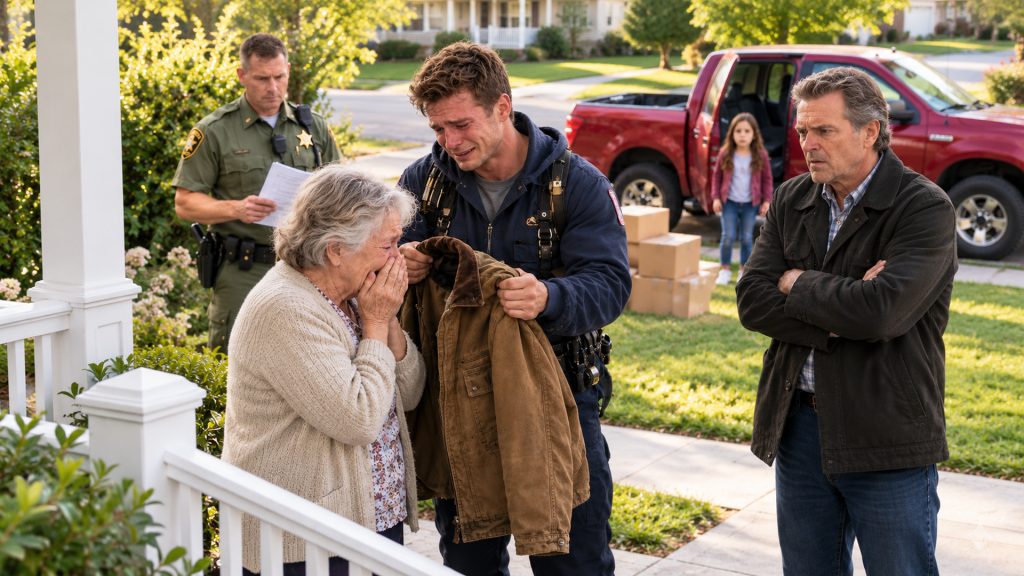
For a moment, the three of us stood on that freezing porch, crying and holding one another while my belongings waited in cardboard boxes beside the door.
The sheriff’s deputy near the sidewalk looked away.
The woman from the moving company wiped her eyes.
And the eviction notice remained taped to my front door.
It should have been the worst morning of my life.
Instead, it was the morning the two boys I’d spent years worrying about came home.
Nora Ellis waited until we could breathe again before speaking.
“Mrs. Kessler, I’m sorry to interrupt.”
I turned.
Her leather folder was open.
“I’m Nora. Danny told you I was an attorney?”
I nodded.
She looked toward the boxes.
“We have several things to discuss, including your housing situation. But first, I want to make sure you’re warm and that your belongings are protected.”
The deputy approached.
He was an older man named Officer Benson, whom I’d seen around Duluth for years.
He wasn’t unkind.
He was carrying out an eviction order.
“Mrs. Kessler,” he said gently, “I need to know whether you have transportation for your things.”
I looked down at the scattered mugs.
“I suppose I do now.”
Danny stepped forward.
“We’ve arranged a moving truck and storage if necessary.”
Nora added, “We’ve also filed an emergency motion concerning the eviction and contacted the property owner’s attorney. There’s no guarantee of relief today, but we’ve requested that further action be reviewed in light of newly discovered ownership records.”
Officer Benson nodded.
“I understand. Until there’s a change to the court order, I have to follow the instructions I’ve been given.”
“I know,” I said.
And I did.
The deputy hadn’t doubled my rent.
He hadn’t stolen my job.
He hadn’t spent years convincing other employers I was dishonest.
He was simply standing in the doorway at the end of a chain of events that had begun long before he arrived.
Jesse touched my arm.
“Mom, you don’t have to worry about where you’ll sleep tonight.”
I looked at him.
He swallowed.
“Danny and I already talked about it.”
Danny nodded.
“There’s a room ready for you.”
My eyes filled.
For six years, I had worried about where Danny slept.
For eleven years, I had wondered whether Jesse had a roof over his head.
Now the boys I’d lost were standing beside me, offering one to me.
I covered my mouth.
“Oh, boys.”
Danny grinned.
“Mrs. K, please don’t cry again. I’m already out of tissues.”
That made me laugh.
And the laughter felt strange.
Like opening a window in a house that had been closed for years.
We spent the next two hours packing.
Jesse carried the heavy boxes.
Danny handled the fragile things.
Nora stayed near the kitchen table, reviewing documents and speaking quietly with the deputy and the property owner’s representative.
I moved through the little duplex like a ghost.
I had lived there for nearly fourteen years.
It wasn’t much.
Two bedrooms.
A narrow kitchen.
Windows that rattled during storms.
A radiator that knocked every winter.
But it had been home.
My husband, Thomas, had spent his final Christmas there.
Jesse had celebrated his sixteenth birthday beneath the crooked ceiling fan in the living room.
And after both of them were gone, the walls had held the sound of my grief.
I had never imagined I’d leave it with strangers carrying my furniture toward a truck.
Jesse found me standing in the doorway of his old bedroom.
The walls were still pale blue.
I had painted them when he was twelve.
He used to complain that the color looked like toothpaste.
“Mom?”
I turned.
He looked into the room.
A strange expression passed across his face.
“You kept it the same.”
I smiled sadly.
“For a long time.”
He stepped inside.
There was no childhood furniture anymore.
I’d sold most of it when the motel cut my hours.
But one thing remained.
A pencil mark on the doorframe.
Jesse — 5’10” — age 16.
He touched the mark.
Then looked at me.
“I’m taller now.”
I laughed through tears.
“I noticed.”
He swallowed.
“Mom, I have so much to tell you.”
I reached for his hand.
“And I have eleven years of questions.”
He nodded.
“Can we start with breakfast?”
I smiled.
“Breakfast?”
He laughed shakily.
“I haven’t eaten since yesterday. Danny said you make the best scrambled eggs in Minnesota.”
I looked toward the kitchen.
The stove was already disconnected.
Most of my pans were packed.
For a moment, grief rose in my throat.
Then Danny appeared in the doorway.
“There’s a diner ten minutes from here,” he announced. “And I’m buying.”
I looked at him.
“You always did like a hot meal.”
He smiled.
“Some things never change.”
At the diner, we sat in a booth near the window.
Snow drifted lightly across the parking lot.
Jesse ordered pancakes, bacon, eggs, and coffee.
Danny ordered enough food for two people.
I ordered toast.
Neither boy accepted that.
“Mrs. K,” Danny said, “you made me eat when I said I wasn’t hungry. Your turn.”
Jesse nodded solemnly.
“He’s right.”
I laughed.
And ordered eggs.
For a while, we ate quietly.
I watched Jesse take his first bite of pancakes.
The way he held his fork.
The way he pushed his coffee cup away from the edge of the table.
The way he frowned slightly when he was thinking.
All those little things.
All those ordinary movements I’d spent eleven years wishing I could see again.
Finally, I asked the question that had lived inside me every day since he disappeared.
“Why did you leave?”
Jesse put down his fork.
His face changed.
“I thought you were better off without me.”
My throat tightened.
“Jesse—”
“After Dad died, you were working all the time. You were exhausted. I kept getting into trouble at school. And every time you came home, there was another bill.”
I stared at him.
He continued.
“Remember when I broke the kitchen window?”
I nodded.
He had thrown a baseball too close to the house.
I’d been angry.
It was the same week the insurance company denied part of Thomas’s medical expenses.
I remembered crying over the repair bill.
Jesse looked down.
“You said you didn’t know how you were going to keep us both afloat.”
I closed my eyes.
I remembered saying it.
Not because I blamed him.
Because I was frightened and exhausted and had forgotten he was listening.
He swallowed.
“I thought if I left, you’d have one less person to feed.”
I reached across the table.
“Oh, Jesse.”
He shook his head.
“I know now it was wrong. But I was sixteen. I didn’t understand what leaving would do to you.”
Tears ran down his face.
“I thought I was helping.”
I took his hand.
“Sweetheart, you were never a burden.”
He looked away.
I squeezed his fingers.
“I was grieving your father. I was afraid of losing the house. I was trying to figure out how to be a mother and a widow at the same time.”
My voice broke.
“But none of those things meant I wanted a life without you.”
He began sobbing.
I moved around the booth and sat beside him.
And there, in the middle of a diner while strangers quietly ate breakfast, I held my son and cried for eleven years of missed mornings.
When Jesse could finally speak again, he told me where he’d been.
Not all of it.
Not every frightening night or every mistake.
Those stories would come later, when he was ready.
But he told me enough.
He’d taken a bus west with eighty-three dollars in his pocket.
He believed he could find work, send money home, and prove he wasn’t the burden he’d imagined himself to be.
Instead, he discovered that the world was much less forgiving to a sixteen-year-old boy without identification, a steady address, or anyone to call when something went wrong.
He spent his first winter moving between shelters.
He washed dishes.
Loaded trucks.
Slept in bus stations when there were no beds available.
And kept telling himself he’d call me once he had something good to report.
But the longer he stayed away, the more ashamed he became.
“I kept thinking you must hate me,” he whispered.
I shook my head.
“Never.”
“I imagined coming home and seeing how much I’d hurt you.”
I touched his hand.
“Jesse, I would have opened the door.”
His eyes filled.
“I know that now.”
He told me that several years earlier, he’d been injured while working a temporary construction job.
The scar beside his mouth came from that accident.
He spent months recovering.
He lost his job.
Then he began drinking heavily, trying to quiet the guilt and loneliness that followed him everywhere.
Eventually, a shelter counselor helped him enter a recovery program.
He found steadier work.
Started saving.
And began volunteering with younger people experiencing homelessness.
“That’s where I met Danny,” he said.
I turned toward the young man across the table.
Danny smiled faintly.
“Not exactly.”
Jesse looked at him.
Danny continued.
“We’d actually crossed paths once before. I just didn’t know who he was.”
I frowned.
“What do you mean?”
Danny took a slow breath.
“After Doug fired you, I ended up in a youth shelter in Superior. One night, a volunteer brought in blankets and helped fix the broken heater.”
He looked at Jesse.
“That volunteer was him.”
Jesse smiled sadly.
“I remember telling you your jacket was too big.”
Danny laughed.
“And I told you I was going to grow into it.”
My eyes filled.
Jesse looked at me.
“I didn’t know it was my jacket, Mom. I mean, I didn’t recognize it then. It was dark, and Danny was wearing it over another coat.”
Danny nodded.
“Later, when I found a stable place to live, I started looking at that photograph you kept in the pocket.”
He reached into his bag.
And carefully removed an old envelope.
My breath caught.
Inside was the photograph.
Jesse at sixteen.
Standing beside our Christmas tree, holding a fishing rod his father had bought him.
I remembered taking it.
Thomas had been gone only a few months.
Jesse had tried so hard to smile for me.
Danny handed it over.
“I kept this safe.”
I touched the faded edges.
For six years, I’d mourned that photograph.
Not because it was the only picture I had of Jesse.
But because it had been the last one I took before he disappeared.
The last moment I remembered him standing in our living room, trying to look happy for my sake.
I looked at Danny.
“How did you find him?”
Danny smiled.
“I started volunteering at a community workshop that helped people find jobs and rebuild their lives. A few years later, Jesse came through as a volunteer from another program.”
He looked at my son.
“I recognized the name, but I still wasn’t sure.”
Jesse nodded.
“Then one night he brought out the photograph.”
Danny’s voice broke.
“I asked him if he knew the boy.”
Jesse swallowed.
“And I said, ‘That’s me.'”
I began crying again.
Danny continued.
“I showed him the jacket. Told him about the gas station. About you.”
He looked down.
“And about how you lost your job because you let me sleep someplace warm.”
Jesse covered his face.
For a moment, neither boy spoke.
Then Danny whispered, “I told him what you said the first night you gave me cocoa.”
I looked at him.
“What did I say?”
His eyes filled.
“You said, ‘Nobody should have to earn the right to be warm.'”
I remembered.
A skinny boy standing beside the coffee machine in a January snowstorm.
His fingers red from the cold.
His stomach growling.
I’d handed him cocoa because I couldn’t bear the thought of sending him back outside.
Danny smiled through tears.
“I never forgot that.”
Then he added, “And once Jesse and I finally understood who we were to each other, we started trying to find a way to bring him home.”
I looked at my son.
“Why didn’t you call immediately?”
He lowered his eyes.
“I wanted to, Mom.”
I waited.
“But Danny told me what happened after Doug fired you. And I thought if I came back with nothing, I’d only make your life harder.”
I shook my head.
“Jesse—”
He looked up.
“I know. I was wrong.”
Then he whispered, “I wanted to come home as someone who could help you for once.”
I leaned across the table.
“Sweetheart, you never needed to become successful before you could come home.”
He began crying.
I squeezed his hand.
“Being alive was enough.”
After breakfast, Nora spread the documents across the table.
“Mrs. Kessler, I need to explain what we found.”
I nodded.
The first document was an old property record.
It described a narrow commercial parcel along Highway 53, not far from the gas station.
The property had belonged to my husband, Thomas, and me.
I stared.
“That’s impossible.”
Nora looked up.
“Why?”
“Tom told me he’d planned to sell that land to cover some medical expenses. After he died, I thought it was gone.”
Jesse frowned.
“Mom, Dad owned land?”
I nodded slowly.
“Years ago, he bought a small lot beside an old equipment yard. He thought someday the highway might expand, and the property could become useful.”
I looked at Nora.
“But I thought it had been sold.”
She turned to the next document.
“According to the recorded history, the property was still in your name years after your husband’s death.”
I stared.
“Then what happened?”
She placed the disputed deed in front of me.
“Six years ago, three months after you were fired, a deed was recorded purporting to transfer your interest to a company controlled by your former landlord, Calvin Rusk.”
I felt cold.
“Calvin?”
Nora nodded.
“He owned the duplex before selling it to the current landlord last fall.”
I looked down at the signature.
My name.
Marlene Kessler.
It looked close.
But the final letter was wrong.
I had always written the last R with a long downward stroke.
This signature ended abruptly.
“I didn’t sign this.”
“That’s what we believe, and we’re investigating it through the appropriate process.”
She continued.
“The property was then transferred to a development company. The recorded sale price was one hundred eighty-six thousand dollars.”
I stared at her.
“One hundred eighty-six thousand?”
She nodded.
“There’s no indication that the proceeds reached your accounts.”
I felt dizzy.
For six years, I’d cleaned motel bathrooms.
Washed stained sheets.
Worked through arthritis pain.
Skipped meals when the rent was due.
And all that time, someone may have stolen the proceeds of land I’d helped my husband buy.
Nora turned another page.
“We’ve traced part of the sale proceeds through the company that received them. Some payments went to Calvin Rusk.”
She paused.
“Others appear connected to Doug Pruitt.”
I closed my eyes.
Doug.
The man who had fired me in front of customers.
Who’d called me a thief.
Who’d threatened to destroy my chances of finding another job.
And who had apparently profited from a transaction involving property I didn’t remember selling.
I whispered, “How did he get involved?”
Danny leaned forward.
“That’s the part we found when we started investigating what happened at the Gas-N-Go.”
Nora explained that Danny had spent years wondering why Doug reacted so violently to finding him asleep in the storage room.
He knew allowing him inside violated the station’s rules.
He’d always understood that.
But Doug’s rage had seemed larger than the offense.
He hadn’t merely dismissed me.
He’d accused me publicly of stealing.
Threatened my reputation.
And insisted I leave before anyone could review the station’s financial records.
Danny’s questions eventually led him to a former bookkeeper who had worked for the company that owned the station.
Her name was Gloria Vance.
She had retired after identifying unexplained differences between fuel sales, cash receipts, and register deposits.
At the time, her concerns were dismissed.
But she kept copies of the reports.
Nora laid several pages on the table.
“Gloria’s records suggest that cash was being removed from the station before it was deposited.”
I frowned.
“By Doug?”
“The pattern points toward transactions made under his management credentials. The evidence still needs verification, but it’s significant.”
I looked down.
For years, Doug had accused me of stealing hot dogs and cocoa.
In reality, I’d often paid for Danny’s food myself.
Sometimes I’d written it down and settled the amount at the end of my shift.
But Doug had portrayed me as a thief while questions about his own handling of the station’s money remained unresolved.
Nora continued.
“Calvin Rusk also did property work for people connected with the station. He had access to information about the parcel you and Thomas owned.”
I stared.
“And they used my firing to make me look dishonest.”
“We believe your public dismissal and the later accusations may have made it easier for them to disregard your objections and harder for you to obtain assistance.”
I looked toward Danny.
He was staring at his hands.
For a moment, I understood why he’d returned with an attorney instead of simply knocking on my door.
He hadn’t forgotten what happened at the station.
He’d spent years believing my kindness had cost me my livelihood.
And once he found Jesse, he’d refused to let the story end there.
I reached across the table.
“Danny.”
He looked up.
“You didn’t cause any of this.”
His eyes filled.
“I know that now.”
I smiled sadly.
“But you came back anyway.”
He nodded.
“Somebody had to.”
I looked at the boy I’d once fed when he was hungry.
Then at my son.
And I realized that the two people I had believed were lost had found each other.
And somehow, together, they had found their way back to me.
The room Danny had prepared for me was in a little house near the edge of Duluth.
He rented it with another young man who worked at the same heating and repair company.
Danny had become a certified heating technician.
He was saving to buy a share in the business.
He told me these things almost apologetically, as though he worried I would be disappointed that he hadn’t become wealthy or famous.
I looked around the clean kitchen, the shelves filled with books, and the neatly folded blankets on the spare bed.
“Danny, look at you.”
He smiled nervously.
“What?”
“You have a home.”
He looked down.
I touched his cheek.
“You have work you enjoy. You have people who care about you. You made a life for yourself.”
His eyes filled.
“Yeah.”
I smiled.
“That’s a wonderful thing.”
He laughed shakily.
“Mrs. K, you’re going to make me cry again.”
“Then we’d better keep some tissues in the kitchen.”
Jesse helped carry my belongings upstairs.
He’d arranged to stay at a nearby apartment while we figured out what came next.
When I realized that, I felt a strange panic.
“You’re leaving?”
He stopped.
“Mom?”
I stared at him.
It was an unreasonable reaction.
He was a grown man.
He had work, responsibilities, and a life that existed beyond my front door.
But for eleven years, I’d spent every goodbye wondering whether it was permanent.
Now the thought of watching him drive away frightened me.
Jesse set down the suitcase.
Then he came toward me.
“Mom, I’m not disappearing.”
My throat tightened.
“I know.”
He took my hands.
“I’ll be here tomorrow.”
I nodded.
“And the day after that.”
Tears ran down my cheeks.
He smiled gently.
“We have a lot of catching up to do.”
I held him.
And slowly, I began to understand that having my son back would require something different from holding on to him.
It would require learning to trust that he could leave a room and still come back.
The first night in Danny’s house, I couldn’t sleep.
The mattress was comfortable.
The room was warm.
There were clean towels beside the bed and a little lamp on the nightstand.
Everything I needed was there.
But at two in the morning, I found myself standing beside the window, watching snow gather on the street.
For years, two o’clock had been the hour when Danny appeared at the Gas-N-Go.
Skinny.
Silent.
Pretending to study the labels on the coffee machine.
I used to wonder what kind of world allowed a fifteen-year-old boy to walk through twenty-below-zero weather without anyone noticing.
Now I was standing inside the home he’d helped make possible for himself.
And I couldn’t stop thinking about all the children who hadn’t found a warm storage room.
A soft knock sounded.
“Mrs. K?”
I turned.
Danny stood in the doorway wearing sweatpants and an old sweatshirt.
“Everything okay?”
I nodded.
“Couldn’t sleep.”
He smiled.
“Me neither.”
He joined me at the window.
For a while, we watched the snow.
Then he said, “I used to be afraid of falling asleep.”
I looked at him.
“Why?”
“Because I never knew whether somebody would wake me up and tell me to leave.”
My throat tightened.
He continued.
“Even after I found a real room, I kept sleeping in my shoes.”
I stared at him.
“How long?”
“Almost a year.”
I covered my mouth.
Danny looked toward the street.
“Sometimes I still wake up thinking I have to get out before somebody notices me.”
I reached for his hand.
He squeezed mine.
Then he said quietly, “You were the first adult who let me sleep without asking what I’d done to deserve it.”
I closed my eyes.
I remembered the sleeping bag.
The humming refrigerator units.
The sound of snowplows moving along the highway.
I hadn’t known how much those six hours mattered.
I only knew a child was cold.
Danny turned toward me.
“Mrs. K, I want you to promise me something.”
“What?”
“Don’t spend the next six years feeling guilty because you couldn’t fix everything for me.”
My eyes filled.
He smiled.
“You gave me a chance. Other people helped after that. I did some work myself.”
Then he added, “That’s how people get through things, isn’t it?”
I nodded.
“Sometimes.”
He looked toward the spare bedroom.
“And now it’s your turn to let somebody help.”
I laughed through tears.
“You’re a bossy young man.”
He grinned.
“Learned from the best.”
The legal investigation moved slowly.
Nora warned me from the beginning that proving a forged property transfer could take months.
We needed original documents.
Notary records.
Bank transactions.
Witness statements.
And evidence establishing who received the money from the sale.
The disputed deed had been recorded six years earlier.
That meant memories had faded, businesses had changed hands, and some records were no longer easy to obtain.
But there were still important pieces available.
The notary whose seal appeared on the document told investigators she had no record of witnessing my signature.
The identification copy attached to the transaction appeared to have come from employment paperwork I’d completed at the Gas-N-Go.
And the signature itself differed significantly from known examples collected by the document examiner.
Gloria Vance, the former bookkeeper, also provided records from an earlier internal investigation involving cash shortages at the station.
Some archived security footage had been retained in connection with that investigation.
It didn’t show everything.
It didn’t magically prove every accusation.
But it supported questions about Doug’s handling of cash and contradicted parts of the story he’d told when he fired me.
A former customer named Leonard Fisk came forward after hearing about the case.
Leonard was the man in the Vikings cap who had put down his coffee and walked out that morning.
He remembered Doug shouting.
Remembered Danny crying.
And remembered me offering to pay for the food.
“I thought about that day for years,” he told Nora.
He looked ashamed.
“I should have said something.”
I shook my head.
“You couldn’t have known how things would turn out.”
Leonard swallowed.
“I knew it was wrong to humiliate somebody like that.”
I didn’t answer.
Then he looked at me.
“I’m sorry I walked away.”
I took a breath.
“I wish you’d stayed.”
His eyes filled.
“But I’m grateful you came back.”
It wasn’t the same as changing the past.
Nothing could do that.
But hearing one witness acknowledge what happened helped me understand that Doug’s version of the story had never been the only one.
The current landlord, a man named Clifford Ames, eventually agreed to meet with Nora.
He had purchased the duplex the previous fall as an investment property.
The rising expenses and rent increase were real.
He hadn’t participated in the disputed land transaction, and the evidence didn’t establish that he knew anything about Doug’s earlier conduct.
That was important.
For a while, I wanted every person connected with the eviction to be part of the same terrible scheme.
But Nora kept reminding me that suspicion wasn’t proof.
Clifford reviewed the documentation concerning the circumstances of my eviction.
Through counsel, we reached an agreement resolving the remaining dispute over the tenancy and my belongings.
It didn’t give me my old apartment back.
The building had been sold, and I no longer wished to live there.
But it brought a painful chapter to an end without forcing me into another prolonged fight.
I had spent years believing that apartment was the last place I might call home.
Now I understood that home couldn’t be preserved merely by remaining inside familiar walls.
Sometimes it had to be rebuilt among people who treated you with dignity.
Four months after Danny knocked on my door, Jesse and I visited Thomas’s grave.
The snow had finally begun to melt.
Little patches of dark earth appeared beneath the trees.
Jesse stood beside me holding a small bunch of white flowers.
For a long time, he didn’t speak.
Then he placed the flowers beneath his father’s name.
“Hi, Dad.”
His voice broke.
I looked away to give him privacy.
Jesse knelt beside the stone.
“I’m sorry I left Mom.”
Tears filled my eyes.
He continued.
“I thought I was helping. I really did.”
His shoulders shook.
“I didn’t understand how much she needed me.”
I stepped closer.
“Jesse.”
He looked up.
I knelt beside him despite the ache in my knees.
“Your father loved you.”
He nodded.
“And if he were standing here, he wouldn’t want you spending the rest of your life apologizing for being frightened when you were sixteen.”
Jesse began crying.
I touched the engraved letters.
THOMAS KESSLER.
My husband.
My partner.
The man who used to tease Jesse about leaving his shoes in the hallway.
The man who’d bought that small parcel near Highway 53 because he believed someday it might help our family.
The man whose death had changed our lives in ways none of us knew how to manage.
I whispered, “We were both lost after he died.”
Jesse lowered his head.
I took his hand.
“But we’re finding our way back.”
He leaned against me.
And for a while, we sat beside Thomas’s grave, allowing ourselves to grieve the years we’d lost without blaming the frightened people we’d been.
Jesse started seeing a counselor regularly.
He’d already received help during his recovery, but returning home stirred memories he’d spent years trying to quiet.
Sometimes he became withdrawn.
Sometimes he apologized for things that happened a decade earlier.
Occasionally he called just to make sure I was still at home.
I recognized the fear.
I carried some of it myself.
If he was late for dinner, my heart would begin racing.
If his phone went unanswered, I imagined highways, hospitals, and strangers.
One afternoon, after I’d called him four times in twenty minutes, Jesse gently said, “Mom, I need you to trust that I can go to the store without disappearing.”
I felt ashamed.
Then I took a breath.
“You’re right.”
He smiled sadly.
“I’m not sixteen anymore.”
“I know.”
“But I’m still your son.”
My eyes filled.
“That part never changed.”
He took my hand.
And I realized that healing wasn’t simply getting the people we loved back.
It was learning how to live beside them without letting fear control every moment.
We had both spent years believing we’d failed each other.
Now we needed to give ourselves permission to become a family again.
Not the family we had been before Thomas died.
Something new.
Something built from the truth.
The first significant financial resolution came almost eighteen months after the morning I was evicted.
By then, the investigation had uncovered records connecting Calvin Rusk and Doug Pruitt to the sale of the Highway 53 property.
The transaction documents contained serious irregularities.
The signature attributed to me was challenged.
The supporting identification records raised additional questions.
And the money trail led to accounts associated with the men who had handled the transaction.
Through the civil proceedings, the parties eventually reached a resolution that provided substantial financial recovery for the loss of my property interest.
It wasn’t a miraculous check for every dollar anyone had taken.
There were legal expenses, disputed amounts, and issues that needed to be resolved through formal agreements.
But after years of scraping by, I finally had enough to establish a modest, secure home.
The evidence involving the property transfer and the station’s financial records also led to investigations of Doug’s conduct.
Some allegations resulted in criminal proceedings.
Others were addressed through civil claims and regulatory review.
I couldn’t control every outcome.
And I eventually stopped trying.
What mattered was that the records no longer supported the story Doug had told about me.
The company that had operated the Gas-N-Go issued a written correction concerning the unsupported accusation that I’d stolen from the business.
It acknowledged that my termination had been handled improperly and that the earlier allegations should not have been presented as established facts.
I read that letter three times.
Then I sat at the kitchen table and cried.
For years, I’d walked into job interviews knowing that one telephone call to Doug could destroy my chances.
I’d tried to explain why I was fired.
Some managers listened.
Others didn’t.
A few looked at me with the same suspicion Doug had planted in the minds of customers that morning.
Now I had a document acknowledging that the accusation wasn’t supported.
It didn’t give me back the years.
But it returned something I hadn’t realized I was still waiting for.
My good name.
I bought a little house the following spring.
It wasn’t fancy.
Two bedrooms.
A narrow porch.
A kitchen that needed new cabinets.
And a backyard with an old apple tree.
But it was mine.
I could afford it without borrowing more than I could comfortably repay.
Jesse helped me paint the living room.
Danny replaced the aging furnace with help from his employer.
Joanne, my neighbor from the old duplex, brought over curtains she’d found at a thrift shop.
And June, a friend I’d made while cleaning motel rooms, arrived with a box of dishes and announced that no respectable kitchen should have only four plates.
For the first time in years, I had more help than I knew what to do with.
On moving day, Danny carried a box marked KITCHEN through the front door.
He set it on the counter.
Then looked around.
“Well, Mrs. K.”
I smiled.
“What?”
“Looks like you finally got yourself a place with a proper guest room.”
I laughed.
“Yes.”
He grinned.
“Just saying, if I ever need to escape my roommates, I know where to go.”
I walked over and hugged him.
“You won’t have to ask twice.”
His eyes filled.
Then he whispered, “I know.”
And for a moment, I saw the boy who used to stand beside the Gas-N-Go coffee machine, pretending he wasn’t hungry.
I held him tighter.
Not because he needed rescuing anymore.
But because he deserved to know he would always be welcome.
Jesse moved into the second bedroom for several months while he found permanent work nearby.
He took a position with a community outreach organization that helped young adults experiencing homelessness.
Sometimes he came home exhausted.
Sometimes he needed quiet.
And sometimes he sat at the kitchen table talking about a teenager who reminded him of himself at sixteen.
I listened.
But I learned not to ask for details that belonged to the people he helped.
One evening, he came home holding a little paper bag.
Inside was a pineapple upside-down cake.
I laughed.
“What’s this?”
He shrugged.
“Somebody at work said you deserved a treat.”
I looked at him.
“Jesse, did you tell your coworkers about me?”
He smiled.
“Maybe.”
I shook my head.
He placed the cake on the counter.
Then said, “I told them about the gas station. About Danny. About how you kept looking for me.”
My throat tightened.
“And?”
He looked down.
“I told them that when I finally came home, you didn’t ask me where I’d been first.”
I stared at him.
He continued.
“You just hugged me.”
Tears filled his eyes.
“One of the kids at the center asked what I remembered most about that day.”
I smiled sadly.
“What did you tell him?”
Jesse looked at me.
“I told him I remembered your hands.”
I covered my mouth.
He continued.
“I remembered how you held my face like you were checking whether I was real.”
I reached for him.
And he pulled me into his arms.
For eleven years, I’d believed my son was somewhere beyond my reach.
Now we could stand in the same kitchen, hold each other, and talk about things that had once been too painful to say aloud.
It wasn’t a perfect ending.
It was better.
It was a life we could keep living.
The following December, I volunteered at a warming center.
Danny had introduced me to the organization.
They provided hot meals, winter clothing, and temporary shelter referrals to people who had nowhere safe to sleep during the coldest nights.
The first evening I worked there, the temperature dropped to fifteen below zero.
Snow blew sideways across the parking lot.
I stood behind a counter serving soup.
Then a teenage boy walked through the door.
He wore a thin jacket.
His cheeks were red.
His hands shook as he tried to unzip his backpack.
He stood near the entrance, looking uncertain.
For a moment, I was back at the Gas-N-Go.
Two o’clock in the morning.
A skinny boy beside the coffee machine.
Pretending to read labels because he was too ashamed to ask for food.
I set down the ladle.
“Sweetheart, come warm up.”
The boy looked startled.
“Is it free?”
“Yes.”
He hesitated.
“Even if I can’t stay?”
I nodded.
“You can have something to eat.”
He approached slowly.
I handed him a bowl of soup.
Then added two pieces of bread.
He looked at me.
“Thank you.”
I smiled.
“You’re welcome.”
A volunteer helped him find a warm place to sit and explained the services available.
I returned to the counter.
But tears had begun running down my cheeks.
Not because the boy reminded me how much I’d lost.
Because he reminded me that kindness was still possible.
I’d spent years wondering whether helping Danny had ruined my life.
Doug had convinced me that letting a hungry child into a storage room was something shameful.
But the real shame had been the cruelty that followed.
Now I understood the difference between kindness and having to do everything alone.
I could help within safe, appropriate boundaries.
I could work with people trained to provide shelter.
And I could contribute without sacrificing my own security.
That was something Danny had taught me.
Helping someone didn’t mean becoming responsible for the entire world.
Sometimes it meant offering a bowl of soup.
Sometimes it meant knowing whom to call.
And sometimes it meant refusing to look away when another person was cold.
On Christmas Eve, Danny and Jesse came over for dinner.
Joanne joined us.
So did a few friends from the warming center.
The kitchen was too small for everyone.
The roast was slightly overcooked.
And the Christmas lights on the porch kept flickering because I had bought the cheapest set at the hardware store.
It was the happiest Christmas I’d had in eleven years.
After dinner, Jesse brought out a small wrapped package.
“Mom, this is from both of us.”
I looked at Danny.
He smiled.
“Open it.”
Inside was a wooden picture frame.
It held the photograph of Jesse at sixteen.
The last photograph I’d taken before he ran away.
The one I’d kept in the inside pocket of his father’s old Carhartt jacket.
The one Danny had carried with him through years of growing up.
The one that had helped two lost boys discover they belonged to the same story.
Beneath the photograph was a small engraved plate.
It read:
SOME PEOPLE LEAVE A LIGHT ON.
I couldn’t speak.
Jesse sat beside me.
“Mom, we wanted you to have it back.”
I touched the photograph.
Then looked at Danny.
“And the jacket?”
He grinned.
“Still have it.”
I laughed.
“Does it fit now?”
He stood and held out his arms.
“Pretty much.”
I began laughing through tears.
For two winters, I’d watched that jacket hang from Danny’s narrow shoulders.
It had been much too big.
I’d told him he’d grow into it.
And somehow, he had.
Not only the jacket.
He had grown into a man who understood compassion, responsibility, and the importance of returning when someone needed him.
I reached for both boys.
They moved closer.
And we sat together beneath the Christmas lights, holding a photograph that had once seemed like the last remaining piece of a broken life.
Now it belonged to a new beginning.
Later that night, after everyone had gone home, Jesse stayed behind to help wash dishes.
We stood side by side at the sink.
He washed.
I dried.
For a while, neither of us spoke.
Then he looked at me.
“Mom?”
“Yes, sweetheart?”
“Do you ever wish things had happened differently?”
I stopped drying a plate.
I thought about Thomas.
About Jesse’s disappearance.
About Danny sleeping on the storage room floor.
About Doug firing me.
About the years spent cleaning motel bathrooms and wondering whether I would ever feel safe again.
I thought about the eviction notice on my door.
And the moment I opened it to find two young men standing in the cold.
“Yes,” I said quietly.
Jesse nodded.
“Me too.”
I looked at him.
“I wish your father had lived longer. I wish I’d understood how frightened you were. I wish Danny had never needed a storage room to survive a winter.”
My voice trembled.
“And I wish people hadn’t taken advantage of us.”
Jesse put down the dishcloth.
I continued.
“But I don’t wish I’d stopped loving you.”
His eyes filled.
“And I don’t wish I’d turned Danny away.”
I looked toward the photograph on the mantel.
“Because even when I couldn’t see it, those choices were still making a difference.”
Jesse reached for my hand.
Then he asked the question I’d been answering in my heart since the morning he came home.
“Do you think we’re going to be okay?”
I smiled.
Not because I believed life would suddenly become easy.
Not because all our losses had been repaired.
But because we were no longer trying to carry them alone.
“Yes, Jesse.”
He looked at me.
“How do you know?”
I squeezed his hand.
“Because we’re here.”
He smiled through tears.
“And tomorrow?”
I laughed softly.
“Tomorrow, we’ll be here again.”
He pulled me into his arms.
I held him as the kitchen clock ticked quietly behind us.
And I realized that was what I’d been missing all those years.
Not a perfect ending.
Not a fortune.
Not even the promise that nothing terrible would ever happen again.
I had been missing the ordinary certainty of tomorrow.
Knowing someone would come home.
Knowing the porch light would be on.
Knowing that if the world became cold, there would be a place where we could sit together and be warm.
Before going to bed, I stood at the front window.
Snow drifted across the street.
The apple tree in the backyard was covered in frost.
And a warm light shone from the little lamp beside my chair.
I thought about the morning Doug fired me.
He’d called me a thief.
He’d humiliated me in front of strangers.
He’d made me feel that helping a hungry child was the worst mistake I could have made.
For years, I almost believed him.
Then I remembered the day Danny returned.
The legal documents.
The photograph.
The two young men standing on my porch.
And I understood something I wished I could have told my younger self.
Kindness does not always return when we expect it, and it doesn’t guarantee that life will be fair. But the good we give someone can become part of the strength they carry into the world.
I had given Danny a sleeping bag, a hot dog, and a cup of cocoa.
He had given me back a photograph.
A chance to defend my name.
And, most precious of all, a path back to my son.
I switched off the lamp.
The house grew quiet.
But it wasn’t the lonely quiet I’d once known.
My family was alive.
My name had been restored.
And somewhere across town, two young men were sleeping in warm beds, knowing they had a mother who loved them.
I looked toward the framed photograph one last time.
Then whispered into the darkness:
“Welcome home, boys.”
And for the first time in eleven years, I went to sleep knowing they could hear me.
THE END STORIES! THANK YOU FOR READING GOOD LUCK !❤️
Related Posts