I stared at the bank transfer until the numbers began to blur. The amount was $186,000. The recipient was my only son, Daniel Whitcomb. And the date was March 7. Six days after my husband, Henry, died. One day after we buried him. I looked up at Eleanor Shaw.
“That can’t be right.”
She didn’t answer immediately. Instead, she turned the document toward me and pointed to the transaction description. Family Property Settlement — Maple Avenue. My hands began to tremble. “Daniel told me his father had given him some money for the house,” I whispered. “But Henry never mentioned anything like this.”
Eleanor folded her hands. “Mrs. Whitcomb, the transfer came from an account held solely in your husband’s name. According to the bank’s records, someone accessed his online banking profile and initiated the payment after his death.” I stared at her. “After he died?” “Yes.” “But his accounts should have been protected.”
“They should have been handled through the proper estate procedures. That’s one reason the bank has been notified, and we’re working with its fraud department.”
I pressed my fingers against my mouth.
For forty years, Henry and I had shared nearly everything.
Morning coffee.
Doctor appointments.
The little arguments about whose turn it was to buy groceries.
The quiet joy of watching our son grow up.
But I had never imagined that, six days after losing my husband, I would be sitting in a Manhattan office looking at evidence suggesting our child had taken money from his dead father’s bank account.
“Daniel had his father’s passwords,” I said faintly.
Eleanor nodded.
“Did your husband give him permission to use them?”
“Only to help pay bills while Henry was in the hospital.”
She watched me carefully.
“Helping with bills isn’t the same as authorizing a transfer to himself.”
I looked back at the document.
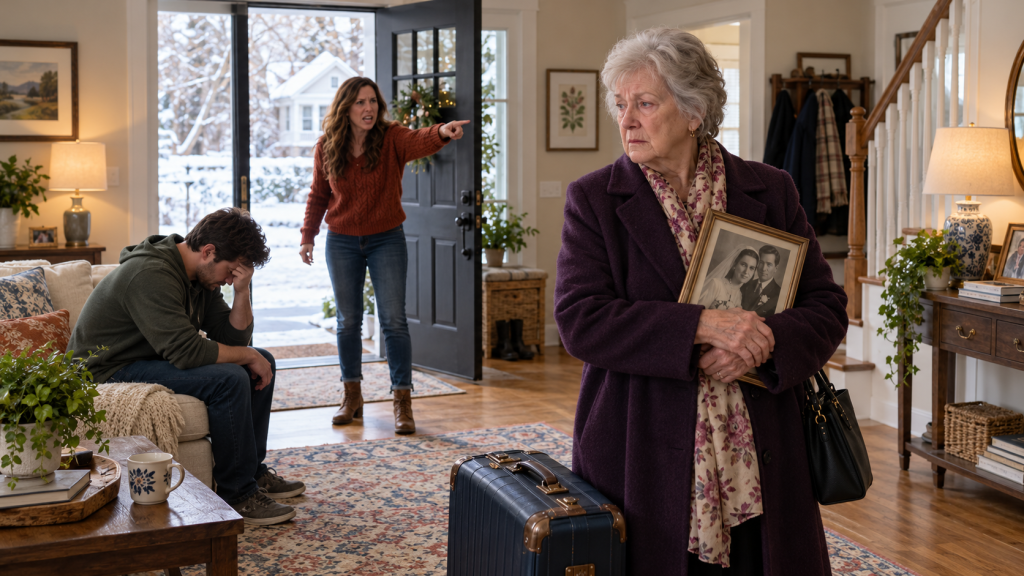
The money had been moved just before my daughter-in-law, Vanessa, placed those papers on my bed and told me I no longer belonged in my own home.
Suddenly, the sequence was too obvious to ignore.
First, the money.
Then, the papers.
Then, the eviction from the life I’d spent forty years building.
“Why?” I whispered.
Eleanor opened another folder.
“We have reason to believe Daniel and Vanessa intended to sell the Maple Avenue property.”
I felt my stomach turn.
“The house?”
She nodded.
“The paperwork you signed appears designed to make it seem that you consented to surrender your residential rights and allow a transfer.”
I closed my eyes.
I remembered Vanessa standing beside my bed in her cream-colored sweater.
“Just sign here, Margaret. It’ll save everybody unnecessary trouble.”
My son had stood in the doorway, staring at his shoes.
I’d been wearing the black dress from Henry’s funeral.
I hadn’t even changed out of it.
And when Vanessa pushed the papers toward me, I hadn’t read every page.
I’d signed because I was exhausted.
Because I’d just buried my husband.
Because the two people standing in my bedroom had made me feel that I had no right to remain there.
“I’m such a fool,” I whispered.
Eleanor leaned forward.
“No, Margaret. You were grieving. Someone may have used that grief to pressure you into signing documents you didn’t understand.”
Tears burned my eyes.
“But I signed them.”
“Your signature alone doesn’t establish that you had the legal authority to transfer property belonging to a trust. And the documents contain serious irregularities, including a purported witness signature from an attorney who died four years before the stated signing date.”
She paused.
“Nothing about this is being treated as valid merely because Daniel and Vanessa say it is.”
I looked down at the brass key resting beside my handbag.
The one Henry had pressed into my palm three weeks before he died.
Keep this safe. And don’t tell anyone.
For the first time, I understood that my husband hadn’t simply left me an inheritance.
He’d left me a way to find the truth.
Eleanor asked whether I could bear to hear more.
I thought about the motel room.
The cracked lampshade.
The cold vending-machine sandwich I’d bought but couldn’t swallow.
The way I’d lain awake wondering whether a seventy-six-year-old widow could survive on her pension if her own son refused to help her.
I looked at Eleanor.
“I’ve already lived through the worst part,” I said. “Tell me everything.”
She took a slow breath.
“Your husband was a founding investor in a logistics technology company called Northbridge Systems.”
I frowned.
“Henry told me he worked with a transportation business years ago.”
“He did considerably more than that.”
She opened a financial statement.
There were columns of numbers I could barely understand.
Then I saw the total.
Approximately twenty-eight million dollars in estate and trust assets, before final expenses, taxes, and other adjustments.
I stared.
“Henry had all that?”
“He retained an ownership interest in the company as it expanded. Much of the value accumulated over many years.”
I shook my head.
“He wore the same winter coat for fifteen years.”
Eleanor smiled faintly.
“He once told me you kept trying to replace it.”
“He said the old one was perfectly good.”
“He said he preferred having choices to having things.”
I looked toward the window.
For forty years, we’d lived carefully.
We weren’t poor.
Our house was paid for.
We had savings.
But Henry always insisted we should never mistake expensive possessions for security.
I’d worked as a nurse at Saint Vincent’s Hospital.
He’d spent decades involved in transportation operations and consulting.
We took modest vacations.
Drove our cars until they became unreliable.
Donated to the church food pantry.
And argued affectionately about whether we could justify buying a new dishwasher.
All that time, he’d been quietly building an extraordinary financial legacy.
“Why didn’t he tell me?” I whispered.
Eleanor’s expression changed.
“He intended to explain everything as part of your retirement planning. By the time his illness became serious, he was worried that Daniel had begun asking questions about the family’s assets.”
I stared at her.
“What questions?”
“Questions about ownership. Beneficiaries. Whether you would inherit outright. Whether he could obtain early access to money.”
My stomach tightened.
“Daniel knew?”
“Not the full amount, as far as we can establish. But he knew his father had significant investments.”
I looked away.
My son had never been good with money.
There had been business ventures that failed.
Credit cards that somehow never stayed paid off.
A leased luxury car.
Expensive dinners.
And Vanessa’s constant insistence that they deserved a better lifestyle.
Henry occasionally helped them.
I knew that.
But I hadn’t realized how often they had begun asking for more.
Eleanor closed the folder.
“Margaret, there’s a reason your husband placed the Maple Avenue house into a properly administered trust years ago.”
I looked up.
“He knew someone might try to take it?”
“He wanted to ensure you had secure lifetime occupancy and that the property couldn’t simply be disposed of because another family member wanted the proceeds.”
I began crying.
Even before his final illness, Henry had been thinking about where I would sleep after he was gone.
And the child we’d raised under that roof had tried to remove me from it.
That afternoon, Eleanor took me to the penthouse.
It was near Central Park, high above the noise and impatience of Manhattan.
The elevator opened directly into a private entrance.
Floor-to-ceiling windows framed the city.
Sunlight poured across pale wooden floors.
There was a living room larger than my entire first apartment, a kitchen with marble countertops, and a terrace overlooking the distant trees.
I stood motionless.
“Henry owned this?”
Eleanor nodded.
“He bought it as part of his long-term investment and retirement plans.”
I walked slowly toward the windows.
Far below, yellow taxis moved along the streets.
People hurried past storefronts.
The city seemed to stretch forever.
Henry had always loved New York.
When we were young, he used to take me into Manhattan for our anniversary.
We couldn’t afford expensive restaurants back then.
We’d buy sandwiches, walk through Central Park, and sit on a bench watching people.
He’d put his arm around me and say, “One day, Margaret, we’ll have a place here.”
I always laughed.
“Henry Whitcomb, we can barely afford parking.”
He’d smile.
“Then one day we’ll have a place with free parking.”
Standing in that extraordinary apartment, I remembered those conversations.
And I suddenly began to cry.
Not because of the view.
Not because of the furniture.
Because my husband had remembered a dream we’d shared when we were young.
Eleanor waited quietly.
I walked into the bedroom.
On the dresser was a framed photograph.
Henry and me, forty years earlier, standing outside our first house.
I was wearing a yellow dress.
He had one arm around my waist.
We were smiling at something beyond the camera.
Beside the photograph was a handwritten note.
For Margaret. When she’s ready to see the city again.
I sat on the edge of the bed.
For a long time, I held the note.
Then I whispered, “Oh, Henry.”
The man I’d buried had left me enough to live comfortably for the rest of my life.
But the note reminded me that his greatest gift had never been money.
It was the way he had loved me.
Quietly.
Faithfully.
And, even at the end, with an almost unbearable tenderness.
For three days, I stayed in the penthouse.
I didn’t tell Daniel.
I didn’t tell Vanessa.
And I didn’t tell the neighbors on Maple Avenue who had begun calling to ask where I’d gone.
I needed quiet.
Not the lonely quiet of the motel, where every passing car made me wonder what would happen next.
This was a different kind of quiet.
A place where I could sit beside a window, hold Henry’s photograph, and make decisions without anyone telling me to hurry.
On the fourth morning, I called my old friend Beatrice.
We’d worked together at Saint Vincent’s for thirty-one years.
She had been beside me through difficult shifts, my mother’s funeral, Daniel’s childhood surgeries, and Henry’s final months.
When I told her what had happened, she was silent.
Then she said, “Margaret, I’m going to ask you something, and I need an honest answer.”
“All right.”
“Have you eaten breakfast?”
I laughed through tears.
“Beatrice!”
“I’m serious. When you get upset, you forget to eat.”
I looked at the untouched toast beside my coffee.
“Not much.”
“Then eat. I’ll be there by noon.”
She arrived carrying homemade soup, fresh bread, and the same large handbag she’d taken to work for decades.
When she saw the apartment, she stopped dead.
“Margaret.”
I smiled weakly.
“Hello, Bea.”
She looked around.
Then back at me.
“Did you rob a bank?”
For the first time since Henry died, I laughed so hard my stomach hurt.
Then I cried.
Beatrice held me.
And when I finally told her about the inheritance, the forged paperwork, and the transfer from Henry’s account, her expression hardened.
“Your son did that?”
I nodded.
She sat down slowly.
“Margaret, do you remember what Henry told me at the hospital?”
I looked up.
“What?”
She hesitated.
“The evening before he gave you that key. He asked whether I thought you would be able to stand up to Daniel if he became difficult.”
My throat tightened.
“What did you say?”
“I told him you were the strongest woman I’d ever worked beside.”
I began crying.
Beatrice smiled sadly.
“Henry said, ‘She is. But she forgets it whenever our boy looks disappointed.'”
I covered my mouth.
“He knew,” I whispered.
“He knew Daniel had become demanding. I don’t think he knew every detail of what was coming.”
I stared out the window.
For years, Daniel’s disappointment had been enough to make me change my mind.
If he wanted money, I found a way to help.
If Vanessa complained that we didn’t visit enough, I apologized.
If they forgot my birthday, I said they were busy.
I had spent so much time protecting my son’s feelings that I’d gradually stopped noticing my own.
Beatrice took my hand.
“Margaret, you can love Daniel without giving him everything he wants.”
I looked at her.
“And you can be furious with him without becoming a bad mother.”
That sentence stayed with me.
Because I had begun to understand that the greatest change in my life would not come from twenty-eight million dollars.
It would come from learning that my needs mattered too.
Eleanor arranged for me to meet the independent trustee responsible for the Maple Avenue property.
Her name was Marian Brooks.
She was a former trust officer with silver hair, careful manners, and an almost unnerving attention to detail.
She brought a large folder containing the original trust deed, property records, and correspondence.
“Mrs. Whitcomb,” she said, “the trust holds the property. You have the lifetime right to occupy it under the trust terms.”
I nodded.
“And Daniel?”
“He has no present right to take ownership or sell it.”
I looked down.
“But he’s living there.”
“That began with your permission, correct?”
I thought about it.
Two years earlier, Daniel and Vanessa had sold their townhouse after a series of financial difficulties.
They told us their next home wouldn’t be ready for several months.
Henry and I offered them the guest rooms.
I remembered Daniel arriving with boxes, laughing about being back in his childhood bedroom.
“Only until we get organized, Mom.”
Months became a year.
Then two.
They stopped looking for a new place.
Vanessa redecorated the living room.
Daniel filled the garage with equipment from one of his failed businesses.
And whenever Henry gently mentioned their moving plans, Vanessa became offended.
“We’re family,” she’d say. “Why are you making us feel unwelcome?”
Eventually, Henry stopped asking.
I had convinced myself he simply enjoyed having Daniel nearby.
Now I wondered how much of his silence had been exhaustion.
I looked at Marian.
“We let them stay because they said they needed help.”
She nodded.
“Then their occupancy was a family arrangement. But that doesn’t give them the authority to remove you or dispose of the trust’s property.”
I swallowed.
“What happens now?”
“We can give formal notice terminating their permission to occupy, and if they refuse to leave, we’ll pursue the required legal process.”
I stared at the papers.
“Can we do that?”
Marian looked at me kindly.
“Margaret, your husband made these arrangements specifically so that you could choose how to live. The question is what you want.”
For a moment, I didn’t answer.
I imagined Daniel walking out of the house carrying the furniture he’d placed there.
Vanessa complaining that I was cruel.
Neighbors asking why I would put my own son out.
But then I remembered the yellow sticky notes.
The wedding photograph leaning against the wall.
Vanessa’s voice.
Cry, pack your things, and go live on the streets.
And Daniel standing behind her.
Silent.
I looked at Marian.
“I want my home back.”
She nodded.
“Then we’ll begin the proper process.”
The investigation into the documents uncovered something worse than I expected.
Eleanor had hired a forensic document examiner to review the papers I’d signed on the afternoon of Henry’s funeral.
The examiner found that my signature appeared consistent with my normal handwriting.
That hurt.
Because it meant I’d actually signed away what I believed they were asking me to surrender.
But the purported witnessing attorney was a man named Arthur Bellamy.
Arthur had been Henry’s friend for decades.
He’d helped us with ordinary legal matters before retiring.
He had died four years earlier.
And the transfer documents claimed he had witnessed my signature just days after Henry’s funeral.
The date could not be true.
Further examination suggested that Arthur’s signature had been copied from an older document.
There was also evidence that pages had been assembled from different versions of the paperwork.
The signature page I’d seen in the bedroom did not match the full document Daniel later submitted to a title company.
I felt physically sick when Eleanor explained it.
“Are you saying I signed one thing, and they attached my signature to something else?”
“That’s a serious possibility. The examiner’s findings support further investigation, but we’ll need the original documents and other evidence before reaching a final conclusion.”
I stared at the copied page.
I remembered Vanessa turning each sheet quickly.
“This is just to organize the estate, Margaret. Everybody signs these.”
My hands had been shaking so badly that I could barely hold the pen.
She’d guided my wrist.
And I’d signed because I trusted that she wouldn’t deliberately harm me while I was grieving.
I looked at Eleanor.
“How did they expect this to work?”
She opened a file from the title company.
“Someone submitted a proposed sale of the Maple Avenue property. The buyer was prepared to pay approximately nine hundred thousand dollars, subject to clear title and other conditions.”
I stared.
Nine hundred thousand.
The house where Henry and I had raised Daniel.
Where we’d celebrated forty Christmas mornings.
Where my husband had spent his final weeks before going into the hospital.
They had put a price on it.
Eleanor continued.
“The title company discovered the trust’s ownership during its review. It questioned the attempted transfer and did not complete the transaction.”
I exhaled shakily.
“Thank God.”
“Yes. And we notified the company of the disputed documents.”
I looked at the date on the proposed contract.
It was signed eighteen days before Henry died.
I froze.
“Wait.”
Eleanor stopped.
“Daniel signed this while his father was still alive?”
She nodded.
“And while Henry was in the hospital?”
“Yes.”
I stared at the paper.
For eighteen days before my husband died, our son had been preparing to sell the family home.
And while I held Henry’s hand, thinking only of how to make his final days peaceful, Daniel and Vanessa were already deciding what to do with the walls that had held our marriage.
I began to cry.
But this time, my tears weren’t only grief.
They were anger.
A deep, clean anger that made everything suddenly clear.
They had mistaken my silence for permission.
And they were about to discover the difference.
Exactly three months after I left Maple Avenue with one suitcase, a courier delivered a large envelope to the house.
Vanessa opened it.
I know because she called me less than ten minutes later.
For almost ninety days, she had barely attempted to reach me.
There had been a handful of text messages, mostly about mail and furniture.
Not once had she asked whether I had found somewhere safe to sleep.
Not once had she asked if I was eating properly.
But now my telephone rang so insistently that I knew something had happened.
I answered.
“Hello, Vanessa.”
“Margaret, what is this?”
I looked out across Central Park.
The trees had turned green.
A warm breeze moved across the terrace.
“What is what, dear?”
“Don’t play games with me. We just received a notice saying we have to leave the house.”
I closed my eyes.
For a moment, I remembered the way she’d stood in my bedroom three months earlier.
Cry, pack your things, and go live on the streets.
Now her voice was trembling.
I kept mine calm.
“The trustee has terminated your permission to occupy the property.”
“What trustee?”
“The trustee of the family trust that owns Maple Avenue.”
There was silence.
Then Vanessa laughed sharply.
“That’s ridiculous. Daniel inherited the house.”
“No, Vanessa. He didn’t.”
“His father promised it to him.”
“Henry made the legal arrangements years ago. The house belongs to the trust, and I have the right to live there.”
She was silent.
I continued.
“You’ll receive information from the attorney about the next steps. Please contact her rather than discussing the legal issues with me.”
Her voice rose.
“You cannot throw us out!”
I looked toward the sky.
“I can ask that my home be returned to me. If you disagree, the matter will be handled through the proper legal process.”
She began shouting.
I held the phone away from my ear.
Then I said quietly, “Vanessa, I remember exactly what you told me when your father-in-law had been dead for five days.”
She stopped.
“You told me to cry, pack my things, and live on the streets.”
For several seconds, I heard only breathing.
Then she whispered, “You were never supposed to take it literally.”
I felt something inside me settle.
“Neither was I supposed to take your paperwork seriously?”
She didn’t answer.
“Goodbye, Vanessa.”
I ended the call.
Then I sat down.
My hands were shaking.
Not from fear.
From the strange realization that I had finally done something my daughter-in-law couldn’t control.
I hadn’t raised my voice.
I hadn’t insulted her.
I hadn’t threatened her.
I had simply exercised a right my husband had spent years protecting.
And it was enough to make her furious.
Daniel called that evening.
“Mom, what have you done?”
I was sitting beside the window with a book I hadn’t managed to read.
I closed it.
“I asked for my home back.”
His voice cracked.
“Vanessa says you’re making us homeless.”
I looked at the photograph of Henry on the table.
“Daniel, you and Vanessa have been living there for two years without paying rent.”
He was silent.
“You told me it would be temporary.”
“We were getting back on our feet.”
“And what happened to the money transferred from your father’s account?”
There was a long pause.
Then he whispered, “Mom…”
I waited.
“Vanessa said Dad had promised it to us.”
I closed my eyes.
“Did your father authorize the transfer?”
He didn’t answer.
I took a slow breath.
“Daniel, your father died before the money was moved.”
“I know.”
His words were almost inaudible.
I felt tears filling my eyes.
“Then why did you do it?”
He began crying.
“I was going to pay it back.”
I’d heard that explanation before.
When he borrowed from us to launch a landscaping business.
When he bought equipment he couldn’t afford.
When he asked Henry to cover a credit-card balance.
When Vanessa needed help paying for an expensive vacation they’d already booked.
Every time, there had been an urgent reason.
Every time, he intended to repay us.
And every time, we somehow became responsible for the consequences.
I closed my eyes.
“Where is the money now?”
He swallowed.
“Some went toward our debts.”
“How much?”
“About ninety thousand.”
I waited.
“And the rest?”
Another long silence.
“Vanessa put a deposit on the new house.”
I stared.
“The six-hundred-thousand-dollar house?”
“Yes.”
I felt my breath catch.
“Before you knew what your father’s estate was worth?”
He didn’t answer.
I looked down at my hands.
My son had transferred money after his father’s death, put much of it toward personal obligations and a luxury house, and then stood silent while his wife told me I had no right to remain in the home I’d helped pay for.
I whispered, “Daniel, what did you think was going to happen to me?”
He began crying harder.
“I thought you’d stay with Aunt Lillian.”
I stared.
My sister Lillian lived in Arizona.
She was eighty-one and recovering from a hip replacement.
“Did you call her?”
“No.”
“Did you ask whether she could take me?”
“No.”
“Did you even ask me where I went that night?”
Silence.
I closed my eyes.
That silence was more painful than any answer.
Because it was the same silence I’d heard at the funeral.
The same silence that had followed Vanessa’s cruel words.
The same silence that told me my son was willing to let me suffer if speaking up meant disappointing his wife.
At last, he whispered, “Mom, I’m sorry.”
I sat quietly.
Then I said, “I love you, Daniel.”
He began sobbing.
“But love doesn’t make what you did acceptable.”
He was silent.
“Your father’s accounts are being reviewed. The property documents are being investigated. You’ll need to work with the attorneys and tell the truth.”
He sniffed.
“Are you going to forgive me?”
I looked through the window.
“I don’t know what forgiveness will look like yet.”
Then I whispered, “But I know it cannot begin with another lie.”
Two weeks later, Eleanor called with a discovery that made me sit down.
“The real-estate deposit wasn’t the first attempt to use your husband’s money,” she said.
I frowned.
“What do you mean?”
“Daniel and Vanessa contacted a financial adviser several months before Henry died. They presented documents suggesting Daniel was entitled to control certain family assets after his father’s death.”
I felt my stomach tighten.
“When?”
“Late November.”
I stared at the wall.
In November, Henry had still been at home.
He’d been weak, but he was eating breakfast at the kitchen table and teasing me about the amount of cinnamon I put in my oatmeal.
He hadn’t yet gone into the hospital.
Eleanor continued.
“The adviser asked for documentation of Daniel’s authority. They couldn’t provide it.”
I felt cold.
“So they knew they couldn’t get the money legally.”
“They knew their claimed authority wasn’t sufficient. Their later actions are being evaluated in light of that and other evidence.”
I closed my eyes.
Then Eleanor said, “There’s also an email exchange involving Vanessa and a private care facility.”
My eyes opened.
“A care facility?”
“Yes. She asked about residential placements for an older adult who might be unwilling to move.”
For several seconds, I couldn’t speak.
Then I whispered, “Me?”
“The correspondence doesn’t identify you by name in every message, but the details correspond to your circumstances.”
My hands began shaking.
Eleanor continued carefully.
“An inquiry doesn’t establish that anyone could have placed you against your will. There are legal and medical safeguards. But it shows they were exploring other ways to get you out of the property.”
I remembered Vanessa’s smile as she placed the papers on my bed.
How she’d told me I’d be happier somewhere smaller.
How she’d insisted that large houses were dangerous for older people.
And how she’d begun referring to me as confused whenever I questioned her decisions.
I felt something terrible settle inside me.
They hadn’t begun planning after Henry died.
They had been preparing while he was still alive.
And my husband, somehow, had sensed the danger.
I looked at the brass key resting beside my Bible.
Then whispered, “Henry, you knew more than you could tell me.”
The investigation continued through the summer.
Eleanor and Marian worked with the bank, the title company, and the appropriate authorities to preserve the documents and establish what had happened.
The attempted transfer of Maple Avenue never closed.
The trust records were clear.
The questioned witness signature and altered pages became part of a formal fraud investigation.
The bank also investigated the withdrawal made after Henry’s death.
Daniel cooperated after retaining his own attorney.
Vanessa was less cooperative.
At first, she insisted everything had been Henry’s idea.
Then she claimed I had voluntarily agreed to move.
When those explanations became difficult to reconcile with the documents, she began blaming Daniel.
But the emails, transaction records, and the real-estate deposit showed that both had participated in important parts of the plan.
I didn’t celebrate their difficulties.
I had loved Vanessa once.
I remembered welcoming her into our family.
Helping her choose flowers for the wedding.
Holding her hand when she lost her first pregnancy.
Bringing soup to her bedside when she was ill.
I had believed kindness would eventually make us close.
But kindness cannot make another person honest.
And generosity cannot purchase affection from someone who sees it only as a resource to exploit.
The truth was painful.
Yet it was also freeing.
Daniel and Vanessa separated in August.
I learned about it from my son.
He called one evening while I was sitting in the penthouse, watching the sunset turn the windows gold.
“Mom, Vanessa moved out.”
I closed my book.
“I’m sorry to hear that.”
He laughed bitterly.
“Are you?”
I thought about the question.
“I’m sorry your marriage is in trouble. I’m not sorry the truth came out.”
He was silent.
Then he said, “She keeps telling people you turned me against her.”
I took a breath.
“Daniel, I didn’t make you transfer the money. And I didn’t make her prepare those documents.”
“I know.”
I waited.
His voice broke.
“I keep thinking about Dad.”
My eyes filled.
“He loved you, Daniel.”
“I know.”
“He was disappointed by some of your choices. That doesn’t mean he stopped loving you.”
My son began crying.
“I went to see him at the hospital, Mom.”
I closed my eyes.
“When?”
“Two days before he gave you the key.”
I sat motionless.
Daniel continued.
“He asked me whether Vanessa and I had been looking at houses.”
My breath caught.
“What did you say?”
“I told him we were thinking about moving.”
He swallowed.
“Then he asked whether we’d discussed selling Maple Avenue.”
I gripped the phone.
“And?”
“I told him you were getting older and the house was too much for you.”
Tears slid down my cheeks.
Daniel’s voice broke.
“Dad looked at me for a long time.”
I couldn’t speak.
“Then he said, ‘Your mother has spent forty years making that house a home. What makes you think you get to decide when she’s finished living there?'”
I covered my mouth.
Daniel began sobbing.
“I told him I was only trying to help.”
“What did he say?”
There was a long silence.
Then my son whispered, “He said, ‘Then ask her what she needs instead of deciding what she’s worth.'”
I began crying.
Oh, Henry.
Even while sick, he had understood.
He had seen the entitlement beneath Daniel’s excuses.
And he’d tried to teach our son one final lesson.
I wiped my eyes.
“Daniel, why didn’t you tell me?”
“Because I knew you wouldn’t agree to sell.”
I closed my eyes.
There it was.
Not confusion.
Not a misunderstanding.
He had known my wishes and helped make plans around them.
I took a slow breath.
“Then you need to begin changing the way you make decisions.”
He nodded quietly.
“I know.”
I loved my son.
But that evening, I finally understood that his remorse would not repair anything unless it led to action.
By September, Daniel and Vanessa had vacated Maple Avenue following the required legal process and a written agreement addressing their departure.
The trust regained possession.
The financial disputes continued separately, including recovery efforts related to the unauthorized transfer.
Daniel agreed to a repayment arrangement backed by available assets.
Vanessa’s share of responsibility remained part of the ongoing civil and criminal inquiries.
I left those proceedings to the people qualified to handle them.
There were days when I wanted to demand answers from everyone.
Days when the memory of my wedding photograph leaning against the wall brought tears to my eyes.
But I also knew that I couldn’t spend whatever years remained to me sitting in anger.
Henry hadn’t left me a life of security so I could devote it entirely to revenge.
He had wanted me to live.
And I was beginning to remember how.
The first time I returned to Maple Avenue, Beatrice came with me.
We stood together on the porch.
The front door looked exactly as it had for forty years.
There was a tiny scratch beside the lock where Daniel had once tried to insert a toy key when he was four.
The brass house number Henry had polished every spring was still beside the door.
And the rosebush near the front steps had begun blooming again.
I held the key.
My hand trembled.
Beatrice touched my shoulder.
“Ready?”
I took a breath.
“Yes.”
The door opened.
The house was quiet.
Vanessa had taken much of the furniture she’d brought.
But some of our belongings were missing too.
The blue vase Henry gave me for our twentieth anniversary.
Several framed photographs.
The old mahogany clock from the dining room.
The trustee was documenting the missing property, and the lawyers would address it.
Still, walking into those half-empty rooms made my chest ache.
Then I reached the mantel.
Our wedding photograph was gone.
I stood staring at the empty space.
For a moment, I couldn’t move.
Beatrice came beside me.
“Oh, Margaret.”
I swallowed.
“She threw it away.”
My voice cracked.
Forty years.
Thousands of mornings.
A marriage full of ordinary, imperfect love.
And Vanessa had treated its memory as something to discard.
Beatrice took my hand.
“We’ll find another photograph.”
I nodded.
But the tears kept coming.
Then, from the doorway, a voice said softly, “Mom?”
I turned.
Daniel stood in the hall holding a cardboard box.
He looked thinner than I’d ever seen him.
His hair was uncombed.
And his eyes were red.
“I found some things,” he whispered.
I stared.
He placed the box on the floor.
Inside were photographs.
Our anniversary albums.
The mahogany clock.
And wrapped carefully in an old dish towel, the blue vase.
At the bottom lay our wedding photograph.
I reached for it.
My fingers trembled.
Daniel watched me.
“Vanessa put these in storage. I should have stopped her.”
I held the frame against my chest.
My son began crying.
“I should have stopped all of it.”
I looked at him.
For a moment, I saw the little boy who used to climb into my lap when he was frightened.
But he wasn’t little anymore.
He was a grown man who had made choices that hurt his parents.
I could love him.
I could hope he changed.
But I would not pretend those choices hadn’t happened.
I placed the photograph gently on the mantel.
Then turned toward him.
“Daniel, your father loved this house.”
He nodded.
“So did I.”
Tears ran down his cheeks.
“I know, Mom.”
I took a breath.
“One day, perhaps we’ll be able to sit here and talk without everything hurting.”
He wiped his face.
“I’d like that.”
I nodded.
“So would I.”
Then I added, “But we’ll need time. And honesty.”
He lowered his head.
“I understand.”
For the first time in his life, my son didn’t ask me to make his consequences disappear.
He simply picked up the empty cardboard box.
And quietly walked outside.
That winter, I made several changes.
I kept the house on Maple Avenue.
Not because I needed four bedrooms.
Not because the property was valuable.
But because it held the life Henry and I had built together.
I also kept the Manhattan penthouse.
I spent some weekends there, walking through Central Park, visiting museums, and sitting in little cafés where Henry and I once shared sandwiches because we couldn’t afford anything more expensive.
Sometimes Beatrice joined me.
Sometimes my sister Lillian came from Arizona.
And sometimes I went alone.
I discovered that being alone by choice was very different from being abandoned.
I could sit beside a window with a good book and feel peaceful.
I could take the train into the city without answering questions about where I was going.
I could buy flowers simply because I liked them.
At seventy-six, I was learning that my life hadn’t ended when Henry’s did.
It had changed.
Painfully.
Unexpectedly.
But it was still mine.
I also established a scholarship at Saint Vincent’s for nursing students who struggled to afford their education.
I remembered being twenty-two, standing in a hospital corridor after an exhausting shift, wondering whether I’d ever manage to pay my tuition.
An older nurse named Margaret Dawson had quietly helped me buy textbooks when I couldn’t afford them.
I’d never forgotten her kindness.
Now I had the means to pass it forward.
I also began supporting programs that helped older adults facing housing insecurity and financial exploitation.
Not because I believed money could solve every problem.
But because I knew what it felt like to stand in a room full of your own belongings and be told you no longer belonged there.
No widow should have to beg for dignity.
And no older person should have to surrender their home simply because a family member becomes impatient for an inheritance.
Daniel continued working to repay what he owed.
He found a modest apartment and returned to regular employment.
He attended counseling and began facing the financial problems he’d spent years hiding.
Our relationship remained cautious.
Some weeks, we spoke on the telephone.
Other weeks, we needed space.
He stopped asking for money.
And slowly, he began asking about my life.
Whether I’d been to the city.
How the garden was doing.
Whether my knees were bothering me.
Small questions.
Ordinary questions.
Questions I had longed to hear when I was sitting alone in that motel.
I didn’t know whether our relationship would ever become what it had once been.
But I was willing to see whether he could become someone I could trust again.
Forgiveness, I had learned, was not a doorway that opened because someone knocked once.
Sometimes it was a long road.
And sometimes the most loving thing you could do was allow another person to walk that road without carrying them.
On the first anniversary of Henry’s death, I sat in our garden with a cup of coffee.
The morning was cold.
A few patches of snow still clung to the lawn.
But the first signs of spring were beginning to appear.
I wore Henry’s old cardigan.
The brown one he’d kept for years despite my complaints that its sleeves were fraying.
Beside me was our wedding photograph, restored to its rightful place inside the house.
I looked toward the sky.
“Well, Henry,” I whispered, “you certainly kept a few secrets.”
A breeze moved through the bare branches.
I smiled through tears.
“I wish you’d told me everything. I wish we’d had more time.”
My fingers closed around the small brass key.
The key that had led me to the truth.
To the trust papers.
To the life he’d prepared for me.
For a long time, I sat quietly.
Then I whispered, “But I understand what you were trying to give me.”
Not just the money.
Not just the penthouse.
Not even the protection of our family home.
He’d given me the freedom to choose what happened next.
When Vanessa told me to leave, I’d said one word.
“Okay.”
She had mistaken it for surrender.
Daniel had mistaken it for weakness.
But three months later, when the notice arrived at their door, they learned that silence didn’t always mean defeat.
Sometimes it meant a woman was finally taking the time to understand her rights, protect her future, and decide who deserved a place in her life.
I looked at the house where Henry and I had spent forty years.
The curtains I’d sewn were hanging in the windows again.
The flowers he’d planted were beginning to bloom.
And the front door was mine to open.
For the first time since his funeral, I didn’t feel like a widow waiting for life to happen to her.
I felt like Margaret Whitcomb.
A nurse.
A wife who had been deeply loved.
A mother still learning how to love her son without losing herself.
And a woman who had finally remembered her own worth.
I lifted my coffee cup toward the morning sky.
“Thank you, Henry.”
Then I smiled.
Because my daughter-in-law had told me to pack my things and live on the streets.
But my husband had left me something far greater than twenty-eight million dollars.
He had left me the means to protect my independence—and the courage to never again ask permission to live my own life.
THE END STORIES! THANK YOU FOR READING GOOD LUCK !❤️
Related Posts