“Through our bedroom window?” The words came out so quietly that I barely recognized my own voice. On the other end of the telephone, my nine-year-old daughter began crying again. “Yes, Mommy.” I pressed my free hand against the wall.
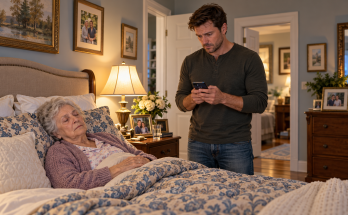
“Ellie, sweetheart, are you sure?” “It was you. You were sleeping with your blue blanket. And the picture had the little white flowers on our curtains.” 1My stomach turned. The blue blanket was folded at the foot of my bed that morning. I’d pulled it over myself the previous night because the temperature had dropped unexpectedly.
And the white flowers? They were embroidered along the edges of my bedroom curtains. Only someone who had been standing outside my window could have taken that photograph. I looked toward the hallway leading to my bedroom. For the first time in the six years we’d lived in that little house, it didn’t feel safe.
“Mommy?”
Ellie’s voice trembled.
“I’m here, sweetheart.”
“Are you mad at Mr. Frank?”
I closed my eyes.
Only minutes earlier, I’d been terrified that the school bus driver had taken my daughter away.
I’d screamed at him to stop.
I’d called the police.
I’d imagined every possible terrible thing happening inside that yellow bus.
Now I understood that Frank Lawson had seen something I hadn’t.
Something dangerous.
And he’d made a decision that frightened both of us because keeping Ellie safe mattered more than being understood.
“No, baby,” I whispered. “I’m not mad at him.”
“He told me he wasn’t leaving me alone.”
Tears filled my eyes.
“He kept his promise.”
A man’s voice came onto the line.
It was Deputy Daniel Reeves.
“Mrs. Carter, Ellie is safe here with us. The driver contacted transportation dispatch before leaving the stop, and the district coordinated with our office. We have officers checking the area near your house.”
I gripped the phone.
“Who was that man?”
“We’re working to identify him.”
“But he has a photograph of me sleeping.”
“I understand how concerning that is. We need you to stay inside, away from the windows, until an officer reaches you.”
I looked toward the front door.
Mrs. Alvarez stood on my porch, wringing her hands.
“Can I come get Ellie?”
“We’ll arrange for you to be reunited as soon as we can do that safely.”
My eyes filled.
“Please tell her I’m coming.”
“She knows, ma’am.”
Then he added something I would remember for the rest of my life.
“Your daughter did exactly what she needed to do. She told a trusted adult that something frightened her. Mr. Lawson listened.”
After the call ended, I slid down the wall until I was sitting on the hallway floor.
For several seconds, I couldn’t move.
Then Mrs. Alvarez stepped inside.
Her face was pale.
“Oh, Hannah.”
She knelt beside me.
My name is Hannah Carter.
For seven years, I’d been the only parent Ellie knew.
I knew how to handle fevers, nightmares, school projects, lost teeth, and birthday parties.
I could identify the difference between her tired crying and her frightened crying before she said a single word.
But I had no idea how to explain that a stranger had been photographing me through my bedroom window.
Mrs. Alvarez took my hand.
“He was standing behind you,” she whispered.
I looked up.
“What?”
“At the bus stop. He came from a dark sedan parked down Briar Street.”
My heart pounded.
“Did you see his face?”
“Not clearly. He had his cap pulled down.”
She swallowed.
“I was watering my flowers when I saw him walking toward you. I thought perhaps he was somebody you knew.”
I shook my head.
“He wasn’t.”
Mrs. Alvarez’s eyes filled.
“He slowed down when the bus doors opened. Then he reached toward the front of his jacket.”
I stopped breathing.
“Did he have a weapon?”
“I couldn’t see.”
She squeezed my hand.
“But Frank saw him. I know he did, because he looked straight past you.”
I thought of the driver’s expression.
The sudden movement.
The warning.
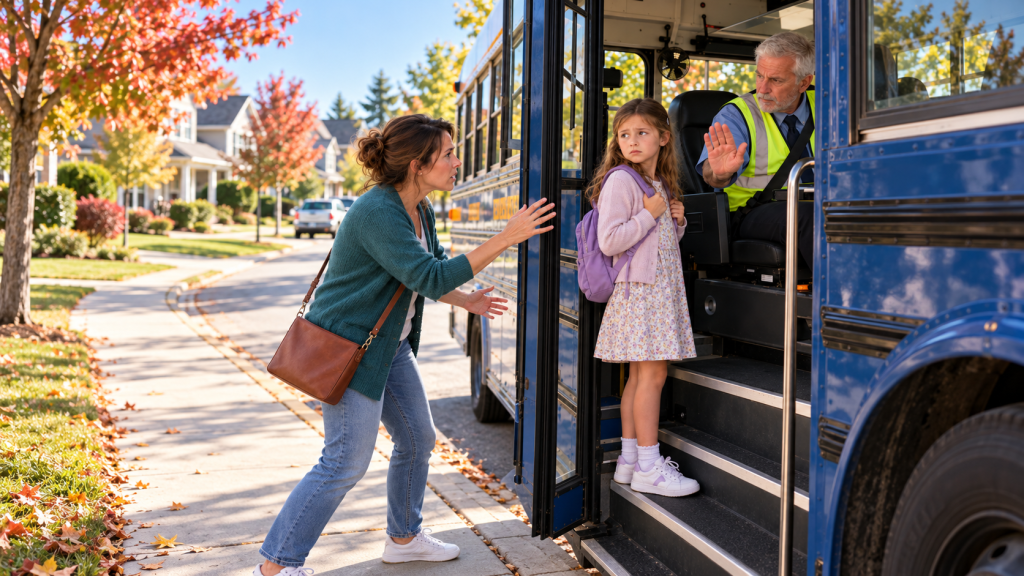
Please stay back! I need to keep her safe!
Frank hadn’t been shouting at me.
He’d been shouting at the man behind me.
And when I stepped toward the bus, trying to reach my daughter, Frank had faced an impossible choice.
Open the doors and risk letting the stranger reach Ellie.
Or drive away and risk terrifying a mother who didn’t understand.
He’d chosen to protect my child.
I covered my mouth.
“Oh, God.”
Mrs. Alvarez hugged me.
And for the first time since the bus disappeared around the corner, I began to sob.
The first patrol car arrived seven minutes later.
A female deputy named Rachel Collins came to the door, introduced herself, and asked us to describe everything we’d seen.
Mrs. Alvarez repeated her account.
I described the silver-haired bus driver, Ellie’s frightened expression, and the strange man I had completely overlooked.
Deputy Collins listened carefully.
Then she asked, “Mrs. Carter, has anyone been trying to contact you unexpectedly?”
I frowned.
“What do you mean?”
“Unwanted calls. Messages. Someone asking about your daughter.”
I hesitated.
There had been three strange calls the previous week.
Each time, I’d answered and heard silence.
I’d assumed they were spam calls.
Then, two days earlier, someone had left a small white envelope in our mailbox.
No stamp.
No return address.
Inside was a folded sheet of paper with a single sentence.
Some promises don’t expire.
I’d thought it was a religious advertisement or a strange neighborhood prank.
I’d thrown it away.
Now I told the deputy.
Her expression changed.
“Do you still have the paper?”
“No.”
“Can you remember exactly what it said?”
I repeated the sentence.
She wrote it down.
Then asked, “Does that phrase mean anything to you?”
I shook my head.
At first.
Then an old memory stirred.
A hospital room.
A man holding a newborn baby.
A promise whispered over a tiny pink blanket.
I’ll always come back for you, little moon.
My mouth went dry.
Deputy Collins noticed.
“Mrs. Carter?”
I looked at her.
“There is someone who used to say things like that.”
“Who?”
I swallowed.
“Ellie’s father.”
The deputy waited.
“What’s his name?”
“Evan Carter.”
“And where is he now?”
I stared at the floor.
“I don’t know exactly.”
She tilted her head.
“When did you last have contact with him?”
“Seven years ago.”
I closed my eyes.
“He disappeared from our lives when Ellie was two.”
I could hear my own heartbeat.
Then Deputy Collins asked gently, “Was his disappearance connected to a criminal case?”
My eyes flew open.
For a moment, I couldn’t speak.
How did she know to ask that?
Then I remembered that she’d probably already been checking records.
“Yes,” I whispered.
Evan hadn’t vanished into thin air.
He’d vanished from Ellie’s life.
The truth was that he’d been arrested after a long investigation involving forged financial documents, stolen money, and a series of threats he’d made while our marriage was falling apart.
He’d later been sentenced to prison.
I’d known where he’d gone.
I’d simply never told Ellie.
At two years old, she couldn’t understand.
At five, I’d convinced myself she was still too young.
At seven, every attempt to explain made me remember the frightening months before Evan’s arrest.
So I’d told her that her father had gone away because he couldn’t be the parent she needed.
It was true.
But it wasn’t the whole truth.
Deputy Collins looked at me carefully.
“Mrs. Carter, do you have a recent photograph of your former husband?”
I shook my head.
“The last one I kept is years old.”
“Could you show it to me?”
I stood slowly.
In the hallway was a small cabinet where I stored important papers.
Inside the bottom drawer was an old envelope.
It contained our divorce documents, Ellie’s birth certificate, and one photograph I’d never found the courage to throw away.
Evan stood beside me on the day we brought Ellie home from the hospital.
He was smiling.
His dark hair fell across his forehead.
One arm rested around my shoulders.
In the other, he held our daughter.
We looked happy.
For a while, we had been.
Deputy Collins studied the photograph.
Then asked, “Does he have a scar beneath his chin?”
I felt my stomach tighten.
“Yes.”
“On the right side?”
“Yes.”
She paused.
Then said, “I’d like to show you something.”
She took out her department-issued phone and displayed a still image from the bus’s exterior camera.
The picture was grainy.
The man wore a blue jacket and a baseball cap.
His beard was gray.
His face was broader than I remembered.
But as I looked closer, I saw the shape of his nose.
The uneven right eyebrow.
And beneath his chin, a small pale scar.
My knees weakened.
“No.”
Deputy Collins moved closer.
“Mrs. Carter?”
I shook my head.
“No, no, no.”
She didn’t rush me.
I stared at the photograph.
Then whispered the name I hadn’t spoken aloud in years.
“Evan.”
The deputy lowered the phone.
And suddenly I understood why the stranger knew Ellie’s birthday.
Why he’d claimed to know her father.
Why he’d been watching our house.
The man standing behind me at the bus stop wasn’t a stranger.
He was Ellie’s father.
And after seven years of silence, he’d returned without telling either of us.
I don’t remember getting into the patrol car.
I remember Mrs. Alvarez handing me my handbag.
I remember Deputy Collins telling another officer that our house needed to be checked before I returned.
And I remember staring through the windshield as we drove toward the sheriff’s station, wondering how a person could be absent for seven years and still have the power to make the ground disappear beneath my feet.
Evan Carter.
My former husband.
The man who had once called our daughter his little moon because she’d been born during a summer night when the sky was unusually bright.
The man who’d kissed my forehead in the hospital and promised to protect us.
The man who, years later, had forged my signature on financial paperwork and emptied accounts I didn’t know he’d opened in my name.
Our marriage had ended in a storm of unpaid bills, police interviews, and court hearings.
During one argument, shortly before his arrest, Evan had said something I’d never forgotten.
“You can leave me, Hannah. But you can’t make me stop being Ellie’s father.”
At the time, I’d thought he meant that he wanted to remain in her life.
Later, when he began threatening to take her without telling me where he was going, I understood that his idea of fatherhood included a frightening belief that love gave him the right to control other people.
After his conviction, I obtained primary legal and physical custody through the family court.
Any future contact would need to follow the court’s requirements.
Evan never completed the steps necessary to establish it.
For years, there’d been no letters addressed to Ellie that could appropriately be passed along, no court-approved contact, and no genuine effort I could verify to rebuild a safe relationship.
Eventually, I heard through his attorney that he’d been released and moved out of state.
That had been eight months earlier.
I hadn’t heard anything since.
Now I wondered whether he’d been watching us for days.
Or weeks.
Or longer.
I pressed my palms against my knees.
The deputy glanced toward me.
“Are you feeling all right?”
I laughed bitterly.
“I don’t think so.”
She didn’t offer some empty reassurance that everything would be fine.
Instead, she said, “Your daughter’s at the station. That’s where we’re going.”
I held on to those words.
My daughter is safe.
For that moment, it was enough.
Ellie was sitting in a small room beside the station lobby when I arrived.
She had her purple backpack on her lap and was holding a paper cup of water with both hands.
Frank Lawson sat in a chair near the door.
The moment Ellie saw me, she jumped up.
“Mommy!”
I dropped to my knees.
She ran into my arms so hard that we almost fell backward.
I held her.
I didn’t care that deputies were watching.
I didn’t care that my knees hurt.
I just held my daughter and felt her heart beating against mine.
“I’m here,” I whispered.
She buried her face in my neck.
“I thought you were going to be mad.”
“Oh, baby.”
I pulled back just enough to look at her.
“Why would I be mad at you?”
“Because I didn’t get off the bus.”
I shook my head.
“You did exactly the right thing.”
She began crying again.
“But you were shouting.”
“I know.”
I wiped her tears.
“I was frightened because I didn’t understand what was happening. I wasn’t angry with you.”
She studied my face.
“Promise?”
“Promise.”
Then she leaned toward my ear and whispered, “Is the man going to come here?”
My stomach tightened.
I looked toward Deputy Reeves.
He stepped closer.
“We’re making sure you and your mom are safe while we investigate.”
Ellie nodded.
She didn’t look entirely reassured.
Neither was I.
But she held my hand more tightly.
Across the room, Frank stood.
He was still wearing his dark blue driver’s jacket.
His gray hair was slightly disheveled.
For a moment, we simply looked at each other.
Then I walked toward him.
“Mr. Lawson.”
His eyes filled.
“Mrs. Carter, I’m sorry I frightened you.”
I shook my head.
“No.”
My voice broke.
“No, please don’t apologize.”
He looked down.
I reached for his hand.
“You protected my daughter.”
He swallowed.
“I was afraid if I opened those doors, he would get too close.”
I nodded through tears.
“I understand now.”
Frank took a breath.
“I tried to warn you, but I could see you were looking at Ellie. You didn’t notice him.”
I covered my mouth.
He continued.
“He was watching the bus stop, not the traffic. When Ellie came down the aisle, he moved toward the doorway.”
Frank’s voice trembled.
“And he had something in his hand. At first, I thought it was a photograph. Then I saw Ellie recognize him from the day before.”
I looked at my daughter.
She was staring at her shoes.
Frank continued.
“She’d mentioned a man at the playground earlier, just before the bus reached your stop. I asked whether she’d told a grown-up. She said she hadn’t.”
He paused.
“When I saw the same man outside, I knew I couldn’t take the chance.”
I squeezed his hand.
“You made the right choice.”
Frank blinked rapidly.
“I’ve driven children for twenty-eight years. We train for emergencies, but you never know how you’ll feel when something actually happens.”
He looked toward Ellie.
“I kept thinking that if I let her off and something went wrong, no amount of explaining afterward would matter.”
I began crying.
Because he was right.
The moment I’d watched the bus disappear, I’d believed something terrible was happening to my child.
But the real danger had been standing behind me, close enough that I hadn’t seen him.
I hugged Frank.
It surprised both of us.
Then I whispered, “Thank you for seeing what I couldn’t.”
He patted my shoulder.
“I’m glad I was there.”
A child-services specialist helped Ellie describe what had happened at the playground.
She wasn’t questioned repeatedly by a room full of officers.
One trained interviewer spoke with her gently while I waited nearby, and the investigators explained how they would preserve her account without making her relive it unnecessarily.
Later, with Ellie’s permission, they asked me to sit beside her while she showed them something in her backpack.
It was a folded piece of paper.
My heart sank.
“Where did you get that, sweetheart?”
“The man gave it to me yesterday.”
I looked at the deputy.
Ellie continued.
“He said it was from Daddy.”
She unfolded it carefully.
Inside was a handwritten message.
Dear Ellie,
I’ve waited a long time to see you. There are things your mother hasn’t told you, and I want to explain them myself. Meet me by the playground after school tomorrow. Don’t worry her before we talk. I have a surprise for you.
At the bottom was a little drawing of a crescent moon.
I recognized it immediately.
Evan used to draw that moon on birthday cards.
My eyes filled.
Ellie looked up.
“I didn’t know if I should tell you.”
I reached for her hand.
“Why not?”
“Because he said it would be a surprise.”
I swallowed.
“And I thought maybe Daddy wanted to see me.”
Her voice was so small that I almost couldn’t bear it.
“Oh, sweetheart.”
I hugged her.
She whispered, “Would that be bad?”
“No.”
I took a breath.
“It’s not wrong to wonder about your father. It’s not wrong to want to know him.”
She pulled back.
“Then why did he tell me not to tell you?”
I looked at the letter.
“That’s one of the things grown-ups are going to have to answer.”
The specialist spoke gently.
“Ellie, when an adult asks you to keep a secret about meeting them somewhere, it’s always okay to tell your mom or another trusted adult. Even if they say it’s a surprise.”
Ellie nodded.
Then asked, “Did I make a mistake?”
I shook my head.
“No, baby. An adult made an unsafe choice. You are not responsible for that.”
She looked toward Frank through the glass window.
“He told me I didn’t have to keep it secret.”
I followed her gaze.
Frank was speaking quietly with a transportation official.
My eyes filled again.
A man I’d barely known had given my daughter permission to speak when another adult had tried to make her feel obligated to stay silent.
That permission might have saved her life.
Or at the very least, spared her from something frightening that no nine-year-old should have to manage alone.
At six that evening, Deputy Reeves returned with new information.
Ellie was resting in a family room with a counselor and a coloring book.
I stood in the corridor with Deputy Collins.
“We’ve located the sedan,” Reeves said.
My heart raced.
“Where?”
“At a roadside motel about twelve miles outside town.”
“Was Evan there?”
“He wasn’t in the room when officers first arrived. We located him nearby and brought him in for questioning.”
I gripped the edge of a chair.
“Did he admit taking the photograph?”
“The investigation is ongoing. We have evidence suggesting he has been in your neighborhood on multiple occasions.”
My stomach tightened.
“How many?”
“We’re still determining that.”
He paused.
“Mrs. Carter, do you remember anyone coming to your house recently asking about a utility inspection?”
I stared.
“Yes.”
Two weeks earlier, a man had knocked on my door wearing a reflective vest.
He’d said he was checking the location of buried cables before work on the neighboring property.
I’d told him the utility boxes were behind the house.
He’d thanked me and walked toward the side yard.
I hadn’t thought anything of it.
I looked at Reeves.
“Oh, God.”
He nodded.
“We found a reflective vest and related paperwork in the vehicle. We’re working to verify whether any legitimate inspection was scheduled.”
I covered my mouth.
The man at my door had been wearing sunglasses.
A cap.
His face mostly hidden.
And I’d barely looked at him.
I remembered standing in the doorway with a basket of laundry against my hip.
Ellie had been upstairs, doing homework.
I’d let him walk around the side of the house.
Near my bedroom window.
My knees weakened.
Deputy Collins guided me into a chair.
“Mrs. Carter, this isn’t your fault.”
I looked up.
“He came right to my house.”
She nodded.
“And he misrepresented why he was there.”
I stared at my hands.
“Could he have gotten inside?”
“We haven’t established that. Officers are checking the property. We’ll tell you what we can verify.”
I nodded.
But inside, I was shaking.
Seven years earlier, I’d struggled to free myself from a marriage in which Evan controlled money, decisions, and eventually the truth.
Now he’d returned pretending to be someone else.
And the most frightening part wasn’t that I hadn’t recognized him.
It was that he’d known I might not.
By eight-thirty that evening, the officers had finished their initial inspection of our house.
They found footprints beneath my bedroom window.
A small patch of crushed flowers along the side fence.
And marks on the wooden gate where someone had apparently been opening it repeatedly.
Nothing indicated that Evan had entered the house.
That should have comforted me.
Instead, I kept thinking about the photograph.
Someone had stood outside my bedroom window while I slept.
Someone had watched me in the one room where I believed I could close the door on the rest of the world.
And that someone had been my former husband.
Deputy Collins explained that investigators had found several photographs of my house and the school bus route among Evan’s belongings. They were collecting information about when the images had been taken and what he intended to do.
He had also been questioned about approaching Ellie at the playground and giving her the letter.
I asked whether he would be arrested.
The deputy explained that investigators were evaluating the evidence and coordinating with prosecutors, including whether his behavior violated any existing court orders.
I appreciated that she didn’t promise an outcome she couldn’t guarantee.
But uncertainty was difficult.
After years of building a peaceful life, I wanted one person to tell me that danger had ended.
Instead, I had to accept that safety would come from practical steps, not from a single reassuring sentence.
A victims’ advocate helped me contact Catherine Monroe, a family-law attorney who could review our existing custody orders.
The advocate also explained how to seek protection from further unwanted contact.
The school district agreed to review Ellie’s transportation arrangements and maintain strict pickup procedures.
I gave the school the relevant court paperwork and confirmed that Evan was not authorized to collect Ellie.
We changed the locks at home.
Had the exterior lighting repaired.
Installed better window coverings.
And arranged for Ellie and me to spend a few nights with my older sister, Laura, while everything was assessed.
Laura lived twenty minutes away.
When we arrived, she opened the door and wrapped both of us in a hug.
Ellie held on to her purple backpack.
She looked exhausted.
“Can I sleep with Mommy?” she asked.
Laura smiled gently.
“Of course.”
Ellie looked toward me.
“Even though I’m nine?”
I crouched beside her.
“Especially tonight.”
Her shoulders relaxed.
For the first time since the bus incident, she gave me a small smile.
That night, Ellie couldn’t sleep.
She lay beside me in Laura’s guest bedroom, holding the stuffed moon she’d had since she was a baby.
The room was dark except for a little lamp near the door.
For nearly an hour, she said nothing.
Then she whispered, “Mommy?”
“I’m here.”
“Was that really my dad?”
I closed my eyes.
I’d been afraid of this conversation for seven years.
I’d imagined having it when she was older.
When she could understand complicated things.
When I could find the perfect words.
But children don’t always ask important questions when adults feel prepared.
Sometimes they ask in the middle of the night, after something frightening has happened, when all the careful explanations you’ve rehearsed suddenly feel useless.
“Yes,” I answered.
She was quiet.
Then asked, “Why didn’t you tell me he was coming back?”
“I didn’t know he was coming.”
She turned toward me.
“But you knew where he went.”
My throat tightened.
I looked at her.
“Ellie, your dad made some serious choices when you were very little. He took money that didn’t belong to him and lied about things that mattered. He was arrested and went to prison.”
She stared at me.
“Like on television?”
I nodded.
“In some ways.”
“Was he bad?”
I took a long breath.
“People aren’t always simple enough to fit into one word. Your dad did things that were wrong and hurtful. And some of the choices he made were unsafe.”
She looked down at her stuffed moon.
“Did he hurt you?”
I hesitated.
I didn’t want to give her frightening details she wasn’t ready to hear.
But I also didn’t want to teach her that telling the truth was something adults did only when it was convenient.
“He frightened me before we separated,” I said. “He tried to control things he didn’t have the right to control. I needed help making sure we were safe.”
She was quiet.
Then she asked, “Did he go away because of me?”
I sat up immediately.
“No, sweetheart.”
I pulled her closer.
“Absolutely not.”
Her eyes filled.
“Maybe I cried too much when I was little.”
My heart broke.
“Oh, Ellie.”
I held her face gently between my hands.
“Nothing you did caused your dad to leave. You were a little girl. Taking care of you was his responsibility, not the other way around.”
She began crying.
“But he knew my birthday.”
“Yes.”
“And he drew my moon.”
I nodded.
“He remembered things about you.”
She looked at me.
“Does that mean he loves me?”
For a moment, I couldn’t answer.
I didn’t know what Evan felt.
I knew what he’d once said.
I knew he’d held our newborn daughter and cried.
I knew he’d wanted to be part of her life, at least in some way.
But I also knew he’d chosen to frighten her rather than approach us safely and honestly.
So I answered as carefully as I could.
“He may have loving feelings for you, Ellie. I can’t tell you exactly what’s in his heart.”
She waited.
“But loving someone doesn’t give you permission to frighten them, lie to them, or ask them to keep unsafe secrets.”
She considered that.
“Even if he’s my dad?”
“Even then.”
Tears slipped down her cheeks.
Then she whispered, “I wanted him to be nice.”
I pulled her against my chest.
“I know, baby.”
She cried for a long time.
And I let her.
Because I realized she wasn’t only frightened of the man who’d appeared at the bus stop.
She was grieving the father she’d imagined.
The one she thought might arrive someday with a birthday cake, an apology, and an explanation that made everything right.
I couldn’t give her that father.
But I could give her the truth.
And I could let her feel sad about it without asking her to pretend she wasn’t.
Three days after the incident, Detective Celia Ward called.
She’d been assigned to the investigation and wanted to update me on what she could share.
Evan had been charged in connection with his unwanted conduct, including alleged stalking and trespassing, and the court had imposed no-contact conditions while the case proceeded.
The detective was careful to explain that the allegations would still have to be addressed through the legal process.
But the evidence was substantial.
Investigators had found a notebook containing dates, bus arrival times, and observations about my schedule.
There were notes describing when I left the house, when I returned from work, and when the lights went out in my bedroom.
One entry read:
Tuesday. Mother distracted by child at bus door.
My hands began shaking.
He’d known I would be looking at Ellie.
He’d been counting on it.
Detective Ward continued.
“We also reviewed footage from another nearby camera. It shows him approaching the bus stop shortly before the bus arrives.”
I gripped the phone.
“Was he trying to take Ellie?”
“We can’t conclusively tell you his intentions from the footage alone. But his efforts to arrange a private meeting with her, together with the surveillance, are extremely concerning.”
I nodded.
Then she said something that made my throat tighten.
“Mrs. Carter, there’s another reason we wanted to speak with you.”
I stared at the wall.
“What?”
“Evan told us he believed his parental rights meant he could contact Ellie whenever he wished.”
I closed my eyes.
The old argument.
The same belief that had frightened me years before.
Detective Ward continued.
“We’ve advised him that he must comply with the applicable court orders and the conditions placed on him. He can’t simply decide to bypass the legal process.”
I looked toward the kitchen, where Laura was helping Ellie with a puzzle.
Then I whispered, “Did he say why he took the picture of me sleeping?”
There was a pause.
“Yes.”
My heart pounded.
“What did he say?”
“He said he wanted proof that you were still living alone.”
For a moment, the room seemed to go silent.
Not because I had forgotten how to breathe.
Because I suddenly understood something about Evan that had taken me years to recognize.
He hadn’t been searching for the best way to become a father again.
He’d been searching for the moment when he thought I would be easiest to frighten.
I sat down.
Then asked quietly, “And the letter he gave Ellie?”
Detective Ward paused.
“He described it as an attempt to reconnect.”
I looked at the doorway.
Ellie was laughing at something her aunt had said.
A small, beautiful sound.
The sound of a childhood continuing.
I thought of the sentence he’d written to her.
Don’t worry her before we talk.
Then I answered, “People who want to reconnect don’t need to make a child keep secrets from her mother.”
The detective was quiet.
Finally, she said, “That’s an important part of what we’re looking at.”
After we ended the call, I sat alone for several minutes.
Then I opened the photograph of Ellie I’d taken on the first day of school.
She was standing beside our front door, grinning beneath a backpack almost as large as her shoulders.
Nine years old.
Missing two baby teeth.
Still convinced she might someday discover a new species of butterfly.
My daughter deserved to grow up without being responsible for the mistakes her father made.
And I was going to do everything I could to give her that chance.
The weeks that followed weren’t easy.
There were meetings with attorneys.
Updates from investigators.
Conversations with school officials.
And nights when Ellie woke from dreams she couldn’t explain.
Sometimes she asked whether Evan knew where we were.
Sometimes she wondered whether he would try to see her again.
Other times, she said nothing at all.
She simply sat beside me on the sofa, holding her stuffed moon.
I learned not to fill every silence with reassurance.
Some fears needed time.
Some questions didn’t have immediate answers.
And sometimes what Ellie needed most was to know that I wouldn’t disappear when the conversation became difficult.
We began seeing a child counselor named Dr. Rebecca Sloan.
She helped Ellie understand that being frightened didn’t mean she was weak and that missing the idea of her father didn’t mean she wanted to see the man who’d scared her.
During one session, Ellie drew a yellow school bus.
Inside was a little girl wearing a purple backpack.
Beside the driver’s seat stood a man with silver hair.
Outside was a woman holding out her arms.
When Dr. Sloan asked what the picture meant, Ellie thought carefully.
Then she said, “Sometimes people protect you even when you don’t understand what they’re doing.”
I cried when the counselor told me.
Because my daughter had understood something that had taken me thirty-eight years to learn.
Safety doesn’t always feel comfortable in the moment.
Sometimes it looks like a locked door.
Sometimes it looks like a difficult boundary.
And sometimes it looks like an old school bus pulling away while a mother screams for it to stop.
In the months that followed, the criminal case moved through the courts.
I attended the proceedings when needed, supported by Laura and a victims’ advocate.
I learned more about the surveillance, the false utility-worker story, and the way Evan had tried to arrange a private meeting with Ellie.
He eventually accepted responsibility for several of the offenses through a plea agreement. The resulting court conditions restricted further contact and required him to comply with the separate family-court orders.
Our family-law attorney helped ensure that no arrangement for contact with Ellie would be made without a proper review of her safety and welfare.
There was no dramatic confrontation where Evan suddenly understood all the damage he’d caused.
No speech that erased seven years.
No magical apology.
What mattered was that there were enforceable boundaries and people who could help us maintain them.
Ellie never had to enter a courtroom to prove she was frightened.
And I stopped feeling obligated to explain her father’s behavior in a way that made him seem better than his choices.
One afternoon, she asked whether people who did wrong things could change.
“Sometimes,” I answered.
She looked thoughtful.
“Do you think Daddy will?”
“I hope he chooses to become a safer, more responsible person.”
She nodded.
Then asked, “Do we have to wait for him?”
I pulled her close.
“No, sweetheart.”
I kissed the top of her head.
“We can hope somebody changes without putting our lives on hold.”
She smiled.
“Good. Because I have a science fair.”
I laughed through tears.
“Then we’d better get started.”
The school district completed its review of what happened on Route 24.
The bus camera footage, radio communications, and dispatch records confirmed that Frank had reported the concern and taken Ellie to a secure location.
The district also reviewed its procedures for notifying families during emergencies, because the time between the bus leaving our stop and my receiving an explanation had been terrifying.
The transportation director called me personally.
“Mrs. Carter, Mr. Lawson acted to protect your daughter. We’re grateful he noticed the risk and communicated with dispatch.”
I began crying.
“I know.”
She paused.
“Would you like to speak with him?”
“Very much.”
We arranged to meet at the bus garage one Friday afternoon.
Ellie insisted on coming.
She spent the previous evening making something at the kitchen table.
When I asked what she was doing, she covered it with her elbows.
“It’s a surprise.”
I laughed.
“All right.”
The next afternoon, Frank was standing beside Route 24 when we arrived.
He wore his usual dark blue jacket.
His silver hair was neatly combed.
And when he saw Ellie, his serious expression softened into the warmest smile.
“Well, hello there, young lady.”
Ellie ran toward him.
Then stopped a few feet away.
“Mr. Frank?”
“Yes, sweetheart?”
She held out a handmade card.
On the front she’d drawn a bright yellow bus beneath a blue sky.
Inside, in careful purple handwriting, she’d written:
Dear Mr. Frank,
Thank you for keeping me safe when I was scared. I know you were scared too, but you helped me anyway.
Love, Ellie.
Frank read it slowly.
Then his eyes filled.
For a moment, he couldn’t speak.
Finally, he looked toward me.
“I’ve driven a lot of children over the years.”
His voice trembled.
“But I don’t think anybody’s ever given me something quite like this.”
Ellie smiled.
Then she asked, “Were you really scared?”
Frank crouched so they were eye to eye.
“Yes, I was.”
She looked surprised.
“But grown-ups are supposed to be brave.”
He smiled gently.
“Being brave doesn’t always mean you’re not frightened.”
Ellie considered that.
“Then what does it mean?”
Frank looked at her for a long moment.
“It means you try to do what’s right even when you’re frightened.”
She nodded.
Then threw her arms around his neck.
He hugged her carefully.
I stood a few feet away, wiping tears from my cheeks.
For years, Frank had been simply the man who drove the bus.
A familiar face.
A brief greeting.
Someone whose work was so dependable that I’d rarely thought about how much responsibility he carried.
But on that Tuesday afternoon, he’d noticed what I hadn’t.
He’d made the difficult decision.
And he’d stayed beside my daughter until she was safe.
I would never forget that.
By the following autumn, Ellie was riding Route 24 again.
It hadn’t happened overnight.
For several weeks, I drove her to school.
Then we practiced waiting at the bus stop together.
We worked with her counselor and the transportation office to make sure she understood what to do if somebody approached her or asked her to keep an unsafe secret.
We didn’t teach her that every stranger was dangerous.
We taught her to pay attention to her instincts, seek help, and remember that she never owed an unfamiliar adult her trust simply because they claimed to know her family.
Gradually, the bus stopped being a reminder of fear.
It became a familiar part of her day again.
One crisp October afternoon, I stood at Willow Lane and Briar Street.
The leaves were turning gold.
A light breeze moved through the trees.
At 3:19, the yellow bus appeared around the corner.
Route 24.
I felt the old fear rise for a moment.
Then I saw Frank behind the wheel.
He pulled up beside the curb.
The doors opened.
And Ellie came down the steps, wearing her purple backpack and an enormous smile.
“Mom!”
I opened my arms.
She ran toward me.
I hugged her tightly.
Then looked up at Frank.
He gave me a small nod.
I smiled.
No words were necessary.
Ellie waved goodbye, and the bus continued down the road.
We walked home together.
She told me about a spelling test, a classmate’s new puppy, and the science project she’d decided to enter.
The entire way, she held my hand.
When we reached our front porch, she stopped.
“Mommy?”
“Yes?”
“Do you remember the day Mr. Frank wouldn’t let me off the bus?”
I felt my throat tighten.
“Of course.”
She looked thoughtful.
“I used to think that was the worst day ever.”
I nodded.
“It was frightening.”
She squeezed my fingers.
“But now I think it was the day somebody noticed.”
My eyes filled.
I knelt beside her.
“What do you mean?”
She looked directly at me.
“Mr. Frank noticed I was scared. Mrs. Alvarez noticed the man. And you noticed something was wrong when the bus left.”
She paused.
“Everybody helped.”
I smiled through tears.
“Yes, sweetheart.”
She leaned against me.
“And you didn’t stop looking for me.”
I wrapped my arms around her.
“Never.”
That evening, after Ellie was asleep, I sat beside her bedroom window.
Moonlight fell across her pillow.
Her purple backpack rested against the desk.
On the wall hung a drawing of a yellow school bus, framed beside the card she’d made for Frank.
I thought about the strange, frightening road we’d traveled.
About Evan.
The secrets I’d kept because I thought I was protecting my daughter.
The truth she’d eventually needed to hear.
The people who’d helped us when I couldn’t manage everything alone.
And the quiet courage of a school bus driver who’d refused to look away.
For years, I’d believed protecting Ellie meant keeping every frightening thing outside her world.
But I couldn’t control everything that happened beyond our front door.
I couldn’t guarantee she’d never encounter dishonesty, disappointment, or danger.
What I could do was listen.
Tell her the truth in ways she could understand.
Teach her that her voice mattered.
And surround her with people who believed the same.
I looked at her sleeping face.
Nine years old.
Still young enough to clutch a stuffed moon.
Old enough to recognize that someone who claimed to love her might not always act safely.
And wise enough to understand that courage sometimes belongs to the people who notice what others overlook.
I reached over and switched off the bedside lamp.
Then whispered the words I wanted her to carry throughout her life.
“You never have to stay silent when something feels wrong, sweetheart. There will always be people willing to listen.”
That afternoon at the bus stop, I’d thought a man was taking my daughter away.
I hadn’t understood that he was protecting her.
I’d thought the greatest danger was inside the bus.
I hadn’t noticed it standing behind me.
And I’d thought being a good mother meant seeing everything, knowing everything, and never needing anyone else’s help.
I knew better now.
A mother’s love is powerful, but sometimes protecting a child takes more than one pair of eyes.
Sometimes it takes a watchful neighbor.
A careful deputy.
A patient counselor.
And a silver-haired school bus driver who knows when keeping the doors closed is the kindest thing he can do.
I would always remember the terror of watching Route 24 pull away.
But I would remember something else even more.
My daughter came home because someone chose her safety over his own comfort, even when he knew I might misunderstand.
And that was the kind of courage I hoped Ellie would recognize—and someday carry into the world herself.
THE END STORIES! THANK YOU FOR READING GOOD LUCK !❤️
Related Posts