For a moment, I thought I’d misunderstood my daughter-in-law. I stood beside the kitchen table in my slippers, holding a cup of coffee that had already gone cold. Outside, the first pale light of morning was spreading across our quiet Ohio neighborhood. Inside, my son looked as though somebody had struck him.
“What account?” I asked. Clare’s eyes were red. She had returned from the cash machine less than twenty minutes earlier, still wearing her winter coat. Her hands were trembling so badly that she couldn’t manage the zipper. “Eleanor,” she whispered, “I found statements in Mark’s things yesterday. There’s a credit account in your name.”
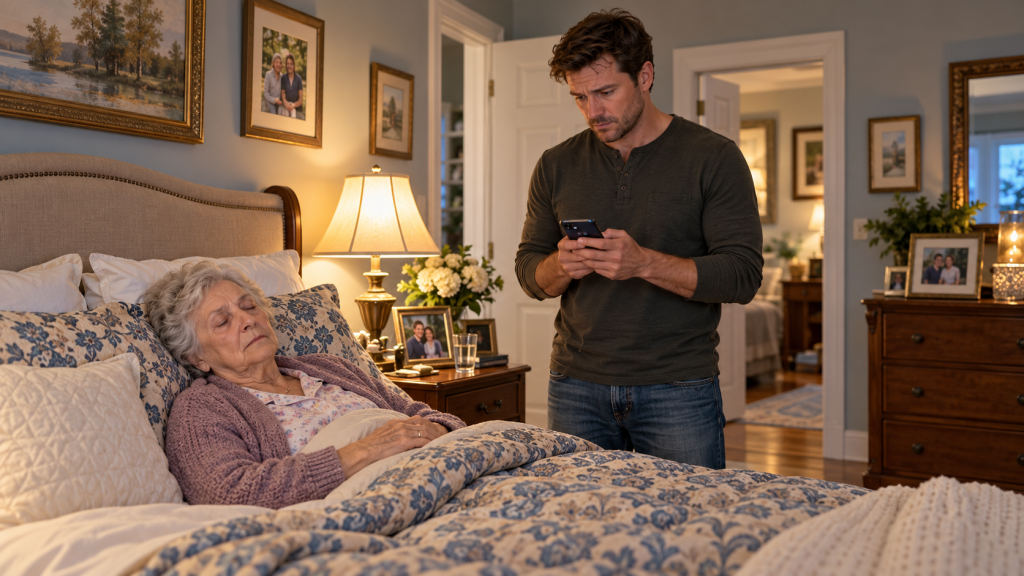
I turned toward my son. “Mark?” He stared at his coffee. “Mom, it’s complicated.” I had heard those words before. When he’d borrowed money for a car he couldn’t afford. When he’d promised to repay the six thousand dollars I’d given him for moving expenses. When he and Clare needed somewhere temporary to stay and three weeks quietly became seven months.
“It’s complicated” always seemed to mean that someone else would be expected to make his problem disappear.
I pulled out a chair.
“Sit down, both of you.”
Clare obeyed immediately.
Mark remained standing.
“Mom, please. Don’t make this into something bigger than it is.”
I looked at him.
“Bigger than what, exactly? Planning to take eighty thousand dollars from my retirement savings while I was asleep?”
He flinched.
Clare covered her mouth.
I continued.
“Or opening an account using my identity without asking?”
Mark finally sat.
For several seconds, nobody spoke.
Then I asked, “How much?”
My son closed his eyes.
“Thirty-eight thousand five hundred.”
I felt the breath leave my chest.
“What?”
“That’s the credit limit.”
“How much have you used?”
He rubbed his forehead.
“Thirty-one thousand, eight hundred and some change.”
I gripped the edge of the table.
Thirty-one thousand eight hundred dollars.
Borrowed under my name.
Without my permission.
For a moment, I heard nothing except the old kitchen clock ticking above the stove.
That clock had belonged to my husband, Daniel.
He’d bought it at a flea market during our first year of marriage, when we could barely afford groceries.
For thirty-eight years, it had marked the hours of our ordinary life.
Early shifts.
School mornings.
Birthdays.
Anniversaries.
The nights Daniel came home so tired that he fell asleep in his chair before supper.
He’d died six years earlier, leaving me the house and a lifetime of memories I still wasn’t ready to pack away.
Now our only son sat beneath that clock, admitting he’d borrowed a small fortune under my name.
“Why?” I whispered.
Mark lowered his eyes.
“I was going to pay it back.”
“That isn’t what I asked.”
His jaw tightened.
“I needed money.”
“So you used my identity?”
He didn’t answer.
I turned toward Clare.
“Did you know?”
She began crying.
“Not when he opened it.”
“But you knew about the plan to take my savings.”
She nodded.
I waited.
Finally, she whispered, “Yes.”
I closed my eyes.
It would have been easier if she had denied everything.
If she had claimed Mark forced her.
If she had invented some elaborate misunderstanding involving a gift or a loan.
But she didn’t.
“I knew we didn’t have your permission,” Clare said. “I told myself we’d put it back before you noticed.”
I opened my eyes.
“And you believed that?”
She shook her head.
“Not really.”
For the first time, I saw the full shape of what had happened.
My son hadn’t made one desperate mistake in the middle of the night.
He’d made a series of choices.
And Clare, even while frightened, had made choices of her own.
I set my coffee aside.
“Tell me everything.”
Mark looked toward the window.
“Mom, can’t we do this later?”
“No.”
My voice was quiet.
“We’re doing it now.”
He stared at me.
Perhaps he expected shouting.
Perhaps he expected tears.
Perhaps he expected me to crumble and beg him to explain how such a terrible thing could be forgiven.
Instead, I sat straight in my chair and waited.
Finally, he took a breath.
“I lost my job in February.”
Clare turned toward him.
“What?”
Mark stared at the table.
“I was laid off.”
His wife looked stunned.
“You told me they moved you to another department.”
He didn’t answer.
“Mark, you’ve been leaving the house every weekday.”
He swallowed.
“I know.”
“Where have you been going?”
He rubbed his face.
“The library. Sometimes a coffee shop. I’ve been applying for jobs.”
Clare stared at him.
Then whispered, “You let me think you were working?”
He nodded.
I watched my daughter-in-law’s expression change.
Not simply from anger.
From shock.
I knew that expression.
It was the face of someone realizing that the person beside them had been living in a different reality for months.
Mark began explaining.
He’d been passed over for a promotion before losing his job.
He’d argued with his supervisor.
He’d told Clare he’d resigned for a better opportunity.
Then, when the opportunity failed to materialize, he’d kept pretending everything was normal.
He used credit cards to cover his payments.
Then cash advances.
Then loans.
When those became difficult to manage, he opened the new account using my name and personal information.
“How did you get my information?” I asked.
He looked away.
“From the filing cabinet.”
The one in my hallway.
The one containing Daniel’s death certificate, my insurance papers, old tax returns, and the documents I trusted my family not to misuse.
I stared at him.
“You went through my private records.”
He nodded.
“And you knew my PIN?”
He swallowed.
“I saw you enter it at the grocery store once.”
I felt suddenly cold.
He’d watched me pay for groceries.
Stored four little numbers in his memory.
Then repeated them to Clare while he believed I was asleep.
My son had learned how to steal from me during a perfectly ordinary afternoon when I’d believed we were shopping together.
I looked down at my hands.
They were sixty-four-year-old hands.
The knuckles slightly swollen.
The skin thinner than it used to be.
Hands that had worked in a pharmacy for thirty-seven years.
Hands that had folded Mark’s baby clothes, helped him build model airplanes, and held Daniel’s during his last night in the hospital.
Now they rested on the table between two people who had been preparing to take everything I’d saved.
“Mark,” I said, “you could have told me you’d lost your job.”
He shook his head.
“You would’ve been disappointed.”
I looked at him.
“I’m your mother. I might have been worried. I might have offered to help you make a plan. But instead, you let me believe you were employed while using my identity to borrow money.”
His face crumpled.
“I didn’t know how to tell you.”
I leaned forward.
“You knew how to forge my consent. You knew how to apply for credit. You knew how to convince your wife to use my bank card before daylight.”
Tears slipped down my cheeks.
“You knew how to do all of that.”
He covered his face.
“But you didn’t know how to tell me the truth?”
He began crying.
And for the first time in my life, I didn’t rush to comfort him.
Clare spoke when the silence became unbearable.
“There’s something else.”
Mark looked up sharply.
“Clare.”
She shook her head.
“No. I’m finished keeping secrets.”
She turned toward me.
“Eleanor, yesterday I found a folder in his car. There was more than the credit account.”
My stomach tightened.
“What was in it?”
She swallowed.
“Copies of your financial records. A form to request access to your accounts. And a document about giving someone authority to manage your money.”
I looked at Mark.
“What document?”
He shook his head.
“Nothing was signed properly.”
“That wasn’t my question.”
Clare reached into her handbag.
She removed a folded photocopy and placed it on the table.
Across the top were the words:
DURABLE FINANCIAL POWER OF ATTORNEY — DRAFT.
My name appeared in the section identifying the person granting authority.
Mark’s name appeared where an agent would be listed.
There was no completed witness or notary section.
But near the bottom, where my signature would belong, someone had made several attempts to imitate it.
I recognized the long looping E.
The slanted H.
The distinctive way I crossed the final stroke of Hayes.
My throat tightened.
“You practiced my signature.”
Mark stared at the floor.
“I never used that form.”
I looked at him.
“Did you think that made it all right?”
He said nothing.
I picked up the paper.
For years, I’d kept a little notebook beside my bed.
I wrote grocery lists.
Appointments.
Birthdays.
Occasionally, I’d write things down because I didn’t want to forget them.
Mark used to tease me about it.
“Mom, you write down everything.”
I’d laugh and tell him that writing things down was how I kept life organized.
Now I wondered whether he’d mistaken ordinary aging for an opportunity.
“Why did you want authority over my accounts?” I asked.
His voice was barely audible.
“I thought if I managed them for a while, I could straighten everything out.”
I stared.
“Straighten out whose problems?”
He didn’t answer.
I looked at Clare.
She was crying silently.
Then she said, “He told me you were starting to forget things.”
My chest tightened.
“What?”
“He said you were getting confused about bills. He said you might need help with your finances soon.”
I looked at Mark.
For several seconds, I couldn’t speak.
Then I asked, “Did you believe him, Clare?”
She shook her head.
“Not entirely. I’ve watched you balance your checkbook. I’ve watched you plan every expense. I knew you weren’t confused.”
“Then why did you go along with it?”
Her face crumpled.
“Because I was afraid of losing our marriage. Because he kept promising everything would be fixed. Because it was easier to tell myself we were borrowing than admit we were stealing.”
I sat back.
There it was.
Not an excuse.
But the truth.
Fear could make people do terrible things.
So could shame.
And so could the belief that someone else would always rescue them.
I looked at my son.
“Mark, I used to think the worst thing that could happen between a mother and son was that they’d stop speaking.”
He lifted his head.
My eyes filled.
“But I think there’s something worse.”
He waited.
“Continuing to speak every day while one of them quietly destroys the other’s trust.”
He began sobbing.
I didn’t move.
Because love had already taught me how to hold him.
Now I needed to learn how to hold a boundary.
I didn’t call the police that morning.
Not immediately.
I called the fraud specialist at my credit union.
Her name was Denise Warren, and she’d helped me three weeks earlier when I mentioned the missing bank statements and the questions Mark kept asking about my savings.
Denise answered on the second ring.
“Eleanor?”
I could hear concern in her voice.
“Are you all right?”
I looked across the kitchen table.
Mark sat with his head bowed.
Clare stared at the untouched coffee in front of her.
“No,” I answered. “But my savings are safe, aren’t they?”
Denise paused.
“The old debit card is inactive. The attempted withdrawal overnight was declined, and the account protections we discussed are still in place. We should review everything else together.”
I exhaled.
“There’s an account in my name that I didn’t open.”
Her tone changed immediately.
“Then we need to document that and contact the institution involved. Can you come in this morning?”
“Yes.”
“Bring whatever information you have. And Eleanor?”
“Yes?”
“Don’t share any new passwords or access codes with anyone.”
I looked toward my son.
“I won’t.”
After the call, I asked Mark and Clare to give me space.
Mark looked up.
“Mom, can we just work this out between us?”
I felt my chest tighten.
For years, those words had been enough.
Let’s keep this in the family.
There’s no reason to embarrass anybody.
You know I’d never deliberately hurt you.
Every time, I’d quietly absorbed the consequences.
But this was different.
Someone had used my identity to obtain credit.
There were documents bearing imitations of my signature.
And Mark had attempted to take money from an account meant to support me through retirement.
“No,” I said.
He stared.
“We’ll discuss what happens next, but I’m not hiding this.”
His face went pale.
“You’re going to report me?”
I took a breath.
“I’m going to report what happened to my accounts.”
“Mom, that could ruin my life.”
The words struck me.
I looked at him.
“Mark, you were prepared to take my retirement savings. Did you think about what that would do to mine?”
He began crying again.
I wanted to reach across the table.
To tell him I would make everything better.
To promise that nobody would ever know.
But I didn’t.
Instead, I stood.
“I need you both to understand something. I love you, Mark. That hasn’t changed. But love is not permission to take what isn’t yours.”
Then I left the kitchen.
For the first time since they’d moved into my house, I closed my bedroom door and locked it.
Not to punish them.
To have one room where I could think without being asked to solve somebody else’s problem.
By ten-thirty, I was sitting across from Denise at the credit union.
My oldest friend, Ruth Holloway, had driven me.
Ruth was sixty-seven, a retired school secretary who’d known me since Mark was in second grade.
When I called her, I hadn’t needed to explain much.
“I need someone to sit beside me at the bank,” I’d said.
She answered immediately.
“Give me ten minutes.”
She arrived with a thermos of tea, an extra cardigan, and the determined expression of someone who knew when a friend needed help more than advice.
At the credit union, Denise reviewed the unauthorized withdrawal attempt, the replacement card, and the protections on my account.
Then she helped me contact the lender associated with the second account.
A representative confirmed that an online credit line had been opened in my name four months earlier.
The application used my date of birth, address, and other personal information.
The contact email did not belong to me.
Neither did the phone number.
The account had already been used for several transactions.
I stared at the statement.
There were payments to credit cards.
An automobile lender.
An online debt-consolidation service.
And a transfer to an account I didn’t recognize.
The total amount owed, including accrued charges, was more than thirty-two thousand dollars.
I felt sick.
“Will I have to repay it?” I asked.
Denise spoke gently.
“That will need to be investigated by the lender. We can help you understand the identity-theft reporting process, but I can’t promise an outcome before the records are reviewed.”
I nodded.
I appreciated her honesty.
We documented the disputed account.
I requested the lender’s application records and asked that the account be investigated as unauthorized.
I changed my online banking credentials.
Reviewed the security of my email account.
And began placing fraud protections and credit freezes where appropriate.
Denise also explained why the previous night’s plan couldn’t have worked the way Mark imagined.
A bank card and its PIN weren’t enough to withdraw eighty thousand dollars in one early-morning transaction.
Daily limits and account protections existed.
But that didn’t make the attempt harmless.
The card had been a starting point.
Given the information Mark possessed, I needed to treat the entire situation as an identity-security problem.
Ruth sat beside me throughout the appointment.
She didn’t interrupt.
Didn’t ask how I’d managed to raise a son capable of this.
Didn’t tell me everything would be fine.
When the meeting ended, she simply reached for my hand.
“Do you want to go home?”
I looked at her.
“Not yet.”
She nodded.
“Then we won’t.”
We drove to a small diner near the river.
I ordered tomato soup.
Ruth ordered a turkey sandwich.
For a while, we watched people moving past the window.
Then she asked, “Do you remember when Mark was ten and broke your kitchen window with a baseball?”
I smiled sadly.
“How could I forget?”
“He came to my house crying because he was afraid you’d be angry.”
I nodded.
“He thought I’d take away his bike.”
Ruth looked at me.
“And what did you do?”
“I told him he’d have to help pay for the glass.”
“Exactly.”
She took a sip of tea.
“You didn’t stop loving him.”
“No.”
“But you made him take responsibility.”
I looked down.
Ruth continued.
“He’s not ten anymore, Eleanor. The responsibility is larger now.”
Tears filled my eyes.
“I know.”
She squeezed my hand.
“You can love him without protecting him from every consequence.”
I stared through the window.
And for the first time that morning, I felt something besides pain.
A small measure of clarity.
That afternoon, I consulted an attorney named Meredith Shaw.
She specialized in elder financial issues and estate planning.
I’d expected a stern woman who would tell me I’d been foolish to let my son move in.
Instead, Meredith listened quietly while I explained everything.
When I finished, she said, “Eleanor, the fact that you trusted your son does not mean you authorized him to use your identity.”
I swallowed.
“He lived in my house.”
“That doesn’t make your private financial information his.”
She reviewed the draft power-of-attorney form.
“The incomplete document doesn’t give him authority,” she explained. “But the attempts to imitate your signature are concerning, especially alongside the unauthorized credit application.”
I nodded.
Then I asked the question that had been troubling me since breakfast.
“What if Mark says I gave him permission?”
Meredith looked at me.
“Then we document the facts. Your communications, the application records, the financial transactions, and any other relevant evidence can be examined. We won’t resolve a dispute by guessing about what someone might claim.”
She helped me make a practical plan.
I would file a report with law enforcement about the identity theft and attempted unauthorized withdrawal.
I would preserve my records and the messages I’d received.
I’d review my credit reports and dispute accounts or transactions I hadn’t authorized.
And I would address Mark and Clare’s living arrangements lawfully, with proper notice rather than an impulsive confrontation.
“Can I make them leave?” I asked.
“We can determine what notice and procedures apply to their situation,” Meredith answered. “You don’t have to keep housing them indefinitely. But we’ll handle it correctly.”
I looked down.
“I don’t want my son sleeping in his car.”
She nodded.
“Then you can tell him to make a housing plan. You don’t have to fund it.”
I considered.
“What about Clare?”
“She has choices and responsibilities of her own.”
I looked toward the window.
For months, I’d cooked meals for them.
Washed towels they left on the bathroom floor.
Paid the increased utility bills without complaint.
I’d told myself I was helping them recover.
But perhaps I’d been making it easier for them not to change.
Meredith leaned forward.
“Eleanor, what do you want your life to look like in six months?”
The question startled me.
I thought about my quiet mornings.
The flowers along the porch.
The little sewing room I’d planned to organize after retiring.
The trip to see my cousin in Vermont that I’d postponed because Mark and Clare were staying with me.
Then I whispered, “I want my house to feel like mine again.”
Meredith nodded.
“That’s a reasonable place to begin.”
When I returned home, Mark was waiting in the living room.
Clare had gone to visit her sister.
My son stood beside the fireplace, holding a photograph of himself and Daniel taken during a fishing trip when he was fourteen.
“Mom,” he said, “I need to talk.”
I set my handbag down.
“We can talk.”
He looked exhausted.
There were dark circles beneath his eyes.
For the first time in months, he seemed less like the confident man who’d been telling me how to manage my savings and more like someone who had finally run out of ways to hide.
“I called the lender,” he said.
I stopped.
“Why?”
“To tell them I opened the account without your permission.”
I stared.
“You admitted it?”
He nodded.
“They told me there were procedures to follow. I didn’t know what would happen next.”
I took a breath.
“Mark, you should speak with your own attorney before making more statements. I’m reporting what happened, and that process needs to be handled properly.”
He looked at me.
“Are you really going to the police?”
“Yes.”
His face fell.
I continued.
“The account is in my name. Somebody could demand payment from me for money I never borrowed. My credit could be damaged. I need an official record of what happened.”
He nodded slowly.
Then he whispered, “I understand.”
I wasn’t certain he did.
But for the first time, he wasn’t arguing that I owed him protection from the consequences.
We sat across from one another.
After a while, he said, “Clare’s staying with her sister for a few days.”
I nodded.
“That’s probably sensible.”
He looked toward the photograph.
“She’s furious.”
“She has reasons to be.”
He swallowed.
“I didn’t tell her about losing my job. Or the credit account. Not until she found the statements.”
I watched him.
“Then why did she go to the ATM?”
He lowered his eyes.
“Because I told her the money was the only way to stop everything from collapsing.”
I waited.
“I said we’d replace it with a new loan after I found work.”
I shook my head.
“You were already using a loan you weren’t authorized to take.”
“I know.”
“Another loan wouldn’t have solved that.”
He covered his face.
For a long moment, he said nothing.
Then he whispered, “I thought if I could get eighty thousand dollars, I could pay everything off and there’d still be enough left to pretend nothing happened.”
I felt my stomach turn.
“Enough left?”
He nodded miserably.
He’d been thinking about my retirement savings as though they were a pile of spare money.
As though the only important calculation was whether he could keep enough of it to conceal his theft.
I took a breath.
“Mark, that money is what I have when I can no longer work. It’s how I’ll pay for a new roof, unexpected medical expenses, or help if my knees become worse.”
My eyes filled.
“Your father and I saved it one paycheck at a time.”
He looked down.
“I know.”
“I don’t think you do.”
I paused.
“Because if you did, you wouldn’t have been willing to gamble my future on your ability to hide what you’d done.”
He began crying.
I let the silence remain.
Eventually, he reached into his pocket and placed a folded sheet of paper on the table.
“I wrote this last week.”
I didn’t touch it.
“What is it?”
“A letter to you.”
I looked at him.
“Why didn’t you give it to me?”
He swallowed.
“Because it told the truth.”
I unfolded it.
The handwriting was uneven.
Mom,
I haven’t been working for months. I’ve made a mess of our money, and I’m ashamed to tell you. I know you’ve already helped us more than you should have to. I don’t know how to ask you for help again without feeling like a failure.
I stopped reading.
Mark looked toward the floor.
I continued.
I keep thinking Dad would know what to do. Then I remember he would probably tell me to stop lying and start fixing what I broke.
My eyes filled.
Daniel would have said something very much like that.
At the bottom was a final sentence.
I’m afraid you’ll stop loving me when you know the truth.
I stared.
Then I folded the letter.
“Mark.”
He looked up.
“I have never stopped loving you because you made a mistake.”
His eyes filled.
“But these weren’t only mistakes. You made deliberate decisions that harmed me.”
He nodded.
“Being ashamed doesn’t excuse them.”
“I know.”
“And being afraid I’d be disappointed didn’t give you the right to steal from me.”
His voice broke.
“I know.”
I looked down at the letter.
For a moment, I imagined the young boy who’d once broken my kitchen window and stood trembling beside the porch because he didn’t know how to confess.
Back then, one honest sentence had been enough to begin making things right.
Now the damage was much greater.
But the need for honesty was the same.
“You should have given me this,” I whispered.
He began crying.
“I know, Mom.”
I reached across the table and squeezed his hand.
Only for a moment.
Then I released it.
“Your father used to say that admitting a debt doesn’t pay it.”
Mark nodded through tears.
“He did.”
I stood.
“You need to start doing the work.”
Two weeks later, Mark and Clare moved out.
It wasn’t as simple as packing their suitcases and driving away.
There were arrangements to make.
Proper notice to address.
Furniture to collect.
Mail to redirect.
And more emotional conversations than I could count.
Clare went to stay with her sister while she decided what she wanted for her marriage.
Mark rented a room from an old friend.
He found temporary work at a warehouse and continued applying for positions in his field.
Neither of them had access to my new bank card or my financial records.
With Meredith’s help, I made sure any permissions, passwords, and account information that might have been compromised were reviewed.
I also had the locks changed after they had lawfully vacated.
The first evening after they left, the house was so quiet that I could hear the refrigerator cycling on and off.
I stood in the hallway looking at the guest bedroom.
The bed was stripped.
The dresser was empty.
There was a faint rectangle on the carpet where Mark’s television had stood.
For months, I’d complained to Ruth about the noise.
The laundry.
The dishes.
The way my grocery bill had doubled.
Now that the house was silent, I felt unexpectedly lonely.
I sat on the edge of the guest bed.
Then began crying.
Because boundaries don’t erase love.
Sometimes they make you feel the full weight of it.
I missed my son.
Not the man who’d whispered my PIN across the hallway.
The little boy who used to fall asleep on the sofa with his head in my lap.
The teenager who’d bring me wildflowers from the roadside.
The young man who’d stood beside Daniel’s grave, holding my hand so tightly that I thought his fingers would bruise.
I missed the person I’d believed he would become.
And I grieved the knowledge that, for a while, he’d chosen to be someone I couldn’t trust.
That night, Ruth came over with vegetable soup.
She found me sitting in the kitchen beneath Daniel’s clock.
“Did you eat?” she asked.
I shook my head.
She set the soup on the stove.
Then sat beside me.
“I feel like I’ve lost him,” I whispered.
Ruth took my hand.
“You may have lost the way things used to be.”
My eyes filled.
She continued.
“But the way things used to be wasn’t working, Eleanor.”
I looked down.
“I know.”
She squeezed my fingers.
“You can leave a door open for someone to become trustworthy without leaving your bank account open in the meantime.”
I laughed through tears.
It was such a Ruth thing to say.
Practical.
A little sharp.
And exactly what I needed.
We ate soup at the kitchen table.
Then she helped me put fresh sheets on the guest bed.
The next morning, I moved my sewing machine into that room.
For years, I’d kept it folded inside a closet because Mark and Clare needed the space.
Now I placed it beside the window.
I opened the curtains.
And let the sunlight fall across the little wooden table.
The room was mine again.
The financial investigation took nearly eight months.
Some days, I thought about nothing else.
Other days, I managed to go several hours without remembering it at all.
I supplied the lender with the records requested during the identity-theft investigation. The account applications, payment history, and digital records were reviewed alongside the police report.
Eventually, the lender confirmed that I was not responsible for the unauthorized borrowing and began correcting the account information reported under my name.
There were still letters to answer and records to monitor.
Nothing about it was as simple as one telephone call magically erasing the damage.
But my eighty thousand dollars remained protected.
And the fraudulent debt was no longer being treated as an obligation I’d willingly accepted.
Mark cooperated with the investigation and eventually accepted legal responsibility for the identity theft and related financial misconduct.
The court imposed supervision and restitution obligations, along with other conditions.
Clare also had to answer for her participation in the attempted withdrawal.
I didn’t ask for either of them to be spared accountability.
But I didn’t celebrate their humiliation either.
They’d hurt me.
That was true.
They were still human beings who would have to decide what to do with their lives after the consequences arrived.
That was true too.
Clare moved into her own apartment.
She and Mark separated while deciding whether their marriage could be rebuilt.
One afternoon, she came to my porch carrying a small potted lavender plant.
“I know a plant doesn’t make up for what I did,” she said.
I looked at her.
“No, it doesn’t.”
She nodded.
Then whispered, “I’m sorry, Eleanor.”
For once, there was no explanation attached.
No discussion of fear.
No insistence that she’d only been following Mark’s wishes.
Just an apology.
I accepted the plant.
And told her that I hoped she would build a life in which she never again felt compelled to steal or lie to preserve a relationship.
She began crying.
Then thanked me.
We didn’t hug.
We weren’t ready.
But we parted honestly.
That mattered.
By autumn, Mark had found steady employment.
He worked for a regional distribution company.
The job wasn’t prestigious.
He didn’t have an impressive title.
But he arrived on time, paid his bills, and gradually began addressing the debts he’d created.
He attended counseling and started dealing with the shame that had led him to hide his job loss rather than ask for help.
None of that erased what he’d done.
But it was different from the endless promises I had heard before.
In November, he asked whether we could have lunch.
I agreed to meet him at the little diner near the river.
When I arrived, he was already sitting in a booth.
He stood when he saw me.
“Hi, Mom.”
“Hello, Mark.”
He looked nervous.
I sat across from him.
For a while, we talked about ordinary things.
The weather.
Work.
The neighbor’s new dog.
Then Mark reached into his jacket pocket.
My heart tightened.
But this time, he didn’t bring out another financial document bearing my name.
He placed a folded receipt on the table.
It showed a payment he’d made toward his restitution obligations.
“I know it doesn’t fix everything,” he said.
I looked at the paper.
“No.”
He nodded.
“But I’m going to keep paying.”
I looked at him.
“That’s what you need to do.”
He swallowed.
Then said something I hadn’t expected.
“Mom, I used to get angry when you wouldn’t give me money.”
I waited.
“I told myself you were being selfish.”
My throat tightened.
He continued.
“But when I started earning my own paycheck again, I realized how much work it takes to save anything.”
He looked down.
“I’d forgotten that your money was your time.”
I stared at him.
He continued.
“Every dollar you saved came from hours you worked. Things you went without. Plans you postponed.”
His eyes filled.
“And I was ready to take all of it because I didn’t want to admit I’d made a mess of my life.”
I covered my mouth.
For a long moment, neither of us spoke.
Then he whispered, “I’m sorry, Mom.”
I looked at the man sitting across from me.
My son.
Older now.
Less certain of himself.
Finally beginning to understand that adulthood wasn’t a privilege somebody handed him when he turned eighteen.
It was something he had to practice.
I reached across the table.
He took my hand.
“I love you, Mark,” I said.
Tears slipped down his cheeks.
“I love you too.”
I squeezed his fingers.
“But trust will take time.”
He nodded.
“I know.”
And for the first time, I believed he understood what those words meant.
The following spring, I finally took the trip to Vermont I’d postponed for years.
Ruth came with me.
We drove through little towns with white church steeples, visited antique shops, ate maple candy, and stopped whenever we found a view beautiful enough to deserve a photograph.
One afternoon, we sat outside a small café overlooking a river.
Ruth looked at me.
“You seem happier.”
I smiled.
“I think I am.”
She tilted her head.
“Do you miss having Mark at home?”
“Sometimes.”
I looked toward the water.
“But I don’t miss being afraid to say no.”
Ruth nodded.
“That’s worth something.”
I laughed softly.
“It’s worth more than I realized.”
Then I told her something I’d been thinking about.
For most of my life, I’d believed that being a good mother meant being available whenever my child needed me.
Money.
Time.
Advice.
A place to stay.
I’d thought love meant keeping my door open regardless of what came through it.
But I was learning that real love could survive a boundary.
And that giving someone the consequences of their own decisions wasn’t the same as abandoning them.
Sometimes it was the first opportunity they’d had to grow.
Ruth lifted her coffee cup.
“To growing up.”
I laughed.
“At sixty-four?”
“Especially at sixty-four.”
We touched our cups together.
And watched the river move beneath the afternoon sun.
On the anniversary of that terrible night, I woke at 3:15 in the morning.
For a moment, my heart raced.
I remembered Mark’s voice.
The whispered PIN.
The plan to empty my savings.
The phone call that had sent panic through the guest bedroom.
I lay beneath my blankets, listening.
The house was silent.
No footsteps across the hallway.
No secret conversations.
No one searching through drawers or asking questions about my money.
Only the familiar ticking of Daniel’s old kitchen clock.
I got out of bed.
Put on my slippers.
And walked downstairs.
Moonlight fell across the kitchen table.
For a moment, I stood where I’d served three cups of coffee that morning and asked my son to tell me the truth.
Then I opened the cupboard.
I took down one cup.
Just one.
I made myself tea.
And carried it into the little sewing room.
On the table was a quilt I’d begun making from pieces of Daniel’s old shirts.
Blue checks.
Gray stripes.
A little patch of green fabric from the shirt he wore on our last anniversary.
I ran my fingers across the stitches.
I’d spent so many years saving money for an uncertain future that I’d almost forgotten I was allowed to enjoy the present.
My savings were still there.
My home was still mine.
And although my relationship with Mark would never return to its old innocence, we were beginning to build something more honest.
I looked toward the window.
The sky was dark.
The neighborhood quiet.
And for the first time in a year, I didn’t feel frightened by the silence.
I felt peaceful.
I thought of the child Mark had been.
The man he’d become.
And the difficult road he still had to travel.
I hoped he would keep choosing honesty.
I hoped one day we’d be able to laugh together without the shadow of what happened standing between us.
But I knew now that his future choices belonged to him.
And mine belonged to me.
I had spent thirty-seven years working in a pharmacy, saving small amounts whenever I could, preparing for the day when I would no longer have a paycheck.
I’d believed those savings represented security.
And they did.
But the greatest security I’d found wasn’t a number on a bank statement.
It was the knowledge that I could protect myself without feeling ashamed.
That I could say no.
That I could demand honesty.
And that being a mother didn’t mean surrendering the right to live my own life.
My son thought my love meant I would forgive anything and pay for everything.
I had to teach him that love could remain, even when the money and the excuses stopped.
That morning, I drank my tea slowly.
Then I returned to bed.
And as I closed my eyes, I thought about the words Ruth had said to me at the diner.
He’s not ten anymore, Eleanor.
She was right.
My little boy had grown up.
And at sixty-four, I was finally learning that I didn’t have to spend the rest of my life rescuing him.
I could love him.
I could hope for him.
I could welcome genuine change.
But I could also protect the woman who had worked so hard to give us both a future.
Because a mother’s love should be a gift her children cherish, not an account they believe they have the right to empty.
And that was the lesson I would carry for the rest of my life.
THE END STORIES! THANK YOU FOR READING GOOD LUCK !❤️
Related Posts