I stared at the newspaper clipping in my daughter’s trembling hands. The paper was yellowed, its edges uneven, and the photograph had faded until the people standing outside the courthouse looked almost like ghosts. But I recognized them.
My father, Samuel Carter. And my mother, Margaret Carter. The two people who had raised me. The two people who had taught me that honesty mattered more than reputation. Beneath their photograph was a headline that made my heart feel as though it had stopped beating.
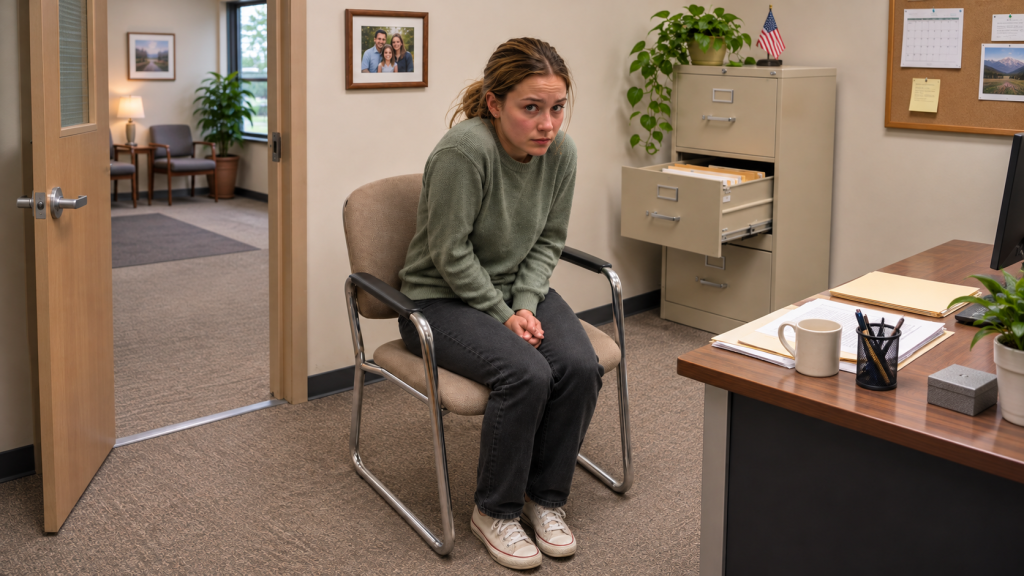
CHILD TAKEN FROM HOSPITAL; PARENTS STILL SEARCHING. The article was dated October 17, 1984. My birthday. I looked at Emily. She was sitting in the principal’s office, her injured ankle tucked awkwardly beneath the chair, her torn skirt hidden beneath her backpack.
Her face was still wet with tears.
“Mom,” she whispered, “why does that newspaper say Grandma took a baby?”
I couldn’t answer.
Because the truth was, I didn’t know.
And something about that frightened me more than the article itself.
Before I could speak, Emily gripped my wrist.
“Mom, there’s another picture.”
She turned the clipping over.
On the back was part of a second photograph.
A young woman stood outside a hospital, holding a baby’s blanket.
She was crying.
Beneath the photograph, someone had circled a sentence in red ink.
The missing infant’s mother, twenty-year-old Rebecca Hayes, has pleaded for information about her daughter.
My hands began trembling.
A daughter.
Born on October 17, 1984.
The same day I was born.
And the woman accused of taking that baby was the mother who had raised me.
My name is Sarah Wilson.
I was forty-two years old when a phone call from my daughter’s school changed everything I believed about my family.
Until that afternoon, I thought I understood where I came from.
My father, Samuel Carter, had been a quiet, hardworking man who repaired agricultural equipment.
He died when Emily was four.
My mother, Margaret, was seventy-three, a retired nurse who still lived in the small brick house where I grew up.
She had always been loving, though strangely private about her past.
Whenever I asked about my birth, she told me the same story.
“You arrived during a thunderstorm, sweetheart. Your father held you before I did, and he cried like a baby.”
I loved that story.
I had repeated it to Emily.
I had even written it in her baby book, beside photographs of her grandparents.
Now, sitting in Principal Harris’s office, I wondered whether every word had been a lie.
But there was one thing more important than the mystery in my hands.
My daughter was hurt.
And the adults responsible for her safety had failed her.
I knelt beside Emily.
“Sweetheart, I want you to listen to me.”
She looked at me through swollen eyes.
“Whatever happened to our family years ago, none of it makes what happened to you acceptable.”
Her lower lip trembled.
“But everybody was laughing.”
I gently touched her cheek.
“I know.”
“They said Grandma was a criminal.”
My heart tightened.
“And Mr. Bennett told me I was making everything worse.”
I took a breath.
“We’re going to address that.”
She looked toward the door.
“Can we leave?”
“Yes. But first, I want somebody to check your ankle and help you change into something comfortable.”
Emily began crying again.
“I don’t want anyone to see.”
I took off my cardigan and wrapped it around her waist.
“Then they won’t.”
Principal Harris returned a moment later.
Mr. Bennett was no longer with him.
I stood.
“Principal Harris, my daughter has an injured ankle, damaged clothing, and she’s been subjected to humiliation by other students.”
His face tightened.
“I understand.”
“Do you?”
I kept my voice controlled.
“Because I had to discover most of that from Emily.”
He looked down.
“Mrs. Wilson, I apologize. We should have addressed her physical injury and immediate needs before discussing the classroom incident.”
I nodded.
“She needs medical attention. And I want the school to preserve any relevant evidence, including classroom recordings, communications, and reports of students taking photographs.”
He straightened.
“We’ll begin documenting the incident.”
I looked directly at him.
“And I want to know why Mr. Bennett was questioning her while she was frightened and asking for him to leave.”
Principal Harris swallowed.
“That will be reviewed.”
I didn’t ask for Mr. Bennett to be fired on the spot.
I wanted the truth established.
But I made something clear.
“Emily shouldn’t have to return to his classroom until there’s a safe plan she can agree to.”
Principal Harris nodded.
“I understand.”
Then he turned toward my daughter.
“Emily, I’m sorry we didn’t respond appropriately.”
She stared at the floor.
He continued.
“You haven’t done anything wrong by asking for your mother.”
Those words brought fresh tears to her eyes.
The school nurse helped us arrange care, and I took Emily to an urgent care clinic.
Her ankle was sprained, not broken.
The doctor recommended rest, appropriate support, and follow-up if the symptoms worsened.
Emily barely spoke during the examination.
But as we drove home, she finally whispered, “Mom?”
“Yes, honey?”
“Are you mad at me?”
The question nearly broke me.
I pulled into a quiet parking lot.
Then turned toward her.
“Emily, why would I be mad at you?”
She wiped her cheeks.
“Because I made you leave work.”
I reached across the console and took her hand.
“Nothing at work is more important than making sure you’re safe.”
Her face crumpled.
“And I didn’t mean to make Grandma look bad.”
I shook my head.
“You didn’t.”
She looked at the folded newspaper clipping resting between us.
“Then why did everyone act like I did?”
I swallowed.
“Because sometimes people are cruel when they think they’ve found something embarrassing about somebody else.”
Emily looked down.
I continued.
“But discovering something difficult about your family doesn’t give anyone the right to hurt you.”
She nodded slowly.
Then whispered, “Do you think Grandma really took that baby?”
I stared through the windshield.
“I don’t know yet.”
My voice trembled.
“But we’re going to find out.”
That evening, I called my husband, Michael.
He was away on a construction project and had already heard about Emily’s injury.
When I explained the newspaper clipping, he went quiet.
“Sarah, are you saying your mother might not be your biological mother?”
I closed my eyes.
“I don’t know.”
He paused.
“Have you asked her?”
“Not yet.”
I looked toward Emily’s bedroom.
“Emily needs me tonight.”
Michael’s voice softened.
“Then focus on her. I’ll come home tomorrow.”
I swallowed.
“Thank you.”
He hesitated.
“And Sarah?”
“Yes?”
“Whatever that article means, it doesn’t change who you are.”
My eyes filled.
“I hope you’re right.”
Emily fell asleep early.
I sat beside her bed for a long time.
Her ankle rested on a pillow.
Her school uniform lay folded on a chair.
The torn skirt was inside a bag, preserved along with the photographs she’d shown me.
As I watched her sleep, I thought about the day she was born.
I remembered holding her tiny hand.
Remembered how frightened I was when the nurse carried her away for a routine examination.
Remembered counting the minutes until she returned.
Then I thought about Rebecca Hayes.
A twenty-year-old mother in an old newspaper photograph.
Holding an empty baby blanket.
Begging strangers to help her find her daughter.
I suddenly understood something terrible.
If that missing baby was me, then while my mother raised me with love, another woman had spent her life wondering where her child had gone.
The next morning, I drove to Margaret’s house.
I didn’t call first.
Part of me wanted to give her a chance to prepare.
Another part couldn’t bear the thought of hearing one more carefully rehearsed explanation.
When she opened the door, she smiled.
“Sarah! What a lovely surprise.”
Then she saw my expression.
Her smile disappeared.
“What’s wrong?”
I stepped inside.
“Mom, we need to talk.”
She looked frightened.
“Is Emily all right?”
“She sprained her ankle at school. She’s safe at home with Michael.”
Margaret pressed a hand against her chest.
“Oh, thank goodness.”
I watched her.
Then reached into my handbag.
I unfolded the newspaper clipping.
And placed it on the kitchen table.
My mother’s face changed before she touched the paper.
The color drained from her cheeks.
Her lips parted.
Then she whispered, “Where did you get that?”
I felt my stomach tighten.
“You recognize it.”
She closed her eyes.
“Sarah.”
I sat down.
“Mom, please don’t lie to me.”
Her hands began trembling.
For several seconds, she stared at the clipping.
Then she pulled out the chair opposite mine and sat heavily.
“I wondered whether this day would come.”
The words made my heart ache.
“What day?”
She looked at me.
“The day somebody told you about Rebecca.”
I couldn’t breathe.
“Rebecca Hayes?”
She nodded.
Tears filled her eyes.
I looked down at the newspaper.
“The woman whose baby disappeared?”
My mother covered her mouth.
Then whispered, “Yes.”
I took a breath.
“Was that baby me?”
She began crying.
I waited.
And after what felt like a lifetime, she nodded.
“Yes, Sarah.”
The kitchen seemed to tilt.
I gripped the table.
My mother continued crying.
I stared at her.
For forty-two years, I’d called this woman Mom.
She’d braided my hair.
Packed my lunches.
Sat beside me when I had nightmares.
And cried on my wedding day.
Now she was telling me that I was the missing baby in a newspaper article.
“Did you kidnap me?” I whispered.
Margaret shook her head frantically.
“No!”
I flinched.
She lowered her voice.
“No, sweetheart. But I made choices I should have explained to you long ago.”
I stared at her.
“Then explain them now.”
Margaret folded her hands.
“In 1984, I worked as a nurse at St. Agnes Medical Center.”
I nodded.
“I knew that.”
She swallowed.
“Rebecca Hayes came to the hospital late one evening. She was young, frightened, and in labor.”
I listened.
“She had arrived with an older woman who claimed to be her aunt.”
My mother looked down.
“But the woman wasn’t her aunt.”
I frowned.
“Who was she?”
“Her employer.”
I stared at her.
Margaret continued.
“Rebecca had been working as a live-in housekeeper for a wealthy family outside Charlotte. She was unmarried, had very little money, and was terrified of losing her job.”
I swallowed.
“What happened?”
“She gave birth to a healthy little girl.”
My mother’s eyes filled.
“You.”
I covered my mouth.
Margaret continued.
“Two days later, there was confusion over discharge documents. A private adoption arrangement was being discussed.”
My chest tightened.
“Did Rebecca agree to it?”
Margaret shook her head.
“That’s what became disputed.”
I stared at her.
“She told me she wanted to keep her baby.”
My heart began pounding.
Margaret began crying.
“But other people said she’d changed her mind.”
I looked down.
“And?”
My mother swallowed.
“I believed something was wrong.”
She stood slowly.
Then walked toward a cupboard near the hallway.
When she returned, she carried an old metal box.
I recognized it immediately.
For years, she’d kept it locked inside her bedroom closet.
Whenever I asked what was inside, she said it contained documents from her nursing career.
Now she placed it between us.
And opened it.
Inside were hospital papers.
Letters.
Photographs.
And a small pink identification bracelet.
I reached for the bracelet.
The faded label read:
Baby Girl Hayes.
My breath caught.
I looked at my mother.
“That’s me?”
She nodded.
“Yes.”
I began crying.
Margaret waited.
Then continued.
“A social worker named Helen Morris questioned the adoption paperwork. She believed Rebecca hadn’t received independent counseling or adequate information.”
I swallowed.
“What happened to Helen?”
“She raised concerns.”
Margaret looked down.
“And then she was removed from the case.”
I frowned.
“Why?”
“I never knew the full reason.”
She paused.
“But I believed people with influence were pushing the arrangement forward.”
I stared at her.
“What did you do?”
Margaret closed her eyes.
“I helped Rebecca contact an attorney.”
I looked up.
“An attorney?”
“Yes. Someone who worked with families who couldn’t afford private representation.”
She swallowed.
“Your father knew him.”
My heart tightened.
“Dad was involved?”
Margaret nodded.
“From the beginning.”
She continued.
“The attorney advised that the baby shouldn’t simply disappear into a private arrangement while the mother’s consent was disputed.”
I listened.
“Rebecca wanted to leave the hospital with you.”
My stomach tightened.
“And?”
“She was told she couldn’t.”
Margaret looked down.
“The situation became chaotic. There were arguments. The hospital called security.”
I stared at her.
“Then you took me?”
She nodded slowly.
“I carried you out of the nursery while the dispute was unfolding.”
My heart stopped.
“Without permission?”
She lowered her eyes.
“Yes.”
For several seconds, I couldn’t speak.
My mother began crying.
“I was afraid you’d be taken somewhere Rebecca couldn’t find you.”
I shook my head.
“Mom, you couldn’t just take somebody’s baby.”
“I know.”
She looked up.
“I believed I was helping protect her child.”
I stared at her.
“Then why didn’t Rebecca get me back?”
Margaret covered her face.
And for the first time, I saw something more painful than guilt.
Regret.
“Because I lost control of what happened afterward,” she whispered.
I stared at her.
She continued.
“The police became involved. Rebecca was questioned. The hospital accused me of removing you without authorization.”
I swallowed.
“The newspaper.”
She nodded.
“Yes.”
I looked at the clipping.
“What happened in court?”
“Emergency proceedings. Investigations. Conflicting accounts about whether an adoption had been consented to.”
She paused.
“There were documents I didn’t fully understand then, and some I never saw.”
I waited.
Margaret continued.
“Eventually, you were placed in temporary care while the legal issues were reviewed.”
My stomach tightened.
“Then how did you become my parents?”
She looked toward the window.
“Your father and I were later approved as caregivers. Over time, an adoption was finalized.”
I stared at her.
“Was Rebecca told?”
Margaret began crying again.
“The records said proper notice had been provided.”
I leaned forward.
“Was it?”
She looked down.
“I don’t know whether she actually received it.”
I felt sick.
For forty-two years, my mother had told me a sweet story about a thunderstorm.
She’d never mentioned a contested adoption.
A missing infant.
A crying birth mother.
Or legal proceedings involving the hospital where she’d worked.
“Why didn’t you tell me?”
Margaret whispered, “I was afraid you’d think I stole you.”
I stared at her.
“Then why didn’t you tell me the truth and let me decide?”
She closed her eyes.
“Because I was selfish.”
The words hung between us.
For a long time, neither of us spoke.
Finally, I whispered, “Did Rebecca ever try to find me?”
Margaret’s eyes filled.
“Yes.”
My throat closed.
“How many times?”
She looked down.
“Several.”
I felt tears running down my cheeks.
“What did you tell her?”
Margaret began sobbing.
“Sarah, please.”
I shook my head.
“No. I need to know.”
She took a breath.
“After the adoption, we were told contact would have to follow the legal arrangements. Rebecca sent letters through an attorney.”
My chest tightened.
“And you?”
Margaret looked at me.
“We didn’t respond.”
I stared at her.
“Why?”
“Because we were afraid of losing you.”
I stood.
My chair scraped across the floor.
“You were afraid of losing me, so you let another mother spend her life looking for me?”
Margaret covered her face.
“Yes.”
I walked toward the kitchen window.
Outside, the garden looked exactly as it always had.
The rosebushes.
The birdbath.
The little stone path Dad built when I was twelve.
Everything was familiar.
Yet suddenly, my childhood felt like a house whose foundation had cracked beneath my feet.
I turned toward her.
“Did Dad know everything?”
Margaret nodded.
“Most of it.”
I closed my eyes.
He had died without telling me.
I remembered sitting beside his hospital bed.
Holding his hand.
Asking whether there was anything he wanted me to know.
He’d smiled weakly.
“Just remember how much we love you.”
Now I wondered whether he’d been trying to tell me something else.
I picked up my handbag.
Margaret stood.
“Sarah, please don’t go like this.”
I looked at her.
“I need time.”
She began crying.
“You’re still my daughter.”
My eyes filled.
“I know you raised me.”
I swallowed.
“But I need to understand whose daughter I was before that.”
Then I left.
Michael was waiting when I got home.
Emily sat on the couch with her ankle supported.
She looked up immediately.
“Mom?”
I tried to smile.
“Hi, sweetheart.”
She studied my face.
“Did Grandma tell you?”
I nodded.
“Yes.”
Emily swallowed.
“Was the baby you?”
I sat beside her.
Then took her hand.
“Yes.”
She stared at me.
For a long moment, she didn’t speak.
Then she whispered, “Does that mean Grandma isn’t really your mom?”
My throat tightened.
I looked at her.
“Grandma raised me. She loved me. That’s real.”
Emily nodded slowly.
“But I also had another mother who gave birth to me.”
Her eyes filled.
“And nobody told you?”
I shook my head.
“No.”
Emily began crying.
I hugged her carefully.
She whispered, “I’m sorry I found that newspaper.”
I pulled back.
“Emily, look at me.”
She did.
“You didn’t cause this.”
Her lower lip trembled.
“You didn’t make anyone hide anything.”
I took a breath.
“And you did nothing wrong by asking questions.”
She hugged me tightly.
I held her.
And I realized something important.
The truth was painful.
But I would not make my daughter responsible for the pain.
That evening, Michael sat beside me at the kitchen table.
The newspaper clipping lay between us.
The house was quiet.
Emily had gone to bed.
I looked at him.
“Do you think I’m a different person now?”
He frowned.
“What?”
I swallowed.
“I don’t know who my family is.”
Michael reached for my hand.
“Sarah, you’re still the woman I married.”
My eyes filled.
“The woman who cries at old movies.”
He smiled.
“The woman who makes terrible pancakes but insists they’re excellent.”
I laughed weakly.
He continued.
“And the woman who would do anything to protect our daughter.”
I began crying.
Michael squeezed my hand.
“Learning the truth about your birth doesn’t erase your life.”
I nodded.
“But it changes how I understand it.”
He smiled sadly.
“Then we’ll work through that together.”
The next morning, I contacted an attorney experienced in adoption records and family matters.
Her name was Caroline Bennett.
She listened as I explained the newspaper clipping, the documents Margaret had shown me, and the questions surrounding the adoption.
Caroline was careful.
“Sarah, we need to separate what people remember from what the records establish.”
I nodded.
“Can we find the original documents?”
“We can explore what records may be available and what procedures apply.”
I took a breath.
“And Rebecca Hayes?”
Caroline paused.
“We can look for lawful ways to contact her if she’s living and you want to pursue that.”
My hands began trembling.
“I do.”
The investigation into my birth took several months.
Some records were incomplete.
Others had been archived.
A few documents contained conflicting dates and descriptions.
Caroline helped me obtain the materials I was entitled to access and identify what further records might be available through appropriate procedures.
I also consulted an independent specialist who helped interpret older adoption and hospital records.
The truth emerged slowly.
And it was more complicated than the story either my mother or the newspaper had told.
The hospital had been involved in arranging private placements during the early 1980s.
Some procedures had been poorly documented.
The adoption paperwork in my case showed a disputed consent process.
Rebecca Hayes had challenged it.
My parents had later become my legal adoptive parents through a court order.
But the records raised questions about whether Rebecca had been adequately notified and whether the court had received complete information.
Not every question could be resolved decades later.
People had died.
Documents had disappeared.
And witnesses remembered events differently.
But one fact became increasingly clear.
Rebecca Hayes had not voluntarily disappeared from my life.
She had tried to find me.
One afternoon, Caroline called.
“Sarah, I have some news.”
My heart began racing.
“About Rebecca?”
“Yes.”
I gripped the phone.
“Is she alive?”
A pause.
Then Caroline answered.
“Yes.”
I covered my mouth.
For several seconds, I couldn’t speak.
Rebecca Hayes.
The young woman in the newspaper photograph.
The mother who had held an empty blanket outside the hospital.
She was alive.
Caroline continued.
“She’s living in Greensboro.”
I stared at the wall.
Less than two hours away.
My biological mother had been living in the same state my entire life.
I began crying.
Caroline waited.
Finally, I whispered, “Does she know about me?”
“We haven’t contacted her yet.”
I took a breath.
“Can we?”
“Yes, through an appropriate process that respects her privacy and her choice about responding.”
I nodded.
“Please.”
The waiting was unbearable.
I checked my phone constantly.
At work.
At dinner.
Before bed.
Every notification made my heart race.
Then, one Thursday afternoon, Caroline called again.
“Sarah?”
“Yes?”
“Rebecca received the message.”
I closed my eyes.
“And?”
Caroline’s voice softened.
“She would like to speak with you.”
I sat down.
For a moment, I couldn’t breathe.
Then I began crying.
Michael came into the room.
He knelt beside me.
“What happened?”
I looked at him.
“She wants to meet me.”
His eyes filled.
He wrapped his arms around me.
And I cried against his shoulder.
Our first conversation happened over the phone.
I sat in my bedroom with Michael nearby.
My hands were shaking.
When the call connected, a woman answered.
“Hello?”
Her voice was soft.
A little uncertain.
I swallowed.
“Rebecca?”
A pause.
Then she whispered, “Sarah?”
My eyes filled.
“Yes.”
For several seconds, neither of us spoke.
Then she began crying.
“Oh, sweetheart.”
The word broke something open inside me.
I covered my mouth.
“I don’t know what to say.”
Rebecca laughed through tears.
“Neither do I.”
I wiped my cheeks.
She continued.
“I’ve imagined hearing your voice so many times.”
My throat tightened.
“I’m sorry.”
There was a pause.
Then she said firmly, “No.”
I froze.
“Sarah, you don’t have anything to apologize for.”
I began crying harder.
“You were a baby.”
For the first time, I heard someone say what I’d desperately needed to believe.
I hadn’t abandoned her.
I hadn’t chosen to stay away.
I hadn’t caused her suffering.
I’d been an infant.
And the adults responsible for protecting us had made decisions neither of us understood.
We talked for almost an hour.
Rebecca told me she’d married several years after my birth.
She had two younger sons.
She worked as a librarian before retiring.
And she’d spent years wondering what happened to the baby she’d named Grace.
I went still.
“Grace?”
She hesitated.
“That was the name I chose.”
My eyes filled.
“Grace Hayes?”
“Yes.”
I stared at the wall.
For forty-two years, I’d been Sarah Carter Wilson.
Before that, someone had named me Grace.
I wasn’t sure how to hold both names inside my heart.
Rebecca seemed to understand.
“You don’t have to use that name,” she said gently.
I swallowed.
“Thank you.”
She continued.
“Sarah is a beautiful name.”
I began crying again.
We arranged to meet the following weekend.
Michael offered to drive.
Emily wanted to come, but I explained that I needed our first meeting to be quieter.
She understood.
Before I left, she hugged me.
“Mom?”
“Yes?”
“Are you scared?”
I smiled sadly.
“A little.”
Emily squeezed my hand.
“Then remember what you always tell me.”
I looked at her.
“What?”
She smiled.
“Being scared doesn’t mean you can’t do something important.”
My throat tightened.
I hugged her.
“Thank you, sweetheart.”
Rebecca chose a quiet botanical garden for our meeting.
When Michael and I arrived, I saw a woman standing near a bench beneath flowering trees.
She had silver hair.
A blue cardigan.
And a small bouquet of yellow flowers.
My heart began pounding.
She looked toward us.
For a moment, neither of us moved.
Then she whispered, “Sarah?”
I nodded.
“Yes.”
Her face crumpled.
She took one step forward.
Then stopped.
“May I hug you?”
I began crying.
“Yes.”
She wrapped her arms around me.
And for the first time in my life, I held the woman who had given birth to me.
I hadn’t known what to expect.
I thought I might feel instant recognition.
Or overwhelming certainty.
Instead, I felt grief.
Tenderness.
And the strange comfort of being held by someone who had spent decades hoping to see me.
Rebecca cried against my shoulder.
“I looked for you.”
My chest tightened.
“I know.”
She pulled back.
“I never stopped thinking about you.”
I wiped my cheeks.
“I believe you.”
We sat together for hours.
Rebecca told me about her childhood.
Her parents.
Her work.
And the difficult months surrounding my birth.
She explained that she’d been young and frightened.
The family employing her had pressured her to consider adoption.
She’d initially discussed the possibility but insisted she wanted time and independent advice.
After I was born, she said she told the hospital she wanted to keep me.
Then events moved beyond her control.
“I remember asking where you were,” she whispered.
I took her hand.
“They told me there were legal questions.”
Her eyes filled.
“Then people started telling me you’d been placed somewhere safe and that I couldn’t see you.”
I swallowed.
“What did you do?”
She smiled sadly.
“I kept asking.”
She told me about letters.
Phone calls.
Visits to attorneys.
Attempts to obtain records.
And years of being told there was little she could do.
She hadn’t been wealthy.
She didn’t have influential connections.
And the legal processes were intimidating and expensive.
Eventually, she learned that an adoption had been finalized.
She continued searching for information whenever she could.
“I was afraid you would think I didn’t want you,” she whispered.
I began crying.
I squeezed her hand.
“I thought I knew everything about my birth.”
She nodded.
“And now?”
I looked at her.
“Now I want to know you.”
Her face crumpled.
“I’d like that.”
Before we left, Rebecca handed me a small envelope.
Inside was a photograph.
A newborn wrapped in a white blanket.
On the back, written in careful handwriting, were the words:
My beautiful Grace. October 17, 1984.
I stared at the picture.
My first photograph.
Taken before the confusion.
Before the newspaper.
Before the adoption.
Before two women began living with different versions of the same tragedy.
Rebecca touched my hand.
“I kept that picture all these years.”
I looked at her.
“Thank you.”
She smiled through tears.
“I hoped someday I could give it to you.”
Driving home, I felt exhausted.
Michael was quiet.
Finally, I whispered, “I have two mothers.”
He glanced toward me.
“Yes.”
I looked down at the photograph.
“One raised me.”
I swallowed.
“And one spent her life trying to find me.”
Michael reached for my hand.
“Both relationships can matter.”
I began crying.
Because I wanted to believe that.
The school investigation was continuing during those months.
Principal Harris had arranged interviews with students and staff.
The school reviewed relevant accounts and digital evidence.
Several students had taken photographs of Emily after her skirt was damaged.
Some had shared them in a group chat.
The school worked with families and appropriate personnel to address the images, student conduct, and Emily’s safety.
Mr. Bennett’s handling of the incident was also reviewed.
One afternoon, Principal Harris invited Michael and me to a meeting.
Emily chose to attend with us.
She was nervous, but she wanted to speak.
Principal Harris began by apologizing again.
“We failed to respond appropriately when Emily was distressed and physically hurt.”
I nodded.
He continued.
“The classroom activity was intended to examine the history of civil rights and access to justice.”
I looked at him.
“But the material was presented without adequate preparation for the personal impact it could have on a student.”
He nodded.
“And Mr. Bennett should have intervened immediately when the discussion became humiliating.”
Emily looked down.
Principal Harris turned toward her.
“Emily, would you like to tell us anything?”
She hesitated.
Then whispered, “I tried to explain that I didn’t know anything about the picture.”
Her eyes filled.
“But everybody kept laughing.”
I took her hand.
She continued.
“And when I fell, I was embarrassed. I just wanted somebody to help.”
Principal Harris’s expression softened.
“You deserved that help.”
Emily nodded.
“I don’t want anyone else to feel like that.”
The room grew quiet.
Then Principal Harris said, “Neither do we.”
The school implemented a plan to address the bullying, protect Emily from further harassment, and support her return to class.
The students involved faced consequences consistent with school policy and their individual actions.
Families were contacted.
The school addressed the inappropriate sharing of images.
And Mr. Bennett was removed from Emily’s class while personnel matters were handled through the appropriate process.
The school also reviewed how sensitive historical materials were selected and discussed.
Teachers received additional guidance on responding when a lesson unexpectedly involved a student’s family.
I appreciated those steps.
But I didn’t pretend they erased Emily’s pain.
She began meeting with the school counselor and later with an outside therapist.
At first, she dreaded walking through the hallway near her history classroom.
She worried students would whisper.
She avoided wearing skirts.
And she cried when someone laughed behind her, even when the laughter had nothing to do with her.
Healing took time.
One evening, she sat beside me on the couch.
“Mom?”
“Yes?”
“Do you think I should’ve just ignored them?”
I shook my head.
“No.”
She looked down.
“Mr. Bennett said I was disrupting the lesson.”
My throat tightened.
“Emily, speaking up when someone hurts you isn’t the same as causing the problem.”
Her eyes filled.
I continued.
“You were allowed to be upset.”
She nodded.
“And you’re allowed to ask for help.”
She leaned against me.
Then whispered, “I wish he’d believed me.”
I kissed her forehead.
“I know.”
Over time, Emily began feeling safer at school.
She returned to her activities.
Started laughing with friends again.
And eventually volunteered for a student group focused on kindness and respectful behavior.
I didn’t push her to turn her experience into a lesson for others.
That was her choice.
But I was proud of how she learned to speak about what happened without blaming herself.
My relationship with Margaret was more complicated.
For months, I kept some distance.
We spoke occasionally.
She asked about Emily.
I answered.
But whenever she tried to explain the adoption again, I felt the old hurt rise inside me.
Eventually, I told her we needed to speak with a counselor.
She agreed.
At our first session, Margaret cried almost immediately.
“I loved Sarah from the moment I held her.”
I looked down.
The counselor, Dr. Evelyn Reed, spoke gently.
“Margaret, Sarah isn’t asking you to prove you loved her.”
My mother looked up.
“Then what does she want?”
I took a breath.
“The truth.”
Margaret’s face crumpled.
I continued.
“And for you to understand that loving me didn’t give you the right to keep Rebecca’s existence a secret.”
Margaret wiped her cheeks.
“I was afraid you’d leave.”
I nodded sadly.
“You were afraid of losing me.”
She whispered, “Yes.”
I took a breath.
“And because of that fear, you kept me from knowing where I came from.”
She began crying harder.
“I know.”
For a long time, neither of us spoke.
Then Margaret said something I hadn’t expected.
“Sarah, I also need to tell you something about your father.”
My stomach tightened.
“What?”
She looked down.
“He wanted to tell you.”
I stared at her.
“When?”
“Before you graduated college.”
My heart began pounding.
She continued.
“He thought you were old enough to understand.”
I swallowed.
“And you?”
“I begged him not to.”
My eyes filled.
She looked directly at me.
“He agreed to wait.”
I covered my face.
For years, I’d imagined Dad as the one person who always told me the truth.
Now I understood that he too had chosen silence.
Margaret began crying.
“Near the end of his life, he told me we had made a terrible mistake.”
My throat tightened.
“He said we couldn’t keep pretending the past didn’t exist.”
I looked down.
“Then why didn’t you tell me after he died?”
She whispered, “Because I was still afraid.”
I sat quietly.
Then said something I’d been struggling to understand.
“Mom, I don’t want to erase the life we had.”
Her eyes filled.
“I know.”
“But I can’t keep pretending there wasn’t another family affected.”
She nodded.
I continued.
“And I need you to respect my relationship with Rebecca.”
Margaret began crying.
“I will.”
I didn’t know whether she’d always keep that promise.
Trust would take time.
But for the first time, she wasn’t asking me to choose between them.
The legal review continued separately.
Caroline explained that the old adoption order remained a significant legal document, and that establishing historical wrongdoing would require evidence and careful consideration of the applicable law.
There were questions about the disputed consent.
Questions about notice.
Questions about the hospital’s procedures.
And questions about the conduct of individuals who had handled the case.
Some issues could no longer be fully resolved.
Others could be documented more clearly.
I decided I didn’t need every uncertainty settled before I could build a relationship with Rebecca.
I wanted to understand the past.
But I also wanted to protect the present.
And I had already lost forty-two years.
Rebecca eventually met Emily.
I was nervous about introducing them.
I worried Emily might find the situation confusing.
But she surprised me.
Before the meeting, she asked, “Mom, what should I call her?”
I smiled.
“Whatever feels comfortable to both of you.”
She considered.
“Maybe Grandma Rebecca?”
My eyes filled.
“That sounds lovely.”
We arranged lunch at a quiet restaurant.
Rebecca arrived carrying a small gift bag.
When Emily saw her, she stood awkwardly.
“Hi.”
Rebecca smiled.
“Hello, Emily.”
For a moment, they stared at each other.
Then Emily whispered, “I’m sorry you couldn’t find my mom.”
Rebecca’s eyes filled.
“Oh, sweetheart.”
She reached for Emily’s hand.
“That was never your responsibility.”
Emily nodded.
Then asked, “Can I hug you?”
Rebecca smiled through tears.
“Of course.”
They embraced.
And I began crying.
Because the child who had been humiliated by an old photograph was now standing beside the woman whose life had been changed by the events behind it.
During lunch, Rebecca gave Emily the gift bag.
Inside was a beautiful hardcover journal.
On the first page, she’d written:
For Emily, whose questions helped bring our family together.
Emily stared at the inscription.
Then looked up.
“Do you really mean that?”
Rebecca smiled.
“Yes.”
Emily’s eyes filled.
“Even though everybody was mean about the newspaper?”
Rebecca nodded.
“Especially because you kept asking questions when things didn’t make sense.”
That evening, Emily placed the journal on her bedside table.
Then she hugged me.
“Mom?”
“Yes?”
“I think history is more complicated than Mr. Bennett said.”
I smiled sadly.
“It usually is.”
She considered.
“Sometimes the newspaper doesn’t tell the whole story.”
I nodded.
“That’s true.”
She looked up.
“But it can still tell us something important happened.”
I kissed her forehead.
“Exactly.”
A year after Emily’s history-class incident, we held a small family gathering.
Not to erase the past.
Not to force anyone to forgive.
But to acknowledge the people who had become part of our lives.
Rebecca came with her husband, Peter, and their two sons, Andrew and Michael.
Margaret attended too.
I’d asked everyone beforehand whether they were comfortable.
Nobody was required to come.
Nobody was expected to pretend things were simple.
At first, the afternoon was awkward.
Margaret sat near the window.
Rebecca stood beside the dining table.
For several minutes, they avoided looking directly at each other.
Then Rebecca approached.
“Margaret.”
My mother’s face tightened.
“Rebecca.”
I stopped breathing.
For forty-two years, these two women had carried very different versions of my life.
Now they stood in the same room.
Rebecca took a breath.
“I’ve spent many years angry.”
Margaret nodded.
“I understand.”
Rebecca’s eyes filled.
“I won’t pretend that anger has disappeared.”
My mother began crying.
“I don’t expect it to.”
Rebecca looked toward me.
Then back at Margaret.
“But Sarah has asked us to be civil. And I love her enough to try.”
Margaret wiped her cheeks.
“Thank you.”
For a moment, they stood quietly.
Then Margaret whispered, “I’m sorry I didn’t tell her about you.”
Rebecca’s face crumpled.
She looked down.
“I wish things had been different.”
Margaret nodded.
“So do I.”
There was no dramatic embrace.
No instant forgiveness.
But there was a beginning.
And that was enough for one afternoon.
The years that followed brought changes I never could have imagined.
Rebecca became part of our family’s life.
We celebrated birthdays together.
Shared photographs.
And learned the small details that make people feel connected.
She told me I had her grandmother’s eyes.
I learned that she loved old mystery novels.
That she disliked thunderstorms.
And that she had once dreamed of becoming a nurse before her life changed direction.
Margaret remained my mother too.
Our relationship was different.
There were boundaries.
Difficult conversations.
And questions that still made both of us cry.
But over time, she became better at listening without asking me to make her feel better.
She stopped describing Rebecca as a threat.
And gradually, she accepted that loving me meant making room for the truth.
Emily grew older.
She became more confident.
Her experience at school never vanished entirely from her memory, but it stopped defining her daily life.
She made friends.
Joined the debate team.
And developed a passionate interest in history.
One afternoon, she came home carrying a folder.
“Mom!”
I looked up.
“What?”
She grinned.
“I won the school research competition!”
I hugged her.
“Emily! That’s wonderful!”
She laughed.
“Guess what my topic was?”
I smiled.
“What?”
She held up the title page.
When Historical Records Tell Only Part of the Story.
My throat tightened.
Her project explored how archived newspapers, legal records, oral histories, and personal accounts could reveal different aspects of an event.
She didn’t expose private family details.
She used public historical examples and carefully selected research.
But I knew what had inspired her.
The newspaper clipping.
The questions.
And the realization that a headline could affect lives long after the ink had dried.
At the award ceremony, Emily stood before the audience.
She held her certificate.
Then said something I will never forget.
“History isn’t just about memorizing what happened.”
Her voice was steady.
“It’s about asking whose voices were heard, whose voices were missing, and whether we’re willing to keep looking when the first answer is incomplete.”
I began crying.
Michael squeezed my hand.
Rebecca smiled beside us.
And Margaret quietly wiped her eyes.
For a moment, I thought about the frightened girl who had refused to stand up from a chair in the principal’s office.
The child who’d been mocked because of a photograph she didn’t understand.
Now she stood proudly before a room full of people, using her voice without fear.
And I knew how much courage it had taken to get there.
Years later, when I remember that afternoon at school, I don’t think first about the newspaper clipping.
I think about Emily.
Her swollen eyes.
Her trembling hands.
The way she clutched her backpack to hide her damaged clothes.
And the courage it took for her to say she didn’t want her teacher in the room.
I remember how desperately I wanted to protect her.
How frightened I felt when I realized she was hurt.
And how important it was to listen before demanding that she explain herself.
The family mystery changed my life.
But my daughter’s safety mattered more than solving it quickly.
She needed medical care.
Reassurance.
And adults who would believe her when she said something was wrong.
Only after she was safe could I begin understanding the photograph that had frightened her.
The truth about my birth was painful.
The woman who raised me had loved me deeply.
But she had also hidden facts I had a right to know.
My biological mother had spent decades searching for a child she never willingly stopped loving.
And my father had carried secrets to his grave.
No single person held the entire story.
No newspaper headline explained everything.
And no apology could return the years that had been lost.
But I learned that understanding the past didn’t require destroying every good memory of it.
I could acknowledge Margaret’s love without excusing her dishonesty.
I could embrace Rebecca without pretending our lost years didn’t matter.
And I could teach Emily that family history should never be used as an excuse to humiliate someone.
One autumn afternoon, I sat between my two mothers in Rebecca’s garden.
Emily was helping Peter plant flowers.
Michael was carrying chairs onto the patio.
Andrew and Michael Hayes were arguing cheerfully about which dessert to serve.
The afternoon sunlight warmed the grass.
For a while, I simply watched everyone.
Then Rebecca took my hand.
“Sarah?”
I turned.
“Yes?”
She smiled.
“Are you happy?”
I looked toward Emily.
She was laughing.
Her face bright.
Her shoulders relaxed.
The frightened little girl from the principal’s office had become a confident young woman.
I smiled.
“Yes.”
Margaret reached for my other hand.
Her eyes filled.
“I’m glad.”
For a moment, I sat between the two women whose decisions, losses, and love had shaped my life.
I couldn’t change what happened in 1984.
I couldn’t give Rebecca back the years she’d missed.
I couldn’t make Margaret’s secrecy harmless.
And I couldn’t erase the pain Emily experienced at school.
But I could choose what happened next.
I could tell the truth.
Listen.
Protect my daughter.
And make room for relationships built on honesty rather than fear.
For forty-two years, I believed I knew exactly who my parents were.
Then one newspaper clipping showed me how incomplete that understanding had been.
But the most important lesson wasn’t that my past contained secrets.
It was that the truth deserved to be handled with compassion, especially when it concerned people who had already been hurt.
My daughter wasn’t responsible for our family’s history.
I wasn’t responsible for the choices adults made before I could understand them.
And Rebecca wasn’t responsible for the years she spent searching for a child she loved.
The people who concealed the truth had to face what they’d done.
The people who caused harm at school had to be held accountable.
And the people who’d lost years together needed the freedom to decide what healing would look like.
One evening, long after the investigation had ended, Emily asked me a question.
“Mom?”
“Yes, sweetheart?”
“Do you wish I never found that newspaper?”
I looked at her.
For a moment, I remembered the fear.
The tears.
The terrible uncertainty.
Then I smiled gently.
“I wish nobody had hurt you.”
She nodded.
“And I wish our family had told the truth long before you ever saw that clipping.”
Her eyes filled.
“But do I wish we never learned it?”
I shook my head.
“No.”
Emily leaned against my shoulder.
“Why?”
I wrapped an arm around her.
“Because the truth gave us a chance to know people we might never have found.”
She smiled faintly.
“Like Grandma Rebecca?”
I nodded.
“Exactly.”
We sat quietly.
Then Emily whispered, “I’m glad we found her.”
Tears filled my eyes.
“So am I.”
That night, I took the old newspaper clipping from the folder where I’d kept it.
I looked again at the faded photograph of my parents outside the courthouse.
Then at the young woman holding an empty baby blanket.
For the first time, I didn’t see only accusation, shame, or fear.
I saw people whose lives had been altered by decisions that should never have been made without care, transparency, and respect.
And I saw how one brave question from my daughter had finally brought those hidden lives together.
I placed the clipping inside a new family album.
Beside it, I added a recent photograph.
Emily stood between Margaret and Rebecca.
All three were smiling.
On the back, I wrote:
Our history is complicated, but our love does not have to be built on lies.
And whenever I open that album now, I remember the moment my daughter looked at me through tears and begged me to make her teacher leave.
I thought I was entering a school office to protect her from one terrible afternoon.
I had no idea that her courage would uncover a secret buried for four decades.
Or that the truth would bring us to people who had been waiting a lifetime to be found.
Sometimes the past cannot be repaired.
But it can be faced.
And when we choose honesty over fear, we give the future a chance to become something better.
That was what my daughter taught me.
That was what my two mothers helped me understand.
And that was the lesson I would carry for the rest of my life.