➡️ PART 3 ➡️
Pastor Jordan stood beneath the stained-glass window of Pleasant Grove United Methodist Church, holding a letter my wife had written four months before she died. His hands were shaking. Whitney Strickland stood beside him, still clutching the old savings passbook.
Faye Pope had pulled her glasses down from the chain around her neck. And I stood there in my Sunday jacket, feeling as though Ernestine had reached across ten years of silence and taken my hand. “Pastor,” I said quietly, “you might want to sit down before you read that.” He looked toward me.
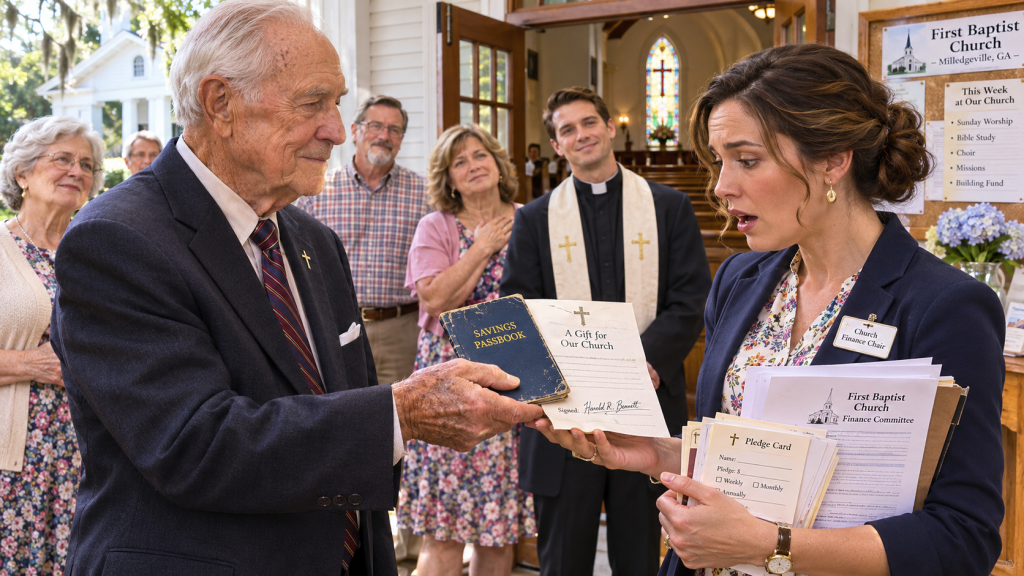
“Mr. Gaskins, did your wife know about the account?” I nodded. “She knew more about it than I did.” He unfolded the second page. Then he began reading. To the future trustees of Pleasant Grove United Methodist Church: If this letter has reached you, I hope it means the roof has finally needed some attention.
Ozell always said a good roof ought to outlast the fellow who put it on. I told him that was a fine ambition, but somebody still needed to save for the next one. A little laugh escaped my throat. That sounded exactly like Ernestine. Then Pastor Jordan turned the page. And his expression changed.
“In addition to the weekly roof reserve, I established a separate account in 1974 with the assistance of Reverend Barfield and Clarence Pope.”
Whitney looked up.
“A separate account?”
I nodded.
“Keep reading.”
“The purpose of this gift is to help Pleasant Grove maintain its sanctuary, repair its roof, and provide safe access to the building for members who grow old or become unable to manage the front steps.”
Faye covered her mouth.
“Oh, Ernestine.”
The pastor continued.
“The original money was a gift from two women who believed the church should never have to choose between keeping the rain out and welcoming everybody inside.”
His voice faltered.
He looked at me.
“Two women?”
I swallowed.
“My wife and somebody else.”
Pastor Jordan lowered the letter.
“Who?”
I looked toward Faye.
“Your mama.”
Faye stared at me.
“Ruth Ann?”
I nodded.
“Yes, ma’am.”
Her eyes filled immediately.
“My mama cleaned this church every Friday for thirty-eight years.”
“I remember.”
“She barely had money to buy herself a new coat.”
I smiled sadly.
“She had money saved that nobody knew about.”
Faye gripped the back of a pew.
“How much?”
I took a breath.
“She gave Ernestine one thousand dollars in 1974. Ernestine matched it.”
Whitney blinked.
“Two thousand dollars?”
“Yes, ma’am.”
“And they invested it?”
I nodded.
“With help from Pastor Barfield and Clarence Pope.”
Faye began crying.
“My daddy knew?”
“He helped arrange the paperwork.”
She shook her head.
“Neither of them ever said a word.”
I looked toward the sanctuary.
“Some folks don’t need everybody knowing what they’ve given.”
The stained glass caught the morning sunlight.
Blue and yellow light spilled across the old wooden pews.
For a moment, I could almost see Ernestine standing beside the church piano, smiling at Ruth Ann while the children practiced their Christmas songs.
Both women had been gone for years.
Yet there we stood, discovering another way they’d been looking after the place they loved.
Pastor Jordan carefully folded the letter.
“Mr. Gaskins, we need to examine these records.”
I nodded.
“That’s why I brought them.”
Whitney looked toward the passbook.
“But how could the church have an account nobody knows about?”
I considered the question.
“Well, honey, that’s exactly what I’d like to find out.”
She flushed.
I hadn’t raised my voice.
Didn’t need to.
I looked toward the pledge cards in her hands.
“Before this church borrows three hundred and eighty thousand dollars, oughtn’t somebody know what we already have?”
That afternoon, we met in Pastor Jordan’s office.
Whitney brought the current financial statements.
Faye brought a box of her father’s old church records.
I brought Mama’s—well, Ernestine’s—letter, the passbook, and the original agreement.
Old habits die hard.
I still sometimes call for Ernestine when I mean to ask where a paper is.
Then I remember.
And the house feels empty all over again.
Whitney opened her laptop.
“I need to explain something.”
I sat back.
“Go ahead.”
“When I took over as finance chair, I reviewed the accounts listed in the current bookkeeping system.”
She looked toward me.
“There wasn’t a roof reserve.”
I nodded.
“Apparently not in your system.”
She swallowed.
“And I assumed the old designation was simply a tradition.”
“It was a tradition.”
She looked relieved.
Then I added.
“But it was also a promise somebody put in writing.”
Pastor Jordan leaned forward.
“How did the account disappear from our reports?”
Faye opened her father’s ledger.
“That might have something to do with the bank mergers.”
She turned several pages.
“Daddy recorded deposits through 1988. Mr. Ransom kept the next books.”
Whitney examined the entries.
Then frowned.
“There are references to an external reserve.”
“Yes,” Faye said.
“But the current general ledger doesn’t show it as an asset.”
I shrugged.
“I put shingles on roofs. I don’t know why your computer forgot the money.”
Faye laughed.
Whitney didn’t.
She was staring at the ledger.
Then she looked up.
“Mr. Gaskins, do you have any current bank correspondence?”
I reached into my coat pocket.
“Sure do.”
I handed her a copy of the letter I’d received the previous week.
She read it carefully.
Then looked toward Pastor Jordan.
“The bank confirms an account number associated with the original reserve.”
He sat straighter.
“Is the money still there?”
Whitney hesitated.
“The letter says further verification is required.”
I nodded.
“That’s what the bank lady told me.”
Pastor Jordan looked toward me.
“You spoke with the bank?”
“Yes, sir.”
“When?”
“Last Wednesday.”
He blinked.
“Before the council meeting?”
“Yes.”
I smiled faintly.
“Figured I’d better ask somebody who knew more about money than I do.”
Whitney returned to the letter.
“The original account was transferred through successor institutions. We need to confirm its ownership, restrictions, and current balance.”
I nodded.
“That’s sensible.”
Then I looked toward the pastor.
“And while you’re doing that, I’d hold off signing anything with Atlanta.”
Pastor Jordan nodded slowly.
“Agreed.”
Whitney looked disappointed.
“But the roof is leaking.”
I pointed toward the ceiling.
“Then we fix the leak.”
She frowned.
“What if the whole roof needs replacement?”
“Then we replace what needs replacing.”
I smiled.
“But first we find out what’s wrong.”
The following Tuesday, my telephone rang just after breakfast.
It was Caleb Whitmore.
He’d worked for me when he was a skinny nineteen-year-old carrying bundles of shingles.
Now he owned a successful roofing company outside Valdosta.
“Mr. Ozell?”
“Yes, sir.”
“This is Caleb.”
“Well, I know your voice, boy.”
He laughed.
“Pastor Jordan called me about the church roof.”
I smiled.
“Did he now?”
“Yes. Asked whether I’d inspect it.”
“Good.”
Caleb hesitated.
“He said you thought there was a flashing problem.”
“I do.”
“How long since you’ve been up there?”
I looked toward my knees.
“Long enough that I’m not going back.”
He laughed.
Then said, “I’ll take a proper look.”
Caleb arrived Thursday morning with two experienced roofers.
They inspected the shingles.
The roof penetrations.
The flashing around the bell tower.
The gutters.
And the areas where water had entered.
I stayed on the ground.
At eighty-one, I knew better than to climb a ladder just to prove I still remembered how.
After several hours, Caleb came down.
He looked thoughtful.
“Mr. Ozell, you were right about the flashing.”
I nodded.
“That north corner?”
“Yes, sir.”
I smiled.
“Same place it leaked in 1974.”
He laughed.
“Some things never change.”
Then his expression grew serious.
“But there’s more work needed.”
Several shingles were damaged.
Some underlayment had deteriorated.
A section of sheathing required replacement.
And the gutters needed attention.
The building was old.
I knew that better than anybody.
But Caleb didn’t see evidence that justified immediately tearing off every roofing surface and replacing all the structural framing.
He recommended an independent structural inspection to determine whether there were hidden concerns.
I agreed.
The church arranged one.
And when the report came back, Pastor Jordan called another meeting.
Whitney presented the findings.
Her voice was quieter than it had been during the original campaign presentation.
“The independent engineer identified localized repairs but did not recommend replacing the entire roof structure.”
Several council members murmured.
She continued.
“We’ve also requested clarification about the Atlanta company’s estimate.”
I looked toward her.
“Good.”
Pastor Jordan leaned forward.
“What’s the expected cost now?”
Whitney hesitated.
“We have two local proposals for the defined repairs. The estimates range from approximately fifty-one thousand to sixty-four thousand dollars, depending on contingency items.”
Someone whistled.
Faye looked toward me.
“That’s a long way from three hundred and eighty thousand.”
I nodded.
“Different work.”
Whitney looked toward me.
Then said something I hadn’t expected.
“Mr. Gaskins was right to question the original scope.”
Nobody applauded.
Nobody made a speech.
But I appreciated it.
Because admitting you’re wrong is harder than pretending you were right all along.
And Whitney had started doing the harder thing.
A week later, the successor bank located additional account records.
The original roof reserve had survived several mergers.
Its balance had been transferred into a newer deposit and investment arrangement.
The records also showed that, after the handwritten passbook stopped being updated, successor treasurers had continued maintaining and recording contributions through separate statements.
The old information hadn’t been included in the church’s current bookkeeping.
That was the problem.
Not missing money.
Missing institutional memory.
When Pastor Jordan told me, I sat quietly.
Then asked.
“What’s the balance?”
He took a breath.
“We don’t have a final reconciled number yet.”
I nodded.
“Alright.”
He hesitated.
“But the preliminary records indicate it’s considerably more than seventy-four thousand dollars.”
I looked toward the window.
The sunlight fell across Ernestine’s old rocking chair.
For a moment, I imagined her sitting there, shaking her head.
Ozell, don’t you go counting money until somebody’s checked the figures.
I smiled.
“Tell the bank to take its time and get it right.”
Then Pastor Jordan said something that made me sit straighter.
“There’s another account.”
I swallowed.
“Ernestine’s?”
“Yes.”
“What about it?”
“The bank located records associated with the donor agreement.”
My heart tightened.
“And?”
He hesitated.
“It appears to have remained invested.”
I closed my eyes.
For ten years, I’d wondered what happened to all the little things Ernestine left unfinished.
A quilt she never completed.
A recipe she’d promised to write down.
A letter she’d started for our youngest daughter.
Now I was learning that one of her promises had quietly continued after she was gone.
That evening, I got down the box of photographs from our bedroom closet.
I found one taken in 1974.
Ernestine stood beside me on the church steps.
She wore a yellow dress.
I had dark hair.
My roofing truck was parked behind us.
And Pastor Barfield stood near the door holding a plate of sandwiches.
I laughed.
“Lord, we were young.”
Then I looked closer.
Ruth Ann Pope stood beside Ernestine.
She had one hand on my wife’s shoulder.
Both women were smiling.
I stared at that photograph for a long time.
Neither of them had ever told the congregation what they were doing.
They’d simply done it.
Two weeks later, an attorney named Caroline Briggs came to Pleasant Grove.
She’d been retained to help clarify the old charitable accounts and donor restrictions.
Whitney had arranged for an independent accountant to assist with the financial reconciliation.
We sat in the fellowship hall around a long table.
There were seven of us.
Pastor Jordan.
Whitney.
Faye.
Two church trustees.
Caroline.
And me.
Caroline opened her folder.
“Mr. Gaskins, your documentation has been extremely helpful.”
I smiled.
“Glad that coffee can finally earned its keep.”
Faye laughed.
Caroline continued.
“The bank records confirm that both historical arrangements existed.”
Pastor Jordan leaned forward.
“Both?”
“Yes.”
“The roof reserve?”
“Correct.”
“And the separate donor account?”
“Also correct.”
Whitney looked toward Caroline.
“Can you tell us the balances?”
Caroline nodded.
“Subject to final verification and the relevant valuation dates, the roof reserve stands at approximately two hundred and forty-six thousand, eight hundred dollars.”
The room went silent.
I took off my glasses.
“Well, I’ll be.”
Faye covered her mouth.
Pastor Jordan whispered.
“Two hundred and forty-six thousand?”
Caroline nodded.
“Approximately.”
Whitney stared at her hands.
Then whispered.
“I returned ten dollars to a man whose contributions helped preserve a reserve worth nearly a quarter of a million dollars.”
I looked toward her.
“Whitney, it wasn’t only my money.”
She raised her eyes.
“Yes, sir.”
“Other folks gave.”
She nodded.
“And treasurers kept it.”
“Yes.”
“And time did its part.”
Her eyes filled.
I smiled gently.
“Don’t forget any of them.”
Then Caroline opened another folder.
“The second account is more complicated.”
My heart tightened.
“Ernestine’s?”
She nodded.
“Yes.”
Faye leaned forward.
“Did Mama’s money survive too?”
Caroline looked toward her.
“The original donor instructions identify Ernestine Gaskins and Ruth Ann Pope as contributors.”
Faye began crying.
I reached across the table and squeezed her hand.
Caroline continued.
“The original two-thousand-dollar gift was placed into a long-term investment arrangement. Historical records show that additional donations were made over the years, and earnings were largely reinvested.”
Whitney nodded.
“That would explain the growth.”
Caroline smiled.
“Partly.”
Then her expression became serious.
“But there’s an important restriction.”
Pastor Jordan leaned forward.
“What restriction?”
“Funds are designated for sanctuary roofing and certain building improvements. The account cannot simply be treated as unrestricted operating cash.”
I nodded.
“That sounds like Ernestine.”
Caroline turned another page.
“The documents also contain an explicit instruction against pledging the account as collateral for construction borrowing without the required authorization.”
Whitney looked toward the proposed loan papers.
Her face changed.
“So we couldn’t just use this account to secure the loan?”
“Not without resolving the donor restrictions and applicable requirements.”
Pastor Jordan closed his notebook.
“Then the loan proposal stays suspended.”
I nodded.
“Good.”
Caroline looked at me.
“Mr. Gaskins, there’s something else.”
I frowned.
“What?”
“Your wife amended her donor instructions in December 2015.”
My throat tightened.
I remembered that month.
Ernestine was getting weaker.
Some days, she barely left her chair.
But she still insisted on getting dressed for church whenever she could manage it.
“What did she change?”
Caroline reached into the folder.
“She added a personal letter.”
My heart began pounding.
“To whom?”
Caroline looked directly at me.
“To you.”
For a moment, I couldn’t breathe.
I stared at the envelope.
It was cream-colored.
My name appeared across the front.
For My Ozell.
Ernestine’s handwriting.
No mistaking it.
I reached for it.
Then stopped.
My hands were shaking.
Pastor Jordan looked toward me.
“Mr. Gaskins, would you like some privacy?”
I nodded.
“Reckon I would.”
They stepped outside.
I sat alone in the fellowship hall.
The old ceiling fan clicked overhead.
Through the window, I could see the church where Ernestine and I had worshiped for forty-four years.
The church where we raised our daughters.
Where we celebrated weddings.
Buried friends.
And eventually held her funeral.
I opened the envelope.
Inside was a letter.
I unfolded it carefully.
Then began reading.
My darling Ozell,
If you’re reading this, I reckon I’ve gone on ahead.
Don’t you go fussing about that. We both knew one of us would have to make the trip first.
I laughed through tears.
That woman.
Even dying, she couldn’t resist teasing me.
I continued.
I know you’ll keep sitting in the third pew.
And I know you’ll leave me room.
But I don’t want you spending all your Sundays looking at an empty place.
I want you to look at the people sitting around you.
They’re the reason we gave.
My vision blurred.
I wiped my eyes.
Then read on.
Remember Ruth Ann.
Remember Mrs. Pope cleaning the church when nobody thanked her.
Remember Pastor Barfield bringing sandwiches when you fixed the roof.
Remember all the little things people did because they loved this place.
I swallowed.
Then reached the next paragraph.
Ozell, there’s something I never told you about our first gift.
I sat straighter.
Ruth Ann and I didn’t only want the church to have a roof.
We wanted it to have a future.
And we wanted that future to include the people who might not have enough money to make anyone notice them.
My eyes filled.
Then I read:
So if the money ever grows beyond what the roof needs, I want the church to use the permitted funds to make the building easier for older people and people with disabilities to enter.
I looked toward the sanctuary steps.
Three brick steps.
A handrail.
A side entrance that was awkward for anyone using a wheelchair.
Ernestine had struggled with those steps during her final years.
Now I understood why she’d been so particular about the wording.
The letter continued.
But before they spend one penny, make sure somebody checks the roof properly.
I laughed out loud.
You always said there’s no sense replacing a whole roof because somebody forgot to fix the flashing.
I wiped my cheeks.
“Yes, honey.”
My voice cracked.
“That’s exactly what I said.”
Then I reached the final paragraph.
Ozell, I don’t need anybody to put my name on a wall.
I don’t need a plaque.
I just want the church to remember that small gifts matter.
And I want you to remember something too.
I stopped.
My hands trembled.
Then I read the final words.
“You spent your whole life making sure other people had a roof over their heads. Don’t forget you deserve somewhere to rest beneath one, too.”
I covered my face.
And cried.
Not the quiet tears I’d shed at her graveside.
Not the polite tears I’d swallowed during her funeral.
I cried the way a man cries when the woman he loved for forty-eight years reaches across death and tells him he can finally put down his tools.
For so long, I’d measured myself by what I could fix.
A leaking roof.
A broken gutter.
A loose shingle.
A problem somebody called about before sunrise.
Ernestine had understood something I hadn’t.
That being useful wasn’t the same as being loved.
And that even a man who spent his life working deserved to rest.
When I finally opened the fellowship hall door, Faye was waiting.
She looked at my face.
Then wrapped her arms around me.
I cried again.
She didn’t ask what the letter said.
She simply held me.
Sometimes that’s all a person needs.
A few days later, Caroline returned with updated financial information.
The second account’s historical records had been reconciled further.
The investments remained subject to confirmation of their legal administration and restrictions.
But the balance was substantial.
Far more than any of us had imagined.
At the next council meeting, Caroline placed the latest statement on the table.
Whitney adjusted her glasses.
Pastor Jordan leaned forward.
Faye gripped my hand.
Caroline took a breath.
“The current reported value of the Ernestine Gaskins and Ruth Ann Pope charitable account is four hundred and seventeen thousand, six hundred and thirty-two dollars.”
Nobody spoke.
Then Hattie Bell, our ninety-three-year-old organist, whispered from the end of the table.
“Mercy.”
I stared at the figure.
Four hundred and seventeen thousand dollars.
Combined with the roof reserve, the historical accounts held more than six hundred and sixty thousand dollars at the reported valuation dates.
Money that had grown from decades of careful giving, stewardship, and reinvestment.
Money nobody had needed to borrow against.
Money that could help protect Pleasant Grove for years to come.
Whitney looked toward me.
Her eyes filled.
“Mr. Gaskins, I don’t know what to say.”
I smiled sadly.
“Well, honey, that’s alright.”
She swallowed.
“I told you ten dollars wasn’t moving the needle.”
I nodded.
“Yes, ma’am.”
She looked toward the statements.
“And now…”
I reached across the table.
“Whitney, you weren’t wrong that ten dollars won’t buy much roofing material.”
Her eyes filled.
“But you forgot what happens when people keep showing up.”
Pastor Jordan leaned forward.
“We should tell the congregation.”
Caroline raised a hand.
“Once the trustees approve the accounting and the bank documentation is complete, the church can provide an accurate report while protecting any confidential donor information.”
The pastor nodded.
“Of course.”
Whitney looked toward the old passbook.
Then whispered.
“We need to preserve these records properly.”
I smiled.
“That’s what Ernestine would’ve wanted.”
Then Faye asked a question.
“How much of this money can actually be used for the roof?”
Caroline looked toward the documents.
“That will depend on the final interpretation of the account restrictions and the trustees’ decisions. But the approved purposes do include qualified roofing expenditures.”
I nodded.
“And if the roof only needs sixty thousand dollars’ worth of work?”
She smiled.
“Then the church should not spend three hundred and eighty thousand simply because that was the first estimate.”
I laughed.
“Well, now you’re talking like a roofer.”
The council agreed to wait for the final documentation before authorizing major spending.
The proposed loan remained on hold.
The three-year pledge campaign was suspended.
And the independent roof repair plan moved through the proper review process.
For the first time in months, nobody was rushing to make a financial decision.
We were asking questions.
Reading documents.
And taking care of what people had entrusted to us.
A week later, Whitney came to my house on Bemiss Road.
She brought pound cake.
I made coffee.
We sat at Ernestine’s old kitchen table.
Whitney looked nervous.
“Mr. Gaskins, I owe you another apology.”
I shook my head.
“You already apologized.”
She nodded.
“But I didn’t fully understand.”
I waited.
She continued.
“When I returned your envelope, I thought I was enforcing good accounting practices.”
I smiled faintly.
“You were trying to keep things organized.”
“Yes.”
She looked down.
“But I made you feel as though fifty-two years of giving meant nothing.”
I didn’t answer.
She swallowed.
“And I was wrong.”
I took a sip of coffee.
“Whitney, let me tell you something my daddy taught me.”
She looked up.
“He said if you don’t understand an old tool, don’t throw it away until you ask what it’s for.”
She smiled.
I nodded toward the passbook.
“Same goes for old records.”
Her eyes filled.
“Yes, sir.”
Then she asked something that surprised me.
“Would you help us create a proper history of the church’s roofing work?”
I laughed.
“Honey, I’ll tell you what I remember.”
She smiled.
“That’s more than we had last month.”
That evening, after Whitney left, I sat in Ernestine’s rocking chair.
The house was quiet.
I looked toward her photograph.
“Well, honey,” I whispered, “your money’s still there.”
My eyes filled.
“And it looks like we’re finally going to fix that bell tower.”
Then I smiled.
“You would’ve liked Whitney once she learned to listen.”
But the next morning, Pastor Jordan called.
His voice was unusually serious.
“Mr. Gaskins, I need to speak with you.”
I sat down.
“What’s happened?”
He hesitated.
“We received a letter from the Atlanta roofing company.”
I frowned.
“What kind of letter?”
“They’re claiming the church owes money for preliminary design and planning work.”
My stomach tightened.
“Did anybody sign a contract?”
“That’s what we’re trying to establish.”
I looked toward the window.
“Well, son, don’t pay a bill until you know whether it’s owed.”
He took a breath.
“There’s something else.”
I waited.
“The company attached a copy of what it says is an authorization.”
My heart tightened.
“Signed by whom?”
Pastor Jordan was silent.
Then he answered.
“Whitney.”
For a moment, I couldn’t speak.
Whitney had been leading the capital campaign.
She’d arranged the estimate.
She’d pushed for the loan.
But she’d also admitted her mistakes and begun helping us understand the old accounts.
I didn’t want to believe she’d deliberately committed the church to a major expense without approval.
I took a slow breath.
“Pastor, what exactly did she sign?”
He hesitated.
“That’s the problem.”
I frowned.
“What?”
“The copy isn’t clear about whether she authorized preliminary work or the entire project.”
I rubbed my forehead.
“Then let’s see the original agreement.”
Pastor Jordan swallowed.
“There’s one more thing you need to know.”
I looked toward Ernestine’s photograph.
“Go ahead.”
“The contractor’s representative says Whitney discussed the historical reserve with him before she told the council it didn’t exist.”
I sat perfectly still.
“What?”
He continued.
“They claim she mentioned an old roof account during the first meeting.”
My stomach tightened.
That changed things.
Not because it proved Whitney had lied.
There could be explanations.
She might have heard rumors about a reserve without knowing whether it was real.
But it meant we needed to ask questions.
Carefully.
Fairly.
And before anybody signed anything else.
I stood and reached for my coat.
“Pastor, I’ll be there in half an hour.”
He hesitated.
“Mr. Gaskins, what do you think this means?”
I looked toward the old coffee can sitting on my kitchen shelf.
Then toward Ernestine’s letter.
And I answered the only thing I knew for certain.
“It means we aren’t finished asking questions.”