When Nolan lifted the front of his shirt, I thought he was about to show the judge another stain. I was wrong. He turned the fabric inside out, carefully searching along the seam beneath the tiny embroidered moon. Then he slipped two fingers into a pocket I had never noticed before. A pocket so small and neatly stitched that it looked like part of the shirt’s original lining.
My mother had made it. I recognized her careful stitches immediately. Nolan pulled out a folded piece of paper, then a small black recording device no larger than a matchbox. Across the courtroom, Grant Bellamy stopped smiling. “Your Honor,” Nolan said, his voice shaking, “my daddy told me not to show anybody this.” My breath caught.
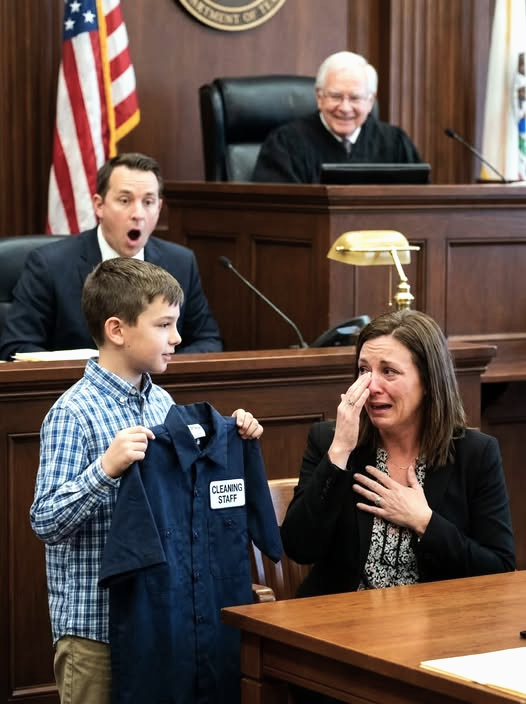
Grant’s attorney immediately stood. “Your Honor, I object to this entire—” Judge Eleanor Whitcomb raised one hand. “Mr. Carroway, sit down for a moment.” The courtroom became silent. Nolan held the device against his chest. “I didn’t steal it,” he whispered. “Daddy gave it to me.” I turned toward him. “Sweetheart, what is that?”
His brown eyes filled with tears.
“It’s my brave button, Mom.”
I stared at him.
He continued.
“Daddy said I could push it when I got scared at his house. But one night, I pushed it because I heard him shouting.”
Grant leaned forward.
“Nolan, buddy—”
The judge’s expression hardened.
“Mr. Bellamy, do not address the child.”
Grant fell silent.
Nolan swallowed.
“Daddy was talking about Mommy.”
My hands began trembling.
“What did he say?”
My son looked down.
“He said if he made us poor enough, everybody would think Mommy was bad.”
The words struck me so violently that I almost couldn’t breathe.
Then Nolan unfolded the paper.
It contained a drawing.
A small apartment.
A woman standing beside a little boy.
And a man holding a bag of money.
Above the man, in Nolan’s careful handwriting, were four words.
DADDY PAID THEM MONEY.
Grant stood abruptly.
“This is ridiculous!”
Judge Whitcomb struck her gavel.
“Mr. Bellamy, sit down.”
But Nolan wasn’t finished.
He looked directly at his father.
Then whispered something that made Grant’s face turn completely white.
“Daddy, you promised Grandma Ruth wouldn’t lose her home if I kept quiet.”
For several seconds, nobody moved.
I sat frozen beside my son.
My mother.
Ruth.
The woman who had moved into our little apartment to help us survive.
The woman who cooked breakfast when I left for the diner at five in the morning and tucked Nolan into bed when I cleaned offices until nearly midnight.
What did Grant mean to do to her?
I turned toward my former husband.
He wouldn’t meet my eyes.
Judge Whitcomb leaned forward.
“Nolan, did someone tell you that your grandmother would lose her home?”
My little boy nodded.
Then he looked at me.
“Mom, am I in trouble?”
My heart shattered.
I reached for his hand.
“No, sweetheart.”
The judge’s expression softened.
“Nolan, you’ve told us something important. But I don’t want you to feel responsible for solving the adults’ problems.”
He nodded uncertainly.
She continued.
“I’m going to ask the adults to handle this carefully. You won’t have to explain everything in front of everyone right now.”
Then she turned toward the attorneys.
“Given the child’s statements and the material he has produced, we’re taking a recess. The court will determine how any recording or other information should properly be preserved, authenticated, and considered. I also want arrangements made for an appropriate, neutral professional to speak with Nolan.”
Carroway rose.
“Your Honor, my client disputes—”
“I understand that, Mr. Carroway.”
She looked directly at him.
“And no conclusion has been reached about the contents or admissibility of that device.”
Then she glanced toward me.
“Mrs. Bellamy, do you have legal representation?”
I lowered my eyes.
“No, Your Honor.”
“Have you applied for legal assistance?”
“I tried. The local program had a waiting list, and I couldn’t afford private counsel.”
The judge nodded.
“Court staff can provide information about available legal resources and procedures. I strongly encourage you to obtain advice before we resume the contested issues.”
Then she looked at both parents.
“And until this matter is reviewed, neither parent is to question Nolan about what he has said here or place pressure on him concerning his testimony.”
Grant stared at the table.
For the first time since our divorce, he looked frightened.
Not angry.
Not inconvenienced.
Frightened.
And somehow, that frightened me too.
Because Grant Bellamy was never more dangerous than when he believed he was losing control.
My name is Sarah Bellamy.
I’m thirty-four years old, and until that January morning, I believed the worst part of my divorce was already behind me.
I’d endured my husband’s infidelity, his financial manipulation, the loss of our home, and the humiliation of borrowing money from my mother to buy groceries.
I’d worked until my feet swelled.
Missed meals so Nolan could eat properly.
And lain awake at night calculating which bill could wait another week.
But I had never imagined Grant would deliberately destroy our stability so he could stand before a judge and call me an unfit mother.
Even worse, I hadn’t realized how much our little boy had heard.
Children notice things.
They remember unfinished conversations.
They recognize fear in a parent’s voice.
And sometimes, without meaning to, they carry secrets that should never have been placed upon their shoulders.
Nolan had carried one of those secrets inside his favorite birthday shirt.
A shirt I bought after selling my grandmother’s gold locket.
The same shirt Grant’s attorney had held up as evidence of neglect.
And now, beneath that little embroidered moon, the truth had begun to emerge.
During the recess, I took Nolan into a quiet waiting room.
My mother was already there.
She’d been asked to wait outside the courtroom earlier because there was a possibility she’d be called as a witness.
When she saw us, she rose immediately.
“Sarah?”
I shook my head.
“Mom, I don’t know what’s happening.”
Nolan rushed toward her.
“Grandma!”
She knelt and hugged him.
“Hello, my darling.”
He began crying.
Grandma Ruth rubbed his back.
“What’s wrong?”
His voice trembled.
“I showed them the moon pocket.”
She went still.
For a moment, the expression on her face changed so sharply that I noticed.
“Ruth,” I whispered, “what moon pocket?”
My mother looked at me.
Then at Nolan.
She took a slow breath.
“Sweetheart, I made a little pocket inside his shirt.”
I stared at her.
“Why?”
She brushed the hair from Nolan’s forehead.
“Because he asked me to.”
My heart began pounding.
“When?”
“About six weeks ago.”
I looked down at the little navy shirt.
Its permanent stains.
Its faded fabric.
Its tiny embroidered moon.
I had washed it dozens of times without noticing the extra seam.
My mother lowered her voice.
“Nolan told me he wanted somewhere to keep something important when he stayed at his father’s house.”
I swallowed.
“Did you know it was a recording device?”
She hesitated.
“I knew Grant had given him one. I thought it was for reassuring messages.”
My eyes filled.
“Did he tell you why he needed to hide it?”
Ruth looked at Nolan.
Then back at me.
“He said Daddy didn’t like it when he kept things from his house.”
I closed my eyes.
Nolan was watching both of us anxiously.
I knelt beside him.
“Sweetheart, none of this is your job to fix.”
He looked down.
“But I wanted the judge to know.”
“I understand.”
He swallowed.
“Daddy said Grandma might have to sleep in her car if I told.”
Ruth covered her mouth.
I felt something cold move through my chest.
My eight-year-old son had been threatened with the possibility that the grandmother he loved would become homeless.
And he had kept that fear to himself.
Before I could say anything else, a court staff member entered.
She introduced herself as Angela Price, a family-services coordinator.
She explained that the court was arranging for a child specialist to become involved and that Nolan could wait in a quieter area.
She spoke gently to my son.
“Nolan, would you like some water?”
He nodded.
“And maybe some crackers?”
He smiled faintly.
“That would be nice.”
I watched her lead him toward a small table.
Then I turned toward my mother.
“Mom, did you know Grant was threatening you?”
Ruth looked down.
Her silence answered before she spoke.
“Sarah…”
My heart began pounding.
“What happened?”
She rubbed her hands together.
“Grant came to see me two months ago.”
I stared at her.
“Why didn’t you tell me?”
“Because you were already worried about so much.”
I closed my eyes.
She continued.
“He said he knew I had some old debts. He said if I helped persuade Nolan to live with him, he could make those problems disappear.”
I swallowed.
“What debts?”
My mother’s eyes filled.
“Medical bills from your father’s final illness. Some are still being disputed, but collectors have been contacting me.”
I stared at her.
“You told me those were settled.”
“I thought they were.”
Her voice broke.
“I didn’t want you carrying one more burden.”
I reached for her hand.
“Mom…”
She shook her head.
“He said if I refused to cooperate, he knew people who could make things difficult.”
My stomach tightened.
“What did you say?”
Ruth straightened.
“I told him he could take his money and leave.”
Despite everything, I almost smiled.
That sounded like my mother.
But then she began crying.
“And I should have told you immediately.”
I held her.
For the first time, I understood how carefully Grant had chosen the people he tried to intimidate.
He hadn’t simply attacked me.
He’d gone after the small circle of people who helped me survive.
By early afternoon, I had spoken briefly with an attorney from a local legal assistance organization.
Her name was Rebecca Foster.
She couldn’t promise immediate full representation without completing the program’s eligibility and intake procedures, but she explained the importance of documenting Grant’s conduct, preserving Nolan’s device, and obtaining the relevant financial records through proper legal channels.
She also helped me understand something I’d been too frightened to consider.
A parent’s wealth alone did not determine custody.
A child needed stability, safety, dependable care, and meaningful relationships.
My income mattered to our daily lives.
But being poor didn’t automatically make me an unfit mother.
And Grant’s expensive clothes didn’t establish that he could provide a healthier home.
Rebecca looked at the photograph Carroway had submitted.
“The shirt is clean in this picture?”
I nodded.
“The darker marks are permanent.”
“Do you know what caused them?”
I thought about it.
“Some are from craft paint. Nolan loves making model rockets and painting little planets.”
She nodded.
“And the others?”
I hesitated.
“Those appeared after a weekend with Grant.”
Rebecca looked up.
“What happened?”
“Nolan said he’d spilled something during breakfast.”
I swallowed.
“But he seemed upset when he told me.”
She made a note.
“Did you photograph the shirt before and after?”
I shook my head.
“No.”
“That’s all right. We can identify what other evidence exists.”
Then she asked about my cleaning job.
I explained how I’d lost the contract after an anonymous allegation of misconduct.
She listened carefully.
“Did you receive anything in writing?”
“Yes.”
“Keep it.”
I nodded.
“And the landlord?”
“He told Grant’s investigator our apartment was unsuitable.”
“Do you have photographs of the apartment?”
“Yes.”
“Maintenance requests?”
“Yes.”
“Rent receipts?”
I almost laughed.
“Every single one.”
Rebecca smiled faintly.
“Good.”
Then she leaned forward.
“Sarah, I can’t tell you how the judge will rule. But I can tell you that your records are worth organizing and reviewing. You are entitled to respond to the allegations with evidence.”
Tears filled my eyes.
For months, I’d felt as though I were standing beneath an avalanche.
And for the first time, someone was helping me separate the falling rocks from the ground beneath my feet.
That afternoon, the judge issued interim directions to protect Nolan while the disputed allegations were investigated.
The existing primary residential arrangement with me remained in place.
Grant’s parenting time was temporarily modified to reduce the risk of pressure on Nolan, subject to further review.
Both parents were instructed to avoid discussing the litigation with him.
The court also arranged a process for the child’s views and experiences to be assessed without unnecessarily exposing him to adult conflict.
No one declared Grant guilty.
No one announced that a recording had settled the case.
There were still questions about what Nolan had captured, how the device had been used, and what other evidence might corroborate his account.
But Grant’s plan to win custody that morning had failed.
When we left the courthouse, the January wind struck my face.
Nolan held my hand.
Ruth walked beside us.
And across the parking lot, Grant stood beside his attorney, speaking furiously into his phone.
He looked toward me.
For a moment, our eyes met.
Then he turned away.
That evening, Nolan fell asleep almost immediately after dinner.
He was exhausted.
So was I.
My mother sat beside me at the kitchen table.
The bakery downstairs had begun preparing dough for the following morning.
Warm bread scented the air.
I stared at the courthouse papers.
Then whispered, “I thought I was hiding everything from him.”
Ruth looked up.
“What?”
“The bills. The fear. The days when I didn’t know how we’d manage.”
My eyes filled.
“I thought I was protecting him.”
She took my hand.
“You’ve been doing the best you can with very little support.”
I shook my head.
“But he was scared.”
Ruth nodded.
“Yes.”
That simple acknowledgment hurt more than reassurance would have.
Because it was true.
Nolan was loved.
He was fed.
He was cared for.
He had a home.
But he’d also been frightened.
And some of that fear came from choices his father had made.
I wiped my cheeks.
“I don’t want him believing he has to save us.”
Ruth squeezed my hand.
“Then we’ll remind him that he doesn’t.”
The following morning, I called Nolan’s pediatrician and asked for guidance about finding a child therapist experienced in working with children affected by parental conflict.
I also contacted his teacher.
I didn’t disclose unnecessary details.
I simply explained that Nolan was going through a stressful family situation and might need additional support.
His teacher, Ms. Jenkins, listened carefully.
Then said something that made me cry.
“Sarah, he’s a wonderful little boy.”
I swallowed.
“Thank you.”
“He’s been quieter lately.”
My heart tightened.
“But he still helps other children with their reading.”
I smiled through tears.
“That sounds like Nolan.”
Ms. Jenkins continued.
“And there’s something you should know.”
I sat up straighter.
“What?”
“Last week, Nolan asked whether children can make adults stop fighting.”
My chest tightened.
“What did you tell him?”
“I told him adults are responsible for their own disagreements. Children can share their feelings, but they don’t have to solve the problems.”
I closed my eyes.
“Thank you.”
She paused.
“Sarah, he loves you very much.”
Tears streamed down my face.
“I love him too.”
The next several weeks brought one discovery after another.
Some came from the disputed recording.
Others came from bank records, employment documents, and people who were finally willing to speak.
The little device Nolan had produced was examined under an agreed procedure.
It contained multiple recordings.
Some were ordinary.
Grant reminding Nolan to brush his teeth.
A message saying he would return from a business dinner.
And a short recording of Nolan laughing after learning how to make scrambled eggs.
But one file was different.
It had been recorded on a Sunday evening, approximately two months before the custody hearing.
Nolan was present in the room.
His voice could be heard briefly, asking whether he could have water.
Then Grant’s voice.
And another man’s.
The recording had apparently continued after Nolan placed the device on a nearby table.
I listened only after my attorney had reviewed the material and advised me about the process.
Even then, I wasn’t prepared.
Grant’s voice emerged from the speaker.
“Once she loses the cleaning contract, she’s going to fall behind.”
The other man replied, “The complaint won’t survive a serious investigation.”
Grant laughed.
“It doesn’t have to. The contract just needs to disappear before the hearing.”
I gripped the edge of my chair.
The man continued.
“And the landlord?”
“Already handled.”
My breath caught.
Grant said, “He’ll describe the apartment as unsuitable. I’ve made it worth his while.”
For a moment, I couldn’t breathe.
Then the other man asked, “What if Sarah gets another job?”
Grant laughed again.
“She barely sleeps now. How much more can she do?”
I covered my face.
For months, I’d blamed myself.
For losing the job.
For not having enough savings.
For struggling to replace the income.
I’d wondered whether I was becoming the kind of mother Grant described.
Unstable.
Overwhelmed.
Unable to provide.
And now I was hearing him describe the exact steps he’d taken to create those circumstances.
Then the recording continued.
The other man said, “You really think the court will give you full custody?”
Grant replied, “Once she looks desperate enough, yes.”
There was a pause.
Then he added:
“And after that, she’ll have to come to me for everything.”
I began crying.
Because I finally understood.
Grant hadn’t wanted custody only because he loved our son.
He wanted control over the last part of my life that still felt entirely mine.
My attorney stopped the playback.
“Sarah?”
I looked up.
“Are you all right?”
I shook my head.
“No.”
She nodded.
“That’s understandable.”
Then she continued carefully.
“The recording may be relevant, but we need to address authenticity, context, applicable recording law, and admissibility. We also need independent corroboration.”
I swallowed.
“And Nolan?”
“He shouldn’t have to keep explaining it. The child specialist can assess how best to understand his experience.”
I nodded.
“Good.”
For the first time, I wasn’t simply afraid of losing the case.
I was afraid of what the investigation might reveal about the man my son still loved.
And I had to learn to carry both truths.
Grant could be dangerous to our stability.
And Nolan could still love him.
Those facts were not mutually exclusive.
A week later, the former manager of my cleaning company agreed to speak with investigators and provide employment records.
His name was Arthur Bell.
He had been the person who terminated my contract.
When he entered the meeting room, he looked ashamed.
“I owe you an apology,” he said.
I stared at him.
He continued.
“The complaint about you came through someone connected to our building ownership.”
I nodded.
“I know.”
He swallowed.
“I was told there was a serious client concern.”
I looked at him.
“But there wasn’t.”
He lowered his eyes.
“No substantiated complaint was ever produced.”
For a moment, I couldn’t speak.
Then I asked, “Why did you let me go?”
Arthur looked toward his hands.
“Because the property manager pressured us to make a quick decision.”
I swallowed.
“Did you investigate?”
He shook his head.
“Not properly.”
I thought about the nights I’d lain awake wondering how to tell Nolan we might have to move.
The groceries I’d put back on store shelves.
The electricity bill I’d paid three weeks late.
The pain in my mother’s face when she offered the last of her savings.
I took a breath.
“Mr. Bell, you didn’t just end a contract.”
His eyes filled.
“I know.”
“You helped create a crisis in a household with a child.”
He nodded miserably.
“I know.”
He provided documentation of the complaint and communications he’d received.
His employer later reviewed the termination and offered to discuss compensation and reinstatement options through appropriate channels.
The process didn’t resolve everything immediately.
But it mattered that the original allegation was no longer being treated as truth.
Then the landlord’s story began to unravel.
Our landlord, Dennis Caldwell, had told Grant’s investigator that the apartment was poorly maintained.
But the actual maintenance records showed something different.
I’d repeatedly reported a leaking bathroom pipe.
Requested repairs to a loose window latch.
And asked for an inspection of an electrical outlet that occasionally sparked.
Dennis had delayed the repairs.
Then described those conditions as evidence that I was failing to maintain the property.
My attorney obtained copies of my messages.
Every request.
Every reply.
Every photograph.
One afternoon, she laid the records across her desk.
“Sarah, look at this.”
I leaned forward.
A message from Dennis.
Dated six weeks before the custody hearing.
I’ll handle the report the way we discussed. Make sure the payment clears first.
The recipient was an account associated with one of Grant’s businesses.
My hands began trembling.
I stared at the screen.
“He paid him.”
Rebecca nodded.
“The records support a payment connection that needs to be explained. We won’t assume the purpose based on one message alone, but it is important evidence.”
I swallowed.
“How much?”
“Five thousand dollars.”
Five thousand.
Enough to cover several months of rent.
Enough to keep Nolan in winter clothes.
Enough to replace the income I’d lost for a time.
And Grant had apparently spent it trying to make us look unfit to remain in our home.
I began crying.
Not because I wanted the money.
Because I finally understood how much effort my former husband had put into making sure I couldn’t stand on my own.
But the most painful revelation came from Nolan’s therapist.
Her name was Dr. Hannah Wells.
She worked carefully with children experiencing difficult family transitions.
She did not interrogate him about the litigation.
She focused on helping him identify emotions, understand adult responsibilities, and feel safe expressing fear.
After several sessions, she invited me to discuss his general emotional needs, within appropriate confidentiality boundaries.
I sat across from her in a room filled with books and colorful drawings.
She smiled gently.
“Sarah, Nolan is a thoughtful child.”
I nodded.
“He is.”
“He also feels responsible for a great deal.”
My throat tightened.
“What do you mean?”
She took a breath.
“He worries that if he says he loves his father, you’ll be sad.”
I covered my mouth.
“And he worries that if he says he wants to stay with you, his father will be angry.”
Tears streamed down my face.
Dr. Wells continued.
“He needs repeated reassurance that he is allowed to love both parents without managing either parent’s feelings.”
I nodded through tears.
“I’ve never told him he couldn’t love Grant.”
“I understand.”
She smiled gently.
“But children often develop those fears from tension, changes in behavior, and things they overhear. They don’t need someone to say it directly.”
I closed my eyes.
Then whispered, “What can I do?”
She leaned forward.
“Tell him he doesn’t have to choose whom to love.”
I nodded.
“And make sure your actions support those words.”
That evening, I sat beside Nolan on his bed.
His constellation book lay open across his knees.
He was studying a picture of Saturn.
“Mom?”
“Yes, sweetheart?”
“Can I ask something?”
“Of course.”
He hesitated.
“Are you mad at Daddy?”
My throat tightened.
I took a breath.
“I’m upset about some choices your dad has made.”
Nolan looked down.
“Do you hate him?”
I shook my head.
“I don’t want you to carry my feelings about your father.”
He considered.
Then whispered, “But I love him.”
I smiled gently.
“I know.”
His eyes filled.
“Is that okay?”
My heart broke.
I wrapped my arms around him.
“Of course it is.”
He began crying against my shoulder.
I continued.
“You never have to stop loving someone because another person is upset with them.”
He sniffed.
“Even if they did something bad?”
I took a breath.
“You can care about someone and still know their actions were wrong.”
He looked up.
“Really?”
“Yes.”
He leaned against me.
Then whispered, “Daddy used to be nice.”
I closed my eyes.
“I know, sweetheart.”
“He used to take me fishing.”
I nodded.
“He did.”
“And he taught me to ride my bike.”
“Yes.”
Nolan wiped his cheeks.
“I miss that Daddy.”
I held him tighter.
For a moment, I couldn’t speak.
Because I missed that man too.
Not the husband who’d manipulated me.
Not the person who’d tried to destroy my financial stability.
But the father who’d once carried Nolan on his shoulders and spent Saturday mornings teaching him how to skip stones.
I kissed his forehead.
“You can miss those times.”
He nodded.
Then whispered, “I just want everybody to stop fighting.”
I closed my eyes.
“So do I, sweetheart.”
But wanting peace was not the same as pretending nothing had happened.
Two months after the first hearing, the custody case returned to court.
This time, I had counsel.
Rebecca Foster had completed the necessary arrangements to represent me, with assistance from a local legal aid program.
We had submitted organized records.
Income statements.
School attendance information.
Medical records where relevant.
Photographs of our apartment.
Maintenance requests.
Evidence relating to the termination of my employment.
And the materials concerning Grant’s conduct, subject to the court’s evidentiary rulings.
I wore a simple navy dress I’d borrowed from a friend.
My mother sat behind us.
Nolan was not required to sit through the entire hearing.
His views and experiences had been addressed through the court’s approved child-focused process.
I was grateful.
He’d already carried far too much.
Grant entered wearing another expensive suit.
His watch gleamed beneath the fluorescent lights.
But he no longer smiled.
His attorney looked tired.
There were new documents to explain.
New witnesses.
And questions that couldn’t be dismissed with a photograph of a stained shirt.
The hearing lasted most of the day.
Evidence was presented.
Witnesses were questioned.
Documents were examined.
And the court considered the credibility and relevance of the competing allegations.
The employment manager acknowledged that the complaint used to terminate my cleaning work had not been properly substantiated.
The landlord’s financial connection to Grant was examined.
The recording’s admissibility and significance were addressed through the appropriate legal process.
And the court considered how both parents’ conduct affected Nolan’s wellbeing.
At one point, Grant’s attorney attempted to return to the photograph of Nolan’s shirt.
I watched him hold it up again.
The little embroidered moon.
The dark stains.
The faded fabric.
Rebecca rose.
“Your Honor, the photograph doesn’t establish neglect. We have records of Nolan’s regular school attendance, medical care, and adequate daily supervision. We also have photographs showing his other clothing and the conditions of his home.”
She paused.
“The fact that a child wears a well-loved shirt with permanent stains is not, by itself, evidence that a parent is unfit.”
The judge nodded.
“Agreed. The court will consider the evidence in context.”
I looked down.
For months, I’d feared that one photograph would erase every meal I’d cooked.
Every bedtime story.
Every school assignment.
Every doctor’s appointment.
Every difficult day I’d managed with love and limited money.
Now someone had finally said what should have been obvious.
A stain was not a measure of motherhood.
Then the judge questioned Grant about his financial disclosures.
He had reported limited income when calculating support obligations.
But his business records showed substantial expenditures on luxury goods and personal travel.
His attorney offered explanations.
Some were legitimate business issues requiring further review.
Others raised serious questions.
The court requested additional financial documentation and indicated that support obligations would be addressed through the appropriate proceedings.
I watched Grant shift in his chair.
For two years, he’d told me he couldn’t afford to help.
He’d claimed his business was struggling.
He’d complained that I was asking too much whenever I mentioned school supplies or winter coats.
And all the while, he’d been wearing watches worth more than my annual rent.
The numbers didn’t tell the whole story.
But they exposed how misleading his claims had been.
Near the end of the hearing, the judge addressed both parents.
“Nolan is not a prize to be awarded to the person with the greater income.”
The room fell silent.
“He is a child who needs stability, care, honesty, and freedom from adult pressure.”
My eyes filled.
She continued.
“The evidence raises serious concerns about conduct designed to undermine the mother’s circumstances and influence the child’s living arrangements.”
Grant stared at the table.
The judge looked toward him.
“Mr. Bellamy, the court expects parents to support a child’s relationship with the other parent, not manufacture instability for litigation advantage.”
For a moment, nobody moved.
Then the judge explained that the current evidence supported maintaining Nolan’s primary residence with me, with parenting arrangements for Grant designed around the child’s welfare and safety.
Additional conditions, including counseling-related recommendations and appropriate safeguards against pressure on Nolan, were incorporated into the court’s orders.
The financial issues would continue through separate proceedings.
I heard the decision.
But for a moment, I couldn’t absorb it.
Nolan would stay with me.
Not because I’d defeated Grant in some personal competition.
But because the court had considered the evidence and concluded that our home remained the appropriate primary residence for him.
My mother began crying behind me.
Rebecca touched my arm.
“Sarah.”
I looked at her.
“You can breathe.”
I laughed through tears.
And finally, I did.
Outside the courtroom, the winter sun had begun to break through the clouds.
My mother hugged me so tightly I could barely breathe.
“We did it,” she whispered.
I shook my head.
“We got through today.”
She nodded.
“Yes.”
“And now we have to help Nolan get through everything else.”
Her expression softened.
“We will.”
When we returned home, Nolan was waiting at the kitchen table with a bowl of cereal and his constellation book.
He’d spent the afternoon with a trusted neighbor while Ruth attended court.
The moment he saw us, he jumped down from his chair.
“Mom!”
I opened my arms.
He ran into them.
“Did the judge get mad?” he asked.
I smiled gently.
“The judge made some decisions about how our family will be cared for.”
Nolan studied my face.
“Do I have to move?”
My throat tightened.
“No, sweetheart. You’re staying here with me and Grandma.”
He stared at me.
Then wrapped his arms around my neck.
I held him as he began crying.
For a long time, he didn’t speak.
Then he whispered, “I can still see Daddy?”
I kissed his forehead.
“There are arrangements for you to spend time with him safely. The adults will explain them to you.”
He nodded.
“Okay.”
Then he pulled away.
“Mom?”
“Yes?”
“Can I wear my moon shirt tomorrow?”
I laughed through tears.
“Of course.”
He grinned.
“Good. We have science.”
And just like that, he returned to being eight years old.
A little boy who loved constellations.
Who wanted to see his friends.
And who had no idea how much his willingness to tell the truth had mattered.
The months that followed were not easy.
The custody decision brought relief, but it didn’t erase the damage.
I still had bills.
I still needed dependable work.
And Nolan still had difficult days when he worried that loving his father might hurt me.
But gradually, life became less frightening.
The financial proceedings resulted in revised support arrangements based on a fuller examination of Grant’s circumstances.
Some outstanding obligations were addressed.
The dispute over my cleaning contract moved toward resolution.
And I began working with a counselor to process the exhaustion and fear I’d carried for so long.
One afternoon, the diner manager asked to speak with me.
His name was Frank Donnelly.
He was sixty-two, gruff, and famous for pretending not to care about anything except whether the coffee was fresh.
He stood beside the kitchen door.
“Sarah.”
I looked up.
“Yes?”
“Got a minute?”
I followed him into his office.
He sat behind his desk.
Then pushed a folder toward me.
“There’s an opening for assistant manager.”
I stared at him.
“What?”
He shrugged.
“You know the customers. You handle the staff well. You keep the place running when I’m not here.”
I swallowed.
“Frank, I don’t have management experience.”
He raised an eyebrow.
“You’ve been managing this place unofficially for years.”
I laughed.
“That’s different.”
“Is it?”
I looked down.
He continued.
“I’m not offering charity, Sarah. I’m offering a promotion.”
My eyes filled.
“Why?”
Frank looked almost offended.
“Because you’ve earned it.”
I began crying.
He handed me a tissue without looking directly at me.
“Don’t make it awkward.”
I laughed through tears.
“Yes, sir.”
The promotion came with a steadier schedule and better pay.
For the first time in years, I could make plans that extended beyond the next overdue bill.
I still lived carefully.
Still compared grocery prices.
Still repaired things rather than replacing them whenever possible.
But I no longer woke every morning wondering whether one missed shift would leave us unable to pay rent.
Nolan noticed the change before I did.
One evening, he sat beside me while I reviewed our household budget.
He looked at the paper.
“Mom?”
“Yes?”
“Are those the bills?”
I smiled.
“Some of them.”
He frowned.
“Are we okay?”
I put down the pen.
“Yes, sweetheart.”
He studied my face.
“Really?”
I nodded.
“Really.”
He thought carefully.
Then asked, “Can Grandma stop worrying too?”
My eyes filled.
I laughed softly.
“We’re working on that.”
For several months, Grant participated in the parenting arrangements established by the court.
At first, the interactions were difficult.
Nolan sometimes returned quiet and withdrawn.
Other times, he came home excited because they’d played a board game or worked on a bicycle.
I learned not to interpret every happy memory as a threat.
My son was allowed to enjoy time with his father.
And I was allowed to expect that time to be safe, consistent, and free from pressure.
The professionals involved encouraged Grant to take responsibility for the emotional harm caused by placing adult conflict on Nolan.
Whether he would genuinely change was something only his conduct over time could demonstrate.
I stopped trying to predict it.
Then, almost a year after the first hearing, Grant sent a message through our parenting communication system.
Sarah, I found something that belongs to you.
I stared at the words.
Then read the next sentence.
It’s your grandmother’s locket.
My heart stopped.
The antique gold locket.
The one I’d sold to buy Nolan’s birthday presents.
The last valuable keepsake I’d inherited from my family.
For months, I’d imagined it disappearing into a stranger’s jewelry box.
I had never expected to see it again.
I replied carefully.
How did you get it?
Several minutes passed.
Then Grant answered.
I bought it after I learned you’d sold it.
I stared at the screen.
Why?
Why would he purchase something I’d surrendered out of desperation?
His next message arrived.
I thought I could use it to convince you to stop fighting me.
My stomach tightened.
There it was again.
Control.
Even something as precious as my grandmother’s necklace had become a bargaining tool.
I put the phone down.
For a moment, I wanted to scream.
Then I thought of the woman who’d worn that locket before me.
My grandmother, Eleanor.
She’d raised three children through difficult years.
Worked as a seamstress.
And believed that dignity had nothing to do with the size of a bank account.
I remembered her saying:
“Sarah, never let someone turn a gift into a leash.”
I picked up the phone.
And wrote:
If you want to return it without conditions, please arrange that through our attorneys. I won’t negotiate parenting decisions in exchange for personal property.
He didn’t respond that evening.
But two weeks later, my attorney called.
The locket had been delivered to her office.
No additional conditions.
I sat at my kitchen table and cried when she placed it in my hands.
The gold was slightly scratched.
The hinge was stiff.
But the tiny photographs inside remained.
My grandmother and grandfather.
Smiling into a camera almost fifty years earlier.
I pressed it against my chest.
Ruth sat beside me.
Her eyes filled.
“Sarah…”
I looked at her.
“It’s back.”
She nodded.
“I know.”
For a long time, we sat together.
Then she whispered, “Your grandmother would be proud of you.”
I shook my head.
“For what?”
“For refusing to trade what mattered just because someone held something precious over your head.”
I looked down at the locket.
And for the first time, I understood that recovering it wasn’t the true victory.
The victory was knowing I would have been all right even if it never came back.
That spring, Nolan’s school announced a family science evening.
Each student could present a project they’d worked on during the year.
Nolan chose the solar system.
Of course he did.
For three weeks, our kitchen table disappeared beneath painted foam balls, cardboard, string, and silver glitter.
Ruth helped him cut out stars.
I helped him practice his presentation.
And Nolan insisted that every planet be labeled correctly.
One evening, he held up a small dark-blue sphere.
“Mom?”
“Yes?”
“This is Neptune.”
I smiled.
“Very nice.”
He frowned.
“But it’s too big.”
I looked at the enormous cardboard sun beside it.
“Well, the planets aren’t all to scale.”
He sighed dramatically.
“That’s the problem.”
I burst out laughing.
He grinned.
Then reached for another piece of cardboard.
On the night of the science fair, he wore his navy moon shirt.
The same faded shirt that had been displayed in court.
The stains remained.
I’d washed it carefully.
Mended a small tear near the sleeve.
And replaced the loose thread along the hidden pocket.
But I hadn’t removed the little moon.
Or the memories attached to it.
When Nolan stood beside his project, his face glowed with pride.
He explained how Saturn’s rings were made of ice and rock.
He pointed out the difference between stars and planets.
And he told his classmates that the moon reflected sunlight rather than producing its own.
Then he noticed me standing beside Ruth.
“Mom!”
I waved.
He grinned.
“Come see!”
I approached.
He pointed toward a small silver moon suspended beside his model Earth.
“That’s my favorite.”
I smiled.
“I know.”
He looked down at his shirt.
Then back at the display.
“Mom, can I tell you something?”
I knelt.
“Of course.”
He touched the embroidered moon.
“I used to think this shirt was unlucky.”
My heart tightened.
“Why?”
“Because Daddy got mad about it.”
I swallowed.
He continued.
“And because everybody looked at the stains.”
I nodded.
“But now I like it again.”
I smiled.
“Why?”
He looked toward his project.
“Because you bought it for me.”
My eyes filled.
He continued.
“And because Grandma made the little pocket.”
I nodded.
Then he whispered, “And because I told the truth.”
I held his hand.
“You did.”
He thought for a moment.
Then added, “But I don’t want to go to court anymore.”
My throat tightened.
“I know, sweetheart.”
I kissed his forehead.
“The adults are working to keep those responsibilities with the adults.”
He smiled.
“Good.”
Then ran back to explain Jupiter to his classmates.
I watched him go.
And I realized how much he’d grown.
Not because he’d been forced to face adult problems.
But because he was gradually learning that those problems were not his responsibility.
That summer, we moved into a slightly larger apartment.
Not a grand house.
Not a luxury townhouse.
A simple place with two bedrooms, a bright kitchen, and a small balcony overlooking a courtyard.
The rent was manageable.
The building was well maintained.
And Nolan could walk to a nearby park.
My mother moved with us.
She insisted she could live independently, but we all agreed we enjoyed being together.
She took the smaller bedroom.
Nolan chose the room with the biggest window.
And I hung the restored gold locket on a hook beside my dresser.
On our first night, Nolan stood in the middle of the living room.
He looked around.
Then smiled.
“Mom?”
“Yes?”
“Is this really ours?”
I nodded.
“This is our home.”
He walked toward the window.
Outside, a few stars were beginning to appear.
He pressed his fingers against the glass.
“Can we stay?”
My heart tightened.
I knelt beside him.
“We’ve made a good plan, sweetheart. And if anything changes, we’ll tell you and work through it together.”
He nodded.
Then whispered, “Okay.”
I kissed his forehead.
He looked toward the sky.
“Look, Mom.”
I followed his gaze.
A bright point of light shone above the rooftops.
“That’s probably a planet,” he said.
I smiled.
“Which one?”
He grinned.
“Depends what time it is.”
I laughed.
“Of course it does.”
We stood there quietly.
And for the first time in years, the future didn’t feel like a courtroom waiting for someone to declare me inadequate.
It felt like something we could build.
One ordinary day at a time.
People sometimes ask me whether I hate Grant.
The answer is more complicated than they expect.
There are things I will never excuse.
The false complaint.
The pressure on my landlord.
The financial manipulation.
And most painfully, the fear he placed inside our son’s heart.
But I have learned that hatred doesn’t protect Nolan.
Boundaries do.
Accountability does.
Reliable support does.
And refusing to make my child responsible for adult conflict does.
Grant remains Nolan’s father.
What kind of father he chooses to become is his responsibility.
I will cooperate with safe, lawful arrangements that serve Nolan’s wellbeing.
But I will never again confuse keeping the peace with surrendering the truth.
As for Nolan, he’s still the same little boy who loves the night sky.
He still asks questions about black holes.
Still leaves books beside his bed.
Still thinks Saturn is the most beautiful planet.
And still refuses to throw away that faded navy shirt.
One afternoon, I found him sitting at the kitchen table with his constellation book open.
He was drawing a picture.
A small house.
Three people standing outside.
And a sky filled with stars.
“What’s that?” I asked.
He smiled.
“Our family.”
I looked closer.
The figures were me, Nolan, and Grandma Ruth.
Above them, he’d drawn a huge silver moon.
I smiled.
“It’s beautiful.”
He nodded proudly.
Then pointed toward the moon.
“That’s our lucky moon.”
My eyes filled.
I sat beside him.
For a while, we colored together.
Then Nolan asked something that made me stop.
“Mom?”
“Yes, sweetheart?”
“Are we poor?”
I looked at him.
We had a modest home.
Secondhand furniture.
A carefully managed budget.
And enough to meet our needs, though we still had to make difficult choices sometimes.
I took a breath.
“We don’t have as much money as some families.”
He nodded.
“But we have what we need, and we’re working toward more stability.”
He considered that.
Then asked, “Does that make us bad?”
My heart broke.
I put down the pencil.
“No.”
He looked up.
“Not even a little?”
I shook my head.
“Not even a little.”
I took his hands.
“Having less money doesn’t make someone less worthy of love or respect.”
He nodded slowly.
“And having lots of money doesn’t automatically make someone a good parent.”
He thought carefully.
Then smiled.
“Okay.”
He returned to his drawing.
As though the question had been settled.
But I sat there for a long time.
Thinking about the courtroom.
The photograph.
The expensive watch.
The way Grant had smiled while his attorney held up my son’s stained shirt.
For months, I’d believed I was losing because I couldn’t afford what Grant could.
The lawyer.
The investigator.
The polished appearances.
The perfectly tailored suit.
But the case had exposed something far more important.
A child’s safety cannot be measured by the price of his clothing.
A parent’s love cannot be calculated from a bank statement.
And a family’s worth cannot be determined by whether its home looks impressive in photographs.
Real care is found in ordinary things.
A grandmother waking early to make breakfast.
A mother working long hours to pay for groceries.
A teacher noticing when a child grows quiet.
A counselor helping a frightened boy understand that he doesn’t have to choose whom to love.
And a little shirt that remained precious long after its color faded.
The day Nolan stood before Judge Whitcomb, he was scared.
His hands trembled.
His voice was small.
And he believed telling the truth might cost his grandmother her home.
But he spoke anyway.
Not because I taught him to fight his father.
Not because he wanted to win a custody battle.
And certainly not because I asked him to gather evidence.
He spoke because a secret had become too heavy for him to carry.
I wish he’d never had to hold that burden.
I wish Grant had made different choices.
I wish the courts had never become part of our family life.
But I can’t rewrite those events.
I can only make sure Nolan knows what they mean.
He wasn’t responsible for saving me.
He wasn’t responsible for exposing his father.
And he wasn’t responsible for protecting his grandmother from a threat no adult should ever have made.
He was a child who needed to be heard.
And eventually, he was.
Last month, Nolan wore the moon shirt to school again.
When he returned home, I noticed a new paint stain near the hem.
I held it up.
“Nolan!”
He looked alarmed.
“What?”
I pointed toward the blue streak.
“Another stain?”
His eyes widened.
Then he began laughing.
“Mom, it’s Uranus!”
I stared at him.
“What?”
“The paint spilled when we were making planets.”
I tried to look stern.
But I couldn’t.
We both burst out laughing.
I looked at the old shirt.
Its faded navy fabric.
Its permanent marks.
Its crooked hidden pocket.
And the tiny silver moon still shining above the chest.
Then I folded it carefully and placed it beside the washing machine.
Because I knew something now that Grant’s attorney hadn’t understood.
A stained shirt can tell a story of neglect.
But it can also tell a story of birthday wishes, sacrifices, science projects, and a child who is deeply loved.
That little moon had become a reminder of everything we’d survived.
Not because the fabric itself was magical.
But because of what it represented.
A mother’s sacrifice.
A grandmother’s care.
A child’s courage.
And a family that refused to let money determine its worth.
One evening, Nolan climbed beside me on the sofa.
He rested his head against my shoulder.
“Mom?”
“Yes, sweetheart?”
“Are you happy?”
I thought about the question.
For years, I’d been surviving.
Rushing between jobs.
Worrying about bills.
Trying to smile when I was exhausted.
Wondering whether I would ever feel safe again.
I looked around our small living room.
Ruth was reading beside the window.
Dinner was cooking.
Nolan’s schoolbooks lay across the coffee table.
And outside, the first stars were appearing.
I smiled.
“Yes.”
He looked up.
“Really?”
I kissed his forehead.
“Really.”
He grinned.
“Good.”
Then he reached for his constellation book.
I watched him turn the pages.
And I realized that happiness wasn’t the absence of difficulty.
We still had challenges.
Still had responsibilities.
Still had days when the past felt painfully close.
But we also had peace.
And truth.
And the freedom to build a future without pretending that someone else’s cruelty was our failure.
If I could return to that January morning in the Knoxville courtroom, I would tell the frightened woman sitting beside her son something she desperately needed to hear.
You are not an unfit mother because you are struggling financially.
You are not less deserving of respect because you cannot afford an expensive attorney.
And you do not have to let someone else’s wealth rewrite the truth about your life.
I would also tell her to look at Nolan.
Not at his stained shirt.
Not at the photograph.
Not at the expensive watch across the room.
Look at the little boy holding her hand.
The child who loves her.
The child who needs her.
The child who has been frightened but still believes home is where she is.
Because that was what mattered.
Grant entered the courtroom convinced that money would decide the outcome.
He wore his expensive watch.
Brought his attorney.
And presented a photograph of my son’s favorite shirt as evidence that I was unfit.
He believed he could manufacture hardship and then use it against me.
But he hadn’t considered one thing.
The little boy he was trying to claim as his prize had feelings, memories, and a voice of his own.
And when Nolan lifted that shirt, the truth began to emerge.
Not a truth that made him responsible for the court’s decision.
But one that compelled the adults to examine the evidence more carefully.
Today, Nolan still sleeps beneath glow-in-the-dark stars.
He still wants to become an astronomer.
And he still keeps his favorite navy shirt folded in the top drawer of his dresser.
Sometimes he wears it.
Sometimes he simply looks at it and smiles.
And whenever I see that little embroidered moon, I remember something important.
A child doesn’t need a perfect parent.
He needs a parent who keeps trying, listens when he’s afraid, and makes sure love never becomes a bargaining chip.
I couldn’t give Nolan the wealthy life Grant promised.
But I could give him honesty.
Consistency.
Warmth.
And a home where he never had to earn his place.
In the end, Grant’s ten-thousand-dollar watch couldn’t buy what mattered most.
It couldn’t purchase trust.
It couldn’t erase the harm he’d caused.
And it couldn’t turn a mother’s devotion into neglect.
I looked at my son one evening as he stood beside the window, pointing excitedly toward the stars.
And I understood.
The most valuable thing in that courtroom wasn’t the watch on his father’s wrist.
It was the little boy in the faded moon shirt, whose courage reminded everyone that love is measured by how we protect a child, not by how much money we can spend.