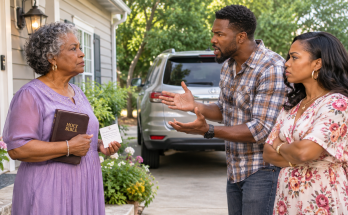
The woman standing behind James could not have been much younger than fifty. She had dark hair streaked with silver, gentle brown eyes, and the unmistakable expression of someone who had spent years carrying a truth too heavy to share. But it wasn’t her face that frightened me. It was the photograph in her hand. The little girl in the picture wore a white dress with embroidered flowers. Her dark curls fell around her cheeks, and she held a yellow rose against her chest.
I knew that photograph. I was seven years old when my father took it in our backyard. My mother had planted yellow roses beside the porch, and I had insisted on holding the largest one because I wanted to look like a princess. The original photograph had disappeared from our family album decades earlier. I stared at the woman. “Where did you get that?” She glanced toward James. “Please,” she said softly. “I think you should sit down.” “No.” My voice surprised even me. “Fifty-six years, and everyone keeps telling me to sit down before telling me the truth. I have spent enough of my life waiting. Tell me who you are.”
The woman swallowed. “My name is Ruth Bennett.” She paused. “James is my father.” The garden seemed to tilt beneath my feet. I looked at James. He lowered his head. And in that terrible moment, I understood there were wounds waiting for me that had nothing to do with war. “You have a daughter?” I whispered. James nodded. “Yes, Mary.” “How old?” Ruth answered. “Forty-seven.” I closed my eyes. Forty-seven years. That meant she had been born long after the war, long after I had buried my husband’s memory in a cemetery where there was no body. I opened my eyes again. “Did you marry someone else?”
James’s face crumpled.
“Yes.”
The word landed between us with devastating simplicity.
For fifty-six years, I had worn my wedding ring.
I had turned away kind men who offered companionship.
I had spent Christmas mornings remembering a husband who would never open another present.
And somewhere in the world, James had been celebrating birthdays, raising a daughter, and building another life.
My knees weakened.
Eleanor caught my elbow.
“Aunt Mary, let’s go inside.”
This time, I didn’t argue.
Because I was suddenly afraid that if I remained standing, the weight of all those lost years would bring me to the ground.
James’s living room smelled of lavender and old books.
There were photographs on the mantelpiece.
Ruth as a child.
Ruth graduating from college.
Ruth standing beside a young man on her wedding day.
Two grandchildren grinning beneath a Christmas tree.
And in the center, a framed picture of James with a beautiful woman whose blond hair was swept into a loose bun.
I stared at that photograph.
“Your wife?”
James nodded.
“Elizabeth.”
“Where is she?”
“She died six years ago.”
I looked away.
I had spent most of my adult life believing myself to be a widow.
Now I was sitting in the home of a man who had been widowed twice, although one of his wives had never known he was alive.
Ruth brought tea.
My hands trembled so badly that Eleanor took the cup before I could spill it.
James sat opposite me.
He looked older than I had ever imagined he would.
His shoulders were narrow, his fingers knotted with arthritis, and a faint scar crossed his forehead.
But when he looked at me, something in his expression remained painfully familiar.
The young man who had stood beneath my parents’ apple tree on our wedding day was still somewhere inside those tired eyes.
“Start at the beginning,” I said.
James nodded slowly.
“The explosion happened on September eighteenth, 1970.”
I knew the date.
I had lived with it for more than half a century.
“Our patrol was moving through a village when we came under fire. There was an explosion near the road. I remember heat, noise, and someone shouting. Then nothing.”
He rubbed his forehead.
“I was badly injured. A local family found me several days later. They hid me while fighting continued nearby.”
“Why didn’t they contact the Americans?”
“They were afraid. And when I woke up, I couldn’t tell them who I was.”
Ruth sat beside him.
“Dad had a serious head injury. His memories returned in fragments, but for years he couldn’t piece together his identity.”
James continued.
“Eventually, I reached a medical facility, but by then I had been separated from my identification. Records were confused. I was transferred under an incorrect name.”
I stared at him.
“Surely somebody must have realized.”
“I asked myself that question for years.”
He looked toward the window.
“I was moved between hospitals. There were mistakes, incomplete files, and people trying to help who didn’t understand what had happened before I came into their care.”
His voice broke.
“When I finally began living independently, I knew almost nothing about the man I had been.”
“Not even that you were married?”
He shook his head.
“Sometimes I dreamed of a woman in a white dress. Sometimes I remembered yellow roses. I thought they were dreams made from pieces of other people’s stories.”
I reached for the photograph Ruth had placed on the table.
“Then explain this.”
James touched the edge of the picture.
“It was found among the belongings I carried when I was rescued. For years, nobody knew who the little girl was.”
“Why did you have a photograph of me as a child?”
“You gave it to me.”
The words stirred a memory.
Two days before our wedding, I had shown James my mother’s old family album.
He had laughed at the picture of me holding the rose.
“There’s my future bride,” he’d said.
I had slipped the photograph into his jacket pocket.
“So you won’t forget what I looked like before I became a sophisticated married woman.”
He had kissed my forehead.
“As though I could ever forget you.”
I pressed the photograph against my chest.
For the first time since arriving, tears spilled down my face.
“Elizabeth knew about the photograph,” Ruth said gently.
I looked at her.
“Did she know about me?”
“Not at first.”
James lowered his gaze.
“Elizabeth was a nurse. We met during my rehabilitation. I was living under the name Joseph Bennett, a name that appeared in the records I had been given.”
He glanced at Ruth.
“We married in 1977.”
Seven years after our wedding.
Seven years after I watched military officers arrive at my parents’ house.
Seven years after Adrian told me that James could not have survived.
I imagined Elizabeth walking down an aisle beside a man who could not remember that he had already made the same vows.
“Did you love her?” I asked.
James’s expression changed.
“Yes.”
I nodded, even though the answer hurt.
“Then don’t apologize for that.”
He looked startled.
I continued.
“If you truly didn’t remember me, loving another woman wasn’t a betrayal. But I need to know when you learned the truth.”
The room fell silent.
Ruth looked toward her father.
James pressed his lips together.
“That’s the part I’m most ashamed of.”
My stomach tightened.
“When?”
He struggled to answer.
“Not last winter.”
I stared at him.
“What?”
“I began remembering more than thirty years ago.”
The silence afterward was unbearable.
Outside, a bird called from somewhere in the garden.
Eleanor’s hand tightened around mine.
“Thirty years?” I repeated.
James nodded.
“In 1994, I had a terrible fall. Afterward, the dreams became clearer. I remembered your name. Mary Sullivan. I remembered our wedding. I remembered our house.”
I could barely breathe.
“And you didn’t come?”
His eyes filled.
“I was afraid.”
I stood so abruptly that my chair scraped across the floor.
“Afraid?”
“Mary—”
“No. You don’t get to say that word as though it explains everything.”
He flinched.
“For twenty-four years after you remembered me, I was still sitting alone on our anniversary!”
“Thirty-two,” Ruth whispered.
I turned.
She looked devastated.
“Thirty-two years, Mary. From 1994 until now.”
I stared at James.
Thirty-two years.
It was no longer possible to place every missing day at the feet of war, trauma, and bureaucracy.
Some of those years had been a choice.
“You remembered me,” I whispered, “and you let me keep believing you were dead.”
James began crying.
“I didn’t know what to do.”
“You could have written a letter.”
“I know.”
“You could have asked someone to find me.”
“I know.”
“You could have told me you were alive!”
My voice rose until it filled the room.
“I buried you without a body. I attended memorial services. I listened to your mother crying herself to sleep. I spent decades wondering whether you had suffered, whether you had called my name, whether you had died alone!”
James covered his face.
I stepped backward.
“And all that time, you were alive.”
Eleanor drove me home.
Neither of us spoke for almost twenty minutes.
The roses remained on my kitchen table, magnificent and almost unbearably yellow.
I had once imagined what I would do if James returned.
I would run into his arms.
I would kiss him until the lost years disappeared.
I would thank God for restoring what death had taken.
But death hadn’t taken James.
And the years had not disappeared.
They stood between us like a wall neither of us could climb.
Eleanor made tea while I sat beside the flowers.
“Do you regret going?” she asked.
I shook my head.
“No.”
“Do you want to see him again?”
“I don’t know.”
She sat opposite me.
“Aunt Mary, you don’t owe him anything.”
I looked at the roses.
“That’s what hurts.”
“What?”
“I spent fifty-six years believing I owed him my loyalty. And now I don’t know what to do with it.”
Eleanor reached across the table.
“You gave him your loyalty because you loved him. That doesn’t make those years meaningless.”
I studied her face.
Eleanor was my younger sister’s daughter.
Her mother had died eight years earlier, and ever since then, Eleanor had become the daughter I never had.
She visited every Sunday.
She remembered my medications, brought groceries when the weather was bad, and never forgot my birthday.
“Did I waste my life?” I whispered.
Eleanor’s eyes filled.
“No.”
“But I never married again.”
“That was one part of your life. Not all of it.”
She gestured around the kitchen.
“You taught children for thirty-eight years. You helped hundreds of families. You cared for Grandma when she was sick. You raised money for the library. You taught me how to drive.”
I smiled faintly.
“And nearly gave you a heart attack.”
“You were an impatient teacher.”
“An excellent teacher.”
“The worst passenger in the state.”
We laughed through our tears.
Then Eleanor squeezed my hand.
“Your life wasn’t empty because James wasn’t in it. But you deserved to know he was alive.”
That night, I took off my wedding ring for the first time in fifty-six years.
I placed it beside the roses.
And I cried until dawn.
Three days later, Ruth came to my house alone.
She carried a worn leather folder.
“I know you may not want to see me,” she said.
I stepped aside.
“Come in.”
We sat at the kitchen table.
Ruth looked at the flowers.
“They’re still beautiful.”
“Flowers are easier than people,” I replied.
She smiled sadly.
“That’s true.”
Then she opened the folder.
Inside were old medical records, photographs, letters, and copies of documents.
“I brought these because I think Dad left something out.”
I felt my chest tighten.
“More secrets?”
“Yes.”
I closed my eyes.
Ruth waited.
When I looked at her again, she pulled out a letter.
It was dated November 1994.
The envelope had been addressed to me.
My full name.
My old street.
My hometown.
I recognized James’s handwriting.
“He wrote to you,” Ruth said.
My throat tightened.
“Then why didn’t I receive it?”
“Because he never mailed it.”
I stared at the envelope.
“Why?”
Ruth looked ashamed.
“Because of my mother.”
I said nothing.
“Mom knew Dad had begun remembering his first life. She knew he was trying to understand what had happened. And she was terrified.”
Ruth took a breath.
“By then, they’d been married seventeen years. I was fifteen. She thought if Dad found you, he’d leave us.”
I looked down at the letter.
“Did she stop him?”
“She begged him not to go. But she didn’t lock him inside the house. He made his own decision.”
I appreciated the honesty.
Ruth continued.
“Mom wasn’t a cruel woman. She cared for Dad through years of nightmares and confusion. She loved him. But she was frightened of losing the life they’d built.”
She hesitated.
“That doesn’t excuse what happened to you.”
“No,” I said quietly. “It doesn’t.”
Ruth pushed the letter toward me.
“I found it after Mom died. There were several others.”
“Several?”
She nodded.
“Every few years, Dad wrote to you. He kept the letters in a box. He never sent them.”
I stared at the stack she removed from the folder.
1994.
1999.
2006.
2012.
2018.
All those years.
All those envelopes.
I reached for the first.
My hands were surprisingly steady.
Inside was a single page.
“My dearest Mary,
I don’t know whether you’ll believe this letter. Some mornings I scarcely believe the memories myself. But I remember the wedding cake your mother made. I remember your blue shoes because you said white shoes were too expensive for something you would only wear once.
I remember dancing with you in the backyard, even though there was no music playing.
I remember promising you yellow roses.
I have another family now, Mary. I have a daughter who calls me Daddy. I don’t know how to tell you that without hurting you.
I am ashamed that I can remember two lives and cannot find the courage to face the woman from the first.
Forgive me for being weak.”
I lowered the letter.
Ruth was crying.
“So was Mom,” she whispered. “When she found that one.”
I stared at her.
“Did your mother ever try to contact me?”
Ruth hesitated.
“Once.”
In 2001, Elizabeth had apparently written a letter to my old address.
Ruth found the draft among her mother’s belongings.
It was short.
Elizabeth introduced herself as the wife of a man who might once have been named James Whitaker.
She asked whether I had known a soldier by that name.
But before mailing it, she became ill.
She had been diagnosed with a serious heart condition and required surgery.
After recovering, she put the letter away.
Ruth looked at me.
“I think she wanted to do the right thing. But wanting isn’t the same as doing.”
I nodded slowly.
“Your mother and I might have liked each other.”
Ruth looked surprised.
“Really?”
“We loved the same man. Apparently, he was capable of making both of us miserable.”
A startled laugh escaped her.
Then she covered her mouth.
“I’m sorry.”
“Don’t be.”
I smiled faintly.
“At my age, one must find humor wherever possible.”
Ruth looked down at the photograph of the little girl.
“There’s something else.”
I sighed.
“Of course there is.”
She pulled another page from the folder.
It was a photocopy of a military inquiry.
“Last winter, I contacted an organization that helps families investigate unresolved missing-service-member cases. They helped us locate records connected to Dad’s disappearance.”
She paused.
“They found something about Adrian.”
I felt a sharp chill.
“Adrian?”
“Your husband’s friend.”
“He’s dead. He died twelve years ago.”
Ruth nodded.
“But he left records.”
She passed me a document.
It contained testimony Adrian had provided during an investigation in the early 1970s.
I read it slowly.
Then I stopped.
According to his original account, Adrian had not seen James die.
He had seen an explosion near James’s position.
When the survivors regrouped, James was missing.
Adrian had assumed the worst.
I looked up.
“He told me he saw the explosion.”
“Yes.”
“He said James couldn’t have survived.”
Ruth leaned forward.
“He may have believed that. But he didn’t know for certain.”
I thought of Adrian sitting in my parents’ living room, his hands trembling around a cup of coffee.
I remembered how devastated he looked.
“Mary,” he’d said, “I would give anything to bring him home.”
For years, I had trusted those words.
Now I wondered whether grief had made him more certain than the evidence allowed.
Ruth touched my hand.
“I don’t think he deliberately lied. The records suggest he searched for Dad afterward. There are letters asking military officials to reopen inquiries.”
My anger softened into something more complicated.
Adrian had been young.
He had survived a battle that killed many of his friends.
Perhaps he had needed to believe James was dead because the alternative meant imagining him wounded somewhere, waiting for rescue.
We were all so young then.
Too young to understand how easily certainty could become another kind of cruelty.
After Ruth left, I spent the afternoon reading James’s letters.
Some were filled with memories.
Others were apologies.
Several described Elizabeth and Ruth.
He wrote about teaching his daughter to ride a bicycle.
He wrote about the first time he saw snow after leaving the hospital.
He wrote about waking from dreams in which he heard helicopters and couldn’t remember which country he was in.
One letter, dated 2012, contained a sentence that made me stop breathing.
“I saw a photograph of you in the newspaper today.”
I remembered that article.
Our town had honored several retired teachers, and a reporter had photographed me standing outside the elementary school.
James had seen it.
He knew where I was.
He knew I was alive.
And still, he remained silent.
I read the next sentence.
“You were smiling beside the children. I told myself you looked happy. I used that smile as permission not to disturb you.”
I placed the letter down.
There was something deeply selfish about using another person’s happiness as an excuse to avoid telling them the truth.
Had I been happy?
Sometimes.
I had laughed with friends.
I had traveled.
I had watched former students grow into parents.
I had known days of profound joy.
But there had also been evenings when I sat beside the telephone because some foolish part of me still imagined James might call.
Happiness and grief had lived together inside me for decades.
He had seen one photograph and decided it told the whole story.
I wanted to tell him that a smile was not proof that a heart had finished aching.
And for the first time, I realized I wanted to see him again.
Not because I was ready to forgive.
Because I was finally ready to ask the questions I had carried for fifty-six years.
James came to my house the following Saturday.
Ruth drove him.
When I opened the door, he stood on the porch holding a small paper bag.
“No more flowers,” I said.
He smiled sadly.
“No flowers.”
Inside the bag was a tiny wooden music box.
I recognized it immediately.
He had given it to me during our courtship.
A small carved rose decorated the lid.
I had lost it when my parents’ house flooded in 1986.
“Where did you get this?” I whispered.
James shook his head.
“It’s not the original. I remembered it and asked someone to make another.”
I opened the lid.
A delicate melody filled the hallway.
It was the song we had danced to at our wedding.
For several seconds, neither of us spoke.
Then I stepped aside.
“Come in, James.”
We sat in the living room.
He noticed the wedding photograph on the mantel.
Two young people smiling beneath an arch of garden flowers.
“We looked so certain,” he murmured.
“We were twenty-two.”
“Children, really.”
“Old enough to make promises.”
He looked at me.
“Yes.”
I folded my hands.
“Ruth told me about the letters.”
James nodded.
“She said she would.”
“Why didn’t you send even one?”
He stared at the floor.
“At first, I was afraid of losing Elizabeth and Ruth. Later, I was ashamed of having waited so long. Every year made the truth harder to tell.”
“Did you ever think about what the silence was doing to me?”
“Every day.”
“Then you thought about it and chose silence anyway.”
He closed his eyes.
“Yes.”
I appreciated that he didn’t argue.
“I need to ask you something,” I said.
“Anything.”
“If Elizabeth were still alive, would you be sitting here?”
He looked toward the window.
For a long time, he said nothing.
Finally, he whispered, “I don’t know.”
The answer hurt.
But it was honest.
I nodded.
“Thank you.”
He leaned forward.
“Mary, I loved Elizabeth. I won’t dishonor her by denying that. But I never stopped feeling that something was missing from my life.”
I stared at him.
“Something?”
“Someone.”
“James, I wasn’t a missing piece of a puzzle. I was a person. I had birthdays, illnesses, Christmas dinners, and funerals. I had a whole life while you were deciding whether to acknowledge I existed.”
Tears slipped down his cheeks.
“I know.”
“No,” I said gently. “I don’t think you do. Not yet.”
We talked for three hours.
I told him about his mother, who had died in 1983 still believing her son was buried somewhere in Vietnam.
I told him about his father, who kept James’s childhood baseball glove in a drawer until the day he died.
James wept when I described the funeral.
“He asked about you,” I said. “Even near the end.”
“What did he say?”
“He asked whether I thought you were at peace.”
James covered his mouth.
“What did you tell him?”
“I said yes.”
His shoulders shook.
“I didn’t know what else to say.”
He cried harder.
I let him.
There was no kindness in protecting him from the consequences of his absence.
But neither was there any kindness in punishing him for suffering he could not undo.
We were two elderly people sitting among the ruins of a future that had never happened.
Eventually, James wiped his face.
“Tell me about your life.”
I looked at him.
“All of it?”
“Whatever you want me to know.”
So I told him.
I told him about becoming a teacher.
About the little boy who arrived at school without shoes and later became a doctor.
About the trip to Italy I took with my sister.
About learning to swim at forty because I was tired of being afraid of deep water.
About the breast cancer scare I endured in my sixties.
About the neighbors who checked on me during snowstorms.
About Eleanor, who had become the family I never expected to have.
James listened.
He didn’t interrupt.
When I finished, he whispered, “You built a beautiful life.”
I shook my head.
“I built a real life.”
He nodded.
“You’re right.”
“And you need to understand something. I didn’t spend fifty-six years sitting by the window, doing nothing but waiting for you.”
“I know.”
“I loved you. I mourned you. But I lived.”
He reached toward my hand, then stopped.
I noticed.
And after a moment, I placed my hand over his.
Not as a promise.
As an acknowledgment that we were both still human.
Over the following weeks, James and I began meeting occasionally.
Sometimes Ruth brought him.
Sometimes Eleanor drove me.
We visited the park where we had once walked as young sweethearts.
We ate lunch at a diner that had somehow survived fifty years of changing neighborhoods.
James told me about Ruth’s childhood.
I told him about my students.
But I kept the conversations away from one question.
What happened now?
Was I supposed to become his wife again?
Were we supposed to pretend the last five decades were an unfortunate interruption?
I didn’t know.
Then one afternoon, Ruth called me in tears.
“Dad’s in the hospital.”
My heart stopped.
“What happened?”
“He collapsed in the garden.”
I grabbed my coat.
Eleanor drove me to the hospital, where Ruth was waiting outside the emergency department.
The doctors had stabilized James.
He had suffered a cardiac event and needed further tests.
For several hours, I sat beside Ruth beneath fluorescent lights.
Neither of us knew what to say.
Finally, she whispered, “I’m sorry.”
I turned.
“For what?”
“For bringing him back into your life.”
I studied her.
“Ruth, look at me.”
She lifted her eyes.
“You didn’t create this situation.”
“But I reopened everything.”
“The truth was already there. You merely gave it a door.”
She began crying.
I put my arm around her.
For the first time, she rested against me as though we had known each other much longer.
“I was afraid you’d hate me,” she whispered.
“Why would I hate you?”
“Because I’m proof that he had another life.”
I held her more tightly.
“You didn’t choose the circumstances of your birth.”
She looked at me.
“And you don’t have to apologize for being loved by your father.”
Her face crumpled.
I thought of Elizabeth, a woman I had never met.
I wondered whether she would have wanted her daughter to carry guilt for something she could not control.
I hoped not.
James recovered enough to return home.
But the doctors warned him that his heart was weaker than it had been.
His age and medical history complicated his recovery.
He needed rest.
He also needed to make decisions about his care.
One evening, Ruth asked me to visit.
James was sitting beside the window, wrapped in a cardigan.
He smiled when I entered.
“There’s my girl.”
I stopped.
The words were so familiar that I almost saw his young face instead of the old one.
He noticed my expression.
“I’m sorry.”
I shook my head.
“It’s all right.”
He gestured toward the chair.
“I’ve been thinking.”
“That sounds dangerous.”
He laughed.
For a moment, he looked twenty-two again.
Then his smile faded.
“Mary, I know I don’t deserve another chance with you.”
I said nothing.
“But I’d like whatever time we have left to be peaceful.”
I sat down.
“What does that mean?”
“It means I don’t want you to feel responsible for me. Ruth can help with my care. I have arrangements in place. I’m not asking you to become my nurse.”
He looked at his hands.
“I only want to know you again, if you’ll allow it.”
I studied him.
“And if I don’t?”
“Then I’ll be grateful you came at all.”
Something in his answer moved me.
For the first time, he was not asking me to resolve his guilt.
He was allowing me to choose.
“I don’t know what I want,” I admitted.
“Neither do I.”
We sat quietly.
Then he said, “Do you still love yellow roses?”
I smiled faintly.
“Yes.”
He looked relieved.
“Good.”
“But not because of you.”
His eyebrows rose.
“My mother grew them,” I explained. “They were beautiful before you ever gave me one.”
James laughed softly.
“Fair enough.”
A month later, I received an unexpected telephone call.
The woman introduced herself as Dr. Helen Carter, a historian assisting with James’s military records.
She had been working with Ruth to reconstruct his movements after the explosion.
“Mrs. Whitaker,” she said, “we’ve located information that may clarify how your husband remained unidentified for so long.”
I gripped the telephone.
“What information?”
She explained that some early records contained conflicting names and identification numbers.
James had apparently been treated under an identity that could not be reliably matched to his original service record.
The confusion continued through multiple transfers.
“There were opportunities for the mistake to be corrected,” she said. “But the paperwork was incomplete, and several inquiries went unanswered.”
I closed my eyes.
“Could someone have found him sooner?”
“Possibly. We cannot know with certainty.”
I thought of all the wives who had waited through wars.
All the mothers who had stared at photographs.
All the children who had grown up beneath the shadow of an empty chair.
“Was there negligence?”
“There may have been administrative failures. We’re still reviewing the documentation.”
After the call, I sat beside the roses in my garden.
For years, I had imagined war as a single terrible moment that took James away.
Now I understood that his disappearance had been prolonged by many smaller moments.
Missing records.
Unanswered questions.
Fear.
Silence.
Choices.
A life could be altered not only by catastrophe, but by the ordinary failures that followed it.
And sometimes the cruelest damage came from people who knew the truth and could not bear to speak it.
Summer arrived.
James and I began taking short walks in the mornings.
He used a cane.
I walked slowly because of my knees.
We must have looked like any other elderly couple enjoying the sunshine.
Strangers smiled at us.
Occasionally someone said, “What a lovely pair.”
We never corrected them.
But we never explained either.
One morning, we sat beneath an oak tree near the town square.
James pulled a folded paper from his pocket.
“I found something I want you to have.”
It was a copy of our original marriage certificate.
I stared at the names.
James Edward Whitaker.
Mary Catherine Sullivan.
June 14, 1970.
“Ruth helped me obtain it,” he said.
I ran my finger across the date.
“Do you know what I remember most about our wedding?”
“The cake?”
I smiled.
“No.”
“The flowers?”
“No.”
He looked puzzled.
“What?”
“I remember that you were nervous.”
James laughed.
“I was terrified.”
“You kept checking your pockets.”
“I was afraid I’d lost the rings.”
“You had them in your hand.”
He chuckled.
“I remember that.”
For a moment, the years dissolved.
We were young again, standing in my parents’ backyard beneath strings of little white lights.
Then James grew quiet.
“Mary, if I could go back—”
I raised my hand.
“Don’t.”
He looked at me.
“Why?”
“Because we can’t.”
I watched a child running across the grass.
“I’ve spent enough of my life imagining a different ending. I don’t want to spend what’s left doing the same thing.”
He nodded slowly.
“Then what do you want?”
I thought about it.
“Tomorrow.”
James smiled through tears.
“Tomorrow?”
“Yes. One more ordinary day. Perhaps a cup of tea. A walk. A conversation without hiding anything.”
He reached for my hand.
This time, I let him take it.
Then came the revelation neither of us expected.
It began with a small wooden chest Ruth found while clearing her father’s storage room.
Inside were several belongings recovered after the war.
A damaged watch.
A few coins.
A military identification fragment.
And a packet of letters wrapped in faded cloth.
The letters were mine.
I had written them during the weeks after James returned to Vietnam.
Every evening, I sat at my parents’ kitchen table and described the ordinary details of home.
The tomatoes growing in the garden.
My mother’s latest attempt at baking bread.
The neighbor’s new puppy.
How terribly I missed him.
Some letters had reached him before the explosion.
Others had apparently been recovered with his belongings.
But one letter was different.
It had never been opened.
The envelope bore a date from September 1970.
I recognized my handwriting.
My fingers shook as I opened it.
“Dearest James,
I have something wonderful to tell you, and I wish you were here so I could say it while holding your hands.
I went to the doctor yesterday.
James, darling, we’re going to have a baby.”
The room went silent.
Ruth stared at me.
James’s face drained of color.
I continued reading, but the words blurred.
“I know we’re young, and I know you’re far away, but I am happier than I have ever been. I wish you could see the little sweater Mother has already started knitting.
I haven’t told anyone else yet.
I wanted you to be the first.”
I lowered the letter.
James whispered, “Mary?”
I couldn’t speak.
He stared at me.
“We had a child?”
Tears poured down my face.
“No,” I whispered.
He looked confused.
“I lost the baby.”
Ruth covered her mouth.
I had buried that grief so deeply that even Eleanor knew little about it.
After James was declared missing, I had become ill.
The pregnancy ended in miscarriage.
The doctor told me there was nothing I could have done.
But for years, I blamed myself.
I thought my grief had somehow harmed the baby.
I imagined a little boy with James’s eyes.
Or a daughter with his smile.
I never told James’s parents.
They were already mourning their son, and I couldn’t bear to give them another loss.
James reached for the letter.
His hands shook.
“I never knew.”
“I know.”
He looked at me with an expression I will never forget.
“Mary, you carried that alone?”
I nodded.
He began sobbing.
And suddenly, the fifty-six years between us were filled not only with what we had lost, but with someone who had never been given the chance to live.
Ruth knelt beside me.
“I’m so sorry.”
I touched her cheek.
“Thank you.”
For a long time, the three of us sat together.
Then James whispered, “Did you name the baby?”
I shook my head.
“I was afraid it would make the loss too real.”
He looked at the letter.
“Would you want to now?”
I considered the question.
Outside, sunlight moved across the garden.
“Rose,” I whispered.
James lifted his head.
“Rose?”
I smiled through my tears.
“Whether our baby was a boy or a girl, I would have liked that name.”
He reached for my hand.
“Then Rose it is.”
Something changed after that afternoon.
Not because the revelation repaired our past.
It couldn’t.
But it allowed us to grieve something together that I had carried alone for more than half a century.
James asked questions.
I answered what I could.
I told him about the small knitted sweater my mother had made.
About the hospital room.
About the terrible silence afterward.
He listened without trying to explain or diminish my pain.
One evening, he said, “I wish I had been there.”
I looked at him.
“So do I.”
He nodded.
“I know that’s not enough.”
“No,” I whispered. “But it’s true.”
A few days later, Ruth arrived with a small gift.
It was a wooden box lined with blue velvet.
Inside lay a silver rose pendant.
“For Rose,” she said.
I stared at her.
“I thought perhaps you’d like something to remember your baby by.”
I began to cry.
Ruth put her arms around me.
And for the first time, I realized that the daughter James had raised might become part of my life without taking anything away from the child we had lost.
Love was not a limited inheritance.
It could make room for grief, forgiveness, and unexpected family.
But only when truth was allowed to live beside it.
As autumn approached, James grew weaker.
Some mornings he was cheerful.
Other days, he struggled to climb the stairs.
His doctors adjusted his treatment, and Ruth arranged additional help at home.
I visited when I felt able.
Sometimes I brought soup.
Sometimes we watched old movies.
Sometimes we sat in silence.
One afternoon, James asked me to open a drawer beside his bed.
Inside was a small velvet box.
My heart tightened.
“James.”
“Just open it.”
I did.
There was a wedding ring inside.
Not the plain gold band I had placed on his finger in 1970.
A different ring.
Elizabeth’s.
James looked at it.
“She wore that for thirty-seven years.”
I nodded.
“She must have loved you very much.”
“She did.”
He looked toward the window.
“And I loved her.”
“I know.”
He took a breath.
“I used to think loving one of you meant betraying the other.”
I sat beside him.
“And now?”
“Now I think the betrayal was believing love excused silence.”
I looked at him.
He continued.
“Elizabeth deserved the whole truth. You deserved the whole truth. Ruth deserved the truth about where I came from.”
He swallowed.
“I spent years trying not to hurt anyone, and I ended up hurting everyone.”
I placed the ring back inside the box.
“Then perhaps the best thing you can do now is stop hiding.”
He smiled faintly.
“That’s what I’m trying to do.”
On the fifty-seventh anniversary of our wedding, James asked Ruth to bring him to my house.
He arrived with a bouquet of yellow roses.
Not enormous this time.
Just twelve beautiful flowers tied with a white ribbon.
I opened the door and laughed.
“James Whitaker, you are becoming predictable.”
He smiled.
“I was hoping you’d say that.”
We sat in the backyard where I had planted roses in memory of my mother.
Eleanor and Ruth joined us for lunch.
Ruth’s two grown children came as well.
The afternoon was warm.
There was lemonade.
There was cake.
And, for the first time in decades, there was no empty chair at the anniversary table.
James watched everyone laughing.
“Mary,” he whispered, “do you remember our first wedding cake?”
“Of course.”
“Your mother put too much lemon in the frosting.”
I gasped.
“She did not.”
“She absolutely did.”
“It was delicious.”
“It made my eyes water.”
I laughed so hard that tears rolled down my cheeks.
James joined me.
And suddenly, everyone around the table was laughing too.
For one beautiful moment, we were not a family defined by war, betrayal, or lost years.
We were simply people gathered beneath the summer sun.
Later, when the others went inside, James and I sat alone.
He reached for my hand.
“Mary, I want to ask you something.”
I looked at him.
“Go ahead.”
“Do you think you could ever forgive me?”
The question hung in the warm air.
For months, I had avoided giving him an answer.
Now I realized I knew.
“James, I have forgiven you for the man you were when fear made you silent.”
His eyes filled.
“But forgiveness doesn’t mean the years didn’t happen.”
“I know.”
“And it doesn’t mean we can begin our marriage again as though nothing changed.”
He nodded.
“I understand.”
I squeezed his hand.
“But I don’t want to spend whatever time we have left being angry.”
He closed his eyes.
“Thank you.”
I watched the roses moving in the breeze.
“I loved you when we were young,” I whispered. “And some part of me will always love that young man.”
James lowered his forehead toward our joined hands.
“I loved you too, Mary.”
I smiled sadly.
“I know.”
James died the following spring.
It happened quietly, in his sleep, with Ruth sitting beside him.
She called me just after sunrise.
When I heard her voice, I knew.
“Mary,” she whispered, “Dad’s gone.”
I closed my eyes.
For a moment, I was twenty-two again.
Standing in my parents’ kitchen.
Watching two uniformed officers approach the door.
But this time, there was no mystery.
No missing body.
No unanswered question about whether he was suffering somewhere beyond reach.
This time, I knew where he was.
I knew he had been loved.
I knew he had finally told the truth.
And I knew that the last words I had spoken to him were kind.
At his funeral, Ruth asked whether I would like to say something.
I hesitated.
Then I stood before the people gathered to remember him.
I looked at Elizabeth’s relatives.
At Ruth and her children.
At Eleanor.
At the framed photograph of James as a young soldier.
“I knew James in two different lifetimes,” I began.
My voice trembled.
“In the first, he was a young man who promised me yellow roses. In the second, he was an old man who taught me that love and forgiveness are not always simple.”
I paused.
“For many years, I believed losing him was the greatest sorrow of my life.”
I looked toward Ruth.
“Then I discovered that he had lived a life I knew nothing about.”
The room was silent.
“I was angry. I was hurt. And I had every right to be.”
I took a breath.
“But I also learned something I wish I had understood when I was younger.”
I looked at the faces before me.
“A person can do something terribly wrong and still be capable of love. We can acknowledge the damage without denying the good. We can forgive without pretending the past was fair.”
Tears filled my eyes.
“James cannot give me back the years. But he gave me the truth before he left this world. And that truth allowed us to stop living as ghosts in each other’s memories.”
I looked at his photograph.
“Goodbye, James.”
My voice broke.
“Thank you for the roses.”
After the funeral, Ruth came to visit every Sunday.
Sometimes she brought her children.
Sometimes Eleanor joined us.
We talked about books, gardens, recipes, and the ridiculous things grandchildren say.
We didn’t spend every visit discussing James.
That was important.
Our relationship had begun because of him, but it became something that belonged to us.
One afternoon, Ruth asked whether she could call me Aunt Mary.
I smiled.
“You can call me Mary.”
She hesitated.
“Would it be strange if I thought of you as family?”
I took her hand.
“Ruth, I think we’ve been family for quite some time.”
She began to cry.
I hugged her.
And in that moment, I understood something extraordinary.
I had spent fifty-six years believing my story was about a husband who never came home.
But perhaps it had also been about the people who would find their way into my life because I remained willing to open the door.
That summer, Eleanor helped me plant a new rosebush in the backyard.
We chose a variety that bloomed bright yellow.
Beside it, we placed a small stone engraved with one word.
“Rose.”
It was for the child James and I had lost.
Not a monument to regret.
A recognition that even the briefest life could leave a lasting place in someone’s heart.
Ruth brought a small watering can.
Her granddaughter helped cover the roots with soil.
As we worked, I looked around at the people beside me.
Eleanor.
Ruth.
Two young children laughing beneath the trees.
For so many years, I had imagined the family James and I might have had.
I thought of birthdays that never happened.
Christmas mornings that existed only in dreams.
A child who might have called me Mother.
Yet here, in the final chapter of my life, I was surrounded by a family I could never have predicted.
Not the family I had planned.
But a family nonetheless.
That evening, after everyone left, I sat alone in the garden.
The last sunlight rested on the yellow roses.
I thought about the morning James went away.
His young face.
The way he kissed my forehead.
His promise to bring me the biggest bouquet of yellow roses he could find.
For fifty-six years, I believed that promise had been broken by death.
Then I learned it had been delayed by injury, fear, and choices that hurt more than I could explain.
But I no longer needed to make the promise perfect.
It had belonged to two young people who could not possibly have understood what the world would do to them.
I touched the silver rose pendant around my neck.
And I whispered, “We made it, little Rose.”
The garden was silent.
Above me, the sky turned pink and gold.
Somewhere beyond the trees, church bells began ringing.
I smiled.
Because I finally understood that waiting had never been the whole story of my life.
I had loved.
I had grieved.
I had made mistakes.
I had laughed.
I had taught children.
I had watched generations grow.
I had been betrayed and had found the courage to forgive.
And I had discovered that even after fifty-six years, the heart could still make room for something new.
The following morning, a small envelope arrived.
Ruth had found it among James’s final papers.
On the front, written in his trembling handwriting, were the words:
“For Mary, when I am gone.”
Inside was one last letter.
“My darling Mary,
If you’re reading this, I’ve finally made the journey I was supposed to make fifty-six years ago.
I know I cannot ask you to remember only the good.
I made mistakes that changed both our lives, and you carried pain you never deserved.
But when you opened your door to me, you gave an old man something he thought he had lost forever.
The chance to tell the truth.
The chance to say he was sorry.
The chance to see the woman he loved become someone even stronger than the girl he married.
I used to think coming home meant returning to a place.
Now I know it means finding the courage to stand before someone you hurt and stop hiding.
Thank you for allowing me to come home, Mary.
Not as the husband you remembered.
But as the man I finally became.
And if there are yellow roses wherever I am going, I promise to save the biggest bouquet for you.
Forever yours,
James.”
I held the letter against my heart.
Then I walked outside.
The roses were blooming.
A gentle breeze moved through their petals.
And for the first time in fifty-seven years, I did not look down the road wondering whether James would return.
I looked toward the future.
Whatever time remained, I intended to live it fully.
Because love was never meant to turn a life into a waiting room.
And the greatest tribute to those we have lost is not to stop living when they leave.
It is to carry what was good, acknowledge what was painful, and continue becoming the person we were always meant to be.
I placed James’s final letter beside our wedding photograph.
Then I opened the windows, let the sunlight into the house, and began another beautiful, ordinary day.