➡️ PART 3 ➡️
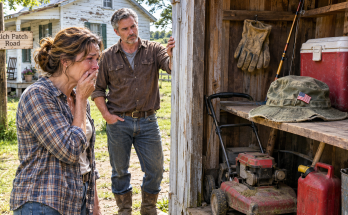
Faye Pope stood in the narthex of Pleasant Grove United Methodist Church with one hand pressed against her mouth. She was sixty-eight years old, a grandmother six times over, and the daughter of the best church treasurer I’d ever known. Her daddy, Clarence Pope, had been dead for seventeen years.
But there, on a yellowed piece of paper from 1974, was his signature. Clear as Sunday morning. Clarence E. Pope, Treasurer. Faye looked at me. “Ozell, what did Daddy sign?” I took off my glasses and wiped them with my handkerchief. “Something he figured this church might need one day.” Whitney Strickland stood beside us, still holding the old passbook.
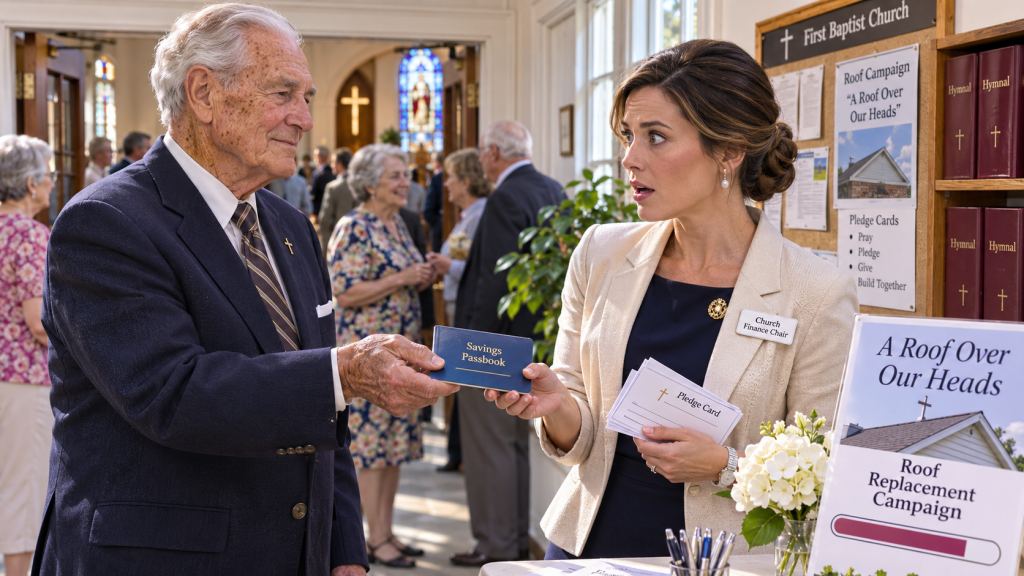
Pastor Jordan had gone quiet. And several people who’d been collecting their coats had stopped to listen. I pointed toward the paper. “Read the rest, Faye.” Her fingers trembled as she unfolded it. Then she began. “In recognition of labor and materials donated by Ozell Gaskins for the repair and replacement of the sanctuary roof, Pleasant Grove shall establish a restricted reserve for future roof maintenance.”
She paused. I nodded. “Keep going.” “The reserve shall remain designated for the sanctuary roof, and the church treasurer shall maintain records of contributions and deposits.” Whitney looked toward me. “That’s what the first page already says.” I nodded. “Yes, ma’am.” Then I tapped the second paragraph.
“But that ain’t the part Faye needs to read.”
Faye continued.
“In addition, the undersigned treasurer acknowledges receipt of a separate gift pledged toward future roof replacement, to be held and administered according to the attached donor instructions.”
Her voice faltered.
She looked up.
“What separate gift?”
I swallowed.
“Your daddy called it the Ernestine Fund.”
Whitney blinked.
“Ernestine?”
“My wife.”
Pastor Jordan stepped closer.
“Mr. Gaskins, I thought Mrs. Gaskins passed away in 2016.”
“She did.”
My voice caught slightly.
“We were married forty-eight years.”
Faye looked toward the document again.
“Why would Daddy have a fund named after Ernestine in 1974?”
I smiled.
“Because it was her idea.”
The narthex was quiet enough to hear the ceiling fan.
I could see my wife’s favorite stained-glass window behind Faye.
Blue glass.
Yellow flowers.
A little white dove.
Ernestine had helped raise the money to repair it in 1989, back when the glass was coming loose around the edges.
She’d stood on a ladder beside me, handing me tools and telling me not to drop anything on the altar.
That woman never liked wasting money.
Didn’t like wasting time either.
And she especially didn’t like seeing good people frightened by a bill they hadn’t prepared for.
“Back in 1974,” I said, “Ernestine and I had been married just two years.”
Faye nodded.
“I remember. Y’all lived out behind your daddy’s place.”
“That’s right.”
I looked toward Whitney.
“We weren’t rich. I was just getting Gaskins Roofing started. Ernestine kept the books at night after working all day at the school cafeteria.”
Pastor Jordan listened carefully.
“When I fixed that roof, Pastor Barfield wanted to pay me.”
I smiled.
“Couldn’t have, even if I’d let him.”
Several people chuckled.
“So Ernestine suggested something.”
I paused.
“She said if we could afford to give the church a roof once, maybe we ought to help make sure the next generation didn’t have to stand around with buckets.”
Faye wiped her eyes.
“That sounds like Ernestine.”
“It does.”
I nodded toward the old paper.
“We started a reserve. Ten dollars every Sunday from me. And Ernestine made a separate arrangement.”
Whitney looked confused.
“What arrangement?”
I took a breath.
“She put two thousand dollars of her own savings into a long-term account.”
Pastor Jordan stared.
“Two thousand dollars in 1974?”
“Yes, sir.”
I smiled sadly.
“She’d saved it working summers and sewing dresses for people around town.”
Faye covered her mouth.
I continued.
“She told Pastor Barfield that if somebody kept the money invested instead of spending it on little things, it might grow enough to help the church someday.”
Whitney looked down at the papers.
“But this document doesn’t identify a current bank account.”
“No, ma’am.”
“Or a current balance.”
“No.”
She frowned.
“Then how do we know the money still exists?”
I looked toward her.
“That’s exactly why I’m asking for an accounting before the church borrows three hundred and eighty thousand dollars.”
For the first time since she’d taken over the finance committee, Whitney didn’t have an answer ready.
Faye folded the paper carefully.
“Ozell, did Daddy manage that money?”
“He helped establish the arrangement and kept copies of the instructions.”
“And after he died?”
I hesitated.
“That’s what we need to find out.”
Pastor Jordan finally spoke.
“Maybe we should move this conversation into my office.”
Whitney glanced toward the members watching us.
“I agree.”
I shook my head.
“Reckon it’s too late to keep it quiet.”
The pastor looked embarrassed.
I smiled.
“Don’t worry, son. I don’t intend to holler at anybody.”
Then I added.
“But I don’t intend to let anybody sign away this church’s future before we know what’s already been set aside for it.”
That afternoon, seven of us gathered around the table in Pastor Jordan’s office.
Whitney.
Faye.
The pastor.
Two council members.
Mrs. Hattie Bell, who’d played the church organ since 1965.
And me.
I laid out everything I’d brought.
The passbook.
The original agreement.
Ernestine’s donor instructions.
And copies of the letters I’d received from the successor bank.
Whitney examined the pages.
“Mr. Gaskins, this account number is ancient.”
I nodded.
“So am I.”
Hattie laughed.
Whitney didn’t.
She was too busy reading.
The passbook showed seventy-four thousand dollars in 1996.
That was the last entry anybody had written by hand.
After that, the bank had merged.
Then merged again.
The accounts had been transferred into newer systems.
I’d kept the old passbook because Ernestine told me never to throw away proof of something important.
She was right about that.
As usual.
Whitney looked at the bank correspondence.
“These letters say the institution has located historical records, but the present ownership and restrictions require verification.”
“Correct.”
“And you haven’t received a current balance?”
“Not one I can rely on.”
She looked surprised.
“You don’t know how much is there?”
“No, ma’am.”
I folded my hands.
“But I know enough to ask before we borrow money.”
Pastor Jordan leaned forward.
“Why didn’t anyone bring this up earlier?”
Faye looked toward him.
“Because our old treasurers knew about it.”
She glanced at Whitney.
“And when leadership changed, apparently some records didn’t follow.”
Whitney stiffened.
“I inherited disorganized financial statements.”
I nodded.
“I believe you did.”
She looked at me.
That seemed to surprise her.
I continued.
“But inherited confusion ain’t the same thing as permission to tell an old man his giving don’t matter.”
Nobody spoke.
Whitney lowered her eyes.
For a moment, I could see that she wasn’t simply the sharp-tongued young woman who’d returned my envelope.
She looked tired.
And worried.
Maybe even frightened.
I knew something about being afraid of responsibility.
When I was twenty-four, I had three employees and a business loan I could barely sleep thinking about.
I’d made mistakes.
Plenty of them.
But I learned early that numbers were supposed to tell you what was happening.
They weren’t supposed to make people feel small.
Pastor Jordan cleared his throat.
“Mr. Gaskins, I owe you an apology.”
I shook my head.
“Son, you haven’t done anything to me.”
He looked serious.
“I approved the wording of the capital campaign announcement without asking whether our historical records had been reviewed.”
I studied him.
He couldn’t have been more than thirty-two.
A good young pastor.
Still learning.
“Then ask next time.”
He nodded.
“I will.”
Whitney set down the passbook.
“The inspection report still says the roof needs replacement.”
I leaned back.
“Then let’s look at the inspection.”
She frowned.
“It’s from a reputable company.”
“Good.”
I folded my arms.
“Then they won’t mind another qualified roofer looking at it.”
The Atlanta company’s estimate was thick.
Twenty-three pages.
Photographs.
Warranty information.
Roofing materials.
Labor.
Equipment.
Disposal.
And a line item for structural work.
I turned pages slowly.
Then stopped.
“Well, I’ll be.”
Whitney looked toward me.
“What?”
I pointed.
“This includes replacing the roof framing over the entire sanctuary.”
“Yes.”
“Why?”
She glanced at the report.
“Because the engineer recommended it.”
I looked at the page.
“Where’s the engineer’s report?”
Whitney hesitated.
“It’s included.”
I searched again.
“No, ma’am. This says engineering review recommended. That’s not the same thing as an engineer recommending replacement.”
The room became quiet.
I slid the estimate toward her.
“See that?”
Whitney adjusted her glasses.
She read the line twice.
Then looked up.
“I see.”
Pastor Jordan leaned forward.
“Does that change the price?”
“It might,” I said.
“But don’t take my word. Get a licensed engineer to inspect it.”
I paused.
“And somebody local who knows what rain does around here.”
Faye smiled.
“Ozell, are you offering to go up there?”
I laughed.
“At eighty-one?”
Hattie chuckled.
“Your knees would file a complaint.”
“Before I got halfway up the ladder.”
I shook my head.
“No, ma’am. I know when to stay on the ground.”
Then I smiled.
“But I know a fellow who trained under me twenty years ago. Runs a good roofing business now.”
His name was Caleb Whitmore.
Forty-six years old.
Married.
Three children.
Owned Whitmore Roofing outside Valdosta.
He’d started working for me the summer after high school.
Back then, he couldn’t carry a bundle of shingles without complaining.
Now he had twenty employees and a reputation for doing honest work.
I called him Monday morning.
“Caleb?”
“Mr. Ozell?”
“Yes, sir.”
He laughed.
“Well, there’s a voice I haven’t heard in a while.”
I smiled.
“You still know how to find a roof leak?”
He laughed harder.
“Depends how much coffee you bring.”
Caleb agreed to examine the sanctuary.
The church also arranged for an independent structural engineer to evaluate the framing.
Neither of them promised an answer before inspecting.
I liked that.
A good professional doesn’t decide what’s wrong before looking.
The following Thursday, I stood beside the church while Caleb’s crew worked safely up on the roof.
I stayed on the ground.
Drank coffee.
And watched the men move around like I used to.
Their boots sounded against the shingles.
The wind carried the smell of wet pine needles.
And for a moment, I was twenty-four again, standing beside my daddy with a roofing hammer in my hand.
Caleb came down after the inspection.
His face was thoughtful.
“Mr. Ozell.”
“What’d you find?”
He looked toward the bell tower.
“You were right about the flashing.”
I smiled.
“Well, I do remember a little.”
Then his expression grew serious.
“But there’s more.”
The north-side flashing had separated where the roof met the bell tower.
Water had been entering during heavy rain.
Some sheathing needed repair.
There were other maintenance issues around vents and gutters.
But the roof wasn’t uniformly failing.
Caleb said some sections had aged better than others.
The engineer’s assessment found no evidence requiring the complete replacement of the sanctuary’s structural framing, though several areas needed targeted work.
I nodded.
“Sounds about right.”
Caleb held up his notes.
“There’s something else.”
I looked toward him.
“What?”
He hesitated.
“The Atlanta estimate includes items that don’t match the building as it stands.”
I frowned.
“Such as?”
“More square footage than our measurements indicate. Structural replacement allowances without supporting findings. And equipment charges that need clarification.”
I looked toward the church.
Then back at Caleb.
“Could be estimating mistakes.”
He nodded.
“Could be.”
I studied him.
“Or somebody priced a project before they knew what the project was.”
“That’s how it looks.”
I didn’t accuse anybody.
Didn’t call the company dishonest.
A bid can be excessive without being fraudulent.
And an estimate can include allowances for work that later turns out unnecessary.
But three hundred and eighty thousand dollars was an awful lot of money for a church where half the congregation lived on Social Security.
I wanted every dollar justified.
At the next council meeting, Whitney presented the updated findings.
Her slides looked different.
There were no dramatic photographs of buckets.
No giant fundraising thermometer.
Just a table of documented concerns.
She cleared her throat.
“The independent assessment does not currently support replacing the entire sanctuary structure.”
Several people murmured.
She continued.
“We’ve requested clarification from the Atlanta contractor and additional local estimates.”
I watched her.
She glanced toward me.
Then said.
“Mr. Gaskins was correct that the leak near the choir loft is associated with the bell-tower flashing.”
Faye smiled.
Hattie squeezed my shoulder.
I just nodded.
Being right didn’t make me happy.
Not when I could’ve prevented some of the worry if somebody had asked me sooner.
Then Whitney turned to another slide.
“The historical roof reserve also requires further accounting.”
My stomach tightened.
She continued.
“The successor bank has confirmed that an account associated with the original roof reserve existed and was transferred through institutional mergers.”
Pastor Jordan leaned forward.
“Has the balance been verified?”
“Not fully.”
She paused.
“However, the bank has located documents indicating the reserve was not simply closed in 1996.”
I exhaled slowly.
That was something.
Whitney clicked to the next slide.
“But the bank has also identified a second historical account.”
Faye sat straighter.
“What account?”
Whitney looked toward me.
“An account associated with the donor instructions signed by Ernestine Gaskins.”
The room went quiet.
I closed my eyes.
Ernestine.
Even after ten years in the ground, that woman was still helping us keep our heads straight.
Whitney continued.
“The institution is reviewing the beneficiary designation and the authority to release information.”
Faye leaned forward.
“Was Daddy involved?”
“His name appears in historical trustee correspondence.”
Faye covered her mouth.
I looked toward Whitney.
“And the money?”
She hesitated.
“That’s where things become complicated.”
After the meeting, Pastor Jordan asked me to stay.
Whitney remained too.
She looked uncomfortable.
“Mr. Gaskins, may I speak plainly?”
I nodded.
“I’d appreciate it.”
She folded her hands.
“I thought your ten-dollar envelopes were a bookkeeping problem.”
I smiled faintly.
“They probably were, if you didn’t know what they were for.”
She looked surprised.
I continued.
“But somebody should’ve asked.”
She swallowed.
“You’re right.”
Then she looked down.
“I shouldn’t have written that line about not moving the needle.”
I waited.
She continued.
“It was disrespectful.”
I nodded.
“Yes, ma’am. It was.”
Her eyes filled.
“I’m sorry.”
I looked toward the stained-glass window.
Then back at her.
“Whitney, ten dollars ain’t much money to somebody with plenty.”
She nodded.
“But for some folks, it’s a week’s worth of groceries.”
She began crying.
I continued gently.
“Ernestine and I gave because we loved this church. Not because we thought anybody owed us applause.”
Whitney wiped her cheeks.
“I understand.”
I smiled.
“Good.”
Then I added.
“And another thing.”
She looked up.
“Yes?”
“Don’t ever tell somebody their gift don’t matter because it ain’t big enough.”
Her shoulders shook.
“I won’t.”
Three weeks later, Caroline Briggs, a banking attorney retained to help clarify the old accounts, came to Pleasant Grove.
She was careful.
Professional.
And unwilling to state anything she couldn’t document.
I liked her immediately.
She spread a series of records across the fellowship hall table.
Whitney.
Faye.
Pastor Jordan.
Two trustees.
And me.
All of us leaned forward.
“The original roof reserve was established in the 1970s,” Caroline explained.
“Records show regular designated deposits over many years.”
Faye nodded.
“That’s Daddy’s work.”
Caroline smiled.
“And subsequent treasurers.”
She turned a page.
“The account passed through multiple bank mergers and was eventually transferred into a newer deposit and investment arrangement.”
My heart pounded.
“Is it still there?”
Caroline nodded.
“Yes.”
Whitney covered her mouth.
Pastor Jordan whispered.
“Thank God.”
Caroline raised a hand.
“Before we discuss the balance, I need to clarify that the account’s ownership and restrictions are being documented formally. The church and its trustees will need to resolve the administrative records.”
I nodded.
“That’s fair.”
She continued.
“The preliminary reconciled balance is substantially greater than the last amount recorded in the passbook.”
Faye leaned forward.
“How much greater?”
Caroline looked at the statement.
Then spoke slowly.
“Two hundred and forty-six thousand, eight hundred and nineteen dollars.”
Nobody moved.
The room was completely silent.
Then Hattie, who’d joined us for the meeting, whispered from the doorway.
“Mercy.”
I sat back in my chair.
Two hundred and forty-six thousand dollars.
From years of small gifts, careful deposits, and earnings over time.
I thought about every Sunday I’d tucked ten dollars into an envelope.
During good years.
Hard years.
After knee surgery.
During Ernestine’s hospital stays.
And after the day I buried her.
One envelope.
One Sunday.
One small promise.
Pastor Jordan began crying.
Whitney stared at the statement.
Then whispered.
“I returned his ten dollars.”
Nobody answered.
She looked toward me.
“I returned the gift of the man who’d been keeping this promise for fifty-two years.”
I smiled sadly.
“Well, you can always take it next Sunday.”
She covered her face.
But Caroline wasn’t finished.
“There is another matter.”
I looked up.
She placed a second file on the table.
“The Ernestine Gaskins account.”
My throat tightened.
“Yes, ma’am?”
She nodded toward the original donor instructions.
“The records indicate that Mrs. Gaskins arranged a separate long-term charitable gift with specific conditions.”
Whitney leaned forward.
“What conditions?”
Caroline looked toward me.
“That the funds remain available for future sanctuary roofing needs, subject to the terms of the original agreement.”
I swallowed.
“And the account?”
She paused.
“Before I give you the current figure, I need you to understand something.”
The room became quiet again.
Caroline continued.
“This account was not simply a savings account.”
I frowned.
“What was it?”
She turned another page.
“It was placed into a long-term investment arrangement that changed custodians over the years.”
Faye looked toward me.
“Ozell, did you know?”
I shook my head.
“Ernestine handled the arrangements with Pastor Barfield and your daddy. I knew what she wanted, but I never kept up with the paperwork after she passed.”
Caroline nodded.
“The documents are unusually detailed for their time.”
I smiled.
“That sounds like my wife.”
Caroline looked toward Pastor Jordan.
“There is also a provision concerning the use of any funds above the amount reasonably necessary for roof repairs.”
Whitney frowned.
“What provision?”
Caroline took a breath.
“Mrs. Gaskins wanted excess funds to support necessary maintenance of the church building, with priority given to accessibility and safety improvements.”
My eyes filled.
Of course she did.
Ernestine had always worried about older members struggling up the brick steps.
She used to say folks shouldn’t have to climb a mountain just to come worship.
Then Caroline turned to the final page.
“There’s one additional detail that requires verification before any distribution.”
My stomach tightened.
“What detail?”
She looked directly at me.
“Mr. Gaskins, the records indicate that your wife revised her donor instructions shortly before her death.”
I froze.
“Revised them?”
Caroline nodded.
“In 2015.”
My heart began pounding.
Ernestine had been ill that year.
Not yet bedridden.
But tired.
She’d spent long afternoons sorting family photographs and writing letters to our daughters.
I remembered finding her at the kitchen table one evening with a stack of papers.
I’d asked what she was doing.
She’d smiled.
“Just getting a few things in order, Ozell.”
I’d kissed the top of her head and gone outside to put away my tools.
Now I wondered whether those papers had been connected to this account.
Caroline unfolded a document.
“The amendment includes a personal instruction.”
I stared at her.
“What kind?”
She hesitated.
“One addressed specifically to you.”
The room seemed to stop.
For a moment, all I could hear was the old ceiling fan.
Then I whispered.
“From Ernestine?”
Caroline nodded.
“Yes, sir.”
My hands began trembling.
Ten years.
Ten years since I’d heard my wife’s voice.
Ten years since she’d sat beside me in the third pew.
Ten years since I’d stood at her grave wondering how a house could hold so many memories and still feel so empty.
I looked toward the folded document.
“May I read it?”
Caroline hesitated.
“Mr. Gaskins, I can provide you with the personal letter. The financial instructions still need formal verification.”
I nodded.
“That’s alright.”
She handed me the page.
I unfolded it slowly.
Ernestine’s handwriting stared back at me.
Slanted.
Neat.
Beautiful.
Just like the grocery lists she used to leave beside the refrigerator.
At the top were four words.
For My Darling Ozell.
My eyes filled immediately.
I tried to read the first line.
But the words blurred.
Faye reached for my hand.
Pastor Jordan looked away.
And Whitney, who’d once told me my ten dollars wasn’t moving the needle, stood silently beside the table with tears running down her face.
I swallowed.
Then began reading.
Ozell, if you’re holding this paper, I reckon somebody finally found the account we started all those years ago.
A broken laugh escaped me.
That sounded exactly like her.
I wiped my eyes.
Then continued.
You always said a roof was only as good as the hands that maintained it. But I believe a church is only as strong as the people who remember why it was built.
We didn’t give because we had more than everybody else.
We gave because somebody had to begin.
My hands trembled.
Then I reached the final paragraph.
And what Ernestine had written there made me stop breathing.
Ozell, there’s one thing I never told you about that first two thousand dollars.
I stared at the words.
My heart began pounding.
It wasn’t all mine.
I looked up.
Faye leaned closer.
“What does she mean?”
I shook my head.
“I don’t know.”
Then I read the next sentence.
“Half of it came from a woman who made me promise never to tell anybody her name while she was alive.”
The room went silent.
I continued reading.
She knew what it felt like to worship in a building where nobody thought about the people who couldn’t climb the steps or afford to give much.
She told me that if the money ever became enough to make a difference, I should make certain the church remembered her.
I swallowed.
Then read the final line.
“Her name was Ruth Ann Pope.”
Faye gasped.
Her chair scraped against the floor.
“That’s my mother.”
I stared at her.
Ruth Ann Pope.
Clarence’s wife.
A woman who’d cleaned this church every Friday for thirty-eight years.
Who’d brought casseroles to funerals.
Who’d washed the choir robes.
And who’d died in 2003 without ever asking for a single word of praise.
Faye began crying.
“Mama gave that money?”
I looked down.
Apparently, she had.
Caroline gently reached for the document.
“There’s one more page.”
I looked up.
“What?”
She placed another sheet beside Ernestine’s letter.
“This is the account instruction concerning the original donors.”
My heart tightened.
“What does it say?”
Caroline looked toward Faye.
Then toward me.
“It names Ernestine Gaskins and Ruth Ann Pope as the original contributors.”
Faye covered her mouth.
Caroline continued.
“And it includes a request that the church honor their wishes before any funds are spent.”
Whitney whispered.
“What wishes?”
Caroline looked down at the page.
Then said something that made every person at that table sit perfectly still.
“The donors specifically prohibited borrowing against the account or pledging it as security for construction debt.”
Pastor Jordan looked toward Whitney.
Whitney stared at her notes.
“The proposed church loan…”
Caroline nodded.
“Would need to be examined carefully in light of those restrictions.”
I closed my eyes.
The church had been preparing to borrow three hundred and eighty thousand dollars.
But now there was an old reserve worth nearly a quarter of a million dollars.
A separate charitable account.
And a forgotten agreement that might prevent the very financing arrangement the council had been discussing.
I looked toward the stained-glass window.
The one Ernestine had cleaned every Easter.
And whispered.
“Honey, you thought of everything.”
Caroline gathered the documents.
“Before anyone makes financial commitments, the trustees need to establish the exact legal status of both accounts and the donor restrictions.”
Pastor Jordan nodded.
“We’ll suspend the financing proposal.”
Whitney looked toward him.
“I agree.”
Then she looked at me.
“Mr. Gaskins, there’s something I need to do.”
I raised an eyebrow.
“What’s that?”
Her voice trembled.
“Correct the record publicly.”
I nodded.
“That’s a good start.”
But as everyone began gathering their papers, Caroline touched my arm.
“Mr. Gaskins?”
“Yes, ma’am?”
She lowered her voice.
“There’s one more thing about Ernestine’s account.”
My heart tightened.
“What?”
She glanced toward the closed door.
“I didn’t want to discuss it until I could explain the supporting records.”
I stared at her.
“Explain what?”
Caroline took a slow breath.
Then whispered.
“The original balance has grown considerably. And according to the latest records, the account may now be worth more than the entire roof estimate.”
I sat perfectly still.
Three hundred and eighty thousand dollars.
More than the entire roof estimate.
I looked down at my wife’s handwriting.
Then toward Faye, who was still wiping tears from her cheeks.
And suddenly I understood that the greatest gift Ernestine had left Pleasant Grove might not have been the money at all.
It might have been the reminder that the quietest people in a congregation sometimes carry its strongest foundations.
But I also knew something else.
Before a single dollar could be spent, we had to find out exactly how much Ernestine and Ruth Ann had left behind.
And why the church’s old financial records had failed to account for a gift large enough to change everything.