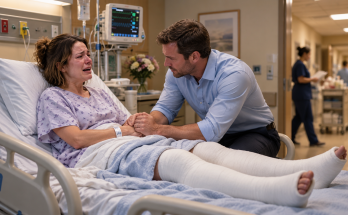
I spent my wedding night alone because my husband’s grandmother said every groom in their family had to sleep beside “the matriarch” before joining his bride. My husband told me not to make a scene. By morning,
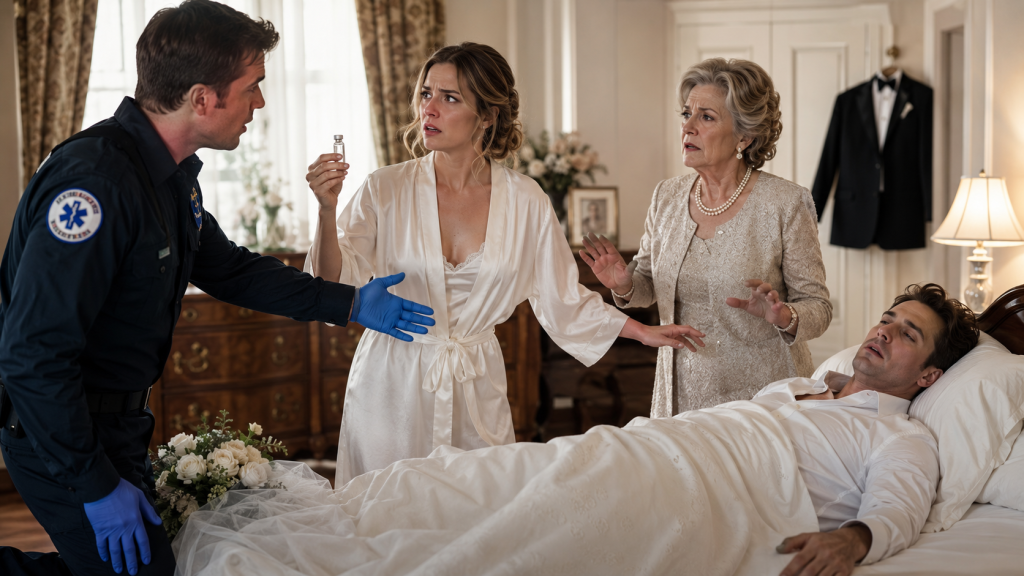
I was done being polite. I opened the door and found him unconscious beside her, with an unfamiliar stain on the sheet and a tiny puncture mark on his arm. That was when the story stopped looking like a disgusting tradition and started looking like something much darker.
I said his name twice and crossed the room before his grandmother could stop me.
She was already awake. Fully dressed. Calm enough to make my skin crawl.
“He fainted,” she said. “He always was sensitive.”
My husband’s face was pale against the pillow. His breathing was shallow but steady, and when I touched his shoulder, he barely reacted. The puncture on his arm was small, almost neat. The stain on the sheet was darker near his side, but there was no obvious wound that explained it.
I reached for my phone.
His grandmother stood up.
“Don’t embarrass this family,” she said.
Same sentence. Different mouth.
My husband had used nearly those exact words the night before when I objected to the whole ritual. He had looked exhausted, caught between me and a lifetime of being told that whatever happened in this family was normal if enough people had done it before him.
But this wasn’t normal.
I called for emergency help.
His grandmother kept talking while I gave the address. She told me he had been nervous. She said he drank too much. She said newlyweds were dramatic these days.
She said. She said. She said.
Then my husband moved.
His fingers curled weakly around my wrist.
“I said no,” he whispered.
I bent closer. “No to what?”
His eyes opened only halfway. He looked past me toward his grandmother, and the fear in his face was clearer than anything she had said all morning.
“The drink,” he breathed. “I told her I wasn’t drinking it.”
His grandmother snapped, “You’re confused.”
He flinched at her voice.
That small reaction settled something in me. Whatever explanation came next, I was not leaving him in that room with her.
When the emergency crew arrived, she tried to take over the conversation. She answered questions meant for him. She insisted the puncture was probably from something harmless. One responder finally asked her to step back while another checked his arm and breathing.
I stayed beside him.
As they shifted him carefully toward the stretcher, something rolled from the fold of the sheet and tapped against the hardwood floor.
A tiny glass vial.
His grandmother saw it at the same moment I did.
She moved first.
So did I.
My hand closed around it just before hers, and for the first time all morning, her calm expression cracked.
“Give me that,” she said.
I looked at the vial, then at my husband.
His eyes were open now.
He stared at the object in my hand and whispered, “I’ve never seen that before.”
One of the responders held out a gloved hand.
His grandmother reached for me again, but I stepped back and placed the vial into the responder’s palm.
PART 2: THE TRADITION WAS NEVER ABOUT SLEEPING BESIDE HER
The responder closed his gloved hand around the vial.
My husband’s grandmother stopped breathing.
Just for a second.
But I saw it.
That tiny fracture in her composure frightened me more than if she had screamed.
“What is it?” I asked.
The responder turned the vial carefully beneath the light.
“No label.”
His voice changed.
Professional.
Sharper.
He looked toward his partner.
“Bag this.”
The grandmother stepped forward.
“That belongs to me.”
The responder looked at her.
“Then you can explain what it contains to the hospital or to law enforcement.”
Her face hardened.
“There is no reason to involve anyone else.”
My husband made a weak sound from the stretcher.
I turned immediately.
His eyes were barely open.
“Eli?”
His fingers found mine.
That was my husband’s name.
Eli Warren.
We had been married less than twelve hours.
I had spent half of those hours alone because his family had insisted a grown man sleep in his grandmother’s room before he was “allowed” to begin married life.
I had thought the tradition was grotesque.
Now I was beginning to wonder whether grotesque had been the least important thing about it.
Eli whispered:
“Don’t let her…”
His voice disappeared.
“Don’t let her what?”
He tried again.
“The papers.”
My skin went cold.
“What papers?”
His grandmother snapped:
“He’s delirious.”
The responder turned toward her.
“Ma’am, step away.”
“He needs family.”
“I am his wife.”
The words came out before I thought about them.
His grandmother looked at me.
Something ugly moved behind her eyes.
Not anger.
Offense.
As though I had claimed a title she did not recognize.
“You have been his wife for one night.”
she said.
“And I have known him since birth.”
I tightened my hand around Eli’s.
“Then maybe you should have known he meant no when he said it.”
For the first time, she had no answer.
The stretcher rolled toward the hallway.
I followed.
She followed us.
One of the responders blocked her path.
“Immediate family can meet us at the hospital.”
“I am immediate family.”
He looked at me.
Then at her.
“The spouse is coming.”
That sentence should not have felt like victory.
It did.
Not because I wanted to defeat an old woman.
Because someone had finally recognized that Eli belonged to himself before he belonged to a family hierarchy.
I climbed into the ambulance.
The doors closed.
And the last thing I saw was his grandmother standing in the driveway, perfectly upright, watching us leave.
She did not look worried.
She looked furious.
At the hospital, everything happened quickly.
Blood pressure.
Heart monitor.
Questions.
Tests.
A nurse cut away the sleeve around the puncture site.
Under the brighter hospital lighting, I could see it clearly.
The mark was not a random scratch.
It was small.
Precise.
And surrounded by the faint yellow-brown discoloration of something that had been wiped across his skin.
The nurse frowned.
“Do you know if he received an injection?”
“No.”
Eli opened his eyes.
“Maybe.”
I bent closer.
“You remember?”
He swallowed.
“She kept touching my arm.”
“What do you mean?”
His breathing changed.
“She said I was tense.”
The nurse looked at him.
“Do you remember being injected?”
He closed his eyes.
“No.”
Then:
“I remember her saying I had embarrassed her.”
“Why?”
“Because I wouldn’t drink.”
My stomach turned.
The night before suddenly came back in pieces.
His grandmother at the reception.
Standing beside Eli.
Telling me the “family custom” was harmless.
Telling me every Warren groom had spent his first married night in the matriarch’s room.
I had laughed because I thought it was a joke.
Nobody else laughed.
Eli had taken me aside afterward.
His face pale.
“It’s just one night.”
he had said.
“You want to sleep beside your grandmother on our wedding night?”
“No.”
“Then don’t.”
“It’s complicated.”
“No, Eli. It’s disgusting.”
He had looked exhausted.
“Please don’t make a scene.”
That sentence had hurt me.
I thought he was choosing tradition over me.
Now I wondered whether fear had been choosing for him.
The nurse asked:
“What drink?”
Eli’s mouth tightened.
“Some family thing.”
“What kind?”
“Dark red.”
My chest tightened.
The stain.
I looked at the nurse.
“There was a dark stain on the bedsheet.”
She glanced at me.
“Could have been spilled liquid.”
“Or blood?”
“Possibly.”
She did not speculate beyond that.
Good.
I needed facts.
Not fear multiplying itself.
Eli whispered:
“She said Granddad drank it.”
I looked at him.
“What?”
“On their wedding night.”
His eyes opened.
“She said Dad did too.”
A chill moved through me.
“Your father?”
He nodded.
“He told me once he got sick after the ritual.”
“When?”
“Years ago.”
“Why didn’t you tell me?”
His eyes filled.
“I thought he meant drunk.”
I stared at him.
“But he doesn’t drink.”
Eli closed his eyes.
“No.”
That was when a doctor entered.
She introduced herself as Dr. Patel.
Calm voice.
Tired eyes.
The kind of person who did not waste words.
“We’re still waiting on complete results.”
she said.
“But I want to ask a few questions.”
She looked at Eli.
“Did you take any sleeping medication last night?”
“No.”
“Prescription anxiety medication?”
“No.”
“Recreational drugs?”
“No.”
“Anything given to you by anyone else?”
His face tightened.
“The drink.”
“But you said you didn’t drink it.”
“I didn’t.”
Dr. Patel looked at the puncture site.
Then back at him.
“Did anyone inject you with anything voluntarily?”
“No.”
Silence.
She wrote something down.
Then:
“Your initial screening indicates the presence of a sedating substance.”
My stomach dropped.
Eli stared at her.
“What?”
Dr. Patel continued.
“We’re sending additional testing because the first screen is limited.”
I gripped the edge of the bed.
“So he was drugged?”
“I’m saying there is a substance present that he says he did not knowingly take.”
She looked at Eli.
“And that makes consent and source important.”
His face went completely white.
I touched his shoulder.
He whispered:
“She injected me.”
Dr. Patel did not answer.
She simply said:
“We will document what we find.”
Then she looked at me.
“The vial has been transferred for identification through appropriate channels.”
My pulse quickened.
“Police?”
She did not overstate it.
“The circumstances were reported.”
Good.
Because suddenly I did not care how embarrassed the Warrens became.
Embarrassment was no longer the emergency.
An hour later, Eli’s father arrived.
Not the grandmother.
His father.
Thomas Warren.
He walked into the room looking like someone had aged him ten years since the reception.
He stopped at the foot of the bed.
Saw the IV.
Saw the monitor.
Saw Eli’s face.
Then sat down.
Hard.
“Oh God.”
Eli looked at him.
“Dad.”
Thomas covered his mouth.
For several seconds, he could not speak.
Then he looked at me.
“What did she do?”
That question stopped me.
Not:
What happened?
Not:
Is he okay?
What did she do?
I stood.
“You knew.”
His face collapsed.
Eli turned toward him.
“Dad?”
Thomas started crying.
I had never seen him cry.
At our wedding he had been polished.
Reserved.
A man who shook hands like business deals were constantly happening somewhere nearby.
Now his shoulders shook.
“I thought she stopped.”
Eli whispered:
“Stopped what?”
Thomas looked toward the door.
As though even inside a hospital his mother might appear and punish him for speaking.
I moved closer.
“Thomas.”
He looked at me.
“Your son was found unconscious.”
His eyes closed.
“There was an unmarked vial.”
“A puncture.”
“A substance in his system he says he never agreed to take.”
My voice shook.
“You do not get to protect a tradition now.”
He lowered his head.
“It was never a tradition.”
Silence.
Eli stared.
“What?”
Thomas looked at his son.
“That’s what she called it.”
“What was it?”
His face twisted.
“Control.”
The word landed heavily.
Thomas leaned forward.
“When I married your mother, my mother made me spend the night in her suite.”
Eli’s breathing changed.
“She told me the same thing she told you.”
“Every Warren groom must spend one final night under the protection of the matriarch.”
I almost laughed from disgust.
Thomas continued.
“She gave me a drink.”
“Did you take it?”
“Yes.”
“What happened?”
“I woke up sick.”
“Confused.”
“My arm hurt.”
My stomach turned.
“Did you have a puncture mark?”
Thomas nodded.
“Yes.”
Eli whispered:
“Dad.”
“I didn’t understand then.”
“What did she tell you?”
“That I had panicked.”
“That I drank too quickly.”
“That I passed out.”
Thomas rubbed both hands across his face.
“Then she showed me documents I had supposedly signed.”
I froze.
“What documents?”
He looked at Eli.
“Family trust papers.”
The room went silent.
Eli’s eyes widened.
“What trust?”
“The Warren Legacy Trust.”
I had heard the name.
Barely.
Eli’s family owned several commercial properties, agricultural land, and a chain of assisted-living facilities founded by his grandfather.
The family trust held much of it.
Eli had always described it as boring inherited paperwork.
Apparently the paperwork had teeth.
Thomas continued.
“The papers restricted what I could do with my future trust interest without approval.”
“What does that have to do with marriage?”
I asked.
His mouth tightened.
“Everything.”
He looked at me.
“My mother believes spouses are threats.”
My skin chilled.
“She believes anyone marrying into the family will eventually try to take family assets.”
Eli stared.
“So she drugs grooms?”
Thomas closed his eyes.
“Yes.”
I felt sick.
“And makes them sign?”
“I don’t know exactly what happened that night.”
“You just said—”
“I woke with documents.”
he said.
“I cannot prove how my signature got there.”
That distinction mattered.
He continued.
“I challenged her once.”
“What happened?”
“She showed me a video.”
Eli went still.
“What video?”
Thomas’s face flushed with shame.
“Me.”
“Barely conscious.”
“Signing.”
My chest tightened.
“Were you coherent?”
“No.”
“Did you understand what you were signing?”
“No.”
“Then why didn’t you fight it?”
Thomas laughed bitterly.
“Because I was twenty-six.”
“Newly married.”
“Dependent on the family business.”
“And my mother told me if I embarrassed the family, I would lose everything.”
He looked at Eli.
“I was a coward.”
Eli shook his head.
“Dad…”
“No.”
Thomas cried.
“I was.”
Then:
“And I made you pay for it.”
Eli’s eyes filled.
“What do you mean?”
Thomas swallowed.
“When you told me she was insisting on the ritual…”
His voice disappeared.
“You knew?”
Eli whispered.
Thomas nodded.
“I knew she would try.”
“And you let me go?”
I watched something inside my husband fracture.
Thomas stood.
“I thought the documents had already been handled.”
“What documents?”
“I thought she only wanted the performance of it.”
Eli stared at him.
“The performance?”
“I thought she wanted to prove you would still obey her.”
“That is supposed to make this better?”
“No.”
Thomas shook his head.
“No.”
Eli turned his face away.
Thomas continued.
“I should have stopped it.”
“Yes.”
Eli’s voice was barely audible.
“You should have.”
Thomas sat again.
No defense.
No request for forgiveness.
Good.
Eli looked at him.
“Who else?”
Thomas froze.
“Dad.”
His face told us before his mouth did.
“Who else went through this?”
Thomas whispered:
“Your uncle Raymond.”
“And?”
“Your cousin Paul.”
Eli stared.
“Paul isn’t married.”
“No.”
“He was engaged.”
I remembered.
Three years earlier.
Paul Warren had been engaged to a woman named Vanessa.
The engagement ended abruptly.
Family gossip said Vanessa had “shown her true colors.”
I suddenly hated that phrase.
“What happened?”
I asked.
Thomas looked ashamed.
“Paul refused the ritual.”
My stomach tightened.
“And?”
“Mother told him she would remove him from the family trust.”
“Did she?”
“No.”
“Why not?”
“Because Vanessa left.”
My skin went cold.
“Why did she leave?”
Thomas hesitated.
“Mother showed her documents suggesting Paul had been hiding debt.”
Eli frowned.
“Was he?”
“No.”
Silence.
I stared at Thomas.
“She fabricated them?”
“I don’t know.”
“But Paul says they were false.”
“Did anyone investigate?”
Thomas laughed bitterly.
“In this family?”
That answer told me enough.
Police arrived later that afternoon.
Not dramatic.
No handcuffs.
No television-style accusations.
A detective named Maren Cole asked questions.
Separate questions.
Eli’s statement.
Mine.
Thomas’s.
She asked about the vial.
The puncture.
The drink.
The documents.
She asked whether any wedding guests had photographs or videos from the grandmother’s suite.
No one did.
Of course.
The ritual required privacy.
Privacy protects tenderness.
It also protects abuse.
That thought stayed with me.
When Detective Cole left, she said:
“Do not confront anyone.”
I nodded.
Eli asked:
“Can my grandmother come here?”
“If the hospital allows visitors and you want her here.”
“I don’t.”
“Then tell staff.”
He did.
For the first time in his life, perhaps, a boundary involving his grandmother became an instruction other people would enforce.
Her name went onto the restricted visitor list.
Thirty minutes later, she arrived.
Of course she did.
We heard her before we saw her.
Her voice outside the nurses’ station.
Controlled.
Insistent.
“I am his grandmother.”
Then another voice.
“He has requested no visit.”
“That request is not informed.”
I stood.
Eli grabbed my hand.
“No.”
I looked at him.
His face was pale.
“Don’t go out there.”
“You don’t have to.”
“I know.”
“Do you want me to?”
He hesitated.
Then shook his head.
“No.”
So I stayed.
That mattered.
I wanted to confront her.
Wanted to ask what was in the vial.
Wanted to tell her she had lost.
But this was not my confrontation to steal from him.
We stayed inside.
Eventually security escorted her away.
Eli cried afterward.
Not because he wanted her.
Because sometimes saying no to someone who raised you hurts even when that person is dangerous.
He whispered:
“I still love her.”
I sat beside him.
“I know.”
“She raised me half the time.”
“I know.”
“She came to every school play.”
I touched his face.
“Love does not become fake because someone also harmed you.”
His eyes filled.
“Then why does it feel like every good memory is contaminated?”
I had no perfect answer.
So I said:
“Maybe because you just learned the person in those memories had another side you weren’t allowed to see.”
He closed his eyes.
I held him.
We had been married one day.
This was not how I imagined marriage beginning.
But maybe marriage is revealed most clearly when ceremony ends and reality enters the room uninvited.
That evening, Paul arrived.
The cousin whose engagement had collapsed.
He looked nervous.
He brought no flowers.
No dramatic sympathy.
Just a worn brown envelope.
He placed it on the hospital tray.
“What is this?”
Eli asked.
Paul looked toward the door.
Then:
“What she made me sign.”
My stomach tightened.
“You kept it?”
“A copy.”
Eli opened the envelope.
Inside were eight pages.
Trust amendments.
Confidentiality language.
Spousal waiver acknowledgments.
And a document titled:
POST-MARITAL FAMILY ASSET PROTECTION DECLARATION.
I stared.
“This is dated three days before your wedding would have happened.”
Paul nodded.
Eli frowned.
“You never married Vanessa.”
“No.”
“Then why does this exist?”
Paul laughed bitterly.
“Because Grandma wanted me to sign before the wedding.”
My heart started pounding.
“She tried the ritual early?”
“No.”
Paul swallowed.
“I refused the ritual entirely.”
“How?”
“I told her if family money required me to spend my wedding night in her bedroom, she could keep the money.”
Despite everything, I almost smiled.
Eli looked at him.
“I wish I’d done that.”
Paul shook his head.
“No.”
“You didn’t know what I knew.”
“What did you know?”
Paul looked toward Thomas.
Thomas lowered his head.
Paul continued.
“My dad told me.”
“Uncle Raymond?”
“Yes.”
“What happened to him?”
Paul’s face changed.
“He had the drink.”
“Then?”
“He woke up with two puncture marks.”
I felt sick.
“Two?”
Paul nodded.
“He said Grandma told him she needed blood for a medical compatibility test.”
Eli whispered:
“What?”
Paul opened another folder.
Inside were photocopies.
Old ones.
Laboratory reports.
Names.
Blood types.
Genetic markers.
I stared.
“What is this?”
Paul looked at us.
“She wasn’t only getting signatures.”
The room went silent.
Eli’s face tightened.
“What was she doing?”
Paul whispered:
“Testing us.”
“For what?”
He hesitated.
Then slid one paper forward.
At the top was Thomas Warren’s name.
Below it:
PATERNITY PROBABILITY: CONSISTENT WITH DECLARED PARENTAGE.
Thomas went completely still.
I stared.
“What?”
Paul continued.
“She tested every male heir.”
My skin crawled.
“For paternity?”
“Yes.”
“Why?”
“Because the trust passes differently if someone is not biologically descended from Granddad.”
Thomas grabbed the page.
His hands shook.
“You have this?”
“I found it in Dad’s safe after he died.”
Eli looked at his father.
“Uncle Raymond knew?”
“Apparently.”
Thomas looked devastated.
Paul continued.
“Grandma calls it bloodline verification.”
I nearly laughed in disbelief.
“That sounds medieval.”
“It is.”
Paul said.
“But the trust language is old.”
“Some distributions were written around direct descendants.”
“So she decided she had the right to secretly test everyone?”
“Yes.”
My stomach turned.
The ritual suddenly made horrifying sense.
The drink.
The unconsciousness.
The puncture.
The privacy.
The papers.
One night where the groom was separated from everyone else.
One night controlled by the matriarch.
She could collect blood.
Obtain signatures.
Document obedience.
And then call it tradition.
Eli stared at Paul.
“Why didn’t you tell me?”
Paul looked ashamed.
“Because Vanessa left.”
“That isn’t an answer.”
“I thought if I brought this up, Grandma would destroy me too.”
“Destroy you how?”
Paul laughed bitterly.
“Financially.”
“Socially.”
“She told everyone Vanessa was after money.”
“She told Vanessa I was hiding debt.”
“She told my parents I was unstable.”
He looked at Eli.
“And everybody believed whichever version cost them least.”
That sentence stayed in the air.
Then Thomas whispered:
“Raymond died believing one of those tests was wrong.”
Everyone turned.
“What?”
Paul’s face went white.
“Dad never told me that.”
Thomas stared at the report.
“My brother called me two months before he died.”
“What did he say?”
“He said Mother had tested someone and panicked.”
“Who?”
Thomas shook his head.
“He wouldn’t tell me.”
Paul leaned forward.
“Tested who?”
“I don’t know.”
Thomas’s voice broke.
“He said if the result became known, the trust would ‘split the family in half.’”
My heart started pounding.
Eli looked from Thomas to Paul.
“Who could that be?”
No one answered.
Then Paul slowly reached into the brown envelope.
“There’s one more thing.”
Of course there was.
He removed a sealed photocopy.
Not opened.
At least not by him.
Across the top:
CONFIDENTIAL — ELI WARREN
My husband stopped breathing.
“What is that?”
Paul looked horrified.
“I found it with the other test results.”
Eli stared.
“Mine?”
Paul nodded.
“But how?”
Eli whispered.
“I’ve never done one.”
Thomas closed his eyes.
“No.”
We all turned.
He looked sick.
“Dad?”
Thomas whispered:
“When you were born…”
Eli’s face emptied.
“What?”
“Your grandmother insisted on taking you for newborn screening herself.”
My stomach dropped.
Eli whispered:
“You’re telling me she tested my paternity when I was a baby?”
Thomas cried.
“I think so.”
Paul pushed the sealed copy toward Eli.
“I didn’t open it.”
Eli looked at me.
His hand was trembling.
I covered it with mine.
“You don’t have to.”
“I know.”
“Whatever is in there does not change who raised you.”
“I know.”
“It doesn’t change who you are.”
He looked at his father.
Thomas was crying openly now.
Eli whispered:
“I need to know.”
He opened the envelope.
Slowly.
The paper inside was old.
A lab report.
His name.
His mother’s name.
Then a comparison to Thomas.
Eli read.
His face went white.
Thomas stood.
“What?”
Eli did not answer.
“Eli.”
My husband looked at him.
And in that moment, I watched a family history collapse without anyone raising their voice.
Eli placed the report on the bed.
Thomas reached for it.
Then stopped.
As though touching the page might make the words more real.
I looked down.
The result was clear.
Declared paternal relationship excluded.
My heart stopped.
Thomas made a sound like someone had punched him.
“No.”
Eli stared at him.
Neither spoke.
Paul whispered:
“Oh God.”
Thomas picked up the report.
Read it once.
Then again.
“No.”
His voice broke.
“This is wrong.”
“It has to be wrong.”
Eli looked like he had disappeared inside himself.
Thomas rushed toward the bed.
“I am your father.”
Eli flinched.
Thomas stopped instantly.
That hurt all of us.
He whispered:
“I’m sorry.”
Then:
“I am your father.”
This time quieter.
Not biology.
Claim.
Memory.
Love.
Eli’s eyes filled.
“I know.”
Thomas began crying harder.
I looked at the report.
Then something occurred to me.
“Wait.”
Everyone turned.
“This is a photocopy.”
Paul nodded.
“Yes.”
“From an old file.”
“Yes.”
“We do not know whether it is accurate.”
Thomas looked at me.
Hope and terror mixed in his face.
I continued.
“We don’t know who ordered it.”
“We don’t know whether samples were handled properly.”
“We don’t know whether this page was altered.”
Paul slowly nodded.
I looked at Eli.
“If you want the truth, you get a new test.”
He breathed.
In.
Out.
Then nodded.
“Yes.”
Thomas whispered:
“Whatever it says…”
Eli looked at him.
Thomas’s voice broke.
“…I’m still your dad.”
Eli started crying.
For the first time since the hospital, he reached for his father.
Thomas moved carefully.
Like asking permission without words.
Eli pulled him into a hug.
I looked away.
Because some moments deserve privacy even when you are standing beside them.
Then Paul’s phone buzzed.
He looked down.
His face changed.
“What?”
I asked.
He held the screen toward us.
A message from an unknown number.
Only one sentence.
IF ELI OPENS THAT REPORT, ASK THOMAS WHO HIS REAL FATHER IS BEFORE THE POLICE ASK ME.
Nobody moved.
Thomas stared at the screen.
His face became something beyond pale.
Eli pulled away from him.
“Dad?”
Thomas looked toward the floor.
My pulse thundered.
Paul whispered:
“Who sent that?”
Thomas said nothing.
“Thomas.”
I stepped closer.
“Who is Eli’s biological father?”
His eyes filled.
He looked at his son.
Then at me.
Then toward the hospital-room door as if the past itself might walk through it.
Finally he whispered:
“I don’t know.”
Eli stared.
Thomas continued.
“But your mother might have.”
“What does that mean?”
His voice cracked.
“Because a month before you were born, she tried to leave me.”
Silence.
Eli stopped breathing.
“For who?”
Thomas closed his eyes.
And whispered a name none of us expected.
“Raymond.”
Paul’s father.
His own brother.
Paul stumbled backward.
“No.”
Thomas cried.
“I never knew whether anything happened.”
“You just said—”
“She came back.”
“She said she was frightened.”
“She said pregnancy had overwhelmed her.”
“I believed her.”
He looked at Eli.
“Then Mother ran that test.”
“And?”
“She never showed me the result.”
My chest tightened.
“You never saw this report?”
“No.”
Thomas shook his head violently.
“No.”
Eli looked at Paul.
Paul looked at him.
Cousins.
Maybe half-brothers.
Maybe not.
Nobody knew.
And suddenly the hidden blood tests were no longer merely about preserving a trust.
They were about preserving a secret the matriarch had known since Eli was born.
A secret that could change who inherited.
Who was considered a son.
Who was considered legitimate.
And possibly explain why Raymond died convinced one test could split the family in half.
I looked at the empty vial bag logged on the hospital paperwork.
At the puncture in Eli’s arm.
At the old paternity report.
Then at Thomas.
The grandmother had sedated Eli on his wedding night.
She had tried to take blood again.
Not because she needed a test she had already performed as an infant.
Because she wanted a new one.
A fresh sample.
One obtained without his consent.
The question was no longer whether Eli’s old result was true.
The question was:
What had changed enough that his grandmother suddenly needed to test him again on the night he married me?
And before anyone could answer, Detective Cole appeared in the doorway.
She looked at the papers spread across the bed.
Then at Eli.
“We identified what was in the vial.”
Every person in the room went still.
She continued.
“And Mr. Warren…”
Her expression hardened.
“…we also found something in your grandmother’s car.”
Eli’s hand closed around mine.
“What?”
Detective Cole opened a clear evidence photograph on her tablet.
Inside the trunk was a locked metal case.
Several sealed blood-collection tubes.
A stack of unsigned trust documents.
And six small envelopes.
Each labeled with the name of a Warren man.
Thomas.
Raymond.
Paul.
Eli.
Two others I did not recognize.
But one of the envelopes was different.
Newer.
Marked in fresh black ink.
Not with Eli’s name.
With mine.
My stomach dropped.
Detective Cole looked directly at me.
“Mrs. Warren, do you know why your husband’s grandmother would have prepared a blood-collection envelope for you?”
I could not answer.
Eli stared at the screen.
Then at me.
And for the first time since this nightmare began, his fear was no longer about what his grandmother had already done.
It was about what she had planned to do next.
PART 3: THE ENVELOPE WITH MY NAME ON IT
For several seconds, nobody in the hospital room spoke.
Detective Cole’s tablet remained angled toward us.
Six envelopes.
Six men.
Years of blood collected, labeled, hidden, and treated like property.
And then one newer envelope.
Mine.
My husband squeezed my hand so tightly my wedding ring pressed painfully into my skin.
I barely noticed.
“Why would she need my blood?”
I asked.
Detective Cole shook her head.
“That is what we are trying to determine.”
Eli looked toward his father.
Thomas had gone pale.
Paul stared at the screen as though he expected the photograph to change if he looked long enough.
It did not.
Detective Cole continued.
“We also found several trust documents in the same case.”
“What kind?”
Eli asked.
“Draft amendments.”
Her voice remained careful.
“Nothing I am prepared to characterize beyond that until counsel reviews them.”
“Was my name on those too?”
“Yes.”
My stomach turned.
“And mine?”
I asked.
Detective Cole looked at me.
“Yes.”
That frightened me more than the envelope.
I was not a Warren by blood.
I had been a Warren by marriage for less than twenty-four hours.
And somehow Eli’s grandmother had prepared paperwork involving me before I had even finished washing wedding makeup from my face.
I whispered:
“What did the vial contain?”
Detective Cole glanced toward Eli.
“The preliminary laboratory identification suggests a sedative medication.”
His face tightened.
“Injected?”
“The hospital will document what was found in your system.”
She did not speculate beyond that.
Good.
Facts.
Even when facts were horrifying, they were cleaner than imagination.
Then Detective Cole added:
“There were also several unused collection needles in the case.”
My skin crawled.
Eli shut his eyes.
“She was going to take my blood.”
Paul whispered.
“She did take your blood.”
We all looked at the tiny puncture mark on Eli’s arm.
No one needed to say more.
The room seemed colder.
Detective Cole asked:
“Does anyone know whether the grandmother had medical training?”
Thomas nodded slowly.
“She was a nurse.”
Of course.
“For how long?”
“Nearly thirty years.”
“What kind?”
“Private surgical nursing at first.”
“Then she worked in an executive medical practice.”
Detective Cole wrote it down.
Suddenly the neat puncture mark made even more sense.
She had not guessed where to place a needle.
She knew exactly what she was doing.
I felt sick.
Then I looked at the envelope with my name.
“Why me?”
Nobody answered.
Thomas looked toward Paul.
Paul looked toward Eli.
And then something changed in Thomas’s expression.
Not recognition.
Dread.
“What?”
I asked.
He said nothing.
“Thomas.”
His eyes lifted to mine.
“When Mother found out Eli was marrying you…”
He swallowed.
“…she asked whether you planned to have children.”
Every muscle in my body went still.
Eli turned.
“What?”
Thomas looked ashamed.
“She asked me.”
“When?”
“About four months ago.”
My heartbeat quickened.
“And what did you say?”
“That it was none of her business.”
For once, good.
“But she kept asking.”
“Why?”
Thomas stared at the evidence photograph.
Then whispered:
“Because the trust has another clause.”
Paul’s face changed.
“What clause?”
Thomas rubbed both hands over his mouth.
“My grandfather wrote it.”
“The original trust.”
“What does it say?”
Eli asked.
Thomas looked at his son.
“If a direct male-line descendant has no biological children, his branch can eventually revert back into the broader family pool.”
I stared.
“That sounds archaic.”
“It is.”
Thomas said.
“But parts of the trust are almost seventy years old.”
Paul leaned forward.
“So if Eli had children…”
Thomas nodded.
“His branch stays separate.”
My stomach tightened.
“And if Eli is not your biological son?”
Silence.
Thomas looked at me.
“Then depending on what the governing documents say and what amendments were valid, Mother may have believed Eli’s branch was vulnerable.”
Eli looked sick.
“Because I’m not biologically yours.”
“We do not know that.”
Thomas said quickly.
“We have one old photocopy.”
“Exactly.”
Eli snapped.
“But she believed something.”
No one argued.
That was the problem.
The grandmother had carried certainty powerful enough to justify drugging a grown man on his wedding night.
Whether her certainty was correct almost did not matter anymore.
Then I understood the envelope.
My hand moved instinctively to my abdomen.
Eli noticed.
His face changed too.
“No.”
I whispered.
Paul looked between us.
“What?”
I stared at the photograph again.
“She wasn’t preparing my blood because I’m a spouse.”
My voice shook.
“She wanted to know something about future children.”
Thomas’s face collapsed.
Detective Cole looked up.
“What do you mean?”
I spoke slowly.
“If Eli had a child with me…”
Eli finished.
“…she would want proof it was mine.”
My stomach rolled.
Not because we were expecting a child.
We weren’t.
But because an old woman had apparently planned years ahead into our bodies.
Our marriage.
Our possible children.
Our blood.
All without asking.
Paul whispered:
“She was building a biological map.”
Yes.
That was exactly what it looked like.
Not family.
Inventory.
Again.
People transformed into evidence.
The next seventy-two hours changed everything.
Not because the police solved decades of secrets immediately.
They did not.
Because once the metal case existed, people began talking.
First Thomas.
Then Paul.
Then two older relatives whose names had been written on the other envelopes.
One of them remembered becoming mysteriously ill on his wedding night thirty years earlier.
Another remembered waking with a sore arm and being told he had cut himself shaving.
A ridiculous explanation.
He had believed it.
Why?
Because his mother said so.
Because everyone around him acted normal.
Normal is powerful when a whole family performs it together.
The “matriarch tradition” had never truly been about sleeping beside an older woman.
That explanation was the curtain.
Behind it was a ritual of control.
The groom was isolated.
Given a ceremonial drink.
Sedated if necessary.
Blood collected.
Documents placed in front of him.
Then the next morning, anything strange was dismissed as nerves, alcohol, or tradition.
Not every groom experienced exactly the same thing.
That became important.
Some had signed while fully awake.
Some had refused.
Some had only given blood.
Others had apparently been tested as children.
The grandmother adapted.
That almost made it worse.
This was not one bizarre act repeated mechanically.
It was a system.
Flexible enough to survive.
Thomas kept saying:
“How did I let this happen?”
At first, Eli would not answer.
Then one evening in the hospital, he did.
“Because you were scared of her.”
Thomas lowered his head.
“That doesn’t excuse me.”
“No.”
Eli said.
“It explains some of it.”
The distinction mattered.
Thomas had been victimized too.
He had also failed his son.
Both could remain true.
A new DNA test was performed.
Legitimately.
With consent.
Thomas and Eli both agreed.
Paul also volunteered a sample because of the possibility involving Raymond.
The wait lasted nine days.
Nine horrible days.
Eli came home before the results arrived.
Physically, he recovered quickly.
Emotionally, nothing about him was quick.
The wedding gifts remained unopened in our living room.
My dress still hung in the garment bag.
People texted asking whether we had gone on our honeymoon.
I stopped answering.
There was something obscene about responding:
No, actually, my husband’s grandmother sedated him, collected his blood, and may have been planning to verify the paternity of children we do not have yet.
So we became quiet.
Not secretive.
Quiet.
There is a difference.
We needed room before other people turned our trauma into gossip.
Eli slept badly.
The first three nights, every time he drifted off, he woke touching his arm.
Checking the puncture.
Making sure no one was standing beside the bed.
One night, he whispered:
“I feel stupid.”
I turned toward him.
“For what?”
“For going into that room.”
My heart broke.
“No.”
“I knew I didn’t want to.”
“That doesn’t make you stupid.”
“I told you not to make a scene.”
“Yes.”
He closed his eyes.
“I made you feel like the unreasonable one.”
“That hurt.”
“I know.”
I touched his face.
“But you were also afraid.”
He shook his head.
“I’m thirty-two.”
“Fear does not check your driver’s license.”
That made him laugh weakly.
Then cry.
“I should have chosen you.”
I whispered:
“You should have chosen yourself.”
That silenced him.
Because that was the deeper wound.
Before he failed me, Eli had been taught to abandon his own no.
I could be angry with him for what happened between us.
But I would not make him responsible for being drugged.
Those were separate truths.
Marriage would have to become a place where both could exist.
The DNA results arrived on a Thursday.
Thomas came to our house.
Paul too.
Nobody wanted to read them alone.
Eli sat at the dining table.
The same table where our wedding thank-you cards waited in a stack.
His hand covered the envelope.
He looked at Thomas.
“What if you’re not?”
Thomas’s eyes filled.
“I’m still your father.”
“What if Raymond was?”
Paul looked down.
Thomas answered:
“Then Raymond would be part of the biology.”
He swallowed.
“But I changed your diapers.”
“I taught you how to drive.”
“I sat outside the principal’s office when you punched that kid in tenth grade.”
Eli almost smiled.
“He deserved it.”
Thomas nodded.
“He did.”
Then:
“I’m your father because I lived it.”
Eli started crying.
He opened the results.
Read.
Stopped.
Then laughed.
Just once.
Thomas went pale.
“What?”
Eli looked at him.
“You’re my father.”
Thomas broke.
He covered his face.
Paul exhaled so hard it sounded like something had escaped him.
I cried too.
Not because biology created Thomas’s fatherhood.
Because it removed one weapon.
One old secret no longer belonged to the grandmother.
Eli pushed the report toward Paul.
Thomas’s probability of paternity was consistent.
Raymond was excluded.
The old report had been wrong.
Or altered.
Or attached to the wrong sample.
We still did not know.
But now we had something more important.
A current result.
Obtained with consent.
Truth that belonged to the people inside it.
Thomas whispered:
“She knew.”
Eli looked at him.
“What?”
“She had to know the old result might be wrong.”
“Why?”
Thomas’s face hardened.
“Because she tested you again.”
Silence.
That was true.
If she trusted the infant report completely, why drug Eli on his wedding night and collect fresh blood?
She had been trying to confirm something.
Not protect something already certain.
That insight became important later.
Very important.
The police investigation uncovered the rest through records.
Old storage boxes.
Trust archives.
Private laboratory invoices.
The grandmother’s personal notebooks.
She had documented almost everything.
Not because she expected to be caught.
Because controlling people often believe documentation proves righteousness.
Her notes used phrases like:
lineal confirmation
asset purity
marital contamination risk
unverified descendants
I felt nauseated reading even excerpts.
Eli stopped after two pages.
“I don’t want more.”
Good.
He was learning.
Truth does not require consuming every grotesque detail.
What investigators and attorneys eventually pieced together was both simpler and uglier than our fears.
Decades earlier, Eli’s great-grandfather created a trust heavily favoring biological descendants.
When family relationships became complicated, the grandmother appointed herself the unofficial guardian of “bloodline accuracy.”
No one gave her legal authority to drug people.
No one authorized secret blood collection.
No trust required wedding-night sedation.
That was hers.
Her invention.
Her obsession.
She believed spouses might introduce children who were not biologically connected to the family, and she believed men might sign away rights under romantic pressure.
So she created what she considered safeguards.
Consent was merely an obstacle.
That was the darkness beneath everything.
Not witchcraft.
Not some ancient sexual tradition.
Control disguised as protection.
The drink was part ceremony, part compliance test.
If the groom drank voluntarily, she waited until sedation or alcohol made him easier to manage.
If he refused, as Eli did, she had apparently used an injectable sedative.
That choice made his case especially serious.
The stain on the sheet?
Mostly the ceremonial drink.
Spilled when Eli pushed the glass away.
A smaller portion was blood from the collection attempt.
No hidden wound.
No supernatural ritual.
Just enough ordinary physical evidence to expose something extraordinary in its cruelty.
And the envelope with my name?
Detectives found notes beside it.
My blood had been intended for future genetic comparison if Eli and I had children.
Not necessarily that night.
The envelope was preparation.
A place already waiting for part of me.
That knowledge haunted me for months.
The trust documents found in the case mattered too.
Several were drafts seeking to make future distributions conditional on biological verification.
Some were legally questionable.
Some had never been executed.
Others had valid signatures but unclear circumstances.
Family attorneys had to review years of trust administration.
That process took more than a year.
Not every document was thrown out.
Not every asset suddenly changed hands.
Reality was messier.
Some amendments survived.
Others were challenged.
Several transactions had to be unwound or renegotiated.
But the central truth remained:
Nobody could point to a valid trust clause authorizing what had been done to Eli.
The grandmother had not been “following the trust.”
She had used the trust as moral permission for acts the trust never required.
That distinction became important at trial.
Yes.
There was a trial.
Not immediately.
Months later.
Charges related to administering a substance without consent, assault, evidence tampering, and other conduct were handled according to what investigators could actually prove.
Older incidents were more difficult.
Time.
Lost records.
Dead witnesses.
Faded memories.
But Eli’s case was current.
The vial existed.
The hospital toxicology existed.
The puncture existed.
The collection materials existed.
Her notes existed.
And most importantly, Eli existed.
Alive.
Able to say:
“I said no.”
That sentence became the center of everything.
Not blood.
Not inheritance.
No.
He said no.
And she decided family authority mattered more.
She was eventually convicted on several charges tied to what she did to Eli and related evidence.
The sentence was not some theatrical lifetime in prison.
She was an elderly woman.
The court considered age, health, the evidence, and the law.
But there were real consequences.
Restrictions.
Custody.
Loss of control over family financial roles.
Court supervision and civil consequences beyond the criminal case.
For perhaps the first time in her life, people did not obey simply because she spoke with certainty.
That mattered more than I expected.
The family split.
Of course it did.
Some relatives supported Eli immediately.
Others said he had “destroyed the Warrens.”
One aunt told me:
“Whatever happened should have stayed private.”
I asked:
“Private for who?”
She had no answer.
Another relative accused me of manipulating Eli because the investigation began after our marriage.
That almost made me laugh.
Apparently my greatest act of seduction was calling an ambulance.
Paul became one of Eli’s closest allies.
He finally contacted Vanessa.
Not to ask her back.
That ship had sailed.
To apologize.
He told her the debt documents his grandmother showed her had been false or misleading.
He apologized for not believing her fear when she said something about his family felt wrong.
Vanessa answered once.
Only once.
Thank you for telling me. I built a good life. I hope you do too.
Paul cried.
Then respected the boundary.
Growth sometimes means accepting that an apology does not reopen a door.
Thomas changed most slowly.
His guilt was enormous.
Too enormous, sometimes.
He wanted to punish himself instead of becoming different.
Therapy helped.
One afternoon, months later, Eli told him:
“If you spend the rest of your life calling yourself a coward, you are still making this about how you feel.”
Thomas stared.
Eli continued:
“I need you to become someone who believes me the first time I say no.”
Thomas cried.
Then nodded.
After that, he stopped apologizing every visit.
Instead, he practiced.
When we declined Sunday dinner, he said:
“Okay.”
When Eli skipped a family holiday, Thomas said:
“I understand.”
When I refused to discuss trust litigation at Christmas, he changed the subject.
Small things.
But trauma is often repaired by boring respect.
And our marriage?
It almost did not survive.
That deserves honesty.
I loved Eli.
He loved me.
That was not enough by itself.
I had spent my wedding night alone because he chose family pressure over a boundary we should have shared.
Then I found him unconscious.
That changed the meaning of the choice.
But it did not erase the hurt that came before.
For months, I felt guilty even admitting that.
How could I be angry with someone who had been drugged?
Then our therapist said:
“You are not angry that he was assaulted.”
“You are angry that before the assault, he asked you to abandon your own discomfort so he could avoid conflict.”
That freed me.
Two injuries.
Different sources.
Both real.
I told Eli.
He cried.
Then said:
“You’re right.”
I almost smiled.
“Good answer.”
He laughed.
Then:
“I don’t ever want ‘don’t make a scene’ to be something I say to you again.”
“Excellent.”
“And if my family asks us to do something insane?”
“We leave.”
“Immediately?”
“Immediately.”
He nodded.
“Can we still take the cake?”
“Obviously.”
That was the first joke we made about the wedding.
I knew then we might survive.
Not because laughter fixes trauma.
Because laughter means the trauma is no longer the only thing in the room.
One year after the wedding, we did something ridiculous.
We had another wedding night.
Not another wedding.
Just the night.
We booked a hotel.
Ordered room service.
Turned off our phones.
No family.
No rituals.
No speeches.
At midnight, Eli stood by the bed.
Suddenly nervous.
I looked at him.
“What?”
He smiled weakly.
“Apparently I have terrible wedding-night associations.”
I walked toward him.
Then asked:
“Do you want me here?”
His eyes filled.
“Yes.”
“Are you sure?”
“Yes.”
I took his hand.
“Good.”
Consent should not feel revolutionary.
In our marriage, for a while, it did.
We slept until ten the next morning.
Nothing terrible happened.
No grandmother.
No vial.
No blood.
Just two people waking up beside each other because both had chosen to be there.
I cried in the bathroom afterward.
Happy tears.
Grief tears.
Probably both.
We decided not to have children for several years.
Not because of the trust.
Not because of genetics.
Because we wanted our marriage to belong to us before parenthood added another layer.
When we eventually decided to try, Eli panicked.
“What if I become like them?”
I knew who he meant.
The Warrens.
The people who confused love with ownership.
I touched his face.
“Then we notice.”
“And change.”
“That sounds too simple.”
“It is simple.”
I said.
“Not easy.”
Our daughter was born three years later.
Her name is Clara.
The first time Thomas held her, he cried so hard the nurse laughed.
No one took her blood without explaining why.
No one tested paternity.
No trust papers waited beside her bassinet.
Just a tiny pink hat.
Eli stood beside me and whispered:
“She doesn’t belong to the family.”
I looked at him.
He smiled.
“She belongs to herself.”
That sentence healed something I had not known was still bleeding.
The old Warren trust still exists.
But it changed.
Years of legal review eventually led the younger generation to restructure what they legally could.
The obsession with biological descent did not disappear from every old document.
Some things were too embedded to rewrite easily.
But new family entities were different.
Clearer.
Fairer.
No secret verification.
No coercive conditions tied to marriage.
Paul became one of the people pushing hardest for reform.
He once joked:
“Our family finally entered this century.”
Eli answered:
“Which one?”
Fair.
The grandmother never regained her role as matriarch.
That title died before she did.
Not because anyone voted.
Because titles built on obedience disappear the moment people stop obeying.
Years later, shortly before her death, she sent Eli a letter.
He left it unopened for two weeks.
Then asked me:
“Should I read it?”
I said:
“That is entirely your choice.”
He smiled.
“You’ve been waiting years to say that.”
“Yes.”
He opened it.
The letter was disappointing.
Some apology.
Some justification.
A lot about protecting the family.
At the end, she wrote:
Everything I did was because I was afraid the Warrens would lose what generations built.
Eli stared at that sentence for a long time.
Then wrote something on the back.
“What?”
I asked.
He showed me.
You protected the inheritance and nearly lost the people.
He never sent it.
He did not need to.
Sometimes the final answer is for yourself.
We have been married fourteen years now.
Clara is ten.
The same age Eli was when his grandmother first started teaching him that family traditions were not optional.
We teach her something different.
If an adult says:
“Because that’s how our family does it,”
she is allowed to ask:
“Why?”
If the answer is bad, she is allowed to say no.
If the adult gets angry, she is allowed to come find us.
No title outranks bodily autonomy.
Not grandmother.
Not father.
Not mother.
Not tradition.
Especially not tradition.
Last month, Clara found our wedding album.
She stared at one photograph.
Me alone at the reception after Eli had left for the “ritual.”
My smile looked stiff.
She frowned.
“Where was Dad?”
Eli and I looked at each other.
We have never lied to her.
But children deserve truth in portions they can carry.
So Eli said:
“My family had a tradition that I should have questioned sooner.”
Clara frowned.
“Was it dumb?”
I laughed.
Eli smiled.
“Extremely.”
“What happened?”
He looked at her.
“I learned that being family does not mean somebody gets to ignore your no.”
She thought about that.
Then nodded.
“Obviously.”
Obviously.
I nearly cried.
Because what took Eli thirty-two years to learn was obvious to our ten-year-old.
That was the ending I wanted.
Not prison.
Not trust documents.
Not proving who someone’s biological father was.
A child growing up in a house where no does not require an explanation.
Sometimes people ask about our wedding night.
Usually people who know only the public version.
The bizarre tradition.
The ambulance.
The scandal.
They expect the story to be about a sinister grandmother stealing blood for inheritance.
That is part of it.
But not the part that stayed with me.
What stayed was Eli’s hand around my wrist.
Weak.
Barely conscious.
And two words:
I said no.
Everything began there.
His grandmother thought years of family authority could overpower those words.
His father had spent a lifetime believing silence was safer.
His cousins had learned that questioning the matriarch cost too much.
I had spent one terrible night wondering whether marriage meant I had entered a family where my discomfort would always come second.
But no turned out to be stronger than all of them.
Not instantly.
Not magically.
It needed an ambulance.
Doctors.
Police.
Lawyers.
Therapy.
Years.
Courage.
But eventually, no became enough.
The old bedroom where it happened is gone now.
The family sold that house after the grandmother’s death.
Before the sale, Eli went back once.
I went with him.
The room was empty.
No bed.
No dark stain.
No vial.
Just sunlight crossing hardwood.
He stood in the doorway for several minutes.
Then walked inside.
I stayed where I was.
His choice.
He touched the wall.
Then looked at me.
“I thought this room ruined our wedding.”
I waited.
He smiled faintly.
“It didn’t.”
“No.”
“It exposed my family.”
“Yes.”
“And me.”
I shook my head.
“It exposed what you had been taught.”
He looked at me.
“That’s kinder.”
“It’s also true.”
He came back toward the door.
Then held out his hand.
I took it.
We walked away together.
No ritual.
No permission.
No matriarch waiting upstairs.
Just us.
And as we crossed the front porch, Eli stopped.
Turned back once.
Then said:
“My grandmother spent her whole life trying to protect the Warren bloodline.”
I looked at him.
He smiled sadly.
“The best thing we ever did was stop treating blood like the most important thing in the family.”
Then we left.
And for the first time, that house did not feel like a place holding a secret.
It felt empty.
Exactly as it should.
THE END STORIES! THANK YOU FOR READING GOOD LUCK !❤️
Related Posts