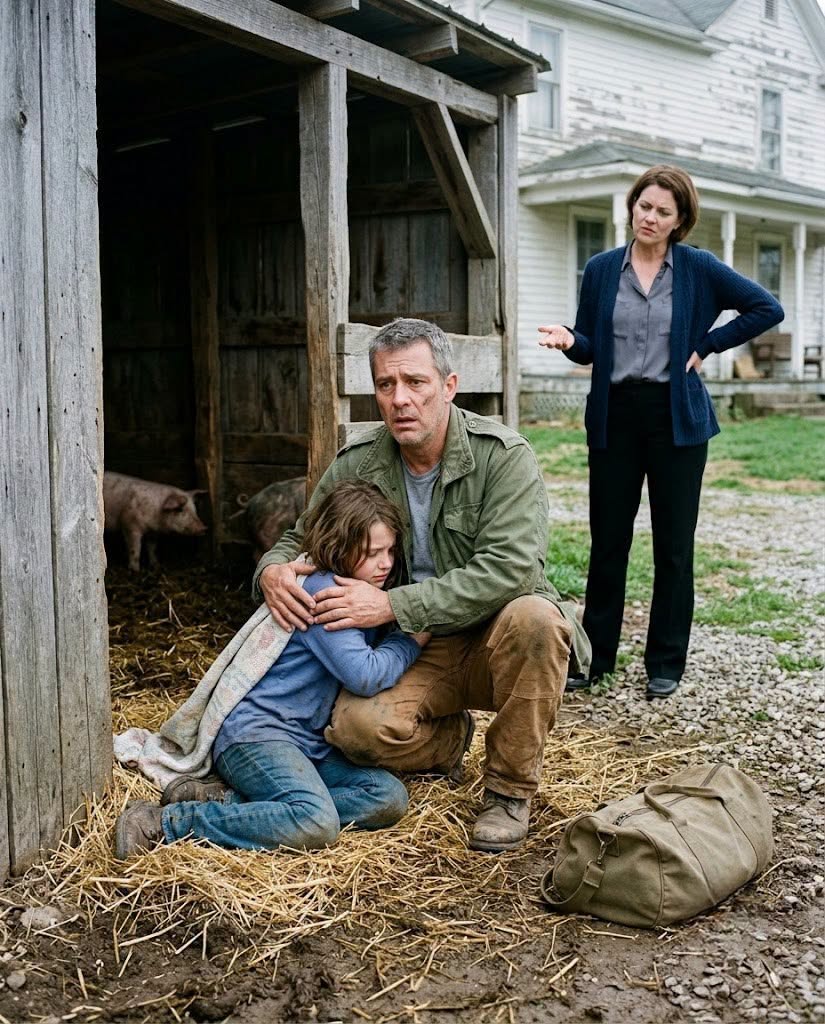
I never told my sister I owned half the land in this town. When I returned from the army, my daughter was forced to sleep in the pigsty, humiliated, and told, “You’re a useless burden.” In front of me, she even sneered, “A poor,

washed-up soldier has no right to speak up.” I silently signed the legal papers, reclaiming the entire house she was living in. A week later, I took my daughter and left, leaving her standing there crying in front of a house that was no longer hers.
Dust clung to my boots as I walked the gravel driveway toward Thorne Manor. Ten years in the army had changed almost everything about me, but I still remembered this place as home. The porch. The gardens. The long driveway my parents used to watch from whenever I came back late.
Now it belonged to Sarah’s world.
My sister stood on the porch with a glass of five-hundred-dollar vintage in one manicured hand. She watched me approach without moving to meet me.
“Look what the wind blew in,” she said. “I hope you aren’t expecting a suite in the main house, Elias. This is a residence for respectable people now—not for those who spent a decade playing in the mud of a foreign wasteland.”
I stopped at the bottom step.
“I didn’t come for the silver, Sarah. I came for my daughter. Where is Lily?”
Sarah laughed.
“She’s exactly where her father’s absence put her. She’s finally being useful for once. In this economy, Elias, even baggage has to earn its keep.”
Then she pointed past the roses, past the pool, toward the old farm sheds at the back of the property.
I ran.
As I rounded the corner, I heard metal clinking inside the pigsty.
The smell of wet straw and animal waste hit me when I shoved open the rotten wooden door.
“Lily?”
A small figure moved on a pile of moldy burlap sacks.
She was eight years old, but she looked closer to five. Ash streaked her face. Her hair was tangled. Her dress looked like it had been pieced together from old potato sacks, and her hands were raw from scrubbing stone.
She turned toward me.
“Daddy?”
That one word nearly took my knees out.
I crossed the floor and lifted her into my arms. She weighed almost nothing. My duffel dropped into the dirt beside us as she grabbed the front of my faded army jacket.
Then Sarah’s voice came from the doorway.
“Don’t get dramatic, Elias.”
I turned with Lily still against my chest.
Sarah stood there with a silk handkerchief near her nose, more annoyed by the smell than disturbed by what she was seeing.
“She was a useless burden,” Sarah said. “She eats more than she contributes, and her presence was disturbing my guests. I put her out here to teach her the value of a roof. In this house, we don’t believe in handouts. Especially not for the offspring of a man who deserted his responsibilities for a uniform.”
I looked down at Lily’s hands.
Then I looked back at my sister.
“You shouldn’t have done that, Sarah.”
Her mouth curled into a smirk.
“Oh, please. What are you going to do, Captain? You’re a broken soldier with a bag of rags. You’re dismissed.”
Sarah turned away, her heels clicking against the path as she headed back toward the house.
I didn’t chase her. I didn’t shout. Lily needed me more than Sarah needed an answer.
But Sarah had made one mistake.
She assumed the faded jacket, the light duffel bag, and the tired man standing in a pigsty told her everything she needed to know about me.
They didn’t.
With Lily still held against me, I reached into the hidden lining of my jacket and pulled out the satellite phone.
PART 2: THE SOLDIER WHO CAME HOME WITH A SECRET
The satellite phone felt cold in my hand.
For a moment, I simply stared at it.
Lily was still clinging to my jacket.
Her small fingers trembled against my chest.
She had not asked me where I had been.
She had not asked why I had taken so long to come home.
She had only whispered one word.
“Daddy.”
And somehow, that was enough to break ten years of discipline.
Enough to break through every wall I had built inside myself.
I looked down at her.
“You’re safe now.”
She looked up at me.
Her eyes were too old for an eight-year-old child.
“Really?”
That word hurt more than anything Sarah had said.
Really?
As if safety was something she had learned not to believe in.
I held her tighter.
“Yes.”
My voice was quiet.
But there was nothing uncertain inside it.
“Really.”
I stepped outside the pigsty.
The afternoon sun hung low over Thorne Manor.
It was beautiful.
That was the cruelest part.
The gardens were blooming.
The fountain glittered.
The swimming pool reflected the sky.
From the outside, the property looked like a postcard.
But behind the roses—
My daughter had been sleeping beside pigs.
Behind the expensive windows—
My sister had been drinking wine while Lily scrubbed stone with raw hands.
I looked toward the manor.
Then I pressed a single number on the satellite phone.
It rang once.
Twice.
Then a familiar voice answered.
“Captain Thorne.”
I closed my eyes.
“Hello, Victor.”
There was a pause.
“Elias?”
“Yes.”
“You’re home.”
“I’m home.”
His voice softened.
“How is Lily?”
I looked down at my daughter.
Her cheek rested against my shoulder.
“She won’t be staying here another night.”
Silence.
Then Victor asked—
“What happened?”
I looked toward the house.
Sarah had disappeared inside.
She probably believed she had won another argument.
She probably believed I would leave quietly.
That I would take my daughter and disappear.
She did not understand.
I had spent ten years learning the difference between reacting and responding.
Reacting was easy.
Anger was easy.
Destroying something in the moment was easy.
But patience—
Patience could move mountains.
“They put her in the pigsty.”
The line went silent.
Even the static seemed to disappear.
Then Victor spoke.
“Who?”
“My sister.”
Another silence.
When he spoke again, his voice was colder.
“Does she know?”
“No.”
“Does anyone else know?”
“No.”
“Then perhaps we should keep it that way.”
I looked at the old manor.
The home my parents had built.
The land where I learned to walk.
The place Sarah had spent years calling hers.
“Yes.”
I said.
“Keep everything quiet.”
Victor understood immediately.
“How much of the property do you want reclaimed?”
I looked at Lily.
She had closed her eyes.
For the first time since I found her—
She was beginning to relax.
“All of it.”
Victor took a breath.
“Elias.”
“She had my daughter sleeping with animals.”
“I understand.”
“No.”
My voice became quieter.
“You understand the land.”
I looked toward the house.
“You don’t understand what she took.”
The phone remained silent.
Then Victor said—
“What do you need?”
I answered without hesitation.
“Everything.”
Victor Hale had been my father’s attorney for almost thirty years.
He had known me since I was a boy.
He had taught me how to tie a tie before my first formal dinner.
He had attended my mother’s funeral.
He had stood beside my father when the original Thorne estate agreement was signed.
And unlike Sarah—
Victor remembered every word.
My parents had owned more land than anyone in town knew.
The manor was only the center.
Behind it were farms.
Warehouses.
Commercial buildings.
Woodland.
A lake.
And hundreds of acres purchased quietly over several decades.
When my father died, he left the estate divided.
Sarah received management rights.
I received ownership rights.
She had been allowed to live in the manor.
I owned half the land beneath it.
But there was more.
Much more.
A clause had been placed inside the family trust.
A clause that could transfer control of the estate if one heir endangered another member of the family.
Especially a child.
My father had believed money could make people cruel.
He had believed that wealth often revealed what kindness tried to hide.
So he had created protection.
Sarah had never read the entire agreement.
Why would she?
She believed she knew everything.
That was her greatest weakness.
I carried Lily toward my old room.
Sarah’s guests were beginning to arrive.
Luxury cars rolled up the driveway.
Men in tailored suits.
Women wearing dresses worth more than some people’s yearly salaries.
They laughed as they stepped through the front entrance.
No one noticed me.
Not at first.
I walked through the manor with Lily in my arms.
The house had changed.
The portraits had been replaced.
The furniture was new.
My mother’s piano was gone.
My father’s books were missing.
Even the hallway photographs had disappeared.
Sarah had not merely lived in the house.
She had erased us from it.
I stopped in front of the staircase.
Lily looked around.
“Daddy?”
“Yes?”
“Are we allowed to be here?”
I looked at her.
That question almost made me turn around and leave.
But I didn’t.
I bent down until our eyes met.
“Listen to me.”
She waited.
“You never have to ask permission to exist.”
Her eyes widened slightly.
“You don’t?”
“No.”
I brushed her hair away from her face.
“And no one gets to make you feel like you don’t belong in the world.”
She looked toward the floor.
“Aunt Sarah says I don’t belong here.”
I stood slowly.
“Then Aunt Sarah is going to learn something.”
We reached the upstairs hallway.
Sarah’s voice drifted from the ballroom.
I could hear her laughing.
I followed the sound.
Lily held my hand now.
Her fingers were small inside mine.
But they did not let go.
When I entered the ballroom, the music stopped.
Not because anyone had told it to.
The musicians simply noticed me.
Every conversation became quieter.
Sarah stood beside the fireplace.
Charlotte—
No.
Not Charlotte.
I caught myself.
A different woman.
A different story.
Sarah held her wineglass.
Her smile faded when she saw Lily beside me.
Then she laughed.
“Oh.”
She said.
“Did you bring her into the house?”
I walked forward.
“You told me she was useful.”
Sarah’s smile returned.
“Elias, don’t embarrass yourself.”
Around us, her guests watched.
Curious.
Uncomfortable.
She had always cared about appearances.
I knew exactly where to strike.
I looked at Lily.
“Tell me what you did today.”
Sarah’s face changed.
“Elias.”
I ignored her.
Lily hesitated.
Then whispered—
“I cleaned the stones.”
“Where?”
“Outside.”
“For how long?”
She looked at Sarah.
Sarah stared back.
Lily lowered her eyes.
“Since morning.”
My jaw tightened.
“Did you eat?”
“Aunt Sarah said I could eat after I finished.”
“Did you finish?”
“No.”
The room became silent.
Sarah laughed nervously.
“This is ridiculous.”
I looked at her.
“You haven’t eaten her?”
“I feed her.”
“When?”
“She eats.”
“When?”
Her face hardened.
“Don’t interrogate me in my own house.”
I looked around the ballroom.
At the guests.
At the chandeliers.
At the expensive walls.
Then I said quietly—
“That’s the interesting part.”
Sarah’s expression changed.
“What?”
I reached into my jacket.
Not for the phone.
For a folded document.
Victor had sent it electronically only twenty minutes earlier.
I printed it from the small portable device in my duffel.
Sarah stared at the papers.
“What is that?”
I placed them on the table.
“The beginning of a conversation.”
She picked them up.
Her eyes moved across the page.
Then she laughed.
“Oh, please.”
But her laugh was thinner now.
“What is this supposed to mean?”
I looked at her.
“Read the highlighted section.”
Her eyes moved.
Then stopped.
Her hand tightened.
I watched her face lose color.
“No.”
I said nothing.
“No.”
She looked up at me.
“You can’t.”
I held Lily’s hand.
“Read it again.”
She did.
The room was silent.
Then Sarah threw the papers onto the table.
“This is ridiculous.”
“No.”
I said.
“This is legal.”
Sarah stormed toward me.
“You left.”
I didn’t move.
“You walked away from this family.”
“I joined the army.”
“You abandoned the estate.”
“I served.”
“You abandoned Lily.”
That one stopped me.
The room went silent.
Sarah smiled.
Cruelly.
“You want to talk about protecting children?”
I looked at her.
My voice became quiet.
“Be very careful.”
She stepped closer.
“You disappeared for years.”
“Yes.”
“And now you come home pretending to be a hero?”
“No.”
I answered.
“I came home as her father.”
Her smile faded.
I continued.
“And fathers learn.”
Sarah looked away.
For one second.
Just one.
But I saw it.
Fear.
Victor called.
I answered in front of everyone.
“Victor.”
“Captain.”
“Tell me.”
“Everything is prepared.”
Sarah’s eyes widened.
I placed the call on speaker.
Victor’s voice filled the ballroom.
“Under Article Twelve of the Thorne Family Preservation Trust, temporary occupancy rights may be revoked when an occupant knowingly subjects a minor beneficiary or direct descendant to neglect, unsafe conditions, or degrading treatment.”
Sarah turned pale.
“This is private legal information.”
Victor continued.
“The ownership review has been completed.”
Sarah grabbed the edge of the table.
“No.”
“Mrs. Thorne’s residency rights are suspended pending investigation.”
Sarah looked at me.
“Elias.”
Victor continued.
“Furthermore, the transfer documents related to the northern property have been activated.”
Sarah stared.
I said nothing.
Victor’s voice remained calm.
“The residence is included.”
The wineglass fell from Sarah’s hand.
It shattered across the floor.
Lily jumped.
I immediately pulled her close.
Sarah stared at the broken glass.
Then at me.
“You planned this.”
“No.”
My voice was quiet.
“You gave me a reason.”
The guests began leaving.
No one wanted to remain.
Not when lawyers were mentioned.
Not when property ownership became uncertain.
Not when the woman hosting the party suddenly looked like a stranger in her own house.
Sarah walked toward me.
“You wouldn’t do this to your sister.”
I looked at Lily.
Then back at Sarah.
“You did it to your niece.”
Her face twisted.
“She was difficult.”
Lily flinched.
That was enough.
I stepped forward.
My voice remained calm.
But every person in the room heard it.
“She is eight years old.”
Sarah opened her mouth.
“No.”
I raised my hand.
“She is eight.”
Silence.
“She does not need to earn food.”
Sarah looked away.
“She does not need to earn a bed.”
The guests stopped moving.
“She does not need to prove she deserves warmth.”
My voice shook.
Not with fear.
With something deeper.
“She is a child.”
Lily began crying.
I knelt beside her.
“You hear me?”
She nodded.
“You are a child.”
She cried harder.
“And you deserve to be protected.”
I held her.
For a long moment, I forgot Sarah existed.
I forgot the house.
The documents.
The money.
There was only my daughter.
And the promise I should have made long before.
No one would ever make her feel worthless again.
Not while I was alive.
That night, Lily and I stayed at a hotel.
Not because I couldn’t return to the manor.
Because I didn’t want her first safe night to be surrounded by memories of what happened there.
I ordered pancakes.
She stared at them.
“You can have them.”
She looked uncertain.
“All of them?”
“All of them.”
She smiled.
A small smile.
Then another.
By the end of the meal, she was laughing.
I watched her.
And realized how much Sarah had stolen.
Not money.
Not land.
Something more precious.
Time.
Moments.
Childhood.
I couldn’t get those days back.
But perhaps—
I could give Lily better ones.
The next morning, Sarah arrived at the hotel.
I almost didn’t let her in.
But Victor said she had agreed to speak with us.
She entered the room without makeup.
Without expensive clothes.
She looked tired.
Real.
For the first time in years.
“Where’s Lily?”
“Eating breakfast.”
Sarah nodded.
Then she looked at me.
“I didn’t know.”
My jaw tightened.
“Didn’t know what?”
“That it was this bad.”
I laughed once.
“She slept with pigs.”
Sarah closed her eyes.
“I know.”
“She was hungry.”
“I know.”
“She was afraid to enter the house.”
Sarah began crying.
I felt nothing.
Perhaps that sounds cruel.
But I had seen Lily cry too.
And no one had comforted her.
“Why?”
I asked.
Sarah looked at me.
“I was angry.”
“At Lily?”
“At you.”
The answer surprised me.
“Why?”
“Because you left.”
I stared at her.
“You had the army.”
“Yes.”
“And I had the estate.”
“Sarah—”
“You had purpose.”
Her voice cracked.
“And everyone looked at you like you were brave.”
I said nothing.
She continued.
“After Mom and Dad died, people looked at me like I was supposed to protect everything.”
“And Lily?”
Sarah closed her eyes.
“I failed her.”
“Yes.”
She began crying harder.
I didn’t argue.
Because sometimes the truth was cruel enough.
The legal process took months.
Sarah lost the right to manage the estate.
The trust appointed independent administrators.
The manor returned to its original ownership structure.
The northern properties came under my control.
And slowly, the truth became public.
Sarah’s friends disappeared.
The guests who once drank wine in her ballroom stopped answering her calls.
People who loved luxury often loved it more than the person providing it.
Sarah discovered that quickly.
But I did not enjoy watching her fall.
That was not who I wanted to become.
Revenge would have been easy.
Hatred would have been easy.
But Lily had already seen enough ugliness.
I wanted her to learn something different.
Justice did not need to be cruel.
I sold part of the land.
Not the manor.
Never the manor.
But several unused properties.
With the money, I created a fund for veterans and children in difficult homes.
Victor helped.
The town council eventually joined.
And one day, Lily stood beside me as we opened the center.
She was wearing a yellow dress.
Her hair was brushed.
Her hands had healed.
She looked taller.
Healthier.
Happy.
A reporter asked her—
“What do you want to be when you grow up?”
Lily looked at me first.
Then she smiled.
“Whatever I want.”
Everyone laughed.
But I nearly cried.
Because that was the answer.
Whatever she wanted.
No permission.
No fear.
No one telling her she was a burden.
Sarah eventually moved out.
The day she left Thorne Manor was cold.
Boxes covered the driveway.
Her belongings were loaded into a moving truck.
I stood near the porch.
Lily was beside me.
Sarah walked down the steps slowly.
She looked at the house.
Then at me.
“Are you happy now?”
I thought about the question.
“No.”
She looked surprised.
“I’m not happy because you lost the house.”
The wind moved through the trees.
“I’m happy because Lily finally has one.”
Sarah looked at Lily.
My daughter did not hide behind me.
That was how much she had changed.
Sarah swallowed.
“I am sorry.”
Lily said nothing.
She didn’t have to.
I placed my hand gently on Lily’s shoulder.
“Come on.”
We turned toward the house.
Behind us, Sarah began crying.
But I didn’t turn around.
Not because I hated her.
Because some doors had to close before children could feel safe inside the next room.
Years passed.
Lily grew.
She ran through the gardens.
She learned to ride a bicycle on the old gravel road.
She played the piano where my mother once played.
And sometimes, I watched her from the porch and thought about the day I found her inside the pigsty.
The small girl.
The frightened eyes.
The raw hands.
The question—
Are we allowed to be here?
One afternoon, she came running toward me.
“Daddy!”
I smiled.
“Yes?”
“Can we have friends over?”
“Of course.”
She stopped.
“Really?”
I laughed.
“Lily.”
“What?”
“You don’t have to ask permission to be happy.”
She smiled.
Then ran away.
And I sat quietly on the porch.
The same porch where Sarah had once watched me arrive.
She thought she was looking at a poor soldier.
A tired man.
A washed-up brother.
She saw my boots.
My faded jacket.
My small duffel bag.
And she believed she understood my worth.
But people often make the same mistake.
They measure others by what they can see.
They see worn clothes and assume failure.
They see silence and assume weakness.
They see patience and assume surrender.
They forget—
Some people have learned to carry strength quietly.
The army taught me many things.
How to endure.
How to survive.
How to protect the person beside me.
But fatherhood taught me the most important lesson of all.
There are battles you win with weapons.
And there are battles you win by becoming the safe place someone else desperately needs.
Lily did not need me to destroy Sarah.
She needed me to come home.
She needed me to see her.
To believe her.
To choose her.
And that was what I would do.
Every day.
For the rest of my life.
One evening, I walked with Lily through the back of the property.
The old pigsty still stood.
I had considered tearing it down.
But Lily stopped me.
“Why?”
I asked.
She looked at it.
Then said—
“Because I want to remember.”
My heart tightened.
“Remember what?”
She took my hand.
“That I got out.”
I looked at her.
The sun was setting behind the fields.
Golden light touched the old wooden walls.
Lily smiled.
“Can we make it something else?”
I thought about that.
Then smiled.
“Yes.”
“What?”
I looked toward the building.
“A place where children can learn.”
She laughed.
“A school?”
“Maybe.”
“For kids who don’t have anywhere to go?”
“Yes.”
Her eyes brightened.
“Then nobody will sleep there again.”
I squeezed her hand.
“Not one child.”
And together, we walked home.
The old pigsty eventually became a small learning center.
The walls were rebuilt.
The floor was replaced.
Windows were opened toward the fields.
Books filled the shelves.
Children came every afternoon.
They painted.
They read.
They laughed.
And one day, Lily stood in the doorway watching them.
She looked at me.
“Daddy?”
“Yes?”
“Do you think they know what this place used to be?”
I looked around.
Children were laughing.
Sunlight filled the room.
“No.”
She smiled.
“Good.”
I smiled too.
Because perhaps that was the best kind of victory.
Not making people remember the darkness.
But building enough light that darkness no longer mattered.
On the tenth anniversary of my return home, Lily and I stood together on the porch.
She was eighteen now.
Almost grown.
Almost ready to build her own life.
The gardens were blooming.
The gravel driveway stretched toward the road.
The same road where I had once arrived covered in dust.
I looked at her.
“Are you nervous?”
“A little.”
“About leaving for university?”
“Yes.”
I smiled.
“That’s normal.”
She looked toward the driveway.
“Daddy?”
“Yes?”
“Do you ever regret coming home?”
I thought about Sarah.
The pigsty.
The legal papers.
The years that followed.
Then I looked at my daughter.
“No.”
She smiled.
“Even after everything?”
I placed my hand on her shoulder.
“Especially after everything.”
She leaned against me.
For a while, neither of us spoke.
The wind moved through the trees.
And I realized that the house was never the real inheritance.
Not the land.
Not the money.
Not the manor.
The real inheritance was what we chose to build after pain.
Safety.
Kindness.
Dignity.
A place where someone could say—
I am home.
And mean it.
My name is Elias Thorne.
I spent ten years wearing the uniform of a soldier.
But the greatest battle of my life began the day I came home.
I did not win because I owned half the land.
I did not win because Sarah lost the house.
I did not win because lawyers signed documents in my favor.
I won because my daughter learned she was never a burden.
I won because she stopped being afraid to enter her own home.
I won because one day, she looked at me and said—
“I know I belong here.”
And that was worth more than every acre in town.
More than the manor.
More than the inheritance.
More than anything Sarah had ever believed she owned.
I looked down the driveway one last time.
The dust was gone.
The road was quiet.
And beside me stood my daughter.
Safe.
Strong.
Free.
I smiled.
Then we walked inside.
Not away from the past.
But beyond it.
The soldier had finally come home.
And this time—
He was exactly where he belonged.
PART 3: THE HOUSE THAT FINALLY BECAME HOME
Ten years after I carried Lily out of that pigsty, I stood in the same garden and watched my daughter pack her suitcase.
It was strange how quickly time could move.
One moment, she had been eight years old.
Small enough to disappear inside my army jacket.
Frightened enough to ask whether she was allowed to eat.
Ash on her face.
Raw hands.
A trembling voice.
Then somehow, life kept moving.
One sunrise became another.
One winter became spring.
And suddenly—
She was eighteen.
Tall.
Confident.
Laughing more easily than she ever had as a child.
She was leaving for university in three days.
Her acceptance letter sat on the kitchen table.
Every time I looked at it, I felt the same impossible mixture of pride and grief.
I was proud because she was ready to leave.
I was sad because she no longer needed me in the same way.
Perhaps that was the strange beauty of being a parent.
You spend years teaching your children how to stand on their own.
Then one day—
They do.
And your heart breaks beautifully because of it.
“Daddy?”
Lily stood in the doorway.
“Yes?”
“Are you crying?”
“No.”
She smiled.
“You are.”
“I have allergies.”
“To what?”
“Universities.”
She laughed.
That laugh filled the kitchen.
And I thought about the silence that had once lived inside her.
The little girl who barely spoke.
The child who apologized for everything.
The daughter who had learned to make herself small.
That girl was gone.
In her place stood someone extraordinary.
Someone who knew her worth.
Someone who understood that she belonged in every room she entered.
And I would have given every acre of land I owned just to hear her laugh like that.
The next morning, Victor Hale came to the manor.
He was older now.
His hair had turned completely silver.
But his mind remained as sharp as ever.
He carried a brown leather briefcase into my office.
“Please tell me those aren’t legal papers.”
He smiled.
“When have I ever brought anything else?”
“Once.”
He thought about it.
“I brought Lily a birthday present.”
“A legal encyclopedia.”
“It had pictures.”
I laughed.
Lily entered the room.
“Uncle Victor.”
He stood and opened his arms.
She hugged him.
“Look at you.”
“I’ve been looking like this for years.”
“Still stubborn.”
“Learned from my father.”
I raised an eyebrow.
“Traitor.”
Victor placed the briefcase on my desk.
Then his expression changed.
“I actually do have something important.”
Lily looked at me.
I knew that look.
She sensed seriousness.
“What is it?” I asked.
Victor opened the briefcase.
Inside was a single envelope.
I recognized my father’s handwriting immediately.
For a moment, I could not breathe.
“Where did you get that?”
Victor sat down slowly.
“It was stored with the original trust documents.”
I stared at it.
“Why wasn’t I given this before?”
“Because your father instructed me not to deliver it until Lily became an adult.”
Lily became quiet.
“Me?”
Victor looked at her.
“Yes.”
My hands trembled as I opened the envelope.
Inside was a letter.
The paper had yellowed with age.
My father’s handwriting covered both pages.
I began reading.
My dear Elias,
My throat tightened.
I continued.
If Victor has given you this letter, then Lily has reached the age when she can begin choosing her own future. I hope she has grown surrounded by the things every child deserves: safety, patience, and love.
I stopped.
My eyes filled.
Lily moved closer.
I continued.
I made mistakes with my children. I sometimes believed providing a house was the same as creating a home. It is not. A home is built by the way people treat one another inside its walls.
The room became silent.
I read the final lines.
If this family has ever been broken by pride, then do not use my land to build higher walls. Use it to create doors for people who have nowhere else to go.
I lowered the letter.
No one spoke.
Then Lily whispered—
“Grandpa knew.”
I looked at her.
“Maybe he hoped we would learn.”
That letter changed something in me.
Not immediately.
The manor remained.
The land remained.
The trust remained.
But suddenly, I began looking at everything differently.
For years, I had believed reclaiming the estate was justice.
And perhaps it had been.
Sarah had taken advantage of Lily.
She had turned our family home into a place of fear.
There had to be consequences.
But consequences were not the same as purpose.
I had spent ten years protecting what belonged to our family.
Now I began asking a different question.
What was it for?
That question followed me everywhere.
Through the gardens.
Across the fields.
Into the old barn that Lily and I had turned into a learning center.
One afternoon, I stood outside the center and watched children arrive.
Some came from difficult homes.
Some came from families struggling to survive.
Some were children of veterans.
Some simply needed a safe place to spend the afternoon.
They ran through the door laughing.
And suddenly—
I knew.
This was what the land was for.
Not proving that I was richer than Sarah.
Not reminding the town who owned what.
Not winning an old family war.
This.
Children laughing in a building where my daughter had once been forced to sleep in fear.
I walked inside.
Lily was helping a little boy paint.
He held up his picture.
“What do you think?”
Lily studied it seriously.
“I think you’re an artist.”
He grinned.
I watched her.
And my father’s words returned.
Use it to create doors.
Three weeks before Lily left for university, I received a letter from Sarah.
I nearly threw it away.
Then I recognized the handwriting.
I stood beside the fireplace for a long time.
The envelope felt heavier than paper.
Eventually, I opened it.
There were only three pages.
Sarah wrote that she had moved twice since leaving Thorne Manor.
She had taken a job.
A real job.
Not because she wanted to.
Because she had to.
She wrote that she had lost friends.
Then realized many of them had never truly been friends.
She wrote that there were days when she hated me.
Days when she hated herself.
And finally, she wrote—
I have spent years trying to understand why you could never forgive me for what I did to Lily. I think I finally understand. I kept asking for forgiveness because I wanted relief from my guilt. I never stopped to ask what Lily needed.
I read that sentence several times.
Then I placed the letter down.
Lily entered the room.
“What is it?”
I looked at the envelope.
“A letter from your aunt.”
Her expression changed.
“Sarah?”
“Yes.”
“Is she coming here?”
“No.”
Lily became quiet.
“What does she want?”
I thought about the letter.
“She wants to apologize.”
Lily looked toward the window.
For a moment, I said nothing.
Then I asked—
“Do you want to read it?”
She shook her head.
“No.”
“That’s okay.”
“She can be sorry without me having to listen.”
I looked at her.
Then smiled.
“Yes.”
She looked surprised.
“What?”
“That is exactly right.”
Lily had learned something it took me years to understand.
Forgiveness was a gift.
Not a debt.
No one was entitled to it.
Not because they cried.
Not because they changed.
Not because they finally understood the pain they caused.
I placed the letter back inside the envelope.
Sarah deserved the opportunity to become better.
But Lily deserved the right to heal without being asked to comfort the person who hurt her.
Those two truths could exist together.
Sarah returned to town six months later.
I learned about it from Victor.
“She wants to meet you.”
I looked up from my desk.
“No.”
He smiled faintly.
“I thought you might say that.”
“Then why tell me?”
“Because she wants to donate.”
That made me pause.
“To what?”
“The children’s center.”
I stared at him.
“With what money?”
“She has been working for several years.”
I leaned back.
“Victor.”
“She insists.”
I thought about it.
Then shook my head.
“No.”
His eyebrows rose.
“No?”
“She can donate anonymously.”
“You don’t want to meet her?”
“No.”
“Why?”
I looked out the window.
The fields stretched toward the horizon.
“I don’t need to hate her anymore.”
Victor remained quiet.
“But I don’t need her in my life either.”
He nodded slowly.
“That sounds healthy.”
“Don’t sound so surprised.”
“I knew you when you were seventeen.”
“Then forget what you knew.”
Lily came home from university during the summer.
She walked through the front door carrying two bags and talking before she even put them down.
“Daddy, I have so much to tell you.”
I smiled.
“I missed you too.”
She hugged me.
Then stepped back.
“You changed the curtains.”
“They were ugly.”
“They were historical.”
“They were ugly historically.”
She laughed.
And suddenly, the house felt alive again.
That evening, we sat on the porch.
She told me about her classes.
Her friends.
Her plans.
She wanted to study social work.
I wasn’t surprised.
“You know,” I said, “you could have studied business.”
She made a face.
“You already own enough land for both of us.”
“That’s not the point.”
“Exactly.”
I laughed.
Then she became quiet.
“Daddy?”
“Yes?”
“Can I ask you something?”
“Anything.”
“Do you ever think about Aunt Sarah?”
The question surprised me.
“Sometimes.”
“Do you hate her?”
I looked toward the sunset.
“No.”
Lily waited.
“I hated what she did.”
“Yes.”
“And I hated the years it took from you.”
Her fingers tightened around her cup.
“But hate?”
I shook my head.
“It’s too heavy to carry forever.”
Lily nodded slowly.
“I think I understand.”
“You don’t have to forgive her.”
“I know.”
“But you don’t have to let what she did become your entire story.”
She smiled.
“That part I know.”
I looked at her.
“How?”
She pointed toward the fields.
“Because I’m going to leave.”
My heart tightened.
She laughed.
“Not forever.”
“I know.”
“I want to see the world.”
“You should.”
“I want to help people.”
“You will.”
“And I want to come home sometimes.”
I smiled.
“The door will always be open.”
She rested her head on my shoulder.
And together, we watched the sun disappear.
Five years later, Lily returned home carrying a suitcase again.
But this time—
She wasn’t eighteen.
She was twenty-three.
And she was not the frightened child I had rescued from the pigsty.
She was a social worker.
Confident.
Independent.
Kind.
She had spent two years working with children in crisis.
When she entered the house, she placed her bag down and said—
“Daddy, I need to talk to you.”
My heart immediately became nervous.
“What happened?”
She smiled.
“Nothing bad.”
“Those words usually mean something bad.”
She sat across from me.
“I received an offer.”
“For a job?”
“Yes.”
“Where?”
“Chicago.”
I stared at her.
“That’s far.”
“I know.”
“How long?”
“I don’t know.”
I looked at the floor.
The old fear returned for a moment.
The fear of being left.
The fear of losing the people I loved.
Then I remembered something.
Children were not possessions.
Love was not a leash.
I looked at her.
“Are you excited?”
Her eyes filled with tears.
“Yes.”
“Then go.”
She laughed and cried at the same time.
“Just like that?”
“No.”
I stood.
I walked around the table.
Then I hugged her.
“Not just like that.”
I held her tighter.
“Come home whenever you want.”
She whispered—
“I will.”
The day Lily moved to Chicago, I stood alone on the porch.
The driveway was quiet.
For the first time in years, there was no suitcase waiting in the hallway.
No music playing upstairs.
No footsteps.
I expected to feel empty.
Instead—
I felt proud.
Because the little girl who once asked whether she was allowed inside the house had become a woman capable of walking into any room in the world.
And knowing she belonged there.
I whispered into the quiet house—
“You did it, Lily.”
The wind moved through the trees.
And somehow—
I imagined my parents hearing me.
The children’s center continued to grow.
The old pigsty had long disappeared beneath new walls.
The learning center expanded.
Then came counseling rooms.
A library.
A small kitchen.
A garden.
Eventually, families from across the county came for help.
The sign outside read:
THE LILY THORNE CENTER
She protested when I named it after her.
“Daddy.”
“What?”
“That’s embarrassing.”
“Good.”
“You didn’t even ask me.”
“I own half the town.”
“That doesn’t make you a dictator.”
I smiled.
“Your aunt might disagree.”
Lily stared at me.
Then burst out laughing.
And I realized something beautiful.
Sarah’s name no longer brought fear into this house.
It had become a memory.
A lesson.
Nothing more.
One winter afternoon, Sarah came to the center.
I saw her through the window.
She was older.
Her hair was shorter.
She wore a simple coat.
No expensive jewelry.
No wineglass.
No audience.
Just Sarah.
I stepped outside.
She looked at me.
“Hello, Elias.”
“Sarah.”
The snow fell softly around us.
For a moment, neither of us spoke.
Then she reached into her bag.
“I brought something.”
I looked at the envelope.
“What is it?”
“A donation.”
“I told Victor you could give anonymously.”
“I know.”
“Then why are you here?”
She looked toward the center.
“I wanted to see it.”
I followed her gaze.
Children moved behind the windows.
Laughing.
Reading.
Painting.
Safe.
Sarah’s eyes filled with tears.
“This used to be the pigsty.”
“Yes.”
She nodded.
“I know.”
The silence between us was long.
Then she said—
“I am sorry.”
I looked at her.
She waited.
Perhaps for forgiveness.
Perhaps for anger.
Perhaps for something dramatic.
But after so many years, I only felt tired.
“I know you’re sorry.”
She began crying.
“I don’t expect you to forgive me.”
“Good.”
She laughed weakly through tears.
“That sounds fair.”
I nodded.
Then I looked at the center.
“What matters is what happens next.”
Sarah wiped her face.
“What do you mean?”
“You can spend the rest of your life drowning in guilt.”
She looked down.
“Or?”
“Or you can become someone who would never do it again.”
Sarah closed her eyes.
“I am trying.”
“Then keep trying.”
That was all I had to give her.
Not forgiveness.
Not revenge.
Just truth.
And perhaps, for that moment—
It was enough.
Sarah began volunteering quietly.
Not at first.
It took months.
She did not work directly with children.
She helped organize supplies.
Cleaned rooms.
Filed paperwork.
No one knew her history.
And I never told them.
Her past was not mine to display.
One afternoon, I watched her carry boxes into the storage room.
She looked tired.
But peaceful.
Victor stood beside me.
“Do you think she’s changed?”
I looked at Sarah.
“I don’t know.”
“That’s honest.”
“People can change.”
Victor nodded.
“But?”
“But trust changes more slowly.”
He smiled.
“You’ve become wise.”
“Don’t tell Lily.”
“Why?”
“She already thinks she’s smarter than me.”
Victor laughed.
“She is.”
I looked at him.
“You too?”
Years continued passing.
Lily built a life in Chicago.
Then she met someone.
A teacher named Daniel.
The first time she brought him home, I interrogated him for almost an hour.
Lily eventually said—
“Daddy.”
“What?”
“Stop interviewing him.”
“I’m not interviewing him.”
Daniel raised his hand.
“You asked me about my five-year plan.”
“Normal conversation.”
Lily covered her face.
But Daniel smiled.
And I liked him immediately.
Perhaps because he listened.
Perhaps because Lily laughed when she was with him.
Or perhaps because when I asked what he admired most about my daughter, he answered—
“She knows exactly who she is.”
That night, after they went upstairs, I stood alone in the hallway.
My eyes filled with tears.
Because once—
My daughter had not known who she was.
She had only known what other people called her.
Burden.
Useless.
Unwanted.
Now—
She knew.
And no one could take that away again.
Lily married Daniel two years later.
The ceremony took place in the garden behind Thorne Manor.
The same garden where Sarah once looked down at me.
The same land where Lily had once been made to feel unwanted.
Hundreds of flowers surrounded the ceremony.
Children from the center helped scatter petals.
Victor sat in the front row.
He cried more than anyone.
When Lily walked toward me before the ceremony, she whispered—
“Daddy?”
“Yes?”
“I’m nervous.”
I smiled.
“That’s normal.”
“What if I cry?”
“Then cry.”
“What if you cry?”
“I don’t cry.”
She stared at me.
“Really?”
“No.”
I laughed.
“I’ll cry.”
She hugged me.
And I held her for a moment longer than necessary.
Then I walked her toward the man waiting for her.
As we moved through the garden, Lily whispered—
“Do you remember when I asked if I was allowed to be here?”
My heart stopped.
“Yes.”
She smiled.
“I don’t ask that anymore.”
I could barely speak.
“Good.”
She squeezed my hand.
“I know.”
Then she stepped forward.
And I watched my daughter begin another chapter.
After the wedding, the music played late into the night.
People danced beneath lights hanging from the trees.
Laughter moved across the gardens.
I stood near the porch with a glass of water.
Victor came beside me.
“You did well.”
I looked at him.
“We did.”
He shook his head.
“No.”
He looked toward Lily.
“You came home.”
I thought about those words.
Yes.
I came home.
But perhaps I had not understood what home meant when I first arrived.
I thought it was land.
A manor.
An inheritance.
I thought it was ownership.
But it wasn’t.
Home was Lily sleeping peacefully upstairs.
Home was laughter from the garden.
Home was knowing no child inside those walls would ever be told they were a burden again.
Home was not what belonged to me.
Home was what I protected.
Many years later, I returned to the old learning center alone.
The building was larger now.
Children filled the rooms.
Teachers moved through the halls.
Sunlight poured through windows.
I stood near the entrance.
A little girl ran past me.
She stopped suddenly.
“Sir?”
“Yes?”
“Are you lost?”
I smiled.
“No.”
She looked suspicious.
“You’re sure?”
“Very sure.”
She pointed toward the office.
“Do you need help?”
I looked around.
At the books.
The paintings.
The children.
Then I shook my head.
“No.”
She smiled.
“Okay.”
And ran away.
I stood there for a long time.
Because once—
I had carried my daughter into this place when it was dark and filthy.
I had promised her she would never sleep there again.
Now, children ran through the same ground without knowing what had once happened there.
They knew it only as a place of warmth.
A place of learning.
A place where adults listened.
And perhaps that was the greatest victory of all.
Not remembering the pain.
But transforming it.
When I grew old, Lily came home often.
Sometimes with Daniel.
Sometimes with children of her own.
The house became noisy again.
Shoes appeared in hallways.
Toys covered the floor.
Someone was always hungry.
Someone was always laughing.
And every time I heard small footsteps running through the manor, I remembered the little girl who once slept on burlap sacks.
One afternoon, my granddaughter climbed onto my lap.
“Grandpa?”
“Yes?”
“Did you always live here?”
I smiled.
“No.”
“Did Mommy?”
I looked toward Lily.
She stood in the kitchen.
For a moment, our eyes met.
Then I looked back at my granddaughter.
“She came home here.”
The little girl thought about that.
Then smiled.
“Is this home?”
I held her close.
“Yes.”
She looked around.
“Forever?”
I kissed the top of her head.
“As long as there is love here.”
And I meant it.
Because houses change.
Land changes.
Money disappears.
Names fade.
But the kindness we leave behind—
Sometimes that remains.
My name is Elias Thorne.
I spent ten years serving as a soldier.
I spent the rest of my life learning what it truly meant to protect someone.
I thought strength was surviving war.
I was wrong.
The greatest strength I ever found was kneeling beside my frightened daughter and promising—
“You are safe now.”
I thought wealth was owning half the land in town.
I was wrong about that too.
Wealth was watching Lily laugh without fear.
Wealth was hearing her say she knew she belonged.
Wealth was seeing a place of humiliation become a place of hope.
Sarah lost the house.
But that was never the ending of the story.
The ending was not about what she lost.
It was about what Lily gained.
A childhood.
A future.
A voice.
A home.
And most importantly—
A life where she never again had to ask whether she deserved to belong.
One morning, near the end of my life, I stood on the porch alone.
The gravel driveway stretched toward the horizon.
The gardens moved gently in the wind.
I remembered walking down that road for the first time after ten years away.
Dust on my boots.
A duffel bag on my shoulder.
A heart full of hope.
I had believed I was returning to the place I knew.
Instead—
I found a battle waiting for me.
But perhaps life had brought me home for a reason.
Not to reclaim land.
Not to punish my sister.
Not to prove I was stronger than anyone.
I came home because my daughter needed me.
And sometimes—
That is reason enough to change everything.
I looked toward the house.
Inside, I could hear Lily laughing with her children.
The sound drifted through the open window.
I smiled.
Then I walked inside.
Not as a soldier.
Not as the owner of an estate.
Not as a man who had won a battle.
I walked inside as a father.
And in the end—
That was the only title I ever truly needed.
The house stood behind me.
The land stretched around me.
The past remained where it belonged.
In the past.
Ahead of me were the voices of the people I loved.
Warmth.
Laughter.
Life.
I opened the door.
And stepped into the sound of home.
Because the soldier had finally learned something after all those years.
You do not come home when you reclaim what belongs to you.
You come home—
When the people you love no longer have to be afraid.
And at last—
No one in Thorne Manor was afraid anymore.
THE END STORIES! THANK YOU FOR READING GOOD LUCK !❤️
Related Posts